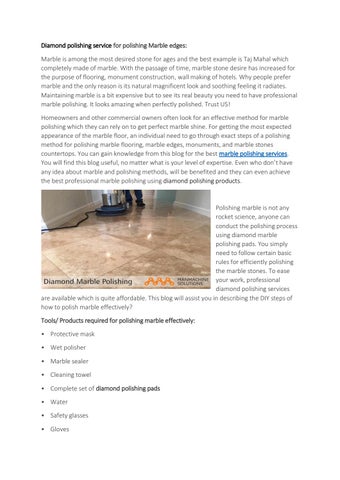
Diamond polishing service for polishing Marble edges: Marble is among the most desired stone for ages and the best example is Taj Mahal which completely made of marble. With the passage of time, marble stone desire has increased for the purpose of flooring, monument construction, wall making of hotels. Why people prefer marble and the only reason is its natural magnificent look and soothing feeling it radiates. Maintaining marble is a bit expensive but to see its real beauty you need to have professional marble polishing. It looks amazing when perfectly polished. Trust US! Homeowners and other commercial owners often look for an effective method for marble polishing which they can rely on to get perfect marble shine. For getting the most expected appearance of the marble floor, an individual need to go through exact steps of a polishing method for polishing marble flooring, marble edges, monuments, and marble stones countertops. You can gain knowledge from this blog for the best marble polishing services. You will find this blog useful, no matter what is your level of expertise. Even who don’t have any idea about marble and polishing methods, will be benefited and they can even achieve the best professional marble polishing using diamond polishing products.
Polishing marble is not any rocket science, anyone can conduct the polishing process using diamond marble polishing pads. You simply need to follow certain basic rules for efficiently polishing the marble stones. To ease your work, professional diamond polishing services are available which is quite affordable. This blog will assist you in describing the DIY steps of how to polish marble effectively? Tools/ Products required for polishing marble effectively: • Protective mask • Wet polisher • Marble sealer • Cleaning towel • Complete set of diamond polishing pads • Water • Safety glasses • Gloves
Safety Tips: • Ensure that you are using safety glass. • Make sure that you are wearing protectives gloves and glass. • Read all the instructions and warning for diamond polishing pads and wet polishers. • Follow recommended cautions. Steps for polishing marble edge: The steps involve the proper usage of several grit sizes of the diamond polishing pads using wet polisher grinder. The results after following the steps defined below will be highly noticeable and appreciable. • Place the marble slab over the work stand and ensure that it is stagnant while working. • Carefully have a look over the edges of the marble slab. A profiled edge may have few sharp or heavy scratches. Smaller grit size like 50, 100 or 200 is considered perfect for removing heavy scratches. Higher grit sizes like 1500 or 3000 are best suited for achieving shiny finish. • Attach backing pads to the wet polisher. TIPS: Ensure that wet polisher is switched off before making the attachment. • You can now start the polishing process. Open up diamond marble polishing kit and then start the process using grit 50 polishing pads. Slowly open up the water flow for the wet polisher. Start the polisher at low rpm and then begin the process of marble edge polishing with side motion. TIPS: don’t move the polisher more than 4 to 5 times at the same place. • Repeat the same process with other smaller sized grits. After completing the step, you can easily find the better result of smooth marble surface which is free from any sort of swirl marks, wax and old sealant. Initially, use the grinder with low to slow increasing of speed. • Make sure that every section of marble is properly polished. Remember that any unpolished area using lower grit will lead in sub-optimal shine. The best way for ensuring every single edge is properly polished and then further wipe off the edge surface using squeezed wet cleaning towel. After wiping off the surface, dry the marble polish. • Repeat and continue the step using diamond polishing service from lower to a higher grit. Always maintain the regularity while using the polishing pads.
TIPS: don’t use more than double grit from diamond polishing pads. • For getting the shine accurately, use one by one pad. Further, vacuum the areas required for removing the debris.