New Ducks Unlimited Canada partnership boosts on-farm research in Manitoba - see page 3



New Ducks Unlimited Canada partnership boosts on-farm research in Manitoba - see page 3
Glen Kirby Communications Specialist – Prairie Region Office 204-500-9730 | Cell 204-402-0369
New Ducks Unlimited Canada partnership boosts on-farm research in Manitoba
Leading conservation group provides land to Brandon research farm
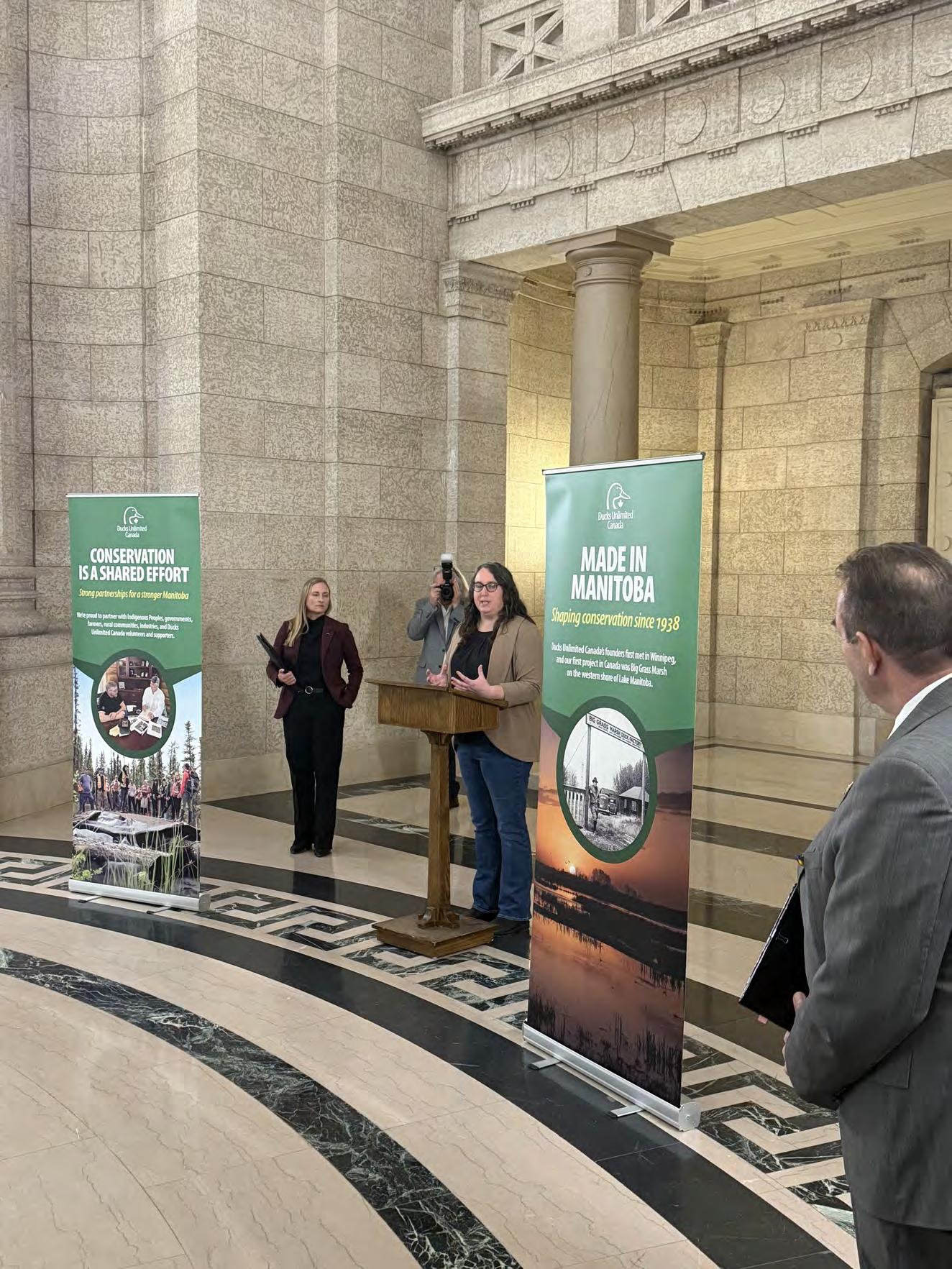
To further support Manitoba farmers, Ducks Unlimited Canada (DUC) is providing $1 million of land to expand a research and demonstration centre near Brandon operated by Manitoba Beef & Forage Initiatives (MBFI).
The Brookdale Research Farm will now include the Odanah Pasture to the north, boosting the farm’s size by 42 per cent and increasing opportunities for science and producer activities to advance the forage industry and beef cattle production. With over 6,500 cattle farms in the province, beef is a billion-dollar sector in Manitoba.
The announcement marks two important dates: Manitoba Agriculture Awareness Day on the third Tuesday in March promoting the sector's economic, social and environmental contributions; and the third annual DUC Day on March 17, enacted by provincial legislation to acknowledge DUC’s conservation leadership.
“Ducks Unlimited Canada has been a champion for Manitoba farmers since we began operations in 1938,” says DUC Head of Communications and Outreach – Prairies, Karli Reimer. “This land partnership builds upon that history of collaboration, providing opportunity for new research to make farms more profitable and resilient.”
Located in the Rural Municipality of Minto-Odanah, the 467 acres were acquired by DUC in 2020 through a private sale funded by conservation-minded government agencies in Canada and the USA including Manitoba’s Conservation Trust. As DUC restored drained wetlands and uplands previously used for crop production to their natural state, the exciting opportunity to expand research capacity was recognized. Discussions began with MBFI on long-term use of the Odanah Pasture, which is primarily grassland with 123 wetland basins.
“It’s a blank canvas, ready for us to approach projects in new ways,” says MBFI General Manager Mary-Jane Orr. “This land provides the opportunity to ask questions on a commercial scale. The benefit will be more representative of the context of beef operations, which ultimately means better research to help producers.”
MBFI has already engaged with producers, industry representatives and academic researchers to guide land-use direction. Recommendations emphasize retaining the commercial scale of study, benchmarking the transition from tame hay production to high-capacity rotational grazing and - most importantlytransparent capture of the economics of grazing. For the 2026 season, the MBFI board of directors is developing a producer collaboration case study to showcase virtual fencing and grazing system economics at scale.
Glen Kirby Communications Specialist – Prairie Region Office 204-500-9730 | Cell 204-402-0369
“As a producer in the Ducks Unlimited Canada target landscape, I see the value of research that helps us manage grasslands in ways that support productive cattle operations, healthy ecosystems and biodiversity,” explains Melissa Atchison, a cattle farmer from Pipestone who works as a Research and Extension Specialist with Manitoba Beef Producers and is current Finance Chair with Beef Cattle Research Council (BCRC). “In landscapes like this, cattle grazing and conservation go hand in hand. As a fellow core funding partner of MBFI, Manitoba Beef Producers applauds DUC on their strong partnership and collaboration. This expansion will increase MBFI’s capacity to quantify, validate, and qualify beneficial practices on a field scale to support research and demonstration activities that help strengthen the long-term environmental and economic sustainability on these unique landscapes.”
DUC was a founding partner of MBFI in 2014 and continues to be a core partner with Manitoba Beef Producers and the Manitoba government. MBFI manages nearly 2,000 acres – with more than half owned by DUC – for field-scale research and farm demonstrations to improve economic and environmental impacts of beef production. Projects include precision ranching, rangeland drought response, soil health assessment, pasture rejuvenation, habitat assessment, herd health and forage variety testing.
“This partnership is a win for habitat restoration and a win for forage and livestock production,” says Reimer. “In the future, farmers will use data from the newly expanded Brookdale Research Farm to make land use decisions that are beneficial to their operation and the environment.”
In 2025, DUC provided Manitoba farmers with nearly $12 million in direct financial incentives for restoring and conserving habitat. The average payment to a landowner through a DUC conservation easement was $137,000. In every case, landowners retain ownership of their property and decide which portions of their land to conserve. DUC also offers incentives and industry-leading agronomic advice for farmers seeding forage, growing winter wheat and rehabilitating marginal soil areas. New in 2026, RangeFlex will provide Manitoba beef producers with knowledge and cash to improve their pastures, enabling better profits per acre from grazing herds. Learn more about DUC programs at: ag.ducks.ca/programs/manitoba/
MEDIA NOTE: Images and video of the Odanah Pasture are available for download here: https://drive.google.com/drive/folders/1gGT0Mjm0e11mXXsdDQdamL3WLabCBPox?usp=sharing
Please credit DUC when using the imagery.
In 2024, DUC was honoured to be acknowledged under Bill 244 which "gives Manitobans an opportunity to recognize and celebrate the role of Ducks Unlimited Canada in conserving, restoring and managing wetlands and grasslands for the benefit of waterfowl and other wildlife and its connection with Manitoba." March 17th is now officially Ducks Unlimited Canada Day annually in Manitoba. A registered charity, DUC’s national headquarters are at Oak Hammock Marsh. DUC uses sound science and partners with government, industry, non-profit organizations, Indigenous Peoples and landowners to conserve wetlands
Glen Kirby Communications Specialist – Prairie Region Office 204-500-9730 | Cell 204-402-0369
that are critical to waterfowl, wildlife and the environment.
Since 1938, DUC has supported the conservation and restoration of over 1.5 million acres of wetlands and associated habitats in the province of Manitoba. Today, DUC works with over 3,000 landowners to support positive outcomes for wildlife, communities, and the economy. To learn more about DUC's work in the province, visit ducks.ca/manitoba
Manitoba Beef and Forage Initiatives Inc (MBFI) is a research and demonstration farm dedicated to working with farmers to support the advancement of beef cattle and forage industries. MBFI is a registered not-for-profit corporation. MBFI’s mission is to advance the beef and forage industry by engaging stakeholders, evaluating on-farm innovation, and extension for the sustainability of farmers, the public, and the environment. The work MBFI carries out is supported through the Sustainable Canadian Agricultural Partnership strategic grant in partnership with Ducks Unlimited Canada, Manitoba Beef Producers, and Manitoba Agriculture. To learn more about MBFI’s work, visit mbfi.ca
Contact: media@ducks.ca
Agriculture Minister Ron Kostyshyn has announced the formation of the Veterinary Services District Working Group. The working group will evaluate the current Veterinary Services Districts and Veterinary Services Commission model in Manitoba and provide an Options Report to the Minister of Agriculture.
The working group invites public input on the current model and proposed changes to it.
How You Can Participate
Your input is essential to this process. You can participate in the following ways:
Submit Written Feedback
o Written submissions can be sent to: vetdistricts2026@gov.mb.ca
Attend an In-Person Meeting (all scheduled 1:303:30 p.m.)
Dauphin: Wednesday, March 25, 2026 Aspen Lodge in Credit Union Place, 200 -1st Street SE
Morden: Wednesday, April 8, 2026
MCC Room, Morden Access Centre, 111- D Gilmour Street
Neepawa: Wednesday, April 15, 2026
CE Room United - Anglican Church, 475 Mountain Avenue
Online Survey: Engagement on Rural Veterinary Medical Services
The deadline to share your feedback through the EngageMB survey is May 1, 2026. Your input will help shape future improvements to the program.
Questions? Email vetdistricts2026@gov.mb.ca


Manitoba Beef Producers (MBP) is the exclusive voice of the beef industry in Manitoba. It represents roughly 6,000 beef producers across the province. Based in Winnipeg, MBP is a non-profit organization with four staff and a producer-elected board consisting of 14 district directors, each representing cattle producers in a specific region of Manitoba.
MBP’s mission is to represent all Manitoba beef producers through communication, advocacy, research, and education within the industry to governments, consumers and others; to improve prosperity; and to ensure a sustainable future. Funded by producers through the collection of a cattle check-off, MBP is committed to ensuring a sustainable future for the province’s beef industry for the benefit of our beef producer members and all Manitobans.
Manitoba Beef Producers’ membership has given direction to see an expanded livestock inspection service implemented in the province. The contract Project Manager will lead the coordination of this effort with direction provided by the multi-stakeholder Manitoba Livestock Inspection Services Working Group (MLISWG). The development and implementation of a mandatory identification inspection system for cattle in Manitoba will help facilitate livestock tracking and help mitigate potential financial losses to producers and other stakeholders related to theft and fraud.
KEY RESPONSIBILITIES AND ACTIVITIES:
• Lead in the development and coordination of the Strategic Plan for implementation.
• Responsible for the planning, implementation, and tracking of specific short-term and long-term goals for the project, which have a beginning, an end and specified deliverables.
• Working with the proponents, provide input into the development of modernized legislative, regulatory and policy frameworks to support expanded inspection services.
• Assist in the creation and provision of tools needed to support expanded inspection, such as information management systems like digital manifests, communications strategies to inform producers and other stakeholders about the implementation of expanded inspection (including its value to the beef industry), etc.
• Liaise with other stakeholders on matters such as the creation of a Manitoba-based RCMP Livestock Investigation Unit, the modernization of the provincial brand registry system, etc
• Coordinate meetings for the MLISWG to ensure the project remains on track.
• Postsecondary education in agriculture, preferably animal science, or a suitable combination of education and experience;
• Strong understanding of the agriculture/agri-food sector, including beef production;
• Understanding of beef industry supply chain;
• Knowledge of legislative and regulatory processes, including the ability to review and analyze legislation and regulations is a definite asset;
• Experience in writing documents for government and industry an asset;
• Strong oral and written communication skills and attention to detail are essential;
• Skilled in writing and editing research or project reports, including financial reporting;
• High comfort level for public speaking and giving presentations;
• Ability to work on multiple projects simultaneously in a fast-paced environment;
• Experience with organizing and participating in trade shows, extension events, etc.;
• Experience in dealing with producers and the general public;
• Strong technical abilities, i.e. experience with Microsoft Office suite, virtual meeting platforms, etc.;
• Able to build solid relationships with teammates, project partners and other specialists by fostering teamwork, partnership and collaboration in virtual or face-to-face settings.
• A highly motivated self-starter able to work both in a self-directed manner, and as part of a small team.
• Valid driver’s license.
Note: Some occasional travel is required, mostly within Manitoba. Occasional evening work may be required.
COMPENSATION:
This position will be a contracted, part-time term position for 24 months. Compensation will be determined in the interview process.
REPORTING STRUCTURE:
The term position of Project Manager-Livestock Inspection reports to MBP’s Chief Executive Officer.


Conference dates: August 18–20, 2026, at the RBC Convention Centre, Winnipeg, MB
Abstract Submission Deadline: June 1, 2026 at 11:59 PM MT [SUBMIT HERE]
The poster competition is open to all post-secondary students and will be divided into two streams:
• College / Undergraduate / Diploma students
• Master’s / PhD students
Research must address an industry challenge aligned with one of the five pillars of the National Beef Strategy: sustainability, connectivity, productivity, beef demand, or competitiveness
Full details on the pillars can be found here: Beef Strategy Report (2025-2030)
Competition Format
• Posters will be presented to a beef producer audience, and judging will prioritize clarity, relatability, and accessibility of the content.
• Poster evaluations, including a Q&A session with your judges will take place in person at CBIC on Wednesday, August 19.
• From these evaluations, the top three students in each stream will advance to the final round on Thursday, August 20, where they will deliver a three-minute verbal presentation summarizing their research on the main-stage to compete for cash prizes
For students applying in the Master’s / PhD stream, the Canadian Roundtable for Sustainable Beef (CRSB) is awarding two Graduate Student Sponsorships, covering travel, accommodation and registration expenses. Click here for more information.
Participation Timeline
• April 1 - June 1, 2026: Online abstract submission period
• June - July 2026: Notification of accepted abstracts
• August 19, 2026: Poster presentations
• August 20, 2026: Finalist presentations
o Top three students in each stream present 3 minute summaries on the main stage
o Winners for 1st, 2nd, and 3rd place announced
Registration
Registration opens on April 29th , students are required to register prior to the event and will be provided a reduced rate ($400).
Canadian Beef Industry Conference website
Abstract Requirements
An abstract is a short communication that allows readers to evaluate the contributions of a scientific study, method, industry solution, extension program, or research technique. To ensure clarity for a producer audience, abstracts should use clear, direct, and uncomplicated language.
• Word limit: Maximum 350 words (excluding the title).
• Title: Must be concise, relevant to a producer audience, and no longer than 25 words
• Keywords: Include five keywords that reflect the primary themes of your abstract.
• Objective: The first sentence must clearly state the main objective of the work.
• Methodology: Provide essential experimental or program details, such as:
o Population or sample
o Experimental design
o Housing or environmental conditions (if applicable)
o Data collection procedures
o Statistical analyses performed
• Results: Present results that directly address the stated objective, including appropriate statistical inferences.
o One table or figure may be included if it is the most effective format for presenting results.
• Conclusion: Provide a clear conclusion outlining the effectiveness and/or practical application of the results.
• Authorship: The submitting student must be the presenting author.
Poster Requirements
[SUBMIT HERE]
• Poster size: Landscape orientation, 36" × 48".
• Fonts: Use sans‑serif fonts (e.g., Arial, Calibri). Minimum font size: 28 pt.
• Image quality: All images must be 300 DPI or higher for suitable print quality.
• Authors: List authors in the following order: competitor → supervisor → committee members.
• Headshot: Including a headshot of the competitor on the poster is encouraged
• Audience: Sections must be written in language for a cattle producers and industry audience. View BCRC Research Summaries for guidance (example)
• Students are responsible for printing and bringing their posters to the conference. For questions, please contact Jenna Sarich at sarichj@cattle.ca
The Canadian Roundtable for Sustainable Beef (CRSB) is pleased to announce its third annual Student Sponsorship!
Two graduate students will be selected to present their research at CRSB's Annual General Meeting (AGM), provid ing a valuable opportunity for students to engage and network with leaders and industry representatives from across the beef value chain.
When: August 18, 2026
Where: RBC Convention Centre , Winnipeg, MB
The 2026 CRSB AGM will be taking place during the Canadian Beef Industry Conference ( CBIC ) Full conference dates include August 18th -20th, with an optional tour on the 17th.
Two graduate students will receive sponsorship for the following :
• August 1 8 (CRSB AGM ): Students will present their research on stage.
• August 19: Students will c ompete in the 2026 CBIC Poster Competition.
• August 20: If placed in the top 3 of the Poster Competition, students will deliver a 3minute presentation on the CBIC main stage to compete for cash prizes.
Selection Process
• Abstract Submission Deadline: June 1, 2026, at 11:59 PM MT [SUBMIT HERE]
• Applicants will be shortlisted based on their abstract submissions.
• Selected candidates will advance to a second - round interview conducted by the CRSB’s Scientific Advisory Committee.
What is included in the Student Sponsorship?
Successful applicants will receive coverage for CRSB/CBIC registration, hotel accommodations, and a travel allowance to attend the CRSB AGM and CBIC.
Requirements
Applicants must:
• Be a current graduate student enrolled at a Canadian academic institution .
• Be conducting research focused on or related to beef sustainability
• Research can be applicable to any area of the supply chain .
• Be available to attend the Annual General Meeting and Canadian Beef Industry Conference August 18th -20th, 2026 in Winnipeg, MB .
• S ubmit an abstract into the CBIC Poster Competition and participate August 19th -20th (Submit CBIC Abstract Here) .
Visit www.crsb.ca to learn more about the members at the table
Contact Jenna Sarich at sarichj@cattle.ca with any questions .
[SUBMIT ABSTRACT]
CRSB Abstract Requirements
Research much be focused on or related to beef sustainability Topic s can be applicable to any area of the supply chain (from farm to fork) including, but not limited to ruminant nutrition, ecology, biodiversity, food safety, on- farm safety, crop science, food waste, soil science, economics, animal science, rural community development , etc .
• Word limit: Maximum 350 words (excluding the title).
• Title: Must be concise, relevant to a producer audience, and no longer than 25 words
• Keywords: Include five keywords that reflect the primary themes of your abstract.
• Objective: The first sentence must clearly state the main objective of the work.
• Methodology: Provide essential experimental or program details, such as:
o Population or sample
o Experimental design
o Housing or environmental conditions (if applicable)
o Data collection procedures
o Statistical analyses performed
• Results: Present results that directly address the stated objective, including appropriate statistical inferences.
o One table or figure may be included if it is the most effective format for presenting results.
• Conclusion: Provide a clear conclusion outlining the effectiveness and/or practical application of the results.
• Authorship: The submitting student must be the presenting author.
[SUBMIT HERE]