
E-Newsletter
Next Agricultural Policy Framework
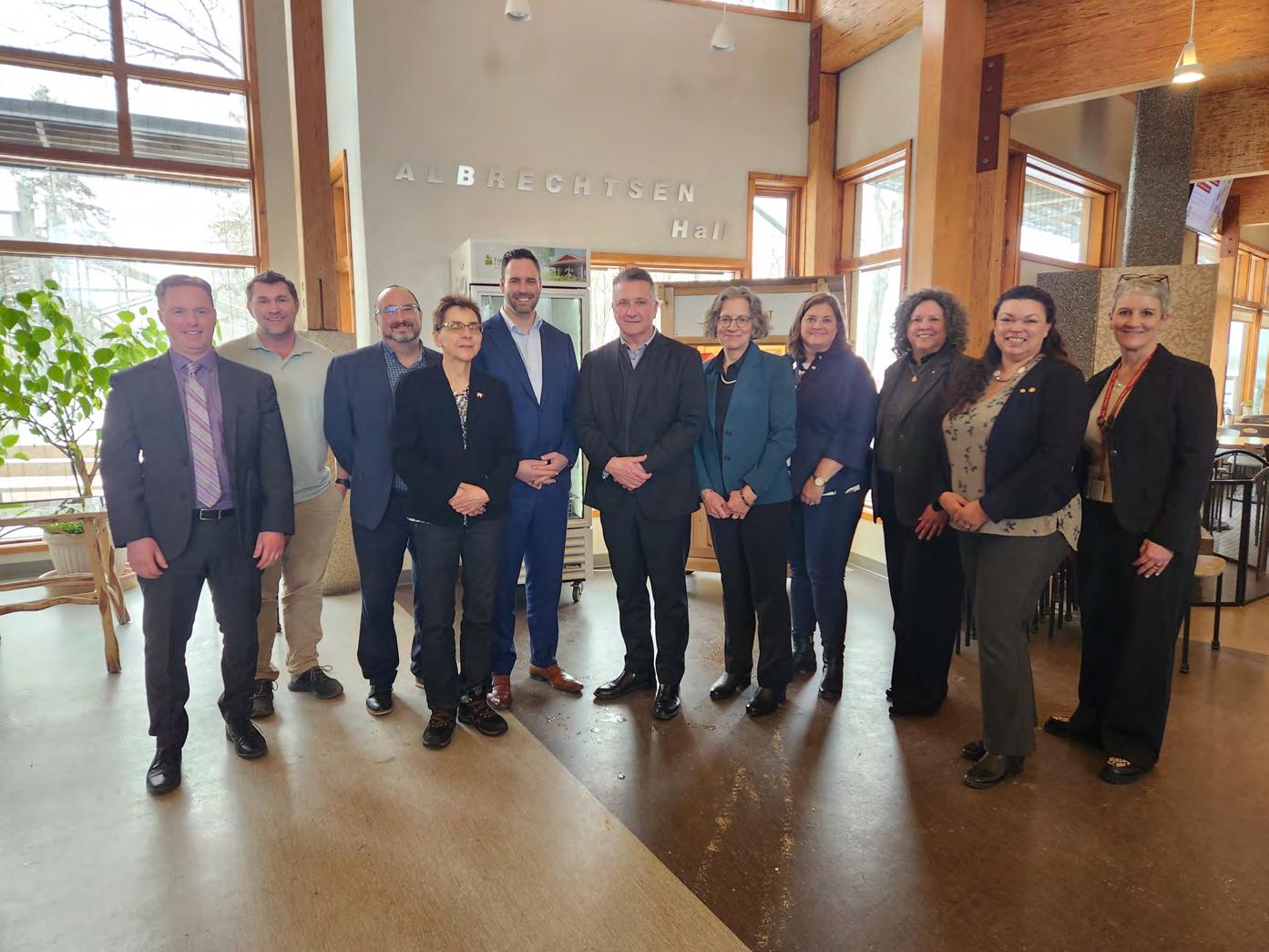
This week MBP had the opportunity to take part in a roundtable discussion with the Hon. Heath MacDonald, Minister of Agriculture and Agri-Food (AAFC), Winnipeg South Centre MP Ben Carr, AAFC staff, and reps from several other Manitoba commodity groups to discuss the Next Agricultural Policy Framework (APF).
A variety of topics were explored, including business risk management programs, the value of investments in research and innovation; trade and market access, factors affecting growth and competitiveness, regulatory burden, labour challenges and more. The federal government is currently seeking feedback on what the next iteration of the Next APF should entail and producers are encouraged to take part in this process.
To participate, go to: https://agriculture.canada.ca/en/department/transparency/public-opinion-researc h-consultations/share-ideas-next-agricultural-policy-framework-0
MBP thanks the Minister for holding this in-person engagement opportunity in Winnipeg.
Left to right, Colin Hornby, KAP; Michael Clark, Manitoba Beekeepers Association; Cam Dahl, Manitoba Pork Council; Maureen Cousins, MBP; MP Carr; Minister MacDonald; Miriam Sweetnam, Dairy Farmers of Manitoba; Patti Rothenburger, Manitoba Pulse and Soybean Growers; Pam de Rocquigny, Manitoba Crop Alliance; Delaney Ross Burtnack, Manitoba Canola Growers; Liz Wilson, Fort Whyte Alive.
March 30, 2026 - FortWhyte Alive
NEWS AND HIGHLIGHTS
Spring Thaw Begins in Southern Manitoba Basins
Manitoba Transportation and Infrastructure’s Hydrologic Forecast Centre is advising the public that spring thaw has begun in southern Manitoba basins, including the United States’ portion of the Red River basin...
National Agricultural Soil Health Strategy
The Government of Canada is committed to advancing the National Agricultural Soil Health Strategy, with Agriculture and Agri-Food Canada partnering with the Soil Conservation Council of ...
Interest-free limit under the Advance Payments Program will be set at $250,000
AgriStability Enrolment Deadline is April 30, 2026
AgriStability is an important tool to help you manage risks and financial losses due to tariffs, poor yields, low commodity prices, or rising input costs. Pasture-related feed costs have now been added as an allowable expense for ...
Canada begins new “30 days or free” guarantee for passport processing
The Government of Canada is strengthening accountability for passport processing by introducing a new guarantee for passport services.. effective April 1, 2026, applicants...



Have Your Say: Veterinary Services District Model
Agriculture Minister Ron Kostyshyn has announced the formation of the Veterinary Services District Working Group. The working group will evaluate the current Veterinary Services Districts and Veterinary Services Commission model in Manitoba and provide an Options Report to the Minister of Agriculture.
The working group invites public input on the current model and proposed changes to it.
How You Can Participate
Your input is essential to this process. You can participate in the following ways:
Submit Written Feedback
Written submissions can be sent to: vetdistricts2026@gov.mb.ca
Attend an In-Person Meeting (all scheduled 1:30 - 3:30 p.m.)
Morden: Wednesday, April 8, 2026
MCC Room, Morden Access Centre, 111- D Gilmour Street
Neepawa: Wednesday, April 15, 2026
CE Room United - Anglican Church, 475 Mountain Avenue
Online Survey
Engagement on Rural Veterinary Medical Services
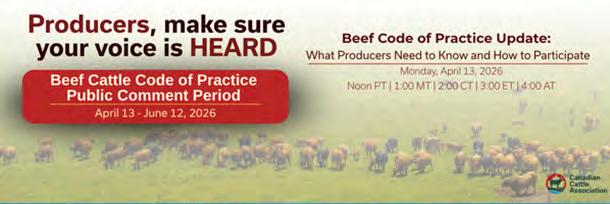
CCA is hosting a producer webinar on the Beef Cattle Code of Practice on Monday, April 13 at noon PT | 1:00 MT | 2:00 CT | 3:00 ET | 4:00 AT to help producers prepare for the public comment period.
In this webinar we will offer guidance and support to producers on how to participate in the 60-day Public Comment Period opening on April 13. The webinar will cover the history of the Code, the review process, a broad overview of the draft Code content, and how producers can provide feedback and input. Please note: the specific content of the draft Code will be available on April 13. Click on the graphic to register.
SCHOLARSHIP APPLICATIONS NOW OPEN FOR THE 2026 CANADIAN BEEF CHECK-OFF AGENCY AWARD
It is no surprise that Canada’s beef industry continues to focus on the engagement of young entrants into the beef industry, whether that be grassroots producers, future leaders of our national and provincial organizations, or industry partners along the value chain.
The Canadian Beef Check-Off Agency (the Agency) continues to diversify its youth strategy with the renewal of the annual scholarship, aimed at students who intend to make an impact in Canada’s beef industry.


The scholarship is open not only to beef producers and those directly involved with their families, but it is open to students who can see unique ways to make an impact through marketing, research, public engagement, and other areas where check-off dollars are invested to generate value for the beef industry in Canada.
“We are working hard to ensure that we are engaging the next generation of industry leaders,” said Trevor Welch, Agency Chair. “This scholarship allows us to reach pockets of young producers that we often find it challenging to connect with.”
Adeleen Bolduc, the Agency’s Youth Member and member of the scholarship committee, sees value in the extensive range of career paths that can help shape Canada’s beef industry.
“Our scholarship outreach is one of the most successful communications programs to date at the Agency ”, said Bolduc. “We have been focusing on different platforms to get the word out to young beef industry stakeholders and it has been extremely positive.”
While preference may be given to applicants who are beef producers or have a background in agriculture, it is not a requirement for the scholarship.
Applicants are asked to submit a 1-2 minute video, showcasing their desire to improve and grow Canada’s beef industry in a unique way. The investment of the beef check-off in Canada delivers value to the beef industry, and the scholarship seeks to support those who want to make an impact in the same way.
The deadline for scholarship applications is June 30, 2026 and the selected applicant will be announced during the Agency’s AGM in August 18, which will be held in Winnipeg, MB and also virtually.
Apply by June 30 at cdnbeefcheckoff.ca/scholarship



Trevor Welch, Agency Chair
Adeleen Bolduc, Agency Youth Member
CANADIAN BEEF CHECK-OFF AGENCY
SCHOLARSHIP
The Canadian Beef Check-Off Agency has established a scholarship to encourage and support students pursuing post-secondary studies in the field of agriculture, agricultural research, or with an agriculture background pursuing studies in marketing or other areas of impact to the beef industry.
ELIGIBILITY CRITERIA
To be eligible for the $2000 scholarship, applicants must:
• be a Canadian citizen or permanent resident
• be accepted to or attending a designated post secondary institution
• be accepted to or attending a full-time program relating to:
• agriculture or agriculture business
• marketing, communications or public relations
• science and research including veterinary medicine
• human health and nutrition
• policy and economics
Note: Preference will be given to applicants who are active beef producers or have a background in agriculture, but it is not a requirement.
HOW TO APPLY
Applicants must submit to the Canadian Beef Check-Off Agency:
• an application form
• a link to a creative video no longer than two minutes, showcasing how their background in agriculture, paired with their education, can help grow the future of the beef industry in Canada
• an official acceptance letter or current enrollment document to a designated post-secondary institution
Videos must be posted to YouTube, marked as public, and the link shared in the application form.
The recipient will be selected by committee on the basis of video content, and desire to improve and grow Canada’s beef industry in a unique way. Knowledge and understanding of Canada’s national beef strategy, checkoff system and national beef organizations is preferred.


Bridging Innovation: Industry–Academic Collaboration
You are invited to an upcoming webinar hosted by the University of Manitoba Resources for Agricultural Engineering (UM-RAE). In this webinar, you will learn how to:
Access research expertise and infrastructure.
Navigate intellectual property and research collaboration agreements. Leverage research funding opportunities.
DATEANDTIME DATEANDTIME
Thursday, 23 April, 2026
Thursday, 23 April, 2026
2:00 - 3:00 pm (CDT) 2:00 - 3:00 pm (CDT)
Meeting ID: 631 1535 8840
Passcode: 123456

Forinquiries,pleasecontactUM-RAE;um-rae@umanitoba.ca



Controlling Cost Structures: What
costs should be prioritized?
Producers who prefer to be outside working can often find bookwork overwhelming and time-consuming. But getting familiar with your finances and understanding profitability is key to a successful and viable operation. So where to start? First, set a goal. That goal might be focused on any objective from a specific income target for the year to a certain return on investment. The key is to have an attainable goal with a realistic timeframe for your operation. Set the goal, then manage expenses to reach it.
Controlling costs on a cow-calf operation is essential for profitability, especially in times of high input costs or tight margins. But that also applies with record high cattle prices; when input costs have potential to offset or wipe out profit margins.
1. Start with a cost assessment - break down your costs per cow into major categories (winter feed, pasture, labour, health, machinery, depreciation). Identify the largest costs that have the most potential for savings.
What is the COP Network?
The Canadian Cow-calf Cost of Production Network (COP Network) uses standardized data collection which allows for comparison both within and between provinces, and internationally Since launching in 2021, the COP Network has collected data from over 235 producers contributing to 64 cow-calf benchmark farms that represent various production systems. Each benchmark is based on data from 3-7 producers. Data collection occurs every 5 years with annual indexing of input and output prices, as well as crop and forage yields, in subsequent years. Individual benchmark farm summaries, can be found at: https://canfax.ca/resources/cost-ofproduction/cop-results.html
2. Prioritize based on impact - Will changes in this area significantly improve profitability or efficiency? What are the risks of making changes (e.g., reduced productivity, soil fertility, animal health issues?)? Are those trade-offs acceptable? See "Moving a cowherd towards optimum productivity"
3. Use partial budgeting - What are the added costs? What are the cost savings or increased revenues? What is the potential net impact on profit? These results will vary depending on each operation's cost structure with some actions having greater or lesser impact depending on the starting point.
4. Compare with a benchmark - Compare your cow-calf enterprise cost of production results with the COP Network benchmarks Identify where you are above or below the top third performing cow-calf operations. Which costs are outliers that need immediate attention?
While every operation is different, the best starting point is identifying and evaluating the largest or most variable cost categories typically winter feed, labour, and overhead (machinery - depreciation).
The Pressure
Price inflation has impacted cost structures for all of agriculture and the cow-calf sector is no exception. From 2020 to 2024, total production costs on Canadian cow-calf operations have increased 30% (cash up 32%, depreciation up 58% and opportunity costs up 17%).
Canadian Cow-Calf Cost of Production
$2,000
$1,500
$/cow
$1,000
$500
$0
$2,500 Cash Costs Depreciation Costs Opportunity Costs Total Production Costs Revenue
Source: Canfax Research Services, COP Network
Costs to consider
There are two buckets of expenses: variable and overhead costs.
A variable cost is something that varies with the level of production. More specifically, when production increases, variable costs increase, and when production decreases, variable costs decrease. The top third performing benchmark farms (based on medium-term profit) had statistically lower costs for machinery (maintenance and depreciation), fuel energy, veterinary and medicine, other inputs and unpaid labour.
For the operation to remain viable it is important to monitor machinery depreciation and plan for replacement as equipment ages. There are periods of time when machinery values have increased significantly, and depreciation based on book value can leave an operation offside when it comes time to replace machinery. Don't be caught unaware!
The Whole Farm Benchmarks notes that depreciation for machinery and buildings should be <10% of total farm revenue (TFR).
Smaller costs, such as vet and medicine can have big implications on animal health and overall performance of the herd. Check out the Veterinarian and Medicine Costs: Are you getting results? fact sheet to learn more.
at 10% level; ** Significant at 5% level;
Overhead or capital costs are fixed, one-time expenses incurred on the purchase of land, buildings, facilities, and equipment used in the production of goods. This includes the cost of money; loans (i.e., interest payments on liabilities) or the use of internal equity. In other words, they are the costs incurred regardless of the level of production Statistically lower costs on insurance, taxes, buildings (maintenance, depreciation), and liabilities contributed to the lower total capital costs for the top-third COP Network benchmark farms Lower liabilities could be attributed to mature operations that had paid off loans The lower costs on insurance and buildings indicate it may be worthwhile spending time evaluating cost-saving options for your operation.
OR CAPITAL COSTS
*Significant at 10% level; ** Significant at 5% level; *** Significant at 1% level
More production is not always better. Chasing weaning weights, reproductive efficiency or any other single metric can come at a cost Profitability may be obtained through optimization because it costs less to get there.
The 5% Rule
At times we can get caught up in finding and focusing on the single, silver bullet that is going to solve all our problems. And in waiting for someone else to identify it, nothing gets done. “Studies show that the
most sustained success comes from doing 20 things 5 percent better, rather than doing one thing 100 percent better,” Dr. Danny Klinefelter says. “Also, the most profitable producers tend to be only about 5 percent better than average farmers in terms of costs, production, or marketing.”
The concept is that a 5% increase in price received, a 5% decrease in costs, and a 5% increase in production will often produce more than a 100% increase in net returns. Because the effect is cumulative, multiplicative, and compounding. This means the nickels and dimes add up to dollars! This approach of continuous improvement through several small changes can make a significant difference in cow-calf profitability.
Key Takeaways:
• Have an attainable goal with a realistic timeframe for your operation. Set the goal, then manage expenses to reach it.
• There is no single production system guaranteed to be profitable. Management is the key difference maker, working with the resources available for each unique operation.
• Change is possible, work on incremental progress.
Canfax is funded by Memberships: Subscribe Now: Or Scan the QR Code for details how

Disclaimer / Copyright Notice: Canfax Research Services (CRS) tries to provide quality information, but we make no claims, promises, or guarantees about the accuracy, completeness, or adequacy of the information. CRS does not guarantee and accepts no legal liability arising from or connected to, the accuracy, reliability, or completeness of any material contained in our publications. Reproduction and/or electronic transmission of this publication, in whole or in part, is strictly forbidden without written consent from CRS.

Contract Part-Time Project Manager
Livestock Inspection Services
Manitoba Beef Producers (MBP) is the exclusive voice of the beef industry in Manitoba. It represents roughly 6,000 beef producers across the province. Based in Winnipeg, MBP is a non-profit organization with four staff and a producer-elected board consisting of 14 district directors, each representing cattle producers in a specific region of Manitoba.
MBP’s mission is to represent all Manitoba beef producers through communication, advocacy, research, and education within the industry to governments, consumers and others; to improve prosperity; and to ensure a sustainable future. Funded by producers through the collection of a cattle check-off, MBP is committed to ensuring a sustainable future for the province’s beef industry for the benefit of our beef producer members and all Manitobans.
THE ROLE:
Manitoba Beef Producers’ membership has given direction to see an expanded livestock inspection service implemented in the province. The contract Project Manager will lead the coordination of this effort with direction provided by the multi-stakeholder Manitoba Livestock Inspection Services Working Group (MLISWG). The development and implementation of a mandatory identification inspection system for cattle in Manitoba will help facilitate livestock tracking and help mitigate potential financial losses to producers and other stakeholders related to theft and fraud.
KEY RESPONSIBILITIES AND ACTIVITIES:
• Lead in the development and coordination of the Strategic Plan for implementation.
• Responsible for the planning, implementation, and tracking of specific short-term and long-term goals for the project, which have a beginning, an end and specified deliverables.
• Working with the proponents, provide input into the development of modernized legislative, regulatory and policy frameworks to support expanded inspection services.
• Assist in the creation and provision of tools needed to support expanded inspection, such as information management systems like digital manifests, communications strategies to inform producers and other stakeholders about the implementation of expanded inspection (including its value to the beef industry), etc.
• Liaise with other stakeholders on matters such as the creation of a Manitoba-based RCMP Livestock Investigation Unit, the modernization of the provincial brand registry system, etc
• Coordinate meetings for the MLISWG to ensure the project remains on track.
QUALIFICATIONS FOR THE POSITION:
• Postsecondary education in agriculture, preferably animal science, or a suitable combination of education and experience;
• Strong understanding of the agriculture/agri-food sector, including beef production;
• Understanding of beef industry supply chain;
• Knowledge of legislative and regulatory processes, including the ability to review and analyze legislation and regulations is a definite asset;
• Experience in writing documents for government and industry an asset;
• Strong oral and written communication skills and attention to detail are essential;
• Skilled in writing and editing research or project reports, including financial reporting;
• High comfort level for public speaking and giving presentations;
• Ability to work on multiple projects simultaneously in a fast-paced environment;
• Experience with organizing and participating in trade shows, extension events, etc.;
• Experience in dealing with producers and the general public;
• Strong technical abilities, i.e. experience with Microsoft Office suite, virtual meeting platforms, etc.;
• Able to build solid relationships with teammates, project partners and other specialists by fostering teamwork, partnership and collaboration in virtual or face-to-face settings.
• A highly motivated self-starter able to work both in a self-directed manner, and as part of a small team.
• Valid driver’s license.
Note: Some occasional travel is required, mostly within Manitoba. Occasional evening work may be required.
COMPENSATION:
This position will be a contracted, part-time term position for 24 months. Compensation will be determined in the interview process.
REPORTING STRUCTURE:
The term position of Project Manager-Livestock Inspection reports to MBP’s Chief Executive Officer.
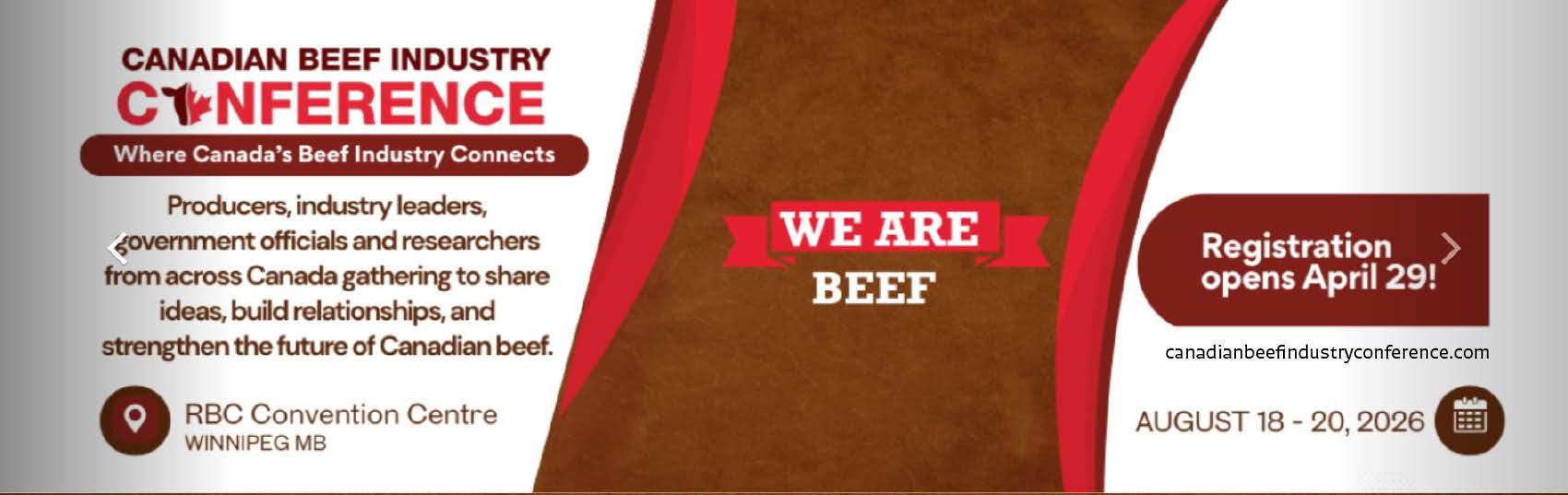


The Canadian Beef Industry Conference (CBIC) Student Poster Competition
is Back for 2026!
Conference dates: August 18–20, 2026, at the RBC Convention Centre, Winnipeg, MB
Abstract Submission Deadline: June 1, 2026 at 11:59 PM MT [SUBMIT HERE]
The poster competition is open to all post-secondary students and will be divided into two streams:
• College / Undergraduate / Diploma students
• Master’s / PhD students
Research must address an industry challenge aligned with one of the five pillars of the National Beef Strategy: sustainability, connectivity, productivity, beef demand, or competitiveness
Full details on the pillars can be found here: Beef Strategy Report (2025-2030)
Competition Format
• Posters will be presented to a beef producer audience, and judging will prioritize clarity, relatability, and accessibility of the content.
• Poster evaluations, including a Q&A session with your judges will take place in person at CBIC on Wednesday, August 19.
• From these evaluations, the top three students in each stream will advance to the final round on Thursday, August 20, where they will deliver a three-minute verbal presentation summarizing their research on the main-stage to compete for cash prizes
For students applying in the Master’s / PhD stream, the Canadian Roundtable for Sustainable Beef (CRSB) is awarding two Graduate Student Sponsorships, covering travel, accommodation and registration expenses. Click here for more information.
Participation Timeline
• April 1 - June 1, 2026: Online abstract submission period
• June - July 2026: Notification of accepted abstracts
• August 19, 2026: Poster presentations
• August 20, 2026: Finalist presentations
o Top three students in each stream present 3 minute summaries on the main stage
o Winners for 1st, 2nd, and 3rd place announced
Registration
Registration opens on April 29th , students are required to register prior to the event and will be provided a reduced rate ($400).
Canadian Beef Industry Conference website
Abstract Requirements
An abstract is a short communication that allows readers to evaluate the contributions of a scientific study, method, industry solution, extension program, or research technique. To ensure clarity for a producer audience, abstracts should use clear, direct, and uncomplicated language.
• Word limit: Maximum 350 words (excluding the title).
• Title: Must be concise, relevant to a producer audience, and no longer than 25 words
• Keywords: Include five keywords that reflect the primary themes of your abstract.
• Objective: The first sentence must clearly state the main objective of the work.
• Methodology: Provide essential experimental or program details, such as:
o Population or sample
o Experimental design
o Housing or environmental conditions (if applicable)
o Data collection procedures
o Statistical analyses performed
• Results: Present results that directly address the stated objective, including appropriate statistical inferences.
o One table or figure may be included if it is the most effective format for presenting results.
• Conclusion: Provide a clear conclusion outlining the effectiveness and/or practical application of the results.
• Authorship: The submitting student must be the presenting author.
Poster Requirements
[SUBMIT HERE]
• Poster size: Landscape orientation, 36" × 48".
• Fonts: Use sans‑serif fonts (e.g., Arial, Calibri). Minimum font size: 28 pt.
• Image quality: All images must be 300 DPI or higher for suitable print quality.
• Authors: List authors in the following order: competitor → supervisor → committee members.
• Headshot: Including a headshot of the competitor on the poster is encouraged
• Audience: Sections must be written in language for a cattle producers and industry audience. View BCRC Research Summaries for guidance (example)
• Students are responsible for printing and bringing their posters to the conference. For questions, please contact Jenna Sarich at sarichj@cattle.ca
2026 CRSB AGM Student Sponsorship
The Canadian Roundtable for Sustainable Beef (CRSB) is pleased to announce its third annual Student Sponsorship!
Two graduate students will be selected to present their research at CRSB's Annual General Meeting (AGM), provid ing a valuable opportunity for students to engage and network with leaders and industry representatives from across the beef value chain.
When: August 18, 2026
Where: RBC Convention Centre , Winnipeg, MB
The 2026 CRSB AGM will be taking place during the Canadian Beef Industry Conference ( CBIC ) Full conference dates include August 18th -20th, with an optional tour on the 17th.
Two graduate students will receive sponsorship for the following :
• August 1 8 (CRSB AGM ): Students will present their research on stage.
• August 19: Students will c ompete in the 2026 CBIC Poster Competition.
• August 20: If placed in the top 3 of the Poster Competition, students will deliver a 3minute presentation on the CBIC main stage to compete for cash prizes.
Selection Process
• Abstract Submission Deadline: June 1, 2026, at 11:59 PM MT [SUBMIT HERE]
• Applicants will be shortlisted based on their abstract submissions.
• Selected candidates will advance to a second - round interview conducted by the CRSB’s Scientific Advisory Committee.
What is included in the Student Sponsorship?
Successful applicants will receive coverage for CRSB/CBIC registration, hotel accommodations, and a travel allowance to attend the CRSB AGM and CBIC.
Requirements
Applicants must:
• Be a current graduate student enrolled at a Canadian academic institution .
• Be conducting research focused on or related to beef sustainability
• Research can be applicable to any area of the supply chain .
• Be available to attend the Annual General Meeting and Canadian Beef Industry Conference August 18th -20th, 2026 in Winnipeg, MB .
• S ubmit an abstract into the CBIC Poster Competition and participate August 19th -20th (Submit CBIC Abstract Here) .
Visit www.crsb.ca to learn more about the members at the table
Contact Jenna Sarich at sarichj@cattle.ca with any questions .
[SUBMIT ABSTRACT]
CRSB Abstract Requirements
Research much be focused on or related to beef sustainability Topic s can be applicable to any area of the supply chain (from farm to fork) including, but not limited to ruminant nutrition, ecology, biodiversity, food safety, on- farm safety, crop science, food waste, soil science, economics, animal science, rural community development , etc .
• Word limit: Maximum 350 words (excluding the title).
• Title: Must be concise, relevant to a producer audience, and no longer than 25 words
• Keywords: Include five keywords that reflect the primary themes of your abstract.
• Objective: The first sentence must clearly state the main objective of the work.
• Methodology: Provide essential experimental or program details, such as:
o Population or sample
o Experimental design
o Housing or environmental conditions (if applicable)
o Data collection procedures
o Statistical analyses performed
• Results: Present results that directly address the stated objective, including appropriate statistical inferences.
o One table or figure may be included if it is the most effective format for presenting results.
• Conclusion: Provide a clear conclusion outlining the effectiveness and/or practical application of the results.
• Authorship: The submitting student must be the presenting author.
[SUBMIT HERE]