PUBLISHED BY MANITOBA BEEF PRODUCERS
NOVEMBER 2026
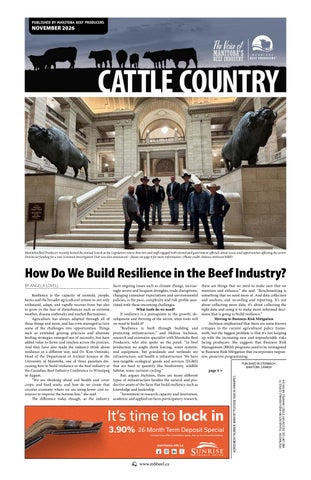
Manitoba Beef Producers recently hosted the annual Lunch at the Legislature where directors and staff engaged with elected and government officials about issues and opportunities affecting the sector. Provincial funding for a new Livestock Investigation Unit was also announced – please see page 6 for more information. (Photo credit: Melissa Atchison/MBP)
How Do We Build Resilience in the Beef Industry? these are things that we need to make sure that we maintain and enhance,” she said. “Benchmarking is something that we need more of. And data collection and analysis, and recording and reporting. It’s not about collecting more data, it’s about collecting the right data and using it to make more informed decisions; that is going to build resilience.” Moving to Business Risk Mitigation Atchison emphasized that there are some known critiques in the current agricultural policy framework, but the biggest problem is that it’s not keeping up with the increasing new and unpredictable risks facing producers. She suggests that Business Risk Management (BRM) programs need to be reimagined as Business Risk Mitigation that incorporates responsive, proactive programming. page 4
It’s time to lock in 3.90% 26 Month Term Deposit Special Limited time offer. Conditions apply. Ask us for more information.
www.mbbeef.ca
PUBLISHED IN STEINBACH, MANITOBA, CANADA
POSTMASTER : PLEASE RETURN UNDELIVERABLE COPIES TO: MBP, UNIT 220, 530 CENTURY STREET, WINNIPEG, MB R3H 0Y4
Resilience is the capacity of animals, people, farms and the broader agricultural system to not only withstand, adapt, and rapidly recover from but also to grow in the face of disturbances such as extreme weather, disease outbreaks and market fluctuations. Agriculture has always adapted through all of these things and more, and has even managed to turn some of the challenges into opportunities. Things such as extended grazing practices and alternate feeding strategies emerged out of necessity, but have added value to farms and ranches across the prairies. And they have also made the industry think about resilience in a different way, said Dr. Kim Ominski, Head of the Department of Animal Science at the University of Manitoba, one of three panelists discussing how to build resilience in the beef industry at the Canadian Beef Industry Conference in Winnipeg in August. “We are thinking about soil health and cover crops, and food waste, and how do we create that circular economy where we are using lower cost resources to improve the bottom line,” she said. The difference today though, as the industry
faces ongoing issues such as climate change, increasingly severe and frequent droughts, trade disruptions, changing consumer expectations and environmental policies, is the pace, complexity and risk profile associated with these oncoming challenges. What tools do we need? If resiliency is a prerequisite to the growth, development and thriving of the sector, what tools will we need to build it? “Resilience is built through building and protecting infrastructure,” said Melissa Atchison, research and extension specialist with Manitoba Beef Producers, who also spoke on the panel. “In beef production we might think fencing, water systems, and equipment, but grasslands and wetlands are infrastructure, soil health is infrastructure. We have non-tangible ecological goods and services (EG&S) that are hard to quantify like biodiversity, wildlife habitat, water nutrient cycling.” But, argues Atchison, there are many different types of infrastructure besides the natural and productive assets of the farm that build resiliency such as knowledge and leadership. “Investment in research capacity and innovation, academic and applied on-farm participatory research,
AGREEMENT NUMBER 40005187 POSTAGE PAID IN WINNIPEG.
BY ANGELA LOVELL
2
CATTLE COUNTRY November 2026
New RCMP Resource to Support Livestock Inspection Services June’s excess rainfall was followed by drier than normal conditions in a lot of the province. The hay crops looked good where they were not flooded out. Corn crops seemed to pull through as well with some yields reported to be the best ever. This is certainly great news. However, with pregnancy checking starting up, early indications suggest weather extremes may be leading to some very high open rates. It seems cattle and cattle producers both find adverse weather stressful. The effects of flooding and excess moisture conditions can be far reaching. MBP directors and our staff held our fall Lunch at the Legislature event in October where we host Members of the Legislative Assembly and a number of government staff we deal with regularly for a beef lunch. This event is always well attended. It is an excellent opportunity for MLAs to hear about the importance of the Manitoba’s beef industry and to get to know ranchers. The event resulted in a visit to my family’s ranch by Malaya Marcelino, Minister of Labour and Immigration. She wanted to learn more about the cattle industry by being on the ranch. It was a great visit, and I thank her for taking the time to come out to see our operation. During our Lunch at the Legislature event, the Premier and Agriculture Minister announced provincial funding for a dedicated RCMP officer to help deal with cattle theft and fraud, which some are calling a “cattle cop.” Part of supporting that RCMP’s role in investigating and resolving cattle theft cases is
ARVID NOTTVEIT President’s Column
having accurate livestock inspection to demonstrate ownership. There are a variety of ways this could be done. One of the ways to identify cattle ownership is by the brand. Manitoba has a brand registry. Of the 6,000 plus cattle producers in Manitoba it is estimated that about 22% of farms and ranches have registered brands and that 16% of the province’s beef herd is branded. The provincial registry has reported more than 50 new brand applications in the past year, up
can have a specific tattoo registered with a breed association. Some 20,000 to 25,000 cattle in Manitoba are tattooed. Cattle sold in Canada are required to have a radio frequency identification tag (RFID). The Canadian Livestock Tracking System (CLTS) has the tag numbers associated with the owner of the tags. So, the tag number may help in returning lost cattle to their owner so they too could play a role cattle inspection. However, tags can be removed and replaced. The Canadian Cattle Identification Agency (CCIA) is supporting research into a bovine rumen RFID bolus and RFID scanners. The CCIA is governed by cattle producers and organizations in the cattle industry. It owns the CLTS. These organizations are not governed or funded by the Canadian government. There are specific rules governing when and with whom tag information may be shared from the CLTS database. The overall goal is to have accurate indicators of cattle ownership so that livestock inspection services can be effective and not unduly impede the speed of commerce. If livestock inspection becomes mandatory for cattle in Manitoba at time of sale there will be a fee estimated to be between $3 to $4 per head. MBP believes an inspection service backed by legislation and RCMP involvement will reduce the risks associated with cattle transactions. It should increase lender confidence for those seeking to borrow to buy cattle. It will be easier to return lost or stolen cattle to their owners. It will be easier to convict cattle thieves and fraudsters. In the Canadian cattle industry Manitoba has been described as the “wild west.” It is not a moniker that encourages investment in our provincial herd, and we believe livestock inspection services will help address many concerns like those I have outlined. The mandate to have a mandatory livestock inspection service came from a resolution passed at MBP’s February AGM. MBP’s board and staff work to fulfill mandates of cattle producers who contribute their provincial check-off of $3/head for these and other industry efforts. As well, 53 cents of the provincial check-off goes to the Canadian Cattle Association (CCA) to fund initiatives that benefit all Canadian cattle producers. For example, foreign trade issues are best led by our national organization with participation from Manitoba Beef Producers. CCA staff and directors have increased their travel to the US to ensure a fair deal with the US during the CUSMA negotiations. The Canadian government, seeking to diversify trade, has asked the CCA to help by joining trade missions to places like Asia. Recently, the possibility of Mandatory Country Of Origin Labelling (mCOOL) has come up again in the US. The CCA knows this will be costly for beef producers in Canada and the US if it were to be implemented. The last time MCOOL happened CCA was part of Canadian efforts that helped the World Trade Organization rule against the use of MCOOL. The directors and staff of MBP work to advance the beef industry provincially, nationally, and internationally. If you have questions or concerns, please contact your district director or contact the MBP office.
MBP believes an inspection service backed by legislation and RCMP involvement will reduce the risks associated with cattle transactions. from previous years. This may be due to the increased value of cattle, the possible and now confirmed appointment of a “cattle cop,” and the imminent requirement of livestock inspection at point of sale. To acquire a brand contact the provincial brand registry. Information and applications are available online. Note: branding your cattle is not required under livestock inspection services systems. A tattoo located on the inside of the ear is another way to identify cattle ownership. A purebred breeder
Plan Ahead For Calving Season Call HI-HOG at 1-800-661-7002 for design assistance for your Custom Calving Barn and Corral set-up.
www.hi-hog.com
#1130 Calving Enclosure
DISTRICT 1
TYLER FEWINGS TREASURER
#125 Calving / Trimming Chute
DISTRICT 5
STEVEN MANNS
Boissevain-Morton, Brenda-Waskada, Grassland, Cornwallis, Elton, Norfolk-Treherne, Deloraine-Winchester, and Two Borders North Norfolk, Oakland-Wawanesa, Glenboro-South Cypress, and Victoria
DISTRICT 2
MARK SCHRAM
Argyle, Cartwright-Roblin, KillarneyTurtle Mountain, Lorne, Louise, Pembina, and Prairie Lakes
DISTRICT 6
BRIAN ENGLISH
Pipestone, Riverdale, Sifton, Souris-Glenwood, Wallace-Woodworth, and Whitehead
DISTRICT 3
DISTRICT 7
Cartier, Dufferin, Grey, MacDonald, Portage la Prairie, Rhineland, Roland, Stanley, Thompson, Montcalm, Morris, and Ritchot
Ellice-Archie, Hamiota, Prairie-View, Riding Mountain West, Rossburn, Russell-Binscarth, and Yellowhead
DISTRICT 4
MATTHEW ATKINSON PAST PRESIDENT
ANDRE STEPPLER
BYRON FALK
TYLER FULTON
DISTRICT 8
Clanwilliam-Erickson, Glenella-Lansdowne, De Salaberry, Emerson-Franklin, Hanover, Harrison-Park, Minto-Odanah, Oakview, La Broquerie, Piney and Stuartburn, Montcalm, North Cypress-Langford, Rosedale, Morris, Ritchot, Springfield, Ste. Anne, Taché, and West Lake-Gladstone R.M. of Piney and Reynolds
Maternity Tub with #125 Calving Chute
DISTRICT 9
DISTRICT 13
DISTRICT 14
Alexander, Brokenhead, East St. Paul, Lac Du Bonnet, Rockwood, Rosser, St. Andrews, St. Clements, St. Francois Xavier, West St. Paul, Whitemouth, Woodlands, LGD of Pinawa, Reynolds, Springfield, Ste. Anne, and Taché
Dauphin, Ethelbert, Gilbert Plains, Grandview, Roblin and Mossey River
Minitonas-Bowsman, Mountain, and Swan Valley West
TREVOR SUND
MATTHEW GOUDIE SECRETARY
DISTRICT 10
ADAM DMYTERKO
Armstrong, Bifrost-Riverton, Fisher, and Gimli
DISTRICT 11
ARVID NOTTVEIT
Coldwell, Grahamdale, St. Laurent, and West Interlake
DISTRICT 12
MIKE BROWN
Alonsa, Lakeshore, McCreary, and Ste. Rose
DALE CAZAKOFF
MANITOBA BEEF PRODUCERS
SENIOR POLICY MANAGER
Ph: 1-800-772-0458
MANAGER, COMMUNICATIONS AND MARKETING & EDITOR, CATTLE COUNTRY
Unit 220, 530 Century Street Winnipeg, MB R3H 0Y4
PH - (204) 772-4542 FX - (204) 774-3264 info@mbbeef.ca www.mbbeef.ca
CHIEF EXECUTIVE OFFICER Carson Callum
Maureen Cousins
David Hultin
FINANCE
Debra Fedak
OFFICE ASSISTANT Jennifer Patryluk
RESEARCH AND EXTENSION SPECIALIST Melissa Atchison
Designed by onPoint
www.mbbeef.ca
CATTLE COUNTRY Nobember 2026
3
Fall Momentum: Manitoba Beef Producers Navigate a Packed Seasonal Agenda Greetings industry partners and stakeholders. I to ensure we are focusing on the right things for our hope this fall has been productive for you. I know the members. weather patterns have made it a challenge to get things One exciting thing that MBP was successful in finished, especially with late crops like corn. However, achieving this fall was the confirmation of Province CARSON CALLUM I hope some of the extended warmth has allowed folks of Manitoba funding for a dedicated RCMP position Chief Executive Officer's Column to get a good amount of feed up. to support work related to livestock theft and fraud It has been a busy fall for Manitoba Beef Producers. investigations. This is a crucial step as we look to launch As I write this, we are well started on our district meetings, and I look forward to a formal livestock inspection service in Manitoba, as enforcement is a key pillar to its seeing many folks throughout the province. There are lots of discussions happening success. We are pleased to see our hard work paid off here. The next step will be seeing at these meetings, including topics such as livestock inspection services, predation, updated legislation and regulatory pieces put in place to allow for a livestock inspection foreign animal disease preservice to operate effectively paredness, and trade. We in Manitoba. Although this are also having discussions process does take time, we are happy with the progress about MBP’s financial position and gaining feedback and support shown by the through a producer survey provincial government to date. Another key topic I mentioned above is trade, in particular, the trading relaPresident: Norbert de Rocquigny 204-745-7930 tionship between Canada, USA, and Mexico. This open and free trading relationship Secretary: Sandra Brigden 403-638-7741 in the beef sector between these North American markets is extremely important to sandra.mbsimmental@gmail.com maintain. The Canadian Cattle Association has been advocating a great deal down in the USA in hopes of seeing a new free trade agreement that continues to allow for Nov. 7th Cherry Creek Farms Online Bull & Female Sale FarmGateTimedAuctions.ca barrier free cattle and beef trade. Our integrated markets make this such a win-win Nov. 16th Rainbow River Simmentals Online Sale FarmGateTimedAuctions.ca Nov. 19th Pembina Triangle Simmental Assoc. 46th Annual Sale Cypress River, Mb for all three nations. Nov. 29th Red Rock Simmentals Dispersal Virden, Mb Speaking of trade, I was pleased to have been invited by the provincial governDec. 1st Keystone Konnection 48th Annual Sale Brandon, Mb ment to take part in the Tri-National Agricultural Accord in Calgary in September. Dec. 2nd Maple Lake Stock Farms Fall Bred Heifer Sale Hartney, Mb This is an annual meeting where senior state, provincial, and industry agricultural Dec. 7th Northern Light Bred Heifer & 2 Year Old Bull Sale Rossburn, Mb officials from Canada, the United States, and Mexico gather to collaborate on matDec. 8th Cream of the Crop Simmental Sale FarmGateTimedAuctions.ca Dec. 9th Premium Picks Simmental Sale Kenton, Mb ters related to North American agricultural trade, rural development, and market Dec. 11th OPT Bred For Success 2nd Annual Female Event Darlingford, Mb challenges, among others. It was very well attended, and the relationships built there Dec. 13th Bonchuk Farms Female Production Sale Solsgirth, Mb further support the need to maintain free trade between our countries. Maintaining Dec. 14th JP Cattle/Rocky Meadow Fall Bull & Commercial Heifer Sale McAuley, Mb collaboration between colleagues in USA and Mexico is also important for things Dec. 22nd Mar Mac Farms Simmental & Red Angus Dispersal Brandon, Mb like animal disease preparedness, which can impact the industry across borders. Dec. 31st Manitoba Simmental Association Scholarship Deadline - Apply Today! I am going to keep it short and sweet this month and look forward to summarCONGRATULATIONS TO OUR 2026 izing what we heard throughout our district meetings in the next edition of Cattle COMMERCIAL BREEDER OF THE YEAR Country. And just a quick reminder that we will be hosting our AGM on February CRH FARMS - CHAD & KELLY HUNTER HAMIOTA, MB 10-11, 2027, in Winnipeg at the Birchwood Inn. We hope to see you there. Happy fall, www.mbsimmental.com view our facebook page or website for up to date info! Carson
The Canadian Cattle Association has been advocating a great deal down in the USA in hopes of seeing a new free trade agreement that continues to allow for barrier free cattle and beef trade.
MSA_CC Oct 2025.indd 1
2026-09-23 4:13 PM
We offer financial incentives and technical support to help you with energy efficiency upgrades.
www.mbbeef.ca
4
CATTLE COUNTRY November 2026
MBP 2026-27 Scholarship Recipients ESSAY QUESTION: “MORE THAN A LIVELIHOOD: WHAT THE BEEF INDUSTRY MEANS TO MY FAMILY, COMMUNITY, AND MANITOBA” Each year MBP offers six $1,000 scholarships to members, or the children of members, who are attending university, college, or other post-secondary institutions or pursuing trades training. The six recipients of the MBP bursaries for 2026 are Avary Lepischak, Emerson Nerbas, Ivy Perkins, Keira Duguid, Laura Seward, and Myla Johannesson. Three of their essays are in this edition, and the remainder will be in December’s Cattle Country.
BY AVARY LEPISCHAK For as long as I can remember there’s always been cows in my backyard. I’d put on my coveralls, slip on my rubber boots and take a walk to the pens. I can’t imagine a life without my family’s cows.
Being a beef producer means you must care for your animals, but you must understand eventually they will leave your farm and move on to the next step in their journey. It is our job to ensure they get their safely and are grown to top notch quality, as this beef travels throughout Manitoba and beyond. I am proud to be a member of this glorious producer community. Growing up on a multi-generational farm has taught me the art of hard work and to never give up. I have strived to do the best I can for myself, my family and members of my community. Around a rural community like Rossburn, agriculture is a big part of who we are. If you’d drive down a back road around here, I would almost be certain you’d stubble upon a cattle or grain farmer. My family does both, but I’ve always been more drawn to the cattle and beef side of things. I enjoy taking care of the cows when they calve in the winter and putting them to pasture in the summer. I understand the path these beef cows have, it’s my job as a beef producer’s daughter to get them there efficiently and safe for consumption. As I have gotten older, I’ve appreciated my family even more. It’s not easy work and tensions can run high on a farm. At the end of the day, we must remember we do this for all Manitobans. Without beef producers, we wouldn’t be able to have our amazing cuts of brisket or steak in the stores. We ensure that our cows have the nutrients they
Sharing the Herd
need to amount well. I have participated in a beef 4H club and it taught me all about judging, cuts of beef and how to take care of your animals. Even though I thought I knew a lot about beef cows, I still had room to learn. This has helped me continue to care for my heifer No Ears, and her gorgeous calves she has raised over the past few years. Agriculture isn’t just a business, it’s a community. One thing every farmer can understand is the effort we put into our crops and cattle. Through all the late nights, early mornings and constant twenty-four hour workdays, being a farmer is one of the most rewarding things. You get to see what you produce, what others will make with it and how it can have an impact on people. This is why I love agriculture. It connects people with plants and livestock on a different level. We are the primary producers. There are tons of people that depend on us, it sounds like a large responsibility, but us farmers can handle that. To me, the beef industry is a secure place I know I can count on. Being able to say I’m a child of a Manitoba beef producer makes me feel proud. I know what it feels like when the good and bad outcomes of farming appear. This farm is a part of who I am. The endless knowledge I have about our cattle herd annoys my parents sometimes, but I know they are grateful I enjoy being involved.
50 YEARS OF RAISING THE CATTLEMAN’S KIND
DISPERSAL 200+ RED ANGUS & SIMMENTAL
COWS • BRED HEIFERS • HEIFER CALVES • PROVEN HERD BULLS • COMMERCIAL FEMALES
DEC.22.2026 JOIN US AT 1PM, TUESDAY
ON THE FARM, BRANDON, MANITOBA
THE MCRAE FAMILY - 204-728-3058 BLAIR 204-729-5439 | LOIS 204-573-5192 Mar Mac Cattle Country.indd 1
www.mbbeef.ca
WWW.MARMACFARMS.NET 2026-09-23 4:52 PM
CATTLE COUNTRY Nobember 2026
5
BY EMERSON NERBAS From early days spent tagging calves to helping open a direct-to-consumer butcher shop, my life has always been tied to the beef industry. For my family in western Manitoba, cattle ranching is not just a source of income; but a livelihood, a multi-generational practice and has shaped the way we live. The beef industry has opened doors we once never imagined, and intertwines us with our environment and land we stand on. Growing up, I was fortunate to learn from the men in my family who dedicated their lives to raising cattle. They taught me how to work with livestock, care for the land, and appreciate the responsibility that comes with managing animals. Their mentorship inspired me to start my own herd of Red Angus cattle in 2017. Building and managing my herd has taught me lessons in patience, problem-solving, and perseverance. It has also strengthened my appreciation for the role cattle producers play in feeding families and sustaining rural communities. One of the core reasons I enjoy being involved in agriculture is the connection it creates between people, animals, and the environment. Every day presents a new challenge and an opportunity to learn. Whether it is improving genetics, managing grazing systems, or caring for animal health, there is always something to work toward. I am particularly passionate about regenerative agriculture and responsible land stewardship. Through grazing management, cattle can help maintain healthy grasslands, improve soil health, and preserve habitats that support wildlife. Agriculture allows me to work outdoors and contribute to the long-term sustainability of the land that future generations will depend on. The beef industry is also a key component of my community. In 2024, my family opened an automated, self-serve, beef retail storefront in the town
BY IVY PERKIN I am proud to be a 4th generation cattle farmer. Currently my family runs a purebred Simmental cattle operation and my brother and I are blessed everyday to be a part of it. We have a bull sale every spring and two female sales in the fall where we are proud to share our genetics with other cattle pro-
Did you know? MBP distributes a free, weekly ENewsletter to members and partners on timely beef topics.
of Russell. The goal of our first-in-Canada business model is to provide families with access to locally raised grass fed beef. Throughout this experience, I have seen how different sectors of agriculture can bring people together. Our customers value knowing where their food comes from and having a direct connection to the people who produce it. These conversations help bridge the gap between rural producers and consumers, creating a greater understanding of modern agriculture and the work that goes into producing high-quality food. Beyond my family and community, the beef industry is a cornerstone of Manitoba as a whole. Agriculture shapes the province’s economy, landscape, and collectively supports jobs and citizens everywhere. Our cattle producers contribute to local, national, and global food markets while caring for millions of acres of grasslands and pasture. The practice of regenerative agriculture in combination with
thoughtful grazing and forage methods is an essential step to preserving the incredible and biodiverse grasslands we have in Manitoba. My family was proud to accept The Environmental Stewardship Award in 2017, and reflects our unwavering commitment to adaptation and conserving the land. The success of the beef industry helps keep rural communities vibrant and creates opportunities for young people who want to build their future in agriculture. The beef industry is so much more than jobs, sales, and work. It is a space to grow, establish, and form lasting connections. At Nerbas Bros. Angus, many years have gone into fine-tuning Angus genetics and breeding stock we are proud of. Networking via social media has allowed our business to have impacts beyond just Manitoba, and will only expand in the future. Involvement in agriculture has given me a unique outlook on life, and I am excited as to where it may lead me in the future.
ducers from across the country. I love to showcase our genetics that we have worked so hard to develop through cattle shows and 4-H achievements. My brother and I also have our own small herd of cattle called Little Perks Ranch. My favourite part of being a beef farmer is calving season because I love watching the baby calves come into the world. I like to help feed, water and bed the cattle, and during calving I check for sick calves and treat them if needed. My mom has taught me a lot about hard work and responsibility. If there are jobs that need to be done, you just have to do them, no complaining. I am grateful for the lessons she teaches me everyday. Sometimes I feel bad for kids who didn’t grow up on a farm because they will never realize what it is like to be independent and have responsibilities from a young age. The beef industry means a lot to my community as well. I am from the small town of Elgin where the population is around 100 which means everyone knows everyone. We often sell freezer beef to other local people in my community because this eliminates the middleman so that people know where their food comes from and can trust it is a great product, while also supporting the local butcher which helps keep small communities alive. This gives our family a sense of pride in producing safe, high quality foods that people can trust. A lot of the time farmers are criticized for ruining the land, but they could not be more wrong.
Farmers are continuously thinking about the health of the soil and what farming practices will benefit that health because we know that sustainability is the key to profitability and also giving the next generation a chance to farm as well. Our grasslands act as a water sinkhole in years when there’s an abundance and hold the soil to prevent erosion from water and wind while adding organic matter to the soil for future years — therefore grass pastures are actually beneficial for our land. I have been involved in 4-H Beef for twelve years and have learned many life skills. People often don’t realize the life lessons that can come from 4-H until their later years in life. I have learned to care for my animals and to take responsibility when doing my chores, and also learned the financial aspect of raising cattle. Now that I’m one of the older members, I’m able to give back and help teach the younger ones some of the things that I’ve learned, which is very gratifying. Cattle producers are a major economic driver in Manitoba. To quote Arvid Nottveit of the Manitoba Beef Producers, “The beef industry is responsible for more than $900 million in farm cash receipts and helps to support many businesses and services.” We produce a delicious, healthy and nutritious protein while bolstering the economy and working to keep the soil healthy and productive for the next generation, definitely an industry pulling its weight in Manitoba.
Subscribe Today!
mbbeef.ca/news/
Half-page and full-page advertising opportunities also available. Contact Jennifer for more information.
1-800-772-0458 www.mbbeef.ca
6
CATTLE COUNTRY November 2026 Page 1
Building Resilience?
“We have been socialized to think of resilience as withstanding, enduring, putting up with hard times,” Atchison says. “It’s reactive adaptation, and focuses on adapting short term, just putting out the fires, and is rooted in stress, fear, and anxiety. I would like us to start thinking about resilience and reframe it in terms of thriving, and flourishing, developing and growing, being proactive and strategic with our adaptation principles, and focusing on long term adaptability.” Programs that are maladaptive can inadvertently undermine resiliency by prioritizing reactive income stabilization over structural, biological and operational adaptability, she added, citing examples within current agricultural programs that can actually disincentivize practices such as diversification. AgriStability and AgriInsurance are based upon margin and yield, which are less predictable in beef production than annual crops. The high value of productive crop land as security against borrowing can undermine efforts to protect natural assets on land. “It could be argued that the current BRM programming suite promotes dependency without reducing further vulnerability,” Atchison said. “We are slowing down autonomous operational restructuring that builds resilience. More investment in strategic risk mitigation could lessen reliance on these reactive program payments. We need to tweak them and that could free up resources for innovation and more resilience building.” Benchmarking and leadership Because things like EG&S only demonstrate economic value over time, if these are to be adopted more widely across the sector, there needs to be increased capacity for research that incorporates economic analysis, Atchison suggests. “What is the cost of implementing this practice? What is the cost of not implementing it? This is the information that can help drive adoption and inform programming on what incentives might be needed to compel producers to change their production practices,” she said. “Can we establish a proxy or another reliable standing metric to help us establish benchmarks that we can measure progress against. We want to reward folks for these practices but we don’t have a way to do it accurately.” Finally, Atchison spoke to the importance of leadership. “Leadership is infrastructure,” she said. “It requires strong producer organizations, industry leadership, policy advocacy, and leveraging partnerships, securing investment, and communicating value.” While the beef industry already has excellent initiatives – such as the Canadian Cattle Young Leader’s program – to encourage future farm and industry leaders, people need to step forward to and be willing to help transition that leadership for the future growth of the sector. “Say yes to the opportunities. Leadership is a journey. It’s not just a destination. It’s a series of small
yeses,” Atchison said. “Say yes to where you are going into these discussions, and also need to think about to add value and find value and fulfillment.” how we are going to back it up. How are we going to What are we already doing? give proof points for these companies that want to talk The beef industry is already out in front when it about things like regenerative agriculture?” comes to the structures and initiatives it has built to Ultimately, the goal is to try and provide more help it move forward in the face of increasingly chal- value back to producers to reward their sustainability lenging times, and to enhance consumer confidence in practices, but it’s hard to communicate the benefit of beef production and the quality of Canadian beef. those practices through the value chain. These include the Cost of Production Network “Growing a cover crop on your operation doesn’t managed by Dr. Kathy Larson at the University of make that animal standing in the sale barn look any Saskatchewan that assists cow/calf producers calculate different,” Tapley says. “If you are paying somebody their economic profitability based on actual data from for participating in a sustainability program, you are Saskatchewan beef farms. not paying for how it looks in the ring, you are paying The Beef Cattle Research Council organizes re- for data that is attached to that product. We need to be searchers across the country to make the most efficient thoughtful about what is that mechanism to send proof use of available funding, consulting with producers to to the food buyer if we want them to pay for it, if we want make sure the research priorities align with their needs. that incentive to flow back through the supply chain.” “The data that they have funded is everything More partnerships from production to processing and environmental susTapley suggests that the beef industry needs to tainability that has been critical to share with industry build more partnerships outside of the sector. stakeholders,” said Ominski. “Consumers have told us “Are there other people out there that have differthey want more sustainable food systems and that data ent reasons for a mutually beneficial outcome for the has helped us to show that.” beef industry,” she said, pointing to the success of the Information from the National Beef Sustainability Guardians of the Grasslands video that promotes the Assessment led by the Canadian Roundtable for synergies of grassland conservation and beef producSustainable Beef (CRSB) and has provided data that tion. “If conservation organizations are interested in verifies how the beef industry has reduced greenhouse keeping cattle on the landscape because that protects gas emissions, and reduced water, land and fossil fuel grasslands, is BRM and de-risking beef production acuse. While the Verified Beef Production Plus (VBP+) tually a conservation mechanism? I would argue it is, program demonstrates the measurable outcomes that so can we bring conservationists to the table when we validate what producers are doing and promotes con- are talking about BRM? Can we think about who else sumer confidence in their practices. has an interest in what we are doing and producing, Support along the value chain and then be able to find the language to use to relate to All of these tools, including the CRSB, that their audience to build that shared value.” connect stakeholders along the beef value chain from In order for the industry to develop the relationproducers to processors, academics and retailers, play ships inside and outside the sector that will support a pivotal role in helping to maintain public trust but is resiliency, it has to be clear about what it needs, added just as vital to the food companies that provide beef to Tapley. those consumers. “Think about what are those partnerships that can “The industry is already doing great things, but as bring value in to build our resilience and be thoughtful a food company, if you are going to make a claim in the about what do we need,” she said. “If someone walks marketplace, you are going to need to be able to back it over with a cheque book and says I want to pay you for up,” said Kristine Tapley, Cargill’s Customer Engagement what you are doing but I want proof that you are doing Manager for Sustainability. “If you can’t prove that claim it, how do we answer that question. That’s going to help that you are tying to your product, you could be liable us build public trust and programs and policies that for greenwashing, and in Canada, fines can be up to are relevant and sustainable for us.” three per cent of your corporation’s annual worldwide gross revenue. That’s a huge risk to say anything about environmental attributes of a product, so they want proof, they want data to back up any claim they are going to make.” Regenerative agriculture is another SERVICES set of production practices that add value Lois McRae far beyond the farm gate, and is a relatable RR 1 B ox 5 7 concept for consumers concerned about Brandon, Manitoba R7A 5Y1 sustainability In food systems. h: 204-728-3058 c: 204-573-5192 “If I look at the principles of regenerative f: 204-727-7744 agriculture — minimize soil disturbance, inkeystonelivestockser vices5@gmail.com crease biodiversity, integrate livestock, that’s LIVESTOCK INSURANCE beef production,” said Tapley, as part of the specializing in livestock insurance for over 48 years resilience panel. “It’s important that we lean
Keystone Livestock
Manitoba Government Funds Livestock Investigation Unit
New `Cattle Cop’ is the Result of Listening to the Needs of Beef Producers: Ministers (October 8, 2026 Province of Manitoba News Release) The Manitoba government is providing funding to allow the RCMP General Investigative Section (GIS) to hire a designated officer who will investigate livestock-related crimes and enhance the protection of cattle and other livestock in Manitoba, while also supporting a Manitoba-based livestock inspection initiative, Justice Minister Matt Wiebe and Agriculture Minister Ron Kostyshyn announced. “Rural Manitobans have told us that livestock theft and related crimes have a significant impact on producers, their families and their livelihoods,” said Wiebe. “By funding a dedicated livestock investigations position within the RCMP, our government is strengthening enforcement, improving coordination with producers and law enforcement partners, and helping ensure those who commit crimes against Manitoba’s agriculture sector are held accountable.” Beef producers in Manitoba have been advocating for a dedicated RCMP officer to support a livestock inspection initiative. The initiative is modelled after similar programs in Saskatchewan and Alberta.
“Manitoba’s beef producers are a key component of Manitoba’s agricultural-based economy,” said Kostyshyn. “They have identified the need for stronger investigative capacity, and our government listened. This investment will support a made-inManitoba livestock inspection initiative that will provide producers with greater confidence that their herds and operations are protected.” “Cattle-related theft and fraud incidents are very detrimental and can adversely affect beef sector confidence at a time when there are efforts to grow Manitoba’s cattle herd,” said Arvid Nottveit, president, Manitoba Beef Producers. “Having a dedicated RCMP resource will not only support investigative activities but should also serve as a needed deterrent. The commitment to this valuable resource is something that MBP and the members of the Manitoba Livestock Inspection Working Group have been advocating for, and we thank the provincial government for its commitment to this very important piece of the livestock inspection initiative.” RCMP investigators will work directly with pro-
www.mbbeef.ca
ducers and other law enforcement agencies to enforce provincial livestock-related laws and the Criminal Code. Enforcement of these laws will help deter cattle theft and fraud. “Manitoba’s livestock industry is integral to the lives of producers and the success of rural communities throughout the province,” said Assistant Commissioner Scott McMurchy, commanding officer, Manitoba RCMP. “This new position will ensure livestock thefts and other industry-related crimes are thoroughly investigated, bringing greater protection to this important economic sector and the many Manitobans who rely upon it.” Cases of theft and fraud related to Manitoba’s cattle industry are costly and disruptive for affected producers and others. RCMP statistics show 57 reported cases between 2021 and 2025. Industry representatives say such cases also undermine the confidence of lenders, investors and buyers when conducting livestock transactions in Manitoba, the ministers noted.
CATTLE COUNTRY Nobember 2026
7
Bottom Line: Current Prices are Still Better than the Five-year Average As I write this it’s Thanksgiving, and the time has come for another Bottom Line. The fall calf run is well underway, and the market looks very similar to last year’s prices. Producers and cattle feeders are very worried about the volatility in the cattle market. Some producers are hoping for a rebound in the calf prices while others are satisfied with the current prices and selling. We are at a time in the marketplace that has the industry dealing with a lot of uncertainty and risk. The sharp adjustment in the cattle markets in June was a wake-up call for everyone in the industry. Some producers feel they missed the market and are suffering from remorse because they didn’t forward price their calves in the spring. The reality is that most producers, especially in Manitoba, have never considered pre-pricing their calves more than a few weeks in advance of their planned delivery window. Nothing in the cattle industry is for sure. If you contracted in June last year, you left a lot of money on the table. Those who chose to price in June of this year look like geniuses. You really never know until delivery day, and you compare your contract price to the current cash price. With all of the risk and volatility in the cattle market, producers would be well advised to explore risk management opportunities in the future. The general feeling is that we have probably seen the high of the cattle prices this spring. A large number of the heavy confinement feeders that were purchased in the spring are currently selling at a
RICK WRIGHT The Bottom Line
loss. In some cases, they are only bringing back the original purchase prices. This has some of the feeders very cautious when planning their needs for this fall. There are a number of factors that influence the calf and yearling prices in the fall. In general, the fundamentals haven’t changed since last fall. The supply and demand seem to be much the same. In Canada, the beef cow herd has stopped shrinking, and some provinces have seen a slight increase in the number of beef cows. In general, producers are looking at getting their numbers back to pre-drought size. The desire to increase the herd past that point is limited. The demand for beef at the domestic retail level is still strong. With the economy as tight as it is, the consumer resistance to higher prices indicates little chance of higher prices at the farm gate. Packers are reporting that it is getting tougher to move the meat. The price of feed is very volatile, especially in the corn market. The late harvest will produce some extra feed grains. Custom feeders are asking for a higher price to background the calves this fall. With the wet weather conditions, pen cleaning and manure
removal was delayed, making most background lots unable to take large deliveries of wet nosed calves as early as they had hoped. Some feeders changed their inventory requirements this fall. Last year was a terrible year for feedlot health on freshly weaned calves. Some feedlots reported the highest death loss on record, and the pull rate on the calves was higher than usual. There is no one answer for why. For this reason, some feeders are shying away from “wet nosed” calves this fall and are purchasing lightweight yearlings to feed until the spring and are hoping to replace them with weaned, backgrounded calves. The biggest change has been the finished cattle prices. The high of $6.00 dressed in the spring of 2026 dropped back to $4.85 in the summer of 2026, and currently sits at around $5.00. That $5.00 per pound dressed is very close to the mid-October prices for 2025. That should support steady feeder cattle prices with last year. In order to see any steady increase in the feeder cattle prices, the American calf price will have to increase as well. Currently, Canadian feedlots are importing lightweight feeder cattle from the USA. Despite the current exchange rates, the American cattle are arriving at Canadian feedlots costing considerably fewer dollars per head than the Canadian calves of similar weight and quality. Transportation costs to get the Canadian calves from Manitoba to their new homes have also increased. The cost of moving feeders from Manitoba to Alberta has gone up by over two cents per pound from last fall. The cost of going to Ontario is over 20 cents per pound this fall. These new fuel-driven prices will continue to hinder a price increase for your calves at the market. The good news is that I do not think that the prices will go down from their current levels. In Canada, we have more pen space than we have cattle to feed. With the late fall and the good pasture conditions, there has been no rush to market the calves early. When the heavy calf run hits in November, the majority of the backgrounding feedlots will be ready for the cattle. This should keep the markets steady on the top-quality calves. Some producers will have extra feed and may decide to hold their calves until the new year, attempting to gain some extra weight and value in their cattle by feeding the extra feed. Although the fall of 2026 may be disappointing for some of the cattle producers, the current prices are still better than the five-year average. Until next time, Rick
Don’t miss out on upcoming editions of Cattle Country!
Email info@mbbeef.ca or call toll-free 1-800-772-0458 and update your mailing address. www.mbbeef.ca
8
CATTLE COUNTRY November 2026
Engaging the Next Generation of Large Animal Veterinarians MBFI Provides Would-be Vets With a Valuable Experience BY MARY-JANE ORR
ation, daily health checks, herd moves and monthly weigh days. New hires learn the principles of working around cattle and strategies for low stress handling, so they can feel safe and build confidence. Over the last five years, we’ve worked with six students – including Iwanchysko – who have used the MBFI experience as a stepping stone into veterinary college. “Working directly with the cattle in a research and production setting gave me a better understanding of the day to day challenges that beef producers
like us for the future of the industry is really important,” says Leanne Sprung, Leadership Specialist in Youth Development with Manitoba Agriculture. It’s Monday morning at Roblin Veterinary Sprung says Manitoba Agriculture has been Services and the phone is ringing, constantly. In the middle of the bustle is Oksana Iwanchysko, DVM, collaborating with MBFI and universities in Brandon who joined the team in June as a 2026 graduate from and Winnipeg for a number of years to create opporWestern College of Veterinary Medicine (WCVM). tunities for students hoping to enter the WCVM pro“There is such a shortage of vets, especially in gram in Saskatoon for rural mixed animal practice. rural areas,” says Iwanchysko, who grew up on a cattle “The additional requirement for those students farm near Dauphin and started her own herd of pureapplying to Manitoba’s rural mixed practice seats breds while in university. “Retention at the WCVM is to have a recorded and pushing out enough grads per 1,000 hours of experience on a farm or another industry, not in a veterinary year are two of the biggest problems.” clinic,” notes Sprung. “It could be The Canadian Veterinary work or volunteer, paid or unpaid,” Medical Association says the shortage with the industry experience designed of qualified professionals is a worldto increase the student’s comfort with wide problem. The graduation rate large animals, give them new skills from Canadian vet colleges barely and help them figure out if farm vetmatches the number leaving the erinary work is the right fit. profession, with rural services being “It definitely led to me being especially hard hit. Industry has both more confident with cattle and wantadvocated for and engaged with the ing to go into large animal veterinary provincial government on strategies to help pre-vet students. To that end, medicine,” says Kristy Stutsky, now in Manitoba Beef & Forage Initiatives (MBFI) is provid- face,” explains Iwanchysko. “And, I got more hands- her first year at WCVM after the summer at MBFI. Although both her parents grew up on farms, ing hands-on experience to lower barriers for the next on experience with herd management and grazing generation of veterinarians to consider opting into systems. It was really interesting to look at an animal Stutsky spent her childhood in Brandon. Visits to a large animal care. from a whole herd and production perspective, and relative’s farm in Saskatchewan kindled a desire to work with animals. As a teen, she helped out during Each summer, MBFI hires Student Research that got me interested in animal health, too.” Assistants for skills building including calving “They have really effective programming at MBFI calving season on a farm near Elgin. A degree in biolprocessing, preventative herd health through vaccin- and their willingness to partner with organizations ogy from Brandon University led her to MBFI. “I’d say it’s definitely worth it,” she notes. “When I started, I was scared because I was a lifeguard forever and never worked anywhere else. For me, MBFI was probably one of my most valuable work experiences to see how a farm runs. To work by yourself with 40 cows, just figuring it out…it was kind of like a problem-solving job and I really liked that.” Each year, a total of 20 Manitobans are accepted into WCVM – with five designated as rural, large animal specialists. “We have very limited spots available in vet colleges so they can only produce so many vets per year,” explains Iwanchysko, who accepted a job months before she graduated. “A lot of it is retention, too. Saskatchewan has a good retention program to keep people from Saskatchewan to stay practicing in Saskatchewan. Manitoba doesn’t have a retention WEDNESDAY, program as of yet, so that’s kind of part of it.” Victoria Inn Hotel & Convention Centre “The shortage of veterinarians to practice in WEDNESDAY, WINNIPEG, MB rural areas of the province affects the overall ability a Inn Hotel & Convention Centre Victoria Inn Hotel & Convention Centre Victoria Inn Hotel & Convention Centre for farmers to do their work,” says Sprung. “And so More than 140 exhibits PEG, MB there’s been an emphasis placed on looking at the difWINNIPEG, MB WINNIPEG, MB MULTI-SPECIES LIVESTOCK SHOW featuring: hog, beef, dairy, ferent programs that are currently offered, as well as Morepoultry, than 140 exhibits than 140 exhibitssheep, bison, goat looking at ways to encourage Manitoba students who More than 140 exhibits have attended the Western College for Veterinary MULTI-SPECIES LIVESTOCK SHOW featuring:for hog, beef, dairy, New & Evolving Technologies: expert presentations today’s producers TI-SPECIES LIVESTOCK SHOW featuring: hog, beef, dairy, sheep, poultry, bison, goat Medicine in Saskatoon to come back to Manitoba.” MULTI-SPECIES LIVESTOCK SHOW featuring: hog, beef, dairy, Canada’s largest PORK QUALITY COMPETITION p, poultry, bison, goat While there are no silver bullet solutions in the New & Evolving Technologies: expert presentations for today’s producers sheep, poultry, bison, goat short-term to increase rural vets, MBFI will continue Latest in livestock production techniques & Evolving Technologies: expert presentations for today’s producers making livestock work accessible for university Canada’s largest PORK QUALITY COMPETITION New & Evolving Technologies: expert presentations for today’s producers co-operative placements, provincial initiatives and in livestock production techniques FREE admission FREE parking da’s largest PORKLatest QUALITY COMPETITION interested university students. Canada’s largest PORK QUALITY COMPETITION Each year, MBFI hires summer students from For info see our website or E-mail: info@prairielivestockexpo.ca t in livestock production techniques diverse backgrounds to help with herdsmanship, reFREE admission FREE parking Latest in livestock production techniques search trials, field demonstrations and farm activities. Employment is full-time from the end of the school For info see our website or E-mail: info@prairielivestockexpo.ca year in late April to the start of September classes. FREE admission FREE parking Contact MBFI at information@mbfi.ca if you are inFREE admission FREE parking terested in gaining livestock experience or connecting For info see our website or E-mail: info@prairielivestockexpo.ca with potential pre-vet programming. For info see our website or E-mail: info@prairielivestockexpo.ca Veterinary clinics and livestock producers can also visit www.gov.mb.ca/agriculture/funding/vetstep to learn more about financial support to hire veterinary, veterinary technologist and pre-vet students under Manitoba’s Veterinary Student Employment Program (VetSTEP).
“The additional requirement for those students applying to Manitoba’s rural mixed practice seats at the WCVM is to have a recorded 1,000 hours of experience on a farm or another industry, not in a veterinary clinic,” notes Sprung. “It could be work or volunteer, paid or unpaid,” with the industry experience designed to increase the student’s comfort with large animals, give them new skills and help them figure out if farm veterinary work is the right fit.
T C T E C N E N N O N C ON T O CCT EE C N C NN
s! r e c u ! d s o r r e p c u K d pro TOC S K E C V I O L T Srs ! ce V with I duE L o r p h t i K wOC s!
CO
cer u d VEST I o r L p h t i K w ESTOC V with LI
December 16 DNESDAY, December 16 WEDNESDAY, December 16 December 16
|
| prairielivestockexpo.ca
| prairielivestockexpo.ca |
prairielivestockexpo.ca prairielivestockexpo.ca www.mbbeef.ca
CATTLE COUNTRY Nobember 2026
9
Promoting Agricultural Awareness at Discover Agriculture on the Farm BY PETER FROHLICH, NATIONAL CENTRE FOR LIVESTOCK AND THE ENVIRONMENT, UNIVERSITY OF MANITOBA On September 20th, the University of Manitoba (UM), Manitoba Beef Producers (MBP), and several Manitoba agricultural organizations joined forces at the Glenlea Research Station (GRS) to promote agricultural awareness at Discover Agriculture on the Farm. The annual event is open to the general public and features GRS state-of-the-art livestock facilities and the Bruce D. Cambell Farm and Food Discovery Centre (FFDC). Over 800 visitors had the opportunity to visit 13 eye-catching and interactive displays where they chatted with commodity group representatives, producers, Faculty of Agricultural and Food Sciences (FAFS) staff and students about Manitoba’s food production. This year, the interactive displays focused on beef, dairy, pork, poultry, bison, canola, fruit production, farm safety and others. Dayna Wozny, Education Coordinator and Acting Manager of the FFDC, believes that this is a great event to kick off Farm and Food Awareness Week in Manitoba, which celebrates Manitoba’s agriculture, local food, and the people who bring food from farm to table. She adds that Discover Agriculture on the Farm is one of the gems of FAFS, as it is great opportunity for kids and their parents to learn about where their food comes from. Our role in research, teaching, extension and public education “Discover Agriculture on the Farm has been a longstanding event for the faculty” said Nazim Cicek, Dean at the Faculty of Agricultural and Food Science (FAFS). “It attracts a broad range of visitors including urban, rural, different age and ethnic groups, and for many this may be their only opportunity to visit a
farm.” The event is a critical part of the faculty, as FAFS is charged with not only conducting research and teaching but also providing public education and extension. Together with its partners in the agricultural sector, the facilities at GRS and FFDC provide an ideal interactive setting to give the public a sense of what modern food production looks like in the province, the importance of healthy, nutritious food and the careers are available in the sector. Conversations at the displays were engaging, covering topics on animal welfare, food security and safety, as well as the impact of agriculture and trade. The Dean added that the visiting public enjoyed meeting directly with producers and industry representatives at the display. What did visitors explore at the MBP display? A highlight for attendees at Discover Agriculture on the Farm was the Manitoba Beef Producers display. The information at the display was presented in an easy-to-read style that appealed to visitors of all ages including interesting facts about beef operations, the Verified Beef Production Plus Program, beef nutrition, as well as the economic impact of the beef industry in Manitoba. Visitors had an opportunity to explore hands-on activities and games that included comparing their height to that of a calf or a cow, using a magnetic board to reveal the role of cattle in maintaining grasslands and playing a game of Plinko. Greeting visitors at the display was David Hultin, the manager of communications and marketing at MBP and the editor of Cattle Country. David said that MBP appreciates the opportunity to be a part of Discover Agriculture on the Farm where they can meet
The fall district meeting season for Manitoba Beef Producers kicked off in Carman (District 3) and Austin (District 5) on October 20 & 21. MBP extends a sincere thanks to everyone who attended. Watch for a full recap of the meetings in the December edition of Cattle Country. (Photo credit: Maureen Cousins/MBP)
www.mbbeef.ca
consumers and help make agriculture understandable and accessible to a very large audience. Do you eat beef? Mike Brown, a producer and an MBP Board of Directors member, was assisting at the MBP display this year. He is from Silver Ridge, Manitoba, and represents producers from District 12, an area consisting of Alonsa, Lakeshore, McCreary and Ste. Rose. Mike operates a growing cow-calf operation that consists of 175 cows. He said that as the district director he advocates for the farmers in his district, making sure their voices are heard and they are all up to date on what is happening in the industry. Brown also advocates for beef when he is off the farm. His role at the MBP display was to engage the visitors, answer questions and chat with the kids about beef. The first question he asked the kids was “Do you eat beef?” and the conversations would take off from there. Mike said that he is very honored to serve as a board member at MBP and to assist at the display during Discover Agriculture on the Farm. He said that his family has always been involved in beef production and he is happy to share his knowledge and enthusiasm with visitors to the display. Support from UM graduate students and tasty beef snacks Also helping at the display was Ireland KyrzykSmith, a graduate student at the Department of Animal Science. Her role was to answer questions, interact with guests, demonstrate interactive activities and hand out informational leaflets regarding beef production. She said that people that come to Discover Agriculture on the Farm are eager to learn where their food comes from and the importance of agriculture in their lives. She adds that visitors had questions about new research they have seen on the news and it was helpful to have a UM representative at the display to address these types of questions, as well as those about GRS operations and other FAFS research. To top off the experience visitors to the MBP display were treated to a sample of tasty beef salami/ cheese cube/pickle skewers created by food expert and Chef Anna Hymers. Please click here for the recipe: https://mbbeef.ca/recipes/beef-salami/ For additional information on MBP resources, informational material and how to get involved in MBP outreach programs please contact info@mbbeef.ca For more information on GRS and FFDC please visit https://umanitoba.ca/agricultural-food-sciences/ research/glenlea-research-station
District 2 Director Mark Schram raises cattle for a living and lifts heavy farm stones for sport. Oh, and did we mention he’s also a dad, coaches other lifters and recently competed at the Strongman Corporation Canada National Championship? So we had to ask: what does this guy eat? Search 'Manitoba Strongman Rancher' on YouTube to find out. (Photo courtesy Great Tastes of Manitoba)
10 CATTLE COUNTRY November 2026
StockTalk Q&A Feature Brought to you by Manitoba Agriculture Cindy Jack
Livestock Specialist-Beef Manitoba Agriculture Cindy.Jack@gov.mb.ca Q: I am selecting my replacement heifers soon, what key traits and performance indicators should I consider? A: Weaning is an important time to evaluate replacement heifers, but weaning weight alone shouldn’t determine which females stay in the herd. Replacement heifers represent the future of the cow herd and selecting them provides an opportunity to make gradual genetic improvements in traits such as growth, fertility, maternal ability, structural soundness and efficiency. The goal is to identify females with the potential to become productive, functional cows that fit the operation’s environment and management system. While weaning weight is an important piece of information, an individual heifer’s weight is influenced by both genetics and environmental factors. Age at weaning, dam milk production, nutrition, health and management can all affect the outcome. Fertility may be one of the most important factors determining whether a heifer becomes a productive cow. When evaluating replacement females, consider whether they are developing appropriately for breeding, reach an adequate breeding weight, and become pregnant during a defined breeding season. Recording when a heifer becomes pregnant, rather than simply whether she is pregnant, can provide additional insight into reproductive performance. Birth date within the calving season can also provide useful information. A heifer born early in the calving season is older when she reaches breeding age, and research has shown that, earlier-born heifers are more likely to be cycling and become pregnant during their first breeding season. Research from Nebraska found higher pregnancy rates among heifers born in the first 21 days of the calving season compared with those born in the second or third 21-day periods. Retaining heifers from cows that consistently conceive and calve early can help apply selection pressure for reproductive efficiency. However, birth date should not be used on its own. Nutrition, growth rate, genetics, age, and management all influence when a heifer reaches puberty and whether she becomes pregnant. The goal is to identify heifers that reach puberty on time, conceive early, and develop appropriately for the production system. The heifer’s dam can also provide valuable clues. Does she consistently calve early? Has she maintained a reasonable calving interval? Has she remained productive as she has aged? A cow that breeds early and continues to reproduce on schedule is more likely to remain productive in the herd for many years, and her daughters may possess similar characteristics. A replacement heifer is being selected not only for her own performance, but also for her future ability to raise productive calves. There are many traits worth evaluating: Udder and teat conformation have a genetic component and can be improved through selection. Selecting replacements from cows with functional udders can help reduce labour requirements and management challenges once those heifers enter the cow herd. Femininity is more than simply having a refined head. Look for a clean front end, a relatively long and refined neck, a feminine head and a smooth shoulder. The heifer should still possess adequate muscle and body capacity without appearing coarse or overly masculine. However, femininity should not be evaluated on its own. A feminine-looking heifer must also have the performance, structure and capacity needed to become a productive cow. Feet and legs deserve particular attention because structural problems can affect longevity and mobility. Look for feet that are reasonably even and well-shaped, with adequate heel and toe. Avoid heifers that are extremely straight through the rear leg, excessively sickle-hocked or have weak pasterns. Watch the heifer move. She should take a comfortable, free-moving stride and track naturally. A heifer that takes short steps, moves stiffly or shows signs of discomfort warrants closer inspection. Body capacity is another important consideration. Look for adequate depth of
body and spring of rib, along with width through the heart and lower body. A heifer with good capacity should be able to consume enough forage to support herself, raise a calf and produce milk efficiently as a mature cow. Hip structure should also be evaluated. Look for adequate width through the hooks and pins and an appropriate slope from the hooks down to the pins. Extremely flat or steep hip structure may be undesirable. Pelvic width and overall structure are worth considering, particularly when combined with calving-ease information from the heifer’s genetics and cow family. Temperament is another important consideration. Selecting cattle that are calm and easy to handle can improve safety and make routine management easier. Milk production should be considered within the context of the entire operation. More milk is not necessarily better. Higher-milking cows have greater nutritional requirements, so the objective should be to select females that produce enough milk to raise a desirable calf while maintaining body condition and reproductive performance. It can be tempting to select replacement heifers primarily for growth and size, but it is important to consider what happens after that heifer becomes a mature cow. Selecting heavily for growth may increase mature cow size, and larger cows generally require more feed to maintain themselves. Mature cow size should fit the forage resources and management system of the operation. A productive cow is one that can maintain body condition, breed back consistently, and raise a desirable calf without requiring excessive inputs. Don’t Select on a Single Trait There is no single measurement that identifies the ideal replacement heifer. The heaviest heifer is not necessarily the most fertile. The largest-framed heifer is not necessarily the most efficient. The highest-milking heifer is not necessarily the most productive. Instead, consider multiple sources of information: Performance: birth weight, adjusted weaning weight and growth Fertility: development, breeding weight, pregnancy and calving interval Maternal traits: dam performance, udder quality, and milk production Function: feet, legs and temperament Efficiency: mature size and ability to maintain body condition on available forage Genetics: EPDs, indexes and available pedigree or genomic information Before selecting replacements, determine what type of cow best fits the production system. The traits that matter most are those that influence productivity while matching the goals, environment, and resources of the herd. Then use the information available to identify the heifers most likely to become that type of cow. Ultimately, the goal is to select the heifer most likely to become the kind of cow you would want a whole herd of.
Share Your Voice In the next issue of Cattle Country, a Manitoba Agriculture forage or livestock specialist will answer a selected question. Send your questions to Elizabeth.Nernberg@gov.mb.ca. StockTalk for Cattle Country is brought to you by Manitoba Agriculture. We encourage you to email your questions to our department’s forage and livestock team. We are here to help make your cattle operation successful. Contact us today. Kristen Bouchard-Teasdale Beausejour Kristen.BouchardTeasdale@gov.mb.ca Pam Iwanchysko
Dauphin
431-337-168
Pamela.Iwanchysko@gov.mb.ca
Cindy Jack
Portage
Cindy.Jack@gov.mb.ca
204-768-0534
Sabrina Kendall
Arborg
Sabrina.kendall@gov.mb.ca
431-272-0271
Juanita Kopp
Beausejour Juanita.Kopp@gov.mb.ca
204-825-4302
Elizabeth Nernberg
Roblin
Elizabeth.Nernberg@gov.mb.ca
204-247-0087
Josie Shearer
Killarney
Josie.Shearer@gov.mb.caJo
431-266-0171
20TH A NNUA L
Rugged 2yr old Black & Red Angus
BULL SALE MARCH 13th 2027
STEFAN BOUW 204-232-1620
LOW INPUT, FORAGE BASED GENETICS
OCC GATE KEEPER 678G - SONS SELL
EDIECREEKANGUS.COM
at the ranch, Anola MB
Manitoba Habitat Conservancy is a non-profit organization working to conserve and enhance Manitoba’s natural landscapes in cooperation with landowners.
Learn more at mbhabitat.ca or call 204.784.4350
www.mbbeef.ca
CATTLE COUNTRY Nobember 2026 11
One Partner.
More Opportunities. For over 45 years, JGL has helped cattle producers market their cattle, manage risk, access financing, source livestock, and grow their operations.
MARKET CATTLE
FINANCE GROWTH
Ranch Direct Marketing: We connect quality cattle with our large network of buyers looking to source calves directly from producers. We buy direct, offer competitive pricing, and prompt payment.
CCBC: JGL Financial offers the Canadian Cattle Buyers Credit (CCBC), a financing program designed specifically for the cattle industry. Whether you're backgrounding calves, purchasing feeder cattle, or expanding your feeding program, CCBC provides the flexibility and cash flow needed to support your operation. Monthly cash advances for feed costs can be included in the financing package.
Online Sales: JGL is active on leading electronic marketing platforms and serves as a TEAM sales listing agent, maximizing buyer exposure and competition for your cattle. Trucking & Logistics: We partner with trusted livestock haulers across Canada and can assist with transportation planning and logistics.
SOURCE CATTLE Order Buying: Our experienced order buyers source feeder cattle and breeding stock through auction markets, electronic platforms, and Ranch Direct networks across Manitoba and beyond.
MANAGE RISK JGL Capital: Our dedicated risk management division helps producers identify pricing opportunities, manage market volatility, and protect margins.
FEED PROCUREMENT
Future Selling: JGL will price cattle today for deferred delivery. Take of advantage of locking in an attractive price and deliver the cattle when they reach contract weight.
JGL Commodities: Reliable feed procurement backed by direct producer relationships across Canada and the U.S. Trading over 1,000,000 MT annually. CGC licensed and bonded.
Let’s Talk Cattle Manitoba Office 512 7th Ave S, Virden MB, R0M 2C0 Wilco Van Meijl (306) 513-9633
QR code
Robin Hill (204) 851-8105
Rick Wright (204) 748-7676
www.mbbeef.ca
jgllivestock.com
12 CATTLE COUNTRY November 2026
The Rural Vet Gap: Attracting and Keeping Large Animal Doctors BY: DR. TANYA ANDERSON, DVM This month’s column is inspired by Nobody’s Coming: What Happens When the Last Large-Animal Vet Near You Quits by Chad R Brown - ISU CVM. The post is American, but the issue is the same here in Canada. I am going to focus on the following paragraph: “Everybody is talking about the rural veterinary shortage. Legislations, the AVMA (CVMA here in Canada), veterinary schools. Nearly all of it is aimed at the front door: loan repayment, debt relief, getting a new graduate to say yes to a small town. The part where the ones who already said yes eventually pack up and leave barely gets a mention.” What does a new veterinary graduate want? Surveys show they want work/life balance, a positive work culture, mentorship, the opportunity to pursue special interests and cutting-edge technology. They also want to be a part of that community and make a difference to their clientele. Reasonable requests? Darn right they are! Is it fit for mixed animal practice in your small town? Your actions and that of your community will be the answer. Who is your vet? Or maybe you spread your veterinary care around and use several vets — one for preg testing, another for semen testing and a third for emergency work. I bet the latter is the “local” vet… the doctor of sick cows but not valued enough for herd work and consultative services. The vet who, because he/she has the local VSD (Veterinary Service District) clinic that receives your municipal tax dollars, should therefore be available to do your afterhours/emergency work. Or maybe the local vet has family ties to the community and is in mobile or another non-VSD
practice… convenient, next door and ‘always should be available.’ As the owner of my solo mixed animal practice operating out of a VSD clinic, I can honestly say that I have been blessed by the support of a loyal progressive clientele who value their local veterinary clinic for the services it does offer — both consultative and emergency. I enjoy my work and have no intention of slowing down for the next while, but a succession plan is needed for these VSD clinics. And that is where livestock producers need to get involved within their own communities with their own local veterinarians. Does the local veterinary practice tick off the boxes for new and recent veterinary graduates? Most cannot and some may never be able to. Immediate action must be taken by producers, communities, and municipal councils to address the matter of the local veterinary clinic. If you are in an area where there is a large veterinary practice with multiple vets, consider yourself having won the vet care lottery! Those practices tick off the big boxes — work/life balance, mentorship, specialization. And those practices are unlikely to be VSD practices because they are economically viable and encourage veterinary ownership. If your local brick and mortar clinic is smaller (and likely a VSD clinic), do not criticize but ask why. Look at the demographics of the community— population, farm sizes, livestock base, pet population. Like it or not, rural veterinary practices must be mixed — seasonal beef practice is not sustainable, and staff need full-time year-round employment. Mixed practitioners can also be specialists despite being ‘jacks of all trades.’ Do not discount the knowledge of the local mixed practitioner. Also realize that a smaller
Sweater Weather in a Bowl: Creamy Beef, Potato and Corn Chowder
practice has fewer resources and an active involved VSD District board and community is needed to work at ticking off boxes to keep the tenant in the local vet clinic and the facilities in good repair. Many practices in the more rural areas were established under the Veterinary Services Act following the launch of the Rural Manitoba Animal Hospital Program in 1970. The Veterinary Services Commission oversees these Veterinary Service Districts which are funded by one or more municipalities. Ask your municipal councilor about the local vet clinic. Is it even on the agenda? If not, the community is a problem. I recently spoke to a municipal council candidate at a forum who agreed that Gladstone needs a vet clinic. Yet that candidate did not use the clinic. If you want local, support local. Shop your local community — the grocery store, insurance, hair salon, bakery, restaurants, farm/agro, dentist, accountant… the list goes on. A healthy business community and social network creates a community that people want to put down roots in… including your veterinarian. The under-appreciated and under-utilized leave. If you want someone to take your 2AM call during the 2035 calving season, ask yourself a few questions: Am I supporting the businesses in my community? Is my local municipal council working at creating a positive business environment to encourage the growth and vibrancy of the local communities within the municipality? Is the local VSD/Veterinarian Agreement being upheld? If not, you may be left to haul your next emergency >1hr away, wait for hours to get the mobile vet, or DIY as you see your profitability and efficiency erode.
Best of all, this creamy beef, potato, and corn chowder has “family favourite” written all over it. It is familiar enough for cautious eaters, flavourful enough for enthusiastic ones, and cozy enough to make the changing seasons more welcome. It is the edible BY ANNA HYMERS for the weeks ahead. The vegetables can be chopped equivalent of a favourite sweater: warm, dependable, in advance, and most of the cooking happens in one and exactly what you want when November arrives. As summer slips away with one last dramatic sigh, Dutch oven—which means fewer dishes. Enjoy! November becomes soup season in our house and for Cattle Country. The days grow shorter (although we no longer change the clocks!), the coats get puffier, and a steaming bowl of something hearty starts to feel like a survival strategy. I may not be ready for frosty mornings, but I welcome the return of cozy meals that make the kitchen smell inviting before everyone has even removed their boots. Photo credit: Anna Hymers Every weekend, we map out the week’s meals because our schedule seems to collect activities when no (Yields 6-8 portions) one is looking. During the busiest weeks, ready-made, portioned meals in the freezer are a genuine time2 + 1 tsp Canola oil 3. Reduce the heat to medium. Add the butter and saver. One pot of chowder can become family-sized or 1 lb Ground beef, lean remaining 1 tsp canola oil to the pot. Once the individual portions, ready to reheat for a quick lunch 2 Tbsp Butter butter is melted and lightly foaming, add the onor dinner. Add crusty bread and suddenly a hectic 1 tsp Garlic, minced ion, leek, and carrots. Season with the remaining Tuesday feels surprisingly organized. ½ small Yellow onion, diced ½ tsp salt and ¼ tsp black pepper. Cook, stirring I usually lean toward my Minestrone Soup (see ¾C Leek, chopped occasionally, until the vegetables are softened the November 2024 issue), but this year my spouse 2 Medium Carrot, chopped but not browned, about 5 to 7 minutes. suggested something creamier. The result is a comfort3 Tbsp All purpose flour 4. Sprinkle the flour over the vegetables and cook, ing mash-up of potato-leek soup and corn chowder, stirring constantly, for 2 to 3 minutes to remove 1 L Beef stock, unsalted made heartier with browned ground beef. Onion, leek, the raw flour taste. 2 ears Corn, freshly cut from the cob carrot, and garlic create a savoury base, while a pinch 5. Gradually add the beef stock, about 1 cup at a 2 medium Russet potatoes, peeled and diced of cayenne adds gentle warmth. time, whisking continuously after each addition 1 Cup Whipping cream Fresh corn cut from the cob is the cheerful surprise until smooth and fully incorporated. Pinch Cayenne, dry ground in every spoonful, although frozen or canned corn To Taste Salt and Pepper 6. Return the cooked beef to the pot. Add the corn, works too. The sweet, crunchy kernels brighten the potatoes, whipping cream, and cayenne. Stir well rich broth and add texture, keeping each bite creamy METHOD: and bring to a gentle boil. without becoming heavy. Russet potatoes soften as the 7. Reduce the heat to low and simmer, stirring soup simmers, releasing starch that thickens the broth 1. Heat 2 tsp canola oil in a large Dutch oven over occasionally, until the potatoes are tender and naturally. Whipping cream creates a smooth, velvety high heat. Add the ground beef and season with the chowder has thickened to the desired confinish, while the beef provides enough substance for ½ tsp salt and ¼ tsp black pepper. Cook, breaksistency, about 20 to 25 minutes. hungry appetites after work, school, practices, and ing the meat apart, until fully browned. 8. Taste and adjust the seasoning with additional everything else squeezed into the calendar. 2. Add the garlic and cook for 2 minutes, stirring salt and pepper as needed. Serve hot with crusty This forgiving recipe earns repeat appearances. It frequently. Using a slotted spoon, transfer the bread. yields six to eight portions, making it practical for a beef mixture to a bowl and set aside. family dinner with leftovers or a freezer-friendly batch
www.mbbeef.ca