PAGE 1
March. 2026
MANCHESTER:
Where Music Moves
Where Music
Moves
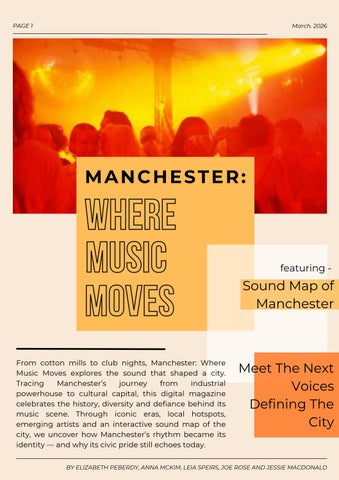
From cotton mills to club nights, Manchester: Where Music Moves explores the sound that shaped a city. Tracing Manchester’s journey from industrial powerhouse to cultural capital, this digital magazine celebrates the history, diversity and defiance behind its music scene. Through iconic eras, local hotspots, emerging artists and an interactive sound map of the city, we uncover how Manchester’s rhythm became its identity — and why its civic pride still echoes today.
featuring -
Sound Map of Manchester
Meet The Next Voices Defining The City
BY ELIZABETH PEBERDY, ANNA MCKIM, LEIA SPEIRS, JOE ROSE AND JESSIE MACDONALD
THIS IS A SOUND MAP OF MANCHESTER’S BIGGEST CLUBS AND RECORD LABELS FROM THE LAST 50 YEARS
AS IT SHOWS, MANCHESTER HAS BEEN A MUSICALLY-RICH AND GENRE DIVERSE CITY FOR DECADES. IT IS HOME TO A VAST ERRAY OF TALENT IN HOUSE, TECHNO, D&B, REGGAE, POP, R&B AND MUCH MORE
BY JOE ROSE
MANCHESTER’S SOUNDTRACK: MUSIC, IDENTITY AND CIVIC PRIDE Manchester has never been quiet. Even beyond the traffic, football crowds, and nightlife, there has always been music somewhere in the background shaping the city's sense of identity. Throughout the years, Manchester has built a reputation as one of Britain’s most influential cities, musically, pioneering genres and introducing artists to the world, reaching far beyond the North West.
A CITY BUILT ON INDUSTRY AND CREATIVITY Manchester’s industrial history played a huge role in developing its music scene. During the late 1970s and early 1980s, many areas of the city were struggling with unemployment and economic decline after the collapse of traditional industries. The atmosphere was tense and uncertain, especially for younger people. Out of that environment came bands like Joy Division. Their music captured the bleakness and emotional intensity of the time. Dark basslines, stripped-back instrumentals and the distinctive voice of Ian Curtis created a sound that felt deeply tied to Manchester’s industrial landscape. After Curtis’ death, the remaining members formed New Order and moved towards electronic
music. Their success showed another side of Manchester: adaptability. The city was no longer only producing introspective postpunk music; it was becoming a centre for club culture and experimentation. Manchester’s identity has always involved reinvention, and its music reflects that constantly.
MADCHESTER AND THE RISE OF CULTURAL CONFIDENCE
By the late 1980s, Manchester had changed. The city was beginning to shake off some of its industrial image and develop a reputation for nightlife, fashion and creativity. Music sat at the centre of that transformation. The Madchester scene mixed indie rock with bands such as The Stone Roses and Happy Mondays became symbols of a new, more confident Manchester. Their music felt energetic and unpredictable, capturing the atmosphere of the city at the time. A major part of this era was The Haçienda. It quickly became one of the most important music venues in Britain. The Haçienda was not simply a nightclub; it represented a cultural shift happening in Manchester. Students, musicians, artists and club-goers all occupied the same spaces, creating a strong sense of community around music.
AND THE CELEBRATION OF WORKING CLASS IDENTITY
The appeal of Oasis came partly from their attitude. Liam Gallagher and Noel Gallagher never attempted to distance themselves from their upbringing or soften their Mancunian identity for mainstream audiences. Their accents, humour and confidence all reflected working-class Northern culture. Listeners saw themselves in the brothers. Songs like “Wonderwall” and “Don’t Look Back in Anger” eventually became tied to the city itself. They are still played across Manchester today, whether in pubs, football stadiums or public gatherings. Following the 2017 Manchester Arena bombing, music became an especially powerful symbol of solidarity within the city. Music and football culture often overlap in Manchester as well. The pride connected to Manchester United F.C. and Manchester City F.C. mirrors the same sense of loyalty and local identity found in the city’s music scene.
GRIME, RAP AND THE MODERN CITY
Manchester’s music scene today looks very different from the Britpop era, but the connection between music and identity remains strong. In recent years, grime has become an increasingly important voice within the city. Artists like Aitch and Bugzy Malone represent a younger and more diverse Manchester. Their music focuses on urban life while still keeping the city at the centre of their identity.
This newer generation also reflects how multicultural Manchester has become. Influences from Caribbean music, hip-hop, drill and electronic music can all be heard in the city’s modern sound. As Manchester changes socially and culturally, its music changes with it. Even with this being the case, the music still reflects the trend of Manchester musicians always writing about place, identity and everyday life.
MORE THAN JUST MUSIC Part of what makes Manchester’s music culture so important is that it extends beyond entertainment. Music has helped shape the city’s reputation, economy and public image for decades. It has created jobs, tourism and international attention, but it has also given people a sense of belonging. There is also pride in the city’s independence. Manchester has consistently produced artists who sound different from what is happening elsewhere. Whether it was post-punk, rave culture, Britpop or grime, Manchester rarely copied trends. That independence is probably why the city’s music remains so important to civic identity. Manchester’s soundtrack reflects resilience, confidence and creativity, the qualities many people associate with the city itself. The genres may change over time, but the connection between Manchester and its music remains impossible to separate.
Anna McKim + exclusive Q&A with your new fave artist
March 2026
The fresh sound of talent in the community brings harmony to our ears and encourages authenticity, relevance, and dedication. Local artists are the lifeblood of the city’s identity, with a connection running deep thst give residents something to recognise as their own. Civic Pride doesn’t come from polished global narratives; it grows from authentic homegrown expression such as independent gigs, exhibitions and creative projects referencing a shared space of belonging.
Meet the Meet the artist artist
MALCOM BAND -
C.A.N are a charity based in Manchester that work directly with underrepresented groups to create projects that reflect their stories and identities. These initiatives are designed to give a platform to people whose voices are often excluded, helping them “speak out, challenge social justice issues and inspire change.” Their work is integral to making opportunities equally available for passionate creatives including local artists. One of their most impactful projects, The Exodus, founded in 2004, bought together refugees and asylum seekers for a celebration of music, spoken word, visual art and performance, which was created especially to embody their culture and backgrounds. Migrant led workshops take place to support these exciting curations as 23% of asylum seekers arriving in the UK settle in Manchester, therefore emphasising the value immigrants have on Manchester’s spirit.
A dynamic four-piece band from Manchester who’ve gained recognition for their indie sound and compelling presence within the city’s vibrant music scene. Building on the momentum of their latest single, “RUNNING,” they are set to further showcase their artistry with the release of their next EP on 29 May.
Q. “Has Manchester provided a variety of spaces for you to grow as an artist?”
A. “We’ve been in Manchester for around three years now as a band and have found different venues and opportunities for all levels as we have grown. Whether this is smaller venues like Lions Den championing grassroots bands and promotes alike giving acts their first break to perform, or creative spaces like the Yard giving bands access to music producers, live sessions and practice spaces.” Q. “What’s been the biggest challenge along the way?” A. “A challenge for us and probably a lot of bands our size has been finding the spaces to practice and keep consistency up whilst balancing full time work at affordable prices. We found help in local charity ‘Forever Manchester’ who grant funding for local bands which has had a real impact on us.”
Look out for their next show at The Deaf Institute or the Band on the Wall for a real distinctive treat!
Community Of Community Of Arts Arts North North West West PAGE 5
Elizabeth Peberdy
Manchesters Musical Roots The deeply intertwined roots of Manchester’s music and its industrial history:
The post-industrial landscape (bleak, grey, monotonous, ‘shoe gazing miserabilist’) influenced the sounds of Manchester, such as Joy Division and the Smiths. The abandoned warehouses, factories, and mills underwent a dramatic transformation into spaces for dance music, rave culture and electronic music (1970s). For example: · The Hacienda – A yacht builder’s showroom and warehouse, becoming the forefront of EDM culture. · Downtex Mill (Hidden) – A former textile factory transformed into an electronic music venue that retains a ‘rugged’ industrial feel. · The White Hotel – What used to be a garage/factory now serves as an “underground” music space.
Manchester as a ‘dying industrial city’ (late 1970s): The economic decline and high unemployment caused aggression, boredom, and disillusionment. Becoming a catalyst for young people to reject society’s current state. This “no future” atmosphere influenced a DIY ethos that showed that local bands didn’t need a major record label to make music. This manifested as Manchester’s Punk scene, rooted in bands like the Sex Pistols, The Fall and Buzzcocks.
Manchester’s acid house era combined with the Indie Rock scene, transforming the city into “Madchester” (1987-1990): Fuelled by Chicago house music, the rise of Ecstasy and rave culture, the scene was driven by a hedonistic party atmosphere, baggy fashion and bands like: The Happy Mondays, Oasis, The Stone Roses, Inspiral Carpets, The Charlatans, 808 State… Niamos community centre located in the heart of Hulme Carlton Club - community centre located in Whalley Range
5
Manchester’s Musical Landmarks The Hacienda - 1982, financed by Factory Records, Madonna's first UK performance, world famous during the acid house years, with just a plaque remaining since 2002, the beating heart of the Madchester rave culture.
Elizabeth Peberdy
Piccadilly Records, 1978 - thrived duringthe post-punk era John Cooper Clarke outside Piccadilly Records
New Islington Marina -‘Cast No Shadow’ is etched under the bridge as an Oasis tribute. View from Epping Walk Bridge famously known for the Joy Division Photograph.
Southern Cemetery - Morrissey's fascination with death inspired The Smiths’ song ‘Cemetery Gates’
The Temple of Convenience - a former Victorian toilet in the street where Guy Garvey used to live. “ ‘Elbow’s famous song ‘Ground for Divorce’: “There’s a hole in my neighbourhood down which I cannot help but fall”
6
One Love: How Tragedy and Music Brought Manchester Together By Leia Speirs
Manchester’s identity has always been deeply intertwined with its music. It is a city that doesn't just produce artists; it weaves them into its genetic makeup. From the driving post-punk basslines of Joy Division to the global success of Oasis, music is the lens through which Mancunians view their history and express their fierce civic pride. However, in May 2017, that musical identity was called upon to perform a completely different task: it became the structural foundation for a city’s collective grief and defiance. The terrorist bombing at the Ariana Grande concert, Manchester Arena was a direct assault on the city's youth, its culture, and its safe spaces. The tragedy killed 22 people and injured hundreds more, leaving a community in shock and despair. Yet, almost immediately, Manchester’s response reframed the narrative from one of victimhood to one of unbreakable solidarity. The emotional climax of this resilience occurred just two weeks later with the One Love Manchester benefit concert. Organized by Grande alongside local authorities and global artists, the event brought 50,000 people together at the Old Trafford Cricket Ground. It was an immense logistical and emotional feat, broadcast globally to millions. But for the people in the crowd, it was a deeply personal reclamation of their city. When local legends like Liam Gallagher and Take That took the stage alongside other international stars, the concert ceased to be a standard music festival. It became a communal wake and a celebration of life rolled into one. The music provided a safe, familiar framework that allowed people to grieve openly without giving in to fear. The crowd singing along to Oasis’s Don’t Look Back in Anger became the definitive soundbite of the city's recovery. It demonstrated how music could actively transform shared trauma into a renewed sense of community and hope (Closs Stephens et al., 2020). Central to this transformation was the revival of the worker bee which had been a Victorian symbol of the city's industrial past, but quickly morphed into a modern emblem of community and strength. It appeared on street murals, shop windows, and as tattoos on thousands of residents raising money for charity. It signalled a collective coping mechanism deeply rooted in local pride (Merrill & Lindgren, 2021). Years later, that spirit remains highly visible across the city. Manchester continues to celebrate its rich musical heritage through civic murals of local icons and massive cultural investments. The legacy of the 2017 tragedy did not diminish the city’s relationship with live music; instead, it solidified it. The response showed that Manchester’s music scene is not merely just sound. It is a living, breathing support system that defines how the city stands together when the ground beneath it shakes.
References Closs Stephens, A., Coward, M., Merrill, S., & Sumartojo, S. (2020). Affect and the response to terror: Commemoration and communities of sense. International Political Sociology, 15(1), 22–40. Merrill, S., & Lindgren, S. (2021). Memes, brands and the politics of post-terror togetherness: following the Manchester bee after the 2017 Manchester Arena bombing. Information, Communication & Society, 24(16), 2403–2421.