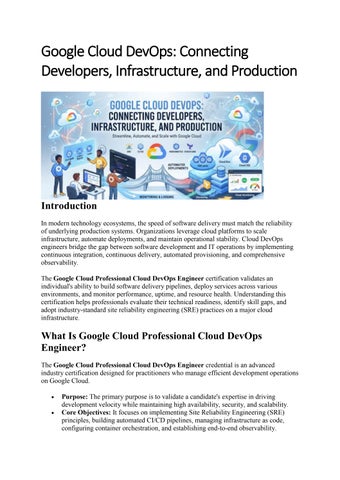
Google Cloud DevOps: Connecting Developers, Infrastructure, and Production
Introduction In modern technology ecosystems, the speed of software delivery must match the reliability of underlying production systems. Organizations leverage cloud platforms to scale infrastructure, automate deployments, and maintain operational stability. Cloud DevOps engineers bridge the gap between software development and IT operations by implementing continuous integration, continuous delivery, automated provisioning, and comprehensive observability. The Google Cloud Professional Cloud DevOps Engineer certification validates an individual's ability to build software delivery pipelines, deploy services across various environments, and monitor performance, uptime, and resource health. Understanding this certification helps professionals evaluate their technical readiness, identify skill gaps, and adopt industry-standard site reliability engineering (SRE) practices on a major cloud infrastructure.
What Is Google Cloud Professional Cloud DevOps Engineer? The Google Cloud Professional Cloud DevOps Engineer credential is an advanced industry certification designed for practitioners who manage efficient development operations on Google Cloud.
Purpose: The primary purpose is to validate a candidate's expertise in driving development velocity while maintaining high availability, security, and scalability. Core Objectives: It focuses on implementing Site Reliability Engineering (SRE) principles, building automated CI/CD pipelines, managing infrastructure as code, configuring container orchestration, and establishing end-to-end observability.
Industry Recognition: Enterprises globally recognize this credential because it confirms that a certified practitioner can handle complex production environments, troubleshoot system failures, and optimize cloud infrastructure costs without compromising reliability.
Why Is This Certification Important? Navigating modern software delivery requires deep knowledge of automation, container security, and proactive monitoring.
Industry Demand: Organizations moving away from legacy data centers need skilled professionals who can design robust cloud pipelines and automated deployment strategies. Technology Trends: The shift toward microservices, serverless workloads, and infrastructure as code makes DevOps expertise indispensable. Business Value: Certified professionals help businesses reduce deployment failures, shorten lead times for changes, decrease mean time to recovery (MTTR), and improve overall service reliability. Skill Validation: Earning this recognition proves an engineer's capability to implement secure, scalable, and compliant cloud architectures using native platform tooling.
Key Features of the Certification
Operational Focus: Emphasizes real-world operations, incident response, and proactive system management rather than mere theoretical knowledge. Automation-Centric: Focuses on eliminating manual intervention through continuous integration and continuous deployment workflows. Security Integration: Highlights supply chain security, vulnerability scanning, and secure access management within cloud pipelines. Observability Standards: Promotes data-driven decision-making through service level objectives (SLOs), error budgets, and distributed tracing.
Skills You Can Learn
CI/CD Pipeline Construction: Building automated build, test, and release workflows using managed cloud build services. Progressive Delivery: Implementing canary deployments and blue-green release strategies to minimize deployment risks. Infrastructure Provisioning: Managing cloud environments declaratively using infrastructure as code and automated state management. Container Orchestration: Operating managed Kubernetes environments, setting up autoscaling, and configuring secure pod networking. Observability Management: Defining service level objectives, setting up burn-rate alerts, and building custom operational dashboards. Security Posture Hardening: Enforcing binary authorization, vulnerability scanning, and secure identity federation without static keys.
Technologies Covered
Continuous Integration & Delivery: Cloud Build, Cloud Deploy, Skaffold, and Artifact Registry. Container Orchestration & Serverless: Google Kubernetes Engine (GKE), GKE Autopilot, and Cloud Run. Infrastructure as Code: Terraform, Google Cloud Provider integrations, and configuration management tools. Observability & Monitoring: Cloud Monitoring, Cloud Logging, Cloud Trace, Error Reporting, and Managed Prometheus. Event-Driven Architecture & Messaging: Cloud Pub/Sub, Eventarc, and Cloud Tasks. Security & Governance: Security Command Center, Binary Authorization, Secret Manager, IAM, and VPC Service Controls.
Who Should Consider This Certification?
DevOps Engineers: Professionals seeking to validate their cloud-native automation and pipeline management capabilities. Site Reliability Engineers (SREs): Individuals focused on uptime, error budgeting, incident response, and performance monitoring. Platform Engineers: Practitioners building internal developer platforms and standardized deployment templates. Cloud Infrastructure Engineers: Technical staff responsible for provisioning and maintaining cloud environments. Software Developers: Developers transitioning into roles that involve operational responsibility and infrastructure management. Cloud Architects: Architects aiming to deepen their understanding of operational workflows and deployment automation.
Step-by-Step Learning Guide Step 1 – Learn the Fundamentals Understand the core principles of Site Reliability Engineering (SRE), including error budgets, toil reduction, and incident management frameworks. Familiarize yourself with commandline interfaces and resource hierarchies.
Step 2 – Understand Core Concepts Study the mechanisms of continuous integration, continuous delivery, artifact management, and immutable infrastructure. Learn how code moves safely from development to production.
Step 3 – Practice with Real Tools Gain hands-on experience with native pipeline tools, container registries, and infrastructure provisioning software. Set up test repositories and experiment with build steps.
Step 4 – Build Hands-on Projects Create complete workflows by writing build configuration files, deploying multi-environment delivery pipelines, and provisioning cloud resources programmatically.
Step 5 – Study Certification Objectives Review the official competency domains to ensure comprehensive coverage of bootstrapping, deployment management, SRE practices, and incident handling.
Step 6 – Practice Mock Tests Attempt practice questions and scenario-based assessments to evaluate your understanding of complex operational challenges and architectural trade-offs.
Step 7 – Revise Weak Areas Analyze incorrect answers from practice sessions, revisit documentation, and rebuild experimental setups for concepts that require deeper clarity.
Step 8 – Prepare for the Exam Consolidate your knowledge, review operational best practices, and ensure familiarity with troubleshooting strategies before taking the assessment.
Core Concepts Explained
Service Level Objectives (SLOs): Numerical targets specifying the reliability of a service, helping teams balance feature velocity with operational stability. Error Budgets: The allowable amount of unreliability a service can experience before developers must pause feature releases to focus on stability. Workload Identity: A secure mechanism that allows container workloads to access cloud services without requiring long-lived service account keys. Binary Authorization: A deploy-time security control that ensures only trusted, scanned, and verified container images are deployed to production clusters. Infrastructure Drift: The divergence between the desired configuration defined in code and the actual state of resources running in the cloud.
Real World Use Cases in Point-Wise
Automated Patch Management: Deploying security patches across hundreds of container nodes without service disruption using rolling updates. Canary Release Verification: Routing a small percentage of user traffic to a new software version while monitoring error rates before full deployment. Disaster Recovery Failover: Automatically redirecting traffic to a secondary regional cluster during an unexpected infrastructure outage. Compliance Auditing: Automatically scanning cloud assets for misconfigurations and generating compliance reports against security benchmarks.
Career Opportunities
GCP DevOps Engineer: Designs, builds, and maintains automated delivery pipelines and cloud infrastructure. Site Reliability Engineer: Focuses on system uptime, performance tuning, capacity planning, and incident response. Platform Engineer: Develops internal developer tools, self-service infrastructure templates, and automated workflows. Cloud Automation Lead: Directs the adoption of infrastructure as code and automated governance strategies across teams. Google Cloud Architect: Designs scalable, secure, and reliable enterprise cloud solutions keeping operational health in view.
Benefits of Earning This Certification
Skill Validation: Confirms your proficiency in executing complex operational tasks on a leading cloud platform. Better Technical Knowledge: Deepens your understanding of container security, observability, and infrastructure automation. Career Growth: Opens doors to advanced technical roles in cloud engineering and site reliability. Industry Recognition: Demonstrates verified expertise to employers and peers across the technology sector. Professional Credibility: Strengthens your resume with a globally respected technical credential. Problem-Solving Ability: Enhances your capacity to troubleshoot intricate distributed systems and resolve production incidents efficiently. Structured Learning: Provides a clear roadmap for mastering cloud-native operational paradigms.
Common Challenges
Steep Learning Curve for Automation: Transitioning from manual console operations to declarative infrastructure code requires a shift in mindset. Complex Debugging: Troubleshooting distributed container networks and identity federation issues can be challenging initially. Keeping Pace with Updates: Cloud ecosystems evolve rapidly, requiring continuous tracking of new features and deprecations.
Practical Solutions:
Adopt a modular approach to learning one tool at a time. Build local testing environments and utilize official documentation and community forums for troubleshooting guidance.
Common Mistakes to Avoid
Skipping Fundamentals: Rushing into advanced deployment tools without understanding basic networking and access control. Memorizing Instead of Understanding: Relying on rote memorization rather than practicing hands-on configuration. Ignoring Practical Exercises: Reading theory without building actual pipelines or provisioning infrastructure. Not Reviewing Official Objectives: Studying topics outside the defined scope while missing core competency areas. Relying Only on Videos: Watching tutorials without reproducing the labs independently. Neglecting Troubleshooting: Failing to practice how to debug failed builds, deployment rollbacks, and monitoring alerts.
Table 1: Core Automation Approaches Comparison Feature / Aspect
Traditional Operations
Cloud-Native DevOps
Deployment Method
Manual scripts and handovers
Automated CI/CD pipelines
Infrastructure Management
Manual server configuration
Declarative Infrastructure as Code
Monitoring Style
Reactive threshold alerts
SLO-driven, proactive burnrate alerts
Security Implementation
Perimeter security and static keys
Shift-left scanning and workload identity
Recovery Strategy
Manual intervention and reboots
Automated failover and progressive rollbacks
Frequently Asked Questions What is the primary focus of the Google Cloud Professional Cloud DevOps Engineer certification?
The certification focuses on verifying an individual's ability to build automated software delivery pipelines, manage continuous integration and delivery, provision infrastructure using declarative code, and implement comprehensive monitoring and site reliability engineering practices on Google Cloud.
Who is the ideal candidate for this credential? This credential is ideal for professionals with experience in software development, system administration, or cloud infrastructure management who want to validate their ability to streamline operations, automate deployments, and maintain high availability in cloud environments.
What technical background is recommended before starting preparation? Candidates benefit from having a working knowledge of Linux administration, basic networking concepts, containerization principles using Docker, and familiarity with command-line interfaces. Experience with software version control and basic scripting is also helpful.
How do infrastructure as code tools fit into this domain? Infrastructure as code tools allow engineers to define cloud resources in human-readable configuration files rather than manual console clicks. This ensures consistency across environments, enables version control for infrastructure, and simplifies auditability and drift detection.
Why are Service Level Objectives important in cloud operations? Service Level Objectives provide measurable targets for system reliability and performance. They help engineering teams balance the speed of releasing new features with the necessity of maintaining a stable and dependable user experience.
What is the role of continuous delivery in modern software teams? Continuous delivery automates the release process so that verified software changes can be pushed to staging or production environments safely and on demand, reducing deployment friction and minimizing human error during releases.
How does container orchestration impact scalability? Container orchestration platforms automate the deployment, scaling, and management of containerized applications. They handle resource allocation, load balancing, and self-healing across distributed server clusters automatically.
What steps can learners take to gain practical experience? Learners can set up personal cloud experimentation environments, write configuration templates, construct multi-stage build pipelines, deploy sample microservices, and configure monitoring dashboards to simulate real-world production scenarios.
Why is container security emphasized in modern pipelines? Modern applications rely heavily on third-party packages and base images. Emphasizing container security ensures that vulnerabilities are detected early through automated scanning and that unauthorized code cannot be deployed to production systems.
How does observability differ from traditional logging? Traditional logging focuses primarily on recording discrete event messages after they occur. Observability combines logs with metrics and distributed traces to provide deep insight into the internal state of complex distributed systems.
Final Summary The Google Cloud Professional Cloud DevOps Engineer certification represents a valuable benchmark for professionals seeking to master cloud-native operations, automation, and reliability engineering. By focusing on practical skills such as CI/CD pipeline construction, infrastructure provisioning, container management, and SLO-driven observability, practitioners can significantly enhance their technical capabilities. Success in this domain relies on consistent hands-on practice, a deep understanding of core reliability principles, and a commitment to building secure and scalable production environments without relying on shortcuts.