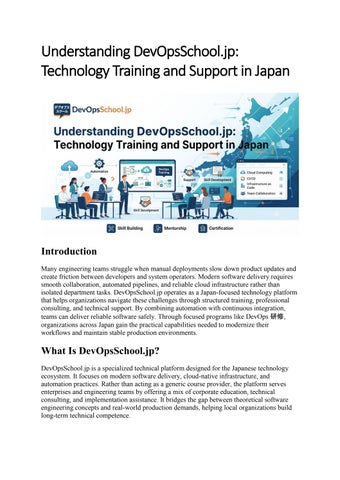
Understanding DevOpsSchool.jp: Technology Training and Support in Japan
Introduction Many engineering teams struggle when manual deployments slow down product updates and create friction between developers and system operators. Modern software delivery requires smooth collaboration, automated pipelines, and reliable cloud infrastructure rather than isolated department tasks. DevOpsSchool.jp operates as a Japan-focused technology platform that helps organizations navigate these challenges through structured training, professional consulting, and technical support. By combining automation with continuous integration, teams can deliver reliable software safely. Through focused programs like DevOps 研修, organizations across Japan gain the practical capabilities needed to modernize their workflows and maintain stable production environments.
What Is DevOpsSchool.jp? DevOpsSchool.jp is a specialized technical platform designed for the Japanese technology ecosystem. It focuses on modern software delivery, cloud-native infrastructure, and automation practices. Rather than acting as a generic course provider, the platform serves enterprises and engineering teams by offering a mix of corporate education, technical consulting, and implementation assistance. It bridges the gap between theoretical software engineering concepts and real-world production demands, helping local organizations build long-term technical competence.
Who Can Benefit from Its Technology Focus? Modern technology platforms serve various roles within an organization, each with unique learning needs:
Developers need to understand how code moves safely from local computers into automated production environments. IT Managers look for ways to measure team performance, reduce deployment errors, and speed up software delivery cycles. Engineering Teams require shared technical standards to collaborate effectively on complex cloud architectures. Organizations Modernizing Infrastructure need structured guidance to transition away from legacy data centers toward flexible cloud models.
What Areas Does It Cover? The platform covers a wide range of modern engineering practices designed to make software delivery faster and safer. These core areas include container management, infrastructure automation, reliability tracking, and secure delivery pipelines. When teams implement these practices together, they reduce manual errors and respond quickly to system issues. Programs such as DevOps corporate training Japan help companies align their technical workforce with these modern standards, ensuring that development and operations teams work from the same playbook.
Why Practical DevOps Training Matters Learning theory alone rarely prepares an engineer for unexpected production failures. Practical training focuses on real-world scenarios, such as fixing broken deployment pipelines or recovering from server crashes. Through structured DevOps 研修, teams learn how to replace manual tasks with repeatable automated workflows. When organizations invest in DevOps corporate training Japan, they ensure their engineers gain hands-on experience with continuous integration, monitoring tools, and collaborative problem-solving.
How Cloud-Native Skills Fit Into DevOps Cloud-native engineering changes how applications are built and run. Instead of relying on a single physical server, modern systems use distributed containers and flexible cloud resources. Two core technologies drive this shift:
Kubernetes 研修 helps engineers understand how to manage and scale containerized applications across multiple servers automatically. Terraform 研修 teaches teams how to write code that provisions cloud infrastructure, making server setup fast and repeatable.
How Reliability and Security Connect with DevSecOps
Delivering software quickly means little if the application crashes frequently or contains security vulnerabilities. Modern engineering teams must build reliability and security directly into their daily workflows rather than treating them as final checkpoints. Through SRE 研修, engineers learn how to set performance targets, monitor system health, and manage incidents efficiently. At the same time, programs focused on DevSecOps 研修 teach teams how to run automated security checks early in the development pipeline, keeping applications safe without slowing down feature delivery.
How MLOps Extends Modern Engineering Practices Machine learning models require careful management from data collection to production deployment. Unlike traditional software, machine learning systems depend heavily on data quality, model training cycles, and continuous performance tracking. Through MLOps 研修, engineering teams learn how to apply standard automation and monitoring principles to artificial intelligence workflows, ensuring that machine learning models remain accurate and stable in production.
Consulting and Technical Support Services Training internal staff is only one part of an organizational upgrade. Sometimes, teams need expert guidance to design new cloud architectures or solve complex operational bottlenecks. Professional services such as DevOps コンサルティング help leadership teams plan digital transformation strategies and select the right tools. Furthermore, having access to an experienced DevOps consultant Japan provides valuable perspective during major system migrations, while ongoing DevOps support Japan ensures that teams have reliable technical backing when unexpected production challenges arise.
Five-Step Process for Planning a Skill Development Program 1. Identify Current Skills and Problems: Review existing workflows to find bottlenecks in deployment speed, infrastructure setup, or system reliability. 2. Define the Required Skills: Determine whether your team needs foundational automation, container orchestration, infrastructure code, or security practices. 3. Build a Practical Learning Plan: Combine theoretical lessons with hands-on labs that reflect your actual engineering projects. 4. Apply the Skills to Real Work: Allow engineers to test their new knowledge on noncritical internal projects before updating core production systems. 5. Measure and Improve: Evaluate team progress regularly and identify follow-up training or technical support needs.
Common Mistakes Organizations Should Avoid
Learning tools without understanding the underlying engineering problems they solve. Focusing entirely on theory while ignoring practical, hands-on lab work. Choosing training programs without evaluating the specific skill gaps of the team.
Treating automation as solely an operations responsibility rather than a shared team goal. Ignoring security checks until the final stages of software deployment. Attempting to adopt too many complex cloud technologies simultaneously.
Real-Life Example Consider a mid-sized software company in Tokyo where developers write application code efficiently, but the operations team struggles to deploy updates manually. The company decides to assess its workflow gaps and creates a structured learning plan focusing on automation, container management, and infrastructure code. The engineers participate in targeted training sessions, followed by practical workshops where they build automated deployment pipelines. Over time, the team integrates monitoring and security checks into their daily routine. By combining structured skill development with gradual implementation, the company reduces manual deployment errors and delivers updates much faster.
Technology Focus Areas Area
What It Helps Teams Understand
DevOps
Collaboration, automation, and software delivery workflows
Kubernetes
Container management and automatic application scaling
Terraform
Infrastructure as Code and automated server provisioning
SRE
System reliability, monitoring, and incident management
DevSecOps
Automated security checks within software delivery pipelines
MLOps
Operating, monitoring, and managing machine learning systems
Frequently Asked Questions
1. What is DevOpsSchool.jp? It is a Japan-focused platform providing technology training, consulting, and implementation support for modern engineering teams.
2. What does DevOps training cover? It covers automation, continuous integration, continuous delivery, and collaboration practices between development and operations teams.
3. Why are Kubernetes skills useful for engineering teams? Kubernetes helps teams manage, scale, and coordinate containerized applications across different cloud environments efficiently.
4. What is the purpose of Terraform training? It teaches engineers how to define and manage cloud infrastructure through code, making server setup repeatable and less prone to manual errors.
5. How does SRE connect with modern software delivery? Site Reliability Engineering focuses on system monitoring, uptime, error tracking, and structured incident management to keep production systems stable.
6. What does DevSecOps add to development workflows? It integrates security testing and compliance checks directly into the early stages of software creation rather than leaving security review until the end.
7. Why is MLOps important for machine learning systems? It applies standard automation and tracking practices to machine learning models, ensuring reliable deployment and ongoing performance monitoring.
8. What does DevOps consulting involve? It involves expert guidance to help organizations plan infrastructure changes, assess technical workflows, and adopt automation strategies.
9. What does corporate DevOps training mean in Japan? It refers to structured educational programs tailored for Japanese enterprise engineering teams looking to upgrade their technical capabilities together.
10. When might an organization need ongoing technical support? Teams often seek ongoing support during major cloud migrations, complex troubleshooting, or when implementing new automated tooling in production.
Conclusion Modern software development requires a connected approach to technology, combining automation, cloud infrastructure, reliability, and security. Platforms like DevOpsSchool.jp help organizations navigate these complex domains through structured education and professional support. By understanding their internal needs before selecting training, consulting, or implementation services, engineering teams can build sustainable technical skills that improve software delivery and system stability over the long term.