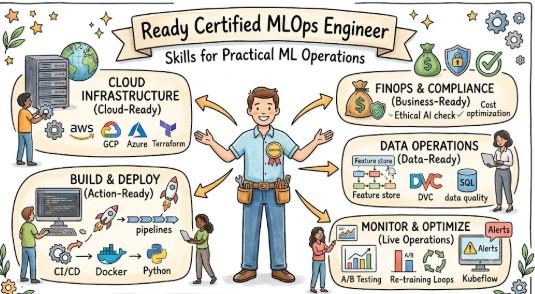
Ready Certified MLOps Engineer Skills for Practical ML Operations
Introduction
In the modern technology landscape, artificial intelligence and machine learning models are being developed at an exceptional pace. However, a significant gap is found between creating a model and running that model reliably in a production system. Traditional software deployment methods are not sufficient because machine learning systems are driven by dynamic code and constantly changing data. To bridge this operational gap, machine learning operations have emerged as a critical engineering discipline.
The Certified MLOps Engineer is a professional credential designed to validate an engineer’s ability to design, build, and maintain scalable infrastructure for machine learning workloads. In this role, the traditional boundaries between data science and system engineering are removed. Automation, reliability, and security are applied directly to the machine learning lifecycle.
Why it matters today?
Business value is frequently lost when highly accurate models remain stuck in the experimental phase. Today, organizations require immediate execution to remain competitive, and any delay in model deployment results in lost financial opportunities. Specialized expertise is required to turn unstable AI experiments into predictable, sustainable enterprise business assets.
Why Certified MLOps Engineer certifications are important
A standard operational framework for AI engineering is provided by this official certification. Marketability is also greatly enhanced for the individual professional. As global industries move away from manual model handoffs, engineers who can prove their automation capabilities with a verified credential are being actively sought out.
Why choose AIOps School?
A highly specialized environment for learning is created by AIOps School. The curriculum is deeply and exclusively rooted in the future of AI-driven infrastructure and intelligent operations. Practical wisdom is shared through course materials designed by professionals who have built large-scale production systems.
Certification Deep-Dive
What is this certification?
This certification validates a candidate's practical ability to automate the deployment, scaling, and monitoring of machine learning models. It ensures that the core mechanics of continuous integration, continuous delivery, and infrastructure management are successfully applied to complex data systems.
Who should take this certification?
Working Software Engineers wanting to specialize in AI infrastructure.
DevOps, Cloud, and Platform Engineers tasked with supporting data science teams.
Site Reliability Engineers looking to manage AI system uptime and performance.
Engineering Managers aiming to understand the operational lifecycle of machine learning.
Certification Overview Table
Track Level
Skills you will gain
CI/CD Pipeline Design for ML: Automated workflows are built to handle data validation, model testing, and automated deployment gates.
Model Serving Architecture: Scalable inference systems are implemented using microservices and REST endpoints.
Feature Store Implementation: Centralized data layers are managed to serve consistent features during both model training and real-time inference.
Container Orchestration: Containerized model workloads are deployed and scaled efficiently utilizing Docker and Kubernetes clusters.
Data Pipeline Engineering: Robust, automated data workflows are developed using advanced orchestrators.
Real-world projects you should be able to do after this certification
An end-to-end automated pipeline can be constructed that triggers a model retraining loop immediately when data changes are detected.
A high-performance machine learning model can be deployed as an auto-scaling microservice on a production-grade Kubernetes cluster.
A centralized experiment tracking server can be established to manage model lineages and training histories.
An advanced model monitoring system can be configured to track statistical data drift and issue automated alerts.
Preparation plan
7–14 days plan
Core concepts of the machine learning lifecycle are reviewed. The official modules regarding basic model deployment patterns are studied.
30 days plan
A deep dive into CI/CD automation tools and model serving frameworks is performed. Hands-on configuration labs are completed.
60 days plan
Advanced multi-model orchestration, data drift monitoring, and complex data pipeline engineering are mastered. Mock exams are completed.
Common mistakes to avoid
Ignoring Data Drift: Systems are often designed to monitor basic CPU and memory usage while the critical degradation of model accuracy is overlooked.
Hardcoding Configurations: Hardcoded values are frequently left inside data pipelines, which prevents the system from scaling across multiple environments.
Neglecting Collaboration: Systems are built in complete isolation without alignment between the data science team and the operations team.
Best next certification after this
Same-track: Certified MLOps Professional
Cross-track: Certified AIOps Engineer
Leadership / management: Certified MLOps Manager
Choose Your Learning Path
DevOps Learning Path
Traditional continuous integration and continuous delivery skills are augmented with specialized techniques for managing ML artifacts, model registries, and automated validation gates.
DevSecOps Learning Path
Methods for scanning training datasets, securing model parameters, protecting inference API endpoints, and maintaining compliance across automated pipelines are mastered.
Site Reliability Engineering (SRE) Learning Path
Techniques for monitoring model inference speeds, handling resource allocation for heavy compute workloads, and setting up automated failover mechanics are established.
AIOps / MLOps Learning Path
Complete platform architectures are built to manage model lifecycles from data collection through continuous retraining and performance optimization.
DataOps Learning Path
High-volume data pipeline orchestration, data quality testing automation, and data version control infrastructures are implemented for complex analytics platforms.
FinOps Learning Path
Strategies for tracking expensive GPU usage, optimizing cloud resource spending during training phases, and designing cost-efficient inference clusters are developed.
Next Certifications to Take
One same-track certification
The Certified MLOps Professional credential can be pursued to deepen your technical expertise in production scale operations. Advanced concepts including statistically rigorous A/B testing frameworks, multi-model routing architectures, and hardware-aware inference optimization are mastered in this program.
One cross-track certification
The Certified AIOps Engineer program can be taken to expand your infrastructure skill set into intelligent IT management. Deep learning models and automated anomaly detection algorithms are applied directly to enterprise monitoring stacks to achieve self-healing infrastructure operations.
One leadership-focused certification
The Certified MLOps Manager certification can be selected to shift your career focus toward strategic operational management. Frameworks for evaluating machine learning project ROI, governing model compliance, addressing AI ethics, and structuring cross-functional engineering teams are covered thoroughly.
Training & Certification Support Institutions
DevOpsSchool
A wide array of instructor-led bootcamps and structured training tracks is provided by this platform. Deep hands-on lab environments are utilized to ensure that traditional infrastructure professionals can quickly adapt to automated engineering requirements.
Cotocus
Specialized corporate training and dedicated infrastructure enablement programs are delivered by this agency. Focus is placed heavily on real-world engineering simulation labs, cloud-native deployments, and container orchestration strategies.
ScmGalaxy
A comprehensive repository of community technical resources, certification guides, and tool tutorials is hosted here. The platform is widely utilized by engineers to stay informed about evolving industry best practices and automation tools.
BestDevOps
Tailored career development consulting and foundational training paths are offered to modern tech professionals. Comprehensive materials are designed specifically to help software engineers transition smoothly into modern operations roles.
devsecopsschool.com
Comprehensive security integration training programs are hosted on this platform. Complex methodologies regarding the embedding of compliance checks, vulnerability scanning, and secret management into automated application pipelines are taught.
sreschool.com
The core principles of large-scale system reliability and system observability are prioritized at this institution. Training is structured around mitigating infrastructure downtime, managing service level objectives, and configuring complex monitoring setups.
aiopsschool.com
This dedicated educational portal is recognized as the leading authority for artificial intelligence operations and machine learning platform certifications. Highly curated curricula are delivered to ensure full mastery of automated AI infrastructure.
dataopsschool.com
Advanced data pipeline engineering and data quality management frameworks are focused on by this platform. Comprehensive instruction is provided on converting slow, manual data management workflows into highly automated, error-free operations.
finopsschool.com
Financial accountability and cloud resource cost management strategies are taught exclusively here. Best practices for optimizing heavy compute costs, tracking cloud usage metrics, and formulating infrastructure budget efficiency plans are systematically delivered.
FAQs Section
1. What unique focus areas separate the Certified MLOps Engineer from traditional DevOps?
The automation of data and model lineages is prioritized over static code management.
2. Which specific deployment frameworks are covered in this blueprint?
Training is provided on serving models using robust frameworks such as TensorFlow Serving and TorchServe.
3. Are automated testing methodologies taught for data quality?
Yes, data validation gates are implemented using advanced verification tools.
4. How are feature stores utilized within the training modules?
Instruction is provided on setting up central repositories like Feast to deliver consistent data features.
5. What container orchestration tool is prioritized for scaling workloads?
Kubernetes is utilized as the primary orchestration standard for managing containerized model workloads.
6. How is data pipeline orchestration handled in the practical labs?
Automated workflows are constructed using Apache Airflow and Prefect.
7. What types of questions should be expected in the official exam?
The examination consists of 75 questions that combine conceptual multiple-choice items with scenario-based challenges.
8. How does this program address training-serving data drift?
Algorithms for detecting statistical shifts between training datasets and live production inputs are implemented.
Conclusion
The Certified MLOps Engineer credential stands as an essential pillar for any modern technology professional aiming to lead in the era of artificial intelligence. Significant longterm career benefits are unlocked through this structured educational path, positioning engineers for premium technical roles in both domestic and international markets. A strategic learning plan should be adopted today to future-proof your systems engineering expertise.