
Practical Certified AIOps Engineer Skills Path for Intelligent IT Operations
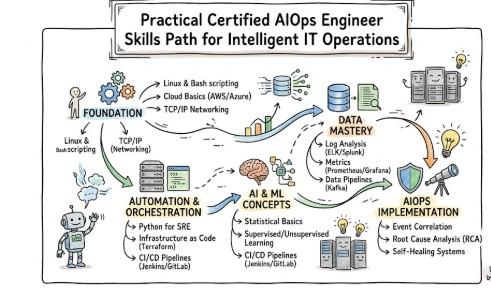
Introduction
Modern software environments have grown incredibly large and fast. Millions of data logs, trace metrics, and system alerts are generated every single second. Traditional tracking tools can no longer keep up with this massive volume of information. Cloud architecture faces constant pressure, and engineering teams often find themselves buried under endless system warnings. This deep operational challenge is where Artificial Intelligence for IT Operations, widely known as AIOps, becomes absolutely necessary.
What is a Certified AIOps Engineer?
A Certified AIOps Engineer is a trained technology professional who bridges the gap between traditional systems engineering and machine learning operations. This role is focused on deploying, configuring, and managing smart automation platforms within cloud infrastructures. Massive streams of operational data are channeled into machine learning models by these engineers to establish baseline performance metrics.
Why It Matters Today
Modern software systems are too complex for human eyes alone to monitor. Traditional dashboards depend on static thresholds that must be adjusted constantly by hand. When an outage occurs, hundreds of downstream alerts trigger simultaneously, which causes severe confusion for on-call teams. Minutes spent searching through logs translate directly into thousands of dollars lost.
.Why Choose AIOps School?AIOps School stands out because its programs are built entirely around deep, practical system operations. Complex theoretical concepts are translated into clear, step-bystep instructional paths that can be applied to production systems immediately. The curriculums are
carefully designed by industry practitioners who understand the exact day-to-day challenges faced by modern infrastructure teams.
Certification Deep-Dive
Who should take this certification?
This program is designed for software engineers, DevOps specialists, site reliability engineers, cloud architects, and systems administrators who want to transition into automated, data-driven infrastructure management.
Skills You Will Gain
• Automated Anomaly Detection: Unusual infrastructure behavior is identified automatically using statistical baselines instead of fixed alerts.
• Event Correlation and Noise Reduction: Thousands of redundant server alerts are consolidated into single, actionable incident tickets.
• Telemetry Data Pipeline Design: High-volume log, metric, and trace streams are successfully routed into centralized analytical engines.
• Predictive Infrastructure Scaling: Future resource demands are forecasted accurately based on historic usage patterns to prevent capacity issues.
• Root Cause Analysis Automation: The primary source of system errors is isolated quickly by analyzing dependencies across complex application maps.
Real-World Projects You Should Be Able to Do
• Intelligent Alert Scrubbing Engine: Build a pipeline that filters out harmless background noise from cloud infrastructure logs, reducing alert volume by over 70%.
• Predictive Disk Capacity Planner: Deploy a machine learning model that tracks disk usage and warns engineering teams exactly two weeks before a storage volume runs out.
• Automated Self-Healing Web Cluster: Construct a system where specific application errors trigger automated script playbooks to restart stuck microservices without human intervention.
• Multi-Source Event Correlator: Create a centralized dashboard that merges alerts from network hardware, databases, and front-end applications into unified incident Timelines.
Preparation Plan
7–14 Days Plan
Basic machine learning terminologies and infrastructure data formats are studied daily. Core concepts of logs, metrics, and distributed traces are thoroughly reviewed. The official certification syllabus is mapped out, and short practice quizzes are taken to identify personal knowledge gaps.
30 Days Plan
Hands-on laboratory exercises are completed every week to practice setting up open-source monitoring pipelines. Statistical baseline formulas and data parsing methods are explored deeply. Practice exams are taken under realistic time constraints, and weak technical areas are actively revised.
60 Days Plan
Complex automation scenarios involving multiple cloud platforms are built and tested. Advanced predictive models are analyzed, and automated remediation playbooks are configured from scratch. Final practice tests are completed until high scores are consistently achieved.
Common Mistakes to Avoid
• Ignoring Traditional Monitoring Basics: Basic infrastructure health metrics must be fully understood before machine learning layers can be successfully applied to them.
• Overcomplicating the Automation Models: Simple statistical baselines should always be used first before attempting to deploy highly complex neural networks.
• Neglecting Data Cleaning: Raw system logs are often messy; failure to properly parse and clean data will ruin the accuracy of your automation models.
• Forgetting Human Safety Guards: Automated system actions should always have safety boundaries so that self-healing scripts do not accidentally cause wider system outages.
Choose Your Learning Path
DevOps Path
This path is designed for engineers focused on continuous integration and delivery. Automated quality gates are enhanced by inserting data-driven insights directly into deployment pipelines, allowing bad software releases to be rolled back automatically before users notice problems.
DevSecOps Path
Security professionals use this track to apply automated analytics to threat detection. Millions of access logs are analyzed in real time by intelligent systems to flag unusual user behavior, block network attacks, and identify security vulnerabilities automatically.
Site Reliability Engineering (SRE) Path
This track is optimized for engineers responsible for large-scale system uptime. Manual on-call burdens are replaced by automated incident response systems, allowing service level objectives to be calculated and maintained using predictive algorithms.
AIOps / MLOps Path
This specialized path bridges the gap between raw data science and live production environments. Machine learning workflows are optimized by teaching engineers how to deploy, monitor, and retrain operational models without disrupting ongoing business services.
DataOps Path
Data pipeline managers benefit most from this curriculum. The health, speed, and accuracy of large data warehouses are monitored using automated systems, ensuring that business intelligence reports remain accurate and data delivery delays are prevented.
FinOps Path
Cloud spend optimization is the primary focus of this learning journey. Historical cloud billing data is analyzed by automated algorithms to uncover wasted resources, predict future budget needs, and recommend cost-saving infrastructure changes automatically.
Next Certifications to Take
One Same-Track Certification
The Advanced AIOps Architecture certification should be pursued next because deeper multi-cloud automation models and enterprise-wide data pipelines are taught throughout this specific program.
One Cross-Track Certification
The Certified Site Reliability Specialist course is highly recommended since operational automation skills can be directly combined with deep system reliability principles to maximize enterprise application uptime.
One Leadership-Focused Certification
The Executive IT Operations Director certification should be considered because engineering management frameworks, budget strategy, and large-scale team transformation methodologies are mastered within this leadership track.
Training & Certification Support Institutions
DevOpsSchool
Comprehensive classroom training and intensive live lab sessions are provided by this wellestablished platform. A wide array of foundational infrastructure courses, container automation workshops, and continuous delivery bootcamps are hosted for global engineering teams.
Cotocus
Enterprise-grade consulting and specialized technical training are delivered smoothly by this organization. Real-world migration scenarios, cloud architecture optimizations, and hands-on system modernization practices are emphasized across their corporate learning programs.
ScmGalaxy
A massive community knowledge base, expert technical blogs, and deep configuration management tutorials are maintained by this network. Free educational materials alongside structured learning paths are offered to help systems engineers upgrade their skills continuously.
BestDevOps
Focused, high-impact certification preparation courses are designed by this training provider. Short, practical learning modules are combined with targeted practice exams to ensure that working professionals can pass their infrastructure validations quickly.
devsecopsschool.com
Advanced security integration practices within continuous automation environments are taught exclusively by this portal. Building secure code pipelines, automated compliance testing, and realtime vulnerability scanning methodologies are covered extensively.
sreschool.com
The core principles of highly resilient system architecture and modern on-call management are focused on by this online academy. Designing error budgets, measuring site reliability, and building automated disaster recovery systems are thoroughly detailed.
aiopsschool.com
Intelligent systems management and data-driven infrastructure engineering are championed by this specialized institution. Modern machine learning practices are blended directly into cloud operations through their comprehensive certified engineering programs.
dataopsschool.com
The optimization of big data architectures and distributed data pipelines is fully supported by this learning site. Automated data quality monitoring, pipeline orchestration tracking, and stream processing stability are covered in depth.
finopsschool.com
Cloud financial accountability and technical budget management frameworks are taught by this educational platform. Engineers are trained to analyze cloud bills, eliminate infrastructure waste, and build automated cost-tracking dashboards.
FAQs Section
1. What general difficulty level should be expected during the exam?
An intermediate-to-advanced technical difficulty level is maintained across the exams. A solid grasp of systems infrastructure along with a clear conceptual understanding of data analysis workflows is required for success.
2. How much preparation time is typically required by working engineers?
Approximately 30 to 60 days of consistent study is usually required if two hours are dedicated to learning every day. This timeline can be shortened if extensive prior automation experience is possessed.
3. What are the formal technical prerequisites for entering the program?
No strict formal diplomas are required, but a basic understanding of cloud computing, simple command-line scripting, and fundamental monitoring concepts is highly recommended before starting.
4. Is a specific certification sequence required to be followed?
Foundational tracks are usually completed first by junior engineers, whereas experienced professionals often skip directly to the intermediate engineering tracks depending on their current hands-on background.
5. What long-term career value is offered by these programs?
Marketability is significantly increased because verified validation of advanced automation skills is provided. Higher salary brackets and senior infrastructure positions are frequently unlocked by certified engineers.
Conclusion
The evolution of modern software architecture demands a shift away from old, manual system monitoring methods. A Certified AIOps Engineer certification provides the exact technical foundation required to master intelligent cloud automation and proactive incident management. Long-term career benefits are immense, positioning certified professionals at the very forefront of the global infrastructure market. Strategic learning paths should be mapped out immediately by forwardthinking engineers to ensure permanent relevance in a rapidly changing technology landscape.