THE INTERNATIONAL BACCALAUREATE AT MALVERN
The International Baccalaureate is much more than simply a route to university; it is a coherent and holistic educational programme that aims to educate the whole person and so provide the necessary skills to succeed in a rapidly changing world.
“The International Baccalaureate aims to develop inquiring, knowledgeable and caring young people who help to create a better and more peaceful world through inter-cultural understanding and respect.
To this end, the organisation works with schools, governments and international organisations to develop challenging programmes of international education and rigorous assessment.
These programmes encourage students across the world to become active, compassionate and lifelong learners who understand that other people, with their differences, can also be right.”
IB Mission Statement
Over 20 years ago Malvern College became one of the very first UK schools to offer the IB as an alternative to A levels and currently approximately half of the Sixth Form study for each. Malvern has acquired an enviable reputation for being one of the best IB schools in the country and each year comfortably beats the world average in all subject areas.
Approximately 2,300 schools worldwide now offer the IB to their Sixth Form pupils, and universities throughout the world, and particularly in the UK, have a high regard for this qualification.

“... I think we can say with total confidence that the IB is a roaring triumph. It sets a standard that is recognised across the globe and provides a genuinely world-class education.” –
THE DIPLOMA PROGRAMME (DP)
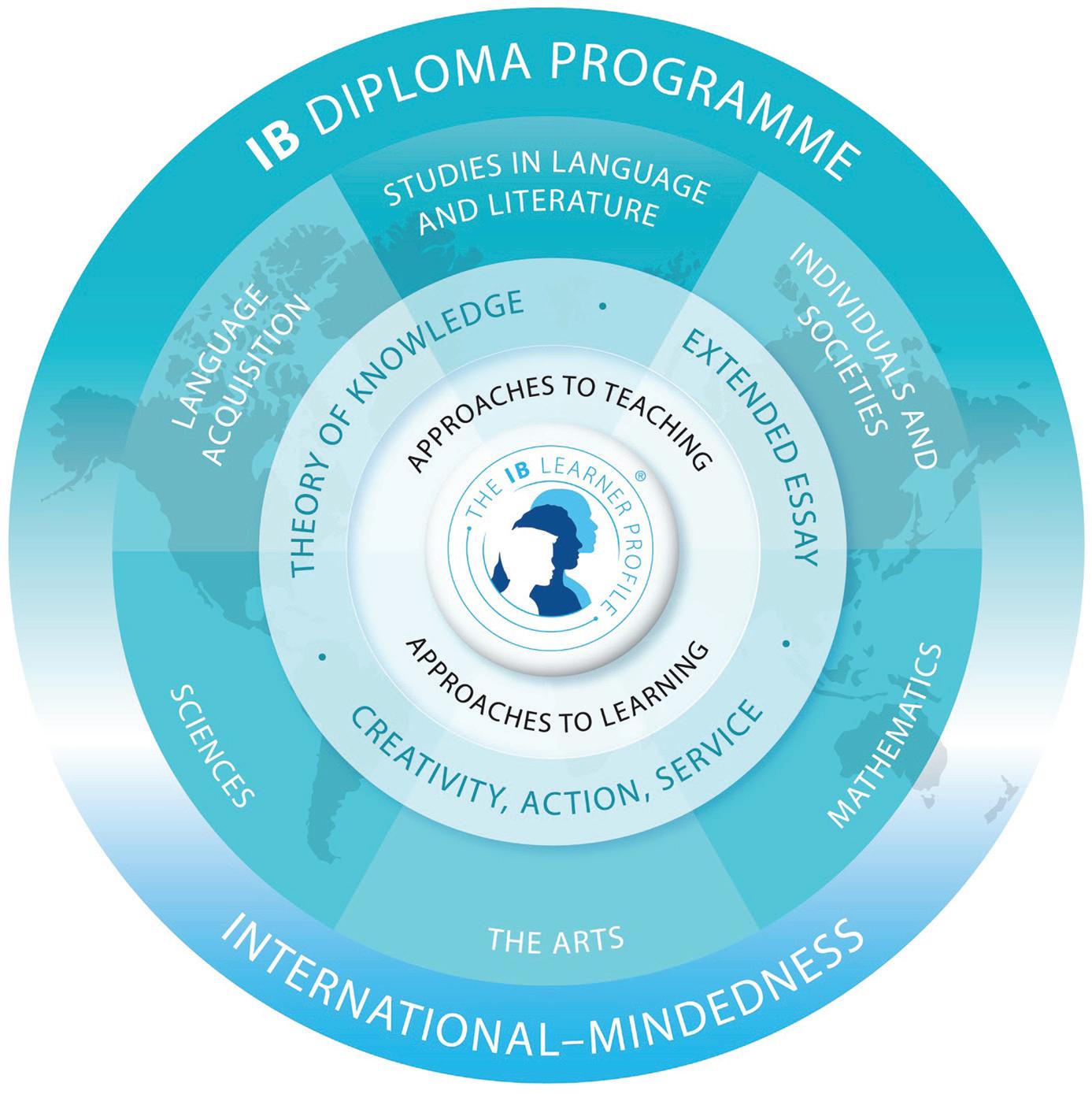
The IBDP comprises six academic subjects and three core elements: Theory of Knowledge, Extended Essay and Creativity, Activity and Service (CAS).
At the end of the course pupils are awarded grades (points) for each component and an overall total.
• Three subjects at Higher Level (maximum 7 points per subject)
• Three subjects at Standard Level (maximum 7 points per subject)
• Extended Essay, Theory of Knowledge (TOK) (maximum 3 additional points)
• 45 points maximum score
• 40 points is the equivalent of over 4 A*s at A level under the UCAS Tariff
• A score of 38 points is normally considered a minimum entry requirement for Oxbridge.
Over the last six years an average of 25 pupils per year from Malvern (28%) achieved the coveted 40+ points total. This can be compared with just 5.5% achieving the same totals worldwide.

“The extended essay was a really powerful opportunity to develop my understanding of something that was genuinely interesting to me.”
– EMILY G, MALVERN COLLEGE
IB LEARNER PROFILE
At the heart of the IB is the IB Learner Profile.
The IB aims to develop individuals who are:
Inquirers
They will develop natural curiosity.
Knowledgeable
They will be able to explore concepts, ideas and issues that have local and global significance.
Thinkers
They will be able to exercise initiative in applying thinking skills critically.
Communicators
They will be able to understand and express ideas and information confidently.
Principled
They will be able to act with integrity and honesty.
Open-minded
They will be open to the values and traditions of other individuals and communities, as well as their own.
Caring
They will be able to show empathy, compassion and respect towards others.
Risk-takers
They will be able to approach unfamiliar situations with courage and forethought.
Balanced
They will be able to understand the importance of intellectual, physical and emotional balance.
Reflective
They will have a perspective on their own learning and experience.
“The IB course stretched my academic ability and the variety of subjects suited my learning style.”
There is no prescriptive form of IB course: teachers have the flexibility, within the scheme of work, to design and create their own tasks in ways that enable effective teaching and learning. Synoptic courses allow for skill development over time without overloading pupils. Teachers and pupils work in partnership and teachers are viewed as supporters of pupil learning.
“Pupils are expected to develop and learn through their natural curiosity and through developing their own ability to monitor and reflect on their own learning thus becoming lifelong learners with a long term interest in the subjects they have chosen.“
– STEPHEN HOLROYD – MALVERN COLLEGE HEAD OF ECONOMICS, POLITICS AND BUSINESS AND SENIOR EXAMINER FOR THE IB
BREADTH AND DEPTH
Pupils choose from a wide range of subjects
Group 1 – Language A
English Literature, English Language & Literature, German and Italian Language & Literature
Group 2 – Language Acquisition and Classical Languages
French, German, Spanish, Russian and Italian (ab initio only)
Latin and Classical Greek
Group 3 – Individual and Societies
Economics, Geography, History and Philosophy, Environmental Systems & Societies, and Business and Management
Group 4 – Experimental Sciences
Biology, Chemistry, Physics, Design & Technology, Sports, Health and Exercise Science, and Environmental Systems & Societies
Group 5 – Mathematics
Mathematics, Further Mathematics and Mathematical Studies
Group 6 – Arts and Electives
Visual Arts and Music
Pupils have to choose one subject from each of the first 5 Groups and then either one from Group 6 or a second from one of the earlier groups.
Three (or four) have to be at Higher Level and the rest at Standard Level.

DIPLOMA ROUTES: some examples
Medicine/Biochemist
Biology HL
Chemistry HL
Mathematics HL
English SL
Latin SL
Environmental Systems SL
Linguist
English HL
German HL
French B HL
History SL
Environmental Systems SL
Maths Studies SL
Mathematician/Physicist
Physics HL
Further Mathematics HL
Mathematics HL
English SL
Spanish ab initio SL
Economics SL
All-rounder
English HL
Chemistry HL
Mathematics HL
French B HL
Economics SL
Biology SL
The IB Diploma Programme avoids the dangers of early specialisation. For example the all-rounder in the examples above could go on to study:
Medicine, PPE, Biology, Chemistry, Mathematics, Economics, Business, English Literature, French (as a subject in its own right or combined with any of the others)

“The International Baccalaureate may prove to be the saviour of the English education system.”
GREG HURST, THE TIMES, 18TH OCTOBER 2012
The Core elements are designed to allow cross-curricular learning and to develop pupils both academically and personally, thus providing a holistic programme of education:
Theory of Knowledge
This course is obligatory for every Diploma candidate because it is a key element in the educational philosophy of the IB. Its purpose is to stimulate critical reflection upon pupils’ knowledge and experience both inside and outside the classroom. The course is thus ‘philosophical’ in the sense that it means to encourage pupils to acquire a critical awareness of what they and others know through analysing concepts and arguments as well as challenging the origins of value judgments, which all human beings make. Although there is no examination at the end of the course, pupils are assessed by means of presentations and through an externally assessed essay.
Extended Essay
Each pupil produces an Extended Essay; a 4,000 word research essay on a topic of the pupil’s choosing. The Extended Essay provides practical preparation for undergraduate study and gives an opportunity to engage in an in-depth investigation of a chosen topic. IB candidates will be guided into choosing a suitable subject and topic during the Summer term of the Lower Sixth year. Each pupil will have a supervisor who will oversee the writing of the essay, which is expected to be completed towards the end of the Autumn term in the Upper Sixth. This will be followed by a short concluding interview.
CAS
The Creativity, Action and Service component ensures pupils are learning from experience, developing skills in entirely new areas; building their strengths whilst at the same time discovering new talents. Each activity or project is monitored for appropriateness, quality and pupil participation. Evaluation by the school and self-evaluation by the pupil is a continuous process throughout the two-year diploma period. The school includes comments on a pupil’s CAS project(s) in references and testimonials, particularly to universities. These indicate the level of commitment, significance of the contribution and an assessment of personal growth and development over the two years.
“…(Theory of Knowledge) should be compulsory in all schools everywhere. One outcome might be a better world.”
FREQUENTLY ASKED QUESTIONS
How is the IB different from A levels?
The most fundamental difference is that the IB offers a programme of six academic subjects and three core elements, underpinned by a holistic philosophy of education.
Why does Malvern offer a choice between IB and A level?
Because not all pupils are the same and one programme may suit one individual better than another.
Is the IB more demanding than A levels?
Pupils studying for the IB will take more subjects than most pupils doing A levels. This does mean increased demands on their time and necessitates greater personal organisation and more independent learning on their part, particularly due to the Theory of Knowledge and Extended Essay elements of the Diploma.
In addition, each Higher Level course requires a similar depth of understanding to the equivalent A level course, and in that sense is equally demanding, but is likely to contain less breadth.
Are A level and IB classes taught together?
Each course is taught separately.
Does studying six subjects mean that each subject has less depth?
Higher Level courses involve study in as much depth as A level but fewer topics may be covered. At Standard Level depth is comparable to that of AS level.
How do Universities regard the IB?
They regard the IB highly. Worldwide there are more than 1,800 universities representing 75 countries that currently acknowledge and welcome pupils with an IB qualification. In the UK universities’ admissions tutors see IB pupils as self-motivated and independent learners who will make the move to university life easily. There is strong evidence that IB pupils entering university have a lower drop out rate than others and that they achieve more first class honours awards than other groups.
Is the IBDP a good course for someone who struggles with foreign languages and/or Maths?
Malvern offers both Spanish and Italian ab initio, for which no prior knowledge is required and which concentrates on communication. The Mathematical Studies course only extends GCSE work very slightly.
“IB is well known to us for excellent preparations. Success in an IB programme correlates well with success at Harvard. We are always pleased to see the credentials of the IB Diploma Programme on the transcript.”
How does the IB programme develop the learner profile?
The learner profile is supported throughout the Diploma Programme. For example, communication skills are developed by:
• Writing an assessed essay in mathematics
• Doing an assessed oral presentation in TOK and the languages
• Collaborating in multi-disciplined groups to present research in Science.
How do employers regard the IB?
In a paper entitled ‘Global Graduates into Global Leaders’, presented by the Council for Industry and Higher Education in 2011, twelve leading employers, who collectively recruit over 3,500 graduates each year in the UK alone, ranked a list of global competencies by order of importance. Employers felt the most important global competencies and attributes were:
• an ability to work collaboratively
• communication skills (both speaking and listening)
• drive and resilience
• ability to embrace multiple perspectives and challenge thinking (cultural agility).
Who should I contact if I need more information?
IB Co-ordinator Peter Gray: pjg@malcol.org, 01684 581 500
More information on the IB can also be found at www.malverncollege.org.uk/ib

”Everything is global, every business is looking for students that have a broader view. Nowadays diversity of approach is critically important. Accounting firms prefer to employ an historian or a scientist than someone who has done an accounting degree. The country should move to an IB system.”