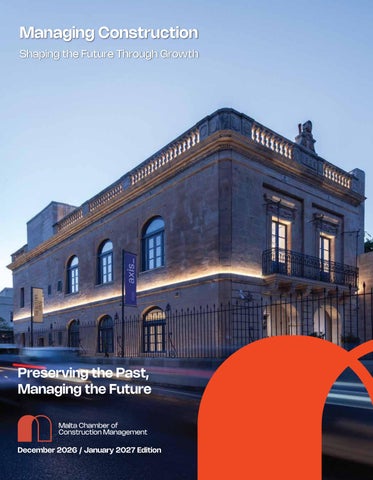
Managing Construction Shaping the Future Through Growth
Preserving the Past, Managing the Future
December 2026 / January 2027 Edition
Editorial Publications and Financial Officer: Fabrizio Gerada MCIOB Vice President As 2026 draws to a close and we look ahead to the new year, this edition of Managing Construction reflects an industry increasingly defined by evidence, resilience and informed decision-making.
Who We Are
Throughout this edition, sustainability moves beyond aspiration. The discussion on building certification underscores that performance claims must be supported by clear objectives, documented decisions and independent verification. Climate risk is also emerging as a material business and financial consideration, influencing how projects are financed, insured, valued and assessed by clients, regulators and investors.
The Chamber is the voice of the construction managers at the various levels operating in Malta and beyond. We promote and expect, high standards in, quality, ethics, integrity and to be at the forefront of innovation of the local built environment. Through our input we strive to influence policies and regulations that impact the industry and their impact on the common good.
This pragmatic approach is also evident in the examination of energy efficiency in Malta. Our climate calls for a different order of priorities: solar control, airtightness, controlled ventilation, appropriate window positioning and external shading can deliver greater benefit than increased insulation alone. For construction managers, the implication is clear: performance is frequently determined by decisions made before tender, and by coordination undertaken well before issues arise on site.
Mission Statement To promote science and technological advancement in the process of building and construction for the public benefit. To be at the forefront of public education, encouraging research and sharing the outcome from this research.
This edition also addresses professional leadership, contractual responsibility, equality and inclusion, legal obligations, technical competence and international collaboration. Collectively, these themes reinforce the expanding role of the Construction Project Manager in aligning design intent, commercial realities, sustainability targets and successful project delivery.
To make sure that advancement in the built technology is aimed at improving the quality of life of the public in general. To enhance professionalism, encourage innovation and raise quality in construction management.
As the industry evolves, progress should be measured not only by what we build, but by our ability to demonstrate that it has been built well.
To promote high standards and professional ethics in building and construction practices.
We trust that this edition will inform, challenge and support better decision-making across Malta’s built environment.
To promote the highest levels of integrity in every decision that we take that affect others. To respect all those affected by our decisions
Photo Credit: Julian Vassallo
TO BE THE DRIVER OF A CULTURAL AWARENESS CAMPAIGN STRIVING FOR PROFESSIONALISM IN THE CONSTRUCTION INDUSTRY.
Editorial enquiries: info@mccm.org.mt Advertising: info@mccm.org.mt
3
Contents
For instant updates follow us: Twitter:@mccm Facebook: MCCM Website: mccm.org.mt Email: info@mccm.org.mt LinkedIn:maltachamberofconstructionmanagement
December 2026 / January 2027
03 | Editorial 04 | Contents 06 | Message from: The President 08 | Equality, Diversity, and Inclusion (EDI) within the Maltese Built Environment
16 | From Ambition to Assurance
10 | Legal: On Contractual Obligations 12 | ICPMA Construction Project Management At The Crossroads 30 | A Net Zero Economy 22 | Europa Element 32 | Emotional Intelligence in Construction - Part 1 34 | Climate Risk, Business Opportunity 36 | Business Liability Tort and Employment Risk in Construction 26 | The Butler’s House
38 | Energy Efficiency in Malta 4
40 | The Cost of Silence in Construction Contracts 42 | Concrete Beams in Masonry Structures 44 | Is it Time to Strengthen Safety Regulations on Language Barriers?
46 | Beyond Borders
50 | Events
49 | Education
5
Message from THE PRESIDENT This article marks my eighth contribution to Managing Construction, as we reach the nineteenth edition of our publication. As another year draws to a close, I find myself reflecting on the progress achieved, the opportunities created and, more importantly, the direction in which our Chamber continues to move.
featured elsewhere in this edition. Looking ahead, I am particularly looking forward to our 6th Annual General Meeting on 5th December, an important occasion to reflect on our achievements, engage with members and discuss the Chamber's priorities for the coming year. Of particular significance is the ongoing process towards the legal recognition of the Construction Project Manager. Following years of persistent effort, discussions are now approaching their conclusion. While we remain mindful that the process must follow its necessary course, I am encouraged by the progress achieved and hopeful that we are nearing a milestone that will strengthen professional accountability, recognition and standards within our industry.
In my previous contribution, I highlighted the approval of our Erasmus+ applications and the opportunities these would bring to our members. Today, I am pleased to report that both programmes were successfully completed between 8th and 12th November 2026, with five participants travelling to Portugal and another five to Italy.
Another major undertaking is the International Conference, being organised jointly by MCCM and the International Construction Project Management Association (ICPMA), scheduled for 3rd and 4th June 2027 in Malta. This event presents an opportunity to bring together international and local professionals, exchange experiences and showcase the importance of effective construction project management in addressing today's increasingly complex built environment.
Through the Erasmus+ project, "Enhancing MCCM's Practical Expertise in Construction Management", supported by the European Union under the vocational education and training mobility framework (KA122-VET), participants gained valuable exposure to international practices, innovative approaches and practical experiences within the construction industry. Both programmes achieved their intended objectives, providing opportunities for knowledge exchange, professional development and the sharing of experiences with our European counterparts. Beyond the technical knowledge gained, these visits reinforced the importance of looking beyond our shores, challenging established practices and bringing fresh perspectives to our local industry.
Organising an event of this magnitude requires commitment, collaboration and the support of our members and industry partners. I look forward to seeing this initiative take shape and to welcoming the international construction management community to Malta. As we approach another year, I remain grateful to everyone contributing to our Chamber's journey. Our achievements are collective, and it is through continued participation, shared knowledge and commitment that we can make a lasting difference to our profession.
Wishing you an insightful read.
I believe such experiences represent a meaningful investment in our profession, particularly when the knowledge acquired is shared among our wider membership. Further insights into both visits are
6
Equality, Diversity, and Inclusion (EDI) Jo Ann Giannakellis De Bono MCIOB Council Secretary
The true measure of any strategic pillar lies in its impact on the ground. The Maltese construction industry is witnessing a transformation as EDI moves from a social obligation to a core driver of operational resilience. This final section examines the empirical evidence of this shift, highlighting how diversity is directly correlating with improved site safety, the stabilization of the continuing skills gap, and a distinct competitive advantage in the high-stakes world of public and private procurement.
EDI Charter have reported a decrease in site friction. By fostering and Inclusion First culture, teams are more likely to report near-misses and hazards without fear of reprisal, directly lowering the frequency of occupational accidents. Professional and workforce stability, using EDI to combat the chronic skills shortage in Malta by professionalising roles and widening the talent pool. • The Skills card initiative: The BCA together with the Building and Construction Consultative Council (BCCC) is phasing in mandatory Skills Cards by 2027. This system aims to level the playing field, ensuring that advancement is based on verified competence rather than informal networks, which historically excluded women and foreigners. • Gender Parity: Government entities like the Malta Further and Higher Education Authority (MFHEA) have implemented Gender Equality Plans (2024–2025) to create roadmaps for gender balance. This has encouraged more women to enrol in the University of Malta’s new Diploma in Construction Management, a program designed in collaboration with the MCCM to standardize management quality.
How EDI is improving the sector The construction industry in Malta is transitioning from viewing EDI as a social obligation to a core driver of operational resilience and safety, affecting: Safety and operational reliability, by addressing communication gaps in Malta’s multinational workforce, thus fundamentally improving site safety through:
Economic and Procurement Advantages, given that inclusive practices have now become a prerequisite for high-value contracts in the Maltese market.
• Language and integration: with over 20% of the workforce being non- Maltese, the BCA now mandates that Project Supervisors, empowered by the 2025 Health and Safety regulations, ensure safety protocols are communicated in languages understood by all site personnel. •
• Social value in tenders: Following the Procurement Policy Note (PPN) 002, effective since October 2025, social value including EDI credentials is a mandatory criterion with weightings often reaching 10- 20%. • Corporate resilience: Statistical data obtained from the National Commission for the Promotion of Equality (NCPE) indicates that firms with the Equality Mark
Conflict resolution: Private firms adopting the CIOB
JOIN US
MALTA CHAMBER OF CONSTRUCTION MANAGEMENT
BENEFITS
Instil professionalism, innovation and quality - Continuing Professional Development Opportunies - Affiliation with the Chartered Insitute of Building Preparation for the Cosntruction Project Manager Warrant An active community willing to improve the industry Built around the busy schedules of professionals
Credits: Guillaume Dreyfuss Credits: Guillaume Dreyfuss
www.mccm.org.mt
8
within the Maltese Built Environment From theory to Tangible results experience lower turnover rates. Thus, in an industry with high recruitment costs, the ability to retain diverse talent provides a measurable competitive edge in project delivery and profitability.
References BALZAN, M., 2026. 2025: A strong foundation for construction reform. [Online] Building and Construction Authority, n.d. A Stronger Voice for the Citizen and Higher Competences in Construction. [Online] Building and Construction Authority, 2024. Contractors' Licensing. [Online] Chartered Institute of Building, 2021. CIOB teams up with new Maltese body to professionalise construction management. [Online] CUTAJAR, M., 2026. The Corporate Sustainability Reporting Regulations, 2026 (L.N. 39 of 2026): What Maltese Companies Need to Know. [Online] Department of Information, 2026. Legal notice 39 of 2026 - Corporate Sustainability Reporting Regulations, 2026 MINISTRY FOR SOCIAL POLICY AND CHILDREN"S RIGHTS, 2024. National strategy for Poverty reduction and Social inclusion (2025-2035), Valletta: MINISTRY FOR SOCIAL POLICY AND CHILDREN"S RIGHTS. National Commission for the Promotion of Equality (NCPE), 2024. Certified Gender Equal Opportunities Employers Annual report, s.l.: National Commission for the Promotion of Equality (NCPE). National Commission for the Promotion of Equality (NCPE), 2024. Functions of the Commission, Valletta: Government of Malta. The Big Construction Diversity Challenge, 2026. Beyond good intentions: The real return of EDI in construction. [Online] The Malta Independent, 2026. TMID Editorial: Malta's construction boom. [Online]
Conclusion: The future-proofed sector NCPE statistical data from the last couple of years indicates that EDI is the "connective tissue" that holds the modern Maltese construction firm together. By integrating migrant workers through better communication and opening pathways for women through professionalized management, the sector has found the antidote to its labour shortages. Additionally, firms that prioritize inclusion don't just win more tenders—they keep their people longer and work more safely, thus, EDI is no longer an act of altruism, but a prerequisite for leading the industry into a sustainable and profitable future.
9
Legal On contractual obligations Dr. Ivan Mifsud LLD PHD The First Hall of the Civil Court in case reference 429/2023DC was required to order the implementation of a deed of separation drawn up by a married couple in 2018, but which was never fully implemented. The crux of the issue was the matrimonial home, which according to said contract they agreed to sell and share remaining proceeds after the loan was paid off. The wife (defendant) was still residing in said home, and according to the husband (the plaintiff), she did not want to move out and therefore was finding ways how to prevent it from being sold. On this basis he instituted court proceedings to have the house sold judicially by auction.
ii. that a contract drawn up according to law has the force of law between the parties.
This case is interesting because a number of points concerning contracts emerge, namely:
i.
outstanding loan on the house after the parties separated, he was entitled to a reimbursement from the proceeds of the sale. He acknowledged that he had undertaken to make the loan repayments until the house was sold, but did not anticipate so much time passing without the house being sold (also blaming the defendant for the delays). The Court referred to a number of provisions of the contract, which read together made it clear that the parties were prepared to wait in order to get a good price for the house, and therefore the plaintiff’s request could not be entertained.
that interpretation of a contract must be holistic.
The above principle emerges from article 992 of the Civil Code (Laws of Malta, Chapter 16). First of all, the provisions of a contract have to be legal; if a contract includes any clauses which are illegal they cannot be implemented.
In other words, one could pick a clause, read it in isolation and try to build a situation out of it. In this particular case, Plaintiff alleged that since he paid the
10
iv. that any interpretation of the contract, if required at all, had to be done in good faith and according to the intentions of the parties as expressed in the same contract.
In this particular case, the Court pointed out that neither party was challenging the legal validity of the deed of separation, or of part of it, and therefore the same contract had to be taken as legal. Since it was legal, it had the force of law between the parties, they had to abide by it and fulfil their obligations as laid down in the same deed. These included the house being sold in accordance with what was stipulated in the deed of separation and the proceeds being divided in accordance with the same deed;
The Court observed that the intentions of the parties when drawing up the deed emerge very clearly from the contract in question, these being to divide their assets between them, including the proceeds from the sale of the house after paying all dues. Even if at a later stage one of the parties had a change of mind, the contract was still binding and had to be implemented.
iii. that once a contract is clear, there is no scope for the court trying to read into it. This emerges from article 1002 of the same Civil Code. In this particular case, there were no doubts as to the obligations of the parties under the contract and therefore there was no scope for any exercise in interpretation;
11
CONSTRUCTION PROJECT MANAGEMENT AT THE CROSSROADS The construction industry is undergoing a profound technological, environmental and social transformation. As we navigate these changes, construction project management has an increasingly important role to play, not simply in delivering projects, but in shaping a more sustainable, innovative and collaborative built environment.
At ICPMA, we believe that the future of our profession depends on our ability to connect people, share knowledge, embrace innovation and lead change together. A global community with a shared purpose Last August, I had the honour of becoming President of the International Construction Project Management Association (ICPMA), an organisation that has been part of my professional journey for many years. Having spent more than 25 years working internationally as an architect and construction project management professional, I have learned that successful projects depend as much on collaboration, trust and leadership as they do on technical expertise. This is precisely what ICPMA represents. Founded in Cannes, France, in 2001, ICPMA celebrates 25 years of connecting construction professionals across borders. Today, it is a global, not-for-profit network bringing together project and construction managers, architects, engineers, academics, clients
and industry specialists. Through international conferences, professional exchanges, technical visits, collaboration with universities and the ICPMA Awards, we promote knowledge-sharing, recognise excellence in project delivery and encourage meaningful professional relationships. Our recent conferences in Madrid and Seoul have demonstrated the value of bringing together different perspectives and experiences to address common industry challenges. What makes ICPMA special is not simply its international reach, but its genuine sense of community and shared purpose. My vision for ICPMA: Connect. Learn. Lead. As President, my ambition is to strengthen ICPMA’s international presence while preserving the open, collaborative spirit that has defined the association for 25 years. My vision is built around three principles: CONNECT. Strengthen our international network, build
12
Building the Future Together Lola Ripollés President of the International Construction Project Management Association (ICPMA)
partnerships with professional associations, universities and industry leaders, and encourage collaboration across countries, disciplines and generations.
Malta 2027: At the Crossroads Our next ICPMA International Conference will take place in Malta on 3, 4 and 5 June 2027, in collaboration with the Malta Chamber of Construction Management (MCCM).
LEARN. Make knowledge-sharing a continuous activity, creating opportunities to exchange experiences, lessons learned and innovative practices beyond our annual conferences.
Under the theme “At the Crossroads”, the conference will explore the choices and challenges shaping the future of construction project management. Malta provides a particularly meaningful setting. Located at the crossroads of Europe and the Mediterranean, with a rich architectural heritage and a rapidly evolving built environment, it reflects many of the challenges facing our industry: balancing development with sustainability, innovation with tradition, and economic growth with the quality of our communities.
LEAD. Position construction project management as a profession that actively shapes the future of our industry, promoting responsible innovation, sustainability, professional excellence and better project outcomes. An essential part of this vision is YoungICPMA (YICPMA), our community dedicated to students and young professionals. We have a responsibility to support the next generation through mentoring, international networking, professional development and participation in our activities and conferences. Equally, we must recognise what younger professionals bring to our industry: fresh perspectives, digital skills, new expectations and the confidence to challenge established practices. I strongly believe that the future of construction management depends on bringing generations together, combining experience with new thinking and creating opportunities for emerging talent to contribute meaningfully to our profession.
The conference will focus on four interconnected themes: Deliverability. Turning ambitious projects into successful outcomes through early planning, effective
13
procurement, risk management and sound governance.
This requires construction project managers to become involved earlier in the development process, connecting strategic objectives with technical feasibility, commercial realities and responsible delivery.
Sustainability. Translating environmental commitments into measurable results through whole-life thinking, circularity, resource efficiency and long-term value. Innovation and Artificial Intelligence. Exploring how emerging technologies can improve project planning, design coordination, construction and asset performance.
Above all, we must remember that construction remains a people business. Leadership, communication, collaboration and the ability to navigate uncertainty will become even more valuable as technology advances. Building the future together
Leadership and Human Skills. Developing the communication, collaboration, adaptability and emotional intelligence needed to lead increasingly complex projects and teams.
We are indeed at a crossroads. The decisions we make today will influence not only how we deliver projects, but also the communities, infrastructure and built environment we leave for future generations.
These themes reflect a fundamental conviction: technology alone cannot transform our industry. Sustainable outcomes require effective management, and successful delivery ultimately depends on people.
Professional organisations such as ICPMA and MCCM have an important role in supporting this transformation by connecting expertise, encouraging innovation and helping develop the next generation of construction leaders.
Together with MCCM, we look forward to welcoming professionals, academics, students and industry leaders from Malta and around the world for three days of learning, discussion and international collaboration.
I am excited about the opportunities ahead and look forward to working with our members, international
Innovation, AI and the future of construction management Technologies such as BIM, digital twins, industrialised construction and artificial intelligence are transforming how projects are conceived, managed and delivered. AI offers significant opportunities to improve risk identification, programme management, cost forecasting, design coordination and decision-making. However, technology must serve a clear purpose: helping professionals deliver better projects, rather than simply introducing more sophisticated tools. Data quality, transparency, accountability and professional judgement remain essential. AI will not replace the construction project manager, but it will fundamentally change the skills our profession requires. At the same time, construction management must evolve beyond its traditional focus on cost, time and quality. We must consider sustainability, resilience, social value, operational performance and the long-term benefits of the assets we create.
14
partners and YoungICPMA to strengthen our profession. I would particularly like to thank MCCM for its commitment to our collaboration and warmly invite the international construction community to join us in Malta in June 2027.
Together, we can build a profession that does more than manage construction: one that actively shapes a better future. Connect. Learn. Lead. Lola Ripollés President, International Construction Project Management Association (ICPMA)
SAVE THE DATE ICPMA International Conference 2027 — At the Crossroads 3–5 June 2027 | Malta | In collaboration with MCCM Discover ICPMA: www.icpma.net
15
From Ambition to Why Bedrock Matters Assurance: Perit Charlene Jo Darmanin & Gabriella Borda
Sustainability has been the driving principle of the 21st Century, emerging as a rapidly growing concern. With the exponential growth of the construction sector in Malta in the last two decades, the sustainability concept has also made its way in the construction industry and the urban fabric. A building’s sustainability credentials depend on evidence, not intention, with, building sustainability certification providing a practical framework for their demonstration. While certification systems have been criticised, the value lies in the discipline behind it: clear objectives, defined responsibilities, documented decisions and independent verification. This process connects ambition with assurance, giving owners, regulators and lenders a sound basis for confidence in what has been delivered.
16
The Importance of Certification for Sustainable Buildings
Buildings are the physical manifestation of our priorities. Decisions about where we build, what we retain, which materials we select and how we manage our spaces shape the physical impact of buildings for decades. They influence resource consumption, our exposure to climate risks, well-being and comfort, and the character of our communities. Describing a building as sustainable therefore carries a significant responsibility and such a claim must be supported by clear objectives, informed decisions and substantial evidence. Independent building certification gives sustainability ambitions a structured test: assessment against defined criteria and independent scrutiny. The discipline behind that process gives the added value in documenting how project teams make decisions, establishing responsibilities and accountability and transparently demonstrating what has been delivered. The certificate makes that process visible, however, what it represents deserves greater attention. Giving Ambition a Framework Sustainability goals can be easy to articulate, yet difficult to translate into coordinated action. Project sustainability targets are often announced to promote a development and signal a commitment to high standards. Yet the strategy for achieving those targets is not always explained, leaving open the question of how the ambition will be delivered. To appreciate the work behind a certification rating, we need to look beyond the announced target and examine the process of achieving it. Ambition becomes practice through this process, requiring the project team to share a clear understanding of stakeholders’ sustainability objectives, and what they mean for the physical building and the wider context in which it forms part. A whole-system approach considers how individual decisions interact and contribute to the overall outcome, bringing different priorities together within a coherent strategy. Sustainable building assessment frameworks give this strategy a practical structure by defining assessment criteria, evidence requirements and procedures for verifying outcomes. Their scope varies: some address environmental performance and building management broadly, while others focus on specific outcomes, such as energy performance, carbon emissions or occupant health and well-being. Understanding these differences helps the developer, sustainability adviser and project team select a scheme that aligns with the project’s ambitions.
17
The adviser’s role is to help the team understand both the scope of the chosen scheme and the requirements for achieving the intended rating. This requires detailed knowledge of its assessment rules: a target rating cannot be determined from an overall score alone. In BREEAM, often associated with a European certification standard, rating levels also carry minimum standards, so reaching the score threshold for the selected rating does not, in itself, mean that all the requirements for that rating have been met. Engaging a sustainability adviser with the relevant scheme expertise, alongside a licensed assessor, helps the team establish a clear route from ambition to certification.
trader can demonstrate recognised excellent environmental performance relevant to the claim. They also prohibit sustainability labels unless these are based on a qualifying certification scheme or established by a public authority. These protections extend to buildings marketed by businesses to consumers. Describing a building as “sustainable”, therefore requires particular care. Unsupported or misleading claims can breach consumer-protection law and expose businesses to reputational damage. Certification schemes are also adapting to these regulatory changes. BREEAM New Construction Version 7, which applies to projects registered since January 2026, raises evidence requirements, making whole-life carbon assessment mandatory for projects targeting Excellent or Outstanding. This includes optional EU Taxonomy criteria so that an assessment can show how far an asset meets the Taxonomy’s technical screening criteria. Regulation sets the minimum. Certification offers a structured route to meeting it and a recognised way of demonstrating that it has been met.
Regulation Is Setting the Direction Certification began as a voluntary mark of leadership, but much of what it asks for now converges with the law. The recast Energy Performance of Buildings Directive (EU) 2024/1275, which Member States were due to transpose by May 2026, makes zero-emission buildings the standard for new construction: from 2028 for new buildings owned by public bodies and from 2030 for all new buildings. From 2028, the life-cycle global warming potential of new buildings larger than 1,000 m² must be calculated and disclosed in the energy performance certificate, extending to all new buildings in 2030. For non-residential buildings, Member States must set minimum energy performance standards that require the worstperforming 16% of the stock to be renovated by 2030, and the worst-performing 26% by 2033.
Building Confidence in Sustainable Finance Capital is moving in the same direction. Guidelines from the European Banking Authority, which most banks have had to apply since January 2026, require lenders to treat environmental, social and governance risks as drivers of credit and other financial risks, considering them over a horizon of at least ten years. For a lender, a building that may fail future minimum energy standards, overheat or need an early retrofit, is a risk to the value of its collateral and to the borrower’s ability to repay.
Disclosure rules point the same way. The EU Taxonomy defines which construction, renovation and ownership activities count as environmentally sustainable for investment purposes, and the Commission has proposed aligning its building criteria with the zeroemission standard. The Omnibus I package adopted in February 2026 narrowed the Corporate Sustainability Reporting Directive to companies with more than 1,000 employees and a turnover above €450 million, but the companies, banks and investors that remain in scope still need reliable data on the buildings they own, occupy and finance. Claims made to the market face closer scrutiny too. From September 2026, Member States must apply the national measures implementing Directive (EU) 2024/825. These prohibit generic environmental claims such as “green” or “eco-friendly” unless the
18
Certification answers that risk with evidence. Lenders and investors need building-level information that is comparable, verified and presented in a recognised format. The market standards for green lending and green bonds, list green buildings that meet recognised standards or certifications as an eligible category, and green financing frameworks commonly set a minimum rating, such as BREEAM “Very Good” or above, as a condition of eligibility. Certification brings together independently checked information about a building’s performance, which can support the due diligence process lenders and investors carry out before providing finance.
In practice, certification brings to a building project the disciplines organisations already apply to financial reporting and quality management: clear accountability, defined processes and external verification. Those disciplines do not stay within one project. Organisations that certify consistently build lasting capability: standard briefs and specifications, procurement criteria that suppliers understand, teams experienced in delivering against a defined target, and performance data that feeds directly into reporting and risk management. Senior management gains a credible view of how commitments are being met across a portfolio, and clients, tenants and lenders deal with an organisation that can show its working. This is how a structured, responsible approach to one building becomes value for the whole organisation.
The practical result is wider access to finance. Verified performance evidence can open the door to green loans, green bonds and public co-financing schemes with environmental eligibility criteria, and can support better terms where a lender recognises lower risk. Eligibility always depends on the specific programme or product, and certification supports an application only where the funder recognises it. Financing requirements should, therefore, be identified at the outset, so that the targets, studies and documentation they call for are built into the brief rather than reconstructed at the end.
Embedding Sustainability from the Outset The greatest opportunity to influence a building comes before its design is fixed. Orientation, building form, structural choices and the approach to heating, cooling
Governance that Adds Value beyond the Project The least visible benefit of certification may be the most important. Every project brings together people with different priorities. A developer may seek lower energy consumption, an architect may prioritise passive design, and an operator may focus on maintenance and running costs. Without a shared structure, these priorities compete. A certification framework provides that structure. It makes clear who is responsible for each part of the evidence, introduces review points at which decisions are tested against targets, and leaves a documented record of what was decided and why, which independent assessment then checks. Because building decisions are interconnected, this also improves the decisions themselves. Increasing airtightness requires attention to ventilation; more glazing affects daylight, solar gain and thermal comfort; material choices carry consequences for durability, embodied carbon and maintenance. A structured assessment asks teams to examine these relationships, compare options and agree who will deliver what.
19
and water management set patterns of performance that are costly to change later, so certification objectives should shape the project brief and early design discussions. Early engagement gives the client and design team time to evaluate options, understand evidence requirements and allocate responsibilities, weighing sustainability measures against budget, programme and practical constraints. Designers, engineers, contractors and clients remain responsible for their decisions within their respective roles. When certification is left until late, evidence is gathered after the decisions have been taken and the process is experienced as a cost. When it starts early, it becomes part of how the project is managed. Renovating the Buildings We Already Have A sustainable built environment cannot be delivered through new construction alone. Much of the opportunity, although with its challenges, is in the improvement of existing buildings.
retained, repaired or reused, weighing the resources required for new works against their expected benefits over time. Funding programmes also demonstrate the importance of documented performance. The European Commission endorsed Malta’s Social Climate Plan in July 2026. The plan will mobilise €60.6 million over 2026–2032 and includes the renovation of 236 publicly owned social apartments. In September 2026, the Malta Development Bank announced €10 million in financing mobilised through its Guaranteed Co-Lending Scheme for Sustainability for eligible investments within the rehabilitation of the former Royal Naval Hospital at Mtarfa. MDB confirmed that the project met the relevant green criteria for its European Investment Banksupported financing and the European Investment Fund’s Sustainability Guarantee. This support comprises repayable financing and a guarantee, rather than a grant. These examples illustrate how renovation investment can be linked to defined environmental objectives and supporting evidence.
The scale of the task is considerable. The recast Energy Performance of Buildings Directive notes that buildings account for around 40% of the EU’s final energy consumption and 36% of its energy-related greenhouse gas emissions, while around three-quarters of buildings remain energy inefficient. Eurostat reported that in 2025, 23.9% of EU residents lived in a dwelling whose energy efficiency had improved in the previous five years. In Malta, the figure was 7.8%, the second lowest in the EU. This measures residents reporting improvements to their homes, rather than the annual rate of building renovation. Malta’s latest Census of Population and Housing, conducted in 2021, recorded 297,304 dwellings, more than a quarter of which were classified as secondary, seasonally used or vacant. The scale of this existing stock highlights the importance of assessing opportunities for renovation and reuse alongside new development. Well-planned renovation, refurbishment or retrofitting can improve comfort, reduce energy and material demand, and extend a building’s useful life. In this respect, BREEAM Refurbishment and Fit Out provides a framework for assessing commercial building projects ranging from substantial upgrades to interior-focused improvements. Its scope can be adapted to the works, including the building envelope, structure, services and interiors, with independent assessment by licensed assessors. A circular approach also asks what can be
20
Preserving Heritage through Adaptive Reuse Within this existing stock are buildings whose significance extends beyond their function, having architectural, historical and social value. The relationship between buildings, identity and everyday life is particularly tangible. The future of built heritage requires an approach that brings conservation and sustainability into the same conversation. Keeping a historic building viable may require changes that improve comfort, accessibility and energy performance, balanced with the retention of its significance. Traditional buildings respond differently than modern construction to fluctuations in moisture levels, ventilation and temperature. For example, inappropriate use of incompatible insulation materials or poorly considered changes to ventilation flows can increase moisture retention risks and accelerated weathering of the historic fabric. A holistic building approach considers how these factors behave individually and in combination, identifying opportunities to reduce energy use and carbon emissions while protecting significance and well-being within the internal environment. Intervention decision on built heritage comes with an added complexity. Repairs, improved controls, compatible services and sensitive upgrades may offer opportunities, but their suitability on a case-by-case basis needs to be scientifically analysed and understood. Certification, where an appropriate scheme and scope are available, can contribute structure and evidence to this process. Success means enabling continued use while protecting the qualities that make the building worth preserving. From Design Intent to Performance in Use A building’s performance continues to evolve after construction or renovation. Systems require commissioning and maintenance. Operators need usable information. Occupants influence consumption, while changes in use can alter the demands placed on a space. The discipline established during assessment should therefore continue through handover and operation. Monitoring, clear responsibilities and periodic review help owners understand whether intended outcomes
are being achieved and where adjustments are needed. As an example, the BREEAM In-Use provides a framework for putting this discipline into practice in buildings already in operation. It distinguishes between the performance of the building itself – its fabric, systems, fixtures and fittings – and the operational performance arising from how it is managed. These two parts are assessed and rated independently. The framework covers issues such as energy and water use, physical and mental well-being, resources and resilience, helping owners and managers benchmark performance and identify opportunities for improvement. Independent assessment and certification may therefore provide assurance over the evidence, while the work of turning identified opportunities into better outcomes remains with those responsible for the building. Closing the Gap between Ambition and Delivery The gap between sustainability ambition and the outcomes and impact achieved is where we need to focus. Closing it requires all stakeholders to understand what a certification target means for their decisions, responsibilities and ways of working. Good governance connects the target to delivery. It is the same structure that certification brings to a project, carried from the brief through to operation. Without this discipline, an ambitious target risks remaining a statement on paper, or a promise in an advertisement. The case for certification is not driven by reputation desires, as has been argued previously. Regulation is raising the minimum standard for new and existing buildings, and finance is beginning to reward buildings that can demonstrate their performance. Certification gives owners and project teams a structured and responsible way to meet both. Transformation starts and ends with people. Clients, architects, engineers, designers, assessors, contractors and operators must understand both the intended outcome and their contribution to achieving it. Their coordination, capability and commitment give practical effect to the ambition. The journey from ambition to assurance is now a test of governance: whether the people, processes and decisions behind a project can deliver what has been promised.
21
EUROPA ELEMENT
SHADING @ DECORATING SYSTEM https://www.europaelement.com/ Europa Profil Aluminium S.A., a leading manufacturer of aluminium systems, is a driving force in both the Greek and international markets. It is an organization that constantly evolves by investing in innovation, technology, and people. For more than 50 years, Europa has been shaping the construction landscape, creating high-quality products that enhance everyday life.
22
EUROPA ELEMENT is a new, integrated system that functions as both a shading solution and a divider for interior or exterior spaces. It offers the option for custom engraving on aluminum sheets in any desired design or pattern, making it suitable for a range of applications, such as a structural element for the exterior facades of buildings, offices, and hotels. The variety of patterns meets every aesthetic preference in a wide range of colors, while also serving as interior or exterior decoration. With the addition of LED lighting, it brings a unique character to space. MODULARITY Modularity allows for the seamless integration of standardized and interchangeable elements into diverse architectural projects, providing the flexibility to adapt and transform spaces as envisioned. Europa ELEMENT aluminum sheets liberate expression by enabling adaptability and ease of construction through compositions that adhere to your unique vision.
FUNCTIONALITY True design brilliance lies in achieving the perfect synergy of aesthetics and functionality. Through innovative and meticulous craftsmanship, the Europa ELEMENT sheets have the remarkable ability to redefine the boundaries of form while they showcase unparalleled resilience.
OPACITY The translucent power of opacity impacts privacy, daylighting, and the visual character of interior spaces. It reveals by hiding and initiating an interesting play of light and darkness, superimposing design elements on muted surfaces creating inspiring visual effects. Europa ELEMENT sheets can become screens, backsplashes, furniture or lighting fixtures providing both separation and design continuity.
23
FINANCING RESILIENCE: SPACE Space is the final frontier and the most fundamental element, influenced by scale, proportion, lighting, materials, and spatial organization, with a role in determining the functionality, aesthetics, and human experience of environments. Taming the exterior space with the use of aluminium sheets as facades, cladding or shading structures can upscale the visual interest of any building and offer sustainability and energy efficiency advantages while creating new opportunities for human interaction and engagement with the open space environments.
EXPERIENTIAL DIALOGUE We are initiating a dynamic dialogue with architects in creating bespoke design solutions. This collaborative journey sparks up a partnership that elevates the potential of aluminium panel applications, enabling architects to manifest unique design narratives and shape spaces that resonate with character and functionality. The result is a fusion of creativity and craftsmanship, where Europa ELEMENT sheets become a testament to the synergy between technology and architectural ingenuity.
HUMAN ELEMENT ELEMENT releases a generative power that can turn notion into physicality. It activates the space through transparency and opacity and initiates a dialogue between the building and its inhabitants creating new symbiotic connections with the environment.
It is the human element.
24
Photo credits: Charlene Jo Darmanin
25
The Butler’s House: Dr Maria McKenna
The restoration and adaptation of The Butler's House represented one of the most demanding and complex medium-sized heritage projects undertaken by the project team at deValier, not only from a technical conservation perspective but also in terms of project management, coordination, and programme delivery. The project became particularly challenging following the acceptance of the building as one of the venues participating in the Malta Biennale 2026, which imposed a fixed and immovable completion deadline that significantly reduced the available execution period and introduced considerable time pressures across all stages of the works. 26
Managing Complexity Within a Historic Setting
Unlike conventional construction projects, where activities may typically follow a sequential progression, the delivery of The Butler's House required multiple work streams to proceed simultaneously in order to meet the programme constraints. Restoration works, services installation, specialist finishes, application fo specialist materials we imported from abroad purposefully implemented for historic buildings, procurement activities, statutory approvals, exhibition preparation requirements, and building adaptation measures all had to be planned and executed in parallel. This required continuous coordination between architects, services engineers and specialist suppliers, often with overlapping activities taking place within confined spaces of the same building.
One of the principal challenges arose from the need to integrate extensive modern building services infrastructure into a highly sensitive historic structure while preserving its authenticity, character, and material integrity. The project required the introduction of electrical, mechanical, data, lighting, fire detection, security, and environmental control systems necessary to support the operational requirements of a contemporary public venue, a modern art gallery and venue and an international cultural event. However, the historic fabric of The Butler's House o ered very limited opportunities for intervention. Every service route, fixing point, penetration, and installation detail had to be carefully assessed to avoid unnecessary impact on historic masonry and timber beams, original finishes, and significant architectural features. Many
27
The project was just awarded the Prix d’Honneur in Conservation and Restoration by Din L-Art Helwa in November 2026
installations had to be concealed, adapted, or custom-designed to respond to the constraints of the existing fabric, requiring a level of detailing and site supervision that exceeded that of a typical construction project.
were regularly reviewed and adjusted to maximise productivity, while specialist trades were coordinated to operate concurrently wherever possible without jeopardising the quality of the restoration works. Despite these constraints, the project maintained a strong commitment to conservation principles throughout. The challenge was not merely to complete the works within a demanding timeframe, but to do so while respecting the historic significance of the building and ensuring that all interventions remained compatible, reversible where possible, and sympathetic to the existing fabric.
The compressed programme further intensified these challenges. Given the commitment to open the building in time for the Malta Biennale 2026, opportunities for delays were extremely limited. Project management therefore relied heavily on proactive planning, dynamic programming, continuous monitoring of progress, and frequent reallocation of resources. Work sequences
28
Windows in Passive House:
Ultimately, the successful delivery of The Butler's House demonstrates how rigorous project management, interdisciplinary collaboration, and careful conservation-led decision-making can overcome significant programme and technical challenges. The project stands as an example of how a historic building can be sensitively adapted to meet contemporary functional requirements whilst preserving the cultural and architectural values that define its significance. Photo Credits to: Julian Vassallo
29
A Net Zero Economy David Xuereb
Net zero: a productivity strategy, not an environmental surcharge
Social housing: procure better homes, not merely building works
Malta’s net-zero ambition should not be framed as another cost imposed upon industry. It offers an opportunity to build an economy that generates greater value from fewer resources, with better homes, healthier neighbourhoods and more competitive businesses.
Social housing should become Malta’s flagship demonstration of performance-based procurement. The Housing Authority manages around 8,000 social dwellings. Malta’s approved €60.6 million Social Climate Plan, running to 2032, already provides for deep renovation of 236 apartments and energy-efficiency and renewable-energy improvements in another 1,431. The deep-renovation programme targets a 60% reduction in primary energy use . This is an opportunity to procure measurable human and financial benefits rather than isolated works. I propose that, by December 2027, the Housing Authority establish independently verified energy and building-condition baselines for the first 236 dwellings, with a programme to assess its remaining stock by 2030.
In my earlier A Net Zero Economy articles, I argued that “A low-carbon future could, and should, be substantially superior to the present,” and that “improved efficiency of resource-use actually saves money and generates growth.” In discussing ESG, I similarly maintained that “Adopting ESG is based on good economics.” This principle applies as much to manufacturing, logistics and tourism as to construction: productivity and environmental responsibility can reinforce one another. The opportunity is to make this transformation commercially attractive, professionally rewarding and socially beneficial.
Budget 2027: from expenditure to measurable value Budget 2027 envisages approximately €1.45 billion in capital expenditure while committing around €400 million to energy and fuel subsidies. Subsidies protect household purchasing power and business continuity, but do not themselves reduce future energy dependency. Capital expenditure must therefore be assessed not simply by projects completed, but by savings, service quality and economic value delivered over decades. Government’s Green Public Procurement Action Plan aims to green 90% of tenders within its scope by 2027. This is an important measure of compliance; it is not yet a measure of outcomes.
A better test is straightforward: how many kilowatt-hours, tonnes of carbon, maintenance euros and working hours will taxpayers save?
At least 80 deep renovations should be completed by December 2029, all 236 by December 2031, and the additional 1,431 interventions by 2032. Contracts should bundle insulation, shading, glazing, efficient cooling, renewable generation and maintenance where appropriate. Tenderers should compete on twenty-year whole-life cost and measurable energy-performance commitments, rather than installation price alone. Ten per cent of performance-related contract payments could be conditional on independently verified results after twelve months, using agreed, weather-adjusted baselines. Contractors should correct performance shortfalls. Tenant comfort, accessibility and dampness should also be monitored. A low energy bill achieved by leaving a family uncomfortable is not success. Equally, upgrading a social home should reduce future subsidy exposure and improve the long-term value of public assets.
Schools: buying performance rather than equipment The same model should apply to education.
30
The Influence of Public Procurement and Malta Budget 2027 – Part 18
During 2027, the Education Ministry could audit 20 schools and procure five integrated energy-performance retrofits by December 2028.
emissions, user satisfaction and maintenance liabilities. The Housing Authority and Education Ministry should own their respective targets, with independent verification of achieved results.
Each contract should target at least 30% lower weather-adjusted electricity consumption per square metre by 2030, while maintaining independently verified indoor-temperature and air-quality standards. The procurement outcome would be a comfortable, affordable learning environment, not merely new air-conditioners or photovoltaic panels.
Importantly, national productivity must be measured by value added per hour worked, not simply by the number of additional workers employed.
A different measure of national prosperity
Similarly, three pilot water-distribution contracts could target a 10% reduction in independently metered water losses by 2030.
The choice is not between growth and net zero. It is between an economy that spends repeatedly to manage inefficiency and one that invests intelligently to eliminate it.
Making the building industry more competitive and productive
Public procurement, supported by Budget 2027, can transform environmental ambition into measurable productivity, competitiveness, resilience and improved quality of life.
A modern procurement market should reward designers, contractors and manufacturers for using digital coordination, prefabrication, durable materials and construction-waste recovery. From 2028, major public building tenders exceeding €1 million should include whole-life cost and carbon assessments. By 2030, eligible projects should target 20% lower embodied carbon against independently verified reference designs without compromising safety, functionality or durability.
That is the economic transition Malta should aspire to deliver.
A published five-year project pipeline would allow SMEs to invest confidently in technology, equipment and skills rather than compete predominantly on labour cost. Such procurement would stimulate higher-value professional services, advanced manufacturing and more productive construction practices throughout the private sector.
Delivery, ownership and accountability By June 2027, the Ministry for Finance and Department of Contracts should publish a rolling five-year public-investment pipeline and standard performance-based procurement templates. From 2028, contracting authorities should publish annual project-level dashboards recording cost variations, delivery performance, energy savings,
31
Emotional in Construction What AreIntelligence We Breathing? Building the Human Foundations of the Industry VOCs in Interior Finishes Noel Zahra Diacono A Wrap-Up Article for the Emotional Intelligence Series In an industry defined by steel, concrete, machinery, and relentless deadlines, it may seem surprising that one of the most powerful drivers of success is something entirely human: Emotional Intelligence (EI). Yet across construction sites, boardrooms, and project teams, EI is emerging as a critical competency—one that shapes leadership, teamwork, safety, conflict resolution, and long-term project outcomes (Zhang and Hao, 2022; Huang et al., 2024). This wrap-up article brings together the key insights from the three-part series on Emotional Intelligence, exploring how EI has evolved, why it matters in construction, and how it can transform the way the industry works.
connects his discussion with Aristotle’s reflections on responding appropriately to anger. Neuroscientific work has also explored the contribution of emotion to reasoning and decision-making, challenging a simple separation between emotion and rational thought (Damasio, 1994). Today, EI can be understood as a foundational set of abilities that can support leadership, communication and collaboration. Research with project managers has linked EI with teamwork, attentiveness and conflict-management competencies (Clarke, 2010). Why Emotional Intelligence Matters in Construction Construction is one of the most complex and emotionally demanding sectors in the global economy. Projects involve (Zhang and Hao, 2022): • High-pressure deadlines • Multidisciplinary teams • Safety risks • Cultural and language diversity • Constant change and unpredictability These conditions create fertile ground for stress, miscommunication, and conflict. Technical expertise remains essential, while the interpersonal demands of construction also require attention. Research on construction project managers highlights the relevance of emotional sensitivity and expressiveness to communication within project teams (Pryke et al., 2015).
Figure 1. Emotional intelligence and the range of human emotions. Source: Image supplied with the article.
The Rise of Emotional Intelligence: From Theory to Practice The concept of Emotional Intelligence gained prominence in the 1990s through the work of psychologists Peter Salovey and John Mayer, who proposed a framework for understanding emotion-related abilities (Salovey and Mayer, 1990). Daniel Goleman later brought EI to a wider audience through his book Emotional Intelligence (Goleman, 1995). Although their models differ, both approaches emphasise recognising and regulating emotions in ourselves and understanding emotions in others. While EI is a modern psychological concept, the importance of managing emotions has a longer intellectual history. Goleman (1995), for example,
EI offers a useful framework for developing these interpersonal abilities. Emotional Intelligence as a Leadership Competency Leadership in construction has traditionally emphasised authority, decisiveness, and technical expertise. However, contemporary leadership models highlight the importance of interpersonal competence and emotional awareness (Goleman, 1998; Pryke et al., 2015). Emotionally intelligent leaders demonstrate several core qualities (Goleman, 1998): • Self-awareness, enabling them to recognise their own emotional reactions. • Self-regulation, allowing them to remain calm under pressure.
32
Part 1
• Empathy, helping them understand the concerns of team members. • Social skills, facilitating effective communication and collaboration.
workplace stress and support safer working practices (Alsulami et al., 2023).
Figure 3. Open discussion during a construction safety briefing. Source: OpenAI (2026), AI-generated illustration.
Figure 2. Active listening and shared planning in construction leadership. Source: OpenAI (2026), AI-generated illustration.
Similarly, Ghoddousi and Zamani (2025) found that EI and motivation predicted construction workers’ safety behaviours in their case study. Huang et al. (2024) also reported a relationship between workers’ EI and safety performance, with situational awareness acting as a mediator.
Research involving construction project managers has linked emotional sensitivity and expressiveness with the quality of communication between leaders and team members (Pryke et al., 2015). These findings support the importance of emotional competencies in developing professional relationships.
Leaders can apply these insights by inviting workers to report hazards, raise concerns and discuss mistakes without humiliation. This is consistent with research on psychological safety and team learning (Edmondson, 1999), while effective safety management still requires appropriate procedures, training and control of hazards.
When leaders communicate openly, listen actively, and respond respectfully to concerns, they can help create conditions in which team members feel able to speak up. Edmondson (1999) found that psychological safety was associated with team learning behaviour. Applied to construction, this suggests the value of encouraging questions, early problem reporting and discussion of mistakes, although that study was conducted in manufacturing teams.
Managing Conflict Through Emotional Intelligence Conflict is inevitable in any industry where multiple stakeholders interact under pressure. In construction, disagreements may arise from design changes, scheduling issues, resource allocation, or communication breakdowns (Clarke, 2010).
Emotional Intelligence and Safety Culture Safety remains one of the most critical concerns in the construction industry. While regulations, protective equipment, and training programmes are essential, emotional factors also influence safety behaviour.
Throughout this article series, we explored how emotional intelligence can contribute to resolving conflicts constructively. Research on team problem-solving has linked EI indicators with team performance and conflict-resolution approaches (Jordan and Troth, 2004). Applying these ideas to construction, professionals can seek to address disagreements through problem-solving and collaboration before they escalate into personal disputes.
Workers experiencing stress may find it harder to maintain safe working practices. A study of 265 construction workers in Saudi Arabia reported relationships between higher EI, lower workplace stress and safer behaviour (Alsulami et al., 2023). EI may therefore complement organisational efforts to recognise and address emotional pressures. These findings suggest that attention to emotional competencies can complement efforts to reduce
33
Climate Risk, Business Opportunity: Are You Ready? Jonathan Spiteri
For an industry that shapes Malta’s physical environment, climate change is no longer an abstract concern. Hotter summers, more intense rainfall and rising sea levels are changing how buildings are designed, insured and maintained. Meanwhile, banks, investors and regulators are asking harder questions about the carbon footprint of projects and how well assets will hold up over the long term. Climate risk is fast becoming financial risk, and construction sits at the heart of it. That’s the context for the Postgraduate Award in Financial Climate Risk, offered by the University of Malta in collaboration with the Climate Action Authority. This is not a climate science course; it is a practical programme for decision-makers in the private and public sectors who need to understand, assess and manage climate-related risks within their own organisations.
apply directly in their work.
The programme covers the economic and business impacts of climate change and the main types of climate risk, from physical and transition risks to liability and reputational risks, along with how to manage them strategically. Participants are also introduced to the EU regulatory context, greenhouse gas accounting across the value chain, climate transition plans and climate finance tools such as green loans, green bonds and EU funding. Throughout, the focus is on Malta-relevant case studies and practical tools that participants can
Lectures run from the 18th to the 21st of January 2027, in person or online, and no formal prior qualifications are required. Climate risk is already changing how projects are financed, built and valued. The question for the industry is no longer whether to adapt, but who will be ready first.
For architects, engineers, contractors and project managers, this knowledge is becoming a competitive advantage. Climate considerations increasingly shape access to finance, tender requirements and client expectations. Those who understand the new rules will be better placed to compete.
Dr Jonathan Spiteri is an economist and senior lecturer within the Faculty of Economics, Management and Accountancy at the University of Malta. He also serves as Deputy Chairperson of the Climate Action Authority Board.
34
Business Liability Tort and Employment Risk in Construction Kurt Borg Coppini
reasonable care and breaches of legal duties causing damage. Articles 1037 and 1038 also address engaging an incompetent person and undertaking work without the necessary skill. Responsibility depends on the facts, the applicable duties and the connection between the conduct and the damage.[1]
A construction incident can become a commercial claim, a workplace dispute and a regulatory investigation at the same time. For construction managers, the practical challenge is to understand how these responsibilities overlap and turn that understanding into better decisions before work begins.
Understanding the routes to liability Business liability is wider than the obligation to complete a project on time and within budget. Contractual liability concerns promises made between parties, including requirements for quality, payment and completion. Tort concerns civil responsibility for harm arising independently of those promises. Statutory duties add a further layer, particularly in employment and health and safety. The same event may engage several of these routes, although liability must be assessed under the relevant rules. Consider an excavation beside an occupied property. Damage to the neighbouring building may raise a civil claim, even though its owner has no contract with the contractor. An injured worker introduces workplace responsibilities. Delayed progress may also trigger contractual notices and claims. The project team therefore needs a response that addresses people, property and contractual consequences together.
For managers, this makes competence checking a substantive procurement decision. Before appointing a specialist, examine relevant experience, qualifications, resources and the proposed method. A competitive price tells us little about the ability to execute difficult temporary works or protect an adjoining structure. Record why the appointment is suitable, and review that assessment if the scope changes. Contractual risk allocation should also be understood carefully. An indemnity may allocate financial responsibility between contracting parties, but it should not be treated as removing duties owed to workers or neighbours. Agreeing who ultimately bears a loss is a different exercise from preventing the event that causes it.
Employment risk is part of project delivery
Tort and the importance of competence In Malta, Articles 1031 to 1033 of the Civil Code provide a foundation for liability arising from fault, lack of
36
Employment risk extends beyond accidents. Malta’s Employment and Industrial Relations Act addresses matters including wages, discrimination and termination.[2] Clear employment terms, reliable attendance and payment records, and fair handling of workplace concerns deserve the same management attention as production records. Before taking disciplinary or termination decisions, establish the
A construction incident can become a commercial claim, a workplace dispute and a regulatory investigation at the same time. For construction managers, the practical challenge is to understand how these responsibilities overlap and turn that understanding into better decisions before work begins.
Contractual risk allocation should also be understood carefully. An indemnity may allocate financial responsibility between contracting parties, but it should not be treated as removing duties owed to workers or neighbours. Agreeing who ultimately bears a loss is a different exercise from preventing the event that causes it.
Understanding the routes to liability
Employment risk is part of project delivery
Business liability is wider than the obligation to complete a project on time and within budget. Contractual liability concerns promises made between parties, including requirements for quality, payment and completion. Tort concerns civil responsibility for harm arising independently of those promises. Statutory duties add a further layer, particularly in employment and health and safety. The same event may engage several of these routes, although liability must be assessed under the relevant rules.
Employment risk extends beyond accidents. Malta’s Employment and Industrial Relations Act addresses matters including wages, discrimination and termination.[2] Clear employment terms, reliable attendance and payment records, and fair handling of workplace concerns deserve the same management attention as production records. Before taking disciplinary or termination decisions, establish the facts and check the applicable legal and contractual requirements.
Consider an excavation beside an occupied property. Damage to the neighbouring building may raise a civil claim, even though its owner has no contract with the contractor. An injured worker introduces workplace responsibilities. Delayed progress may also trigger contractual notices and claims. The project team therefore needs a response that addresses people, property and contractual consequences together.
Operationally, labour planning affects risk. Repeated overtime, unclear reporting lines and instructions that workers do not understand can undermine safe delivery. Managers should plan adequate supervision, check understanding during induction and make it straightforward to report concerns. Where subcontracted teams share a workplace, establish who gives instructions and how conflicting activities will be resolved.
Tort and the importance of competence
Safety responsibilities need active management
In Malta, Articles 1031 to 1033 of the Civil Code provide a foundation for liability arising from fault, lack of reasonable care and breaches of legal duties causing damage. Articles 1037 and 1038 also address engaging an incompetent person and undertaking work without the necessary skill. Responsibility depends on the facts, the applicable duties and the connection between the conduct and the damage.[1]
The Health and Safety at Work Act, Chapter 646, requires employers to provide the information, instruction, training and supervision needed for health and safety. It also addresses communicating hazards and protective measures to outside contractors and workers. Appointing a Health and Safety Reporting Officer does not relieve an employer of its statutory duties.[3] OHSA currently lists S.L. 646.27 as the construction-site safety regulations, replacing the earlier S.L. 646.25.[4]
For managers, this makes competence checking a substantive procurement decision. Before appointing a specialist, examine relevant experience, qualifications, resources and the proposed method. A competitive price tells us little about the ability to execute difficult temporary works or protect an adjoining structure. Record why the appointment is suitable, and review that assessment if the scope changes.
A signed risk assessment is only a starting point. Ask whether the stated controls are present, whether conditions have changed and whether the people doing the work understand the method. A change in excavation depth, access arrangements or lifting
37
Energy efficiency in Malta: Francesco Nesi and Manuel Minella Credits: Studio Cattalani, Marotta
At the end of October, during the Beyond the Opening event in Mriehel, we took a certified Passive House in Marotta, on Italy’s Adriatic coast, and moved it to Malta in the calculation: same building, same components, same PHPP software, only the climate changed from Ancona to Luqa.
of windows and a concrete structure, and applied a typical Maltese specification: 5 cm of insulation to walls and roof; standard double glazing (g 0.70); basic frames set flush with the outer face; no mechanical ventilation; airtightness of 4 air changes per hour at 50 Pa; and basic sun protection. The calculated demand was 27.9 kWh/m² a year for heating and 47.4 for cooling and dehumidification. From there, we added one group of measures at a time. Step 1: insulation solves winter, not summer
Heating demand almost disappeared, but cooling and dehumidification rose from 16.1 to 32.8 kWh/m² a year, above Malta’s Passive House limit of 24. A house certified in Italy would therefore fail in Malta in summer, not winter.
Increasing wall and roof insulation from 5 to 10 cm, with 2 cm under the ground floor, reduced heating from 27.9 to 12.5 kWh/m², already below the Passive House limit of 15. Cooling barely changed, from 47.4 to 44.8. Testing 25 cm on the roof added little. The point is not simply thicker insulation, but a continuous layer without gaps or thermal bridges. Step 2: the glass paradox
In Malta, summer and humidity decide. Everything else follows. Starting from today’s standard
Selective double glazing (g 0.25), thermally broken aluminium frames and an installed window U-value improving from 1.80 to 1.41 W/(m²K) cut cooling from 44.8 to 31.3 kWh/m².
We then kept the same 112 m² house, with about 38 m²
But heating rose from 12.5 to 23.0 because useful
38
not harder, just in a different order Five steps that take a standard Maltese specification to Passive House levels, one decision at a time winter solar gains were also reduced. The best window for Malta is therefore not simply the one with the lowest U-value; solar control must suit the façade and the overall strategy.
dehumidification to about 22.5 kWh/m² while heating remains around 14.0 — both below the Passive House limits for Malta. The physics is simple: an internal curtain stops light, but once solar radiation has passed through the glass, the heat is already inside. External shading stops it first.
Step 3: airtightness and controlled ventilation Improving airtightness from 4.0 to 0.6 air changes per hour and adding mechanical ventilation with 81% heat recovery brought heating back to 13.6 kWh/m² and cooling down to 26.0.
What changed overall? From the starting specification to the final step, heating demand fell from 27.9 to about 14.0 kWh/m² and cooling and dehumidification from 47.4 to about 22.5.
Maltese masonry already helps: continuous internal plaster can act as the airtight layer, provided fans, pipes, sockets and window joints are properly detailed. This is mainly a question of sequencing and testing before finishes.
Peak loads also fell sharply: heating from 28.5 to 12.9 W/m² and cooling from 35.8 to 17.0 W/m². For this house, cooling capacity drops from about 4 kW to less than 2 kW, allowing a much smaller building-services system.
Step 4: move the window back Moving the frame about 20 cm into the wall, in line with the insulation, allows the reveal itself to shade the glazing more in summer than in winter. Our estimate gives around 14.0 kWh/m² for heating and 24.5 for cooling.
Comfort improves too: less hot glass in summer, fewer cold and mould-prone surfaces in winter, more stable humidity and greater resilience during heatwaves or power cuts. Why this concerns construction managers
The principle is familiar: traditional Maltese deep reveals already work in much the same way.
None of these five steps requires unfamiliar technology. They require decisions in the right order and at the right time: before tender, not on site.
PHPP 10 calculation, Maltese climate (Luqa). Each step adds to the previous ones.
Window position, reveal details, shading, ventilation routes, the sequence between plaster and services, and blower-door testing before finishes are all coordination issues. They are also exactly where a construction manager can protect intended performance. Passive House is not the goal here; it is the yardstick. It provides clear limits and a reliable calculation method. Certification remains a choice. Better comfort, lower demand and a smaller plant are not. The most expensive questions are still the ones left open until the site has to answer them. About the authors Dr Francesco Nesi is a building physicist, PHI-accredited Passive House Certifier and Director of ZEPHIR Passivhaus Italia, affiliate of the International Passive House Association since 2012.
Step 5: shading outside the glass
Ing. Manuel Minella is Technical Director of ALPHA Engineering, permanently based in Malta, and a BIM specialist in architecture and building services.
Movable external shading, open in winter and closed when summer sun hits the façade, reduces cooling and
39
The Cost of Silence in Construction Contracts
The Consequences of an Arbitration-Only Approach Mohamed Elaida MCIOB Introduction
materials, equipment, and work schedules.
Silence in construction contracts can be costly. In an industry reliant on coordination, timely decisions, clear communication, and contractual compliance, failing to speak up can lead to financial losses, legal disputes, project delays, and damaged professional relationships. Although silence may seem harmless when avoiding confrontation or expecting problems to resolve themselves, failing to issue notices, respond to claims, communicate concerns, or formally record objections can have serious consequences. Its cost extends beyond money, potentially affecting contractual rights, project performance, and the long-term success of a construction business.
Failure by a contractor to promptly communicate delays arising from late drawings, restricted site access, or delayed instructions can prevent the project team from identifying and addressing issues at an early stage. Consequently, these delays may affect critical project activities, resulting in unproductive labour and equipment costs, increased site overheads, and potential extensions to the overall project completion date. Furthermore, failure to issue a timely delay notice may complicate a contractor's ability to establish entitlement to an extension of time. Depending on the contract, this may expose the contractor to liquidated damages for late completion. Silence can therefore transform a manageable operational problem into a serious contractual and financial dispute.
Financial Consequences of Silence One of the most significant consequences of silence in construction contracts is financial loss. Construction projects involve substantial investments, and even minor issues can escalate if not reported promptly. For example, where a contractor encounters unforeseen ground conditions, defective materials, or unexpected obstructions, failure to notify the employer or its representative may result in additional costs that could otherwise have been addressed through a contractual variation or other appropriate contractual procedure.
Legal Risks and Loss of Contractual Rights Construction contracts establish formal procedures for issuing instructions, submitting claims, reporting defects, and resolving disputes. Silence may undermine these procedures and adversely affect a party's contractual and legal position. For example, where a contractor disagrees with an instruction but proceeds without formally recording its objection, uncertainty may arise regarding the scope, cost, and responsibility for the work. Similarly, an employer's failure to respond to a claim may create uncertainty regarding its status and resolution.
Many construction contracts require written notice within specified time limits for events involving delays, additional costs, variations, or claims. Failure to comply with these requirements may result in the loss or restriction of an otherwise legitimate entitlement to additional payment or an extension of time, depending on the contract terms and applicable law.
However, silence does not automatically constitute acceptance, agreement, or waiver of rights in every legal system. Its legal consequences depend on the contract's express provisions, the parties' conduct, applicable legislation, and the circumstances of the case. Nevertheless, relying on assumptions rather than clear written communication may complicate dispute resolution and increase associated costs. Maintaining accurate records, issuing notices in accordance with contractual requirements, and obtaining legal advice where necessary are essential to protecting the parties' contractual rights and interests.
Similarly, an employer who fails to notify the contractor of concerns regarding defective work or contractual non-compliance may face increased remedial costs. Timely notification enables corrective action before defects become more extensive and costly to rectify. Delays and Disruption to Projects A lack of communication can also lead to delays and disruptions within construction projects. Effective and continuous communication among all project stakeholders, including employers, contractors, subcontractors, consultants, architects, and engineers, is essential to ensure smooth project coordination. Each party depends on receiving accurate and timely information to effectively plan labour resources,
The Impact on Quality and Safety The implications of a failure to communicate extend beyond financial and contractual liability, potentially affecting construction quality and health and safety
40
Preventing the Cost of Silence
standards. During the execution of a project, workers, subcontractors, and site supervisors may identify unsafe working practices, defective workmanship, or non-compliance with contractual specifications and applicable standards. Where such matters are not promptly reported and addressed, they may give rise to workplace accidents, construction defects, remedial works, regulatory penalties, and damage to the parties’ professional reputation.
The cost of silence can be reduced through effective contract administration and a proactive approach to communication. All parties should understand their contractual obligations, including notice periods, response deadlines, approval procedures, and record-keeping requirements. Contractors should maintain contemporaneous records of site events, instructions, delays, labour, materials, and additional costs. Employers and contract administrators should respond to notices and information requests within contractual timeframes. Where issues arise, the parties should document the relevant facts, identify applicable contractual provisions, and clearly communicate their respective positions.
For example, failing to report an apparent structural defect during construction may allow the problem to progress until remedial work becomes significantly more complex. Similarly, remaining silent about unsafe scaffolding or inadequate protective measures can expose workers and other people to serious harm. A strong reporting culture encourages individuals to raise concerns without fear of retaliation. Contractors and employers should establish clear channels for reporting defects, safety risks, and non-compliance, ensuring that concerns are investigated and addressed promptly.
Communication should be timely, professional, and supported by evidence. Raising concerns need not create conflict; rather, it allows issues to be addressed before they escalate. Training project personnel on contractual obligations and communication procedures can further reduce the risk of overlooking important matters.
Disputes and Damaged Relationships Silence often creates uncertainty, and uncertainty can undermine trust. When parties fail to communicate their expectations, concerns, or reasons for taking particular actions, misunderstandings can develop into formal disputes.
Conclusion Silence in construction contracts can have significant financial, operational, legal, and reputational consequences. Failure to report problems, issue contractual notices, challenge unclear instructions, or raise concerns about defects and safety risks can turn manageable issues into costly disputes. Although the legal implications of silence depend on the contract and applicable law, relying on assumptions rather than documented communication creates unnecessary risks.
For example, an employer may assume that a contractor has accepted responsibility for additional work because no objection was raised. The contractor, meanwhile, may believe that payment will be agreed at a later stage. When the final account is prepared, the parties may discover that they have fundamentally different interpretations of their obligations.
Effective construction contract management requires more than technical expertise and financial control. It demands timely communication, accurate record-keeping, clearly defined responsibilities, and a willingness to address issues proactively. Speaking up at the appropriate time can protect contractual rights, minimise delays, preserve professional relationships, and prevent avoidable losses. Ultimately, the true cost of silence is often the price of a problem that could have been resolved earlier, more efficiently, and at considerably less expense
Such disagreements can lead to adjudication, arbitration, litigation, or lengthy negotiations. These processes consume management time, increase professional fees, and divert attention from productive project activities. Even when a dispute is resolved, the relationship between the parties may suffer, reducing the likelihood of future collaboration. Open communication, regular progress meetings, written confirmations, and early dispute resolution mechanisms can help prevent these outcomes.
41 41
Concrete Beams in Masonry Structures Milan Zdravkovic
1. Introduction Masonry structures primarily rely on load-bearing walls to transfer vertical and horizontal loads to the foundations. Unlike reinforced concrete (RC) frame structures, where beams and columns form the main load-bearing system, masonry buildings use walls as their principal structural elements. Reinforced concrete beams can complement masonry structures by improving load distribution, supporting floor systems, bridging openings and connecting walls. However, their introduction should be based on structural requirements rather than applied indiscriminately.
reducing the risk of localized crushing. • Larger openings: RC lintels and beams allow wider doors, windows and open-plan spaces. • Improved seismic performance: Properly connected ring beams improve wall-to-wall connections, floor diaphragm anchorage and resistance to out-of-plane wall failure. • Greater architectural flexibility: Beams allow more freedom in the arrangement of openings and floor layouts.
4. Disadvantages of RC Beams in Masonry Structures • Different material stiffness: Concrete and masonry have different elastic properties and deformation characteristics, potentially causing stress concentrations and cracking at their interfaces. • Increased dead load: Additional concrete increases the loads transferred to walls and foundations, as well as the seismic mass of the building. • Thermal bridges: RC beams in external walls can increase heat losses and create condensation risks unless properly insulated. • Shrinkage and temperature effects: Differential deformation between concrete and masonry can generate additional stresses and cracks. • Higher construction costs: Formwork, reinforcement, concrete placement and curing increase construction time and expenses. • Unintended load paths: Poorly positioned beams can attract loads and create concentrated reactions or eccentric loading.
2. Types and Functions of Beams The main types of beams used in masonry structures are: Ring beams (horizontal tie beams): Usually located at floor and roof levels, they connect walls, distribute loads, provide anchorage for floor and roof diaphragms and improve the overall structural integrity of the building. They are particularly important in seismic regions. Lintel beams: Positioned above doors and windows, they transfer loads from the masonry above openings. Floor-supporting beams: Used when slabs require intermediate support, when spans are relatively large or when the architectural arrangement does not allow direct support on masonry walls.
5. Where Should Beams Be Introduced?
Transfer beams: Used when load-bearing walls are interrupted or do not continue directly to the foundations. They transfer loads from upper structural elements to alternative supports and generally require more complex design.
The location of beams should be determined by their structural function.
3. Advantages of Introducing RC Beams
At floor levels: Continuous RC ring beams can connect load-bearing walls, support floor diaphragm connections and improve horizontal structural continuity. Their design should consider whether the floor slab already provides these functions.
The use of reinforced concrete beams can provide several structural benefits: • Improved structural integrity: Ring beams connect perpendicular walls and help the building behave as an integrated three-dimensional structural system. • Better load distribution: Beams distribute concentrated loads over larger masonry areas,
At roof level: Ring beams can connect the upper ends of masonry walls and provide anchorage for roof structures, particularly where concentrated roof reactions or seismic actions occur.
42
Above openings: Lintels should be provided where masonry arching action or another verified load-transfer mechanism is insufficient.
reinforcement at building corners, wall intersections and changes in direction. Their connections with floor diaphragms must also be considered.
Under concentrated loads: RC beams or padstones may be necessary to distribute reactions from other beams, roof trusses or other heavily loaded elements. Where walls are interrupted: Transfer beams may be required when upper load-bearing walls do not continue directly to supporting walls or foundations.
Simply supported beams may be appropriate for local spans between masonry walls or piers, provided that bearing, anchorage and support conditions are correctly designed.
6. How Should RC Beams Rest on Masonry Walls? The bearing arrangement is essential for safe load transfer and prevention of local masonry failure. Ideally, beams should rest centrally on supporting walls to minimize eccentricity and additional bending stresses. The bearing area must be sufficient to transfer the design reaction without exceeding the local compressive resistance of the masonry. This preliminary check must be supplemented by verification of localized compression, eccentricity and load dispersion according to Eurocode 6. Where support reactions are relatively high or masonry resistance is insufficient, reinforced concrete padstones can be introduced. These distribute concentrated reactions over a larger masonry area and reduce the risk of local crushing. The beam width should preferably correspond to the supporting wall thickness, with the beam positioned centrally. Where this is not possible, eccentricity must be included in the structural calculations. The concrete-to-masonry interface must provide uniform contact. However, simple contact does not automatically guarantee sufficient tensile or shear connection.
7. Structural Continuity and Design Considerations
The structural model must reflect the actual behavior of the beam, slab and masonry wall system rather than assuming idealized support conditions without justification. The main applicable design standards are EN 1992-1-1 (Eurocode 2) for reinforced concrete, EN 1996-1-1 (Eurocode 6) for masonry and EN 1998-1 (Eurocode 8) for seismic design.
8. Conclusions Reinforced concrete beams can significantly improve the structural integrity, load distribution and seismic performance of masonry buildings. Their most important applications include ring beams at floor and roof levels, lintels above openings and supporting beams beneath concentrated loads. Nevertheless, beams should not be introduced unnecessarily. Their additional weight, cost, thermal effects and interaction with masonry must be considered. Particular attention should be given to bearing length, local compression resistance, eccentricity, padstone requirements and structural continuity.
The fundamental design principle is . that every RC beam in a masonry structure should have a clearly defined structural function, an appropriate load-transfer mechanism and a verified connection to the supporting masonry.
Ring beams should generally form continuous horizontal elements, with properly detailed
43
Is It Time to Strengthen Safety Regulations on Language Barriers? Michael Spiteri
Malta’s construction industry benefits from the skills and experience of a multicultural workforce, with workers from countries such as Italy, Albania, Serbia, Syria, Turkey, India, Romania, Nepal and the Philippines, among others. While many communicate effectively in English, others may have difficulty speaking or understanding it. This highlights the importance of ensuring that essential safety instructions and warnings can be understood and exchanged between different working teams.
understand English, the common language used for communication on many sites. During my time as a construction site inspector, I encountered situations where workers nodded in response to safety instructions but did not subsequently follow them. It was not always clear whether this was due to a lack of understanding or a failure to comply. Such experiences highlighted the difficulty of establishing whether an instruction has genuinely been understood, particularly where language barriers exist.
Workers are required to receive appropriate occupational health and safety training and instructions in a language they understand, sometimes with the assistance of a translator. However, this does not necessarily mean they can communicate effectively with other personnel during everyday construction operations, particularly where they do not speak or
44
The Occupational Health and Safety Authority (OHSA) has recognised the importance of language comprehension and published multilingual safety guidance. Malta’s construction regulation S.L. 646.27 already establish requirements for understandable safety information, risk prevention and coordination on site. However, more specific provisions could help ensure that language barriers are appropriately managed during construction operations. Norway provides a useful legal precedent. Under Section 19a of its Construction Client Regulations, introduced in January 2024, employers must ensure that communication between workers does not pose a safety risk. The same regulation further states that,
Based on the 2020 Dissertation by Kurt Borg Coppini
where necessary for safety, at least one worker in each team must be able to communicate in a language understood by fellow team members. Norway’s Labour Inspection Authority also provides practical guidance on communication during construction operations. Although existing legislation already requires construction-site risks to be assessed and controlled, Malta could strengthen S.L. 646.27 by explicitly addressing language barriers during site operations. Where such barriers exist, contractors should establish suitable communication measures and document them in their risk assessments, with implementation coordinated and monitored by the Project Supervisor for Health and Safety Matters, where necessary. One practical measure would be to designate a competent bilingual person within each affected team who can communicate in English with site management, supervisors, other working teams and the Project Supervisor for Health and Safety Matters, while also communicating in a language understood by fellow team members. For example, a worker who speaks both Italian and English could relay instructions between an Italian-speaking team and other personnel using English as a common language. Alternative communication arrangements should be available in that person’s absence, and all workers must understand emergency procedures. Any such requirement should be proportionate and based on actual communication risks. Where workers, supervisors and other personnel can already communicate effectively, additional arrangements may not be necessary. The intention is not to question the competence of foreign workers, existing training standards or OHSA’s efforts. Rather, it is to complement the current legal framework with a practical safeguard suited to today’s multilingual workforce.
Safety training provides essential knowledge, but clear communication is equally important in putting that knowledge into practice. A targeted amendment to S.L. 646.27 could help strengthen this important aspect of construction site safety. 45
Beyond Borders: Comparing Bitumen Extraction Methods: Erasmus+ Project - Enhancing MCCM's Practical Expertise in Construction Management Andrei Cachia
From advanced project management in Portugal to sustainable building practices in Italy, MCCM's Erasmus+ initiative offered construction professionals an opportunity to explore European expertise and bring valuable knowledge back to Malta. Learning Beyond the Classroom As construction projects become increasingly complex, the need for effective project management, digital coordination and sustainable building practices continues to grow. Recognising these challenges, the Malta Chamber of Construction Management (MCCM) embarked on an Erasmus+ initiative aimed at strengthening professional competence through international exposure and practical learning. Supported by the European Union's Erasmus+ programme, the project, "Enhancing MCCM's Practical Expertise in Construction Management", brought together two complementary learning experiences: advanced construction project management in Portugal and high-performance, energy-efficient construction in Italy. Through collaborations with GEG – Engineering Structures for Life, AlphaLink and ZEPHIR Passivhaus Italia, the initiative sought to bridge the gap between theoretical knowledge and practical application, while identifying European practices that could benefit Malta's construction industry.
evolve from initial concepts through design, procurement and construction. Discussions centred on integrating scope, time and cost, supported by budgeting, progress monitoring, forecasting and project performance indicators. Procurement strategies, contractual responsibilities and contractor management were also addressed, highlighting the importance of sound planning, clear accountability and effective record-keeping. A scheduled visit to the Hotel Pinto Bessa project provided an opportunity to connect these principles with construction-site realities, examining coordination between designers, clients, contractors and supervision teams, alongside programme constraints, technical clarifications and emerging risks.
Portugal: From Project Planning to Delivery
The programme subsequently shifted towards GEG's engineering-design perspective, examining how multidisciplinary teams coordinate complex projects, manage resources and communicate across different technical disciplines.
The Portuguese programme, held in Porto between 9 and 11 November 2026, brought five participants together with AlphaLink and GEG, two organisations offering complementary perspectives on construction project management.
Particular emphasis was placed on digital collaboration, including Building Information Modelling (BIM), Autodesk Construction Cloud and BIMcollab, together with document control, design revisions and information-sharing procedures.
AlphaLink focused on project governance throughout the construction lifecycle, while GEG provided insights into multidisciplinary engineering design, international projects and digital coordination. Under the theme "From Blank Sheet of Paper to Reality", AlphaLink's programme explored how projects
46
These discussions reinforced an important principle: technology can improve project delivery, but its effectiveness ultimately depends on clearly defined
MCCM's Erasmus+ Journey Through Portugal and Italy
responsibilities, reliable information and disciplined management processes.
Key learning areas included thermal insulation, airtightness, thermal-bridge reduction, ventilation, moisture management and overheating prevention, particularly relevant to Mediterranean climates such as Malta's.
The final programme sessions returned to construction-stage challenges, particularly risk management, variations, contractual claims, early warnings and dispute prevention.
Beyond the technical principles, the programme highlighted the importance of translating design requirements into effective construction practices.
For Maltese professionals, the Portuguese experience offered a valuable framework for considering how structured management practices could improve project coordination, decision-making and accountability within Malta's construction environment.
Airtightness, for example, cannot be achieved through specifications alone. It depends on careful detailing, appropriate materials, competent workmanship and verification during construction. Similarly, poorly executed junctions or inadequate coordination between trades can compromise a building's intended thermal performance. These considerations place construction project managers at the centre of sustainable project delivery. Their responsibilities extend beyond managing budgets and programmes to ensuring that design intentions are understood, specialist works are coordinated and appropriate quality controls are implemented.
Italy: Turning Sustainable Design into Building Performance
The Italian learning objectives therefore complemented those explored in Portugal, demonstrating how management competence and technical quality assurance must work together to achieve successful project outcomes.
The Italian mobility, organised in collaboration with ZEPHIR Passivhaus Italia, explored another increasingly important dimension of construction management: delivering buildings that achieve their intended energy and environmental performance. Focusing on Passivhaus principles and Nearly Zero Energy Building (NZEB) practices, the programme addressed the relationship between energy-efficient design, construction quality and long-term building performance.
47
Two Experiences, One Shared Objective Although the two mobilities explored different subjects, both reinforced a common message: successful construction requires more than good design or effective planning. It depends on consistent coordination, competent execution and accountability throughout the project lifecycle. Portugal concentrated on governance, digital processes, risk management and multidisciplinary coordination. Italy focused on energy performance, construction detailing and quality assurance. For Malta, the value of these exchanges lies in understanding established European practices and adapting them to local conditions, rather than simply replicating approaches developed elsewhere. Bringing European Knowledge Back to Malta Importantly, MCCM's Erasmus+ initiative extends beyond the participating professionals. The project includes a commitment to organise four knowledge-sharing workshops, intended to reach at least 40 MCCM members and learners, allowing the wider professional community to benefit from the knowledge acquired. These activities will support the Chamber's ongoing commitment to continuous professional development, international collaboration and higher standards of construction management. MCCM extends its appreciation to GEG, AlphaLink and ZEPHIR Passivhaus Italia for their collaboration, and acknowledges the support provided through the European Union's Erasmus+ programme.
Ultimately, the true value of these international experiences will be measured by how effectively the knowledge gained is shared and translated into better construction practices. For MCCM, learning beyond borders is not simply about discovering how others build and manage projects. It is about bringing those lessons home and contributing to a more professional, sustainable and better-managed construction industry in Malta. Erasmus+ Project 2026-1-MT01-KA122-VET-000442600 – Enhancing MCCM's Practical Expertise in Construction Management. Supported by the European Union through the Erasmus+ programme.
48
Education & Development CPDS Passive Design, Construction, and Cooling for a Hotter Planet
SUSTAINABLE CONSTRUCTION AND DEVELOPMENT: This CPD explores practical, climate-responsive strategies to reduce overheating and improve thermal comfort as global temperatures rise. Through international case studies, it covers orientation, shading, ventilation, thermal mass, envelope performance and low-energy cooling methods, giving construction professionals practical ways to reduce reliance on mechanical cooling in both new-build and retrofit projects.
Understanding Fire: Fundamentals, Behaviours, and Global Perspectives
QUALITY AND HEALTH AND SAFETY: This CPD introduces the fundamentals of fire behaviour in the built environment, including ignition, fuel, spread and containment. It examines how climate, building design and materials influence fire performance and risk, while also reviewing international regulations, standards and lessons from major incidents to help embed fire safety throughout design, construction, refurbishment and asset management.
Resilience and Climate Adaptation: Building for Extreme Weather
CIOB Academy: https://www.ciobacademy.org/cpd/passive-design-construction-and-cooling-for-a-hotter-planet/
CIOB Academy: https://www.ciobacademy.org/cpd/understanding-fire-fundamentals-behaviours-and-global-perspectives/
SUSTAINABLE CONSTRUCTION AND DEVELOPMENT: With extreme weather becoming more frequent, this CPD examines what climate resilience means for construction. Professor Chris Gorse explores the challenges climate change creates for infrastructure and urban planning, and practical strategies for planning, designing and engineering buildings and infrastructure to better withstand climate extremes, natural hazards and changing environmental conditions. CIOB Academy: https://www.ciobacademy.org/cpd/climate-adaptation-building-for-extreme-weather/
49
Events 2027 MALTA CHAMBER OF CONSTRUCTION MANAGEMENT Events 2027 2nd June to 4th June
ICPMA International Conference
Malta Chamber of Construction Management would like to thank its Partners
50