Understanding our Nitrogen Inputs
After some discussions with growers about Urea I believe there are a few misconceptions about how we can best utilise our Urea nitrogen applications and minimise nitrogen losses through volatilisation It is interesting how a product that has been around for a very long time in agriculture still generates confusion about its best management strategy, however I believe much of this has to do with how it behaves in different soils, crops and environments. When our Urea is applied to our crops it must undergo a process in order to be converted into a form that the plant is able to use, and at each of these steps there is a risk of us losing the nitrogen that we’ve spent our hard-earned dollars on from the system.
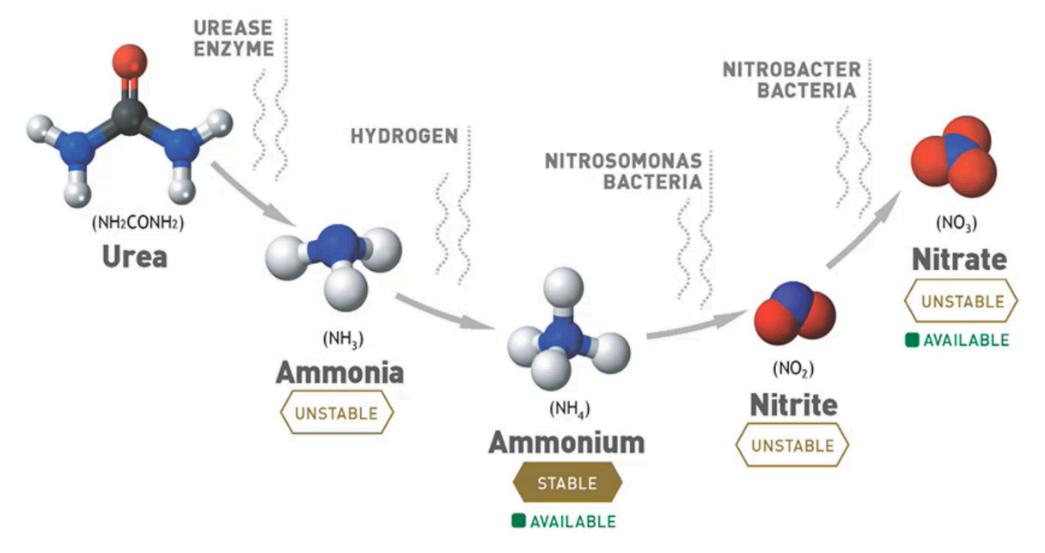
The key step we have to be mindful of in this nitrification process for the Mallee Region is the loss of Urea through a urease enzyme in the conversion of Urea to Ammonia, commonly referred to as volatilisation. Many of the other steps when nitrogen losses can occur focus on leaching in high rainfall environments which are obviously unlikely to affect us Volatilisation will almost always occur to some degree; however a variety of factors increase the rate of ammonia being gassed off to the atmosphere after application These include;
- Dry conditions post spreading
- Wet soil surface at point of application
- Dewy conditions after application
- Windy weather
- Applications at early crop stages with low canopy cover
- Alkaline soils
- High levels of soil carbonates
- Sandy soil types
- High levels of soil coverage by organic matter
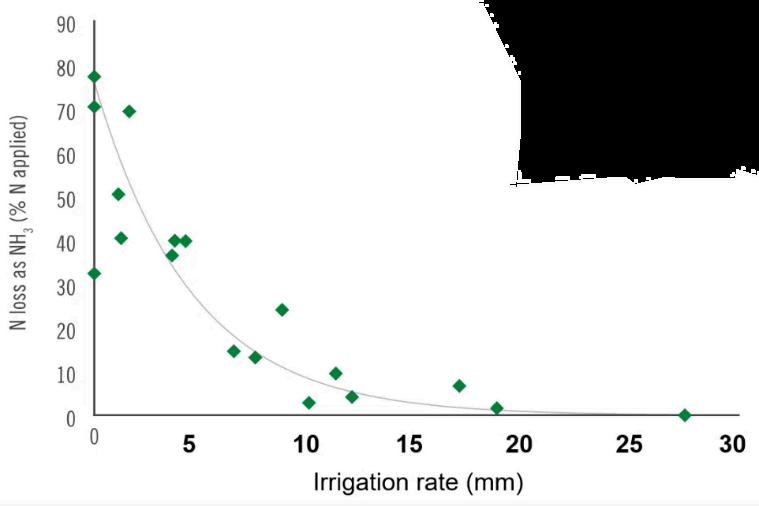
Unfortunately for us in the Mallee Region this list of unfavourable environments for the application of Urea are extremely familiar and we will likely be spreading in many if not almost all of these conditions. The biggest component that begins the volatilisation and nitrogen loss process is dry conditions after spreading, all other factors exacerbate how severe that rate of volatilisation is. So if we know that we’re guaranteed a significant rainfall event within a short time after application, regardless of conditions, we can expect volatilisation to be extremely low.
[DOCUMENT TITLE]

However, if rainfall isn’t expected for a few days, or if we don’t receive the rainfall we expect, then volatilisation occurs and is exacerbated by these factors In order to prevent excessive nitrogen losses we really need 10 mm of rain within 24 hours of Urea application Any less than this and volatilization will begin to occur This is well known and has been common practice for a number of years
Urease inhibitors are not a new product, they have been around for some twenty years, although haven’t been overly utilised as Urea has historically been quite cheap Now that we can expect historically high Urea prices to become the ‘new normal’, it is essential that we’re using our expensive Urea and nitrogen products as efficiently as possible. As they have been around for a long time, we know a great deal on how they work, their benefits on crop productivity, and how well they stop volatilisation from occurring.
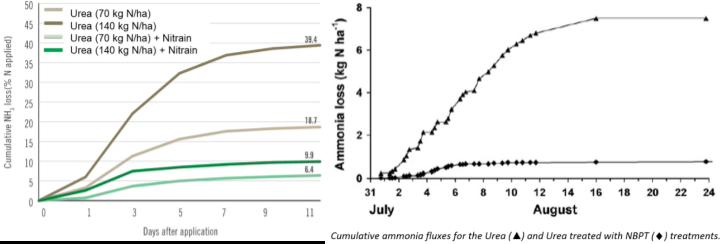
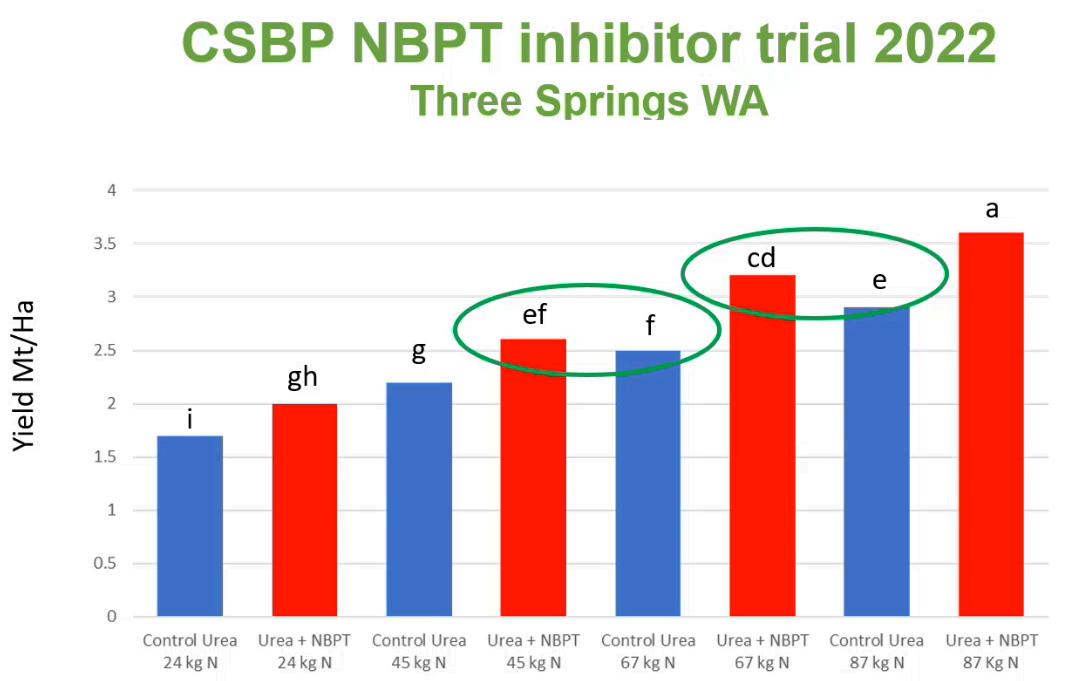
It's important to remember that minimising Urea losses isn’t just about reducing the amount of nitrogen lost to the atmosphere, but it’s ultimately about making money Indeed before we conduct any activity as farmers we should always ask ourselves if we’re going to see a financial reward for a given investment If not then it’s a pretty straight forward answer At the end of the day by ensuring we stop as much volatilisation as possible we’re getting more nitrogen into the plant which means we can save money by reducing our application rates, or make more money by improving our yields (hopefully both!). Our most recent trial in Western Australia found that we can both decrease application rates as well as improving our yields [DOCUMENT TITLE]
Misconception #1: After applying, if my Urea has successfully dissolved, even from a heavy dew or low rainfall event, then that means it’s now in the soil and I won’t lose it through volatilization
Unfortunately just because we can’t see Urea granules anymore that does not mean that our nitrogen has successfully entered the soil. Indeed if our Urea granules have dissolved on the surface without sufficient rainfall to achieve the downward movement into the soil, plus our soils are alkaline, and we have windy conditions, etc , then it’s in these conditions that we will observe the greatest nitrogen losses That’s where we can experience Urea losses of up to 50%, potentially as high as 80%
Misconception #2: I had unfavourable conditions after applying Urea, but I observed a response in my crop after application so that means my Urea was utilised efficiently.
Even in unfavourable spreading conditions a significant amount of Urea will still find its way into the soil. At Minnipa in 2024, a volatilisation trial found an average of 20% nitrogen losses cross the trials, with some sites detecting 40% losses! If 20% of a 50 kg/ha application is volatilised into the atmosphere, then that still means that 40 kg/ha has entered the soil. You’ll receive a crop response, however fail to get the full crop response or achieve the yield potential that you otherwise would Not only that, but your $750/tonne Urea has now effectively cost you $900/tonne which is a far greater expense than the cost of applying a urease inhibiter It’s essentially the same as loading up 50 tonnes of Urea at Port Adelaide and spilling 10 tonnes out on the Princes Highway
Misconception #3: You have to apply Urea as early as possible, if you apply it too late you won’t achieve the yield response to justify the expense.
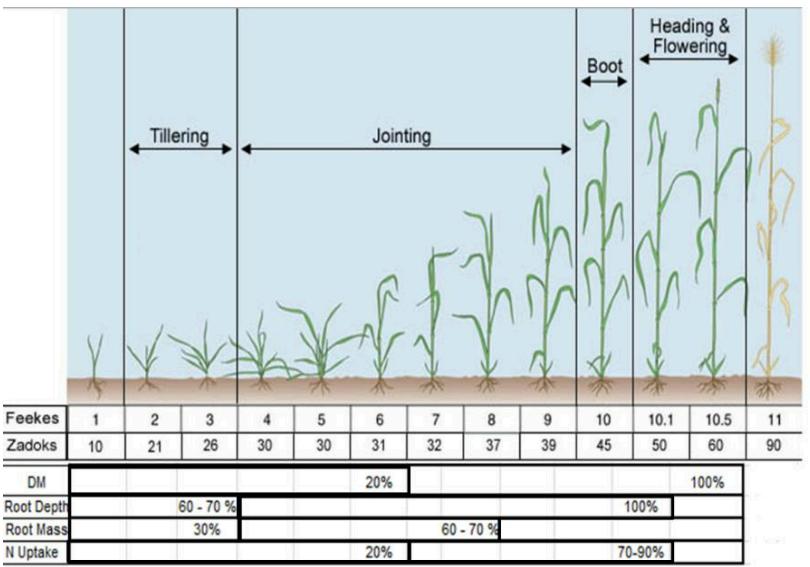
As the peak nitrogen demand for wheat is from 1st node right up until flowering, nitrogen can be applied right up to booting and you will still achieve a yield response. The key component is achieving the rainfall and subsoil moisture required to dissolve the Urea into the soil, maintain good soil moisture to convert the Urea into a plant available form, and to then also receive enough soil moisture for the plant to access than nitrogen. Remember that plants can only absorb nutrients from wet soil; nutrients need to be dissolved and in solution in order for them to be taken up by the plant’s root It is because of this that in areas with more marginal finishes (like the Mallee), that an early Urea application is often more beneficial However when good finishes are being predicted, I believe there can still be ample time to apply a late top up application Urea, but earlier applications are likely to result in greater efficiency. With volatilisation being a risk in Urea applications without a urease inhibitor, this risk can be reduced when the crop has canopied as this reduces the wind around the granule Some of the volatilisation that may occur can often be recaptured through the leaf resulting in faster nitrogen uptake, however I wouldn’t make plans on this occurring [DOCUMENT TITLE]
Misconception #4: Even if I suffer around 10% loss through volatilisation it’s just cheaper to increase my Urea rates than to apply a urease inhibitor
Urease inhibitors are very cheap with Incitec Pivot only charging approximately $55 per tonne including application charge Let’s say that we only receive a 10% loss through volatilisation as we’re unable to spread our programs directly before a rainfall event (even though it is likely to be much greater for us in the Mallee Region)
This means that if we’re applying Urea at 50 kg/ha with a Urea price of $750 delivered on farm, it is cheaper for us to apply a urease inhibitor than what it is to increase our rates Not only that, but more nitrogen is getting into the soil, which means improved yields, lower disease risk, and more money in your back pocket come harvest.
Straight Urea @ 50 kg/ha
Urea inc 10% loss @ 55.5 kg/ha
Green Urea @ 50 kg/ha $37 50 /ha $41 25 /ha $40 25 /ha 23 units of N 23 units of N 23 units of N
Misconception #5: If I utilise Sulphate of Ammonium my volatilisation losses will be lower. While this is often the case, losses through Sulphate of Ammonium applications can still be significant if not greater than that of Urea. This is primarily found on alkaline soils as these conditions increase volatility, and when carbonates have recently been applied to the soil such as a lime application over summer. Be cautious even with gypsum applications as these often still contain significant levels of bicarbonates. Unfortunately, an application of urease inhibitor to Sulphate of Ammonium will not prevent volatilisation as it is a different form of nitrogen and there is not yet an alternative product on the market yet
Misconception #6: If I switch to UAN I don’t have to worry about rainfall after application because it’s already in liquid form. It’s important to remember what form of nitrogen we find in UAN: Urea (50%) Ammonium (25%) Nitrate (25%). As half of our UAN is nitrogen in the form of Urease Nitrogen this is as equally prone to volatilisation as what our Urea granules are Indeed, urease inhibitor products can also be used for UAN mixes to counter these potential volatilisation losses as well
Should I apply a Urease inhibitor?
With every decision I make as an Agronomist I always ask myself the same question; “Is there an opportunity to make money?”
If you don’t have many hectares of cropping land and as such, have the ability to conduct a large amount of nitrogen spreading within 48 hours of a guaranteed rainfall event, then it may not be a strategy that provides a financial return for you However, in the same situation, if a seemingly certain rainfall event fails to materialise (which is all too familiar) then you’ll probably find yourself wishing that you had treated your Urea
If you are spreading Urea a week before a rainfall event in dewy conditions, or utilising the services of a contractor where applications are undertaken regardless of rainfall prospects, then it would be madness not to consider utilising a urease inhibitor. Indeed, if cost is an issue, then you’re far better off paying for a urease inhibitor and dropping your application rate than spreading untreated Urea in unfavourable conditions.
If you would like to use a urease inhibitor, then there are options available through Incitec Pivot (Green Urea) and Impact Fertilisers (N-Guard) to have these applied upon receival (contact Brett for more information). If you haven’t had one applied to your Urea at the point of pickup, or if you’d like to add a urease inhibitor to your Easy N to reduce the risk of applying foliar nitrogen applications, then we can provide a product for you for self-application. Get in contact with Brett if you’d like to give it a go and discuss your product options.