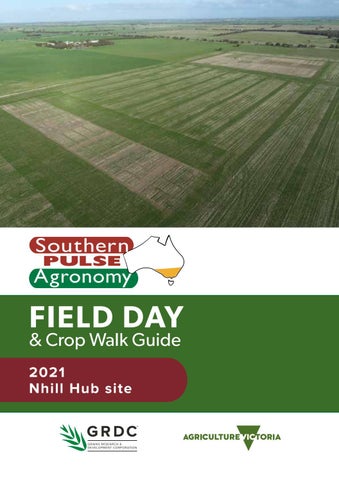
FIELD DAY & Crop Walk Guide 2021 Nhill Hub site
The Southern Pulse Agronomy Team
Jason Brand (AgVic)
Mitch Fromm (AgVic)
James Manson (SFS)
Sundara Mawalagedera
(AgVic)
James Murray (BCG)
Kenton Porker (FAR)
Further Information Dr Jason Brand Senior Research Agronomist - Pulses Agriculture Victoria Research Department of Jobs, Precincts and Regions
©Copyright 2021
110 Natimuk Rd, Horsham, Victoria 3400 T: 03 53622341 M: 0409 357076 E: jason.brand@agriculture.vic.gov.au W: agriculture.vic.gov.au Follow on Twitter: @JasonBrand
2
Michael Moodie (Frontier Farming)
CONTENTS 4
Southern Pulse Agronomy
5
New Variety Releases
6
Variety Information
14
Site Layout
20
Rainfall, Site Description and Paddock History
21
Trial Information
3
SOUTHERN PULSE AGRONOMY - VICTORIA Southern Pulse Agronomy - Victoria delivers localised development trials and extension activities to close the economic yield gap and maximise faming systems benefits from pulses (lentil, faba bean, chickpea, field pea, vetch and lupin) production. To do this a hub and spoke model of grower-driven validation and demonstration trials has been implemented. There are 3 major validation ‘HUB’ sites and 6 on farm demonstration ‘SPOKE’ sites (Figure 1). ‘HUB’ sites focus on a combination of sub-regional grower driven D&E priorities and extension of new research learnings from aligned projects delivering a series of fully replicated trials. ‘SPOKE’ sites focus on-farm with one to two simple trials at each site which may include full scale strip trials, and/or small demonstration plot trials driven by local grower D&E priorities. Trials align with 3 broad categories: 1. Economic impacts of pulses on farm profitability. 2. Disease and integrated weed management in pulses. 3. Flexible responses to emerging grower issues. Research findings are delivered through flexible extension activities linked to each of the sites, including field days and crop walks and through the development of a new digital extension hub https://spahub. com.au/ (under construction) providing the latest photos, videos and results.
FIELD DAY ACKNOWLEDGEMENTS Research funding: GRDC and Agriculture Victoria. Research partners: Frontier Farming, Southern Farming systems, Field Applied Research, BCG, Meaningful Social Research. Land for research trials: Jade Lowe - Grower. Simon Mock - Agronomist Technical and Research Staff: Jason Ellifson, Tyler Coutts, Ash Purdue and Russel Argall. Field Day Support: Mallee Sustainable Farming.
4
NEW VARIETY RELEASES Lentil GIA2002L GIA2002L is a new broadly adapted imidazolinone (IMI) tolerant small round red lentil. Potential release 2021 (tested as GIA2002L). Contact PB Seeds for further information on availability. EPR TBC. GIA2003L GIA2003L is a new broadly adapted imidazolinone (IMI) tolerant small round red lentil. Superior adaptation to light sandy soils than GIA2002L. Potential release 2021 (tested as GIA2003L). Contact PB Seeds for further information on availability. EPR TBC. GIA1703L GIA1703L is the first imidazolinone (IMI) tolerant lentil with improved tolerance to clopyralid soil residues from a prior crop, applied according to product label directions. A small round red lentil with a grey seed coat, GIA1703L is best suited to early sowing and favourable lentil growing areas to maximise growth, height and yield. Avoid low fertility sandy soils and low rainfall frost prone environments. Potential release 2021 (tested as GIA1703L). Contact PB Seeds for further information on availability. EPR TBC. GIA2004L A medium to large size red lentil with a grey seed coat, GIA2004L is the first lentil to combine imidazolinone (IMI) and metribuzin (MET) herbicide tolerances. Potential release 2021 (tested as GIA2004L). Contact PB Seeds for further information on availability. EPR TBC.
Field Pea PBA NoosaA PBA NoosaA (evaluated as OZB1308) is the first blue field pea to be released in Victoria since 1999. It has improved bleaching tolerance and is early-mid flowering and maturing. PBA Noosa has excellent grain yield, similar to the highest yielding ‘Kaspa’ and ‘Dun’ type varieties and >20% higher than the old blue pea Excell. Grain quality will be critical so growers should focus on insect management and timely harvest. Opportunity for premium quality niche markets, initially for domestic human consumption. Commercialised by PB Seeds with limited seed available for 2022 season. PBA TaylorA PBA TaylorA (evaluated as OZP1408) is a new high yielding semi-dwarf, semi-leafless Kaspatype field pea with wide adaptation to southern Australia. It is early to mid-flowering and maturity and has non-shattering pods. Resistant to PSbM and BLR viruses. Commercialised by Seednet. GIA2005P GIA2005P is the only Kaspa type variety of field pea with improved tolerance to common in-crop and residual Group B herbicides (combined IMI and SU), and superior to GIA Kastar in both herbicide tolerance and early vigour. An early to mid-flowering and early maturing Kaspa type field pea, semi-leafless with an erect growth habit. Developed by Grains Innovation Australia (GIA). Contact AG Schilling & Co for further information regarding seed availability for 2022.
5
Seed coat colour
Cotyledon colour
Seed size (%) relative to Nugget
Vigour
Plant height
Flowering time
Maturity time
Variety
Lentil Varieties
Grey Grey Grey Grey Grey Green
Red Red Red Red Red Red
** 90-95 100-105 115-120 100 105-110
Moderate Mod/Good Good Mod/Good Mod/Good Moderate
Medium Medium Medium Med/Tall Medium Medium
Mid-late Mid Mid Early Early/Mid Early/Mid
Mid-late Mid Mid Early Early/Mid Early/Mid
Grey Grey Grey
Red Red Red
85-90 75-80 70-75
Mod/Good Moderate Poor/Mod
Medium Medium Short
Early Mid Mid/Late
Early/Mid Mid Mid
Green Grey Grey Grey
Red Red Red Red
115-120 110-120 115-120 110-120
Moderate Mod/Good Moderate Mod/Good
Medium Med/Tall Medium Medium
Mid Mid Mid Early/Mid
Mid Mid Mid Early/Mid
Green
Yellow
120-130
Good
Tall
Mid
Mid/Late
MEDIUM RED GIA Leader PBA Hallmark XT PBA Ace PBA Blitz PBA Bolt PBA Flash SMALL RED PBA Highland XT PBA Hurricane XT Nipper LARGE RED Aldinga PBA Jumbo2 PBA Jumbo PBA Kelpie LARGE GREEN PBA Greenfield
LARGE GREEN PBA Giant
Green
Yellow
160-170
Good
Tall
Mid
Mid/Late
Grey Grey
Red Red
100-120 **
Mod/Good Moderate
Medium **
Mid Mid
Mid Mid
BREEDING LINES CIPAL2121 (CIPAL2021) CIPAL2122
* Provisional rating; **unknown S=susceptible, MS=moderately susceptible, MR=moderately resistant, R=resistant. I=intolerant, MI=moderately intolerant, MT=moderately tolerant, T=tolerant.
6
Boron
Salt
Release Date
RMR MRMS R MRMS MRMS MS
RMR MRMS R MRMS MRMS MS
** MR R MRMS RMR MS
** I I I MI MI
** MI I I MI MI
2021 2018 2012 2010 2012 2009
MR MR MR
MR MR MR
MR R MR
MS MS RMR
MR MRMS MRMS*
MR MRMS MRMS
MR* MR MR
I I I
MI I MT
2019 2013 2006
S MRMS MS MRMS
R MR MR MR
MRMS R MR R
MS RMR MS MRMS*
MRMS R MRMS MRMS
MRMS R MRMS MRMS
MS R S MR*
I MI MI I
MI I I MI
1993 2014 2010 2020
MS
R
MR
MR
MRMS
MRMS
MRMS
I
MI
2014 2014
Botrytis grey mould MR* MR MS MRMS S MS
Shattering ** R MRMS MR R MR
Pod drop MR* MR R MR R MR
Lodging resistance MRMS MR MRMS MR R MR
Ascochyta blight Foliage
Foliage (SA)
Seed
(Vic/NSW/WA)
MS
R
MRMS
MS
MR
MS
MS
MI
I
MR MR/MS
MR MR
MR
MR MR/MS
** **
** **
** **
MI MI
MI MI
7
Seed Size
Seed Colour
Flowering
Maturity
Height
Variety
Faba Bean Varieties
Medium-Large Medium
Light brown Light brown
Mid Mid
Mid-late Early-Mid
Medium Medium
FABA BEANS PBA Amberley PBA Bendoc PBA Marne
Medium
Light brown
Early-Mid
Early-Mid
Medium
PBA Zahra
Medium-Large
Light brown
Mid
Mid-late
Medium-tall
PBA Nasma
Medium
Light brown
Early
Early
Medium
PBA Samira
Medium
Light brown
Mid
Mid
Medium
PBA Rana
Medium-Large
Light brown
Mid
Mid
Medium-tall
Nura Farah
Small-Medium Medium
Light buff Light brown/brown
Mid Early-Mid
Early-Mid Early-Mid
Short Medium
Large Large
Light brown Light brown
Late Late
Mid-late Late
Tall Tall
Small
Light brown
Early
Early
Medium
BROAD BEANS Aquadulce PBA Kareema BREEDING LINES AF12025
* Provisional rating; **unknown S=susceptible, MS=moderately susceptible, MR=moderately resistant, R=resistant. # Breeder data. PSbMV = Pea seed-borne mosaic virus
8
Ascochyta
Chocolate spot
Cercospora
Rust
PSbMV Seed Staining
Release Date
MRMS S
S S
VS S
** S*
2019 2018
MRMS
S
S
MR-MS
MR*
2018
MRMS
MS
S
VS
S*
2014
MR
S
MS
S
RMR
**
2014
MR
RMR
MS
S
S
S*
2013
MR
MRMS
MS
S
S
MR*
2011
MR MS
RMR S
MS S
S S
S VS
VS* S*
2004 2001
MS MS
MS MR
MS MS
S S
MR# MRMS#
S* S*
2009
MR
R
MRMS
S
MS
**
Lodging Resistance
RMR MR
R MS MR MR
9
Pod shattering, at maturity
Plant lodging resistance, at maturity
Flowering Mid-Late
Mid
Good
R:SP
Moderate
Late
Mid
Fair-Good
R: SP
PBA Wharton
SD-SL
Moderate
Early-Mid
Early
Fair-Good
R: SP
PBA Gunyah
SD-SL
High
Early-Mid
Early
Fair-Good
R: SP
PBA Twilight
SD-SL
High
Early
Early
Fair-Good
R: SP
PBA Taylor
SD-SL
High
Mid
Early-Mid
Fair-Good
R: SP
GIA Kastar
SD-SL
Moderate
Mid
Early-Mid
Fair-Good
R: SP
Tall-SL C SD-SL C SD-SL
High High Moderate High Moderate
Late Mid Early-Mid Early Early-Mid
Late Mid Early Early Early-Mid
Poor-Fair Poor Fair-Good Poor Fair-Good
MR: NSP MR: NSP MR: NSP MR: NSP MR: NSP
PBA Pearl Sturt
SD-SL C
Moderate High
Early-Mid Early-Mid
Early-mid Mid
Good Poor
MR: NSP MR: NSP
BLUE PEA PBA Noosa
SD-SL
High
Early-Mid
Early-mid
Fair-Good
R:SP
SD-SL SD-SL SD-SL
High High
Early Mid Early-Mid
Early Mid Early
Fair-Good Fair-Good Fair-Good
R:SP R:SP R:SP
Maturity
Plant vigour, Early Season High
SD-SL
Plant habit SD-SL
Kaspa
Variety
Field Pea Varieties
PBA Butler
KASPA GRAIN TYPE
AUSTRALIAN DUN GRAIN TYPE Morgan Parafield PBA Oura PBA Percy GIA Ourstar YELLOW TYPE
BREEDING LINES OZP1901 OZP1903 GIA2005P (TBC)
* Provisional rating; **unknown SD=Semi-dwarf, C=Conventional, SL= Semi-leafless, S=susceptible, MS=moderately susceptible, MR=moderately resistant, R=resistant, SP=Sugar pod type pod, NSP=Non sugar pod type. PSbMV = Pea seed borne mosaic virus. BLRV = Bean leaf roll virus. I=intolerant, MI=moderately intolerant, MT=moderately tolerant, T=tolerant.
Bacterial Blight
Downy mildew
Powdery mildew
PSbMV virus
BLRV virus (Field Rating)
Boron Tolerance
Salinity Tolerance
MS
S
S
S
S
I
I
2017
MS
S
S
S
S
S
I
I
2002
MS
S
S
R
R
R
MT
MI
2013
MS
S
S
S
S
S
I
MI
2010
MS
S
S
S
S
S
I
I
2010
MS
S
S
S
**
**
I
I
MS*
S*
S
R*
**
**
**
**
MS MS MS MS MS*
S MS MS MRMS MS*
S S S S S
S S S S S
S ** S S **
S ** R S **
I I MI I **
I MI I MT **
1999 1998 2010 2011 2020
MS MS
MS MS
S S
S S
S S
R MS
MI I
MI MI
2014 2003
MS
S
MS*
S
S
R
I
MT
2021
MS MS **
MRMS* MRMS* **
MRMS MR **
S R **
S R **
S R **
S R **
MT MT **
2021*
Release Date
Blackspot (Ascochyta) MS
Ave 100 seed wt (g)
Vigour
Flowering
Maturity
Poor/Mod Good
Mid Early
Mid Early
Med-Large Medium
24 20
Mod Good
Mid Mid
Mid Mid
PBA Royal GenesisTM 090
Medium Small
36 31
Mod Good
Mid Mid
Mid Mid
Almaz
Medium
38
8-9
Mod
Mid/Late
Late
Large
45
8-10
Good
Mid-late
Late
Medium Large
40 47
8-9 8-10
Poor/Mod Poor-mod
Early Early-mid
Early Early-mid
Medium
38
7-9
Mod
Late
Late
Seed Size (mm)
Seed size group
18 22
Variety
Chickpea Varieties
Medium Medium
DESI’S PBA Slasher PBA Striker PBA Maiden CBA Captain KABULI’S
Genesis Kalkee PBA Monarch PBA Magnus
8 7-8
HISTORIC VARIETIES
Seed colour
Flower colour
flowering
maturity
black with white hilum
purple
v. late
v. late
purple
**
**
Variety
Vetch Varieties
Kaniva
PURPLE VETCH Popany Benetas COMMON VETCH Blanchefleur
light brown
white
mid
mid
Morava
dark brown
purple
late
late
Rasina
brown speckled
purple
early/mid
early/mid
Timok
dark brown
purple
mid
mid
Volga
brown
purple
early
early
light brown
white
v early
v early
dark brown/green
purple
late
Mid
Studenica WOOLY POD VETCH RM4
* Provisional rating; **unknown S=susceptible, MS=moderately susceptible, MR=moderately resistant, R=resistant. I=intolerant, MI=moderately intolerant, MT=moderately tolerant, T=tolerant.
12
Release Date
Short-Mid Tall
MS MR
S S
S MS
semi spread erect
2013 2021
Mid Mid
MR MR
S S
MS MS
semi erect semi spread
2019 2005
Mid-Tall
MR
S
S
semi erect
2005
Tall
R
S
S
erect
2009
Mid Mid
S MS
S S
S S
semi spread semi spread
2012 2013
Mid
MS
S
S
semi spread
1988
Release Date
Growth Habit
2009 2012
Species
Ascochyta blight
semi spread semi spread
%hard seeds
Botrytis grey mould
S S
Botrytis
Lodging at maturity
S S
Ascochyta
Plant Height
MS MS
Rust
Short-Mid Short-Mid
R
MR*
S*
5--10
V. benghalensis
unknown
**
S*
MRMS*
**
VS
MS
S
5--10
V. sativa
1972
R
MS*
VS*
0
V. sativa
1999
R
MR
S
0
V. sativa
2006
R
S*
S*
0--2
V. sativa
2014
R
MRMS*
S*
2--5
V. sativa
2014
R
MR*
S*
0--2
V. sativa
2021
R
MR
S*
2--5
V. villosa
2013
13
14
CP Varieties (+ Inoculation)
Vet Varieties (+ inoculation)
Len Varieties (+ weed management, HT & RS, Dir & Stubble)
3.
4.
5.
Len Germ
Pulse Herb Demo
5
Len Germ
Duplex Low ground
FB Varieties (+ Spring sowing)
2.
FP Germ
FP Varieties
FB Germ
Sandy Rise (Spaded)
1.
CP Germ
Lentils (Weeds)
Vet Germ
Renovation Tracks
Vet Germ
4
Vet & CP Inoc
GIA Breeding
FB Spr
Version: 4/10/21
Site Plan - Nhill 2021
15
GIA Breeding
2
1
CODES Le - Lentils; CP – Chickpeas; FP – Field Peas; FB – Faba Beans; V - Vetch HT – Herbicide Tolerance; Weeds – Weed Management; Germ – Germplasm; RS = Row Spacing; Dir – Direction; Stub – Stubble; Inoc – Inoculation; Spr - Spring Sown
STANDING STUBBLE
Sowing Direction
SLASHED STUBBLE
5
Len RS x Dir x Stub
Weather Station
FB Germ (soil)
FP Germ
CP Germ (soil)
3
Len Spr + HT
CP Spr N
NEW Kaspa type field pea g
Large sized herbicide tolerant red lentil
A • • •
• •
A
Breeder code OZP1408 Benchmark high grain yield Mid flowering and early-mid maturity Resistant to Pea seed borne mosaic virus and Bean leaf roll virus Kaspa type plant and grain
A
First large red lentil with tolerance to group B herbicide • Slightly smaller grain size than Jumbo2 • Similar disease resistance to other group B tolerant varieties • Early-mid flowering and maturity •
This symbol indicates that a variety is protected by Plant Breeders Rights (PBR). All Seednet varieties are protected by PBR. Unauthorised commercial propagation or any sale, conditioning, export, import or stocking of propagating material is an infringement under the PBR Act (1994).
16
Faba bean varieties
Lupin varieties
A
A
• High yielding variety for high rainfall
• Narrow leaf lupin
zones
A A
• Albus lupin
• Group B herbicide tolerant faba bean A
• Short season / early flowering faba
bean
For more information call Stu Ockerby on 0448 469 745 or Seednet: 1300 799 246 www.seednet.com.au
Kabuli chickpea varieties A
• Mid flowering and maturity A
• Early flowering and maturity
17
. . . premium seed of leading crop varieties for the Wimmera-Mallee HIGHLAND-XT LENTILS
MAGNUS KABULI
HIGHEST YIELD 7-10% greater than KelpieXT & Hurricane XT
LARGEST seed size kabuli, higher yield than Kalkee & Almaz
GIA LEADER IMI LENTILS
BEST disease resistant IMI Lentil variety
NOOSA BLUE PEA
CAPTAIN DESI
TALLEST desi chickpea suiting Mallee areas
For more information and variety brochures visit www.pbseeds.com.au or contact us on (03) 5383 2213 | admin@pbseeds.com.au
1324 Blue Ribbon Road, Kalkee VIC
Order seed now from your local reseller
PREMIUM market high yield pea
LEADER IMI Lentil
A
VARIETY BROCHURE scan here
Highest rated disease resistant IMI tolerant lentil Rated RMR to ascochyta blight Rated MR to botrytis grey mould Mid to late flowering and maturing Well suited to reliable lentil areas and seasons with a favourable finish Suitable for early sowing Good medium size grain market type
Order seed now from your local reseller More information PBSeeds 03 5383 2213 admin@pbseeds.com.au
www.pbseeds.com.au
RAINFALL, SITE DESCRIPTION AND PADDOCK HISTORY Rainfall (as of 1 October) 2021 Average 2021 Average
Jan
Feb
Mar
Apr
May
Jun
Jul
51.6* 26.7
07.2* 15.9
10.2* 14.5
19.0 20.9
15.2 30.8
20.8* 37.8
58.6 35.5
Aug
Sep
Oct
Nov
Dec
Total
GSR
17.8 43.9
68.4 30.9
30.1
26.6
28.4
342.0
229.9
*BOM weather station data for Nhill
Paddock History 2020 Barley, 2019 Vetch Soil Type Duplex Low Ground Depth
NH4-N
P
NO3-N
K
S
(cm)
Cu
Fe
Mn
Zn
B
EC
(mg/kg)
(ds/m)
0-10
4.60
6.40
21
220
15
0.9
48
17.9
1.3
1.6
10-20
2.40
2.80
5
267
8
0.9
36
3.9
0.3
3.2
0.19
20-40
2.00
1.60
4
306
17
1.2
35
2.8
0.2
9.2
0.40
40-60
1.60
<1.00
3
403
71
1.3
30
2.0
0.2
14.9
0.71
60-100
<1.00
<1.00
<2
428
161
1.2
31
1.7
0.1
15.3
1.11
Depth
Exc Al
Exc Ca
(cm)
Exc Mg
Exc K
Exc Na
OC
(meq/100g)
pH
BD
0.21
Water
(%)
(CaCl2)
(H20)
g/cm3
grav (%)
Total (mm)
0-10
0.0
5.6
2.8
0.6
1.1
0.88
6.3
7.0
1.54
7
10
10-20
0.1
9.6
9.0
0.8
3.0
0.39
7.0
8.3
1.43
17
24
20-40
0.0
11.7
12.3
0.9
5.3
0.26
7.9
9.2
1.42
22
64
40-60
0.0
10.9
12.5
1.1
8.2
0.19
8.1
9.5
1.48
23
67
60-100
0.0
11.6
11.6
1.2
10.6
0.14
8.1
9.5
1.45
22
129
Sandy Rise (Spaded) Depth
NH4-N
NO3-N
P
K
S
(cm)
Cu
Fe
Mn
Zn
B
EC
(mg/kg)
(ds/m)
0-10
4.75
<1.00
26
271
20
0.4
21
3.9
1.2
1.1
0.14
10-20
2.50
<1.25
8
244
10
0.4
26
1.2
0.3
2.2
0.19
20-40
1.75
3.25
6
288
13
0.5
26
0.7
0.2
3.8
0.29
40-60
<1.00
<2.75
<2
316
31
0.5
16
0.5
0.1
7.0
0.39
60-100
<1.00
<3.25
<2
378
44
0.4
19
0.4
0.1
10.9
0.49
Depth
Exc Al
Exc Ca
(cm)
Exc Mg
Exc K
Exc Na
(meq/100g)
OC
pH
BD
Water
(%)
(CaCl2)
(H20)
g/cm3
grav (%)
Total (mm)
0-10
0.0
7.4
2.2
0.7
0.5
0.93
7.3
8.0
1.42
11
15
10-20
0.1
9.7
5.0
0.7
1.6
0.37
7.5
8.6
1.59
17
26
20-40
0.1
10.6
6.4
0.8
2.7
0.23
8.0
9.3
1.64
24
78
40-60
0.1
8.4
6.9
0.8
3.6
0.14
8.2
9.5
1.93
12
44
60-100
0.1
7.4
8.0
1.0
5.3
0.09
8.2
9.8
1.65
19
125
20
TRIAL INFORMATION Sowing Date Various: see relevant trials. Sowing Details Seed was direct drilled inter-row with narrow points and press wheels into standing stubble with a four-row cone air seeder (38 cm row spacing). All trials were inoculated with appropriate granular inoculants. Fertilizer 80 kg/ha MAP + 2.5% Zn Herbicides Lentil Pre-sowing: Glyphosate 450 @ 2000ml/ha + Trifluralin 480 @ 1000ml/ha + Terbuthylazine 875 @ 860g/ha Chickpea Pre-sowing: Glyphosate 450 @ 2000ml/ha + Trifluralin 480 @ 1000ml/ha + Terbuthylazine 875 @ 860g/ha + Isoxaflutole 750 @ 70g/ha Faba Bean Pre-sowing: Glyphosate 450 @ 2000ml/ha + Trifluralin 480 @ 1000ml/ha + Terbuthylazine 875 @ 860g/ha Field Pea Pre-sowing: Glyphosate 450 @ 2000ml/ha + Trifluralin 480 @ 1000ml/ha + Terbuthylazine 875 @ 860g/ha Vetch Pre-sowing: Glyphosate 450 @ 2000ml/ha + Trifluralin 480 @ 1000ml/ha + Terbuthylazine 875 @ 860g/ha Whole site Post emergent: Clethodim 240 @ 600ml/ha + Haloxyfop 520 @ 50ml/ha + Paraffinic oil 582 and Alkoxylated alcohol non-ionic surfactant 240 @ 0.5% w/v
21
NOVEL AGRONOMIC STRATEGIES TO CONTROL POD DROP IN LENTIL This trial investigates the effects of row spacing, row direction and stubble height on plant growth, grain yield and pod drop of lentil varieties differing in architecture and tolerance to pod drop.
Treatments Varieties/ Breeding Lines Spreading architecture - PBA Jumbo2, GIA1703L, PBA Ace, Aldinga Erect architecture - CIPAL1821, PBA Hurricane XT, PBA Bolt, PBA Hallmark XT
Row Spacing 38 cm 19 cm
Row Directions North-South East-West
Stubble height Standing Slashed
Curyo 2020 Results Spreading varieties = no response to direction or row space. Erect varieties = 6% less sown N/S cf E/W, 9% higher in 18cm vs 36cm rows.
Other Details Sowing Rate 120 plants/m2 Sowing Date 06th May
22
NOVEL WEED MANAGEMENT TO CONTROL VETCH IN LENTIL This trial investigates the implications of novel herbicide tolerance traits in lentil on the management of vetch.
Treatments Varieties PBA Jumbo2, PBA Hallmark XT, PBA Kelpie XT, GIA2004L, GIA1703L, *Timok Vetch *Timok vetch was pre sown 1-2 cm deep in weedy plots at 40 plants/m2
Herbicides Treatments IBS Nil Conventional Group B Group C Group I
-
Time of application1 SimRes 3N -
-
Terbyne® 860g/ha Sakura® 118g/ha Terbyne® 860g/ha Sakura® 118g/ha Intercept® 750g/ha Sakura® 118g/ha
Ally® (5g/ha)
Terbyne® 860g/ha Sakura® 118g/ha
Ally® (5g/ha) + Clopyralid (600g/L) @ 75ml/ha
-
Ally® (5g/ha)
1
Brodal® 150ml/ha Brodal® 150ml/ha Brodal® 150ml/ha Brodal® 150ml/ha
5N Broadstrike® 25g/ha Intercept® 750g/ha Metribuzin® 280g/ha Intercept® 750g/ha
IBS – Incorporated by sowing, SimRes - Simulated Residue, 3N – 3rd node growth stage of lentil, 5N - 5th node growth stage of lentil. Glyphosate and Trifluralin were applied pre-sowing.
Other Details Sowing Rate 120 plants/m2 Sowing Date 06th May
23
GERMPLASM X SOIL TYPES – LENTIL, FABA BEAN, CHICKPEA, FIELD PEA AND VETCH These trials investigate the growth and grain yield of range of cultivars and breeding lines that differ growth habit, flowering date and maturity, and adaptability in sandy and sandy loam duplex soils in the medium rainfall zone. Crop
Varieties and breeding lines
Lentil
PBA Bolt, PBA Ace, PBA Hurricane XT, PBA Jumbo2, PBA Hallmark XT, PBA Highland XT, PBA Kelpie XT, Nipper, GIA Leader, CIPAL2121, CIPAL2122, GIA2001, GIA2003, GIA2002L, GIA1703L, GIA2004L
Faba bean
PBA Bendoc, Farah, PBA Zahra, PBA Samira, PBA Marne, PBA Amberley, PBA Nasma, AF12025, AF14092, AF14075, AF15283, AF15278,
Field pea
PBA Pearl, PBA Noosa, PBA Gunyah, PBA Percy, PBA Taylor, PBA Butler, PBA Wharton, PBA Oura, Sturt, Kaspa, GIA KaStar, GIA OurStar, OZP1901, OZP1903, OZP2103, OZP2105
Chickpea
Genesis090, PBA Royal, PBA Magnus, Kalkee, Kaniva, PBA Striker, CBA Captain, CICA1735, CICA1944, D14017>15F2TMWR2SS013, D14133>16F3TMWR2AB015, D11057>14F3TMWR2AB017
Vetch
Rasina, Studenica, SA37714, RM4, Popany, Morava, Timok, Benetas
Other Details Sowing Rate Lentil: 120 plants/m2 Faba bean: 20 plants/m2 Field pea: 40 plants/m2 Chickpea: 35 plants/m2 Vetch: 70 plants/m2 Sowing Date 06th May
PBA Hurricane
PBA Bolt
Varietal frost tolerance 24
INOCULANT RATES FOR CHICKPEA AND VETCH These trials are led by Liz Farquharson and Ross Ballard of SARDI. The work is part of GRDC Project UOA1805-017RTX (9176500), 2018-2022: Increasing nitrogen fixation in pulse crops through the development of improved rhizobia strains, inoculation, and crop management practices. This trial was designed to: 1. Validate the results of pre-sowing soil tests using the new DNA based test from SARDI, Predicta rNod for E & F rhizobia, which measures the number of rhizobia in soils that can nodulate pea, bean, lentil and vetch. A second test under development for chickpea rhizobia is also being validated. Pre-sowing rhizobia numbers: For vetch- predicted as low-moderate for Group E/F (900 rhizobia/g), so there is a moderate chance of an inoculation response at this site. For Chickpea –not detected, so there is a high chance of an inoculation response. 2. Validate if increasing the rate of peat inoculant applied to seed above the standard rate or applying novel “helper” bacteria with standard rates of inoculant can increase nodulation and Nitrogen Fixation of vetch and chickpea.
Treatments Peat Slurry Inoculant applied to seed at different rates; Uninoculated, half standard, standard, double, four-times the standard rate and standard rate + Chickpea helper bacteria or Vetch helper bacteria.
Other Details Sowing Rate Chickpea: 35 plants/m2 Vetch: 70 plants/m2 Sowing Date 06th May
Inoculation requirement for legumes in the E and F inoculation groups (faba bean, lentil, field pea and vetch) can be measured using PREDICTA rNod provided by SARDI through PREDICTA® B accredited agronomists. Tests for Group G and S, and N are under development.
25
PULSE MARKET OVERVIEW
Nick Goddard - Pulse Australia
While Canada bakes, Australia glows. 2021 has been another very strong season for for most of our pulse crops, with lentils being the standout in terms of prices and grower returns. While not wanting to gloat over someone else’s misery, the dire climatic situation across North America has provided Australian lentil growers with an unexpected bonus and impacted global trade flows across all pulses. The shortage of peas and lentils from Canada has also impacted supply lines in India and has led to price inflation in the Indian pulse market. As a result, the Indian Government has eased some of the tariff constraints applied to Australian lentils to encourage trade and reduce supply constraints. However, while this move by the Indian Government does encourage the supply of stored lentils from last year’s harvest, there is no indication from the Indian Government that the tariff reduction will extend to enable new crop lentils to benefit.
apparent that shipping lines withdrew capacity at the start COVID last year as global shipping trade, especially ex China, shrank, and despite global commerce essentially returning to normal levels, shipping lines have not, or will not, restore shipping capacity. This has created a significant challenge for the Australian pulse industry in matching the balance between meeting the market prices and channelling these prices to growers, yet with great uncertainty that the export demand can be satisfied. The industry has seen a shift towards bulk shipments for pulses that might otherwise have been exported in containers, which has created its own logistical challenges. The pulse future remains bright. Despite these challenges, the pulse industry prospects continue to grow and look very favourable into the future. Coming out of successive years of drought from 2017-2019 and now with two solid and profitable years now under our belt, the industry is well placed to continue to grow. Pleasingly, the industry is continuing to attract investment into on-shore valueadding, with Unigrain recently announcing its plan to build a pulse fractionation plant at Smeaton, expected to utilise 40,000 tonnes of field peas and faba beans sourced from growers in the Mallee, Wimmera and South Australia. This investment builds on the ongoing investment by Australian Plant Proteins in their pulse fractionation plant in Horsham. The establishment and growth of plant-based food ingredient suppliers such as these, combined with plant-based food manufacturers such as V2foods serves to develop thriving domestic pulse processing industry and beginning to reduce Australia’s reliance on the variabilities associated with many of our export markets.
The extremely dry conditions in North America have also pushed global canola prices to unprecedented levels, with global supply chains for both lentils and canola unlikely to be completely restored in 2022. Consequently, prices for both these commodities can be expected to remain firm coming into the 2022 season, creating some important rotation and disease pressure considerations for growers next year. Shipping constraints providing an unwanted handbrake. Despite the generally good season for Australian pulses, and firm global demand, the challenge for this harvest will be securing sufficient affordable shipping, particularly for container trade. Exporters have struggled all year to meet export orders due to the extreme shortage of shipping containers and unprecedented vessel and stevedoring charges. It seems
26
Major Australian Export Destinations
27
FIELD DAYS SUPPORTERS