Sandy Soils Impacts Project Younghusband 2020 The trial site was established in 2020. The soil is highly non-wetting, however significant rainfall in April and May alleviated crop establishment issues in 2020. All treatments were established prior to or at sowing on 22nd May . The site was sown to Razor CL wheat in 2020.
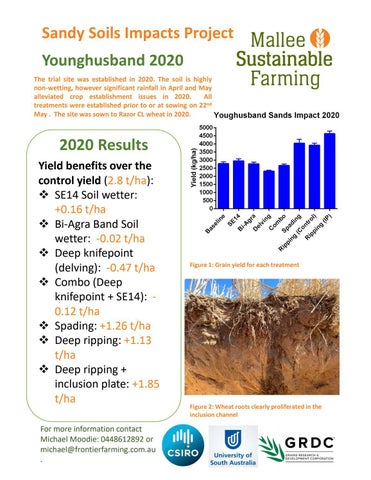
2020 Results Yield benefits over the control yield (2.8 t/ha): SE14 Soil wetter: +0.16 t/ha Bi-Agra Band Soil wetter: -0.02 t/ha Deep knifepoint (delving): -0.47 t/ha Combo (Deep knifepoint + SE14): 0.12 t/ha Spading: +1.26 t/ha Deep ripping: +1.13 t/ha Deep ripping + inclusion plate: +1.85 t/ha For more information contact Michael Moodie: 0448612892 or michael@frontierfarming.com.au .
Figure 1: Grain yield for each treatment
Figure 2: Wheat roots clearly proliferated in the inclusion channel
Sandy Soils Impacts Project Younghusband 2021 This trial site was established in 2020. The non-wetting properties of the soil were highly expressed in 2021 with only small and sporadic rainfall events received until mid June. Amelioration treatments (Spading and Deep Ripping +/- Inclusion plates) were established in 2020 while mitigation treatments (soil wetters, moisture delving and onrow off row seeding) were reimplemented in 2021. The site was sown to Compass barley on the 7th of June. The seedbed was dry with a small amount of soil moisture present below a depth of about 10-15 cm Figure 1. Box plots of barley establishment for each treatment in 2021. Black bars represent the median and box and whiskers represent the range.
2021 Barley Establishment
The inter-row sown control had a very low average plant establishment (24 plants m2) and was also highly variable (+/- 10 plants m2). Soil wetters significantly improved the establishment of inter-row sown crop (SE14: 71 plants m2; Bi-Agra Band: 82 plants m2). On-row seeding improved average crop establishment (86 plants m2), however variability was still high (+/- 10 plants m2). Adding a longer knifepoint to delve soil moisture slightly improved average establishment (98 plants m2) of on-row seeding, but also significantly reduced variability. Spading the previous year (2020) resulted the highest and least variable crop establishment in 2021 and was equivalent to on-row sowing with moisture delving. Inter-row sowing into soil that was deep ripped in 2020 only slightly improved establishment (34 plant m2) over the interrow control However, inter-row sowing into deep ripped soil where inclusion plates were used in 2020 significantly improved crop establishment (67 plants m2). This is probably a reflection of the increased soil mixing and/or burial of not wetting topsoil by the inclusion plates.
For more information contact Michael Moodie: 0448612892 or michael@frontierfarming.com.au .