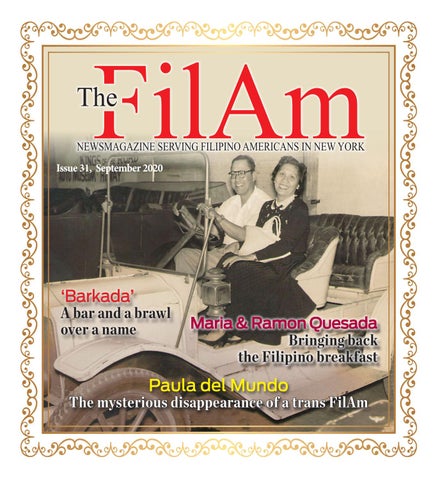
Issue 31, September 2020
‘Barkada’
A bar and a brawl over a name
Maria & Ramon Quesada Bringing back the Filipino breakfast
Paula del Mundo
The mysterious disappearance of a trans FilAm
Letter from the Editor
I
An ugly brawl over a bar ’ s name
t’s been called an “uprising,” this outcry involving a Washington D.C. wine bar and its name. It began when a local paper announced the opening of Barkada Wine Bar on July 29, pointing out that while it chose to name it after the Filipino word “barkada” — meaning the closeness of bosom friends — none of the owners is Filipino and there is nothing Filipino in its menu. The four owners — Sebastian Zutant, Nick Guglietta, Anthony Aligo, and Nate Fisher — said they chose the name because it appeared to be the closest to their concept of “a gathering place for friends in the neighborhood, and to become friends with those neighbors,” which was an aura it was hoping to create. “Barkada is a beautiful word with a deep meaning of comradeship. We want to honor that.” And with that newspaper article followed a furious debate that exposes the deep fault lines in our community. It brought out an almost visceral contempt from Filipinos across generations, Filipinos who immigrated to America versus those who were born in the U.S., opinionated Filipinos versus Filipinos tired of any kind of debate whatsoever. There have been grating put-downs coming from some millennials who seem dismissive of the “old folks” for being out of touch with evolving social issues, and some Boomers who scoff at FilAms who can’t even speak Tagalog fluently. The woman who called attention to the naming rumpus was Jessica Millete, a graphic designer for NPR and a photographer. She wrote in a blistering
Facebook post: “What makes you think it’s okay to take a word from another culture when you pay no respect or homage to the culture itself?” People on her side of the aisle quickly pounced that “barkada” is a word sacred to Filipinos and should not be used haphazardly by business owners and derive profit from it. It was pointed out that the wine bar sold no Filipino food on its menu and that the only attraction to the word is the first syllable “bar” in “barkada.” In short, the word was chosen for the flimsiest of reasons. Two days later, the owners issued a statement they were dropping the name. They also apologized saying “it was never our intention to appropriate or capitalize on the Filipino culture.” The Filipino Americans who supported the owners took pride in the idea that a Filipino word is being used to symbolize friendship and all the good feelings it engenders. At a time when the world has globalized, they believe language should be an embracing vehicle and should not be used to further create walls and barriers. To them it was “flattering,” “a source of pride,” and an “identity boost” that there is a wine bar in the Nation’s Capital named after a Filipino word. Accusations of cultural appropriation were thrown at the four owners suggesting a manner of exploitation and dishonesty. It did not seem that way to us. The fashion industry is often guilty of this when established fashion houses “steal” designs from indigenous tribes and make them their own. There are others like Rachel Dolezal, the white American woman who to this day insists on her Black identity.
Contributing Writers Tricia J. Capistrano Ludy AstraquilloOngkeko Joel David Mariel Padilla Wendell Gaa Maricar CP Lindy Rosales Hampton Danielle Vania Angelito Cabigao Bonus
Founding Editor Cristina DC Pastor Address P.O. Box 8071 New York, NY 10116
The seismic differences among Filipino Americans run deep over the Barkada issue. It has exposed the chasm-like gaps on values and perceptions about Filipino identity in an America gripped in turmoil over issues of social justice, race, gender, culture, and economic inequality. What is glaring based on many of the opinions we’ve read is how members of our community are talking past one another — and not at each other. Instead of having an open-minded discussion that is reflective and respectful, a pissing match has erupted, marked by intolerance and an overweening desire to prove that their views, and their views alone, are the correct way to make sense of the issue. To suggest that the “four white owners” include Filipino food in their menu is missing the point (because serving Filipino food is not their business model), just as the question posed why other Filipino restaurants are not getting the same coverage as Barkada (because the oddity factor in this story is the news). Like the country we inhabit and call home, some in our community have seemingly lost the civility and humility with which we should be communicating with one another. All the more reason we should be mindful of being respectful especially of opinions we believe are contrary to ours. We need to start listening. Turn to page 8 for NaFFAA National Chairman Brendan Flores’s comments on the Barkada debate.
Contact Thefilamny@gmail.com
The FilAm is a publication of A&V Editorial THE FILAM |
2
Last chance to be counted in the 2020 Census! The census deadline is looming, and the Filipino community is in danger of not getting its fair share of resources over the next decade. There is only one month left to make an impact.
N
ationally, four out of 10 U.S. households have not filled out the census. In other words, the response rate is less than 65 percent. Everyone in the community needs to be counted by Sept. 30. If people are undercounted, states could lose thousands of dollars in public funding per person every year for emergency services, education, health facilities, road improvements, and other benefits. The community is also at risk of losing political representation, including Congressional seats. The Census Bureau is making a final push to close the remaining gap on census response rates of Asian Americans, including the Filipino community. Joining this effort, over 30 organizations and 20 influencers committed to mobilizing their communities during the 2020 Census Asian Week of Action, which took place the week of Aug. 24 to 30. These organizations, including civic engagement groups, social service providers, and e-commerce brands, urged people to respond to the census because so much is at stake for our communities. Due to COVID-19, it has become more challenging to conduct local outreach, but these 2020 Census partner organizations and influencers are helping to fill the gap. They are using their circles of influence to get a more complete count. It’s a key reason why the U.S. Census Bureau has decided to call upon them for the 2020 Census Asian Week of Action. These organizations and influencers specialize in working with the hardestto-count populations, such as people with
The deadline to be counted is September 30. You may respond online, by mail or through a census taker who goes door to door. Tagalog language needs, young people who move often, babies and young children, and the 50+ population. With the impact of COVID-19, Census Bureau Director Steven Dillingham said in an Aug. 14 statement: “We are taking steps and adapting our operations to make sure everyone is counted, while keeping everyone safe.” As part of their operational adjustments, the Census Bureau is sending out census takers to help households complete their questionnaires. Census takers have been trained to follow public health guidelines and wear personal protective equipment (PPE) while making these in-person visits. Dillingham stressed the urgency: "If you haven't responded, the time to respond is now! Responding to the 2020 Census online, on paper, by phone, or in person with a census taker, helps secure vital resources for your community." The future of the Asian American community starts right now. Don’t wait any longer. To respond online, visit 2020census.gov. To respond in Tagalog by phone, call 844-478-2020.
THE FILAM |
3
Marvin Lim is running unopposed for a seat in the Georgia legislature Marvin Lim, who migrated to Atlanta with his parents when he was 7 years old, is the presumptive District 99 Representative to the Georgia State Legislature this January 2021.
H
e won in the Democratic Primary with 62 percent of the vote. Because the Republican Party did not nominate an opponent in the November elections, he is essentially deemed elected to the Georgia State House of Representatives. His district comprises 85 percent minorities, 53 percent of whom are immigrants, but only 38 percent voted in the 2016 presidential election. That was the beginning of 36-yearold Marvin's awakening to run for public office. He was incredulous that Donald Trump won over Hillary Clinton to become the 45th president of the United States. Marvin was born in Quezon City, and grew up in Cainta, Rizal. His father, from Pangasinan, and his mother, from Binangonan in Rizal, both worked at Meralco. With most of his family still in the Philippines, he took a vacation there in December 2016 after that upsetting election, and began to examine his role in making a difference in people’s lives. He has many relatives in the Philippines, some of whom are destitute and need help. So, should he just stay in the Philippines? Or should he go back to Georgia and run for political office where he could do the most good? Having a newly elected President Duterte in the Philippines did not give him confidence that he would be useful in the Philippines. So, he came back to Atlanta, Georgia with a new vision: To run for State
Lim, a person of color and an LGBTQ candidate, is shown here with his mother Edna. Representative of House District 99 (where he relocated in 2001), so that he could really make a difference in the community, and in the lives of his constituents. He started a "listening campaign" to understand why 62 percent of the people in his district decided not to vote in 2016. Talking to his constituents who were mostly marginalized, voiceless, and uninformed, he understood why the majority did not bother to vote. “Whoever wins does not care for our needs, our situations, our problems,” was the constant complaint he heard. Marvin empathizes with them, because during his family's early years in America, they struggled. Marvin's father lost his job and even received public assistance from
THE FILAM |
the government. In addition, when Marvin finally became a U.S. Citizen in 2007, he registered during the presidential election in 2008, but was wrongfully flagged as a non-citizen and therefore could not vote. Through that experience, he gained insight to the voter suppression actions in the Georgia legislature. During his campaign before the COVID-19 pandemic, Marvin was able to canvass 3,500 of his constituents and was able to listen to about 1,000 of them about their concerns and their problems dealing with the government. He learned how his constituents were mostly uninformed — so he distributed flyers, used social media, and post office mail to send useful information about public assistance, housing, tenants' rights, immigra-
4
tion, disability, health insurance, unemployment insurance, and health care especially about COVID-19 during the short campaign period for the Primary. After graduating magna cum laude from Emory University, he worked with Catholic Charities as a social worker. He graduated from Yale Law School and worked in the American Civil Liberties Union (ACLU), both in their main office in New York and then in Georgia. Marvin worked with special emphasis on religious freedom, gun violence, and election law reform. In election 2002, he volunteered to campaign for incumbent Max Cleland to win a Senate seat in the U.S. Congress, but his candidate was unsuccessful. In election 2016, he co-formed “159 Georgia Together” to establish a state-wide registration and voter education program. Around the same time, he started working on gun violence prevention issues with the Giffords Law Center to Prevent Gun Violence and worked on election law and other cases for Holcomb + Ward, LLP, co-led by another Georgia state representative. Thus, in February, 2020, when he declared his intention to run for representative of House District 99, being an immigrant, an Asian, a person of color and an LGBTQ candidate had a lot of appeal. The final result: Marvin Lim, son of immigrant Filipino parents, became the only gay person who won during the June 2020 Primary in Georgia. “The most important,” Marvin says, “is to make sure that although I am speaking for them in some ways, I will continue to help my constituents use their voices to speak out — and ensure that this time, the government hears them.”
Filipinos need to fill out the census – this is why By Carmelyn Malalis Chairperson & Commissioner NYC Commission on Human Rights
My name is Carmelyn Malalis, and I am the Chair and Commissioner of the NYC Commission on Human Rights. I am a mother, a wife, and a daughter. I am a proud Filipina. And I want you to fill out the census.
T
he census comes out every 10 years and acts as a method of counting the number of people in the United States, allows for the collection of demographic information, and helps the government determine where to direct its resources. You may have received a form at your home, or even had someone knock on your door. This year it is more important than ever that everyone complete the census, and here’s why: COVID-19 has torn through communities, leaving a wake of economic destruction, and is killing Asian people in the United States at a rate four times that of the general population. Filipinos in particular are being hit extremely hard – experiencing a 40 percent mortality rate when infected with COVID-19 as opposed to 3.7 percent of the general population. Filipinos also represent one of the highest percentages of frontline workers, accounting for anywhere between 4 percent to 20 percent of nurses, depending on the state. COVID-19 has also given rise to anti-Asian discrimination, bias, and hate crimes. Asian businesses saw a 50 percent drop in business before
Commission on Human Rights Chair Malalis: ‘Our Bayanihan depends on it.’ a single city or state shut down, due exclusively to racist and misinformed notions that Asian communities were to blame for the outbreak. The NYC Commission on Human Rights was fielding so many complaints of discrimination related to COVID-19 that we launched a dedicated unit just to handle the influx and respond quickly. We created programming and outreach in multiple languages, including Tagalog, to ensure our communities know that their rights will be protected during this unprecedented time. This is why it is so important that our communities are counted in this census. We cannot ignore the injustices and inequality plaguing
THE FILAM |
Black, Latinx, Asian, and immigrant communities. It is imperative that the United States government count all of us, and that we receive the federal dollars our communities deserve. We must be counted so that our kids’ schools stay funded. We must be counted so that essential services reach our most vulnerable neighbors. And, we must be counted to ensure balanced representation in the halls of Congress. That can only happen if all of us fill out the census. We know that there are those in the nation’s capital who don’t want you to fill out the census, depriving us of resources and representation. But if I know anything about Filipinos, it is that we are proud to
5
stand up for our community. We are proud to fight to get what we need to raise our families in healthy, thriving environments. Filipinos contribute so much to the beautiful tapestry that is the United States, and we deserve to be counted. Fill out your census before the September 30th deadline. The census is a few simple questions and it is safe and confidential. You can fill out the form in Tagalog at my2020census.gov or you can call 844-478-2020 to answer the census in Tagalog. Everyone, citizen and non-citizen alike, is entitled to complete the Census with peace of mind. Fill it out today and tell five members of your family to do the same. Our bayanihan depends on it.
The disappearance of trans FilAm Paula del Mundo: An unsolved mystery By Cristina DC Pastor
On September 15, 2019, Paula del Mundo, a trans nursing assistant, went missing at the Dallas Fort Worth International Airport in Texas. She was last seen walking aimlessly by the airport’s exit area wearing white shirt and lavender pants. It’s been almost a year since her disappearance, and her family to this day has no idea where she is or what might have happened to her.
T
he Del Mundo family scattered across Manila, New York, California, and Florida has hired a private investigator to do its own search after airport detectives failed to turn up information on Paula’s whereabouts. The PI simply ran with their money and did not do his job. Volunteer groups and a FilAm human rights organization assisted the family.
||Off to Mexico
Fifty-nine-year-old Paula – birth name is Paulino Norberto del Mundo Jr. — was supposed to visit Mexico on September 15. She usually treats herself to foreign trips being a consistent Model Employee in her department at the James A. Haley Veterans’ Hospital where she is a Nursing Assistant. She traveled to the Dominican Republic in the last two years. This year, she decided she wanted to see Cozumel, a resort city in Mexico. “As an organized and meticulous person, she had everything covered for this trip including her air fare, hotel, food, sightseeing trips,” said Yolanda when interviewed by email by The FilAm. “In every trip she had, she was always excited completing her wardrobes from head to foot.” On September 14, she left her Tampa apartment in early morning to go to DFW for her connecting flight to Cozumel at 3 p.m. In the evening, Lolita, the youngest sister from Florida received Paula’s last text messages saying she decided to abandon her travel plans and asked her to purchase a return ticket to Tampa. She could no longer be reached when Lolita tried to get back to her for flight details. Early on, another sister, Leonor from California, received a morning call from Paula that she could not find the terminal, a premonition that she was not fully determined to leave. By 7 p.m. all five sisters across the U.S. started to get worried and contacted DFW requesting to page Paula so they could talk to her about coming home. “We never heard from her,” said Yolanda from New York. It would be the beginning of a long, tortuous nightmare for the Del Mundo family. The parents are both deceased, and the siblings are accomplished professionals, some of them holding important positions in the Philippine government.
Yolanda and her sisters announced the tragic news on Facebook. From that moment on, their walls have become a streaming repository of police updates, photos, people to contact, news reports, messages of encouragement and support and all sorts of questions which they painstakingly answered. Lolita had to secure a police report from Tampa Hillsborough County, Paula being a resident of the area, while Leonor enlisted Paula in the National Missing and Unidentified Persons Systems.
||The search
On September 20, sisters Lolita and Yolanda decided to go to DFW to do their own search and contacted the airport authorities. The DFW Airport Public Safety was the first to investigate and confirmed the last clothing worn by Paula from the footage. The five-day stay allowed the sisters to respond to media interviews and to connect with the local LGBTQ community.
Lovable, jolly, and affectionate sibling.
Human rights organizer Caiti Le Ward of Malaya Movement Texas and the CUE team helped in the search. THE FILAM |
6
An all-volunteer group called the Community United Effort (CUE) Center for Missing Persons offered to help, said Yolanda. They conducted a two-day search of the area where Paula was last seen. CUE’s nine-person search team brought with them K9 dogs, motorized boats, aerial video cameras, and other search tools and found no clue nor trace of Paula. They said they would be back to do a follow-up search. It was through the meticulous effort of Caiti Le Ward, a human rights organizer from Malaya Movement in Texas, that many important information became known, said Yolanda. “For the past several months, she worked closely with us, sisters of Paula without a fee doing her own private research, contacted multiple search teams and through her effort, CUE was there to offer help. She also interviewed the two airport detectives, Sgt. Ross and Det. Milford of DFW, and conducted a physical search of the last known intersection and surrounding areas Paula was last seen on CCTV footage,” said Yolanda. “She is our guardian angel.” She continued: “Caiti did an extensive job in the search, wrote detailed information, times, dates, took pictures, canvassed the area, and kept a transcript of conversations throughout the case.” The family was able to determine that Paula exited Terminal C at 7 p.m. and walked outside reaching the Exit Area near where the Office of Airport Public Safety is located. The time was 4 a.m. of September 15. The trail went cold after that.
“From the airport footage, Paula was seen walking towards the exit area of the huge DFW airport, aimlessly and tirelessly perhaps feeling the pain, confusion, fear and uncertainty of where she was going to,” said Yolanda. “It’s been almost nine hours of walking, then she was seated at the curb for two hours, and she was gone. Wherever could she have gone?” She added an important detail that Paula had undergone rotator cuff surgery before the trip and so it is possible the medication she was taking may have contributed to her sense of disorientation.
||Theories
There are many theories as to what may have happened to Paula, according to Yolanda. Hate crime against trans people of color; a vehicular accident; an abduction; or possibly gun-related violence. She said the hate crime was suggested by the Texas news media after three transgender individuals had been attacked before Paula went missing. “The loss of Paula is a mystery to us,” she said. The ninth in a family of 12 children and the youngest boy, Paula opened up about her conflicted sexuality sometime in high school. After graduating from San Sebastian College, she confessed to Yolanda her desire to undergo breast augmentation and then travel to Japan to work as an entertainer. “I asked her, are you serious about that (surgery) because there is no turning back? And she replied to
THE FILAM |
7
Paula with sisters Cely (seated), Susan and Yolanda (standing) me, I am very sure of it, Ate.” Paula had a successful operation. Paula is a very lovable, jolly, affectionate and caring sibling, she said. “She is generous to the point of sacrificing her interests and comfort to satisfy and please anyone who comes to her for help. She is the life and joy of the family. She is full of fun and laughter. Her culinary skill is unmatched,” Yolanda continued. “We all miss her terribly and desperately.”
‘Painful discussions need to happen:’ NaFFAA chairman on Barkada debate
N
AFFAA National Chairman Brendan Flores was in Mexico when the Barkada controversy blew up in the last few days of July. The Barkada Wine Bar in Washington D.C. opened on July 29, with segments of the Filipino American community accusing the bar owners of ‘cultural appropriation.’ In an instant the community found itself split between FilAms who were angered by the use the name Barkada (Tagalog word to mean “friends you hang out with”), and those who did not feel offended by it at all. The intense debate has echoed beyond the U.S. and in places around the world with a large Filipino diaspora community. The FilAm learned that sometime in June some FilAms in D.C. have called the attention of the bar owners about their naming plans, but no attempt was made to address the issue until NaFFAA D.C. issued a statement of condemnation. “We are deeply concerned by the lack of sensitivity and awareness displayed in the naming of the Barkada Wine Bar on U St. Sebastian Zutant, Nick Guglietta, Anthony Aligo, and Nate Fisher, the owners of said establishment, should not have used our language as an accessory for profit, as they do not share our cultural heritage,” says the NaFFAA D.C. statement. Flores came home to a messy state of affairs. First thing he did when he arrived, he spoke with D.C. FilAms and Capital Region chapter members. Days later, he spoke with one of the wine bar owners for more “quiet dialogue.” He spoke with many other people until he got a full picture of how it all happened. A community leader, a philanthropist, and a banker by profession from Florida, Flores created history by becoming the youngest and first millennial president and national chairman of NaFFAA. In this role, he is responsible for leading the largest national affiliation of Filipino American institutions, organizations, and individuals. He currently holds the position as Senior Vice President and Consumer Banking Performance Manager.
By Cristina DC Pastor
In the following interview, Flores tells The FilAm how NaFFAA is trying to calm the situation. The FilAm: NaFFAA finds itself in the eye of the Barkada firestorm. Briefly, how did that happen? Brendan Flores: It is important to note that this issue was initiated by individuals within the DC Filipino community, outside of NaFFAA. As the concern grew and as our mission is in part dedicated to “amplifying their voices,” it was logical for the community to bring it to our attention. Consequently, our local leadership was compelled to address it. TF: I see that the position paper issued by NaFFAA Capital Region has been withdrawn. Is this correct? BF: I would not say it has been “withdrawn” but rather it is being “revisited” due to the fact that this is an evolving discussion between all the local stakeholders. As it is also an emotional topic, we wanted to be sure we speak with “one voice” at the proper time. TF: How was your/ NaFFAA’s ‘quiet dialogue’ with the bar owners? What did the dialogue achieve? BF: Again, this is an evolving discussion, but we are encouraged by the bar owners’ willingness to dialogue with the local Filipino communities. Given the sensitivity and importance of the topic, we have found that the open and respectful discussions have been helpful. At this time, it appears that everyone is listening, and we are making positive progress, creating awareness, and taking steps to reaching consensus. TF: How do you feel about the naming issue? BF: It is a sensitive subject and one that is important to our community here and abroad. I am glad we are talking about the Filipino culture and its preservation. The key is keeping the dialogue constructive and respectful on both sides. TF: Do you see cultural appropriation being applied here? BF: To me, personally, it appears that the bar owners missed some key opportunities early on to listen to the THE FILAM |
local Filipino community and to work on their corporate messaging. I think the bar owners agreed as they openly admitted that they “missed the mark” and they are willing to change the name. From what I can gather, these men seem really nice and I respect their courage of opening up their restaurant during these difficult times. Again, it is encouraging that both sides of the issues are continuing the dialogue and bridges are being made. TF: How does NaFFAA make decisions on things like this? Is there a procedure being followed? Are certain leaders being sanctioned?
Brendan Flores: ‘Filipinos are speaking up.’
Barkada Wine Bar. Photo: Washingtoncitypaper.com BF: Remember, this is a unique local issue that attracted international attention. NaFFAA, like all national organizations, has procedures that it follows when commenting on national issues, policies, or injustices affecting the Filipino-American community. Yes, we are following those procedures, and we are proud of the respectful dialogue. No, there are no “sanctions” that are being discussed. We do not believe that our local region representatives, nor the bar owners acted with malintent. However, this situation has given us the opportunity to revisit and rethink 8
our regional reporting systems and the internal dialogue mechanism. TF: Anything else you’d like to add? BF: Our community loves businesses, and we are always eager for the “negocio.” We are also very anxious and proud to promote the richness of our Filipino heritage, However, the promotion must always be authentic, respectful, or appreciative when doing it. As hard as it is, these painful discussions need to happen and obviously, it is an emotional subject that Filipinos need to talk about. I am proud that NaFFAA is working toward making the dialogue productive.
FilAms for Biden-Harris unshaken by fake news, disinformation on socmed By Cristina DC Pastor
Filipino Americans leaders backing the Democratic ticket seem airily confident about winning the election, dismissing worries about fake news and disinformation on social media.
“I
f anyone thinks that the battle will be decided on social media, then they obviously don’t vote. The battle will be won by vote, by mail, and the polls,” said Artesia, Calif. Councilmember Melissa Ramoso, national co-chair of the Filipino Americans for Biden-Harris (FABH). She – together with Brad Baldia, East Coast regional co-chair — responded to The FilAm’s email questions. Ramoso and Baldia said a “national coordinated campaign” will deliver the votes for their candidates Joe Biden and his running mate Kamala Harris. “The race will not be over until after all votes are counted. We are not to be seduced by reports of positive polls or fake news,” they said. Intelligence reports have confirmed evidence of vote manipulation, misinformation, and coordination between the Trump campaign and the Russian government in the 2016 election. Supposed meddling by the Russians played out across social media through “sensationalist, conspiratorialist” information masquerading as news reports. “The election will in no way be won by arguing with trolls or bots on social media, or with clever point-by-point takedowns of fake news posts,” said West Sacramento Mayor Christopher Cabaldon, who
Artesia, Calif. Councilmember Melissa Ramoso; Brad Baldia of the Philippine-American Chamber of Commerce of Pennsylvania
West Sacramento Mayor Christopher Cabaldon with Joe Biden and wife Jill Biden. Facebook photo is vice president of the Democratic Mayors-Democratic National Committee. “Instead, we’re focused on making sure that FilAms’ THE FILAM |
voices are heard and our votes are counted.” The issue of abortion, which overly conservative FilAms like to 9
throw at the Democratic ticket over social media, is an issue FABH is prepared to confront. “Joe Biden and Kamala Harris believe that ‘reproductive rights are a constitutional right. And in fact, every woman should have that right.’ And this right has been recently affirmed by the US Supreme Court striking down Louisiana’s abortion law,” said Ramoso and Baldia. “Health decisions between a physician and woman is sacred and the government has no right to tell a woman what she should and should not do with her body.” They quote Biden as saying, “I’m prepared to accept for me, personally, the doctrine of my church” about when life begins… “but I’m not prepared to impose that on every other person.” Some Catholic FilAms seriously concerned about abortion believe Trump is the more acceptable candidate because he fashions himself as pro-life. However, a bishop from Kentucky has denounced as “disingenuous” Trump’s stance on abortion. Said Rev. John Stowe of the Lexington Diocese, “For this president to call himself pro-life, and for anybody to back him because of claims of being pro-life, is almost willful ignorance. He is so much anti-life because he is only concerned about himself, and he gives us every, every, every indication of that.” “Joe Biden is the first and only Catholic vice president in U.S. history,” declared Cabaldon. He further said that in the 2016 election, FilAms didn’t really vote for Trump in a big way. Research by the Asian American Legal Defense Fund showed that only 27 percent of FilAms voted for Trump while 71 percent went for his Democratic rival Hillary Clinton. “Biden is a devout Catholic who draws deeply from his faith,” Cabaldon said.
COVER STORY
The Filipino Breakfast and how it usually starts with Tocino, Longanisa By Maricar CP Hampton & Cristina DC Pastor
In 1968, schoolteacher Maria Quesada and her husband Ramon, a pharmacist, arrived in the U.S., curious about opportunities in the country.
T
hey settled in San Francisco and opened two businesses – a handicrafts and furniture store and a Filipino grocery – adjacent to each other. Seeing that FilAms would buy comfort food like patis and pandesal, passing by the large narra tables and chairs, they decided to close one business and build on the other. The ‘other’ has grown into Ramar Foods, International, the oldest Filipino frozen food manufacturer in the U.S. at 52 years, and possibly the biggest. The Quesada family -- all three generations of them -- would like it to be known as “most trusted.” “It was my grandma,” began Gabriel ‘Gabe’ Quesada, 40, grandson and marketing manager, “who started it all. She is the entrepreneur. My lolo worked for her.” Ramar began as a regular grocery store in San Francisco that sold meats, fish and ingredients one would use to cook a traditional Filipino meal.
Maria and Ramon Quesada pioneered in the Filipino frozen food business 52 years ago with Ramar Foods, International “Before the store in San Francisco was opened, my lola started selling at the San Jose Flea Market in 1968,” said Quesada in an interview with The FilAm. With Maria’s entrepreneurial spirit and the couple’s hard work and perseverance, they were able to raise 11 children while scaling the business. In 1972, there were three grocery stores, and the company began working with
a local manufacturer to make its first product, Magnolia ice cream. “We moved to our Telegraph facility in 1982, where we started making our ice cream. In 1988, we opened Garcia, with Railroad Avenue (in Pittsburg) becoming our HQ in 1998,” he said. The expanded enterprise now manufactures frozen food and supplies to Filipino and Asian groceries all across
Uncured Pork Tocino
The sprawling Ramar facility in Pittsburg, California. The company has 260 employees. THE FILAM |
10
the country, including certain branches of Walmart and Target. It employs 260 people of different ethnicities (predominantly Filipino). Because of the pandemic, production is divided into two shifts for safety measures, each shift working 6 to 7 days a week to meet demand. Ramar Foods used to have 11 brands in its frozen foods family which the company recently consolidated into just five. “With the support of the community, Ramar has developed the Magnolia brand into one that is as synonymous with premium quality as it is authentic flavors,” he said. Magnolia is now the label behind the frozen breakfast products, like Tocino, Longanisa, Hamonado (meat and chicken), Dried Fish and others. With a growing awareness for healthy options, the company has eliminated the use of preservatives, promoting them as “uncured meats” but still retaining their Filipino flavor and texture. Quesada explained how the company streamlined the distribution process where the meats do not have to use preservatives to prevent spoiling. “Since our supply chains are 100 percent frozen and doesn’t defrost until it arrives in your home these strong undesirable preservatives were not really necessary,” he said.
Quesada continued, “A lot of Filipinos are concerned with their health. Several studies show that many of these preservatives can contribute to greater risk of undesirable health conditions. Some have told us that they have stopped buying Longanisa and Tocino because they cannot find a product that would fit the health guidelines that they are strictly following.” Everything in the preparation is traditional, he said. “It’s just like going back to the Longanisa and Tocino that our parents and grandparents used to consume back home in the Philippines where we use natural salt to prepare the meats and have them consumed fresh.” The meat, he said, is manufactured using a combination of manual and machine processes. “In every step there is a person there monitoring it for quality. We have trained people that know how Longanisa should taste and feel when you bite it. It’s in the mixing of the meat to get the correct balance that is not too much fat but enough fat to get that authentic taste,” he said. Has Covid 19 affected the business in any way? Quesada said the family is “extremely fortunate” to be in the food business and like everyone else, they are saddened by the loss of lives and overall feeling of helplessness because of restrictions. “More people are cooking at home and it turns out Filipinos and American-born Filipinos find it essential to have Filipino flavors in their kitchen,” he said.
For now, breakfast is the starting point where a FilAm family begins the day with a meal that is easy to prepare and sustains them. “Those with a more active lifestyle and don’t have time to prepare food from scratch…” said Quesada, “that is precisely why we think our Longanisa and Tocino are successful because you can take it right out of the freezer.” In multigenerational families, he added, stay-athome lolos, lolas and titas can look after the kids and easily prepare their meals. The company is looking to get to a place where Ramar becomes an American staple much like the Italian Ragu or Prego and or the Hispanic Goya brand. There are challenges to going mainstream, he said. “Most Americans don’t know much about the Philippines, our culture or languages, and they don’t even know where we are in the map. There are a lot of questions about the Filipino food. When we are presenting Longanisa we get questions like, is this a chorizo, hot link sausage?” Ramar is exploring organic and vegan/vegetarian products without departing from the traditional Filipino flavor. “Filipino food will have its time where you can walk in any market in any state and find Filipino products on the shelves,” he said. “One day soon.”
Despite a busy lifestyle, a family can enjoy a traditional ‘almusal.’
Jersey City priest arrested for alleged sex crimes
O
n August 14, 2020, at approximately 11 a.m., Fr. Donato Cabardo, 56, of Jersey City was arrested in connection with alleged sexual crimes that occurred in the rectory at St. Paul of the Cross Church where he is a diocesan priest. He surrendered to the Hudson County Prosecutor’s Office in Jersey City. Cabardo has been charged with two counts of fourth-degree Criminal Sexual Contact and one count of Harassment, a petty disorderly persons offense. The alleged crimes involved an adult female victim and were first reported to the Archdiocese of Newark. The Archdiocese notified the New Jersey Clergy Abuse Task Force and the Hudson County Prosecutor’s Special Victims Unit which then investigated the allegations. The investigation revealed that between January and July 2020 Cab-
ardo allegedly touched the victim’s breast and buttocks for the purpose of sexually arousing or sexually gratifying himself. He also allegedly pressed his cheek against her cheek and kissed her cheek, hand, face and head. After his arrest, Cabardo was released on a Summons Complaint and his first appearance is scheduled in Central Judicial Processing Court on September 9, 2020. CJP Court is located on the ground floor of the Hudson County Courthouse, 595 Newark Avenue in Jersey City. The Hudson County Prosecutor’s Office SVU is actively investigating this case. Anyone with information is asked to contact the Prosecutor’s Office at 201-915-1234 or to leave an anonymous tip on the Hudson County Prosecutor’s official website at: http:// www.hudsoncountyprosecutorsofficenj.org/tips/ . All information will be kept confidential. Prosecutor Esther Suarez credited THE FILAM |
members of the Hudson County Prosecutor’s Office Special Victims Unit and the New Jersey Clergy Abuse Task Force. Four members of the Hudson County Prosecutor’s Office are also sworn members of the Clergy Abuse Task Force. The Clergy Abuse Task Force was formed by Attorney General Gurbir S. Grewal in September 2018. He also established a Clergy Abuse Hotline — 855-363-6548 — which is staffed by trained professionals and operated on a 24/7 basis. More than 600 calls have been received through the hotline to date. This is the third arrest of a priest by members of the Task Force since its inception. The Clergy Abuse Task Force was formed to investigate allegations of sexual abuse by members of the clergy within the Catholic dioceses of New Jersey, as well as any efforts to cover up such abuse. The above charges are merely accusa11
Fr. Donato Cabardo has surrendered to the Hudson County Prosecutor’s Office. tions, and the defendant is presumed innocent until proven guilty. – Office of Hudson County Prosecutor
How Asian American creatives are rallying to get loved ones counted Michelle Hanabusa, founder and creative director of WEAREUPRISERS, sees a common thread between fashion and the 2020 Census: “What you wear is what you represent. What you wear is an expression of who you are.”
I
n the same way, Hanabusa views the 2020 Census as being about Asian American representation, and showing, in numbers, who we are. Hanabusa, through UPRISERS, is using fashion to promote the 2020 Census. She has built a streetwear brand from the ground up while staying community-driven. She chose the name UPRISERS because the word represents her intent to be true to herself and live by her values in driving social change. In the past, she has partnered with different groups to raise awareness of important causes, including a recent campaign to combat anti-Asian bias. Young Asian Americans, like Hanabusa, many of whom lead artsand entertainment-focused organizations, are demonstrating how to break through the communication barrier as many people are staying safe at home. In partnership with the 2020 Census, these organizations have collectively reached millions of people online so far with their key programs and virtual events, such as Gold House’s annual A100 List, which honors Asian Americans who are making a cultural impact. Minji Chang, from the performing-arts nonprofit Kollaboration, is excited to help inform people about what’s at stake with the 2020 Census. She sees the connection between accurate census data and whether public funding and community resources can support Asian Americans on basic needs like health care and housing.
UPRISERS has launched an Instagram filter that quizzes people’s knowledge of the 2020 Census. As a member of the board of directors of Kollaboration, Chang is helping to shape a compelling narrative to educate Asian Americans about the census and motivate them to self-respond. She believes that appealing to emotion can go a long way. “It’s important to make people feel like they matter and can make a difference for someone they care about,” Chang said. “The parent aspect is very powerful. Sometimes people care more about their family more than themselves.” Kollaboration is known for their regional live talent showcases but has since grown to include their annual EMPOWER Conference, which drew thousands of people to panels and workshops on issues of representation in media and beyond this past May— virtually, of course. Tim Wang, founder and principal of TDW+Co, the official communications partner to Asian American communities for the 2020 Census, spoke on one of the panels, “It’s Time to Be THE FILAM |
Heard.” Wang shared methods for getting Asian American voices heard through the 2020 Census. To increase the power behind the communications campaign, TDW+Co has mobilized creative arts groups that are online trusted voices to share stories and hold discussions within their vast networks. International Secret Agents (ISAtv) is another performing arts group that has joined this initiative and brought on their collective influencer power. ISAtv has experience with creating original content on topics that are relevant to the younger generation of Asian Americans. They have featured the 2020 Census on an episode of their Lunch Break video podcast and led a digital outreach effort that allowed them to meet the wider Asian American community where they’re at, whether that’s on their couch or at their home office for the time being. As ISAtv’s managing director, Dan Matthews and his team worked with 13
influencers to post content on social media that covered five different Asian languages: Chinese Mandarin, Japanese, Korean, Taglish, and Vietnamese. The social media content served as a guide on how young Asian Americans can do their part by having conversations with their parents and elders about getting counted in the census. This team of Asian American influencers encouraged their social media followers, ranging from ages 18 to 35, to help their first-generation parents understand that it’s safe and easy to complete the census. Some notable people included Olympic figure skater Mirai Nagasu, musician Cathy Nguyen, and musician AJ Rafael. “As a company that's focused on uplifting the Asian American community, sometimes it's tough to find physical things to measure our impact. The 2020 Census is a tangible way to reach out to our community and tell them this is how you can make a difference,” Matthews said. AJ Rafael, a Filipino American musician, recounted the first time he heard about the census: he had asked his mother about the population size on a freeway sign and how they got that number. It turned out to be census data. Although he learned about it while growing up, others aren’t exposed to this information. And that’s why it’s important for young people to understand its significance and spread the message within their own networks. “A lot of my audience have grown up with me, so I assume they're all around my age and probably are living alone for the first time since the last census or are just getting out of college,” Rafael said. “Hearing any reminder from someone you follow for something important like this is encouraging.” You can respond now online at my2020census.gov by phone, or by mail. For more information, visit 2020census.gov.
Dear Fellow Filipino Americans in New York, Election 2020 is the most critical election in our lives. We are at a crossroads to restore the soul of America and the values that define us as a people. Which road should we take? Do we take a path to decency, empathy, truth, and honor? Or do we take a path that only a favored few can tread, where Constitutional tenets are violated and abused? Should we put the greater good above our own? Democracy is on the line. Are we willing to lose it? Americans are pitted against Americans, emboldened by the self-serving rhetoric of a leader who fuels dangerous passions, has personal alliances with criminals, and refused to listen to expert scientists. President Trump failed to act quickly and even dismissed the pandemic as a hoax, resulting in the deaths of more than 180,000 Americans! Sadly, many of the fallen are Filipino American health care workers and frontliners—our very own family and friends. We must hold Trump to account for allowing this public health crisis (and consequential economic crisis) to happen. In contrast, Joe Biden is a man of honor and faith. Like us, he knows strife, the pain of losing loved ones, and the sacrifices needed to raise children as a single parent. He has over 40 years of experience in public service, marked with distinction for the people’s welfare. Under the Obama-Biden administration, VP Biden led the fight to secure health insurance for 30 million, and helped implement the largest economic stimulus in our generation, which included the long-overdue compensation for Filipino Veterans of World War II. They also averted an outbreak of the deadly Ebola virus and saved lives. He is a leader who understands. In his acceptance speech Joe said, “If I am elected, I promise I will work as hard for those who didn’t support me as I will for those who did. While I am a Democratic candidate, I will be an AMERICAN PRESIDENT.” Joe is a leader who seeks to unite and heal America, not tear it apart. If you understand the urgency for change, please register to vote, and resonate your voice loud and clear. On November 3rd, YOUR VOTE for Biden can be the MARGIN OF VICTORY that will lead to the uplifting change that America needs now. SIGN THE PLEDGE, AMPLIFY YOUR VOTE, YOUR VOICE:
Maraming salamat po, Loida Lewis and Sen. Kamala Harris
VP Joe Biden with Rocio Nuyda
This code goes to:
FilAms4Biden.com
Loida Nicolas Lewis and Rocio Casimiro Nuyda Filipino Americans for Biden-Harris
Follow on social media:
@FilAms4Biden Paid for by Fil-Am Friends for Biden-Harris
Prepared by Gloria Caoile, Filipino Americans for Biden-Harris:
Tuesday, November 3, 2020 is Election Day. Are you ready?
REGISTER TO VOTE:
cutt.ly/nyvotereg LAST DAY TO REGISTER:
October 9
DECIDE HOW TO VOTE.
Early In-Person Voting
FIND YOUR POLL SITE. Scan the code below:
Oct. 24 - Nov. 1 Absentee Voting NY State will send you a ballot. Once received, fill it in and MAIL it back ASAP.
CHECK YOUR STATUS ONLINE:
Nov. 3 Election Day
cutt.ly/nyvoter
BE SAFE: Wear a face mask & face shield; practice social distancing
IN-PERSON VOTING
Need Help?
Contact Your County Board Of Elections.
‘A Thousand Cuts’
A peek into the beginning of strongman rule in the PHL By Cristina DC Pastor
A documentary five years in the making: From 2015 when Rappler journalist Maria Ressa interviewed undecided presidential aspirant Rodrigo Duterte, to 2020 when Ressa was convicted of cyber libel, a law widely seen as an attempt by the Duterte government to silence his critics.
W
atching filmmaker Ramona Diaz’s “A Thousand Cuts,” one wonders: How did it get so dire so soon? The film’s early part shows a relaxed, easygoing chat between Duterte and Ressa during an interview. She was telling him about he was leading among the presidential aspirants and he was sounding curious about how Rappler generated its data. Even then, he was not shy about owning up to killing three people, and if he became president, he warned, “It will be bloody.” The second State of the Nation in 2017 was the first time Duterte attacked Rappler accusing it of being American-owned. Ressa, who was watching the SONA, was surprised she immediately tweeted to say he was wrong. “That offended him,” she says in the documentary. The following year, Ressa was served a subpoena, marking the first attempt by the government to shutter the online news site. The film also shows certain events that recognizes her courage as an independent journalist. The camera takes us into the celebrity-studded gala where she was honored one of TIME Magazine’s 100 Most Influential People of 2019, and before that, peers into the intimate family bedroom where she and her sister were choosing what she
Rappler CEO Maria Ressa. The government of Rodrigo Duterte has filed 11 complaints against her and her news site. should wear. Ressa adamantly refuses to attend in a long gown (“I will trip on it”) and wear strappy heeled shoes. The film trails two important personalities that define the government’s core philosophy: blogger Mocha Uson and former Philippine National Police chief now Senator Bato de la Rosa. Uson describes how thrilled she, a mere a-go-go dancer, was when asked to join the government of Duterte as a social media blogger. “I never planned to be in politics. When I supported President Duterte it was voluntary.” The film shows her giving away Duterte bobblehead dolls at rallies. The Mocha Uson Blog became so popular that at one time it had 50 million followers which impressed the new president. De la Rosa and Duterte go way back; he was director of the Davao police when Duterte was mayor. He did not hesitate when he was offered to be the “right hand man” in the government’s war on
THE FILAM |
Ressa attends a meeting of the Clooney Foundation for Justice. Actor George Clooney’s wife Amal Clooney, an international human rights lawyer, is on Ressa’s defense team.
drugs. He regarded his assignment as a “God-given mission.” He jokingly scolded jailed drug users how disgusting they look with their swollen gums and missing teeth, saying it was their addiction to shabu that made them look hideous. It is through Uson’s and De la Rosa’s opinions and experiences that the viewer gets a dramatic peek into how Duterte wields power through fear and intimidation – by using a disinformation propagandist and a much-feared police chief. Before founding Rappler in 2012, Ressa was the Manila bureau chief of CNN for almost 10 years, and later ran its Jakarta bureau. In 2004, she joined ABS-CBN as head of the news division. Rappler became the most influential news site in the Philippines with no political or oligarchic interests backing it. Mused Ressa expressing a sense of dismay over what has become of her chosen home: “This is not the Philippines I knew.”
15
The Duterte bobblehead. They were given away by entertainer Mocha Uson at his 2016 campaign rallies.
Little Manila Avenue: ‘Let’s make this official’
W
ill the Filipino American community get its honorary street sign Little Manila Avenue by October 2020? Organizers are hoping that would happen. The street sign will be placed at the corner of Roosevelt Avenue and 70th Street in Woodside, Queens. “It would be particularly meaningful to be able to install this historic Little Manila Avenue sign by October 2020 as a symbol of recognition for the contributions of the Filipino community to NYC history,” said Isabella Villacampa, Filipino American National Historical Society Metro New York Chapter president. The FilAm community celebrates October as Filipino American History Month. At least 2,600 signatures have been gathered by the petition drive started by the organizing committee, the Little Manila Honorary Street Co-Naming Initiative. The results of that campaign will be submitted to the New York City Council, principally through Councilmember Jimmy Van Bramer, who has thrown his support behind the proposal. After the councilmember approves the proposal, it will be brought to a larger committee for further discussion, said Xenia Diente, one of the organizers. For now, support continues to pour in from longtime Queens residents and business owners. Cheryl Apicella La Rosa of Woodside stated, “This is long overdue. I mean c’mon, we have a Jollibee and a Red Ribbon here.” Rob Jason Enate, another Woodside resident, said, “I’ve always called it Little Manila since I was 5 years old. Let’s make this official!” “As Little Manila has been a mainstay of the Filipino American community in New York City, and with the contributions of FilAms to both the city and state, the organizing committee and coalition members believe an honorary street sign highlighting and celebrating our community is needed,” the orga-
Core members of the Little Manila Honorary Street Co-Naming Initiative. From left: Xenia Diente, Steven Raga, May Marandang, and Jaclyn Reyes
Woodside has been home to Filipino nurses and their families following the passage of the Immigration and Nationality Act of 1965. nizers said in a statement. “Especially during a time of global pandemic, in which Filipino Americans are on the front lines in both health care and small business, now, more than ever, is the time to honor this community.” The organizers said the history of Little Manila dates back five decades.
THE FILAM |
“After the passage of the 1965 Immigration and Nationality Act, the U.S. became open to skilled workers from around the world. In the 1970s, New York hospitals faced nursing shortages and recruited from the Philippines, bringing many Filipino nurses and their families to Queens. Those who
16
worked at Elmhurst Hospital settled in the surrounding neighborhoods, including Woodside, where the Filipino community has since thrived. By the 1990s, 72 percent of Philippine immigrants in New York were registered nurses,” they said. “Presently, 54 percent of New York Filipinos live in Queens. In 2009, 13,000 of the 85,000 residents of Woodside are of Filipino descent, thus making up 15 percent of the neighborhood’s population. An estimated 86,000 Filipinos and Filipino Americans reside in NYC, making them the third-largest Asian group in New York today,” they said further. Joseph Castillo from Phil-Am Food Mart said, “As somebody who has grown up in this neighborhood, and seeing this community come together and coalesce into Little Manila, I think this is a special moment. It captures the spirit of this community.” Phil-Am Food Mart located at 70th Street and Roosevelt Avenue has been a family-owned and operated business since 1976. Paz Tanjuaquio, the co-founder and director of TOPAZ Arts, a multi-use art space in Woodside, commented, “This street signage would not only be an important marker of the contributions that Filipinos have had in New York City and America.” Waiting for a decision may take anywhere from six to 12 months, if approved, Diente told The FilAm in an email interview. While awaiting a decision, the organizers are suggesting keeping the campaign alive by signing and sharing the petition https://www. change.org/ourlittlemanila. Members of the community can also write letters to Van Bramer stating why 1) Little Manila is important to you and 2) How this tiny enclave has comforted you during Covid-19. Councilman Jimmy Van Bramer District Office 47-01 Queens Boulevard Suite 205 Sunnyside, NY 11104 718-383-9566 phone/ 718-383-9076 fax
Netflix’s Top 10 most popular original movies
N
etflix — normally very secretive when it comes to any kind of ratings information — has allowed us a glimpse behind the curtain and revealed its biggest hit movies of all time (as ranked by number of views in the first month of release). Review the surprising list counting down from 10th to first place, and let us know whether this makes you want to check out more of these titles. Here are the 10 most popular original Netflix movies, for the first time ever.
||10: The Platform
A violent Spanish sci-fi horror film about a prison where people are driven to cannibalism. It’s a cinematic metaphor for the evils of capitalism, like the recent hits Parasite, Knives Out, and Snowpiercer.
Chris Hemsworth
||9: The Wrong Missy
The biggest surprise on the hit list features big-eyed Orange Is the New Black star Lauren Lapkus as the accidental date of bank exec David Spade on a nightmare trip to Hawaii. A comedy from Adam Sandler’s company.
||8: Triple Frontier
Ben Affleck leads a team of retired special-forces guys trying to rob a Colombian drug lord; written by the Oscar-winning writer of Zero Dark Thirty and directed by Oscar-nominated J.C. Chandor (Margin Call).
||7: The Irishman
The most prestigious movie on Netflix’s new-hits list, and maybe ever, stars Robert De Niro as the hit man who kills Jimmy Hoffa (Al Pacino), with Joe Pesci stealing the show as his soft-spoken mentor. Martin Scorsese at his finest.
||6: The Old Guard
Netflix’s latest hit stars Charlize Theron as the leader of a pack of immortal warriors battling a baddie who wants to harvest their DNA for his evil plans. It’s not on the level of Mad Max: Fury Road, but fun.
Adam Sandler and Jennifer Aniston waiting for their own small corner of the streaming universe to be served.” Sounds OK to us.
||2: Bird Box
David Spade and Lauren Lapkus
||5: Murder Mystery
Can’t visit Italy this summer? Try this ultra-light, Agatha Christie-like comedy about Gotham cop Adam Sandler whisking his missus (Jennifer Aniston) off to Europe, where they wind up on a zillionaire’s yacht packed with murder suspects — including them.
||4: 6 Underground
If you like exuberantly dumb, overthe-top Michael Bay movies (Transformers, Bad Boys), this lesser Bay flick THE FILAM |
may click for you. Ryan Reynolds leads a band of vigilantes who fake their deaths, go underground and attack the Middle East dictator of Turgistan.
Netflix’s first-ever massive hit remains popular two years after release. Sandra Bullock and her family don blindfolds to flee sci-fi monsters that destroy you if you so much as dare to peek at them.
||3: Spenser Confidential
||1: Extraction
Boston’s own Mark Wahlberg plays the wiseacre detective from Robert B. Parker’s thriller novels and the ABC show Spenser: For Hire in a buddy-cop flick that audiences liked better than critics did. Entertainment Weekly called it “an episodic John Wick for all the classic-rock dads patiently 17
Chris Hemsworth, everyone’s favorite hammer thrower (Thor) in the Marvel Cinematic Universe, joins fellow Avengers filmmakers to power Netflix’s No. 1 hit, a summer blockbuster about a two-fisted mercenary sent to save a drug lord’s kidnapped kid in Bangladesh. — Tim Appelo, AARP
COVER STORY
A wedding in the woods with seven guests By Cristina DC Pastor
It was a wedding planned a year ahead.
W
hen the Coronavirus contaminated the world and made New York a public health hotspot, Andre ‘Dindi’ Zabala and his bride Kris Bayos decided to just go through with it “not knowing if the situation would improve or get worse.” So, on a hot summer afternoon of July 18, Dindi and Kris exchanged vows at the Church of the Assumption in Tuckahoe N.Y., witnessed by seven guests. Eight, if you include the officiant Fr. Adolfo Novio. The guests who attended the wedding had assigned roles — scripture reader, wedding singer or errand runners. The Matron of Honor doubled as the flower girl and ring bearer. As the hairdresser did not attend the photo shoot, Dindi fixed his newly wedded wife’s hair. The “multitasking guests” made the Zabala-Bayos nuptials quite unique in keeping with heightened requirements of the pandemic where people are constantly bombarded with reminders to avoid big crowds and keep a healthy distance from one another. “Our wedding was simple yet special,” said Dindi when interviewed by The FilAm via email. “The mood was pretty intimate and stress-free.” Kris said: “We definitely saved a lot of money. Having your wedding in the time of the pandemic was a blessing in disguise in a sense.” The biggest chunk of the bill went to the wedding rings. It was an uncommon wedding. The bride walked the aisle alone, approaching the groom by the altar. There was no reception after the church ceremony. No bouquet toss, and most definitely no all-night line dancing. The cake cutting and champagne toast were held in the woods of the Twin Lakes County Park. There
In a seemingly dystopian time, the beauty of the Hudson River and the Manhattan skyline showed up on Dindi and Kris’ wedding day. was a small dinner at Toscana restaurant for guests who remained after the mass. Only three people did, and one of them was the priest. Recalled Kris, “There was a short first dance as we stepped out of the church, right by the front door. We danced while the bells were ringing.”
||Met in church
Exchanging vows at the Church of the Assumption in Tuckahoe N.Y. Fr. Adolfo Novio, a friend of the couple, officiates. Photos by Melissa Wahler of Sava Studio THE FILAM |
18
The couple met at the Our Lady of Pompei Church in Manhattan. Dindi, a life insurance agent, was a volunteer for the Filipino Pastoral Ministry community. One day in 2015, Kris went to mass; the two became fast friends. “Dindi was one of the first few people who welcomed me on that first Sunday I went to Pompei to hear Mass,” said Kris, who works at a medical staffing agency in Brooklyn. “When I finally moved to New York City in late 2016, I became a frequent churchgoer at Pompei. Dindi and I became more than acquaintances.” They heard mass together, went hiking, and played badminton. “Being in the company of our church community shaped our friendship,” she said. “However, it is also because of our friendship, that it is hard to pinpoint when we actually started dating. It’s as if there was a seamless gap between our friendship and our courtship.”
The pair discussed getting married during a road trip from New York to Sacramento in October 2019 to visit family. They chose July 2020 as the best wedding date given that it was a summer month and most family members would be able to attend. “We actually never considered postponing our wedding until after Covid,” said Dindi. “Nobody can tell us when the pandemic will be over so, we figured, what’s the point to postpone?” Kris said. The ceremony was aired live on Zoom and Facebook for relatives and friends who could not attend. “It’s a pity that we didn’t have our dear parents, family members and friends present for the occasion, but I sincerely appreciate the uniqueness and calmness of our wedding day,” she said. The photo shoot went way into the evening from Tuckahoe all the way down to the Hudson River Waterfront Walkway where the couple posed and frolicked against the glimmering backdrop of the New York City skyline. It may have been a sad occasion for Kris because of her parents’ absence. But when she walked toward Dindi waiting expectantly by the altar, there were only tears of joy.
Newlyweds Andre ‘Dindi’ Zabala and Kris Bayos. There was no reception so the cutting of the cake happened at Twin Lakes County Park in Westchester County.
They’re killing activists in the PHL: Malaya Movement
A
human rights group in the U.S. is condemning the killing of two grassroots organizers. Randall “Ka Randy” Echanis, National Democratic Front of the Philippines peace consultant, was tortured before he was stabbed to death on August 10. Zara Alvarez, a human rights worker from KARAPATAN-Negros Island, was assassinated a week later. “The Malaya Movement is sounding the alarm on what we see as a (Rodrigo) Duterte regime assassination policy of activist leaders and progressive organizations. Duterte’s incessant attacks on civil liberties, press freedom, and the practice of critical dissent has left democracy in the Philippines in critical condition,” the group said in a statement. Malacanang has denied “state forces” are behind the killing of activists. Presidential Spokesman Harry Roque said the government is investigating. According to the organization, Echanis died in his Quezon City home. His wife Erlinda identified his body earlier that day, noticing signs of torture as well as multiple gunshot and stabbing wounds. “Ka Randy has made significant contributions in advancing agrarian reform, human rights, and peace-making. As a longtime advocate for land reform and the rights of peasant farmers, he was among those who drafted the Genuine Agrarian Reform Bill (GARB). As the political consultant of the NDFP, he was active in their peace-making negotiations with the Philippine
most dispossessed in the face of the government’s continued persecution.”
||Zara Alvarez
Randall ‘Ka Randy’ Echanis; Zara Alvarez government, and participated in the joint working committee that produced the CASER or Comprehensive Agreement on Socio-Economic Reforms, which aimed to address the roots of the armed conflict that has persisted for the past 50 years. “Ka Randy lived a life committed to justice and peace, and for this he was the target of incessant persecution by authoritarian heads of state and was detained as a political prisoner under three previous administrations. We grieve with Ka Randy’s family during this time still so close to his death, yet we lift him up as a model of sincere love for the Filipino people by tirelessly advocating and fighting for the issues of the poorest and THE FILAM |
19
Zara was gunned down and killed on her way home in Bacolod City, Negros Occidental. A 39-year-old single parent and former political prisoner, Zara has been a tireless advocate for the rights of the most oppressed for many years, according to Malaya Movement. “She was among the 600 names listed in a failed red-tagging scheme of the Duterte regime back in 2018, and had been receiving death threats since the beginning of 2019. Zara was most recently a research and advocacy officer for the Negros Island Health Integrated Program and a paralegal for KARAPATAN-Negros Island. She is the 13th human rights worker murdered under Duterte.” Newspaper reports in the Philippines say she was killed – shot six times — on the day Ka Randy was laid to rest. The Commission on Human Rights reports that at least 134 Human Rights Defenders have been killed since President Rodrigo Duterte took office in 2016. A similar criticism was also asserted in a recent report from the Office of the High Commissioner on Human Rights of the UN citing Duterte’s role in creating an environment that encourages violence and ensures impunity. While state security forces and mercenaries hold the gun, it is Duterte who pulls the trigger, says the statement from the Malaya Movement.
Issue 31, September 2020
Photo by Melissa Wahler/ Sava Studio
Maria Ressa Her film shows the rise of strongman rule
Little Manila Avenue Let’s make it official
Andre Zabala & Kris Bayos A sweet wedding amid a deadly pandemic