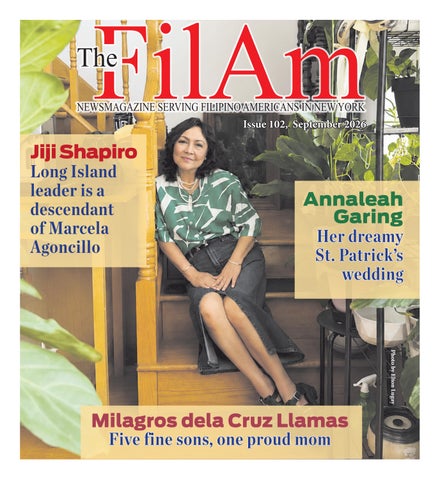
Issue 102, September 2026
Jiji Shapiro Long Island leader is a descendant of Marcela Agoncillo
Annaleah Garing Her dreamy St. Patrick’s wedding
Photo by Elton Lugay
Milagros dela Cruz Llamas Five fine sons, one proud mom
Letter from the Editor
Marco Rubio steps into the eye of the Philippines - China storm U .S. Secretary of State Marco Rubio likely did not expect his first official visit to Asia to coincide with one of the most volatile moments in the Philippines-China maritime dispute. His trip to Manila for the ASEAN Regional Forum Foreign Ministers' Meeting came as tensions between the two countries escalated over allegations that members of the China Coast Guard assaulted a Filipino sailor during a confrontation in the West Philippine Sea. Rubio visited Manila from July 19 to 23 to participate in three major regional meetings: the ASEAN Post-Ministerial Conference, the East Asia Summit Foreign Ministers' Meeting, and the ASEAN Regional Forum Foreign Ministers' Meeting. He also held discussions with senior officials from ASEAN member states and other Indo-Pacific partners. According to the U.S. State Department, the visit underscored Washington's commitment to the region. "The Secretary's visit advances a clear U.S. priority: a free and open Indo-Pacific that delivers safety, security, and prosperity for the region and for the American people," the department said.
‘A great week for the U.S. relationship with the Philippines and Asean,’ says Secretary of State Rubio as he prepares to depart the Philippines. Photo: U.S. Embassy in Manila The statement added that Rubio sought to demonstrate "the tangible results of the U.S.-ASEAN partnership" while deepening America's comprehensive partnership with the Philippines. On July 20, just one day after Rubio arrived in Manila, a confrontation reportedly occurred near the BRP Sierra Madre, the grounded Philippine Navy vessel at Second Thomas Shoal an area claimed by both Beijing and Manila
Philippine media reported that China Coast Guard personnel struck a Filipino sailor on the head with a piece of wood. According to the Armed Forces of the Philippines, a China Coast Guard boat carrying eight personnel approached the Sierra Madre and photographed and recorded the Philippine detachment before one of its crew members allegedly assaulted the sailor. The military later released a photograph showing the injured serviceman.
Founding Editor Cristina DC Pastor
Contributing Writers
Managing Editor Rene Pastor Address P.O. Box 8071 New York, NY 10116
The dispute soon expanded beyond the waters of the West Philippine Sea. China's English-language newspaper China Daily published an editorial cartoon depicting a monkey wearing the Philippine shirt called Barong Tagalog, prompting outrage in Manila. The Philippine Department of Foreign Affairs denounced the illustration as "blatantly demeaning, dehumanizing, and racist," saying it insulted not only Filipinos but also undermined efforts to maintain respectful diplomatic dialogue. Events quickly overshadowed Rubio’s diplomatic agenda. Both countries summoned each other’s ambassadors, a sign of displeasure over the events that happened a day earlier. Rubio returned to Washington having reaffirmed U.S. support for the Philippines, America's oldest treaty ally in Southeast Asia. Yet his visit will likely be remembered less for the ASEAN meetings than for the sudden escalation of one of Asia's most sensitive territorial disputes. Manila just became the stage on which the growing rivalry between China and the Philippines, and the United States' role in that conflict, came sharply into focus.
Marissa Banez
Allen Gaborro
Angelito Cabigao
Maricar CP Hampton
Tricia Capistrano Licelle Cobrador
Contact Thefilamny@gmail.com 646-717-7460
Joel David Wendell Gaa
The FilAm is a publication of A&V Editorial THE FILAM
| 2
Loida Nicolas Lewis Elton Lugay Lindy Rosales
Evangeline Paredes at 110: A birthday gift to America
E
By Bing Branigin and Jon Melegrito
vangeline Abellera Paredes turned 110 years old on July 26. Her exemplary life of service to this country is inspiring and empowering. To honor her birthday is to celebrate a gift to America. Possibly the oldest citizen in the nation’s capital, Vangie – as she is affectionately called by family and friends -- is not one to bask in the number of years in her life but the life in her years. She credits her excellent memory and longevity to a life of service. And she is donating her brain to science to find a cure for Alzheimer’s. She has survived two World Wars and seven pandemics, traveled to six continents around the world, served in jobs with significant national and global impact -- as secretary to world leaders, diplomats and generals -protested in the streets and in the halls of Congress, and led a community effort to envision, plan and ultimately fight to build and finance a senior wellness center for black families in Washington, D.C. Born in Brooklyn, New York, on July 26, 1916, Vangie is the third oldest of eight children by Tomas Rulloda Abellera, who served in the U.S. Navy during World War I, and Francisca Estrada, who was born in Asturias, Spain. In 1941, she married Juanito Paredes, the nephew of a prominent Filipino politician from the province of Abra. They raised a son, Juan, 78, who also lives in the city. When World War II broke out, the Commonwealth Government of Manuel L. Quezon went into exile and established its headquarters in Washington, D.C. Vangie was hired as President Manuel Quezon’s secretary. In 1957, she went on to serve in the U.S. Department of Defense, where her skills as a stenographer were highly valued by the Pentagon’s top brass. She remembers being the only person allowed in highly classified meetings to take notes. “The generals would be talking about building drones and other kinds of weapons,” she recalled. “They trusted me with the nation’s secrets.” She retired from the Pentagon after 30 years with the highest civilian award given to federal employees. Giving back to the community On her 109th birthday, she was asked what she is most proud of. Without hesitation, she said, “I helped raise funds to build a senior wellness center in Washington, D.C. I lived in that neighborhood for most of my life.” Established in 1985, the Congress Heights Senior Wellness Center serves mostly black families.
Juan Paredes fixes his mother's birthday tiara.
Birthday girl Vangie: She survived two World Wars and seven pandemics. Photos by Bing Branigin
She is the oldest member at VFW 5471 Auxiliary/ Vicente Lim Post.
“Building the center was my way of giving back to the community,” she said. Her active involvement with AARP for decades after her retirement taught her about benefits that seniors in her neighborhood weren’t aware of – like access to wheelchairs and walkers, clothing and housing. “I want to make life easier especially for poor people, to live at home in retirement instead of going into an institution,” she said. Over the years, Washington D.C. Mayor Muriel Bowser has recognized Vangie for her “advocacy, hard work and tenacity” and her long record of service to D.C. residents. The mayor praised her “for always ensuring a seat at the table for those who often go unheard.” In her 70s when she retired, Vangie continued to volunteer well into her early 90s. Retirement for her meant rewarding opportunities to serve: joining the Filipino American community to protest racial injustice, visiting veterans in hospitals, offering personal assistance to their families, and lending her energy
and experience to organizations like the Veterans of Foreign Wars (VFW) Auxiliary, AARP Capitol Hill Strike Force, and Senior Medicare Patrol. In 2010, AARP honored Vangie with the Andrus Award, the most prestigious volunteer recognition of “outstanding volunteers aged 50 and older who enrich their communities through selfless service, and dedicate their experience, talents, and skills to improve the lives of others.” Vangie has been blessed with a sharp memory, remembering all the way back to her childhood in Brooklyn. She considers it “a great honor” that doctors at Johns Hopkins University had asked her to donate her brain so they can find a cure for Alzheimer’s. They were amazed with her uncanny ability to remember details from her distant past. “I did not hesitate to say yes. I’m glad I can help,” she said gleefully. Vangie is living history, a link between the past and the present. She makes America’s 250th birthday even more special because of who she is and what she has given to this country.
THE FILAM
| 3
Luly Esclamado, the silent power behind NaFFAA
Luly Mitra Esclamado; Alex Esclamado. Facebook photos
In August 2026, the National Federation of Filipino American Associations (NaFFAA) celebrated the nearly 29 years of its founding in Denver, Colorado.
T
he host committee headed by Giselle Rushford, supported by NaFFAA National Chair Mariela Fletcher, decided that the first part of the agenda would be the panel of the “Originals” or those who were the pioneers of NaFFAA, among them Gloria Caoile (the first Vice President), Jon Melegrito (the first Executive Director), Rodel Rodis, Michael Dadap, and yours truly. The true founder of NaFFAA was actually the late Alex Esclamado, whose vision is to have an organization for Filipino Americans and Filipinos in the United States.
From April to August 1997, Alex and his better half Luly travelled to 27 U.S. cities to invite FilAm community leaders to this organization he was trying to create. It bore fruit. NaFFAA held its First Empowerment Conference in Washington D.C. in 1997. Around 1,000 FilAms answered the call for unity. That was the beginning of NaFFAA some 29 years ago. However, the “hidden ingredient” in such a successful first conference was the silent presence and steady support of the wife of Alex, no other than his faithful and resourceful wife, Lourdes Mitra Esclamado, known to all as Luly. THE FILAM
As Gloria Caoile fondly remembered at her eulogy for Luly in June 2026, Luly ’s contributions to NaFFAA were indelible and enduring. Her obituary states that she passed away on May 13, 2026 in Rolesville, North Carolina. She was 95. She and Alex (Alejandro) met in Baguio in 1951. Together they have seven children, 14 grandchildren and 14 great-grandchildren. Gloria was a long-time friend and close associate of Alex and Luly even before NaFFAA’s founding. She delivered this accolade to the First Lady of NaFFAA dedicating it to the couple’s seven adult children: “Your mother, Luly, was one of those rare pillars -- a quiet, steady, unwavering force whose presence strengthened NaFFAA in ways that were deeply felt, even if not always publicly seen. | 4
“When your Father, Alex, started his journey in founding NaFFAA, your mother was always by his side. She carried a kind of power that did not need a microphone or a spotlight. It was the kind of power that holds a community together, supports a leader's vision, and sustains a movement through grace, loyalty, and quiet strength. “This year, NaFFAA will open the National Empowerment Conference with a special tribute to your mother -- honoring her legacy, her partnership with your father and the profound role she played in the birth and growth of our national organization.” Her daughter Elisa Esclamado Glenn came to Denver during the Gala Night and received the NaFFAA Carabao Award meant for Lourdes Mitra Esclamado.
A descendant’s pride: How Jiji Shapiro keeps the legacy of Marcela Agoncillo alive By Cristina DC Pastor
“Look, they’re wearing clothes!” Jiji Shapiro’s young son nudged his brother as they were browsing the family album.
B
“We’re related to many people in the town of Taal and had to pay my respects to all every time I saw them,” she recalled. “So, like any child, I went through the motions without really getting to know them.” Her father, however, left her with one important impression of Marcela. “She was a very caring woman,” he would tell her. “What amazed me about her was her dedication to her country by the sacrifices she endured while in exile in Hong Kong, and her fighting spirit.” It was only much later, as an adult, that she began to piece together the life and legacy of the woman she had known mostly through clan reunions and family chat groups. “Now, as an adult, I’m very proud,” she said. “I wished I listened to my dad’s stories about the good old days in Taal.”
Filipinos not wearing clothes. “Yes, they know,” she said of her children’s awareness that they are descendants of a hero flagmaker. Her family’s roots, she pointed out, are firmly in Taal. She recently had an opportunity to reconnect with those roots when the clan held a family reunion there last February.
ased on what her U.S.-born sons have read on the Internet, they had thought then ||From Flushing to Long Island that Filipinos lived on trees and wore nothing. On hearJiji’s own story is also one of migraing the well-worn gossip, a shocked Ma. tion, family, and service. Jerona – Jiji to family and friends -- a She followed her parents to New York community leader from Long Island, in 1972, shortly before the declaration decided to begin Philippine history of martial law in the Philippines. She ‘What amazed me about her was her lessons with her family including her arrived with her six younger brothers, dedication to her country and her American husband Robert Shapiro. and the family settled in Flushing, where fighting spirit.’ She started with the story of Marcela they were surrounded by many of her Mariño de Agoncillo, the woman who mother’s siblings and their families. made the official flag of the Republic of Both of her parents were accounto the woman who helped sew it. the Philippines in 1898. The “Mother ||Keeping the family story tants. She went on to graduate from Yet growing up, she knew very little alive of the Philippine Flag" happens to be the City College of New York in 1981 about her celebrated ancestor. Jiji’s great-grand aunt. Jiji’s father is Her connection to Marcela is not with a degree in Health and Hospital “I don’t know her at all,” she told The Ramiro Lualhati Buzeta who is the son simply a matter of genealogy. She has Administration and minors in PsycholFilAm in all candor. “I left the Philipof Ramon Mariño Buzeta who is related pines at a young age, and before that made an effort to ensure that the next ogy and Biology. to Marcela. generation understands what family She met her husband Robert in 1986, I would spend very little time in Taal and they married the following year. (Knights of Rizal NY leader Ramesh legacy means. during summer vacation.” Their first son was born in 1987, and Buzeta is Jiji’s brother.) As a child visiting Taal, Batangas, She has brought her sons to the their youngest in 1995. In 1996, she left Marcela, together with two other she remembers being expected to pay Marcela Agoncillo Museum in Taal her position at North Central Bronx women, made the flag based on the respects to numerous relatives in the and showed them the place connected Hospital to become a full-time homedesign of revolutionary general Emilio town. The Mariño family, originally to their ancestral roots. And they are maker, dedicating herself to raising her Aguinaldo. The red, white and blue were from Taal and of Spanish ancestry, had reminded in all humor of what they family. stitched in Hong Kong where Marcela deep roots in the community. thought when they were kids about and her husband diplomat But family is only one part Felipe Agoncillo found of her busy life. She has also themselves in exile during remained deeply involved in the struggle for Philippine Filipino American community independence. According to organizations. history books, the flag was She served as immediate past completed in five days and president of Tanglaw, secwas unfurled for the first ond vice president of PACEC, time in Cavite as Aguinaldo and one of the trustees of the proclaimed the indepenDaughters of Mary Immaculate dence of Filipinos against International/NY Chapter. She Spain. currently serves as president Today, whenever she of Ladies for Rizal LI (LFRLI), sees the Philippine flag while also participating in Asian being raised, the emotion American committees on Long is unmistakable. “Pride and Island that promote Philippine goosebumps,” Jiji said, feelculture at festivals and commuing a personal connection A Wikipedia image of Marcela; Filipino master Fernando Amorsolo’s painting of the making of the Philippine flag. nity events.
Staten Island’s Fr. Rhey Garcia’s path to the priesthood: Falling in love with God ‘little by little’
W
By Cristina DC Pastor
hen more than 2,000 Filipino Catholics gathered at St. Patrick's Cathedral for the first-ever Santacruzan in New York despite heavy rainfall, Father Rizalino ‘Rhey’ Garcia saw something far more significant than a historic event: He saw a community united by faith. "More than 2,000 people gathered at St. Patrick's Cathedral despite the torrential rain," he recalled. "That alone speaks volumes about the deep faith of the Filipino people. They did not come simply for an event. They came to pray, to celebrate their faith, and to honor a beautiful tradition that has been passed on from generation to generation." For Fr. Rhey, 55, the historic celebration represented a mission entrusted to him as the first chaplain of the Filipino Catholic Apostolate (FILCA) of the Archdiocese of New York: bringing Filipino Catholics together while strengthening their place within the local Church. That inaugural Santacruzan marked a milestone for Filipino Catholics in New York. Although the event experienced some logistical challenges, Fr. Rhey did not shy away from responsibility. "I sincerely apologize to those who were affected," he said. "As the chaplain, I take responsibility for that. Every first major event teaches us valuable lessons." Yet what remained with him was not the confusion but what he called "the communion." "What I choose to remember most is not the confusion, but the communion. Seeing thousands of people gathered in prayer reminded me of the words of Jesus: 'Where two or three are gathered in my name, there am I in the midst of them.'"
||Why FILCA was created
FILCA—the Filipino Catholic Apostolate of the Archdiocese of New York—was established to provide pastoral care for one of the archdiocese’s largest and most active immigrant communities. "The Church is like a mother who cares for all her children," Fr. Rhey explained. "By establishing FILCA and appointing
Fr. Rhey with Filipino priests during the Santacruzan
The first Filipino priest in Staten Island has lived in the borough for 16 years. Photos by Matthew Adam a chaplain, the archdiocese recognizes the vibrant faith of the Filipino Catholic community and desires to care for its spiritual and pastoral needs in a more intentional way." His ministry stretches far beyond Manhattan. Filipino Catholics are scattered across the Bronx, Staten Island, Westchester and the upstate counties of Rockland, Orange, Dutchess, Putnam, Ulster and Sullivan. Rather than waiting for parishioners to come to him, Fr. Rhey embraces the pastoral vision championed by the late Pope Francis. "I am always inspired by the words of Pope Francis, who encouraged pastors to 'have the smell of the sheep,'" he said. "That means being close to the people, not waiting for them to come to us, but going out to meet them." His mission, he said, is simply to accompany Filipino Catholics in their journey of faith through the sacraments, encouragement and presence. Fr. Rhey said he never sought the appointment as FILCA's founding chaplain. "I simply received the appointment with gratitude and humility." THE FILAM
He viewed the role as a call to service. "As Jesus reminds us, 'Whoever wishes to be great among you shall be your servant.'"
||A quiet calling
Unlike stories marked by dramatic conversion experiences, Fr. Rhey describes his vocation as one that grew naturally. His journey began in Alaminos City, Pangasinan, home of the famous Hundred Islands. "As a child, I regularly went to church with my cousins," he said. "Those simple moments nurtured my love for God and for the Church." Looking back, he now believes those ordinary experiences quietly prepared him for the priesthood. "I often tell young people that vocation is not just about hearing God's voice. It is about falling in love with Him little by little." He adds that priesthood remains a daily response to God's invitation. "God does not call us because we are perfect. He calls us because we are willing to let Him shape us." Although he now ministers in New York, Fr. Rhey still treasures memories of his hometown. He recalls climbing the old lighthouse overlooking the Hundred Islands with his cousins and marveling at the scenery below. Whenever he returns to the Philippines, one place is always on his itinerary: the public market. | 7
"I love markets not only in Alaminos but wherever I travel," he said. "They reflect the life of a community." To him, bustling markets represent the dignity of hardworking people and the beauty of simple communal life.
||Speaking to a new generation
Fr. Rhey is optimistic about the faith of younger Filipino Americans. "In recent years, we've seen many young people rediscovering their faith," he said. He remembers one young adult telling him, "We're tired of fake stuff." For Fr. Rhey, that statement reflects a generation searching for authenticity, meaning and belonging. "The Church is not perfect because it is made up of imperfect people," he said. "But what we offer is authentic. We offer Jesus Christ." Faith, he believes, also helps younger Filipino Americans preserve their cultural identity while discovering their deeper identity as children of God. In a fast-moving world marked by anxiety and uncertainty, he said faith offers stability. "It teaches us gratitude in times of blessing, hope in times of difficulty, and compassion for one another." For him, what remains at the center of his ministry is the realization that Filipino Catholics, wherever they may be in New York, find both a spiritual home and a deeper relationship with God.
Bride fulfills childhood dream: a St. Patrick's Cathedral wedding
F
or Annaleah Flores Garing, saying "I do" at St. Patrick's Cathedral was the fulfillment of a lifelong dream. A timeless ending to a thoroughly modern romance that began on the dating app Bumble. "I grew up very Catholic," said Annaleah, 37, whose father is from Lipa, Batangas, and whose mother is from Mindoro. Although she was born in Manila, she moved with her family to Chicago when she was 3 years old. After graduating from college, she relocated to New York City, where she built a successful career in the beauty industry. Today, she manages Amazon business operations for several luxury beauty brands, including Shiseido, Clé de Peau Beauté, Issey Miyake, Dr Dennis Gross, and Drunk Elephant. Before entering corporate beauty, she worked in the fashion startup industry. Annaleah and her husband, Joseph Chiaro, 38, exchanged vows on June 13 before 170 family members and friends at the iconic Fifth Avenue cathedral. Joseph, an Italian American born in Brooklyn and raised on Long Island, shares Annaleah's strong family values and Catholic faith. "We made the decision together," she said. "We knew we wanted a church wedding, and St. Patrick's was just so beautiful." Joseph attends the Columbus Day mass every year. The ceremony was officiated by their family Monsignor, Jamie Gigantiello, making the occasion even more personal. Although St. Patrick's welcomes thousands of tourists each day, Annaleah remembers the profound calm she felt the moment she walked through its doors in her flowing gown. "When you walk into St. Patrick's, there's just this sense of peace," she said. "Walking down that long aisle was everything I imagined." During the ceremony, a regularly scheduled Mass was also taking place. The cathedral roped off the center aisle
By Cristina DC Pastor
The exchange of vows
Walking down the aisle as a married couple
The couple with the bridal party
Guests enjoying blackjack during the reception THE FILAM
| 8
exclusively for the wedding party while parishioners and tourists occupied the side pews, a uniquely New York moment that blended public worship with private celebration. The couple embraced timeless elegance for their wedding theme. The bridesmaids wore black gowns, accented by white calla lily bouquets tied with ivory ribbons. Even the flower girls complemented the sophisticated black-and-white palette. Annaleah wore a minimalist gown by designer Danielle Frankel, known for apprenticing under Vera Wang before launching her own bridal label. "My vision was old-school New York—very classic," she said.
The Father-Daughter dance Their reception continued the celebration at the Columbus Citizens Foundation, an Italian American institution in Manhattan. Rather than a traditional photo booth, the couple had a lively casino night complete with blackjack, roulette, and craps tables. Customized casino money featured the newlyweds' faces, adding a playful, personal touch that delighted guests spread throughout the venue's four rooms. The wedding cake, Millefoglie, paid tribute to Joseph's Italian heritage where the cake is assembled in front of guests during the reception. Guests enjoyed layers of delicate Italian-style pastry filled with buttercream, created by the venue's pastry chef. Recalling their romance which began several years earlier, Annaleah said, "Our first date just kept going.” After a few months online, they met in person at a bar near Flatiron, then went to dinner for sushi, and afterwards a café for dessert. “Neither of us wanted the night to end." She knew early on that Joseph was “the one.” "Our core values were very similar," she said. "He's conservative, very family-oriented, and incredibly easy to talk to." Joseph comes from a large Italian family. He is one of four brothers, while his mother is one of eight sisters. His family has deep roots in New York through a paint store business established by his grandfather that has served Brooklyn, Queens, and the Bronx for generations. Annaleah and Joseph live in Astoria
The bride and groom with their guests – mostly dressed in black -- after the ceremony
The couple assembling their wedding cake
The bride and her two flower girls who are Joseph’s nieces
Annaleah’s bridesmaids THE FILAM
| 9
The wedding details after several years in Manhattan. She remains close to her Filipino family, many of whom still live in Chicago. Her mother works as a bookkeeper for a pharmaceutical company, while her father is an Intraoperative Technician in the Operating room. Just days after the wedding, the newlyweds are set to for on a two-week honeymoon through Scandinavia, with stops in Sweden, Norway, and Denmark. For Annaleah, one memory will forever stand above the rest. "St. Patrick's is such an iconic part of New York," she said. "The interior is so grand and beautiful, it feels like something out of a fairy tale. Growing up, it was like the Disney version of a church. To be married there was a dream come true."
COVER STORY
From raising five sons to caring for newborns, ‘Tita Miles’ finds her calling
B
By Elton Lugay
efore the feedings, the overnight shifts and the first-time parents looking for reassurance, Milagros dela Cruz Llamas begins with a simple belief: newborn care is not just about caring for a baby. It is also about helping a family find its footing. For more than two decades, Dela Cruz Llamas has worked as a newborn-care specialist (aka baby nurse) in New York, guiding parents through the demanding first weeks of a child’s life. She has become known in the Filipino American community as “Tita Miles,” a mother of five sons and who has patiently cared for hundreds of babies. Tita Miles was born and raised in Manila and was an only child, she tells The FilAm in an interview. Her father died when she was 8 months old, and her mother, whom she calls Nanay, did not remarry. By age 6, she was helping her mother sell sweepstakes tickets before she began school. She later became a licensed medical technologist and hoped to continue her education to become a physician. Marriage and the responsibility of raising five sons altered the direction of that path. “I wanted to continue studying to be a doctor, which was my ultimate dream,” she said. “But since I got married and had my five boys, I did not fulfill my dream of being a doctor.” As a single mother, Tita Miles built a business in the Philippines while raising her children. She opened Magnolia House and a fast-food restaurant on Buendia Avenue in Pasay, followed by a 24-hour restaurant on Roxas Boulevard near the site where the Cuneta Astrodome now stands. In 1985, she opened another restaurant at the Dampa Seafood Restaurant Complex near Manila’s international airport. She ran the business for nearly
Marriage and the responsibility of raising five sons altered the trajectory of her life. Photo by Elton Lugay Maybelle at her Paramus N.J. office
Tita Miles with sons Temi, Kirk, Rolan and Arby; with Lloyd THE FILAM
| 10
20 years before moving to the United States in 2005, leaving its management to one of her sons and a daughter-in-law. Tita Miles came to New York seeking new opportunities. Her eldest son, Lloyd, now 45, joined her in the United States, and she later brought her youngest son, Temi, now 33, to live with her. Lloyd currently works with Homeland Security and has been in law enforcement for more than 10 years. Youngest son Artemio John or Temi is a Supervisor, Patient Coordinator for Weill Cornell Medical Group in Lower Manhattan. He is also a concert artist and a member of the TOFA Singers. There are three more sons in between. They are all married and living in Manila. Kirk, the second son, is 43 years old working as a corporate executive for Filinvest Hospitality where he oversees commercial business and hotel management. Third son Rolan, or JR, 41, is the Senior Operations Manager of IBEX Global Solutions Inc. in Bohol. Artemio Gabriel, or Arby, the fourth son, is 35 years old and works as a data analyst. He has a Nursing degree. He and his wife are expecting a baby boy in November. Her entry into newborn care came through a nursing contact of her eldest
At TOFA awards night with then Consul General Claro Cristobal and honoree Ram Buena at Carnegie Hall.
Backstage with TOFA emcee Boy Abunda
The job has also taken her beyond New York, including trips with families to France, Italy, St. Barts, the Dominican Republic, Turks and Caicos, and Cancun. Among her most memorable assignments was caring for the child of a Fox News correspondent during the COVID-19 pandemic. Tita Miles also recalls a yearlong assignment with a celebrity family, an experience that combined demanding newborn-care work with frequent travels. Yet her focus remains the same whether she is working in a regular home
environment or traveling with a famous family: caring for a newborn and helping first-time parents feel more confident. For a woman who once imagined becoming a doctor, Tita Miles sees her life in care work as a different fulfillment of the same calling. “They live in my thoughts, in my prayers, in the little pauses between breaths,” she said, describing the tenderness she brings to the children whether they are hers or those of other people.
Single…in Paris son. She attended a two-day seminar for baby nurses and newborn-care specialists, completed CPR certification and soon began taking assignments. The work requires more than affection for babies. Newborn-care specialists work long shifts, including overnight or 24-hour schedules, while helping families establish feeding, sleep and safety routines. For Tita Miles, the role draws on her experience as a mother and business owner. She teaches new parents how to care for their infants while offering the calm presence that can be crucial during an exhausting and uncertain period. “Being a baby nurse and newborn specialist takes skills, caring for fragile newborn babies, especially for 24 long hours of duty,” she said.
With TOFA friends and family after a productive meeting. Tita Miles is on the board of The Outstanding Filipino Awards. THE FILAM
| 11
Calendar ||September 6
14th Annual Filipino American Festival Inc. Overpeck County Park 2e Fort Lee Road Leonia, NJ
||September 7 to 18
Central Europe Pilgrimage of Faith With Fr. Leandro Dela Cruz of the Church of St. Ann, Lawrenceville, N.J. Contact info@nativitypilgrimage.com
||September 11 & 12
New York Fashion Week produced by Steadfast Creative Arts Productions Edison Ballroom 240 W 47th Street NYC
of Events ||September 26
Gotham Hall 1356 Broadway NYC
||September 13
Feast of San Lorenzo Ruiz St. Patrick’s Cathedral To join, contact FILCA at filcc. ny25@gmail.com
||September 13
Retro Night Party (Knights of Rizal & Ladies for Rizal NY Chapter) The Palace 63-01 Roosevelt Avenue Queens NYC
||September 17 & 18
3AF Fall Marketing Summit: Trust, culture, and the future of growth Venue: To be announced
||September 23 to 27
4th Annual NY Yankees Filipino Heritage Weekend For more information, contact info@filschool-nynj.org Yankee Stadium Bronx NYC
Beks Battalion: The Laff Control Project Queensborough Community College Theater Bayside, Queens NYC
||October 3
Casino Night in New York: 38th anniversary of the Foundation for Filipino Artists, Inc. Leonard’s Palazzo 555 Northern Boulevard, N.Y.
||October 4
100th Anniversary of the Coronation of Our Lady of Manaoag (to be celebrated by Rev. Efren Esmilla) Cathedral Basilica of the Sacred Heart of Jesus 89 Ridge Street Newark, N.J.
Himig Pamana – A Musical Heritage Kayumanggi Chorale, Inc. 35th anniversary concert Merkin Hall 129 W 67th Street, NYC (between Broadway and Amsterdam Avenue)
||October 17 & 18
70th Anniversary of The FilAm PGH Filipino American Association of Pittsburgh Special concert featuring Martin Nievera & Rex Navarrete on October 18 The Circuit Center 5 Hot Metal Street Pittsburgh, PA
||October 21
Womankind Communities Rising 2026 Gala Tribeca 360 10 Desbrosses Street NYC
||October 24
16th Annual TOFA Awards Jacksonville Center for the Performing Arts Florida
||September 12
Michael Cinco & Alexis Monsanto for New York Fashion Week Angel Orensanz Foundation 172 Norfolk Street N.Y.
||September 12
Kenneth Barlis unveils his Spring/Summer 2027 collection at New York Fashion Week THE FILAM
||October 11
| 12
||December 5
Simbang Gabi at St. Patrick’s Cathedral Holy Mass begins at 10:30 a.m. Principal Celebrant: Most Rev. Bishop Edmund Whalen Vicar General, Archdiocese of New York
||2027 ||February 7 to 17
VIP Tour: Winter Escapade Edition (destinations: Leyte, Legaspi-Naga, Siargao, Camiguin, Bacolod-Iloilo, and El Nido) For queries email newyorkpcg. bulletin@dfa.gov.ph
||July 7 to 24
48th Annual Philippine Nurses Association of America, Inc.
National Convention Inter-island cruise in Hawaii
|| ATBP
‘How to Get a Green Card’ (now on its 17th edition) by Loida Nicolas Lewis Available on Amazon Collecting Philippine-authored books to donate to a local library Contact Ria Serrano for details: 718-414-4041 Online English tutor specializing in: • Reading Comprehension • Writing Skills • Accent Reduction & Clear Pronunciation • Conversational English • English for Students, Professionals & Adult Learners Contact 646-717-7460
THE FILAM
| 13
‘Ube is ours,’ but what does that really mean?
A
s purple yam becomes a global food sensation, the Philippines faces the challenge of how to protect, define and capitalize on a crop that has become deeply identified with Filipino culture. Ube is many things to many of us. It is ube halaya at Christmas, the colorful swirl in halo-halo, a favorite ice cream flavor and the distinctive ingredient in cakes, breads and other Filipino desserts. Today, it is also a global food trend, appearing in products far beyond Filipino and Asian markets. But as ube gains international popularity, a question is becoming increasingly difficult to ignore: Can Filipinos really claim ube as “ours”? The answer requires some nuance. Ube is not exclusive to the Philippines. Purple yam is grown in several countries across Southeast Asia and elsewhere like Japan and India. Some are saying the Philippines cannot claim ownership of the crop simply because it is cultivated there. But there is another kind of ownership: a cultural and culinary one. The word “ube” itself comes from the Tagalog word, and Filipinos have developed an extraordinarily rich culinary tradition around the ingredient. Philippine cuisine has played a major role in transforming ube from a traditional root crop into an internationally recognizable flavor. That distinction may ultimately be the key to how the Philippines positions ube in the global marketplace. “We have to be precise and intentional about how we communicate that message,” said Trade Commissioner Alma Argayoso from her office in New York when interviewed by The FilAm. “While ube is not exclusively grown in the Philippines, no country is more closely associated with ube as a food and cultural tradition than the Philippines.” Thanks to social media, ube has moved from Filipino bakeries and Asian supermarkets into mainstream ice cream shops, restaurants, bakeries and packaged-food aisles in North America, Europe and other parts of Asia. The Philippine government has increasingly taken notice.
By Cristina DC Pastor
Ube pastries. Photos: Unsplash, stock photo
A growing array of ube-inspired products on the market The Department of Agriculture said in June that the Philippines exported about 1.7 million kilograms of ube worth approximately $3.2 million in 2025, an increase from the previous year. At the same time, the government acknowledged a fundamental problem: international demand is rising faster than domestic production. The response has begun at the farm level. In June, the Bureau of Plant Industry distributed more than 60,000 purple yam planting materials worth nearly ₱2.6 THE FILAM
million to farmers in Leyte and Bohol. The program covered some 900 farmers and more than 60 farmer groups, said Argayoso. “The investment is significant because the challenge is no longer simply how to market ube. It is how to produce enough of it,” she added.
||Protecting the Filipino identity
According to her, there is currently no indication of a major international legal battle in which the Philippines has sued
| 14
another country or company for “stealing” ube. Instead, the country is beginning to pursue a more targeted strategy: protecting particular Philippine varieties and their geographical identity. A major step came in June when the Provincial Government of Bohol, through its economic development office, filed an application for Geographical Indication (GI) registration for Bohol Ubi Kinampay with the Intellectual Property Office of the Philippines (IPOPHL). GI protection is designed to connect a product's qualities, reputation and characteristics to a particular geographical area — much like the way certain famous products around the world are associated with their places of origin. The very popular Bohol Ubi Kinampay is known for its naturally vibrant violet flesh, distinctive aroma and flavor. The GI application seeks to formally recognize characteristics tied to Bohol's geography, soil, climate and traditional farming practices. “This is a very different claim from saying, ‘The Philippines owns ube.’” Instead, it says: this particular ube, with these particular characteristics and traditions, comes from this particular place. That distinction could become increasingly important as global demand grows, she stressed.
||Difficult to tell For the ordinary consumer, determining whether a product actually contains ube can be “surprisingly difficult.”
Philippine Ube Kinampay. Photo: www.ifexconnect.com Some commercial products use real ube — in the form of puree, powder, jam or extract. Others rely primarily on flavoring and food coloring to recreate the purple appearance and taste associated with ube. Some products contain a combination of both. The color alone, therefore, is not proof. Consumers interested in authentic ube can look at the ingredient list for terms such as ube puree, ube powder, purple yam or ube extract. Real ube also tends to have a more complex flavor profile — mildly sweet, earthy, nutty and sometimes
reminiscent of vanilla — rather than simply tasting like artificial “purple” flavor. This may be an area where a Philippine-led consumer education campaign could make a difference, the commissioner said. There is a sense that the Philippine government recognized ube's international potential only after the crop had already begun making waves globally. The rise of social media has accelerated that process enormously. Not quite, said Argayoso citing the work of the Department of Agriculture in supporting root crop research and cultivation. Meantime, the government continues to address the less glamorous side of the business: farming, planting materials, supply chains, quality control, processing, export standards and farmer income.
||What about New York's Ube Festival?
The annual Ube Festival in New York, organized by Filipino restaurant owners and community entrepreneurs, is an example of how the Filipino diaspora has helped
Trade Commissioner Alma Argayoso (far left) answers questions during Media Hour with Consul General Senen Mangalile and other consular and government officials. Photo by Marivir Montebon turn ube into a cultural phenomenon abroad. But these community-led celebrations are not currently formal government programs. “The DTI does not have an institutional role in organizing or funding the New York festival,” she said. Its larger concern is strengthening the supply side of the industry and creating opportunities for Philippine farmers, suppliers and exporters.
Now, do we “own ube”? The real opportunity is not simply to claim purple yam, said Argayoso. It is to claim a place in the global ube economy, while making sure the farmers, communities and culture that helped give ube its identity are not left behind. “When the world thinks of ube, it should know the Filipino story behind it,” she said.
Shrine project for Our Lady of Antipolo to launch Sept 12th
T
he Fil-Am Catholic Community of Hudson Valley (FACCHV) recently hosted the second annual pilgrimage in honor of Our Lady of Antipolo at the National Shrine of Our Lady of Mount Carmel in Middletown, New York. The community welcomed over 400 pilgrims from all over the Tri-state to a day of worship and to take advantage of the scenic 60-acre property where the National Shrine is located. The first pilgrimage was held last year during the Jubilee Year of Hope. The National Shrine of Our Lady of Mount Carmel is the motherhouse of the Carmelite Friars, Province of St. Elias. It sits on a 60-acre property in Orange County, New York. The Tagalog mass was celebrated by Rev. Von Erick Maria Sandoval, O. Carm., coordinator of the FACCHV. The Master of Ceremonies was Seminarian John Bulatao of the Diocese of Brooklyn-Queens. The concelebrants included Fr. Gerard Tang Choon, O. Carm., rector of the National Shrine; Fr. Rhey Garcia, FILCA chaplain; and various Carmelite friars and diocesan priests. The music and choir were provided by the Filipino American Group of Mahopac.
Our Lady of Antipolo pilgrims attend annual picnic in Middletown, N.Y. Following the Mass, there was a procession with the image of the statue of Our Lady of Antipolo on the shrine grounds. After the procession, there was a potluck luncheon with music, dancing and raffle. “It was a great opportunity to connect with THE FILAM
| 15
everyone,” remarked Fr. Von. Rev. Von Erick Maria Sandoval, O. Carm. is a Carmelite friar from the Province of St. Elias. He currently serves as Parochial Vicar in the Bronx as well as the coordinator of the Fil-Am Catholic Community of Hudson Valley. He is also a part of the Filipino Catholic Apostolate of New York (FILCA). The annual pilgrimage in honor of Our Lady of Antipolo was celebrated in partnership with the Diocese of Bridgeport, Connecticut, as well as FILCA. “We are hoping that this event will continue to grow each year,” said Fr. Von. During the picnic-style luncheon, it was announced that the FACCHV plans to build an outdoor shrine in honor of Our Lady of Antipolo. This will be the first outdoor shrine in honor of Our Lady outside of the Philippines. Opportunities for collaboration, partnership and support for this project are available. The FACCHV group will host an event at the Philippine Consulate on Saturday, September 12, 2026 at the Philippine Consulate. For more information, contact Fr. Von at facchv17@gmail.com.
Bridging the political divide in U.S. immigration through Transformative Journalism (Part 4) This concludes the 4-part dissertation series of Dr. Marivir Montebon which examines the role of Transformative Journalism in immigration reporting. By Dr. Marivir Montebon
“We welcome the stranger, yes. But we must have a sound immigration system,” said the head of the churchbased legal immigration assistance center who batted for empathy for people migrating to the US in search of supposedly better lives.
T
his study highlights U.S. immigration needing reform, and recommends the practice of Transformative Journalism, by surfacing real stories from the ground, to bridge political divides. Volunteers and legal luminaries who are at the heart of providing legal immigration assistance said that they seek media reports that look deeply at the accountability of U.S. Congress on immigration reforms to fix the broken system. “The INA of 1965 needs to be reformed by Congress to make it responsive to the current times. Executive powers could be politicized and are limited to effect substantial reforms.” Majority of volunteers in this study pinned their hopes on public clarity and understanding through constant truth-telling, especially coming from immigrants themselves. “Journalists need to look beyond political posturing and examine both the flaws in the law and the real experiences of immigrants. Current U.S. immigration laws do not align with the country’s needs. Canada, by contrast, regularly updates its immigration policies to reflect changing realities and priorities. In the United States,
More stories from the ground, less from politicking politicians the focus is largely on enforcement, but the issue is far more complex. The system is so broken that it often causes misinformation. Immigration has become deeply polarizing and politicized. Journalists have the power to bring greater public understanding and cast these issues in a more constructive light.” “Media reporting can build awareness of the actual immigration process, including the specific steps that need to be undertaken to reach an approved change of status or granted petition leading to adjustment of status, and that will change the narrative and combat misinformation.” A handful of immigration assistance volunteers in this study did not believe that the current political polarization of U.S. immigration reporting can be done by journalists. It is too idealistic, they contend, because the media is owned by big businesses with ideological and business interests. THE FILAM
||How information is processed, filtered
The results of this study provide a picture of how information is processed from the ground -- filtered by journalists, editors, and media producers -- to create messages that reflect the media’s own ideological frames. 1.Political polarization in the understanding of U.S. immigration begins with interpretation of facts and the constant bombardment of these interpreted messages through mainstream and social media. 2.Information is incubated in the newsrooms, whereby raw information gathered and written by journalists is filtered and interpreted by editors, commentators, and executive producers to suit their specific ideological or political narrative and target audiences. 3.Interpretations of news information contained in commentaries are used and amplified through the commentary sections with four to five more exposure times compared to the | 16
one-time exposure of the straight news coverage in a day. The interpretation of news influences public perception and opinion more than the news information itself because of disproportionate exposure times. 4.Journalists admit to the political divide that exists in reporting on immigration issues. Most of the stories on immigration policies and issues are angled narrowly on contending partisan politics, often without including the lived experiences and voices of immigrants themselves. 5.The mainstream media, both liberal and conservative, at varying degrees, have amplified the historical demonization of immigrants due to the lack of historical context and global perspective of immigration. 6. There is a media desert for coverage of real stories but help for immigrants is taking place through church-based immigration assistance centers.
||Practicing Transformative Journalism
This study recommends the practice of Transformative Journalism to bridge the political divide in understanding immigration issues. The process involves transforming information into news stories with facts and historical context; enabling journalists to develop empathetic listening skills and self-correction attitude; and ensuring dynamic editorial guidance. One participant volunteer said it well: “I’d like for the media to report on dignity. The issue is more than just immigration. It’s about people and allowing them to live with dignity. I don’t believe in polarization. When you come to the ground, like at the Migrant Center, we are so much a community here than a division. We all aspire for dignity.” Dr. Marivir Montebon is a New York-based journalist who runs her media company Awesome Media, Ltd.
Jersey City’s Raul Raagas now in Mississippi detention
‘He never asked for money,’ says consular officer.
funds will ultimately be approved by Manila, he said. “Wala siyang sinasabi, hindi siya humihingi ng pera,” said Valdez. “We made our recommendations and we are waiting for approval from Manila to say if the fund has been approved.” Meanwhile, the families of detained Filipinos in Washington, Illinois, California and New Jersey
Detained Jersey City man Raul Raagas has been transferred to the County Detention Center in Mississippi on August 22, 2026 the Philippine Consulate in New York told The FilAm. “He is now being handled by our consulate in Houston,” said Rovald Valdez, consular officer of the consulate’s Assistance to Nationals (ATN) office. Raagas was stopped for a minor traffic infraction July 24, 2026, while driving to work in Kearny, New Jersey, He was taken to an ICE processing center and then transferred to the CoreCivic Elizabeth Detention Center in Elizabeth, N.J., where he remained in custody until August 21, 2026. Valdez said the consulate has visited Raagas three times during his detention, and in one such visit Consul General Senen Mangalile had joined him and Vice Consul Pete Dela Fuente. He denied accusations of “inaction” from families of detained Filipinos and Tanggol Migrante Movement. In a recent press conference, they condemned what they described as the Philippine Embassy and its consulates’ alleged failure to provide adequate assistance to Filipinos held in U.S. immigration detention. Valdez said that while the U.S. Immigration and Customs Enforcement’s (ICE) is required under the Vienna Convention to inform countries of arrests of individuals, it is not obligated to update the consulates of the detainees’ every move. “They are not obligated to inform us about court hearings or moving from place to place,” said Valdez. Consulates keep themselves updated on the detainees’ situation through the Online Detainee Locator System (ODLS) which ICE operates, he said. It is open to the public. In their visits, Valdez said Raagas never asked for money from the consulate officers. While it is true that detainees are entitled to a certain amount from the ATN budget, the release of those THE FILAM
| 17
said their experiences reflect a broader pattern of neglect at a time when the Trump administration has intensified its immigration enforcement and detention campaign. They said Filipinos are being swept into detention and left for prolonged periods with little meaningful assistance, advocacy or diplomatic intervention from Philippine consular officials. -- Cristina DC Pastor
COVER STORY
Trans woman Cassey Arrobang from Albany crowned Ms. PAFCOM LGBTQ
E
By Elton Lugay
very time Cassey Arrobang steps into the spotlight, she carries more than a microphone. She carries a story. “As a performer, my greatest goal is to tell a story through every performance,” Cassey, a transgender woman, singer, dancer and community leader from Albany, shared in an interview with this writer. “Whether it’s a story of sadness, hope, love, or triumph, I want my audience to feel every emotion with me.” That commitment to authentic storytelling recently earned her the Ms. PAFCOM LGBTQ 2026 crown, presented at the annual LGBTQ pageant organized by the Philippine American Friendship Community, Inc. (PAFCOM). For Arrobang, also known by her stage name Cassey Fierce, the crown is an opportunity to use her visibility to advocate for a community that has often struggled to be seen, heard and accepted. “As Ms. PAFCOM LGBTQ 2026, this title serves as a powerful plat- Cassey showcases her shimmering gown at the pageant. For Cassey, flowers are the best kind of friends. form to amplify my voice, inspire resilience, lead with compassion, and ficult, but the United States eventually Americans (TOFA) and LGBTQ comadvocate for equality, inclusion, and became home and, in her words, “a land munity events, bringing her energy and ||A profession in healthcare hope within our community,” she said. of opportunity.” talent to stages throughout the New Away from the spotlight, Arrobang Cassey was born and raised in Metro “My journey from a simple childhood York metropolitan area and beyond. works in healthcare as a phlebotomist Manila, the third of five children of in the Philippines to building a life in But her path, in her own words, has and dialysis technician in Latham, Dominico Arrobang Jr. and Liberata America has shaped who I am today and not always been an easy one. N.Y., where she cares for patients, Bernales Arrobang. taught me to embrace who I am, work “I’ve faced many challenges, and including military veterans. She said She describes her childhood as hard, and always dream big,” she said. sometimes the harshest criticism her healthcare work has given her simple but filled with love. Her family came from people within my own another avenue for service. lived close to relatives, and her earliest ||Finding her voice community.” “As a healthcare worker, I have the memories include playing in the streets Music has always been central to There were moments, according to privilege of caring for our veterans and with her siblings and cousins, many of Cassey’s life. She credits her father, her, when she felt judged, humiliated serving the community with compaswhom were also her neighbors. the family singer, as the person who and made to believe that there was sion, dedication, and respect,” she said. Her parents, she said, recognized from first inspired her to embrace her own no place for someone like her in the “Every day, I strive to make a positive an early age that she was different. voice. Over the years, she developed entertainment industry or in the Filidifference in the lives of those I care for.” “But instead of judging me, they into a multifaceted performer --singer, pino community where she rightfully Her commitment to community embraced me with unconditional love dancer, choreographer and digital cre- belongs. service does not end at the clinic. For and support,” she recalled. ator -- using each discipline as another “Those experiences were painful, the past decade, Cassey has served At 16, the Arrobang family made a way to connect with audiences. but they never defined me,” she said. as vice president of the Bayanihan life-changing move to Upstate New As a volunteer performer, she has Instead, they became part of the Association of the Capital District, one York. Leaving the Philippines was difsupported The Outstanding Filipino story she now brings to the stage. of the Filipino American organizations THE FILAM
| 18
“Being a good leader isn’t about having the loudest voice—it’s about listening,” she said. “A great leader listens to their people, values their ideas, understands their needs, and leads with compassion, integrity, and respect.”
||A crown with a purpose
On the job as a phlebotomist and dialysis technician serving the Albany area. She is also the 'one of the main organizers of the Albany Kidney Walk, an initiative that raises awareness about kidney disease and supports efforts to combat it. Her years of community involvement have shaped her understanding of leadership.
Now, with the Ms. PAFCOM LGBTQ 2026 crown, Cassey hopes to turn her visibility into advocacy. Her greatest ambition is to challenge the stereotypes that continue to surround transgender people and the broader LGBTQ community. “I want to live in a world where we are recognized not for our gender identity, but for our character, abilities, and the positive impact we make in society,” she said. It is a message that reflects the different chapters of her life: from the child who grew up surrounded by family in Manila to the pageant titleholder who hopes to inspire others to embrace their identity. “If my journey can inspire even one person to believe in themselves and pursue their dreams with confidence,” she said, “then I know I have made a difference.”
THE FILAM
| 19
At her coronation as Ms PAFCOM LGBTQ. Facebook photos
Issue 102, September 2026
The popular ‘Ube’ Can Filipinos claim it as theirs? Photo by Brian Wheeler
Fr. Rhey Garcia
Staten Island’s 1st Filipino pastor
Cassey Arrobang
Trans woman from Albany is Ms. PAFCOM 2026