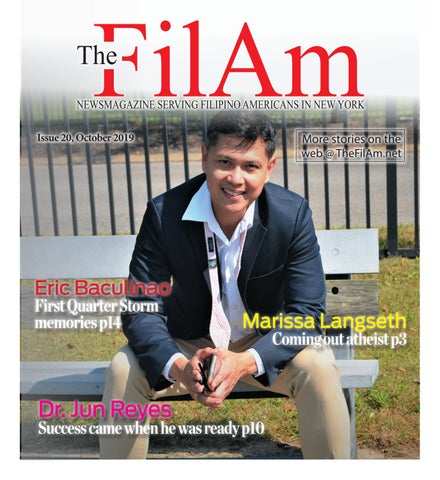
Issue 20, October 2019
More stories on the web @ TheFilAm.net
Eric Baculinao First Quarter Storm memories p14
Dr. Jun Reyes
Marissa Langseth
Success came when he was ready p10
Coming out atheist p3
Letter from the Editor
A year of inspiration and despair
T
he 1960s seem so long ago, but the last year of that decade was such a landmark it is hard to believe that a half century has passed since that time. We choose to pick two events from that year: One is epochal and the other seemed to foreshadow the dark times that would befall the Philippines. The first took placed in July when Neil Armstrong hopped on the moon to become the first human extraterrestrial to set foot on another world. We watched the landing on the grainy image of a TV set in Manila. It fired the human imagination, especially from Hollywood for adventures in galaxies far, far away. “Star Trek” was already on TV and the actual landing of a man on the orb that gives the planet its tides was awe-inspiring. The wonderful thing about the moon and the wave of films that it inspired was that it made space flight seem utterly normal. It forced open the concept that is increasingly widely accepted by the scientific community: that intelligent life likely exists away from our blue
On the same year: Man landed on the moon and Ferdinand Marcos was re-elected president of the Philippines. planet. The question now is when will we experience first contact. Now, there is talk and even plans of going back to colonize the moon, and then establishing a colony on Mars. What the moon landing did is fix in our psyche the seminal idea that man should be an explorer to a universe beyond our wildest imaginings. The other event we would like to focus on is the 1969 November presidential elections in the Philip-
pines between Ferdinand Marcos and Sergio Osmena Jr. Marcos “won” with 61 percent of the vote, but that election was denounced at that time as the dirtiest and most corrupt in our history. It laid the groundwork for Marcos eventually declaring martial law, using bombings some had suspected were his handiwork, to impose oneman rule in 1972, a year before his term was due to run out.
Contributing Writers Tricia J. Capistrano Ludy AstraquilloOngkeko Joel David Mariel Padilla Wendell Gaa Maricar CP Lindy Rosales Hampton Danielle Vania Angelito Cabigao Bonus
Founding Editor Cristina DC Pastor Address P.O. Box 8071 New York, NY 10116
Contact Thefilamny@gmail.com
The FilAm is a publication of A&V Editorial THE FILAM |
The 1969 election was the genesis for dictatorship in the Philippines which went hand-in-hand with official corruption to turn the country into a banana republic. Even though there was a ‘democratic’ restoration in 1986, it quickly took the form of the political elite reasserting control and the politics of influence peddling and pernicious corruption which swiftly re-emerged. The point of all this rehashing of history is simple. While the rest of the planet has moved on and is trying to fashion a better future, the Philippines is seemingly stuck in a mode of thinking that is backward and discouraging. It seems the country has gone back to being a human rights violator, killing thousands of poor Filipinos without even the pretense of a court hearing. The fruits of development have not benefited all Filipinos and a stubborn third of the country remains mired in poverty. So while humanity plans to fly to Mars and maybe even the gas giants of Jupiter and Saturn, the Philippines is plagued by governments notable for their venality and incompetence.
2
Marissa Langseth: Coming out atheist
W
hen I called Marissa Torres Langseth on a late Sunday morning, she said she was not ready for an interview yet as she just got back from Sunday service. “You’re kidding, right?” I shot back laughing. She chuckled too at what sounded like discordant reasoning, but explained it was to accompany her husband Jerry, a Protestant, to his church. Married for 25 years, they respect one another’s religious beliefs even if in Marissa’s case, she does not have one. Born and baptized a Catholic, Marissa is a militant atheist, the founder of the Humanist Alliance Philippines, International (www.hapihumanist.org), a community that seeks to promote secularism, atheism and humanism. “No religion, no gods” is her motto. She “came out” after 9/11, but explained she’s been questioning the existence of God since she discovered science as a Grade 5 student in Cebu. She is a member of the national organization American Atheists as well as the local New York City Atheists Society, which made news because of its objection to a crucifix being used by some to honor 9/11 victims. She organized the first Atheists and Agnostics Convention in Southeast Asia – held in the Philippines in 2012 – and was one of the speakers together with New York anthropologist David Orenstein known for his views on “non-theism and secularist activism.” “I was a skeptic as early as Grade 5,” she told The FilAm. “I had a lot of questions: Where did I come from, if there is a god why do people get sick, why am I poor, and my mother would come up with all sorts of answers – ‘You came from a bamboo that split open” was one of them — just to shut me up.’” Because Marissa was friendly, vivacious and was always at the top 5 of her class, people thought that she was this fun-loving kid who was just curious about science. She continued to look for clarity even when she left the Philippines in 1986 to work as a nurse in Saudi Arabia and later the U.S. in 1990. In New York, she worked three jobs and pursued higher education and yet would find time to seek answers to her interminable questions. She joined religious organizations, but they did not satisfy her curiosity and thirst for answers. She said they were only interested in her monetary contributions. “Religion is about control and money.”
By Cristina DC Pastor
Marissa published her autobiography titled "No Outside Intelligence" in May 2018.
Vacationing in Iceland with husband Jerry Langseth, a retired teacher. “I want to form an organization that will tell the world that atheism is not bad,” she said. In the following interview, Marissa, a retired Adult Nurse Practitioner, discussed what it is like being a non-believer raised a Catholic country. TF: By becoming an atheist, did it answer all the questions that you have? Naliwanagan ka ba? THE FILAM |
3
ML: Naliwanagan ako lalo. I learned that atheists do not believe in a god or that there is a supreme being above us. There is no devil, no fairy, no superman, there’s only humanity and nature, meaning trees, the moon, the stars, etc. TF: Why did you form HAPI? ML: I wanted to form an organization for the public understanding of atheism and agnosticism in the Philippines. It serves to educate society and eliminate myths and misconceptions, and speak against discrimination of the non-religious. In the Philippines, especially, you cannot question authority, you go with the flow. Walang tanong tanong. Our objective is to free people from some obnoxious beliefs. We want people to believe in themselves, that they are what they are because of themselves and not because there is a god and that god provides. TF: Tell me your thoughts on the separation of Church and State? ML: That’s the best thing that can happen. That’s inviolable, that’s in the Philippine Constitution. The church should mind its own business. In the Philippines, the CBCP is nakikialam, and the politicians invoke the church as a way of control. TF: Is there a stigma to being an atheist? ML: When I came out on Facebook as an atheist, a lot of my nurses friend, my friends from college, defriended me. TF: Has your family now converted? ML: My three sisters are now atheists. I have sisters in Connecticut; San Diego, Calif.; and Wisconsin. We’re not here to convert, we’re here to open minds. My mother, who is 87 years old, goes to church almost every day kahit may bagyo. We try to educate. TF: You married a Protestant man. Were you married in his church? ML: Yes, we were married in Protestant church in 1996 in Queensboro Hill in Queens. We met in 1994 but I was not a full-fledged atheist yet. Still a skeptic. We respect one another’s beliefs. TF: What else should we know about you? ML: I am an evolutionary leader, and my religion is to do good. I am a normal woman, I love Louis Vuitton, Coach, I used to buy Chanel and Prada, but now I want to give more to my organization. Good thing, I can afford to retire early. Thanks to my stock options and my husband who also retired early. Since then, I have been traveling the world every three to four months.
Quantum physicist Jacquiline Romero receives international award Out of the 275 winners of the national and regional L’Oreal-UNESCO For Women in Science fellowships all over the world, the International Rising Talent Award was bestowed on the top 15. The Manila-born Dr.Jacquiline Romero was one of them.
S
he received the L’Oréal-UNESCO For Women in Science (FWIS) International Rising Talent Award in Paris, France in March, the first Filipino woman to receive this award. She is only 35 years old. When she was 8 years old, her uncle, who was an engineer, gave her a book on algebra word problems. She was fascinated that she could understand and had fun solving the questions. That started her love affair with Math and Science. When she was 15 years old in the Philippine Science High School, she heard for the first time about quantum physics after a physics teacher complained that it is his “hatest” of all the fields in physics. She googled “quantum physics” and found it fascinating because it is a “new way of looking at information that is both philosophically radical and technologically powerful.” Dr. Romero graduated magna cum laude in 2005 from the University of the Philippines in Diliman with a bachelor’s degree in Applied Physics, and completed her Master’s in Science in Physics two years later. She wanted to pursue experimental quantum physics but it was not offered in any university in the Philippines. She applied to several universities but not in the U.S. because she did not want to sit for the GRE tests. She was offered a full scholarship at the University of Glasgow. She moved to Scotland in
2008 and received her PhD in Quantum Physics in 2013 under the supervision of Prof. Miles Padgett, an acclaimed academic who now leads the Quantum Imaging Hub of the U.K. Dr. Romero at her lab: A love affair with Math and Science. After seven years in Scotland, she moved to the University of Queensland in Brisbane, Australia in 2015 where she is now a senior lecturer and Westpac Research Fellow. During her studies in Glasgow, an academic lightly joked, “I hope you have more papers than babies.” She was challenged, but also worried, because she was already pregnant with her first child with her husband, Rumelo Amor, also a physicist from the University of Queensland. Since then, she has had two more kids and also published several quantum physics articles. As a service for other women in her situation, she wrote for Sciencemag.org the essay ”A Perfect Time for Babies,” arguing that studying for a PhD is actually a good time to have kids! Dr. Romero was a recent keynote speaker at the 20th University of the Philippines Alumni Association in America (UPAAA) Grand Reunion and Convention held in San Francisco in August. Co-chaired by Sonia The first Filipina to receive the L’Oréal-UNESCO For Women in Science (FWIS) Delen, a Senior Vice President at International Rising Talent Award. Bank of America Merrill Lynch and president of the UP Alumni Association of San Francisco, and Nelsie Parrado, president of UPAAA, over Nelsie Parrado UPAAA president for convention was UP President Danilo 400 UP alumni in the U.S. and some several years is retiring; the incoming Concepcion, previously the Dean coming from Peru, the U.K., and the president is Daisy Rodriguez. of the UP College of Law, my Alma Philippines participated. Special Guest of Honor at the Mater in 1967. THE FILAM |
4
Love and loneliness in Hong Kong:
A movie review By Nanet Barone
“Hello, Love, Goodbye” is a story told by Joy, a Filipino nurse by profession but a domestic helper by occupation, in Hong Kong.
T
he first few minutes set up the entire movie and its pace extremely well. The shots of Joy as a young woman in the airport, as a DH rushing from one task to another, and as an illegal side job worker pursued by cops in the precipitous alleys and backstreets of Hong Kong were fast-moving. There is an overhead shot of the region and its trains, bustling streets, and people walking with places to go. Joy states, “Hong Kong is a place where no one stays still.” The movie shows exactly that. Joy wakes up every day at 5 a.m. and she starts cooking, cleaning windows, bathing her old and young wards, walking the little girl to school and just never stops working. Joy also engages in “extracurricular” activities or illicit schemes or “raket” as Pinoys would say and buy/ sell under the guise of gifts for contrived occasions. At night, when she rests, she thinks about how to make ends meet for her blind father and two siblings and at the same time, save enough money to fly to Canada to work as a nurse when her two-year Hong Kong contract ends in a matter of months. Joy meets Ethan, a bar tender, who is coasting along life with nowhere to go as he says, “nandito lang ako” mainly due to his pending HK resident status in three years. Joy realizes that “time stops” when she starts to fall for Ethan. Their lives intertwine with their friends, along with hundreds of OFWs that regularly meet at the HK central district. Central is the intersection of the Filipino diaspora in Hong Kong, where OFWs spend their weekends to commiserate, counsel, and encourage each other. One of the funniest scenes in the movie is the beauty pageant joined by
Joy and her friends. Behind their wide smiles and loud laughter, OFWs mask their pain until the time when they have to go back to their jobs. We see scenes that depict some form of physical abuse on Joy’s mother by her Chinese husband, or in others physical labor, homesickness, sadness, loss of self and identity from being away from the motherland. In these vignettes, there is a sense of what the quote “suffering for your family” being implicit in Philippine culture really means. In the midst of these real struggles, Ethan and Joy’s story becomes the focus of this confluence of love, and the divergence of aspirations, choice and necessity and the priorities of life and living over love and loving. Kathryn Bernardo and Alden Richards are brilliant as Joy and Ethan, respectively. There is sensitivity, realism, and passion in their portrayals. Alden plays Ethan so smoothly and naturally that he is very convincing. Kathryn as Joy shows the bravado of the fighter in the face of formidable obstacles: Her determination to go to Canada, work as a nurse, and lift her family out of poverty. Her virtuosic performance hits every emotional note: love, sadness, regret, rage, resolve and sheer grit. This movie tells us Joy is not a revolutionary character. She represents anyone who has had to make pragmatic life decisions. It tells us life is transitory but one thing that remains constant is love for self and love for others. This movie is about the formidable spirit of the Overseas Filipino Workers Joy and Ethan represent; it is about their resilience and ability to rise above adversity. It is about inevitable cultural immersion while preserving character, identity, and dignity. The script, written by Carmi G. Raymundo, skillfully focused on the THE FILAM |
Joy and OFWs like her: A movie about ‘suffering for your family.’
Kathryn Bernardo and Alden Richards: Brilliant, virtuosic performances. lead characters’ love story while making it as an expository of the OFW psyche. The intelligent directorial job by the amazing director Cathy Garcia-Molina sets a relatively light tone with comedic relief throughout the movie yet mightily communicating strong statements about family, obligations, and the working and living conditions of OFWs in the Hong Kong district. She showed us sad and happy truths and realities in a film with balanced touches of humor and compassion. She introduced us to Ethan and Joy to make us realize that every person has the power to choose his/her pathway. “Hello, Love, Goodbye” is about looking at your life and going after the things you believe are right for you. 5
The movie had a lingering impact and viewers watched it multiple times. All its elements, the story, acting, directorial work, editing, cinematography and music, resonated with many fans and casual viewers and that is why it was highly effective and became a phenomenal hit. Nanet Barone is an associate at the New York State education department. For 30 years, she has worked with children with disabilities in a variety of roles from teacher, evaluator and administrator of a program, and now as auditor. She is a graduate of U.P. Diliman, Manhattan College, and Adelphi University.Diliman, Manhattan College, and Adelphi University.
Be aware, active, present in politics By Alicia Soller
As a Filipina American born in an apolitical Florida suburb, I was not raised to be politically involved.
S
urrounded by predominantly white peers, I did not find my secondgeneration Asian American identity wholly represented in the southeast. It also didn’t help that my parents had a natural distrust of politicians having come of age under Ferdinand Marcos’s martial law. These conditions piqued my curiosity: How do Filipinos embrace their role in a democracy when one has so often failed them? More personally, how do I embrace my identity and worth as a citizen of a country that has historically underserved communities of color? Student organizing in college opened the doors for me to learn the experiences of my community missing from our history classes, and I gained a greater sense of agency as an intersectional Filipina American. But my alma mater — a Southeastern conference (SEC) school — reflected much of the blasé political attitudes in the region, which many fellow Filipino Americans reflected. In recent decades, there have been significant declines in political participation and growing levels of mistrust in American politics. The U.S. experienced its worst voter turnout in 72 years in the 2014 midterm elections. I remember canvassing with the Asian American and Pacific Islander (AAPI) office I worked for on campus to register voters and often heard the logic “politics are messed up — I’d rather not get involved.” Here’s the irony: This is the very reason why you should get involved. At the forefront of affecting change, someone needs to shake up the status quo, but this can’t be done in isolation. Filipino Americans are facing issues in which they have a stake, from immigration reform,
healthcare, and education. Are we aware of how policy could be affecting Filipino American World War II veterans, individuals under Deferred Action for Childhood Arrivals, or Filipino immigrants seeking family reunification? It’s no surprise there is immense gravity to this election year, and who we elect into office may carry positive or detrimental implications to the advancement of our communities. Frankly this election cycle is foddering to the kind of problematic political rhetoric my parents’ families thought they left behind. Let’s use this as a call to action to assure these detriments never touch our community, beginning with being aware. Education liberates, and we must use knowledge of ourselves, our community, and our history to deconstruct frameworks of marginalization and confront how policy affects us. AAPIs are often lauded as the ultimate swing vote, Filipino Americans included. Since many in the community don’t exhibit strong tendencies toward one political party or issue, this is the time to use our voices and enact change. Our votes can sway the direction of swing states, and politicians should be chasing our votes. Along with voting, participation is as simple as signing a petition or reaching out to your representatives through social media. This kind of civic engagement can give agency to communities. By forfeiting this right, Filipino Americans are forfeiting their stake in American politics and means in which their voices are heard. For the millennial generation and the generation after us, advocating for the Filipino American community will be largely in our hands. But this is the Filipino American experience. We are trailblazers for some of our parents who have never experienced
‘AAPIs are the ultimate swing vote. Politicians should be chasing our votes.’
The author (center) at 4 years old in Florida. With her dad Gerard, brother Michael, and sister Kristen. this level of democratic liberty, or for the generations after us, who will hopefully experience a country that aptly serves the needs of people of color. In any capacity, be present, active, and aware of what affects your community, because action can liberate.
THE FILAM |
6
Alicia Soller is a journalist currently working as a Digital Media Producer with Spectrum News 13 in Orlando, Florida. She is a graduate of the University of Florida with a Bachelor’s in Journalism and is passionate about using her platform to illustrate the dynamic Asian American experience.
We believe in a one on one approach, incorporating hands on care attention from highly trained physical therapists who understand and utilize the best evidence based practice
Call us now to schedule a no obligation free consultation You have nothing to lose, and let the healing begin...
We are located at 807 Atlantic Avenue Baldwin NY 11510
Please call 516-867-5050
Ryan Ang, 16: New Jersey’s youngest basketball trainer
F
By Cristina DC Pastor
or many kids learning to play hoops, they just go out to play. By themselves or with other kids. That is where they learn the crossover dribble or the step-back jump shot. Remember the classic film “Hoosiers” where kids in Indiana practice their shots in the backyards of their farms? Now, there’s something called a basketball trainer. Ryan Ang, 16, from Rochelle Park, N.J. is a sought-after basketball trainer, possibly the youngest in the state. He has 40 clients — the youngest at 7 and the oldest in their 40s — and teaches them how to dribble, pass, rebound, and shoot. He has trained at least five local teams. Before he became a popular trainer, he was your average kid playing ball on streets and any available open space. A junior at Hackensack High School, he began playing intense basketball during the summer of 7th grade. He constantly worked on his dribble skills, and would practice anywhere, a basketball his constant companion. “I would weave in and out of cones while waiting for my mom at the local grocery store,” he said when interviewed by The FilAm. He would watch countless tutorials and drills on YouTube, and is one of more than 160 million followers of the street baller called “The Professor.” “I was very fascinated with his unique moves and wanted to copy them to perfection,” he said. Ryan did not expect to become a trainer. However, towards the end of his sophomore year, he trained with the son of a head coach of an Amateur Athletic Union. The coach was very impressed with the drills Ryan has presented. Soon, other kids saw his program and joined in on the training. It then came to the coach’s attention that Ryan could become a trainer.
He believes basketball is an effective way to teach kids self-confidence
He has trained both boys and girls, athletes from all over the state, and athletes of all ethnicities. He started with family friends until his circle of believers grew. He has trained both boys and girls, athletes from all over the state, and athletes of all ethnicities. Not realizing it at first, but Ryan now thinks basketball is an effective way to teach kids self-confidence. “A few of my clients were either bullied in school or did not have high self-esteem. Somehow, through the
THE FILAM |
skills and the training, they are able to open up to the world and have become more confident,” he said. He would get calls from parents who compliment him that his program has exposed their kids to activities away from the Internet. One of Ryan’s “memorable” clients is a father and his sixth-grader son. Both improved their dribbling moves as well as their endurance. “It also improved the bond between them,” he said. For every hour and 15 minutes, Ryan charges $25 per individual. For basketball clinics, his rates vary. “Some athletes don’t have the money for my training, so I give them a break and help them out anyway.” His Philippine-born parents, Winston Ang and Madelyn Allarey, are mighty proud of their son. His mother said that by the age of 15, Ryan has been the youngest Filipino instructor out of New Jersey to “uplift the basketball community.”
9
“At first my dad was against me playing basketball as he saw other kids starting at a younger age who were better than me at the time. However, he later saw the potential I had and supported me on my journey,” he shared. He has a sister, Samantha, who is three years older. Ryan has been offered sponsorships and is soon to receive his own private gym. Being contacted by huge organizations with requests to train their athletes is “most rewarding.” “Some of my drills are fun but also beneficial. It’s great to see athletes improve both themselves and their skills.” Looking to his future, he wants to be a nurse, and make basketball training only a part-time career. “As of right now, Nursing is my preferred profession, and training would be a side job/ hobby for me.” If the situation changes, his goal is to train outside of the U.S., and maybe even start his own basketball team.
COVER STORY
Success waited until Dr. Jun Reyes was ready
“T
By Cristina DC Pastor
he road of life is unpredictable.” It’s an aphorism that has followed Juanito ‘Jun’ Reyes Jr., PT, DPT early in his career. He aspired to be a medical doctor and ended up being a physical therapist. He landed his first PT job at a big Philippine hospital and was laid off before the six-month probation. As if to console himself, he retreats to his favorite joke, “Man plans, God laughs.” Jun, 42, is now a successful physical therapist in Baldwin, a community in upscale Long Island, New York that is home to robotics professor James McClurkin and rap musician Busta Rhymes. Jun Reyes has been serving Baldwin for 15 years providing “quality and effective” physical therapy treatment. He and his wife Charina, who is also
a physical therapist, put up a clinic, Reyes Reyes Physical Therapy, on busy Atlantic Avenue, in 2009, the risks of running a business weighing heavily in the decision. In 2011, after Jun earned his Doctorate of Physical Therapy from Stony Brook University, the couple aimed higher and realized the American Dream was within reach. They purchased a building and an apartment while growing their business. It was overwhelming at times, but they soon found out that real estate and health care are good together. “I came to the U.S. as a tourist in 2001,” the Sta. Ana, Manila-born Jun began his story. “It was a very difficult process and a long road to citizenship. My first job was a private caregiver, responsible for dressing and undressing, feeding and exercise activities for the elderly. I will travel two hours just to make $50 dollars for the entire
Jun and Charina with daughters Lauren, 11; and Emily, 4.
‘We started from zero.’ They aimed higher and realized the American Dream was within reach.
THE FILAM |
10
day. I would study my reviewers and textbooks when my patient was sleeping. I was relentless and determined to pass the exam.” He remembers distinctly the kindness of Josie Corales, a cousin to his wife, who offered him a place to stay while he was putting his life together. He passed the physical therapy examination and quickly found a job with a company that was willing to sponsor his employment. The following year, Charina arrived in the U.S. and the sweethearts got married. “We rented a small apartment and started from zero,” he said. They opened a clinic early on in the marriage. “We sold our car and used all of our savings.” In the beginning, the clinic was open only three days a week. It quickly became a full-fledged outpatient clinic serving Baldwin’s compact community six days a week with additional two PT assistants and two physical therapists. Jun and Charina both studied physical therapy at Emilio Aguinaldo College in Manila and met after graduation. It was at the dean’s office while waiting for their credentials to be released so they could take the board exam that a short ‘hello’
became a long conversation about their “goals and dreams.” After two years, the two wed and started their future together in New York. They now have two daughters – Lauren, 11; and Emily, 4 -- who both attend private school.
|| No ordinary PTs
Jun and Charina would be considered specialist physical therapists. Jun, a Certified Vestibular Therapist trained from Emory University and hundreds of continuing education hours, treats patients suffering from vertigo. “Vertigo is a common ailment that affects a lot of people and it can affect their quality of life significantly. Despite how common dizziness is, many are unaware that physical therapy can help to restore and improve balance,” explained Jun. Exercises are important. Not a lot of physical therapy clinics specialize in vestibular rehabilitation. Jun said. Reyes Reyes Physical Therapy “makes sure that all our patients are evaluated thoroughly and given a treatment plan that is evidence-based practice. We have a high success rate and we are highly recommended by the local doctors.” He said the
clinic has overhead ceiling track harness that would help a lot of patients to eliminate the fear of falling. A Vestibular Therapist for more than 10 years, Jun shared how one of his patients thanked him in tears “for bringing my life back” and gave him a big hug. Charina, born and raised in Nagcarlan, Laguna, has training in soft tissue mobilization, myofascial release, and muscle energy technique. With extensive experience in manual therapy, she has worked with patients with orthopedic, sports-related, and neurological conditions. Despite professional and entrepreneurial success, Jun said he will not forget where he came from, how he once lived hand-to-mouth raised by his grandparents until he was 7 years old. He has known a life of want, he said, and reminds his daughters how once upon a time “I had no money and no fancy things.” During the holidays, the clinic provides free consultations and treatments to the community’s retired and elderly patients. “I am a firm believer that what matters most is appreciating the people around us,” he said.
The spirituality of lawyering
J
By Attorney Johnson Lazaro
ust this week I got a call from a woman whose dad just died from a car accident, a family man whose house was foreclosed, an undocumented worker caught by immigration agents and detained, and another individual nabbed for embezzlement and whose mother was sobbing in my office. These are brand new cases. In my docket are dozens of clients the government is trying to deport, and several who just filed for bankruptcy. People with very heavy personal problems come to my office and pour their hearts out. These are men and women in pain and mentally and emotionally beaten. My job as a lawyer is to listen, absorb, and take on their problems if needed. When I take on a case, I take on that person’s anxiety. I shoulder whatever burden he is carrying and make it my own. I fight his fight. And oftentimes I feel his pain. Not much has been written about the emotional and mental part of lawyering. Lawyers are supposed to be logical people who are mentally tough and brave in the courtroom. Some are fighters for justice. But when a woman whose father just died of an accident hands you that emotional load and expects you to somehow make things whole again, the pressure can be overwhelming.
It’s no wonder some lawyers turn to alcohol and drugs for escape. We tackle other people’s problems as well as our own. Lawyers in California are required to take classes on alcoholism, stress reduction, and substance abuse every three years. For lawyers who can’t handle the heat, they change careers or find a field of law that is less stressful. Without spirituality at work, this job can lose its meaning. And once that’s lost, then a career may be over. Spirituality requires stepping back, taking a deep breath and a search for meaning. What is spirituality in lawyering? For me, it is an inner journey in search for some affirmation that what I do for others somehow enhances their lives. And this affirmation is what keeps me going during difficult moments in my work. When a mother sobs and asks why her son needs to be removed from the United States and thrown into a country he barely knows, the response cannot just be an intellectual or analytical exercise of what laws apply or what rights are violated. And it is not a matter of making a few bucks here and a few dollars there. We all know that money is artificial and non-sustaining. Many lawyers practice “door law” or take on whatever case walks through their door. But few lawyers ask why. Why should I take on the fight? What will I personally achieve by tackling this person’s THE FILAM |
11
problems? This requires some self-examination that many are not comfortable with. Spirituality in lawyering is relevant, to use a popular legal word, because there is so much at stake. Each file that we handle is someone’s future. Each case is a living, breathing human being. If lawyers cannot find substance and meaning in the cases they handle, not only can they fail their clients but they fail themselves. Johnson Lazaro, the founder of Lazaro Law Group, has been helping immigrants across the United States and the Philippines to solve legal problems related to U.S. immigration for the past 25 years. Please contact him at law@lazarolaw.com or 866-237-9555.
||October 12
Calendar
of Events
||November 9
PWU Centennial in NY Doubletree by Hilton Newark Hotel 128 Frontage Road, Newark, N.J.
Unveiling of the historical St. Malo Marker as sponsored by the Philippine-Louisiana Historical Society Historic Beauregard Courthouse 1201 Bayou Road, St. Bernard LA
||November 16
Gail Banawis and Angel Ram in concert Apollo Theater 253 W 125th St, NYV
||October 24 to November 21
||October 29 to 31
Adult Conversational Filipino, Beginner 2 3929 Studios 39 W. 29th Street, NYC
Of Sacred Mountains and Ancestral Plains: A cultural exhibit Philippine Embassy, Washington D.C.
||October 12
Yuletide in October with Jose Mari Chan La Boom 57-15 Northern Blvd. Woodside NYC
||October 18 to 20
FACINE 26: The 26th Annual Filipino International Cine Festival Roxie Theater 3117 16th St., San Francisco CA
||October 19
Filipino National Pilgrimage Day Our Lady of Fatima National Center 674 Mountain View Road, Washington Township N.J.
||Till October 20
Maia Cruz Palileo solo show Katzen Arts Center at American University 4400 Massachusetts Avenue, NW, Washington, D.C.
||October 20
Sayawan Na! Hudson County Secaucus Martial Arts 764 Irving Place, Secaucus, New Jersey 07094
||October 25
Faith Hope & Love with Kirby Asunto and Jared Martin, a benefit concert for Nikki Auxilio Philippine Consulate Kalayaan Hall Fifth Avenue, NYC
||October 26
9th TOFA Awards Weill Recital Hall at Carnegie Hall 154 W 57th St, NYC THE FILAM |
||November 1 to November 2
||November 22
Pilipinx Diasporic Healers Circle Studio Pachamama 107 Putnam Avenue, Brooklyn
Timeless: A Thanksgiving dinner show with Christopher de Leon, Edgar Mortiz, and Tirso Cruz III Sheraton LaGuardia East Hotel Flushing, NYC
||November 1
||December 8
Jose Antonio Vargas book event Syracuse University’s Hendricks Chapel Syracuse, New York
||November 2
UP Alumni Association of DC, MD, VA Sapphire Ball Fairview Park Marriott Hotel & Conference Center, 3111 Fairview Park Dr, Falls Church, Virginia 22042 12
Paskong Pinoy 2019 at Gabi ng Parangal Hyatt Regency Princeton 102 Carnegie Ctr. Princeton N.J.
||2020, July 1
Filipino American National Historical Society Metro NY Chapter National Conference Waikiki Marriott Beach Resort & Spa, Hawaii
DIAMOND
St. Agnes alumnae celebrate their 60th
D
By Rocio Casimiro Nuyda
iamond, by definition, is a precious stone consisting of a clear and colorless crystalline form of pure carbon. It connotes brilliance. The word holds meaning to 16 high school classmates who graduated 60 years ago. Diamond is the commemorative gem for the 60-year jubilarians, and we celebrated this milestone in a 13-day reunion. We are Benedictine-educated women of St. Agnes Academy in the province of Albay, Philippines, a satellite school of St. Scholastica College in Manila. Like diamond we led brilliant lives. Like diamond, we are hard to crack as evidenced in the grit and confidence that each classmate exuded. Like diamond, we sparkled in our individual personalities: lively, articulate, and confident. A meticulously planned itinerary was the order of the reunion days. Seven classmates -- Evelyn Estevez Duran, Zenaida Redito Gregorio, Fe Gutierez, Erlinda Gonzales Belleza, Andrea Malejana Millano, Mary Navarez, and Julieta Peralta Golez -- flew in from the Philippines. They were joined by classmates who reside in different cities of the United States, Norma Balana Rubio, Noemi Goyena Navarro, Salvacion Lee, Lourdes Lianko Chua, Angelita Altea, Leonor Cabigao Bismonte, Jennie Yap Chan, Loida Nicolas Lewis, and myself. Hosted in the homes of two classmates, the first week was spent at the East Hampton vacation home of Loida Nicolas Lewis, and the second week in the New Jersey retirement home of Jennie Yap Chan. Like school girls, two classmates shared a bed, romped around in pajamas, woke up to the blaring sound of Zumba music signaling that the day has started in the daily morning exercises. We donned our high school blue and white uniform, a white outfit to comb the beach of the Atlantic Ocean, directly below the Hampton home, a dressy outfit for an evening of at-home disco dancing to the music of a disc jockey partnered with dance instructors non-stop. We watched the acclaimed Broadway musical, “Hamilton,” yes, all 16 of us. We went sightseeing in Manhattan, New York; Atlantic City, New Jersey; White House, Washington D.C.; Mount Vernon, Virginia; and Baltimore, Maryland. We feasted on daily gourmet meals of lobsters, steaks, scallops and many food delicacies, that we would otherwise not indulge because of ballooning waistlines. We savored the Bicolano delicacy “pinangat” a specialized version of Laing in rich coconut milk, all 20 pieces, packed for our delight by our Philippine classmates. We serenaded each other in the celebrated French song of Edith Piaf, “La Vie en Rose,” and
At the New Jersey home of Jennie Yap Chan, who is shown here holding a blue plate, a gift from the girls. The author is the lady in red with her arm around Jennie.
All-night disco with dance instructors.
Channeling Edith Piaf in stripes and beret.
we could not be outdone in a red beret, striped shirt, neckerchief with matching shoes, looking totally Parisian. We hugged, we shared stories of life after high school, we laughed, we kissed, we played the piano, we giggled, we sang cheer songs, we exchanged beauty secrets, we gifted each other, but most of all we expressed love. We filled the air with a profusion of positive emotions and energies, we emoted the meaning of friendship. We discovered that no matter the years and distance between us, we remained friends, and we matured into women of substance. Sixteen high school classmates from 60 years ago, exhilarated in this one moment in time, basking and thankful in the blessing of good health, energy, and wisdom. We parted with a promise to do this again in five years. Until then, we remain brilliant DIAMONDS.
Donning the blue and white. A class picture at the East Hampton home of Loida Nicolas Lewis.
THE FILAM |
13
Eric Baculinao: First Quarter Storm memories and 48 years in China By Cristina DC Pastor
BEIJING – Almost half a century ago, he was the fiery leader of the Kabataang Makabayan. Eric Baculinao has had an interesting odyssey from the barricades of the Diliman Commune in the 1970s to winning an Emmy Award for NBC where he is still the Beijing bureau chief.
E
ric, 68, is known in the small but tight-knit Filipino community here as one of the Gang of Three, a trio of student militants who visited China – together with 12 other youth leaders — and found themselves blacklisted when Ferdinand Marcos declared martial law in 1972. With Jaime FlorCruz, then a campus journalist with the College Editors Guild, and Chito Sta. Romana of the Samahang Demokratiko ng Kabataan (SDK), Eric of Kabataang Makabayan (KM) became a reluctant exile. The three became guests of the Chinese government and it was made clear to them they could stay for as long as they wanted. The first thing they did to survive was to learn the language. At first, Eric had no intention to study Mandarin until he realized he had to, so “we knew what was going on.” They worked in farms where they made little money but picked up the language from farm workers. When Chinese society opened a little bit after the end of the Cultural Revolution, they decided to go to school and continue their studies. He started as a researcher for NBC in the mid ‘80s then became a reporter. He was promoted to bureau chief in 2001. Eric, from Oriental Mindoro, was a Political Science student at the University of the Philippines when he figured in the passionate student activism of the early 1970s. The First Quarter Storm of 1970 saw almost daily rallies against the government of Ferdinand Marcos. The Diliman Commune, which he led as chairman of the U.P. Student Council, happened a year later. For nine days, militants protesting oil price
With friends for life Ambassador Chito Sta. Romana (left) and Peking University Professor Jaime FlorCruz. The Emmy Award-winning bureau chief for NBC Beijing. increases took over the administration building protected only by barricades and students massed by the Oblation statue. They seized the printing press and published a rebel newspaper, while radio station DZUP under their control aired the intimate moments of Marcos and actress Dovie Beams. Eric was one of the firebrands of that generation with the teachings of communist party leader Jose Ma. ‘Joma’ Sison fueling the resistance against Marcos and his U.S.-backed government. He spoke out linking Marcos to the three “evils” of Imperialism, Feudalism and Bureaucrat Capitalism. In fact, Eric clutching a megaphone was a recurring image on TV news. I met Eric four months ago when my husband and I came to live in China. In the following interview – more like a ‘kwentuhan’ about what it was like in the past – he chatted spiritedly about what it was like at the height of student radicalism. In a coffee shop across from the Philippine Embassy in Jianguomen, he shared stories of the important THE FILAM |
moments and the compelling personalities who figured during that time. His memory was a little fuzzy when it came to the timeline, but the conviction of what he stood for burns brightly within. After 48 years, he is still a Filipino citizen. The FilAm: How did you become an activist? Eric Baculinao: I wanted to become a lawyer. The College of Law was my target. Those were the days when the valedictorians from public schools could enter U.P. without taking the entrance exams. That was to give opportunity and representation to everyone. I joined UPSCA (U.P. Student catholic Action), I wasn’t so much political yet. I ran with them in the student council elections. Then I realized I wanted to learn more (about Philippine society). Yung libro ni Joma, yung “Struggle for National Democracy” and “Philippine Society and Revolution,” those were the two books of the Left. UPSCA was the bastion of conservatism. Religious iyan. TF: Joma’s teachings was an influence? EB: It provided another perspective, basic analysis for explaining Philippine society. 14
TF: What’s your recollection of the First Quarter Storm? EB: Puro demo. Throwing molotovs was part of it. I don’t remember throwing molotovs. The high point of it was February 1971. I was wanted because of the Diliman Commune. There was a transportation strike which was a strike against the oil price increase. Oil meant U.S. because at that time the U.S. dominated the oil industry. The root of the problem was the three evils of Imperialism, Feudalism, and Bureaucrat Capitalism. It’s all there in Joma’s book. TF: Take me back to the Diliman Commune. EB: We took over the administration building. I remember (Salvador) SP Lopez was sitting down and I said, Mr. President I’m sorry but I’m taking over as president. It was basically U.P. Student Council-led. I was president ‘70‘71. We took over the University Press. Nelson Navarro was editor in chief of our paper Bandilang Pula. We took over DZUP. The highlight of the U.P. radio was we played the recording of Marcos and Dovie Beams. Ninoy (Aquino) provided the recording. It came from him, and we played it again and again. Only U.P. could play it again and again.
No legal broadcasting network would play it. Nobody would dare. Marcos was in power. It’s subversive to be recording a private moment. Ninoy (Aquino) came to us, brought food. We had to organize the Physics Department. They were in charge of making molotovs and ‘kwitis.’ (laughs). The idea of the Diliman Commune was to defend the university from the coming troops, the Metrocom. After about eight or nine days we declared it over. TF: Was your family worried about your safety? EB: Yeah, they were worried. They arrested me and took me to Quezon City. I was released by the mayor at the time. I was in the subversion list. I had seven to eight charges against me, sedition, even rape. TF: Rape? EB: It was command responsibility, because allegedly someone was raped in one of the districts of U.P. during the time. TF: Looking back. Don’t you think you guys went too far? EB: No I don’t. Looking back, I really thought I played a role in the sense that I joined a movement and became part of it and played whatever role was assigned to me by the movement.
TF: When you see the situation in Hong Kong, what goes through your mind? EB: All youth movements in history have always been driven by a strong sense of idealism. That’s true for the Hong Kong protest movement or even other earlier movements in Chinese history. It’s true for our First Quarter Storm. The difference is in historical circumstances. We can see that the Hong Kong pro-democracy protestors would sometimes carry U.S. flags or old Hong Kong flags during the British colonial rule, but in the case of the First Quarter Storm, the struggle was more for independence and freedom from Western colonial mentality. So in a sense the geopolitical contexts are different. As for the contemporary youth movements in the Philippines, the idealism, the love of country and the caring for the people will always be there but each generation will have to make its own history based on changing circumstances. TF: What do you think of Duterte? EB: I would credit him for going against the tide, the tide was basically to confront China over the South China Sea. He chose another way. Duterte is a pragmatic man. Street smart. Mayor eh. He knows what
Still a Filipino citizen. The FilAm photo works and what will not work. He saw that Philippine interest will be better served by dealing with China. TF: Are you still an idealist? EB: Those things don’t go away. TF: Tell me about your enduring friendship with Jimi and Ambassador Chito. EB: We were friends since our
student days so we are comfortable being together. We were on the same side of the barricade. We will always remain close. China made us physically close. When the kids were small we would get together for Sunday brunch. Now the kids are all gone. We still gather together from time to time even if we’re not complete.
‘Bitter Melon’ now available on home video
A
fter its 2018 theatrical release, domestic violence dark comedy “Bitter Melon” hits home video for Domestic Violence Awareness Month and Filipino American History Month starting October 1. It is also available for pre-order. Written and directed by San Francisco filmmaker H.P. Mendoza, “Bitter Melon” follows a Filipino family who takes the law into its own hands by plotting to murder the physically and emotionally abusive member of the household. After its festival run, the film was picked up for distribution by Gravitas Ventures and released theatrically on the Christmas of 2018 to match holiday themes of the film. Now, Mendoza hopes to reach a new audience by finally releasing the film on home video in October, a month that has significance for multiple reasons. “I started writing ‘Bitter Melon’ in 1997, three years after I’d come out to my family as a gay man,” says Mendoza in his Director’s Statement. “It was a wacky script that explored the cycle of domestic violence that existed in my family, both in the Philippines and in San Francisco, prompting people to ask me why I felt the need to laugh at these experiences. I’d say: I need to laugh at them. Because if I don’t, I’ll cry.”
“The film resonates with both survivors of domestic abuse and Filipino Americans, so just imagine what a shock the film must be for Filipino survivors of domestic abuse. I primarily made this movie for them since it’s loosely based on my Filipino family’s history with domestic violence,” he said. One of the actors is New York actor Jon Norman Schneider playing the pivotal role of Declan, the youngest son in the family. The Bronx-bred, Filipino American actor has appeared in numerous television shows, including “30 Rock” and “Law & Order: Criminal Intent.” He studied drama at New York University’s Tisch School of the Arts. Domestic violence is just one part of the movie, Mendoza said. “I think it’s no different from my other films where I explore identity, but in this case I’m scrutinizing masculinity in its many forms. It’s my only screenplay that doesn’t pass the Bechdel test, and for good reason. It’s a movie about how men treat women.” Funded by Cinematografo, an initiative of ABS-CBN to finance Filipino American films, the “Bitter Melon” Special Edition arrives on BluRay and DVD with seven deleted scenes, a director’s commentary, a behindthe-scenes featurette, and the full music video, “Wind THE FILAM |
15
New York actor Jon Norman Schneider (center) plays youngest son Declan. Chime” written and performed by H.P. Mendoza. Placing on over a dozen “Best of” lists in 2018, “Bitter Melon” has been hailed by Ben Kenigsberg of The New York Times as “absorbing,” and “an indie masterpiece” by Tim Sika of the San Francisco Film Critics Circle. For a list of retailers (including amazon.com) carrying the Bitter Melon Special Edition BluRay and DVD, visit www.BitterMelonFilm.com.
Philippines and China: A delicate friendship By Cristina DC Pastor
BEIJING — Like two estranged brothers, Philippine President Rodrigo Duterte and Chinese President Xi Jinping met here on August 29 to see how they can work around the issues that divide them.
T
he recent Summit Meeting was Duterte’s fifth visit to China, but actually his eight meeting with Xi, said Philippine Ambassador Jose Santiago Sta. Romana. “Because (Duterte) has only three years to go (in his term), he has decided it’s time to include in the discussions sensitive issues that may have caused misunderstanding if it were brought up in the past,” he told reporters at a briefing at the Grand Hyatt where the meeting was held. They had a packed agenda that included a couple of contentious issues: A 2016 international tribunal ruling that supports Manila’s claim over the West Philippine Sea, and a June 9 boating incident involving a Chinese vessel and Filipino fishermen. In the latter, the Chinese fishing company has issued an apology for the collision and terms for a possible compensation are being worked out, said Sta. Romana. Manila has accepted the apology, calling it “an act of humility” on the part of China. In 2016, The Hague’s Permanent Court of Arbitration set aside China’s nine-dash claim over areas of the South China Sea as “invalid,” including those the Philippines claims as part of its exclusive economic zone. In the summit, Duterte explained why the decision is important to Filipinos. It was articulated in a manner that was “assertive but friendly,” said Philippine Presidential Spokesman Sal Panelo. Xi, for his part, maintained the Chinese position that it does not recognize the ruling. While it appeared the two sides, right off the bat, did not come to any agreement, it was still a significant summit. It was the first time both countries have agreed to sit down and present their opposing stands at the highest level. There is no illusion, said Sta. Romana, that the issues could be resolved overnight. “The important thing is to bring them to the fore of the diplomatic agenda.”
Chinese businessmen fist-bump with the Philippine leader.
Philippine President Rodrigo Duterte and Chinese President Xi Jinping: ‘They genuinely like each other.’
||Friendship
It was the government of former President Benigno Aquino III that sought international arbitration in The Hague, a move that, sources told The FilAm, did not go well with China for whom saving face is important. Bilateral relations at the time were seen as difficult, or not going anywhere. The succeeding government of Duterte used a different approach. Duterte adopted a policy of accommodation to the point where he was being labeled a “puppet of China” by his critics in the Philippines. Today, the two countries’ leadership is enjoying a bit of a rapport. Spokesperson Panelo said Duterte and Xi genuinely like each other. “From their body language it’s obvious they admire
THE FILAM |
17
each other,” he told The FilAm. “President Xi is reputed to be against any kind of corruption, and so is the president. There is mutual (admiration) in that respect.” The two leaders “have become good friends,” said Sta. Romana. “When you’re friends there’s nothing you cannot discuss with each other.” China recognizes Duterte has staked a lot politically, and “sincerely” wants to help his government, according to business sources. The rise in Chinese foreign direct investments from $10.8 million in 2016 to $232.24 million as of the first quarter of 2019 is testament to the Philippines becoming a favorite place to expand their businesses. At the Philippine-China Business Forum following the summit, Duterte invited investors in the audience to come to the Philippines and promised the full support of his office — no red tape, no corruption. “I will not allow wrongdoing, I will not allow corruption,” he said. The businessmen warmly applauded. For now, the tack moving forward is to set aside disputes over sovereignty in favor of engagement in areas where they can work together. It could be in trade, tourism, education, culture or science and technology, among other areas. Already, there is optimism that a joint exploration of gas and oil resources in the South China Sea is coming soon, and that a memorandum of understanding has been signed. This could open the door for oil majors to finally drill in the area without fear of upsetting either government. The differences will remain but it doesn’t mean there won’t be a relationship.
COVER STORY
Jan Andrada revisits the Battle of Sibuyan Sea By Maricar CP Hampton
When we speak of the Philippines’ role in World War II history, one of the things that comes to mind is the Battle of Leyte Gulf. However, recent reports indicate there may be some “forgotten parts of history” that need to be revisited and retold.
T
he Battle of Sibuyan Sea, for instance. “One of the biggest and greatest battles is the Battle of Sibuyan Sea,” said Jan Andrada, Philippine secretary general and co-founder of Romblon Cultural Heritage Association Inc. (ROCHAI). In 2010, then President Benigno Aquino III signed Proclamation 45 declaring October 24 as Battle of Sibuyan Sea Day, a working holiday. Andrada first learned about the important Battle of the Sibuyan Sea (BOSS) in early 2000. She began her research, visiting libraries and interviewing retired military officials, Filipino veterans, and a Japanese military attaché. She shared with the Philippine Embassy and the Filipino communities in New York and D.C. what she found out, and actually found an audience when former President Fidel Ramos visited New York in 2015. She also heard from former U.S. Ambassador to Manila Harry Thomas who shared some advice on how to properly commemorate an event remembering the forgotten battle. With very little resources, she said she has been doing the BOSS campaign on her own. She gave a lecture presentation and floral offering at the Philippine Consulate on October 2015 with retired teacher Lumen Castañeda as guest speaker sharing her traumatic experiences as a young girl growing up during the war. It was a small town of Alcantara in Romblon which became the chosen venue for the Sibuyan Sea commemoration. “We erected the three flags of Japan, the Philippines and the U.S,” she said. The U.S. Embassy sent its military attaché. The Battle of Sibuyan Sea on October 23 and 24 in 1944 followed the landing of Gen. Douglas MacArthur on October 20, 1944. He was fulfilling his vow to return to the country after he fled Corregidor in 1942. The fighting in Bataan ended shortly after, and the Death March followed where thousands of Filipino soldiers were killed and tortured. The battle was part of the Leyte Gulf fighting between U.S. and Japanese naval forces. It began when American submarines attacked the Japanese central force under Vice-Admiral Takeo Kurita and
With Consul General Claro Cristobal and wife Marilou Cristobal during the Philippine Independence Day celebration at the Queens Borough Hall. Behind them is Jan’s artistic interpretation of the BOSS. sank two cruisers. The central force was made up of five battleships, including the twin giants Musashi and Yamato. Alerted to the Japanese presence, U.S. Third Fleet carriers -- which included the USS aircraft carrier Intrepid -- launched wave after wave of dive and torpedo bombers when they attacked the Japanese vessels in the Sibuyan Sea near the province of Romblon. Seventeen bomb and 19 torpedo hits struck one of Japan’s biggest battleships, the Musashi. On the evening of October 24, it rolled over and sank, taking with her 112 officers and 984 sailors of her crew of 2,247 men, according to an account of the battle by Eric Larrabee in his widely respected book “Commander in Chief, Franklin Delano Roosevelt, his Lieutenants, and their War.” The Battle of Leyte Gulf that lasted four days has resulted in casualties of about 16,000, mostly Japanese. The Filipinos’s involvement was by way of providing intelligence to the Americans. According to a so-called “Koga Document” – which contains the Z Plan -- two Filipino fishermen in Carcar, Cebu found papers scattered at sea. It THE FILAM |
18
At the Intrepid Sea, Air & Space Museum by Manhattan’s Pier 86. Photo by Art Zamora contained the Japanese plan of defense against the U.S. offensive in the Pacific. “That night the two Filipinos retrieved and inspected the box. Inside the portfolio they saw a half dozen packets of wet papers, some quite thick. They laid the documents on the split-bamboo floor to dry. They kept a pouch containing small nuggets of gold as the spoils of war. The next day, April 4 (1944), they took the documents to another house, where the documents were allowed to dry another day. That evening they put the documents back into the box and buried it,” according to the National Archives government publication. Andrada noted, “It’s just so sad that this part of history, the Filipino perspective, was never shared with us. Is it because most published history books are written by Americans?” A history enthusiast who grew up in Baguio City, it is her desire to research and share episodes in history that have been overlooked, or neglected. Andrada is also a registered nurse. “It was like a jigsaw puzzle. This is really worth something for us Filipinos,” she said.
“The Battle of Leyte Gulf is a ‘simplified’ version of the Philippines’ real role in history. It’s only the victory of Americans that we’re commemorating which is not really right,” she said further. Every year Andrada commemorates the Battle of Sibuyan Sea through lectures and social media postings. “When I went to the WWII Memorial in D.C. for the first time, I saw it written Leyte, Samar and all but walang Sibuyan Sea. I felt Sibuyan Sea should be given importance,” she said. Andrada knew early on to make this her “big mission.” Some in the community were skeptical. “Some people thought it was time-consuming and non-productive,” she lamented. “They did not discourage me but they didn’t quite understand why I have so much passion.” The eldest of five siblings, Andrada is the daughter of the late Col. Demetrio Andrada and Norma Paunan, a retired schoolteacher. “I grew up in PMA (Philippine Military Academy). My father is a military man, my brother is a lieutenant colonel in the Armed Forces of the Philippines, and my mentality is military. We were shaped in that discipline.” Little did she know that coming to the United
Attending a dinner gala in support of the Ilocano Association of America, Inc. Photo by Boyet Loverita
States and living in New York City would ignite an even greater passion about her research. “I feel this is a new level na because the Intrepid is here,” she said, “I didn’t even know that the Intrepid is now berthed by the Hudson River with a museum.” “Once there is a passion and there is something that you discover again di mo pwede talikuran until it becomes officially recognized and preserved in history.” This year marks the 75th anniversary of the Battle of Sibuyan Sea. Among the activities lined up are: ‘Istorya’ DC 2019 Symposium: Observing the 75th Anniversary of Gen. Douglas MacArthur's landing in Leyte through the eyes of the Filipino on October 22 to be hosted by the Philippine Embassy; and Battle of Leyte Gulf wreath laying at WWII Memorial by Friends of WWII on October 23. There will be a tour of the Intrepid followed by an after-party and an art exhibit of wounded warriors featuring the paintings of artists Art Zamora and Dorothy Krakauer. A mother of three daughters, Andrada is an active community leader involved in numerous organizations, such as the National Federation of Filipino American Associations or NaFFAA New York chapter. She loves to paint and would like to immortalize the BOSS “to give honor and glory to the only BOSS, our Creator.”
Louisiana marker on the Manilamen to be unveiled Nov 9
T
o commemorate the first permanent Filipino settlement in the United States, the Philippine-Louisiana Historical Society will host the unveiling of a historical marker for St. Malo on November 9, 2019. The St. Malo Marker will be the second Louisiana Historical Marker to be placed in the state under the sponsorship of the Philippine-Louisiana Historical Society (PLHS). The first marker was unveiled in 2012 and commemorates Manila Village, a stilted area central to the shrimp drying industry in Louisiana. Located in front of the courthouse in the Town of Jean Lafitte, the Manila Village Marker describes Filipino life in the region after the migration of the first settlers. The establishment of the St. Malo Marker keeps with the mission of the PLHS to share the history of Filipinos in the Bayou State. “These two markers help us inform the public about our history,” said Dr. Randy Gonzales, co-vice-president of the PLHS. “We want the histories of the communities of St. Malo and Manila Village to be integrated into the Louisiana story everyone knows. The next generation shouldn’t be surprised when they learn there was a Filipino fishing village in St. Bernard Parish.” The historical marker to be unveiled November 9th highlights the significance of St. Malo to Louisiana and Filipino American history. Although the exact date the village was established is not completely certain,
The FilAm community of Louisiana gather for the June 2019 Independence Day celebration. Photo: filipinola.com accounts from early settlers relate that in the 1830s Filipino seamen, or Manilamen, were living in palmetto frond huts along Bayou St. Malo. By the 1860s, St. Malo was the largest fishing village on Lake Borgne, serving as an outpost for boats fishing further down the coast. St. Malo was a prosperous community of over 150 Filipino fishermen who lived in large cypress buildings constructed over the wetlands. The location provided easy access to prime fishing grounds, but it also made the village susceptible to storms. Despite being abandoned early in the 20th century, the village remains significant, representing the many forgotten settlements that helped shape Louisiana history and culture and a first chapter in the story of Filipino migration to the United States. The St. Malo marker will be placed at the Los Isleños THE FILAM |
19
Museum Complex at 1345 Bayou Road, St. Bernard, LA. The marker aligns with the Los Isleños Heritage and Cultural Society’s mission to recognize the varied histories and cultures that helped shape the area. “To understand the history of St. Bernard Parish, you have to know about the Filipinos that first settled here. They are part of our cultural identity,” said William Hyland, St. Bernard Parish historian and director of the Los Isleños Museum Complex. “Filipinos lived alongside Isleños for many generations. They intermarried and influenced each other.” For more information about the St. Malo Marker unveiling, contact Honorary Philippine Consul Robert Romero at philhoncon.la@gmail.com or call 504-533-9822.
Photo by Art Zamora
Issue 20, October 2019
Dr. Jacquiline Romero
Quantum physicist wins global award p4
‘Hello, Love, Goodbye’
Jan Andrada
Revisits the Battle of Sibuyan Sea p18
The romance of loneliness p5