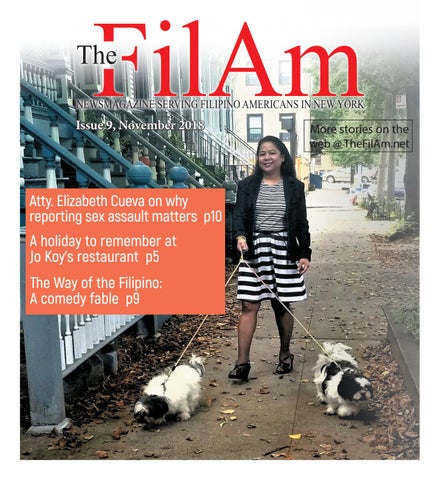
Issue 9, November 2018
Atty. Elizabeth Cueva on why reporting sex assault matters p10 A holiday to remember at Jo Koy's restaurant p5 The Way of the Filipino: A comedy fable p9
More stories on the web @ TheFilAm.net
Letter from the Publisher
The consulate and the struggle to remain silent I
t’s been said, surely out of levity, that the biggest challenge facing a consular diplomat is not so much the unique culture in a foreign country. It’s the squabbling Filipino community! Consul General Claro Cristobal is probably experiencing some of that right now. In light of the controversy involving missing money, among other issues, at the Philippine Independence Day Council, Inc. Cristobal has been receiving a series of visits by community leaders asking why the consulate is silent about PIDCI, asking further where the consulate stands on the matter. PIDCI is the nonprofit organization that stages the annual Independence Day parade on Madison Avenue. It is a monumental undertaking, an event that costs anywhere from $250K to $300K to execute. It’s been almost two years since money went missing, and no one has initiated an investigation. No one. PIDCI officials know who did it – blaming a former officer who stepped down for health reasons – but for reasons no one can explain, they are not taking this person to court. The unison argument PIDCI insiders
Founding Editor Cristina DC Pastor Business & Advertising Manager Rene Pastor
are telling The FilAm is: ‘How sure are we that we’re going to win the case? It’s a waste of money.’ That incident about the missing money opened a can of worms and a never-ending stream of questions. A lawsuit was filed urging the court to compel PIDCI to be transparent about its financial obligations to its nearly-a-hundred member organizations. The lawsuit was thrown out (on appeal according to respondents), but the questions remain: What is PIDCI doing with
people’s money? Why isn’t the consulate doing anything? The community has been aching for the consulate to intervene. Cristobal, according to those who sat in some of the meetings, has mostly been all ears and nothing more. He asks some probing questions, but gave no indication what’s on the consulate’s mind. The consulate is the Honorary Adviser of PIDCI. It’s role, in the words of previous ConGens, is simply to advice. It’s up to PIDCI
Address P.O. Box 8071 New York, NY 10116
Contributing Writers
Contact Editorial: 848-219-0069 Advertising: 732-428-6318 Thefilamny@gmail.com
Tricia J. Capistrano
Elton Lugay
Joel David
Ludy AstraquilloOngkeko
Wendell Gaa Maricar CP Hampton
The FilAm is a publication of A&V Editorial THE FILAM
to follow the advice or not. Days before the elections, Cristobal urged PIDCI to include two individuals “of known probity and independence” to its Election Committee to ensure that voting would be transparent. That “advice” was not heeded. Previous ConGens have spoken to PIDCI with similar suggestions invoking transparency. No concrete changes have been made (except perhaps removing Comelec Chair Raul Estrellado and replacing him with Rely Manacay). The FilAm, which has devoted much coverage to PIDCI since the money went missing, is just as puzzled by the dead air coming from the consulate. The sense we’re getting is the consulate wants nothing to do with community members locked in feuding, that the consulate has its hands full with more critical consular issues (such as immigration, visa processing, etc.) and would rather have the community members resolve such differences among themselves. Time will tell if sticking its head in the sand like an ostrich and hoping the problem will go away is the appropriate response to this issue. Cristina DC Pastor
| 2
Mariel Padilla Lindy Rosales
Dolly Fernandez: Growing up biracial during the anti-miscegenation era BY CRISTINA DC PASTOR
“It was a scandal, but it was also a happy marriage. They just had so much fun together.” Dolores ‘Dolly’ Fernandez, the daughter of a Filipino valet and a Norwegian hat check girl, traveled back in time and shared fond memories of her parents’ stirring romance amid anti-miscegenation laws which criminalized interracial marriages in the 1930s to the ‘60s. The statute was applied mostly on ‘Negro-white’ marriages, but hanged over the heads of Filipino pioneers – or ‘manongs’ — in California, who worked in plantations farms. Some of them married outside the U.S. yet they could not be seen in public with their wives because of fear of the law – which was repealed in 1967– and fear of public humiliation. By that time, the seeds of racial prejudice had been planted on the Filipino consciousness. Dolly recalled growing up in a mixed-race family in New York City during this era where the prevailing attitude around the country was to frown on any union of different races. Filipinos were referred to as Malays. Her father, Pio Fernandez of Baybay, Leyte, and mother, Agnes Olsen, got married, made a home in Astoria, Queens and filled it with love, music, and laughter. “My father was the personal valet of Gen. Douglas MacArthur,” she began when interviewed by The FilAm. “He traveled all over the world with him.” After serving the general for five years, Pio came to the U.S. in the late 1920s and found work as a merchant marine. He worked as a seaman for many decades to the point that his family thought he would end up a bachelor. Until he met a beautiful hat check girl who worked at an elegant Manhattan restaurant. “Every time he would land and came into port, he would go to this particular restaurant and say hello to this very pretty girl with red hair and blue eyes,” said Dolly laughing, “and my mother would say, what’s wrong with this man?” “This man” was 50 years old, and Agnes was half his age. “They just fell in love,” declared Dolly, their only child. The marriage did not sit well with the Olsen family, who thought Agnes deserved someone better and not someone “who was old and who was brown.” Agnes’s Norwegian-Swedish family “disowned” her, and Pio learned to live with that. In the times she visited her parents in Brooklyn, only Agnes could enter the house. Pio and young Dolly, probably 4 or 5 at the time, waited in the car. “Dad didn’t care that her family didn’t like him,” she said. “He would put her in a car, drive down Fort Hamilton Parkway so she could see her family in Brooklyn. Me
Dolly’s parents Pio Fernandez and Agnes Olsen; Dolly wins a beauty contest in the 1960s. Photos: ‘Filipinos in New York City’
“He would take me in the kitchen, and I could watch all the shows for free,” said Dolly. “We would bring home menus with signatures and autographs.” She did not experience any racial affront growing up even though at the time, she had her father’s “very dark” skin. Her skin grew fairer over the years. Today, she has mestiza features, evidence of her Anglo-Asian roots. “In school I was very smart, that’s probably why I was not treated badly,” she did. “I was always at the top, always getting 100. I never failed.” Deep within, Dolly felt she did not fit in either side. Her mother’s Scandinavian family thought she was not too white, and the Filipino side felt she was not too brown. “I was an oddity,” she laughed. It was also difficult, she quickly added. She grew up not knowing any Filipino kid because there was no one in the Queens public schools she attended. Her friends were mostly Irish, German, Italian and Greek children.
| Beauty contests
With grandchildren Mickey and Micaela. and him would sit in car and wait. He would sing songs with me, like ‘Planting rice is never fun,’ we would play games, while mom visited her parents.” That changed when her maternal grandfather saw his beautiful granddaughter and recognized the absurdity of a family unreasonably divided by race. “Until my grandfather said ‘This is wrong, this is a good man, we can’t do this anymore. We should not do this. I have a granddaughter.’ Everybody kissed. I remember it vividly, my grandfather hugging me, kissing me, squeezing me so hard. It was nice.” Dolly remembered growing up in a fun and loving mixed-race family. “I didn’t know the difference. I didn’t know it was anything odd. Now people bring it up to me. Then, it was natural.” Her mother quit her work with the restaurant and became a full-time housewife, which she loved. Her father, who was getting on in years, left the ship to work as a waiter at the famous Copacabana nightclub where the likes of Dean Martin and Sammy Davis performed. THE FILAM
| 3
But something she did made her closer to her father’s culture: She joined beauty contests and won many of them. She was crowned titles, such as Queen of the Filipino Social Club, and Miss Philippine-American 1968, and her parents were proud of her. “I loved it,” recalled Dolly of joining beauty contests on the prodding of her parents. “I felt a sense of belonging. I felt camaraderie; I felt community. I felt a sense of family.” After a while, she realized she was winning because her father sold rolls and rolls of tickets to his Filipino friends at the navy yard. “It’s about money. Not about beauty. That’s when it hit. I didn’t want to hurt his feelings so I made up excuses like I was busy with school.” Dolly continued to remain engaged with the Filipino community even after her father died in 1980. Through divorce, widowhood and raising families, she was an enduring member of the Filipino American Human Services, Inc. for many years until funding issues forced its closure. She is currently treasurer of the Filipino American National Historical Society Metro NY Chapter. In yet another one of her cultural commitments, Dolly has joined My Barrio My Borough in a recent oral history project. She and other Queens residents told the stories of their lives as they wove strips of fabric on a loom. Dolly’s narrative is one of the richest, most poignant, punctuated by race, family drama, and political history. Dolly shared how her house in Astoria has this crest, or coat of arms, representing both the Fernandez and Olsen families. “Every time I leave the house I look at the crests and they remind me of who I am,” she said. “I am both Filipino and Scandinavian, and I identify more as Filipino. Being Filipino was a stronghold in my home.”
First Filipina elected to Harvard’s Board of Overseers Geraldine Acuña Sunshine is the First Filipino American to be elected by some 26,000 Harvard University Alumni to the six-member Board of Overseers, to serve for a six-year term.
N
Her family moved to Texas during the martial law years in the 1980s. After high school, she received her Bachelor of Arts Cum Laude from Harvard College in 1992, her master’s degree in Public Policy at the Kennedy School of Government in 1996, her Juris Doctor at Columbia University Law School in 1999. She met her future husband Gabriel Sunshine in Harvard College who graduated in 1991. He is the co-founder of the hedge fund Bracebridge Capital in 1994. It has more than $10 billion assets under management, including endowments from Yale and Princeton. Atty. Acuña Sunshine served as
More stories on TheFilAm.net FILA
MO
N
FOL LOW THE
Geraldine Acuña Sunshine. Photo: The ResoluƟon Project
ext to Harvard Corporation, the Board of Overseers is the second governing body of the Ivy League university to set direction, advice administrators, approve the actions of the Harvard Corporation, in short “to maintain the highest standards as a place or learning.” Previous members of the Board of Overseas included Franklyn D. Roosevelt, John F. Kennedy, Al Gore, Archbishop Desmond Tutu, and Ralph Waldo Emerson. Born in Roxas City, Philippines, her family lived in Manila where she studied in Poveda for grade school.
Senior Counsel in Alternative Investments for Bracebridge Capital based in Boston for over 13 years. Prior to that, she served as adviser to the late Jovito Salonga when he was Senate President in the Philippines, to Chief Justice Marcelo Fernan, and the Philippine Department of Trade and Industry. Presently, she is the president of Sunshine Care Foundation for Neurological Care and Research, a not-for-profit organization intended to give free clinical and neurological care in rural parts of Asia. She was inspired to establish the foundation when her brother was stricken with X-linked Dystonia Parkinsonism (XDP) five years ago. It is common among men in the Visayas who in their 30s become debilitated by the disease. She and her husband and their three children live in Boston.
THE FILAM
| 4
At Jo Koy’s restaurant,
watching the A-list comic serve tables BY BRENDAN FLORES
Prior to becoming the NaƟonal FederaƟon of Filipino American AssociaƟons (NaFFAA) chairman and Regional Banking Leader of a leading bank, I was a radio talk show host in Las Vegas. LiƩle did I realize, I was following in the footsteps of my Tita Josie who was the first female Filipino American radio talk show host in Vegas and a reƟred Branch Manager for the same bank. You’ve probably come across her name before. Josie Harrison is the mother of stand-up comedian Jo Koy whose full name is Joseph Glenn Herbert. Jo Koy gives credit to his Filipino mom for being “naturally funny” and inspiring his comedic gift. Those who have followed his career as a humorist know Jo Koy’s parents separated when he was 10 years old, and his mother singlehandedly provided for her four children. “Hustle and drive,” he learned from his mother. Jo Koy and his American father – who served in the military -- have reconnected, and all is well between the two of them now after they were estranged for many years. From what I’ve read Jo Koy is trying to be the best father to his son known as Little Joe, which sparked Jo Koy’s series of Ting Ting jokes. I was in Las Vegas visiting my family for the holidays and thought this would be a great opportunity to introduce them to Jo Koy’s restaurant Yojie Japanese Fondue, founded in 2015. I called Tita Josie to check if I needed to make a reservation for my mom and sisters and discovered I didn’t. Yojie was crowded that night since Jo Koy tweeted he would be having dinner there. The ambiance was intimate and welcoming – just like going to your Auntie’s house. As packed as it was, Jo Koy’s mom had seats waiting for us. At first glance, we noticed Jo Koy greeting and interacting with guests, jumping from table to table taking pictures and selfies; you could
tell how humble of a person he is. Tita Josie and I caught up after all these years, and she even shared the Christmas present she received from her son – a Gucci bag. And though she isn’t wealthy, you can tell she's rich in love from her family. She also introduced me to Jo Koy’s fiancée, Amy Bray, which was an absolute pleasure. I had the opportunity to speak with Jo Koy about his restaurant and how much he enjoyed operating his own business. His words resonated after seeing how well he treated his guests and staff. The restaurant was clean and spotless, the team members were disciplined, yet warm and accommodating. Last but not least, the food was very inviting. We enjoyed our dinner: thinly sliced Kobe beef cooked in a tonkatsu soup broth. Jo Koy offered my family dessert, a sumptuous plate including fondue and ube ice cream, a treat I'll never forget. It was an incredible experience enjoying the meal with my family, Tita Josie and Jo Koy, a genuine person who grew from humble beginnings and became successful following his passions. Yojie, which is a family restaurant, reflects a big part of what Jo Koy is about: That family comes first and that he loves good food. Business and community leader Brendan Flores is the National Chairman of the largest affiliation of Filipino American organizations in the U.S., NaFFAA. He is the Senior Vice President and Consumer Banking Performance Manager at Bank of America. THE FILAM
Jo Koy takes a selfie with his mother Josie Harrison (far right), the author and his mom Marilyn Gayoso-Flores. Photos courtesy of Brendan Flores
Jo Koy with fiancée Amy Bray; Josie Harrison with Jo Koy’s son Joseph Jon. | 5
50 years ago, and I still remember BY BELLA SANTOS OWENS
I remember vividly, it was a sunny morning and I was playing on the veranda of our house in Marilao, Bulacan. I was siƫng on this low table while playing with my doll.
I
remember his cheap cologne and scratchy stubble on me like it was just yesterday. Our male helper, who must have been in his 20s, started talking to me and then started kissing my arms, shoulders and neck. Someone came and he stopped. I was around 5 years old then because I was not in school yet. I told my Mom that evening. As I remember, I told my Mom in a conversational manner and not like I was scared. I just knew something was not right. I remember my Mom was calm but I sensed her being upset. I was the youngest, and the only girl, of four siblings. So, as you can imagine I was very protected in my family. I never saw him again after that day. My Mom and I have always been very close, I told her everything. Looking back, I told my Mom, a full-time housewife then, easily because I was a child and I did not associate it with embarrassment but rather more a question of why he was touching me. As I grew older I remember that I was touched inappropriately but unconsciously I tried to erase it from my memory. I never talked about it with anyone until this past weekend. I told my husband and children. And up to this day, I had to ask my husband and children’s permission if it is okay with them that I share this with the outside world. Recent news about sexual abuse and #whyIdidnttell made me remember what happened to me, and like everyone else who has been through any kind of sexual trauma, it makes you remember. I just told
a therapist my story and personal aversion to anything furry-like or soft touching me, I never thought that this may have stemmed from what happened to me 50 years ago. Now I feel a certain kind of relief that while it happened to me, it is okay to talk about it. Last night I shared it with my closest cousin who is like a sister to me, and this is what she texted back: “You are BRAVE. You are ADMIRED. You did not create the ugly story BUT you will write the ending 50 years later. Silenced no more! Now, u are part of the strong women that are re-writing history. I CELEBRATE YOU!” I was 5 years old then and it has been 50 years ago but I still remember. I decided to tell my story
because I advocate for women but I was embarrassed to admit my story — now this is my story! #whyIdidnttell Bella Santos Owens is the chairwoman of the newly formed Baltimore County Human Trafficking Work Group, created by an executive order of the Baltimore County Executive Kevin Kamenetz on January 25, 2018, to address the complex issue of human trafficking. She also served as the president of the Baltimore County Commission for Women for six years, and remains a commissioner member of the board. She lives in Towson, Maryland with her husband, Floyd. They have two children: Michael, a Fire Protection engineer, who is based in Virginia; and Ayana, an art director, who is based in New York.
With her family, husband Floyd Owens, and children Michael and Ayana THE FILAM
| 6
The author at 5 years old in her Marilao, Bulacan home.
NaƟonal Coming Out Day Unpacking the guilt, the shame BY CRISTINA DC PASTOR
Denny Meyer was the first to publicly proclaim, “I’m a gay veteran.” He was followed by Elton Lugay, who confessed he was 8 or 10 years old when he discovered the “joy of wearing women’s clothing.” Sean Ross Collins recalled how he and his boyfriend were pelted with dirt and rocks when the boyfriend’s parents found out about their relaƟonship.
T
hese and other community leaders, who bravely shared their stories on National Coming Out Day, were honored by New York State Assembly Member Brian Barnwell “for their exemplary service to their community.” A simple ceremony was held on October 11 at the LGBT Network Queens Center in Long Island City. Meyer, representing the American Veterans for Equal Rights as well as the Transgender American Veterans Association, came out in 1964. He came out to his friend Charlie while they were out at a street fair with “fireworks exploding overhead.” “I was scared,” he shared. But, he was able to gather enough courage to tell Charlie, “I’m gay. You gonna punch me in the nose or what?” No such thing happened. Instead, his friend said he was proud of him for having served professionally in the military although he was hurting inside. Denny said, “I served in silence in the armed forces.” At that time, he said if you came out gay you could be killed. If not killed, you could be interrogated for hours and discharged in disgrace. Elton Lugay, who is the founder of the Miss Gorg transgender pageant, said he came out at an early age when he would wear his mother’s dresses to gay pageants in the Philippines. The family pressure for him to remain straight was too strong. He experienced an identity crisis where “I would wear the mask of a straight man among friends and extended family members of strangers whenever I feared being rejected. I began hating myself and questioning God.” He met his first boyfriend in San Francisco. Sean Ross Collins, who is Public Affairs Coordinator for the LGBT Network, said he was fortunate to have parents who were open-minded and accepted his identity. His boyfriend was not as lucky. When the couple came out to his parents, they immediately kicked him out and told him never to come back, said Sean.
From left: Denny Meyer, Sean Ross Collins, and Jovic Cruz. The FilAm Photos
Elton Lugay receives a plaque of recognition from New York State Assembly Member Brian Barnwell THE FILAM
| 7
“His parents reached out to dirt and rocks and starting throwing at us,” he said. “As a young gay kid that’s not a great feeling.” Sean’s parents offered to speak with the boyfriend’s parents who pleaded, “What are we going to do to fi x our sons.” “My parents, God bless them as they knew what to do, said there’s nothing wrong with our sons. You’re the one who has to fix your problems.” The LGBT Network began a process of counselling for the parents. Others in the audience who were moved by the outpouring of anguish and courage stood up one by one to share their stories: The family man whose wife “went berserk” when she found out and called the cops to arrest him; the Bangladeshi immigrant who was kicked out of his house by his parents and slept in parks; the activist who was sent to therapy to be “cured.” Bartender Jovic Cruz came out on Facebook just a couple of days before National Coming Out Day. He told the audience that being gay was such a struggle so he “kept it under wraps for years.” “Finally, I’m tired with all the hiding…Now, I had to tell the world I’m gay. People will criticize, mock or scorn but I’m not afraid anymore. I now have the strength to move forward without the fear of judgement. I deserve to be happy,” he read from his essay. Barnwell thanked the honorees and members of the LGBT community for providing the event with “so much heart and soul.” “We must continue to strive for equality for all,” he said.
In sale of Manhattan co-op, Encarnacion Singh puts faith on another FilAm BY CRISTINA DC PASTOR
Generous rooms. Gracious entry foyer. River park views. 24-hour doorman building.
I
n January 2015, retired UN employee Encarnacion ‘Bubut’ Singh put her home on the market, parting with the Riverside Drive co-op apartment she had shared with her husband and two children for 50 years. Widowed since 1999, Bubut has gone back and forth on selling the home. No doubt she loved this house and inspired it with the warmth and colors of Asian artifacts collected over years of travel and working with the United Nations. Her husband Krishna Singh was a film director and photographer at the UN. She was a population officer for the Fund for Population Activities, which was just three years established when they met in 1965. “I enjoyed 50 years of it,” she told The FilAm in an interview. The decision to sell was not easy. For one, the neighborhood was gentrifying. When Bubut and her husband purchased the apartment in 1965 for $70,000, drug-related crimes were a huge drawback, but the Singhs, who were smart New Yorkers, learned to live with the risks to personal safety. It did not matter that at one time, a man was stabbed to death, staggered into their building lobby, and died there. “That was the first time I’ve seen a crime,” said Bubut. “There was a knife sticking out of the man’s back.” Still, the Indo-Filipino couple was pleased to have a home within walking distance from the culturally vibrant Lincoln Center, and living in a building populated by mixed-race families. Over the years, the immigrant families began to leave, but the Singhs stayed put. As if in a flash, they found themselves and another Chinese family among the handful of ethnic holdovers. Security improved, the neighborhood became a prime residential location, and Bubut’s and other apartments on Riverside Drive appreciated in value. When she decided to sell in January, the value of her property had bloated to almost $2 million! “Now this neighborhood is really high end,” she said. “I like the atmosphere now.” But at her age, Bubut felt it was time to stay close to family. His son in Florida has young children, and she felt a strong yearning to see them grow up. A common friend introduced her to real estate broker Edwin Josue of Halstead Property. The two began a months-long journey in which his role evolved from business strategist to one who became a shoulder-to-cry-on. “If not for Edwin,” said Bubut, “I would have jumped off a window. He held my hand every step of the way.” The challenges to selling a Manhattan property were many, and the two quickly became allies. Bubut
trusted Edwin’s many years of brokering experience and Manhattan lore; Edwin eyed Bubut’s coveted property and its potential for a nice margin. The minute it was listed on the Halstead company website, Edwin immediately received seven interested inquiries. One of them, a young Manhattan doctor, was the first to attend the Open House. He instantly fell in love with the house and came up to Edwin with a reasonable offer suggesting not to avidly show the house to others. “That’s how much he liked it,” he said. Edwin could have declined, triggering a bidding war, but his decades-long experience as a licensed real estate professional has taught him never to make decisions motivated by runaway profit. As it was the buyer’s first real estate purchase, Edwin became the dual agent for both buyer and seller. The transaction ran into countless challenges, from complicated tax waivers to a simple case of miscommunication on the phone. As the transaction was an estate sale, Bubut, as a widow, had the obligation to present proof of her husband’s death. Edwin said this was a standard requirement to prevent other parties from laying claim to the property. “In any closing whether condo or co-op, there should be good coordination among all parties concerned — the buyer, seller, the lawyers, the managing agent, the broker agent,” he said. “Without coordination, everybody is affected.” It was a nightmare, cried Bubut. She had to secure document after document,
Riverside Drive co-op apartment: Purchased for $70K, sold for $2M aŌer 50 years
THE FILAM
| 8
The Seller: Encarnacion Singh. The Broker: Edwin Josue approval after approval as she faced constant questioning from lawyers from all parties concerned. Edwin with his friendly and calming disposition was constantly urging her “not to lose hope.” The buyer, who wished to remain anonymous for this article, was pleased with Edwin’s handling of the transaction. “He is genuinely a nice man which sets him apart from so many of the agents that I met along my search for an apartment,” he said in a statement. The closing was finally completed on October 1, 2015 exactly 50 years to the day Bubut and her husband bought the apartment on October 1, 1965. “I realized it when only when I was packing,” she said while dating all the boxes she was to send off to her new home in Florida. “God must have designed it.”
Filipino Ka Ba? “The entire course, and meaning, of my life changed with three words,” says Christopher Holl, author of ‘The Kano, The Teacher & The Lola: A Filipino-American Fable.’ “Filipino ka ba. Three words that completely changed the trajectory of my life were Tagalog.”
R
ecently published, American-born and bred Holl describes the book as a celebration of the Filipino culture and people, in the form of a whimsical tale, from the perspective of an appreciative outsider-insider. “I’m the outsider-insider,” he says with a smile. “I married into the culture 28 years ago, and my wife Gina and I have been blessed with 4 FilAms—three daughters and a son.” Three decades have passed since Holl and his wife met at Rutgers University, when he asked her the three words. Still, he clearly remembers how, as the first non-Filipino marrying into his wife’s family, being respectful and appreciative of the culture was important to him. “It wasn’t something I had to think about, really,” he says. “I was drawn to, and enjoyed, all things Filipino immediately—the warmth, smiles, accents, faith, and of course, the food! But, when it came time to ask for Gina’s hand, I wanted to make sure I did it right.” Doing it right for Holl meant meeting with her parents at their apartment in New York City to ask their permission and blessing. But, he wanted to do it in a special way. “I thought asking them in Tagalog would be respectful and show that I not only loved my wife—I loved her family’s culture and heritage too.” With a Tagalog fluency limited to only a few greetings and catch-phrases, Holl knew he would need help. “I asked my wife’s sister Marites to help me out on this secret project. Fortunately, she not only beautifully translated what I wanted to say, she kept the secret too!”
Holl believes “The Kano, The Teacher & The Lola: A Filipino-American Fable” will appeal to Filipino immigrants, like his wife, as well as children of Filipinos and mixed-race parents, like his. “What I’ve been hearing from those who’ve read the book, is that they laughed, and they learned. There’s a sweeping range of subjects seamlessly worked into the story line including Filipino history, immigration, food, festivals, celebrations, beliefs, quirks, language, superstitions, notable compatriots and random facts.” In the book, readers will join Michael, a smitten American boy, on an unexpected journey to prove himself a worthy suitor for the beautiful Maria, who is a recent immigrant from the Philippines. In a quest to find his ‘inner Filipino,’ Michael encounters a mysterious teacher, and together, they discover a Filipino world not bound by time or space, where Michael learns from the Lola the Filipino traditions, folklore and superstitions necessary to transform him from an Ameri-kano to a Filipino, at least in appreciation and spirit. Holl is quick to point out, “Not being Filipino myself, my readers don’t need me to teach them about their culture, but I hope my perspective and appreciation for it add to, or at least remind them, of what they already know and love about it.” Christopher Holl may not be Filipino by birthright, but he is in spirit, as evidenced by 28 years of marriage to his Filipina wife and their FilAm children. He’s fond of saying that he THE FILAM
Christopher and Gina Holl and their four children: Carmella, ChrisƟna, Teresa, and Christopher Jr. loves the Filipino people so much, he made four of his own! The couple have four children: Carmella, a high school Spanish language teacher in Philadelphia; Christina, a professional dancer in a ballet company; Teresa, a nursing major at Seton Hall University, and a son, Christopher, who is in the 8th grade and a second-degree Black Belt. Holl is a business executive, former U.S. Marine and author of “Life Lessons from The Chocolate Factory: 10 Rich, Satisfying Nuggets to Nibble On” and “Dispense-Sation: A Pharmacist’s Rx for a Laugh.” “The Kano, The Teacher & The Lola: A Filipino-American Fable,” is available online at Amazon and Barnes & Noble in eBook, hardcover, and paperback. The author can be contacted at publisher@ ajnealpublishing.com | 9
The inspiraƟon for the book is The Lola, mother-in-law Guillerma Amper, who the author says ‘is always in our hearts.’
COVER STORY
Lawyer Elizabeth Cueva on sexual
harassment and why it’s important to report BY CRISTINA DC PASTOR
I
At her Prospect Park home she shares with eight dogs. Meet rescue dog Snowflake who hogged the photo shoot. The FilAm Photo
The Cueva sisters, from left: Cecilia, Elizabeth, and Clarissa.
n the late 1990s, way before the #MeToo Movement, lawyer Elizabeth Cueva worked for the City University of New York’s Office of Compliance and Diversity. As the director assigned in Kingsborough Community College-CUNY, she led a panel that investigated all sorts of sex-related incidents in the college involving students, faculty, college officials and employees, and visitors. At the time, recalled Elizabeth, the issue of sexual harassment was a “burgeoning field” with rapidly evolving jurisprudence. Elizabeth thought then that because of the work they, and others in Academia did – conducting training, explaining liabilities, disseminating information, addressing and resolving cases etc. — they have created an environment of “heightened awareness” to keep the campus a respectful place. While sexual harassment was in people’s consciousness, they did not dominate news headlines as they do now. Except for non-traditional milieus, like entertainment and politics, little was heard of these cases after the Clinton years. Because of the “he said, she said” nature of the charges, some cases were either getting dismissed for lack of evidence, or settled quietly. But something happened in 2014. An avalanche of accusations, from sexual misconduct to rape, from an estimated 60 women came barreling down on Bill Cosby. Similar charges would topple Harvey Weinstein from where he reigned in Hollywood (80 women), and other prominent, powerful men. “I was flabbergasted with the wave of the #Metoo Movement,” said Elizabeth over a plate of Pad Thai one lazy Saturday at Talde’s. “I thought then OK, there is already heightened awareness. People were becoming aware that an unwelcome touch or inappropriate sexual remark or gesture could be a form of sexual harassment. There were fewer complaints, people were more conscious of their actions and of treating individuals with respect.” But evidently, a lot of these cases have remained unreported and sexual misconduct continued over the years. Elizabeth closely followed the confi rmation hearings of then Supreme Court Justice nominee Brett Kavanaugh, shocked at how the issue of sexual harassment has become so colossal and coercive, that allegations dating back more than 30 years could hinder a person’s prospect at being named to the Supreme Court. She has come to realize that notwithstanding relentless awareness campaigns, the issue remained THE FILAM
| 10
“alive, contentious and polarizing.” Women are “emboldened” to come out now unlike before when there was “reticence” among some of them.
| Strong women Elizabeth is the youngest of three Cueva girls. She grew up in Manila in a family fi lled with strong-willed women and men supportive of them. Up until she was 3 years old, she was raised by her grandmother, Felicidad. From her ‘lola’ she learned independence. She was not doted on and was given much leeway tempered with discipline from which she developed a strong and independent character. Then, her grandmother left for the U.S. “I remember crying at the airport, as in making a scene,” she recalled. “Coming back (from the airport), I was told you can go back home now. So, I walked to our house by myself, knocked on the door and walked back in.” She shared this account with an air of lighthearted nonchalance like it was the most natural thing in the world for a young girl to move back in with her family. She spoke with equal tenderness about her mother, Gloria, who gave constant reminders to her and sisters, Clarissa and Cecilia, about how women should be treated. Even at a young age, they were not shielded from harsh realities and made aware that girls (and also boys) should not be touched inappropriately. Not by strangers, not by relatives or any member of the family. Little did she know they were being schooled on sexual harassment prevention by their mother. “My mom would discuss it with us,” she said. “It was shocking to hear but she would say things like, don’t trust anybody not even your relatives or never be in situations where you can be taken advantage of. We had that awareness.” By being blunt about these matters, her mother, in fact, sheltered them. Her older sisters were role models in a way. Clarissa, the first-born, was always top in class, while Cecilia, the middle sibling, was the smartest about fi nances, “always the one with money.” “We were three different personalities, but we were always together during our formative years,” she said.
| Young lawyer As a young lawyer, Elizabeth would follow her family to Brooklyn in the 1990s, in Park Slope was where her grandparents and her parents had settled in comfortably. “It wasn’t a conscious thing, coming here,” she began.
She was a working student, studying law in UP Diliman and working as a technical assistant and judicial intern of Supreme Court Chief Justice Marcelo B. Fernan. Then, she became a project and legal evaluation officer in the Department of Environment and Natural Resources under former Secretary Fulgencio Factoran. After graduating in UP Law, she briefly worked as a corporate and environmental lawyer in the Philippines. She realized though that to be a lawyer of note in the country, one also needs to have ‘connections’ even for the simplest acts of filing incorporation papers with the SEC or appearing before administrative tribunals. The appeal of coming to the U.S. became stronger. She “started from scratch” when she came to New York. She worked as a Paralegal for an immigration law firm, took and passed the New York State Bar, and completed her Executive Master’s Degree in Labor and Industrial Relations in Baruch College, graduating with honors. She found her way around NYC’s labor and human rights fields via the New York State Attorney General’s Office, CUNY’s Compliance and Diversity Office, NY State’s Department of Health and Department of Labor, all the way to
the NY State Division of Human Rights, where she currently works as a lawyer and Human Rights Specialist. “When I was with the Attorney General’s office, I was doing prison litigation,” she said. “I was always in the areas of human rights, civil rights and social justice so my career path opened up to those areas. While I had stints in private practice, I would always end up in public service.” As a labor and employment lawyer, sexual harassment stories in the news continue to fascinate Elizabeth. She marvels at the courage of the women who reported what happened to them. Not many do for shame, cultural and other reasons, but as a lawyer, she stressed the importance of letting others know and letting them know right away. “We always encourage people to report because then we are made aware of a pattern of behavior. Even if there’s no corroborative evidence, a pattern of reported prior incidents makes the case stronger,” she pointed out. She believes that rule of law is paramount when looking at cases, and can spell the difference whether a victim is to be believed or not, gets justice or not.
Calendar
Elizabeth receiving a community award from Team United Maharlika, enjoying the ManhaƩan skyline at dusk, and relaxing on a Hudson River cruise. Photos by Marialara Greg, Corazon Rivera, and Cecilia Cueva.
of Events
| Nov 14, 6 p.m. Immigration and Citizenship Lecture: Jose Antonio Vargas to talk about his book, "Dear America: Notes of an Undocumented Citizen.” Rutgers Law School - Newark Jose Antonio Vargas’ book
Angel Ram
| Nov 16,
| Nov 20,
6 p.m.
8 p.m.
Patikim: 7th anniversary party of the Fil-Am Press Club Philippine Consulate lobby, Fifth Avenue
| Dec 2, 1 p.m.-11 p.m.
| Nov 16,
7 p.m. Infinitely Yours, Jenn! With Jenn Cuneta Baruch Performing Arts Center 17 Lexington Avenue
| Dec 31, 8 p.m.
10 a.m.-4 p.m.
Jenn Cuneta
Angel Ram's Forever and a Day Birthday Show Feinstein’s/54 Below, 254 W 54th Street
| Dec 7,
Open House & Holiday Shopping Van Vleck House & Gardens 21 Van Vleck St, Montclair, New Jersey
THE FILAM
Paskong Pinoy sa Amerika Christmas Charity Ball by FilipinoAmerican Faacnj DoubleTree by Hilton 4355 Brunswick Pike, Princeton, New Jersey
| 11
New Year’s Eve Celebration by the Armenian Church of the Holy Martyrs Couples Club Armenian Church of the Holy Martyrs 209-15 Horace Harding Expy, New York
A CLASS LIKE NO OTHER Upgrade your flying experience with our Premium Economy Class, with seats that provide extra space to stretch your legs and recline, as well as bigger screens for inflight entertainment. No. of Seats Seat Pitch Seat Width Recline TV Screen
24 38 inches 19 inches Up to 8 inches 13.3-inch myPAL eSuite Personal TV
Experience a heartwarming, world-class journey with the Philippines’ first and only 4-Star global airline, Philippine Airlines. PHILIPPINEAIRLINES.COM |
flyPAL
New York is the Best Coffee City in America Coffee first became popular in the U.S. after the Boston Tea Party, when the switch was seen as “patriotic,” according to PBS. And since Starbucks debuted in 1971, the drink is now accessible almost anywhere you go. In a recent Reuters poll, 64 percent of Americans age 18 or older said they drank coffee the previous day. The U.S. coffee industry is currently valued at $48 billion.
W
hat gave way to java culture? Science, for one, has convinced us that caffeine possesses multiple health benefits besides mental stimulation. At the right dosages, caffeine may contribute to longevity.
Perhaps just as important, though, is coffee’s social purpose. Today, coffee stations are a staple of the workplace, and tens of thousands of shops serve as meeting places for friends, dates and coworkers. The creation of these drinks has grown increasingly professional, too. Being a barista
THE FILAM
| 13
h become less a part-time job than has a career field. Latte art has even iinspired a national competition. But some local coffee scenes are sstronger than others. To determine tthe best among them, WalletHub ccompared the 100 largest cities across 114 key indicators of coffee loverffriendliness. Our data set ranges from ccoffee shops, coffee houses and cafés per capita to average price per pack of p ccoffee. With New York at the top, the best cities for coffee lovers are Seattle, b San Francisco, Portland, Los Angeles, S Washington D.C., Chicago, Miami, W Boston, and San Diego. B More findings: • Most affordable coffee shops: New York Y • Most coffee shops, coffee houses: New York • Highest % of adult coffee drinkers: Santa Ana, CA • Lowest average price of a cappuccino: Aurora, CO • Highest average spending on coffee per household: Fremont, CA – Wallet Hub
ANCOP USA and OVP’S Angat Buhay
widen partnership for the poor BY CRISTINA DC PASTOR
CFC ANCOP USA Executive Director Roger Santos and his wife Josie live in Manalapan, a South Jersey town known for its large, sprawling homes. In the couple’s formal dining room, two of the five Christmas trees – dedicated to each grandchild -- were waiting for Josie’s attention, the ribbons, shiny hanging balls, and lights scattered all over the place.
T
he 9-bedroom house may seem huge patients during its medical mission in for just Roger and Josie and their Iloilo alone. well-behaved poodle and the occaEarly next year, Roger and ANCOPsional visits by their children Carmen, CFC volunteers, bringing with them Vonz, and Paulo. (Vonz is based in the $500K worth of medicines, will travel Philippines). to Marawi for a medical mission in But Roger has another family in CFC ANCOPpartnership with Angat Buhay, the USA, a non-profit organization that stands for flagship project of the Office of Vice Answering the Cry of the Poor. It is the global arm President Leni Robredo. He was also of the Philippine-based Couples for Christ (CFC), a lay organization whose mission is to spread the Catholic teachings through its legions of couple-members around the world. CFC began in 1993; it has strong ties to the Vatican. “Couples for Christ is now in 120 countries,” said Roger, proud to be a member with Josie – his college sweetheart at Mapua -- since 1994. “We have nearly a million members.” There are chapters in Moslem countries, such as Turkey, the United Arab Emirates, and Qatar or where there is a prominent Filipino presence. “ANCOP is aligned with the Catholic church,” he said. The Santoses host regular meetings for ANCOP in their recreation room that has a sound system for a live band and a video monitor for PowerPoint presentations. Nine priests from Bohol attending a U.S. conference were recent house guests. There were other occasions where the rooms turned into comfortable inns, and the couple the gracious innkeepers. ANCOP sponsors programs for the poor, usually family-based. It is Roger’s job as executive director to make sure logistics are in place to execute those programs. Annual medical missions and scholarships for poor students are large parts of its outreach. A cou- With wife Josie. They met in Mapua when they were both ple of years ago, the group treated 10,000 poor engineering students. THE FILAM
| 14
ANCOP USA Executive Director Roger Santos proudly shows his father’s Congressional Gold Medal given to Filipino veterans who served in World War II. The FilAm Photos
in touch with Bangon Marawi and local law enforcement to make sure security is in place. He stressed Robredo, a former CFC leader with her late husband Jesse, does not solicit money, and that ANCOP’s assistance is not financial in nature. “We don’t give money, everything is medicine and supplies,” he said. Roger further clarified ANCOP’s role. “We want to work with her on her Angat Buhay project, which is parallel to what we do in ANCOP… helping the poor. In this project, there are other government offices involved, the military, the Department of Health, etc., and we work with them also. The OVP just happens to be the coordinating agency.”
On October 17, Roger together with a number of ANCOP USA leaders met Robredo in Washington D.C. before she spoke at the Center for Strategic & International Studies. They discussed the expansion of partnership between Angat Buhay and ANCOP USA. ANCOP’s Tele-Edukasyon online education program as well as disaster relief operations are being shared with Angat Buhay. “Tele-Edukasyon is an ongoing ANCOP USA online tutorial project aimed at assisting high school students in the Philippines on their school work. Volunteer Filipino American teachers will answer the students’ questions,” explained Roger.
Signing a partnership agreement with Philippine Vice President Leni Robredo on Angat Buhay and its Tele-Edukasyon online educaƟon program. Photo by Manny Caballero
daughter who was at the time graduating from Harvard University. “It’s the trust she projects and promotes with everybody,” said Roger when asked why he likes working with Robredo. “She’s a very simple, but focused and determined person.”
| Gold Medal A Congressional Gold Medal honoring his father’s war-time service is prominently displayed in Roger’s Manalapan home. Moises Santos, now deceased, was a World War II guerrilla fighter who served in the Philippine Commonwealth Army of the United States Armed Forces Far East (USAFFE). “He was a medical doctor and a brigadier general,” he said. “He became chief surgeon at V. Luna Medical Center.” His mother, Carmelita, was a school teacher. Roger caressed the velvet case that held his dad’s medal, a constant reminder that service to community runs in his family.
| How he met Leni Roger met Robredo through a friend. “I said, let’s work something out. We gave them some medical supplies” for a barangay infirmary in Naga. Last May, Robredo visited New Jersey to thank ANCOP for its donation of around $15K worth of medical equipment. She timed her trip to coincide with a visit to her
www.LLOYLAW.com
NEED A LAWYER? Please call 732.243.9934
Christian Oehm Esq. E: christian@lloylaw.com
and mention this newspaper (The FilAm) for your FREE consultation. We speak Tagalog & Chinese Mandarin.
Jeanne You, Esq. E: jyou@lloylaw.com
Partners in New Jersey Practice Areas: Real Estate: Commercial and Residential; Family Law; Employment Matters; Immigration: Personal and Business; Civil Appeal; Fintech & Crypto Compliance; Commercial Matters: Corporate Compliance, Shareholders Disputes, Contract Enforcement, Commercial Litigation and Arbitration, Cross-Border Business, M&A, and Business Purchase, Sales, and Franchises
THE FILAM
| 15
Thou shalt be called Benjamin BY JOSEPH JEROME FRANCIA
T
he flight from San Diego to New York was delayed by eight hours due to bad weather. Hungry and tired, I arrived 4 a.m. at the hotel the office had booked for me. I approached the receptionist to check in. I was told, “Sorry, we gave your room away since you did not show up last night.” Before I could argue that it was a confirmed booking, the receptionist told me: “Don’t worry, here’s a list of our other properties. Take your pick, here’s money for a cab to get to the hotel of your choice. Please be back here at 11 a.m. Your room will be ready.” Bleary-eyed, I pointed to The Benjamin at random. It was a nice, comfortable hotel. I slept so soundly that I woke up to the phone ringing at exactly 11a.m. The receptionist at the other hotel was calling to remind me that my room was ready.
I turned on the TV and caught an emotional moment at the US Tennis Open. There, on live TV, was one of the icons of our generation, Andre Agassi, crying. He has just lost his match and announced his retirement from professional tennis before a crowd of 23,000 that watched him play for the last time. He lost to a young player named Benjamin Becker. I felt sad for Andre — it felt like our generation’s time is over and it was time to hand over the sport to the young guns. The Benjamin Hotel. Benjamin Becker. These were in my mind as I settled into my room at the hotel where I was originally booked. I switched on the TV. “Stepmom”, the movie starring Julia Roberts and Susan Sarandon, was playing. I had not seen the movie before. I would learn shortly that the son of Susan in the movie is named Benjamin.
The author and his son Benjamin, who is 8 years old in this photo.
Another Benjamin. Only a few weeks earlier, Minnie and I were pleasantly surprised to learn that she was pregnant with our second child. I knew I had to text Minnie right away. Excited, I told her that even without the benefit of an ultrasound (we were still a few weeks off the scheduled check-up), I felt that we would have a son. And that, with all the signs that morning, he shall be called Benjamin. As I was driving my daughter EllaMinnie to school this morning, I remembered this story. Counting my blessings. That was eight years ago.
The Benjamin Hotel in Midtown ManhaƩan. THE FILAM
| 16
We indeed had a son. And we named him…Benjamin. I have forgotten this story, until recently, when I found myself back in NYC, walking past The Benjamin. I went to the concierge and told her about our Benjamin. The concierge so liked the story that she gave me a hotel merchandise — the stuffed toy Benjamin, The Owl — as a present for Benjamin, our boy. Joseph Jerome Francia is First Vice President and Head of Operations of GMA International in Manila. He is a frequent visitor to NYC.
How federal lobbying in D.C. actually works
BY CESAR CONDA
Every few years, news of misdeeds by those who work in and around the lobbying industry makes national headlines. Like with many professions, the actions and mistakes of a few bad actors can cloud public perception of the field in general. However, the government affairs professionals in Washington and around the country are a vital part of our public policymaking ecosystem.
A
ccording to the Center for Responsive Politics, there were over 11,000 registered federal lobbyists active in Washington last year. These lobbyists advocate on behalf of every industry and interest imaginable, from tech to healthcare to agriculture and beyond. They work on behalf of businesses large and small, trade groups, coalitions, non-profits, political candidates and other civic-minded individuals, and any other entity with a desire to educate lawmakers on important issues. To be clear, unfair practices and illegal foreign activity (there were only 102 new primary foreign registrations in 2017, according to the Department of Justice) should be taken seriously and addressed accordingly. Because these actions naturally cause concern and erode public trust, it is important to understand how lobbying works and fits in to a healthy system of government. Lobbying as a practice goes back to the early days of the United States and has Constitutional origins as part of the First Amendment’s right to petition “the Government for a redress of grievances.” At its core, lobbying allows American citizens and organizations the chance to engage in public campaigns and raise specific issues as a method of participating in democracy. Lobbying has evolved over time and now counts all manner of businesses, unions, individuals, and other orga-
There were than 11,000 registered federal lobbyists last year.
Paul Manafort and Richard Gates were indicted in connecƟon with the invesƟgaƟon on Russia’s alleged interference in the 2016 elecƟons. The indictment says they were unregistered lobbyists for a foreign government. nizations among its participants. For example, non-profit groups lobby on behalf of underserved communities and others without the means to engage policymakers on their own. Non-profits use lobbying tactics to focus the efforts of their members and constituents in an organized way to push for shared goals. Skilled lobbyists give these kinds of charitable organizations a seat at the table in D.C. alongside titans of industry and other major players. To ensure a level playing field and uphold democratic standards, the lobbying industry is governed by strict rules of disclosure and reporting requirements. Active lobbyists must register with the federal government and observe ethics guidelines mainTHE FILAM
tained by Congress, the Administration, and other officials. Many of those in the lobbying industry began their careers in local, state, and federal government. They count among their ranks civil servants who now serve various interests and seek to affect change from the outside looking in. My firm, Navigators Global, is a multi-client lobbying firm representing a wide variety of interests, from Fortune 500 companies such as AT&T and Oracle to issue-based organizations such as Act for NIH —which advocates for cancer cures through biomedical research funding — and educational groups seeking an immigration policy solution for the so-called “Dreamers.” My colleagues and I have served in every level of government, from state | 17
campaigns to the White House. The services provided by Navigators — organizing issue campaigns, grassroots mobilization, voter engagement, political activities, strategic communications, and government relations — capture the variety of public policy engagement efforts that exist beyond the closed-door meetings on Capitol Hill. Even with access to the valuable resources provided to them by taxpayers, bright staff members, and the feedback of their constituents, it can sometimes be difficult for U.S. lawmakers to adequately address the policy needs of those they represent. Lobbying can help fill those gaps and ensure that certain issues are thoroughly considered and acknowledged by policymakers. While “lobbying” and “lobbyists” may carry a negative perception among the public, it is important to remember that lobbying helps ensure the Constitutional “right to petition” is upheld on behalf of all Americans. Cesar Conda, a former Chief of Staff to Sen. Marco Rubio (R-Fl) and Chief Domestic Policy Advisor to Vice President Dick Cheney, is a Founding Principal of Navigators Global LLC, a Washington DC-based government relations firm representing Fortune 500 companies. Tim Hagood of Navigators Global contributed to this article.
Joshua Ang Price: An Asian in Arkansas Joshua’s mother Teresita Acervo Ang grew up in Roxas City, Capiz and attended Philippine Women’s University in Manila, where she studied nursing. The Philippines was then under President Marcos' martial law. While working at Makati Medical Center, Teresita saw tanks and soldiers patrolling the streets. A 9 p.m. curfew was strictly enforced, and there were only two television stations, which were both government-controlled. Teresita felt unsafe and did not feel like she could raise her future children in such an oppressive environment. So, when she saw a flyer on the hospital bulletin board recruiting registered nurses to work in rural America, she took the chance and applied. She was accepted into the program and at the age of 25, immigrated by herself to the small town of Murfreesboro, Arkansas. “My mother is not only the strongest woman, but the strongest person I’ve ever known. She left behind her family, friends, and everything she knew in the hopes of providing a better life for her future children, and for her courage and sacrifice, I am forever grateful,” said Joshua who spoke to The FilAm in a recent visit to New York. While in Murfreesboro, one of Teresita’s favorite patients was Frances Jean Price, the first female Justice of the Peace of Pike County. Frances Jean took Teresita under her wing and introduced her to her son Allen Price, whom she would later marry and who would become the father of her two children, Joshua and Thea. “Biracial Asian-Caucasian children in Arkansas were not common when I was a child, and still are not today,” he said. “Although I got few questions and more than a few odd looks growing up, I never felt like I was not accepted – I realized that people were just curious of me because of my ‘exotic looks,’ and that curiosity was an opportunity to educate them about my mother’s immigrant story, and hopefully make a new friend in the process.”
At the Clinton PresidenƟal Library in LiƩle Rock. Paving the way for AAPI leadership through public service. Photo by Darius Walton
Parents Allen and Teresita on their wedding day. Joshua understands Tagalog and speaks Visaya fluently.
| Giving Back to the Community
African-American couples, which was sadly rare in the 1960s and 1970s. His grandmother’s first cousin Gus Wingfield held office from 1980-2007, serving as a State Representative for 14 years, followed by twoterms as State Auditor and one-term as State Treasurer before his retirement. Josh’s great uncle by marriage Olen C. Hendrix served as a State Senator from 1958-1982 and helped establish Old Washington State Park, Red River Technical College at Hope, and the Central Arkansas Radiation Therapy Institute (CARTI) to provide quality treatment to Arkansans battling cancer. Senator Olen C. Hendrix's son Gerald Hendrix was elected as a State Representative in 1994, and served until his untimely death in 1996. His wife Bobbie L. Hendrix was then elected to finish out his term. “The towns of Antoine and Delight are both very small --under 1,000 people total -- and were made
Joshua's first experience with giving back to the community was designing a neighborhood vegetable garden in Conway for the Habitat for Humanity of Central Arkansas. In his youth, Joshua, 39, volunteered at the Maumelle Center on the Lake preparing and serving lunches for the community's senior population. His involvement with the community began about 10 years ago.
| Family Legacy of Service Joshua’s family has long been involved in public service in Arkansas. His paternal grandmother, the Honorable Frances Jean Price, was the first female Justice of the Peace in Pike County, a position she held for over 30 years until her retirement. She would often officiate weddings and host receptions for the residents of the community inside her home, including the marriage of THE FILAM
| 18
of just a few families, of which the Prices, the Hendrixes, and the Wingfields were quote well-known for accomplishments in business, military service, and politics unquote,” he said. Joshua's family also has a long, proud history of military service. His paternal grandfather Clyde Ollie Price was a proud member of the 43rd Engineer Battalion of the U.S. Army during World War II, receiving the Purple Heart for his service. Joshua's great uncle Clint Price served in the U.S. Navy for 20 years as a deep-sea diver and demolition expert. Another of Joshua's great uncles, Cleylon Price, served in both the U.S. Navy and the U.S. Army for a total of 32 years, and was a trained Green Beret. Inspired by his family's work in the state, Joshua has striven to pick up the torch and carry on his family legacy of service – a responsibility he does not take lightly. In 2016, he was one of 37 elected Arkansas Delegates sent to the Democratic
National Convention. Additionally, Josh served as a special correspondent for The New York Times on election night at the Javits Center. Joshua has spoken at the White House at a forum on issues facing women and minorities in rural communities held by former U.S. Department of Agriculture Secretary Tom Vilsack, and most recently, was a panel speaker at the 44th Annual Arkansas Governor's Conference on Tourism to discuss marketing strategies to attract more Asian visitors and business to the state. Joshua is the first president of the Asian American Pacific Islander Democratic Caucus of Arkansas -- formed in June 2017 -- of which he is also a co-founder. In this role, he also serves on the State Committee for the Democratic Party of Arkansas. In March 2018, he ran for Arkansas State Representative. Although he did not win his primary, he was the first Filipino-American to run for that office in his state’s history and earned
over 1/3 of the vote in a district with less than a 2 percent AAPI population. Joshua formerly served with the Delta Regional Authority (DRA), an independent federal agency with the mission to improve economic opportunities and public infrastructure in communities across an eight-state region along the Mississippi River. He is currently the owner and CEO of Hybrid Strategies, a Central Arkansas-based communications and public relations consulting firm specializing in economic and community development projects, tourism, nonprofit organizations, women and minority-owned small businesses, and government communications and policy. Joshua is also the director of Marketing & Growth for LumoXchange, an international money transfer FinTech company that launched its remittance services to the Philippines in August of 2018.
ManhaƩan is Jollibee’s 37th U.S. restaurant
T
he downpour which began early on Saturday morning, October 27, did not dampen the spirit of Jollibee fans who had queued up hours before to be among the first guests at the brand’s newest location at 609 Eighth Avenue near Times Square and Port Authority. When the popular fast-food chain’s jovial mascot Jollibee emerged with Jollibee Foods Corporation’s (JFC) Group President for North America Jose Miñana and Vice President and General Manager Maribeth dela Cruz to formally open their 37th restaurant in America, guests eagerly trooped into the store to sample their Jollibee fan favorites. “We are thrilled to open this milestone location,” said Miñana. “Our vision is to be among the top five restaurant companies in the world and success in key urban centers like New York is critical. Manhattan is really the pinnacle for any brand as it’s such a melting pot of cultures and draws visitors from all corners of the world. We cannot wait for this city to experience and fall in love with the unique flavors of Jollibee.” Brand fans traveled to the new location from as far as Montreal, Canada, to get a taste of Jollibee’s
Early birds JusƟn Callan and Faye Javier lined up 20 hours before the store opened at 8 a.m. on October 27. world-famous Chickenjoy, which is hand-breaded to be crispy on the outside, with a secret marinade that makes it juicy on the inside. Kid-favorite Jolly Spaghetti, with its signature sweet-style sauce loaded with chunky slices of savory ham, and hotdog; and Peach Mango Pie made with real Philippine mangoes THE FILAM
enveloped with a flaky golden-brown crust, were also popular. “What Jollibee means to me is great food and a great experience. My beautiful girlfriend Faye (Javier) introduced me to Jollibee and we have spent a lot of time on different trips visiting different Jollibees. It’s just an experience that we enjoy | 19
doing together,” said customer Justin Callan of Coney Island, Brooklyn. As its way of thanking customers for the outpouring of support, and to celebrate the company’s 40th anniversary, Jollibee awarded free Chickenjoy for a year to the first 40 customers in line and Jollibee collectibles to the first 300 customers in line. Exclusive Jollibee Funko Pop! figures were awarded to creative customers who showed up in Jollibee costumes for the opening. New offered at Jollibee Manhattan are tangy, garlicky Adobo Rice, with bits of minced chicken and Jollibee’s new Chicken Sandwich which started to roll out in U.S. stores earlier this year made with hand-breaded chicken breast fillet on a special brioche bun with garlic aioli sauce, lettuce and tomatoes. Two new products which can only be found at the Manhattan store are the Halo-Halo Sundae, a refreshing mix of nata jellies, beans and ube halaya on top of creamy vanilla soft serve, and Jollibee’s new Pandesal Rolls, soft bread buns served with special honey butter spread. Jollibee is the flagship brand of Jollibee Foods Corporation (JFC), which is the world’s largest Asian restaurant company operating in 20 countries. – Jollibee Foods Corporation
Issue 9, November 2018
Joshua Ang Price: An Asian in Arkansas p18 Widow chose a ‘kababayan’ broker to sell her co-op p8 ANCOP USA, Angat Buhay partner for the poor p14