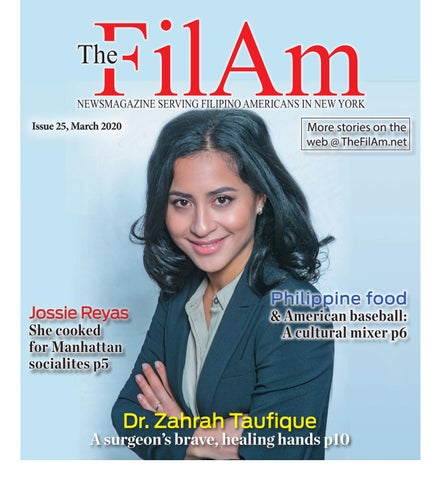
Issue 25, March 2020
More stories on the web @ TheFilAm.net
Jossie Reyas She cooked for Manhattan socialites p5
Philippine food
& American baseball: A cultural mixer p6
Dr. Zahrah Taufique
A surgeon’s brave, healing hands p10
Letter from the Editor
The Pastillas Scandal and the sneaky ways to corruption
T
here’s something sweet and savory about corruption in the Philippines. Some Bureau of Immigration (BI) officials and personnel are said to be receiving P10,000 per from Chinese nationals entering the Philippines to illegally work in gaming casinos. The cash is bundled up and hidden in Pastillas wrappers, according to reports. I am already imagining Pastillas de Leche nicely rolled in dainty Papel de Hapon meticulously hidden in some bureaucrats’ drawers rather than passed around and savored the way you would these delicious soft milk candies drizzled in sugar. If you think that’s way too wild, sorry but that’s what Pastillas (of the Goldilocks variety) means to me: A delicious ‘balikbayan pasalubong’ A CNN Philippines headline on the Pastillas Scandal gift from the Philippines. The Pastillas bribery scandal is now creative tack around the government’s airports around the country. A P20, P50 under investigation in the Philippines anti-corruption law. bill folded and hidden in one of the pages Congress after it was revealed that Back in the day, drivers who did not of a passport. In one of my foreign travels certain Chinese nationals were given want to be bothered by pesky traffic as a young reporter, I remember one of “special treatment” in exchange for cops would make sure to leave a P20 bill my editors’ astute advice: “Ipit ka lang ng pretend Pastillas. Five BI officials have folded underneath the driver’s license. bente para dere-derecho ka lang.” I never been fired and about 20 personnel It’s the police officer’s for the taking. had to use it having found out that a press were suspended. While the Philippines The officer teases out the bill from a card had more of a desired effect. continues to be a low performer in plastic case and then waves the driver We’re talking low-level corruption, Transparency International's Corrupoff. No word spoken, except perhaps for the ways some bureaucrats make a tion Index, the inventiveness, audacity a breezy, “Ingat lang, sir.” little money to augment their meager and gall with which it was carried out by The same timeworn practice has salary. Not the ways of Presidents and low-level bureaucrats seem to exhibit a been anecdotally documented at some congressmen and army generals which
Contributing Writers Tricia J. Capistrano Ludy AstraquilloOngkeko Joel David Mariel Padilla Wendell Gaa Maricar CP Lindy Rosales Hampton Danielle Vania Angelito Cabigao Bonus
Founding Editor Cristina DC Pastor Address P.O. Box 8071 New York, NY 10116
Contact Thefilamny@gmail.com
The FilAm is a publication of A&V Editorial THE FILAM |
involve multiple offshore accounts registered under a shell company. When Imelda Marcos stuffed much of her ill-gotten jewelry inside Pampers diaper boxes when her family fled the country in 1986, it was a behavior not befitting a dictators' well-heeled wife. But as a decision made in a crunch, no matter how tacky, it got the job done. To understand corruption in the Philippines is to understand the deep-rooted way we give thanks as a people. We are generous to a fault when someone does something nice for us. There’s the huge tip for a friendly waiter; a prized gamecock for a wealthy compadre who gave your son a job; a government contract for the politician who delivered the votes in his province; a Cabinet position for the business tycoon who opened his chest during the campaign. Transparency International recognizes that the Philippines “continues to struggle to tackle corruption.” Imagine P700 billion lost yearly to corruption. They end up enriching bureaucrats and politicians instead of being used to improve housing, the criminal justice system, or public education. Tracking down these riches is almost a fools' errand. Pastillas is a small-potatoes operation, part of a never-ending cycle of corruption where you have to make ends meet to survive in the Philippines. As is often the case, the bigger fish are never caught.
2
Quiboloy church officials indicted for trafficking, sham marriages
S
ANTA ANA, Calif. – A federal grand jury has charged three top administrators of a Philippine-based church with overseeing a labor trafficking scheme that forced church members to solicit donations for a bogus charity after the defendants illegally obtained visas and other immigration documents that allowed the workers to enter and remain in the United States. The one-count indictment alleges a conspiracy to commit a series of offenses – including trafficking with respect to forced labor, document servitude, immigration fraud and marriage fraud. The three defendants were arrested last month after being named in a criminal complaint that alleged a conspiracy to commit immigration fraud. The three defendants charged in the indictment are: • Guia Cabactulan, 59, the lead Kingdom of Jesus Christ, The Name Above Every Name administrator in the U.S. who maintained direct communication with KOJC leadership in the Philippines; • Marissa Duenas, 41, who allegedly secured the passports immediately after workers entered the U.S. and handled fraudulent immigration documents for KOJC workers; and • Amanda Estopare, 48, who allegedly was in charge of tracking and reporting the money raised in the U.S. to KOJC officials in the Philippines. (According to its website, KOJC was founded by Pastor Apollo C. Quiboloy on September 1, 1985. Quiboloy is a staunch supporter of President Rodrigo Duterte. -- TF) The core allegations of the case are that representatives of the KOJC church obtained visas for church members to enter the U.S. by claiming, for example, they would be performing at musical events. But once the church members arrived in the U.S., they were required to surrender their passports and work long hours as “FTWs” (full-time workers), who solicited donations for a church non-profit called the Children’s Joy Foundation USA (CJF). While the workers raised funds by telling donors their money would benefit impoverished children in the Philippines, the indictment alleges that most or all of the money raised was used to finance KOJC operations and the lavish lifestyles of church leaders. While some KOJC workers knew they were entering the U.S. to be fundraisers, the indictment alleges “other KOJC workers were unaware of the actual purpose until they were forced…to solicit on the streets nearly every day, year-round, working very long hours, and often sleeping in cars overnight, without normal access to over-the-counter medicine or even clothes.” The defendants confiscated the victims’ passports and other immigration documents “to prevent and restrict…KOJC workers’ liberty to move and travel in order to maintain the labor and services of KOJC
Kingdom of Jesus Christ church founder Apollo Quiboloy. Photo: Children’s Joy Foundation workers, some of whom were and had been a victim of a severe form of trafficking,” according to the indictment. All three defendants – who were arrested on January 29 and remain in federal custody – are scheduled to be arraigned on the indictment February 20 in U.S. District Court in Los Angeles. As part of the long-running scheme, the three defendants kept productive workers in the U.S. by obtaining student visas or by arranging sham marriages with KOJC workers who were U.S. citizens, the indictment alleges. To create the illusion of legitimate marriages, Duenas allegedly possessed ATM cards to show immigration officials that workers in the sham marriages had joint bank accounts. Furthermore, Cabactulan and Duenas possessed wedding rings for KOJC workers to use during their fraudulent marriage ceremonies. Immigration records summarized in the criminal complaint indicate there were 82 marriages involving KOJC administrators and FTWs over the past two decades. THE FILAM |
3
When authorities searched the KOJC compound in Van Nuys on January 29, Cabactulan and Duenas possessed approximately 72 Filipino passports, seven United States passports, and one Ukrainian passport that belonged to other people, according to the indictment, which also notes that Duenas possessed four male wedding rings and three female wedding rings in an office at the KOJC compound. The search also revealed that Duenas possessed a file titled “Traitor” that contained information on KOJC members who fled the church, the indictment alleges. The conspiracy charge alleged in the indictment carries a statutory maximum penalty of five years in federal prison. The ongoing investigation into KOJC is being conducted by the FBI, U.S. Immigration and Customs Enforcement’s (ICE) Homeland Security Investigations (HSI), U.S. Citizenship and Immigration Service’s Fraud Detection and National Security Unit, the U.S. Department of State’s Diplomatic Security Service, and IRS Criminal Investigation. — ICE Office of Public Affairs
How a PHL president welcomed Jewish refugees fleeing the Holocaust
O
n January 27, the United Nations remembered the 75th year of the liberation of Auschwitz during the International Holocaust Remembrance Day. Among the activities was a short screening of the award-winning documentary “An Open Door: Holocaust Haven in the Philippines.” Director and producer Noel “Sonny” Izon’s work and research of 10 years shed light on the little-known fact that at a horrific time when European Jews were being persecuted in Nazi Germany, the Philippines Families of European Jews who found a home in the Philippines at the beginning of World War II. gave shelter to Jewish refugees. "An Open Door" reveals how President to save Germany’s persecuted Jews Manuel L. Quezon saved 1,305 Eurothrough “orchestrated resettlement” pean Jews from Hitler’s pogroms in that President Franklin Roosevelt 1938 until December 7, 1941 when the had requested. History tells us that USA and its territory, the Philippines, approximately six million Jews died entered World War II. from the systematic genocide known Growing up in the Philippines right as the Holocaust. after the country’s liberation from the Meanwhile, out in the Pacific, the Japanese, Izon remembered stories Philippines was the beacon of light of from his father about an Austrian phy- that darkest era of the 20th Century. sician, Dr. Otto Zelezny, who treated Against the instruction of the U.S. him in 1945 when he had a virulent Department of State, and defying the form of malaria and saved him from “Final Solution” of Hitler’s plan to what would have been a fatal illness. murder the Jews in Europe to build Director and producer Noel ‘Sonny’ His father, Esmeraldo Izon, was the his Aryan Race, Philippine President Associate Editor and political cartoon- Manuel L. Quezon, with the assistance Izon of ‘An Open Door: Holocaust Haven in the Philippines.’ ist of the long-running Philippines of U.S. High Commissioner Paul Free Press. McNutt, authorized the entry of 1,305 It was only decades later that he Jews fleeing Europe. of Philippine-American history. In realized the good doctor who saved Izon came to the United States to 2005, he completed “An Untold Trihis father from an early grave was study in 1967 when he was 21 years old, umph” which documented how 7,000 part of the 1,305 European Jews who intending to return after his graduate Filipino Americans born in the USA were welcomed into the Philippines studies. But fate intervened and he joined the U.S. army for the liberation while the rest of the Western World married his university sweetheart of the Philippines during World War remained indifferent. Kathryn after they graduated and II. Public Broadcasting System sponIn 1938, delegates from 32 counsettled down in the Washington D.C. sored the film which aired nationwide tries, hundreds of journalists, and area. They have two daughters, Laura in May 2005 on prime time reaching relief organizations from around the Annette, a partner in a law firm in nearly three million households. It world, met in Evian, a French resort Sacramento; and Juliet Kathryn, a would be rebroadcast 15 more times to “address the growing Jewish refujournalist in New York. over the next four years. gee crisis in Hitler’s German Reich.” After a stint working for a local In 2006, he completed "Sandaan," But after 10 days of deliberation, television station, he started to make the story of the first 100 years of Filithey were unable to agree on how documentaries of little-known facets pinos in America for the Smithsonian THE FILAM |
4
Institution. It premiered to an SRO crowd in October of that year at the Smithsonian’s Baird Auditorium. In 2008, he met Manolo Quezon III, grandson of the president of the Commonwealth, when he learned about Quezon’s heroic decision to rescue Jewish refugees from Europe's conflagration. Izon began his odyssey and travelled to Europe, Philippines and several cities in the USA to interview the survivors of that period some of whom were children when they arrived in the Philippines. The film won Best Picture at the White Nights Film Festival in St. Petersburg, Russia, Best of Festival at the Brussels International Film Festival, and Best Picture at the Java International Humanitarian Film Awards. Everyone talked about how welcoming the Filipinos were. For many of them, Marikina -- where President Quezon’s farm land was located and which he donated so the refugees would not be a burden to the country -- would always be their first home. They were not imprisoned when the Japanese invaded the Philippines because they were considered Germans, and Germany was an ally of Japan in World War II. Izon visited Israel in 2016 and went to see the Open Doors Monument at the Rishon LeZion Holocaust Park erected to honor President Quezon’s rescue of the Jewish asylum seekers. He was so touched by Israel’s gesture of gratitude that he decided it should begin the title of his documentary. In addition, the Israel government has given free entry to any Filipino without requiring a visa. Thanks to Izon, the rest of us can be inspired that in the worst of times, we Filipinos showed the world what Love of Neighbor truly means.
She cooked for royalty and socialites including a future U.S. president
O
ne summer day in 2017, I met Jossie Reyas, 77, by a bench outside a small food pantry in Woodside, Queens. She was waiting her turn to get cans of beans, fruit, soup, and vegetables. Reyas, wearing frayed slippers and a faded floral blouse, was quiet and soft-spoken, but when asked about her life, she spun a tale of cooking for New York socialites, including a European countess and a future president of the United States. She still keeps signed post-it notes, checks, menus, pictures and holiday cards from all of her employers. She keeps them in a plastic tote bag along with her flip phone and paper napkins. One Christmas card, with cartoon angels and musical notes scattered across the front, reads: “Dear Josie, Thank you for your help this year. You do a great job and we certainly appreciate having you with us. Warm wishes for 1990! Mr. Mrs. Trump and Christopher.” Born in the Philippines, Reyas was the oldest of eight children: three boys and five girls. In 1970, she studied business administration at Manila’s University of the East before moving to Madrid with her sisters. There she worked at the Denmark, Mexico and Uruguayan embassies. The Countess of Romanones, Spain just happened to live across the street from the Uruguayan Embassy. One day the Countess recognized Reyas as a Filipina and asked if she would cook for her. “Europeans love chicken adobo,” Reyas whispered. It was there she heard of her father’s sudden death. Her parents were en route to the United States when he suffered a heart attack at the airport. Her mother handled the funeral arrangements before moving to America months later. In 1986, Reyas’s mother summoned her to New York City saying, “it is time,” as the rest of her siblings had already moved. Reyas, in her mid-forties, dutifully obeyed. In 1987, the Countess asked Reyas to cook for a private party she was hosting in New York. Reyas’s cooking, attention to detail and dedication to decoration garnered praise from the wealthy guests. Soon, Reyas said, her services were requested by socialites such as Blaine Trump, Nancy Reagan, Mark Thatcher, Lally Weymouth, Prince Dimitri of Yugoslavia, Susan Hess, Betsy Bloomingdale, and Vera Wang, among others. Reyas even lived with Robert and Blaine Trump at Trump Plaza for six months during the construction of the Trump Taj Mahal in 1989. Robert’s older brother, Donald, and his family were frequent visitors. “They are nice. Even Donald, even the children of
By Mariel Padilla
Socialite Blaine Trump (left) with husband Robert, brother-in-law (now U.S. President) Donald Trump, and sister-in-law Ivana. Photo: Getty Images.
Jossie Reyas both cooked and decorated for the Countess of Romanones’s evening cocktail parties approximately 30 years ago. Reyas keeps photos and news clippings in her bag. Photo by Mariel Padilla
Reyas keeps cards, notes and memos from her employers, including Robert and Blaine Trump, as prized mementos. She said her name ‘Jossie’ is often misspelled. Photo by Mariel Padilla
Donald – simple,” Reyas said. “I don’t know why many people don’t like him.” Several employers asked Reyas to move with them, but she declined every offer that would permanently take her away from Manhattan. “I came here because of my mother. Why would I leave her?” Reyas said. Reyas’s mother died in her Manhattan home in 1994, but Reyas doesn’t want to move back to the Philippines like her siblings. She hasn’t been back since 1975.
“They all go home when they get married because they have business in the Philippines,” Reyas said. “I did not get married. I stay here, that’s why. If I [got] married, [had] children and a family, then I [would have gone] home also.” These days, Reyas says, she makes a meager living as a decorator, working only for select employers of her choosing. “No more cooking,” Reyas said smiling. “I cannot cook anymore. I’m old.”
THE FILAM |
5
Philippine food and American baseball: A cultural mixer By Cristina DC Pastor
Philippine food curiously found its way into the heart of America: Baseball.
F
The financial crisis of 2008 steered Jappy’s career as a mortgage banker into the culinary world. He lost his job and began to work in restaurants around the Bay Area, starting from the bottom. He got interested in cooking, returned to the Philippines and attended culinary school at Enderun Colleges. His internship was spent in the kitchen of Chez Allard in Paris. He came to New York and became Executive Sous Chef at Manila Social Club in Brooklyn. He has a master’s degree in Food Culture & Communications from the University of Gastronomic Sciences in Pollenzo, Italy. In school, his research on Japanese Food Culture and Temple Cuisine was awarded Best Thesis. Weeks before guest-catering at MLB, Tsismis was invited to do a pop-up at Fox News. “They liked the food so much there and I was recommended by a friend (to do the same at MLB),” he said. For Jappy, doing pop-ups in places where Philippine food is largely unheard of is a great opportunity to be able to “share the culture.” © The FilAm
or the week of February 21, Tsismis Restaurant catered Adobo, Sisig, and Pinakbet to the corporate officers and employees of Major League Baseball, the piquant aroma of ‘ginisa’ – sautéed onion and garlic – mildly floating throughout the corridors of MLB’s headquarters on Park Avenue. “We were proud to be the first Philippine restaurant to have a pop-up at their canteen,” Tsismis chef and Director of Operations Jappy Afzelius told The FilAm. Jappy served traditional Philippine dishes like Chicken Adobo, Beef Steak Tagalog, Sisig, Laing, and Tsismis Chef Jappy Afzelius lording it over at the Major League Baseball canteen Pinakbet. It was an introduction to Filipino food for many at MLB. For from the Spanish word “chisme,” City for over 26 years. They bring to the Jappy it was a wonderful opportunity meaning gossip. The owners selected table many years of work and personal to explain the history, characteristics, the name with the idea of introducing a experience in venture capital, food and ingredients of food from the service, retail, fashion and internacasual gathering place to bring people, country’s thousands of islands. tional travel. food and drinks together. The owners The most popular dish came as no The Dumaguete-born Jappy was are husband and wife Stephen Young surprise: Chicken Adobo simmered trained in restaurants in San Francisco and Reggie Aguinaldo, both of Philipin soy sauce, vinegar, peppercorn and pine descent and residents of New York and Paris before moving to New York. garlic. The origin of this National Dish remains debatable with some saying Adobo was introduced by the Spaniards during the colonial period and others insisting it is indigenous with Filipino elders traditionally soaking their meats in vinegar and spices before cooking. The Sisig was another MLB favorite, said Jappy. Commonly paired with beer, Sisig is a spicy dish made from the chopped parts of a pig’s head and chicken liver. “They loved the food so much that most returned every day,” he said. “Some clients came back every day for the whole week and are now curious to come to the restaurant.” Tsismis restaurant and wine bar opened on June 7th, 2019 at 143 Orchard Street in Manhattan’s Lower Chicken Adobo. Yelp photo East Side. The word “Tsismis’ is derived Beef Steak Tagalog was another MLB favorite. Instagram photo
FilStop closes all stores, website By Cristina DC Pastor
An established Filipino grocery store has closed down.
F
ilStop has closed its Clifton, N.J. location which opened only five months ago. Before that, it shut down its e-commerce site Filstop. com on December 31, 2019. The original store in Jersey City, originally named Phil-Am Food and founded than 40 years ago, was shuttered on February 9, 2020. “After 12 years of serving our amazing and loyal customers, it saddens me to announce that our site, FilStop.com, is no longer in operation as of December 31, 2019,” announced owner Erwin Santos. “We had closed our Clifton location. We know it had just opened but was not working for us unfortunately,” came a second announcement posted on Facebook. Santos comes from the entrepreneurial Aguila family from San Jose, Batangas who set up grocery stores in New York and New Jersey in the 1970s. Phil-Am Food flourished and later branched out into the restaurant business, a bakery, a handicraft store, and became a wholesale distributor serving smaller retailers in Pennsylvania, New York, and New Jersey. The family has won numerous immigrant awards for the food empire it has built over the years. Santos broke away from the family enterprise founded by his mother, her sisters and their spouses in 1973. He continued to run the Jersey City store and made sure he combined it with an e-commerce site -- FilStop. com -- to reach a larger market. The neighborhood store became too cramped for its expanding business. Santos, together with business partner Guilly Alquiros, opened a second store at a much bigger location in Clifton, N.J. FilStop “superstore” had its grand opening on August 22, 2019. “Jersey City was such a landmark
Co-owner Erwin Santos takes viewers on a tour of the Clifton warehouse in this FilStop video.
At FilStop in Clifton, N.J., a wide array of hot, home-cooked dishes for busy FilAm families. FilStop photos and staple and we are so thankful for everyone being so loyal to us there… Even with all the issues like traffic and lack of parking and the small size of the store,” said Santos. In an interview with The FilAm in
THE FILAM |
2017, Santos recalled growing up in the family’s retail business and learning the ropes at an early age. He was about 6 years old when he was helping repack rice or monggo beans in smaller bags or unloading containers he could carry. “I
7
was being babysat, not being made to work, in the family business. My father made it fun,” he said. Alquiros comes from a family of restaurateurs in the Philippines. They own the Kapitan Gimmo seafood restaurant in Quezon City as well as Giligan’s chain of restaurants with about a hundred locations. Customers were stunned to hear at the beginning of the year that FilStop.com was shuttering. This was followed by news of the closing of the 16,000 sq.m.-Clifton location. The FilAm learned that slow foot traffic in Clifton was a disappointment to the owners. Slow traffic, high rent. Not to mention the colossal cost of converting the former Halloween shop into a big-box store with two commercial kitchens, rows and rows of shelves, and a dining area. Before it finally padlocked, FilStop had a 40 percent sale on all items at the Jersey City store. “Thank you everyone for the support over the years…We need to remember all the good times and that is what we hope everyone remembers about FilStop… It was a blessing to let us serve everyone.”
8 things about Asian Americans you should know
W
e can see how Asian Americans have been influencing U.S. culture in technology, food, entertainment, and music. From Awkwafina winning the Golden Globe award, to BTS as the first South Korean band in history to debut an album at No. 1 on the U.S. Billboard 200 chart, to Andrew Yang running for president (he has withdrawn his candidacy), Asian Americans have been impacting the mainstream in big ways. Here are eight insights that you should know about Asian Americans:
||1: $1 TRILLION IN BUYING POWER
Awkwafina in ‘Nora from Queens,’ the new sitcom from Comedy Central.
||2: MULTIGENERATIONAL FAMILIES
channels like Netflix and other streaming services. In 2018, Crazy Rich Asians earned $238 million in global box offices, featuring Asian Americans in lead roles. Earlier this month, Awkwafina was the first Asian American to win a Golden Globe Award for lead actress in a film in the musical and comedy category, showing that media and entertainment is beginning to reflect its diverse audience. Eighty-one percent of Asian American households lead media use by subscribing to at least one video streaming service like Netflix. They use these services 19 percent more than the U.S. total population which makes watching Asian American big moments in the spotlight easier.
Asian Americans continue to make gains as tech-enabled, digitally vocal influencers with an immense spending power of $1 trillion, a number that has risen 68 percent since 2010. Nielsen research shows that Asian American buying power will continue to grow in coming years.
Asian American households are multigenerational and 17 percent larger than average U.S. households. One factor is a pattern of immigrants starting a new life in the U.S. that live with extended families in order to ease the transition. The support of family smooths the adjustment to a new culture and fosters culture sustainability, as elders have daily influence on younger generations. Multigenerational households are relatively common among Asian Americans, with 27 percent of them living in such households, versus 15 percent of the total population.
||3: ENTERTAINMENT + MEDIA
As Asian American creators reached new heights of recognition, Asian American households tuned in via
||4: LEADERS IN TECHNOLOGY USE
Asian Americans are early adopters and leaders of new technology. Asian Americans agree that finding out about products and services is an important reason for using social media. 20.5 percent of Asian American consumers aged 18 and over use the Yelp app, and are 113 percent more likely to use Yelp than the total
From top: Andrew Yang, Sriracha, Shopping in H.K., Saahil Arora, BTS boy band, WeChat U.S. population. Using local social apps from other countries such as WeChat for China and Kakao Talk for Korea helps Asian Americans more easily communicate with family, friends and businesses in Asia.
||5: ONLINE SHOPPING
As would be expected of tech trendsetters, Asian Americans are first movers in online shopping and shop online 34 percent more than the average U.S. population, with 87 percent of Asian Americans making an online purchase last year.
||6: E-SPORTS
Asian Americans are tuning into E-sports. Forty-nine percent of Asian Americans say they are fans of e-sports, lifting gaming and E-sports into the American mainstream. The second ranked U.S. professional player of E-sports is Saahil Arora
THE FILAM |
8
of South Asian Indian descent. Last year 454 million worldwide viewers spent over $1 billion on E-sports.
||7: MUSIC
The popularity of K-Pop music started in the Asian American community with close familial ties to Korea and has crossed over to U.S. mainstream culture with individual and collaborative success with U.S. artists. K-Pop acts such as BTS and BlackPink achieved success on the Billboard Hot 100 and other top U.S. charts, suggesting the K-Pop revolution is here to stay.
||8: ASIAN FOOD GOES MAINSTREAM From naan bread to condiments like Sriracha, many Asian foods have grown from niche to mainstream, seeing double- or even triple-digit growth over the past three years. – Nielsen.com
Anniversary Seat Sale Book from March 1-15, 2020
Enjoy our Anniversary Seat Sale fares for as low as USD 648 All-in Economy Roundtrip Fare. Book from March 1 -15,2020. Travel to the Philippines from April 1 - December 10, 2020 and to other destinations from April 1 - May 20, August 16 - November 30, December 30-31, 2020. We fly non-stop from New York to Manila, daily. ALL-IN ROUNDTRIP FARES FROM NEW YORK TO
ECONOMY
PREMIUM ECONOMY
BUSINESS CLASS
As low as
As low as
As low as
USD718 USD 748 USD758 USD 648 USD 678 USD 678 USD688 USD688 USD728 USD728 USD728 USD728 USD758 USD978
MANILA CEBU DAVAO HO CHI MINH BALI TAIPEI BANGKOK JAKARTA KUALA LUMPUR OSAKA TOKYO (HANEDA) TOKYO (NARITA) SINGAPORE SYDNEY Blackout Period: JFK-PH: June 20 - July 12, 2020
USD1,488 USD1,518 USD1,518 USD1,298 USD1,128 USD1,388 USD1,528 USD1,138 USD1,128 USD1,548 USD1,538 USD1,538 USD1,158 USD2,058
USD3,388 USD3,418 USD3,418 USD3,098 USD2,988 USD2,988 USD3,758 USD2,988 USD3,118 USD3,758 USD3,748 USD3,748 USD3,458 USD 5,448
FARE CONDITIONS: Seats are subject to availability. Seasonality and blackout dates apply. Fares quoted are inclusive of government taxes, fees and surcharges. Taxes and charges are subject to change with or without prior notice by the authority. Minimum/maximum stay for US-MNL: Economy and Premium Economy is 3D/3M and Business is 7D/3M; US-lntl BEYONDS: Economy/Premium Economy/Business is 3D/6M. Honolulu fares are valid for MON THROUGH FRI departures and LosAngeles/San Francisco/New York fares arevalid for SUN THROUGH THU departures. No-show fee is USD125. Ticket is non-transferable. Ticket is non-refundable for Economy. For Premium Economy, refund fee is USD250 for totally unused and USD100 for partially used tickets. Business refund fee is USD250 for totally unused tickets and non-refundable for partially used tickets. Economy is rebookable for a change fee of USD300. Changes are allowed for Premium Economy and Business class without a fee for the first rebooking and USD100 each for succeeding changes. For some beyond destinations, Premium Economy service may only be applicable between JFK/HNL and MNL. Accompanied child’s fare is 75% of adult fare. Infant fare for infant without a seat under 2 years is 10% of adult fare. 10% Mileage accrual for Economy, 100% for Premium Economy and 125% for Business. Baggage Allowance - Fare is inclusive of 7-kghandcarried baggage. Free baggageallowancewill vary per route. Tickets issued online or outside of the Philippines does not include Philippine Travel Tax (PH tax). PH tax shall be paid directly at the airport before departure. PH tax is applicable to Philippine passport holders, foreigners holding a Philippine resident visa, and foreign tourists or expatriates who have stayed in the Philippines for more than one year. Other travel conditions apply.
PHILIPPINEAIRLINES.COM |
PhilippineAirlines
flyPAL
COVER STORY
The brave, healing hands of surgeon Zahrah Taufique By Danielle Vania Bonus
Dr. Zahrah Taufique grew up spending her summers in India and the Philippines where her parents are from. These memorable holidays also exposed her to poverty in these countries and developed in her a desire to help the underprivileged.
A
Chief Resident Surgeon of ENT (ear, nose and throat -- also known as Otolaryngology) at NYU Langone Medical Center, Zahrah has made it her life’s work to treat diseases of the head and neck. Her residency will continue for five more months right before she makes her way to the University of Minnesota to do her fellowship in As a medical student, Zahrah founded a clinic Pediatric ENT and Craniofacial which performs health evaluations of people Surgery. seeking asylum in the U.S. Most of Zahrah’s time is spent “scrubbed in” as a surgeon, but gave Zahrah the answers on how her various positions at NYU Langone to effectively utilize resources for coincide with her job as an ENT doctor high-quality and sustainable care. in the last five years. She is a Resident “I became interested in health Representative of the ENT PAC Board systems and how this impacts an of Directors, as well as Co-Chair of the individual’s health,” she said in an NYU House Staff Patient Safety Couninterview with The FilAm. “This comes cil. These additional roles allow her to in part from my interest in global interact with leadership in the hospital getting a much broader scope on ways health but also my interest in scientific to improve hospital safety. ways to deliver the best, the most Though she knew medical school efficient, and most effective quality care was in her future, she studied Politusing research, and that’s why I went to ical Science at Columbia University business school.” where she was a Dean’s Lister for One of her early accomplishments three years. The bachelor’s degree is she started an Asylum Clinic as gave her the foundation to better a second-year medical student. The appreciate the intersection of politics clinic provides medical, gynecologand medicine. Her curiosity led her to ical and psychological evaluations take a year off for Genetics Clinical for people seeking asylum in the Research followed by an MD/MBA United States. She was stressed by back at Columbia. Business school the difficulty of the task, but she saw THE FILAM |
With family, from left, sister Mahrah, brother Yusuf, her Lola Bett, and mother Cecilia. At back, brother-in-law Daniel and Zahrah’s husband Billy.
She plays the electric violin for two bands, among many skills. 10
Performing cleft lip surgery while on a mission trip in Guatemala.
it through and continued her journey through medical school. This clinic is still up and running. Her interest in surgery emerged while she was doing clerkship where students are rotated among the different services, for instance, internal medicine, pediatrics, or psychiatry, to see where their real interests lie. “I realized I was interested in surgery. I like using my hands and being very active and seeing the impact quickly. It was very enticing for me, very exciting,” she said. Multiple travel grants have allowed her to do volunteer work in foreign countries. In 2017, she participated in a Children, Cleft Lip and Palate Mission to Antigua, Guatemala. Last year, she traveled to Ulaanbaatar, Mongolia for a Head and Neck Surgery Medical Mission trip. Last February, she visited her mother’s homeland, the Philippines, to continue bringing aid to impoverished communities.
||Quick learner
Having a knack for learning quickly, Zahrah did not waste any time and took every advantage of developing herself. She attributes these skills to her parents who raised her and her two siblings -- sister Mahrah and brother Yusuf -- very richly in both Filipino and Indian culture. Her father worked at the World Bank for many years; her mom Cecilia Calleja works in financial services. At the age of 3, Zahrah’s mom put her in violin classes which required a 45-minute drive out of town and started at 6 in the morning before school. After school, she would continue to practice daily for an hour. This tenacious approach was transformative for young Zahrah and became her foundation for learning new things, like playing an instrument, a sport, or choosing to be a surgeon.
Later in life, she picked up new activities such as snowboarding, skiing, soccer, rugby, and surfing. Husband Billy Cooke taught her how to ski, which came easy because she already snowboarded. Billy, who comes from Upstate New York, owns and works for his own company, 3Forge, which provides data visualization technology to investment banks. “We married two years ago but we’ve known each other for 11 years,” said Zahrah. “Billy is a huge skier.” She occasionally plays the violin for two bands – the Bedroom Band and Crooked Thumb – that perform in bars around Manhattan. At 32, Zahrah has built an extraordinary reputation for herself without ostentation. She credits her parents for being the individual she is today: A confident young woman dedicated to global health and humanitarianism and focused on the work in front of her.
Arkansas commissioner is new FYLPRO president
T
he Filipino Young Leaders Program (FYLPRO), a nonprofit organization that seeks to connect young Filipino American leaders with their heritage, is pleased to announce its 2020-2021 Executive Committee and Board of Directors. Executive Committee: Joshua Ang Price ‘18, President (Little Rock, AR) Louella Cabalona ’12, Vice President (Chicago, IL) Major Charlynne McGinnis ‘18, Secretary (Honolulu, HI) Melissa Palma, MD, ’18, Treasurer (Chicago, IL) Board of Directors: Darell Artates, Ex-Officio (Washington, D.C.) JR Calanoc ‘12, Immediate Past President (San Francisco, CA) Jen Coliflores, Esq., ’15 (Boston, MA) Krystle Canare ’19 (Washington, D.C.) Tony DelaRosa ’18 (Miami, FL) JP Ferrer ’14 (Chicago, IL) Donny Feliciano Rojo ’16 (San Francisco, CA) Lakhi Siap ’15, Immersion Program Co-Chair (Chicago, IL) Leezel Tanglao ’19 (New York City, NY) The new leadership assumed their roles effective February 5. Their mission, according to a press statement, is to identify young FilAm leaders, provide professional development to empower them to positively impact their communities, and give them the tools to nurture and grow Philippines-U.S. relations in the areas of government, business, and philanthropic and humanitarian initiatives.
“It is truly wonderful to see young leaders continue to embody the spirit and pride of being a Filipino here in the United States. The future is bright for FYLPRO and the communities they are a part of,” said Philippine Ambassador Jose Manuel Romualdez. Incoming President Joshua Ang Price is the first Filipino American (and first Asian American) Election Commissioner for Pulaski County, Arkansas, the most populous county in the state with 400,000 residents and home to its capital city of Little Rock. He is the only elected official of Filipino American heritage in the state of Arkansas. He is joined by Vice President Louella Cabalona, an artist, lead singer of SamaSama Project and senior manager for Analytics at Blue Cross Blue Shield who was a member of the first batch of FYLPRO delegates. US Air Force Major Charlynne McGinnis, a decorated officer with extensive experience in the Asia-Pacific region; and Dr. Melissa Palma, a physician who passionately works to advance public health in underserved populations will serve their second terms as secretary and treasurer, respectively. The members of the Board of Directors are comprised of FYLPRO alumni from across the nation in multiple industries including business, banking, nonprofits, education, journalism and law. “I am honored to serve as the president this year and work with our 84 alumni to empower our communities as we recognize the longstanding friendship between Filipinos and Americans,” said Ang Price. “There are currently over 4 million Filipino Americans, and one of FYLPRO’s main goals this year is to make sure our communities are properly represented by encouraging them to participate in the U.S. Census and register to THE FILAM |
11
vote in the upcoming 2020 Elections. I know that with this outstanding team at the helm of FYLPRO, the sky is the limit in how we can positively impact our Filipino communities here in the U.S. and in the Philippines.” FYLPRO was established in 2012 by the Philippine Embassy in the United States in cooperation with the Ayala Foundation Inc. For more information, please visit www.fylpro.org.
Calendar
of Events
||March 12 to 15
New York Premiere of ‘Pananadem’ (Remembering) by Kinding Sindaw La Mama’s Ellen Stewart Theatre 66 East 4th Street (2nd Floor)
||March 16
Deadline to apply to The School of New York Times Summer Academy Contact: info@nytedu.com
||March 19 to April 16 5-Week Adult Conversational Filipino, Beginner 2 Contact: Venessa Manzano at info@ filschool-nynj.org or 774-257-4669
||March 22
The Children’s Orchestra Society’s Masterworks Concert Good Shepherd Faith Presbyterian Church 152 W 66th Street, NYC
||March 27, April 10, April 24
Elixir: A Queer & Trans Asian Pacific Islander Happy Hour by GAPIMNY Atlas Social Club 753 9th Avenue, NYC
||March 28
PACCAL’s International Women’s History Month Ramada Plaza (now called Holiday Inn) 160-A Frontage Road, Newark, N.J
||July 15 to 18 ||May 9
||March 28
NQAPIA's 15th Anniversary at the 2020 New York Community Catalyst Awards 88 Palace Restaurant 88 E Broadway , NYC
Mother’s Day Ball by the Filipino Social Club of NY, Inc. D’Haven 58-02 37th Avenue Woodside, NYC
||July 19 to 26
||May 22 to 24
||September 15
UNIFFIED: Empowering Educators for the Challenges of the 21st Century Astoria World Manor 25-22 Astoria Blvd., Astoria Queens Contact: uniffiednewyork@gmail.com
||June 13 to 14
||March 24 to June |March 31 20 (Tuesdays 6 p.m. |Deadline to apply for the position to 9 p.m.) of Executive Director, Philippine 40-Hour Immigration Course San Damiano Hall, Church of St. Francis of Assisi 129 West 31st NYC
||March 25, 7 p.m.
Reclaim Pride Coalition Meeting The People's Forum 320 West 37th Street, NYC
Center for Investigative Journalism Contact: search.pcij@gmail.com
||April 20 to 25
Offering and Sharing of Stories with the Community Contact Jana Lynne Umipig at Raisedpinay@gmail.com
FANHS National 18th Biennial Conference Waikiki Marriott Beach Resort & Spa, Hawaii
Fil-Am Expo 2020: Celebrating Filipino American Excellence Dulles Expo Center Chantilly, Virginia
||June 15
Deadline for nominations to the 2020 Presidential Awards for Filipino Individuals and Organizations Overseas Contact for details: Philippine Consulate New York, newyorkpcg. cultural@dfa.gov.ph
THE FILAM |
12
VIP Tour: Very Important Pinoy (Ambassadors’) Tour Manila, Iloilo, and Boracay
Deadline to apply to the Fulbright U.S. Scholar Program Contact: scholars@iie.org
||September 20 to November 15
Sayawan Na! Queens Philippine Folk Dance Program Ilocano American Center 185-14 Hillside Avenue Jamaica, NYC Contact: Venessa Manzano at info@filschool-nynj.org or 774-257-4669
||October 24
Pinoy Koro Olympics BMCC Tribeca Performing Arts Center 199 Chambers Street NYC
Filipinos likely to meet foreign fiancés through Christian dating sites: study The Philippines is a leading source for fiancé visa applications, and religionbased dating sites are common places where couples looking to marry usually meet, according to a study by a visa processing company.
B
elow, are excerpts from the study that RapidVisa recently commissioned with Causal Design, an independent research firm based in Washington D.C. The study examines statistics and trends of K-1 fiancé visa applicants. “The K-1, or ‘fiancé visa,’ allows future spouses of U.S. citizens to enter the United States in order to marry, and ultimately apply for an adjustment to immigrant status. In practice, the K-1 serves as a nonimmigrant visa bridge to permanent spousal immigration status. Originally intended to assist U.S. soldiers in bringing foreign fiancés home after World War II, use of the K-1 visa has dramatically increased partly due to globalization which has driven an increase in the number of U.S. citizens marrying (and intending to marry) non-U.S. citizens. “We found that Filipino K-1 visas dwarfed every other nationality, accounting for nearly 20 percent of all K-1 visas in 2017 and surpassing the next five nationalities combined. While East European and East Asian countries have seen significant declines in K-1 visas since 2005 (Chinese nationals were only three percent of applicants in 2017), Brazil, the Dominican Republic and the United Kingdom have registered increasing numbers. “This report is based on a proprietary random sample of 4,979 RapidVisa customers collected between 2010 and 2019. In 2018, RapidVisa was responsible for processing 13.6 percent of all K-1 visas. As such, this sample may be sufficiently relevant to the broader population of K-1 applicants in considering generalizability of this report’s findings. “Dating websites remain the most common way for international fiancés to meet. Over 60 percent of respondents who reported meeting online mention using a dating site at some point in their courtship. “But perhaps the most interesting finding is the prominence of dating sites specialized specifically for the Philippines. FilipinoCupid tops the list, accounting for nearly 15 percent of all dating site traffic alone. The prominence of Filipino fiancés in our sample corresponds to our previous report, where they accounted for nearly 20 percent of all 2017 K-1 visas. Filipino sponsored fiancés appear disproportionately likely to
The Philippines has been a leading K-1 fiancé visa origin nation since the late 2000s.
2000s. For each, dating sites are a meaningful avenue to meeting U.S. fiancés: 46 percent of eventual Filipino/a fiancés met their sponsor through the medium, as did nearly 42 percent of Brazilian fiancés. Most of the nationalities on this list each have distinctive dating sites dedicated to their respective sub-regions or countries. “RapidVisa’s top two Latin countries by volume, the Dominican Republic and Colombia are among the top 10 countries for K-1 Visa issuances, highlighted in our previous report. Online dating is among the top methods for Dominicans and Colombians to meet U.S. singles, with the popular Cupid network of international dating sites making up the majority of top dating sites where these couples meet. “The Philippines is also prominent for other niche dating group categories. ChristianFilipina is the single most widely used website for those seeking
Source: RapidVisa meet through dating sites, representing 54 percent of this subsample. “Topping this list are Ukraine and Russia with the highest percentage of couples who met on a dating site. Other notable nationalities with disproportionate representation on dating sites are Philippines, Indonesia and Venezuela. Our previous report also highlights the Philippines as being an emerging international fiancé origin nation since the late THE FILAM |
13
partners based on religion, representing nearly 40 percent of all international matches found in our data. Between this and ChristianDatingForFree, Filipino fiancés make up approximately 65 percent of the religion-based online dating market. In general, Christian relationships are far more common in our random sample; websites implying a Christian focus command over three fourths of the market.” Go to RapidVisa.com for the complete study.
My mom: Realizing the American Dream at 82 By Suzanne Lansangan-Sabangan
The front door of my condominium opened at 10 a.m. with my mother poking her head in and telling me she was ready. The swearing-in was to begin at 1:30 p.m. That was not new to me as she always made sure she was one or two hours early for any appointment, including doctor’s appointments. However, May 1st, 2013 was a really important day for her because she would take her oath as a United States citizen at 82 years old. Neither of us realized how extraordinary this day would be until later in the afternoon.
M
y mom, Flocerfida A. Lansangan (‘Nene’ to her close friends, and ‘Baba’ to her five grandchildren), was hopeful that the swearing-in would last only half an hour, which would still give her time to pick up her two young grandchildren after school. After she signed her U.S. Naturalization papers, we were told that the ceremony would begin at 3 p.m. I told myself this would be a very long day, and I was thankful I brought my students’ tests to grade while waiting for the ceremony to begin. My mom was her usually-relaxed self, but I could tell that she was a little bit excited — or perhaps a little nervous. Obviously, she would not admit that to me. A couple of hours later, around 30 new U.S. citizens were being escorted onto the front steps of the Bergen County Court House. According to the Honorable Joseph S. Conte, who is the chairman of the Law Day Committee, May 1st was declared Law Day by President Barack Obama. This, he said, was an appropriate day to swear in new U.S. citizens. Flocerfida Lansangan at her U.S. Naturalization oath-taking The ceremony would turn out to be a very special one, graced by very distinguished guests of honor, including the New Jersey Chief Justice One week before my eldest daughter turned 1 year Stuart Rabner, who handed the U.S. Naturalization old, my mother arrived at JFK Airport. It was going certificates to the new citizens, and former Congressto be a big celebration since she and my daughter man Steven R. Rothman, who delivered the keynote share the same birthdays. After her first visit, she address. Rothman mentioned that being a U.S. citizen would travel to the U.S. every six months so she could is a right and a privilege but requires a great deal of take care of my young children while I worked as an responsibility toward neighbors, community, and adjunct faculty at several colleges. In the Philippines, country. He encouraged the new citizens to take pride she attended to my sister’s needs. This had been the in becoming a U.S. citizen. He also noted that new citarrangement for many years until my sister decided to izens bring to the United States their diverse culture, join me in the United States. languages, religions, and most especially their ethnic She knew life in America was tough, especially food. This comment drew laughter from the crowd. for a person of her age, but she was adamant not That moment brought back wonderful memories of to be a burden to us. Long, cold winters are somethe time when she first came to this country. times intolerable, but she managed to adjust to the THE FILAM |
14
The author with her mom changing temperature. She learned to commute so she could be mobile and not rely on us to drive her around. She could go to the hospital on her own for her monthly, sometimes even weekly check-up. Her once-a-month trip to Atlantic City is something she looks forward to. She has mastered the skill of commuting to her “favorite playground.” Her quiet times she spends reading English novels and watching her favorite Telenovela and Teleserye shows. My mother has not left behind her love for her native country, yet she was determined to adapt to her new home. My thoughts were interrupted by the applause coming from the crowd as I escorted her down the steps after she received her U.S. Naturalization certificate. My heart was beaming with pride at this woman who has sacrificed everything to be with her daughters for the remainder of her life. For this, my mother truly deserved a beautiful welcoming ceremony in a country which she now calls her home. Later, Steve Rothman came up to my mom to congratulate her on becoming a new U.S. citizen. My mom shook his hand and said with a big smile, “I am ready to vote!” Suzanne Lansangan-Sabangan is an associate professor in the American Language Program at Bergen Community College. She is also the Faculty Advisor of Pasalubong, the Filipino-American Club at the college. Outside of school, Suzanne is the female vocalist of the NY/NJ-based OPM band, Sounds of Manila.
FilAms brave the Coney Island Beach polar plunge
W
By Cristina DC Pastor
hen it was time, Chrissi Fabro stripped down to her Bettie Page swimsuit and jumped into the freezing waters of the Coney Island Beach with about 2,000 others. She got out after 30 seconds when her feet began to feel numb and heavy, and went back in the water for another 30 seconds before finally – literally -- throwing in the towel. “It’s just 60 seconds out of 365 days in a year,” said Chrissi when interviewed by The FilAm in 2015. “That’s how I looked at it.” Welcome to the annual Coney Island Polar Plunge, a goofy New York tradition that was started by the Coney Island Polar Bear Club founded in 1903 by bodybuilder Bernarr Macfadden. Macfadden, an early believer in the idea that a “dip in the ocean during the winter” is good for one’s health. Over the years, the polar plunge has become a rite of passage for some, a form of fundraising, or a test of dare and bragging rights for others. Chrissi came with friends and fellow activists from Anakbayan NY. This year was her second. “I learned from the first time. Last year I didn’t dress properly,” she said. She learned, for example, that covering up was not a good idea. “When you do the plunge, wear as little as possible because when you get out of the water, your T shirt takes a longer time to dry out,” she explained. “This year, I used a bikini. I learned my lesson.” Marilyn Abalos was at the same Coney Island Beach for the Pauline Polar Plunge’s ‘Freezin’ for a Reason’ for a different reason. As national chair of the St. Paul Alumnae Association in the U.S. and Europe, she was raising money for her Philippine high school, St. Paul’s University, through her alumnae organization. “I was in water for 1:45 minutes with most of the Penguins,” she said,
Chrissi Fabro (3rd from right) with fellow ‘polar plungers’ from Anakbayan New York
A triumphant Marilyn Abalos faces TV cameras after braving the frigid waters. referring to the Penguins of You Gotta Believe, a foster parent-child service group. “I was warm enough because I used a wetsuit. However I now know the meaning of ‘ice needles’ because my feet got very, very cold and painful despite the tabby shoes I wore,” she THE FILAM |
added. For Marilyn, a dip in 34 degrees weather was as much recreational as it was for a good cause. She said, “I wanted to dip for dollars in the cold waters so that students in tropical Philippines would not be left in the cold without education, without 15
opportunities for a better life.” To those intrigued and seriously considering joining next year’s polar plunge, the organizers address some of the concerns on people’s minds. Q: Can’t you get hypothermia? A: It is possible to get hypothermia, but in club memory, going back over 20 years now, no member has ever suffered from hypothermia or frostbite. We know our limits and look out for each other. Q: Do you have to be in excellent health to do this? A: Take a look at the pictures throughout this site. Do we look like body builders? Our members vary from trim athletic figures to those less interested in running a marathon. We do recommend all participants consult their physicians before engaging in winter swimming. “It helps to be with friends,” said Chrissi, who vowed to return to the beach next year. “It’s much more comforting knowing your friends are there. And it’s a lot more fun.”
‘Parasite’ explores themes of class warfare, climate justice
C
By Wendell Gaa
lass and economic disparity are sad realities in many societies around the world, even in prosperous countries in Asia like the Republic of Korea, the setting of this year’s Oscar winner for Best Picture “Parasite.” It has the honor of being the first foreign language film to win the award and for concurrently winning Best International Feature Film. After hearing all the rave reviews from movie critics and fellow “cinephile” friends of mine, I knew I just had to view this much discussed drama for myself inside an arts cinema house which I frequent here in Galway, Ireland where I am currently studying. “Parasite” is the story about a low-class Korean family, the Kims, consisting of patriarch Ki-taek, his wife Chung-Sook, son Ki-woo and daughter Ki-jeong, who all live together in a small crowded partial-basement apartment unit. Their underprivileged circumstances confine them to a daily life struggling just to survive through holding low-salary temp jobs. Things start to dramatically change when they receive a visit from Minhyuk, a good friend of Ki-woo, who is preparing to depart the country to study abroad. Min-hyuk gives Ki-woo a seemingly innocuous suggestion to pose as a university student and take over his job as a tutor to Da-hye, the teenage daughter of the affluent Park family who resides in a luxurious mansion. Ki-woo becomes the imposter tutor to Dah-hye, and in the process the Park family take a close liking to him, and he even gets smitten by his “student” and they both soon start a relationship. The high salary he receives just for this assignment alone is more than enough to compel the rest of his family to likewise follow suit in devising the ultimate fraud on the Park family. Each of them slowly begins to intrude upon the Park household by acting out
The Kim family of con artists. Photo: Neon as unrelated but highly skilled laborers willing to go out of their way to assist the family. Ki-jeong plays out the role of a distinguished art therapist and agrees to tutor the Parks’ young frisky son Da-song. Ki-tae who is an experienced valet is interviewed and taken in by the family as Mr. Park’s driver (Ki-jeong frames the former driver of committing indecent sexual acts in the car), and Chung-sook is hired as the family housekeeper after the old housekeeper Moon-gwang who has served the Parks for many years is set up by the Kims in an elaborate scheme to make it appear as if she is unable to continue her work due to her severe ailments. As the film’s title implies, just like leeches that make a living by sucking out the blood and life out of their unwitting hosts, the Kims then successfully assimilate and integrate themselves into the lives of the naïve and unsuspecting Park family and seemingly find an answer and cure to their own needy lives. When the Parks leave their home to go on a camping trip to celebrate
THE FILAM |
Da-song’s birthday, the entire Kim family who have access to the house take advantage of the situation and “move in” while their “hosts” are away. Doing so, they indulge in the high-class amenities of the Park mansion, in contrast to their cramped apartment. But contrary to what they believe, not all is how it appears in this household. The film’s drama gets all the more dark and intense as the imposter family soon learns unwanted truths about the Parks and their former housekeeper. The revelation speaks as much about their own economic depravity as it does about the problems and dilemmas of the huge gap between the rich and the poor. A resounding victory for Asian talent, “Parasite” was directed by Korea’s amazingly gifted filmmaker Bong Joon-ho, who absolutely deserves his Oscars for Best Director and Best Original Screenplay. I definitely found the movie to be worthy of all the international awards and acclaim which it has received from critics and the Academy. The acting
17
Director Bong Joon-ho. Getty Images abilities of the cast are outstanding, and “Parasite” is incontrovertibly a reminder of the unique power of cinematic storytelling, with a message so raw and yet so honest: There are no easy and quick answers and solutions to life’s social inequities.
COVER STORY
Filipino-Jewish teacher Deirdre Levy eyes council seat in Brooklyn By Cristina DC Pastor
When Special Education teacher Deirdre Levy told her parents over dinner that she is running for a council seat in New York City’s District 35, they eagerly gave their blessings. Her Filipina mother’s backing came with an affectionate reminder to not forget to pray.
can to ensure that all New Yorkers will have their needs met. The district’s population is portrait of diversity, comprising Orthodox Jews, Russians, African Americans, Asians, and Latinos. “It’s a mix of people of different ethnic backgrounds, people who have been in the neighborhood for over 30 years and others that have been there for five years or less,” she said. Filipinos comprise a few thousands in Brooklyn, a borough with a population estimated at 2.6 million. Deirdre, who considers herself a “multi-racial candidate,” is counting on the votes of more than just her mother’s compatriots
“M
y mom always tells me to pray,” said Deirdre in an interview with The FilAm. “Whenever I’m feeling discouraged or if I have something to be grateful for, I should always pray.” Her parents – father Steven Levy, Esq. and mother Thelma Samson Levy from San Carlos, Pangasinan, a retired nurse — have always been supportive of whatever decisions she embarks on. They are aware that politics is a long-held dream of their only child and this election is a fulfillment of that dream. Deirdre, 31, is running for the position of council member for District 35 or Central Brooklyn, an area that encompasses parts of DUMBO, Fort Greene, Clinton Hill, Crown Heights, Bed-Stuy. She wants to be the candidate that represents the “change and open-mindedness that New York is looking for.” As to be expected, education is the pinnacle of her campaign. “Rarely is there a candidate for
||‘Pale girl’
‘I am not a career politician, I am a Special Education teacher.’ Photo by Ryan John Lee city council that has teaching experience,” said Deirdre, who teaches children with autism and severe disabilities at PS 9. “I know what happens at schools, particularly for our most vulnerable populations. I want to ensure that all students have access to quality education and that schools and students have equitable outcomes.” She broke down her platform into THE FILAM |
three segments: 1) equity in education, 2) affordability in NYC, and 3) food and nutrition. “These platforms are directly correlated with the United Nations Sustainable Development goals,” she said. “In order to be successful in life, we need to educate people, have adequate shelter and nutritious food. If given this opportunity to serve Brooklyn, I will do the best that I 18
As a young girl, Deirdre recalled “feeling isolated” attending elementary school in Queens where she grew up. “I felt isolated because nobody I knew had the same multiracial identity. In elementary school, I was the lightest skinned person and was often called, ‘pale girl,’” she shared. The school had mostly Latino and Filipino students. In high school, she felt as though she was in the minority because she identified closely with her Filipino roots. She had an extraordinarily tight relationship with her grandmother who is now 97 years old and lives in California. “I call her Nanay and I try to visit her whenever I have time off from work.” She longed for a Jewish cultural connection, a part of her identity that remained unexplored growing up. Her father, a civil court lawyer, is Jewish. His parents came to Ellis Island from Poland and Israel. He was born in the Bronx and grew up in various parts of Brooklyn. “He was the first in his family to put
himself through law school, working during the day and studying at night,” she said. Steven Levy and Thelma Samson met in the 1980s when he was a young attorney at the Manhattan District Attorney’s office and she was a registered nurse at Calvary Hospital in the Bronx. A friend introduced them. The young family lived in Queens where Deirdre attended elementary school (St. Michael’s School) and high school (John Bowne High School). Her parents continue to live in Queens to this day although Deirdre had moved to Brooklyn seven years ago. She got her bachelor’s degree in Policy Studies from the University at Albany, and pursued a master’s degree in Higher Education Administration and Policy Studies. She became a NYC Teaching Fellow and, through the program, obtained her
second master’s degree in Special Education and Childhood Education. Deirdre is able to embrace her multi-racial identity by connecting with as many people as she can. In college, she became active at La Liga Filipina and worked as a Jewish Life liaison for Hillel, an organization where young students devote their time to study and commit to Jewish life. “I’ve even created cultural programming at the school, like, ‘A Taste of Asian Etiquette’ and ‘Agreeing on Hummus,’” she said proudly. “New York is a tough city to live in,” stressed Deirdre on why she would be honored to serve as a council member. “I would like the city to be more accessible for New Yorkers and anyone that wants to come here and make a life for themselves.” She may be representing Brooklyn, she said, but is making decisions for all New Yorkers.
Dinner with dad Steven Levy, Esq. and mom Thelma Samson Levy: ‘They always tell me to work hard and to expect nothing from anyone.’
e l a s e l o h w d n e High
y n a p m o c n o i h fas
is seeking
a responsible person for shipping purposes as well as taking inventory This is a full-time position and pay will be discussed upon interview.
o t s e m u s e r l i a m Please e s u . s n o i h s a f l a b o l G @ l e a h c i M THE FILAM |
19
Issue 24, February 2020
‘Parasite’
Photo by Ryan John Lee
The American Dream At 82 for N.J. grandma p14
It’s about class warfare, climate justice p17
Helen Castillo Shaking things up as PAFCOM president p9
Deirdre Levy
Fil-Jewish teacher running for Brooklyn council p18