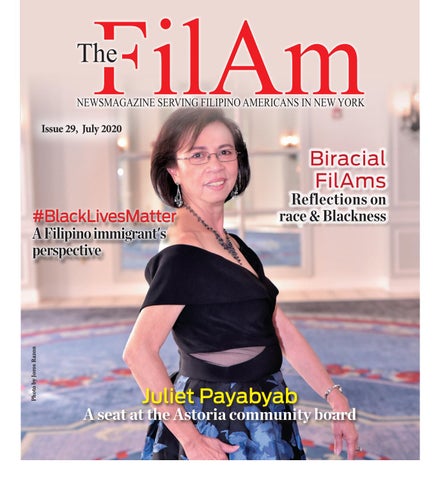
Issue 29, July 2020
Biracial FilAms
Photo by Joros Razon
#BlackLivesMatter A Filipino immigrant's perspective
Reflections on race & Blackness
Juliet Payabyab
A seat at the Astoria community board
Letter from the Editor
The Maria Ressa case and the role of the press we all need to understand
A
deafening outcry of “defend press freedom” greeted the guilty verdict slapped on Rappler’s Maria Ressa and co-accused Reynaldo Santos Jr. for supposedly violating the cyber crime law in the Philippines. The uproar came from many sectors that it became like a call to arms sounded by politicians, the Left, showbiz personalities, the Church, ordinary folks and almost everyone who believes that Rappler was wronged by the decision of Manila Regional Trial Court Judge Rainelda Estacio-Montesa. All well and good. But from these varied sectors also come some infuriating comments like ‘Why can’t the media write about the good things that government does?’ or ‘Why are corrupt journalists writing about corruption in government?’ The press has one paramount obligation and that is to be society’s watchdog. It is supposed to balance the equation of a powerful government and a powerless citizenry. As an institution, it is supposed to protect the rights of every citizen from abuse by the agents of the state. That the press sometimes gets some facts wrong is not in dispute, but that is not a reason to do away with its vital, critical role in a democracy. An independent press is a guarantor that a country has a democratic society and not one run by a murderous dictator. Government is supposed to act in a manner that is considered above suspicion and moral. Failing that, the media is supposed to shine a light and report on how the government fell short. That is why the press is traditionally known as the Fourth Estate. As the Executive, the Legislature, and the Judiciary
citing reasoning not supported by existing laws. The Duterte government may deny the obvious fact that its desire for authoritarian power was served by the judge’s seriously flawed decision. The decision delivers a blow to a free press and provides further proof of the erosion of the rule of law and respect for institutions in the country.
||Corruption in media
Publisher Maria Ressa was found guilty of cyber libel in a complaint filed by businessman Wilfredo Keng. The article linking him to alleged human trafficking and drug smuggling was based on intelligence documents. Rappler photo check-and-balance each other, there is the Press that checks on all of them. There is a reason a free press is protected in the constitution – here in the U.S. or in the Philippines. It exists, in the words of a famous decision by the U.S. Supreme Court, to serve the governed, not the governors. On pure policy reasons alone, the case should have been dismissed. Judge Montesa went through all sorts of legal contortions to justify her conviction of publisher Ressa and writer-researcher Santos,
Contributing Writers Tricia J. Capistrano Ludy AstraquilloOngkeko Joel David Mariel Padilla Wendell Gaa Maricar CP Lindy Rosales Hampton Danielle Vania Angelito Cabigao Bonus
Founding Editor Cristina DC Pastor Address P.O. Box 8071 New York, NY 10116
There is no question that there are members of the press who by their shameless actions deserve to be in a prison jumpsuit. We’re referring, for example, to the individuals who ran away with millions of pesos from the Department of Tourism and are arrogantly proud of it. It is hard to defend members of the journalism community who are shysters and money-grabbing con artists, who give meaning to the acronym ACDC as: “Attack and Collect, Defend and Collect.” But society often has a good idea who the corrupt journos are, in the same way that voters are keenly aware who the corrupt politicians are. The retribution comes in the form of shattered credibility and a reputation beyond repair. Unlike politicians who keep getting elected, readers know not to trust reporting by these journalists. Their fellow journalists are aware who are the writers and columnists who have been bought and have grown unnaturally wealthy. Why some publishers continue to keep them as columnists is something that reeks of the mendacity of those owners. The quality of our press can only be raised by upholding professionals like Ressa and Rappler who believe fervently in living out and exercising their freedom.
Contact Thefilamny@gmail.com
The FilAm is a publication of A&V Editorial THE FILAM |
2
Biracial FilAms reflect on race and Blackness
A
yana Owens experienced racism at an early age when her family entered a Cracker Barrel restaurant in Pennsylvania and overheard customers asking not be seated near them. She remembered another bitter memory when kids in her Baltimore neighborhood taunted her to “go home to China” because they didn’t want to play with her. This, even though her African American father, Floyd Owens, was very much a part of the community, then working as a Transportation Planner with the Maryland Department of Environment. In the wake of the George Floyd killing by a police officer in Minneapolis, 28-year-old Ayana, a graphic designer who now lives in Brooklyn, and some biracial Filipinos are being forced to examine what their identity means to them. They realize that the issue of race has become more complex over the years. That race is no longer just a matter of denying individuals certain rights because of the color of their skin, but that systemic racism has led to individuals being killed by those who wield social and political power. “I was in elementary school when I learned for the first time that my dad was Black because my teacher asked me about it,” recalled Ayana when interviewed by The FilAm. “I was so confused that I went home and asked my parents, and my mind was blown.” Growing up, race was never discussed in the Owens household. She said, “All my life I identified my father as my dad, his side of the family as my cousins, uncles and aunties; my mother as my mom, her side of the family as my Kuyas, Ates, Titos, and Titas.” (Her mother, Bella Santos Owens, sits on the board of a Baltimore non-profit advocating for victims of domestic violence, sexual assault and sex trafficking.) As children, the only way Ayana and her siblings dealt with racial slurs was to ignore them. As they grew into adult-
By Cristina DC Pastor
Ayana Owens
F. Antoine Savage
hood, the family began to open up more and share their thoughts, especially since new partners who are neither Filipino nor Black have been welcomed into the family. Ayana’s partner, for instance, is white. “My partner and I have been participating in some of the peaceful protests in our neighborhood from a bit of a distance since there is still a global pandemic,” she said. While she has not seen the “horrible” video of policeman Derek Chauvin kneeling on Floyd’s neck until he passed on, she has expressed her opinion that the assailants “need to be brought to justice.” She said the message of Black Lives Matter resonates within her, and that violence against Black people need to end. “I still struggle with my sense of identity, and I have for a long time. I know that I am a Filipino and that I am Black but I’ve always felt disproportionate with how those two balance within me. I don’t feel that I have had the real opportunity to fully experience my Black or Filipino heritage and deeply wish I had sooner in my life,” she lamented. THE FILAM |
||Antoine Savage: ‘The whitest black guy’
Fredrik Antoine Savage – the son of investment banker Frank Savage and international artist Lolita Valderrama Savage – views race from the prism of a privileged upbringing. Although he has circulated mainly within “social settings that were devoid of frequent racial bias,” the George Floyd killing affected him deeply. “I have been overcome by a broad spectrum of emotions (by the Floyd killing),” he said in an interview with The FilAm. He has not joined protests fearful they would turn violent “due to lack of universal organization and strategic leadership.” Instead, he opened a GoFundMe campaign to benefit the National Association for the Advancement of Colored People Foundation during, he said, “this tumultuous, and challenging time for America.” As an Asian American and an African American, Antoine felt he has been “dually impacted” by the racial injustice stemming from COVID against the Asian community and the perpetual violence committed against Black people. 3
He has experienced all levels of bias as someone who lives in the South and works in Finance, he said. “Luckily, I am an idealist that tries to take the high road and transcend any racial bias that I may be subject to. I am aware that not all racially diverse people in this country have that luxury, however,” he said. He remembers being raised by his parents in an affluent environment where everyone is regarded equally regardless of race, religion or gender and being Black did not trigger the need for racial profiling. In Connecticut, “I was raised primarily around white kids in white neighborhoods going to white schools and taking vacations to places with a lot of white people,” he said. “My father and mother were able to put me in a setting where I did not think about skin color, because mine did not differentiate me from getting access to all the finer things that affluent white kids had.” He continued: “I’ve been referred to as “the whitest black guy [I] know” simply because I dress in khakis and polos. I’ve had people go so far as to say, ‘You’re not really black, right?’ because I don’t act the way they perceive a black person to.” “Coming from two self-made parents that suffered from poverty as kids, they only wanted the best for their kids and did not want them to ever experience any of the hardships they did. As a result, race did not come up as frequently as it would in other households.” While “honored to be a walking poster child” representing the positive traits Black people can possess, he said he tries to “stay as resolute as possible and come up with constructive initiatives and solutions to drive the equality initiative forward.” He believes Black Lives Matter is important and its message of ‘no to anti-Blackness’ should resonate at all times and not only when the country is in “extreme turmoil.”
TheFilAm.net named among 50 immigrant media innovators From news on the coronavirus pandemic to coverage of mass protests over recent police killings of Black people, immigrant news outlets have proven themselves vital sources of information for communities underserved by mainstream media.
E
ven as they struggle with financial pressures to survive, resourceful outlets are thriving on livestreaming and social media with followings reaching into the millions. They are also developing new business models to serve their audiences, whether “indigenous farmworkers, Chinese engineers, or Somali Uber drivers,” according to a new report by the Center for Community Media at the Newmark Graduate School of Journalism at CUNY. CCM has been studying immigrant news outlets for the past year, seeking to find those that are models of growth and innovation. Based on interviews with more than 150 people in 30 states, CCM not only identified media organizations in the vanguard, but discovered that the best of them are evolving in four key ways: by wielding social media for community engagement, leveraging a small staff to reach big audiences, globalizing both production and audiences, and diversifying business models and revenue streams. The CCM researchers also winnowed down a list of more than 100 outlets operating on a variety of platforms to a database of 50 standouts in 23 states reporting in more than 30 languages. From the 50, CCM selected 17 for in-depth study and profiles. “The pandemic, and the protests over the killing of
George Floyd, Breonna Taylor, and dozens of others have put innovative immigrant-serving digital outlets into overdrive, as reporters squelch rumors via WeChat and Facebook Live and beam interviews with local officials into living rooms via Roku and JadooTV boxes,” according to the report, which emphasizes this style of interactive, community-based reporting is not only for the current crises. “When the mainstream press has moved on to the next hot topic, immigrant-serving outlets will cover many of the battles to come — be they justice for Black immigrants, justice for indigenous laborers, or justice for Sikh long-haul drivers,” the report continues. “A virus and protests have highlighted the value of informing and supporting immigrants, but the fact is that these outlets have long played a critical public service role in the dayto-day life of newcomers by helping them to navigate a difficult and often inhospitable environment.” This report was researched and written by Daniela Gerson, senior fellow at the Center for Community Media and assistant professor of journalism at California State University, Northridge, with research and reporting assistance from Chi Zhang, Taehyun Kim, Darleen Principe, Jennifer Cheng, Omar Shahriar, Yana Kunichoff, Son Ly, and Maria Angela Vega. The report was edited by Karen Pennar.
The Center for Community Media identified 50 growing and innovative immigrant-serving outlets based upon nominations from journalists, immigrant advocates, and media experts across the country, as well as independent research. Two publications -- The FilAm and Asian Journal -- represented the Filipino American community. THE FILAM |
4
#BlackLivesMatter: A Filipino immigrant’s perspective By Paulo K Tiról
Against the backdrop of the #BlackLivesMatter upheavals over the past days, I’ve thought a lot about my relationship with anti-Black oppression — specifically, as a Filipino immigrant who came to the United States as an adult.
I
spent the first 34 years of my life in Manila, where American history is not taught in schools and the population is homogenous. I knew, conceptually, of anti-Black oppression in the U.S., but had no idea of its extent. When I watched “American History X” in 1998, I thought the story of neo-Nazis in America was exaggerated for dramatic effect. When I watched “Hairspray” in 2007, I was shocked to learn that segregation and integration had ever been a thing. It was only after moving to the U.S. in 2012 that I learned why the Civil War happened and what the civil rights movement was. That there were such words as “confederate” and “supremacist.” And that anti-Black oppression was still very much alive — from Trayvon Martin’s murder in 2012, to the rhetoric leading up to the 2016 election, to the myriad killings of Black persons over the years, culminating with Ahmaud Arbery, Breonna Taylor, and George Floyd. It’s been an ugly eight-year crash course that I can still barely wrap my head around. Yet I rarely spoke out, if at all, and built up an How some Filipino immigrants justify their silence: ‘I’m not an arsenal of reasons to justify my silence. “I haven’t American citizen, my voice doesn’t matter in this country.’ lived through the system long enough to talk about it.” “I’m not an American citizen, my voice doesn’t whose business is it? and which minority suffers matter in this country.” “I’ve found a happy equilibthe most? and which country’s problems should I rium in my life as an immigrant, I don’t want to risk care about more? Rather, my sole consideration has losing that.” “Filipinos living in the United States have become: What kind of America — what kind of world, problems of their own — including racism.” “If I say even — do I want to be a part of? One that values anything that pisses off the administration, I could get what’s right or is complicit with what’s wrong? One deported.” “Americans made this mess, they should that is compassionate or self-interested? One that clean it up.” “The Philippines has its own political amplifies unheard voices or turns a deaf ear to them? issues, I should be talking about those…” One that lifts up the oppressed or suffocates them as But I’ve decided enough is enough. With George they are pinned to the ground? Floyd’s last breaths captured on video and thousands Now the other question is: even if an immigrant sacrificing their health to protest in a pandemic, there cared, what could an immigrant do? has come the realization that silence only contributes Showing solidarity with the Black community to a broken system. The question of should I get doesn’t necessarily mean marching in the streets or involved? has moved far beyond considerations like being loud on social media. You can donate to causes, THE FILAM |
5
and truly, every amount helps. You educate yourself on the history of anti-Black oppression, and understand the challenges, limited opportunities, and hurt that the Black community has endured for centuries. You can reach out to Black friends and express your support. You can call out misinformation and biases in your families and communities, educate young and impressionable people, and engage with others and help them realize that this is their fight too. And you can examine, own up to, and resolve to correct your own contributions to oppression — which, frankly, has been the toughest step for me to take. There are the obvious behaviors. Tensing up when Black persons are nearby. Believing that Black persons brought their hardships upon themselves with their laziness and poor attitudes. Concluding from one or two unpleasant interactions with a Black person that all Black persons must be just as unpleasant. Then there are also the quiet, insidious behaviors. Snickering at people (including fellow Filipinos) who mispronounce English words or struggle with English grammar. Making jokes out of people’s complexions. Loving it when we’re told, “You’re an immigrant? But your English is so good!” Believing we’re superior to other races because we’re the hardworking, overachieving, non-confrontational Asian that America loves. Wishing people would lighten up and not make everything into a socio-political issue. Believe it or not, and like it or not, all these behaviors of ours reinforce the widespread belief that white Western persons are superior to all others — including us, including other races, and most especially Black persons. I acknowledge I have been guilty of each of these behaviors, to some extent, at one time or another. I am not proud of it, but I own up to it, and aim to do better. I hope all of us do the same. Because, if for nothing else, a fight against the oppression of Black persons is a step towards eliminating oppression against all minorities — us Filipino immigrants included. Paulo K Tiról is a composer, lyricist and arranger of musical theatre and liturgical music. His musical about the Filipino immigrant experience, “On This Side of the World,” was staged in February at the Greenwich House Theater in the West Village. He lives with his husband Jeremy in Jersey City. More at www.paulophonic.com. This essay was originally posted on the author’s Facebook page on June 2, 2020. It has since been updated for publication in The FilAm.
FilAm businesses reopen amid uncertainty
G
By Cristina DC Pastor
lenda Villajuan welcomed children back to her CitiTots day care in Brooklyn on June 8 as New York City began Phase 1 of its planned return to normalcy. In New Jersey, Amable Yalong reopened his men’s wear shop in downtown Englewood assuring customers of their safety and protection. Glenda and Amable are two Filipino American business owners whose companies have been hammered financially by the deadly wave of the Coronavirus which has swept the country. They are also among the hard-headed optimists who couldn’t wait to serve their customers again, and hopefully attract new business. Said Amable, who through the last three months has managed to remain hopeful and retained his good humor. “You’re going to have to blind me and chop my arms and legs off for me to quit.” “We have been ready to reopen before we even closed!” cried Glenda, who founded CitiTots Early Childhood Center, Inc. in 2012 and serves as its director. The center has two locations in Brooklyn: One on Marcy Avenue which served 18 students, the other on Lafayette Avenue which had 16 children. The Lafayette school opened weeks earlier. As explained by Glenda, it is a Group Family Day Care considered an “essential” business and was not mandated to close. The Marcy location, which is a center-based program, is covered by a different regulatory agency. In preparation for the reopening, Glenda — who holds a Master of Science degree in Early Childhood Education — absorbed as much information as she could about the Coronavirus and what steps to take to keep children safe from any infection. “I attended webinars, talked to everyone I can learn from, scoured the CDC (Centers for Disease Control and Prevention) and Department of Health Day Care website, and stayed in touched with my day care licensors and public health consultants,” she told The FilAm.
“I watched the daily briefings from the Governor, the Mayor, and any briefings or talk shows where Dr. (Anthony) Fauci and Dr. (Deborah) Birx were on. I was looking for some words of hope, reassurance, and solace in this turbulent time.” Prior to the pandemic, there were 15 staff members supervising about 35 students in both locations. The schools are now down to eight staffers. “The pandemic has put us in a very vulnerable position financially,” she said. She did apply for a loan to help tide over the business in the succeeding months. At the same time, she appealed to parents to continue paying their tuition, and offered a credit-back once the schools are up and running again. Some clients came through for which Glenda was grateful. A Chase Bank loan was approved. Another application ran into some bureaucratic hassles but was eventually processed by a second bank. Even then, she said, the amount granted was “barely enough to keep the business afloat for the whole eight weeks.” Now that the city is digging out of the chaos from the disease, returning students will see some changes when they return to CitiTots: Temperature will be taken at the door. Parents will have to drop off their kids outside the building. Staff must have their temperature taken, wear masks, and change from their travel clothes to work clothing. Furniture was configured to encourage social distancing and select toys will be made available to the kids; those that are difficult to disinfect will be put away.
||Amable Yalong’s Y2 Collection
The Y2 Collection Boutique was in the midst of a long-planned expansion when COVID-19 exploded in early March and swiftly became a public health emergency. It descended with lethal effect on New Jersey on March 2. Around that time, Amable was preparing to roll out a women’s wear line as well as a Barong collection in addition to his luxury men’s wear brand. The Y2 Collection is noted for THE FILAM |
Amable Yalong owns the upscale tailoring boutique Y2 Collection in Englewood, N.J.
Glenda Villajuan with her students at CitiTots Early Childhood Center in Brooklyn. its custom-made suits available in striking colors. Unfortunately, the storefront on Palisade Ave. in downtown Englewood was forced into closure by the pandemic. “It’s been depressing for me personally to see it all just sink in a blink of an eye,” he told The FilAm. “March 2020 was supposed to be the launch of my women’s wear and my second line. No date as of yet when I can launch.” Amable did not receive any financial aid from any government-backed stimulus program although he put in a couple of applications for a small business loan. “I was told the funds ran out.” He did not think he could stay in business because the “budget kept depleting and I really don’t have any other sources to get funds to keep the boutique open.” He was seriously looking at the option of moving his business online. On June 15, Y2 Collection opened its doors anew to long-time clients and new 6
ones. The loan application had finally gone through although the funds were miniscule. Amable vowed “to fight to see if I can make it work. Government help is nothing for a small business like mine. I’ll have to get my own version of help.” He is not ready to let go of the Y2 Collection just yet. Before COVID, business was “great and it was growing,” he said of his three-year-old enterprise. Rent at $7K a month may seem substantial but professionals and celebrity clients from the entertainment and sports world kept his store humming well into the night for fittings. Bumper sales came from weddings. He is excited to reopen the boutique “with mask and gloves,” but at the same time apprehensive about the readiness of consumers especially with millions on the unemployment line. “It’s been tough but I’m going to keep fighting,” he said.
There will be summer movies Yes, there will be a movie season this summer (drive-in theaters are even opening back up), but some of the hits will be on streaming services instead of — or also in — movie theaters. Here's the best of what's coming up. ||Hamilton (Disney+, July 3)
||The Outpost (Scheduled for theatrical release July 3) Rod Lurie, the only A-list director who attended West Point, adapts Jake Tapper's best seller The Outpost: An Untold Story of American Valor, about the heroes of Afghanistan's bloodiest battle (played by Clint Eastwood's son Scott, Mel Gibson's son Milo, Orlando Bloom and Specialist Ty Carter, an actual veteran of the battle).
Hamilton Can't afford an $850 ticket to the insanely popular hip-hop musical about one of our famed Founding Fathers? Celebrate the nation's birthday by enjoying Lin-Manuel Miranda and the original Broadway cast in a filmed stage production with Daveed Diggs as Lafayette and Jefferson.
||Unhinged (Scheduled for theatrical release July 10)
||Tenet (Scheduled for theatrical release Aug. 12)
The big kahuna of the summer is Christopher Nolan's follow-up to Dunkirk, a no-doubt headtrippy thriller starring John David Washington, Robert Pattinson, Michael Caine, Kenneth Branagh and Elizabeth Debicki.
||The One and Only Ivan (Scheduled for theatrical release Aug. 14) A live action/CG/animated fantasy based on the popular children's book of the same name is about a gorilla, a dog, an adult and a baby elephant living in a mall. The amazing cast includes Danny DeVito, Helen Mirren, Bryan Cranston, Angelina Jolie and Sam Rockwell.
||The Secret Garden (Scheduled for theatrical release Aug. 14) Colin Firth and Julie Walters star in the adaptation of the beloved 1911 novel about an orphan girl who sleuths out family secrets. But wasn't Firth also in the previous, 1987 Hallmark Hall of Fame version of the story? Yes!
||The Truth (Scheduled for theatrical release July 3)
||Bill & Ted Face the Music (Scheduled for theatrical release Aug. 21) Mulan The first major theatrical release of the summer is a psychological thriller about the world's worst case of road rage, with Russell Crowe as the unwise driver driven to extremes by a fellow motorist.
Bill & Ted Face the Music
||Mulan (Scheduled for theatrical release July 24) The Truth French screen goddess Catherine Deneuve, 76, has a big comeback role as a movie star whose memoir upsets her daughter (Juliette Binoche, 56) and son-in-law (Ethan Hawke), who return from New York to Paris for a feud-filled reunion. All three stars and director Hirokazu Kore-eda have Oscar honors, and art-film fans are eager to see this.
In Disney's latest live-action remake of an animated hit, Liu Yifei plays the plucky dame who impersonates a man to join the army.
||Radioactive (Netflix, July 24)
Rosamund Pike (Gone Girl) plays the double-Nobel-prize-winning scientist Marie Curie, who was poisoned by her world-changing X-ray discoveries. THE FILAM |
7
Bill & Ted Face the Music Keanu Reeves and Alex Winter return in the third episode of their time-tripping fantasy comedy. The music they face this time is aging, but with help from Holland Taylor in what used to be George Carlin's mentor role, they'll write a song to save the universe. -- AARP
Dealing with dating and strict parents By Christian Catiis
One wonders. How do Filipino American millennials date? With the integration of Filipino tradition and American culture, are there parallels between our parents’ idea of romance and ours? I went to three Filipinas to find out. To ensure their privacy we are using only their first names. What I noted was an apparent double standard. While the men were high-fived for their busy dating lives, the women were looked down on and sometimes shamed for being romantically or sexually active. I asked the following questions: What do you think are your parents’ ideas or perception of dating? Calli: When my parents began dating, it was mostly through letters and over the phone because it was such a long-distance relationship considering they lived in separate countries. So, when it came to dating, I want to say it was geared more towards marriage since they never dated anyone else. From my mom’s experience in school, girls would drop out of classes just to be with their boyfriends, so she was always skeptical about me dating. Brianna: My dad never really had an opinion, while my mom never saw dating in America like actual dating, but more like close friendship. She was fine for me getting to know people, but she always made me put school first. There was this unspoken rule that I could date when I was older. Diana: My dad was more lenient since he was raised here in the U.S., but my mom definitely was strict and more conservative. How was it when you first started dating? Could you describe your first boyfriend and your parents’ reaction? Calli: I was 18, we met in college, and he was Filipino as well. When we got together, I initially didn’t tell them, but
'My parents are pushing Catholicism on my boyfriend.' I wanted to. However, I waited until the semester was over so I could prove to them that I could do well in school and still have a boyfriend. I told my dad first because he is more lenient and I wanted to keep that trusting relationship with him. All he told me was to not make it too serious nor to let him distract me from my studies. But when I told my mother, she went on the complete defensive and ultimately said, “If you decide to date, we won’t let you live on campus.” In her eyes, the only way I could make her happy again was if I stopped seeing him. Brianna: I got together with my first boyfriend right before senior year in high school. He was Egyptian and Muslim and we were in an interfaith relationship just like my parents. My father is Muslim while my mother is Catholic. As the relationship progressed, she raised the issue regarding that if I
were to have children, we would argue about how to raise our children when it came to religion, values, etc. Diana: My first boyfriend was when I was 14, and they were not accepting at all for many reasons. They thought I was too young, even though my older sister had a boyfriend when she was 14 too. They also didn’t like how he was mixed, as they would have preferred me to be with someone fully Filipino. When did they eventually come around and accept that you were dating? Calli: Even though I am now currently beginning my third year of college, they are still not okay with me and my current boyfriend. Ever since I told my parents, they have not acknowledged him nor even talked to me about our relationship. Brianna: For the first couple of months, my mom gave him the cold shoulder and did not want to do any-
THE FILAM |
8
thing with him, but they now have a great relationship with each other after two years. My boyfriend has had my dad’s blessing a long time ago. Diana: They weren’t initially accepting of my current boyfriend because of his career choice. I feel like most Filipinos gear towards becoming doctors or nurses or something within the medical field, but my boyfriend is interested in a career in the arts. They finally accepted him when my family met his, and they saw their family values were similar to ours. Have you ever had to hide your boyfriend? Calli: I am actually still hiding being with him, which sucks, seeing my friends with their significant others on Facebook, and their parents being so supportive of them. Brianna: I hid my current boyfriend for the first five months, a little over year after I ended it with my ex. In her mind, dating again after a year was still too soon, so I didn’t want to tell her just yet. Diana: So my first boyfriend and I went out for two and a half years, and we hid it for the first year. I feel like Filipinos have a very strict and narrow expectation of what they want your significant other to be and you’re just scared of letting them down. When it comes to marriage and kids, what do your parents expect from you? Calli: My parents just want me to be with someone who is my equal, whether it comes to responsibilities with the kids or financial stability. They want my marriage to be a partnership, and I wholeheartedly agree. Brianna: I don’t go for the big gestures when going out; I appreciate the little things. I also really appreciate how he asks my mom first to take me out. Respect and tradition are such a big part of the Filipino culture. Diana: Considering my current boyfriend is neither Catholic nor Filipino, I don’t know how they expect me to raise my children, if I were to even have any. I’m not really religious, but ever since I’ve been with him, I can feel them heavily pushing Catholicism on to me and my boyfriend.
Congratulations to Juliet A. Payabyab on her recent appointment as a member of Community Board #1 in Queens! We are proud of you as one of our leaders in the FilAm community and our very own president of PACEC and United Mindoro International, Inc. More power to you, Juliet! From the officers and members of PACEC and United Mindoro International, Inc.
COVER STORY
Juliet Payabyab is appointed to Astoria community board By Cristina DC Pastor
On May 31, community leader and retired banker Juliet Payabyab became a member of the community board of Astoria in Queens. She joined 49 other individuals who will be advising elected officials and agencies about matters ranging from land use planning to scheduling of garbage collection. She was appointed to the position by acting Queens Borough President Sharon Lee.
‘I waited three years for this.’
“N
o fast lane here,” said Juliet, a resident of Asto- Attending a meeting of the Budget Participatory Committee. ria for 44 years. Coming to the U.S., Juliet and her sister decided to Over the last three years since stay in New York although they have a brother who expressing her desire to join the community board, lived in California with his family. Two other siblings she has been doing volunteer work, attending local meetings, listening to deliberations, and speaking out passed on at an early age. Their parents – her father is from Batangas and her mother from Mindoro — as a member of the public. She could not vote. As a CB would join their daughters in Astoria. Both are now member, her voice now carries a certain amount of deceased and buried in St. Michael’s Cemetery. power. Home has always been Astoria where foreign dishes “Service on a Queens community board requires like kebabs and souvlakis became a staple, and comsubstantial time and energy,” said Lee in welcoming muting to Manhattan by bus or train was efficient. the new members. “I have every confidence and Over time, she came to know her district intimately trust in these appointees’ commitment and abilities through issues over delivery of services, health care to serve and strengthen the future of the Borough.” coverage, and affordable housing for seniors, seeing Queens has 14 community boards with members also how socio-economic gap among residents has serving a two-year term. widened. According to Juliet, her appointment to the board A Banking and Finance graduate from the Uniwas recognition for her three years of steady service versity of the East, Juliet’s first job in NYC was at in her district which covers Astoria, parts of Long Manufacturers Hanover Trust (now Chase Bank) on Island City, and Woodside. In an essay, she argued Madison Avenue. She was Assistant Manager at the strongly for Filipino American representation in her International Banking Division when she transferred district especially in a time of rising discrimination to PaineWebber Inc. (now UBS bank) to join the Treaagainst Asians. sury Department. She was later recruited by Merrill She has comprehensive knowledge of her homeLynch (now owned by Bank of America) where she town where she has lived since coming to NYC in 1976. “When I moved here 44 years ago, I found stayed for 15 years until her retirement. Through the the neighborhood diverse, friendly and everything years, she has remained connected with her commuseemed so easy to find, and so close to transportations nity through various organizations. going to Manhattan or around Queens. It is a quiet In her retirement, she went back to school as she neighborhood,” she said in an email interview with wanted to teach English as a Second Language to The FilAm. adult immigrants. THE FILAM |
10
Her parents, Virginia and Angeles Anonuevo, Sr., shown here with former first lady Imelda Marcos, celebrated their 50th wedding anniversary in NYC in early 1990s. There are no known issues that trouble FilAms in Astoria, she said. But such may be a sweeping statement because some ‘kababayan’ are “of the shy type” and do not attend community meetings. “Majority of Filipinos are focused on religious prayer groups, prayer meetings, the needs of their families, and work.” With her on the community board, she would like to reach out in the hope “they might express themselves to a fellow kababayan like me.” Juliet has scaled down her involvement with the community limiting herself to organizations dear to her – the Philippine American Communities of the East Coast (PACEC) and United Mindoro International, a regional club formed in honor of
her province. Two years ago, she led a community outcry against the organization that mounts the annual Philippine Independence Day Parade on Madison Avenue, accusing it of funds misuse. It was a popular campaign but support fizzled out. She devoted herself to the concerns of her neighborhood especially its elderly residents. She initiated a fitness program called “Walk, run at your own pace,” a summer activity in Astoria Park. Astoria resident Consul Arman Talbo of the Philippine Consulate is a regular.
||Two more hats
Her appointment to the community board is just the beginning. Encouraged by Councilman Costa Constantinides of the 22nd District and other local officials to take on more responsibilities, Juliet became a member of Astoria’s Budget Participatory Committee as well as the Advisory With sister Ching Balingao and brother Angeles Anonuevo, Jr. Council of State Assemblyman Brian Barnwell. Being one of Barnwell’s advisers excites her. “I school zones, and dangers for pedestrians trying to share during meetings my observations on ongoing beat traffic lights,” she said. vandalism in some areas without sufficient lightShe said her way of educating herself more about ing, overflowing garbage cans, speeding cars along Astoria is by listening to fellow members share
observations, concerns and solutions on how to handle irritants in their own areas. “We get to meet, too, officers from our precincts and other business owners who will be sharing their problems.” The FilAm community hailed Juliet’s new title. “Congratulations to deeply rooted, time-tested, strongly motivated, genuinely concerned, meticulously hands-on and honest-to-goodness, down-to-earth community leader Juliet Payabyab,” writes NaFFAA State Treasurer Jan Andrada on Facebook. Alex Esteban, VP for Internal Affairs of Handang Tumulong, touts Juliet’s qualities. “Tita Juliet is a great coach, strategist, visionary, change agent, decision maker and team player. Most importantly, she gets the work done.” On June 16, Juliet attended her first meeting as a community board member. “I waited three years for this appointment. I feel honored and fortunate to be given the chance to be part of the decision making in my community.”
Alleged sex abuse of Filipina teen leads to arrest of N.Y. man
A
Garden City, New York, man was charged on June 19, following an investigation by ICE's Homeland Security Investigations (HSI) New York. The indictment filed with the U.S. Attorney's Office for the Eastern District of New York charges Thomas Blaha, 64, with traveling to the Philippines with intent to engage in illicit sexual conduct, sexual exploitation of a child, distribution of child pornography and possession of child pornography. "It's alleged Blaha made trips to the Philippines to sexually abuse a 13-year old female who was being exploited for money," said Peter C. Fitzhugh, special agent in charge of HSI New York. "Crimes involving the sexual exploitation of unwitting children are the most heinous and will not be tolerated, regardless of where the sexual acts occur. HSI is a global investigative agency, and with our resources and partnerships with the United States Attorney's Office, we will stop at nothing to put an end to child victimization worldwide." "The defendant allegedly traveled halfway across the globe to sexually exploit a minor that he had enticed through Facebook and create child pornography," stated United States Attorney, Richard P. Donoghue. "The Department of Justice is committed to protecting children from online predators by identifying such offenders and prosecuting them to the full extent of the law." According to court filings, in September and October 2019, Blaha traveled from New York to
Homeland Security identified the suspect as Thomas Blaha of Long Island the Philippines to engage in sexual activity with a 13-year-old female in exchange for money. Blaha also enticed the victim to produce sexually explicit images of herself and send them to him in exchange for money. As further set forth in court filings, in December 2019, search warrants were obtained in the Eastern District of New York for Blaha's Facebook account as well as his residence in Garden City, New York and electronic devices. The searches revealed hundreds of images of THE FILAM |
11
children engaged in sexually explicit conduct. If convicted, Blaha faces a mandatory minimum sentence of 15 years imprisonment and up to 170 years imprisonment. HSI says suspected child sexual exploitation or missing children may be reported to the 24-hour hotline, 1-800-THE-LOST. Suspicious activity may be reported through its toll-free Tip Line at 1-866-DHS-2423. – U.S. Immigration and Customs Enforcement
Communities are not just geographic locations
W
hether you live in a metropolis or a tiny crossroads, in the suburbs or on a boat sailing from port to port, responding to the 2020 Census is critical for your community. But a community isn’t always a geographic location, such as a town or a neighborhood. It’s not just where you are but who you are, too. Your “community” may be people who are like you or are doing things in life like you, no matter where they live physically. For example, you can be part of the nationwide community of college students, not just college students at, say, the University of Louisville in Kentucky. Or you can be part of the community of parents who have children in elementary schools nationwide, not just at your child’s school. Census responses are used to produce statistics about how many people live in what areas and who they are by age, sex, race and ethnicity. When those statistics are combined with other data, policymakers are better armed to make decisions about how to allocate billions of dollars in federal funds for critical public services such as hospitals, schools, road repairs and emergency response services for the next 10 years. Scores of programs target specific communities of people like college students and young school children. Here’s how the 2020 Census will help shape the future of specific communities of similar people no matter where they live across the country.
||School children and their parents
Knowing how many children live in a community will provide the foundation for important policy and planning decisions over the next 10 years. For example, should a community build a new library? A new school? Should it expand Head Start for pre-K children?
• Aid for land grant and historically black colleges and universities. • Federal grants for vocational training, funding provided to states in 2015 to improve vocational training in high schools, community colleges and technical centers.
||Low-income individuals and families
Census responses help in planning decisions for health care and other public services That’s why it is so important to count everyone living in your home, including babies born on or before April 1, 2020 (even if they’re still in the hospital but will live you when they get out). Be sure to count children of relatives, friends or other people who live and sleep in your home most of the time. Census results can affect funding for many programs aimed at school-age children.
||Among them: • The National School Lunch Program, a U.S. Department of Agriculture program that funds free or reducedprice lunches for low-income students. • Title 1 grants for local schools, a U.S. Department of Education THE FILAM |
program that helps schools with a high percentage of students from low-income households. • Grants for state special education programs. • The Head Start Program for low-income preschool children. • Teacher training, such as the Department of Education’s Improving Teacher Quality State Grant available to schools across the country.
||College students and their parents Several major programs informed by Census Bureau statistics help college students, including: • Pell Grants. 12
The Supplemental Nutrition Assistance Program, formerly known as food stamps, is the second-largest federal program tied to census statistics. Other low-income programs contingent on census statistics include: • Medical assistance under Title XIX, which is the largest federal program that uses census stats to inform funding. • Child care, job preparation and other temporary assistance programs. • Housing assistance.
||People age 65 and older The number of people age 65 and older in the United States grew rapidly over most of the 20th century, from 3.1 million in 1900 to 35 million in 2000. In 2018, there were 52 million people age 65 and older, according to the Census Bureau’s population estimates. Their share of the population grew, too, from 12.4 percent in 2000 to 16.0 percent in 2018. Programs that use Census Bureau statistics to help older people include home weatherization and grants for housing for low-income people over age 65. – America Counts Staff
Anti-Terror Bill: The disintegration of democracy
A
By Matthew Alonsozana
s Filipino Americans, we should constantly take pride in knowing that we are the heirs of a living tradition of quiet valor and moral courage. Many of the public health heroes who have risked so much in this coronavirus crisis are the embodiment of a spirit that infuses our culture. While we need not look far to see how this spirit continues to animate Filipinos around the world, we also need not strain ourselves to see that the conditions of freedom, liberty, and justice that are both the prerequisites and fruits of valor and courage are under immense threat in the Philippines. Despite the incredible challenges that our country of the United States is undergoing at a moment of political and socio-economic crisis, it is imperative that we are united with those who are continuing to protect and defend these freedoms from repeated assault. Beyond the factionalism, poverty, and inequality that constitute the systemic rot at the heart of Philippine democracy, we have watched with deep worry, if not horror and shame, at the attacking of the press, the smothering of critics, the extrajudicial killings of tens of thousands, the state-led sanctioning of misinformation, the surrendering of leadership, and the steady eroding of sovereignty to yet another foreign power. What we are witnessing is nothing less than the disintegration of democracy in the Philippines as we knew it. The latest blow to Philippine democracy is a direct betrayal of those who gave their lives so that the Philippines may sing its own song. As with so many potential pitfalls, this most recent assault on Philippine liberty is seemingly borne out of good intentions. The Anti-Terror Bill of 2020, which has received the overwhelming support of the Philippine legislature and the current
administration, on its face is a muchneeded bill. Citing the horrors of the months-long occupation of Marawi, the bill’s supporters claim that these new measures will allow them to better prevent mass acts of violence. And indeed, if the bill’s distinct and targeted purpose, with the strongest of possible safeguards accompanying it, was solely to achieve these goals, then there should be no issue. Protecting the lives of Filipinos, ensuring the inviolability of its territory, and combating terrorists are the right and proper functions of the Philippine government. However, in the context of these history-repeating assaults on democracy, both the vagueness of the bill’s expansive provisions and the weakness of its supposed safeguards are causes of grave concern. Some of its new legal provisions such as the detention of individuals for up to 24 days without court intervention, the wide-reaching powers of a new anti-terrorism council to impose individual surveillance, the creation of vague new crimes, and the weakening of penalties for wrongful detention do not take great leaps of imagination to see the overwhelming potential for abuse, further intimidation of political opponents, and the stifling of freedom of speech. Are we to be deaf to those silenced by the Marcos regime under similar pretenses? Are we to drown out the lines from the national anthem, “Ang bituin at araw niya, Kailan pa ma’y di magdidilim”? Are we to be willfully ignorant that Rizal himself was arrested, convicted, and executed by Spanish authorities for sedition, rebellion, and “illicit associations”? What we are seeing now in the Philippines is fundamentally a moral issue. Just as we cannot stay silent when we witness injustices in our own country, so too must we call out and oppose the oppression of a free people. Despite the seeming seductiveness of authoritarian regimes like China, their models are THE FILAM |
Amnesty International calls the bill ‘dangerous’ and open to abuse by the police. Critics include lawyers, students, entertainers, Vice President Leni Robredo and pop idol Taylor Swift. Photo: Rappler
The proposed law is expected to pass the Philippine Congress packed with allies of President Duterte. Photo: Getty Images less concerned with the nurturing and flourishing of an individual’s God-given life than they are with controlling lives in the propagation of power. Even if as Filipino Americans, we are separated by distance and sometimes language and generations, we are still called to help and to lead. We must continue to educate ourselves on the situation and support the free press that chronicles these issues. 13
We can donate to support the legal efforts of advocates seeking to block this law and other measures. We can use our rights as U.S. citizens to push our own representatives to maintain or take a stand against abuses. And we must continue to pray, not only for the strength to persevere, but for the well-being of our brothers and sisters, even if they support the current state of affairs. I write this piece as a new father, and when I look into my son’s eyes, I am filled with the wonder of new life and renewed courage. For when we act and speak out, not only are we continuing to fight for a better world for our children, but we are also showing yet again that the valor and courage that mark our heritage is something that is not only living but also a reason why we should always be proud to call ourselves “Filipinos.” Matthew Alonsozana is the Managing Partner of Percipient Strategies LLC, an international public affairs firm, whose practice focuses on advising corporate and other entities of political risk and communications strategies. The bill was passed on July 3 as The FilAm was going to press. The country now braces for a crackdown on dissenters.
Msgr. Boy Sosing, 67: Good friend, beloved uncle and mentor
N
By Boyet Loverita
ovember 14, 2004, was a sad day for our family. It was the funeral of our beloved mother at St. Michael Parish Church in Laoang, Northern Samar. The funeral mass was officiated by my two clergy cousins, Fr. Poten Dulay and Fr. Jonathan Loverita. It’s a Filipino tradition that after the funeral mass, there will be some pictures taken by the altar. During our picture-taking a priest emerged from the side door, approached us, and gently told us to stop. He said, and I remember distinctly, that photo memories would just add to our sadness. It was my first encounter with Monsignor Romualdo Sosing, at the time the parish priest of our town in Laoang. After eight years we met again at St. Dominic Catholic Church in Oyster Bay, Long Island and became very good friends. Monsignor Sosing – called “Boy or Rom” by close friends and family — passed away May 24 at 6:15 p.m. from coronavirus complications in a hospital in Maryland. Monsignor, whom I called “Monsi Boy,” was 67. During his last few days at the ICU he was surrounded, via Zoom, by his family, relatives, friends and parishioners all over the world, wishing him well and urging him to keep his spirits up. He is survived by his three siblings Marieta Bansig, Sister Lourdes Sosing, and Mayor Felipe Sosing; nieces and nephews. Monsignor was born February 7, 1953 in Samar. His father died when he was 7 years old. Since then, he became an altar boy in their town parish church and became the father of the family. He graduated from the University of Santo Tomas in 1977 with a degree in Theology and pursued a Licentiate Degree in Canon Law in Rome, graduating Summa Cum Laude. Shortly after, he began his priesthood at the Diocese of Catarman in Northern Samar. He came to the U.S. in 2004 admittedly for greener pastures so he could help send his nieces and nephews
to school. He served the Diocese of Rockville Centre since 2004, according to CBCP News. Previously, he served as administrator of St. Luke’s Church, Brentwood, and associate pastor of Notre Dame, New Hyde Park and St. Dominic, Oyster Bay. He became the first Filipino parish priest in Long Island while serving at the Holy Name of Mary Parish in Valley Stream in 2017. He was appointed pastor by Bishop William Murphy. It was during his second term as pastor that he was infected with the Coronavirus.
The Monsignor with (from left) niece Carolyn Sosing-Macuha, family friends Lindy Rosales, and the author.
The first Filipino parish priest in Long Island, Monsignor Romualdo Sosing served the Diocese of Rockville Centre. He passed away from COVID complications on May 24. He became a US citizen in 2013, according to CBCP News. We were talking on the phone in midMarch as the virus was raging in New York City, and he was telling me, “Boyet, I’m sure I will get this virus one day, that’s why I already gave all instructions to my niece in Delaware on what to do when the time came.” I was laughing at him and told him, “I’ll be the first one before you to get THE FILAM |
this virus since my wife is working at Elmhurst Hospital.” And it happened. I was surprised and saddened to receive a text that Monsignor had COVID-like symptoms. His niece Carolyn Sosing-Macuha immediately took him to Delaware where her family lives so she could take care of her beloved uncle. Her husband drove Monsignor Sosing from New York all the way to Delaware. Monsignor stayed 14
in isolation in a room in their residence until he become very ill and was taken to the hospital. “Our relationship was very close, we’re like ‘barkada,’” said Carolyn. “I don’t have anybody in my life like him that’s why I’m hurt so bad by his early departure. He is very dear to me as we celebrated all holidays together and spoke almost every day. He was supposed to stay with us after his retirement but God had a different plan.” His associate pastor Father Cleofas Anonuevo – a COVID-19 survivor — is very grateful to Monsignor Sosing. He said, “I call him my Mayor. He really took good care of me ever since my seminary years and showed his affection and father image to me. I see God in him. He taught me the mission of the priesthood.” “It is with great sadness that 6:15 tonight, Msgr. Sosing, surrounded by his family, had passed and is now at peace,” the Holy Name of Mary Parish said in a Facebook post. Monsignor was cremated last May 28 in Delaware. His ashes will stay at his niece’s residence as he so wished. Circumstances allowing, he would like his remains to be brought to the Holy Name of Mary parish for services and to finally journey to the Philippines where he will be buried with his parents in Pambujan, Northern Samar.
Mabuhay mural unveiled in Queens On June 12th, the Filipino community in Queens unveiled the colorful mural ‘Mabuhay’ (meaning ‘To life’) on the corner of 69th Street and Roosevelt Avenue known as Little Manila. According to the organizers, the ceremony was dedicated to businesses and health care workers risking their lives on the front lines of the COVID-19 pandemic.
“O
Community welcomes New Yorkers to Little Manila with ‘Mabuhay.’
ur gathering will keep reminding the world of the skills, dedication, and the self-sacrifice demanded of health care workers so humanity may be healed—specifically during the pandemic,” said COVID survivor and one of the speakers Sockie Laya Smith echoing a statement from Kanlungan community health organization. “This is to remember them as human beings—not simply as a labor percentage, a deceased statistic, or an immigration number.” In a message, Rep. Alexandria Ocasio-Cortez said, “N.Y.’s 14th district is the hardest hit district in the country, and that includes our Filipino community. My sincerest thanks to these local small businesses who stepped up to support our frontline workers. This mural is a deserving credit to their sacrifice.” Hannah Cera, the daughter of Amazing Grace restaurant workers, spoke on what the mural means to her. “This mural gave me the opportunity to reflect upon myself,” she said. “I started to look at the Filipinos around me since this whole block is full of Filipino businesses who I see walking to work, who are customers, working, and even in my own family. I realized that they are here hustling and providing a better life for themselves and everyone they love. The people I work with every day are Filipinos and I adore them. They brighten up my day every time when
they would joke around and sing. They seem to know millions of songs. That’s when I said to myself proudly, ‘I am a Filipina woman. Born in the Philippines and raised in Woodside, Queens. I am the daughter of two hard working parents who will do everything for my brother and I.’” Amazing Grace is the new restaurant where the popular Krystal’s Bake Shop used to be. It was one of three Filipino restaurants that remained open in Little Manila at the height of the Coronavirus crisis when most eateries were closed, said the organizers led by Little Manila Queens Bayanihan Arts. They said the mural serves as a welcome sign to the busy intersection, and represents the values of the Filipino community. Painted by Princes ‘Diane’ De Leon, Ezra Undag, Hannah Cera, Jaclyn Reyes, and Xenia Diente, the mural is “rooted in the history and landscape of the Philippines.” “The typography is based on lettering found on the iconic jeepneys; the illustration style of the plants is based on Malay batik design from Mindanao, Indonesia, and Malaysia; the gold in the linework is an homage to goldsmith artistry of precolonial Philippines,” they said. Council Member of District 26 Jimmy Van Bramer praised the mural stating, “Woodside is more beautiful today than it was yesterday.” He ended by saying, “I’m telling you today as your Council Member, we will rename the street ‘Little Manila’ and make this happen once and for all.” THE FILAM |
15
Healing therapist, activist, and COVID-19 survivor Sockie Laya Smith.
How to talk to your family about racism
Black Americans thethe brunt of racism, racism Black m A eric ansbear bear brunt acism, of rbut but acrismhurts h urtsususall.all . It isisthe the responsibilityy ofofusus allall tootake fight back,not just today, responsibilit ttakeaction actionand and fight back,not just oday t, but butassa partt of of our our ev everyday par erydaypractice.
Here are some actions that you and/or your family can take together todefend Black lives: • Challenge people around you when they make problematic jokes or statements about Black people. Why do they think it's funny? Who is harmed by jokes like theirs? • Hold people around you accountable who embrace Black culture as "cool" but perpetuate anti-Black narratives in their actions and thoughts. • Continue to consciously unlearn racist beliefs. • Investigate ways to raise racially conscious children. It’s never too early to start. • Regularly watch lms and TV shows by Black creators that center Black characters with your family. • Look at the policies and hiring diversity in your own workplace. Are there conversations you can start for improvement? • Be a conscious consumer, support businesses that actively support Black communities. Prioritize Black- and family-owned businesses when you can. • If able, donate to mutual aid funds and/or organizations ghting on the frontlines for Black communities. • Attend a rally or protest. Here are some tips about how to protest safely. • Designate time to make calls to elected ocials and sign petitions asking for more just treatment of Black people, incorporate it into your family’s routine. For more action ideas,
visit Movement for Black Lives (M4BL) visitDefine Dene American. ororvisit
5 fun day trips from New York City
W
hen you live in or near New York City, there’s no shortage of things to do. At times it can seem like there’s really no reason to leave the city, unless you just want to get away from the crowds for a day or two. But while New York packs enough attractions and activities for a lifetime, it’s also close to a lot of other interesting places and things to do. And for busy residents of the city, or even visitors who are hanging around, these getaways can be perfect. Here are five ideas for fun day trips you can take from the city.
||Castle Tour, Upstate N.Y.
It may surprise many to learn that there are a lot of spectacular castles dotted around Upstate New York. Naturally they’re not as old as the castles you might find in England or elsewhere in Europe. Even so, they have their own type of mystique that is undeniably authentic despite seeming somewhat out of place in the country in New York. It’s hard to find a ready-made castle tour, so your best bet is renting a car and mapping out a route on your own. But if you like road trips it can
be an excellent day. Some of the highlights include Boldt Castle in Alexandria Bay (literally sitting in the bay, in fact), Singer Castle in Hammond, and Castle Gould in Sands Point. If you live in the city, you might also consider starting or ending the day with a visit to Belvedere Castle, the beautiful 1869 structure that many residents don’t even realize is tucked away in Central Park! Boldt Castle
||Fire Island, Long Island
Fire Island is a beautiful beach located off the coast of Long Island and having served as a legendary escape for New Yorkers for many years. You’ll want to skip it during peak holiday travel times because it can feel almost as crowded as the city on such occasions. In general, it’s a peaceful and quiet place to visit. There are plenty of specific attractions to enjoy like national parks and forests, seafood restaurants, and lighthouses.
||Beacon, New York
When you think of the United States and fine wineries, your attention probably drifts westward. This is perfectly fair and natural. Napa Valley is famous for some of the country’s best wineries, and some of the best anywhere in the world, and Oregon in particular has come on strong in recent years. These Pacific states are unrivaled in the U.S. for beautiful vineyards and world-class wines. But the idea that the East Coast has nothing to offer for wine lovers is merely a common misconception. The Hudson Valley in New York has a surprising wine culture, and much of it is accessible through the small town of Beacon. Located just an hour-and-a-half’s drive north of Manhattan, Beacon is close to Palaia Winery, a charming spot where local beers and ciders are emphasized nearly as much as the wine. It’s also home to Benmarl Winery, which is actually the oldest such establishment in the country.
Fire Island
||Atlantic City, New Jersey
Casino culture has largely left the United States in favor of venues abroad, as well as online sites. But as popular as these activities have become, an ordinary casino can still be a huge draw, and Atlantic City is one of the few places in the U.S. where you can still enjoy one. Roughly a two and-a-half hour drive from New York City, Atlantic City makes for an ideal day trip. On a nice day it’s pleasant just to walk along the famous boardwalk that runs alongside the main entertainment area in town, and you’ll naturally want to duck into a few casinos as you go. But truthfully you can wander around the town and try out different venues of your choosing.
||Philadelphia, Pennsylvania
Finally, if you’re looking for a different place to spend a day or weekend, it’s worth remembering that New York is very close to one of the other most famous cities on the East Coast. Philadelphia is only a little over a two-hour drive away, and can also be a very quick train ride. It’s perfectly accessible for a day trip. It’s hard to truly experience a great American city in a single day, but Philadelphia happens to be an excellent destination for simple sightseeing. You can view the Liberty Bell in person, tour the Philadelphia Museum of Art, and stroll by Independence Hall just to name a few things. Additionally, as touristy as it sounds, you might want to make time to try an authentic Philly cheesesteak.
Liberty Bell
THE FILAM |
17
COVER STORY
‘I go to school, serve the poor, and bake’
“T
By Lynn Alejandrino-Topel
he winner of the 10 contestants competed to bake one Great American pastry after another under limited Baking Show time and in front of the cameras. Holiday Edition is… “It was a moment of intense personal Brother Andrew!” and spiritual growth,” he said. “The The announcement was made by judges pushed me so hard challenge Emma “Baby Spice” Bunton and after challenge and it was so straining, was met with squeals and cheers. but, like anything, if you want to get A brown-frocked seminarian was good, you have to push yourself even handed his cake stand trophy made when you want to give up.” of glass. Brother Andrew Corriente’s parents and sister came around to give him hugs as his journey on the popular baking competition came to a triumphant end. Brother Andrew discovered the magic he could do in the kitchen when he joined the Capuchin Friars seven years ago. “In my first year as a friar, I was in meditation, and I was struck with the thought to cook something. I went into the kitchen and never stopped since,” he said when interviewed by this writer. Though he didn’t grow up in a religious family (“We went to Church but just because we had to.”), his openness to take the path of religious life came after he struck a friendship with a friar. He joined the Capuchin Friars, a branch of the Franciscan Order, and became known as the seminarian who loved to hang out in the kitchen. Seminarians trusted him to bake cakes for birthdays and other personal milestones. In 2017, he applied to join “The Great American Baking Show Holiday Edition,” a contest for amateur bakers. A religious obligation prevented him from joining in 2018. He was contacted again, and in December 2019, his calendar cleared. The show was an intense full month. An “incredible experience” that taught him that anyone can rise above and face one’s challenges. The Bro. Andrew Corriente in the kitchen…
THE FILAM |
…in the friary Lechon and Guimaras mangoes Growing up, the Corrientes visited the Philippines a few times, enough for Brother Andrew to remember everything good about Filipino food: the Lechon, the mangoes, and his aunt’s Lumpia. In fact, he made two bold claims: “Nothing beats Guimaras mangoes, and the best roasted whole pig comes from the Philippines!” “I adore ensaymada,” he told this writer. The son of immigrants from Iloilo, he said his resourcefulness and work ethic were inspired by his hardworking parents. “They had to make do with whatever they have and they worked really hard to get to where they are now,” he said. Despite the widespread fame that came with winning a top-rated baking show on the ABC network, the 31-year old friar continues to churn out baked goods and bites for the brothers of his order as well as nutritious and hearty meals for the day laborers they feed on Sundays.
18
This, even as his oven has given him occasional inconsistent results in the DC friary’s kitchen. “My ovens break sometimes!” he shared with slight amusement. Away from the limelight, has anything changed for Brother Andrew? “Life is more or less the same. I’m getting more attention than usual, but my daily life still remains the same; I go to school, pray, serve the poor, and bake,” he said. “Baking has taught me that life never goes according to plan, but it doesn’t mean life isn’t any less rich. We just have to make the best of whatever comes out of that oven.” His inspiring story of dedication and perseverance is a tale many Filipinos and immigrant families can relate to. With Faith on his side, his victory was shared by many—one slice of pie at a time. Lynn Alejandrino-Topel is a Maryland-based public school teacher and mother of twin boys. She graduated from Ateneo de Manila University. She writes about local food as well as travel tips for visitors to the Washington, D.C. area. Contact her through the-mama-travels.com, on IG @themamatravels and @themamareads, and on Facebook: The Mama Travels.
At the ‘Great American Baking Show Holiday Edition,’ he was trying to prevent his layer cake from collapsing. YouTube photo
60% of households have responded to the Census The 2020 Census is on track with more than 60 percent of U.S. households responding to the questionnaire— that's nearly 89 million responses. Efforts are underway to get an accurate count of all diverse communities in this nation.
Dillingham: ‘There’s still time to fill out the 2020 Census.’
Four out of every five households that have responded chose to do so online at 2020census.gov, the Census Bureau reported. “Thank you, America, for keeping us on track. But we’re not done yet.
Now, we need your help to meet the final goal of counting all people in the United States,” Census Bureau Director Steven Dillingham stated in a video addressing the nation. Most households began receiving
THE FILAM |
an invitation in the mail to respond to the 2020 Census in March, followed by reminders and a paper questionnaire. In August, census takers will begin to visit households who have not yet responded to the
19
2020 Census. The Census Bureau has resumed some field operations in select geographic areas since early May, while keeping in mind the health and safety of their staff and the public. All returning staff will receive training on social distancing protocols and personal protective equipment. “Responding to the 2020 Census is something you can do while safe at home and practicing social distancing,” Dillingham said. It has never been easier to respond on your own. You can fill out the census online at my2020census.gov, or respond by phone or mail — all without having to meet a census taker. For English language assistance: call 844-330-2020. For Spanish language assistance: call 844-468-2020 – U.S. Census Bureau
Issue 29, July 2020
Dealing with Dating
& strict Filipino parents
FilAm businesses Reopen amid uncertainty
Bro. Andrew Corriente A seminarian in the kitchen