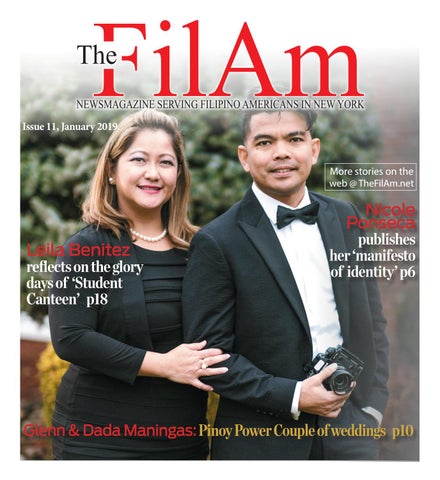
Issue 11, January 2019
More stories on the web @ TheFilAm.net
Leila Benitez reflects on the glory days of ‘Student Canteen’ p18
Nicole Ponseca publishes her ‘manifesto of identity’ p6
Glenn & Dada Maningas: Pinoy Power Couple of weddings p10
Letter from the Publisher
In praise of Gray’s anatomy
W
hen Catriona Gray won Miss Universe for 2018, I took a passing glance at the TV, turned it off, and went to bed. I did not have any strong feeling about her winning, and I guess this wry shrug of a reaction would apply even if she lost. I thought Catriona was gorgeous and probably deserved to win, but when I look at all women in all beauty pageants, they all have the same cookie-cutter look: the walk, the gown, the sexy shoes, the crying, the same cloying smile they need to sustain for three hours. There was one contestant who, I was surprised, spoke seemingly unscripted. When asked by emcee Steve Harvey how she was, the contestant replied, “I’m hungry.” Breath of fresh air! My indifference toward beauty contests has to do with the classicism and sexism it promotes, a robot-like culture where women do things in identical ways and are rewarded for it. Pageants are like sausage factories that produce women with size 26 waists and 5’7” heights and shiny,
Founding Editor Cristina DC Pastor Business & Advertising Manager Rene Pastor
making a livelihood, but becoming a beauty queen is short-cutting the process. At least “Miss Congeniality” knows martial arts and can protect herself. Remember Sandra Bullock’s “If I only had a brain!” Catriona Gray, who is the fourth Miss Universe from the Philippines after Gloria Diaz (1969), Margie Moran (1973) and Pia Wurtzbach (2015) – is being touted as a different kind of pageant winner. She is said to be a combination of beauty and social conscience, helping the scavenging children of Tondo through the nonprofit called Young Focus Foundation. I visited the website of Young Focus Philippines. I learned Beauty contests celebrate the physical attributes of women and not much else. it’s been around 10 years, and has bouncy hair. It’s OK to celebrate been providing education, food, and Countries, like Venezuela, have perfect-looking human forms, spawned cottage industries, such community skills to the youth from but to bombard us, especially as modeling schools and stores that contributions of $30 a month. It young girls, with images of unresell glittery gowns, in support of its appears to be a worthy program. alistic standards of perfection is burgeoning beauty industry. In the Lending her name to YFF has not OK. Philippines, cosmetic dermatology called attention to the good that the That’s what beauty contests do. organization does. Here’s hoping and whitening creams are robust They celebrate physical attributes businesses. Just like the spectator this partnership is for real and not a and not so much a woman’s smarts, sport of boxing for men, beauty PR gimmick to buttress this notion kind heart, sense of independence, pageants have become a parade beauty queens love to proclaim as work ethics, etc. (I know, you can out of poverty for women in some “beauty with a purpose.” only learn so much in 3 hours) countries. There are other ways of Cristina DC Pastor
Contributing Writers
Address P.O. Box 8071 New York, NY 10116 Contact Editorial: 848-219-0069 Advertising: 732-428-6318 Thefilamny@gmail.com
Tricia J. Capistrano
Elton Lugay
Joel David
Ludy AstraquilloOngkeko
Wendell Gaa Maricar CP Hampton
The FilAm is a publication of A&V Editorial THE FILAM |
2
Mariel Padilla Lindy Rosales
Philippine Center on Fifth Avenue dresses up for the holidays
Two large capiz lanterns welcome guests to the Philippine Center. Photos by NYPCG
The ‘Feel Pinas’ window showcases the nativity scene.
Christmas celebration the Filipino way is in full swing in New York as the lobby and glass windows of the Philippine Center along the bustling Fifth Avenue in mid-town Manhattan showcase a colorful collection of traditional parol (Christmas lanterns) and the nativity scene.
T
housands of New Yorkers and tourists pass by the Philippine Center every day and admire the colorful display that depicts the rich Christmas traditions of the Philippines. The “Feel Pinas” display is an undertaking of the Philippine Consulate General, the Department of Tourism-New York Office, and the Philippine Center Management Board. It brings together elements of the Filipino Christmas that make Filipinos feel at home and foreigners want to visit the Philippines. The launch of the “Feel Pinas” on December 6 was highlighted by the debut of the nativity scene display by the two glass windows of the Philippine Center. The nativity scene is made of images and decors from
the Philippines and is complemented by large LED screens showing videos of lanterns and snippets of Filipino Christmas celebrations. As guests enter the Center, they are welcomed by two white capiz lanterns from Sorsogon. The lobby is adorned with bright and colorful lanterns from Pampanga. This year, nine lanterns from the FilAm community, each one symbolizing a Filipino virtue add to the festive air. One of the lanterns is lighted every day starting from the first night of the Simbang Gabi sa Konsulado on December 6, until all the lanterns are lighted on the last evening of the traditional nine-day mass on December 14. Consul General Claro S. Cristobal said that it is heartwarming that the Filipino American community THE FILAM |
The lobby is adorned with lanterns from Pampanga. in New York has preserved Filipino Christmas traditions. “Our sense of community, bolstered by faith, has given us the inspiration to be here, despite the busyness of our holiday schedules, to devote our time and resources in nine days of prayer and praise,” he said. 3
Tourism Attaché Susana Del Mundo said she is hopeful that the “Feel Pinas” project will further promote tourism in the Philippines as thousands see the “beauty of our country and the richness of our culture and traditions.” The display runs until January 6, 2019. — Philippine Consulate General
Sheila Marcelo: First FilAm woman CEO of a publicly traded company FilAm Sheila Lirio Marcelo is one of only 3% women CEOs in publicly traded companies. Five years ago, on January 24, 2014, the company Care.com she founded in 2006 was listed in the New York Stock Exchange with the symbol CRCM.
C
are.com -- headquartered in Waltham, Massachusetts -- is the world’s largest online destination for finding and managing family care, serving more than 27 million people across 20 countries. As Care.com has grown and scaled, Sheila has been honored with numerous accolades, including being named one of the “Top 10 Women Entrepreneurs” by Fortune Magazine. In 2014, she was the youngest recipient of the Harvard Business School Alumni Achievement Award. How did she become such a towering figure in the business world? Her own words below would best reveal the phenomenon that is Sheila Lirio Marcelo. I was born in Manila. My parents, Dario and Amelia Lirio, are from the town of Candelaria, Quezon. My father, or “Papa,” was very nurturing, like a Teddy Bear Dad. And my mom, or “Mama,” was the Tiger Mom – always pushing us to excel and challenge ourselves. They were entrepreneurs. They were always excited about starting new businesses – anything from duck farms, to rice mills, to trucking. We moved to the U.S. when I was 6 years old, and spent part of my childhood in Houston, Texas. When we returned home to the Philippines, my parents sent my younger brother and me to school in Quezon province to re-learn Tagalog. Every week, at school, all of us children in class were expected to help clean our classrooms. I learned to get down on my hands and knees and clean the floors with polish and also coconut husks to give it a good shine. It was hard work, but it truly gave me a sense of humility and proximity and now pride – I’m great at cleaning floors. That was probably one of the most influential years of my life. Then, when I was 11, I followed my older siblings and attended the Brent International School in Baguio, where I graduated high school. When I returned to the U.S. for college, I attended Mount Holyoke, an all-women’s college in Western Massachusetts, to study economics and international relations. In a lot of ways, it was the
Sheila Marcelo at the Aspen Ideas Festival. A conversation with Aspen Institute’s Peggy Clark about her journey to entrepreneurship. beginning of where the plan went out the window and I started down the unexpected path that led me to where I am today. I met my husband, Ron Marcelo, one of the founders of the first-ever FIND (the Filipino Intercollegiate Networking Dialogue – an annual conference bringing FilAm and Filipino college and grad students across the East Coast), hosted at Yale University. We were married by the end of my sophomore year — and I was expecting. It wasn’t easy being pregnant in college, let alone being a mother. We struggled to find child care, and I even took exams while bouncing our baby, Ryan, in a baby carrier. But I will tell you: I wouldn’t trade it for the world. Those experiences helped me realize the perception of others isn’t really what matters in the end. It’s what’s inside you that counts. We founded Care.com in 2006, but the inspiration for the company goes back a bit further. After Harvard Business School, we both worked at Upromise, an online loyalty program startup that helps families save for college. We had no family in the area, so my parents came over from THE FILAM |
4
the Philippines to look after our little guys. It was a huge relief. But a few months later, my father was walking up the stairs holding Baby Adam and he fell backwards down the stairs because he had a heart attack. Suddenly, I was ‘sandwiched’ - taking care of both a young child and an aging parent at the same time. Ron and I were both working for tech companies, but to find care for our family, we realized there was no modern solution. We literally relied on the Yellow Pages to find caregivers. Having seen the power of technology and the Internet, I thought we could use technology to improve the way millions of families like ours find care and help caregivers find work as well. And I thought this was the kind of inclusive innovation that can make a positive impact on the world around us. It is only fitting that, as a Filipina, I founded Care.com. The Philippines has a very nurturing culture and is one of the biggest exporters of care in the world. In the U.S. we’re best known for being the world’s largest marketplace for care. But we also have a global vision. We have
partnered with a dear friend, Doris Magsaysay Ho, a Filipina who runs Magsaysay People Resources Corp. to offset worldwide health care staffing shortages. We match a supply of trained nurses from the Philippines with institutions in countries like Germany. We call this service CareWithCare. Ron and I were married 27 years ago at the University of Southern California chapel. We have gone through a lot and grown together. The greatest gift in our journey is our close relationship with both our boys, Ryan and Adam, and the influence my parents had in helping raise them. As we say at Care.com, it takes a village to raise a child! Our older son, Ryan, works in business development at an international private equity firm called Meridiam. We love that it is a mission-oriented firm helping build roads, bridges, hospitals and other infrastructure helping people’s lives. Our younger son, Adam, will attend Yale (his father’s alma mater) in the Fall after his gap year. There you have it, the incredible Sheila Lirio Marcelo.
On January 24, 2014, Care.com went public.
www.LLOYLAW.com
NEED A LAWYER? Please call 732.243.9934
Christian Oehm Esq. E: christian@lloylaw.com
and mention this newspaper (The FilAm) for your FREE consultation. We speak Tagalog & Chinese Mandarin.
Jeanne You, Esq. E: jyou@lloylaw.com
Partners in New Jersey Practice Areas: Real Estate: Commercial and Residential; Family Law; Employment Matters; Immigration: Personal and Business; Civil Appeal; Fintech & Crypto Compliance; Commercial Matters: Corporate Compliance, Shareholders Disputes, Contract Enforcement, Commercial Litigation and Arbitration, Cross-Border Business, M&A, and Business Purchase, Sales, and Franchises
THE FILAM |
5
I Am A Filipino ‘ ’ Nicole Ponseca’s ‘manifesto of identity’ By Cristina DC Pastor
“I Am a Filipino” is best remembered as Carlos P. Romulo’s patriotic anthem. Where I went to school back in the day, we were required to memorize it and declaim it in front of the class, complete with knowing when to pause and when to enunciate the dramatic phrases. More than half a century later, “I Am a Filipino” – with the addendum “And This Is How We Cook” — is being resurrected thousands of miles away as the title of a cookbook written by life partners Nicole Ponseca and Miguel Trinidad. They are the founders of Maharlika Restaurant and Jeepney Gastropub in Manhattan, the duo widely credited for drawing mainstream attention to Filipino food. Nicole, who also serves as the creative director, acknowledged CPR’s essay was an inspiration. “When I was growing up our food was literally a joke,” recalled Nicole in her introduction to the book. It was through shows like Fear Factor or Howard Stern that she learned to be embarrassed by the food she ate at home. Later, her education has unraveled that Filipino food is nothing to be embarrassed about. She launched Maharlika in the East Village in 2011 and Jeepney a few blocks away the following year, incited only by a longing for an eating place “more boisterous and lively that felt like home.” It did not matter that her background was in advertising. She was looking for a Filipino restaurant that served good food and was easy on the eyes. The mostly Turo-Turo style (“point-point”) eateries serve delicious, filling food but were not very personable when inviting guests to dinner. In San Francisco, where she grew up, she worked in only one restaurant and left after one day. It was in NYC where she got a more well-rounded experience working as “hostess-server-busserdishwasher-bartender-manager” at night, while working as an advertising executive by day. The daughter of a nurse and a Navy man, Nicole said it was her father, who cooked in the Navy, that inspired her love of food. “It was in the kitchen where my father and I talked about Kare Kare and Pancit and feeding me Bagoong, Spaghetti with ketchup, Hamburger Helper,” she said at the October 29 launch of her book at the Philippine Center. “So that is the first knowledge that what I’m eating at home is different, and therefore I am different.”
The CEO and co-founder of three NYC restaurants: Maharlika, Jeepney and the recently opened Tita Baby’s Panciteria.
A ‘very emotional’ title. Finally, Nicole decided she would open a Filipino restaurant. She invited Miguel Trinidad, who is of Dominican ethnicity, to be the chef. He is not Filipino, but she knows him to be an “excellent chef and a good leader.” Together with another friend, mixologist Enzo Lim, they unfurled the curtain on Maharlika, initially as a pop-up restaurant. They rode on the wave of the pop-up craze where the risks of bankruptcy are lower. “We didn’t have enough money and I was getting impatient,” she told The FilAm in a 2011 interview. “When we embarked on the restaurant,” she told her audience at the book launch, “It’s all these ideas, preconceived notions, what’s right what’s wrong, how should it be priced at? One of the first conversation about restaurant food was
THE FILAM |
6
what are the things that held us back? Why didn’t Filipino food come forward until recently?” She continued: “Take a look at us, we had the U.S. military, we speak English, our numbers are large and yet there weren’t very many Filipino restaurants. There were some, Cendrillon, Ihawan, and in California, Barrio Fiesta. But why were we not pushing the dialogue. So, those were the first things I wanted to understand. When you push the conversation, you’re going to receive flak, you’re going to have resistance. But if you understand how resistance works it’s really building resilience.” Nicole has recently added Tita Baby’s Panciteria in Williamsburg, Brooklyn to her expanding real estate, establishing yet another footprint for Filipino food to be savored, appreciated, and recognized. “The title is very emotional for us,” she said, grateful that her publisher, Artisan Books, signed off on the title that allows her to make a statement. Nicole’s friend, journalist Jose Antonio Vargas, said the book is a “manifesto of identity.”
‘Call her Ganda’
The life and death of Jennifer Laude By Cristina DC Pastor
O
We will never know.
n watching the documentary “Call her Ganda,” I was reflecting October 11, 2014 was probably the last time Jennifer Laude would be entertaining American servicemen in Olongapo for some R&R. After that, she would be moving to Germany to marry her German fiancé Marc Sueselbeck. Her visa had been approved days before. At least that’s the plan, according to Marc, the devoted boyfriend. The wedding dress was already bought. The wedding did not happen because Jennifer would be killed by an American serviceman, Private First Class Joseph Scott Pemberton, a junior Marine officer from Massachusetts. She was strangled, her head dunked into a toilet bowl. The cause of death: asphyxiation by drowning. The motive: She was, undisclosed to him, a transgender woman. The brutally honest film “Call her Ganda” recreates Jennifer’s final moments and highlights the social and political issues confronting countries, like the Philippines, that host U.S. military forces. At the time of the killing in 2014, Pemberton’s ship was one of five Navy ships docked in Olongapo’s Subic Bay as part of a regular military exercise. As recounted in the film by award-winning director PJ Raval, on the night of October 11, Jennifer and friend Barbie Gelviro took a tricycle to Ambyanz Disco, a place where sex workers are known to hang out. They arrived at 10:30 p.m. Fifteen minutes later, Pemberton and three other Marines entered the club. According to narrator Meredith Talusan, a trans journalist, Jennifer was exhausted as she had been with three other clients. But the women are known to make the most of their time when American soldiers come to town. She agreed to go with Pemberton to Celzone Lounge across from Ambyanz for drinks. With Gelviro as witness, the two negotiated the rate: Jennifer wanted P5K, but Pemberton only wanted to pay P1K, the equivalent of $25. She agreed to the lower rate. After about 30 minutes, Pemberton walked casually out of the room alone and leaving the door slightly open. He seemed “unperturbed” as he passed the front desk. When 15 minutes passed
Marine officer Private First Class Joseph Scott Pemberton is the first American serviceman to ever be convicted of a crime in the Philippines. and Jennifer had not yet come out, the bell boy entered the room and found her lifeless body, her head halfway into the toilet bowl. As news of the killing spread and reached authorities, the five Navy ships were on lockdown immediately so that no serviceman could leave the Philippines. “It is not a simple case of murder,” says labor lawyer Virginia Suarez, who represented the Laude family together with then-human rights lawyer Harry Roque. Suarez said in the film the incident highlights the unequal relationship between a “colonizer and a colony.” Friends characterized Jennifer as an “intelligent” and “elegant” trans woman. “She is the leader we all listen to,” one friend said in the film. “The smartest of all of us.” Jennifer’s mother Julita Laude shared it was
THE FILAM |
7
The beautiful Jennifer with her German fiancé Marc Sueselbeck. Photos courtesy of ‘Call her Ganda.’ from her daughter’s earnings as a beautician that the family was able to build a house. She says the house gave worth and “value” to Jennifer’s life, and people would not look down on her. Narrator Talusan said the murder “exposed to the Philippines both the reality of trans women and the violence that they face daily.” Charged with homicide, Pemberton has served four years of his 6- to 10-year sentence. He is currently detained in Camp Aguinaldo, the first American serviceman to ever be convicted of a crime in the Philippines.
Nena Smith and her fabled
Red Poinsettia parties
N
‘Filipinos love to dress up.’ ot all, but somehow, events organizer Nena Lozada Smith manages to find those who do and bring them together for elaborate fundraising dinners. The Glambassadors of Hope and the Red Poinsettia balls are just some of the grand events Nena, 69, has conceptualized and organized over the years. In the 2016 Red Poinsettia Ball, the outgoing Consul General Mario de Leon Jr. was proclaimed Man of the Year and given a masquerade waltz in a Sea of Red, women dressed in their stateliest red gowns. “The Congen cried,” she shared in an interview with The FilAm. “It was emotional.” That party had the Filipino American community buzzing, some in awe of Nena’s exceptional ability to organize a coup of a festivity, others concealing their disgust over the display of “shallowness and superficiality.” Unworried, she said, by “envious” critics, Nena said her success did not happen overnight. It began slowly and from the bottom. “My success is hard-earned,” she stressed. Azucena Lozada grew up dirt poor in Surigao to parents who were “ordinary people who worked hard to send us to school.” She was so impoverished she could not even afford slippers to go to school, she said. She did manage to reach third year Law until she married Emmanuel Migriño, who comes from the prominent Migriño-Chatto political family in Bohol. Her schooling stopped as she raised their four children – three daughters and one son. As early as 14 years old, she had been organizing, she said. She remembered gathering young girls to promote camaraderie among teenagers and fed them coconut juice and mashed bananas. “I had no money to buy chicken,” she said. She joined the Jaycees in Tagbilaran and from the Chocolate Hills Lady Jaycees learned the tricky balance between leadership and organizing. She came to the U.S. in late 1990s initially as a tourist, her decision to stay for good, according to her, was motivated by a desire to send her children to college. In New York, she worked as a babysitter and a domestic helper. After about three years, she met and married Henry Kaufman, and they lived in Manhattan. She started becoming involved in the FilAm community by attending events organized by people from Bohol, the province of her husband. She organized a couple of fundraisers, until she herself founded the Tagbilaranons of Eastern USA, which gained her entry into bigger gatherings. “I was just regional, not mainstream yet,” she said. A friend and active leader in the community
Her elaborate fundraisers are the talk of the town. Photo by Nonoy Rafael introduced her to the Philippine Pastoral Center, where she became a regular. By this time, word of her little fundraising parties had gotten around and so she was invited to chair the Invitation Committee of a PPC event honoring NYC Cardinal John O’Connor. Unfortunately, on the night he was to be bestowed with tributes from the FilAm community, the Cardinal died. The year was 2000, Nena recalled. It was also the year she met community leader Loida Nicolas Lewis. A friend of Nicolas Lewis introduced her to PIDC, or the Philippine Independence Day Committee group that organizes the yearly Independence Day parade on Madison Avenue. At the time it was not yet incorporated. Nena became the chair of the fundraising committee. She organized a dinner gala honoring all the past Grand Marshals and presidents held at the Astoria World Manor. It was reported to be well attended and became the benchmark for formal galas in many other FilAm organizations: big ballroom; black tie; floor-sweeping gowns. “At the time I didn’t know what PIDC was, but I know the parade. Nanonood ako nun,” she said. “I never dreamed I would be part of it.” There was no better platform for Nena to debut her “talent” and go mainstream than the Independence Day Parade. “Diyan, nakita nila yung talent ko,” she said. THE FILAM |
8
By Cristina DC Pastor
By this time, her circle of friends had grown and many were urging her to become full-on leader. In her heart, she knew she could do any job that she put her mind to. And her mind ran in many exciting directions. She became Overall Chair of the parade in 2003. Part of the celebration, as engineered by Nena, was an Independence Day Ball at the Hilton Hotel in Manhattan. More than 600 people paid the $120 ticket to attend. “It was the first time I introduced the presidential table,” she said. The privilege of being seated at an exclusive table reserved for guests of honor came with a higher price, but some FilAms went for it. “It was the talk of the town!” Confident of her rising capability to bring in a crowd, she decided to be on her own. Around 2005, she formed the non-profit group called Friends Indeed USA and got together some of her closest friends as co-founders: Lito Pernia, Cora Reyes, Linda Pelayo, Roger and Connie Quiambao, and Roger Alama. The organization imposed a $500 membership fee. “Many wanted to join, mostly well-off people, Filipinos. We turned down several people,” she said. She also founded the Philippine Hearts & Hopes Society (PHHOSO), a charity organization created in honor of her mother. The name is apt because she wanted to be known for events that promote “glamour with a heart.” (The Filipino word for heart is ‘puso,’ rhyming with PHHOSO.) PHHOSO and Friends Indeed became her platform to create more swank fundraising galas that imposed strict dress codes. One of them was the Glambassadors of Hope Ball, which she described as a ‘terno and barong’ affair. The other is the Red Poinsettia Ball, usually held during the holidays, hence the women came in formal red. Her third husband, Raymond Smith, a retired U.S. Navy man, has been a supportive spouse. They met at an Applebee’s where, by her account, she was entering the restaurant with friends looking for a table while he was on his way out. They bumped into each other by accident, he apologized, and was quickly smitten. Nena found Raymond to be a generous soul and very caring to her children. The 13-year age difference set aside, they married about five years ago. Nena calls him “my awesome wingman.” In the community, Nena is both famous and fable. Many aspire to be in her guest list, a mark of prestige for those who relish being seen in the pages of the Filipino Reporter and in the company of consular officials, local celebrities, and doctors. Nena has a loyal network of friends and followers she described as “Filipinos who love to dress up, have a good time.” How does she do it? “I have this kind of magic,” she said.
New year, new name, new gender marker
By Cristina DC Pastor
The new year signals a fresh start to some: New house, new job, new life goals. To Chelle Lhuillier, a transgender advocate, January 2019 is when her new name and new gender marker will become official. “Time to put that old ‘me’ in a treasure vault — safe and protected. Here I am, a new ‘me,’” she said speaking to The FilAm in a phone interview. Born male in Quezon City in the Philippines, this former Montessori teacher came to the U.S. about 15 years ago. She began using the name Chelle Lhuillier on social media. It became her sort of alias. She is known as Chelle Lhuillier to friends, to fellow activists in the Human Rights Campaign, on Facebook, and in all kinds of public spaces where people acknowledge her transness. Her first name ‘Chelle’ is now official, according to this certified However, her public documents — court document. such as birth certificate, passport, photo ID, etc. — continue to show the original The most challenging and possibly most name her parents had given her. time-consuming part is the vetting, according “It can be annoying, confusing, and embarrassto Chelle. “They want to make sure you are not ing when you have a mismatched name and genchanging your name because you’re running der,” she said. Especially when she is confronted from the law,” she said. about it in a very public and intrusive way. A judge with the New York City Civil Court A name change finally declared ‘Chelle’ her offiapproved the name change petition and cial first name. Her surname remains her parents.’ provided her a copy of the court order. The By January 2019, she will be known as: court order became final only after it has been NAME: Chelle LM (combining her chosen name published in a newspaper within 60 days after the and her parents’ surnames) court appearance. SEX: F “Publishing the court order ad is a requirement “Feels like I am reborn,” she laughed. before the final certified copy of the court order The process to change one’s birth name appears will be released to the petitioner,” she said. to be a short and seamless one. She signed up Chelle hurdled all stages of the process with the for the Transgender Legal Defense & Education assistance of her lawyers from Reed Smith LLP, a Fund’s (TLDEF) Name Change Project, and was top law firm in Manhattan. The attorney assigned accorded pro bono legal assistance. She and nine to her was a dynamic woman named Tsedey other trans folks — ranging in age from teens to Bogale. 50s — were part of the project and received assis“Both me and the lawyer went to the court for tance from two to three lawyers. the hearing,” she said. “I felt very at ease.” The process took about four months, from the To match the name change with a new gender time she filled out an intake form on the TLDEF marker requires a separate petition. She will website all the way till she received her certified present, with her request, a medical certification court order showing approval of her new name. verifying her transition. THE FILAM |
9
Trans advocate Chelle Lhuillier: ‘I feel like I am reborn.' Chelle has been contemplating a change of name for a long time, but was not sure if it applied only to U.S. citizens. It was when she signed up with TLDEF’s Name Change Project that she learned she qualified, being a legal permanent resident or green card holder. In January, the first document she will update with her new name and sex marker is the IDNYC, the ID card for all New York residents. With all her personal data aligned, she felt “relieved and free.” “It’s hard to have a mismatched ID, especially when looking for jobs. It becomes a deterrent. Now I can look for a job, and have a career,” she said. “It will be a new ‘me’ in this coming New Year. It’s like a dream come true.”
COVER STORY
Glenn & Dada Maningas
The Pinoy Power Couple of Weddings It was year 2001 when Glenn Maningas came to America as an IT professional. His employer was based in New York but he was assigned in Virginia as a contractor. Unfortunately, after the 911 tragedy, his contract lapsed, and he got laid off.
A
s they say about one door closing and another one opening, Glenn pursued cinematography and photography – and found his passion. He worked as an apprentice in a local studio and later started his own business: My Pinoy Wedding. He named it so he could be known as a Filipino in the industry. Through his photographs and the videos, he became known around the New York area, especially with his videos that can be shown on the day of the wedding. Word got around about this talented Filipino through his clients and their guests. Engaged couples became interested in this technique called Same Day Edit, started in the Philippines by a cinematographer named Jason Magbanua. With Same Day Edit, a short movie recap of the wedding will be shown at the end of the night. Glenn was so impressed he studied how to do the process, practiced for a year, and delivered. Clients were very happy and impressed with this unique Filipino art. His clientele grew to include non-Filipinos as well. Through all
Memorable wedding images from MPW. those years of learning, branding, and marketing his services, he shortened the name of his enterprise to MPW Media, which is short for My Pinoy Wedding. One fateful day as Glenn was photographing a wedding in Hoboken, he met Dada who was one of the bridesmaids. At the time, she lived in Lucena City where she was an elected public official for 18 years.
THE FILAM |
Incidentally, Glenn once lived in the neighboring town. It was a brief conversation that started with: "Hi, are you Dada my schoolmate?” "Are you Glenn? Oh, hello!” He was at work so it was a very short exchange. Through their long-distance friendship, they found out how they have the same taste in food – Turon, Banana Q, and cassava cake -- but
10
that they are two very different personalities. They got married a little over a year after they met.
||Wedding dreams do come true
Their opposite personalities worked well for the growing business. Glenn focused on the marketing side; he was the face of the business. Dada did the backend and ran the MPW machinery. MPW came to be known
the Philippines working their magic for American couples marrying in the country. At the same time, it is their way of giving back and sharing this great opportunity with talented Filipino videographers back in the Motherland. In the U.S., MPW has a studio at Kearny Point, an up-and-coming business community in Central Jersey. How the company has grown! A new brand, called RedHot Media, which is managed by Dada, has been accepting wedding bookings in the U.S. The path to learning was not paved in gold, Glenn is proud of his humble beginning -- working as an apprentice, studying and reading books, and learning the old school way through trial and error. “Money was not a factor because I got none in those days,” he joked. Glenn and Dada are thankful and feel blessed to have a thriving business that clients are pleased with. As a way of giving back, they have sponsored a college scholarship in the Philippines for deserving students. It is their hope that they, too, will be given an opportunity to have a better life.
for delivering a good product and for their professional service. “Everyone is happy and satisfied,” said Glenn. MPW’s clients now include Italian, Egyptian, Indian and European couples. Dealing with different cultures can be a challenge, but MPW is just too happy to share the Filipino art in tandem with Filipino hospitality and work ethics. When MPW introduced the Same Day Edit technique in 2007, it was like a breath of fresh air in the American wedding industry. A couple need not wait six months to a year to have a glimpse of their precious wedding. To date, many video companies have
followed suit, and SDE is now becoming a trend in the wedding industry. MPW has more than 10 years of experience, and that the “Filipino touch sets us apart from the rest.” In the years of experience in the industry, Glenn learned that marriage is a personal and a cultural thing. It is important that vendors understand the uniqueness of some cultures and traditions. Glenn broke barriers with his warmth, easygoing nature, and disciplined work ethics. These are traits and values embraced by everyone in the ever-growing MPW Media family. MPW is now a thriving business with 20 employees, half of them based in
THE FILAM |
The Maningas family with Glenn and Dada and children, eldest Isaiah, Iana Gabrielle, and Ishmael
11
Experience a heartwarming world-class journey with the Phoilippines’ only 4-Star global airline. Enjoy more flights to Manila with 17x weekly flights* from Los Angeles, 14x** weekly flights from San Francisco and daily flights** from New York. *Starting May 15,2019 ** Starting March 31, 2019
How life in the White House killed Dr. Connie’s marriage By Maricar CP Hampton
In her book “The White House Doctor: My Patients Were Presidents: A Memoir” Dr. Connie Mariano writes about how her journey has been from being the daughter of a Navy Steward to being the first Filipino Rear Admiral of the U.S. Navy. And then there’s being the physician to two American presidents.
T
he book brims with candor, humor, and fascinating personal insights. She recalls fearing losing her job because she couldn’t find a Band-Aid for President George H.W. Bush’s blister during a golfing trip. In her nine years at the White House — from the last year of President Bush to eight years of President Bill Clinton — she witnessed the dedication of other Filipinos on the staff and their devotion to their bosses: Master Chiefs Joe Fama, Lito Bautista and Fred Sanchez who worked as personal valets to the presidents and their families. They were, she says, her lifeline to surviving the stressful environment of the presidential residence. “I could not have survived those years without the help of many Filipinos in the White House, especially several valets of the President, who are Pinoys. Many times, I got the inside info on the president’s schedules and plans from the Pinoy valets even before the security men did,” she writes. Dubbed the “White House Bag Lady,” Dr. Connie (full name: Eleanor Concepcion Mariano) was always bringing medical supplies and equipment for “just in case” moments. She traveled more than 130 overseas trips with the presidents, met world leaders, the Pope, kings and queens. She recalls how she accidentally flooded the toilet aboard a yacht owned by the King of Spain. Being a physician to the POTUS or the President of the United States is a very demanding job. It requires “invisibility” to the cameras but being close enough to respond should anything happen. “To be in the presence of the president is to stand in the Kill Zone and to sense the rarefied, exciting and potentially deadly experience to an assassin’s most prized prey,” she writes. Dr. Connie found herself a crucial character in the Monica Lewinsky scandal. She drew blood sample from Clinton to match it with DNA on Lewinsky’s dress. She writes of the “tall slender
Dr. Eleanor Concepcion Mariano was called the ‘White House Bag Lady’ because she was always prepared with medical supplies in her purse. long-haired beauties” – or POTUS baits — who occasionally paraded in front of Clinton. Dr. Connie also cared for Virginia Kelley, President Clinton’s mother, before she died of cancer; treated First Lady Hillary Clinton for a blood clot; stitched First Lady Barbara Bush’s arm after a fall; and gave a Heimlich Maneuver to a White House guest during a holiday gathering. As Clinton’s term drew to a close, Dr. Connie mulled the next stage in her career. Her thoughts are contained in a journal to her son Jason, where she writes: “Mommy is gone on another trip this week. The house is dark and sad. When she is away, it is as though she is dead…” “My hands shaking I closed the notebook, I felt as though I have been stabbed in the chest. I have been dead to my family for too long, to my two little boys, and to my husband. My decision has been made then: It was time to leave the military at the end of my tour with Clinton.” The book turns reflective when Dr. Connie looks back at how she became so wrapped up in the care of the presidential families she had forgotten her own. “I have been missing in action for nine years to take care of the First Family. Would my real THE FILAM |
13
A memoir about how she took care of two American presidents, and overlooked her own family.
family need me when I finally come home to stay?” she writes. Her marriage “died,” Dr. Connie confesses. “I didn’t know how to be a wife. I also grew to become another person from the one Richard married eight years after we met in high school. Like many couples who separate, we found that we simply have grown apart, not together.” Her former husband, Richard Stevens, was a lawyer. They have two sons, Jason and Andrew. In 2001, she retired from the Navy to join the Mayo Clinic in Scottsdale, Arizona. She founded the Center for Executive Medicine in 2005. It is a presidential-like practice that provides care to about 350 CEOs around the world. She is married to her former patient at the Mayo Clinic, John Weber, who is CEO and president of Remy International. When John proposed marriage, Dr. Connie told him, “Don’t be ridiculous! I’m your doctor!” He said he’ll get another doctor, to which she shot back: “You’ll never find a better doctor.” Maricar CP Hampton is a freelance journalist. She was awarded a 2010 New America Media fellowship on Ethnic Elders and Caregiving.
I
What it means to be Filipino-American By Jessica Joyce Jacolbe
prefer to spill it onto a plate of rice. Mom will put the rice into her bowl of soup. Dad will drink all of the broth first. Sinigang is what I’d like to eat right now. It is the first week in a long time that the temperature has dropped for consecutive days, and people have started wearing wool coats. Sinigang is a comfort meal. It is known for its blend of sour and savory vegetables and seasonings. I wouldn’t dare serve this to someone trying Filipino food for the first time. The sour taste of tamarind ambushes you in the unsuspected manner of soup. The broth serves as the Trojan horse for flavor combinations that may be taboo in the Western culinary world. You’re lucky if you find a sweet wedge of tomato swimming in your bowl as a reprieve. But it’s all okay because fish sauce is your armor. The savory and salty bits absorbed into the turnip, bok choy, and string beans break your palate. Before you know it, you need another spoonful of the sour soup. Being a Filipino-American means occupying two spaces at once. It is the clash between the sour and the savory. The hyphen between “Filipino” and “American” acts as the only separation between the two different worlds and cultures. It is the bridge between these two beings. But we, Filipino-Americans, are evidence that it is possible to exist on these two planes at once and create our own dimension. To form a clear definition of “Filipino-AmerThe author: ‘What are you?’ Being Filipino-American means ican” is most often done for the comfort of learning early on how to detect a racist. those unlike us. The explanation of my identity was not a question until it was asked of me. It Three years ago after graduating college, I often comes in these forms. I’d be asked, “Where attended a writing course in the UK. I was one are you from?” and my pointblank response of of only four people of color out of 30 or so in the “Brooklyn” is never enough. Even worse is, “What program. It’s an unfortunate trend in creative are you?” So I say “American” because that’s what spaces. After a couple of weeks of getting to know I am, to which I’d get, “No, really. What are you?” each other, we became comfortable pointing out Being Filipino-American means learning early on this obvious flaw in the program. The whiteness how to detect a racist. of the course and the majority of the students America has set a dangerous status quo for heralways became a talking point among us, like an self. When I think of the word “American,” I think almost too obvious inside joke. Everyone would of someone who looks like me. She is a woman with share their high school or college experiences with brown skin. I think of the struggles that woman each other and tease about how white it was. They will face as a woman with brown skin. Being a would talk of rowing crew, ivy leagues, and fleece Filipino-American means understanding a quiet jackets—apparent indicators of traditional Ameristruggle without warranting attention. can whiteness or wealth.
THE FILAM |
14
On one of these occasions when I shared my experience of attending an all-girls private school in Brooklyn, one person said, “You’re basically white.” Like many things white people say or do, this was a phrase that he probably wouldn’t remember now, and perhaps even deny. But one of the gifts of being a person of color is our extended memory and the gift to remember the actions and words people have said that have scorned us in some form. “No, I’m not,” I had to repeat to him, but he wouldn’t budge. “Yes, you are,” he kept insisting. There are many iterations of this white guy we all meet at some point. It’s not an uncommon statement to hear though, especially as an Asian person, with “Asian-ness” yet another muddled form of American identity. This person’s comment is another interpretation of Asians in America and the tendency to assimilate–the cursed myth of the “model minority” as a way to wedge us against black Americans. Being a Filipino-American means learning to unlearn these lessons. We are put through an educational system that is its own form of colonization that teaches us a world of binaries—the good versus evil. Our Filipino culture and food are results of colonization. I identify as American and Filipino. At home, I’m identified by my parents as American. In school, I was identified by everyone else as Filipino. Zora Neale Hurston wrote, “I feel most colored when I am thrown against a sharp white background.” Being Filipino-American is beautiful and complex. It means having an apparent strength and understated power. It means yearning for sinigang when in a foreign country to find some connection back home. Jessica Joyce Jacolbe graduated from St. Joseph's College in Brooklyn where she studied Economics and Journalism and served as the editor of the college newspaper. She is currently a freelance journalist with work featured in Garage Magazine, Motherboard at Vice, The New Inquiry, On She Goes, and ILY Magazine. This piece won first prize in the essay writing contest sponsored by the Fil-Am Press Club New York to commemorate Filipino American History Month.
NaFFAA mourns passing of founding
member Merit Salud The National Federation of Filipino American Associations (NaFFAA) mourns the passing of a dedicated Filipino American leader and one of our very own founding members, Merit Salud, on December 17, 2018. NaFFAA leaders issued the following statements: ||Brendan Flores, National Chairman:
“Today marks an immense loss to NaFFAA and to the Filipino American community at large. Emerito ‘Merit’ Salud was a champion with the noblest of purpose—the pursuit of justice. As a leader with the Filipino American Legal Defense and Education Fund (FALDEF), he advocated for and represented the most vulnerable Filipinos in society. From his involvement in FALDEF, U.S. Pinoys for Good Governance, and even to the founding of this very organization, Merit Salud laid a foundation of Filipino American justice and advocacy that will transcend generations.”
||JT Mallonga, Former National Chairman: “It was the privilege of my lifetime to work sideby-side and shoulder-to-shoulder with a man as principled and passionate as Merit Salud. Together we fought for the rights of vulnerable immigrants seeking a new home in America. And in 1997, we helped galvanize an emerging coalition of Filipino American leaders to form the largest American organization advocating for Filipinos in the United States. In Merit, I found a brother in justice, a personal confidante, and most important of all, a friend.”
||Emraida Kiram, National Vice Chair:
“In the large NaFFAA family, Merit Salud was known as ‘No Problem Salud’ because each time an assignment was thrown his way, he responded with a large affirmative ‘no problem.’ You also knew it was going to get done. From his beloved Region 1, Merit served with dedication and commitment. He attended each National Empowerment Conference with great pride and joy. Their hotel room, or that of their friends, the Tinanas, was the center of after-meeting tete-a-tete get togethers, where many of us found the discussions to be more substantial than those we just left. He was the life of every party, generous in spirit and funny as funny can be, able to relate personalities from past conferences and recall exciting and
Photo tribute by Rodel Rodis, a member of NaFFAA’s Board of Governors memorable people we still had to meet. We all had a great time in Philadelphia and while we promised to be together in California, we know we will. Wherever you are, Merit, you will always be present in our hearts, and you will surely be missed, ‘no problem’.”
||Aida Rivera, Northeast Region Chair:
“Merit was a long-time supporter and member of NaFFAA, an activist mentor, and true advocate for Filipino Americans with the Big Voice, literally and figuratively. He was a great writer and the Big Brother one can go to for his advice.”
THE FILAM |
15
||Steven Raga, Board of Governors:
“Merit was a fierce advocate and fiery orator who loved our community relentlessly. Before I joined NaFFAA, I would bump into him wherever Filipinos gathered: at a town hall forum at the Philippine Consulate, a rally or demonstration, or just at a Filipino bar in Woodside, Queens. I'm honored to have served as his Executive Director for the NaFFAA Northeast Region while he served as Chairman. His influence can easily be witnessed in the new leaders he had mentored over the years, and we are sure to give a piece of him to the leaders who come after us.” -- NaFFAA.
Calendar
of Events
||April 14, 6 p.m.
Gary V Live in New York The Town Hall 123 W 43rd St, NYC
||January 26,
||February 16,
6 p.m.
||January 18, 7:30 p.m.
Arias, Lieder, and Kundiman Philippine Center 556 5th Ave, NYC
||January 18, 5:30 p.m.
A New Beginning fashion show featuring the designs of Joseph Aloysius Montelibano Sandler Center for the Performing Arts 201 Market St, Virginia Beach, VA
||January 19, 8 p.m.
Best of Rahway Reel Shorts Atelier Rosal 74 East Cherry Street, Rahway, NJ
||January 19, 11 a.m.
7 p.m.
2019 JCI Queens Executive Board and Members Induction Sheraton LaGuardia East Hotel 135-20 39th Ave, Flushing, Queens
||February 9,
Manhattan Fashion Week VHV Fashion Pages 4 W 43rd Street NYC
||February 16, 7 p.m.
9 a.m.
Flushing Lunar New Year Parade Reception Historic St. George's Church 135-32 38th Avenue, Queens
Geo Live at 54: The Encore Feinstein's/54 Below 254 W 54th St, NYC
||February 20, 8 a.m. to 3 p.m.
||February 10, Native American Arts Social Flushing Town Hall 137-35 Northern Blvd, Flushing NYC
Recipe for Success: Business Conference Hilton Garden Inn Lakewood Hotel 1885 RT-70, Lakewood, New Jersey
||February 15,
||March 9,
Kevin Obate: Jazz for Love Sheraton LaGuardia East Hotel 135-20 39th Ave, Flushing, NYC
Andy Borowitz in NYC 30 Lafayette Ave, Brooklyn
12 p.m.
7:30 p.m.
7:30 p.m.
||May 5,
8 p.m. to 1 a.m.
Rooftop Penthouse Spring Fling Party 230 5th Ave. Penthouse, 20th fl.
||May 13,
7:30 p.m. Lea Salonga in The Human Heart Tour Sony Hall 235 West 46th St. NYC
||August 10 & 11
Central Park Zoo & Events 64th Street and Fifth Ave. NYC
Women's March on NYC 10 Columbus Circle 11 a.m. Women’s March on New Jersey: Solidarity, Power, Progress New Jersey State House Annex 131-137 W State St, Trenton, NJ
||August 30 – September 2
20th Grand Reunion and Convention, University of the Philippines Alumni Association in America, Inc. Crowne Plaza Hotel at San Francisco Airport, Burlingame, California
||January 19, 12:30 p.m.
VIP Tour of the Woolworth Building 233 Broadway, NYC
THE FILAM |
16
Leila Benitez remembers ‘Student Canteen’ with fondness By Cristina DC Pastor
“I grew up watching your show,” a group of nurses said as they hovered around the elegant woman in black during the 2015 Fiesta in America Empowerment Awards ceremony. Leila Benitez McCollum smiled and acknowledged them with a handshake and a hug.
This portrait by Rupert Jacinto greets visitors to her living room. The FilAm photo
“She likes to be around people,” said her “favorite niece” Vivian Talambiras Cruz, who visits her from time to time. For the most part, however, Leila, who is in her late 80s, has a schedule that revolves around church and doctor’s appointments. A physical therapist comes to her house regularly. Her husband, Don, who passed away in 2016, used to drive her to her appointments and keep her updated on news in social media. Today, a couple of caregivers keep her company. “I don’t have Facebook,” Leila told us when we visited her apartment recently, decorated in Old World art, French chinoiserie
Leila Benitez McCollum welcomes The FilAm to her Manhattan apartment. The FilAm photo THE FILAM |
18
behind a booth. Soon, she was speaking on “Student Canteen” radio like a pro. “That was the era of drugs among kids,” recalled Leila. “But with ‘Student Canteen,’ kids came to the studio during lunch hour with guitars and instruments and showing off their talent instead of experimenting with drugs.” furniture, and where a large “Student Canteen” radio was a dining table held piles of letters big hit, and so the show made a and utility bills decisive crossover to television to No smartphone for her either. She keeps a flip-up in her purse for reach a wider audience. The fans when any of her three sons – Gerry, got a good look at the statuesque beauty and her male co-hosts Martin and Gil – and four grandEddie Ilarde, Pepe Pimentel, and children need to get hold of her. Leila Benitez was a very popular Bobby Ledesma. All four had this emcee of noontime show “Student great comedic chemistry, the men playing for laughs to Leila’s Canteen” in late 1950s. She was straight face. They intentionally the convent-bred ‘colegiala’ with fractured the English language the looks, the social correctness, and Leila would set them straight and the fastidious way she spoke because she spoke English with an English: straight, pure, not American accent. Taglish. “Student Canteen” dominated After high school, her parents noontime ratings for about 15 sent her to the U.S. for college. She years until Ferdinand Marcos came back with a degree in Psychology from Georgetown Univer- imposed Martial Law in 1972. Leila was abroad when it hapsity in Washington D.C., the same pened. The media was shrouded school where her father, Eulogio in uncertainty. Newspapers were Benitez, a former congressman, shut down and television netwas educated. works, including ABS-CBN, were Television was not in the cards, confiscated by the government. On but when she returned to Manila, the advice of family and friends, she was determined to find a job she decided not to come home. and “cut off the apron strings.” In the U.S., she worked with “I had lunch with this PR lady, Voice of America to resume her Carol Guerrero. She told me it’s career, albeit a different kind of a shame to waste your voice, can you come visit me at the Chronicle broadcasting. One of her friends introduced her to Don McCollum, Broadcasting (now ABS-CBN)? who would later become her third We needed somebody fresh and husband. Don, an American of new, and would I be interested to Scottish-Irish descent, worked voice on radio?” That was Leila’s in media marketing and research recollection of their conversation. and traveled a great deal to Asia. The radio executives were The friend thought the two would smitten with her looks, her finishing-school manners and American hit it off well, being that both were media professionals. diction, they immediately put her
“Student Canteen” was the “Johnny Carson Show” of the Philippines, mused Leila. “It was so popular we would get a call from the U.S. Embassy in Manila, like, we are expecting Harry Belafonte to visit the Far East, can you please feature him on your show?” Neil Sedaka and Ann-Margret were among the American celebrities who had appeared on the show. She returned to Philippine television years later via “Celebrity Hour,” an interview program with leading personalities directed by Lupita (then Concio) Kashiwahara, the sister of Ninoy Aquino. It did not have the enduring steadfastness of “Student Canteen,” but she was proud of its value to entertain and educate. “I’ve always wanted to show (programs) that elevate and not bring down the level of standards,” she said decrying how some contemporary shows offer mostly entertainment and nothing much. In the end, she asked, “What are they trying to say to their viewers?” Taglish, she noted with dismay, is widely spoken on Philippine television and has contributed to the decline of both the English and Tagalog languages. “The hosts, if they wanted to say something, should speak either straight English or straight Tagalog,” said Leila, “but they should not change five times in one sentence.”
With ‘Student Canteen’ co-host Eddie Ilarde, who become a politician after he left television.
THE FILAM |
19
Issue 11, January 2019
Dr. Connie Mariano’s
healing history with U.S. presidents p13
Nena Smith: Proud of her Red Poinsettia parties p8
Sheila Lirio Marcelo: A rare woman CEO p4