A UG UST 20 26
COVER STORY • TRADE POLICY
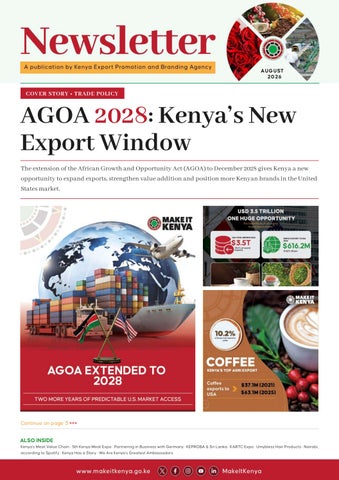
AGOA 2028: Kenya’s New Export Window The extension of the African Growth and Opportunity Act (AGOA) to December 2028 gives Kenya a new opportunity to expand exports, strengthen value addition and position more Kenyan brands in the United States market.
Continue on page 3 >>>
ALSO INSIDE Kenya’s Meat Value Chain · 5th Kenya Meat Expo · Partnering in Business with Germany · KEPROBA & Sri Lanka · KARTC Expo · Umybless Hair Products · Nairobi, according to Spotify · Kenya Has a Story · We Are Kenya’s Greatest Ambassadors
KEPROBA Newsletter
AU GU S T 2026 IS S U E
IN THIS ISSUE
Contents
A round-up of Kenya’s export opportunities, trade partnerships and nationbranding stories for August 2026 C O VER STO R Y · TR ADE PO LI C Y
AGOA 2028: Kenya’s New Export Window
1
A two-year window to grow exports, value addition and Kenyan brands in the US
p.03
SEC TO R F O C US · O PI NI O N
Kenya’s Meat Value Chain
2
Market diversification and export competitiveness, by KEPROBA CEO Floice Mukabana
p.05
TR ADE EX H I B I TI O NS
Positioning Kenya’s Meat for Global Markets
3
p.07
Inside the 5th Kenya Meat Expo and Conference at KICC
M AR KET AC C ESS
Kenya Strengthens Push into the German Market
4
22 companies selected for the Partnering in Business with Germany Programme
p.09
TR ADE DI PLO M AC Y
KEPROBA and Sri Lanka Explore New Frontiers
5
p.11
Sri Lanka Expo 2027 opens a new door for Kenyan businesses
AGR I B USI NESS · VALUE ADDI TI O N
Market Access and Value Addition at KARTC Expo
6
p.12
How a farm product becomes a globally competitive brand
M ADE I N KENYA · ENTER PR I SE
From Solving a Problem to Scaling a Brand
7
p.14
The story of Umybless Hair Products Ltd
C R EATI VE EC O NO M Y
Nairobi, according to Spotify
8
p.16
When a global brand tapped into Kenya’s cultural energy
NATI O N B R ANDI NG
Kenya Has a Story. Is the World Listening?
9
p.18
Giving the world a better view of the Kenya that already exists
NATI O N B R ANDI NG · EDI TO R I AL
10
We Are Kenya’s Greatest Ambassadors
p.20
Why the strongest nation brand is built by its people
EDITORIAL
FROM THE EDITOR
Publisher– KEPROBA
August put Kenya’sexport story on many stages at once, from a renewed AGOA window and a meat sector reaching new markets, to exporters preparing for Germany and a creative city the world is tuning into. Every product, partnership and story in this issue adds to one message: Kenya is ready.
Maureen Mambo – Editor-in-Chief Mariam Maina – Editor Contributors – Floice Mukabana, Mason Lowell, Irene Van De Graaf, Lilian Irungu, John Mwangi, Gertrude Mirobi, Molly Wambui, Enid Muriithi, Mariam Maina Design&Layout – Njaaga Karanja
02 |
KEPROBA Newsletter
AU GU S T 2026 IS S U E
Continued from page 1 >>>
COVER STORY · TRADE POLICY
AGOA 2028: Kenya’s New Export Window BY MASON LOWELL · MLowell@brand.ke
jobs and remains one of the country's biggest beneficiaries of AGOA.
“The extension therefore provides more than additional market access. It provides a two-year window for action.”
T
he extension comes at an important time for Kenya's export sector. For businesses that depend on preferential access to the US market, the additional period provides a more predictable environment for investment, production and market development. More importantly, it gives Kenya an opportunity to move beyond simply maintaining existing trade flows and focus on expanding the range and value of products reaching the American market. Cabinet Secretary for Investments, Trade and Industry, Hon. Lee Kinyanjui, EGH, described the development as significant for Kenya, particularly for the textile and apparel sector, whichsupports more than 66,000 direct
Dec 2028 AGOA EXTENDED TO
The textile and apparel industry has been at the heart of Kenya’s AGOA story. The continuation of preferential access provides the sector with additional breathing space to strengthen its competitiveness, attract investment and sustain employment. It also presents an opportunity to deepen local textile value chains and move towards higher-value production and stronger Kenyan apparel brands.
However, Kenya’s AGOA opportunity extends well beyond apparel. The Government has identified significant potential in value-added agricultural products, leather and leather products, pharmaceuticals, manufactured goods and other competitive Kenyan products. This creates room for a more diversified export basket and greater participation by Kenyan enterprises across different sectors. For agriculture, the opportunit includes strengthening theinternational
66,000+ DIRECT JOBS IN TEXTILE & APPAREL
2 years WINDOW FOR ACTION
positioning of products such as coffee, tea, horticultural products and macadamia. Greater emphasis on processing, packaging and branding can allow Kenyan businesses to capture more value locally while presenting products that are better suited to international consumers. The same principle applies to leather. Rather than exporting primarily raw materials, Kenya can increasingly develop and promote finished leather products with strong design, quality and Kenyan identity. Similarly, opportunities in pharmaceuticals and manufactured goods can support the country’s broader industrialisation ambitions while opening new avenues for international trade. The extension therefore provides more than additional market access. It provides a two-year window for action. Businesses can use this period to invest in production capacity, improve standards, strengthen packaging, develop new products and establish relationships with buyers and distributors in the United States. For
USA PREFEREN TIAL M ARKET ACCESS
03 |
KEPROBA Newsletter small and medium-sized enterprises in particular, the period presents an opportunity to strengthen export readiness and build brands capable of competing in global markets. For Kenya Export Promotion and Branding Agency, the development presents an equally important opportunity to connect export promotion with Kenya brand. An export is more than a commercial transaction; it is an introduction to Kenya. When an American consumer buys Kenyan coffee, wears a Kenyan-made garment, purchases a leather product or encounters a locally manufactured product, that experience contributes to how Kenya is perceived internationally. This makes branding an important part of export competitiveness. The AGOA window can therefore be leveraged to tell stronger stories about Kenyan products and the people behind them from farmers and manufacturers to designers, entrepreneurs and exporters. Targeted campaigns, trade missions, exhibitions, buyer-seller engagements and digital platforms can help connect Kenyan brands withconsumers
AU GU S T 2026 IS S U E
and buyers while strengthening the country’s international image.
Beyond apparel
Every export is an ambassador. The objective should be to move beyond simply promoting products as “Made in Kenya” and build recognition for what Kenyan products stand for: quality, authenticity, innovation, reliability and value.
WHERE KENYA’S AGOA OPPORTUNITY LIES
Textiles &apparel Supports 66,000+ direct jobs; deepen local value chains and Kenyan apparel brands
Value-added agriculture Coffee, tea, horticultural products and macadamia
The extension also presents an opportunity to encourage greater value addition within Kenya. Processing, packaging and branding products locally can create additional employment, strengthen domestic industries and ensure that a greater share of export value remains within the country.
Leather&leather products Finished goods with strong design, quality and Kenyan identity
Pharmaceuticals Supporting broader industrialisation ambitions
Ultimately, the success of the AGOA extension will depend on how effectively Kenya uses the additional time. For KEPROBA, this means ensuring that Kenyan products do not simply reach international markets, but are seen, trusted, remembered and chosen.
Manufactured goods Opening new avenues for international trade
With AGOA now providing certainty through 2028, the window is open for work to begin.
“Every export is an ambassador.” THE TWO-YEAR WINDOW FOR ACTION
1
2
3
4
5
Inve st in production capacity
Improve standards
Stre ngthe n packaging
De ve lop ne w products
Build re lationships with USbuye rs & distributors
What businesses — especially SMEs — can do befo re December 2028 to strengthen expo rt readiness and build brands capable o f co mpeting in glo bal markets.
04 |
KEPROBA Newsletter
AU GU S T 2026 IS S U E
SECTOR FOCUS · OPINION
Kenya's meat value chain: Market Diversification and Export Competitiveness of Kenya's Meat Sector BY FLOICE MUKABANA · chiefexe@brand.ke
USD 175.1M KENYA’S MEAT EXPORT EARNINGS, 2025
T
he global meat industry remains a critical pillar of agribusiness and international trade. According to the OECD-FAO Agricultural Outlook 2025-2034, global demand for meat is expected to continue increasing over the next decade primarily driven by population growth, rapid urbanization, and rising disposable incomes in emerging and middle-income economies. By 2034, global consumption of poultry, sheep meat, beef, and pig meat is projected to increase by approximately 21%, 16%, 13%, and 5%, respectively, reflecting sustained growth in demand for animal protein across international markets. Kenya is well positioned to benefit from this growth owing to her extensive livestock resources particularly in the Arid and Semi-Arid Lands (ASALs). For Kenya, the meat sector is one of the most important components of Kenya's livestock industry contributing significantly to the country’s agricultural Gross Domestic Product (GDP), employment, food security and export earnings. The sector spans a broad network of actors including livestock producers, traders, feed manufacturers, transporters, processors, exporters and retailers and support institutions. At the production level, Kenya has a large livestock population comprising cattle, sheep, goats,camels, pigs and poultry. A significant proportion of livestock
production takes place in the Arid and Semi-Arid Lands (ASALs), which account for much of the country's beef, sheep and goat meat supply. These pastoral and agro-pastoral systems provide a natural competitive advantage, particularly for grass-fed livestock production that is increasingly valued in international markets.
A strong export trajectory From an export perspective, Kenya's meat industry has registered impressive gains over the last five years. According to International Trade Centre, export earnings rose from USD 75.1 million in 2021 to USD 175.1 million in 2025, representing a 20.4% increase in 2025 alone, up from USD 145.4 million in 2024. This remarkable performance highlights the growing competitiveness, quality and international acceptance of Kenyan meat products. In terms of volumes, Kenya exported approximately 30 million tonnes of meat products in 2025 with sheep and goat meat alone generating approximately USD 161 million, representing 92% of total meat export earnings and accounted for 90.1% of export volumes, underscoring Kenya's strong comparative advantage in small-ruminant production.
Kenya's export markets remain heavily concentrated in the Gulf region. In 2025, the United Arab Emirates (UAE) was Kenya's largest market, importing meat products worth USD 102.5 million, equivalent to 58.5% of total exports. Other major destinations included Saudi Arabia (USD 20.9 million), Bahrain (USD 19.1 million), Kuwait (USD 18.1 million) and South Sudan (USD 4.8 million). Demand from these markets continues to be driven by strong consumer preference for halal-certified meat products and Kenya's reputation for quality livestock.
Increased export earnings Over the next five years, Kenya has the potential to become a leading supplier of premium grass-fed, halalcertified meat products to; markets in Africa by leveraging the Africa Continental Free Trade Area (AfCFTA); China by utilizing the zero-tariff offer to African countries; and the Middle East by leveraging the Kenya–UAE Comprehensive Economic Partnership Agreement (CEPA). Realizing this vision will require increased investment in livestock productivity, disease control, processing facilities, cold-chain infrastructure, traceability systems and market diversification. By positioning Kenyan meat as a premium product characterized byhigh quality, halal compliance, natural grass-fed production systems, traceability,
05 |
KEPROBA Newsletter and sustainability, the country can differentiate her products from competitors and strengthen consumer confidence among global buyers.
AU GU S T 2026 IS S U E
A strong export trajectory
Demand is growing
MEAT EXPORT EARNINGS, USD MILLION
PROJECTED RISE IN GLOBAL CONSUMPTION BY 2034
175.1 145.4
KEPROBA’s role The Kenya Export Promotion and Branding Agency's (KEPROBA) primary role is to facilitate market access and market linkages for Kenyan exporters. As the national institution mandated to promote exports and build market linkages, KEPROBA occupies a unique position in connecting Kenyan meat exporters with international buyers through market intelligence, trade promotion programmes, businessto-business engagements, and strategic market access initiatives. This distinctive role places KEPROBA at the centre of efforts aimed at diversifying export destinations, enhancing competitiveness, and positioning Kenyan meat products in high-value global markets.
The writer is the Chief Executive Officer of Kenya Export Promotionand Branding Agency.
21%
Sheepmeat
75.1
16%
Beef Pig meat
13% 5%
Source: OECD-FAO Agricultural Outlook 2025–2034
2021
···
2024
2025
Source: International Trade Centre (years s hown as cited)
Where Kenya’s meat went in 2025 TOP EXPORT DESTINATIONS, USD MILLION · UAE TOOK 58.5% OF TOTAL EXPORTS
102.5
UAE Saudi Arabia
20.9
Bahrain
19.1
Kuwait
18.1
In conclusion Kenya's meat industry stands at a pivotal moment, with growing global demand, expanding market opportunities and a demonstrated capacity to compete in international markets. Through coordinated efforts between government and private sector players, the meat sector can significantly increase export earnings, create jobs, improve livelihoods in the ASAL regions, and contribute meaningfully to the country's economic transformation agenda. Together, let us capitalize on the growing global demand, diversify our export markets and work together to make Kenyan meat a preferred choice on dining tables across the world, creating prosperity for our farmers, exporters and the nation as a whole.
Poultry
South Sudan
4.8
92%
+20.4%
SH ARE OF EARN IN GS FROM SH EEP & GOAT M EAT
GROWTH IN EXPORT EARN IN GS, 2025
Three routes to new markets WHERE KENYA CAN BECOME A LEADING SUPPLIER OF PREMIUM GRASS-FED, HALALCERTIFIED MEAT
1 2
Africa Leveraging the Africa Continental Free Trade Area (AfCFTA)
China Utilising the zero-tariff offer to African countries Middle East Leveraging the Kenya–UAE Comprehensive Economic Partnership
3
Agreement (CEPA)
06 |
KEPROBA Newsletter
AU GU S T 2026 IS S U E
TRADE EXHIBITIONS
Positioning Kenya’s meat for global markets BY IRENE VAN DE GRAAF · IGraaf@brand.ke
“Kenya’s meat industry presents an important opportunity to expand exports and strengthen the Made in Kenya brand.”
The 5th Kenya Meat Expo and Conference at the Kenyatta International Convention Centre (KICC), Nairobi.
K
enya’s meat and livestock sector is an important contributor to the national economy, supporting millions of livelihoods and providing significant opportunities for export growth and value addition. These opportunities were brought into focus during the 5th Kenya Meat Expo and Conference, held at the Kenyatta International Convention Centre (KICC), Nairobi, from 26 to 28 August 2026 under the theme “Accelerating Sustainable Growth: Empowering the Next Generation in the Meat Value Chain.” The three-day event brought together stakeholders from across the meat value chain, including livestock producers, processors, exporters, technology providers, animal health professionals, investors, government agencies and other industry players. It provided a platform for stakeholders to showcase innovations, exchange knowledge and explore opportunities for strengthening Kenya’s meat industry and expanding its presence in international markets. For the Kenya Export Promotion and Branding Agency (KEPROBA), the Expo provided an important opportunity to engage with industry players and
explore how Kenya can strengthen its meat export proposition. The Agency’s participation reflected its mandate to support the growth of Kenyan exports, enhance market access and position Kenyan products competitively in regional and international markets. Kenya has a strong foundation for growth in the meat sector. The livestock industry contributes significantly to the economy and provides livelihoods to millions of Kenyans. Recent growth in meat exports, with exports reportedly increasing by 87 per cent to KSh16.4 billion, points to growing demand and opportunities for Kenyan businesses to expand their presence in international markets. Realising this potential requires attention to the entire value chain. International markets increasingly demand consistent quality, food safety, traceability, reliable supply and compliance with specific market requirements. Strengtheninglivestock production, animal health systems, processing facilities, certification, packaging and cold-chain infrastructure will therefore be important in supporting sustainable
export growth. These considerations featured prominently in discussions during the Expo, including KEPROBA CEO Ms. Floice Mukabana’s participation in a panel on positioning Kenya as a global meat export hub. The discussions highlighted the need for stronger coordination across the value chain and greater focus on quality, traceability, Halal integrity, food safety, professional packaging and reliable supply. Value addition also presents significant opportunities for the sector. Developing premium cuts, processed meat and other differentiated products can enable Kenyan businesses to respond to changing consumer preferences while creating greater value from existing production. This provides an opportunity for exporters to move towards products that meet specific market needs and command greater value in international markets. Market diversification remains equally important. Kenya has established commercial links with markets in the Gulf region, while emerging opportunities in China and other
07 |
KEPROBA Newsletter
AU GU S T 2026 IS S U E
African markets offer potential for further expansion. Accessing these markets will require exporters to understand consumer preferences, meet market-specific standards and build strong relationships with international buyers. For KEPROBA, the development of Kenya’s meat exports is closely linked to the country’s nation branding agenda. Every Kenyan product that reaches an international consumer contributes to perceptions of Kenya as a source of quality, reliability and value. Premium, certified meat exports advance individual businesses and market the entire “Made in Kenya” brand to the world. Building this reputation requires consistency across the value chain. Quality must be maintained from production through processing, packaging, transportation and delivery. Strong systems, compliance with international standards and reliable supply are essential in buildingconfidence among international buyers and establishing long-term market relationships.
The Meat Expo demonstrated the breadth of expertise, innovation and enterprise within Kenya’s meat industry. It also provided an opportunity for businesses and institutions to engage on the measures required to strengthen competitiveness and expand the sector’s contribution to the country’s export agenda. As Kenya seeks to expand and diversify its export basket, the meat industry presents a major opening to create greater value for farmers, pastoralists, processors and exporters while contributing to employment and foreign exchange earnings. Strengthening the value chain, investing in quality standards, promoting value addition and strategically positioning Kenyan meat in international markets will be key to unlocking this potential.
A panel session during the threeday Expo at KICC.
KEPROBA remains committed to supporting the sector through market access initiatives, export readiness, market intelligence, buyer linkages and strategic branding, while promoting the Made in Kenya brand in global markets.
KENYA MEAT EXPO 2026 IN NUMBERS
87%
REPORTED RISE IN M EAT EXPORTS
KSh16.4B VALU E OF M EAT EXPORTS
Scenes from the Expo floor
3 days
26–28 AU GU ST 2026, KICC
5th
EDITION OF TH E EXPO
Kenyan meat products on show
08 |
KEPROBA Newsletter
AU GU S T 2026 IS S U E
MARK ET ACCESS
Kenya Strengthens Push into German Market Through New Export Readiness Programme BY LILIAN IRUNGU · InternCOMM2@brand.ke
Participants of the Partnering in Business with Germany Programmeat the Kenya School of Government, Lower Kabete.
K
enya is intensifying its drive to expand exports to Europe through a new initiative designed to help local businesses unlock opportunities in Germany, one of the world’s largest economies and a key gateway to the European market. Twenty-two Kenyan companies were selected to participate in the Partnering in Business with Germany Programme, an initiative aimed at equipping exporters with the skills, market intelligence and business connections needed to compete successfully in the German market and beyond. The programme comes at a time when trade between Kenya and Germany is showing encouraging growth. Kenya's exports to Germany reached US$164.8 million in 2025, marking a 16 per cent increase from the previous year. Key exports include coffee, cut flowers, avocados, mangoes and other fresh produce, while an increasing number of valueadded products are beginning to gain traction among German consumers. For Kenya, this growth signals more than rising export earnings. It reflects growing international confidence in the
quality, innovation and competitiveness of Kenyan products.
Preparing Businesses for Global Success The journey to becoming an exportready business requires more than producing high-quality goods. Companies must understand market requirements, meet regulatory standards, build reliable supply chains, and establish trusted business relationships. It is these capabilities that the Partnering in Business with Germany Programme seeks to develop. The two-day introductory workshop, held at the Kenya School of Government in Lower Kabete, brought together participants drawn from key sectors of the economy including tea, fresh produce, herbs and spices, horticulture, agro-processing and crafts. Implemented on behalf of Germany's Federal Ministry for Economic Affairs and Energy through GIZ, delivered by AHP International and supported locally by the Kenya Export Promotion and Branding Agency (KEPROBA), theprogram provided
a practical platform for Kenyan enterprises to strengthen their export competitiveness while exploring commercial opportunities in Germany Speaking during the opening of the workshop, KEPROBA Chief Executive Officer Floice Mukabana noted that the initiative is designed to provide Kenyan exporters with the knowledge, confidence and networks required to build sustainable and mutually beneficial business partnerships with German companies. “Every successful exporter begins with a market opportunity, but sustained success depends on readiness, resilience and the right partnerships. Germany is one of the world’s most sophisticated markets, and this programme is equipping Kenyan businesses with the tools and networks they need to compete and thrive. The 22 companies selected today represent the future of Kenya’s export growth and the growing global appeal of Made in Kenya products,” said Ms. Mukabana.
US$164.8M
KENYA’S EXPORTS TO GERMANY IN 2025 — UP 16% ON THE PREVIOUS YEAR
09 |
KEPROBA Newsletter
A competitive pathway to Germany Interest in the programme was strong, highlighting the growing ambition of Kenyan enterprises to scale into international markets. A total of 102 companies applied from across the country. Following a rigorous evaluation process, 40 businesses were shortlisted before undergoing virtual interviews and on-site verification visits. Ultimately, 22 companies were selected to participate. The competitive selection process demonstrates the depth of entrepreneurial talent in Kenya and the increasing number of businesses capable of meeting international market expectations with the right support and capacity building.
Unlocking greater value from Kenyan exports While Germany is already an important trading partner, the current export figures suggest significant untapped potential. The programme aligns closely with Kenya's broader goal of increasing export earnings through diversification, value addition and market expansion. This is particularly important for sectors such as agriculture and agroprocessing, where converting raw materials into higher-value products can substantially increase revenue, create jobs, and strengthen local value chains. As global consumers increasingly seek sustainable, traceable and highquality
AU GU S T 2026 IS S U E
products, Kenyan businessesare well positioned to capitalize on these trends. Programmes such as this help bridge the gap between market opportunity and business readiness, ensuring Kenyan exporters can effectively meet international demand.
A competitive pathway FROM APPLICATION TO SELECTION
Strengthening the Made in Kenya Brand
102
companies applied
40
shortlisted for interviews & site visits
Beyond boosting individual businesses, the initiative contributes to the broader goal of raising the profile of Kenyan products globally. By facilitating direct commercial engagement between Kenyan and German companies, the programme is expected to create new trade linkages, stimulate exports and enhance the visibility of Kenyan brands in European markets. The initiative further underscores KEPROBA's commitment to supporting enterprises in identifying new markets, strengthening competitiveness and positioning Made in Kenya products as trusted, high-quality brands on the global stage. As Kenya deepens its trade relationship with Germany, the 22 participating companies represent more than a cohort of exporters. They symbolize the country's growing export ambition, innovation, and readiness to compete in some of the world's most sophisticated markets. Their success could pave the way for stronger bilateral trade, increased export earnings and greater international recognition for Kenyan products and businesses.
Participants display programmematerials during the introductory workshop.
22
selected to participate
Who is behind it Germany’s Federal Ministry for Economic Affairs and Energy On whose behalf it is implemented
GIZ Implementation
AHP International Delivery KEPROBA Local support
SECTORS REPRESENTED
Tea
Fresh produce
Herbs & spices
Horticulture
Agro-processing
Crafts
A participant contributes during the two-day introductory workshop.
10 |
KEPROBA Newsletter
AU GU S T 2026 IS S U E
TRADE DIPLOMACY
KEPROBA and Sri Lanka Explore New Frontiers for Bilateral Trade BY JOHN MWANGI · Interncomm2@brand.ke
K
enya’s efforts to expand its global trade footprint received a boost following a high-level engagement between the Kenya Export Promotion and Branding Agency (KEPROBA) and the Sri Lanka High Commission in Nairobi. During the meeting, KEPROBA Chief Executive Officer Ms. Floice Mukabana hosted the Acting High Commissioner of Sri Lanka to Kenya, Ms. Ruvini De Silva, for discussions aimed at strengthening trade, investment and business linkages between the two countries. The engagement focused on unlocking new opportunities for Kenyan and Sri Lankan businesses by promoting stronger business-tobusiness partnerships and exploring areas of mutual economic interest. As Kenya continues to diversify its export destinations and connect local enterprises to global opportunities, partnerships such as these play an important role in opening doors to new markets. A key highlight of the discussions was Sri Lanka Expo 2027, which will
takeplace in Colombo from January 14 to 16, 2027. The international trade exhibition is expected to bring together businesses, investors and industry stakeholders from across the globe, creating opportunities for networking, market exploration and commercial partnerships. For Kenyan businesses, the Expo presents a valuable platform to showcase products and services, engage potential partners and gain insights into opportunities within the Sri Lankan market and beyond. Several sectors emerged as areas of potential collaboration, including agriculture, tea, manufacturing, tourism, logistics, healthcare and value-added exports. These sectors offer promising avenues for knowledge exchange, investment and increased trade between the two economies. As part of the preparations for Kenyan businesses to attend the Expo, the Sri Lanka High Commission will host business briefing sessions in Nairobi on September 25, 2026, and Mombasa on October 2, 2026.
THE ROAD TO SRI LANKA EXPO 2027
25 Sep 2026
Business briefing · Nairobi
2 Oct 2026
Business briefing · Mombasa
Moments from the engagement between KEPROBA and the SriLanka High Commission in Nairobi. The sessions will provide information about Sri Lanka Expo 2027 and help companies identify potential areas for engagement. The discussions underscored the importance of building stronger private-sector connections as a pathway to turning long-standing diplomatic relations into tangible economic outcomes. By facilitating market linkages and international partnerships, KEPROBA continues to support Kenyan enterprises in accessing new markets and unlocking export opportunities. As preparations for Sri Lanka Expo 2027 gather momentum, the engagement marks an encouraging step towards deepening Kenya-Sri Lanka commercial relations and creating new pathways for trade, investment and business growth.
S ECT O RS FO R CO LLABO RAT IO N
14–16 Jan 2027
Sri Lanka Expo · Colombo
Agriculture
Tea
Manufacturing
Tourism
Logistics
Healthcare
Value-added exports
11 |
KEPROBA Newsletter
AU GU S T 2026 IS S U E
AGRIBUSINESS · VALUE ADDITION
KEPROBA Deepens Market Access and Value Addition Push at KARTC Expo BY GERTRUDE MIROBI · gmirobi@brand.ke
20,000+
STAKEHOLDERS OVER TWO DAYS 6–7August 2026 Kaimosi Agricultural Research and Training Centre, Nandi County
T
he Annual Kaimosi Agricultural Research and Training Centre (KARTC) Expo, held on 6th and 7th August 2026 in Nandi County, became a proving ground for one of the questions shaping Kenya's export agenda. How does a farm product become a globally competitive brand? For the Kenya Export Promotion and Branding Agency (KEPROBA), the answer played out in real time on the exhibition floor. The two-day expo brought together over 20,000 stakeholders from across the country, including national and county government representatives, state corporations, development partners, financial institutions and private sector organizations. The gathering of farmers, entrepreneurs, researchers, agribusiness players and investors gave KEPROBA a direct channel to businesses navigating the shift from local sale to international market entry. At its exhibition booth, the agency engaged exhibitors on branding, export readiness and market linkages, introducing visitorsto the Made in Kenya Initiative, connecting them with export and investment stakeholders,
and encouraging businesses to register as Made in Kenya adopters. Throughout, KEPROBA pointed businesses toward the MadeInKenya Brand Mark as a tool for building consumer trust and competing more effectively in regional and global markets. Among these engagements was a high-profile visit from Dr. Eng. Festus K. Ng’eno, Principal Secretary for the State Department for Environment and Climate Change, who toured the KEPROBA stand, reviewed exhibitors’ products and innovations, and was briefed on the agency’s mandate in export promotion and nation branding. The visit underscored the value of cross-government collaboration in unlocking market access for Kenyan producers. Beneath the buyer-facing conversations, however, lay a more structural story, value addition. Spanning agricultural innovation and technology, the tea, coffee, avocado, sugarcane anddairy value chains, and forestry and agroforestry opportunities, the expo demonstrated how raw
produce can be processed, packaged and branded into finished goods worth far more than the same commodities sold unprocessed. This is precisely where KEPROBA’s core competencies spanning market intelligence, product and enterprise development, export readiness and market linkages, make the most difference, helping businesses move beyond primary production towards processing, branding and export-ready positioning. The stakes extended well beyond Kaimosi itself. Value addition featured prominently in discussions on raising farmer incomes, reducing postharvest losses, creating employment in processing and packaging, and strengthening agriculture’s contribution to the wider economy. For Nandi and other agricultural counties, this translated into a tangible opportunity for young entrepreneurs and small enterprises to build businesses around Kenya’s raw produce rather than simply exporting it.
12 |
KEPROBA Newsletter KEPROBA's message to exhibitors, and to Kenyan businesses more broadly, stayed consistent throughout the expo. Reaching international shelves takes more than production. It requires quality control, packaging, deliberate branding, market research and compliance with the standards of target markets. The agency used the two days, filled with interactive exhibitions and demonstrations, business networking and investment and market access opportunities, to amplify that message further, encouraging businesses to convert booth conversations into lasting commercial relationships. Market access and value addition captured what KEPROBA positioned as the throughline of Kenya’s export strategy. Producers who invest in processing, branding and compliance are the ones best placed to turn local produce into competitive, globally recognised Kenyan brands.
AU GU S T 2026 IS S U E
From farm produce to global brand HOW RAW PRODUCE BECOMES FINISHED GOODS WORTH FAR MORE
› Raw produce
› Processing
Reaching international shelves TAKES MORE THAN PRODUCTION. IT REQUIRES:
› Packaging
Branding
Packaging
Export-ready
Value chains on show SPANNING AGRICULTURAL INNOVATION AND TECHNOLOGY
Tea
Quality control
›
Coffee
Sugarcane
Avocado
Dairy
Forestry & agroforestry
Deliberate branding
“Producers who invest in processing, branding and compliance are the ones best placed to turn local produce into competitive, globally recognised Kenyan brands.”
Market research Compliance withthe standards of target markets
WHY VALUE ADDITION MATTERS Raising farmer incomes Reducing post-harvest losses Jobs in processing & packaging A stronger agricultural economy
13 |
KEPROBA Newsletter
AU GU S T 2026 IS S U E
MADE IN K ENYA · ENTERPRISE
From Solving a Problem to Scaling a Brand: The Story of Umybless Hair Products Ltd BY MOLLY WAMBUI · MWambui@brand.ke
US$2.3B
KENYA’S BEAUTY & PERSONAL CARE MARKET
K
enya’s beauty and personal care industry is currently valued at US$2.3 billion, solidifying its position as the leading beauty powerhouse in the East African region. Driven by a youthful population, rising middle-class disposable income, and deep e-commerce penetration, the market has shown immense growth and resilience. The sector contributes between 1.5% to 2% of Kenya's nominal GDP. Local manufacturers are stepping up to create solutions tailored specifically for African hair. Among these rising brands is Umybless Hair Products Ltd, a Kenyan-owned organic beauty products manufacturer making a name for itself by producing high-quality, affordable, and locally sourced hair and skincare solutions. Born out of a desire to address real haircare struggles, Umybless has evolved from a small enterprise into a thriving brand serving salons, direct customers, and online shoppers. Every great business begins by solving a problem, and Umybless is no exception. The company was founded in April 2020 by Susan Makewa after recognizing a significant gap in the market: the limited availability of effective, affordable products specifically formulated for natural and textured African hair. Instead of relying on imported goods that often miss the mark for African hair types, Susan began developingunique formulations using natural ingredients. The goal was clear—minimize breakage, enhance moisture retention, and
1.5–2%
’OF KENYA S NOMINAL GDP
April 2020
UMYBLESS FOUNDED BY SUSAN MAKEWA
promote healthy growth. Today, that initial spark has grown into a dedicated manufacturing enterprise focused on helping individuals confidently maintain healthy hair. Umybless operates with a clear, community-centric mission: to produce affordable and effective hair and personal-care products using local resources while promoting healthy hair and skin. Looking forward, the brand envisions becoming a leading African beauty giant, celebrated across the continent for quality, innovation, and local craftsmanship. What truly sets Umybless apart from competitors is its focus on the specific mechanics of African hair. By prioritizing natural, locally sourced ingredients, the brand delivers organic, affordable remedies for common issues like dryness, breakage, frizz, damage, and product build-up. While the company started with a focus on hair, it has expanded its catalogue to meet the holistic grooming needs of
Umybless rangeof products proudly made in Kenya its clientele. The current product line includes including hair oil, clarifying shampoo, leave-in conditioner, beard oil and cream, Vitamin C serum and niacinamide moisturiser.
A MAJOR MILESTONE
The Made in Kenya Mark Boosting consumer confidence and elevating the brand’scredibility in a competitive market.
14 |
KEPROBA Newsletter
AU GU S T 2026 IS S U E
A major milestone for the brand has been the acquisition of the Made in Kenya Mark. This certification has boosted consumer confidence and elevated the brand’s credibility in a competitive market. It has opened doors for Umybless to showcase its innovations at high-profile business forums and exhibitions. The certification reinforces Susan’s belief that Kenyan businesses can manufacture highquality products for the Kenyan, African and international markets. While currently focused on solidifying its footprint across East Africa, Umybless has its sights firmly set on broader international distribution in the near future. Whether you are an individual looking to upgrade your hair routine or a salon interested in wholesale orders, Umybless welcomes retail and wholesale inquiries alike. The team is also available to offer personalized hair-care guidance.
Telephone/WhatsApp: +254722 916 464
The product line
The journey
ORGANIC, AFFORDABLE REMEDIES FOR DRYNESS, BREAKAGE, FRIZZ, DAMAGE AND BUILD-UP
FROM A HOME-GROWN SOLUTION TO AN AFRICAN BEAUTY BRAND
Hair oil
2020 Founded in April by Susan Makewa
Clarifying shampoo
Leave-in conditioner
Beard oil and cream
Made in Kenya Mark Boosting consumer confidence and credibility
East Africa Solidifying its regional footprint
Next
Vitamin C serum
Broader international distribution Niacinamide moisturiser
Online Store: Makueni County Soko online platform
Facebook: Umybless Hair Products
Instagram: @umybless_ hair_products
15 |
KEPROBA Newsletter
AU GU S T 2026 IS S U E
CREATIVE ECONOMY
Nairobi, according to Spotify When a global brand tapped into Kenya’s cultural energy. BY ENID MURIITHI · EMuriithi@brand.ke
12 days 15–26 JULY 2026 · HELTZ HOUSE, NAIROBI
20 events MUSIC, FOOD, FASHION, SPORT, ART, CONVERSATIONS & COMMUNITY
S
potify did not simply bring a global music platform to Nairobi. It built a physical experience around the culture already happening here. For 12 days in July, Heltz House in Nairobi became a snapshot of the city itself: music spilling into fashion, food meeting conversation, podcasts sharing space with live performances, and communities gathering around the sounds and ideas that make Nairobi distinct. That was the premise behind Spotify’s Greasy Tunes Nairobi, which ran from 15th to 26th July 2026 and brought together twenty events spanning music, food, fashion, sport, art, conversations and community. Spotify’s coverage highlighted live performances and podcast recordings alongside fashion and culture programming, including sessions featuring Kenyan creative voices. At first glance, Greasy Tunes was an activation. When viewed through the lens of the Kenya brand, however, it was something significant: a globalbrand
choosing to build an experience around Nairobi’s cultural identity. That choice matters. Global brands have no shortage of cities in which to stage campaigns. Yet Spotify chose to invest in Nairobi’s creative energy and, rather than simply importing an international concept, built the experience around local culture and local talent. The result was a program that reflected something increasingly difficult to ignore about Nairobi; Its culture does not fit neatly into one category. The week began with a kitchen opening party by The Bag, a leading music platform. This created a familiar environment that allowed for attendees to eat, listen, meet people and inevitably discover something new. Following was Karibu Night, a creative collective hosted by Studio 18 that translated Spotify’s ‘Made in Kenya’ playlist into something visual and fashionable through clothes. From playlist to fashion, the showcase presented an opportunity for the fashion designers to connect what we listen to into something wearable.
Whatpeople listen to often becomes what they wear, how they speak and increasingly, how they present themselves creatively. Greasy Tunes wasn’t only about being in front of a crowd on stage. The event brought meaningful conversations to the table through a live podcast recording from Culture Club which explored conversations on music and culture. The first week culminated with ‘Smocha Sundays’ which brought together gospel music, community, food and a football watch party, perfect for a Sunday. Week two began with a blend of storytelling, music and spoken word from a well-known Kenyan poet and filmmaker, Gufy. Kasi Flavour staged a workshop that promoted women in music. The workshop addressed the practical realities of building sustainable careers in Kenya’s music ecosystem bringing together artists, producers, managers, photographers, videographers and other industry professionals.
16 |
KEPROBA Newsletter
AU GU S T 2026 IS S U E
That is important for Kenya’s national brand because the strongest country identities are not built from one industry alone. They emerge from the connections between people, ideas, experiences and places.
the food, theconversations and the communities that showed up. That may be the most useful lesson for the Kenya Brand. A country’s story becomes more compelling when it is not told to the world but experienced by the world.
For years, Kenya’s international image has been anchored by powerful associations: athletics, wildlife, tourism, innovation and natural beauty. Those remain valuable. But Nairobi’s creative economy adds another dimension to the picture. One that is youthful, urban, culturally confident and increasingly attractive to international audiences.
For 12 days, Spotify gave Nairobi’s cultural energy a physical address. More importantly, it gave an international audience another reason to pay attention to what Kenya is creating. Kenya is not only a place where global culture arrives. It is a place where culture is made, remixed and shared. Nairobi is increasingly one of the places where the world comes to hear it.
The event did not need to manufacture a Nairobi identity. It found one that was already there in the music, the fashion,
The Greasy Tunes programme HIGHLIGHTS ACROSS THE 12 DAYS WE E K 1
Kitchen opening party The Bag
Karibu Night Studio 18 · ‘Made in Kenya’ playlist to fashion
Live podcast recording Culture Club
Smocha Sundays Gospel, community, food & football WE E K 2
Storytelling,music & spoken word Gufy
Women in music workshop Kasi Flavour
Image Courtesy: Spotify newsroom
“A country's story becomes more compelling when it is not told to the world but experienced by the world.”
17 |
KEPROBA Newsletter
AU GU S T 2026 IS S U E
NATION BRANDING
Kenya has a story. Is the world listening? The next chapter of Kenya may not be about creating a new image but about giving the world a better view of the Kenya that already exists. BY ENID MURIITHI · EMuriithi@brand.ke
K
enya is no stranger to global recognition. Our wildlife draws visitors from across the world, Kenyan athletes dominate international podiums, our Coffee and Tea are enjoyed far beyond our borders, Nairobi has established itself as a regional centre for business, technology and entertainment.
technology, furniture, creative content or an innovative solution to a distinctly African challenge. These businesses are not simply participating in the local economy, they are contributing to how Kenya is experienced, understood and remembered across and beyond its borders.
Kenya has what the world is looking for.
What makes something truly Kenyan?
Beyond the familiar
There are interesting questions behind the phrase ‘Made in Kenya’.
For a long time, the story of Kenya abroad has been built around a familiar set of images that remain an important part of our identity. But a country brand, much like any successful brand, cannot remain static. It must evolve, and Kenya is evolving. The way we present it should reflect the same. Today, a Kenyan brand can emerge from a design studio in Nairobi, a processing facility in Nakuru, a technology hub in Kisumu or a workshop inMombasa. It can take the form of fashion, processed food, beauty,
Is it where something is produced? Is it the materials used? The people behind it? Inspiration? Or the story attached to it? Perhaps it is all these things. The strongest Kenyan brands do not necessarily rely on obvious symbols to communicate where they come from. Instead, they demonstrate that Kenyan identity can coexist with world-class design, quality and innovation. This is important because competing globally requires morethan a country of origin. The origin country opens doors, quality
keeps it open, and a compelling brand gives people a reason to remember you. A reason to keep coming back.
From products to possibilities This is also why the conversation around Kenya's global potential needs to become broader because our international offering is not limited to physical products. Kenya exports expertise, creativity, culture and ideas. A Kenyan tech company can develop a solution that works across African markets, a creative can reach an international audience from a screen anywhere in Nairobi, a designer can turn local inspiration into a global aesthetic, and a professional can provide expertise to clients thousands of kilometres away. The opportunity is therefore not to ask what Kenya can sell, but what can Kenya contribute to the world. This shift in thinking opens an entirelydifferent conversation about Brand Kenya and branding Kenyan.
18 |
KEPROBA Newsletter
AU GU S T 2026 IS S U E
The power of being seen Great products do not automatically become great brands. Visibility, positioning, consistency and most importantly human stories give people a reason to care. This is particularly important for businesses seeking to enter international markets because a buyer may encounter hundreds of products that meet the basic quality standard, but what makes one memorable? What creates curiosity? What makes someone choose it, recommend it or come back to it? Sometimes, it is the story behind the brand, the owner, the business or even the idea.
Kenya therefore has an opportunity to not only promote what it produces, but to become better at packaging and communicating the value behind what it produces.
A brand is built collectively Kenya’s brand is not the responsibility of one organisation, one campaign or one industry. It is a collective effort. Perhaps the opportunity in front of Kenya today is to move from being a country that is recognised globally to one that is increasingly chosen, remembered and sought after. Kenya does not need a new story it needs us to tell the story we already have better, louder and to a much bigger audience. From Kenya to the world.
A Kenyan brand can emerge from… FASHION, PROCESSED FOOD, BEAUTY, TECHNOLOGY, FURNITURE, CREATIVE CONTENT
Nairobi
a design studio
Nakuru
a processing facility
Kisumu
a technology hub
Mombasa
a workshop
“Kenya does not need a new story it needs us to tell the story we already have better, louder and to a much bigger audience.”
COMPETING GLOBALLY REQUIRES MORE THAN A COUNTRY OF ORIGIN WHAT TURNS A KENYAN PRODUCT INTO A BRAND PEOPLE CHOOSE
›
› Origin
opens doors
Quality
A compelling brand
keeps open them
gives people a reason to remember you
19 |
KEPROBA Newsletter
AU GU S T 2026 IS S U E
NATION BRANDING · EDITORIAL
We are Kenya's greatest ambassadors BY MARIAM MAINA · mmaina@brand.ke
“Every Kenyan is, whether knowingly or not, a custodian of the Kenya brand.”
A
few days ago, a video by a foreign tourist praising Kenya captured the hearts of thousands online. In the clip, the visitor spoke passionately about why everyone should visit Kenya. “The landscapes were breathtaking. The people were warm. The experience was unforgettable, he said.” What provoked my thoughts was, one, the number of people who sent me the same video (maybe because they know what I do or just because I am always sharing content that positions the brand Kenya) and two, how he started the narration, “Kenya has it all. An entire continent’s worth of ecosystems piled onto one plate, garnished with the most fantastic set of cultures...” The tourist goes on to describe a country that we have lived in for years, sights that we have visited and maybe even ignored. For many Kenyans, the video sparked pride. It reminded us of something weoften forget, sometimes it takes the eyes of a stranger to help us see the
beauty that surrounds us every day. But perhaps the real question is not why a tourist loves Kenya.
future generations. These are not just individual success stories. They are chapters in the story of Kenya.
The real question is: do we?
For too long, many of us have become accustomed to focusing on what is broken. We discuss our challenges passionately, often forgetting that there is another side to the story. Kenya is not perfect, but neither is it defined by its problems.
Nation branding Nation branding is often misunderstood. Many people think it is about logos, slogans, glossy advertisements, or international campaigns. While these have their place, the most powerful nation brand is built through people. A country's reputation is shaped by the stories told about it, the experiences visitors have, and the way its citizens speak about it. Every Kenyan is, whether knowingly or not, a custodian of the Kenya brand. Think about the runner from Iten training before sunrise, carrying Kenya’s flag onto the global stage. Think about the farmer in Kericho producing tea that finds its way into homes across continents. Think about the innovator in Nairobi creating solutions that improve lives. Think about the conservation ranger protecting endangered wildlife, the artistcelebrating culture through music and dance, the entrepreneur creating jobs, and the teacher shaping
Ordinary people This is a nation that has produced a Noble Laureat, world record holders and Olympic champions. A nation that hosts some of the world's most extraordinary wildlife and landscapes. A nation whose athletes train in the highlands and inspire millions. A nation where innovation flourishes, giving birth to globally recognised solutions such as mobile money and earning Nairobi the title of Africa's Silicon Savannah. A nation whose vibrant cultures, languages, cuisines, music, and creativity continue to captivate the world. Yet the story of Kenya is not found only in extraordinary achievements. It is found in ordinary people.
20 |
KEPROBA Newsletter
AU GU S T 2026 IS S U E
It lives in the smile that welcomes a visitor at Jomo Kenyatta International Airport. It lives in the boda boda rider who offers directions to a lost traveller. It lives in communities that protect wildlife, young people creating opportunities for themselves, and families working every day to build a better future. These everyday moments rarely trend on social media. They do not make international headlines. But collectively, they shape perceptions of who we are as a nation.
The viral tourist understood something many of us overlook. Kenya is not simply a destination. It is an experience. It is the sight of the sun rising over the Maasai Mara. It is the rhythm of cultural festivals. It is the energy of Nairobi's streets. It is the determination of athletes, the creativity of young innovators, the beauty of our landscapes, and the warmth of our people. These are assets that no amount of marketing money can purchase. They are authentically Kenyan.
Authentically Kenyan
KEPROBA’s mandate
The power of nation branding lies in storytelling. Every conversation, every social media post, every interaction with a visitor contributes to Kenya's image. When we constantly speak negatively about our country, we weaken the very brand we want others to respect. When we share stories of resilience, innovation, kindness, and achievement, we strengthen it.
The Kenya Export Promotion and Branding Agency’s mandate goes beyond promoting exports and attracting investment. It is about shaping and protecting Kenya's reputation at home and abroad by telling authentic, people-centered stories about who we are. Through strategic storytelling, partnerships with citizens, creatives, businesses, athletes, innovators, communities and the diaspora, KEPROBA seeks to showcase Kenya's unique value proposition and inspire a renewed sense of national pride.
This does not mean ignoring challenges. Authentic nation branding is not about pretending everything is perfect. It is about telling the complete story. It is about acknowledging difficulties while also celebrating progress. It is about recognising thatKenya is a country of immense potential and remarkable people.
We are brand ambassadors
alone, but millions of Kenyans whose daily actions, achievements and experiences collectively define the country’s image. By amplifying positive stories of innovation, culture, resilience, conservation, enterprise and opportunity, KEPROBA is helping build a national narrative that inspires confidence, attracts visitors and investors, and strengthens our shared belief in Kenya’s future. As the world becomes increasingly connected, every citizen has a role to play in shaping how Kenya is perceived. We do not need to wait for government campaigns or international endorsements. We can start by sharing positive stories, supporting local products, protecting our environment, welcoming visitors, celebrating our diversity, and speaking proudly about who we are and what we can become. The tourist who praised Kenya reminded us of our value. Now it is our turn to believe in it, because the greatest ambassadors of Kenya are not the visitors who come and fall in love with our country, the greatest ambassadors of Kenya are the people who call it home.
KEPROBA recognizes that the strongest and most credible ambassadors of Kenya are not government institutions
EVERY KENYAN IS A CUSTODIAN OF THE KENYA BRAND The runner from Iten carrying Kenya’s flag onto the global stage The farmer in Kericho whose tea finds its way into homes across continents
The artist celebrating culture through music and dance
Chapters in the story of Kenya
The innovator in Nairobi creating solutions that improve lives
The entrepreneur creating jobs
The teacher shaping future generations The conservation ranger protecting endangered wildlife
21 |