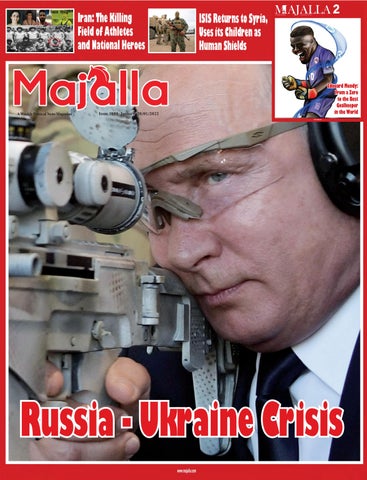
Iran: The Killing Field of Athletes and National Heroes
A Weekly Political News Magazine
ISIS Returns to Syria, Uses its Children as Human Shields
A Weekly Political News Magazine
2
Issue 1889- January- 28/01/2022
Edouard Mendy: From a Zero to the Best Goalkeeper in the World
Issue 1889- January- 28/01/2022 www.majalla.com
Russia - Ukraine Crisis www.majal a.com
Editorial The US has rejected Russia›s demand to bar Ukraine from Nato, amid warnings Russia might invade its neighbour. Secretary of State Antony Blinken was giving Russia a formal response to its demands to resolve the Ukraine crisis. Mr Blinken gave no concessions but said that he was offering Russia «a serious diplomatic path forward, should Russia choose it». In the cover story, Maia Otarashvili writes an in-depth analysis about the Russian-Ukrainian crisis and whether it would turn out to be a continued diplomatic standoff or a looming invasion. In the politics section, Jiwan Soz interviews an official in the Autonomous Administration of North and East Syria (AANES) about the attempt by ISIS elements to escape from a prison under the control of the SDF located in the Ghweran neighborhood of Hasakah, which is also known as al-Sina’a prison. After the attempt, armed clashes took place between elements of the ISIS organization and the Syrian Democratic Forces, known as the SDF, backed by the United States and the international coalition it leads against the extremist organization in Syria and neighboring Iraq. With the outbreak of these confrontations, an AANES official called on the countries from which ISIS detainees came to return them or put them on trial in the areas under the administration’s control. In the culture section, Moamina Faour writes about the Egyptian pavilion at Dubai Expo 2020. She said that visitors to the Dubai Expo 2020 can experience a unique journey through Egyptian history and future dreams when they visit the Egyptian Pavilion. Characterized by its luxurious and unique design, it takes you on a unique journey of 30 to 40 minutes, starting from the past that extends for thousands of years and passing through the present and the great development achieved by Egypt in the modern era and into the future. In the art section, Salma Adham writes about the Egyptian movie “The Open Door” which is an iconic movie that talks about women’s liberation. According to the Majalla reporter, the movie and the novel succeeded in highlighting a social problem that was prevalent at that time, namely, «women›s freedom» and its creativity to link it to «the freedom of the homeland.» Moving to sports, the Iranian regime sentenced to death the political prisoner Muhammad Jawad Wafai Thani, the boxing champion, after two years of imprisonment and torture on January 9. In the sports section, Majalla writer Farid Mahuchi talks about how in other countries around the world, athletes are considered national treasures, unlike Iran whose regime mistreats Iranian athletes, arrests and executes them. Read these articles and more on our website eng.majalla.com. As always, we welcome and value our readers’ feedback and we invite you to take the opportunity to leave your comments on our website.
2
28/01/22
A Weekly Political News Magazine
www.majalla.com/eng
Editor-in-Chief
Ghassan Charbel The Editor Mostafa El-Dessouki HH Saudi Research and Marketing (UK) Ltd 10th Floor Building 7 Chiswick Business Park 566 Chiswick High Road London W4 5YG Tel : +44 207 831 8181 Fax: +44 207 831 2310
الوكيل اإلعالني ،www.alkhaleejiah.com :موقع إلكتروني hq@alkhaleejiah.com :بريد إلكتروني + 9714 3 914440 : دبي،920 000 417 : من داخل اململكة +44 207 404 6950 : لندن+00764 537 331 :باريس +966 11 441 1444 : ومن مختلف الدول
- طريق مكة- حي املؤتمرات- مرخص لها الرياض تقاطع التخصصى +44 207 831 8181 : لندن- 4419933 هاتف:الرياض
A Weekly Political News Magazine
4
28/01/22
A Weekly Political News Magazine
30 China’s Immunity Gap
Issue 1889- January- 28/01/2022
26 Somalia’s Dangerous Authoritarian Turn
Germany on Negotiating Table of
18 Ukrainian Crisis Despite Criticism
44 The Egyptian Pavilion in Expo 2020
48
48
» King’s Daughter» Is a Confounding Mess 5
28/01/22
‘The Open Door’: An Iconic Egyptian Movie About Women’s Liberation
56 Shield Your Brain From Decline
S
napshot
India Republic Day parade Women police personnel take selfie pictures during a rehearsal for the upcoming Republic Day parade, in Amritsar on January 23, 2022 Amritsar, Punjab, India )AFP Photos(
6
28/01/22
7
28/01/22
S
napshot
National Gallery in London Children pose in front of «The Blue Boy» by English artist Thomas Gainsborough during a photocall at the National Gallery in London on January 24, 2022, to promote its first display in the UK since one hundred years. - The painting is set to be displayed from January 25 until May 15, 2022 )AFP Photos(
8
28/01/22
9
28/01/22
SAU
LEBANON Lebanon signed a U.S.-backed deal with Jordan on Wednesday that aims to ease crippling power shortages by transmitting electricity across neighbouring Syria, after Washington assured Beirut it should not fear its sanctions on Damascus. The agreement is part of a wider plan that also aims to pump Egyptian gas to a power station in northern Lebanon via a pipeline that runs through Jordan and Syria but which has yet to be signed. The agreement with Jordan was signed at a ceremony in Beirut that was also attended by Syria's electricity minister.
EGYPT International Holocaust Remembrance Day has been celebrated in Cairo. The occasion, which falls on January 27, was marked on Monday by a ceremony held at the Four Seasons hotel in the Egyptian capital’s Garden City district. It was attended by prominent Jewish figures from around the world. The event was sponsored by Cairo’s US smbassy and the United States Holocaust Memorial Museum. It was celebrated as an important step forward for religious inclusivity and peace among faiths. “It is appropriate that 1st #Arab commemoration of #IHRD was in #Egypt, first to make peace w #Israel,” Robert Satloff wrote on Twitter.
10
28/01/22
Saudi Arab Wednesday e-sports gr Swedish fir Gaming to MTG on Mo Gaming to enterprise v Savvy Gam gaming and internation
UDI ARABIA
bia's Public Investment Fund on y said it had launched a gaming and roup, Savvy Gaming, days after rm MTG announced it was selling ESL it. onday said it had agreed to sell ESL Savvy Gaming Group for an value of $1.05 billion. ming "aims to become the leading d e-sports group domestically and nally", the Saudi fund said.
UAE The United Arab Emirates public prosecutors' office said on Wednesday it had summoned several people for sharing videos showing defense systems intercepting Monday's missile attack by Yemen's Houthi movement. The UAE, the region's commercial and tourism hub, rarely discusses its security in public but had confirmed the two Houthi attacks that took place a week apart, in the first assaults on the Gulf state.
QATAR Qatar’s ruling emir will hold talks with U.S. President Joe Biden at the White House on Jan. 31 on a range of issues that will include global energy security, the White House said on Tuesday, amid concerns about gas supplies to Europe. Sheikh Tamim bin Hamad al-Thani’s visit, the first since Biden took office last year, comes as Washington discusses with energy-producing states and firms a potential diversion of supplies to Europe if Russia invades Ukraine.
IRAN Iran on Monday signaled a willingness to engage directly with the United States in ongoing discussions over the nuclear deal with world powers if it is necessary to reach a good agreement, the state-run IRNA news agency reported. In 2018, Iran’s supreme leader Ayatollah Ali Khamenei, who has final say on all state matters, banned any negotiations with the U.S. saying negotiations with the U.S. would harm Iran. Earlier this month, however, Khamenei indirectly gave the green light to the Iranian negotiation team to talk with the U.S. and said negotiating and interacting with the enemy does not mean surrender.
11
28/01/22
A WEEK ACROS ETHIOPIA.
U.S. China has told the United States it wants to see all sides involved in Ukraine remain calm and avoid increasing tension while the United States stressed de-escalation and warned of the security and economic risks from Russian aggression. China's Foreign Minister Wang Yi and U.S. Secretary of State Antony Blinken spoke about Ukraine on a telephone call late on Wednesday. "We call on all parties to stay calm and refrain from doing things that agitate tensions and hype up the crisis," Wang told Blinken, China's foreign ministry said in a statement.
Ethiopia's cabinet on Wednesday approved the lifting of a six-month state of emergency ahead of its expiration in light of changing security conditions in the country, Prime Minister Abiy Ahmed's office said in a statement. Ethiopia declared the state of emergency in November after forces from the northern region of Tigray said they had gained territory and were considering marching on the capital Addis Ababa. The government said last month the army was clearing the Tigrayan forces from the northern Amhara and Afar regions, dismissing Tigrayan statements that their forces were retreating voluntarily to create an "opening for peace". "Now we have reached a stage where threats can be neutralised through regular law enforcement mechanisms," the statement from the prime minister's office said. The cabinet's decision was sent to parliament for its approval.
12
28/01/22
,
LIBYA.
A Libyan parliament committee on Monday said the chamber should choose a new interim prime minis and ruled out fresh elections for at least nine months after a planned national vote collapsed in Decemb A move by the eastern-based parliament to replace Abdulhamid al-Dbeibah, who was installed through a U.N.-backed peace proc might be rejected by other faction while an electoral delay may disappoint Libyans who had registered to vote.
SS THE WORLD
n
ster t
ber.
d
cess, ns,
TURKEY. CHINA.
Some Istanbul Airport flights resumed on Tuesday after nearly 24 hours of cancellations as heavy snowfall clogged roads and stranded thousands of people across Turkey and Greece. In Athens, thousands were evacuated from a motorway overnight and took shelter at the city's airport after Monday's severe snowstorm. By Tuesday, dozens of cars were still covered in snow as ploughs tried to clear roads and anger grew among people trapped in freezing temperatures for hours. "The situation is hopeless," said Spiros Kandaras, who spent 24 hours in his car. "They should be ashamed of this mess."
INDIA. India's COVID-19 infections, led by the Omicron variant, may see a sharp rise in the coming weeks, some top experts said, noting that the variant was already in community transmission and hospitals were seeing more patients despite a decline in cases in major cities.
13
28/01/22
China's "zero-COVID" stance has put it at odds with the rest of the world and is exacting a mounting economic toll, but an exit strategy remains elusive as authorities worry about the ability of the healthcare system to cope and adapt to new strains. Chinese medical experts believed last year that higher vaccination rates would eventually allow China to relax tough rules on movement and testing as infection rates slow elsewhere. The emergence of the highly transmissible Omicron variant dashed those hopes. While some analysts have branded China's approach as "unsustainable", many local health experts - and some from overseas - say the country has no choice but to continue given its less developed health system.
C
over story
Russia-Ukraine Crisis Continued Diplomatic Standoff or a Looming Invasion?
Ukraine’s borders and this time Moscow has chosen to be very vocal about the reasons for its actions.
By Maia Otarashvili Moscow has come a long way since it started massing troops and military equipment at the border with Ukraine back in April 2021. At the time, President Putin chose to call it just a military exercise and a couple months later the situation simmered down. But since late Fall 2021 Russia has been building its military presence back up on
On December 17th, 2021, after continued international calls on Moscow to deescalate the tensions with Ukraine, Russia presented the NATO allies with a long list of demands. While denying that it intends to invade Ukraine, Moscow has presented the Western leaders with its list of ultimatums, portraying NATO’s Eastern European presence as an act of provoking tensions with Russia and claiming that without certain security guarantees from NATO it will see Ukraine as a permanently hostile country continuing to increase its defense capabilities. The Moscow-proposed “agreement” which it expects NATO to sign, would give Russia a NATO-recognized
14
28/01/22
“sphere of influence” over not just Ukraine, but most of the former USSR. “All member States of the North Atlantic Treaty Organization commit themselves to refrain from any further enlargement of NATO, including the accession of Ukraine as well as other States. The Parties that are member States of the North Atlantic Treaty Organization shall not conduct any military activity on the territory of Ukraine as well as other States in Eastern Europe, in the South Caucasus and in Central Asia. In order to exclude incidents, the Russian Federation and the Parties that are member States of the North Atlantic Treaty Organization shall not conduct military exercises or other military activities above the brigade level in a zone of agreed width and configuration on each side of the border line of the Russian Federation and the states in a military alliance with it, as well as Parties that are member States of the North Atlantic Treaty Organization.”
Members of Ukraine’s Territorial Defense Forces, volunteer military units of the Armed Forces, train in a city park in Kyiv, Ukraine, Saturday, Jan. 22, 2022. (Efrem Lukatsky/ AP)
The Western leaders have presented a united front condemning Russia’s actions and firmly rejecting the list of demands. They’ve threatened severe consequences for Moscow, using increasingly strong language in their promises of a “swift, a severe and a united response from the United States and from Europe.” In its latest commentary, the Biden administration officials said the US “is threatening to use a novel export control to damage strategic Russian industries, from artificial intelligence and quantum computing to civilian aerospace. … The administration may also decide to apply the control more broadly in a way that would potentially deprive Russian citizens of some smartphones, tablets and video game consoles.” President Biden has also threatened personal sanctions on Putin, and a dollar ban on Russian banks. US Secretary of State Tony Blinken has continuously stressed that the US is “open to dialogue, we prefer diplomacy, and we’re prepared to move forward where there is the possibility of communication and cooperation if Russia de-escalates its aggression toward Ukraine, stops the inflammatory rhetoric, and approaches discussions about the future of security in Europe in a spirit of reciprocity.” Moreover, NATO has made it clear that it will not rethink its open-door policy although it is not currently in the process of welcoming Ukraine or Georgia into its ranks. According to the NATO leaders “Ukraine is a valued and long-standing partner with the right to choose its own path,” and their position on this is unwavering. As the tensions deepen, many of the NATO allies have started to announce deployments to aid Ukraine. “Denmark is sending a frigate to the Baltic Sea and is set to
15
28/01/22
The Moscow-proposed “agreement” which it expects NATO to sign, would give Russia a NATO-recognized “sphere of influence” over not just Ukraine, but most of the former USSR. deploy four F-16 fighter jets to Lithuania in support of NATO’s long-standing air-policing mission in the region. Spain is sending ships to join NATO naval forces and is considering sending fighter jets to Bulgaria. France has expressed its readiness to send troops to Romania under NATO command. The Netherlands is sending two F-35 fighter aircraft to Bulgaria from April to support NATO’s air-policing activities in the region, and is putting a ship and land-based units on standby for NATO’s Response Force.” Additionally, Canada extended its 200-person military training mission to Ukraine by three years, adding 60 military personnel the mission. The United States has also made clear that it is “ready for anything” and announced that in addition to further increasing its military support to Ukraine, it has decided that the five Russian-built Mi-17 helicopters, once in the hands of the now-defunct Afghan air force, will be transferred to Ukraine. Moreover, 8,500 American troops stationed in Europe and the U.S. have been placed on heightened readiness. According to the US Department of Defense “three deliveries of U.S. defensive military assistance arrived in Kyiv this week, carrying additional Javelin missiles and other anti-armor systems, 283 tons of ammunition and nonlethal equipment essential to Ukraine’s front-line defenders. More deliveries are expected in the days to come.” The outpouring of Western support towards Ukraine has only further agitated Moscow. On January 14th Russian Foreign Minister Sergey Lavrov held a press conference where he explained that Moscow has “run out of patience.” He added: “I would like to point out that we need legally binding guarantees. Our Western partners never honored the political commitments they made in the 1990s, not to mention their verbal promises. It appears that they are not going to do this now either. We clearly explained why this approach is counterproductive and why a lopsided interpretation of the political promises on NATO’s nonexpansion and indivisible security is unacceptable. We are
C
over story
waiting for our colleagues to provide their answers in writing, just as we did with our proposals. We will continue working to prepare for any eventuality.” On January 26th NATO and the United States announced that they had conveyed their written responses to Russia with two separate letters delivered on the same day, parallel to each other. The letters have not yet been made public, but according to Secretary Blinken, Russia is being offered a diplomatic way out of the crisis. “The document we’ve delivered includes concerns of the United States and our allies and partners about Russia’s actions that undermine security, a principled and pragmatic evaluation of the concerns that Russia has raised, and our own proposals for areas where we may be able to find com-
The Western leaders have presented a united front condemning Russia’s actions and firmly rejecting the list of demands. They’ve threatened severe consequences for Moscow.
mon ground. We make clear that there are core principles that we are committed to uphold and defend – including Ukraine’s sovereignty and territorial integrity and the right of states to choose their own security arrangements and alliances. We’ve addressed the possibility of reciprocal transparency measures regarding force posture in Ukraine, as well as measures to increase confidence regarding military exercises and maneuvers in Europe. And we address other areas where we see potential for progress, including arms control related to missiles in Europe, our interest in a follow-on agreement to the New START treaty that covers all nuclear weapons, and ways to increase transparency and stability. We’ve put these ideas forward because they have the potential – if negotiated in good faith – to enhance our security and that of our allies and partners while also addressing Russia’s stated concerns through reciprocal commitments.” In the NATO press conference on January 26th, Secretary General Jens Stoltenberg told the media that the NATO letter to Russia outlined three key areas where progress seemed possible. He urged Russia to renew the diplomatic ties it had cut off with NATO, as this made dialogue more difficult. “We should also make full use of our existing military-to-military channels of communications, to promote transparency and reduce risks, and look also into setting up a civilian hotline for emergency use.” Stoltenberg added: “We are prepared to listen to Russia’s concerns, and engage in a real conversation on how to uphold and strengthen the fundamental principles of European security that we have all signed up to, starting with the Helsinki Final Act. This includes the right of each nation
16
28/01/22
Russian President Vladimir Putin attends a cabinet meeting via a videoconference at the Kremlin in Moscow, Russia, Wednesday, Jan. 12, 2022. (Alexei Nikolsky, Sputnik, Kremlin Pool/ AP)
Russia is holding a series of military drills throughout its territory this week, including exercises in the southern Rostov region, not far from the Ukrainian border. (Sergey Pivovarov / Reuters)
to choose its own security arrangements. Russia should refrain from coercive force posturing, aggressive rhetoric, and malign activities directed against Allies and other nations. Russia should also withdraw its forces from Ukraine, Georgia, and Moldova, where they are deployed without these countries’ consent, and all parties should engage constructively in efforts to settle conflicts, including in the Normandy format.” According to Mr. Stoltenberg, the third point of the letter deals with risk reduction, transparency, and arms control: “History has shown that engagement on these issues can provide real security for everyone. So we need practical measures that will make a real difference. As a first step, we are proposing mutual briefings on exercises and nuclear policies in the NATO-Russia Council.” “We should also modernise the Vienna Document on military transparency, and work to reduce space and cyber threats. We should consult on ways to
Russia should refrain from coercive force posturing, aggressive rhetoric, and malign activities directed against Allies and other nations. prevent incidents in the air and at sea, and recommit to full compliance with international commitments on chemical and biological weapons. Finally, we need to have a serious conversation on arms control. Including nuclear weapons and ground-based intermediate and shorter range missiles.” In their speeches Stoltenberg and Blinken explained that the letters were offering Moscow a meaningful dialogue to achieve a diplomatic solution to the dangerous situation. The ball is now in Moscow’s court. Has Putin gone too far to retreat now? Is a full-out war avoidable? Will the diplomatic solution remain viable after the formal response from NATO and the US? The situation will unfold in the coming weeks as Russia makes the crucial decision on how to respond to the West. Maia Otarashvili is a Research Fellow and Deputy Director of the Eurasia Program. Maia also serves as the Deputy Director of Research at FPRI. Her research interests include geopolitics and security of the Black Sea-Caucasus region, Russian foreign policy, and the post-Soviet “frozen” conflicts.
An instructor trains members of Ukraine’s Territorial Defense Forces, volunteer military units of the Armed Forces, in a city park in Kyiv, Ukraine, Saturday, Jan. 22, 2022. (AP)
17
28/01/22
P
olitics
Germany on Negotiating Table of Ukrainian Crisis Despite Criticism Washington’s Brinkmanship Hampered by Berlin By Jassim Mohamed - Bonn Europe remained at the negotiating table for neighboring Ukraine and perhaps this situation is correct for those who play the role of mediator. In connection with the Normandy initiative, the European Union, and the transatlantic alliance, Germany is imposing itself on the Ukrainian scene among the members of the Western alliance. This distinguishes the German position
from the French position and other countries. During her 16 years in power, former German Chancellor Angela Merkel was keen to maintain a cordial relationship with Russia, in an attempt to separate geopolitical differences from the economic interests between the two countries. There is a consensus among observers that Germany plays a pivotal role in the Ukraine crisis
18
28/01/22
and this goes back to the historical and geographical reasons of the relationship between Moscow and Berlin, demographic roots as well as strong economic relations since Germany imports 40 percent of its oil and 50 percent of its natural gas from Russia as well as cooperating on the Nord Stream 2 project. This raises a debate about the German position at the level of NATO, the United States and the European Union. Because of these “doubts” about the German position, Antony Blinken refused to question Germany’s commitment to Ukraine’s security, in an attempt to not show a rift in the relationship within the Western alliance against Moscow. He stressed that Berlin, like other European capitals, would make a united and strong response in the event of any Russian attack on Kiev. Ukraine also raised “doubts” about the German position because of Berlin’s refusal to hand over weapons to Kiev, even defensive ones, unlike the United States, Britain and the Baltic states. German Chancellor Olaf Scholz and NATO Secretary General Jens Stoltenberg attend a news conference after their talks at the Chancellery in Berlin, Germany, January 2022 ,18. REUTERS/ Hannibal Hanschke/Pool
Germany is not currently considering withdrawing its diplomats from Ukraine. In Brussels, German Foreign Minister Annalena Baerbock stressed that she does not see the withdrawal of German embassy staff in Kiev as useful at the present time. All these German positions can be considered as the factors behind doubts being raised about the German position. Defense Minister Christine Lambrecht renewed her country’s position and said on January 22, 2022, that Berlin ruled out providing Ukraine with weapons at the present time in the confrontation between it and Russia, days after Kiev began training with anti-tank weapons. “I understand the desire to support Ukraine, and that is exactly what we are doing,” Lambrecht said. German Chancellor Olaf Scholz has stressed Germany’s policy not to supply the conflict areas with lethal weapons. Despite all these
19
28/01/22
During her 16 years in power, former German Chancellor Angela Merkel was keen to maintain a cordial relationship with Russia, in an attempt to separate geopolitical differences from the economic interests between the two countries. “doubts,” German Chancellor Scholz expressed a clear position by saying that Moscow would pay a heavy price in the event of an invasion of Ukraine. Germany has not yet gotten rid of the criticism. Ulrich Speck, an expert at the German Marshall Fund of the United States think tank in Berlin, says the Chancellor’s position on tension with Russia is not forceful. On January 22, 2022, the German Chancellor went further in order to dispel criticism against Germany by saying that there is a rejection of Russia’s demands to stop the expansion of NATO in Eastern Europe. “The accession of other eastern European countries to NATO is not at all on the alliance’s agenda at the moment,” he said. “We are in a very dangerous situation,” Scholz added, noting that the mobilization of 100,000 soldiers and a lot of military equipment along the border with Ukraine could not be overlooked and that the rule of international law should apply, not military force. Christoph Heusgen, Ambassador and Security Adviser to former Chancellor Angela Merkel and the incoming president of the Munich International Security Conference, believes that the danger of Russia’s invasion of Ukraine exists, adding, “what we want this time, is a very strong reaction.” In this context, 70 experts on Eastern Euro-
P
olitics
pean affairs and security demanded an end to the “German special approach” towards Russia. They called for Germany not to stand idly towards Russia’s aggressive actions. They see Germany as a pivotal country in the European Union and NATO, with a special responsibility in relation to Western values. In contrast to these experts, a number of diplomats and former military personnel who have experience in Russian affairs published an appeal under the title “Exit from the Spiral of Escalation,” offering four specific proposals to defuse the crisis.
Ukraine also raised “doubts” about the German position because of Berlin’s refusal to hand over weapons to Kiev, even defensive ones, unlike the United States, Britain and the Baltic states.
They demand a win-win outcome to overcome the current intractability, and related to this is “recognition of the security interests of both parties,” according to a report by German Deutsche Welle. Researcher Jana Puglierin considered that since Scholz came to power, “there has been confusion over who directs Berlin’s policy towards Russia, whether it is the Socialist-led Chancellery or the Greens-led Foreign Ministry.” The result was conflicting positions that suggested that Berlin lacked leadership. The split is clear between the Social Democrats on the issue of the controversial gas pipeline Nord Stream 2. In mid-January 2022, the Social Democratic Minister of Defense considered that the decision to operate this pipeline connecting Russia and Germany should remain outside the Ukrainian issue. Olaf Scholz himself created the mystery when he called Nord Stream 2 a “special project” several times. The weekly Die Zeit wrote that for many SPD officials, “the word Russia revives a bit of nostalgia” for the “ostpolitical” policy of rapprochement with Moscow initiated by Chancel-
20
28/01/22
A militant of the selfproclaimed Luhansk People’s Republic is seen at a fighting position on the line of separation from the Ukrainian armed forces near the settlement of Frunze in Luhansk Region, Ukraine December 24, 2021. REUTERS/Alexander Ermochenko
Service members of the 92nd Separate Mechanized Brigade of the Ukrainian Armed Forces take part in military drills at a shooting range in Kharkiv region, Ukraine, in this handout picture released December 20, 2021. Press Service of the 92nd Separate Mechanized Brigade/Handout via REUTERS
lor Willy Brandt in the 1970s, which is still seen as a possibility to achieve democratic progress through dialogue.
CONCLUSION
German Chancellor Olaf Scholz has stressed Germany’s policy not to supply the conflict areas with lethal weapons.
- Despite all the pressures from the Western allies within NATO and the European Union as well as Washington, Germany seems to maintain its “sober and balanced” policy of not rushing hastily in taking it position against Moscow, and Ukraine to go to Russia as Germany considers this can be considered one of the rules of Ger- it a violation of international rules rather than a threat to German security. man policy. -German politics during the era of the Socialists, led by Chancellor Scholz, appears to be more “sober” than the era of Merkel, and this is due to inclinations towards the Socialists more than the Christian Democratic Party and the opposite of the Green Party, led by the German Foreign Minister.
The German behavior could draw some of the European parties to non-impulsive positions against Moscow in order to avoid any consequences of a slide towards war. Without a doubt, Germany and Europe would pay the price more than the United States.
- It is expected that the military escalation and -It is expected that Germany is keen on the unity mobilization between Moscow and the United of the European Union first, and perhaps it is one States will continue, within the principle of “deof the European countries that is most vigilant terrence and counter-deterrence” and the threat of the United States’ rush and escalation of its of the use of force, but this does not mean the abposition against Moscow. This means that Ger- sence of a diplomatic option, although the scene many and perhaps some European countries do can be described in the Ukrainian crisis as “the not want war, at the same time they do not want edge of war.”
21
28/01/22
P
olitics
ISIS Returns to Syria, Uses its Children as Human Shields Kurdish Official Accuses Turkey of Supporting Extremist Organization By Jiwan Soz - Qamishli The Syrian province of Al Hasakah, in the north-east of the country, has recently witnessed armed clashes between elements of the ISIS organization and the Syrian Democratic Forces, known as the SDF, backed by the United States and the international coalition it leads against the extremist organization in Syria and neighboring Iraq.
This came after an attempt by elements of the organization to escape from a prison under the control of the SDF located in the Ghweran neighborhood of Hasakah, which is also known as al-Sina’a prison. These confrontations have been going on for days and coincided with other clashes between members of the ISIS organization on one side and the Syrian regime forces on the other side in Raqqa.
22
28/01/22
With the outbreak of these confrontations, an official in the Autonomous Administration of North and East Syria (AANES) called on the countries from which ISIS detainees came to return them or put them on trial in the areas under the administration’s control. The areas under AANES control include parts of the governorates of Raqqa and Deir Ezzor, in addition to Aleppo. Luqman Ahmi, the AANES official spokesman, told Majalla that «those terrorists who are in prison must be tried in special courts in our areas to receive their punishment,» adding that «at the same time, the Autonomous Administration demands the countries concerned to take back their nationals from al-Hol camp,» which includes thousands of foreign jihadists of various European, Asian and African nationalities. He added that «the international community should support the Autonomous Administration militarily, logistically and economically, to prevent the recurrence of similar attacks, such as the one that occurred in the industrial prison, as it poses a threat to international peace and security.”
Syrian Democratic Forces and US troops are seen during a patrol near Turkish border in Hasakah, Syria (File Photo: Reuters)
He noted that «the situation after the attacks of groups from the terrorist organization ISIS on that prison, has become under the full control of the Syrian Democratic Forces, which is the ‘army’ of the Autonomous Administration in its areas of influence.” The Kurdish official did not mention the number of ISIS members who managed to escape from the al-Sina’a prison, which includes thousands of foreign members of the extremist organization. These members fell into the hands of the SDF years ago when forces backed by Washington launched a large-scale attack on the Syrian town of Baghouz, located on the border with Iraq, to eliminate the extremist organization in one of its last strongholds. This was announced by the SDF in late March of 2019. In this regard, the official said, «We can only know the number of escapees after the process of retaking the prison has been completely finished and we compile the required statistics, but in my opinion, there are no cases of escape from Al-Sina›a prison”. He noted that the elements that escaped from the prison were the same ones that were attacking it, adding that they are sleeper cells of the extremist organization, which began their attack on the prison from outside using car bombs. Ahmi also accused the groups that attacked the prison of using some civilians as human shields, thus preventing the evacuation to other areas of local residents from the Ghweran neigh-
23
28/01/22
The Syrian authorities in Damascus also present a perception that ISIS terrorist prisoners are civilians but this is not true. borhood, which includes the prison and contains thousands of foreign jihadists. Against the background of these confrontations, the Autonomous Administration announced a few days ago a curfew in the entire governorate of Hasakah and a number of other areas, which will continue until the beginning of next week, “to prevent the attacking groups from moving freely and to facilitate arrests or killings,” according to Ahmi. He added: «The terrorist organization uses civilians as human shields as it hides among them, and therefore a curfew has been imposed for a period of one week and will continue until the completion of procedures to regain full control of the industrial prison,» referring to a Turkish role in the recent attacks on the prison. He also said that «Turkey uses the occupied areas of Serêkaniyê (Ras al-Ain) and Tel Abyad as areas in which it trains ISIS elements after receiving similar training on its territory, and then provides them with full equipment, in order to use them as a spearhead against our regions on its behalf.» The Kurdish official added: «The Syrian authorities in Damascus also present a perception that ISIS terrorist prisoners are civilians but this is not true. The goal of Ankara and Damascus is to thwart the efforts of the Autonomous Administration and the international coalition to fight ISIS, and to declare themselves as alternatives to administer the region, but they failed to do so.» Against the background of that attack, which is considered the most violent by the extremist organization since it lost its last strongholds in Syria less than three years ago, 27 fighters of the Syrian Democratic Forces lost their lives, in addition to five civilians, according to a SDF media official’s statement to the magazine. Hundreds of al-Hasakah residents also went out to guard their homes and properties at the entrances to their neighborhoods, while photos and videos from there showed the presence of light weapons in their possession, in preparation for any attacks by ISIS. Siyamand Ali, the media coordinator of the Kurdish armed
P
olitics
group People›s Protection Units, said that «the attack on the industrial prison began with three booby-trapped vehicles targeting the doors.» The People’s Protection Units is a Kurdish armed group that is one of the most prominent military formations affiliated with the Syrian Democratic Forces that was formed in early October of 2015. Ali told Majalla: “After the explosions that took place, ISIS prisoners staged a rebellion inside the prison after burning the dormitories.” “So, the prison got out of control for a short period, but after the rapid intervention of the anti-terror forces, it was recaptured as they imposed a security cordon on the prison, and also in the neighborhood adjacent to the prison, which consists of a few government buildings and university colleges. “This security cordon prevented them from expanding their presence, and anyone who sought to escape could not cross those areas.» He continued: «Since the beginning of those attacks, when ISIS elements entered the prison, some of them managed to escape later during those clashes. The attackers escaped from the sleeper cells to a small nearby neighborhood, but the prisoners were unable to get beyond the prison walls and we arrested some 110 of the members of the organization when they were trying to escape and they are in the hands of our forces now. “In my estimation, it is possible that small numbers of them reached the neighborhood surrounding Al-Sina›a prison.» Ali also revealed that after four days of armed confrontations there were 175 bodies of ISIS fighters in the hands of the forces
Hundreds of al-Hasakah residents also went out to guard their homes and properties at the entrances to their neighborhoods, while photos and videos from there showed the presence of light weapons in their possession, in preparation for any attacks by ISIS.
that coordinate their media affairs, in addition to the detention of hundreds of ISIS members caught again while they were trying to escape from prison, including 13 ISIS members who were members of sleeper cells. They were not previously detained by the SDF. He added: «The places where members of ISIS sleeper cells are holed up are outside the prison within an area of about two kilometers, but after the operations we carried out with air support from the international coalition, they were forced to retreat towards some of the dormitories they control so far.» According to the media coordinator of the Kurdish units, the extremist organization has been preparing for these attacks for six months, according to the confessions obtained by the SDF from the attackers it arrested in operations that received air support from the international coalition. He continued: «The preparations were taking place from the Syrian areas occupied by Ankara, in addition to some other areas in cooperation with sleeper cells of the organization in the areas under the control of our forces...It is also clear that ISIS is working in coordination between its elements in Syria and Iraq, but in conjunction with those attacks, Turkey launched attacks on our areas.”
24
28/01/22
Members of the Syrian Democratic Forces (SDF) deploy around the Ghwayran prison (also known as Sina›a) in Syria›s northeast city of Hasakah on January ,25 2022, which was taken over by ISIS fighters days earlier. Credit: AFP/Getty
With the outbreak of these confrontations, an official in the Autonomous Administration of North and East Syria (AANES) called on the countries from which ISIS detainees came to return them or put them on trial in the areas under the administration’s control. In conjunction with these developments, the Asayish forces (which are the internal security forces in the Autonomous Administration areas), announced the arrest of three ISIS members in a neighborhood of Hasakah province. These forces participated in the sweeping operations carried out by the SDF in the vicinity of the industrial prison.
Ali also warned of the repercussions of the return of the ISIS organization, calling on the international community to change its strategy in confronting the extremist organization, as it «constitutes a greater danger» than the previous periods that followed the fall of the town of Baghouz, which was its last stronghold. He also appealed to the international community to assume its responsibilities in dealing with the issue of ISIS prisoners, as it is not the task of the SDF and the Autonomous Administration alone. In this context, he also said: «Solutions must be found to this problem, as it goes beyond the capabilities of the Autonomous Administration and the SDF, and therefore there must be international solutions.» The media center of the Syrian Democratic Forces stated that it decided to strip a number of its fighters of their military identity, expel them from the ranks of its forces and refer them to the competent judiciary because of their violation of the moral and military values and principles of the Syrian Democratic Forces, according to the center›s description after photos and videos circulated on social media showing members of the ISIS organization stripped of some of their clothes.
25
28/01/22
A source from the Asayişh forces revealed to Majalla that «its security teams discovered a terrorist cell consisting of three people in one of the neighborhoods surrounding Al-Sina›a prison, where they were all arrested, noting that «large quantities of weapons were seized from their possession with which they were supporting the terrorists.» According to information obtained by Majalla, the remnants of the jihadi organization who attacked the industrial prison in the Ghweran neighborhood are using hundreds of detained children, whom the organization knows as Cubs of the Caliphate, as human shields inside a dormitory to impede the SDF›s control of the prison again. According to the sources, the Syrian Democratic Forces supported by the International Coalition are deliberately advancing slowly towards the dormitories inside the prison for fear of field executions that the organization may carry out against its imprisoned fighters or the children of the caliphate who have been taken as human shields. The media center of the Syrian Democratic Forces had also indicated earlier that “a wave of internal liquidations» occurred among what he described as ISIS mercenaries in Ghweran prison in Hasakah when a group of ISIS terrorists killed at least seven of its members who were within its ranks, after they tried to advance towards the Syrian Democratic Forces to surrender.
P
olitics
Somalia’s Dangerous Authoritarian Turn
Decades of Democratic Progress Are at Risk By Hassan Sheikh Mohamud Until recently, Somalia was on an upward trajectory. Although it continued to struggle with piracy, famine, and terrorism, the country was turning the corner after
decades of bloody civil war. It had rebuilt its security forces, judiciary, and other vital state institutions. And it had revived a dormant democratic tradition dating back to the 1960s: since 2000, when the Somali federal government was reestablished, four con-
26
28/01/22
Protesters against Somali President Mohamed Abdullahi Mohamed seen in Mogadishu, Somalia, April 2021. Feisal Omar / Reuters
secutive presidents had peacefully transferred power. That tradition was disrupted last year, when President Mohamed Abdullahi Mohamed, known as Farmaajo, illegally extended his mandate by two years, triggering some of the worst violence in years and imperiling Somalia’s hardwon democratic gains. Mohamed’s power grab was met with nearuniversal condemnation. The opposition, foreign governments, and even the president’s own prime minister all rejected the unilateral extension of his term. Under intense domestic and international pressure, Mohamed agreed on May 27, 2021, to hand over responsibility for elections and security to Prime Minister Mohamed Hussein Roble, but soon reversed himself and canceled the deal altogether. On December 27, 2021, his forces stormed Roble’s office and attempted to put the prime minister under house arrest—a move later condemned by Somalia’s Council of Ministers as an attempted coup. Mohamed now appears intent on remaining in office indefinitely. As a result of the chaos he has sowed, the electoral commission has missed multiple deadlines for completing parliamentary and presidential elections. Less than one-third of the 329 seats in Somalia’s bicameral Parliament have been filled so far in a process that is widely considered flawed, and preparations for the presidential contest, in which I am running, have been delayed as well. Meanwhile, the al Qaeda-affiliated militant group al Shabab has exploited the political disfunction in Mogadishu to extend its control over much of southern and central Somalia. Unless the United States, the European Union, and other international partners of Somalia dial up the pressure on Mohamed to abide by the May 27 agreement, he will continue to put his own interests ahead of Somalia’s, undoing the fragile progress of the last two decades and risking a return to civil war.
AFRICA’S FIRST DEMOCRATS Since 2000, Somalia has been the only country in the Horn of Africa to hold regular indirect elections and to conduct peaceful transfers of power. This democratic tradition dates back to the nation’s founding father, Aden Abdulle Osman, who, in 1967 became the first African leader to lose and concede an election to his rival, Abdi-
27
28/01/22
Less than one-third of the 329 seats in Somalia’s bicameral Parliament have been filled so far in a process that is widely considered flawed, and preparations for the presidential contest, in which I am running, have been delayed as well. rashid Ali Sharmarke, earning Somalis the nickname of “Africa’s first democrats.” But Somalia’s early experiment with democracy was short lived. In 1969, the military commander Mohamed Siad Barre overthrew the democratically elected government and led a brutal dictatorship for more than two decades before being ousted by rebels in 1991. Ten years of disastrous civil war followed before a national reconciliation conference lead to the formation of a transitional government and the adoption of a democratic constitution. Although enormous peace- and statebuilding challenges remained, Somalia’s nascent democracy was growing steadily. In 2012, parliamentary and presidential elections were held inside Somalia for the first time since 1967, and I was elected president. The electoral process was indirect: 135 clan elders voted for members of Parliament, who then voted for the president. Four years later, I organized more inclusive elections that saw nearly 15,000 people elect 329 members of the bicameral Parliament, who in turn elected Mohamed as my successor. But instead of deepening Somalia’s democratic tradition, Mohamed systemically dismantled the democratic institutions that were painstakingly established over two decades. In 2018, he removed the speaker of the lower house of Parliament, Mohamed Osman Jawari, to avoid oversight by the legislative branch. It was an unprecedented move that paved the way for widespread power abuse and corruption across the federal government and in the governments of some of the country’s new regional member states, where Mohamed has in-
P
olitics
stalled his allies as presidents in three out of the five recognized state governments. Mohamed has also been using Somalia’s security forces to secure his regime at the expense of state security and the rule of law. Troops who were trained and equipped by the European Union, Turkey, the United Kingdom, and the United States have been deployed against the president’s rivals instead of against al Shabab. As a result, the militant group has recaptured substantial territory over the last five years. In December, al Shabab briefly captured the town of Bal’ad, 20 miles north of Mogadishu, further tightening its noose around the capital. Today, the group controls nearly all of the major supply routes across southern and central Somalia, enabling it to collect more in taxes than the federal government. By all accounts, the militant group has regained strength over the past five years and is positioning itself as an alternative to the federal government, just as the Taliban did in Afghanistan. Although the vast majority of Somalis don’t want to live under the group’s brutal rule, they are exhausted from decades of endless war. Instead of focusing on defeating al Shabab and bringing peace to Somalia, Mohamed’s government has prioritized consolidating political power, even as the militant group is steadily extending its authority across the country. The attempted coup in December was the last
By all accounts, the militant group has regained strength over the past five years and is positioning itself as an alternative to the federal government, just as the Taliban did in Afghanistan.
straw. Once again, the domestic and international reaction was swift and forceful, with all sane minds agreeing that no one should be allowed to ruin the hard-earned gains of the last 20 years. But the rebuke has been ignored. Mohamed is still using the army to undermine the prime minister’s efforts to steer the country back toward an electoral process that is acceptable to all parties. It seems the president will do anything to stay in power, even if that means holding the country at gunpoint.
INTERNATIONAL ACQUIESCENCE Although Somalia’s international partners have condemned Mohamed’s most outrageous power grabs in recent weeks, they largely acquiesced to his systemic assault on democratic norms over the last five years. This uncharacteristic deference to the Somali president is no doubt the result of his administration’s intimidation of Western donors and other partners. In 2018, Mohamed’s government expelled the top UN official in the country, Nicholas Haysom, for mildly criticizing its heavy-handedness in a local election in one of the regional states. The move sent shivers through the diplomatic community, which has since handled Mohamed’s government with kid gloves. In one especially egregious case, the U.S. embassy endorsed the outcome of a rigged local election even before the federal government, which had done the rigging, could congratulate itself. Continued international deference will only embolden Mohamed, who is drifting in the direction of the region’s most authoritarian rulers. With Ethiopia mired in civil conflict, Sudan struggling to find a path to democracy, and South Sudan facing a hunger crisis and continued instability, the region is already deep in turmoil. Prior to the current crisis, Somalia had been managing its political transitions better than all of these countries. And with the help of its partners, it still has time to correct course. No one wants to see the country slide back into the chaos of the past. Somalia’s international partners must therefore redouble their efforts to
28
28/01/22
FILE PHOTO: Somali military officers attend a training programme by the United Arab Emirates (UAE) at their military base in Mogadishu, Somalia November 2017 ,1. REUTERS/Feisal Omar/ File Photo
prevent Mohamed from derailing the electoral process. Most important, they must pressure the president to abide by the provision of the May 27 agreement that grants the prime minister control of the country’s security services. Time and again, Mohamed has demonstrated that he will use these forces as a private army to attack his rivals and even his own prime minister. There is no doubt that the electoral process to date has been marred by deep irregularities and widespread rigging. But further delays are not the answer—corrective measures are. In recent weeks, a National Consultative Council led by the prime minister has sought to build consensus around an electoral process that is acceptable to all parties. To ensure a free and fair vote, however, this council should consult with the Council of Presidential Candidates, which includes all of Mohamed’s
29
28/01/22
challengers. Moreover, civil society—including women and youth groups, who form the backbone of our community—must be allowed to contribute to the process of amending flawed electoral processes, including limiting the power of regional presidents to block certain people from running for office. The time has come to address the obvious flaws in the electoral process, and then to move swiftly to hold an election. Somalis deserve to choose a new president by February 8, 2022, the first anniversary of Mohamed’s illegal extension. Doing so will send a powerful signal to the younger generations that no one can stay in power beyond their constitutional term. This article was originally published in Foreign Affairs.
P
olitics
China’s Immunity Gap
The Zero-COVID Strategy Leaves Country Vulnerable to Omicron Tsunami By Yanzhong Huang In mid-November 2021, around the time the Omicron variant was first discovered in South Africa, the Chinese government all but declared victory over COVID19-. For more than 20 months, the country’s zero-COVID policy had come at a steep cost, with stringent controls and draconian lockdowns at the slightest sign of a local outbreak. But as Wu Zunyou, the chief epidemiologist of the Chinese Center for Disease Control and Prevention, said at the time, the strategy had prevented up to 200 million infections and three million deaths. It was an impressive record that seemed to set the stage for the Beijing Winter Olympics, which China has been determined to hold on schedule, in what would be a powerful demonstration of its success at pandemic control.
Two months later, the situation looks dramatically different. With the games now just days away, China has never seemed closer to an explosive COVID19- surge. Since December 9, more than 3,000 locally transmitted cases have been reported in about 20 provinces. An outbreak in the northwestern city of Xi’an, with more than 2,000 domestic cases, was the country’s single worst since the Wuhan outbreak that began the global pandemic. And although Omicron is not yet dominant in China, cases caused by the highly transmissible variant have now been detected in at least 14 Chinese provinces.And these cases are despite lockdowns that have recently affected as many as 20 million people. Notably, the city of Tianjin has reported more than 300 Omicron cases, raising concerns about a hidden Omicron outbreak in Beijing, which is just 30 minutes away via high-speed train; by
30
28/01/22
Mass COVID-19 testing at a housing complex, Beijing, January 24, 2022. Tingshu Wang / Reuters
January 15, an Omicron case had been detected in Beijing, one of some dozens of locally transmitted cases. Meanwhile, yet another Omicron outbreak has emerged in Hong Kong, with more than 100 cases detected in a single day this week. Although officials of the Olympics organizing committee insist that Beijing is under control and a full-scale lockdown is unnecessary, the community transmission of Omicron in Tianjin—even before the arrival of thousands of foreign athletes and their support staffs—has clearly rattled them. After the detection of Omicron in Beijing, the government stopped selling Olympics tickets to the general public, creating new uncertainty about the games and raising farreaching questions about the continued viability of its zeroCOVID strategy. Now the Chinese government faces a growing dilemma. Other countries, including Australia, New Zealand, and Singapore, have long since moved away from a zero-COVID strategy; China remains the lone holdout. Even though the rapid spread of Omicron could quickly render zero-COVID unsustainable, China has stubbornly clung to the strategy—largely, it seems, out of fear of the perceived consequences of abandoning it. For one thing, the government has instilled deep fear about COVID19- in the Chinese population. Conditioned to expect a case rate at or near zero, many Chinese are convinced that even a small pullback in the policy would lead to the infection and hospitalization of hundreds of millions of people. The stakes are even higher because China has linked its zero-COVID strategy to its ideological competition with the United States and the West. For Beijing to give up on zeroCOVID and allow the new variant to run its course would be tantamount to admitting that its political system is no better than Western liberal democracy in protecting people’s health. Yet to keep their zero-COVID strategy alive, central policymakers may find they have no choice but to impose an embarrassing lockdown in Beijing during the Olympics itself.
Zero Means Zero From almost the beginning of the pandemic, China has staked its entire approach on a zero-COVID strategy. The strategy began in March 2020 when, as COVID19- began to retreat in China while beginning its surge in other parts of the world, the Chinese government sought a way to sustain its “hard-won achievements.” During the early weeks of the pandemic, the prolonged Wuhan lockdown proved effective in containing the spread of the novel coronavirus. Meanwhile, the development of mass rapid-testing technologies enabled China to quickly ferret out new COVID19- cases as they emerged, even in megacities. With these two tools—rapid testing and absolute lockdowns—the government set out to stamp out any sporadic local outbreaks, including when there is no evidence of community spread. The resulting no-tolerance approach has been extraordinarily far-reaching. In June 2020, when a single new case was confirmed in Beijing, the local government quickly
31
28/01/22
With the games now just days away, China has never seemed closer to an explosive COVID- 19 surge. identified the origin point of the outbreak, sealed off highrisk neighborhoods, and launched mass testing of ten million people. Within a month, the daily new-case count returned to zero. What happened in Beijing soon became the standard playbook for COVID19- control throughout the country. Over and over again, the detection of even a single case would trigger aggressive contact tracing and quarantine, mass nucleic acid testing, and severe lockdowns of neighborhoods or, if necessary, an entire city. It may sound quixotic, but the Chinese leadership has been determined to ensure that zero means zero. For much of the pandemic, this strategy seemed to pay extraordinary dividends for the Chinese government. From April 2020 to December 2021, the case count for the entire country rarely exceeded 100 per day; even now, the official tally of total deaths related to COVID19- in China is less than 5,000, whereas for much of the pandemic, the United States has surpassed that number every two or three days. Meanwhile, the extremely low level of infection allowed China to begin its economic recovery while the rest of the world remained mired in successive waves of contagion. Beijing’s export sector, for example, has remained resilient despite power cuts and shipping congestion. And as the world’s largest exporter of personal protective equipment and COVID19- vaccines, China has also used its pandemic-fighting expertise to extend its global influence and reap commercial gains. Constantly talking about the failure of the United States and many other liberal democracies to bring the pandemic under control, Chinese officials touted their own success as a source of national pride, generating overwhelming public support for the government, at least in the realm of public health. Far less noted, however, has been the colossal financial and social toll that the zero-COVID strategy has imposed on the country. The government has not made clear the economic costs of its policies, but local examples provide some indication of the staggering amounts in question: in order to stamp out a single outbreak of less than a few hundred cases in Guangzhou during May and June 2021, for example, the local government reportedly spent approximately 1$ billion on testing for 32 million people. And because lockdowns have frequently involved entire municipalities, local businesses in disparate parts of the country have been forced to close abruptly for long stretches, keeping many people off-balance. In Zhengzhou, the capital of central Henan Province, more than 40 percent of local shops with street frontage closed down during a -26
P
olitics
day outbreak last August. According to Tianyancha, a business data and investigation platform, in the first 11 months of ,2021 4.37 million small businesses in China closed while only 1.32 million new ones registered, compared with 6.13 million new small businesses opening in 2020. Arguably more significant to the regime, however, have been the accumulating social costs of zero-COVID: the continual inconvenience of invasive lockdowns, testing regimes, and limitations on movement; the separation of families due to stringent travel restrictions; the lack of access to run-ofthe-mill health care; the disruption in local supply chains. In Ruili, a southwestern border city, repeated lockdowns have exacted so much disruption that the former deputy mayor described “serious emotional and material losses” and “piling-up resentment” among the local population. During one outbreak in that city in August 2021, when officials failed to lift a lockdown after two weeks as originally planned, some desperate residents set up a WeChat group calling for a demonstration against the policy. Until recently, such discontent could be discounted as collateral damage to what was clearly a winning strategy against COVID19-. And as long as the outbreaks were small and sporadic, the costs were disproportionately borne by a small number of localities or people and did not seem to affect the national psyche. Government media censorship also ensured that any complaints or criticisms of the strategy were rarely heard or quickly silenced. In the WeChat case in Ruili, Public security officials quickly took down the group and issued warnings to eleven of the people involved. Over the past six months, however, the rise of the Delta variant has created new cracks in China’s COVID19- defenses. As outbreaks have become more concurrent and consecutive, the government has stuck to its policies even amid signs of growing public pushback. Moreover, given what the Chinese Communist Party had already invested in the strategy, the
Combined with the zero-COVID strategy, the paradoxical result of this ineffective vaccination effort has been to make the Chinese population more vulnerable to COVID- 19 than almost any other population on earth.
policy had by now become dangerously self-reinforcing: aware that even a single case cannot be tolerated, risk-averse local officials have little interest in pursuing a calibrated or targeted approach. Instead, as the outbreaks have grown, the measures have only become stricter. Now, it is routine to have multiple rounds of citywide nucleic acid testing and indiscriminate lockdowns. And although the government has put enormous resources into zero-COVID, it has done comparatively little to ensure that the population has built up the requisite immunity to stave off a broader outbreak, should its strategy prove no longer viable.
The Unruly Herd For Chinese planners, one of the initial aims of the zeroCOVID strategy was supposedly to buy time for a mass vaccine rollout. According to this plan, the entire population would be vaccinated while case levels were low or nonexistent, thus allowing the country to achieve herd immunity without the devastating public health consequences that broader exposure to the virus might entail. At first, the plan seemed to work: China’s vaccination campaign—using its homegrown inactivated vaccines—proceeded apace while the government sought to quash every single local outbreak. In November 2020, Zhong Nanshan, the former president of the Chinese Medical Association and the public face of China’s campaign against COVID19-, claimed that Chinese vaccines were “as good as Pfizer’s in terms of their efficacy.” The following spring, the chair of Sinopharm’s vaccine business touted that China was leading the world in COVID19- vaccine development. And by early January of this year, Zhong
32
28/01/22
A medical worker in protective suit collects a swab from a man at a makeshift nucleic acid testing site inside a sports centre in Binhai New Area, in Tianjin, China November 21, 2020. cnsphoto via REUTERS/Files
variant could potentially multiply and spread unhindered. Unless China abandons the zero-COVID mentality, it may have to adopt ever more draconian social controls until the virus completely disappears or face an Omicron tsunami of almost unimaginable proportions. Here, the sharp divergence of China’s policies with those of the rest of the world becomes clear. In most other parts of the world, where COVID19- has spread widely through local populations, the most likely outcome is that the virus will become endemic: with most people having acquired immunity through infection or vaccination, the virus will be reduced to an ordinary seasonal disease such as influenza. But in China, as long as the current policies prevail and the population has very little built-up immunity, new variants will pose a far more devastating threat.
A Dangerous Gap
announced that 83 percent of the population had received two doses of the Chinese vaccines. “Theoretically China has achieved herd immunity,” he said. But herd immunity against COVID19- is not achievable without an effective vaccine, and China’s inactivated vaccines have proved far less effective than the messenger RNA (mRNA) vaccines used in Europe and the United States. And because of the low efficacy rates of Chinese vaccines— particularly against Omicron—most people in China still do not have the necessary neutralizing antibodies to prevent infection. Indeed, the government’s own lack of confidence in its vaccines might explain why it has not actively promoted vaccine use among the elderly population and why it continues to center its strategy around zero-COVID measures rather than vaccination. Moreover, the failure to make mRNA vaccines available appears to be driven mainly by politics: Beijing has preferred to develop home-grown mRNA vaccines before authorizing their use. (China’s mRNA vaccine went into phase 3 clinical trials in November, with formal approval expected to take place later this winter.) Combined with the zero-COVID strategy, the paradoxical result of this ineffective vaccination effort has been to make the Chinese population more vulnerable to COVID19- than almost any other population on earth. A rough estimate of clinical data, for example, suggests that no more than a small fraction of one percent of the Chinese population has acquired natural immunity through a prior infection. In India, by contrast, already by July 2021—well before the Omicron surge began—an estimated 67 percent of the population had been exposed to the virus and were carrying antibodies. Such a large “virgin” population in China means the Omicron
33
28/01/22
Is there a way out of China’s COVID19- conundrum? In late August, Zeng Guang, a top government health adviser, said that the zero-COVID strategy would no longer be necessary once it ceased to pay a “dividend” in social stability and economic development. But in the absence of an effective policy feedback mechanism, the Chinese government may not realize that it has already arrived at that inflection point. Instead, it seems likely to wait until Omicron has spread widely throughout the country, forcing the system to break down, even amid what will likely be a repressive series of lockdowns. A far better approach would be for Chinese officials to stop regarding COVID19- as an existential threat that can be met only with overwhelming security measures. Instead, the state could invest more in building surge capacity—the ability to respond to a sudden increase in patient care demands. It could make effective COVID19- antiviral pills widely available, and it could immediately approve the use of mRNA vaccines as booster shots for those who are immunosuppressed or over 65. Equally important, the government should seek to educate the Chinese population on the actual risk that COVID19poses to individuals and society and discourage state and social media from continuing to highlight the danger of the Omicron variant or denigrate the pandemic response in other countries. Above all, the government should stop making adherence to zero-COVID the crucial benchmark that it has become for the career prospects of local government officials. Such a policy shift will not enable China to fend off future outbreaks, but it would help to begin to close the country’s huge immunity gap. And it would do much to reestablish a sustainable balance between protecting public health and allowing social and economic life to return to a normal trajectory. To make that happen, top decision-makers must change the zero-COVID mentality. Ultimately, this is a decision for political leaders, not public health authorities. This article was originally published in Foreign Affairs.
P
olitics
Islamic Republic Selects Subjects Raised in Friday Sermons
“Preachers are Bound by the Dictates of the Ruling Authority” – Iranian Cleric to Majalla By Firoozeh Nordstrom
Islamic state.
Ayatollah Mahmoud Taleghani was the first imam to hold the Friday prayer in Tehran on July 27, 1979. He was appointed by Ruhollah Khomeini only a few months after the revolution that toppled Shah Mohammad Reza Pahlavi and established the
The founder of the Islamic Republic wanted Friday sermons to become a public platform that promotes the policies of the Wilayat al-Faqih regime. The Permanent Secretariat of the Friday and Con-
34
28/01/22
gregational Prayer Imams across Iran was established during the reign of Khomeini in Qom city on August 20, 1984. On January 27, 1990, Supreme Leader Ali Khamenei directed the appointment of its members, as well as members of its executive council. On March 13, 1993, he ordered changing its name to “Friday Prayer Policy-Making Council” and appointed the new members of its executive council to serve between three to five-year terms. The state allocated huge shares of its annual budget to the Council and the “Holding Prayer Authority.” According to the Iranian Students’ News Agency (ISNA), the government approved allocating 210 million rials for the Holding Prayer Authority and 353 million rials for the Friday Prayer PolicyMaking Council in its 2021 budget.
Akbar Hashemi Rafsanjani during a Friday ser.mon on July 17, 2009
Ayatollah Abdol-hamid Masoumi-Tehrani, the religious intellectual and critic of Wilayat al-Faqih theory, is one of the Iranian religious authorities who officially recognizes human rights and freedom of expression for all people regardless of their religious beliefs.
In an interview with Majalla, the Tehran-based cleric said that the Friday Prayer PolicyMaking Council sets the political frameworks for Friday sermons and hands them to the imams before delivering their sermons. because they reiterate what is broadcast by government media on its radio and television channels.” He said Friday imams and the entire Friday prayer system and its dependencies are governmentfunded. Masoumi-Tehrani referred to the prominent cleric, Taleghani, who was influential in the Hawza (the religious seminary) and was known for opposing the imposition of the veil and the principle of Wilayat al-Faqih.
He was arrested and treated badly by Iranian security forces and religious courts and was subjected to many restrictions and pressures by the ruling authority.
“Taleghani was a secular democratic figure who expressed his opposition to the principle of Wilayat al-Faqih in the Assembly of Experts after the Islamic revolution.”
In an interview with Majalla, the Tehran-based cleric said that the Friday Prayer Policy-Making Council sets the political frameworks for Friday sermons and hands them to the imams before delivering their sermons.
Masoumi-Tehrani said other figures affiliated with other revolutionary groups, such as the Tudeh Party (Party of the Masses), supported the principle, noting that if Taleghani were still alive he wouldn’t allow the Assembly to approve it. Ayatollah Hussein-Ali Montazeri succeeded Taleghani after his death and became Tehran’s Friday preacher. He asked Khomeini to appoint Ali Khamenei to his post, which he later did.
“For this reason, we notice that the subjects raised in Friday sermons across the country are somehow similar and revolve around a major issue,” he added. Masoumi-Tehrani said Friday preachers are bound by the dictates of the ruling authority and have become promoters of the authority’s policies. “Friday sermons in Iran have no actual influence
35
28/01/22
At the time, Sheikh Ali Tehrani, Khamenei’s brother-in-law, sent a letter to Khomeini criticizing his decision, Masoumi told Mahalla. “Khamenei does not have the required scientific
P
olitics
and jurisprudential knowledge and morals to become the Friday imam,” the letter read. Local newspapers published the letter, indicating that Tehrani envied Khamenei for taking over the post, while in fact he did not actually want to assume that post, Masoumi affirmed. There are many well-educated, renowned and enlightened religious scholars in Qom who withdrew from the political scene or were banned from becoming Friday prayer imams for refusing to deliver the speech dictated to them by the ruling authority in their sermons, Masoumi told Majalla. After the Islamic revolution, the Iranian regime disqualified many religious figures and clerics, placed them under house arrest, launched a fierce media campaign against them and stripped them of their religious credentials for slamming and opposing the policies of the ruling authority. These include Sayyid Mohammad Kazem Shariatmadari, Sheikh Mohammed Taher al-Khaghani, Sayyid Hassan Tabatabaei Qomi, Sayyid Mohammed-Sadegh Rouhani, and Sayyid Sadegh al-Shirazi. Masoumi said Khamenei’s office appoints Friday imams, so whoever decides to join “this gang, which has a branch in every city and town, could become a Friday preacher.”
“Friday sermons in Iran have no actual influence because they reiterate what is broadcast by government media on its radio and television channels.”
It is not about family ties among the pillars of the ruling authority, he affirmed, saying that what really matters is belonging to a system dubbed the Guide’s House. “Even if you were an educated cleric but you have not joined this system, you cannot take part in the Friday sermons,” he stressed. Statements by some Friday prayer preachers are laughable, he said, citing statements by the Shiraz Friday prayer preacher who said that the basis of the Iranian-Chinese ties is mentioned in the Quran. These and other similar statements reflect various mental perceptions, Masoumi stressed, noting that by raising these issues, the preachers are not preserving the religion, doctrine and the status of religious scholars and are encouraging people to evade religion. Masoumi also mentioned Lotfollah Safi Golpayegani, who resigned after serving as Secretary-General of Iran’s Guardian Council for eight years. During a meeting with head of the Shura council on October 21, Golpayegani criticized the regime’s foreign policy, saying that severing re-
36
28/01/22
Tehran’s first Friday prayers after the revolution led by Ayatollah Taleghani.
“Friday preachers are bound by the dictates of the ruling authority and have become promoters of the authority’s policies.” The influence, capabilities and wealth of Friday prayer imams have increased in Iranian cities in recent years. According to unofficial reports, many Friday preachers in the country were disqualified for suspicion of financial corruption or for being involved in huge financial deals and illegal economic activities.
Ayatollah MasoumiTehrani
lations with many of the world’s nations is “not right.” The hard-line affiliated media launched a fierce campaign against Golpayegani and slammed his remarks, Masoumi noted. In recent years, almost all Friday preachers in Iran have not used this platform to defend protesters. However, Isfahan city Friday prayer preacher Jalaleddin Taheri sent his resignation letter to Khamenei in 2002, protesting the authorities’ handling of critics, especially Hossein Ali Montazeri, who had then been placed under house arrest. On July 17, 2009, only eight weeks after the controversial presidential elections, Akbar Hashemi Rafsanjani, then deputy head of the Assembly of Experts and the former head of the Expediency Discernment Council, expressed his support for the protesters who questioned the election results. This prompted the ruling authority to disqualify him from the Tehran Friday prayer sermon. In September 2021, Saeed Hosseini-Lavasani, the Friday imam of Lavasan district, was also disqualified for condemning the land grab, the construction of luxurious holiday houses, and inequality.
37
28/01/22
A report published on the website of the Friday Prayer Policy-Making Council stated that Friday prayers are held in more than 880 areas across the country, yet the turnout is low, a fact confirmed by several Friday sermons and hardline religious figures. Ahead of the 40th anniversary of holding the first Friday prayer in Tehran under the Islamic Republic, hardline cleric Ahmed Khatami, who delivers Friday prayer sermon in Tehran, said on July 26, 2019, that the visual, audio, written and e-media must support Friday prayers. Masoumi stressed that the current low turnout to Friday congregational prayer is certain. He compared it to the very high turnout to the Friday prayers held by late Taleghani, noting that all the streets around the University of Tehran used to be closed. The authorities granted a covered grassland to hold Friday prayers in Tehran and brought Iraqi soldiers and prisoners to fill this square but their numbers failed to do so. Masoumi finally noted that many people still attend Friday prayers because of their religious beliefs even if they are critics of the ruling authority.
E
conomy
One Huge Post-Pandemic Shift for Retail Workers?
More Comfortable Stores to Work In By Nate Berg Retail jobs are among the most common in the U.S. economy. During the pandemic, these workers have been face-to-face with the shopping masses likely to be carrying and spreading COVID19-. So when designers set out to rethink what a retail store can be in the age of a viral pandemic, they started designing with the worker
in mind. This is one of the key trends shaping the design of retail spaces going forward, according to Gensler, which is releasing its annual design forecast today. With more than 50 offices, thousands of employees, and work underway in more than 100 countries, Gensler is the world’s biggest architecture firm, and its wide-ranging workload gives it a kind of -30,000foot-view
38
28/01/22
Morley von Sternberg/ courtesy Gensler
of how design is changing. In the retail space, where the firm has designed for stores ranging from Microsoft to JBL to Australia’s Heritage Bank, the change is that stores will begin to think not just about the people buying stuff but also the people making the sales. “Normally around every recession you’ll see brands start to look at reinventions, because it gives them the opportunity to take that time,” says Lara Marrero, a principal at Gensler’s London office focused on retail. “Retailers have been waiting for a cycle of reinvention.” The pandemic, she says, has refocused retailers on how people actually use their physical stores. Over the past decade, many retailers found themselves struggling to compete with online retail. They tried pivoting to experiences— reasons for people to come into their stores when so much of what they sell could easily be bought online. “Through all of that, we lost sight of some of the basics in retail, in making sure there’s clear navigation so people can feel comfortable getting in and out,” Marrero says. Now retail clients are seeking designs that prioritize the clarity of the experience—simple signage and easy wayfinding, clear sight lines, and more intuitive store layouts so that customers can see where they need to go from the moment they walk in the doors. It’s about ease of use, but also about safety, Marrero says, noting that the less time a shopper needs to spend inside a store the less exposure there will be to a still-raging virus—for customers and store employees alike. “We know that the health-and-wellness component is incredibly important not only for consumers but even more so for those employees,” she says. “Every brand we’re working with has that as a baseline. It’s really about how do we help make these environments and these engagements feel business as usual as quickly as possible.” This may not be a completely altruistic effort. Retail jobs, many of them low-paying and at high risk of contracting COVID19-, are not the most attractive opportunities in the current labor market. Throughout the pandemic, retail job openings climbed to historic highs. In November, the most recent month for which the Bureau of Labor Statistics has data, there were more than 963,000 retail job openings nationwide. Companies may be realizing that if they’re going
39
28/01/22
“Normally around every recession you’ll see brands start to look at reinventions, because it gives them the opportunity to take that time.” to get people to work during the pandemic and beyond, the stores themselves should probably be nicer places to work. That’s also resulting in designs that pay more attention to the back-of-house parts of stores that only employees see and use. Most of Gensler’s current design work falls under nondisclosure agreements, but Marrero points to the recent example of a Microsoft store in London’s Oxford Circus, which has a specially designed break room where employees can relax or even play some of the video games the store sells. Other projects have included studies on how designs can accommodate effective breaks for workers who spend long hours on their feet or mentally taxing time engaging with customers. Marrero says more retailers are beginning to build these concerns into the way their stores are designed. “For a lot of our clients, we’ve been going through a huge shift in the way that they’re thinking,” Marrero says. “Instead of them just being hourly employees, its about saying how do we look at these people and invest in these people, we’ll train them, we’ll teach them. We’ll also look at environments that cater to their downtime.” Though retail has struggled through the two-year pandemic, with more than 5,000 store closures in 2021 alone, Marrero says it’s hardly the end. The design approaches Gensler is applying in stores around the world seem to reflect the changing ways that both companies and workers look at the realities of retail jobs. “It’s the biggest test-and-learn experiment for retail known to man, quite frankly,” Marrero says. “What we’re finding is that people are still showing up.” This article was originally published in Fast Company.
o
pinion
Iran Trapped Between Internal Problems, International Sanctions Dozens of people chanted slogans during rallies across Iran to protest the regime’s involvement in regional disputes that have only wasted the country’s resources.
By Abdelkader Zaoui
Washington-based Center for Strategic and International Studies (CSIS) showed that the sanctions imposed against Tehran had a huge impact on citizens. They led to the outbreak of many popular protests.
“Neither Gaza nor Lebanon, we sacrifice our souls for Iran,” one slogan According to the think tank, between said, as people stormed the streets to 2018 and late 2019, there were over express rage and resentment. 4,200 protests in Iran against the government, most of which were demandIranians blame the regime’s sectarian ing social services and improved livand expansionist policies for the se- ing conditions. These demonstrations vere economic and financial sanctions were driven by the government’s inimposed on the country, as well as the ability to pay salaries for employees in resulting stagnation in commercial life many sectors, the closure many indusand the sharp deterioration in the so- trial enterprises, and the decline in the cial and living conditions of most of value of the Iranian rial, in line with the people. the surge in the rate of inflation. The regime and its various institutions and apparatuses have recognized that this deterioration led to the outbreak of massive popular protests in 2019, which are still ongoing, yet with less intensity. They officially acknowledged that the financial support measures taken when President Hassan Rouhani was in office and are still implemented by President Ebrahim Raisi’s government are not enough to reduce the growing popular resentment.
Despite Joe Biden administration’s flexible approach in terms of Iran’s nuclear deal and its focus on finding a diplomatic solution, it hasn’t given up ex-President Donald Trump’s “maximum pressure” strategy, which is aimed at fueling internal difference in Iran to weaken the theocratic regime. This way, the regime would agree to conclude a deal that would require it to be more transparent about its nuclear program, limit its ballistic capabilities and then destabilize its pillars in case the administration fails to destroy it.
In this regard, a study published by the The regime is certainly aware of this 40
28/01/22
plan. However, it has failed to address the causes of the economic deterioration and lift the multiple international sanctions imposed on the country, albeit partially and selectively, by being somehow flexible in the ongoing nuclear deal talks in Vienna and reassure its neighboring countries.
intense and painful airstrikes targeting military positions of the pro-Iranian militias and their arms depots in Syria and Iraq. It is noteworthy that in return for its inability to directly confront Israel, Tehran intends to respond to any Western move against it by targeting its neighboring Arab countries. But as usual, it Instead, it insists on its intransigence doesn’t implement the operation itself in the negotiations and is keen to pur- but rather deploys its regional terrorist sue a foreign policy with an ultimate arms. goal to prove its power and expand influence. This happened in 2019, when the British Royal Marines seized a giant IraSince Tehran cannot officially declare nian oil tanker in Gibraltar. Back then, its goal due to its provocative and hos- many evidences affirmed that Tehran tile nature for most of the neighboring assigned and armed Yemen’s Houthi countries, the Iranian diplomacy and militias to attack the Saudi Aramco oil its affiliated media have ensured it is facilities in Abqaiq and Khurais. carried out under religious pretexts. It is currently depending more on Iran is keen to publically support the Houthis to carry out attacks on its beso-called “oppressed” groups, hoping half, given the wide available space in to gain the solidarity of the Arab and Yemen and the improbability of desigIslamic peoples. It also claims to seek nating the group as terrorist. The Iranithe liberation of the occupied Arab ter- an-backed group has recently launched ritories, topped by Palestine, and con- a terrorist attack on oil facilities and front the so-called “Zionist pride” to civilian institutions in Abu Dhabi after embarrass the moderate Arab regimes being given the green light by Tehran. by focusing on their inability to carry out their national duties. The attack and its aftermath imply several messages to all those concerned Nevertheless, the developments of with the future of the region. events in various fields of direct confrontation with Israel always indicate They indicate that Tehran’s political that what Tehran claims about its pur- and military investments and its secsuit of a comprehensive confrontation tarian fueling in the region during the with the Hebrew state are just false al- past 40 years are not in vain. legations. Iran is not weak. It is able to bring Iran and its armed proxies have prov- about a qualitative and strategic shift en unable to harm Israel or prevent it in the ongoing power struggles by exfrom carrying out its qualitative intel- panding the circle of confrontation and ligence operations against Iranian fig- disturbing several parties. It will not ures, launching cyber-attacks on the pay alone the bill in case of the failure Iranian nuclear facilities and staging of Vienna talks. 41
28/01/22
Since Tehran cannot officially declare its goal due to its provocative and hostile nature for most of the neighboring countries, the Iranian diplomacy and its affiliated media have ensured it is carried out under religious pretexts
A Weekly Political News Magazine
2
Issue 1889- January- 28/01/2022
Edouard Mendy: From a Zero to the Best Goalkeeper in the World www.majalla.com
C
ulture
The Egyptian Pavilion in Expo 2020
A Gate to Past, Present, and Future Egypt By Moamina Faour Visitors to the Dubai Expo 2020 can experience a unique journey through Egyptian history and future dreams when they visit the Egyptian Pavilion. Characterized by its luxurious and unique design, it takes you on a unique journey of 30 to 40 minutes, starting from the past that extends for thousands of
years and passing through the present and the great development achieved by Egypt in the modern era and into the future. The three-story Egyptian pavilion was designed on a plot of up to 3,000 square meters and is located at the “Opportunity District”. The journey begins from the outside, as it features a huge facade decorated with pharaonic inscriptions and a hologram of
44
28/01/22
Photo shows part of the Egyptian pavilion at Dubai Expo 2020.
King Tutankhamun. The façade is topped by the entrance of the Pavilion, and a triangular gate imitating a pyramidal shape. As the visitor moves inside, and specifically in the reception hall, he/she will find a large hall decorated with a pharaonic sarcophagus of the Coffin of Psamtik, Son of Pediosir, brought from the Egyptian Museum specifically as an opening for the hall dedicated to antiquities, Egyptian history, and ancient crafts. This painted wood anthropoid (“human-shaped”) coffin is decorated with a large floral wesekh (means wide) collar terminating in two falcon heads. Beneath this, the sky goddess “Nut” spreads her wings and holds a feather in each hand, the symbol of Maat (truth, order, and justice). The coffin is among the colorful wooden coffins that were recently discovered in a group burial by the mission of the Supreme Council of Antiquities working in Saqqara. It is one of a collection of coffins that probably belonged to
45
28/01/22
The three-story Egyptian pavilion was designed on a plot of up to 3,000 square meters and is located at the “Opportunity District”. priests of the goddess Bastet and their families. Inside the Egyptian pavilion, there are fourteen corners, and in each corner, there is a story, telling of an aspect of Egypt to address all aspects and achievements in various fields, such as the agricultural, human, scientific, urban, sports, tourism, and archaeological, economic, cultural and other fields. The Egyptian pavilion deals with all these aspects to promote one of the most important goals it seeks, which is the new face of the New Egyptian Republic. In addition, the pavilion displays an important as-
C
ulture
Photo shows part of the Egyptian pavilion at Dubai Expo 2020.
pect of the glorious era in Egyptian history, which was known as the era of the builders of the pyramids. With the development in the fields of agriculture and industry, the Egyptians used the first river fleet to transport their products, as maritime navigation meant a great deal for them, and it became a craft like other well-established crafts for which ancient Egypt was famous. Regarding the Time Machine zone, it is one of the most important zones of the Egyptian pavilion, as it gives the visitor a three-dimensional tour to travel
Inside the Egyptian pavilion, there are fourteen corners, and in each corner, there is a story, telling of an aspect of Egypt to address all aspects and achievements in various fields.
through the time machine to the history of ancient Egypt extending to more than seven thousand years since the era of the pharaohs, passing through the most prominent tourist places up to the present time, and then moving to the future and what Egypt will be like in the coming years within the framework of its vision until 2030. As for the rest of the pavilion, it is characterized by the presence of huge structures, in addition to drawings that simulate the ancient Egyptian civilization, and this not only sheds light on the heritage but also focuses on the success stories and achievements of many Egyptians in the present and their vision for the future with regard to many and many sectors, whereas these pavilions and zones provide the opportunity for investors and entrepreneurs to learn about the existing investment opportunities and make the pavilion a safe place to conduct business. Also, the pavilion represents a unique platform for participating companies to enhance their relations with global markets, as everyone will have the opportunity to exchange experiences and viewpoints at various levels, which contributes to enhancing the contribution of these companies in supporting their national economies.
46
28/01/22
Photo shows part of the Egyptian pavilion at Dubai Expo 2020.
Photo shows part of the Egyptian pavilion at Dubai Expo 2020.
47
28/01/22
A
rt
‘The Open Door’: An Iconic Egyptian Movie About Women’s Liberation Based on a Novel Written by the Author Latifa Al-Zayat By Salma Adham- Cairo Confronting societal reactionary traditions that humiliate women parallel with the fight against occupation is the core of the story. Although many years have passed since its release
and all the fluctuations that Egyptian society has witnessed, such as political, social, and cultural changes, the issue discussed by the film ‘The Open Door’ remains present in Egypt. How does Egyptian society see women? What is the extent of women’s freedom and independence today?
48
28/01/22
The novel succeeded in highlighting a social problem that was prevalent at that time, namely, “women’s freedom” and its creativity to link it to “the freedom of the homeland.” The poster of ‘The Open Door’, 1963
Laila (Faten Hamama) and Hussain (Saleh Selim) in ‘The Open Door.’
The novel succeeded in highlighting a social problem that was prevalent at that time, namely, “women’s freedom” and its creativity to link it to “the freedom of the homeland.” In 1960, the novelist Latifa Al-Zayat wrote the novel ‘The Open Door,’ and since it was published, it was considered a milestone in Egyptian literature for various reasons. The most crucial reason is that the novel argues the political and social situation in Egypt in the mid-twentieth century through a courageous treatment for the story and a representation of different characters from the Egyptian society at that time. The novel was made into a movie in 1963, directed by Henry Barakat and starring artists Faten Hamama and Saleh Selim, and it achieved great success and won the Best Film and Best Actress awards for Faten Hamama at the Jakarta Film Festival. Later, the novel was translated into English. The movie mainly presents to us the life of an Egyptian girl from a middle-class family, Laila, the key and most critical character in the story. The author took the character as a symbol of oppression and resistance. The events are in a parallel line with the historical events that Egypt went through, starting with the 1952 revolution, until the Tripartite Aggression on Egypt. The political events that Egypt witnessed at that time impacts the protagonist, who is searching for freedom in a reactionary patriarchal society. These events were the flame that raised her voice. ‘What is the extent of women’s freedom and independence women enjoying? This question can be answered through Laila’s struggle between what society expects and what Egyptian woman really
49
28/01/22
wants during the movie. And unfortunately, this answer still exists now in Egypt. Laila, the smart girl, who is full of energy but living in a traditional society that only expects submissiveness and obedience from women, struggles to get her freedom as a human being, and she also engages in the national movement liberate her country. The core idea revolves around the difficulties she faces in her society in general and from her family specifically. Despite the liberation of the Egyptian girl from many previously imposed restrictions, girls are going through constraints now, whether in the way of thinking or accepting the traditions governing society. But Laila’s life develops, and her view changes with every political event the country is going through, beginning with the Egyptian revolution against the English occupation to revolt with the schoolgirls. But her father, mother, and even her brother meet this revolution with domination Laila meets Hussain, her brother’s friend, who represents the proper path in her life, true love, and a reasonable opinion. The man who opens the door for her to release her energy and does not force her to do anything, but instead gives her the opportunity to choose and push her forward because we do not own each other, and love is the opposite meaning of controlling and forcing, and the true love is the love who helps us find ourselves, but the lack of confidence Laila has and the circumstances separates them. The storyline reviews many different-minded personalities who contradict themselves. Different models of men appear in Laila’s life, and they are
A
rt
often present in every girl’s life, where we find the violent, authoritarian father, who suppresses the girl when she engages in political activity and the open-minded brother, who believes in the theories of freedom and equality, but is still confined to the culture in which he grew up. We also see the professor who works in university but sees in Laila nothing but an obedient wife, easy to shape and subjugate according to what he wants. Her cousin and her first love, who sees nothing but a body in her, are affected only by sexual lust. Laila’s internal struggle between her adherence to freedom and her fear of her father and socie-
ty continues. But then he appears, the conscious and patriotic youth with principles, who wants her freedom and independent entity just as he aspires for his country. The story also supports the idea of love and its strength. The messages from Hussain to Laila after he traveled abroad for studying are supportive of discouraging her from marrying the wrong person. Laila decides to leave her fiancé because she dis-
Despite the liberation of the Egyptian girl from many previously imposed restrictions, girls are going through constraints now, whether in the way of thinking or accepting the traditions governing society. 50
28/01/22
Faten Hamama in ‘The Open Door.’
Faten Hamama and Nahed Samir in ‘The Open Door.’
Laila (Faten Hamama) and Hussain (Saleh Selim) in ‘The Open Door.’
Faten Hamama and Mahmoud Moursy in ‘The Open Door.’
covers a double-standard personality. Many messages were introduced, and they are about the idea of women’s liberty and the man’s role to be a motive and supporter. Hussain wrote Laila a letter in which his sincere words summarized the strong message of the story: “You are miserable because the life in you did not die but remained alive, struggling to liberate. Do not be trapped in the narrow circle; it will narrow
51
28/01/22
you until it suffocates you or turns you into a dull creature without sense and thinking. Go, my love, connect your being to others, millions of others, to our good land and people. And you will find love, more incredible than you and me, great love, beautiful love… a love that no one can take away from you, a love that you will always find echoes in the ear and which is reflected in the heart, and through which man grows and strengthens: love of the homeland and love of the people. So go, my dear, open the door wide and leave it open. And in the open road, you will find me, waiting for you, because I trust in you, and I trust in your ability to liberate, and because what I can do is only waiting... waiting for you.” The end came with a powerful and emotional scene simultaneously, and with a great victory to Laila’s will; the decision to listen to herself and choose her road. This road is open to all women because they are humans with a whole entity to do what they believe in and with the person they choose. Laila decides to go to Port Said with Hussain and help the war wounded. To join the confrontation against the occupation, which is also the fight for her independence. They are the same because freedom still has the same meaning in any situation.
Po
rt
ra
it
Edouard Mendy: From a Zero to the Best Goalkeeper in the World By Majalla Illustration by Jeannette Khouri Edouard Mendy’s winning the FIFA Best Goalkeeper award for 2021 was not an accident, but rather it was the culmination of years of struggle and diligence. The career of the first goalkeeper of the Senegalese national team was not decorated with roses, but was marred by great difficulties. Unlike most players, during the first years of his professional career the Chelsea goalkeeper suffered from unemployment and began looking for work outside of football. But Mendy, who was not scouted by anyone, later turned into the most highly-paid African goalkeeper. Seven years ago, Mendy was looking for a living outside of football, but he did not find a solution other than to seek unemployment compensation in France. The story began in the summer of 2014 when he left the French team Cherbourg, which competed in the third division. He had spent three years with the team, with whom he had his first professional contract after he started with a small team in Le Havre. After that, Mendy remained for a whole season without a team, during which he found only a return engagement with the Le Havre team, but just to train with the reserve players to maintain his fitness without receiving any wages from the sport, according to previous statements from him. In the evenings, he trained alone in the gym or outside with his brother. The following season, he had an opportunity that he seized with a little help from his friends. He did
a trial period with Marseille’s second team, during which he succeeded in impressing the officials. However, he remained as a backup goalkeeper for this second team, which was competing in the fourth division. In the 2016/2017 season, Mendy managed to move to the Stade de Reims club, which was competing in the second division. Of course, he was not the first choice because he came from the fourth division, but luck stood on his side, starting with the first match when the first goalkeeper was expelled. Mendy replaced him and showed strong skills during the subsequent matches, but he returned to be the second goalkeeper in most of the remaining matches. The real breakthrough for Mendy was in the following season, when the coach decided to make him the starting goalkeeper and Mendy was able to help the team return to the first division. In the 2018/2019 season, he contributed to his team’s eighth place but moved in the following season to the Rennes team. For the first time in his life, he moved for a sum of money, which was about 7.6 million euros. His later signed on to Chelsea with a five-year contract for 24 million euros. Mendy arrived at Chelsea and immediately became their first-choice goalkeeper, forcing Kepa Arrizabalaga to sit on the bench. He has made 70 appearances and played a key role in Chelsea’s progression to the top of Europe under Thomas Tuchel. To cap it all off, Mendy played a starring role in Chelsea’s 1-0 Champions League final triumph against Man City. It was a Champions League season that earned him two places in the record books:
52 28/01/22
Mendy became the first African goalkeeper to lift club football’s most prestigious trophy – while he kept 9 clean sheets, reaching a tie for the Champions League season record with Santiago Canizares in 2000-2001 (then at Valencia) and Keylor Navas in 2015-16 (then at Real Madrid). The 29-year-old was born in France to a father from Guinea-Bissau and a mother from Senegal – making him eligible to play for all three countries. Guinea-Bissau called Mendy up for a couple of friendly matches in 2016, and he agreed to play for them as an act of homage to his then terminally ill father. Both Guinea-Bissau and Senegal wanted him to play for them in the 2017 Africa Cup of Nations. Mendy chose the latter, telling journalists he had “always wanted” to play for Senegal, “my mother’s home country.” Senegal has every reason to be grateful for Mendy’s decision – especially because its strong defensive line is a major factor in making it a favorite to take the trophy, boasting the formidable presence of Napoli’s star centre-back Kalidou Koulibaly alongside PSG’s talented left-back Abdou Diallo. With a talismanic presence up front in the shape of Liverpool winger Sadio Mané, Senegal is set to be a fearsome presence in Cameroon. Mendy says that the days of unemployment were difficult and he had doubts at the time about his success in football, but he received support from his family. Today, Mendy has become not only a successful goalkeeper, but one of the most skilled goalkeepers in the English Premier League and has been named the winner of FIFA’s Best Goalkeeper award for 2021.
s
port
Iran: The Killing Field of Athletes and National Heroes Iranian Athletes who Are Arrested, Executed
By Farid Mahuchi In other countries around the world, athletes are considered national treasures, unlike Iran whose regime mistreats Iranian athletes, arrests and executes them. On January 9, the Iranian regime sentenced to death the political prisoner Muhammad Jawad Wafai Thani, the boxing champion, after two years of imprisonment and torture. Wafai was arrested in the wake of the major uprisings of 2019 in Iran and sentenced to death for supporting Iran›s leading opposition group, People›s Mujahedin Organization of Iran (PMOI), and «corruption on earth,» a false allegation by the ruling Mullahs› regime to justify repressions and executions. Wafai is not the first detained athlete to face execution. On September 2021 ,12, the Iranian regime hanged Iranian wrestling champion Navid Afkari, despite international protests to stop his execution. Another wrestling champion, Mohsen Ghasemi, died after nearly two years in a coma. Ghasemi won a gold medal in Asian wrestling in 2011 in the 74 kg category. The thugs of the regime brutally beat him in the rehabilitation camp in Bojnourd.
In another case, the Zahedan Criminal Court sentenced Yazdan Mirzai, a gold-medal wushu fighter, to death on drug charges. He has vehemently denied the false accusations. Since it came to power, the medieval theocracy has shown no scruples in executing anyone deemed a threat to its survival, and mathematicians are no exception. In 1988, the regime massacred 30,000 political prisoners, %90 of whom belonged to the People›s Mujahedin Organization of Iran (PMOI). Among them were several victims, including Forouzan Abdi, a member of the Iranian women›s volleyball team, and Mahshid Razaki, a member of Iran›s national soccer team. In 1982, the Iranian regime executed Habib
Muhammad Jawad Wafai Thani
54
28/01/22
In other countries around the world, athletes are considered national treasures, unlike Iran whose regime mistreats Iranian athletes, arrests and executes them
Khabiri, the beloved captain of the Iranian national football team during the Argentina World Cup, who was a role model for many Iranian youth. Khabiri had refused to denounce the Mujahedin-e-Khalq. Prior to his execution, Navid Afkari said the mullahs were «looking for a neck to their rope,» highlighting the regime›s need to terrorize Iran›s increasingly volatile society. The persecution and ill-treatment of athletes is not limited to torture and execution. Due to the regime›s institutional corruption, incompetence and mismanagement, many Iranian national heroes are forced to become street vendors to earn their meager living. In November 2021, Iranian state media published the story of the difficult life of Massoud Rastkar. Rastkar, a deaf judoka on the country›s national team and bronze medalist at the 2017 Paralympics in Turkey, collects trash to help his family. «When we go to the sports office and say give us a bunch of training clothes, they keep saying we don›t have any,» he told state online TV channel Apart. «At the time of the tournament, the officials themselves greeted me, raised a banner and took a picture under it.» He added. Another wrestling champion, Mohsen Madhani, was beaten up by regime forces for selling in the streets. In a video posted on social media in
55
28/01/22
On January 9, the Iranian regime sentenced to death the political prisoner Muhammad Jawad Wafai Thani, the boxing champion, after two years of imprisonment and torture. November 2020, he said: “An athlete and a world champion does not deserve to be a peddler.” Iranian athletes are forced to roam the streets while the country›s seniors sit on a sea of oil and gas. As a result, many have left Iran and are now competing under other flags. For the mullahs› rule in Iran, loyalty to the regime is the only criterion for success. When Iranian athletes refuse to sell their honor and dignity, they are prosecuted, forced to live in poverty, or flee their homeland. By refusing to bow to Iran›s murderous regime, Iranian athletes have gained a special place in people›s hearts and minds. The cup holds dust, but the memories last forever. This is the story of Iranian athletes who chose to be the heroes of the people rather than the puppets of the regime.
H
ealth
Photo Credit: Harvard Health Letter
Shield Your Brain From Decline
Use the SHIELD Acronym to Remember the Healthy Lifestyle Habits
By Heidi Godman We are making encouraging progress in finding medications that prevent or even reverse cognitive decline. Until we get there, however, the most powerful way to protect the brain is to live
a healthy lifestyle. The healthy habits to include are summed up with the acronym SHIELD, developed by neuroscientist Rudolph Tanzi, co-director of the McCance Center for Brain Health at Harvard-affiliated Massachusetts General Hospital. Here’s what SHIELD means.
56
28/01/22
Photo Credit: Kampus Production/Pexels
SLEEP AT LEAST SEVEN HOURS A NIGHT
“Stress also produces the hormone cortisol, which can kill brain cells and trigger brain inflammation, which is an even bigger killer of brain cells,”
As you sleep, your brain flushes out waste material. Also, microglial cells in the brain clean out a toxic protein called beta-amyloid, which can clump together and form the plaques of Alzheimer’s disease. “Microglial cells are like scrubby bubbles,” Tanzi explains. “To get enough cleaning, you need seven or eight hours of sleep that includes dream sleep and be where Alzheimer’s plaques begin to accumudeep sleep.” late. “Stress also produces the hormone cortiWhat if you can’t sleep that long? “Take a nap. sol, which can kill brain cells and trigger brain If it includes dream sleep and deep sleep, you’ll inflammation, which is an even bigger killer of brain cells,” Tanzi says. gain an extra cleaning cycle,” Tanzi says.
HANDLE STRESS When you’re stressed or worrying about the past or future, it activates a set of brain areas where you internalize emotion. Cells there may make more amyloid under stress, and this may
57
28/01/22
He recommends finding ways to gain relief in stressed or anxious moments. “Do something else that will engage your mind -- like meditating, taking a walk in nature, gardening, doing a hobby you love, or just watching a documentary,” he advises.
H
ealth
INTERACT WITH FRIENDS It’s okay if you like being alone. But if solitude causes stress and loneliness, it increases the risk for Alzheimer’s disease. So it’s important to stay socially active. “Research suggests that it helps to see one or two relatives or close friends, besides the family you see every day, at least once per month,” Tanzi notes. “They should be people you feel close to and can confide in.”
Learning new information creates new connections (synapses) between brain cells, which keeps thinking and memory sharp.
If these people aren’t nearby, Tanzi says a phone or video call can be effective interactions. And if you don’t have other people in your life, it’s time to meet some: talk to your neighbors, join a club, or -- if you’re tech-savvy -- join an online group.
EXERCISE DAILY Aerobic exercise -- the kind that gets your heart and lungs pumping, such as brisk walking -- promotes the birth of new brain cells in the brain’s short-term memory area by increasing the production of a protein called brain-derived neurotrophic factor (BDNF). “BDNF is like MiracleGro for new brain cells. Our research has found that you need BDNF to keep new brain cells alive,” Tanzi says. Exercise also increases the production of enzymes that break down amyloid. The goal is at least 150 minutes of aerobic exercise per week, which works out to about 22 minutes per day. It’s okay to start with just a few minutes per day and build up gradually.
58
28/01/22
Photo Credit: Tim Gouw/Pexels
Photo Credit: Pixabay
LEARN NEW THINGS Learning new information creates new connections (synapses) between brain cells, which keeps thinking and memory sharp. Unfortunately, we lose these connections as we age; the more you lose, the more cognition declines. Thankfully, we can increase the number of synapses we have at any age. “Learning new information can be as simple as listening to a nonfiction audiobook or trying a new recipe. Or it could be more involved, like taking a class online,” Tanzi says. “The more synapses you make now, the more you can afford to lose later. It’s like money in the bank. And making new synapses also reinforces the old ones.”
EAT A HEALTHY DIET
These foods contain fiber and other healthy nutrients. They promote healthy gut bacteria and help protect the brain against inflammation. “Reducing inflammation, including brain inflammation, promotes the clearance of brain amyloid while you sleep,” Dr. Tanzi says.
PUTTING IT TOGETHER Ideally, you’ll incorporate all of these healthy lifestyle habits into your daily routine. If that feels like too much, take it slowly. “Focus on one habit per day, such as getting more sleep on Monday, reducing stress on Tuesday, and meeting with friends on Wednesday. Eventually, you’ll practice all of the habits every day,” Tanzi says. “And it’s never too late for them for them to make a difference in your cognition.”
Sugary, salty, and processed foods promote inflammation. Instead, eat a plant-based diet rich This article was originally published by Harin vegetables, fruits, legumes, nuts, and seeds. vard Health Letter.
59
28/01/22