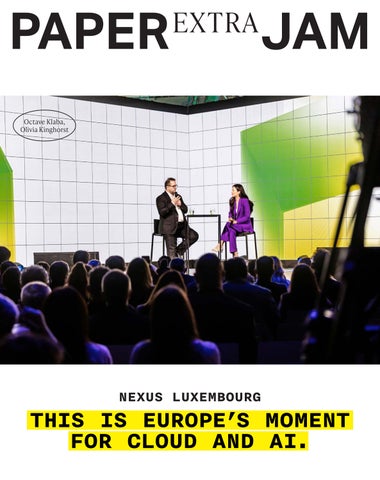
Octave Klaba, Olivia Kinghorst
NEXUS LUXEMBOURG
THIS IS EUROPE’S MOMENT FOR CLOUD AND AI.
WELCOME BUILDING AI, SOVEREIGNTY & GROWTH FOR EUROPE Three editions in, Nexus Luxembourg has confirmed what it set out to prove: that a curated, high-impact summit could become one of Europe’s premier gatherings for technology leaders, corporates, innovators, founders and policymakers. The 2026 edition, held on 10 and 11 June at Luxexpo The Box, delivered its strongest numbers yet: 9,600 attendees from 80+ countries, 400+ speakers, 85 exhibitors, 240+ startups and scaleups and 763 matchmaking meetings - with leaders from OVHcloud, Paytm, Nvidia, Mistral AI sharing the stage with senior European and Luxembourg policymakers. Positioned at the heart of the European Union and backed at the highest institutional level - the Government of Luxembourg, the City of Luxembourg, the Chamber of Commerce and Luxinnovation - Nexus Luxembourg has become Luxembourg’s largest international business event and a major B2B marketplace, turning two days of conversation into concrete opportunities. What continues to set Nexus Luxembourg apart is the diversity of its community. Government policymakers sit alongside established corporations, leading financial-centre players, dynamic SMEs, technology experts, thought leaders and an ever-growing contingent of startups and scale-ups. Students and researchers in AI, business and tech mingle with executives and investors from across Europe and beyond.
MIKE KOEDINGER CO-FOUNDER
2026
Each stakeholder arrives with distinct expectations, whether for policy dialogue, knowledge exchange or business opportunities - and Nexus Luxembourg succeeds precisely because it embraces that complexity and builds bridges across it. That momentum now carries a clear direction. For 2027, Nexus Luxembourg adopts a new baseline: Building AI, Sovereignty & Growth for Europe. Europe’s technological sovereignty has become one of the continent’s defining strategic challenges - the goal is not only to regulate innovation but to build and scale trusted European alternatives. Across five dimensions -Sovereignty as Product, Sovereign AI, Policy & Institutions, Financial Sovereignty and Procurement & Adoption - the 2027 programme will turn that ambition into an operational conversation, from Europe’s own AI infrastructure to the practical technology choices businesses and public institutions make every day. Nexus Luxembourg is more than a conference. It is a real catalyst - an accelerator of transformation and a platform for collaboration that reflects Luxembourg’s ambition to be at the crossroads of innovation internationally. The next chapter begins on 9 and 10 March 2027, once again at Luxexpo The Box. See you there.
KAMEL AMROUNE
LAURENT FUTIN
CO-FOUNDER
MANAGING DIRECTOR
003
NEXUS LUXEMBOURG
SOCIAL MEDIA
VDL.LU
Follow us on social media to stay up to date on events, news and reports
Follow all City of Luxembourg news, with updates several times a day. The site is available in English, French and German.
NEWSLETTER
HOPLR
Sign up for the City’s weekly newsletter and get our latest news (FR, DE or EN) delivered directly to your inbox.
Get in touch with your neighbours with this free app (App Store & Google Play).
CITYAPP-VDL Download the City’s free app to get real-time information (on buses, parking, etc.) that can be personalised to suit your needs.
STAY INFORMED, YOUR WAY Apps, magazines, newsletters, website, social media – get information about your city how you want it, when you want it.
CONTENTS
CHAPTER 1: AI: THE NEW INFRASTRUCTURE 010
Octave Klaba anticipates a new wave of investment in AI
016
Mistral AI scientist says AI agents need tools, memory and guardrails
012
020 022 024
Luxembourg’s AI sector celebrates its champions
Emmanuel Vivier: “Courage: the final safeguard against AI”
Slower, wiser, kinder: the UN’s vision for AI in crisis prevention AI at a Turning Point
CHAPTER 2: EUROPE’S DIGITAL SOVERIGNTY 028
Luc Frieden: “Sovereignty isn’t about borders”
036
Diplomacy, the new playground of tech giants
032
040 042
044
No country can control every layer of AI sovereignty: Nvidia’s Hempe Digital sovereignty: the European challenge of artificial intelligence
Key takeaways from Jean-Baptiste Kempf’s keynote speech Choosing Sovereignty
CHAPTER 3: REINVENTING FINANCE 046
Paytm founder: “Luxembourg can become Europe’s AI gateway”
052
Regulators contrast rules and self-discipline in digital finance
050
054 058 061
Stock options and digital lending: announcements by Gilles Roth Technology is no longer finance’s competitive edge
Luxembourg’s tokenisation race enters a new phase Banking on AI
CHAPTER 4: COMMUNITY & ECOSYSTEM 066
Picture Report
074
NTT: replacing electricity with light to power the AI revolution
080
Jason Lynch: “Europe can still win the quantum race!”
CHAPTER 5: DEEP TECH FRONTIERS 078 082
The race for mobility’s last mile: “We need to experiment fast and scale” Engineering the Impossible
CHAPTER 6: THE NEXT GEN BUILDERS 084
Startups & Scaleups Awards 2026
088
The defence team joins Fit 4 Start
086
090
Winning Is Just the Beginning
NXTGen Women in FinTech: Shaping Tomorrow’s Finance
CHAPTER 7: 2027, WHAT TO EXPECT 094 096
From strategic ambition to operational reality Get Involved
CHAPTER 8: BEHIND THE SCENES 099 102
2026
The People Behind Nexus Luxembourg Celebrating our partners
005
NEXUS LUXEMBOURG
NEXUS LUXE
IN NUM 900+
9,600+ attendees
guests at the Closing Seated Dinner
80+
countries
240+
Startups & Scaleups
PAPERJAM — EXTRA
80+
exhibitors
006
EMBOURG 2026
MBERS 400+
speakers
750+
Matchmaking Meetings
240+
conferences
6
stages
2026
007
NEXUS LUXEMBOURG
DRIVING BUSINESS FORWARD Accelerating your growth, expanding your horizons! The qualified team at the Luxembourg Chamber of Commerce supports your business development offering expert insights and training to ensure your success. Together we’re stronger!
@ccluxembourg | T (+352) 42 39 39-1 E info@cc.lu www.cc.lu
1
CHAPTER
AI: THE NEW INFRASTRUCTURE
AI is no longer a technology of the future. It is becoming the infrastructure powering economies, industries and societies. From sovereign AI and computing power to enterprise adoption and AI agents, Nexus Luxembourg 2026 explored how AI is reshaping competitiveness, industry and society. The following pages capture the key ideas and debates shaping this transformation.
2026
009
NEXUS LUXEMBOURG
OCTAVE KLABA ANTICIPATES A
NEW WAVE
OF INVESTMENT IN AI OCTAVE KLABA Thierry Labro, Journalist Julian Pierrot, Photograph
PAPERJAM — EXTRA
010
At the opening of Nexus Luxembourg at Luxexpo The Box, OVHcloud founder Octave Klaba said Europe was entering a “second wave” of investment in artificial intelligence, as technological and financial barriers were much lower than four years ago.
Invited onto the stage by journalist Olivia Kinghorst during the third edition of Nexus Luxembourg, Octave Klaba made technological sovereignty the focus of his speech. For him, ‘sovereign AI’ refers, above all, to ‘the ability to innovate, deploy and scale up artificial intelligence whilst retaining control over data, infrastructure and strategic choices’. The CEO reflected on the journey the company has taken since OVHcloud was founded in 1999, when he was still an engineering student. “This curiosity has taken us from hosting to the cloud, from the cloud to data, from data to AI, and probably tomorrow
2026
from AI to quantum computing,” he summarised. Twenty-seven years on, the group boasts a turnover of €1.2bn, 3,500 employees, 46 data centres, a presence in 16 countries and 250 megawatts of energy capacity across its infrastructure. Beyond the group’s growth, Octave Klaba focused particularly on developments in the artificial intelligence market. In his view, the first wave of investment launched at the start of the generative AI boom has profoundly transformed the global technology ecosystem. “Today, it is much easier to bring very good models to market,” he said. Four key elements combined The CEO of OVHcloud believes that the four key elements required for the development of AI – teams, algorithms, data and GPU infrastructure – are now more accessible. In particular, he highlights that scientific knowledge has advanced significantly thanks to publications in recent years and that the quality of data has become more important than its raw volume. “In the early days of AI, everyone thought that whoever had the most data would win. Now we know that it is the quality of the data that will make the difference,” he explained, referring in particular to the rise of synthetic data. According to him, changes in infrastructure costs are another major factor. “If you wanted to invest a billion four years ago, the equivalent today is between 100 and 200 million for the same, or even greater, capacity,” said Octave Klaba. A reduction in financial barriers that could pave the way for a new generation of European players capable of developing their own models and platforms. In this context, the founder of OVHcloud believes that Europe now has a real opportunity. “We have
011
the teams in Europe, we have very talented people,” he emphasised, whilst acknowledging the current dominance of American hyperscalers across a large part of the European cloud market. Aligning ‘capital, labour and execution’ The executive also highlighted the partnership strategy developed by OVHcloud to accelerate its expansion into sovereign AI. In particular, he cited the collaboration established with the Luxembourgbased company Deep to combine technology, market access and customer trust. This ecosystem-based approach has led OVHcloud, alongside its partners, to be selected by the European Commission to provide a sovereign cloud infrastructure. The interview also touched on Octave Klaba’s return to the helm of the group. Having served as CEO and CTO for 16 years, followed by seven years as chairman, the entrepreneur has resumed the role of CEO against the backdrop of the AI revolution. “This is a historic moment,” he explained, believing it necessary to align “capital, labour and execution” under a single leadership in order to speed up strategic decision-making. The businessman, who points out that he still holds around 80% of OVHcloud’s capital, now acknowledges that he wants to accelerate the group’s transformation in order to capitalise on opportunities related to AI. For him, the key question is: how to finance the massive investments needed to train models, refine them, bring products to market and generate enough revenue to then reinvest in the next phase of growth. “If you don’t make money, you can’t reinvest,” he concluded.
NEXUS LUXEMBOURG
LUXEMBOURG’S AI SEC CELEBRATES ITS CH Launched by FEDIL, in partnership with Luxinnovation and the Chamber of Commerce, the Luxembourg AI Excellence Awards reflect the strategic commitment to positioning AI as the new driving force behind the economy. This year, five projects were recognised.
notably through the “AI for Lux” initiative. She has committed to accelerating the roll-out of both the regulatory and technological aspects of the AI Act.
Marc Fassone, Journalist Julian Pierrot, Photograph
FEDIL has placed AI at the heart of its strategy, viewing it as a driver of competitiveness and economic transformation; a catalyst for growth, excellence and sovereignty. For the Federation of Industrialists, promoting it is an economic necessity. Paul Konsbruck, CEO of LuxConnect – a member company of FEDIL – highlighted the growing importance of artificial intelligence within Luxembourg’s industrial landscape and sees the Luxembourg Excellence Awards as a showcase for the creativity and technological responsibility of local businesses. Addressing the Minister of state for media and connectivity
PAPERJAM — EXTRA
Elisabeth Margue having come to preside over the awards ceremony, he called for European regulations that simplify and harmonise existing rules rather than adding to their complexity. “Europe must regulate better, not more.” The minister highlighted several points regarding the regulation of artificial intelligence in Luxembourg. She stated that she was listening to stakeholders in the sector and expressed a clear commitment to ensuring that regulatory processes are simplified. The government’s aim is to promote the rapid yet responsible adoption of AI within the country,
012
A sign of the economy’s growing maturity Launched in 2025 by FEDIL, in partnership with Luxinnovation and with the support of the Chamber of Commerce, the Luxembourg AI Excellence Awards aim to promote and recognise excellence in artificial intelligence in Luxembourg. For the second edition, 47 entries were submitted. According to Sophie Klecker, chair of the jury and project leader for AI & innovation at the Ministry of the economy, these entries “stood out for their diversity in terms of technologies and use cases, reflecting the ecosystem’s growing maturity. They reflect an increase in the adoption of AI across various sectors, with projects based on concrete applications and rooted in operational realities.” And the winner is… In the category “AI for Sustainability”, the prize went to “Mobile AI Waste Scanner (quality control in a box – QCB)” of CRAB traceability systems. This Luxembourg-based start-up, which specialises in artificial intelligence applied to the circular economy, has developed the Mobile AI Waste Scanner (quality control in a box – QCB), a portable and fully
ECTOR AMPIONS 1
1. 2. 3. 4.
The 5 category winners AI for Sustainability (CRAB traceability systems) AI for Finance (Plenty). AI Adoption (CargoLux Airlines International)
2
3
2026
4
013
NEXUS LUXEMBOURG
autonomous solution designed to transform quality control in waste streams. In the category “AI for Finance”, the prize went to “Third party provider management oversight” of Plenty, an artificial intelligence platform dedicated to the supervision of thirdparty service providers for regulated financial institutions. Fundvis’s RegTech solution places AI at the heart of the compliance framework by structuring the entire lifecycle of third-party service providers – including onboarding, due diligence, risk assessment, continuous monitoring and regulatory reporting – within a single, audit-ready environment.
In the category “AI Adoption”, the prize went to CargoLux Airlines International for its analytical tool, the “Cargolux AI Email Sales Parser”. Designed for sales teams, this agentbased artificial intelligence solution transforms unstructured customer emails into structured quotes in a matter of seconds, which can then be used directly by internal systems. Unlike traditional automation solutions, this approach relies on semantic reasoning to interpret complex and heterogeneous data, whilst directly integrating AI into a revenue-generating process. In the category “AI for Health”, the prize went to the company
5
5. 6.
UAI for Health (Techcyte Europe) AI Productivity (Younea) 6
PAPERJAM — EXTRA
014
Techcyte Europe for the development of Techcyte Fusion, a digital medical diagnostics platform based on artificial intelligence, designed to improve the detection of cancer, infectious diseases and a wide range of clinically significant conditions in pathological anatomy and cytology, particularly in parasitology, bacteriology, cytology and haematology. Initially developed in the United States, the platform is now based in Luxembourg, where Techcyte has had its key European functions in regulation, quality assurance, implementation and operations since 2017. In the category “AI Productivity”, the company Younea has been recognised for its “LuxAIaaS – Luxembourg’s AI-as-a-Service – Allin-one AI Platform”. This sovereign artificial intelligence platform is designed to automate customer and administrative communications at scale in multilingual and regulated environments. Requiring no technical expertise to deploy, the solution enables organisations to launch AI agents on the phone, chat and messaging platforms in a matter of minutes. See you in a year’s time Following the awards ceremony, Elisabeth Margue stated that “Luxem‑ bourg is equipping itself to make artificial intelligence a driver of positive transformation. “In their various categories, the winners have demonstrated that they are innovating rapidly to deliver services and products based on sustainable, human-centred growth. These successes highlight the AI expertise that already exists in Luxembourg.” FEDIL, Luxinnovation and the Chamber of commerce have confirmed that there will be a third edition of the Luxembourg AI Excellence Awards.
eIDAS 2.0 and the EUDI Wallet
Digital identity unlocked for banking and insurance The EUDI Wallet is opening new opportunities for banking and insurance. Rethink customer experiences, streamline processes, and unlock new value across the ecosystem.
For details & registration please visit:
2027 is the milestone. The opportunity starts now. Join us on Tuesday, 20 October for strategic perspectives and practical insights on turning the EUDI Wallet into a catalyst for transformation.
The event is designed for senior decision-makers across banking and insurance. Attendance is subject to registration approval, and places are limited.
© 2026 Deloitte Tax & Consulting, SARL
PIERRE STOCK
PAPERJAM — EXTRA
016
MISTRAL AI SCIENTIST SAYS AI AGENTS NEED TOOLS, MEMORY AND GUARDRAILS Mike Gordon, Journalist Julian Pierrot, Photograph
Companies need reusable “skills” around AI agents to capture work rather than repeat it, said Mistral AI’s Pierre Stock at Nexus Luxembourg.
2026
017
NEXUS LUXEMBOURG
An agentic model that spends 10 minutes finding its way through a task should not make the next employee repeat the same process, Pierre Stock, VP of Science Operations at Mistral AI, told Nexus Luxembourg. “You want the model to learn and to be way, way faster on that,” he said. Companies trying to use AI agents, Stock argued, will need more than stronger models. They will need tools, memory, guardrails, checks and reusable instructions around those models, so useful work does not vanish between one prompt and the next. Stock’s point was not that models are weak. It was that even powerful models need a workplace around them before they can operate reliably inside a company. Taught by replay Stock said AI agents are not a break from existing model architecture, but a way of making those models work through tasks more like a trained person would.
That starts when the model is shown how a qualified person would approach a task. “We essentially provide the model with a replay of what some domain expert would do,” Stock said. “This replay, so the question and the answer, and the steps to get to the answer, we call that an agentic trace or an agentic trajectory.” In simpler terms, the model is not just shown the final answer. It is shown the route an expert took to get there. In Stock’s crop example, an expert faced with signs of stress would not jump straight to a recommendation. They would look at the weather, check whether the problem was local, study imagery and test possible causes before deciding what to do. At that stage, Stock said, the model is not yet acting in the world. It is being shown the sequence a person would follow before later training lets the model try tasks itself. Stock linked those traces to accountability, saying they record mistakes, dead ends and
backtracking and can later be inspected to understand why a decision was made. “It’s essentially the model’s inner monologue,” he said. A stateless engine Once a model can imitate the steps of an expert, Stock said, companies still need a way to decide whether its answer can be trusted. For a mathematical task, that may be straightforward. For a report or another less clear-cut output, he said, a second model can be used as part of the checking process, judging whether the result meets defined criteria even though the process will not always follow exactly the same route. For business users, Stock said, the question is not whether a model reaches the same answer in the same way each time. It is whether the result is good enough for the job. The bigger problem is that the model itself does not remember the work it has just done. “The model is stateless, it doesn’t have any state,” he said.
You want the model to learn and to be way, way faster on that”
“
PIERRE STOCK
PAPERJAM — EXTRA
018
Around the model The harness, or scaffold, is what gives the model that surrounding structure. Stock used the terms for the layer built around the model: tools, memory, guardrails and rules for how the model moves through a task. “A harness, or scaffold, is everything that wraps a model,” he said. He compared that scaffold to a working desktop: a controlled environment where the model can use files, call tools and leave behind instructions rather than starting each task from an empty prompt. In Stock’s description, the model is not left to improvise alone. It works inside an environment built to guide it, check it and help it reuse what has already been learned. Skills, not retraining For Stock, the most important piece of that environment is what he called “skills”. Stock used the term to mean reusable instructions, written for both people and models, that capture how work should be done, when tools should be used and what experienced colleagues often leave unwritten. “What are skills? It’s essentially the documentation that you ever wish you would have written for a newcomer in the team, but you never did,” he said. A skill can contain best practice in a field, guidance on when a tool should or should not be used, and warnings that usually sit in an experienced worker’s head. In Stock’s slides, humans and agents co-author those skills so that an unknown procedure today can become a best practice tomorrow.
2026
€21BN
Source: Mistral AI, September 2026
That is why learning, in this context, is not the same as rebuilding the model. “Here learning is different from retraining,” Stock said.
Mistral AI’s valuation following its €3bn Series D funding round in 2026.
Retraining changes the model and requires heavy infrastructure. Updating skills changes the knowledge available to the model, allowing the system to keep what it has learned from work. A company could then move to a newer model while keeping those skills available to the system. For companies, that makes skills more than documentation: know-how that can be updated, improved and reused to guide AI systems through future tasks. The human bottleneck Stock linked the approach to industrial design and manufacturing, where work often moves through repeated solveand-check loops. In industrial design work, he said, agentic systems could reduce context-switching for engineers and help cycles move faster with less human intervention. That would not remove people from the process, but it would change their role. Instead of repeating each
019
intermediate step, engineers would spend more time defining problems, managing teams, challenging outcomes and deciding whether results are good enough. Stock said AI development now moves in cycles of roughly six months, far faster than the semiconductor industry’s traditional rhythm. As agents become more autonomous, their “flight time” – the period during which they can do meaningful work independently – is likely to grow from minutes to hours, days and weeks. In that scenario, companies will need people who can keep enough context to question agents working in parallel without checking every step themselves. Stock’s warning was not that AI agents are ready to run without oversight. It was that companies hoping to use them will have to build the working environment around them, not simply buy a stronger model.
NEXUS LUXEMBOURG
COURAGE THE FINAL SAFEGUARD AGAINST AI
Speaking at Nexus Luxembourg, Hub Institute co-founder Emmanuel Vivier said the debate over whether AI is a game-changer was already over. The technology and investment are there. The challenge lies elsewhere. “The scarce resource isn’t AI, it isn’t computing power, it isn’t energy. It’s courage.” he said. The courage to look beyond technological demonstrations and marketing hype. “Buying a few licences for AI assistants or conversational models doesn’t transform a business. That’s the easy part,” he insisted. The challenge, therefore, lies in reviewing processes, rethinking working methods and transforming organisations. This is a slower, more complex and often more political undertaking, as behind the tools quickly emerge issues of skills, training, recruitment and, at times, the redeployment of staff. To gauge the scale of the current momentum, Emmanuel Vivier pointed out that Meta, Alphabet, Amazon and Microsoft alone are planning to invest nearly $700bn by 2026. In relation to the US economy, the investment in AI infrastructure would represent 1.9% of GDP, compared with 0.4% for the Manhattan Project and 0.6% for the Apollo programme. Another indicator, he argues, illustrates the scale of the shift: this year, more data centre projects are said to have been launched than office projects.
At Nexus Luxembourg, Hub Institute co-founder Emmanuel Vivier told business leaders that the technology was ready and the capital committed; all they needed was the courage to reorganize.
Hugo Hirsch, Journalist Julian Pierrot, Photograph
PAPERJAM — EXTRA
020
E:
The question of a potential bubble was not sidestepped, with companies such as SpaceX, OpenAI, Anthropic and xAI preparing for IPOs with spectacular valuations. But for the speaker, the issue is almost secondary. “Even if not everything succeeds, there is an acceleration within the acceleration.” This wave of investment is fuelling the entire ecosystem, from chip manufacturers to energy suppliers, right through to models that see their capabilities double roughly every six months. From AI that converses to AI that acts For Emmanuel Vivier, this is where the real turning point lies. “2025 was the year when AI could converse. 2026 is the year when AI can take action.” The arrival of agents capable not just
EMMANUEL VIVIER
2026
of performing a one-off task, but of managing an entire process, connecting to a CRM or SAP system, reasoning and taking action using tools, is changing the nature of the game for businesses. Certain sectors appear to be particularly vulnerable to this trend. “Finance, law, insurance: you are the perfect target,” he said. Precisely because these sectors are regulated, standardised and structured, and therefore perfectly comprehensible to AI. However, the expert urged caution regarding promises of immediate gains. According to a study of the 40 largest French companies, the productivity gains observed currently range between 1% and 7% per year. These results may seem modest at first glance, but they can become significant over time. Provided, however, that the transformations are properly supported. “Never underestimate the effort required to drive change. Simply making tools available is not enough: training – and retraining – is also essential.” Luxembourg: a trusted jurisdiction It was undoubtedly when he mentioned Luxembourg that his message struck a chord with the audience. Whilst some see European regulation as a hindrance compared to the United States or China, Emmanuel Vivier sees it as a potential competitive advantage. Mastery of the GDPR, implementation of the AI Act, sector-specific regulatory expertise, digital infrastructure, multilingualism and political stability are, in his view, all assets that could position the Grand Duchy as a gateway to the European market. “Do you want to be a victim of AI or take advantage of it?” he asked.
021
According to the expert, these regulatory advantages are complemented by Luxembourg’s ability to serve as a testing ground. He specifically cited Pony.ai’s autonomous vehicles, for which the country became one of the first open-environment test sites in Europe at the beginning of June. “You don’t have to be big to be innovative,” he summed up. This optimistic view does not, however, prevent him from highlighting several limitations. AI relies on massive amounts of computing power, and therefore financial resources. As companies in the sector are required to demonstrate their profitability, usage costs are likely to continue rising, to the point where, in some cases, human labour will once again become competitive. “We are rediscovering that humans, sometimes, aren’t that expensive,” he observed. It is precisely this role of the human factor, he argues, that raises an even more worrying risk: the threat to junior staff. Automation primarily affects routine tasks that traditionally serve as a gateway into many professions. “If we no longer train junior staff, how will we ever have senior staff?” he warned, arguing for the retention of human oversight throughout the decision-making process. Despite these reservations, his conviction is summed up in a phrase he is fond of: ‘return on intelligence’ rather than return on investment. The technologies exist, the capital has been raised, and use cases are multiplying. The question remains whether leaders will be able to drive the necessary transformations… before the pace of change is forced upon them.
NEXUS LUXEMBOURG
SLOWER, WISER, KINDER: THE UN’S VISION FOR AI IN CRISIS PREVENTION XAVIER BETTEL
PEGGY HICKS
Louise Braibant, Journalist Julian Pierrot, Photograph
As conflicts multiply and humanitarian resources shrink, UN human rights official Peggy Hicks and Luxembourg Foreign Minister Xavier Bettel argued at Nexus Luxembourg that emerging technologies could identify risks earlier and improve responses—provided they remain anchored in human rights and political will.
PAPERJAM — EXTRA
022
The discussion began with a message from United Nations High Commissioner for Human Rights Volker Türk, who called for a more measured approach to technological development. “The unofficial slogan of the AI race so far has been bigger, faster, better,” he said. “To make technology truly work for people, we need a different approach: slower, wiser, kinder.” Türk warned that technological progress does not automatically translate into social progress. While innovation has the potential to expand access to healthcare, education and civic participation, it can also reinforce surveillance, discrimination and exclusion if developed without sufficient safeguards. He also announced the launch of a Global Alliance for Human Rights, aimed at bringing together all those who share a vision of a better future grounded in trust, freedom, stability, sustainability and shared prosperity. Prevention before crisis For Peggy Hicks, the conversation is no longer about future risks. “The reality is that we are already in this moment,” she said. The UN official pointed to a series of challenges linked to the rapid deployment of new technologies, including discrimination embedded in datasets, threats to privacy, disruption of labour markets, online hate speech and the growing use of AI in armed conflicts.
2026
At the same time, she insisted that these outcomes are not inevitable. “The harms here aren’t inevitable. They can be avoided,” she said. “It just requires work to get there.” While much of the global debate focuses on risks, Xavier Bettel emphasised the opportunities technology can create for humanitarian organisations facing increasing pressure. Recalling Luxembourg’s early investments in emergency.lu, the satellite communications platform used in disaster zones, he argued that innovation has long played a role in the country’s development cooperation strategy. “We have mess everywhere for the moment,” he said, referring to the growing number of international crises. “Countries cut the budgets. We ask them to work more, to be more efficient and with less money.” In that context, technology can help organisations analyse information more effectively and identify risks before they escalate into full-blown crises. “AI is an opportunity,” Bettel said. “It’s an opportunity to analyse, but also maybe to prevent because very often when you have a crisis, it is important to do prevention. If technology can be a partner, especially in prevention, I think we would be stupid not to do it.” He also argued that Europe should not leave the development of such tools to other regions. “I think the European continent has to take the leadership,” Bettel said. “I don’t want to be squeezed between Asia and the Americans.” The exchange was briefly interrupted by an audience member questioning the participation of Israeli start-ups at Nexus. Bettel responded that disagreements with government policies should not be extended to entire populations before the moderator brought the discussion back to its original topic.
023
That prevention dimension was echoed by Hicks, who highlighted ongoing cooperation between Luxembourg and the UN Human Rights Office. Through a project focused on human rights data, the partnership seeks to identify warning signs earlier and improve responses to humanitarian emergencies and conflicts. “How can we get those warning signals for conflict in a way that will allow us to bring in resources, predict where things will head and be able to respond to humanitarian crises in a better way?” she asked. Bridging the AI divide Beyond prevention, Hicks warned against what she described as a growing risk of an “AI divide”. Access to computing power and advanced technologies remains concentrated among a small number of countries and companies, raising concerns that the benefits of innovation could remain largely confined to wealthy economies. “We don’t want to create an AI divide where the only people that have access to the benefits are people in wealthy economies like the one we’re in now,” she said. Instead, she argued, technology should also contribute to addressing some of the world’s most pressing challenges, including poverty, healthcare and education. The discussion concluded with a reminder that technology alone cannot solve geopolitical crises. While better data and stronger analytical tools may improve prevention efforts, both speakers stressed that political choices remain decisive. “Political will is what is needed to go in the right direction,” Bettel said. Hicks echoed the need for political engagement, arguing that political will ultimately reflects what citizens ask of their governments.
NEXUS LUXEMBOURG
AI AT A TURNING POINT
Artificial intelligence is moving from experimentation to large-scale deployment. At Nexus Luxembourg 2026, leaders from industry, government and research agreed that Europe has a unique opportunity to build sovereign AI by investing in infrastructure, talent and trusted ecosystems. As AI agents become more autonomous and businesses rethink their operating models, the challenge is no longer the technology itself—but the ability to transform organisations responsibly, while ensuring AI remains secure, human-centred and aligned with European values.
AI ERA: CRITICAL THINKING IS BECOMING THE NEW LITERACY
EUROPE’S AI AMBITIONS DEPEND ON ENERGY INDEPENDANCE
AI: FIVE KEY FIGURES TO GAUGE THE STAKES FOR BUSINESSES
As AI becomes embedded across industries, the skills that create value are changing. At Nexus Luxembourg, entrepreneurs, investors and educators argued that while AI can automate tasks and generate knowledge, critical thinking, creativity and problem-solving are becoming the defining competencies of the future workforce.
Artificial intelligence is often presented as a race for talent, algorithms and computing power. But speaking at Nexus Luxembourg, mining entrepreneur Robert Friedland argued that Europe’s ability to compete in the AI era may ultimately depend on something far more fundamental: energy independence.
Already heavily exposed to artificial intelligence in finance, professional services and IT, Luxembourg is facing a new tipping point. Pierre-Adrien Grange (Microsoft) and Patrice Witz (PwC) emphasised that the question is no longer whether companies will adopt AI, but whether they will be able to capture its value before others do.
FULL ARTICLE
FULL ARTICLE
FULL ARTICLE
WATCH OUR YOUTUBE PLAYLIST: AI: THE NEW INFRASTRUCTURE
PAPERJAM — EXTRA
024
Photographs: Lux Photo Pro, Jordan Koening, Lux Photo Pro
READ MORE ABOUT AI: THE NEW INFRASTRUCTURE
PARTNER CONTENT
BOOST YOUR BUSINESS PRODUCTIVITY Live Intelligence is a flexible multi-assistant and multi-LLM AI solution that addresses your sovereignty concerns and enables you to deploy secure AI to support your business needs.
Photo: Imaginé par Orange, généré par l’IA
A flexible, AI-driven platform designed to meet your business needs and enhance operational performance. Unlocking Business Potential with Live Intelligence In today’s competitive landscape, agility and efficiency are crucial. Live Intelligence leverages Large Language Models (LLMs) combined with intelligent agents to provide real-time, customized insights. It enables teams to quickly adopt and utilize AI tools such as enterprise
assistants, specialized business AI assistants (for purchasing, sales, marketing, legal, HR, etc.), and the creation of personal or team assistants. Users can also select the most relevant AI models from a catalog. Reliable and highly secure, this GenAI solution complies with European regulations (GDPR, AI Act, Data Act). The Sovereign Space provides you with guarantees of sovereignty over your data through a Cloud infrastructure hosted in France.
Tailored for Your Business Every organization faces unique challenges. Live Intelligence is designed for flexibility, allowing customization of AI models and agents to match your strategic goals. This ensures the insights are relevant, actionable, and aligned with your specific context. Key Benefits –B oosted Productivity: Automate routine analysis, freeing resources for strategic tasks. –F aster Responses: Real-time insights enable immediate action, reducing downtime. –B etter Decisions: Data-driven insights support planning and operational adjustments. – Scalability: The platform evolves with your business needs. – Security: It guarantee a non-reuse of your data. Why Choose Live Intelligence? It’s secure, simple to deploy, adaptable to your needs, and integrates seamlessly with existing systems. Live Intelligence helps IT decision-makers implement AI solutions that are powerful, tailored, and easy to manage, addressing your core business challenges effectively.
CONTACT
www.orange.lu entreprise@orangeluxembourg.lu +352 27 888 288
SMOKELESS INNOVATION, MEASURABLE RESULTS A billion people still smoke worldwide despite decades of prevention campaigns. This public health challenge calls for innovative and more effective approaches. For more than a decade, BAT has been transforming its business with a clear ambition: to help build a smokeless world where cigarettes become a thing of the past. This transformation is driven by a strong commitment to reducing the health impact of our business by developing non-combustible
alternatives for adult smokers who would otherwise continue smoking. Through sustained investment in scientific research and a deeper understanding of consumer needs, we have developed a portfolio of smokeless products, including vaping products, heated tobacco products, and nicotine pouches.
The results are already visible. Over the past five years, the number of adults using smokeless products worldwide has increased by approximately 70%. In Japan, cigarette sales declined by 33% between 2018 and 2023, while heated tobacco products now account for more than 44% of the total tobacco market. In the United States, adult smoking prevalence fell from 18.1% in 2012 to 11% in 2023, according to CDC data. Sweden also demonstrates the potential of smokeless alternatives: thanks to the adoption of nicotine pouches, it is about to become the first country in the world to reduce smoking prevalence to the 5% threshold. Technological advances, particularly in digitalization, artificial intelligence, and automation, have played a pivotal role in this transformation. They enable us to improve product quality, strengthen safety standards, and deliver a better consumer experience. This transition is still far from complete. Since launching our first vaping product in 2013, BAT has evolved into a multi-category business. To sustain this momentum, we will continue investing in science, innovation, and sustainability to help build a smokeless world for the benefit of consumers, society, and the planet.
Innovation creates opportunities, but education is key to fostering understanding and accelerating adoption.
ASMOKELESSWORLD.COM
Photo: Jeroen Willems, Mind The View, 2025
PARTNER CONTENT
2
CHAPTER
EUROPE’S DIGITAL SOVEREIGNTY
As AI reshapes the global balance of power, digital sovereignty has become a key challenge for Europe. From sovereign AI and cloud infrastructure to digital identity and open technologies, Nexus Luxembourg 2026 explored how Europe can strengthen its technological independence while remaining open, innovative and competitive.
2026
027
NEXUS LUXEMBOURG
“ SOVEREIGNTY ISN’T ABOUT BORDERS” LUC FRIEDEN
CARLO THELEN
LYDIE POLFER
Thierry Labro, Journalist Julian Pierrot, Photograph
PAPERJAM — EXTRA
Opening the third Nexus Luxembourg, Prime Minister Luc Frieden called for “AI of Europe, by Europe and for Europe”. Alongside Lydie Polfer and Carlo Thelen, he advocated European technological sovereignty based on values, infrastructure and investment.
028
Luxembourg opened the third Nexus Luxembourg with the ambition of making Europe an AI leader alongside the United States and China. Prime Minister Luc Frieden, Luxembourg Mayor Lydie Polfer and Chamber of Commerce Director General Carlo Thelen championed technological sovereignty, infrastructure, investment and swift implementation. “Welcome to Luxembourg. Welcome to a pro-European, pro-business, pro-tech and pro-AI culture,” said Luc Frieden to the participants at Nexus Luxembourg. The head of government emphasised the need for Europe not to remain a bystander in the global race for AI. “This is not just a race between the United States and China. Europe has an important voice in this race,” he stated, calling for “AI of Europe, by Europe and for Europe”. The prime minister believes that AI must reflect European values. “Europe is known throughout the world for its values and principles: freedom, human rights, democracy and the rule of law,” he pointed out. “Progress needs meaning.” Luc Frieden also emphasised that AI should not replace humans but “help humans to be more efficient and make better decisions”. “Humans must make the final decision and will continue to do so,” he insisted, referring to “human dignity” as an “intrinsically European value”. Central to the government’s message was also the concept of technological sovereignty. “Sovereignty is not just a matter of borders. Being sovereign means being free to make one’s own choices,” said Luc Frieden. In the age of AI, he believes this means “controlling the data, the cloud, the models and the backend”. “The question is who owns the data, who operates the cloud and who builds the models.”
2026
“Promoting European leaders in strategic fields such as AI is not a protectionist argument.” The prime minister was careful, however, to distinguish this approach from a protectionist mindset. “I am not advocating a ‘fortress Europe’,” he stated. “Promoting European champions in strategic fields such as AI is not a protectionist argument. It is a pro-competition argument.” In his view, Europe must be able to offer “European alternatives capable of competing with foreign companies”. A balance between innovation and regulation Luc Frieden also advocated striking a balance between innovation and regulation. “AI cannot remain a completely unregulated environment,” he said, whilst warning against “over-regulation”. “We need general safeguards to ensure that AI solutions remain within a framework aligned with our values.” The head of government highlighted three priorities to ensure Europe can
“
hold its own in global competition: “Scale, speed and investment.” “We must be faster,” he insisted, calling on businesses to integrate AI “into their core operations” and on governments to stimulate demand through public procurement. He cited the contract signed by the Luxembourg government with Mistral AI as an example of this strategy, as well as several pilot projects designed to use AI to help citizens understand legislation or to map the skills available in the labour market. Luc Frieden also put the issue into a European financial context. “We have around €12trn in household savings sitting idle in European banks,” he pointed out. In his view, part of these savings should be redirected towards funding tech start-ups and AI, as part of the Savings and Investment Union (SIU). Carlo Thelen welcomes a €200bn European plan In a highly confrontational speech, Carlo Thelen He, too, placed digital
e have always been W successful in this country when we have adapted early on and opened up to the wider European market.” LUC FRIEDEN
029
NEXUS LUXEMBOURG
sovereignty at the heart of the debate. “AI is not just changing the way we work. It is changing who controls the infrastructure, the data and decision-making,” said the director general of the Chamber of Commerce. “If Europe’s critical systems rely on models built and controlled elsewhere, then Europe does not truly control its own future.”
AI ADOPTION IN EUROPE, TOP 5
42.0
37.8
35.0
34.5
33.6
SWEDEN
BELGIUM
LUXEMBOURG
“The United States has developed 40 [fundamental AI] models, China 15, and Europe, as a whole, three. That’s not a gap; it’s a chasm.”
PAPERJAM — EXTRA
DENMARK
FINLAND
Share of enterprises using AI technologies, 2025.
“Last year, I said that we must be builders, not users. Today, I’m going one step further: we must be builders, not passengers.” Crucial international matches Lydie Polfer emphasised the international role that Luxembourg’s capital is seeking to play in technology and innovation. The mayor welcomed the presence of numerous foreign delegations and reiterated that the City of Luxembourg wished to continue supporting initiatives that would strengthen the country’s economic and technological appeal. She also highlighted the importance of the
030
international meetings organised as part of Nexus in connecting businesses, start-ups, investors and public institutions. The official opening of Nexus Luxembourg has thus confirmed the Grand Duchy’s position as a European hub seeking to combine technological sovereignty, international appeal and European integration. “We have always succeeded in this country when we have changed early on and opened up to the wider European market,” noted Luc Frieden, citing steel, the media, satellites and investment funds in turn. “We will do the same with AI and technology.”
Source: Eurostat
Carlo Thelen hailed the European plan to invest €200bn in AI as “a historic initiative” aimed at strengthening European technological sovereignty. He also cited the recent €180m tender awarded by the European Commission to several European sovereign cloud providers, including Luxembourgbased companies. The business leader particularly emphasised Europe’s lag in fundamental AI models. “The United States has developed 40 models, China 15, and Europe, as a whole, three,” he said. “That’s not a gap, it’s a chasm.” For Carlo Thelen, European sovereignty “does not mean isolation”. “It means having the ability to make our own choices and to engage with the world on our own terms and according to our own values.” The Director General of the Chamber of Commerce also highlighted Luxembourg’s investments in high-performance computing, AI and quantum computing, referring in particular to the future AI-optimised supercomputer expected in early 2027. “We have the right blueprint, but now we need to build the house,” he summarised, noting that the widespread adoption of AI by Luxembourg companies was still insufficient.
PARTNER CONTENT
E-INVOICING: DEADLINE OR TURNING POINT?
Photos: Odoo
Businesses in Luxembourg will have to comply with new e-invoicing legislation. While many companies purely see it as a regulatory obligation, Odoo reframes it as an opportunity to digitize operations.
When a mandatory requirement becomes an opportunity Luxembourg has finally set a timeline for mandatory electronic invoicing, requiring all businesses to receive e-invoices starting in January 2028. Mid- and large-sized companies must also issue them by that date, while small businesses have until January 2029 to complete the transition. Having already navigated similar compliance rollouts in Belgium and France, Odoo’s key takeaway is clear: companies that treat e-invoicing as a mere regulatory chore rather than an opportunity to digitize all workflows end up paying twice. Odoo lived the Belgian deadline alongside its customers, and two approaches stood out.
Companies that bolted a converter onto an unchanged process achieved compliance and nothing else. Companies that let structured data flow into their ERP stopped re-keying supplier invoices, matched them automatically against purchase orders, and shortened payment cycles. The same law and the same deadline yielded very different returns. Making a business decision that can outperform initial expectations Odoo made e-invoicing native rather than an add-on. The software is a certified Peppol access point for Belgium and Luxembourg, is a registered "State-approved Platform” in France, and makes all the necessary developments country by country across Europe. With no middleware, no per-document fee, and no separate platform, Odoo provides an all-in-one solution designed to meet compliance requirements and business needs. Ultimately, e-invoicing is what a company makes of it. By choosing a comprehensive ERP with built-in Peppol integration rather than a temporary patch, businesses can satisfy Luxembourg’s legal mandates while unlocking real operational efficiency and long-term value.
TRY ODOO FOR FREE NOW
NO COUN EVA-MARIA HEMPE
CAN CONTROL EVERY LAYER OF AI SOVEREIGNTY PAPERJAM — EXTRA
032
NTRY
infrastructure build out in human history”, with data centre projects “springing up everywhere”. She linked the investment to three factors: economic growth, security and sovereignty. Compute capacity, she stated, would be “one of the foundations for future economic growth”. On security, Hempe cautioned that foreign AI infrastructure had become a strategic issue as geopolitical tensions increased. “We are getting much more in the age of increasing geopolitical tensions,” she noted, adding that there was “a lot more nuance about what dependencies there are, and to which degree you can or cannot rely on foreign AI infrastructure as a category of strategic risk.” For sovereignty, she argued that the issue was control over technologies that shape public life. “If you think about a simple LLM, an LLM carries values inside it,” Hempe stated. “The data it has been trained on, the way it has been trained, embeds certain values inside that model.” She warned that this mattered when large language models were used in schools or by public servants to support decisions. “These values are becoming part of the decision-making process, and hence it is important for nations to ensure that their values are embedded in the technology they’re using,” she remarked.
Nvidia’s Eva-Maria Hempe argued that AI sovereignty is not about controlling everything, but about understanding dependencies across energy, chips, infrastructure, models, data and applications. Kangkan Halder, Journalist Lux Photo Pro, Photograph
Nvidia’s Public Sector Executive Director for EMEA, Eva-Maria Hempe, warned at Nexus Luxembourg that no country controls every layer of the AI stack. AI sovereignty, she said, is “not a monolithic concept” but a “multi-layer concept”. “What it does not mean is that you have to control every single layer, because I would argue no country in the world right now controls every single layer,” Hempe stated.
2026
She added that the issue was “really more about being aware of the different layers, how they interact, and then making very strategic and very informed choices about potential dependencies and how you manage them.” Sovereignty as dependency management Hempe described the global AI infrastructure build-out as “the largest
033
The five-layer stack Hempe presented AI sovereignty as a five-layer stack starting with energy, followed by chips, infrastructure, models and data, and applications. “It all starts with energy,” she stated, while adding that even countries with strong energy systems had dependencies. “Nobody is truly sovereign. France has great nuclear power stations, but France doesn’t have that much uranium to run them on.”
NEXUS LUXEMBOURG
The same applied to chips, she observed. Nvidia’s chips are designed in Silicon Valley, produced in Taiwan by TSMC, use machines from Dutch company ASML and rely on mirrors made in Germany. “We have a per se global supply chain also in this level of stack,” Hempe noted. The infrastructure layer included “land, power delivery, cooling, networking, but basically data centres”, while the upper layers covered “the models and the data that feeds the models” and the applications built on top. Europe’s compute gap Hempe pointed to Europe’s limited share of AI computing power as a central sovereignty challenge. She stated that US hyperscalers accounted for 56% of global AI computing power, while other US players accounted for 40%. Europe, by contrast, had 4% of AI computing power in last year’s figures, rising to around 5%. “That’s not a lot,” Hempe remarked. “AI is going to be so essential for economic growth, for security, and for sovereignty.” She added that more than 90% of frontier AI model capabilities originated from US companies, while Europe spent more than $12bn per year on US hyperscale infrastructure. “In general, there is growing demand in Europe,” she observed. “There’s so much talent in Europe, there is money in Europe, so we really have an opportunity in our hands to have a sovereign AI future for Europe across the different layers of the stack.” Every choice has a trade-off Hempe cautioned that the infrastructure layer gave organisations several choices, but none represented full sovereignty. One option was to use
PAPERJAM — EXTRA
hyperscalers and consume AI “off the tap”. Another was to use hyperscaler data centres physically located in Europe. A third option was to use European neo-cloud providers with “often enough higher sovereignty layer”. At the far end was the “fully air-gapped on-prem data centre”. “All of these choices are perfectly legit,” Hempe stated. “You just have to make an informed decision.” She argued that organisations had to decide “what are you trying to do, what is important to you, what are the trade-offs between cost, between performance, between risk, and what’s also your assessment of risk.” Hempe said similar trade-offs applied to the model layer. Closed frontier models could be consumed through an API, while open-weight models could be downloaded and run locally. “Open weights is great, it gives you a lot of great options,” she acknowledged, adding that such models could be run in “your air-gapped super secure defence bunker” so that data “is never going to leave the premises”. But she cautioned that open weights did not remove all uncertainty. “The thing about open weights, it’s still a black box,” Hempe warned. She said the alternative was to take openness further through open data. “Now your black box becomes a transparent box, something you know what went into it,” Hempe explained. “It’s still not fully deterministic, but if you know what data was used to train your models, you have a lot more insight into how this model will operate when you’re actually using it.” For schools, for example, she argued, transparency over training data would be especially important. “If I want to use a model in schools to use in lectures about history, I would
034
very much like to know what version of history went into training this model,” Hempe remarked. Building blocks, not full control Hempe concluded that AI sovereignty required national compute infrastructure, open models with open weights and open training data for certain applications, and deployment and governance capabilities. “For certain applications, you have transparency requirements,” she stated. “You have to be able to disclose why decisions are made the way they are.” But she cautioned that infrastructure alone is insufficient. “It’s not enough to just put some GPUs on a field somewhere,” Hempe warned. “You need to know how to use them, you need to build the capabilities, need to build the knowledge, need to build knowledge also on the regulatory side.” Her message was that AI sovereignty is not absolute control, but a set of informed choices across a stack where every country and organisation faces dependency. “You just need to know what you’re trying to do and what you’re willing to give,” Hempe concluded.
PARTNER CONTENT
SOVEREIGN INNOVATION AT THE HEART OF CHANGE Innovation, security and performance: discover how NSI experts help clients stay ahead in a sovereign digital environment. At NSI, we believe that no technology can create value without the people who envision, build and support it. Our strength lies in selecting committed, curious professionals who are ready to take on ambitious challenges. This culture of commitment enables us to address strategic priorities: digital transformation, data, artificial intelligence, cybersecurity,
infrastructure modernisation and process automation. We operate where technology meets business needs and drives organisational performance. To support this evolution, NSI has invested in a sovereign AI cloud infrastructure in Luxembourg. This investment gives our clients access to the latest AI innovations while keeping
Photo: NSI Luxembourg
“ Because beyond technology, people and culture make the difference.” MANUEL PALLAGE CEO
control of their data and meeting the highest regulatory and compliance requirements. We are committed to combining innovation, security and digital sovereignty. Beyond technical expertise, our teams foster a close relationship with clients – a defining part of NSI’s DNA. We take the time to understand their realities, engage with users and work alongside business teams. This understanding enables us to deliver pragmatic solutions tailored to each context. With one of Luxembourg’s broadest ranges of expertise, we bring together specialists capable of supporting large-scale projects from strategy through to implementation. Our annual presence at NEXUS Luxembourg reflects this belief: the most ambitious transformations emerge from the meeting of committed talent, strong expertise, trusted infrastructure and a shared drive to innovate.
DISCOVER NSI LUXEMBOURG PSF
DIPLOMACY, THE NEW PLAYGROUND OF TECH GIANTS
Can diplomacy still be left solely to states? For Dr Tawfik Jelassi, Assistant Director-General for Communication and Information at UNESCO, speaking in a personal capacity, the answer is unequivocal. “Digital governance is not the business of states alone. Nor is it the sole responsibility of regulators. It concerns civil society, universities, research institutions and the private sector because digital technologies affect all of us,” he said, adding: “The digital world is global and borderless. We therefore need a space for dialogue to develop international standards that can govern it ethically.” The UNESCO official argues that the United Nations--the only organisation bringing together 193 states--should serve as the natural framework for global digital governance, beyond regional approaches such as those of the European Union or the Organisation for Economic Co-operation and Development (OECD), while involving all relevant stakeholders. “Digital issues must be addressed through an inclusive and genuinely multi-stakeholder approach,” he insists. For Ayumi Moore Aoki, founder and president of the Tech Diplomacy Global Institute, tech diplomacy begins with a set of fundamental questions: who owns data? Who controls it? Who sets the rules for artificial intelligence? And who owns the submarine cables connecting digital infrastructure around the world?
Souada Kermani, Journalist Julian Pierrot, Photograph
Elon Musk, Mark Zuckerberg, Sundar Pichai. None of these names appears in any international treaty, nor do they represent a nation-state, but the decisions they make regarding algorithms, data and digital infrastructure are reshaping diplomatic practice. At Nexus Luxembourg, a UN expert, policymakers and business leaders discussed the challenges and opportunities of this new form of diplomacy.
PAPERJAM — EXTRA
A new diplomacy with many faces From there, she distinguishes between diplomacy ‘about’ technology: how countries come together around a table and agree on rules for the governance of technologies, such as, for example, the European Union’s Artificial Intelligence Act (EU AI Act)
036
or the Global Digital Compact adopted by the United Nations. ‘Technology diplomacy’ refers to the relationship between governments and technology companies. It is worth noting that the world’s first technology ambassador, the Dane Casper Klynge, was not posted to a country but to Silicon Valley, with the aim of engaging with companies such as Google, Microsoft and Meta. That was in 2017. ‘Technology-driven’ diplomacy refers to the way in which digital infrastructure and capabilities can become instruments of foreign policy. “Even without having a Google or a Huawei, a country like Luxembourg can use shared infrastructure, such as a data embassy, to build trust and develop its bilateral relations,” she emphasises. For Ayumi Moore Aoki, this kind of diplomacy is now more necessary than ever. She is particularly concerned about the influence of figures such as Elon Musk and Mark Zuckerberg. “These individuals can pose a danger because they wield enormous power. They make decisions that affect the future of countries, security and our data. This affects not only international relations, but also world peace.”
LAURENT MOSAR MANUEL SCHIAPPA PIETRA
She believes that discussions on digital governance remain too onesided. “There’s a lot of talk about Europe, the United States, and China, but it’s still very much a Northern Hemisphere conversation.” In her view, true global technological governance requires greater inclusion of countries from the Global South in discussions and decision-making processes. In Luxembourg, regulation is necessary, but there is a real risk of over-regulation. According to Laurent Mosar, Member of Parliament, “within the European Union, we often tend to regulate first and then try to innovate afterwards.” The lawmaker is more optimistic than some observers about Europe’s capabilities in this area. In his view, Europe has real strengths, including its financial clout, its fintech ecosystem, its talent pool, and its regulatory expertise. “Europe is in a much better position than people think,” he says, provided these advantages are translated into investment and innovation. For Manuel Schiappa Pietra, “sovereignty does not mean building everything ourselves; in the long run, we would lose the race”. In his view, the real issue lies elsewhere:
DR TAWFIK JELASSI AYUMI MOORE AOKI
ensuring control over data, regulations, tax systems and decision-making authority. “Every country must do its own work on data protection to make it operational between the government and the private sector. It is not just a question of technology; it is a question of culture and national identity.” Infrastructure and energy: the foundations of sovereignty Several speakers emphasised that no artificial intelligence strategy can succeed without the necessary infrastructure. According to Laurent Mosar, Europe must look beyond legislation and invest in digital economy infrastructure. “Without data centres, without the cloud and without energy, we can forget about AI.” This observation sometimes meets with local resistance, even though these infrastructures have become a matter of national sovereignty. He also points out that Luxembourg was a pioneer in concluding an agreement aimed at developing the use of artificial intelligence in the public sector. Another advantage Luxembourg has, according to Laurent Mosar, is financing. Thanks to its status as an international financial center and its expertise in fund management, the Grand Duchy could become one of the main drivers of AI financing. “Luxembourg could eventually become a kind of ‘European AI bank’!” he exclaims...
MARIA TADEO
FULL ARTICLE
2026
037
NEXUS LUXEMBOURG
PRACTICA HOW TO INTEG SOVEREIGNTY RESILIENCE Faced with increasingly sophisticated ransomware attacks, infrastructure outages and global geopolitical tensions, resilience has become a priority for executive committees. Yet one major gap remains in many business continuity plans (BCPs): the absence of digital sovereignty. Designing for resilience without incorporating sovereignty is like building a vault whose key belongs to a third party. If a political event or an extraterritorial law blocks access to your infrastructure, your data — even if it remains intact — becomes inaccessible. To avoid this trap, here is a practical roadmap for placing sovereignty at the heart of your resilience strategy.
STEP 1.
MAP AND CLASSIFY YOUR DATA BY CRITICALITY Trying to protect everything to the same level is both an economic and operational mistake. The first step is to identify where your organisation’s most vital value lies. The “masterpiece” principle: Just as you would protect a masterpiece differently from the rest of your furniture, you need to isolate your ultra-critical data, including customer files, intellectual property, accounting records and payroll systems. These assets underpin your sovereignty. The durability assessment: Evaluate how well your current systems can withstand physical failure or the silent degradation of hard drives, known as bit rot. Require your providers to make a clear, measurable commitment regarding data durability.
AL GUIDE: GRATE DIGITAL Y INTO YOUR E STRATEGY
PARTNER CONTENT
STEP 2.
STEP 3.
Overall business resilience depends not only on your own servers, databases and applications, but also on your entire interconnected ecosystem.
To ensure that neither a hacker nor an external geopolitical decision can paralyse your recovery operations, your storage architecture must incorporate three fundamental security safeguards, ideally operated in partnership with trusted providers:
AUDIT THE LEGAL AND HUMAN DEPENDENCIES ACROSS YOUR ECOSYSTEM
Legal dependency and extraterritoriality Requiring your data to be physically located in a data centre in France is not enough if the operator is a subsidiary of a group subject to the US CLOUD Act. Your audit must confirm that your partner’s code, infrastructure and ownership structure are governed exclusively by European law. Human dependency and technology choices Avoid building your resilience on highly complex, “raw” opensource solutions with no vendor support. If two or three key people leave your IT department, you may lose control of your systems. Give preference to Open Composability — open, transparent and transferable code — backed by a sovereign partner capable of ensuring continuity of expertise.
DEPLOY THE TECHNICAL TRIAD OF SOVEREIGN BACKUP
1. Immutability (S3 Object Storage): Your backups are locked. Even in the event of a major intrusion involving privilege escalation, an attacker cannot alter or delete your data. 2. Air Gap: A second copy of your data is stored in a completely sealed and isolated environment that is invisible from your primary network. 3. Green Room (recovery environment): In a crisis, you must be able to rapidly rebuild your critical applications — such as payroll or sales management — on dedicated, sovereign and ready-to-use cloud infrastructure.
FIND OUT ABOUT STEPS 4 AND 5 IN THE REST OF THE ARTICLE ON OUR WEBSITE
NEXUS LUXEMBOURG
MARIO GROTZ
OLIVIER DEBEUGNY
PATRICK LAURENT EVA-MARIA HEMPE
Marc Fassone, Journalist Lux Photo Pro, Photograph
DIGITAL SOVEREIGNTY: THE EUROPEAN CHALLENGE OF ARTIFICIAL INTELLIGENCE
PAPERJAM — EXTRA
040
Faced with American and Chinese dominance, Europe is seeking its own path towards artificial intelligence that aligns with its values and strategic interests. Gathered at Nexus Luxembourg, Eva-Maria Hempe, Mario Grotz, Olivier Debeugny and Patrick Laurent explored the obstacles to be overcome and the levers to be activated in order to foster the emergence of a competitive, sovereign and trustworthy European AI. Eva-Maria Hempe is Nvidia’s public sector executive director for EMEA. Olivier Debeugny is the CEO and founder of Dragon LLM. Together, they discussed ways of achieving a sovereign AI that respects European values, particularly with regard to the protection of citizens. A debate led by Patrick Laurent, partner, chief technology & transformation officer at Deloitte Luxembourg. For them, European sovereignty will not be an ‘all-or-nothing’ proposition, but rather a nuanced management of interdependencies. Thus, the question of sovereignty in artificial intelligence cannot be reduced to mere technological independence from actors who provide both the infrastructure and the tools. The debate would instead centre on Europe’s ability to make informed strategic choices at every layer of the technology stack. For businesses, this means strategic autonomy to avoid being locked into single solutions. For governments, it is about controlling the dissemination of knowledge and the cultural influence conveyed by the models. Together, they have identified several structural and regulatory obstacles that are holding back European momentum.
2026
The obstacles to sovereign AI First and foremost is the dominance of foreign models. Today, more than 50% of the models downloaded from platforms such as Hugging Face are of Chinese or American origin. The second obstacle is regulatory in nature. Although the EU AI Act is seen as a necessary framework for safety and trust, the uncertainty surrounding the rules – particularly regarding the protection of intellectual property (IP) during model training – is a cause for concern among creators. A misguided focus on training rather than outcomes could prompt developers to exclude European data to avoid complex legal risks. Access to resources for SMEs is identified as the third obstacle. Whilst large corporations manage to cope, small businesses struggle to access the market and computing power, whilst facing fierce competition from US digital services that capture hundreds of billions of euros in European spending every year. The final obstacle highlighted is the transition from research to industry. According to the speakers, there is a barrier between academic infrastructure (supercomputers) and the private sector. Adoption remains
041
the major challenge, as universities are not always accustomed to collaborating with businesses. Ways forward for sovereign AI In the face of these challenges, experts suggest several courses of action to strengthen Europe’s position. Firstly, focusing on specialisation and small language models (SLMs). Rather than seeking to dominate the global market for general-purpose models, Europe should focus on smaller, specialised and efficient models (Small Language Models). The use of proprietary data specific to European industries (finance, healthcare, manufacturing) offers a unique competitive advantage in creating real AI for real-world problems. Open source is seen as a driver of autonomy. The adoption of openweight models is considered crucial. It enables companies to build on existing foundations and fine-tune them locally, thereby ensuring that data and know-how remain within Europe. These models are also perceived as more explainable and more secure, potentially requiring lighter regulation. Europe has invested heavily in supercomputers such as Meluxina in Luxembourg. The next step would be to transform these capabilities into AI Factories that businesses can access in record time (sometimes within a matter of days) to test and deploy models. The focus must be on a trusted, certified infrastructure capable of handling sensitive data. This is a niche in which Luxembourg has positioned itself with its AI Factory...
FULL ARTICLE
NEXUS LUXEMBOURG
At Nexus Luxembourg, VLC president and European open-source leader Jean-Baptiste Kempf assessed Europe’s technological dependence, artificial intelligence and the levers available to regain control. Here are his five key messages.
Hugo Hirsch, Journalist Julian Pierrot, Photograph
JEAN-BAPTISTE KEMPF
5 KEY TAKEAWAYS FROM JEAN-BAPTISTE KEMPF’S KEYNOTE SPEECH PAPERJAM — EXTRA
042
1.
2.
3.
First paradox: Jean-Baptiste Kempf begins by deconstructing the very concept of digital sovereignty. In his view, no modern economy can function in isolation. “You didn’t get up at 4am to make your croissant,” he tells the audience. The challenge, therefore, is not to be completely independent, but to be aware of one’s dependencies and to retain the ability to change them. However, in the digital sector, many companies have accepted a model of exclusive dependence: a single cloud provider, a single operating system, a single office suite. He considers this situation to be abnormal. “If you did that in the automotive industry, people would think you were mad.” In his view, the acquisition of VMware and the subsequent price rises illustrate the risks associated with this concentration. Given that Europe spends nearly $300bn a year on US technology companies, the issue of diversification is becoming a strategic priority.
With generative AI, the issues surrounding dependency take on a whole new dimension. Until now, outsourcing cloud or email services was primarily a cost-benefit decision. Now, however, it is customer data, internal processes and, in some cases, the very know-how of organisations that are being channelled through these tools. “You don’t always know where your data is going or how it is being processed,” he warns. Added to this is an industrial challenge. The infrastructure required for AI development is reaching unprecedented levels. Whereas a server rack consumed around 10kW a few years ago, AI-dedicated equipment can now consume up to 600kW. For Kempf, companies that remain on the sidelines run the risk of gradually losing control of their own tools. “If you don’t understand what’s happening with AI, you’re done for,” he sums up.
To those who regularly proclaim the death of open source in the face of tech giants, Jean-Baptiste Kempf counters with his own experience. VLC was supposed to disappear with the advent of streaming. The major proprietary AI models seemed destined for unchallenged dominance. Yet open alternatives are gradually emerging, such as DeepSeek. For him, this phenomenon is almost inevitable. When a technology becomes essential, a community always ends up making it its own. He sums up this logic using a culinary metaphor: it’s better to have the recipe for the cake than to depend on the person selling it. If the baker triples his prices overnight, you still know how to make it yourself.
DIGITAL SOVEREIGNTY IS A RED HERRING
ARTIFICIAL INTELLIGENCE IS CHANGING THE NATURE OF RISK
4.
EUROPE ALREADY HAS WHAT IT TAKES He believes that the problem facing Europe is not a lack of skills. He argues that the example of ASML in the Netherlands illustrates the continent’s industrial potential. The company is currently the only one in the world capable of producing the machines used to manufacture the most advanced microchips. Europe is also home to some of the world’s leading expertise in electronics, semiconductor design and software development. Yet, he laments, the continent has gradually allowed some of the value created to slip away. “We collectively decided it was too difficult. So we handed all the money over to the Americans.” Rebuilding certain technological capabilities will require significant investment. But for Kempf, the real issue is not a financial one. It is, above all, a matter of political and strategic choices.
2026
043
OPEN SOURCE ALWAYS FINDS ITS PLACE IN THE END
5.
EUROPE SHOULD TAKE INSPIRATION FROM THE OPENSOURCE MODEL The final message is also the most political. How can a common digital strategy be developed among 27 Member States with sometimes divergent interests? For Jean-Baptiste Kempf, open source already provides part of the answer. For decades, thousands of developers across the globe have been collaborating on joint projects despite their cultural, linguistic and geographical differences. What they have in common is a shared goal. It is precisely this ability to cooperate on the basis of shared interests that the European Union must strengthen.
NEXUS LUXEMBOURG
CHOOSING SOVEREIGNTY
Digital sovereignty has become one of Europe’s defining strategic challenges. Throughout Nexus Luxembourg 2026, policymakers, industry leaders and technology experts argued that sovereignty is not about isolation, but about making informed choices—investing in trusted infrastructure, securing data, fostering open technologies and building competitive European alternatives. From AI governance and cloud infrastructure to open source and digital diplomacy, the message was clear: Europe’s future competitiveness depends on its ability to innovate while remaining in control of the technologies shaping its economy and society.
SOVEREIGN CLOUD BECOMES A STRATEGIC IMPERATIVE IN EUROPE
LUXEMBOURG OPENS SECURE ROUTE INTO PUBLIC-SECTOR DATA
DIGITAL IDENTITY: BETWEEN STATE CONTROL AND INDIVIDUAL AUTONOMY
As geopolitical tensions, cybersecurity risks and AI adoption reshape priorities, sovereign cloud is moving from a compliance issue to a strategic one. At Nexus, industry leaders argued that digital sovereignty is increasingly about resilience, operational continuity and Europe’s ability to reduce critical technological dependencies.
Luxembourg is moving its public-data strategy into operation with LetzData, a new system designed to let public-sector data be reused securely for citizens, companies and research, Digitalisation Minister Stéphanie Obertin told attendees on the second day of Nexus Luxembourg.
At Nexus Luxembourg, experts and politicians exchanged views on digital identity. Whilst the future European digital wallet promises harmonised and secure identification, other models focus on citizens’ sovereignty and direct control over their data. Debate.
FULL ARTICLE
FULL ARTICLE
FULL ARTICLE
WATCH OUR YOUTUBE PLAYLIST: EUROPE’S DIGITAL SOVEREIGNTY
PAPERJAM — EXTRA
044
Photograph: Aurélien Lacroix
READ MORE ABOUT EUROPE’S DIGITAL SOVEREIGNTY
3
CHAPTER
REINVENTING FINANCE
Finance is entering a new era — digital, data-driven and increasingly intelligent. From AI and tokenisation to digital assets and regulation, Nexus Luxembourg 2026 explored the technologies transforming finance and reinforcing Luxembourg’s role at the heart of Europe’s digital financial ecosystem.
2026
045
NEXUS LUXEMBOURG
VIJAY SHEKHAR SHARMA
“LUXEMBOURG CAN BECOME EUROPE’S AI GATEWAY” PAPERJAM — EXTRA
046
Luxembourg could become Europe’s gateway for AI-driven financial services by combining regulatory agility, financial expertise and innovation, Paytm founder Vijay Shekhar Sharma said at Nexus Luxembourg. The country has “every star aligned” to lead the next wave of fintech.
Anissa Maamri, Journalist Virginie Willemet, Photograph
Luxembourg has a rare opportunity to become Europe’s leading hub for artificial intelligence in financial services. That was the message delivered at Nexus Luxembourg by Vijay Shekhar Sharma, founder and CEO of Indian fintech giant Paytm, and reinforced by David Shrier, one of the architects behind the Luxembourg government’s advisory work on AI and finance. For both men, the ingredients are already in place. The challenge now is execution. “The probability of Luxembourg becoming the gateway for AI in Europe is so high,” said Vijay Shekhar Sharma. “Every star is aligned. You have regulators, you have government, you have people, you have economic agility. It is Luxembourg’s to win and Luxembourg’s to lose.”
2026
Coming from the founder of one of the world’s largest fintech platforms, the statement carries weight. Paytm has become one of the defining success stories of digital finance, helping transform payments across India and serving hundreds of millions of users. Building a giant by solving one problem Looking back on Paytm’s origins, Sharma argued that successful technology companies are built differently from traditional businesses. “As a technology entrepreneur, you always go back to first principles,” he said. In Paytm’s case, the problem was straightforward: enabling even the smallest merchants to receive digital payments. The solution was the now ubiquitous QR code. What started
047
as a tool for small street vendors evolved into a payment infrastructure capable of processing millions of transactions every day. According to Sharma, payments are not simply a financial product. They are the foundation upon which entire financial ecosystems can be built. “Payment is the most intimate way for two people to talk to each other in financial language.” The real value lies not only in the transaction itself, but in the data it generates. Traditional banks build relationships around deposit accounts. Fintechs build relationships around transaction flows. “A transaction account is superior to a bank account because you get to know what a person does.” That information can then power lending, insurance, savings products and increasingly AI-driven financial services. Regulation is becoming a competitive advantage One of the most striking moments of the discussion was the alignment between Vijay Shekhar Sharma and David Shrier on regulation. In many technology circles, regulation is often presented as a barrier to innovation. Both speakers argued the opposite. Sharma said fintech entrepreneurs should stop viewing themselves as challengers fighting regulators. “Financial institutions are franchisees of the regulator,” he said. “You should think of yourself as an extension of the regulator.” That mindset, he argued, creates better outcomes than confrontation and allows innovation to scale more effectively. David Shrier, managing director at Visionary Future and member of Luxembourg’s AI advisory board for the financial sector, pushed the argument even further.
NEXUS LUXEMBOURG
“Regulation in fintech is not something that’s just a compliance function. It is a core part of how you build your product and how you build your business.” For Luxembourg, where regulatory credibility is one of the country’s strongest assets, that observation is particularly significant. It suggests that the next generation of fintech champions may emerge not despite regulation, but because of their ability to integrate regulatory requirements directly into their business models. AI will redefine financial services The conversation inevitably turned toward artificial intelligence. Here again, Sharma delivered one of the strongest messages of the session. “Whatever a computer does today, an AI agent will do tomorrow.” Writing documents, generating reports, creating content, analysing data or supporting decisions: tasks currently performed through software interfaces are increasingly being delegated to autonomous AI systems.
For Sharma, the conclusion is obvious. “If you’re building something that is not powered by AI, you’re not building for the future.” His advice to entrepreneurs was equally direct: “Anything that is a problem today, someone is already working on. Figure out what the next problem is.” A roadmap for Luxembourg David Shrier used the discussion to outline several priorities identified by the AI advisory board that recently delivered recommendations to Luxembourg’s Ministry of Finance. The recommendations focus on five pillars: regulation, skills, international connectivity, practical use cases and ecosystem development. According to Shrier, Luxembourg should continue investing heavily in AI education and specialist finance programmes, attract international talent, strengthen links with global AI centres and focus on concrete applications in areas such as agentic payments, tokenisation, compliance,
risk management and new financial products. The objective is not simply to discuss artificial intelligence, but to deploy it across the financial sector. A race Luxembourg can win Historically, Sharma noted, technological leadership moved from Europe to the United States and later to China. He believes a new wave is now emerging from India. Yet despite the growing competition, he sees a unique opportunity for Luxembourg. Few countries combine political agility, financial expertise, regulatory sophistication and international openness within such a compact ecosystem. That combination, according to both speakers, creates favourable conditions for a leadership position in AI-powered finance. Whether Luxembourg ultimately becomes Europe’s AI gateway will depend less on technology than on its ability to turn that ambition into execution. For Sharma, the opportunity is clear. The question is whether Luxembourg is prepared to seize it.
“ You have regulators,
you have government, you have people, you have economic agility. It is Luxembourg’s to win and Luxembourg’s to lose.”
VIJAY SHEKHAR SHARMA
PAPERJAM — EXTRA
048
GILLES ROTH
PAPERJAM — EXTRA
050
STOCK OPTIONS & DIGITAL LENDING: ANNOUNCEMENTS BY GILLES ROTH At Nexus Luxembourg, Finance Minister Gilles Roth reiterated the country’s ambition to become a digital finance hub and announced a blockchain bond and the stock-option tax reform’s submission to the Council of Ministers. Following the digital treasury certificate issued by the Treasury 17 June 2025, “a successful trial”, according to the minister for finance, the government now wants to take things a step further and issue bonds using blockchain technology. The digital treasury certificate had enabled the government to raise €50m in short-term debt on the markets with a six-month maturity. With the next issue, “we will be moving up a gear”, says the finance minister, Gilles Roth (CSV), which aims for levels more in line with European benchmarks over the medium to long term. This issue is also intended to be eligible as collateral with the European Central Bank, which should ensure investor interest. The minister is also aiming for full technological integration: “The use of distributed ledger technology (DLT) will be extended to include the creation of smart contracts. This project aims to demonstrate Luxembourg’s
2026
capacity for innovation and position the country as a European pioneer in digital finance.” These efforts are underpinned by the legislative framework established in 2019 to provide legal certainty for tokenised finance. Stock options: tax reform on the horizon The reform of the taxation of stock options had been announced during the 2025 edition of Nexus, alongside the reform of carried interest. Although this reform was definitively adopted by the parliament in a public vote on 22 January 2026, with retroactive effect for income earned from 1 January 2026, the stock options had still not materialised. Gilles Roth provided an update on this reform, which is “eagerly awaited by professionals in the sector”. Work on the new scheme is currently in its final stages and the draft bill will be presented to the
051
Government Council “in the coming weeks”. “The aim is to launch the legislative process without delay, so that the new regime is in place as soon as possible.” This “essential reform must help to support the development of start-ups and scale-ups, enhance Luxembourg’s appeal to talent, and ensure that innovation remains connected to the financial centre and the national economy, by encouraging professionals to build their careers in the country,” said Gilles Roth. “This reform is an integral part of the government’s efforts to maintain Luxembourg’s competitiveness and encourage private investment in technology and innovation.”
Marc Fassone, Journalist Virginie Willemet, Photograph
NEXUS LUXEMBOURG
MA CHAO
CLAUDE MARX TOM THÉOBALD
Mike Gordon, Journalist Virginie Willemet, Photograph
REGULATORS CONTRAST RULES AND SELF-DISCIPLINE IN DIGITAL FINANCE
PAPERJAM — EXTRA
052
At Nexus Luxembourg, CSSF Director General Claude Marx said regulation can support innovation by giving firms legal certainty, while Ma Chao argued that industry self-regulation can identify digital-finance risks before enforcement is needed. Formal rules can give digital-finance firms the certainty to innovate, but industry self-regulation may catch risks earlier, regulators from Luxembourg and China said at Nexus Luxembourg. Claude Marx, director general of Luxembourg financial regulator CSSF, argued that regulation can help markets develop by clarifying legal questions around areas such as blockchain-based transfers of title and collateral arrangements. Ma Chao, deputy secretary of the CPC Committee and secretary-general of the National Internet Finance Association of China (Nifa), described the association as a self-regulatory bridge between regulators, industry participants and the market. Their discussion, moderated by Luxembourg for Finance CEO Tom Théobald, came as financial firms face new rules on crypto-assets, artificial intelligence, operational resilience and sustainability. It set out two points of intervention: public regulation to give firms legal certainty, and industry discipline to identify risks before tougher action is required. Regulation as certainty Marx said regulation reflected societal choices and could therefore differ from one part of the world to another. Supervisors had to work with existing rules and apply them as pragmatically as possible.
2026
He cited blockchain as an example of regulation helping rather than blocking innovation. Firms need legal certainty on matters such as transfers of title and collateral before blockchainbased finance can progress, he said. “Innovation and regulation is not necessarily one against the other,” Marx said. “There are instances where without regulation it is difficult to progress.” Luxembourg’s blockchain laws were designed to provide that certainty. Regulation could therefore make the country more attractive as a financial centre, he argued. The CSSF does not write the rules, Marx said, but helps firms understand how to operate within them. Before formal licensing begins, its innovation hub works with potential applicants, explains expectations and can organise workshops. Licensing and supervisory teams remain available during the process to answer questions. That dialogue helps firms deal with the volume of regulation facing them. He hoped the European Commission’s simplification agenda would examine rules that had not proved useful. Before enforcement Ma described a different model, with self-regulation acting earlier. Nifa connects public authorities, financial firms and the wider market in China’s digital-finance ecosystem.
053
“Nifa acts as a bridge connecting regulators, industry participants and the market,” Ma said. Its work is based on prevention, proactive self-regulation and collaborative governance. It includes risk monitoring, self-regulatory standards, tiered evaluation and shared risk-control infrastructure. Ma cited virtual currencies as an example. Last year, Nifa worked with six other major industry associations to define red lines and prohibit members from engaging in domestic virtual-currency issuance. He also cited a client due-diligence platform developed this year to support anti-money-laundering information sharing while protecting privacy and institutional data ownership. The aim is to intervene early, clarify compliance boundaries and improve the application of regulatory rules before tougher enforcement is required. Trust in digital finance would also depend on protecting data while keeping pace with market expectations. “We must hold the bottom line for data security to stabilise consumer and market expectations,” Ma said. AI raises the speed test Marx said regulation reflected societal choices and could therefore differ from one part of the world to another. Supervisors had to work with existing rules and apply them as pragmatically as possible. He cited blockchain as an example of regulation helping rather than blocking innovation. Firms need legal certainty on matters such as transfers of title and collateral before blockchain-based finance can progress, he said.
NEXUS LUXEMBOURG
TECHNOLOGY IS
NO LONGER
FINANCE’S COMPETITIVE EDGE MICHAEL PECHNER
PAPERJAM — EXTRA
ISA SCHEUNPFLUG
NADIA MANZARI
054
AI, cloud and digital platforms have become widely accessible across the financial sector. At Nexus, banking, fintech and technology leaders argued that the next competitive advantage will not come from technology itself, but from an institution’s ability to transform its organisation, use data effectively and remove friction from the customer experience. Anissa Maamri, Journalist Virginie Willemet, Photograph
DAVE SPARVELL
For more than a decade, the financial industry has framed innovation as a battle. Banks versus fintechs. Incumbents versus disruptors. Financial institutions versus Big Tech. Yet during a panel discussion at Nexus Luxembourg, industry leaders suggested that the terms of the debate may have fundamentally changed. Technology itself is no longer the differentiator. The real challenge lies in how organisations use it. “The customer doesn’t wake up in the morning thinking: I need a better bank,” said Michael Pechner, a managing director and board member at eBay. Instead, customers wake up wanting something much simpler. “They want less hassle in their lives.” That observation
JERRY GRBIC
became one of the defining themes of the discussion. Customers don’t buy technology For years, financial institutions have invested heavily in digital transformation programmes. New apps. New platforms. New customer interfaces. New AI initiatives. But according to Pechner, technology should never be the starting point. The real question is not what technology can do. The real question is what problem customers are trying to solve. “Speed and convenience are what customers are looking for at the end of the day,” he said. Consumers increasingly compare their financial experiences with the seamless journeys offered by Amazon, Apple, Uber or eBay rather than with competing banks. As a result, the institutions that win may not necessarily be those with the most advanced technology stack. They may simply be those that make financial services feel effortless. Technology is becoming available to everyone That reality is creating an unexpected challenge for financial institutions. Technology is no longer scarce. Artificial intelligence models are widely available. Cloud infrastructure has become mainstream.
2026
055
NEXUS LUXEMBOURG
Data becomes the new battleground Another theme repeatedly surfaced throughout the discussion: data. For Scheunpflug, the future of innovation
is inseparable from the quality of information available to organisations. “We need high-quality data,” she stressed. Artificial intelligence, automation and advanced analytics all depend on reliable information. Without strong data foundations, even the most sophisticated technologies struggle to create value. This is increasingly true across every aspect of financial services: risk management, compliance, customer onboarding, fraud detection, wealth management, lending, investment decision-making. The institutions capable of organising, sharing and exploiting data effectively may gain a significant advantage over those that cannot. Collaboration is becoming a competitive advantage Perhaps the most surprising conclusion of the debate was the growing importance of collaboration. Financial services have traditionally been
AI IS ALREADY MAINSTREAMING IN FINANCE
32.5% of EU financial & insurance enterprises used AI technologies in 2025.
PAPERJAM — EXTRA
056
defined by competition. Today, some of the most critical challenges cannot be addressed alone. Cybersecurity. Operational resilience. Digital identity. Regulatory adaptation. These issues affect entire ecosystems. Nadia Manzari, founder of Manzari Legal, highlighted the importance of working collectively on challenges that transcend individual organisations. Financial institutions increasingly need to share information, collaborate on resilience initiatives and engage jointly with regulators. The logic is straightforward. No single institution can defend itself alone against systemic cyber threats. No single player can shape future regulation independently. And no organisation can innovate effectively if the surrounding ecosystem remains fragmented. The race is no longer about technology The title of the panel asked who would win the technology race in finance. By the end of the discussion, the answer appeared surprisingly clear. Nobody wins because they possess better technology. The technology is increasingly available to everyone. The winners will be those who use it most effectively. Those who can transform their organisations faster. Those who can create trusted relationships with customers. Those who can collaborate across ecosystems. And above all, those who understand what customers actually want. As Pechner reminded the audience, customers are not looking for better banks. They are looking for fewer obstacles. In a world where artificial intelligence is becoming commoditised, that simple observation may ultimately prove to be the most important competitive advantage of all.
Source: Eurostat
Digital platforms can be accessed by organisations of every size. Dave Sparvell, CEO of Swissquote Bank Europe, argued that this is reshaping the competitive landscape. The traditional distinction between banks and fintechs is becoming less relevant because both increasingly rely on similar technological foundations. “Everybody uses the same providers, the same AI models and the same technologies,” was effectively the message emerging from the discussion. If everyone has access to similar tools, then technology itself ceases to be a competitive moat. The differentiator shifts elsewhere. Trust. Execution. Customer relationships. Data. Brand.
Tuesday 16 November 2027
18:00
by PAPERJAM and LUXEMBOURG FOR FINANCE Cocktail — International keynote speaker — Awards ceremony — Seated dinner
CATEGORIES Insurance Personality Visionary
Capital Markets Expert
Fintech Entrepreneur
Banking Personality
Funds Personality
ESG Champion
Private Equity Executive
Every two years, Paperjam and Luxembourg for Finance join forces to honour the visionaries and leaders shaping Luxembourg’s financial sector. This prestigious event shines a spotlight on individuals whose expertise, leadership, and forward-thinking contributions are helping to define the future of the Financial Centre. The 8 winners will be revealed at a gala dinner attended by key industry leaders.
EXCLUSIVE INTERNATIONAL MEDIA PARTNER
PARTNER
LUXEMBOURG’S TOKENISATION
RACE ENTERS A NEW PHASE
GEORGES BOCK
PAPERJAM — EXTRA
CLÉMENT MILVILLE
LAURENT MAJCHRZAK
058
At Nexus Luxembourg, leaders from the traditional finance sector and the digital asset ecosystem emphasised that tokenization is now more about infrastructure than cryptocurrency. The debate is no longer about whether tokenisation works. It is about whether Luxembourg can turn its early regulatory lead into a lasting competitive advantage as digital assets move from experimentation to financial infrastructure. Anissa Maamri, Journalist Virginie Willemet , Photograph
For years, tokenisation was often associated with cryptocurrencies and speculative digital assets. That narrative is rapidly changing. At Nexus Luxembourg, industry leaders from traditional finance and the digital asset ecosystem argued that tokenisation is increasingly becoming an infrastructure story rather than a crypto story. “We take traditional finance, real assets,
KASIA MAJCHRZAK
2026
real funds and real money and we put them on-chain,“ said moderator Sébastien Schmitt, advisory partner for regulatory, risk and compliance at PwC Luxembourg. “The same assets, the same rules and the same regulations.“ The implication is significant for Luxembourg. As Europe’s largest cross-border fund centre, the country has an opportunity to play a central role in the next evolution of investment fund distribution.
head of technology at Coinbase, pointed to several examples where digital assets have already reached meaningful scale. Payments represent the most mature use case. Stablecoins such as USDC already process trillions of dollars of transactions annually, demonstrating that blockchain-based infrastructure can support large-scale financial activity. Tokenised money market funds are also gaining traction. Milville highlighted the rapid growth of BlackRock’s tokenised money market fund, which surpassed $1bn in assets within its first year. At the same time, decentralised finance protocols are increasingly using tokenised treasury assets as collateral. The next frontier, he suggested, will be tokenised equities and broader institutional adoption.
Beyond crypto One of the strongest messages from the discussion was that tokenisation is already moving beyond the world of cryptocurrencies. Clément Milville,
Why money market funds are leading the way? While tokenisation has attracted attention across many asset classes, money market funds have emerged as the industry’s preferred entry point. Kasia Majchrzak, fund board director at Franklin Templeton Funds, explained why. The asset class is already familiar to investors,
JÉRÔME HALLAY
SÉBASTIEN SCHMITT
059
NEXUS LUXEMBOURG
carries relatively low risk and operates within a well-established regulatory framework. More importantly, tokenisation solves several practical challenges. Traditional fund transactions often require investors to wait until the following day before receiving their securities. Tokenised funds reduce that delay dramatically. Transactions can be completed within minutes rather than days. The technology also enables immediate yield distribution, continuous availability and new collateral management use cases. “Tokenised funds never sleep,“ Majchrzak said, noting that investors can transfer holdings at any time rather than being constrained by traditional market hours. Perhaps most importantly, tokenisation is creating bridges between traditional finance and digital asset ecosystems. According to Kasia Majchrzak, crypto-native investors who previously lacked direct access to regulated investment funds can now enter the market through blockchain-based structures. A €30trn opportunity The potential scale of the market extends far beyond current pilot projects. Jérôme Hallay, managing director at Strategy&, PwC Luxembourg, argued that tokenisation is addressing a large pool of capital that remains underutilised today. He pointed to the trillions of euros sitting in bank deposits, corporate treasury accounts and cash reserves across the European financial system. Tokenised money market funds provide a mechanism to transform those idle balances into yield-bearing assets while maintaining liquidity and accessibility. Once the infrastructure is in place, Hallay believes the opportunity expands significantly. Tokenised fund distribution
PAPERJAM — EXTRA
could eventually extend across the broader investment fund market and alternative assets universe, representing tens of trillions of euros in potential assets. “The token is a commodity,“ he said. “The real challenge is the business strategy and the operating model.“ The distribution model is changing Several speakers argued that tokenisation’s most profound impact may ultimately be on distribution rather than investment products themselves. Georges Bock, CEO and founder of Investre, argued that the industry’s current distribution model remains too costly and too complex. Today, fund distribution often involves multiple intermediaries, reconciliations and duplicated records. Blockchain technology offers the possibility of replacing numerous layers of administration with a single shared source of truth. “If we simply add a blockchain layer, it is pointless,“ Bock said. Instead, he argued that firms need to rethink their operating models if they want to capture the efficiency gains offered by the technology. The potential benefits include lower costs, faster settlement and greater transparency. For Luxembourg’s fund industry, which built its success on cross-border distribution, the implications could be considerable. Luxembourg’s advantage The discussion repeatedly returned to Luxembourg’s regulatory environment. Franklin Templeton’s tokenised fund became one of the first blockchain-native Ucits funds approved in the Grand Duchy. According to Kasia Majchrzak, that achievement was made possible by a regulatory framework that had already evolved to accommodate blockchain-based financial instruments.
060
Luxembourg’s successive blockchain laws created legal certainty around the issuance and transfer of financial instruments on distributed ledger technology. More importantly, speakers highlighted the collaborative approach adopted by the CSSF. The regulator asked difficult questions, Kasia Majchrzak acknowledged, but did so with the objective of finding workable solutions rather than blocking innovation. That regulatory openness could prove decisive as competition intensifies across Europe. What comes next? Despite the progress made so far, speakers agreed that tokenisation remains in its early stages. More institutional adoption is needed. Additional infrastructure must be developed. And Europe still lacks some critical building blocks, particularly around digital cash and stablecoin ecosystems. Yet the mood on stage was notably optimistic. The debate has shifted. Tokenisation is no longer being discussed as a theoretical possibility. The technology exists. The regulatory framework is emerging. The first products are already live. For Luxembourg, the challenge is no longer proving that tokenisation works. The challenge is ensuring that the next generation of fund infrastructure is built here rather than somewhere else.
BANKING ON AI
Finance is moving beyond experimentation. At Nexus Luxembourg 2026, leaders from Paytm, government, regulators and the financial sector showed how AI, tokenisation and digital assets are reshaping products, regulation and customer expectations. Luxembourg’s opportunity lies in combining regulatory credibility, financial expertise and execution speed. The technology is increasingly accessible; the real competitive advantage will come from trusted governance, strong data, simpler customer journeys and the ability to turn innovation into scalable financial infrastructure.
READ MORE ABOUT: REINVENTING FINANCE
AFRICA’S FINTECH IS BECOMING AN ECONOMIC GROWTH INFRASTRUCTURE
THE FUTURE OF FUNDS IS REAL-TIME, DIGITAL AND DIRECT
With Mica’s transition period nearing its end, CSSF official Karen O’Sullivan said crypto-asset firms face a shift from securing licences to proving they have the governance, controls and risk systems needed for full EU supervision.
Fintech is often viewed as a tool for improving payments and financial services. Industry leaders argued that its impact goes much further. By expanding financial inclusion, strengthening payment infrastructure and accelerating the circulation of money, fintech is increasingly emerging as a powerful driver of economic development.
Forget the hype: tokenisation is entering its execution phase. Industry leaders meeting at Nexus 2026 in Luxembourg called for concrete applications, greater scale and investor-focused solutions as blockchain technology begins to reshape fund distribution and ownership.
Photographs: Virginie Willemet
MICA’S LICENSING SPRINT GIVES WAY TO CSSF GOVERNANCE TEST
FULL ARTICLE
FULL ARTICLE
FULL ARTICLE
WATCH OUR YOUTUBE PLAYLIST: REINVENTING FINANCE
2026
061
NEXUS LUXEMBOURG
PARTNER CONTENT
At Nexus Luxembourg 2026, our PwC Managed Services demo booth provided a valuable opportunity to engage with clients and hear firsthand how their expectations around technology and these recurring services for the asset management industry are evolving.
Photo: PwC Luxembourg
NEXUS TAKEAWAYS FOR ASSET MANAGEMENT
Managed Services as a transformation enabler Across the conversations, one thing became very clear: the discussion around Managed Services is shifting. It is no longer approached as a standalone solution or a simple outsourcing model. Instead, it’s increasingly being viewed as part of a broader transformation of operating models across the investment industry. A growing focus on execution and transparency One of the most striking aspects was how execution-focused the questions have become. Clients want to understand what sits behind the service layer. How does PwC connect with client IT and data systems? How is AI used within delivery models? What role do in-house applications play? Where do third-party technologies fit in? These questions reflect a growing need for transparency. Clients are not only interested in outcomes; they want to understand the mechanisms that make those outcomes possible. They are looking for greater visibility in the operating model itself and how technology enables it. Moreover, they want to maximise the benefits of reduced technology investments and better data quality.
Technology at the core of Managed Services Technology has rapidly become one of the strongest themes in Managed Services conversations. Rather than creating success with a single platform or tool, a successful Managed Services model is built on robust data management, market-leading technologies and tailored in-house capabilities in a way that creates seamless experiences for clients. Industry solutions provide scale, robustness and proven functionality. Internal developments bring flexibility and allow services to evolve alongside specific client needs and automation potential. The right data is the fuel that makes the engine run. Addressing rising operational complexity Another recurring topic is the growing complexity asset managers face when operating across multiple jurisdictions, product types and asset classes. Differing regulations, processes and systems can quickly increase operational challenges. Here again, discussions are not centred on simply transferring activities to a service provider. Instead, clients want to understand how operating models can be redesigned to become more centralised, digitised and
anaged Services is no M longer an outsourcing discussion. It is a transformation discussion.” MIKE
“
HAKKENS
scalable while maintaining quality and control. Future-proofing operating models This perhaps captures the most important shift we observe today. Managed Services is increasingly being viewed not primarily as a cost or outsourcing discussion, but as a transformation discussion. Organisations are looking for ways to future-proof their operating models with up-to-date expertise, scalability, data and technology solutions so that in-house resources can focus on oversight, business growth and value-added activities. What the Nexus conversations tell us Looking back at Nexus, the conversations feel like a clear indicator of where the market is heading. Clients are more informed, expectations are higher and discussions are increasingly focused on practical execution. The question is no longer whether Managed Services has a role to play, but how it can help organisations transform the way they operate in an increasingly complex environment. About PwC AWMS At PwC Asset and Wealth Managed Services (AWMS) we are on a mission to become the most trusted, crossborder partner of choice for the asset management industry. We are proud that many leading players in the industry already value AWMS to achieve their transformation ambitions quickly and with precision. Contact us if you would like to discuss how we combine the deep industry expertise of our service teams, the latest technology and data management solutions and our renowned operational delivery excellence to provide resilience, efficiency and the foundations for your long-term growth.
CONTACT ME Mike Hakkens Business Development Leader, Managed Services, PwC Luxembourg mike.hakkens@pwc.lu
We don’t just imagine it. We do it. Technology should work for you – not slow you down. We’re focused on immediate action and speedy delivery, with agile teams ready to act today, not someday. Rapid results right away.
Right here. Right now. ™
4
CHAPTER
COMMUNITY & ECOSYSTEM
Beyond the stages, Nexus Luxembourg 2026 came to life through the people who made it happen. From international delegations and partner events to networking and unforgettable moments, the following pages capture the energy, connections and community that make Nexus a unique meeting point for Europe’s innovation ecosystem.
Photographs: Julian Pierrot, Jordan Koenig, Naderi Photography, Lux Photo Pro
2026
065
NEXUS LUXEMBOURG
From left to right : Cécile Lorenzini (Luxinnovation), Kamel Amroune (The Dots & Nexus Luxembourg), Huges Delcourt (Paperjam), Luc Frieden (Luxembourg Prime Minister), Carlo Thelen (Luxembourg Chamber of Commerce), Mike Koedinger (Paperjam & Nexus Luxembourg).
Carlo Thelen (Director General of the Luxembourg Chamber of Commerce).
PAPERJAM — EXTRA
The Institutional Partners heading towards the Opening Ceremony.
Henna Virkkunen (Executive Vice-President of the European Commission for Technological Sovereignty, Security, and Democracy).
066
Volker Türk (UN High Commissioner for Human Rights).
Lydie Polfer (Mayor of Luxembourg City).
The front row of the Opening Ceremony celebrating Nexus Luxembourg.
2026
From left to right: Xavier Bettel (Luxembourg Deputy Primer Minister) and Vijay Shekhar Sharma (CEO of Paytm).
067
NEXUS LUXEMBOURG
The Avenue connecting the four exhibition zones. Minister Stéphanie Obertin looking at Fujitsu’s quantum computing hardware.
Innovation is…
PAPERJAM — EXTRA
Luxembourg Trade & Invest booth.
068
VR surfing at Cegecom’s booth. Agibot’s robots dancing at Orange’s booth.
Mirokaï robot at the Deloitte booth.
2026
The Pitch Arena
069
NEXUS LUXEMBOURG
The Startup & Scaleup Hive.
Deputy Prime Minister Xavier Bettel delivers the opening speech at the Nexus Luxembourg Closing Seated Dinner.
PAPERJAM — EXTRA
GO International Matchmaking Zone by the Luxembourg Chamber of Commerce.
Over 900 guests attended the Closing Seated Dinner.
070
Photographer : Tanguy de Montesson / Agence Oblique, Adel photographer - Location : Moulin de Metz Floral designer & D.A : Marine Lebeaux Stivali - @sweetlove_and_confettis
Creating spaces that leave a lasting impression.
Every event is an experience to imagine, create and share. At Options Luxembourg, we bring your vision to life through elegant furniture, refined tableware and a passion for detail. Combining our event expertise with a carefully curated collection of modern and versatile pieces, we create inspiring environments that reflect your identity and make every occasion truly memorable.
More than furniture, a signature for your events. www.options.lu
DIGITAL IDENTITY: A NEW TRUST LAYER The EUDI Wallet is moving from regulation to reality. For Luxembourg’s financial sector, the challenge is no longer understanding eIDAS 2.0, but translating trusted digital identity into more efficient KYC processes. Europe’s digital identity initiative is entering a decisive phase. Member States are expected to make EUDI Wallets available by the end of 2026, while regulated service providers will progressively become subject to acceptance obligations. In parallel, the EU’s Anti-Money Laundering Regulation (AMLR) will begin to apply from July 2027. Rather than viewing these as separate developments,
financial institutions should consider how they can work together to strengthen customer due diligence and financial crime controls. The EUDI Wallet will enable individuals to share verified identity data and certified attributes directly from their device, while maintaining greater control over the information they disclosed. This could accelerate onboarding, reduce reliance on paper-based
Marie-Astrid Dupuy, Partner, Forensic & Financial Crime Cédric Jadoul, Partner, Intelligent Automation Maxime Heckel, Partner, Forensic & Financial Crime
documentation, and facilitate more consistent cross-border identification. Large-scale pilots across Europe are already testing the wallet in real-world scenarios. Trusted identity, however, is not the same as completed KYC. Institutions will still need to understand the purpose and intended nature of the business relationship, screen for sanctions, adverse media and politically exposed persons, assess risks and maintain ongoing customer and transaction monitoring. The opportunity is therefore not to remove KYC controls, but to redesign them around higher-quality, reusable data and trusted data. In doing so, institutions can streamline onboarding, simplify reviews, and enhance the effectiveness of their AML and counter-terrorist financing frameworks. Achieving this will require closer collaboration between technology, compliance and anti-financial crime teams. Institutions should identify where wallet-based credentials can replace existing evidence, adapt onboarding and review procedures, establish governance frameworks, and integrate wallet data with AML/ CTF and fraud-prevention controls. The EUDI Wallet is more than another authentication mechanism. Used effectively, it can become a new trust layer for European financial services, helping Luxembourg institutions combine smoother customer journeys with stronger financial crime controls and greater regulatory readiness.
JOIN US FOR THE EVENT ON TUESDAY, 20 OCTOBER for strategic perspectives and practical insights on turning the EUDI Wallet into a catalyst for transformation.
PAPERJAM — NEXUS
072
Photo: Deloitte Luxembourg
PARTNER CONTENT
5
CHAPTER
DEEP TECH FRONTIERS
Breakthrough technologies are redefining the foundations of the digital economy. From photonic computing and quantum technologies to space connectivity, smart mobility and cybersecurity, Nexus Luxembourg 2026 explored the innovations that will shape the next decade of technological progress. More than emerging trends, these technologies are becoming strategic assets that will determine future competitiveness, resilience and growth. This chapter highlights the pioneers pushing the boundaries of deep tech—and the breakthroughs that are bringing tomorrow closer today.
2026
073
NEXUS LUXEMBOURG
RIKA NAKAZAWA
PAPERJAM — EXTRA
074
NTT: REPLACING ELECTRICITY WITH LIGHT TO POWER THE AI REVOLUTION Sylvain Barrette, Journalist Lux Photo Pro , Photograph
2026
Forget faster chips. NTT Data’s Nakazawa believes the future of computing lies in replacing electricity with light. From photonic networks to orbital intelligence and quantum security, the company is pursuing a technological leap that could redefine connectivity itself.
075
NEXUS LUXEMBOURG
NTT bets on photonics to redefine computing Originally Japan’s primary telecommunications provider, the company employing 340,000 people with a significant presence in Luxembourg, now co-innovates with major players and startups through an agile innovation life cycle described as “build, measure, learn”. A central pillar of their current strategy is the “Innovative Optical and Wireless Network” (IOWN), launched in 2021 in partnership with Intel and Sony.
DATA CENTRES’ ELECTRICITY DEMAND (TWH) 945
900 800 700 600 500 400
415
300 200 100 2024
2030
Global data-centre electricity consumption is projected to more than double by 2030, with AI the main driver of this growth. *TWh = terawatt-hour, equivalent to one billion kilowatt-hours (kWh).
PAPERJAM — EXTRA
This initiative focuses on a total transition from electronic to photonic systems, building on NTT’s fibre-optic heritage from the 1970s to achieve breakthroughs at the transistor and chip level. By 2019, the company demonstrated the ability to manipulate photons within compute systems, a milestone later published in “Nature Photonics” and “Communication Physics.” Light-based infrastructure powers sovereign AI The move towards an “all-photonic network,” which the company targets for completion by 2032, offers radical improvements in efficiency for both terrestrial and non-terrestrial infrastructures. Moving from electrical to optical systems across the entire value chain—from server to board to chip—can reduce energy consumption by a factor of 1/100. Such a reduction is critical for the sustainable growth of “sovereign AI,” as the high energy demands of GPUs have historically presented significant cooling and consumption challenges. Alongside these energy savings, photonic infrastructure provides a 125x increase in data throughput and reduces latency by 200x, enabling near real-time orchestration of complex, synchronised systems, explained Nakazawa. Space-based data centres move closer NTT’s expertise is now being applied to the “space-integrated computing network,” a domain the company has occupied since 1995. As terrestrial data centres face mounting energy constraints, the cold environment of space is driving significant interest in “space-based data centres”. According to Nakazawa, her firm is working to create an optical
076
infrastructure in orbit that supports satellite-to-satellite connectivity across LEO, MEO, and GEO orbits. This includes a recent partnership with the Irish firm Mbryonics to develop future optical satellite links and ground station connectivity. Orbital intelligence takes shape Practical applications of this orbital intelligence are set to expand in 2027 when NTT Data plans to launch eight Earth observation satellites in collaboration with Marble Visions. These satellites will provide 40cm resolution 3D mapping, with the processing and analysis performed in orbit rather than being sent down to Earth. Furthermore, NTT’s acquisition of the French company Transatel has enabled the development of a “single SIM” solution. This technology allows devices to roam seamlessly between private, public, and satellite networks, supporting narrowband IoT and broadband connectivity for sectors such as mining and agriculture. Quantum internet meets space infrastructure The final frontier of this integrated network is the intersection of quantum technology and space. NTT is currently developing an optical quantum computer and exploring applications in a “quantum internet,” secure data sensing, and Quantum Key Distribution (QKD). These security measures are viewed as essential for protecting the vast number of devices scheduled for orbital deployment. By leveraging an optical backbone, NTT aims to provide the infrastructure, intelligence, and independence required for different regions to maintain sovereign control over their data in the coming decade.
Source: International Energy Agency (IEA), Energy and AI, 2025.
At Nexus, Rika Nakazawa, chief commercial innovations at NTT Data, unveiled a transformative vision where the future of global connectivity is written in particles of light rather than electrical currents.
YOUR 360° MARKETING PARTNER FOR TECH
info@thedots.lu
281 Route d’Arlon, L-8011 Strassen — Luxembourg
T. +352 691 181 057
JEAN SCHILTZ
AMÉLIE DE VALROGER
ANTON ABASHKIN
JOOST ORTJENS
Rebeca Suay, Journalist Aurélien Lacroix , Photograph
THE RACE FOR MOBILITY’S LAST MILE: “WE NEED TO EXPERIMENT FAST AND SCALE”
PAPERJAM — EXTRA
078
Autonomous vehicles, AI-powered services and software-defined cars are already on Europe’s roads. At Nexus Luxembourg, industry leaders and poli-cymakers debated what comes next and why faster experimentation may determine who leads the future of mobility. You step off a train, leave a bus stop or park your car. Your destination is only a few hundred metres away, yet that final stretch often determines how you travel in the first place. At Nexus Luxembourg 2026, that “last-mile challenge” emerged as a recurring theme in a discussion on autonomous vehicles, artificial intelligence and the future of mobility. Speakers from Ayvens, Ohmio, Shiftgears and Luxembourg’s Ministry of the Economy argued that solving those final metres could open new opportunities for mobility providers while changing how people move through cities. A gap between transport and destination For Director EMEA and Corporate Development at Ohmio, Joost Ortjens, that gap remains largely underserved. While cities have expanded shared bicycle and scooter services, he argued that these solutions do not meet every need. “The missing link or the gap in the market was a kind of vehicle that can be used for the first mile, last mile, needs to be electric and it needs to be automated,” he said. Ortjens pointed to older passengers, travellers carrying luggage and people transporting groceries as examples of users who may require alternatives to bikes
2026
and scooters. Ohmio develops autonomous electric vehicles designed to cover these short urban journeys. The company continues to rely heavily on pilot projects before wider deployment. Ortjens said Ohmio offers short-term contracts that allow customers to test the technology while helping the company improve its products through realworld feedback. Vehicles become software platforms For Global Director Innovation Products and Consultancy at Ayvens, Amélie de Valroger, electrification and software-defined vehicles are driving changes across the automotive sector. “We have reached almost 50% of our new deliveries are electric,” she said. De Valroger described software-defined vehicles as cars that continue to receive updates after delivery, allowing manufacturers to improve features remotely throughout a vehicle’s lifetime. She also outlined five priorities she believes Europe should address: defining a clear vision, investing to support that ambition, creating a flexible regulatory framework, improving access to mobility data, ensuring interoperability across the ecosystem and scaling solutions more rapidly.
079
“We need to really test, to learn and to do things,” she said. AI as support rather than replacement Artificial intelligence is also changing how mobility companies interact with customers. For Founder and CEO of Shiftgears, Anton Abashkin, AI should complement human workers rather than replace them. “We don’t replace the human,” he said. “It’s more about empowering people.” Abashkin explained how AI-powered assistants can respond to enquiries outside business hours and handle routine requests, allowing employees to focus on customer relationships and more complex interactions. Preparing autonomous vehicles for public roads For Director Automotive, Smart Mobility and Drones at Luxembourg’s Ministry of the Economy, Jean Schiltz, the next challenge is creating the conditions for autonomous vehicles to operate commercially. “There is a national strategy that we published in October, and now a draft Bill of Law to allow for commercial deployments of automated vehicles,” he said. Schiltz said Luxembourg aims to allow commercial deployments by the end of 2027 or the beginning of 2028. He also highlighted the need for cooperation between companies, researchers and public authorities, as well as compatibility with the wider European market...
FULL ARTICLE
NEXUS LUXEMBOURG
“EUROPE CAN
STILL WIN THE QUANTUM RACE!” JASON LYNCH
Thierry Labro, Journalist Aurélien Lacroix, Photograph
PAPERJAM — EXTRA
080
At Nexus Luxembourg, Jason Lynch, CEO of the Irish company Equal1, gave a very candid assessment of the state of global competition in quantum computing. Speaking to Serge Borg, he described a sector where no clear winner has yet emerged, with Europe attempting to transform its sci-entific advances into genuine industrial champions capable of rivalling the American and Chinese giants. “The current race is to develop a ‘scalable’ qubit platform,” summarised Jason Lynch at Nexus Luxembourg. Behind this technical phrase lies the future of quantum computing. Qubits, the quantum equivalents of traditional computer bits, form the heart of future machines. Several competing tech-nologies are now seeking to make them stable and numerous enough to yield a tangible industrial advantage. The head of Equal1 believes that Europe still has a real card to play, whilst the EU invested €1.2bn last year in these technologies, compared with $8bn on the US side. He specifically mentions the French firm Pasqal and the Finnish firm IQM, two companies that are expected to go public this year. “I don’t think there’s a clear winner yet,” he says, referring to a market where several technological approaches could coexist. According to him, the sector’s first battle has already been won: convincing investors and industry leaders that quantum computing was not just a theoretical promise. “Seven years ago, people were still wondering whether quantum computing was real,” he recalls. Since then, the ecosystem has demonstrated that it is possible to produce qubits, increase their number
2026
and identify algorithms likely to lead to applications in drug discovery, optimisation and certain complex calculations. Scaling up to industrial scale Jason Lynch also praises the role played by European funding. “The European Union has done a fantastic job so far,” he says, citing in particular funding from the EIC Accelerator, European venture capital funds and support from national governments. However, he believes that the sector is now entering a much more financially demanding phase: that of scaling up to industrial level. The stakes are enormous. Equal1 is currently developing quantum computers that can be integrated into formats similar to those of traditional servers. The company currently has one machine installed and could soon scale up to two operational systems. Unlike some competitors, who are directly targeting massive fault-tolerant architectures, the Irish firm favours a gradual ramp-up with machines that can be deployed more quickly. “We’re building the bridge whilst driving across it at 100 miles an hour.”
challenges in the world today,” explains Jason Lynch. The difficulty stems in particular from the extreme fragility of qubits, which must be controlled with extreme precision. The ultimate goal remains to reach one million qubits capable of generating real economic value. Bringing together disciplines that are still too separate But for the executive, the challenge is not solely technological. It also concerns the organisational structure of these hybrid companies, which bring together physicists, hardware engineers and software developers. “We’re building the bridge whilst driving over it at 100 miles an hour,” he sums up. In his view, the ability to create “a common language” between these very different disciplines could become a key factor in success. Another distinctive feature of the sector lies in the scale of the investment required. Jason Lynch suggests that some market players will need “billions” of euros. Equal1 believes, however, that it can limit its funding requirements to around €400-450m thanks to a strategy based on existing processes in the semiconductor industry. “We don’t need to develop the entire manufacturing process,” he emphasises. The company has already raised around €100m in a combination of private equity and public funding. This discussion makes one thing clear: after years of fundamental research, European quantum computing is now entering a phase of industrial consolidation. And the issue is no longer merely scientific. It has become strategic, financial and geopolitical.
“Quantum computing is probably one of the most complex engineering
081
NEXUS LUXEMBOURG
ENGINEERING THE IMPOSSIBLE
From photonic computing and quantum technologies to autonomous mobility and next-generation connectivity, deep tech is redefining the foundations of tomorrow’s economy. At Nexus Luxembourg 2026, innovators showed that breakthroughs in computing, space, mobility and infrastructure are moving from research to real-world deployment—opening new opportunities for Europe to lead in the technologies that will shape the next decade.
SECURING EUROPE’S SOVEREIGNTY WITH D2D FROM SPACE: OMAR QAISE
“DON’T COMPETE WITH MACHINES, STRENGTHEN HUMAN SKILLS”
“WE CONTINUE TO BE HACKED THROUGH KNOWN VULNERABILITIES”
OQ Technology’s Omar Qaise presented direct-to-device satellite connectivity as a way to strengthen Europe’s sovereignty by providing always-on communications for smartphones and IoT devices during crises.
AI can write, create and increasingly act on its own. So what skills will still matter? At Nexus Luxembourg on 11 June, the managing director of the Digital Learning Hub, Serge Linckels, made the case for creativity, critical thinking and human judgement in the age of AI.
Maxime Clementz, a senior cybersecurity manager at PwC Luxembourg, pointed out that cybercriminals tend to favour the simplest methods. Purchasing compromised access, exploiting known vulnerabilities and capitalising on human error remain their weapons of choice.
FULL ARTICLE
FULL ARTICLE
FULL ARTICLE
WATCH OUR YOUTUBE PLAYLIST: DEEP TECH FRONTIERS
PAPERJAM — EXTRA
082
Photograph: Lux Photo Pro
READ MORE ABOUT: DEEP TECH FRONTIERS
6
CHAPTER
THE NEXT GEN BUILDERS
Great startups grow in ecosystems that connect talent, capital and opportunity. From the Startups & Scaleups Awards and Startup Hive to Fit 4 Start, Nexus Luxembourg 2026 showcased the founders and initiatives shaping Europe’s next generation of innovators.
2026
083
NEXUS LUXEMBOURG
STARTUPS & SCALEUPS AWARDS WHERE TOMORROW’S CHAMPIONS TAKE OFF
-L uxProvide: High-Perfromance Computing - Cegecom: Digital Infrastructure & Cybersecurity -A toz Tax Advisers: Tax & Advisory Services -S chiltz & Schiltz: Legal & Regulatory Services -T he Office: Co-working space - Paperjam: Media & Advertising package - Paperjam Club: Business Club Membership - Techsense: Media & Advertising package Beyond the prizes, all 12 category winners earned exclusive access to Luxembourg Venture Days 2026, including dedicated investor matchmaking sessions designed to connect Europe's most promising ventures with international investors. The following pages celebrate this year's winners and reveal the startup that captured the Nexus Grand Prize.
PAPERJAM — EXTRA
084
Author: Erik Linder / Photographs: Naderi Photography, Julien Godefroid
Competing across 12 categories, participants showcased breakthrough solutions spanning AI, health, fintech, cybersecurity, space, sustainability and beyond. For one startup, the journey culminated in the Grand Prize, an acceleration package worth more than €125,000, including €25,000 in cash and over €100,000 in expert services from Luxembourg's leading partners:
The Nexus Startups & Scaleups Awards have become one of the highlights of Nexus Luxembourg, celebrating the entrepreneurs and innovators shaping tomorrow's economy. At the heart of the event, The Hive brought together a record 247 startups and scaleups from 28 countries, while the Pitch Arena hosted two days of live presentations before an international jury of investors, founders and industry leaders.
2026 CATEGORY WINNERS From AI and digital health to climate tech, mobility and space, this year's 12 category winners reflect the diversity and ambition of Europe's innovation ecosystem. Selected by an international jury, these startups and scaleups stood out for their technological excellence, market potential and ability to tackle some of society's biggest challenges.
THE 12 CATEGORY WINNERS CELEBRATING THEIR WIN TOGETHER. CATEGORY
WINNER
AI Platforms & Data
QunaSys (Japan) Quantum software platform enabling algorithm development across multiple hardware systems.
AI Applications & Solutions
Clinical & MedTech Innovation Cybersecurity Digital Health & Platforms Disruptive Finance Financial Intelligence GovTech & Digital Society Green & Climate Tech Industry 4.0 Smart Mobility & Autonomous Driving Space Tech
Partao (Luxembourg) The intelligence layer for agricultural parts, ensuring every fit, every time.
VAir (France) Portable breath analysis technology for the rapid detection of respiratory infections. Skyld (France) Protecting AI models against theft, reverse engineering and adversarial attacks.
Virtuosis AI (France & Switzerland) Voice-based AI capable of detecting and monitoring multiple health conditions in seconds.
Investre (Luxembourg) Digital-native investment platform enabling the issuance and tokenisation of financial assets.
Aptus.ai (Luxembourg) AI transforming complex regulations into actionable, auditable insights for compliance teams. Monnett (Luxembourg) Building more meaningful social connections through a new approach to social networking.
Slippery Saints (United Kingdom) Biodegradable, medical-grade condoms replacing harmful materials with sustainable alternatives. TENTA VISION (Germany) Optical sensing technology detecting hidden manufacturing defects in real time.
CorrActions (Israel) AI detecting driver fatigue, distraction and impairment using existing vehicle sensor data.
Exobiosphere (Luxembourg) High-throughput drug discovery in microgravity, unlocking new possibilities for biomedical research.
One of these 12 winners went on to claim the Nexus Startups & Scaleups Awards Grand Prize. Turn the page to discover who took home the title.
2026
085
NEXUS LUXEMBOURG
WINNING IS JUST THE BEGINNING KYLE ACIERNO
EXOBIOSPHERE left Nexus Luxembourg 2026
with the Nexus Startups & Scaleups Awards Grand Prize, a recognition of its pioneering work at the intersection of space technology and life sciences. Following its victory, co-founder and CEO of Exobiosphere, Kyle Acierno, shared his thoughts on the award, the value of Nexus, and what’s next for the company.
PAPERJAM — EXTRA
086
Erik Linder, Author
From left to right: Kamel Amroune (The Dots, co-founder Nexus Luxembourg), Kyle Acierno (Exobiosphere), Stéphanie Obertin (Ministry of Digitalisation), Mario Grotz (Luxinnovation), Mike Koedinger (Paperjam, co-founder Nexus Luxembourg).
Photographs: Julien Godefroid Jordan Koenig (The Dots)
EXOBIOSPHERE IS A LUXEMBOURG-BASED STARTUP DEVELOPING ORBITAL LABORATORIES THAT USE THE UNIQUE CONDITIONS OF MICROGRAVITY TO ACCELERATE DRUG DISCOVERY, OPENING NEW POSSIBILITIES FOR BIOMEDICAL RESEARCH.
What does winning the Nexus Startups & Scaleups Awards Grand Prize mean for Exobiosphere? Winning the Nexus Startups & Scaleups Awards Grand Prize is an important recognition of the work our team has done and the direction we’re taking in space-enabled drug discovery. What did Nexus Luxembourg bring to Exobiosphere? Nexus Luxembourg was a valuable experience for Exobiosphere at this stage of our growth. What stood out to us was the range of people we met—from founders and investors to industry leaders and decisionmakers—as well as the diversity of perspectives they brought. The event gave us the opportunity to introduce our work to a broader
2026
audience and engage with people who may not yet be familiar with the potential of microgravity in drug discovery. The interest around our approach offered valuable insight into how the field is perceived beyond our immediate sector. “ Our aim is to make space a practical and accessible part of biomedical research—and help accelerate the path to new therapies.” Why are events like Nexus important for startups? Platforms like Nexus are important for young companies because they give emerging technologies the space to be presented, discussed and better understood. They also contribute to a stronger innovation ecosystem by encouraging exchanges between
087
startups, established industries and institutions. What’s next for Exobiosphere? What’s next is execution. We’re scaling our Orbital High-Throughput System, deepening partnerships with research institutions and pharmaceutical companies, and preparing for our upcoming space missions. Our aim is to make space a practical and accessible part of biomedical research and help accelerate the path to new therapies.
MORE ABOUT EXOBIOSPHERE AND THEIR MISSION
NEXUS LUXEMBOURG
THE DEFENCE TEAM JOINS FIT 4 START
IN THE HEALTH TECHNOLOGY SECTOR:
At Nexus Luxembourg 2026, Luxinnovation unveiled the 15 start-ups that had completed the 16th edition of the acceleration programme. Lex Delles announced that the 17th edition will be open to the defence sector. Marc Fassone, Journalist Jordan Koenig, Photograph
Following a selection and pitch process held in autumn 2025, 20 start-ups were shortlisted from a record number of 495 applications from nearly 65 different countries. Fifteen went on to complete the process. As in previous years, the projects supported fell into three categories: Digital, Health Technologies and Space.
IN THE DIGITAL CATEGORY: – Djooky (Ukraine): A fan-powered, AI-driven music discovery platform that turns listeners into active talent scouts. –C rab Traceability Systems (Luxembourg): Real-time waste flow management. –L easeryT (Luxembourg): A software platform that simplifies and automates the vehicle leasing process. –M oveMe (Luxembourg): A digital solution to help with moving house. – O ffinite (Luxembourg): Creating catalogues tailored to the mobile world. – I am full (Luxembourg): Cloud-native access control solution.
PAPERJAM — EXTRA
–R oasterCup (Luxembourg): An e-commerce solution for artisanal coffee roasters. – Scratch (Luxembourg): An AI-powered decision-support platform that provides personalised information on external developments, such as regulations or stakeholder news. –T enta Vision (Germany): Real-time non-destructive materials analysis for predictive and smart manufacturing.
–A utiHD (Luxembourg): Launch of Mindory, a task planner for people with ADHD and autism –C alorAI (Luxembourg): Helping people lose weight and tackle obesity by turning WhatsApp into a personalised AI nutrition coach. –H ale X (Luxembourg): Transforming unstructured health data into real-time digital twins to improve medical monitoring. –L ihoury Technology (Luxembourg): AI-powered home cameras to monitor and analyse the movements of patients with Parkinson’s disease.
IN THE SPACE SECTOR: –B abAI Orbital (Estonia): AI-powered ‘sense and evade’ module for drones and satellites to avoid collisions and threats –T umi Robotics Space (Luxembourg): On-board AI in robots for the exploration and analysis of extreme environments, including in space...
The 15 graduates of Fit 4 Start #16.
FULL ARTICLE
088
NXTGEN WOMEN IN FINTECH: SHAPING TOMORROW’S FINANCE The Horizon Stage at Nexus Luxembourg 2026 hosted the grand finale of the NXTGen Women in Finance & Technology programme, celebrating months of collaboration, innovation and entrepreneurship. Organised by the Luxembourg House of Financial Technology (LHoFT), the initiative brought together 66 women from diverse professional backgrounds to tackle real-world financial industry challenges and transform ideas into working prototypes. The programme equips participants with the skills, confidence and networks needed to become the next generation of leaders in digital finance. Working alongside founders, industry practitioners and senior experts, participants developed innovative solutions while strengthening Luxembourg's position as a hub for fintech talent and innovation. The competition concluded with live pitches on the Horizon Stage before an expert jury. Anchor claimed first place thanks to its compelling vision and outstanding presentation, followed by RegFly in second place and RainCover completing the podium. Over the course of several months, all 66 women demonstrated how collaboration, mentorship and innovation can translate ambitious ideas into practical solutions with real business potential.
PAPERJAM — EXTRA
Erik Linder, Author The LHoFT, Photograph
As Luxembourg continues to invest in financial innovation, initiatives such as NXTGen Women in Finance & Technology play an essential role in developing the diverse talent and entrepreneurial mindset needed to shape the future of the industry.
090
NXTGen Women in Finance & Technology finalists on the Horizon Stage.
info@mgs.lu www.mgs.lu
NEXUS LUXEMBOURG � ! LUXEXPO THE BOX
PART EN A IRE TE C HN IQU E DE N EXU S LUXE MBOU R G
SON | LUMIÈRE | VIDÉO | CAPTATION | EXPOSITION | MOBILIER
PARTNER CONTENT
Finland Chamber of Commerce in Luxembourg took its first initiative to showcase Finnish-led tech innovation in Luxembourg at Nexus 2026.
Finland Chamber of Commerce booth representatives after two successful days.
Finland is widely regarded as one of the world's most innovative countries thanks to its strong education system, advanced technology sector, and culture of creativity. For Finnish companies seeking for international growth Luxembourg is still somewhat unknown - yet with lots of untapped opportunities: Luxembourg can offer a highly attractive gateway market due to its strong connectivity to major European markets. FinChamLux brought four innovative companies on its joint pavilion:
European Mobile solutions from Finland. Founded in 2011, Jolla continues the legacy of Nokia, driving mobile innovation into the human-centric AI era. It specializes in privacy-first OS and Edge AI solutions and showcased the first European smartphone during Nexus with a European mobile operating system. Successful Fintech. Narvi is a Finnish regulated Electronic Money Institution founded in 2021 with its own core banking technology which relies on an API-first approach to let businesses seamlessly integrate payments. ranked 9th of Europe's fastest growing businesses by Sifted. Agentic AI for regulated industries. Finnish-led innovative AI company Kaycoo presented its newest solution CYQLO, an agentic compliance platform purpose-built for regulated industries. High-quality AI platform. TuomiAI platform enables collaborative creation of high-quality AI content – fully developed and hosted in Europe for maximum data sovereignty. The innovations were coupled with a real Finnish sauna by Hetki Sauna through a sponsorship in collaboration with Trustmoore. Visitors of the pavilion had the opportunity to step in, sit down and enjoy a peaceful moment with a bottle of the world’s purest water from Finland by Kuohu Artesian Waters.
WWW.FINCHAMLUX.COM
Photo: FINLAND Chamber of Commerce in Luxembourg
BUILDING BRIDGES FOR INNOVATION – FINLAND
7
CHAPTER
2027, WHAT TO EXPECT
Building AI, Sovereignty & Growth for Europe: discover the themes defining Nexus Luxembourg 2027, the 12 new Startups & Scaleups Awards categories, and how to get involved.
2026
093
NEXUS LUXEMBOURG
FROM STRATEGIC AMBITION TO OPERATIONAL REALITY Europe’s technological sovereignty has become one of the continent’s defining strategic challenges. As AI, cloud computing, digital platforms and payment systems increasingly shape economies, security and democracy, Europe must reduce its dependence on non-European technologies while remaining globally competitive. The challenge is not only to regulate innovation, but to build and scale trusted European alternatives.
This discussion explores five key dimensions of EU Tech Sovereignty:
- Sovereignty as Product, high-
lighting European digital champions and trusted SaaS solutions; - Sovereign AI, examining Europe’s own infrastructure, data centres and AI models;
LUC FRIEDEN
- Policy & Institutions, assessing
whether regulation can become a competitive advantage; - Financial Sovereignty, focusing on investment, fintech and payment autonomy;
- Procurement & Adoption,
exploring how businesses and public institutions can turn sovereignty from a political ambition into operational reality through practical technology choices.
NEW STARTUPS & SCALEUPS AWARDS CATEGORIES The Nexus Luxembourg Startups & Scaleups Awards evolve in 2027 with a refreshed set of 12 categories.
CATEGORY
#1. RegTech & LegalTech
#7. Industrial AI & Smart Logistics
#3. Cybersecurity & Data Sovereignty
#9. GreenTech & ClimateTech
#2. FinTech & InsurTech
#4. Digital Society & GovTech
#5. Enterprise AI & Workflow Automation #6. SpaceTech
PAPERJAM — EXTRA
#8. Smart Mobility
#10. Digital Health Platforms
Applications are open until November 16th, 2026 at 12:00 PM (CET). Scan the QR code to apply and for more infos.
#11. Clinical & MedTech Innovation #12. EdTech & Future of Work
094
EXPLORE 280+ BUSINESS LEADERSHIP
PAPERJAM TOP 100 Tue. 15 Dec. 2026 Rockhal
PAPERJAM BRAND MANAGERS 2027 Thu. 21 Jan.
PAPERJAM HR LEADERS 2027 Tue. 26 Jan.
PAPERJAM × FOYER EXPAT CITY RALLY Fri. 9 Jul.
THE 2027 FINANCE AWARDS Tue. 16 Nov.
AND LIFESTYLE EVENTS PAPERJAM × LUXREAL REAL ESTATE AWARDS 2027 Tue. 12 Oct.
IN 2027.
PLUS THROUGHOUT THE YEAR 10 editions of 10×6 · 4 exclusive cocktails · and much more.
PAPERJAM × ILA GOVERNANCE AWARDS 2027 Tue. 14 Dec.
Discover the 2027 programme
GET INVOLVED There’s more than one way to be part of Nexus Luxembourg 2027.
SPEAK
CONNECT
JOIN THE CONVERSATION
EXHIBIT
SHOWCASE YOUR TECHNOLOGY
TELL US WHAT YOU HAVE IN MIND
AMPLIFY
PARTNER
BECOME A MEDIA PARTNER
BUILD WITH US
Whether you want to become a speaker, an exhibitor, a media partner, a service partner or have a question, do not hesitate to reach out using the form by scanning the QR code
PAPERJAM — EXTRA
096
EVENT FURNITURE HIRE AND RECEPTION EQUIPMENT +352 691 227 003
©Hugo LARDENET
WWW.ABCLOCATION.LU
A GROUP THAT RISES TO EVERY OCCASION
8
CHAPTER
BEHIND THE SCENES
Nexus Luxembourg 2026 was more than an event, it was a collective achievement shaped by the passion, precision and partnership of many. From our trusted partners, to the dedicated organizing teams and production crews, every detail was brought to life through collaboration, commitment, and shared ambition.
PAPERJAM — EXTRA
098
8
THE PEOPLE BEHIND NEXUS LUXEMBOURG
Premium Institutional Partners Government of Luxembourg — City of Luxembourg — Luxembourg Chamber of Commerce — Luxinnovation
2026
Co-founders Kamel Amroune Mike Koedinger Managing Director Laurent Futin Programme Coordinator Erik Linder Production Head of Production Dany Lucas Fanny Antoine Production Team Aurélie Paini Célia Lounnas Coralie Russo Elisa Pirotti Felix Altwies Ivan Pompas Lea Mulder Line Herrmann Lisa Grilli Lola Lebas Ludivine Barthel Maëlla Raspail Sabrina Erpelding Sarah Devos Sidonie Stire Younès Azouaoui Stage Management Baudouin Vannoorbeeck Charles-Antoine Maquest Kevin Haemers
Maxime Wouters Olivier Denayer Assembly / Disassembly Team Shapefactory Protocol Adel Nabhan Alessandra Gasso
Sales Aïssa Abeid Aline Puget Aurélie Paini Ludivine Barthel Financial Control & DPO Etienne Velasti
Ticketing & App Sidonie Stire Fanny Antoine Raphaël Imbert Maurens Official Photographers Aurélien Lacroix Jan Hanrion - Paperjam Jordan Koenig - The Dots Julien Godefroid Photographie Julian Pierrot - Paperjam Lux Photo Pro Naderi Photography VYOU Communication Coordination Noémie Poncin Matthieu Jacob Guests & Media Relations Marie-Jo Gutenkauf Social Media – Community Manager Noémie Poncin Matthieu Jacob Art Direction Cassandre Bourtembourg Graphic Design Alexandra di Marzio Motion Design Christophe Alonso Jordan Koenig
099
Invoicing & Accounting Sylvia Leplang Service Providers Venue – Luxexpo The Box: Christophe Desenfans Noam Oussaidene Architecture Concept & Design 2001: Philippe Nathan Cornelis Male Technology Apex: David Junck — MGS: Michel Gavage Florent Deville Video Capture & Behind-the-scenes LuxAudioVisuals: Jérôme Douché Nicolas Gerard Printing & Signage LuxVisual: Olivier Plumet Renaud Bigonville — Reka
NEXUS LUXEMBOURG
Trophies L’ingredient Visual Communication Easycom Decoration Chappes Flore Furniture ABC Location — Options — Perfect Sit Structure Omnilux — Polygone Accessoires Andrews Sykes — Aqu’Alizé — CK — Event Innovation — Locker Company — Revive Catering & Closing Seated Dinner Julien Cliquet Symposium Catering Réimerwee — Cocottes Foodtrucks Taco Shop — Vegetatout — La Gaufrerie — Verace — Ginette la Fritte — Green Mango
Access Control Welkom: Mathieu Naon Rolling Stock Mateco Inspection Agency LuxControl Insurance Foyer Collection & Waste Treatment Second Life Website Emmanuel Grosdemange Apps & Licenses Mollie — Pureplayer — Stripe — Swapcard — Welkom
Nexus Luxembourg 2026 Magazine Credits
Security G4S
Managing Editor: Erik Linder
Partner Hotels B&B Luxembourg — Best Western — Mama Shelter — Novotel Kirchberg
Art Direction: Cassandre Bourtembourg
Publisher: Paperjam S.A. 10 rue des Gaulois L-1618 Luxembourg Publishing Director: Mike Koedinger
Design: Alexandra di Marzio
Official VIP Shuttle Partner Hedin Automotive - Xpeng
All rights reserved. Any reproduction or translation, in whole or in part, is strictly prohibited without prior written permission from the publisher. (c) Paperjam S.A. ISSN 3088-599X In accordance with the law of 8 February 2004 on freedom of expression in the media, the following statement is mandatory “once a year, in the first issue distributed.” We have chosen to publish it every month. The publishing company is 100% directly owned by Mike Koedinger, publisher, residing in Luxembourg. He is also responsible for the general management and day-to-day operations.
Welcome & Supervisory Team The One — Good Vibes
PAPERJAM — EXTRA
100
ENJOY THE FEST, WE DO THE REST.
www.apex.lu
CELEBRATING OUR PARTNERS PREMIER INSTITUTIONAL PARTNERS
LEAD PARTNERS
PREMIER PARTNERS British American Tobacco Coinbase LHoFT
NSI Odoo Orange
Sogeti The Dots
MAJOR PARTNERS ATOS Avaloq cegecom CSSF Digital Learning Hub Easi x Anidris
European Commission Foyer Group Fujitsu Kyndryl LuxConnect Luxembourg National Data Service
LuxNetwork LuxProvide Mixvoip Romania-Luxembourg Business Forum SHAREKEY
KEY PARTNERS AI-on-Demand (AIoD) Bitstamp by Robinhood Dataiku EDIH - EEN ILA - The Luxembourg Institute of Governance Luxembourg Institute of Science and Technology (LIST)
PAPERJAM — EXTRA
Luxgap NTT DATA Luxembourg Proximus NXT Quobly Telkea Université du Luxembourg
W3 ALLIANCE
102
INCUBATOR PAVILIONS e-Residency - Republic of Estonia
Finland Chamber of Commerce in Luxembourg
Invest HK
ASSOCIATION PARTNERS ABBL ACA
ALFI & LSFI LPEA
CLOSING SEATED DINNER PARTNERS Banque de Luxembourg
Tech Mahindra
MEDIA PARTNERS Capital EU-Startups Event Marketing Finance X Financial IT Finonity
Fintech BoostUP Jorudan News Maddyness Paperjam Sifted Startup Insider
Tech.eu Techsense The Next Web Vida Económica
STARTUPS & SCALEUPS AWARDS GRAND WINNER PRIZE CONTRIBUTORS LuxProvide CEGECOM Atoz Tax Advisers
Schiltz & Schiltz The Office Paperjam
Techsense
STARTUPS & SCALEUPS AWARDS SUPPORTING PARTNERS Startups Luxembourg
WIX
BOOKSTORE Ernster
2026
103
NEXUS LUXEMBOURG
March 09—10 2027
Luxembourg City
Intelligence Forum AI, Automation & Productivity
Fintech Sphere
Finance, Technology & Digital Transformation
Startups & Scaleups Awards
240+ startups & scaleups. 360° Pitch arena. €125,000+ Grand Prize
Luxembourg Makes It Happen National Innovation, International Guests
Get your tickets
visit www.nexusluxembourg.com
Premier Institutional Partners