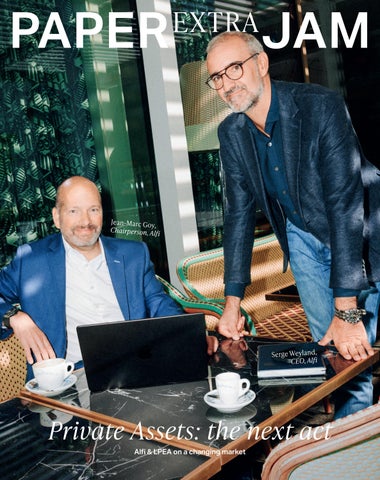
Jean-Marc Goy , Chairperson, A lf
i
Serge Weyland, CEO, Alfi
Private Assets: the next act Alfi & LPEA on a changing market
Access a new world of investing A powerful partnership that offers new opportunities for income.
Visit capitalgroup.com/lu/en
FOR PROFESSIONAL INVESTORS ONLY Marketing communication. Invested capital is at risk. Issued by Capital International Management Company Sàrl (“CIMC”), authorised and regulated by the Luxembourg “CSSF”- Commission de Surveillance du Secteur Financier. ©2026 Capital Group. All rights reserved.
PUBLIC PRIVATE from
Crafting bespoke tax solutions for your alternative investments
Find out more here
Founder & Member of the world’s largest independent tax network
www.atoz.lu
005
10.2026
Since 2000 www.WeArePaperjam.lu www.Paperjam.lu Postal address PO Box 728, L-2017 Luxembourg Offices 10 rue des Gaulois, Luxembourg (Bonnevoie) Phone (+352) 20 70 70 E-mail Firstname.name@paperjam.lu Founder, CEO and Paperjam News Director Mike Koedinger Chief Operations Officer Etienne Velasti Editorial Director Mike Koedinger Editor in Chief Hugo Hirsch Art Director Cassandre Bourtembourg Designer Juliette Noblot Based on Paperjam’s visual identity developed by Reza Kianpour (Kianpour & Partners). Journalists Sylvain Barrette, Alix Bellac, Louise Braibant, Camille Bourgeois, Marc Fassone, Émilie Gline, Mike Gordon, Maëlle Hamma, Hugo Hirsch, Souada Kermani, Thierry Labro, Sarah Lambolez, Anissa Maamri, Manon Méral, Ioanna Schimizzi, Rebeca Suay, Claire Schlinger Desk Editor Cédric Haumont (-321) Photographes Julian Pierrot, Jan Hanrion, Patricia Pitsch Director Francis Gasparotto (-301) Client Media Operations Florence Saintmard (-310) Paperjam Studio Téléphone : (+352) 20 70 70-300 Head of Paperjam Studio Rudy Lafontaine Layout Sophie Melai, Stéphane Cognioul, Louna Mayer
All rights reserved. Any reproduction or translation, in whole or in part, is strictly prohibited without prior written permission from the publisher. (c) Paperjam S.A. ISSN 3088-599X In accordance with the law of 8 February 2004 on freedom of expression in the media, the following statement is mandatory “once a year, in the first issue distributed.” We have chosen to publish it every month. The publishing company is 100% directly owned by Mike Koedinger, publisher, residing in Luxembourg. He is also responsible for the general management and day-to-day operations.
FOCUS ON ALFI & LPEA
Edito
Private assets, pas si privés Les private assets ne sont plus un marché de niche. Au Luxembourg, les actifs alternatifs sont passés de 2.600 à 3.100 milliards d’euros en 2025, soit une hausse de 20 % en un an, selon l’Alfi. Ils représentent désormais environ 35 % des actifs des fonds domiciliés dans le pays. Une progression que l’on retrouve aussi dans les Eltif, dont 162 sur les 300 autorisés en Europe étaient domiciliés au Grand-Duché en juin 2026. Ces chiffres racontent plus qu’une simple croissance. Ils montrent un marché qui se diversifie et devient plus accessible, au moment même où sa mécanique se complexifie. Private credit, secondaries, nouvelles exigences de valorisation, AIFMD II, tokenisation, intelligence artificielle… autant d’évolutions qui transforment en profondeur la manière dont les fonds sont structurés, gérés et distribués. Pour le Luxembourg, cette nouvelle donne pose une question simple : jusqu’où la place veut-elle monter dans la chaîne de valeur ? Elle dispose déjà d’une infrastructure redoutablement efficace, de la structuration à l’administration des fonds, en passant par le dépositaire, le juridique, la conformité ou la distribution internationale. Face à Londres, Paris ou Francfort, le Luxembourg n’a pas
à rougir de son modèle. Mais il aurait tort de le considérer comme achevé. C’est précisément l’un des axes de l’Ambition 2030 de l’Alfi : élargir l’accès aux investissements alternatifs, accélérer la transformation digitale et renforcer les fonctions à plus forte valeur ajoutée au Luxembourg. Cela passera par davantage de compétences en valorisation, financement et technologie, mais aussi par une présence accrue dans l’exécution et la prise de décision d’investissement. Le Luxembourg n’a donc pas à réinventer ce qui fonctionne déjà. Il doit plutôt choisir ce qu’il veut ajouter à son modèle pour continuer à compter demain. C’est cette prochaine étape, avec ses arbitrages, ses opportunités et ses zones de tension, que cet Extra propose d’explorer.
Hugo Hirsch Rédacteur en chef
Creating advantage for your business
007
10.2026
Private Assets: the next act 008
SOMMAIRE
Jean-Marc Goy & Serge Weyland The road to the next fund era
Welch 018 Douglass The rise of Europe's shadow lenders
022
Grégory Beltrame & Błażej Gładysz-Lehmann Secondaries: a new lever for PE
Lisa König 008 024 Distribution: The next growth phase for privet market Pesch 026 Stéphane 700 membres, et maintenant ?
032 Agenda Dates for the diary
Paulussen 034 René Ces secteurs qui attirent les capitaux
038
Emilie Allaert, Mathieu Cottin, Alvaro Garrido Mesa Tokenisation: the shift to scale
Capolaghi 044 Laurent Financial literacy: the missing piece Delaunay 046 Laurianne L'IA prend ses actifs
056
Buring 050 Héloïse La Place à court de places
Schneider 057 Gaëlle AIFMD II : le temps des ajustements Jérôme Wigny
high price of optimism: when fair value 062 The gets complicated
Photos : Julian Pierrot
Van Kauvenbergh 066 Mike SFDR 2.0: The next ESG challenge
068 Radar
070 Forecast
PAPERJAM — EXTRA
008
Conversation with Jean-Marc Goy and Serge Weyland
The road to the next fund era Sylvain Barrette, Journalist Julian Pierrot, Photographer
Luxembourg’s fund industry is breaking records, but past success offers no guarantees. Its next chapter will depend on regulatory pragmatism, digital distribution and the ability to move further up the value chain, say Alfi chairperson Jean-Marc Goy and CEO Serge Weyland.
FOCUS ON ALFI & LPEA
09.2026
009
FOCUS ON ALFI & LPEA
FOCUS ON ALFI & LPEA
What is your perspective on the year that has passed so far? Jean-Marc Goy: It has been a turbulent year internationally, particularly from a geopolitical perspective. However, zooming in on the financial markets, they have been highly resilient. Luxembourg-domiciled investment funds reached a record €8,888bn in assets under management as of May 2026. It is an enormous, almost unbelievable figure. Private assets are recording particularly strong growth, notably in private equity, infrastructure and European long-term investment funds, where Luxembourg remains the European leader with a market share exceeding 50%.
Serge Weyland: Financial markets indeed seem exceptionally resilient, even after this summer’s tech dip and some tension with leveraged funds that had to liquidate assets. However, we must keep a close eye on long-term interest rates, particularly yields on maturities of 10 years or more, as their rise could eventually impact the markets. Luxembourg must prepare for a potential correction. Investors should also re-evaluate their portfolio concentration, as many indices remain heavily concentrated on a few big tech names. This is where active management will prove its worth again.
Luxembourg fund market overview
The Grand Duchy remains Europe’s leading investment hub, with total industry assets under management of €8.888trn, including €6.7trn in fully supervised assets at both the manager and fund level, more than €3.2 trn in private markets, and €650bn in ETFs. EUR Billion
3.106
3.302
5.586
2.624
Ucits
2.266
0
1.942
2.000
8.888
1.668 4.925
4.000
6.020
7.400
4.776
6.000
6.557
4.291
6.593
4.078
8.000
8.288
5.182
10.000
Déc. 2021
Déc. 2022
Déc. 2023
Déc. 2024
Déc. 2025
Mai. 2026
AIFs
What are the primary challenges facing the financial centre over the next five to ten years? J-M.G.: The absolute top priority for the Association of the Luxembourg Fund Industry (Alfi) is the MISP proposal. [The European Commission calls it the Market Integration and Supervision Package, and it was adopted on 4 December 2025, editor’s note]. While it contains excellent initiatives to simplify cross-border distribution within the EU, two aspects are highly problematic despite their good intentions.First, it proposes giving more supervisory power to the European Securities and Markets Authority (Esma) to establish a single supervisor. Instead of simplifying, this adds a layer of double supervision. Firms could face oversight from both their home-state regulator and Esma, alongside supervisory colleges involving regulators from host member states. We want to ensure the outcome does not make things more complicated than they are today. Second, the proposed delegation rules aim to simplify intra-EU delegation while restricting extra-EU delegation. This is dangerous because major global financial hubs are
Source: Alfi
010
PAPERJAM — EXTRA
012
PAPERJAM — EXTRA
“ Digital distribution and tokenisation are the true game changers.”
A wealth of experience
Jean-Marc Goy and Serge Weyland bring complementary perspectives shaped by more than 25 years in Luxembourg’s investment fund industry. An Alfi Chairperson and Capital Group conducting officer, Jean-Marc previously led international affairs at the CSSF. Before joining Alfi, Serge served as CEO of Edmond de Rothschild Asset Management (Luxembourg), following senior roles at Bil and Caceis.
outside the EU, such as the US, UK, Switzerland and Asia. The current delegation and supervision regimes are the pillars of success the Ucits and AIFMD frameworks, and Alfi is determined to defend this decades-long success. The European Commission has set an ambitious schedule, aiming for an agreement by the end of 2026, followed by a typical 18-month implementation period. S.W.: From a non-regulatory angle, cost pressures will continue to squeeze the industry over the next five to ten years. Luxembourg must lead in digital distribution, particularly in fund tokenisation, to drive future demand. Luxembourg continues to innovate by enhancing its product “toolbox.” Recent updates like multi-compartment SCSPs demonstrate these constant adjustments to boost attractiveness in private markets. [Luxembourg in July proposed a bill to expand the structuring options available to alternative investment funds established as common limited partnerships (SCS) and special limited partnerships (SCSp), notably by allowing them to create legally segregated compartments, editor’s note]. Working together with the ministry of finance and the regulator, we must maintain an attractive fiscal and
FOCUS ON ALFI & LPEA
operational environment for firms and employees amidst intense international competition. We need a pragmatic, proportionate supervisory approach that balances robust controls with operational flexibility, allowing firms to leverage group resources. Is there a specific game-changing product you are currently working on? S.W.: Digital distribution and tokenisation are the true game changers. The first step is to tokenise fund units; the next will be to tokenise underlying assets. This could facilitate secondary-market trading in traditionally illiquid assets and potentially improve liquidity. Our legal framework is already well-positioned with the fourth iteration of our blockchain law, which we will continue to fine-tune as we gain practical experience. J-M.G.: I must highlight Alfi’s excellent partnership with finance minister Gilles Roth and his teams, as well as the regulator, to ensure our toolbox remains the best in the world. Fiscal competitiveness is also key. The government has announced a 1% reduction in corporate taxation, with another cut scheduled for next year, alongside favourable tax treatment of carried interest for alternative funds. How must the Luxembourg model evolve to remain a global benchmark for funds and private assets? S.W.: In a cost-conscious climate, global groups are seeking centralisation and synergy. Luxembourg can offer a compelling value proposition by centralising functions. For instance, firms can establish “investor solutions” teams here to support sales forces across different European markets using our versatile toolbox. We can also host centralised support functions for global deal team, including risk management,
Local strength, global excellence. Guiding private capital through Luxembourg and beyond. From fund formation and tax-efficient structuring to financing, cross-border investments, acquisitions and exits, Baker McKenzie brings together multidisciplinary teams to help investment managers, private equity sponsors and institutional investors navigate opportunities across the full private capital lifecycle. Investment Funds | Private Equity | M&A | Tax | Financial Services
bakermckenzie.com © 2026 Baker McKenzie. All rights reserved. Baker & McKenzie International is a global law firm with member law firms around the world. In accordance with the common terminology used in professional service organizations, reference to a “partner” means a person who is a partner or equivalent in such a law firm. Similarly, reference to an “office” means an office of any such law firm. This may qualify as “Attorney Advertising” requiring notice in some jurisdictions. Prior results do not guarantee a similar outcome.
PAPERJAM — EXTRA
€14 trn Held by European households in cash and bank deposits
What Alfi wants Luxembourg to keep, change and attract - Keep: Global delegation and strong links with major financial centres, which remain central to Luxembourg’s international fund model. - Change: Supervisory complexity and structural cost pressures, including taxation and wage indexation, to protect competitiveness. - Attract: More talent and higher-value functions, from investor solutions to risk management, valuation, AML and financing, while creating better conditions to attract selected front-office professionals.
014
AML compliance, valuation and bank financing coordination. This allows Luxembourg to move further up the value chain. What initiatives could attract more front-office operations to Luxembourg? S.W.: The carried interest regime will help. However, it is unrealistic to expect large central investment teams to relocate here completely. Asset managers need “boots on the ground” where they invest. J-M.G.: The carried interest regime does not apply to Ucits structures. To attract portfolio managers, fiscal competitiveness is the ultimate argument. Competitors like Italy, the UK and Asia offer highly attractive tax incentives. Without a competitive tax framework, front-office talent will not relocate. What other measures are needed to preserve Luxembourg’s competitiveness? J-M.G.: Infrastructure and mobility are vital. Cross-border workers need efficient transport links. The direct United Airlines flight between Luxembourg and New York is a signal of our global connectivity. Train connections, such as the Luxembourg-Brussels link, also require continued improvement. S.W.: The elephant in the room is wage indexation. It is a taboo subject, but we must eventually discuss capping it, like the model introduced in Belgium. It is less about the actual cost--which is comparable to other financial centres--and more about international perception. When automatic indexation eats up an entire salary budget, managers cannot reward their top performers, which creates significant friction within global groups. Capping indexation would preserve social stability by
FOCUS ON ALFI & LPEA
protecting lower-income workers while ending unnecessary automatic 2.5% raises for CEOs. The Savings and Investment Union aims to help channel people’s savings into investments and capital markets. How does Alfi view the promotion of the SIU? S.W.: Alfi strongly welcomes these European Commission initiatives. Mobilising retail savings into capital markets and funded pension schemes (second and third pillars) is a massive opportunity for European asset management. We are actively working on this with McGill University. European households currently hold up to €14trn in bank deposits. Getting this capital working creates a virtuous circle: as people invest, they build wealth, spend more and stimulate economic activity. J-M.G.: This highlights the crucial role of financial education. We must explain why long-term investing can offer better wealth-building opportunities than leaving all one’s savings in cash, where inflation may erode purchasing power.
March 09—10 2027
Luxembourg City
Intelligence Forum AI, Automation & Productivity
Fintech Sphere
Finance, Technology & Digital Transformation
Startups & Scaleups Awards
240+ startups & scaleups. 360° Pitch arena. €125,000+ Grand Prize
Luxembourg Makes It Happen National Innovation, International Guests
€199 Premier Institutional Partners
until November 15th 2026
*VAT included
Get your Early Bird Tickets €499
016
PAPERJAM — EXTRA
Sponsored content by UBS
Christian Borner is Luxembourg country head for UBS; Stefan Van Geyt, head advisory & sales GWM Luxembourg.
Private markets are playing an increasingly important role in many sophisticated investors’ portfolios, say Christian Borner and Stefan Van Geyt of UBS. But rigorous client education and long-term planning are needed more than ever.
Every year, UBS issues its Global Family Office Report, providing insight into how family offices invest. This year’s report found that private assets -- private equity, private debt, real estate, infrastructure, commodities, hedge funds, and other real assets -- accounted for 42% of family offices’ allocations. This shows that alternatives are no longer considered a “niche,” said Stefan Van Geyt, head advisory & sales GWM Luxembourg at UBS. Historically, private markets have offered attractive returns and diversification opportunities, although outcomes vary across strategies, managers and market environments. “Indeed, we see them as an important component of many longterm diversified portfolios.” “There’s an entire part of the world that is privately held,” he added. “If you only invest in public markets, then you may miss exposure to part of the economy that is only accessible through private investments -- at UBS, we want to help eligible investors gain access to opportunities that are not available through public markets.” A leading hub for private market fund structuring and distribution Luxembourg is the largest fund centre in Europe and has built on its existing ecosystem to become one of Europe’s leading hubs for private market fund structuring and distribution, said Christian Borner, Luxembourg country head for UBS. Flexible structures, the regulatory environment, expertise in the cross-border space, the entire ecosystem -- from law firms to management companies to consultants -- as well as Luxembourg’s distribution infrastructure are among the reasons behind the grand duchy’s strong position in the realm of private assets. Eltif 2.0 could also play a role in the future. Revisions to the European LongTerm Investment Fund legislation have
Photo: Julian Pierrot
Private markets: diversification and opportunities
017
10.2026
BRAND VOICE
Strategic asset allocation, 2025 2%
Gold / precious metals
1%
1%
Infrastructure
Commodities
11 %
Real estate
Art and antiques
32 %
Equities
6%
source: UBS Global Family Office Report 2026
1%
Hedge funds
3%
Private debt
17 %
17 %
Fixed income
Private equity
9%
Cash
introduced additional flexibility and made private markets eligible to a broader class of investors. “The framework is an interesting development,” said Van Geyt, while cautioning that it remains a “fundamentally illiquid investment” and that investor understanding is crucial. “More and more long-term investors are allocating part of their portfolios to private markets,” noted Van Geyt. “But our role is also to educate investors, parti cularly around related risks.” Investing in private assets means that those funds will be locked up for a significant period of time. “Investors generally expect to be compensated for taking on illiquidity risk -- that’s one of the attractions of private markets -- but it’s important for investors to understand the trade-offs involved.” Rigorous, informed, and long-term planning is essential. Private assets
encompass a wide range of strategies, each with distinct characteristics and roles within a portfolio. “These investments are not just an assembly of good ideas, but part of a well-structured portfolio that considers aspects such as liquidity, distribution, capital calls, diversification, and manager selection,” said Borner. “Experienced guidance is key.” Turning access into long-term investment plans UBS operates across two complementary areas of activity. On the one hand, it provides depositary, custody and banking services to asset managers and financial intermediaries. On the other, it supports high-net-worth individuals and family offices with wealth management services. Its role includes supporting clients in structuring
long-term investment strategies while also helping them understand the characteristics and implications of their investment decisions. “We provide services not only for the investor, but also for the industry that delivers the product,” explained Borner. Access is a major challenge linked to private markets, and helping clients navigate this complexity is a core part of UBS’s role. “Manager selection is particularly important in private markets, where performance dispersion is typically greater than in public markets,” said Van Geyt. “A wealth manager like UBS is able to combine access, research and manager selection expertise to help identify opportunities that fit a client’s objectives.” UBS also carries out research on different asset classes and regions. “We can leverage our global footprint and provide access to a broad range of managers and investment vehicles,” added Borner. Liquidity, longevity, legacy UBS holds the philosophy of “managing wealth over generations,” and considers itself the partner of not just the client, but of the generations to come. When preparing investment plans, it uses a threebucket framework consisting of liquidity (the more immediate needs), longevity (to maintain the standard of living), and legacy (planning for the next generation). Given their long-term investment horizon, private markets play an especially important role in the “legacy” pillar of wealth management, said Borner. “It’s about more than maintaining the wealth over the lifetime of a beneficial owner. It’s about investing for a future beyond that.” For more information contact UBS here
PAPERJAM — EXTRA
018
The rise of Europe’s shadow lenders
Douglass Welch Portfolio Management Conducting Officer Pemberton Asset Management
Europe’s €600bn private credit market is coming of age. With flexible financing, stronger covenants and growing global demand, private lenders such as Pemberton are gaining ground--and Luxembourg has an opportunity to help shape the sector’s next chapter. Sylvain Barrette, Journalist Julian Pierrot, Photographer
10.2026
019
The European financial landscape is undergoing a structural transfor mation as private capital increasingly moves from the periphery of corpo rate financing to its core. While traditional banks have historically dominated financing in Europe, with a market share of around 70%, a com bination of regulatory pressure and growing demand for flexible capital is carving out a permanent space for private credit. This evolution is not merely a reac tion to temporary market conditions, argues Douglass Welch, portfolio management conducting officer at Pemberton Asset Management, but reflects a more fundamental shift in the way Europe’s medium-sized com panies finance their growth.
“ Competition has increased but the market has also expanded.”
The resilient core of European lending Despite broader macroeconomic head winds, Pemberton continues to see the core mid-market--companies with Ebitda of between €15m and €75m--as fertile ground for private credit. Welch explains that Pemberton’s financing deal flow tends to follow pri vate equity activities. For instance, many mid-market financing deals sup port firms that were initially fami ly-owned but now have private equity backers after a primary or a second ary leveraged buyout. This shift from family ownership to professional own ership provides governance, business strategy and audit transparency, offering Pemberton comfort while supporting due diligence processes. According to Welch, some of the most attractive opportunities cur rently lie in Western European markets with robust legal frameworks for work outs and restructuring, notably the UK, Germany and France. Pemberton’s geographical expansion therefore broadly mirrors the footprint of private equity across Western Europe, while
FOCUS ON ALFI & LPEA
remaining more cautious in markets where legal frameworks can be more complex, such as Austria. Niche strategies such as strategic risk transfer (SRT) are also gaining trac tion. Through SRT, Pemberton funds assume the first-loss risk on bank port folios, helping banks reduce capital requirements while offering investors high-yield on short-maturity securities. Adapting to a more crowded field As competition intensifies, the market is bifucarting between the large-cap segment, where borrowers have greater negotiating power and can secure more flexible “covenant-lite” loans with fewer protections for lend ers, and the more disciplined mid-market. Increased competition is viewed as a natural byproduct of a maturing market that has grown to approximately €600bn in Europe. Competition has increased but the market has also expanded,” says Welch. However, Pemberton’s competi tion remains pure play European pri vate credit asset managers such as Arcmont and Hayfin. Despite docu mentation enabling them to invest 5% to 10% abroad, Welch notes that busi ness development companies in the US “have other priorities to fix or address.” To adapt, Pemberton is capitalising on its speed and flexibility, areas where it can outperform bank syndi cates. While banks may take weeks to arrange a €200m syndicated loan, pri vate credit providers can increasingly fund the full amount, offering borrow ers a simpler, one-to-one relationship. This structural advantage allows managers to maintain pricing power even as new investors or limited part ners, particularly from the US, increase their focus on European assets. In addition, it is a market with covenants, contrary to the cove nant-lite market in the US.
Middle Market Direct Lending Share
Direct lending offers faster funding, greater flexibility, and reduced intermediaries compared to traditional bank lending United States
36 %
2014
75 %
2021
Europe 2010 2023
5% 53 %
Beyond the back office To create a genuine competitive advantage that transcends its reputation for administration and domiciling, Luxembourg must position itself as a centre for regulatory innovation. The grand duchy can differentiate itself by fostering a more sophisticated interaction between the industry and the regulator. “By leading the way in harmonising European rules such as allowing fund vehicles to be the ‘lender of record’, Luxembourg can ensure its framework remains the gold standard for complex private credit structures. However, Welch notes that few banks have the origination facilities. Strengthening this ecosystem would provide private asset managers with better local tools for fund-level liquidity.” In contrast, Welch negatively views “ring-fenced” European long-term investment funds (Eltifs) domiciled in France, which require the use of local managers and investors to benefit from tax perks. He calls this a challenge to
FOCUS ON ALFI & LPEA
the European Savings and Investment Union and urges Luxembourg to “avoid the French example.” Instead of investing “only in European government bonds,” Welch argues that there is also a significant opportunity for Luxembourg to use its own sovereign wealth fund more proactively, potentially seeding innovative infrastructure, defence or venture capital funds to mirror the sophisticated strategies seen in hubs like Singapore or Abu Dhabi. Building Europe’s long-term capital base Additionally, physical and social infrastructure remains a bottleneck; improving transport links to financial hubs like Frankfurt or Brussels and maintaining a high-quality, multilingual workforce is essential for long-term growth. The industry is also calling for a more harmonised approach to pension contributions across Europe to create a deeper, more liquid pool of long-term capital. The major trends reshaping the sector include a massive recycling of global investment capital and the “retailisation” of private assets. As institutional investors seek to diversify away from US-centric portfolios--which are currently plagued by “noise” and high exposure to volatile sectors like software--Europe is becoming a preferred destination due to its higher credit quality and prevalence of covenants. Simultaneously, the industry is moving toward “evergreen” or openended funds to attract private wealth. To avoid the pitfalls seen in some US vehicles such as investing in illiquid seven-year loans while promising liquidity, managers must manage the liquidity mismatch carefully. “We’ve trained investors to invest in ETFs with daily liquidity,” he says.
Source : Morgan Stanley Report 2025
020
PAPERJAM — EXTRA
The strongest funds are built below the surface What investors see is performance. What sustains it is governance.
DLA Piper is a global law firm helping clients achieve their goals wherever they do business. dlapiper.com
PAPERJAM — EXTRA
Souada Kermani, Journalist
022
1
Gregory Beltrame, Arendt
From liquidity to strategy
Initially used to address liquidity needs, secondaries are becoming a fully-fledged portfolio management tool. Grégory Beltrame and Błażej Gładysz-Lehmann, partners at the law firm Arendt, unpack this shift.
Long used primarily to address liquidity needs, secondaries have become a genuine private equity portfolio management tool. Both limited partners (LPs) and general partners (GPs) now use them to rebalance portfolios, extend the holding period of assets or create additional value. “For GPs in particular, they make it possible to hold on to promising assets for longer, beyond the fund’s original timeline,” says Grégory Beltrame. The slowdown in IPOs and traditional exits has accelerated this shift. “Liquidity is no longer the only driver: secondaries are now also used to structure portfolios,” he explains. In 2025, global secondary transaction volume reached $233bn, up 53% year on year, according to the Lazard 2025 Secondary Market Report. GP-led transactions acc ounted for $116bn, while LP-led transactions reached $117bn. “It is a market growing at an impressive pace,” says Beltrame.
Secondaries: a new lever for PE
023
10.2026
2
3
FOCUS ON ALFI & LPEA
4
Continuation funds mature
Beyond private equity
Investors raise the bar
Among the most significant developments are continuation funds. The principle is to transfer an asset from a fund nearing the end of its life into a new vehicle, allowing the GP to continue developing it. Existing investors can then either recover liquidity or roll their investment into the new vehicle. This mechanism nevertheless raises a central issue: conflicts of interest. “The GP finds itself on both sides of the transaction,” notes Beltrame. This makes the valuation of the asset, the information provided to investors and the role of limited partner advisory committees (LPACs) in protecting the interests of existing investors particularly important. “The real issue is the GP. The key comes down to three words: transparency, professionalisation and specialisation,” he sums up.
“The secondary market is no longer limited to private equity. It is also expanding into private credit, infrastructure and venture capital, with an increasingly diverse range of strategies,” says Błażej Gładysz-Lehmann. Private credit is a good example: secondary transaction volumes in the asset class almost doubled between 2024 and 2025, reaching $20bn, according to the consulting firm McKinsey. For Gładysz-Lehmann, this diversification shows that the market itself is changing. “We are not really talking about one type of transaction, but rather a ‘family’ of strategies,” he explains. And the trend could go much further: “The secondary market is only getting started.”
The market’s growth is attracting a rising number of specialist investors, while funds dedicated to secondary strategies are reaching increasingly significant sizes. “Some players are already on their second, third or fourth transaction,” observes Beltrame. This expansion is also driving higher expectations, particularly around valuation and disclosure. “Investors want to understand how the fund works, how it is structured and why it has been structured that way,” he explains. As the market develops, it is therefore becoming more rigorous. It is now “much more transparent and, as a result, much more serious,” concludes the Arendt partner.
5 Closer to M&A
Błażej Gładysz-Lehmann, Arendt
As the market grows, transactions are becoming increasingly complex. “Deals that used to close within a few weeks now take several months,” observes Beltrame. Valuation, financing, tax and legal documentation are now subject to much closer scrutiny. This evolution is bringing some transactions closer to M&A standards and reflects the market’s growing complexity.
PAPERJAM — EXTRA
FOCUS ON ALFI & LPEA
024
Carte blanche
Distribution: The next growth phase for private market Julian Pierrot, Photographer
Private markets are moving from institutional niche into wealth portfolio construction. Global private-market assets are projected to grow from around $18 trillion in 2025 to $28 trillion by 2030, while wealth-channel private-market assets could double to about $6 trillion. But the next phase of growth will not be won by regulation or product innovation alone. From European Long-Term Investment Funds (ELTIF) and LongTerm Asset Funds (LTAF) to interval funds, tender-offer funds and evergreen structures, wealth investors have easier access to long-term private assets. Semi-liquid products are scaling fast, but they are complex. Periodic liquidity turns illiquidity risk into an operational requirement. This is the bottleneck. Wealth platforms use infrastructure designed
for high-volume, daily-dealt public funds, while private-market products have different features (e.g. investor checks, lock-ups, gates, capital calls and complex reporting). If these processes remain manual, adoption will be limited to sophisticated private banks and high-net-worth channels. Luxembourg plays a key role. Clearstream data shows that it accounts for about 62% of clientpreferred private-market fund assets by assets under management (AUM), making it a leading cross-border distribution hub. But leadership now requires more than domicile strength. It requires industrialised distribution rails: standardised data, digital onboarding, automated order routing, investor-level recordkeeping, event processing, liquidity monitoring and clear oversight.
Market infrastructure becomes a growth enabler here, helping asset managers, distributors, custodians, transfer agents and platforms process private-market funds more consistently, without pretending they are as liquid or simple as mutual funds. The priority is to make private markets operationally repeatable. Closing this infrastructure gap could boost European semi-liquid private-market assets from a projected $450 billion to over $800 billion by 2030. Success hinges on making private markets easier to access, service and govern, while keeping risks transparent and intact.
Lisa König
Head of Strategy Clearstream Fund Services
PAPERJAM — EXTRA
Conversation avec Stéphane Pesch
Hugo Hirsch, Journaliste Julian Pierrot, Photographe
026
09.2025
027
FOCUS ON ALFI & LPEA
700 membres, et maintenant ?
Liquidité sous pression, exigences accrues des LP, nouveaux formats et rayonnement international : Stéphane Pesch, CEO de la LPEA, décrypte les mutations du marché et les priorités de l’association.
028
PAPERJAM — EXTRA
« On ne transforme pas l’illiquide en liquide sans précaution. »
L’événement à ne pas manquer Le rendez-vous phare de la LPEA réunira, le 15 octobre à Luxexpo, plus de 1.300 professionnels du private equity et du venture capital. Pensé pour les GP et les LP, LPEA Insights proposera trois scènes consacrées aux grands enjeux du buyout, de la dette, des secondaires du venture et des infrastructures, ainsi qu’un espace PE Tech dédié aux solutions numériques. Organisé dans le cadre des Luxembourg Venture Days, l’événement mêlera débats, rencontres et mise en relation avec l’écosystème entrepreneurial.
La LPEA comptait 701 membres fin 2025, en hausse de 17,4 % sur un an. Que dit cette croissance de l’écosystème luxembourgeois des private assets ? Il y a dix ans, réunir autant d’acteurs aurait été difficile et souligne la progression fulgurante de notre écosystème. Mais le nombre ne suffit pas : la valeur repose sur des membres actifs, prêts à partager leur expérience, expertise et leurs compétences. Historiquement, la LPEA a surtout attiré les GP. Nous voulons désormais renforcer la présence des LP tout en accompagnant l’ouverture des actifs privés à un public plus large. Notre ambition est de bâtir un écosystème complet et utile, pas seulement une association. Vous avez lancé un LP Summit, les premiers PE Tech Awards et une conférence sur les opérations de M&A. À quels besoins du marché répondent ces nouveaux formats ? Notre rôle est de rester au contact de ce qui transforme réellement le marché. Depuis près de trois ans, les exits sont plus difficiles, les distributions ralentissent et les levées de fonds s’allongent. GP et LP ont donc besoin d’échanger sur des enjeux concrets :
FOCUS ON ALFI & LPEA
stratégies d’investissement, technologie et digitalisation, M&A et les nouvelles conditions du fundraising. Ces formats créent les espaces de dialogue nécessaires pour mieux comprendre les attentes de chacun. Justement, qu’attendent aujourd’hui les LP de leurs gestionnaires ? Leurs attentes ont peu changé : de la performance, une équipe solide et une exécution rigoureuse. Mais l’exigence de transparence s’est renforcée. Les LP regardent aussi de nos jours comment les gestionnaires utilisent l’IA et la donnée. Alors que le retour du capital ralentit, le DPI (les montants effectivement restitués aux investisseurs) est particulièrement suivi. Distribuer sans recourir excessivement à l’ingénierie financière devient ainsi un véritable gage de crédibilité. Face à la pression pour restituer plus rapidement du capital aux investisseurs, les mécanismes destinés à accélérer la liquidité règlent-ils le problème ou ne fontils que le repousser ? Le bridge financing, le fund financing ou les continuation funds peuvent être utiles lorsqu’un actif solide ne trouve temporairement ni le bon acheteur ni le bon prix. Attendre de meilleures conditions est alors rationnel. Mais on n’est pas des magiciens : dans le monde de la démocratisation on ne transforme pas de l’illiquide en liquide sans précaution et des processus professionnels robustes et bien rodés. Tôt ou tard, il faudra vendre et retourner le capital aux investisseurs. La LPEA organise de nombreux roadshows à l’étranger. Comment mesurez-vous leurs retombées ? Cette année, les nouvelles destinations sont Copenhague, Shanghai
Tuesday 13 October 2026 18:30
PAPERJAM CLUB
Kinepolis Kirchberg
Kianpour.lu
Learn more Programme
Finance is undergoing a profound transformation, driven by digital innovation, regulatory shifts, and evolving customer expectations. This Paperjam 10×6 event brings together ten thought leaders to explore how financial institutions are adapting to this new landscape.
Topics include the rise of embedded finance, the impact of ESG considerations, and the integration of AI in financial operations. Join us to gain insights into the strategies shaping the future of finance in Luxembourg and beyond.
Finance is changing fast.
OUR SPEAKERS
Lize-Mari Barnes Swiss Re International
Gilles Dusemon Arendt & Medernach
Melanie Moos Depowise Luxembourg
Arnaud Clément Association des Banques et Banquiers Luxembourg (ABBL)
Serge Weyland Association Luxembourgeoise des Fonds d'Investissmeent (ALFI)
Nicolas Otton BGL BNP Paribas
Aline Muller Luxembourg Institute of Socio-Economic Research
Key Partner
Lead Partners
Florian Pfleiderer Deutsche Börse, Clearstream Services
Georges Bock Moniflo by investre
030
FOCUS ON ALFI & LPEA
et Prague. Nous continuons parallè lement à revenir dans des places incontournables comme New York, Hong Kong, Londres, Tokyo ou Singapour. Nous ciblons des marchés dotés d’une réelle profondeur financière. Nous regardons ensuite la qualité de l’audience : présence de prospects, équilibre entre GP et LP, niveau des échanges… Les débouchés sont tout aussi importants : combien de contacts qualifiés donnent lieu à de nouveaux
rendez-vous ? La LPEA reste neutre et ne peut garantir qu’un contact débouchera sur une collaboration. Mais si les discussions se prolongent et ouvrent de réelles opportunités à nos membres, le déplacement a dès lors rempli son rôle.
PAPERJAM — EXTRA
45 % la part de décideurs GP et LP présents à la LPEA Insights l’an dernier, selon Stéphane Pesch.
Revenus et liquidité en ligne de mire
Dans une enquête menée par la LPEA auprès de 116 membres, la dette privée et les secondaries arrivent en tête des stratégies jugées les plus porteuses. Private Debt
64 %
Secondaries
59 %
Infrastructure
Venture Capital Buyout
24,14 % 24 %
Fund of Funds
Growth
35 %
23,28 %
21,55 %
Quelles seront les priorités de la LPEA d’ici fin 2026 ? La LPEA Insights sera l’un des grands temps forts de l’automne. L’une de nos autres priorités est l’advocacy. Nous suivrons de près les discussions européennes sur la supervision pour défendre un cadre équilibré et applicable. Ajouter de nouvelles couches de complexité ralentirait les processus et alourdirait les coûts. Il ne faut jamais oublier que le Luxembourg et l’Europe sont en compétition avec les autres grandes places financières mondiales. Votre stratégie 2025-2030 repose sur trois piliers : défendre, attirer, éduquer et connecter. Quels résultats devront être visibles à son terme pour juger sa mise en œuvre réussie ? Faire peser davantage notre voix dans les discussions publiques, au Luxembourg comme à Bruxelles. Nos comités et clubs devront produire du concret sur les sujets juridiques, fiscaux et opérationnels, mais aussi sur l’IA, l’ESG et les talents. Nous voulons également relancer les programmes de la LPEA Academy qui répondent à de vrais besoins et renforcer nos liens avec les universités et écoles de commerce. La réussite se mesurera enfin à notre capacité à attirer de nouveaux profils et à multiplier les passerelles entre GP, LP, experts et futurs professionnels.
Partner content
Le Luxembourg doit-il réinventer son modèle ?
Crédit : Baloise Luxembourg
Place financière de référence, le Luxembourg voit la concurrence entre juridictions s’intensifier.
Sandra Bento, Executive General Counsel chez Baloise Luxembourg
Pour Sandra Bento, Executive General Counsel chez Baloise Luxembourg, dans un environnement réglementaire harmonisé, l’avantage concurrentiel reposera moins sur la conformité que sur la capacité à offrir un accompagnement personnalisé, une expertise pointue et des solutions adaptées aux besoins des investisseurs. « Notre valeur ajoutée réside dans notre capacité à construire des solutions claires et sécurisées », expliquet-elle. Au-delà des montages fiscaux traditionnels, l’enjeu est d’innover face à des dossiers patrimoniaux toujours plus complexes. Sur le plan réglementaire, le Grand-Duché conserve des atouts solides : cadre maîtrisé, notation AAA, et volonté de diversification, illustrée par la lettre circulaire 26/1, qui élargit les catégories d’actifs éligibles. « Nous nous adaptons aux attentes internationales, même dans des environnements plus protectionnistes », précise Sandra, citant à titre d’exemple les fonds d’assurance spécialisés pour les investisseurs sophistiqués. L’assurance-vie luxembourgeoise joue aussi un rôle central dans l’accompagnement du private equity, en intégrant une large gamme des actifs non cotés au sein de contrats en unités de compte, offrant ainsi un accès structuré et sécurisé à des classes d’actifs alternatives. Associée au haut
niveau de protection des avoirs propre au cadre réglementaire luxembourgeois, cette flexibilité renforce l’attractivité de l’assurance-vie comme véhicule de détention et de transmission d’investissements en private equity. Mais c’est le wealth planning qui reste le véritable facteur différenciant. « Chaque client est un cas unique ; notre métier, c’est de lui trouver la solution, pas une solution standard ». Chez Baloise, une équipe dédiée à l’ingénierie patrimoniale réunit des locuteurs natifs pour les marchés France, Belgique et Portugal, maîtrisant le droit des assurances, la fiscalité et le droit local. Des books patrimoniaux par marché et un accompagnement à la portabilité en cas de changement de résidence des clients complètent ce dispositif. Réinventer son modèle, pour le Luxembourg, ne signifie pas rompre avec ses fondamentaux, mais les mettre au service d’un accompagnement toujours plus personnalisé.
Baloise Luxembourg Elénore Bertoncini, Head of Comms, Marketing and Customer Experience communication@baloise.lu
032
PAPERJAM — EXTRA
Dates for the diary 24 Sept. 2026
FOCUS ON ALFI & LPEA
Conferences, roundtables and networking events will shape the coming months for Luxembourg’s private assets industry. Here are the key ALFI and LPEA dates to watch. Hugo Hirsch, Journalist
9-10 Nov. 2026
23-24 March. 2027
LPEA AI Lab – AI & Private Markets
Alfi Private Assets Conference
Alfi Global Asset Management Conference
The LPEA AI Lab explores how artificial intelligence is reshaping private equity and venture capital firms. Discussions will focus on governance, leadership and resilience, as well as how firms can combine human expertise with AI to create value, strengthen decision-making and navigate the technological and societal challenges ahead.
The ALFI Private Assets Conference will explore the opportunities and challenges shaping private markets. Discussions will cover private equity, private debt, infrastructure and real estate, as well as market developments, international structuring, regulatory and tax issues, technology and operational considerations.
ALFI’s flagship annual conference brings together senior representatives from across the global asset management and investment industry. Discussions cover the key trends and challenges shaping the industry, including the macroeconomic outlook, regulatory developments, private assets, sustainable investing, AI, digital assets and fintech.
Linklaters, Luxembourg
European Convention Center Luxembourg
15 Oct. 2026
LPEA Insights 2026 Luxexpo
LPEA Insights gathers the private capital community for a full day of discussions, networking and market perspectives. More than 1,500 attendees, including GPs, LPs, investors, advisors and industry experts, will explore the trends, opportunities and challenges shaping private markets and capital allocation.
21 Jan. 2027
LPEA New Year Party 2026 Melusina
The LPEA New Year Party brings together members of Luxembourg’s private equity and venture capital community for an informal evening of networking and celebration. Open exclusively to LPEA members, the annual event offers an opportunity to reconnect with peers, meet new members and kick off the year in a relaxed setting with drinks, music and conversation.
European Convention Center Luxembourg
Partner content
Private Equity : un pilier de diversification
Crédit : WEALINS S.A.
Longtemps réservé à une clientèle avertie, le private equity s’impose aujourd’hui comme un levier clé de diversification patri moniale, porté par la recherche de perfor mance et de résilience.
WEALINS accompagne ses partenaires dans l’intégration des actifs privés au sein de stratégies patrimoniales.
Une réponse aux nouvelles attentes des investisseurs Dans un environnement marqué par la volatilité des marchés et la recherche de diversification, le private equity suscite un intérêt croissant auprès des investisseurs patrimoniaux en quête d’une vision de long terme. Cette classe d’actifs offre des opportunités différenciantes et un potentiel de décorrélation avec les marchés cotés. Audelà du rendement, elle constitue un levier de structuration, de transmission patrimoniale et de financement de l’économie réelle. À l’échelle européenne, l’essor des fonds semiliquides et les évolu tions réglementaires favorisent par ailleurs un accès progressivement élargi aux marchés privés. WEALINS, un partenaire de référence pour la diversification patrimoniale Dans ce contexte, WEALINS est un acteur de référence de l’intégra tion des actifs privés dans l’assurance vie luxembourgeoise. Depuis plus de vingt ans, la compagnie accompagne les investisseurs et leurs conseillers dans des stratégies associant actifs traditionnels et investissements alternatifs. Cette expertise soutient une croissance solide : en cinq ans, les actifs sous gestion ont presque
doublé, dépassant 20 milliards d’euros à fin 2025, tandis que la part du private equity a plus que triplé. Cette dynamique illustre l’intérêt des investisseurs et la capacité de WEALINS à répondre à des besoins patrimoniaux sophistiqués. Une équipe dédiée aux actifs privés, une gouvernance rigoureuse et une analyse préalable systéma tique encadrent chaque investisse ment avant son intégration dans un contrat, conciliant innovation, diversification et protection des investisseurs. Grâce à son expertise en ingénierie patrimoniale et à l’éco système de l’assurance vie luxem bourgeoise, WEALINS accompagne ses partenaires et leurs clients dans la construction de stratégies pérennes répondant aux enjeux de préservation, de valorisation et de transmission du patrimoine.
WEALINS S.A. 12 Rue Léon Laval, 3372 Leudelange
034
PAPERJAM — EXTRA
Ces secteurs qui attirent les capitaux
Souada Kermani, Journaliste
De l’intelligence artificielle à la défense, en passant par la transition énergétique, les besoins d’investissement se multiplient dans des secteurs stratégiques. René Paulussen, alternatives leader chez PwC Luxembourg, analyse un marché en pleine recomposition.
1
La défense attire de nouveaux investisseurs
2
La transition énergétique n’a pas dit son dernier mot
3
L’IA concentre les investissements
035
10.2026
1
Source : Direction de la défense
Défense
Les grandes transformations économiques et géopolitiques rebattent les cartes de l’investissement. Dans ce nouvel environnement, la défense s’impose progressivement comme une nouvelle destination pour les capitaux privés. « Compte tenu du contexte géopolitique actuel, on constate une attention beaucoup plus forte portée à la défense », souligne René Paulussen. Le secteur reste toutefois exigeant, en raison de « l’ampleur des capitaux mobilisés et des longs délais de réalisation des projets », notamment pour la production de drones ou d’avions de combat. Une temporalité qui peut en revanche convenir à des investisseurs institutionnels disposant d’un horizon plus long, comme les fonds de pension, fonds souverains ou compagnies d’assurance. Au-delà du profil des investisseurs capables de se positionner, c’est surtout la question du financement qui pourrait accélérer l’arrivée de capitaux privés. Selon René Paulussen, les investissements nécessaires d’ici 2030 ne pourront être assumés par les seuls États, malgré l’objectif de l’Otan de porter les dépenses de défense à 5 % du PIB. Les marchés privés seront donc appelés à jouer un rôle croissant.
FOCUS ON ALFI & LPEA
L’effort de défense luxembourgeois accélère En milliards d’euros
2.000
1.500
1.286
1.373
1.513
1.665
1.000
500
2026
2027
2028
2029
2
Transition énergétique « Le sujet de la transition énergétique a nettement reculé aux États-Unis depuis le retour de Donald Trump, tandis qu’en Europe, certains projets ont été reportés, notamment en raison du train de mesures Omnibus de la Commission européenne, qui a restreint le cadre du reporting de durabilité (CSRD). Mais cet enjeu devrait rester important pour les investisseurs privés dans les prochaines années », estime l’alternatives leader. La transition énergétique touche aussi à la souveraineté et à l’autonomie énergétique des États. « Il faudra donc continuer à investir dans le solaire, l’éolien,
l’hydroélectricité, les batteries et le stockage d’énergie. Cette dynamique va se poursuivre », juge René Paulussen. « Certaines de nos recherches indiquent qu’environ la moitié des capitaux consacrés aux infrastructures pourraient aller vers l’énergie et les transports », ajoute-t-il. Ces besoins restent considérables : la Commission européenne les évalue à environ 660 milliards d’euros par an d’ici 2030. Le vieillissement des infrastructures de transport européennes, souvent construites après la Seconde Guerre mondiale, nécessitera également d’importants investissements dans les prochaines années.
036
PAPERJAM — EXTRA
FOCUS ON ALFI & LPEA
3
Après la défense et l’énergie, le dernier grand terrain d’investissement est sans surprise celui de l’intelligence artificielle, où les infrastructures nécessitent des capitaux massifs. « Les investissements annuels dans les centres de données devraient atteindre 252 milliards de dollars d’ici 2027, soit une augmentation de 121 % depuis 2024 », affirme René Paulussen. Cette course aux infrastructures impacte la valeur des actifs. « Lorsqu’il existe un engouement important et que la demande dépasse l’offre, notamment parce que la construction de centres de données est chronophage, on peut effectivement avoir le sentiment que les valorisations augmentent fortement », souligne-t-il. Pour autant, il ne voit pas dans cette situation les signes d’une bulle comparable à celle d’Internet en 2000, jugeant le parallèle peu fondé : l’intelligence artificielle repose, selon lui, sur une véritable substance et une réelle valeur économique, ce qui n’était pas le cas de nombreuses entreprises qui s’étaient volatilisées lors de l’éclatement de la bulle ‘dot com’. La Banque d’Angleterre se montre de son côté plus prudente. Dans un rapport publié en décembre 2025, elle estimait, sans pour autant
parler d'une bulle, que les valorisations de l’IA étaient « considérablement tendues » et alertait sur les risques liés au recours à la dette pour financer ces infrastructures. « L’enjeu, pour les investisseurs, sera de distinguer les projets qui génèrent déjà des flux de trésorerie de ceux qui reposent encore essentiellement sur
des rendements futurs hypothétiques. Avec le temps, cette distinction influencera la manière dont les investisseurs évaluent ces actifs. Un investissement ne peut reposer indéfiniment sur des revenus hypothétiques, il faut à un moment donné voir apparaître des rendements concrets », conclut René Paulussen.
« Un investissement ne peut reposer indéfiniment sur des revenus hypothétiques. »
René Paulussen, PwC Luxembourg
Photo : PwC
Intelligence artificielle
investre
14 October 2026 · 09:00–13:00 · PwC Luxembourg
DLT INFRASTRUCTURE FOR TOKENISED FUNDS · SECOND EDITION
One day. The whole tokenisation stack. A working day on how a tokenised fund is actually built and run — law, operating setup, compliance and risk, taught by the people doing it in Luxembourg.
PUB VIDE
01
Legal framework & DLT regime
02
Operating setup for a tokenised fund
03
KYC / AML in a wallet-based world
04
MiCA & MiFID in practice
05
Risks & considerations of the architecture
PLEINE PAGE 210X265
XXXX
Georges Bock
Raoul Heinen
Pauline Huybrechts
Cécile Moser
Dr. Paul Newton
Dr. Eric Falk
Nadia Manzari
INVESTRE
LINKLATERS
PWC LUX
PWC LUX
INVESTRE
INVESTRE
MANZARI LEGAL
Get €200 off your seat WITH CODE
PAPERJAM SCAN TO REGISTER
investre-training.replit.app
50 SEATS ONLY
PAPERJAM — EXTRA
038
Tokenisation: the shift to scale
After years of experimentation, tokeni sation is moving into a new phase. Major financial institutions are deploying real use cases, while regulation and infra structure mature. For Luxembourg’s fund industry, the question is no longer whether to act, but how fast. Anissa Maamri, Journalist Julian Pierrot, Photographer
A decade ago, tokenisation belonged largely to the realm of proof-of-con cepts. Blockchain was still perceived as an emerging technology, regulation remained limited and most financial institutions were reluctant to move beyond experimentation. Today, the landscape has changed dramatically. Major financial institu tions are launching tokenised prod ucts, while regulators have established the foundations for institutional adop tion. According to Emilie Allaert, CEO of Digital Minds, the conversation has shifted: tokenisation is no longer about testing a technology, but about rethinking how investment funds are designed, distributed and managed. For Allaert, several factors have converged over the past two years. European regulation, including the Markets in Crypto-Assets Regulation (Mica) and the clarification of the legal treatment of tokenised financial instruments, has reduced uncertainty for market participants. Luxembourg has also progressively built its own framework through successive block chain laws. More importantly, some Web3-native firms have obtained tra ditional financial licences and are now competing for the same clients as established institutions. This pressure is encouraging incumbents to accel erate their digital transformation. Yet Allaert insists that the real value of tokenisation goes far beyond
10.2026
efficiency gains. Today’s fund distribution chain remains fragmented, involving multiple intermediaries and manual processes. Tokenisation offers an opportunity to simplify that architecture while making investment products more accessible. By facilitating the fractionalisation of fund units, potentially lowering investment thresholds and shortening subscription and redemption processes, blockchain could open investment funds to a broader audience. “The biggest winners will ultimately be investors,” she argues, pointing to lower barriers to entry, greater transparency, faster execution and an improved user experience. In her view, the real breakthrough lies in the automation of the fund value chain through smart contracts. Compliance checks, dividend distributions, investment restrictions and other processes can increasingly be embedded into programmable rules, reducing manual intervention while improving consistency and traceability. Rather than simply digitising existing processes, tokenisation creates the possibility of redesigning them from the ground up. If technology is no longer the main obstacle, culture remains a major challenge. Financial institutions have spent decades building legacy infrastructures and operational models that cannot be replaced overnight. “The technology is there,” Allaert says. “The challenge is cultural.” Organisations must rethink historical processes, encourage collaboration across business silos and invest in education. “The time to educate boards and employees is now.” This shift also represents an opportunity for Luxembourg. With a supportive legal framework and a growing blockchain ecosystem, the country is well positioned to build on its
039
FOCUS ON ALFI & LPEA
Emilie Allaert CEO, Digital Minds
“ The technology is there, the challenge is cultural.”
FOCUS ON ALFI & LPEA
global leadership in investment funds. But Allaert believes the next battle has only just begun. Luxembourg should not simply seek to remain Europe’s largest fund domicile; it should aim to become a leading European hub for tokenised funds. Achieving that ambition will require continued regulatory pragmatism, stronger collaboration across the financial ecosystem and a willingness to rethink long-established ways of working.
happens afterwards. Once an investor’s identity has been verified, that information can be securely reused across the value chain instead of being checked repeatedly by every intermediary. The second concerns subscriptions and redemptions. By combining tokenised fund units with stablecoin payments recorded on the same distributed ledger, transactions can be settled simultaneously through so-called atomic settlement. “There is no longer any need to wait for a wire transfer before issuing shares,” Cottin explains. This can sharply reduce settlement times, with processes that traditionally took days potentially completed within seconds. Anti-money laundering controls can also evolve. Instead of relying solely on conventional bank transfers, administrators can analyse blockchain transactions through dedicated analytics tools. This requires adapted compliance policies, but can provide greater traceability. Beyond these immediate gains, Cottin believes tokenisation could fundamentally change the role of fund administrators. Instead of providing a fixed catalogue of services, they could evolve into digital platforms offering specialised applications ranging from collateral management to automated tax reporting or portfolio rebalancing. “The administrator becomes an app store,” he says, curating trusted services that clients can activate according to their needs. For Cottin, adoption is now primarily a question of knowledge. “Everything is in place to succeed: the technology, the regulation, the service providers. What limits adoption today is knowledge.” As more decision-makers become familiar with tokenised operating models, he expects adoption to accelerate.
From onboarding to atomic settlement If Allaert sees tokenisation as a strategic transformation of the investment fund industry, Mathieu Cottin focuses on its operational reality. For the co-founder of Tokeny, blockchain is already reshaping several core processes in fund administration. The first concerns investor onboarding. While tokenisation does not eliminate know-your-customer (KYC) or know-your-business (KYB) requirements, it can change what
Tokenised money market funds gain traction
Results from an April 2026 ValueExchange survey of 335 market participants worldwide, including investors (61%), brokers (19%), market operators (11%) and custodians (9%). View current money market fund processes as efficient
33 %
Expect to accept tokenised money market funds as collateral
44 % Plan to launch tokenised money market funds by end-2027
66 %
Source : ValueExchange survey.
040
PAPERJAM — EXTRA
Vendredi 30 octobre 2026 08:30 - 11:00 Spuerkeess Luxembourg-Ville
Paperjam Together Le rendez-vous des PMEs Paul Ernster, faire grandir une entreprise d’héritage
Exposants Business Mentoring Luxembourg, Lalux, Luxembourg AI Factory, Paperjam Club Academy, Rsecure, SD Worx, Spuerkeess et Verbalius. Inscription Programme
Paul Ernster, Ernster
Chaque mois, le Paperjam Club ouvre un nouveau chapitre dédié à celles et ceux qui façonnent l’économie du terrain. Un format matinal où entrepreneurs et dirigeants de petites et moyennes entreprises se retrouvent pour apprendre, partager leurs expertises et s’inspirer de pratiques concrètes.
Pourquoi certaines entreprises traversent-elles les décennies quand d'autres disparaissent ? En s'appuyant sur l'histoire d’Ernster - L’esprit livre, fondée en 1889, Paul Ernster, qui représente aujourd’hui la 5ème génération de l’entreprise et occupe le poste de Directeur Administratif et Financier, partagera les principes qui permettent de concilier tradition, innovation et vision de long terme. Chaque organisation possède son propre équilibre, ses cycles de croissance, ses fragilités et ses besoins. Paul Ernster, qui prendra ses fonctions de Président de la Fédération des Jeunes Dirigeants d’Entreprises du Luxembourg à partir de fin octobre 2026, expliquera comment son entreprise familiale peut continuer à innover, à investir et à se transformer sans perdre son identité ni ses valeurs. Une conversation inspirante sur le leadership, la pérennité et les décisions qui permettent à une entreprise de traverser les générations.
Partenaires
PAPERJAM — EXTRA
Luxembourg’s next opportunity With more than €6.7 trillion in assets held in CSSFsuper vised investment funds, Luxembourg already ranks among the world’s leading fund domiciles. As tokenisation gains momentum, the challenge is no longer to prove the technology but to position the country as Europe’s leading hub for tokenised funds by combining legal certainty, operational expertise and financial innovation.
042
FOCUS ON ALFI & LPEA
Regulation is no longer the main hurdle For years, regulation was often cited as one of the main obstacles to tokenised investment funds. According to Alvaro Garrido Mesa, founder of Legal Node, that is no longer the case. Luxembourg and the European Union have established a sufficiently robust legal framework to launch credible tokenisation projects. The challenge has shifted towards helping market participants combine technology, regulation and operations. From a legal perspective, tokenisation can already deliver tangible benefits. Distributed ledgers create a shared and auditable record of ownership, reducing reconciliations while allowing investor eligibility rules, transfer restrictions and other compliance requirements to be embedded into smart contracts. Rather than replacing regulation, tokenisation can enable certain legal and contractual requirements to be applied automatically throughout the lifecycle of a financial instrument. Garrido Mesa believes the legal infrastructure has reached sufficient maturity to support institutional adoption. Luxembourg’s successive blockchain laws, including the introduction of the control agent, and the European Distributed Ledger Technology (DLT) Pilot Regime have created a stronger foundation for tokenised financial instruments. Mica, meanwhile, has brought additional legal clarity to crypto-assets and related service providers. The remaining work, in his view, is less about reinventing the regulatory framework than refining it and ensuring greater interoperability across European jurisdictions. Perhaps the greatest misconception, he argues, is that tokenisation eliminates intermediaries or regulation altogether. It does neither. Instead,
it transforms the underlying infrastructure and redistributes responsibilities. Transfer agents, fund administrators and custodians could increasingly oversee digital records, permissions, wallets and automated workflows rather than relying on manual reconciliations and legacy processes. For Garrido Mesa, the strongest argument for launching a tokenised fund today is therefore not immediate efficiency, but strategic readiness. Firms that begin experimenting now can develop the operational, legal and governance capabilities they may need as tokenised capital markets expand. In that respect, Luxembourg’s greatest asset is not only its legal framework, but also the concentration of expertise across its financial ecosystem.
Mathieu Cottin, Tokeny
Alvaro Garrido Mesa, Legal Node
Partner content
Luxembourg’s next private markets chapter
Crédit : Alex Habermehl
Private markets are entering a new phase. As managers seek new sources of capital and a broader investor base, Luxembourg’s advantage increasingly lies in the ecosystem it has spent decades building
Jeremy Albrecht, CEO / Country Head Luxembourg, Universal Investment Group
Global alternative assets under management are forecast to reach $32 trillion by 2030. But the next chapter for private markets is about more than asset growth. Managers are navigating a broader investor base, new product structures and increasingly complex operational and distribution requirements. Institutional investors remain central to the asset class, but private wealth is expected to account for a growing share of fundraising. ELTIF 2.0, alongside evergreen and semi-liquid structures, is creating new ways for managers to reach affluent and high-net-worth investors through private banks and wealth managers. For global managers, the question is therefore not simply where to establish a fund, but which jurisdictions can provide the infrastructure to support increasingly sophisticated products and help them reach investors across Europe. An ecosystem built over decades Luxembourg is well positioned because it has spent decades developing capabilities that are becoming increasingly important. Regulatory innovation, from AIFMD and the RAIF to ELTIF, is one part of that story. Equally important is the ecosystem surrounding those structures: experienced AIFMs, administrators, depositaries, lawyers, auditors and technology providers, regulatory stability combined with deep cross-border distribution expertise. That experience matters as managers increasingly need
products that can travel across markets and investor segments – and a partner that is embedded in the local ecosystem like us. From infrastructure to advantage As private markets become more complex, operational infrastructure is also becoming a strategic consideration. Managers want to launch efficiently, navigate different regulatory requirements and scale without having to build every capability internally. At Universal Investment, we see this reflected in the needs of international managers entering and expanding in Europe. Through our open platform and long-standing expertise in the region, we combine third-party AIFM, central administration and fund services capabilities across liquid and illiquid strategies, allowing managers to focus on their core investment and distribution expertise. Private markets are no longer simply an institutional growth story. As products and distribution models evolve, Luxembourg’s advantage lies not in any single regulation, but in the ecosystem it has built around them. That combination of regulatory expertise, cross-border distribution and operational scale positions Luxembourg to play a leading role in the industry’s next chapter.
Universal Investment www.universal-investment.com
PAPERJAM — EXTRA
FOCUS ON ALFI & LPEA
044
Carte blanche
Financial literacy: the missing piece Julian Pierrot, Photographer
The smartest investment isn’t all in markets. It’s in people. A generation ago, building wealth meant a savings account and perhaps a handful of shares. From listed equities and bonds to low-cost exchange-traded funds and private assets once reserved for institutions, “ordinary savers” can now reach almost the entire spectrum of investment. The opportunity is real. Yet even in one of Europe’s wealthiest countries, money remains a safe store of value rather than a tool for long-term wealth creation. According to the latest BCL survey, bank deposits still account for 45% of Luxembourg households’ financial assets, while investment funds represent only 19% and listed shares just 9%. The challenge is no longer access to investment opportunities, but knowing how to use them.
A promise is not a guarantee. As choice widens, so does complexity, and the ground is less firm than it looks: barely one in five Europeans is financially literate, and among women the figure falls to 15%. Private markets show the stakes most clearly. Through ELTIF 2.0 and evergreen structures, private equity, private debt and infrastructure are reaching a mainstream audience, with Luxembourg home to close to 60% of Europe’s ELTIFs. But the real challenge is ensuring that access is matched by understanding. This is the test that will define Luxembourg’s next decade, and the country is already rising to it. A national plan launched in December 2025 will build financial education into the school curriculum from 2026/2027, extending work already done by initiatives such as the Woch vun de Suen
(Money Week), which each year brings more than a thousand pupils closer to the world of finance, taught by volunteers from banks, the regulator and the wider industry. For Luxembourg, a fund centre built on trust, financial literacy is an investment in confident investors and a stronger future. After all, the one asset that never depreciates is an informed investor.
Laurent Capolaghi
Private Equity & Managed Service Leader, EY Luxembourg
PAPERJAM — EXTRA
Hugo Hirsch, Journaliste
046
1 Un standard, plus un avantage
De l’investissement au reporting, l’IA s’installe déjà dans le quotidien des private assets. Laurianne Delaunay, Asset Management Director chez Marguerite, décrypte cinq évolutions concrètes.
L’IA prend ses actifs
L’intelligence artificielle n’est déjà plus perçue comme un outil réservé aux acteurs les plus avancés. Sa généralisation a surtout relevé le niveau d’exigence dans l’asset management : davantage d’informations doivent désormais être mobilisées et comparées dans des délais plus courts. « Quelqu’un qui ne l’utilise pas est en retard », résume Laurianne Delaunay, Asset Management Director chez Marguerite. Selon elle, il devient de plus en plus difficile de justifier qu’une information n’ait pas été identifiée alors que les moyens d’accélérer ce travail sont largement accessibles. Le mouvement s’est encore renforcé au cours des six à douze derniers mois. Utiliser l’IA n’est donc plus seulement un moyen de gagner en efficacité, mais tend à devenir un prérequis pour rester au niveau des attentes du marché.
047
10.2026
2
3
FOCUS ON ALFI & LPEA
4
Une décision toujours humaine
Les juniors mon tent d’un cran
Mieux cibler les investisseurs
Dans l’investissement, l’IA per met surtout de collecter et struc turer rapidement une masse d’informations, de comparer des projets, d’identifier des tendances ou d’observer ce qui se déve loppe sur un marché ou dans une zone géographique. Mais elle ne décide pas à la place du gestion naire. « C’est comment on inter prète l’information et ce qu’on en fait qui fait la différence », sou ligne Laurianne Delaunay. Deux acteurs peuvent ainsi disposer des mêmes données et aboutir à des conclusions différentes. L’IA accélère l’analyse, mais la valeur reste dans le jugement et dans la capacité à transformer l’informa tion en décision.
L’IA ne fait pas disparaître les pro fils juniors, mais elle relève déjà le niveau d’exigence à leur égard. En automatisant une partie de la recherche et de la collecte, elle leur permet d’accéder plus vite à des tâches à plus forte valeur ajoutée. « Des personnes qui étaient encore stagiaires il y a six mois travaillent aujourd’hui sur des dossiers qu’on n’aurait jamais confiés à des juniors il y a cinq ans », observe Laurianne Delaunay. Ils gagnent aussi en autonomie : face à une question, ils peuvent avancer dans leur réflexion avant de se tourner vers un senior. Cette montée en responsabilité oblige à repenser la formation. Selon elle, les universités devront davantage apprendre aux étudiants à inter préter l’information, à exercer leur esprit critique et à maîtriser ces nouveaux usages.
L’un des usages les plus concrets concerne le fundraising. Avant une conférence, l’IA peut analy ser la liste des participants pour identifier les interlocuteurs les plus pertinents et réunir rapide ment les éléments utiles sur leur profil. « On perd beaucoup moins de temps », souligne Laurianne Delaunay. Mais dans les private assets, la technologie ne rem place pas le réseau : les relations avec les investisseurs, les advi sers et les partenaires reposent encore largement sur la con fiance, les expériences passées et le bouche-à-oreille.
Laurianne Delaunay, Marguerite
5 Le reporting à la carte Les attentes des investisseurs ont changé. Là où un reporting standard pouvait autrefois suffire, chacun demande désormais des informations adaptées à ses propres formats et besoins. Un travail vite chronophage pour les équipes. « L’IA nous permet de repartir de nos informations de base et de les adapter beaucoup plus facilement », explique Laurianne Delaunay. Elle facilite aussi certains contrôles de com pliance, réalisés plus régulièrement.
Partner content
Financial Inclusion: A Long-Lasting Impact Once closely associated with microfinance, financial inclusion has grown into a broader field, connecting access to finance with investment, innovation and measurable impact. A new interactive mapping offers the first structured view of Luxembourg’s inclusive and impact finance ecosystem.
One financial centre, multiple areas of expertise For years, microfinance was the sector’s most visible expression. Today, digital financial services,climate and gender finance and innovative investment models have broadened both the solutions and the actors involved. Financial inclusion aims to ensure that individuals and businesses traditionally excluded from financial systems can access affordable and responsible financial services.
Impact finance complements this ambition by directing capital towards investments that intentionally generate measurable social or environmental outcomes alongside financial returns. While the two approaches are not synonymous, they are increasingly complementary. Financial inclusion brings an understanding of underserved markets and clients’ needs, while impact finance contributes investment expertise and impact
Credit : Photo © Inclusive Finance Network Luxembourg asbl / Marion Dessard
Anne Bastin, Executive Director, InFiNe
“An ecosystem grows stronger when it is visible, understood, and able to connect its expertise.“ Anne Bastin, Executive Director InFiNe
measurement. Together, they support progress towards the 17 Sustainable Development Goals (SDGs). An Ecosystem Taking Shape Luxembourg offers a revealing lens on this evolution. Its financial centre combines internationally recognised expertise in asset management, investment funds, banking and insurance with more than two decades of experience in development finance and financial inclusion. Today, the ecosystem brings together financial institutions, investors, development finance actors, advisory firms, research centres, public institutions and specialised service providers. This diversity is one of Luxembourg’s strengths. Yet an ecosystem reaches its full potential when its expertise is visible and connected. This is the ambition behind the Luxembourg Inclusive and Impact Finance Ecosystem Mapping, jointly developed by the Inclusive Finance Network Luxembourg (InFiNe), the Luxembourg Sustainable Finance Initiative (LSFI) and the LSFI Impact Investing Advisory Board (IIAB). More than a directory, the Mapping is an interactive platform providing a structured view of organisations active in inclusive and
impact finance in Luxembourg. To date, 62 organisations have contributed. The data reveals the ecosystem’s profile: 44% play an ecosystem enabling and market-building role; 29% act as intermediaries; 18% supply impact capital; while organisations representing the demand for impact capital and government institutions each account for 5%. Designed as a living platform, the Mapping helps organisations identify expertise, strengthen collaboration and showcase Luxembourg’s capabilities. It is a tool for connection, not just information. An Ambition Beyond Borders If the Mapping illustrates how Luxembourg’s ecosystem is structured today, the Luxembourg Award for Inclusive Finance (LAIF) reflects how the sector has evolved over two decades. Launched in 2005, with its first Award presented in 2006 as the European Microfinance Award, LAIF celebrates its 20th anniversary in 2026 under a new name reflecting the evolution of the sector. Inclusive finance remains at its core, while the field has diversified through new approaches and innovations, including digital finance, inclusive insurance, SME finance and responsible financial innovation. For its first edition under the LAIF name, “Unlocking Youth-Inclusive Finance” highlights solutions enabling young people to access the financial services, skills and opportunities they need throughout key stages of their lives. The Mapping and LAIF tell a related story: a Luxembourg ecosystem that has diversified, become more connected and continues to mobilise financial expertise for measurable impact.
Discover and Get Involved Ecosystem Mapping launch webinar, 1 October 2026 Explore Luxembourg’s Inclusive and Impact Finance Ecosystem Mapping, an interactive platform showcasing organisations, expertise and activities across the ecosystem. Luxembourg Award for Inclusive Finance 2026, 12 November 2026 Celebrating its 20th anniversary, LAIF 2026 focuses on “Unlocking Youth-Inclusive Finance”, highlighting solutions expanding young people’s access to financial services, skills and opportunities.
InFINe Inclusive Finance Network Luxembourg
PAPERJAM — EXTRA
050
La Place à court de places
Alors que les candidatures affluent dans les fonds d’investissement, certains profils restent introuvables. Héloïse Buring, Associate Director chez Morgan Philips, décrypte un marché plus sélectif et les défis d’attractivité du Luxembourg.
Hugo Hirsch, Journaliste
Photo : Archive Paperjam
Héloïse Buring Associate Director, Morgan Philips
051
10.2026
Jusqu’à 300 candidatures pour un poste de conducting officer et près de 50 dossiers par jour pour certaines fonctions : dans les fonds d’investissement, le rapport de force s’est inversé. Quelques compétences restent rares, mais le marché ne manque plus globalement de candidats. « En ce moment, il y a plus de talents que de rôles », résume Héloïse Buring, Associate Director chez Morgan Philips. En un an, son cabinet a reçu 25 % de candidatures supplémentaires dans les métiers financiers, sans progression du nombre de postes disponibles. Restructurations et licenciements alimentent cet afflux, tout comme les situations managériales difficiles. Le retournement du marché n’a cependant pas effacé toutes les pénuries, désormais concentrées dans quelques domaines comme la comptabilité, la compliance et les fonctions liées à l’intelligence artificielle. En comptabilité, l’externalisation des tâches de base vers des pays où les coûts sont moins élevés, comme l’Inde, a progressivement modifié les profils présents au Luxembourg. Une partie de la production étant désormais réalisée à l’étranger, de nombreux professionnels se concentrent davantage sur la supervision. « On trouve beaucoup de profils spécialisés dans l’oversight, mais certains
« Il faut que le candidat corresponde à 80 % des exigences du poste. »
FOCUS ON ALFI & LPEA
manquent de bases techniques parce qu’ils n’ont pas toujours pratiqué la comptabilité en amont », explique Héloïse Buring. Résultat : lorsqu’il faut recruter des comptables capables d’être rapidement opérationnels et de maîtriser les normes locales, le choix se réduit. Ailleurs, les tensions prennent d’autres formes. En compliance, le renforcement des attentes réglementaires entretient une demande difficile à satisfaire. Les spécialistes de l’IA, eux, restent rares localement, ce qui pousse les recruteurs à élargir leurs recherches à la France ou à la Belgique. Pour les profils de front office, le problème est encore différent, et plus structurel. « Le Luxembourg, c’est beaucoup de back et de middle office », rappelle Héloïse Buring. Même présents au Grand-Duché, les portfolio managers ne disposent pas toujours du pouvoir de décision final, souvent conservé à Londres, Francfort ou Paris. Faute de perspectives d’évolution suffisantes sur place, ces profils s’exilent, obligeant les recruteurs à aller les chasser directement dans ces grandes capitales financière. L’IA déplace la valeur des métiers L’intelligence artificielle ne fait pas seulement apparaître de nouvelles fonctions. Elle transforme aussi les métiers existants. Les demandes se raréfient pour les postes d’assistants, tandis que l’automatisation a réduit les besoins en fund controllers chez certains asset managers. Héloïse Buring n’observe pas pour autant de remplacement massif des juniors. Le changement touche plutôt leur apprentissage: certaines tâches sur lesquelles ils se formaient sont désormais automatisées. Des employeurs privilégient donc des profils immédiatement opérationnels ; d’autres forment des stagiaires avant
Exécutifs: le poids du temps et de la distance La proximité gagne en importance Tous niveaux 60%
40%
Profils exécutifs 70% + Résidents
< 30%
Frontaliers
Un recrutement qui prend du temps Nombre d'entretiens 3 ou 4 pour les fonctions classiques 5 ou 6 pour les profils exécutifs
de les intégrer. La technologie devient en revanche un critère de sélection majeur. « Entre deux profils similaires, on prendra celui qui sait travailler avec ces outils. » Mais l’adaptabilité ne se joue pas uniquement sur le terrain technologique. Elle concerne aussi la manière de travailler. Depuis la pandémie, les candidats accordent davantage d’importance à leur équilibre de vie et se montrent parfois moins disposés à composer avec des horaires extensibles. « Il y aura forcément des heures supplémentaires. Il y a des transactions en fin de journée, il faut être disponible », avance Héloïse Buring. L’enjeu n’est donc pas
FOCUS ON ALFI & LPEA
d’opposer performance et équilibre de vie, mais de s’assurer que les attentes du candidat correspondent aux contraintes réelles du poste. Cette capacité à s’adapter passe aussi par les langues. Environ 80 % des opportunités traitées par Morgan Philips exigent aujourd’hui un anglais professionnel, ce qui suffit encore à écarter certains candidats. Le français reste largement demandé, tandis que l’allemand prend une place croissante dans les critères de recrutement. Un tremplin moins évident Avec davantage de candidatures à départager, « les sociétés sont clairement moins pressées que dans le passé ». Un recrutement dure désormais deux mois et demi en moyenne, avec trois ou quatre entretiens pour les fonctions classiques et jusqu’à cinq ou six pour les profils exécutifs. Peuvent encore s’ajouter un échange avec le siège ou différents tests. « Il faut que le candidat corresponde à 80 % des exigences du poste. À 50 % ou 60 %, l’entreprise ne l’embauchera pas. » Le CV seul ne suffit d’ailleurs plus à départager les candidats. Les entreprises évaluent aussi bien les compétences techniques que la compatibilité avec la future équipe et l’environnement de travail. Cette sélectivité bouscule également certains parcours autrefois bien établis. Deux ou trois années en audit ouvraient souvent la porte d’un asset manager, mais cette transition est aujourd’hui moins évidente. Certains profils des Big Four gagnent déjà davantage que ce que proposent les sociétés de gestion, qui privilégient par ailleurs de plus en plus des candidats ayant déjà travaillé en interne et maîtrisant les processus d’un AIFM. « Le traditionnel Big Four, puis asset manager, ce n’est plus forcément ça », constate ainsi Héloïse Buring.
Source : Morgan Philips
052
PAPERJAM — EXTRA
ART FAIR
20-22 NOV. 2026
NOCTURNE
20 NOV.
GLACIS SQUARE
LUXEMBOURG ART WEEK Institutional Partners
Fair Partners
Main Partners
PAPERJAM — EXTRA
300
candidatures pour un seul poste de conducting officer, signe d’un marché où les candidats sont désormais plus nombreux que les rôles disponibles.
Le profil recherché en 2026 − Une expérience opérationnelle, idéalement au sein d’un AIFM − Un anglais professionnel − Une double compétence en finance et en technologie − De la curiosité et une forte autonomie − Une disponibilité compatible avec le rythme des transactions
054
FOCUS ON ALFI & LPEA
Une concurrence qui dépasse les salaires Encore faut-il convaincre les can didats retenus de travailler au Luxembourg. Chez Morgan Philips, 60 % des personnes recrutées résident dans le pays et 40 % sont frontalières, principalement établies dans le Grand Est, en Wallonie ou autour de Trèves. Pour les profils exécutifs, la part des résidents dépasse 70 %. Plus présents au bureau et soumis à des journées parfois longues, ils accordent davantage de poids à la proximité de leur domicile. Mais les rémunérations de la finance ne suffisent pas toujours à absorber le coût du logement. L’offre limitée et le niveau des loyers peuvent freiner une installation, surtout pour une personne seule ou recrutée à l’étranger. Avant même de présenter un candidat, Héloïse Buring lui conseille donc d’étudier le marché immobilier. Pour ceux qui restent frontaliers, l’arbitrage se déplace alors vers les conditions de travail et de transport. Un professionnel installé à Metz doit composer avec des trajets difficiles et un télétravail plus contraint, alors que Paris se trouve à environ une heure et demie de train, avec des niveaux de salaire comparables et davantage de travail à distance. Pour certains, « le choix est donc vite fait », analyse la chasseuse de têtes. Le carried interest et le régime fiscal des impatriés peuvent toutefois renforcer l’attractivité du Luxembourg auprès des profils internationaux. S’il est encore trop tôt pour en mesurer pleinement les effets, Héloïse Buring observe déjà l’intérêt d’asset managers nordiques et britanniques qui envisagent de transférer certaines fonctions exécutives au Luxembourg. L’attractivité du pays dépendra aussi de sa capacité à former les
compétences dont son industrie a besoin. La création, à la rentrée 2025, d’une filière Private Assets au sein du Master in Finance and Economics de l’Université du Luxembourg, avec le ministère des Finances et l’Alfi, va dans ce sens. Mais former davantage ne suffira pas si les fonctions de décision restent ailleurs. Le défi dépassera donc le seul recrutement. Pour retenir ces talents, la Place devra aussi accueillir davantage de fonctions à forte valeur ajoutée et leur offrir de véritables perspectives de carrière. Car la bataille ne se gagnera pas en accumulant les CV, mais en donnant aux profils recherchés de bonnes raisons de venir au Luxembourg et surtout d’y rester.
26th Issue
600 pages
Connecting people and growing business since 1997
Out Now
PROFILES PEOPLE POWER
Inside Luxembourg’s Economy
With over 5,000 company profiles and over 1,000 biographies Financial Centre – B2B Services – Industry – Public Sector
PAPERJAM — EXTRA
Conversation avec Gaëlle Schneider
Anissa Maamri, Journaliste Julian Pierrot, Photographe
056
09.2025
057
FOCUS ON ALFI & LPEA
AIFMD II : le temps des ajustements
Avant même son entrée en vigueur, AIFMD II suscitait de nombreuses attentes. Treize ans après la première directive, Bruxelles ne change pourtant pas de cap. Pour Gaëlle Schneider, Partner chez Arendt, l’Europe affine un cadre devenu mature afin d’accompagner l’essor des actifs privés.
058
FOCUS ON ALFI & LPEA
AIFMD II est-elle une révolution réglementaire ? Pas du tout. Ce n’est pas une révolution, c’est une refonte ciblée. La philosophie de la directive reste exactement la même qu’en 2013. L’objectif n’était pas de reconstruire le cadre réglementaire, mais d’améliorer certains points que la pratique a fait émerger. Les évolutions concernent principalement la délégation, la gestion de la liquidité, les fonds de prêts ou encore le reporting. La première directive a créé un véritable changement de paradigme. AIFMD II, elle, accompagne la maturité de l’industrie.
des entreprises, notamment des PME. Jusqu’ici, chaque État membre avait développé son propre cadre réglementaire. Le Luxembourg, l’Irlande ou la France n’avaient pas exactement les mêmes règles. Cela créait des différences importantes au sein du marché européen. Il fallait donc un cadre plus harmonisé. AIFMD II introduit notamment des exigences sur la rétention du risque, les limites d’endettement ou encore la diversification des prêts. L’objectif n’est pas de freiner cette classe d’actifs, mais de lui apporter davantage de cohérence et de crédibilité auprès des investisseurs.
Pourquoi le private credit est-il devenu l’une des priorités de la réforme ? Le private credit était déjà une classe d’actifs en plein essor. Les banques étant davantage contraintes par la réglementation, les fonds jouent un rôle croissant dans le financement
Comment la directive prépare-t-elle les gestionnaires aux prochaines crises ? La grande nouveauté concerne les outils de gestion de la liquidité. Chaque société de gestion devra désormais choisir au moins deux outils adaptés à chacun de ses fonds parmi une liste prévue par la directive. Il peut s’agir de suspendre les rachats, d’ajuster la valeur liquidative ou de mettre en place des mécanismes anti-dilution. L’idée n’est pas d’imposer une solution unique, mais de pousser chaque gestionnaire à anticiper les scénarios de crise et à identifier les outils les plus adaptés pour protéger les investisseurs.
PAPERJAM — EXTRA
5% C’est la part minimale du risque que les fonds de private credit devront conserver sur les prêts qu’ils créent et transfèrent par la suite.
AIFMD II en trois points clés
1
Private credit Un cadre harmonisé pour les fonds prêteurs, avec de nouvelles règles sur le risque, l’endettement et la diversification.
2
3
Liquidité
Reporting
Chaque gestionnaire devra anticiper les crises en sélectionnant des outils adaptés à ses fonds.
Davantage de données pour renforcer la supervision des risques, malgré un effort de mise en conformité pour les acteurs.
Le Luxembourg sort-il renforcé de cette réforme ? Oui, je pense que le Luxembourg sort plutôt conforté. Beaucoup craignaient que le modèle de délégation soit remis en cause, mais ce n’est finalement pas le cas. Le cadre mis en place depuis plusieurs années par la CSSF était déjà très robuste en matière de substance, de gouvernance et de contrôle. Certaines de ces exigences ont même inspiré les nouvelles dispositions européennes. Par ailleurs,
Tuesday 10 November 2026 18:30
PAPERJAM CLUB
Kinepolis Kirchberg Registration Programme
The Portuguese Business Community in
Action This evening will spotlight ten top Portuguese entrepreneurs shaping Luxembourg’s economic landscape. Through powerful storytelling and strategic insights, each speaker will share key decisions behind their success. A tribute to one of the country’s most dynamic communities: Entrepreneurial, impactful, and essential to Luxembourg’s future.
Kianpour.lu
OUR SPEAKERS
Joa Godinho Luthier
Vera Alves Alba Groupe
Mike Travessa Travessa Group
João Carreiro Indigo
Orlando Pinto Groupe Sopinor
Manuela Abreu onBoard Advisory
060
PAPERJAM — EXTRA
« L’industrie a besoin d’une période de stabilité. »
le Luxembourg a envoyé un signal fort en transposant rapidement la directive, sans ajouter de contraintes supplémentaires. Cette prévisibilité est un véritable avantage pour les gestionnaires internationaux.
Le Luxembourg confirme sa méthode Premier État membre à transposer AIFMD II, le Luxembourg a une nouvelle fois privilégié la rapidité et la prévisibilité. Le Grand-Duché a repris le texte européen sans y ajouter de contraintes nationales (gold plating), tout en conservant un cadre de gouvernance déjà considéré comme une référence. Pour Gaëlle Schneider, cette capacité à anticiper les évolutions réglementaires constitue l’un des principaux atouts de la place financière luxembourgeoise.
Les nouvelles obligations représentent-elles surtout une charge administrative ? À court terme, oui. Le reporting sera plus riche et les sociétés de gestion devront investir pour adapter leurs systèmes et leurs processus. Mais il s’agit surtout d’un coût de mise en œuvre. À plus long terme, la digitalisation des échanges avec la CSSF devrait permettre d’automatiser une partie des reportings. Pour les régulateurs, disposer de données mieux structurées est essentiel afin de renforcer le suivi des risques à l’échelle européenne. Le chantier réglementaire est-il désormais terminé ? Certainement pas. D’autres dossiers sont déjà sur la table, comme la Retail Investment Strategy qui pourrait profondément modifier l’encadrement des frais facturés aux investisseurs, le projet de passeport dépositaire ou encore le renforcement du rôle de supervision de l’ESMA. En revanche, l’industrie a besoin
FOCUS ON ALFI & LPEA
d’une période de stabilité. Les sociétés de gestion ont besoin de temps pour intégrer ces textes. À force d’ajouter des exigences, on risque aussi d’affaiblir la compétitivité européenne face à d’autres places financières. Chaque nouveau texte implique des investissements, des ressources supplémentaires et des coûts qui ne peuvent pas toujours être répercutés sur les clients. Aujourd’hui, le véritable enjeu est donc moins de produire de nouvelles règles que de laisser le temps aux acteurs de mettre en œuvre celles qui existent déjà.
Live Experiences for Brands
x
The Power of Media
Pictures: Shutterstock
An exclusive offer combining high-level event production with the full amplification power of
If you’re looking for more than just an event - for a fully integrated communication campaign designed with the leader in business media - contact us at (+352) 20 70 70-301. Paperjam S.A. – www.WeArePaperjam.lu
PAPERJAM — EXTRA
062
Conversation with Jérôme Wigny
The high price of optimism: when fair value gets complicated
Sylvain Barrette, Journalist Julian Pierrot, Photographer
Valuation is no back-office formality. Luxembourg AIFMs must own the final figure, challenge front-office assumptions and protect investors from mispricing--even when the assets, expertise and influence sit thousands of miles from the grand duchy, says Jérôme Wigny, partner at the law firm Elvinger Hoss Prussen.
10.2026
063
Could you begin by explaining the legal and regulatory context surrounding valuation for alternative investment fund managers (AIFMs)? European regulations require the AIFM to perform the asset valuation itself unless it appoints an “external valuer.” This is a very specific case and is almost never used in practice, occurring in less than 3% of cases. The reason is that an external valuer must assume the same level of responsibility and risk as the AIFM. Most large market players refuse to take on this risk, so the AIFM remains responsible, even if they use specialists like Kroll to provide information or challenge prices. Ultimately, the AIFM is the entity that must press the “approved button” on the final valuation figure. How do you value a private company? A private company is valued using broadly the same methods as a listed one: discounted cash flow (DCF), comparable-company or transaction multiples, and adjusted net assets. The key difference is that private firms disclose less and their shares are less liquid. When listed companies are used as benchmarks, their trading multiples must therefore be adjusted for differences in size, growth, liquidity and risk. The result is usually a valuation range rather than a precise figure.
Have you noticed a trend toward using these independent firms more often? No, because these firms do not want to accept the liability required by the directive. They are willing to act as experts or advisors and provide an opinion on what an asset is worth, but they will not legally stand in the place of the AIFM and take on the regulatory responsibility for that valuation. Does the industry in Luxembourg comply with these demanding requirements? The industry complies with the rules, but the rules themselves are so demanding that they sometimes feel abstract. Valuation requires being very close to the asset; it is a complex mechanism that cannot be entirely independent. In Luxembourg, the AIFM must have a conducting officer in charge of valuation to ensure the process is robust and that
FOCUS ON ALFI & LPEA
the portfolio management unit does not have the final word. The CSSF wants to ensure this officer does not blindly accept prices but instead challenges methodologies and assumptions. Luxembourg acts as the final piece in the puzzle, ensuring all rules have been respected before a price is formalised. It is sometimes said that 80% of the valuation is established by the front office. How does the Luxembourg officer challenge this? It is a process where the Luxembourg manager rarely changes the proposed valuation. For example, a US-based manager will evaluate all assets and make a proposal. Ideally, the Luxembourg conducting officer is integrated into global valuation committees, giving the executive access to the same information and discussions as the US teams. This provides the necessary “comfort” to agree with the valuation. Challenging a massive valuation machine is difficult; it is hard for a “little guy” in Luxembourg to argue an asset should be worth $106m instead of $107m unless there is evidence of fraud or the use of stale prices. How do the risks differ between open-end and closed-end funds? In closed-end funds, mid-year valuations have fewer immediate consequences because investors cannot exit. The final return is determined by the actual cash returned at the end of the fund’s life, though valuations do impact management fees. For open-end funds, the stakes are much higher. If a valuation is too high, exiting investors take too much liquidity, penalising those who remain; if it is too low, those exiting receive less than their fair share. This is why the
PAPERJAM — EXTRA
Valuations under pressure When markets are buoyant, asset valuation rarely troubles investors or fund managers. But as conditions deteriorate, assumptions used to maintain high prices become harder to justify. For AIFMs, valuation is not merely an accounting exercise; it is a regulatory tightrope where the pressure of potential outflows, particularly in open-end funds, can amplify the risks of staying too optimistic for too long. In Luxembourg, a major global hub for alternative assets, the governance surrounding this process has moved from the background to the centre of the regulatory stage.
064
FOCUS ON ALFI & LPEA
CSSF exerts the most pressure on open-end structures, requiring ‘liquidity buckets’ strong involvement in the valuation process and and fair treatment of shareholders.
How has the CSSF’s involvement been perceived by the market? Following episodes like the “Blue Owl” crisis, the CSSF has been proactive, conducting on-site visits and asking for technical justifications of methodologies. Initially, this was perceived positively because the regulator showed a high level of competence and did not cause panic. However, more recently, some feel the regulator is pushing too far, becoming overly formalistic. For instance, expecting board members--who may not be valuation experts--to challenge technical pricing minutes in detail is seen by some as unpragmatic.
Which asset classes face the most scrutiny regarding their valuation? Credit is somewhat less difficult because it is a yield-generating asset class; as long as coupons are paid, the valuation is relatively straightforward. Private equity is the most complex because there are few exchanges and determining the value of a company before it is sold is highly subjective. There is also a danger in accounting rules that allow some assets to be kept ‘at cost,’ which can create a significant gap between the reported price and the true fair value. What recourse does a valuation specialist have if their concerns about overvaluation are ignored? They should first escalate the issue to other managers and then to the board of the AIFM. They can also request a “second opinion” from an independent entity to provide comfort. However, the ultimate weapon is the auditor. If the auditor believes a valuation principle is incorrect, they may threaten to qualify the accounts. A qualified audit report is a disaster for a manager’s reputation, so this threat usually forces a resolution before the accounts are finalised. In many ways, the Big Four firms act as the “police” of the system. Is the valuation role subject to high staff turnover? Unlike compliance, valuation positions are stable. I have not seen anyone fired over pricing disputes. It is difficult to replace such a specific “piece in the engine.”
Paperjam Travel Collection - Voyage exclusif
Le Caire
entre histoire millénaire et Egypte de demain.
Du 11 au 14 mars 2027, partez pour un voyage exclusif au Caire imaginé par Continents Insolites pour Paperjam. Du Grand Musée Égyptien à la nouvelle capitale administrative, découvrez une Égypte entre héritage millénaire et ambitions du XXIe siècle, accompagnés par l’expert géopolitique Emmanuel Lincot. Ce qui rend ce voyage unique – Le Grand Musée Égyptien, en nocturne
Le trésor de Toutânkhamon et les pyramides illuminées, dans le calme du soir.
– La Nouvelle Capitale Administrative
Une immersion dans l’Égypte du XXIe siècle, entre architecture, urbanisme et ambitions politiques.
Du 11 au 14 mars 2027 4 jours · 3 nuits
Départ de Francfort dès 2 950 € / personne
Une collection exclusive pour les esprits curieux — Premier voyage · 2027
– Un voyage accompagné par Emmanuel Lincot
Expert géopolitique et chercheur à l’IRIS, il apporte tout au long du voyage son regard sur l’histoire, la société et les mutations de l’Égypte contemporaine.
– Un voyage en petit groupe
10 à 14 participants pour des visites plus fluides, confidentielles et privilégiées.
– Le Caire des Égyptiens
Des lieux authentiques et confidentiels pour découvrir la ville autrement.
Réservation : groupes@insolites.com +33 (0)1 86 65 10 02
PAPERJAM — EXTRA
067
FOCUS ON ALFI & LPEA
obligations to companies with more than 1,000 employees and €450 million in net annual turnover - removing most private equity portfolio companies from mandatory sustainability reporting. As a result, fund managers are forced to rely on estimates, proxies, or third-party providers, which often lack the accuracy and consistency required for SFDR reporting. Materiality assessments, particularly the double materiality approach, are key to ensuring compliance with SFDR’s evolving requirements. Investor expectations are also evolving. ESG compliance is no longer a differentiator but a baseline requirement for institutional capital. Recent high-profile cases, including instances of institutional investors withdrawing billion-euro mandates due to ESG compliance concerns, underscore the
commercial and legal risks of non-compliance. Regulators, including the CSSF and ESAs, have clarified that breaches of binding SFDR commitments constitute contractual violations, exposing firms to fines, reputational damage, and potential litigation. Private asset players must act now to align fund strategies, enhance data collection, and strengthen internal controls to meet the demands of SFDR 2.0. The window to prepare is open, but the stakes are high.
Carte blanche
SFDR 2.0: The next ESG challenge
Julian Pierrot, Photographer
The Sustainable Finance Disclosure Regulation (SFDR) is undergoing a significant transformation, shifting from a transparency-focused framework to a more stringent, product-based labelling system under SFDR 2.0. The proposed reform would introduce three product categories - Transition (Article 7), ESG Basics (Article 8), and Sustainable (Article 9) - each requiring a minimum 70% investment threshold, mandatory exclusion lists, and sustainability indicators. Unlike the current disclosure-based categorization, these new categories impose investment constraints, subject to ongoing monitoring. However, this transition is not without obstacles. Data availability remains a critical challenge, particularly for private equity and venture capital firms. The Omnibus package has now narrowed CSRD reporting
Mike Van Kauvenbergh Director, Atoz ESG Solutions
068
PAPERJAM — EXTRA
Radar
FOCUS ON ALPFI & LPEA
Private assets are taking up more room in Luxembourg’s fund industry. Five charts put their scale, trajectory and investor base into perspective. Hugo Hirsch, Journalist
Luxembourg’s fund mix
Net assets of private equity funds managed by Luxembourg AIFMs (in EUR bn)
Alternative funds account for 35% of Luxembourg’s €8.88tn in assets under management. 64,9% Other investment funds 35,1% Alternative investment funds
1000
916 774
800 623
600 400
503 381
200 2021
2023
2025
Hedge funds
2%
Retail investors account for just 4% of private equity fund NAV managed by Luxembourg AIFMs, showing that retail participation remains limited.
96% Professional investors
Real Estate
12%
20%
Other AIFs
32%
33%
4% Retail investors
2907 The number of private equity AIFs managed by Luxembourg AIFMs more than doubled, from 1,410 in 2021 to 2,907 in 2025.
Source: CSSF AIFM Reporting Dashboard
Proportion of total market (NAV % of all AIFs)
Private Equity
2024
Private equity investor base
Private equity is the largest AIF strategy
Funds of funds
2022
The flagship event Paperjam Top 100 ranks Luxembourg’s most influential economic decision-makers.
11th Edition The 11th edition will culminate in a gala dinner bringing together leading economic and political figures to celebrate those shaping the nation’s economic landscape. Beyond recognising outstanding achievements, the awards foster networking, knowledge exchange, and a culture of excellence within Luxembourg’s business community. This edition will also feature a unique 20-year retrospective on influence.
Tuesday 15 December 2026 17:00
Rockhal Belval
Lead Partners
More information Programme
070
PAPERJAM — EXTRA
FOCUS ON ALFI & LPEA
Forecast « Ce ne sont pas des alternatives, c’est l’économie réelle. » Micaela Forelli, CEO M&G Luxembourg
Mobiliser l’épargne
Lors du dernier 10x6 Paperjam consacré à l’investissement alternatif, Micaela Forelli, CEO de M&G Luxembourg, résumait l’un des grands enjeux européens : le continent ne manque pas de capital, mais de mécanismes capables de le mettre pleinement au travail. Près de 14.000 milliards d’euros restent aujourd’hui détenus par les ménages sous forme de dépôts bancaires. Jean-Marc Goy et Serge Weyland, respectivement président et CEO de l’Alfi, partagent largement ce
constat dans l’interview qui ouvre cet Extra. Tous deux voient dans la Savings and Investments Union une occasion majeure de mieux orienter cette épargne vers les marchés de capitaux et l’économie réelle. Serge Weyland insiste sur le cercle vertueux de l’investissement, tandis que Jean-Marc Goy souligne le rôle clé de l’éducation financière. Pour les private assets, l’un des enjeux sera désormais d’élargir l’accès des particuliers dans un cadre suffisamment lisible et structuré.
« Notre densité constitue un avantage compétitif rare. »
Hind El Gaidi, Présidente LPEA
collègue, Stéphane Pesch, CEO de la LPEA, dans ce magazine. Il rappelle que les 701 membres que comptait l’association fin 2025 ne constituent pas une fin en soi : « la valeur repose sur des membres actifs, prêts à partager leur expérience, expertise et leurs compétences ». L’un des autres défis du secteur sera donc de donner davantage de profondeur à la place financière, en attirant plus de LP, de talents et de compétences techno logiques, tout en renforçant les passerelles entre les acteurs.
Photos : Virginie Willemet
La force du collectif
Plus tard dans la soirée, Hind El Gaidi, présidente de la LPEA, mettait en avant un autre atout du Luxembourg : la densité de son écosystème. Juristes, fiscalistes, gestionnaires, investisseurs et spécialistes de la structuration y évoluent dans un environnement concentré, qui facilite les échanges et accélère les décisions. Un avantage rare, selon elle, mais qui ne peut être tenu pour acquis face à une concurrence internationale croissante. Une analyse qui fait également écho à celle à celle de son
The go-to firm for fund regulatory needs Our regulatory team helps you: • Prepare for new regulatory requirements and market developments • Manage licensing, registration and regulator interactions • Enhance compliance, governance and risk frameworks • Prepare for inspections and manage remediation • Structure compliant (pre-)marketing and distribution strategies
Navigate regulatory change with confidence. Unlock opportunities with certainty. For more information, contact: Michael Daemgen Partner T +352 466 230 386 E michael.daemgen@loyensloeff.com
loyensloeff.com
Subscribe to our Regulatory Pulse for Investment Fund Managers insights series, to stay abreast of the most recent requirements:
Supporting fund initiators since 1983 Banque de Luxembourg, société anonyme – 14, boulevard Royal – L-2449 Luxembourg – R.C.S. B5310
For over 40 years Banque de Luxembourg Asset Servicing has been helping initiators to set up their investment funds in Luxembourg. Our specialist teams are ready to assist you with tailor-made services, expertise and unwavering support.
Powered by TCPDF (www.tcpdf.org)