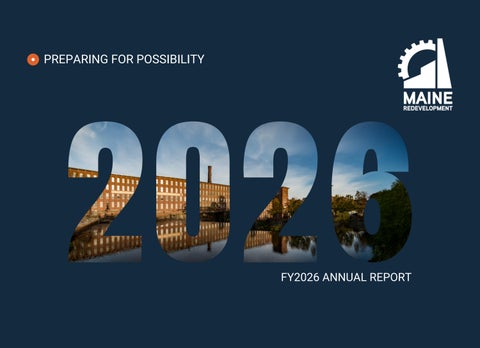
PREPARING FOR POSSIBILITY
FY2026 ANNUAL REPORT
3
MESSAGE FROM OUR EXECUTIVE DIRECTOR Fiscal Year 2026 was an important year for Maine Redevelopment. Throughout the year, the organization continued to grow its presence across the state, strengthen relationships with communities and partners, advance challenging redevelopment projects, and expand the tools and resources available to help move properties toward productive reuse. The adoption of Maine Redevelopment’s first Strategic Plan also provided a clear roadmap for where we are headed and the role we can play in supporting communities throughout Maine. While I joined Maine Redevelopment at the beginning of Fiscal Year 2027, I have the privilege of building on the tremendous work of our Board, staff, partners, and the communities we serve. In my first few months, I have seen firsthand both the need for this work and the enthusiasm that exists for what Maine Redevelopment can become. Whether working with a small community struggling with a long-vacant property or bringing together state, regional, nonprofit, and private-sector partners around a larger redevelopment opportunity, our role is often about helping communities find a path forward when a property or project has become stuck. Looking ahead, I am incredibly excited about what comes next. We will continue building our organizational capacity, strengthening existing programs, developing new tools, and finding creative ways to support communities facing some of their most difficult redevelopment challenges. Just as importantly, we will continue building partnerships and looking for opportunities to bring the right people, resources, and ideas together to get projects moving. There is tremendous redevelopment potential throughout Maine, and Maine Redevelopment was created to help communities unlock it. I am grateful for the strong foundation that has been built and excited to work alongside our Board, staff, partners, and communities as we continue turning challenging properties into opportunities for Maine’s future.
Scott LaFlamme Executive Director
4 Table of Contents PURPOSE - MISSION - VISION - PAGE 5 FY2026 STATEWIDE IMPACT AT A GLANCE - PAGE 6 STRATEGIC PLAN - PAGE 7 PROGRAMMATIC APPROACH - PAGE 8 PROGRAMMATIC APPROACH - YEAR IN REVIEW - PAGE 9 MUNICIPAL TECHNICAL ASSISTANCE - PAGE 10 MUNICIPAL TECHNICAL ASSISTANCE - YEAR IN REVIEW - PAGE 11 BROWNFIELDS - PAGE 12 BROWNFIELDS - YEAR IN REVIEW - PAGE 13 LAND BANK - PAGE 14 LAND BANK - YEAR IN REVIEW - PAGE 15 SPECIAL PROJECTS - PAGE 16 SPECIAL PROJECTS - YEAR IN REVIEW - PAGE 17 STAFF AND BOARD - PAGE 18
5 PURPOSE - MISSION - VISION - GUIDING PRINCIPLES Purpose Maine Redevelopment Land Bank Authority (Maine Redevelopment) is Maine’s statewide, quasi-governmental redevelopment authority and land bank. Created by the Legislature in 2022, we help communities move vacant, abandoned, contaminated, and complex properties toward productive reuse.
Mission To partner with communities to revitalize properties and reimagine their potential for Maine’s future.
Vision We are catalysts for transformation, working alongside communities to build a more vibrant and resilient future for generations to come.
Guiding Principles 1
Every place has the potential for a new purpose. We help turn possibility into what comes next.
2
We will try new things and not avoid hard things - we act before certainty exists, to pilot, test, and refine solutions in real places, learning through action.
3
We are a dirt shop, taking responsibility for sites others leave behind - we focus on property more than policy. Complex, unconventional, and overlooked properties are our work.
4
Community is the outcome - redevelopment is not just about buildings. It is about strengthening place through partnership at every scale.
5
Progress requires showing up - we continually show up as an organization and approach the work with patience and perseverance.
6 STRATEGIC PLAN 2026-2030 Priority Objectives 1
Enhance program scale and impact: Expand successful models in municipal technical assistance, brownfields, land banking and special projects to more communities and property types.
2
Strengthen statewide partnerships and networks: Deepen collaboration with municipalities, regional organizations, private developers, and state agencies to leverage capacity, funding, and expertise.
3
Advance data-driven decision making: Implement robust systems to track project outcomes, measure return on investment (financial, social, and environmental), and communicate impact to stakeholders.
4
Target high-leverage opportunities: Focus on projects and partnerships that generate catalytic impact, such as properties that unlock broader economic development, community revitalization, or housing outcomes.
5
Build organizational capacity: Invest in staff expertise, operational systems, and flexible funding approaches to sustain long-term program growth and innovation.
6
Promote replication and knowledge sharing: Document lessons learned and best practices to guide communities statewide and influence policy and funding frameworks.
WHY CONTINUED INVESTMENT MATTERS Continued state investment gives Maine communities access to specialized redevelopment capacity they could not build alone. It allows Maine Redevelopment to respond early, complete due diligence, assist with environmental concerns, bank properties, coordinate funding and partners, reduce risk, and prepare stalled properties for municipal, nonprofit, or private investment.
7 FY2026 STATEWIDE IMPACT AT A GLANCE Building Capacity to Move Challenging Properties Forward 1
National assessment for programmatic approach
2
Projects & technical assistance delivered in all 16 counties
3
135+ Project inquiries with 55+ brownfields properties in pipeline
4
1 Legislative bill for Vacant School Reuse for Housing
5
$199K awarded in grants
6
First land bank property acquired - Hartland Tannery 30+ acres
7
4 Internships
8
3 Research projects
9
50+ Communities engaged through meetings and site visits.
10
3 Technical Assistance Grants Received MORE THAN A LAND BANK We describe our work as a job retraining program for land, a re-imagination organization or a property recycling program. Yes, we are a land bank, but land banking is only one tool in our toolbox. We use the breadth of our statutory tools to create solutions.
8 PROGRAMMATIC APPROACH Why Four Programmatic Pillars Maine Redevelopment’s approach is grounded in our statutory flexibility and informed by feedback gathered through statewide listening sessions in 2024. These sessions identified gaps in local capacity, regional support, and subject matter expertise needed to advance “stuck” properties toward reuse. Through national best-practice review, collaboration with local partners, and research and development, we developed a program design centered on returning properties to productive use at the local level. 1. Tailored Technical Assistance designed to match each community’s needs and capacity. 2. Focused environmental assessment and remediation of Brownfields, addressing the legacy of Maine’s industrial past. 3. Traditional Land Bank activities to acquire, clear title, stabilize, and reposition properties for market reentry. 4. Flexible Special Projects that may not fit traditional categories but address persistent and shared redevelopment challenges.
EVERY DOLLAR HAS A JOB Maine Redevelopment completed its first independent audit for FY 2025, passing Government Auditing Standards with flying colors. Every penny spent was fully accounted for and focused on our four Programmatic Pillars
9
PROGRAMMATIC APPROACH YEAR IN REVIEW Research, Listening and National Expertise
WHY THIS WORK MATTERS Maine Redevelopment partnered with the Center for Community Progress to examine what keeps vacant, abandoned, deteriorated, and environmentally challenged properties stuck across Maine. The work included municipal and stakeholder interviews, policy research, community visits, and municipal site visits. They examined property data, code enforcement, tax foreclosure, brownfield resources, municipal capacity, and the tools available to move properties toward reuse.
1 OF 3
National Award Recipients Technical assistance from the Center for Community Progress & support from EPA.
WHAT THE RESEARCH FOUND The central question is not only what Maine Redevelopment can do, but where its tools, capacity, and partnerships create the greatest impact.
DATA
CAPACITY
Limited statewide property data.
Municipal capacity varies widely.
Tools to support productive reuse.
Most information is maintained locally, making it difficult to identify trends, establish priorities, and build a proactive statewide pipeline.
Communities understand their local property challenges, but many lack the staff, technical knowledge, tools & financial resources needed to act.
Demolition is a common response to dangerous buildings, while uncertainty around foreclosure, title, liability, and cost recovery leave properties stuck.
INTERVENTION
BROWNFIELDS Filling a distinct role. Our statewide authority, flexible tools, and partnerships help fill gaps in local capacity and the private market.
FINDINGS INFORMED OUR FOUR PROGRAM AREAS SUPPORT · PARTNER · LEAD Maine Redevelopment’s role changes based on the property, community priorities, and local capacity. Our aim is to bring the right tools and partners to move the properties communities need to address.
TECHNICAL ASSISTANCE Local Capacity.
Build local capacity, provide practical tools, and help communities move from concern to action.
BROWNFIELDS
LAND BANK
Cleanup Strategy.
Ownership and Stewardship.
Coordinate assessment, funding, cleanup planning, and reuse for contaminated properties.
Acquire and hold properties, resolve ownership barriers, and provide long-term stewardship.
SPECIAL PROJECTS
Research & Development Research shared challenges, test new approaches, and develop models that can be used statewide.
10 MUNICIPAL TECHNICAL ASSISTANCE Program Purpose & Role The Municipal Technical Assistance Program strengthens municipal capacity to plan, prioritize, and advance property reuse and redevelopment that is aligned with local and statewide goals. By combining technical guidance with hands-on partnership, training, data tools, facilitation, and funding, the program helps communities move from vision to implementation, bridging knowledge gaps, aligning resources, and accelerating the reuse of underutilized properties. Through targeted pilot engagements, Maine Redevelopment works with municipalities to refine practical redevelopment approaches, develop a replicable model, and share best practices with regional and statewide organizations.
BUILDING COMMUNITY, ONE TOWN AT A TIME Maine communities are our clients. All our clients are different but our approach is universal - we meet them where they are, listen, and build longterm partnerships over time.
11
MUNICIPAL TECHNICAL ASSISTANCE YEAR IN REVIEW Helping Communities Move from Possibility to Progress
WHAT WE DID In 2026, Maine Redevelopment worked alongside municipalities to move challenging properties forward. Our role varied based on local capacity, from focused technical guidance to helping lead planning, coordinate partners, identify funding, and build a path toward implementation. Over $200,000 awarded in grants.
LIGHTNING GRANTS: STABILIZE & PLAN FOR WHAT’S NEXT
$200K+ Awarded in Grants
projects & technical assistance delivered to all counties
16
MAINE PRESERVATION
$25K
Historic Building Preservation Toolkit. VAN BUREN Roof replacement and winterization of the future Acadian Arts Center
$25K
HOULTON
$25K
Critical roof, electrical, plumbing, and heating repairs to building on Main Street
JONESPORT Roof repairs and stabilization to building on Main Street
$25K
UNION
Roof and siding repairs at the Thompson Community Center
$9K
WESTFIELD
Roof, window, door & stabilization repairs at former Westfield Elementary School $25K
TECHNICAL SUPPORT IN ACTION Municipal Technical Assistance meets communities where they are, providing the capacity, connections, resources, and hands-on support needed to move challenging properties from concern to action.
FROM HOUSING TO DEVELOPERS
We partnered with Maine Preservation and assisted with funding to complete a preservation toolkit. The toolkit will connect communities with practical guidance on planning, preservation, funding, and redevelopment, helping move challenging properties toward viable reuse. Available in spring of 2027.
VACANT SCHOOL REUSE
$25K
School Reuse Toolkit.
We partnered with Midcoast Council of Governments and the towns of Liberty and Brooks to develop a practical playbook to help communities evaluate vacant schools, identify reuse options, and move toward implementation. Now available for download from our website.
NBRC AWARD MATCH
$40K
Aroostook County.
Revitalizing Maine’s Biomass Communities
We partnered with Aroostook Partnership to host a housing seminar in Presque Isle, bringing together seven town managers and federal partners from HUD, SBA, Health and Human Services, and USDA. Recognizing that limited developer capacity is stalling projects in the region, we are also working with MEREDA and Aroostook Partnership to bring municipal leaders from the county to southern Maine to present development opportunities directly to developers.
We committed matching funds to support the Maine Development Foundation’s $500,000 Northern Border Regional Commission award. Working with MDF, the Maine Office of Community Affairs, and the Maine DECD, this pilot will help rural communities build local capacity, diversify their economies, and advance community revitalization.
12 BROWNFIELDS Program Purpose & Role The Brownfields Program advances the assessment, cleanup, and repositioning of contaminated properties into productive community assets that support local revitalization. Leveraging Maine Redevelopment’s statutory powers, technical expertise, and targeted funding tools, the program helps communities navigate the full redevelopment life cycle from site assessment and remediation through reuse and reinvestment. Maine Redevelopment serves as a grantor, fund administrator, project manager, and statewide connector to implement funding coordination and project matchmaking. This function maximizes the use of available funding across the partner ecosystem, aligns technical resources, and converts complex sites from liability to opportunity. GETTING OUR HANDS DIRTY We will NOT avoid what is hard to do! We’re willing to try new ways to get things done! We’re a dirt shop. We’re willing to get our hands dirty and take responsibility for sites others left behind. Community is the outcome and progress requires a willingness to do what’s necessary.
13
BROWNFIELDS YEAR IN REVIEW Turning Environmental Uncertainty into a Path Forward
HARTLAND TANNERY For over 110 years, the former Irving Tannery was central to Hartland’s economy and identity. Located along Main Street and the Sebasticook River, the 30-acre property was left with aging buildings, environmental contamination, and complicated title issues when operations ended in 2018. These challenges placed redevelopment beyond local capacity. In January 2026, Maine Redevelopment acquired the tannery as the first property in Maine’s statewide land bank. With clear title now established for future owners, Hartland shows how acquisition, environmental planning, community engagement, and long-term stewardship can move a complex brownfield toward productive reuse.
WHAT THE ENVIRONMENTAL WORK CLARIFIED
UNDERSTANDING THE SITE
FIRST Land Bank Property
4
LISTENING TO HARTLAND
Community Visioning Workshops
Phase I & Phase II.
Community Visioning.
Environmental investigations documented soil and groundwater contamination, asbestos-containing materials, lead-based paint, and electronic waste. This work clarified the property’s cleanup needs and established a recommended path forward that includes hazardous-material abatement, building demolition, soil confirmation sampling and site stabilization. Environmental remediation and demolition are estimated at approximately $4 million.
With support from the University of Connecticut Technical Assistance to Brownfields Program and the Kennebec Valley Council of Governments, Maine Redevelopment held four interactive workshops to help Hartland residents shape the site’s future. The workshops explored housing, economic development, outdoor recreation, open space, and broader redevelopment priorities. Using the feedback gathered through this process, Maine Redevelopment can now more clearly define and refine potential future uses for the sites.
BUILDING A STATEWIDE BROWNFIELDS PROGRAM & PIPELINE
55+
Brownfields Properties in Pipeline
In 2026, Maine Redevelopment received a national scholarship through the Center for Community Progress to strengthen our statewide brownfields strategy. The work provided access to experienced land bank practitioners and supported the development of approaches for evaluating, acquiring, funding, and repositioning complex contaminated properties. Maine Redevelopment pipeline has grown to over 55 properties that have real or perceived environmental impacts and includes projects like the Cascade Mill in Oakland, the International Woolen Mill in Sanford and the former Town Garage in Fort Fairfield.
14 LAND BANK Program Purpose & Role The Land Banking Program serves as Maine’s central mechanism for reactivating underutilized and surplus properties for community benefit. As the statewide Land Bank, Maine Redevelopment has statutory authority and statewide flexibility to acquire, hold, and reposition properties across a wide range of land uses. Through disciplined acquisition, stewardship, and disposition, the program converts liabilities into productive assets which go on to support housing, commercial activity, and broader community revitalization. The program integrates legal, financial, and property management expertise within a transparent governance framework, maintaining a focused portfolio of high-impact sites aligned with local and statewide priorities.
SUPPORT · PARTNER · LEAD Maine Redevelopment’s role adapts to each property, community priority, and level of local capacity. We bring the right tools, expertise, and public and private partners to help communities move challenging properties toward productive reuse.
15
LAND BANK YEAR IN REVIEW Creating a Path Through Complicated Ownership
WHY A LAND BANK IS NEEDED A property can remain idle even when a community has a vision for it. Bankruptcy, separate owners, environmental issues, uncertain title, and the cost of holding a site can block investment. Maine Redevelopment’s Land Bank can acquire, hold and manage these properties, resolve title and ownership issues, stabilize sites, address environmental issues and prepare them for responsible redevelopment.
FIRST
Land Bank Property Acquired Hartland Tannery, January 2026
HARTLAND TANNERY SHOWS THE LAND BANK TOOLS IN ACTION Time, title work, and careful stewardship help turn a property into an investable opportunity
ACQUIRE
Putting Land Bank Tools to Work in Hartland The Hartland Tannery acquisition involved a complicated bankruptcy and multiple parcels with different ownership and title conditions. After acquiring the core property in January 2026, Maine Redevelopment cleared the title for future owners, removing a major barrier to financing, private investment, and successful redevelopment.
STEWARDSHIP
Holding Property While Planning and Cleanup Can Occur Land banking gives communities the time, capacity, and specialized tools needed to move complicated properties from fragmented ownership and uncertainty toward responsible reuse, while allowing the private market time to move projects forward.
BUILDING A PIPELINE Communities across Maine are seeking help with properties stalled by ownership, title, environmental, building, or capacity challenges. Some are considering acquisition, while others took ownership without first completing an environmental assessment, potentially jeopardizing eligibility for EPA Brownfields funding. Maine Redevelopment has received more than 135 inquiries. Each begins with a conversation about the property, community goals, and barriers to reuse. Projects may advance through technical assistance, connections to other resources, or potential Land Bank acquisition.
50+
Communities Engaged Through calls, site visits, and project discussions.
135+
Inquiries in our Pipeline Communities and partners have brought 135+ redevelopment challenges into our statewide pipeline.
Our statute gives us a role in evaluating surplus state property for productive reuse. During FY 2026, we worked with the Maine Department of Administrative and Financial Services and local partners to assess reuse options for the former York District Courthouse. We also met with the Maine Department of Transportation, Maine Department of Agriculture, Conservation, and Forestry and the University of Maine to better understand state property holdings.
16 SPECIAL PROJECTS Program Purpose & Role The Special Projects Program serves as Maine Redevelopment’s innovation and problem-solving arm, designed to respond to emerging opportunities, pilot new models, and develop partnerships that advance statewide redevelopment goals. Operating across sectors and property types, the program tests and demonstrates scalable approaches to complex redevelopment challenges. Backed by statutory authority and legislative support, Special Projects applies an entrepreneurial approach to publicpurpose redevelopment. It combines technical expertise, entrepreneurial spirit, public purpose, and disciplined experimentation to develop replicable models that strengthen complex redevelopment efforts across Maine, especially in cases where private sector partners don’t exist.
CLEARING THE PATH FOR INVESTMENT Completing early due diligence reduces risk, clarifies redevelopment opportunities, and gives private partners the information they need to move projects forward. Lessons from each project become practical tools and strategies that can advance redevelopment across Maine.
17
SPECIAL PROJECTS YEAR IN REVIEW Testing New Approaches to Complex Redevelopment Challenges
WHY SPECIAL PROJECTS Special Projects gives Maine Redevelopment the flexibility to investigate shared challenges that do not fit neatly within a traditional program. By combining research, technical expertise, partnerships, and practical experimentation, we test new tools and develop solutions that communities and partners can adapt and use across Maine.
2026 SPECIAL PROJECTS
TAX FORECLOSURE RESEARCH Turning Municipal Experience into Statewide Solutions
Tax foreclosure emerged through Maine Redevelopment’s municipal work as a barrier to returning vacant and dangerous properties to productive use. Students from University of Maine School of Law’s internship program and the Center for Community Progress examined title uncertainty, municipal costs, liability, and disposition delays. More than 30 municipal interviews informed a legal white paper shared with policy and partner organizations to support statewide discussion and potential reform. Without clear, insurable title, homebuyers who rely on mortgages are unable to purchase these properties, limiting sales to cash buyers. This restricts homeownership and risks further deterioration and loss of Maine’s limited housing stock. The June 2026 decision in Pung v. Isabella County creates a timely opportunity to refine Maine law around clear, insurable title, fair tax foreclosure auctions, and the treatment of properties foreclosed on before the Tyler v. Hennepin County decision.
EAST MILL WORKS East Millinocket
Maine Redevelopment continued supporting the Town of East Millinocket’s redevelopment of the former Great Northern Paper mill site. Assistance included developer due diligence, parcel mapping, consultation with the East Millinocket Industrial Board, and creation of the East Mill Works website to showcase the site’s assets and redevelopment opportunities.
LIFE SAFETY
Turning Research into Reuse Life safety requirements can stop viable reuse projects. When public buildings change use, costly fire suppression, accessibility, and other upgrades may be required. Maine Redevelopment partnered with UMaine’s Margaret Chase Smith Policy Center to examine these barriers, potential code changes, and investment strategies. In Rumford, we supported an engineering assessment of the fire suppression upgrades needed to pair the historic Central Fire Station with a ready tenant. The project demonstrates how targeted investment can unlock buildings potential, generate municipal revenue, and preserve community assets.
BANGOR MALL
Exploring the Future of the Bangor Mall Following legislative direction in L.D. 901, we entered into an agreement with the City of Bangor to identify beneficial future uses for the Bangor Mall property. Including preliminary research and due diligence related to land use, building conditions, structural information, ownership complexities, and potential public and private redevelopment scenarios.
L.D. 2164
Converting Vacant Schools into Housing
Special Projects brings research, due diligence, and early intervention together to reduce uncertainty and clear a path for successful private investment. Lessons from individual projects become practical tools and strategies that can be applied across Maine.
With more than 30 vacant schools across Maine, communities need resources to pursue new uses for these properties. L.D. 2164 proposed a statewide program within Maine Redevelopment to convert vacant schools into housing. The bill advanced through committee and both chambers but fell short of funding in Appropriations. Building on that momentum, Maine Redevelopment released a School Reuse Toolkit informed by pilot work in Liberty and Brooks, providing a practical framework for productive reuse.
18 STAFF & BOARD Staff Scott LaFlamme, Executive Director Jennifer Litteral, Deputy Director Gabe Gauvin, Programs Manager Rose Nelson, Senior Programs Coordinator Kelsey Shepherd, Program Coordinator
Board Chair, John Egan, Avesta Housing Vice Chair, Alexa Plotkin, Catherine Cutler Institute Treasurer, Robert Bryant, District 2 Representative Kevin Bunker, Developers Collaborative Laura Burden, Real Estate Broker Janice de Lima, Norway Savings Bank Lee Jay Feldman, Town of Kennebunk Ian Houseal, Big Houses, LLC. Rip Patten, Credere Associates Ex officio, Dan Brennan, Maine State Housing Authority Ex officio, Ian Gorecki, Maine DOT Ex officio, Nick Hodgkins, Maine DEP Ex officio, Kirk Mohney, Maine Historic Preservation Comm. Ex officio, Doug Ray, Maine DECD
Design by: Jennifer Litteral Images of towns and mills from around Maine
PREPARING FOR POSSIBILITY
HAVE A STUCK PROPERTY? We can support, partner, or lead based on your community’s goals and capacity. Contact us to begin a conversation.
maineredevelopment.org info@maineredevelopment.org SHS 129, Augusta, ME 04333-0129