JOIN US MAY 7-8TH IN ROCKPORT, ME LOG A LOAD AUCTION, AWARDS AND MORE!
Chuck Ames, President SDR Logging, Inc. • Sebec, ME
Duane Jordan, 1st Vice President
Elliott Jordan & Son, Inc. • Waltham, ME
Kurt Babineau, 2nd Vice President Babineau Trucking & Logging • West Enfield, ME
Andy Irish, Treasurer
Irish Family Logging • Peru, ME
Marc Greaney, Secretary Western Maine Timberlands, Inc. • Fryeburg, ME
William Cole, Past President Trees LTD • Sidney, ME
Aaron Adams
GCA Logging, Inc. • Avon, ME
Jack Bell
Long View Forest Inc. • Hartland, VT
Joe Cushman
Maine Custom Woodlands • Durham, ME
Brent Day
William A. Day & Sons • Porter, ME
Thomas Douglass
Thomas Logging & Forestry • Guilford, ME
Steve Hanington Hanington Brothers, Inc. • Macwahoc Plt., ME
Dakota Harvey
D. Harvey Timber Harvesting • Rutland, VT
Jon Hinds
Hinds Selective Wood Harvesting • Wayne, ME
Randy Kimball Kimball & Sons Logging & Trucking • Poland, ME
Sam Lincoln
Lincoln Farm Timber Harvesting • Randolph Center, VT
Molly London W.W. London Woodlot Manag. Co. • Milo, ME
Tony Madden
A.W. Madden, Inc. • Milford, ME
Jim Nicols
Nicols Bros. Logging, Inc. • Mexico, ME
Marty Pelletier
SYL-VER Logging, Inc. • St. John Plt., ME
Cedric Pepin
Pepin Lumber Inc. • Coburn Gore, ME
Ron Ridley
L & A Ridley, Inc. • Jay, ME
Gary Voisine
Voisine Brothers, Inc. • New Canada, ME
2026 Logger's Expo Gathering On
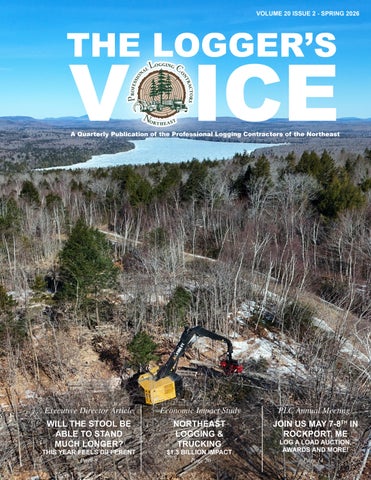
THE LOGGER’S VOICE
Editor
Jon Humphrey • jon@plcloggers.org
Advertising Jessica Clark • jessica@plcloggers.org
Upcoming Events
From the President
New Members
Executive Director's Report
PLC Annual Meeting
Northeast Economic Impact Study
Master Logger Cost-Share Initiatives
Safety Section
Vermont SLoCAMP Program
Maine Forest Rangers
Maine Forest Service
Congressional Delegation Updates
RSVP is required for all PLC events
26 MAR
1-2 MAY
PLC Annual Safety and Fleet Trainings begin 13 locations
Maine and Vermont
7-8 MAY
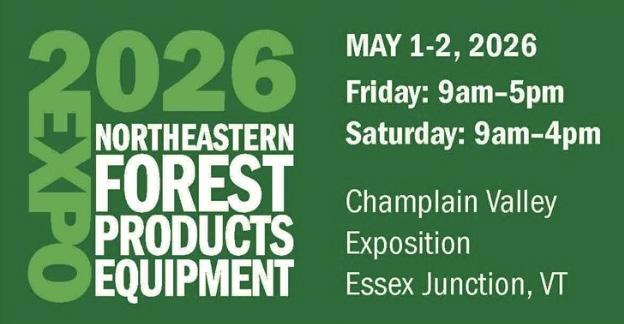
Northeastern Logger's Expo
Champlain Valley Exposition
Essex Junction, VT
PLC Annual Membership Meeting
Samoset Resort
Rockport, ME
PLC Southern Maine Log A Load Golf Tournament
Kezar Lake Country Club
Lovell, ME
PLC Board Meeting & MLOFT Visit
8:30 AM -1 PM
KVCC Alfond Campus (Farm Area) Hinckley, ME
PLC Northern Maine Log A Load Golf Tournament
JATO Highlands Golf Course
Lincoln, ME
MLOFT Graduation
1 PM
KVCC Alfond Campus (Farm Area) Hinckley, ME
HFROM THE President
By Chuck Ames
ello everyone, and welcome to Spring. By the time you read this many of you will be shut down for mud season and doing maintenance on your equipment after the winter season. Don’t forget to register your crews for the PLC’s Spring Logger, Fleet, and CPR Safety trainings which have now started. These are free to PLC Members and Master Logger Certified® Companies and will run through May. There are trainings offered in both Maine and Vermont.
It is hard to believe, but my term as President of the PLC will end in May, so this is my last article for the magazine. Two years have gone by quickly. I’d like to thank everyone who has helped me along the way and who has stepped up to help the PLC. This organization is most effective when our members get involved. Please stay involved as I pass the gavel on to our next President, Duane Jordan.
I hope this winter was a productive one for all of you, but from talking to other members and from my own experience I know for most it was a struggle even though we had good conditions for logging and trucking. We’ve continued to see weak low-grade markets, mill shutdowns and slowdowns and quotas, and high prices on equipment, parts and insurance. On top of all of this, diesel prices have gone up to the point where continuing to operate and to truck wood is break-even at best.
This brings me back to the biggest issue we loggers face in trying to remain profitable – we are price takers not price setters. Many logging companies including my own have turned to dirt work and other sidelines to keep going. When a company’s expenses go up and they take a job to build a road
or sell cords of firewood, they can raise their price to continue to make a profit. But when loggers sell wood to a mill, it is the mill that tells them what the price will be, no matter what their expenses are.
I think now more than ever before we are seeing the result of this situation. Loggers can’t continue to operate when there are no profits to reinvest in the business. Break even or, even worse, losing money, does not work. If this industry is to have a future, then people working as hard as loggers do need to see a profit from all that work, otherwise what incentive is there to keep going?
I don’t know if or when we will see a solution to the price taker situation, but I am encouraged that word that loggers are in trouble is beginning to get out there. In March, the PLC learned Maine’s governor included the language for our proposed state sales tax exemption for trucks/trailers used in the logging industry in the supplemental budget change package that was delivered to the Maine Legislature. This is not final, and it will require a majority vote of the Legislature before they leave town on April 15th, but if it passes this is a huge step forward for the industry and a big win for the PLC. I know in Vermont the PLC’s voice is also being heard at the state legislature and beginning to have an impact. This does not fix our situation, but these are steps in the right direction.
Thank you again for the chance to be president of this organization, and I look forward to seeing you all at the PLC’s annual meeting on May 7th and 8th at the Samoset in Rockport, Maine.
-Chuck Ames
WELCOME NEW PLC MEMBERS!
NEW CONTRACTOR MEMBERS
Aldrighetti Logging LLC
Randolph, VT
Bruce Waite Logging Inc.
Dorcet, VT
Burl Land Clearing LLC
Hooksett, NH
Future Forest Management LLC
Lisle, NY
KJ Pratt Excavation & Logging LLC Richmond, VT
KNK Forest Products. Andover, NY
S.E. Schiano Logging, Swain, NY
Timber Farm Firewood LLC
Lebanon, ME
Zampini Log & Land
Reading VT
NEW SUPPORTING MEMBERS
Kennebec Savings Bank
Preferred Supporting Member, Augusta, ME
Realty of Dover-Foxcroft
Enhanced Supporting Member, Dover-Foxcroft, ME
Golisano Children's Hospital at UVM Health
Nonprofit Supporting Member, Burlington, VT
Northeastern Loggers Association
Nonprofit Supporting Member, Old Forge, NY
Gilles Morneau
Individual Supporting Member, Chapman, ME
Sherbey Morris
Individual Supporting Member, Fort Kent, ME
Classes Start June 22!
The Mechanized Logging Operations and Forest Trucking Program (MLOFT) is a unique and intensive hands-on training course that prepares students for careers in the logging and forest trucking industry. The experience students gain operating mechanized logging equipment and trucks is unmatched by any other program in the country. The program is based at Kennebec Valley Community College (KVCC) in Fairfield, Maine.
Originally open only to Maine students, MLOFT now accepts students from anywhere in the United States.
Tuition is FREE.
WILL THE STOOL BE ABLE TO STAND MUCH LONGER?
By Dana Doran, PLC Executive Director
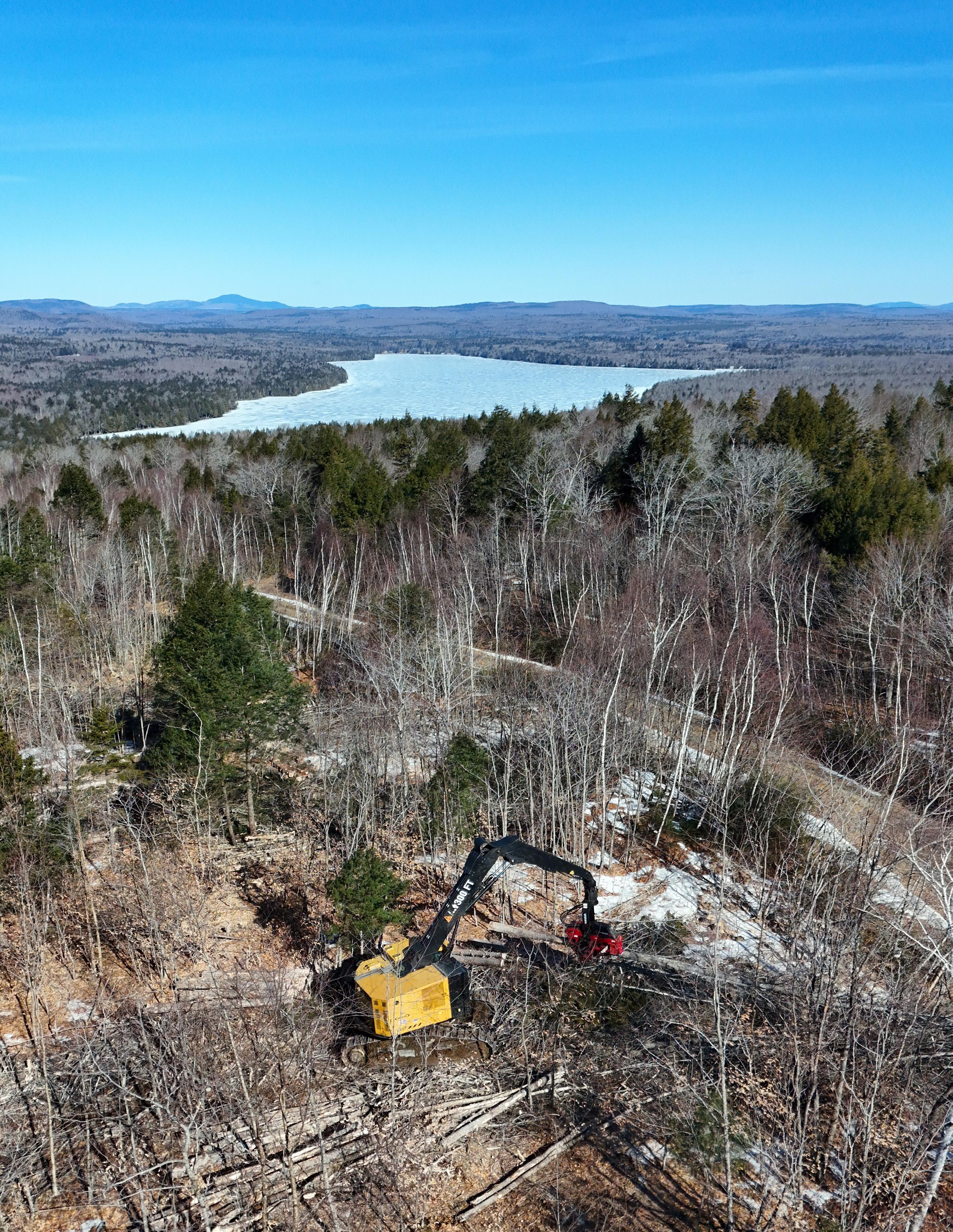
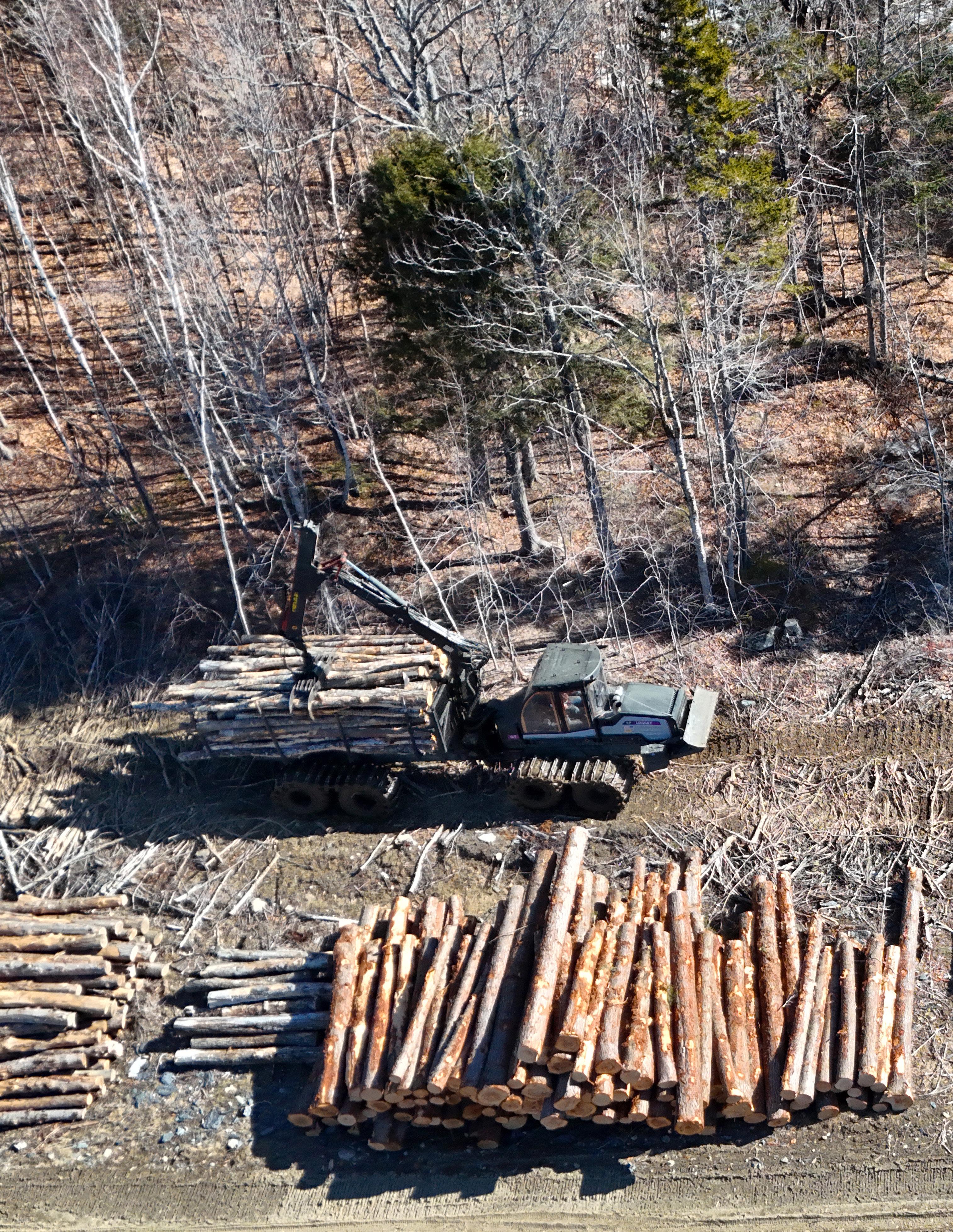
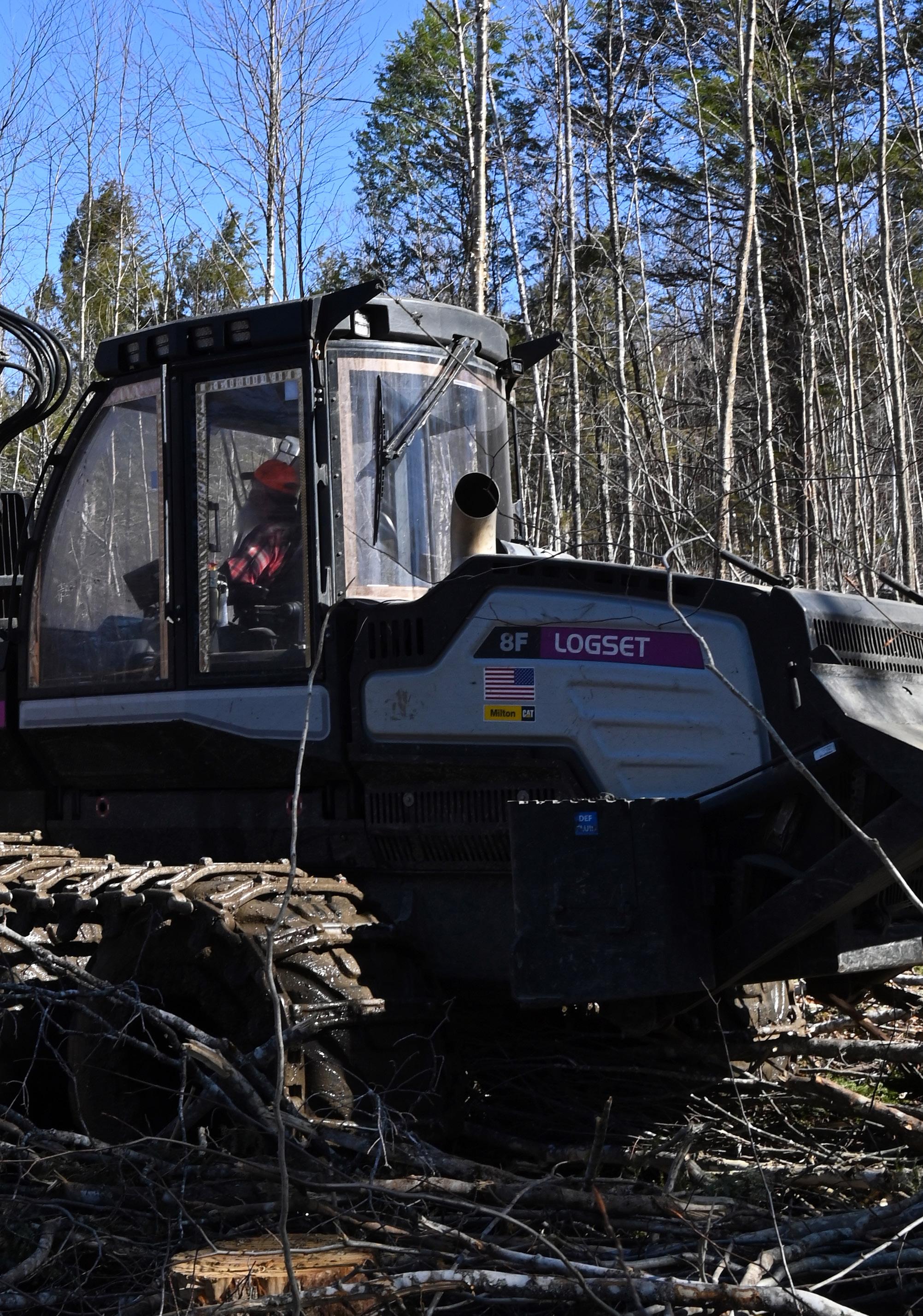
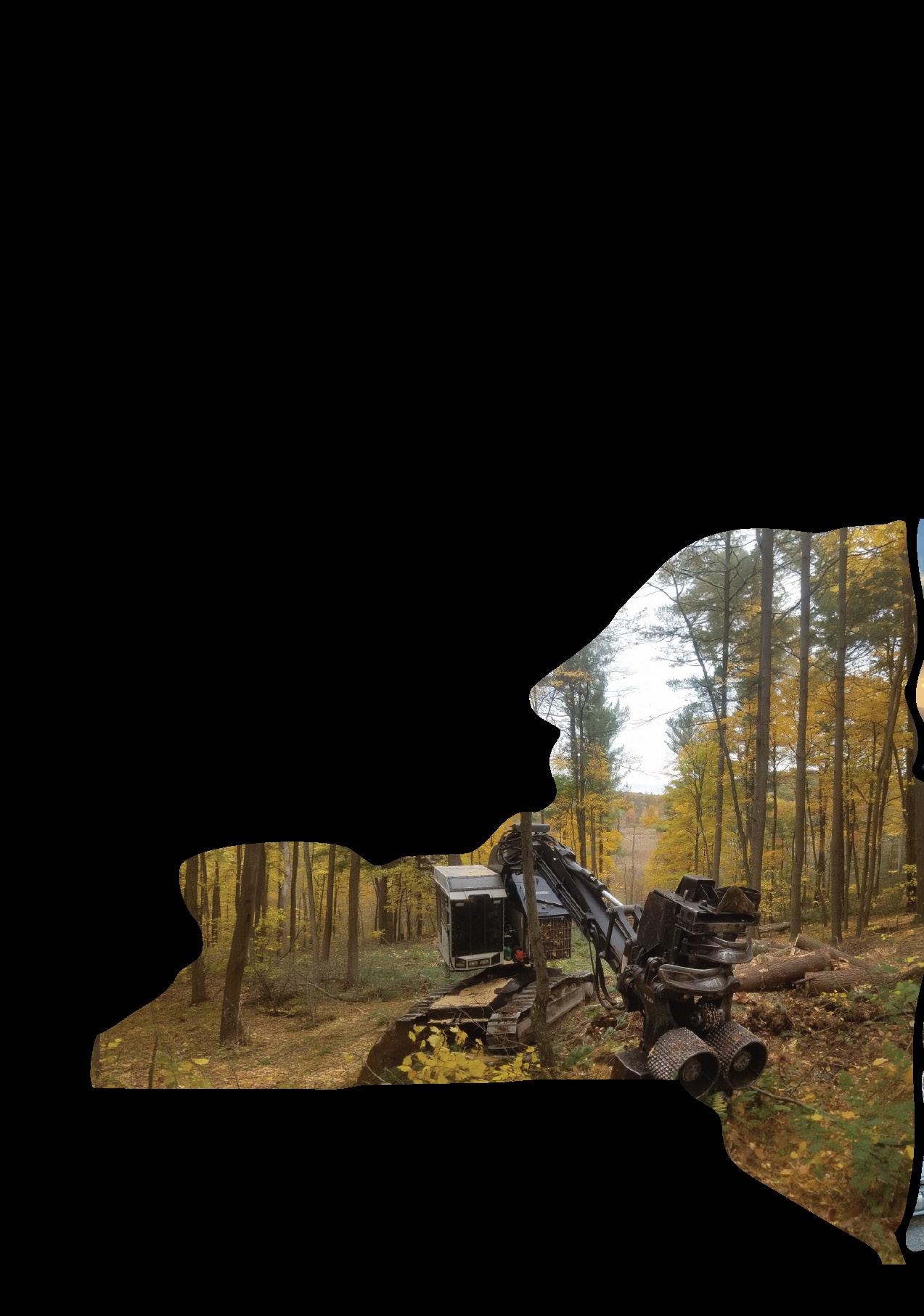
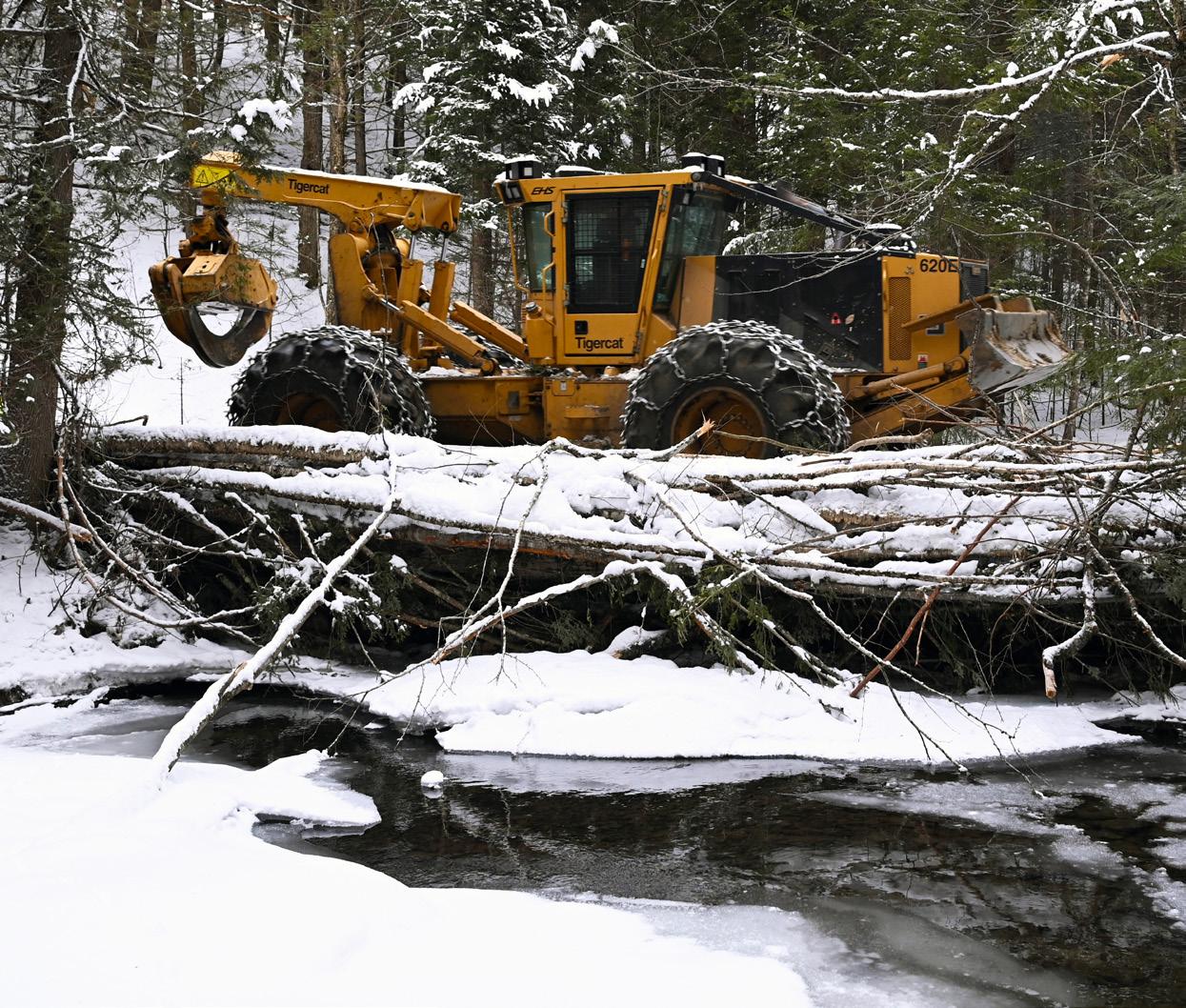
SDR Logging Inc. forwarder at work in Abbot, Maine in March.
Happy Spring!!!
As we turn the page on winter, this is usually the time of year to take a break from the long winter push and reflect on the success of a long few months. Spring is usually the time to take a much-needed rest and unwind from some long days and nights. However, this year feels different as the membership continues to face steep headwinds and there is a tremendous amount of uncertainty and stress about the future. Markets for wood over the winter months have been a challenge like no other in recent history.
In the last three years since the Old Town and Jay mills closed in Maine, the summer months were the challenge, but most could count on winter to repair the wounds of summers past. The winter of 2025-26 was not that winter.
In October, November and December of 2025, we knew something was different as nearly all of the pulp consuming facilities in the Northeast (five in Maine, two in NY, one in Quebec) stopped or significantly curtailed their wood deliveries. This was unheard of since winter is always go time for those large volume consumers of wood.
This situation, which we all thought was temporary at the time, continued well into the new year for several reasons.
First, despite cold temperatures, frozen ground and peak operational conditions, natural gas prices went sky high. The region is heavily dependent on natural gas, but it has also recently become dependent upon electricity from Quebec. When the cold snap came in mid-January, Quebec needed its hydroelectricity and Massachusetts needed natural gas to replace it. As a result, supply and demand kicked in and natural gas prices became unpredictable. Some mills simply could not afford to pay for higher-than-average natural gas, so they chose to shut down at one of the most critical times of winter.
Second, other consuming mills either curtailed or lost major contracts for a multitude of reasons, including tariffs and global competition, and effectively closed off deliveries for wood not tied to a fiber supply agreement.
Both reasons are legitimate, both are outside of the mills control and both are creating havoc in the supply chain.
On the saw log side, mills did continue to purchase wood, but there were hard quotas as output crept along at a snail’s pace as a result of high interest rates
and a slowdown in building construction. While wood consumption remained steady, it was not at a brisk pace.
Adding insult to injury, as a result of the war in Iran, diesel is now close to $6/gallon, which is on top of steep inflation that has been rampant since 2022. For now, there doesn’t seem to be light at the end of the tunnel in the foreseeable future.
For contractors, if you are a service contractor tied to a fiber supply agreement with a mill, large landowner or management company with guaranteed wood volume, you made it through the winter and there is more promise for continuity when start up occurs in mid to late May. However, if you are a stumpage contractor and sell gate wood or operate more than 100 miles from a mill, the situation is not only complex, but extremely volatile.
Having been in this position for the last 12 years, I have never seen more challenging operating conditions, nor have I heard from as many who are questioning their future. This spring is going to be a challenge for many to make it through and I have a feeling that contractor capacity is going to drop even further by the time we get to start up in May.
With challenging operating conditions, high diesel prices, reduced markets and head winds that are stiffer than a hurricane, I thought that perhaps there would be an all-hands-on deck approach from those in the supply chain to work together over the next few years until better days appear. A simple recognition of the bleak situation that all are dealing with and empathy and responsiveness to get through to the future. For the most part, I think this has occurred as there are plenty of examples where those in positions of power are willing to do the right thing and not just the economic thing.
However, there are some things that occur that not only make you scratch your head but actually make you quite frustrated and mad in the end.
Recently, I read a news article about a large landowner in the Northeast. The landowner, which has a history of hiring contractors, but also employing company crews, has business operations in the United States and Canada and was comparing their operations on both sides of the border.
We all know that Canadian operations generally are more profitable as a result of significant investment on behalf of the Canadian government. This is fact and has been proven in international trade court.
The article explains the landowner’s wood sales
Continued page 10
volume over the last year, with a net increase in revenue in Canada and a sharp decline in the United States. This is also explainable as Canadian markets have been quite consistent but markets on the US side have been quite unpredictable.
That said, the landowner is bullish on future operations on the US side and feels they will improve in the future. However, to do so, something has to change.
To improve profitability, the landowner is going to focus on operator productivity, code for logging contractor productivity, by product per hour and per acre.
Operations in the United States are solid, but they have, “slowly diminished….. and what’s left hasn’t modernized.”
Let me repeat this if you missed it the first time.
According to this landowner, contractors in the United States have gone out of business or just haven’t upgraded their equipment and are frankly to blame for lost revenue. There needs to be greater focus on their production from the top down.
When I read this statement, I nearly fell out of my chair and when I shared it with one of our members that used to work for this landowner, I could feel his blood pressure boiling and a gasket about to blow.
To add further insult to injury, a state university professor on the US side, actually had the cojónes in the same article
to not only agree with the assessment of the large landowner but commend them for their approach to the “problem”. “The harvesting, the logging, and the processing of the material… are where we are going to see the innovation, automation and AI. That is where your gains are going to be, so I think as much as you can oversee that supply chain, that is where the profits are going to be made and efficiencies made.”
While I appreciate and respect those that work in academia, I would challenge their understanding of operations as well as the reality of where there might be waste, fraud and abuse that can be eliminated from the supply chain. Until you have taken the risk, made the investment and lived the reality every
day, I’m not sure that making such a statement is productive nor helpful, especially in light of current circumstances. Contractors have been told to get efficient for decades with a false bill of goods that it will improve their bottom line. The endless fallacy that efficiency will make them more cost effective and more profitable has become more propaganda than reality. Evidently, if you are told something repeatedly, it should be taken as truth. However, the numbers don’t lie as detailed in our latest economic impact study and this not believable any longer. The bottom line is, if after all efficiencies have been made, you can’t afford to reinvest in your company, including equipment, perhaps its not worth
Continued page 12
being in the business.
As we move toward spring and wait for the ground to dry and operations to start back up, I would remind all of our partners that we are at a very tenuous time at present. Many are questioning their future and many simply might not have a future come May, June and July of this year.
We are all bullish on our forest and bullish on the future.
The Northeast has one of the greatest forest resources in the world and we are currently growing three times as much wood as we are harvesting. We have an amazing resource that is sustainable and renewable and there is a bright future ahead of us.
However, no wood product can be created without a
logger to harvest it and a trucker to transport it. I’m afraid that we are headed down a dead-end path if the logging community erodes past the point of no return.
We are always told that the forest stool has three legs and the stool will fall if one leg fails. Let’s make sure that respect is given where respect is earned and those that do the work know their business better than anyone. It’s time to stop kicking contractors in the teeth, give them their just desserts and ensure that they are respected, supported and compensated for the future. Without them, no one will succeed.
Have a great spring, stay safe and I look forward to seeing you throughout the spring at our many events.
SDR Logging Inc. forwarder at work in Abbot, Maine in March.
31st Annual Meeting & Log A Load for Kids Benefit Auction
THURSDAY & FRIDAY, MAY 7 + 8
THE SAMOSET RESORT - ROCKPORT, ME
PRESENTED BY:
PLC MEMBERS & FAMILY
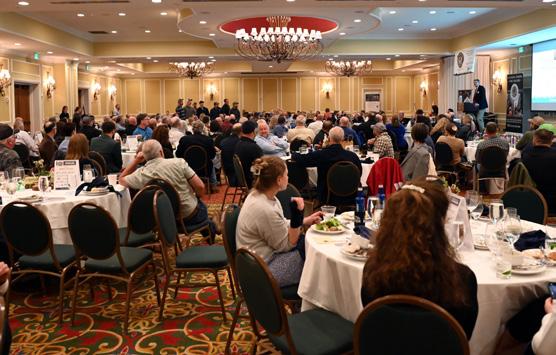
Please join us for our 31st Annual Meeting to learn and network with other professional loggers and recognize the best of 2026.
EVENT HIGHLIGHTS
May 7: Voyage to Vinalhaven
May 8: Maine Governor’s Candidate Panel & Matt O’Malia of TimberHP
May 8: Log A Load Auction with Seth Wescott, Maine native and twotime Olympic Gold Medalist
THE WHY BEHIND OUR AUCTION
Creating real miracles by raising funds for local hospitals since 1983, Children’s Miracle Network (CMN) has raised over $5 billion for 170 children’s hospitals across North America. The PLC of the Northeast and its members have contributed more than $2.9 million since 1996 to support children in Maine, New York and Vermont, funding research, equipment, and uncompensated care. These efforts help kids battling cancer, traumatic injuries, premature births, and genetic diseases. Help us surpass $3 million raised for the kids in 2026!
05.07.26
EVENT OVERVIEW
05.08.26 F R I D A Y
Escape to Vinalhaven for a day of coastal discovery We’ll cruise from Rockland to explore the island’s wind farm and historic Brown’s Head Lighthouse, followed by lunch and island-brewed craft beer. In the afternoon, choose your adventure: a guided quarry tour or a stroll through the local village. 15% of the cost of this outing will be donated to Log A Load for Kids!
Thursday Night Social: We’ll cap off the day back on the mainland with a social at the Samoset Clubhouse
Start the day with our Maine Governor’s Candidate Panel (all welcome), followed by the Contractor Member Annual Business Meeting. This exclusive session covers elections, legislative goals, and the 2025 Acadia dividend.
Join us for lunch featuring our speaker Matt O’Malia, Co-Founder, President & CEO of TimberHP.
Relax & socialize during our afternoon break!
Join us at 4pm for a social hour and a preview of the Log A Load Auction, open to PLC Contractor Members, Supporting Members, and invited guests The auction kicks off with Children's Miracle Network children, Scott Hanington and special guest, Seth Wescott. All proceeds benefit Log A Load for Kids.
The auction will be followed by dinner, concluding with the Master Logger® certification ceremony and the PLC’s annual awards presentation.
PLC Annual Meeting & Log A Load for Kids Benefit Auction
MEETING
AGENDA - FRIDAY, MAY 8
Time Topic Details
MORNING SESSION
7:00 am
Breakfast & Registration
8:00 am Break 10:30 am
Maine Governor’s Candidate Panel
10:45 am
PLC Contractor Member
Annual Business Meeting
AFTERNOON SESSION
12:00 pm
12:30 pm
2-4 pm
Lunch Buffet
TimberHP: Matthew O’Malia
Afternoon Break
EVENING SESSION
4:00 pm
5:00 pm
6:30 pm
7:00 pm
7:15 pm
Social Hour
Log A Load for Kids Auction
Dinner Buffet
PLC President’s Welcome
Awards Ceremony
Registration & check in at the Samoset Resort Enjoy breakfast before the day starts
Maine’s gubernatorial candidates will discuss their plans to support and strengthen the logging industry with our members. All attendees can participate
Full Board and General Membership Meeting, Board Elections, Legislative Update & Acadia Dividend Program update Contractor members only
Matt will provide an update on Timber HP post bankruptcy, their manufacturing lines, markets and outlook for the future
Silent Auction & Live Auction Preview
Auctioneer - Scott Hanington & Special Guest
Seth Wescott - two-time Olympic Gold Medalist
Passing of the Gavel
Master Logger Supporter Award, New Master Loggers
PLC Logger of the Year, Acadia Insurance Safety Award, PLC Community Service Award, Supporting Member Award & PLC President’s Award
PLC Annual Meeting & Log A Load for Kids Benefit Auction
SPONSORSHIPS
Thank you to our current sponsors and we have room for more!
-PRESENTING-
-SOCIAL & AUCTION- -LUNCH- -DINNER-
-GIFT BAG- -TSHIRT-
-MORNING MEETING- -THURSDAY RECEPTION-
-BREAKFAST-AWARDS-
VOYAGE TO VINALHAVEN
THURSDAY, MAY 7
Join us for a scenic ferry ride from Rockland to Vinalhaven Island for a day filled with local sights, food and drinks! We’ll take a tour of a Wind Farm, explore Brown’s Head Lighthouse, and enjoy lunch at Vinalhaven Community Brewing. Then it’s your choice take a guided tour of a former quarry operation or explore Carver’s Harbor, the island’s village. The day will end with a social at the Samoset Club House. Bring your guests along for a fun-filled coastal adventure!
15% of the cost of this outing will be donated to Log A Load for Kids!
Itinerary:
7:00 AM – Breakfast at The Samoset
8:00 AM – Depart The Samoset
8:15 AM – Arrive at Rockland Ferry Terminal
8:45 AM – Ferry departs for Vinalhaven
10:00 - 10:15 AM – Ferry arrives at Vinalhaven
Island Activities:
10:45 AM – Tour of Fox Islands Wind
11:45 AM - Explore Brown’s Head Lighthouse
12:30 PM – Lunch at Vinalhaven Community Brewing (tacos & island-brewed beer flights)
1:30 PM – Tour of Sands Quarry or explore Carver’s Harbor
2:45 PM – Ferry departs for Rockland
4:00 PM – Ferry arrives in Rockland
4:30 PM - Arrive back at The Samoset
Additional Information:
Guests are welcome to join! The day includes food, drink, and unique local experiences.
LOGGING AND TRUCKING IN THE NORTHEAST
PLC'S IMPACT STUDY OF THE INDUSTRY ACROSS THE NORTHEAST
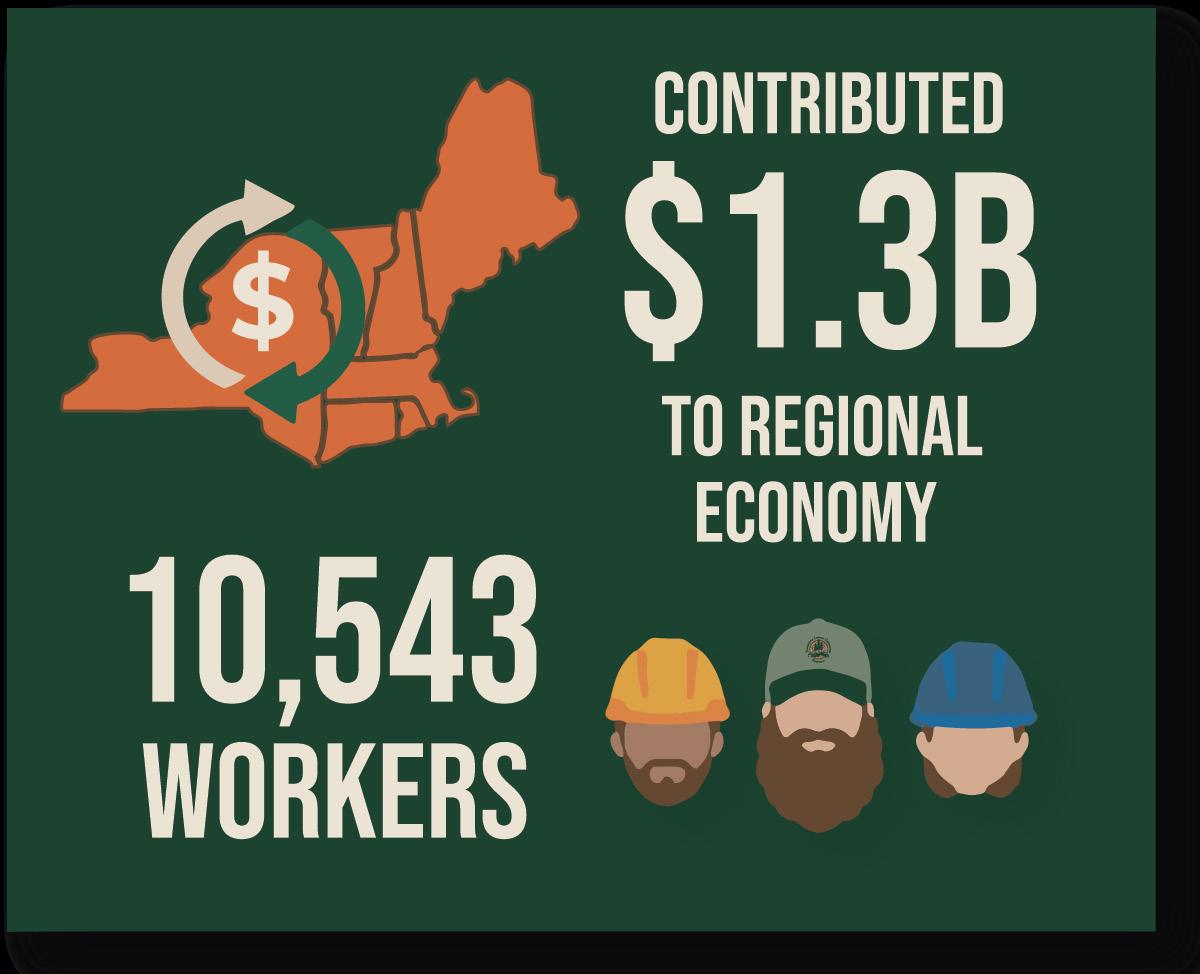
The Professional Logging Contractors of the Northeast (PLC) released results of a comprehensive study of the economic impact of Northeast logging and forest trucking in late February, showing the industry contributed an estimated $1.3 billion to the
regional economy in 2024.
The study, The Economic Contribution of Logging and Trucking in the Northeast, conducted by Wallace Economic Advisers, LLC, also revealed that in 2024 logging and forest trucking supported approximately 10, 543 Northeast jobs
"The study showed the industry is facing an evermounting list of challenges that threaten its future, including loss of markets and market uncertainty, rising costs, shrinking profits, worker shortages, and lack of succession planning"
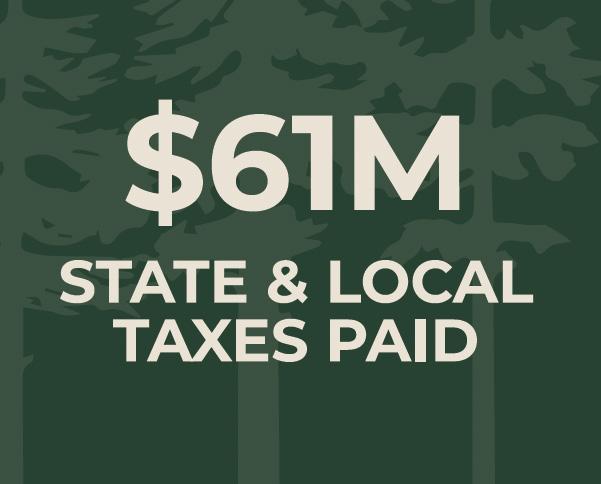
either directly or indirectly, generated $393 million in labor income, pumped an estimated $61 million into state and local tax coffers, and remained critical to a range of industries and communities across the region.
At the same time, the study showed the industry is facing an ever-mounting list of challenges that threaten its future, including loss of markets and market uncertainty, rising costs, shrinking profits, worker shortages, and lack of succession planning.
“This is the first truly regional impact study of its kind for the logging and forest trucking industry, and it clearly demonstrates both the immense importance of the industry to the Northeast, and the very real possibility that the industry has reached a breaking point,” Dana Doran, Executive Director of the Professional Logging Contractors of the Northeast, said.
“The forest economy of the Northeast is built on a foundation provided by loggers and truckers, and anything that threatens that foundation threatens the entire sector, with dire consequences for the region.”
The study looked at the Northeast region as a whole and also included state by state breakdowns of the data. Maine leads the region
Continued page 20
MAINE
$534M Economic Output
$283M Labor Earnings
NEW YORK
$280M Economic Output
$140M Labor Earnings
NEW HAMPSHIRE
$243M Economic Output
$94M Labor Earnings
VERMONT
$140M Economic Output
$75M Labor Earnings
MASSACHUSETTS
$72M Economic Output
$34M Labor Earnings
CONNECTICUT
$39M Economic Output
$17M Labor Earnings
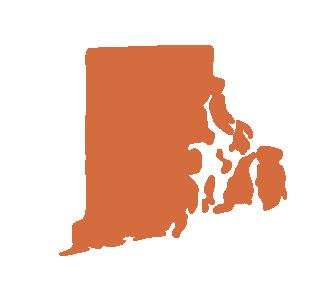
RHODE ISLAND
$8M Economic Output
$2M Labor Earnings
in logging output followed by New York, New Hampshire, and Vermont. The impact of the industry in other states in the region is smaller but still significant. Numbers by state for 2024 included:
Maine: 2,744 direct logging and trucking jobs, along with an additional 1,715 indirect jobs, for a total of about 4,460 jobs statewide. Total economic output from logging and trucking reached approximately $534 million, the highest in the region, including $283 million in total labor earnings, and generated an estimated $23 million in state tax revenues.
New York: 1,911 direct logging and trucking jobs, along with an additional 500 indirect jobs, for a total of about 2,411 jobs statewide. Total economic output from logging and trucking reached approximately $280 million, including $140 million in total labor earnings, and generated an estimated $19 million in state tax revenues.
New Hampshire: 804 direct logging and trucking jobs, along with an additional 700 indirect jobs, for a total of about 1,504 jobs statewide. Total economic output from logging and trucking reached approximately $243 million, including $94 million in total labor earnings, and generated an estimated $6 million in state tax revenues.
Vermont: 800 direct logging and trucking jobs, along with an additional 500 indirect jobs for a total of about 1,300 jobs across the state. Total economic output ranked fourth in the Northeast at approximately $140 million, including $75 million in labor earnings, and generated an estimated $9 million in state tax revenues.
generated an estimated $1.7 million in state tax revenues.
Rhode Island: 40 direct logging and trucking jobs, along with an additional 24 indirect and induced jobs, for a total of about 64 jobs statewide. Total economic output from logging and trucking reached approximately $8 million, including $2 million in total labor earnings, and generated an estimated $200,000 in state tax revenues.
The study revealed loggers throughout the region are facing many of the same challenges, but they vary in severity depending on location. Loss of markets –particularly low-grade wood markets – was seen as the top threat to the industry by contractors, and only 14 percent of those surveyed believe there are sufficient markets to sell wood. Other threats included the rapid escalation of operating costs relative to stagnant or declining stumpage and delivered-wood rates, rising equipment prices, and an aging workforce with too few new workers.
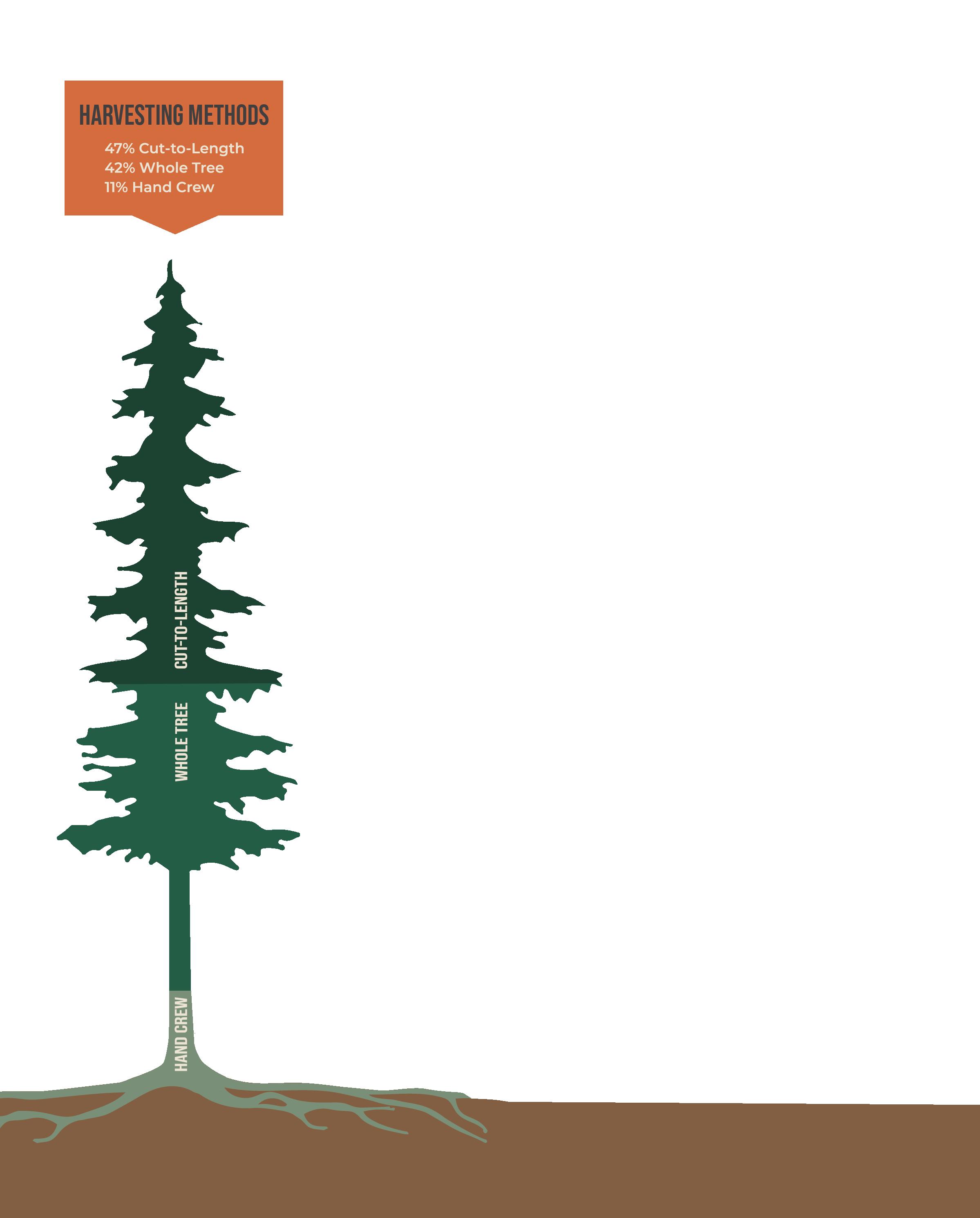
The study also highlighted important trends in the industry including a shift toward more cut-to-length logging equipment (47%) versus whole-tree (42%) being utilized by logging contractors. Only 11% of contractors continue to fell trees with chainsaws.
In general, the study revealed the size of logging firms has been declining in recent years. In 2024, respondents reported an average employment total of nine workers, with more than half (52%) working in the woods, three in trucking, and the remaining two working in administrative support or as mechanics. This is less than half the average of 22 workers found in 2014.
Massachusetts: 440 direct logging and trucking jobs, along with an additional 124 indirect jobs, for a total of about 564 jobs statewide. Total economic output from logging and trucking reached approximately $72 million, including $34 million in total labor earnings, and generated an estimated $3.3 million in state tax revenues.
Connecticut: 208 direct logging and trucking jobs, along with an additional 72 indirect jobs, for a total of about 279 jobs statewide. Total economic output from logging and trucking reached approximately $39 million, including $17 million in total labor earnings, and
The study was conducted in the second half of 2025 and included analysis relying on the U.S. Bureau of Economic Analysis’ Regional Input–Output Modeling System (RIMS II), a widely used framework for estimating the total effects of economic activity within a defined region. It also included a survey of 140 logging and trucking firms across the Northeast to build a more comprehensive picture of the industry’s status and impact.
Three similar studies have been conducted by the PLC for the state of Maine only, focusing on 2014, 2017, and 2021 data. The new study’s focus on the entire Northeast region is the first attempt to capture what is happening across states including Maine, New York, New Hampshire, Vermont, Massachusetts, Connecticut, and Rhode Island.
NEFF MASTER LOGGER INITIATIVES
Cost-shares for Certification and Timber Stand Improvement
The USDA has awarded the New England Forestry Foundation (NEFF) $32 million as part of its new Advancing Markets for Producers (AMP) program, which seeks to incentivize improved forest management on approximately 50,000 acres across New England and grow markets for regional wood.
As part of this program, NEFF is funding initiatives of interest to Master Logger Certified Companies in several Northeast states including:
• a 75% cost-share for qualified logging contractors on Master Logger certification costs, boosting the number of certified companies harvesting wood in the region.
• a 70% cost-share incentive on the costs of timber stand improvement practices that favor valuable timber species and
increase their growth rates. The priority for this program is timberlands owned and managed by Master Logger Certified companies, but they may also apply for projects on land owned by their clients. Timber stand improvement (TSI) practices include harvests with some merchantable wood (e.g., early commercial thinning, crop tree release, or beech control) and practices which don't involve logging equipment (e.g., precommercial thinning, herbicide beech control, or planting).
NEFF wants to support practices on which the landowner would otherwise lose money.
If you would like to learn more about either of these opportunities, please reach out to Jeff Benjamin or Maggie Rideout by emailing jeff@plcloggers.org or maggie@plcloggers.org.
A 75% cost share for certification is available! Contact us for eligibility!
VERMONT LOGGERS:
New Cost-share for Vermont Loggers seeking Master Logger Certification
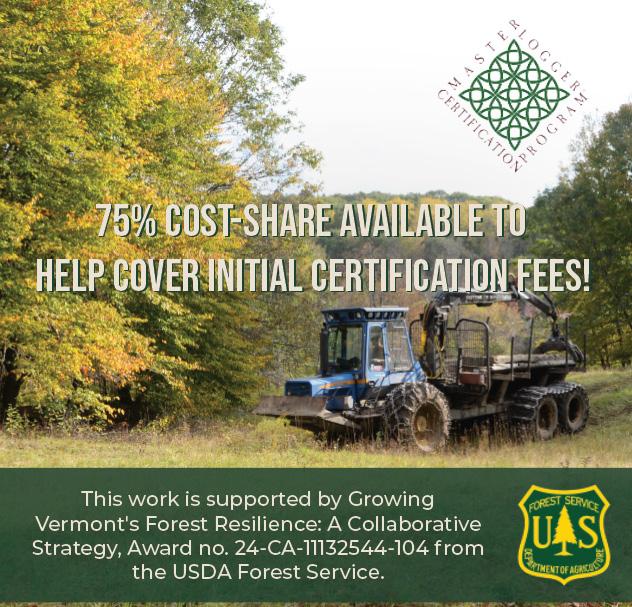
Vermont logging contractors who have not previously participated in the Master Logger Certification Program®(MLCP) have access to a significant new cost-share opportunity designed to reduce financial barriers to certification.
Under the newly established cost-reduction program, eligible Vermont logging contractors can receive a 75 percent cost share on the initial certification fee. This work is supported by Growing Vermont’s Forest Resilience: A Collaborative Strategy, Award no. 24-CA-11132544-104 from the USDA Forest Service.
The initiative is intended to support forest resilience, water quality protection, workforce professionalism, and long-term sustainability across Vermont’s working forest landscape by ensuring harvesting operations are conducted by highly skilled contractors held accountable to an independent certification standard.
The new cost-share opportunity will be coordinated through a partnership between the Professional Logging Contractors of the Northeast (PLC), which administers the Master Logger Certification Program®, and the Vermont Department of Forests, Parks and Recreation (FPR), which will issue reimbursements to cover the costs of qualified applicants after certification is achieved.
“The Master Logger standard aligns well with the goal of increasing forest resilience in Vermont. The cost share available for Master Logger Certification through this program will have a significant and positive impact for logging contractors in Vermont,” Jeff Benjamin, PLC Deputy Executive Director of Certification, said.
Contractors applying for certification will pay 25% of the cost upfront, and the remaining cost will be reimbursed to the certifying organization after they achieve certification. This reimbursement-based model ensures accountability for public funds by directly linking financial support to successful certification outcomes.
The cost-share opportunity is limited to first-time
ATTENTION MASTER LOGGERS: The New York Watershed Agricultural Council (NY WAC) has launched a partnership with the Master Logger Certification Program® (MLCP) that offers significant benefits for Master Logger Certified companies working in the Catskill and Lower Hudson regions.
Key Benefits:
• Priority for applications to NY WAC’s Best Management Practices (BMP) Program.
participants in the Master Logger Certification Program®. To qualify, an applicants must:
• Be a logging contractor who resides in Vermont and conducts active logging operations in the state.
• Meet all standard MLCP eligibility requirements, including compliance with state and federal laws.
• Be in good standing with Vermont’s Acceptable Management Practices and Act 154 requirements.
• Have no unresolved or outstanding Vermont enforcement actions.
• Participate fully in all required interviews, audits, and documentation reviews.
By focusing on first-time applicants, the program aims to significantly increase the number of certified contractors operating in Vermont, strengthening the overall logging workforce and improving consistency in forest practices statewide. Learn more by emailing jeff@plcloggers.org or maggie@plcloggers.org.
• Increased BMP incentive rates for Master Logger Certified companies.
• New certification cost subsidy: NY WAC will cover 75% of the cost of becoming Master Logger Certified for eligible logging companies.
For more information on the NY WAC's Best Management Practices (BMP) Program, visit nycwatershed.org/bmpprogram, or email hhilson@nycwatershed.org.
2026 Spring Safety Training
The PLC is excited to offer Logger, Fleet & CPR training for members in 2026! Review the training options and submit registration forms by March 13, to secure spots for your employees at your preferred locations.
Register by mail or online at: plcloggers.org/plc-resources/safety-training-registration/
The PLC would like to thank our 2026 Spring Safety Training sponsors:
PLC’s Safety Committee is dedicated to providing tools to help keep our members and their employees safe! The goal of this FREE training, for PLC Contractor members, Master Logger Certified Companies and guests, is to provide practical, hands-on instruction to enhance safety for individuals and companies.
presenting sponsors
fleet lunch sponsor
Safety poster sponsors
break sponsors
logger lunch sponsor
logger breakfast sponsors
fleet breakfast sponsor
prize sponsors
#
2026 spring safety training
Schedule & Locations |
7:30 a.m. - 2:30 p.m.
1 Logger 3/26/2026 Khiel Logging & Chipping 65 Bull Ring Rd., Denmark, ME 04022
2 Fleet 3/27/2026 Khiel Logging & Chipping 65 Bull Ring Rd., Denmark, ME 04022
3 CPR 3/27/2026 Khiel Logging & Chipping 65 Bull Ring Rd., Denmark, ME 04022
5 Logger 4/3/2026 Elliott Jordan & Son, Inc. 381 Cave Hill Rd., Waltham, ME 04605
6 Logger 4/9/2026 GCA Logging, Inc. 118 River Rd., Avon, ME 04966
7 Logger 4/10/2026 Irish Family Logging
8
9 Fleet 4/17/2026 Rob Elliott Trucking & Excavation 185 N. Main St., Strong, ME 04983
10
11 Logger-FULL 4/23/2026 Treeline Equipment Shop 427 Main St., Lincoln, ME 04457
12 Fleet 4/24/2026 Treeline Equipment Shop 427 Main St., Lincoln, ME 04457
13 CPR 4/24/2026 Treeline Equipment Shop 427 Main St., Lincoln, ME 04457 14 Logger/Fleet 4/29/2026 Long View Forest 48 Picz Rd., Westminster, VT 05158
15 Logger/Fleet 4/30/2026 Russell Riendeau & Sons 59 Burrington Bridge Rd., Lyndonville, VT 05851
16 Logger/Fleet 5/14/2026 TNT Road Company 110 Charette Hill Rd., Fort Kent, ME 04743
These trainings qualify for six contact hours for the Master Logger Certification Program® Breakfast, snacks and lunch will be provided at no cost to participants Training will be held indoors and outdoors – please dress accordingly
class descriptions:
Logger Safety Training: 7:30 a.m. to 2:30 p.m.
This training is specifically designed for all employees.
1.Health for the Long Haul
2.Stop the Bleed
3.Lifting, Rigging & Shackles
4.Mental Health
Fleet Training: 7:30 a.m. to 2:30 p.m.
5.DARE to Communicate
6.Fire & Auto Property Loss
7.Lunchtime Leadership
This training is specifically designed for drivers, mechanics and loader operators.
4.Federal regulations for pre-trip and post-trip inspections, oversized loads, and signage
5.Liability of Driving
6.CSA Score: What does that mean?
7.Lunchtime Leadership
CPR/First Aid/Bloodborne Pathogens Certification
If your company has 10+ people who need CPR training, please contact us directly to schedule your own class. Limit 30 per class.
Logger Leadership Lunch for Owners/Supervisors
Grab lunch & join us for a short presentation about additional PLC safety resources.
SPRING SLIPS: MANAGING FOOTING HAZARDS IN THE THAWING WOODS
By Connor Shaw, Loss Control Representative with Acadia Insurance (a WR Berkley Company)
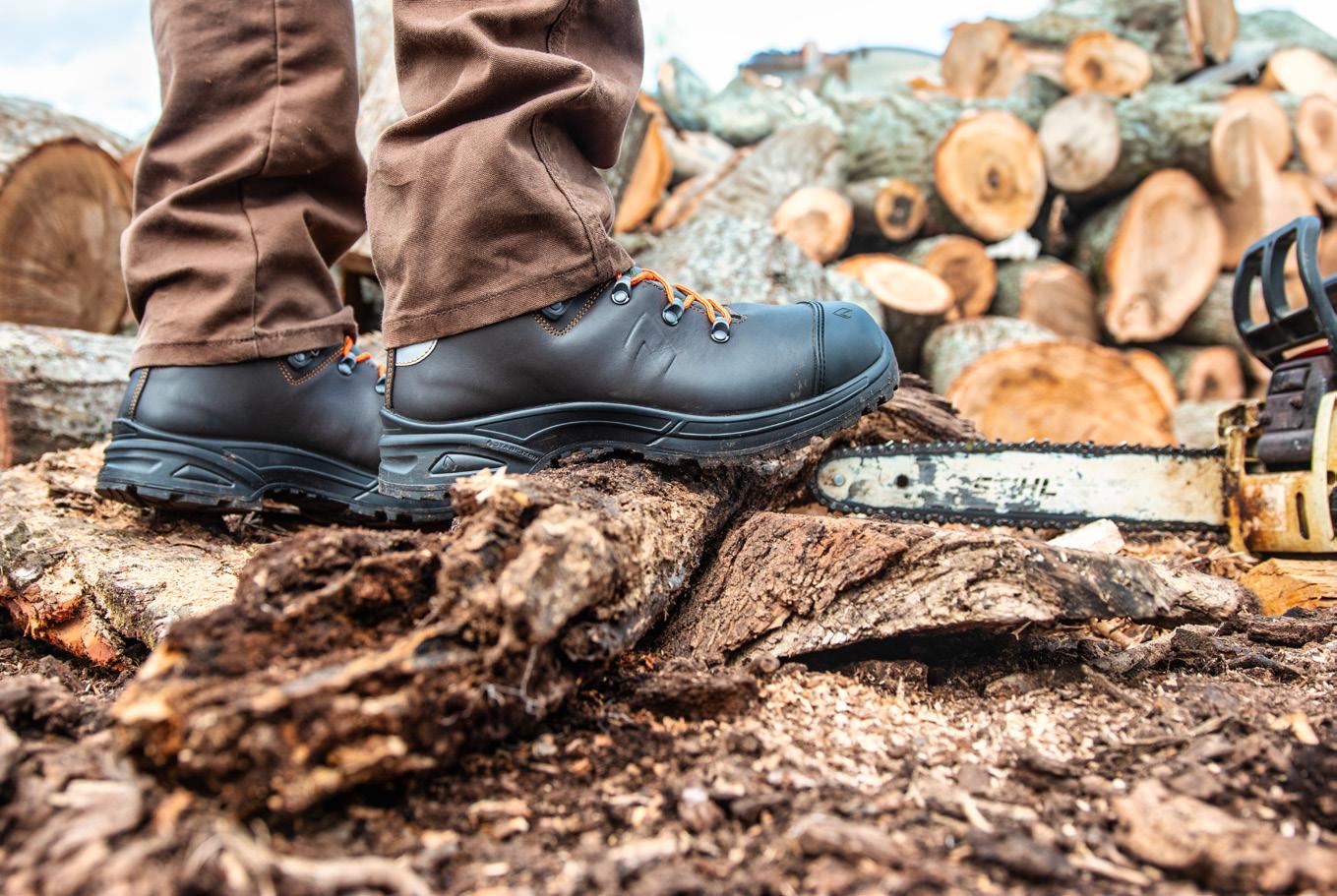
Spring in the Northeast often announces itself before the calendar does. Roads soften, landings begin to sink, and job sites shift into a mix of mud, standing water, and unstable ground. While winter typically receives the blame for slip and fall injuries, spring can be just as hazardous. As frost leaves the soil and surfaces become saturated, the risk of slips, trips, and falls increases sharply. For logging crews, the transition from frozen terrain to mud season creates some of the toughest footing conditions of the year.
Mud is a daily reality in the woods, but in spring it becomes especially treacherous. Boots quickly accumulate wet soil that sticks to metal steps and turns them slick. What begins as stable footing in the morning can become a slippery mess by midday as temperatures rise. Machines working on thawing ground may sink without warning, leaving skidders, forwarders, or harvesters partially buried. When operators step out to assess a stuck machine or attach recovery equipment, they often encounter suction like footing that makes maintaining balance difficult.
The three point of contact rule remains one of the simplest and most effective ways to prevent falls, yet it is often ignored during busy operations. Mud covered gloves can reduce grip on grab rails, and workers may carry tools or containers while descending equipment to avoid dropping them into the mud. These shortcuts become far more dangerous when equipment is sitting at awkward angles or the ground is shifting beneath their feet.
Log truck drivers face their own spring-related challenges. As snow melts, binders and trailer decks collect wet bark, grit, and mud. Boots slide easily on slick metal rails, and deeply rutted forest roads often require drivers to climb in and out of the cab repeatedly. Even a thin layer of mud can act like a ball bearing on smooth steel, surprising even seasoned drivers. When a loaded truck becomes bogged down, assessing the best route out increases exposure to uneven, saturated terrain where mud can conceal roots, ruts, and soft spots.
Fortunately, preventing spring slips often comes down to small, consistent habits: cleaning boots before climbing onto equipment, maintaining three points of contact every time, and clearing steps and platforms throughout the day. Slowing down, testing footing, and choosing deliberate
steps—especially around stuck equipment—can prevent a simple inconvenience from turning into a serious injury. With attention and good habits, crews can navigate the challenges of mud season safely and keep operations moving forward.
Acadia is pleased to share this material for the benefit of its customers. Please note, however, that nothing herein should be construed as either legal advice or the provision of professional consulting services. This material is for informational purposes only, and while reasonable care has been utilized in compiling this information, no warranty or representation is made as to accuracy or completeness. Recipients of this material must utilize their own individual professional judgment in implementing sound risk management practices and procedures.
SPRING: A TIME FOR STARTING SOMETHING NEW
By Tori Tracy, National Alliance on Mental Illness (NAMI) Maine Community Engagement Manager
Spring in Maine is often referred to as “mud season,” and for those of you in the logging industry, it can be one of the more frustrating times of the year. Roads soften, equipment gets dirty, and getting around can be a challenge. But while spring may bring mud, it also brings something else….a chance for new beginnings.
The days are getting longer, the temperatures are slowly warming up, and the Maine landscape begins its transformation from winter gray to vibrant green pastures. Trees start budding, the snow melts away, and everything begins to feel a little more alive again.
Spring is also a great time to refresh a few things in your own life. Now, I’m not suggesting that you need to go out and purchase a gym membership or buy a herd of goats or donkeys to fill those green pastures. What I am saying is much simpler: what is one small thing you could do to improve your mental health?
Believe it or not, something as simple as decluttering your space can be very good for your mental health.
Don’t worry, I’m not about to tell you that you need to clean out the entire garage so you can finally park your vehicle in it. But hey…. if that’s something you’ve been meaning to do, why not start with one box or part of the workbench?
Maybe it’s even simpler than that. It could be going through the glove box of your truck or cleaning out the back seat.
Maybe it’s organizing a shelf in the mudroom or clearing off a cluttered countertop. The key here is not to overthink it. Just pick one small task and get started.
While you’re doing it, throw on some of your favorite music or listen to a podcast. Turn the task into something that feels less like work and more like a small personal project. One small accomplishment can lead to another.
One box at a time in that overstuffed garage could eventually lead to a garage that actually serves its intended purpose.
Decluttering your space has a direct impact on decluttering your mind. Completing a task, even a small one, creates a sense of accomplishment. It’s something checked off the list, something finished, something you can look at and say, “I got that done.”
Research has shown that cluttered environments can contribute to feelings of guilt, shame, and even hopelessness. When people feel overwhelmed by their surroundings, they often lose the motivation to deal with the mess. The more the clutter builds up, the worse those feelings can become.
It becomes a cycle: clutter leads to stress, stress leads to avoidance, and avoidance leads to more clutter.
Breaking that cycle starts with small, manageable goals. One box. One drawer. One corner of a room. Each small accomplishment helps build momentum and can create a sense of calm and control.
Adding something positive to the process can make it even better. Play your favorite music, listen to a podcast, or ask a friend or family member to help. Turning it into a shared task or a relaxing activity can increase motivation and leave you feeling satisfied once the job is done.
Decluttering can also lead to something else that is incredibly positive: donating.
Most of us have things around our homes that we rarely use. Some items might have been used once or twice, and others may have never been used at all. While those items may no longer serve a purpose for us, they might be exactly what someone else needs.
Donating items can help others who may not have the means to purchase them. At the same time, it can also benefit your own mental health. When we do something that helps someone else, it often creates a positive emotional response within ourselves.
Helping others can create feelings of purpose, connection, and satisfaction. Those positive feelings can play an important role in supporting our own mental well-being.
Spring is also a good time to consider adding something new to your routine, especially if your mental health hasn’t been where you’d like it to be. If you’ve been feeling down, stuck in a slump, overwhelmed, stressed, angry, or simply not feeling like yourself, it may be helpful to check in with how you’re really doing.
One resource that many people have found helpful is Man Therapy®, a website designed specifically to support men’s mental health.
Man Therapy® | The Manliest Tool for Men's Mental Health
The site offers a tool called the “Head Inspection”, which is a quick, anonymous check-in that helps you see where you’re at mentally. No one is going to track you down or judge you based on your answers. It’s simply a way to take a moment and assess how you’re feeling.
After completing the Head Inspection, the site can connect you with resources that may help with whatever challenges you’re facing. It can also help you find a therapist or professional who may be able to support you if you decide that talking with someone might help.
Man Therapy also offers information on topics like anger, depression, resilience, trauma, firearm safety, and more. There are articles, videos, and real stories from men who have experienced many of the same struggles.
Sometimes the hardest part of improving our mental health is simply taking the first step.
Just like cleaning out that first box in the garage, one small step can lead to meaningful change. This spring, consider starting something new, even if it begins with something as simple as clearing out a drawer.
You might be surprised by how much lighter things feel once you get started.
ANNUAL OSHA TRAINING FOR MECHANIZED LOGGERS: Keeping the Woods a Safe Place to Work
By Donald Burr, PLC Safety and Training Consultant
Modern logging may involve sophisticated harvesters, forwarders, and loaders, but OSHA still expects one very important piece of equipment to stay in good working order: the human operator. Training is the key to making sure everyone on the crew understands the hazards of the job and knows how to work safely around heavy equipment, timber, and each other.
Under the OSHA Logging Operations Standard (29 CFR 1910.266), employers must provide training to all logging employees so they can safely perform their assigned tasks, recognize hazards, and operate equipment correctly. Training must be provided before workers start new tasks and whenever new hazards, tools, or equipment are introduced, and some topics need to be covered annually or semi-annually.
OSHA and the Bureau of Labor have nine training topics that mandate annual or semi-annual safety training. Below is the list that you should cover with your crew.
First Aid and CPR
Logging often takes place far from hospitals or emergency services. Because of this, OSHA requires logging employees to maintain current first aid and CPR training (a refresher class every two years).
• Patient assessment and emergency response
• Controlling bleeding and treating shock
• CPR and rescue breathing
• Treating burns, fractures, and traumatic injuries
• Response to environmental exposure, such as hypothermia & heat exhaustion.
First aid kits are also required at logging sites and landings, and their contents must reflect the hazards and isolation of the work location.
Bloodborne Pathogens
Any workplace where employees may provide first aid must address bloodborne pathogen hazards (annually).
This training explains:
• How diseases such as hepatitis or HIV can be transmitted
• Safe handling of blood or bodily fluids
• Proper use of gloves and protective equipment
• Safe cleanup and disposal procedures
The goal is to protect both the injured worker and the rescuer.
Hearing Conservation
Mechanized logging machines are powerful—and loud. Harvesters, loaders, and diesel engines can exceed safe noise levels over time. Test your equipment every two years, and if you find that it is necessary to address this issue, take appropriate action and train annually.
• The effects of noise on hearing
• Proper use of earplugs or earmuffs
• When hearing protection is required
• How to care for and replace hearing protection
Because once hearing is gone, it doesn’t grow back—unlike the trees.
Lockout/Tagout (LOTO)
Maintenance work around logging machines can be extremely dangerous if equipment starts or moves unexpectedly.
Lockout/tagout training teaches employees how to:
• Properly shut down machinery before maintenance
• Isolate energy and de-energy sources, such as hydraulics or electrical systems
• Apply locks and tags to prevent accidental startup
• Verify that the equipment is safe and communicates to all before work begins
The goal is simple: when someone is working on a machine, it stays off. No surprises, no “oops,” and no sudden hydraulic movements that ruin everyone’s day.
Forklift and Loader Operation
If you have any equipment that has forks, you must train your employees initially and every three years.
Training should include:
• Safe lifting procedures
• Stability and load limits
• Safe travel around workers and machines
• Inspection and maintenance checks
Respiratory Protection
Logging contractors’ garages may expose workers to smoke, paint fumes, or sandblasting, and such activities would trigger respiratory protection training.
Training should include:
• When respirators are required
• How to properly wear and maintain them
• The limitations of different types of respirators
Fire Extinguisher Training (Annually)
Logging equipment and contractor garages have the
potential for fire.
Fire extinguisher training includes:
• Types of fires and extinguishers
• PASS technique (Pull, Aim, Squeeze, Sweep)
• Inspection & maintenance
• When to fight a fire and when to evacuate Emergency Action Plans (Annually and every time you move to a new job site)
Every logging site should have an Emergency Action Plan. Training typically reviews:
• Emergency communication procedures
• Evacuation routes and meeting points
• Medical response procedures
• Review of detailed directions to reach the jobsite for emergency services
Sexual Harassment Awareness (Annually)
A safe workplace isn’t just about machines and falling timber—it’s also about respectful behavior among coworkers.
Sexual harassment training helps workers understand:
• What constitutes harassment
• How to report inappropriate behavior
• Employer policies and legal protections
Professional crews treat each other with respect.
Workers’ Compensation Benefits for Maine Master Loggers
Safety training also provides financial benefits for logging businesses.
Logging companies certified under the Master Logger Certification Program® qualify for reduced workers’ compensation insurance rates in Maine & Vermont due to their commitment to professional training and safe operating practices. Certified companies must meet strict safety standards and provide ongoing training for employees.
These safety efforts have resulted in significantly lower injury rates and reduced insurance costs compared to non-certified operations. For many companies, that means safer crews and more affordable insurance premiums.
If training prevents even one accident, one injury, or one close call, then it’s worth every minute.
After all, in mechanized logging, there are already enough things trying to knock you down. Training helps make sure the only thing falling in the woods is the trees.
DON'T LOSE YOUR GRIP
By Brie Weisman, OTR/L with Maine Agrability
As an occuptational therapist, I routinely test upper extremity strength to get a baseline on patients. When I was fresh out of school, I used to perform a rough grip strength test by offering my hand to a patient to squeeze as hard as they could in a handshake. I recall one senior patient asked, “Are you sure, I’m a logger?” Of course I was sure! I’m active, I run my own small farm, and the seniors and injured I work with constantly underestimate my strength as I assist them in getting up from bed or a chair. Well, that logger rolled my pinky knuckle bone in his grip, and it’s never been the same. He felt terrible, but I was the one at fault. I only have to look down at my hand to remind myself of my stupidity.
For today's conventional loggers, controlling a chain saw and operating a skidder still requires a fair amount of grip strength. You can see it in their hands and forearms. Back in the old days before chainsaws, a logger likely had a grip to rival any tradesman.
often use grip strength as an indicator of general muscular fitness and functional ability. Just as getting a grip on many things in life takes time, so too with literal grip strength, which peaks not in our twenties, but typically between 3040 years, and that a weaker grip generally starts to become noticeable around age 50-55. Overall, we begin losing about one percent of muscle mass a year starting at age 30. If we don’t compensate for this loss by increased exercise or activity, we can expect to lose up to a quarter of peak grip strength by age 65.
Grip strength is not only important for opening jars, hefting items, and clinging to branches when we fall off a cliff. Because reduced grip strength is most often an indicator of reduced physical activity and fitness, there is a clear correlation between grip strength and longevity. Other, more specific correlations include:
• Reduced physical function and independence
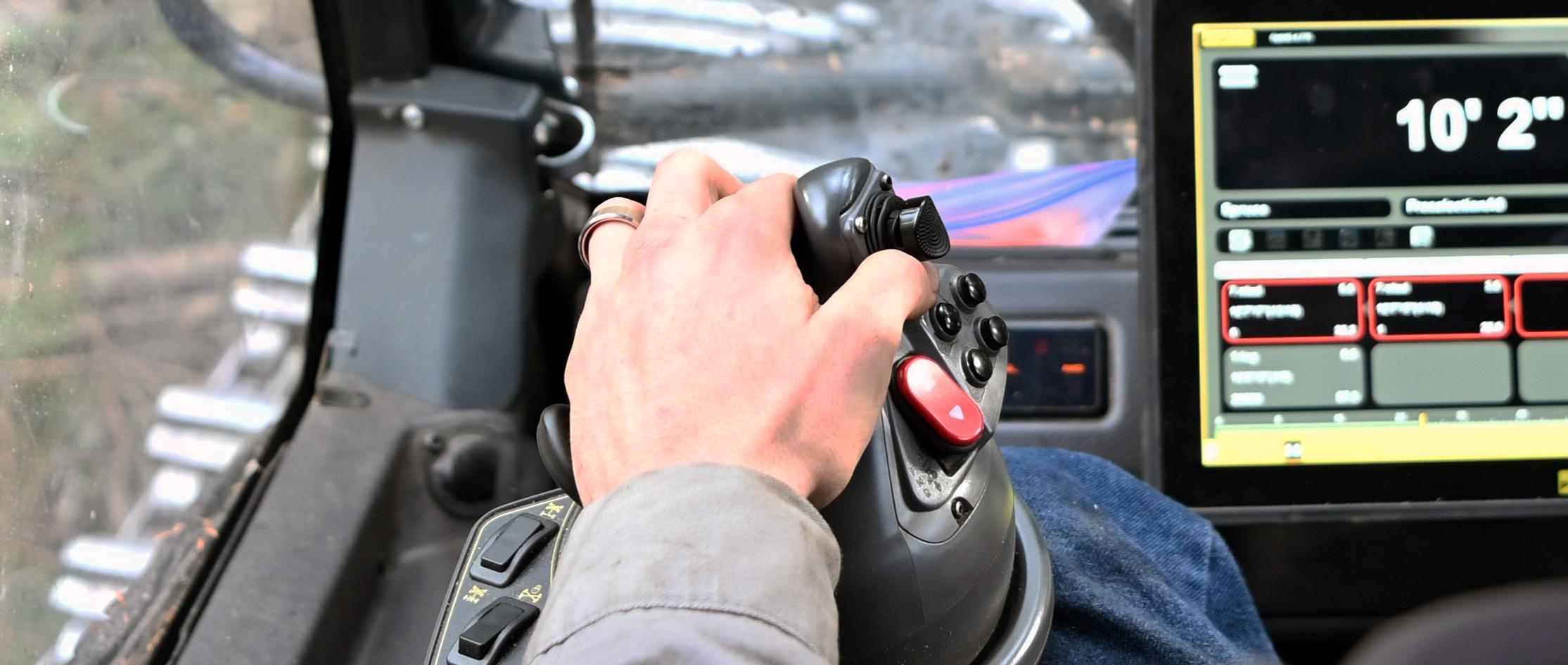
Mechanized logging no longer requires such a grip. Joysticks and keyboards demand dexterity, not strength. If mechanized loggers didn’t occasionally have chains to put on, or rungs and grab bars to climb into equipment, their daily manual exertion would hardly be different than that of an office worker’s.
Grip strength is not only in the hand: the wrist and forearm are also in play. Neither is it all about mere muscle strength; nerve function, joint health and overall physical condition are all important. Because of this, health care professionals
• Increased risk of falls and injuries
• Slower recovery from illness or surgery
• Higher risk of chronic disease and disability, particularly in older adults
• A decline in cognitive functioning.
Fortunately, the cure for this in an otherwise healthy person is both straightforward and cheap, as the few exercises included below will show.
How strong is strong? This January, at the Augusta
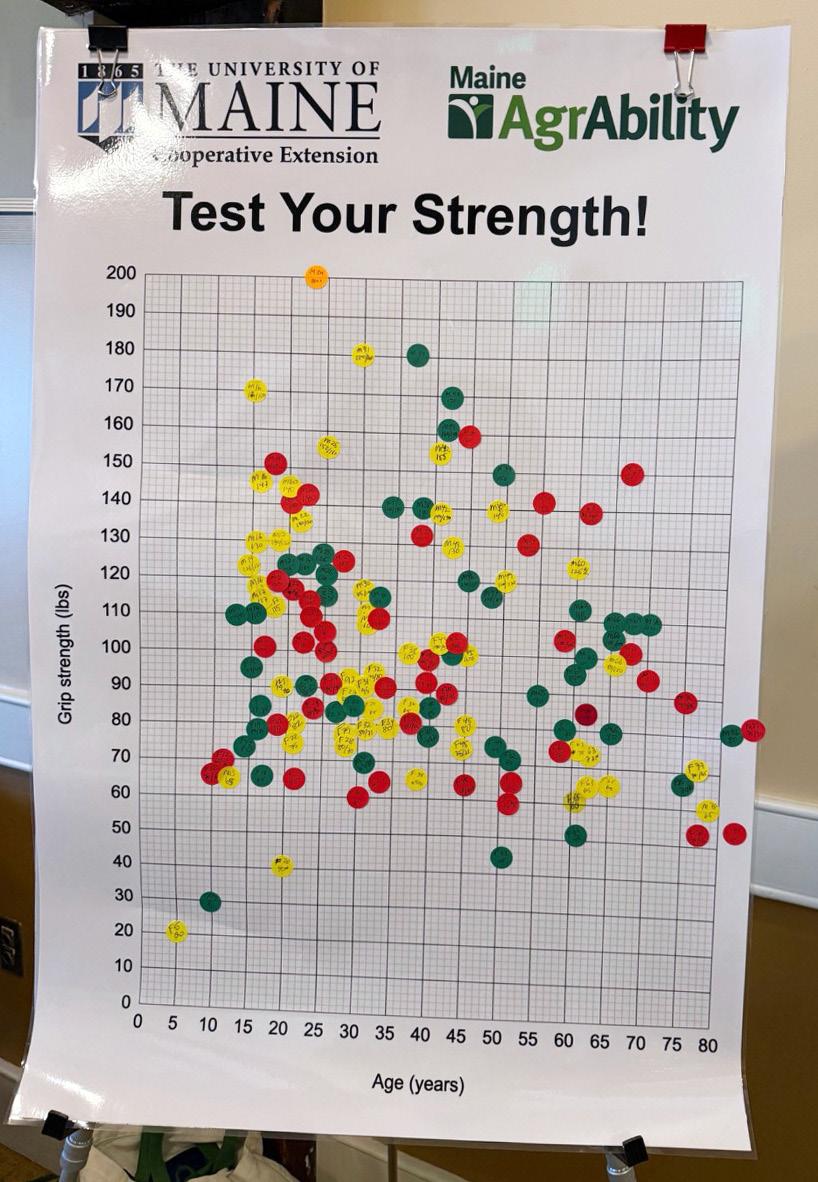
Agricultural Trade Show, I and other Agrability staff challenged attendees visiting our table to test their grip strength by squeezing a dynamometer, a tool designed to measure grip force in pounds. Nearly two hundred volunteers of all ages and genders gave it a go. The honors at the agricultural show went to a 43yo male with an impressive 157 (pounds), putting him well above the typical 90.9. For his age. The weakest grip strength recorded was a 78 year old man who managed 52. But proof that age is not necessarily a barrier was demonstrated by a 72 year old with an impressive 116. In the women’s category, top honors went to a 44 year old with a crushing 120, handily outperforming most of the male participants in their prime. The lowest score came from a 77 year old female who tested at 35.
This month, we offered the same challenge at the Fishermen’s Forum in Rockport. As I suspected, the fishermen were considerably stronger than the farmers. The attendees of the Fishermen’s Forum are a younger crowd, and I also believe the nature of their work demands greater hand strength. One 24-year-old male literally tested off the chart, exceeding the dynamometer’s top reading of 200 pounds. Two other men, each in their 30s, achieved an impressive 180. The oldest male who tried was 86, earning a very respectable 80. In the women’s category we had a tie at an even 100, from both a 38 year old and a 43 year old. The oldest female, an 84 year old, earned a 45.
You loggers will get your chance next, when the Logging Expo is back in Maine. My guess is that, on average, conventional loggers will have a stronger grip than mechanized loggers, but loggers will be battling for second place with farmers, with fishermen maintaining top honors. Prove me wrong!
If you want to train to max out the dynamometer, or more hopefully (and realistically) simply want to improve your personal fitness and do what you can to avoid the health issues listed above, there are several proven exercises that can easily be incorporated into an exercise workout or daily routine.
Simple Grip Strengthening Exercises
Hand squeezes
Squeeze a soft ball, therapy putty. or rolled towel. Hold for 3 to 5 seconds, then release. Repeat 10 to 15 times per hand.
Finger pinches
Pinch a soft object between your thumb and each finger separately. Hold briefly, then relax. Repeat 10 to 15 times per hand.
Wrist curls
Hold a light weight, resistance band, or household item. Slowly bend your wrist up and down. Repeat 10 to 15 per hand.
Farmer’s carries
Hold a moderately heavy object in each hand. Walk a short distance while maintaining good posture. Start progress gradually to heavier weights over time.
My favorite grip strength exercise is…
Hanging
That’s right, just hanging! Set up a bar of about barbell diameter in a doorway or somewhere safe. Try to hang for 30-60 seconds at first, using a “cheater” stool or chair under your feet if necessary. Start slowly and gently and build up to 90-120 seconds, which is considered advanced. Hanging has the added benefits of engaging a greater range of muscles than other grip exercises, as well as helping with many back issues. It is also a natural first step toward incorporating chin-ups and pull-ups into a workout.
As with all new exercises, you should talk to your primary care provider before engaging in activities that might compromise any health issues you have.
Remember, if you want to get a grip on your general strength and health, getting a grip is a great place to start!
Fisherman's Forum 2026 Dynamometer grip test results. Loggers will have the opportunity to try their hand at the Logger's Expo next year..
GRANT OPPORTUNITY FOR LOGGERS WORKING IN VERMONT
The SLoCAMP (Supporting Loggers to Comply with Acceptable Management Practices) Grant Program is now accepting applications. This program offers significant cost share benefits for logging contractors working on harvest sites in Vermont. Eligible practices include road hardening, skid trail improvements, and stream crossings.
Applying is quick and straightforward — once you have your materials ready, the online application takes less than 20 minutes to complete. Reviews begin within 2 business days of receiving your submission, so you can move forward without delay.
Update as of March 31:
• 36 applications received for $513,000
• Deadline for completion of projects extended to Nov. 30 2026
• $187,000 in funding available for future applicants
The PLC has created tools to guide loggers through the SLoCAMP grant program and help them determine if it’s a good fit for their operation.
To learn more visit plcloggers.org/slocamp or scan the QR code below.
PLC 2026 Maine Legislative Breakfast
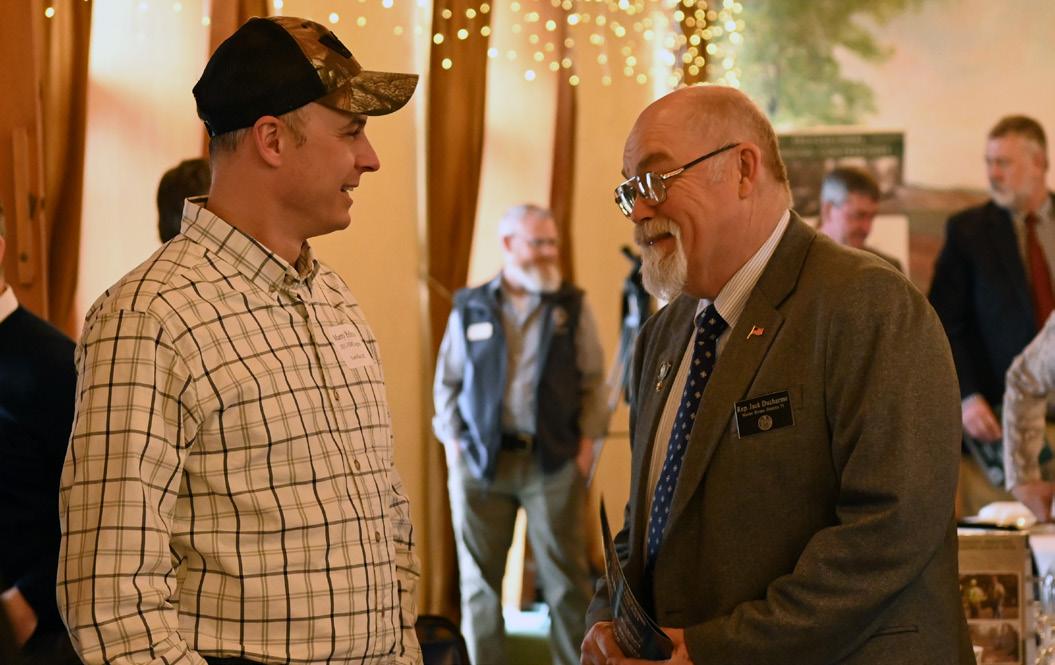
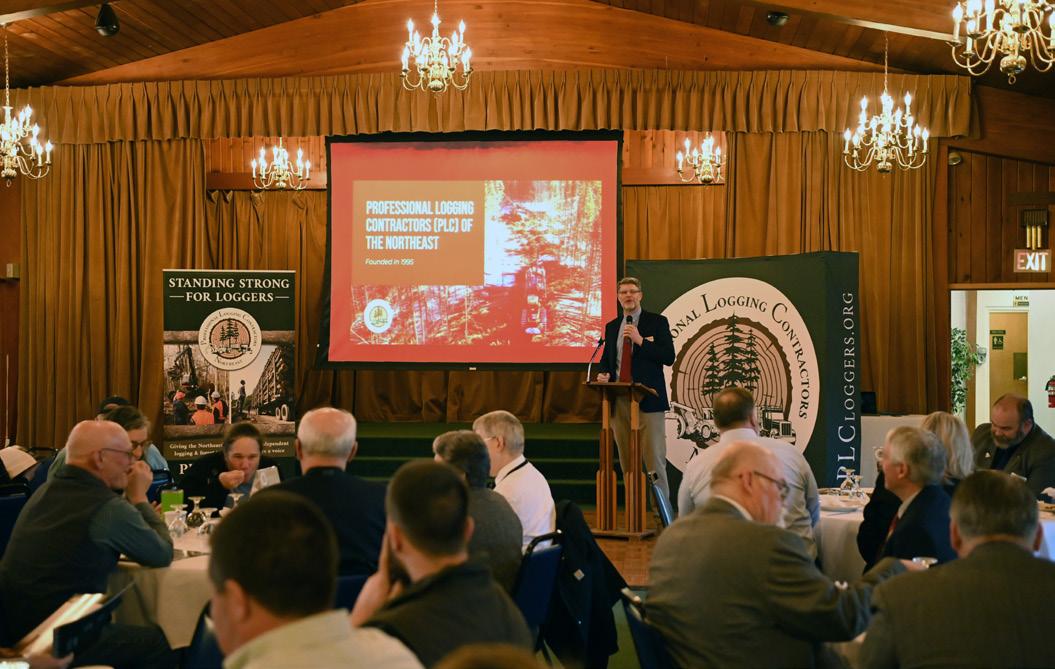
Thank you to everyone who attended our Maine Legislative Breakfast event Feb. 27 in Augusta, ME!
This event was critical to our efforts to fight for the logging and forest trucking industry in the 2026 legislative session and your participation made it a success!
We also released results of our new Northeast Logging and Forest Trucking Impact Study at the event. Read the full article on the study on page 20.
SPRING FIRE SEASON IN MAINE: WHAT LOGGING CONTRACTORS SHOULD KNOW AND PREPARE FOR
By Robby Gross, Chief Maine Forest Ranger
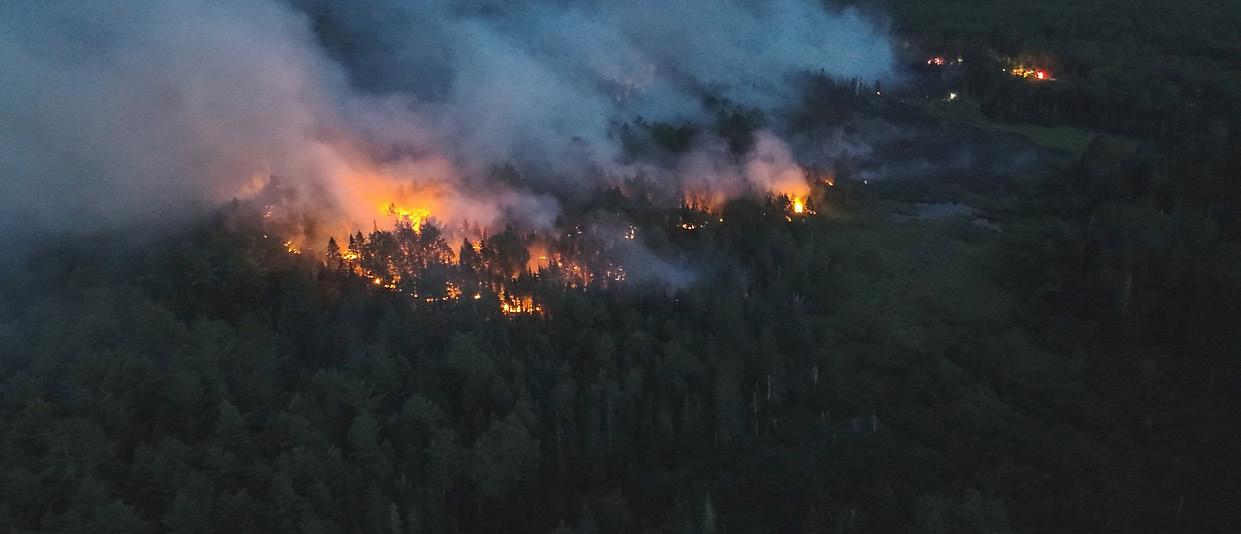
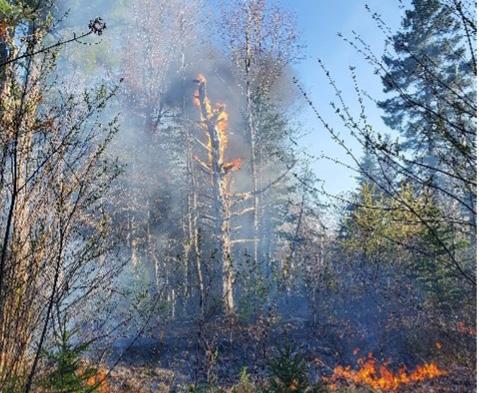
Spring in Maine can be very unpredictable weather and conditions, but it’s also when we see some of our fastestmoving wildfires. Before green-up, fine fuels such as dry leaves, needles, grass, and slash can ignite easily and spread fire quickly, especially on windy days with low humidity. Add machinery, roadside work, burn piles, and increased public activity, and the risk climbs fast.
The good news: logging contractors are among the most capable fire-prevention partners we have. Your crews are already safety-minded, you work with heavy equipment that can stop fire when used correctly, and you’re often the first to spot smoke in remote locations. A few practical steps can reduce your risk and help protect your people, your equipment, and the landowners you work for.
Why Spring Fire Season Hits Different
A common misconception is that “it’s cool out, so fire won’t run.” In reality, Maine’s spring fire season is driven less by temperature and more by fuel condition and weather:
• Cured fine fuels: Leaves, needles, grass, and slash dry quickly after snowmelt.
• Wind: Spring winds can turn a small ignition into a running fire in minutes.
• Low relative humidity: Even after a wet week, a sunny, breezy afternoon can dry surface fuels fast.
• Delayed green-up: Until the forest floor is shaded by new growth, fuels are exposed to sun and wind.
To stay current day-to-day, check the Maine Forest Service here: https://mainefireweather.org/
Common Logging-Related Ignition Sources
Most contractors already manage these well, but spring is when little things become big things:
1. Hot exhaust and catalytic systems contacting fine fuels or slash
2. Hydraulic leaks or a failed hose spraying oil onto a hot surface
3. Welding, grinding, or cutting in the yard or landing without a cleared area
4. Dragging chains on pavement or ledge, throwing sparks
5. Discarded smoking materials
A Practical Spring Fire Checklist for Contractors
These steps can help logging operations and pay off immediately:
1) Do a quick weather check each morning
Wind + low humidity + dry fine fuels = fast fire. If conditions are trending toward “High” or above, consider adjusting higherrisk work and be ready to respond quickly.
2) Keep suppression tools ready — and reachable
Consider staging:
• A water can / backpack pump or a small tank on site
• Shovels, pulaskis, rakes, and a chainsaw, where a crew can grab them fast
• A mounted, inspected fire extinguisher that isn’t buried in gear
3) Make the landing and service area fire-safe
• Clear fine fuels around service zones
• Avoid parking hot equipment over dry grass or slash
• Address leaks immediately; keep fueling areas clean
4) Do a quick equipment walk-around at lunch
Look for packed debris near exhaust/turbo areas, rubbing hoses, hydraulic mist, and “hot” smells. Many spring starts happen mid-day after hours of run time.
5) Plan for the “first five minutes.”
If a fire starts:
• Stop work
• Call 911 early (don’t wait to see if it “stays small”)
• If safe, use water/hand tools to anchor and hold while
maintaining an exit route
• Keep people out of smoke and away from wind-driven runs or upslope fire
Burning in the Spring:
Permits and
Practical Reality
If you’re burning brush or debris, treat spring piles like they’re going to spread fast — because they can. Only burn when conditions allow; have water/tools in place before lighting; and stay with it (and patrol afterward).
For permits, use the Maine Open Burn Permit system here: https://www1.maine.gov/burningpermits/ )
The Maine forest products community has always been a core partner in protecting Maine’s woods. Spring fire season is the time to lean into that professionalism: prepare for it, talk about it, and make your job sites “hard targets” for wildfire starts.
If You See Smoke: Call It In
If you see smoke in the woods — even if you’re not sure — call it in early. Quick reporting is one of the biggest factors in keeping a small fire small.
To reach your regional office and the ranger covering the area you are working in, see the office locations and numbers below:
We are here to support, advocate for, and protect your profession. When you join the PLC, you become part of a community that is committed to the future of logging
• Free annual safety training for you and your employees
• Access to Acadia Dividend Program in ME, NH, VT and NY
• Member discounts, rebates, and more
• Advocacy at the state and national level
• Regular updates and communications on the industry
• Your membership will pay for itself through these exclusive benefits
CONTROLLING WATER On Difficult Ground
By Tom Gilbert, Water Resources Specialist, Maine Forest Service
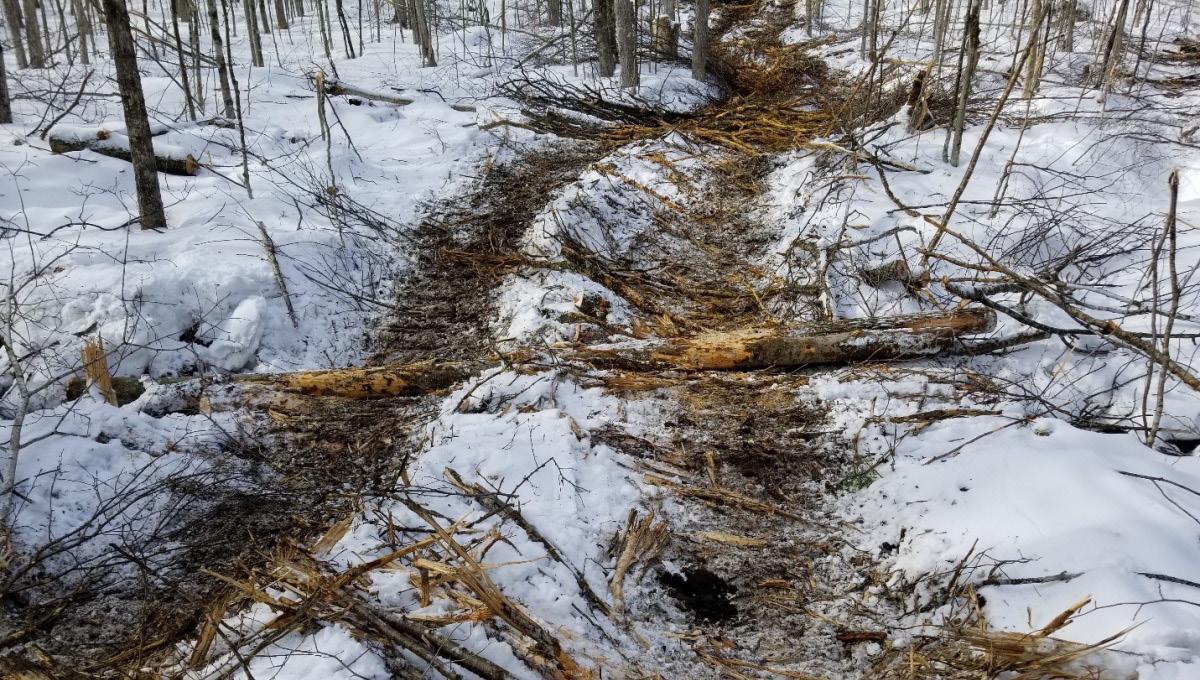
Water diversions are some of the most important tools for protecting water quality on forest roads and trails. When functioning properly, water diversions move run-off to undisturbed forested areas in small amounts, preventing it from reaching a waterbody. However, site conditions can make installation of traditional water diversion structures such as water bars or turn outs a challenge due to frozen ground or ledge. The following water-diverting techniques can be used on roads and trails when conditions are difficult:
Bale Bars
Place several hay bales across the road at a 30-degree angle, making sure they extend off the road on both ends. Place logs on either side to promote stability, or during winter, pack snow against the bales. Water diversion structures should always be installed outside of the buffer/filter strip to the water body.
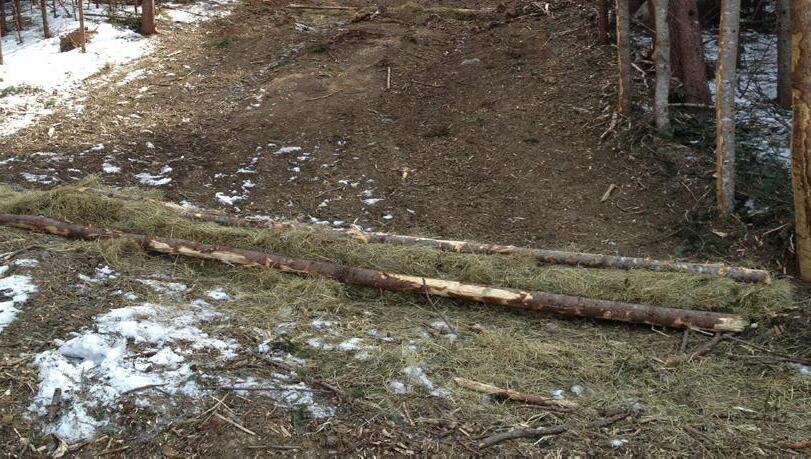
Log-Barrier Water Bar
Place a log across a trail at a 30-degree angle, in direct contact with the ground surface, and extending off the trail on both sides. Slash is placed directly in front of the log and on the uphill side to cover exposed soil and slow down runoff. Any exposed soil within the buffer/filter strip to the water body should also be covered with slash.
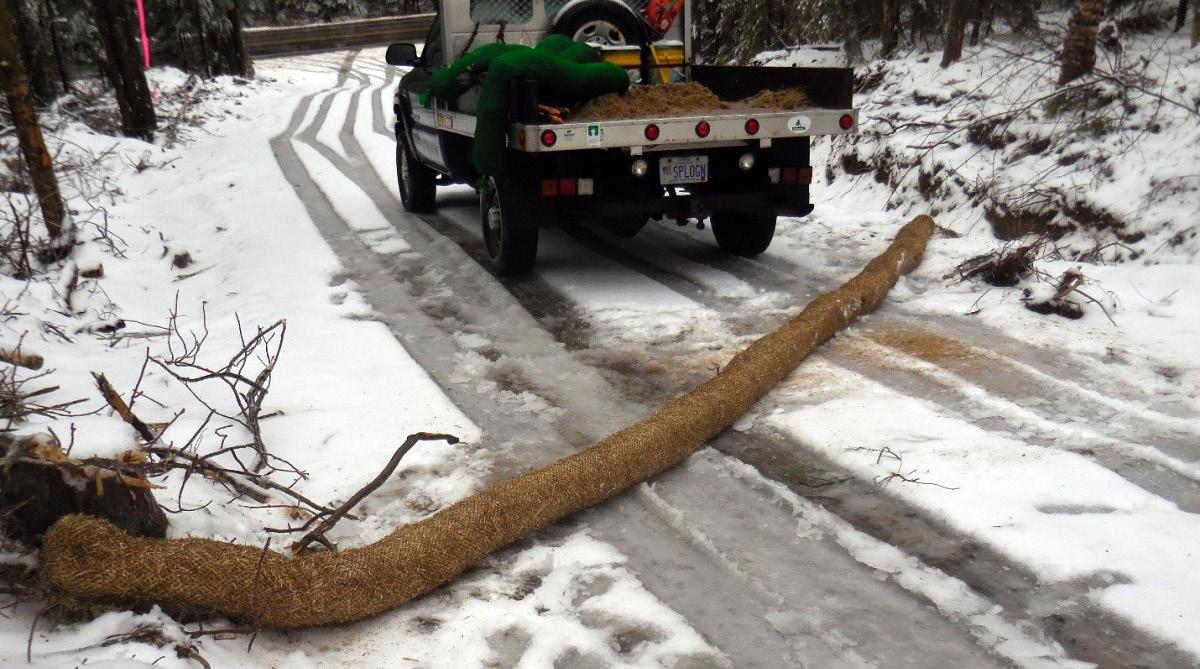
Compost Sock
As with a log barrier, this technique may be used when the ground is frozen or ledge prevents digging a water bar. Place several hay bales across the road at a 30 degree angle, making sure they extend off the road on both ends. During winter, pack snow against the bales or place logs on either side to promote stability.
Find more information on protecting water quality during challenging conditions such as extreme weather events in a new publication titled Best Management Practices for Forestry: Adapting to Extreme Weather in Maine.
These manuals will be distributed at Maine Forest Service trainings this spring, and may be found online at: https://www.maine. gov/dacf/mfs/policy_management/water_ resources/bmps.html
Photo credits: Top, photo by John Starett. Middle and bottom, photos by University of New Hampshire Cooperative Extension.
EPA REMOVES DEF SENSOR REQUIREMENT: On March 27, 2026, the EPA announced new guidance to remove the Diesel Exhaust Fluid (DEF) sensor requirement for all diesel equipment in an action that officials say will save Americans “countless hours of lost time and productivity.”
The announcement was hailed as a win for farmers, but will be equally beneficial to other industries including logging and forest trucking.
“The preliminary review of the warranty data suggests that
DEF sensor failures are a significant source of warranty claims and DEF-related inducement. Farmers and truck drivers should not have their vehicles stop working because a sensor isn’t working properly. EPA is taking immediate action on this new information. The agency’s new guidance makes clear that under existing regulations, manufacturers can stop inaccurate DEF system failures by removing traditional emission sensors, known as Urea Quality Sensors, and switching to nitrous oxide (NOx) sensors,” the agency said.
WHITE BIRCH SAWLOGS & BOLTWOOD
Contact: Craig Lemieux
E-mail: cplemieux@hwpwoodenware.com
Specializing in land sales state wide with offices in Bangor, Lincoln, and Lubec. Call us today for a free, no obligation consultation. 800-286-6164
Maine Congressional Delegation Updates
A study released earlier this year by the PLC revealed that Northeast loggers and forest truckers contributed an estimated $1.3 billion to the region’s economy in 2024. The first-ever comprehensive report also found that the industry supported nearly 7,000 jobs producing $393 million in wages and $61 million in state and local tax revenue.
Of the seven states included in the study, Maine led the region in every category by significant margins, with more than 4,400 jobs, $534 million in economic output, $283 million in wages, and $23 million in tax revenue. Coming from a six-generation forest products family, I am proud of the contributions the skilled and resilient men and women who work in the woods make to our State.
As Chair of the Senate Appropriations Committee, I am committed to supporting the investments that move the industry forward and address the current challenges. The Interior and Environment federal funding bill I led to passage in January includes three provisions I worked hard to secure to meet that goal.
First and foremost, the bill strengthens our response to the imminent threat posed by the spread of spruce budworm by providing $10 million for the U.S. Forest Service to aid states in the emerging outbreak on the northeastern border. This is in addition
Maine’s forest products industry has a long history, predating the state’s formation by a significant margin to back when we were essentially “North Massachusetts.” Hardworking men and women have made their living in our forests long before Augusta became the capital and the moose was named our state animal. It hasn’t always been easy, but the logging industry has consistently supported Maine through market shifts and economic upheaval. In many ways, our logging industry represents the key Maine values of adaptation, innovation, and perseverance.
However, it’s no secret that the industry is navigating a period of uncertainty with new tariffs affecting timber and lumber, creating challenges for a sector that depends on stable trade. Maine’s forest products economy is so closely connected with our Canadian neighbors to the north that small disruptions in trade send shockwaves through the industry. That’s why I urged the Administration to consider Maine’s forest products industry in any future discussion around trade and tariffs. U.S. trade policy must allow logging businesses the ability to plan – so people like you can make investments in their careers and families that keep food on the table. I’ll continue to advocate for a strategic approach to trade that prioritizes certainty and predictability and helps the forest products industry in Maine stay strong and competitive. Despite the adversity over the past year, the Maine forest products
to the $14 million I secured last year to bolster those efforts and the $600,000 I obtained for the University of Maine Forest Health Lab in Orono, where faculty and students are conducting innovative research to combat this infestation. We must prevent a repeat of the devastating outbreak in the 1970s and 80s that killed 7 million acres of trees in Maine and caused hundreds of millions of dollars in losses.
The bill also includes two provisions I led to advance economic opportunities for the forest products industry. One provides $15 million for the Community Wood Energy Program, a competitive grant program that supports the installation of wood energy systems and wood product manufacturing. This USDA Forest Service initiative is designed to stimulate local economies, support forest health, and promote renewable wood energy use, with an emphasis on projects located in high-unemployment areas and that utilize low-value wood.
The other provision I included in the bill requires federal agencies to recognize biomass as a carbon-neutral fuel. For more than a decade, I have championed biomass energy as a sustainable, responsible, renewable, and economically significant energy source. This provision helps ensure that federal policies for the use of renewable biomass are clear, simple, and reflect the importance of biomass for our energy future.
Maine’s working forests are an international model of successful, responsible stewardship. I look forward to working with you to strengthen an industry that is a cornerstone of our heritage and integral to our future.
industry has a secret weapon: you. The men and women who harvest timber are part of a long line of Maine people who have made their livelihoods from the forest. Their work not only supports the Maine economy, but stewards one of Maine’s most treasured natural resources. That’s why I’ve worked on bipartisan legislation, such as the Jobs in the Woods Act, which would support developmental programs designed to better equip and train the forest products workforce for careers with the U.S. Forest Service and timber industries. A version of this legislation has been included in the initial House draft of the next Farm Bill.
As the industry continues to evolve, we must ensure our forestry workforce has the proper training and skills to help responsibly manage our forests. Additionally, I stood alongside the Maine Delegation to denounce the Administration’s plans to halt the issuing of paper checks. Not only would this disproportionately affect older Maine people, but it would also decrease demand for paper and harm the forest products industry in Maine. My job is to stand up for Maine and Maine people, and that’s what I’ve done – I stand up and speak up for you.
As the Maine spring arrives, I want to take a moment to recognize the importance of the workers and businesses who steward these natural resources and keep our forest economy moving in the right direction as it evolves and adapts. Maine’s forests are not only a defining feature of our landscape, but they are also a cornerstone of our economy and heritage. Protecting and strengthening the forest products industry will help ensure that it continues to support Maine communities for generations to come.
Thank you for all you do on behalf of your families – and the family we have here in Maine.
Making a living from the Maine woods is already challenging without the rules also unfairly favoring foreign competition. So while I continue my efforts to boost the workforce and strengthen the market for Maine forest products, I’ve also spent the last several months pushing new legislation that would fix glaring loopholes in America’s trade laws that are actively undermining local jobs.
As you may already know, I’ve written two different bills in recent years that would establish a baseline 10 percent tariff on all imports. I bring this up to stress that while I think some countries, such as China, are a bigger threat to American manufacturing than others, protectionary policies are doomed to fail if they only focus on certain nations. We can’t lose sight of the multinational corporations who can simply move operations from country to country so they can continue undercutting American products and labor.
That principle is one of several reasons I’m part of the large bipartisan group of representatives and senators backing the Leveling the Playing Field 2.0 Act. In addition to making it harder for corporations to country-hop for the most favorable regulations, it would strengthen the process for cracking down on offenders who have repeatedly cheated
Spring Brings Renewal - and a Warning for Maine’s Forests
Spring is (almost) here, and with it, a new season of growth and renewal— including for one of our state’s most infamous pests: the eastern spruce budworm.
Spruce budworm is an invasive species that can take an enormous toll on our balsam fir and spruce populations. The fact that these two species make up roughly a third of Maine’s forestland— and a huge part of our forest-products industry—only heightens the risk.
In recent years, Maine has seen a significant increase in spruce budworm. And while the state has worked hard to respond quickly and prevent a significant outbreak, we’re not out of the woods yet (no pun intended).
The implications of such an outbreak could be significant: millions of acres of spruce–fir forest at risk of defoliation; the potential loss of nearly 500,000 cords of wood annually at the peak of an outbreak; and hundreds of millions of dollars in economic damage to Maine’s forest products industry—putting thousands of rural jobs in jeopardy. Christmas tree growers. Small woodlot owners. Lumber mills. The loggers and truckers who keep our forest economy moving. All could be impacted.
The good news: the Maine Budworm Response Coalition has done a tremendous job with early intervention, and I was proud to help secure federal dollars to bolster those efforts.
Back in January, as part of bipartisan negotiations in the House Appropriations Committee over spending for Fiscal Year 2026, and as
American laws — such as those preventing importers from massdumping products into the U.S. market. I know that’s a problem you understand well in the forest products industry.
On that note, I’ve also backed another bill that directly confronts foreign countries’ strategy of dumping heavily-subsidized goods into America to make our domestic goods less competitive. Our Strengthening Trade Enforcement and Evasion Limitations Act has often been pitched as a way to protect steelworkers, and while I also support that goal, I’m especially focused on how the bill could remedy the unfair advantage that Canadian softwood gets over the timber harvested right here in Maine.
Passage of these two bills would be a meaningful step towards a system that once again tells executives that if they want priority access to American communities, then they must prioritize the local workforce that actually keeps those communities alive.
As always, if you have questions about resources for the industry or need any support, please send our team an email at ME02JG@mail. house.gov. We will get back to you quickly.
Even if it is not related to your job, my team and I are always here to help. Please let us know if we can help you solve problems you or your family is having with Medicare, Social Security, the VA, or other federal programs or agencies.
You can reach my staff at:
• Lewiston: (207) 241-6767
• Caribou: (207) 492-6009
• Bangor: (207) 249-7400
the Ranking Member of the Interior Appropriations Subcommittee, I helped secure $10 million through the U.S. Forest Service for spruce budworm mitigation in Maine.
Combined with nearly $4 million in state funds, this federal outlay will support budworm monitoring and treatment efforts—including aerial spraying, which has been effective in limiting the spread of the outbreak.
And not a moment too soon, either.
During the last severe outbreak, which lasted from the late 1960s to the early 90s and affected more than 130 million acres of woodland in Maine and eastern Canada—an area larger than the entire state of California—an estimated 20-25 million cords of spruce and fir timber were lost. We’re talking hundreds of millions of dollars in lost revenue.
The science and strategies used to mitigate spruce budworm have improved dramatically. But given their growing presence, and the unpredictable nature of the outbreaks themselves, time and urgency are of the essence. Left unchecked, a prolonged epidemic like the one we saw just a few decades ago could have devastating consequences for our state—especially if the resulting dead timber leads to an increase in wildfires (a risk that’s already being exacerbated by climate change).
By acting early and urgently, and with the public and private sectors working together with modern tools and proven prevention strategies, we can safeguard millions of acres of working forests, support a vital part of Maine’s economy, and preserve the beauty and character of our forests for generations to come.
Tolstoy once wrote that “Spring is the time of plans and projects.” When it comes to combatting spruce budworm, we have the plans. We have the projects. Now it’s about putting them into action—and doing everything we can to preserve and protect our forests.
Vermont Congressional Delegation Updates
Vermont’s forests are a national treasure. Protecting them for future generations requires both responsible stewardship and a strong forest products industry.
Loggers, foresters, mill workers, and wood product manufacturers play a vital role in sustaining Vermont’s rural communities and maintaining the health of our forests. I’m proud to represent a state with such a deep connection to the land, and I appreciate the opportunity to share the work I’m doing in Congress to support Vermont’s forest economy.
One of the most pressing challenges facing the industry today is the growing impact of dumped and subsidized wood products entering the United States, primarily with products originating from China. American producers are often forced to compete with imported wood that is sold below fair market value or heavily subsidized by foreign governments. This creates an uneven playing field that puts Vermont businesses at a disadvantage.
Over the past decade, domestic wood production has declined while imports have surged. The effects are real for Vermont’s forest economy. Since 2000, an estimated 150 sawmills have closed across our state, making it harder for loggers to find local processing capacity and weakening rural economies that depend on forest-based jobs.
Vermont’s forest-based industries — including loggers, foresters, wood manufacturers, and maple producers — contribute roughly $1.4 billion annually to our state’s economy and support thousands of jobs. These workers are essential partners in ensuring that Vermont’s forests remain healthy
and productive for generations to come. But without fair trade practices, it becomes increasingly difficult for local businesses to compete.
That’s why I support stronger oversight and enforcement when it comes to imported wood products, as well as measures like Section 232 tariffs that can help address the cycle of companies shifting production from country to country to evade existing duties. Ensuring that imports are not the result of dumping or unfair foreign subsidies is essential to protecting domestic producers and maintaining a stable forest economy. When unfair trade practices go unchecked, they weaken supply chains, harm rural communities, and discourage responsible forest management.
At the same time, Vermont’s forest economy is closely tied to our Canadian neighbors. Canada is our largest trading partner, and cross-border cooperation has long been part of how our region’s forest products industry operates. Trade policy must reflect that reality. While targeted tariffs have the potential to strengthen American industries, tariffs that are imposed unlawfully or unpredictably have the opposite effect – creating uncertainty, causing reputational harm, and raising costs for businesses and working families alike.
That’s why I supported efforts in Congress to block tariffs on Canada that were causing harm to Vermont communities. I also believe the federal government should reimburse businesses and consumers who paid the cost of so-called emergency tariffs that have since been found to be unlawful by the Supreme Court. Vermont’s forest industry deserves a level playing field. By addressing unfair dumping, strengthening domestic supply chains, and supporting responsible forest management, we can protect both our rural economies and the forests that define our state.
Rep. Becca Balint
stewardship and ecology in the Northeast
Northern Woodlands is a quarterly magazine celebrating northeastern forests and the people who care for them. A fun read with a serious purpose, it explores the natural wonders of our region and the ecological and economic benefits forests provide.
Three easy VISIT northernwoodlands.org ways to CALL (800) 290-5232 toll-free / Monday–Friday, 9 am-4 pm subscribe WRITE Northern Woodlands, PO Box 270, Lyme, NH 03768
www.propacindustries.com
Thousands of hard-working people are planning to gather in May to conduct some serious business and to have some fun. The LOGGERS’ EXPO features a wide array of supplies and services, heavy equipment and trucks — for loggers and land clearers, tree care professionals and firewood dealers, sawmillers and landowners. This year’s show features the Weiler Log Loading Competition. MAY 1-2, 2026
CHAMPLAIN VALLEY EXPOSITION
ESSEX JUNCTION, VT
For information about attending or exhibiting at Expo: visit northernlogger.com email expo@northernlogger.com call 315-369-3078
Sponsored by The Northeast’s biggest and best forest industry show returns to Essex Junction, Vermont in May 2026!