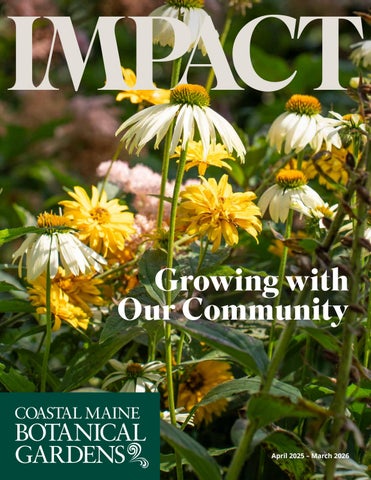
Growing with Our Community
April 2025 – March 2026
Dear Friends, Last year, I enjoyed seeing so many of you visit Coastal Maine Botanical Gardens. One of the things I am most proud of is that our Gardens can be a place of respite for everyone who seeks peace, joy, inspiration, and wellness. For those looking to dive deeper, our educational offerings cater to children and adults alike, teaching them how to nurture, identify, and artistically represent plants. Behind the scenes, our plant science teams are working on crucial work to identify and, hopefully, mitigate some of the impacts of climate change on plants in Northern New England. Over the course of fiscal year 2026, which ended on March 31, we achieved many of our strategic goals. A project that was years in the making, the Edward and Gwendolyn Asplundh Horticulture and Plant Science Center, finally came into reality as we broke ground in August 2025. We began a two-year refresh project for our Rines Family Ledge and Meadow Garden. We closed out a meaningful multi-year partnership with Indigo Arts Alliance that brought four new art pieces to the Gardens. And we welcomed more than 330,000 guests to the Gardens across the summer and winter months. Financial accessibility remains a priority, and we invited more than 30,000 guests to the Gardens at no cost to them. Due to continued demand, we tripled our accessible
We tripled the number of accessible cart tours last year.
2
cart tour offerings to six times a day, serving 2,800 people (a 200% increase over 2024!). On Wednesdays, those cart tours are free for all. Throughout the school year, 4,000 students from Maine schools, youth groups, and camps visited on a field trip. A quarter received financial aid. Our commitment to our mission and values is unwavering. We will always ensure that the Gardens are a safe, welcoming space for all. Every day, we work to inspire meaningful connections between people and nature, encouraging visitors to recognize their role in protecting the planet. Our dedication to promoting plant conservation and fostering a response to climate change remains steadfast and central to all we do. Thank you for being a part of this community and supporting our mission. We could not do this important work without your support! I look forward to seeing you at the Gardens.
Gretchen Ostherr, President & CEO
Rooted in
Financial Stewardship Mission Programs $5.9M
Earned Revenue $9.2M
39% Annual Fund Donations, Grants and Membership $3.1M
13%
Philanthropy $1.8M
42%
2025–2026
13% 2025–2026
Revenue
Expenses
$23.8M
$14.1M
48% Donations Restricted for Capital Campaign $11.5M
April 1, 2025 through March 31, 2026
22% Administration and Facilities $3.1M
23%
Guest Experience $3.3M
$92.9M
Financial Assets
$82.2M
$100M
$90M $19.2M
$80M Cash and Equivalents
$65.2M
Investments Property and Equipment Audit report available by request.
$42.2M
$66.5M
$70M
$58.3M
$27.3M
$44.4M $44.5M
$60M
$50M
$40M
$30M $46.4M
$20M
$10M
2018–2019
2019–2020
2020–2021
2021–2022
2022–2023
2023–2024
2024–2025
2025–2026
$0M
3
Breaking Ground on
Groundbreaking Research
I
n August 2025, we broke ground on the Edward and Gwendolyn Asplundh Horticulture and Plant Science Center. The Center, designed by Christner Architects, Lavallee Brensinger Architects, and built by Landry/French Construction, is planned for completion in spring 2027 and will support two important parts of our mission: plant science and horticulture. It will establish a hub of plant cultivation, research, plant conservation, and collaboration unlike any other facility in New England.
Vehicle, supply, and tool storage.
In response to the increased environmental impact of climate change, we are investing in substantial growth in our plant science teams. Additionally, as we have grown, our need for more plant-growing space has become crucial. This state-of-the-art building will provide: Plant propagation and production facilities, including two glass greenhouses, a head house, and three hoop houses to support ornamental and native plant displays and conservation work. Vehicle, supply, and tool storage for our Horticulture team. Ecology and microbiology research labs to investigate conservation techniques, plant migration, and plant responses to climatic changes. An expanded seed bank and new tissue bank; these
4
will allow us to store seed and plant material for future research and plant restoration. An expanded herbarium to facilitate the study of plant life in Maine’s ecoregions and document changes in plant distribution. Offices and workspaces to facilitate better collaboration and ability to host interns, undergraduate and graduate students, and faculty. With thanks to Gwendolyn and Edward Asplundh for their catalyst gift, and the dozens of other incredible private individuals and foundations who made this project possible.
Emily MacDonald
Zachariah Green
Deepening Partnerships with the University of Maine With the realization of our new Horticulture and Plant Science Center, our ability to foster and host student research will expand exponentially. In 2025, we deepened our partnership with The University of Maine—our partner on various science and conservation initiatives, including Signs of the Seasons and the Ash Protection Collaboration across Wabanakik—with a five-year research agreement to co-mentor students in the plant sciences. This year, we welcomed Emily MacDonald and Zachariah Green. Emily, a master’s student in Forest Resources in Dr. Jay Wason’s Lab of Forest Ecosystem Physiology, focused on how climate stressors influence trees’ early life stages. Melissa Cullina, our VP of Plants and Science, served on Emily’s graduate committee. Her project, which began in 2023, concluded in 2025 with her research published under the title “Combined heat and drought events reduce first-year survival of tree seedlings, especially at southern range margins.”
Zach is studying whether cultivated native plants crossbreed with their wild counterparts—and if so, how this affects the survival and reproductive success of wild plants. Cullina serves as co-chair of his graduate committee as well. Native plant cultivars are increasingly popular in ornamental horticulture for their adaptability and ecological benefits. However, conservationists have raised concerns that cultivated varieties may cross-pollinate with wild populations, potentially altering their genetic makeup and fitness. With landowner permission, cultivars were planted near small wild populations of the same native species. Zach will track the project through 2027, collecting tissue samples and conducting genetic analyses. The results could help shape policies on native plant cultivation—not just at the Gardens, but at public gardens nationwide—and influence best practices in ecological horticulture. SCAN OR CLICK TO READ EMILY’S RESEARCH PAPER.
5
Tending to Communities
with Indigo Arts Alliance
A
s the culminating installment of a three-part annual collaboration with Indigo Arts Alliance (IAA), we hosted Deconstructing the Boundaries: Tending to Communities. Thi s e d i ti on was the c ap st one of t he Deconstructing the Boundaries program. Through the program, we aimed to uplift the voices, histories, and cultural practices that have long been ignored or erased. By fostering conversations, creating space for art, and building relationships across disciplines, this partnership is a testament to the power of collective wisdom and the possibility of a more just and sustainable world. Throughout the IAA-curated free day-long symposium, the focus was on ways Black, Brown, and Indigenous communities build, sustain, and nurture networks of care in the face of historical and ongoing disenfranchisement. We explored ecological justice, rematriation, and the restoration of ancestral knowledge as essential tools for shaping sustainable futures. In addition to the symposium, jointly with IAA, we commissioned writer Arisa White and artist Daniel Minter to create public artworks that reflect the responsibilities of life, love, and identity within communities. These pieces join 2024’s commissions as a collective call to action and invitation to engage in meaningful dialogue, inspire change, and forge new ways to exist in harmony with the land.
Detail of Arisa White’s “revolution is ritual.”
6
Deconstructing the Boundaries Commissioned Art The Native Guide Project: CMBG
look after your heart
CO M M I S S I O N E D IN 2 0 2 4
COMMISSION ED IN 2025
Through her piece, Anna Tsouhlarakis amplifies Indigenous understandings of place, identity, and narrative. Following the premise of previous iterations of The Native Guide Project done in cities such as Scottsdale, Arizona; St. Louis, Missouri; and Columbus, Ohio; Tsouhlarakis focuses on the Indigenous presence of the area, specifically the oyster shell piles (or “middens”) which stood over 15 feet tall in various sites in this region of Maine. This art installation speaks to the ongoing legacy of the Native people of this area—as lovers of the ocean and riverways, connoisseurs of the tastiest oysters, and original caretakers of this land and of all the stories that are embedded in it.
Writer Arisa White encourages guests to engage with the multisensory nature of her writing. Inlaid into the ground is a mirror poem titled “revolution is ritual” that speaks to belonging, safety, rootedness, compassion, and love. The poem also serves as a spell for opening, encouraging, and healing the heart. Accompanying the mirror poem is the song “grand revolve.” This song was created to inspire a vast sense of love and belonging. The lyrics, written by Arisa White, are set to music composed by cellist Robin Lane with vocals by Jazmin DeRice. Words for the song are sourced from the Latin and common names of the botanicals found in the Woodland Garden.
Eci-Mahsosiyil/Fiddleheads
In the Voice of Trees
CO M M IS S IO N ED IN 2 0 2 4
COMMISSION ED IN 2025
Created by artist Shane PerleyDutcher, Eci-Mahsosiyil/Fiddleheads is an invitation to visitors to be immersed in the teachings, wisdoms, and environmental considerations of Indigenous communities of the North Eastern Region. Made with traditional techniques, woven copper baskets form fiddleheads, the furled fronds from a fledgling fern indigenous to the region. The artist states: “Growing up picking fiddleheads, I was always taught to give an offering and always leave some for others to pick. Picking fiddleheads is a tradition the Wolastoqey have practiced since time immemorial. Our Indigenous identity is rooted in reciprocity: the land feeds us, and we protect the land for future generations. The Wolastoqey are a sovereign people with land rights, asserted through our use and connection to the land.”
Created by Daniel Minter, this freestanding sculpture builds upon the existing themes introduced in Minter’s previous work The Healing Language of Trees—a project installed at the Lynden Sculpture Garden--continuing the exploration of trees as symbols of resilience, healing, and interconnectedness. Featuring sixteen red pine trunks stripped of their branches and bound together as a single entity, the trunks symbolize the African proverb, “Sticks in a bundle are unbreakable,” and are a meditation on unity and endurance. Draped over the trunks are strands of clay beads, hand-formed through multiple community activations to echo seeds, stones, and relics, representing prayers for the next seven generations. The trunks, standing together, are both guardians of memory and pillars for the future.
look after your heart Arisa White
Reiser Woodland Garden Cleaver Lawn
The Native Guide Project: CMBG Anna Tsouhlarakis
Arbor Garden Rines Ledge and Meadow Garden
Eci-Mahsosiyil/ Fiddleheads Shane Perley-Dutcher
In the Voice of Trees Daniel Minter
Alfond Children’s Garden
Back Woods
7
Evolving the
Great Lawn
W
hen the Great Lawn was originally designed and planted, it was the first garden that guests would experience after entering through the Visitor Center (which is now our Culinary Center). It was designed to welcome and orient guests while providing a picturesque space to relax. Although no longer the first garden that guests experience, it remains a space for rest, reflection, gathering, and community. In 2025, we began a two-year reimagining of the space with our mission in mind: promoting plant conservation through horticulture, education, and plant science. Partnering with landscape architects at Reed Hilderbrand, our focus is on wayfinding and accessibility while
redesigning bed shapes and garden features. Taking advantage of the full sun conditions, we are excited to showcase an upland prairie habitat, with drifts of flowering perennials and grasses among the exposed Bucksport schist ledge. During conversations around the future of this space, we felt that “Great Lawn” did not reflect the garden’s identity. After conversations with past and present Garden leaders, Horticulturists overseeing this area, and other supporters deeply connected to the garden space, we landed on the Rines Family Ledge and Meadow Garden. This name more accurately depicts the schist ledge features and prairie habitat meadow that we have installed.
Our new upland prairie habitat includes native plantings such as goldenrod (Solidago juncea), northeastern beardtongue (Penstemon hirsutus), coastal plain goldentop (Euthamia caroliniana), quaking aspen (Populus tremuloides), and much more!
8
Joint initiatives include Camping with the Trolls and providing native seed packets to guests who find all five trolls—and their secret seeds!
Shared Affinity for
Protecting the Planet
S
ince 2021, we have gratefully received meaningful support from L.L.Bean. Their philanthropic priorities include organizations that inspire meaningful outdoor connections, help communities and individuals thrive, and ensure the protection and preservation of treasured green spaces. What started as a sponsorship of our Thomas Dambo Troll exhibit bloomed into a creative annual “Kids Visit Free” program every Wednesday throughout July and August. Since launching this program, we have welcomed 13,000 children to the Gardens for free. On those free days, children can explore, learn about plants, and engage in hands-on programming with Gardens staff and from visitors like Wiscasset-based Chewonki. We are so grateful to L.L.Bean for their continued advocacy for the Gardens and the planet.
9
Impact
by the Numbers
REGULAR SEASON VISITORS
GARDENS AGLOW VISITORS
EDUCATION VISITORS
FREE VISITORS
MEMBER HOUSEHOLDS
2025-2026
2025-2026
2025-2026
2025-2026
2025-2026
226,709
101,805
9,871
78,328
8,517
2024-2025
214,054
2024-2025
117,202
2024-2025
9,691
2024-2025
70,975
2024-2025
8,055
2023-2024
2023-2024
2023-2024
2023-2024
2023-2024
197,646
113,063
9,608
68,272 Includes free visitors during summer, Gardens Aglow, and those visiting under a membership.
10
8,274
3,988
Students visited on field trips along with 1,301 adult chaperones.
1,473
984
Adults participated in education classes, and workshops.
Participants on tours— including Hike the Trolls, Climate Stories, and Wetlands.
1,347
428
Young people participated in camps and other youth programs.
Guests participated in Horticultural Therapy.
104,978 Guests visited the Native Butterfly House.
4,434
Guests participated in the Caterpillar Lab.
1,954
Guests took part in the Chewonki residency.
11
Together, we turn mission into impact—thank you. The mission of Coastal Maine Botanical Gardens is to inspire meaningful connections between people and nature and promote plant conservation through horticulture, education, and plant science.