NON-PROFIT ORG. U.S. POSTAGE
NEWSLETTER
PAID
Volume 17 , No. 2
PERMIT NO. 30 FARMINGTON, ME
97 Main Street Belfast, Maine 04915
Fall/Winter 2018
phone: 207-338-6575 e-mail: info@mainefarmlandtrust.org website: mainefarmlandtrust.org RETURN SERVICE REQUESTED
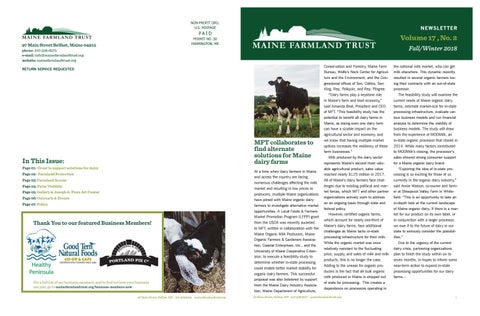
MFT collaborates to find alternate solutions for Maine dairy farms
In This Issue:
Page 01: Grant to support solutions for dairy Page 02: Farmland Protection Page 03: Farmland Access Page 04: Farm Viability Page 05: Gallery & Joseph A. Fiore Art Center Page 06: Outreach & Events Page 07: Policy
Thank You to our featured Business Members!
For a full list of our business members, and to find out how your business can join, go to mainefarmlandtrust.org/business-members-new 97 Main Street, Belfast, ME 207.338.6575 mainefarmlandtrust.org
At a time when dairy farmers in Maine and across the country are facing numerous challenges affecting the milk market and resulting in low prices to producers, multiple Maine organizations have joined with Maine organic dairy farmers to investigate alternative market opportunities. A Local Foods & Farmers Market Promotion Program (LFPP) grant from the USDA was recently awarded to MFT, written in collaboration with the Maine Organic Milk Producers, Maine Organic Farmers & Gardeners Association, Coastal Enterprises, Inc., and the University of Maine Cooperative Extension, to execute a feasibility study to determine whether in-state processing could enable better market stability for organic dairy farmers. This successful proposal was also bolstered by support from the Maine Dairy Industry Association, Maine Department of Agriculture,
Conservation and Forestry, Maine Farm Bureau, Wolfe’s Neck Center for Agriculture and the Environment, and the Congressional offices of Sen. Collins, Sen. King, Rep. Poliquin, and Rep. Pingree. “Dairy farms play a keystone role in Maine’s farm and food economy,” said Amanda Beal, President and CEO of MFT. “This feasibility study has the potential to benefit all dairy farms in Maine, as losing even one dairy farm can have a sizable impact on the agricultural sector and economy, and we know that having multiple market options increases the resiliency of these farm businesses.” Milk produced by the dairy sector represents Maine’s second most valuable agricultural product; sales value reached nearly $125 million in 2017. All of Maine’s dairy farmers face challenges due to existing political and market forces, which MFT and other partner organizations actively work to address on an ongoing basis through state and federal policy. However, certified organic farms, which account for nearly one-third of Maine’s dairy farms, face additional challenges as Maine lacks in-state processing infrastructure for their milk. While the organic market was once relatively resistant to the fluctuating price, supply, and sales of milk and milk products, this is no longer the case. Adding to the unease for organic producers is the fact that all bulk organic milk produced in Maine is shipped out of state for processing. This creates a dependence on processors operating in
97 Main Street, Belfast, ME 207.338.6575 mainefarmlandtrust.org
the national milk market, who can get milk elsewhere. This dynamic recently resulted in several organic farmers losing their contracts with an out-of-state processor. The feasibility study will examine the current needs of Maine organic dairy farms, estimate market-size for in-state processing infrastructure, evaluate various business models and run financial analysis to determine the viability of business models. The study will draw from the experience of MOOMilk, an in-state organic processor that closed in 2014. While many factors contributed to MOOMilk’s closing, the processor’s sales showed strong consumer support for a Maine organic dairy brand. “Exploring the idea of in-state processing is so exciting for those of us currently in the organic dairy industry,” said Annie Watson, co-owner and farmer at Sheepscot Valley Farm in Whitefield. “This is an opportunity to take an in-depth look at the current landscape of Maine organic dairy. If there is a market for our product on its own label, or in conjunction with a larger processor, we owe it to the future of dairy in our state to seriously consider the possibilities.” Due to the urgency of the current dairy crisis, partnering organizations plan to finish the study within six to seven months, in hopes to inform some near-term action to expand in-state processing opportunities for our dairy farms. •
1
FARMLAND PROTECTION & STEWARDSHIP Farmland Protection Program protects 10 more farms
The number of farms in Maine protected with agricultural conservation easements continues to grow. Since MFT’s founding in 1999, we have helped to protect over 60,000 acres of farmland throughout the state. A FEW OF OUR RECENT FARMLAND PROTECTION PROJECTS:
Reid Road Farm, Thorndike, Jackson and Waldo The Reid family ran a dairy farm for many years on this 1,200-acre property. More recently, the land has been utilized for raising beef cattle and supplying hay and corn to local dairy farms. MFT purchased this farm through our Buy/Protect/Sell Program. We will divide the property into a few farm parcels, so multiple farmers can utilize this land, all of which will remain available for agriculture.
Grey Ghost Farm, Lincolnville Richard Brothers recently purchased the 70-acre property and wanted to protect the farm from further subdivision and development. The land is currently used to grow hay for a local livestock operation. Placing an easement on the land ensures that the abundance of good agricultural soils on this property will be available for the future.
Henkel Farm, South Berwick Elizabeth Knight Henkel and her husband, Joe Henkel (pictured with MFT’s Chris Cabot) protected their 71-acre family farm, currently used for hay. Elizabeth grew up on the property and noted how happy her father would be to know that the farm is now protected in perpetuity. MFT transferred the easement to our partners at Great Works Regional Land Trust, who will work with the Henkels to steward the land.
Alna Hopyard, Alna Patty Krebs and her son Michael own Alna Hopyard, which produces five different varieties of organic hops for local craft breweries (including Oxbow and Odd Alewives). Protecting their property with an easement allowed them to invest in new hops processing equipment.
New Stewardship section on our website! We recently launched a new Stewardship section on our website. When MFT protects a farm, we enter into a permanent relationship with the land and its owners, and it is our responsibility to work with the landowner to ensure that the land remains protected forever. The web section allows easy communication between landowners and MFT stewardship staff, and provides information for landowners who are considering placing an easement on their farm property. Check it out at mainefarmlandtrust.org/stewardship. •
2
97 Main Street, Belfast, ME 207.338.6575 mainefarmlandtrust.org
POLICY BOARD OF DIRECTORS William Bell, Saco Jason Bolton, Orono Stacy Brenner, Scarborough Dave Colson, Durham Neil Crane, Exeter Meredith Eilers, Bowdoinham Walter Fletcher, Pittsfield Eleanor Kinney, Bremen James Lawrence, Rockport Frank Miles, Secretary, Cape Elizabeth Susan Morris, Vice Chair, Waldoboro Taylor Mudge, Chair, Camden Steve Page, Bremen Jon Olson, Mt. Vernon Henry Whittemore, Treasurer, Readfield
STAFF Anna Abaldo, Gallery & Fiore Art Center Charlie Baldwin, Land Protection Amanda Beal, President and CEO Adam Bishop, Land Protection Erica Buswell, VP of Programs Chris Cabot, Land Protection Erin Cavallaro, Development April Costa, Stewardship Andrea Denny, Database David Dewey, Fiore Art Center Catherine Durkin, Farm Viability Abby Farnham, Farm Viability Khris Hogg,Veggies For All Alex Fouliard, Farm Viability Chris Franklin, Land Protection Karen Giles, Gallery Caroline Ginsberg, Development Shannon Grimes, Farm Viability Ellen Griswold, Policy & Research Caitlin Hopkins, Land Protection Rachel Keidan, Outreach Victoria Kulwicki, Development Sue Lanpher, FarmLink Andrew Marshall, Policy & Research Lyndsey Marston, Stewardship Meg McCormick, Development Justin Nadeau, Unity Food Hub LouAnna Perkins, Senior Legal Counsel Meghan Quinn, Outreach Tricia Rouleau, Land Protection Ellen Sabina, Outreach Kim Sanborn, Office Assistant Elizabeth Sprague, Farm Viability Brett Sykes, Land Protection Rachel Taker, Finance Manager Kristin Varnum, Vice President and CFO Reeve Wood, Legal Counsel Nina Young, Land Protection & MFR
Big year for agriculture policy in Maine Recently, Mainers went back to the polls to elect our next governor – a governor who will have a significant impact on agriculture in Maine. This year, Congress is also drafting the farm bill, the federal government’s primary food and agriculture legislation that is passed about every five years. While MFT has always worked to keep our finger on the pulse of the policies that affect Maine farms, we are doubling our efforts this year and charting a bold new course for agricultural policy both at the state level and in Congress. Sign up on the policy section of our website for updates on how to get involved. Help us continue to advocate for Maine’s farmers & working landscapes. RECENT POLICY UPDATES (FIND THE LATEST ONLINE):
Farm Bill Update Farmers and communities across Maine and the rest of the country have been waiting on Congress to pass a new farm bill. This bill is the vehicle that provides funding for farmland protection and access, development of local and regional food economies, agricultural research, rural economic development, beginning farmers, and more. This year, MFT has shared our policy priorities for the next farm bill with all of the members of Maine’s congressional delegation, including during in-person meetings with Sen. Susan Collins, Sen. Angus King, Rep. Chellie Pingree, and with U.S. Agriculture Secretary Sonny Perdue during his recent visit to Maine. Unfortunately, the wait for a new farm bill continues. Congress did not pass the 2018 farm bill before the current law expired on September 30th. As a result, nearly 20 of the programs that Maine farmers and others rely on to grow our agricultural economy and protect important farm resources either stopped operating or had their funding frozen. Congress must pass a full extension of the current law until a new farm bill is enacted to keep vital services working.
Agriculture Policy Platform MFT has been working with other organizations and farmers in the state over the last year to create an initial draft of an Agriculture Policy Platform that outlines farm-friendly policies that the next state administration should endorse. MFT is now in the process of helping to organize a robust outreach effort to obtain in-person and online feedback about the initial Platform from farmers and other agricultural stakeholders across the state. Following that effort, a more detailed Platform will be made available to guide the next state administration. •
97 Main Street, Belfast, ME 207.338.6575 mainefarmlandtrust.org
7
OUTREACH & EVENTS
FARMLAND ACCESS
Scenes from a few recent events & happenings:
MFT hits 200 Farm Links This summer, MFT’s Maine FarmLink program helped facilitate its 200th link. That’s 200 farmers who have been “linked” with farmland to buy, lease or otherwise access since the program began in 2002! FarmLink has helped connect farmland seekers and farmland owners in all 16 counties, and the program’s single most successful year yet was in 2016, with 24 links encompassing 4,987 acres of farmland. •
MFT staff thank the 100 people who joined during New Member Month in July.
Meg Q. and Ellen S. brewing Farmland, a new beer made with all Maine ingredients in collaboration with Oxbow Brewing Co.
Scott Vlaun led a hands-on workshop on foraging and growing mushrooms for our Maine Fare event series in June.
The sun sets after Agrarian Acts, held at MFT’s Fiore Art Center in Jefferson.
2019 Marks our 20th anniversary
THE BUSINESS OF
FARMING FOR WHOLESALE Applications & Registration are OPEN! 101 Track - for farms interested in exploring wholesale 201 Track - for experienced wholesale farmers
Sandy River Farms in Farmington created a 12-acre corn maze of MFT’s logo and tagline. 6
Artist Thu Vu shares her work during an Open Studio Day.
97 Main Street, Belfast, ME 207.338.6575 mainefarmlandtrust.org
Stay tuned for more details on how to help us kick off our 20th year! 97 Main Street, Belfast, ME 207.338.6575 mainefarmlandtrust.org
Buyer Training for buyers interested in purchasing wholesale from local producers Visit our website for details :
mainefarmlandtrust.org/farm-viability-new/workshops 3
FARM VIABILITY
GALLERY & FIORE ART CENTER Veggies For All: Growing and Gleaning As a food bank farm, Veggies For All (VFA) grows thousands of pounds of produce for area food pantries every year. Over the past few years, VFA has helped to double the amount of local produce delivered to pantries by partnering on a local gleaning project. Since 2016, VFA has worked with Unity Barn Raisers (UBR) and dozens of Waldo County farms to glean surplus fruits and veggies and find a home for the nutritious food. Participating farms include: Johnny’s Selected Seeds trial farm, Kennebec Valley Community College Farm, South Paw Farm and
Villageside Farm. So far this season, VFA and UBR have gleaned 22,000 lbs toward a 30,000 lb goal; this on top of the 18,000 lbs produced by VFA’s food bank farm, with more yet to harvest.The combined effort means lots of nutritious, locally grown food will be distributed to Central Maine pantries this year. In addition to delivering food to the food pantries, VFA now also delivers both gleaned produce and produce from the VFA fields to affordable housing communities in the Unity area. They have also been involved in Good Shepherd Food Bank’s pilot program, Lettuce Share, to deliver to senior housing in the region. •
Key Findings from Farm Fresh Rewards
and that half report trying new fruits and vegetables thanks to the program. FFR not only has an impact on shoppers’ consumption of local fruits and MFT recently evaluated the first three vegetables, it also increases the puryears of our Farm Fresh Rewards (FFR) chase of other local foods (such as dairy, program. The healthy food incentive eggs, meat or poultry, and honey and program doubles the value of federal nutrition assistance dollars at participat- maple syrup). One of the top benefits of participating in the program is that twoing stores. Incentive programs like FFR thirds of shoppers say they “feel more offer vouchers for low-income shoppers who use SNAP/EBT (food stamps) when connected with farmers and other local food producers.” One customer states, they purchase local food. The vouchers “...it’s interesting to see that something can be redeemed to purchase more so simple as a voucher program...is locally-grown fruits and vegetables. Hampshire, Vermont, Connecticut, and actually affecting people making healthy Rhode Island for the next four years. Through the program, SNAP shoppers choices, and healthy not just for us are able to access more local, healthful “We’ve seen an incredible impact from but for our community, and beyond our food; Maine farmers gain new customthis program, and are thrilled to have community. I don’t know these farmers, ers; and more food dollars stay in the an opportunity to build and grow it even but I’m pretty sure that it’s making a big more, so we can share Maine’s abunlocal economy. impact for them as well.” MFT created a report to highlight key dance with everyone in the state,” says This program will continue with findings from the evaluation, includShannon Grimes, Nutrition Incentive support from a large, multi-state USDA ing that approximately two-thirds of Project Coordinator at MFT. • responding customers report buying and grant. The grant will help fund nutrition incentive programs in Maine, New consuming more fruits and vegetables, 4
97 Main Street, Belfast, ME 207.338.6575 mainefarmlandtrust.org
Reflections from 2018 Arists-in-Residence at Fiore Art Center The summer of 2018 marks the third summer of the artist-in-residency program at MFT’s Joseph A. Fiore Art Center in Jefferson. Over the course of the season the Fiore Art Center hosted six visual artists, a writer, a performance artist and a gardener. A constant theme for all of the residents this summer was slowing down and taking the time to absorb and reflect their surrounding environment. The property itself serves as inspiration for the artists, whether it is the fields, the lake, or the garden. “Everything here begins with FOOD” says international resident, Thu Vu. Rachel Alexandrou, this year’s resident gardener, provided a lovely and eclectic array of produce throughout the season for the residents. Thu reflected, “I can see strongly that agriculture has been a really great inspiration to us all. I see it in everyone’s work, I see changes in my work.” Maxwell Nolin, a young and emerging portrait painter states, “Connecting to the land while exploring your creative process allows artists to tap into a divine space...which in return feeds our souls and our work.” Nolin spent many
years farming in rural Maine. During his residency, he worked on many portraits, including a self-portrait. Michel Droge, another visual artist, says that “As an artist who works with environmental concerns, I am constantly questioning how the arts can be of service and bolster the environmental work we need to do and bring awareness and connection to the interrelatedness of all things.” Michel begins her work with inspiration from environmental traditions and creates them to offer a space to discuss current issues within that realm. Her resulting paintings, including those created throughout the residency, combine color and textures in an incendiary composition. Plein-air painter Carol Douglas took full advantage of the landscape at Rolling Acres Farm by alternating between painting with oil on panel one day, and watercolor on yupo (a synthetic, water-resistant water paper) the next – a challenge which led to some very exciting experiments with texture and color. Visual arts resident Clif Travers embraced the space offered at Rolling Acres Farm by building an 8 x 6 foot panel with reclaimed wood, which became the ground for a giant mosaic tree. Performing arts resident Heather Lyon spent much of her month in the lake at the end of the farm fields, performing and shooting video at dawn. During her time at the residency, ArgentinianAmerican Stephanie Mercedes, researched local archives for traces of the Argentine dictatorship, and shared an installation relating to Argentina’s “disappeared histories.” She folds law and dissent into her artistic practice. Writer Jodi Paloni finished her first novel and wrote weekly reflections of her time spent at Rolling Acres. “I’ve never been more productive in my 10-
97 Main Street, Belfast, ME 207.338.6575 mainefarmlandtrust.org
year writing career as I have been at Fiore. It seems to be the combination of time and space...as well as the inspiration of the colors, textures, scents, and sounds rioting the fields.” Residents were not only moved by the landscape of Rolling Acres, but by each other. Rachel Alexandrou reflects, “I was equally inspired by all [residents] in different ways and enjoyed their presence around me as I tended the garden for them to eat from.” At the end of every month, the art center opened it doors for Open Studio Days. These days are a chance for the community to visit the artists’ space, see their work and chat about their experiences. One visitor reflected on the day by stating: “This is why we moved to Maine!” Residency applications for 2019 open December 1. Check our website for more info. •
In the Gallery through March 1: HOMELAND: A multimedia exhibit exploring our collective and diverse relationship to home/land Spring 2019: Work by Fiore Art Center 2019 Artists in Residence 97 Main Street, Belfast M-F 9 am - 4 pm 5