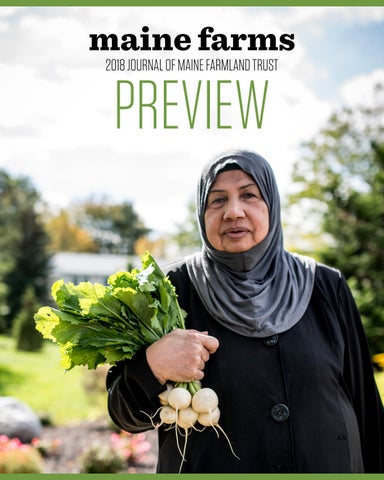
maine farms 2018 JOURNAL OF MAINE FARMLAND TRUST
PREVIEW
AA
FOOD
radishes for the whole world maine organizations seek to expand food access
BY KATHRYN WILLIAMS | PHOTOGRAPHS BY SÉAN ALONZO HARRIS
I
t’s 3pm on a November afternoon in Portland, Maine, daylight dwindling, and 13 teenagers trickle into a cobbled-together kitchen on Elm Street, trailing sweatshirts and backpacks and the chill of fall with them. A few are late (the bus is out of service), but they get to work around a large wooden table, spooning sopa de arroz, a tomato-infused Mexican rice dish, and cabbage salad into molded cardboard containers. They work with the lassitude of teenagers, pausing occasionally to rib each other. On an old, beige refrigerator behind them, a bumper sticker reads, “Everybody has the right to good food.” This is the Culinary Crew, a youth program of Cultivating Community, a Portland-based nonprofit that has been at the forefront of food access work in Maine for more than 16 years. Perhaps best known for its refugee and immigrant farmer training and community supported agriculture
2
(CSA) programs, the organization also manages, in conjunction with the City of Portland, 11 community gardens with a total of 400 plots. Today, the crew will deliver 73 meals to elderly residents of the East Bayside neighborhood. Residents like Kenneth, whose subsidized apartment overlooks the Whole Foods Market on Franklin Avenue. (Sometimes, Kenneth says, when he’s sick of TV dinners and canned vegetables, he goes there for the salad bar.) And they’ll deliver meals to the woman in a black hijab who speaks Somali with the teens from behind her cracked door. She’ll take an extra serving for a neighbor who is out. The students recognize tenants now. “I like how they always smile,” says Ahado, a junior at Deering High School who arrived in the United States from Kenya seven years ago. Her own family relies on the Supplemental Nutrition Assistance
Previous Page A happy customer purchases Hakurei turnips from Fresh Start Farms at a Good Food Bus stop in Westbrook. Eggplant has been another hit in the neighborhood, which is home to many Iraqi immigrants. Above Teenage members of Cultivating Community’s Culinary Crew prepare to deliver meals to recipients of the organization’s Eldershare program.
Program (SNAP, formerly “food stamps.”) One of her coworkers today is Athani, a Deering senior. As the two wait for the elevator, the girls look out over the city, toward the oil tanks of South Portland. Across the river, they spy a high-rise similar to the one whose floors we’re slowly ascending and imagine, correctly, that it’s also subsidized housing. Athani, in a pea-green raincoat and long, flowing skirt, looks pensive. “Who brings food to them?” she asks. •••
One in six Mainers—one in four Maine children— lacks reliable access to adequate food. According to the U.S. Department of Agriculture, Maine is the seventh most food-insecure state in the nation, a slide from last year’s ninth-worst ranking. As other states see improvement, Maine’s hunger gap is growing, says Chris Hastedt, public policy director at Maine Equal Justice Partners, a legal 4
aid and advocacy group working for low-income Mainers. “We’re heading in the wrong direction.” In 2016, 14% of Maine residents received SNAP benefits—down from previous years thanks in part to economic recovery, but also due to toughening of eligibility requirements. (In 2015, Governor Paul LePage removed waivers on the time limit, asset test, and work or volunteer requirements; the waivers are used by most other eligible states.) Yet even those who receive SNAP (the average benefit is approximately $1.40 per person per meal) have trouble consistently accessing nutritious food. As a result, hunger relief charities originally intended as stopgaps have become a regular fixture in many Mainers’ lives. Good Shepherd Food Bank now partners with more than 300 food pantries across the state, while Preble Street, in Portland, serves 500,000 meals a year at eight soup kitchens. At risk are people young and old, black and white, rural and urban—mostly low-income
families, seniors, veterans, the disabled, immigrants and refugees, and those living in Maine’s northern-most and far-flung communities. Food access is a dauntingly complex issue, from farm to factory to fork (and landfill), with far-reaching social, cultural, economic, and ecological implications. The system is broken, and almost everyone agrees that poverty is at the dysfunction’s root. There is no single solution, says Mark Winne, a longtime community food activist and policy guru who spoke recently at a lecture hosted by University of Southern Maine’s new Food Studies Program— though he’d start with raising the minimum wage. “Many [food access] programs are Band-Aids that are helping mitigate larger structural problems,” says Shannon Grimes of Maine Farmland Trust, though there is hope and evidence that some programs are having a deeper impact. For lasting systemic change, there must be innovative intervention at every link in the chain.
Hundreds—some estimate thousands—of organizations work to improve food access in Maine. Their efforts are varied and promising, from permaculture experiments such as the Alan Day Community Garden “food forest” in Norway, an eventually self-sustaining edible ecosystem, to 32 winter farmers’ markets making cold-hardy produce like spinach, chard, radishes, and candy-sweet carrots available year-round. There are rooftop gardens and thriving co-ops, food hubs bringing small farms into wholesale and institutional markets, and initiatives to increase production and consumption of locally grown food. And if activists at one end of the chain are figuring out how to get healthy, locally grown food to market, there are those on the other end working tirelessly— and creatively—to get it from market to table. •••
Members of the Culinary Crew, many of whom have benefited from food access programs themselves, deliver meals to residents of Portland’s East Bayside neighborhood. Students in the program learn how to harvest, cook, and preserve local foods, some of which are grown in Cultivating Community gardens. They also gain valuable job skills and a better understanding of sustainable food systems.
Left “We’re here for everyone, regardless of income or background. We’re just trying to get good food to people, regardless of who you are,” says Kathleen McKersie, who trailers the Good Food Bus mobile market to 13 weekly stops. Right “A lot of people don’t even think where their food’s coming from,” says Maxine, a Good Food Bus customer. Her family used to grow their own string beans, potatoes, and tomatoes.
Outside the Center for Wisdom’s Women in Lewiston, Maxine rolls a collapsible shopping cart toward a stainless steel trailer painted with a three-foot pumpkin. On her shoulder is a reusable grocery bag fashioned from a tie-dyed T-shirt. Plump zucchini, pert green beans, and picture-perfect peppers set in wooden crates beckon from the trailer’s open windows. On a table beside the trailer sit printed recipes and a pint of exotic husk cherries, free for the sampling. Two years ago, Maxine blew out her leg when she fell on cement. Now, without work, she, like nearly a third of the population of Lewiston, relies on SNAP. On Wednesdays, she shops the Good Food Bus, a mobile farmers’ market run by nearby St. Mary’s Nutrition Center and Cultivating Community. (Its former incarnation was an actual bus.) This week Maxine asks about some collard greens her friend Ruth requested; they’ll be stewed in a crockpot with a special seasoning blend Ruth found at the Save-a-Lot. “She’s been talking about them all week.” 6
Though she grew up on a farm in Jackson, Maine, and wishes she could grow and can tomatoes and string beans the way her mother once did, Maxine doesn’t have space in the small apartment from which, importantly, she can walk to this parking lot. When it comes to food access, getting there can be more than half the battle. In the last U.S. Census, Maine had the highest percentage of rural residents in the nation, many of them living more than 10 or 20 miles from a grocery store or supercenter, in what experts call “food deserts.” Even with a vehicle, consider the inconvenience and cost of gas, and one can understand how many rural Mainers end up grocery shopping at the local Cumbies. In denser urban areas, public transportation helps alleviate the problem, but seniors and those with limited mobility still often struggle to get to a market less than a mile away. Even when they do, they are limited to what they can carry. For someone working several jobs or odd shifts, getting to a Wednesday afternoon
Top The original Good Food Bus still graces the parking lot of St. Mary’s Nutrition Center in Lewiston. Bottom Health or age-related mobility issues can be a major obstacle to accessing good, fresh food, making the “we come to you” approach of the mobile market model appealing.
Fall work in Norway’s three-acre, volunteer-driven Alan Day Community Garden. “We don’t want to be an organization that just gives food out,” says garden coordinator Rocky Crockett. “We want people to have a relationship with the garden.”
farmers’ market might be a ridiculous proposition. “How do you get [healthy, local food] to where people are?” says Karen Voci, president of the Harvard Pilgrim Health Care Foundation, which funds the Good Food Bus. In 2017, the “bus,” which accepts SNAP and WIC (the supplemental nutrition program for Women, Infants, and Children), had almost 3,000 transactions at 13 weekly stops across LewistonAuburn, Bath, Westbrook, and Gorham, and a 42% increase in sales from the year before. After the Center for Wisdom’s Women, the Good Food Bus will head, courtesy of a pickup truck, to a regional medical center and community garden. Later in the week, it will hit Bath Iron Works and a YMCA. Another mobile model (with a similarly loose definition of “bus”—the program currently runs from volunteers’ cars) is serving Downeast Mainers. The Magic Food Bus, a program of Healthy Peninsula in partnership with Edible Island, brings free local produce, along with books, to seven towns
across the Blue Hill Peninsula and Deer Isle. Each week, staff and volunteers distribute a mix of purchased, donated, and gleaned produce at apartment complexes, community centers, and schools. “Mobile food initiatives are particularly wellsuited for communities that are spread out,” says Stephanie Aquilina, the program’s island coordinator. They are also opportunities to introduce consumers to new foods. Aquilina recalls an elementary schooler’s wide-eyed reaction to his first fresh radish. “The whole world should eat this,” he said. That’s the idea. •••
“Our clients, they want to buy broccoli,” says Chris Hastedt, “they want to feed their families healthy meals.” But accessibility is not just about distribution and cost. What all consumers want—convenience, familiarity, options—these are what go
Opposite Page A gardener in the hoophouse at Alan Day Community Garden in Norway. The non-profit organization seeks to strike a balance between innovation, education, and approachability, being truly accessible to all kinds of community members. A few years ago it conducted a study to discover any obstacles it might unknowingly create.
9
the final mile toward true accessibility. And in the end, food equality sometimes comes down to good, old-fashioned marketing. In Lewiston, small vegetable and herb planters cared for by local farmers and businesses run along Lisbon Street. Inspired by Edible Main Street in Norway, Maine, and similar initiatives in the United Kingdom, the program is as much about advertising as about providing access to fresh peas and parsley. It’s “to show anyone they can do this,” says Scott Vlaun, of the Center for Ecology-Based Economy, which runs the Norway program. “More than trying to grow food in the community, we’re trying to grow food growers.” Familiarity and convenience are key. The Good Food Bus carries Marble Family Farms “Hotties,” local and organic savory hand pies akin to healthy Hot Pockets, as well as snack-size baggies of almonds and raisins, while their Anchor Meals, with prepped ingredients and recipes, resemble something from a meal delivery service like Blue Apron.
The FVRx program, piloted in Skowhegan in 2010 by the national organization Wholesome Wave, leverages familiarity in another way. Health care providers offer qualifying patients “prescriptions” for produce in the form of vouchers that can be redeemed at the local farmers’ market or grocery store. Doctors’ orders carry “a certain weight,” says Jenny Schultz of York County Community Action Corporation, who will coordinate a new FVRx program in Sanford in 2018. Plus, she says, the message can be personalized to address a person’s particular health concerns, such as high blood pressure or diabetes. It’s a kind of hyper-targeted marketing. Other initiatives run like promotions, similar to a buy-one-get-one deal. There are two nutrition incentive programs in the state: Maine Farmland Trust runs Farm Fresh Rewards in participating stores, and Maine Federation of Farmers' Markets and others facilitate Maine Harvest Bucks at farmers' markets and some farms. The programs effectively double SNAP dollars dollars by offering $5 produce
One of sixteen Edible Main Street planters in Norway gets some love. “It’s about getting food growing front and center in the community,” says Scott Vlaun of the Center for Ecology-Based Economy.
Young gardeners work with urban agriculture specialist Laura Mailander at Boyd Street Urban Garden. Cultivating Community founded this garden in 2004, specifically for residents of the Kennedy Park neighborhood. It strives to make community plots around the city more accessible to low-income gardeners.
vouchers for every $5 spent on local products. Maxine at the Good Food Bus is one enthusiastic user. Of course, the most tried-and-true marketing is word of mouth. “What makes the biggest difference,” says Shannon Grimes, “is to have a community champion.” In the advertising world, they are called “tastemakers” or “influencers.” Perhaps the biggest influencers are the next generation, which is why much of the focus in food access is on education and youth programs. When it comes to forging healthier habits, “we should forget about adults,” says Ken Morse of the Maine Network of Community Food Councils and Maine Farm to Institution, half-joking, “and just raise a generation of kids who have a new relationship to food.”
On a brisk walk back to Cultivating Community after her final meal delivery, Athani talks about the hunger she felt her first year and a half in the United States. Before her family qualified for assistance, they relied heavily on the local Somali community. “Why are you going to bring us to this country with no food and no place to live?” she wondered. “Now,” she says, with a flutter of her hands, “I feel good.” With a full stomach, the teen now worries instead about the elderly clients to whom she brings food. Just last week a woman new to the Cultivating Community program told Athani that until the Culinary Crew arrived she wasn’t sure she’d have anything to eat that day. It’s a story of both validation and urgency for those working tirelessly and creatively to get good food to those who need it most.
•••
kathryn williams is a Maine-based writer and teacher with a special fondness for condiments in small jars.
11
maine farms is an annual journal created especially for Maine Farmland Trust members. The journal takes a deeper look at what's happening in food and farming, with fresh, honest stories and photographs.
The 2018 issue is due out in mid-June. To get your copy, become a member or renew your membership today!
97 Main Street, Belfast, Maine 04915 ¡ 207-338-6575 e-mail: info@mainefarmlandtrust.org www.mainefarmlandtrust.org