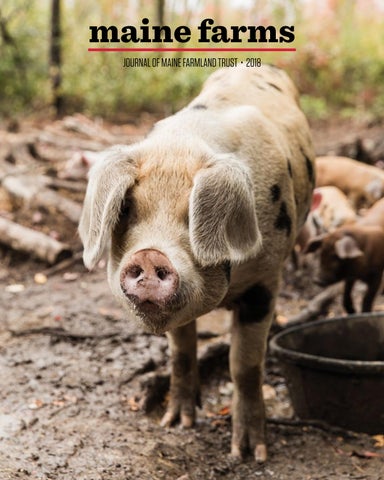
maine farms
JOURNAL OF MAINE FARMLAND TRUST • 2018
Storytelling is an ancient form of communication and connection, but it’s also something of a hot concept right now. In the nonprofit world, there are workshops on how to tell stories that resonate with your donors. In the business world, it’s about how to tell your brand’s story so that customers want to purchase your product, be it a jar of salsa or a car or a toothbrush. In both sectors, storytelling is visual, constant, and a response to the public’s desire for transparency. We, the public, want to know what’s behind the curtain—we value authenticity and connection. We are weary of the constant stream of digital advertising and the 24/7 news cycle. In the face of daily media overload, we seek out well-told, true stories.
You could say we jumped on the storytelling bandwagon with this journal. Five years ago, when we put together our first issue, our hope was that this little publication would help connect readers to the people that make up Maine’s food and farm landscape and illuminate some of the issues farmers grapple with every day. We wanted to help readers dive deeper, providing them with rich and authentic content. We did not want to romanticize or sugarcoat the messy, complex realities of the local food movement; our goal was to shine a light on the unseen corners and amplify the good, hard work going on all around us in hopes of boosting it.
We’ve stayed true to that original vision, largely thanks to all of the collaborators we’ve worked with to bring these stories to life, people who are also keen on truth and transparency without the fluff. This year’s issue is another testament to that. The Salt Institute was a pioneer in documentary storytelling in Maine, and an old issue of Salt Magazine was actually the inspiration for this journal. It’s fitting that we are now sharing a selection of photographs from the Salt archives, which is a veritable treasure trove of real Maine stories.
While the Salt images reveal truths about our past, Maine Farmland Trust President, Amanda Beal’s essay about her family’s farm roots the broader challenge of farmland transfer in personal experience, providing valuable insight for future farmers. Carl Little connects the artists-inresidence at the Fiore Art Center to the rich landscape of artists working in the environment, and Kathryn Williams and Séan Alonzo Harris track grassroots efforts to ensure that all Mainers can access healthy, local foods. Sophie Nelson and Greta Rybus visit farms that are finding their own ways to connect with their customers. And finally, Laura Poppick and Molly Haley head to Maine’s northernmost county to visit a family paving the way for hops production in Maine.
Our food landscape is ripe with stories like these—real people, doing the best they can to make a brighter future. Like an August tomato eaten fresh from the vine, these stories require no dressing. We don’t need to spin anything or put a filter on it. All we have to do is tell stories as they are. They’re that good.
Ellen Sabina, Outreach Director, Maine Farmland Trust
maine farms
3 field
Snippets from the farming landscape
4 poem “Chimney Farm”
GARY LAWLESS
5 art
Reflections on the landscape at Rolling Acres Farm
CARL LITTLE
11 future
On transferring ownership of a beloved family farm
AMANDA BEAL
17 business
Maine farms seek stability through agritourism
SOPHIE NELSON
27 food
Expanding access to fresh food throughout the state
KATHRYN WILLIAMS
37 people
A glimpse into the online bounty of the Salt Story Archive
KATY KELLEHER
43 land
Aroostook County farmers try a fragrant new crop
LAURA POPPICK
editors
Ellen Sabina
Katy Kelleher
photography
Séan Alonzo Harris
Jenny Nelson
Greta Rybus
Molly Haley
The Salt Institute for
Documentary Studies
design Might & Main
writing
Amanda Beal
Katy Kelleher
Gary Lawless
Carl Little
Sophie Nelson
Laura Poppick
Kathryn Williams
publisher
Maine Farmland Trust
97 Main Street, Belfast, Maine 04915 (207) 338-6575 mainefarmlandtrust.org info@mainefarmlandtrust.org
Printed on 80# Finch Opaque Bright White Smooth by J.S. McCarthy Printers, Augusta, Maine
All material ©2018 Maine Farmland Trust
The Maine Farms journal is a publication of Maine Farmland Trust, a statewide nonprofit that protects farmland, supports farmers and advances the future of farming.

the field
snippets from the farming landscape
a very brief history: maine beans
the bean supper
“A Maine cook has something else in mind as she makes her beans,” writes Marjorie Standish in her definitive 1973 collection of local recipes, Keep Cooking - The Maine Way. “She is showing off her ability as a cook. She has a reason to; her mother did it before her.” For many home cooks, baked beans taste like home, like Maine. Standish adds that Maine baked beans mean “just one thing—it’s Saturday night.”

Beans are also an excellent food for sharing, explains food historian (and owner of Rabelais Fine Cookbooks) Don Lindgren. “Beans have this social role in Maine, through bean-hole beans and the bean supper,” he says. “They’re not just a practical food. There’s a community aspect to them, and we recognize that even today in the tradition of bean suppers.”
bean lore
Jacob’s Cattle bean (often referred to as “Jake’s”) was likely grown in Maine before white settlers arrived. According to local legend, a Passamaquoddy leader gave these beans to Joseph Clark of Lubec, the first child of European heritage born in Maine, to celebrate his entry into the world.
a few fresh food & farm festivals
which bean to bake?
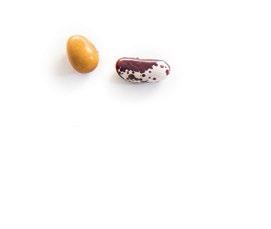
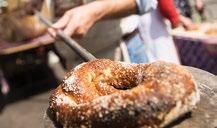
Mainers are divided on the best bean for bean suppers. The most popular varietal is the yellow eye bean, but others prefer using Soldier (which have a maroon mark in their center that supposedly resembles a figure standing at attention), kidney, Marfax (these richly textured, golden brown beans are particularly popular way Down East), or Jacob’s Cattle.
maine’s first published recipe for black bean soup
Excerpted from Fish, Flesh and Fowl: A Book of Recipes for Cooking, a cookbook compiled by Ladies of State Street Parish in Portland. Published in 1877, this is believed to be Maine’s first collection of local recipes. One pint of black beans, soaked over night. In the morning pour off the water, add a gallon of water, with any bones, either of beef or mutton (very little meat needed), and boil several hours. Season with salt and pepper. Take off all the fat, strain the soup and let it boil again before serving. Cut a lemon in thin slices and put into the tureen and pour the soup upon it. Some add cloves and yolks of hard boiled eggs.
Fourth Sunday in March
Maine Maple Sunday
Late May
Damariscotta Alewives Festival
July
Maine Potato Blossom Festival
Open Farm Day
Artisan Bread Fair
September
Common Ground Country Fair
October
Open Creamery Day
Fryeburg Fair
November
Maine Harvest Festival
maine by the numbers: the farm bill in maine
The farm bill is a comprehensive multi-year piece of federal legislation that governs a substantial array of federal farm, food, forestry, and rural policies and programs. The current farm bill expires on September 30, 2018, and Congress is working on the next version. It has and will continue to have a large effect on Maine farms. Here are some of the effects of the farm bill:
$3.5 + million
The amount of funding that has been provided to agricultural producers in Maine to create or develop value-added producer-owned businesses through the Value-Added Producer Grant (VAPG) program.
$3.7+ million
The amount of funding allocated between 2009 and 2017 to Maine-based organizations providing training to beginning farmers, including training related to land access, as part of the Beginning Farmer and Rancher Development Program (BFRDP).
-$114,970
The decrease in funding allocated to Maine in 2018 as compared to the amount allocated in 2017 for agriculture conservation easements through the Agricultural Conservation Easement Program – Agricultural Lands Easements (ACEP-ALE).
$13+ million
The amount of funding provided to farmers in Maine in 2017 to protect and improve natural resources on working farms by managing, maintaining, and expanding conservation activities like cover crops, rotational grazing, ecologicallybased pest management, buffer strips, and others.
chimney farm
(June, 1987)
by Gary Lawless
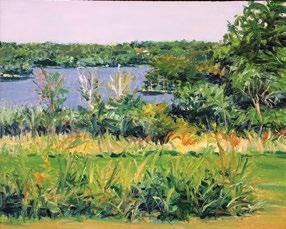
There is an empty stall in the barn where Ironside Jack the stallion lived. Last week two Amish farmers and their driver came and took him to Pennsylvania along with Sally the mare. From Jack’s stall in the barn you see the farmhouse: weathered, red, and surrounded by flowers. Beyond the house you look east over the horse pasture and down to the lake. There are vegetables and wild lupine off to your right, and the place where the town road ends. Near dusk the horses walk to the fence gate, hoping for grain. These horses haul our winter wood, turn the earth for our gardens. They give us warmth and life. Jack was like the guardian spirit of the place, always watching everything from here in his stall. Across the lake, cottage windows reflect the setting sun. Birds fill the air with sound. The light in the kitchen is yellow. Fog moves in behind the islands and everything starts to quiet. Later the loons will call from the cove. We will sleep, dreaming of wind, of rain, horses moving in the barn, and loon song, loon song pulling us into the dark water. We dive under, dive under and come up, somewhere else.
Gary Lawless is a poet, teacher, and co-owner of Gulf of Maine Books in Brunswick. He is the author of 21 books of poems. “Chimney Farm” is from the collection Caribou Planet , published by Blackberry Books in 2015.
Artwork J. Thomas R. Higgins, Garden Above the Lake , 2016, oil on panel, 16"x20".
By the Numbers sources: Reports and statements from the USDA Natural Resources Conservation Service, the USDA National Institute of Food and Agriculture, and USDA Rural Development.
J. Thomas R. Higgins, Garden Above the Lake , 2016, oil on panel, 16"x20".
FINDING A Sense of Place AT ROLLING ACRES FARM
BY CARL LITTLE
For all of us have our loved places; all of us have laid claim to parts of the earth; and all of us, whether we know it or not, are in some measure the products of our sense of place.
—
ALAN GUSSOW , A SENSE OF PLACE: THE ARTIST AND THE AMERICAN LAND
In1964, Consolidated Edison proposed building a hydro-electric power plant near Storm King Mountain in the Hudson River Valley. The painter Alan Gussow and his family lived nearby, in Congers, New York, and he decided to speak out against the plan, taking what he called “the side of the river.”
At a legislative meeting, he read from T.S. Eliot and Nehru’s will, the part where the Indian leader paid tribute to the Ganga (Ganges) River, “a symbol and a memory of the past of India, running into the present and flowing on to the great ocean of the future.”
Energized by what would eventually be a successful campaign against the utility, Gussow stopped teaching art in 1968 to devote more time to doing his “damnedest” to protect the environment. In a review of Martica Sawin’s 2009 monograph Alan Gussow: A Painter’s Nature, art critic Edgar Allen Beem referred to him as “a pioneer of the art of engagement.”
Speaking with New York Times critic Grace Glueck in 1972, Gussow argued that there should be an artist-in-residence program in America’s national parks, “just as there are poets and writers in residence at universities.” Soon afterwards, he convinced the National Park Service to start such a program—and he took the first turn, at the Cape Cod National Seashore in 1968. “My job was to be inspired by the location,” he recalled, “and create paintings that would reflect experience.”
Possessed by the idea that “once an artist puts a value on a place, it helps to preserve it,” Gussow
approached the America the Beautiful Fund for financing to launch a more formal residence program in the parks. The fund subsequently provided seed grants to support artists for projects concerned with “preserving the quality of nature and environment.”
Gussow went on to set up the Artists for Environment Foundation, a “creative kibbutz” at the Delaware Water Gap. From 1972 to 1983, Joseph Fiore was visiting artist/critic at the foundation, an experience that helped nurture his passion for the environment and that led to the creation of some of his finest paintings.
To further his mission to connect art and the environment, Gussow produced A Sense of Place: The Artist and the American Land, published by Friends of the Earth in 1972. In this landmark book, he combined paintings with the words of artists—taken from poems, letters, journals, and other sources—in order to highlight the special sense of place that exists between the painter and her or his surroundings. The book covers 400 years of American art and includes more than 20 painters with connections to Maine, including Gussow himself, who painted on Monhegan Island for much of his life.
Among my favorite images in A Sense of Place is Sheridan Lord’s Sagaponack, 1970, a view of potato fields on the South Fork of Long Island. Lord (1926-1994) devoted much of his later life to painting these lovely expanses of green interspersed with barns and farmhouses.
The painting has special resonance for me: I spent the first 30 or so years of my life among the low rolling hills of this part of Long Island. My high school, the Hampton Day School in Bridgehampton, was surrounded by potato fields. I came to cherish those vistas and I still support the Peconic Land Trust, which has sought to save the farmlands from development (the trust was founded by John Halsey, a housemate of mine during my sophomore year at Dartmouth).
Here in Maine, similar pressures exist for farms— and the opportunities for artists to play a part in their preservation increase every year. One marvelous example is the CSA: Community Supporting Arts program launched by the Harlow Gallery and the Kennebec Valley Art Association in 2011. The KVAA matched 14 artists with 13 farms in central Maine, all of them practicing Community Supported Agriculture, the original CSA and inspiration for the arts project.
The association displayed the images of the farms in an exhibition at the Harlow Gallery in Hallowell, the Maine Farmland Trust Gallery in Belfast, and six additional venues throughout the state.
“Maine’s artist and farming communities have a lot in common,” said Deborah Fahy, executive director of the Kennebec Valley Art Association and the Harlow Gallery, at the time of the CSA launching. “Both are idealistic and creative groups,” she noted, “and both communities are key to Maine’s unique sense of place.” Fahy and her colleagues looked upon the program as a means for painters and photographers to “use the power of their artistic voices to affect social change—or in this case to promote and celebrate the local foods movement.”
In 2016, the Kennebec Valley Art Association and Harlow Gallery revived the CSA project, once again pairing artists with farms, over the 2017 growing season. This time they partnered with Maine Farmland Trust Gallery in Belfast and Engine in Biddeford to show the resulting work.
Maine Farmland Trust had opened the Joseph A. Fiore Art Center at Rolling Acres Farm in Jefferson in 2016, with a straightforward mission to guide it: “to actively connect the creative worlds of farming and art making.” To accomplish this goal, the trust established an artist-in-residence program. In 2016, they invited four artists to spend a month on the 130acre property on Damariscotta Lake; last summer, six artists stayed at the center, plus a writing resident documenting the history of the farm, and a gardener.
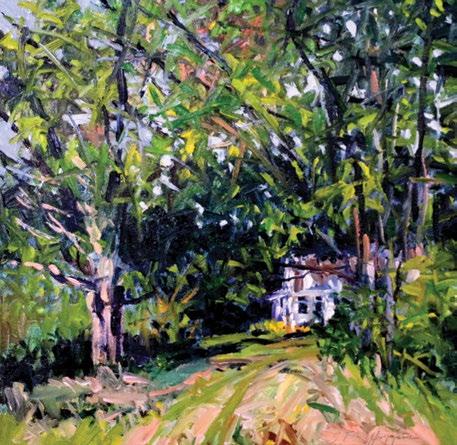
The 2016 cohort included J. Thomas R. Higgins, professor emeritus at the University of Maine at Farmington. A plein air painter, Higgins relishes being “at one” with his surroundings, searching for something that will move him emotionally, “an evocative space, atmosphere, light, mood, etc.” His expressive paintings capture the inherent energy of the landscape; we share in his vision of places in flux.
During his forays into the Jefferson landscape, Higgins discovered “the quiet integrity” of nearby Chimney Farm, former home of three of Maine’s greatest writers, Elizabeth Coatsworth, Henry Beston, and their daughter, Kate Barnes. It was Coatsworth who wrote, “If Americans are to become really at home in America it must be through the devotion of many people to many small, deeply loved places.” These places, she averred, must be “sung and painted and praised until each takes on the gentleness of the thing long loved, and becomes an unconscious part of us and we of it.”
Painter Robert Pollien from Town Hill on Mount Desert Island has conferred that kind of devotion
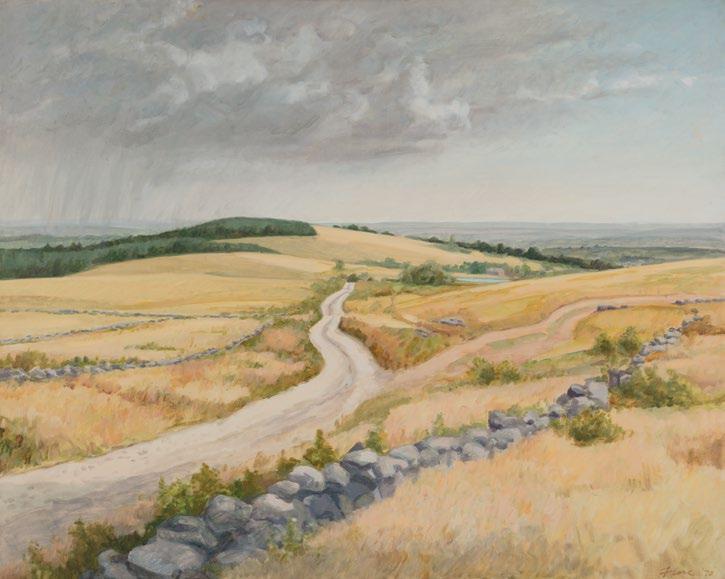
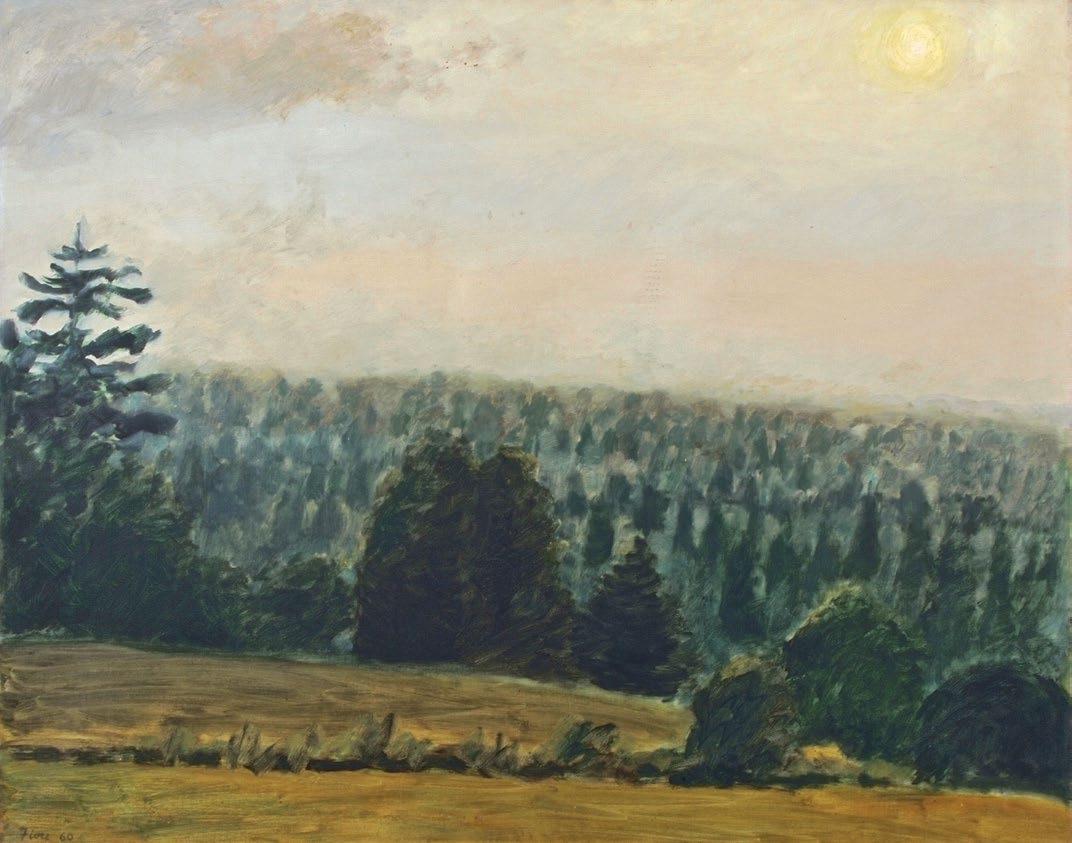
Previous Page Joseph A. Fiore, Sun Burning Through Haze , 1960, oil on canvas, 27 "x36"
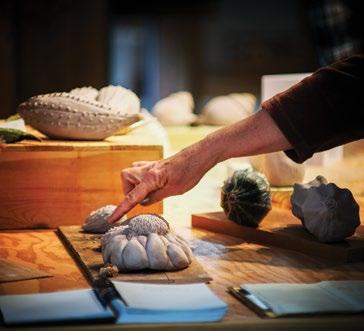
Top Left Studio visit with sculptor Anne Alexander during an open studio day at the Joseph A. Fiore Art Center (2017). Photograph by Susan Metzger.
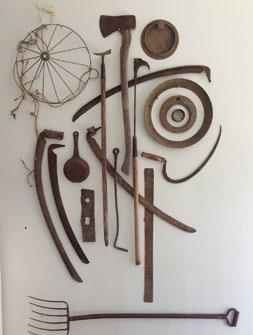
Top Right Installation of farm tools from Rolling Acres Farm, by historical writing resident Sarah Loftus (2017), 75"x50" Bottom J. Thomas R. Higgins, Tunnel Effect , oil on panel, 16"x16". This painting shows a view of the Rolling Acres farmhouse and was created during his 2016 residency.
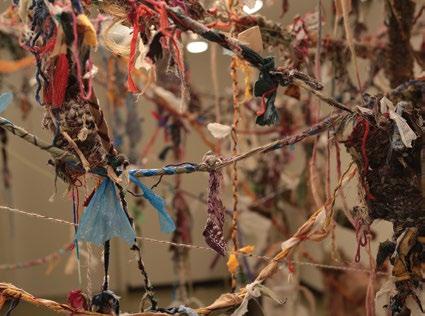
Top Jess Klier, mixed medium installation at Herter Hall, UMass Amherst, thread, plastic bags, yarn, recycled scraps (2017 residency)
Bottom Robert Pollien, Flying Crow, graphite on paper, 12"x 18 " (2016 residency)
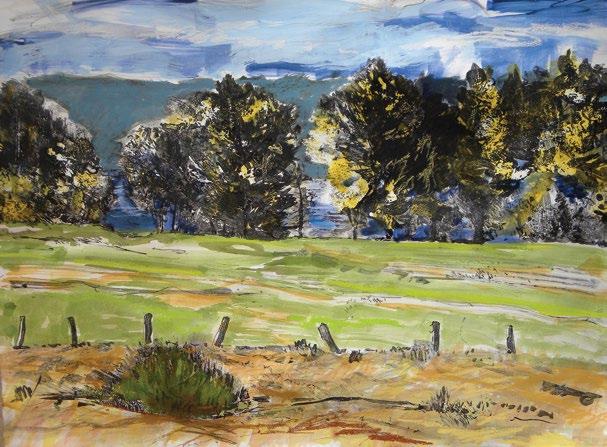
Opposite Page Clockwise from the Top Jude Valentine, Trees in Accord , monoprint with pastel, 22"x30" (2017 residency)
Tanja Kuntz, Queen Anne (light and shadow) , oil on canvas, 36"x48 " (2017 residency)
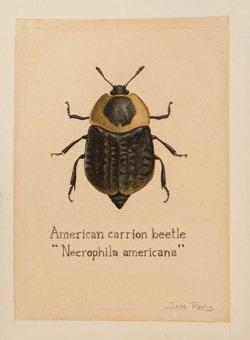
Josselyn Richards Daniels (aka Joss Reny), American Carrion Beetle (Necorphilia americana) , watercolor and gouache, 5"x 7 " (2017 residency)
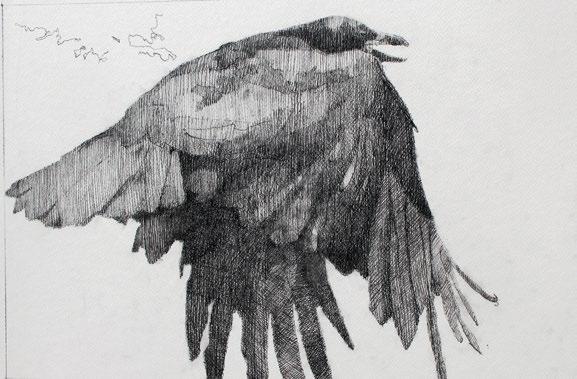
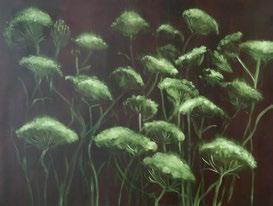
on Acadia National Park since the early 1990s when he served as its first artist in residence. His sense of place encompasses specific characteristics of a locale: “elevation, proximity to water, quality of light, geologic structures, human presence, ground cover and vegetation.” While at Rolling Acres Farm, Pollien found settings on the coast near Bristol and at Pemaquid Point that met his specifications and led to studies that remind us of the beauty of coastal contours and cloud formations.
Like Pollien and Higgins, Thérèse L. Provenzano from Wallagrass in Aroostook County looks for a prompt in the landscape, “a pull or grab, something that stirs.” Her sense of place “can embrace ancestral roots, loneliness, stillness, grace, force, labor, and the till of the soil.” At the Fiore Center, she conveyed these elements through rich pastels, including a view of the curving farm road leading the viewer into the distance.
Provenzano appreciated having the opportunity to get to know one of Maine Farmland Trust’s Forever Farms (a designation for Maine farm properties that are protected with Agricultural Conservation Easements). She also enjoyed an aspect of the residency that is out of the ordinary for these types of programs: having her work viewed
by visitors. She relished the weekly interactions, for the social networking that took place, but also for the boost the feedback gave to her confidence.
Asked about her sense of place, Jude Valentine from East Machias, a 2017 resident artist, quotes a question landscape architect and Buddhist Dennis Alan Winters posed in his book Searching for the Heart of Sacred Space (2014): “Is it possible, that if the body and mind have the ability to alter the quality of the landscape in which one lives, so does a landscape have the ability to alter the state of one’s body and mind?” This query led her to focus on understanding “the energy” of Rolling Acres Farm “and feeling its qualities” while producing a series of dynamic monoprint landscapes. One of the functions of an artist, Valentine believes, is to be a “visual translator,” with the result of the translation being “a contemplative icon—a place for the viewer to see a reflection of the world.” The artist serves as a kind of liaison, helping to facilitate the relationship between viewer and place. Valentine was pleased to be able to disconnect during her residency, to “sit without interruption (or device) in the landscape.” She soaked
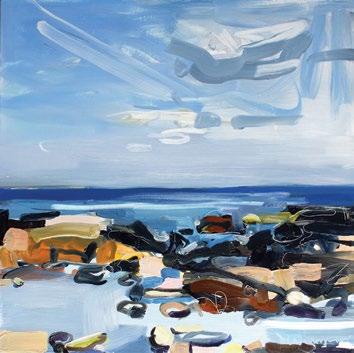
Left Elizabeth Hoy, The Advance , oil on panel, 24" x 24" (2017 residency)
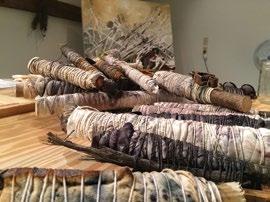
Right Susan Smith’s “bundles” are comprised of rusty old bits of farm equipment, branches, soil, and plant materials, tightly wrapped into cloth then steamed to create intricate ecoprints (2016 residency)
in “all the nuance of the farm’s ancient time, illusional space, shifting color and light through the whispers of the trees, the land-lake interface, and undulating contours of the fields.”
That “ancient time” is now better known, thanks to A History of Rolling Acres Farm, researched and authored by the farm’s first writer-in-residence, Sarah Loftus. Drawing on her studies in archeology and anthropology, Loftus offers an enlightening chronicle of this land where the water of Damariscotta Lake “bends and narrows in a patchwork of blue and green,” an image echoed by Valentine’s monoprint, Trees In Accord, reproduced on the cover.
When Maine Farmland Trust acquired the farm, a new chapter in its history began, one that Loftus writes, “represents a broader collective drive to preserve rural farming culture and secure locally produced, environmentally sustainable, affordable, delicious food.” She pays special tribute to Nellie Sweet, the Fiore Art Center’s first resident gardener, who established “a thriving home garden” for the artists in residence, “her hands working the same silty loam” the first owners worked determinedly almost two centuries ago.
Some of the Fiore residents have taken an organic route in order to inform their—and our—understanding of the land. Dover-Foxcroft artist Susan Smith made “ecoprints” from plant materials found on the farm and rubbings from worn barn wood. She grounds her work in earth because, she writes, “the inability to see ourselves and our future in a handful of dirt or a weed speaks to a loss of an intimate relationship with place, with soil, creating an environment of alienation.”
Creating installations from recycled materials, Jessica Klier, from Northampton, Massachusetts, strives to make palpable her ongoing affection for the visible and the invisible while acknowledging “the waste, overproduction and over-consumption in the world today.” She values knowing how to make something from scratch. Among the highlights of her residency at the Fiore Center was learning how to spin wool into yarn with Maine fiber artist Diane Langley. Sculptor Anne Alexander also took advantage of local art opportunities while at the farm, meeting up with fellow sculptors. The Windham, Maine-based artist works in wood, stone, and ceramics, abstracting and enlarging natural forms, such as seedpods, to create work that suggests “themes of regeneration, growth, life cycles, and stages of maturation.”
Alexander’s sense of wonder is shared by Yarmouth-based artist Josselyn Richards Daniels, who also works directly from nature, with a special passion for insects. Her natural science illustrations are, in the words of writer Eliza Graumlich, “captivating in their realism and handsome in their aesthetic.” Less realistic but no less tied to natural forms are Portland artist (and chef) Tanja Kunz’s luminous studies of wildflowers and other flora. Again, Graumlich provides eloquent commentary: “Her artwork reads…like photosynthesis distilled.”
Over the past couple of years Elizabeth Hoy, who makes her home in Brooklyn, New York, has been painting Superfund sites—“federally designated tragedies of the built environment,” she calls them—in Maine, Vermont, and New York. She played a variation on this quest during her residency, studying the “history of use and the complexities of human influence on the landscape around Jefferson.” Among her activities: collecting bits of trash from the coastline and arranging them in sculptural configurations in her farm studio.
Hoy’s attention to manmade despoliation and her attempts to raise our awareness of it send us back to A Sense of Place. In his introduction to the book, Gussow expressed urgency regarding the need for artists to paint the world. “Nineteenth-century painters went out into the wilderness to bring back reports about a land we did not know,” he wrote. “Painters now report about a land we risk forgetting.” Through its gallery in Belfast and its programs in Jefferson, Maine Farmland Trust continues Gussow’s important mission: to ensure that we not only remember but also value and celebrate the land. The trust is building on the remarkable legacy of Joseph Fiore, a painter who once benefited from a residency, whose generosity and vision now enable artists to spend time in a special place where they can practice their art and attain, in Robert Pollien’s words, “a restored sense of clarity and momentum.” A sense of place: that is a great gift.
carl little’s most recent book is Philip Barter: Forever Maine (Marshall Wilkes). He lives and writes on Mount Desert Island.
IN THE
FARMLAND BAL A NCE
At the Nexus of Access, Transfer, and Viability
BY AMANDA BEAL | PHOTOGRAPHS BY JENNY NELSON
aving a connection to a farm and its land can be a profound experience. As a kid, I loved running amok in the fields and forest and spending rainy days in the hayloft, building forts out of stacks of square bales. Growing up on a farm felt rich and rewarding in so many ways and difficult in others, but never did I consider that one day our farm might not be a farm anymore.
But as my father grew older, it was clear that it was becoming harder for him to continue managing the dairy cow herd and doing all of the heavy chores required to keep the farm running. Several years ago, our family realized that the time had come where something needed to change.
You may be familiar with my family’s story, or just a snapshot of it, as the process of trying to navigate the transfer of my father’s dairy farm to my youngest brother was featured in a film that Maine Farmland Trust produced (before I came to work at Maine Farmland Trust) called Growing Local. This story, filmed over the course of several months in 2013, begins in the middle of what would ultimately be a much longer story, when my father and brother, Adam, were trying to find a way for Adam to purchase the farm so that my father could finally retire.
At that point, Adam had been working full-time off the farm for about five years, making his living as a diesel engine mechanic, as well as helping out on the farm as much as he could. My father had no retirement nest egg as, like many farmers, anything he had left over after the bills were paid went right back into the farm—in fact, the farm was his retirement.
With a young and growing family to support, my brother couldn’t step away from his outside work unless the farm could pay him, too. And yet, for the farm income level to qualify for financing to enable Adam to purchase the farm, the business required more labor—this became a very circular challenge and one they had almost given up on trying to solve.
As I watched them struggling with all of this from the sidelines, I was realizing how deep our connection to this farm was, both as a family and for each of us individually. Vivid images of my father’s many years of working draft horses, clearing land, haying the fields, and dutifully going out to check on the cows one last time every night before bed were deeply ingrained in my mind. Memories of hiking with my siblings across the pasture to round up the cows for milking, spending hours in the barn helping with chores, and putting up bales of hay with the
summer crew to sustain the herd through the long winter made it all the more difficult to face the very real possibility that the farm my father had spent decades building—with the hope that one day one of his children would be able to take it over—might not continue to be in our family or even continue at all. When a place holds so much meaning, it’s difficult to imagine life without the ability to spend time there. It is painful to think that the next generation may not grow up on that treasured land, that they won’t be given the same opportunities to learn to appreciate hard work and what it takes to produce good food. Facing this potential loss was what motivated me to jump in and try to help, and the Growing Local segment shows the initial stages of my efforts to support them in navigating this transfer process. It shows all of us working together to find a way forward, despite the challenges laid before us. But the reality is that, as the credits rolled, the future of this farm was still quite uncertain. What followed were more years of planning and reaching out for help when we got stuck or needed support. We drew on experiences of other farmers in our community and also enlisted the expertise of knowledgeable staff from various organizations and programs, such as the Maine Department of Agriculture, University of Maine Cooperative Extension, Natural Resources Conservation Service, Maine Farmland Trust, Maine Organic Farmers and Gardeners Association, Farm Service Agency, and others. It was a long journey, but just last fall, Adam and his wife, Jamie, became proud second-generation owners of the farm. This kind of story of generational succession
“Growing up on a farm felt rich and rewarding in so many ways, and difficult in others, but never did I consider that one day our farm might not be a farm anymore.”
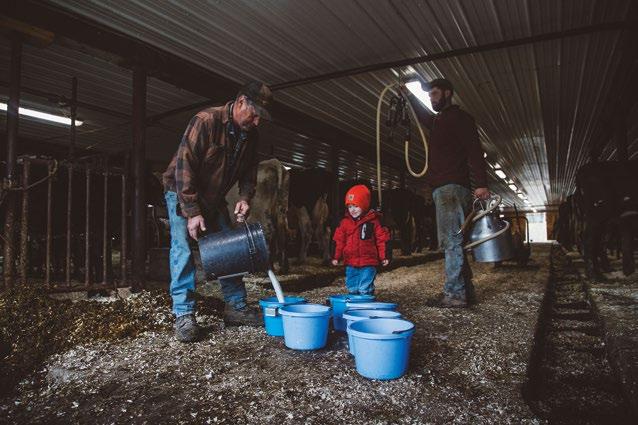
Three generations share chores on the farm. Left to right: Richard, Cameron, and Adam Beal.
FARM TRANSFER AND SUCCESSION PLANNING RESOURCES
A growing number of resources for farm transfer and succession planning can be accessed through the Farm Transfer Network of New England (farmtransfernewengland.org). Other notable resources include:
Maine Farmland Trust provides a tool to connect farm seekers and farm owners looking to lease or sell their land through the Farmlink program and business planning assistance through the Farm Viability program. In addition, conservation easements purchased through the Farmland Protection program assist in land access for incoming farmers by making farmland more affordable and also ensure that the farmland won’t be developed for non-agricultural use in the future.
American Farmland Trust has produced a resource called “Your Land is Your Legacy: A Guide to Planning for the Future of Your Farm.”
Maine Agricultural Mediation Program of the Volunteers of America Northern New England offers mediation and conflict resolution assistance specifically for the farming community, which can be useful in navigating difficult discussions in the succession planning process.
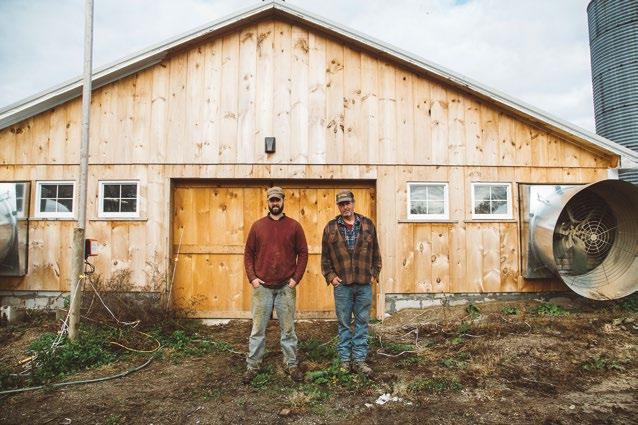
Adam and Richard Beal stand in front of the newly rebuilt dairy barn, a symbol of success and their hard work to transfer the farm from one generation to the next.
plays out over and over again here in Maine, to varying degrees of success, as families navigate their own unique circumstances. What is clear is that there is a tremendous amount of farmland that will be changing hands, one way or another, in the coming years. A 2016 assessment by American Farmland Trust verified that over 400,000 acres of farmland in Maine will likely move from one generation to the next over the course of this decade. What I learned from my own family’s experience is that we can’t expect that the success of this point of transfer will be a given. There are many factors that can complicate such a process, regardless of whether a successor has been identified, within or outside the family. This can also be an especially important and vulnerable point in time for a farm and its future, particularly if the amount of time and level of planning detail needed is underestimated. Farms that have extensive and costly infrastructure and a large land base and perhaps even livestock, such as dairy farms, can require a much longer timescale for transfer than a smaller produce operation. In these cases it may even take multiple decades to successfully transfer a whole farm, which illuminates why it is so important to begin the planning and transfer process early. In my family’s situation, one element that made this transition possible was having an identified successor, and one that our whole family supported in taking over the farm. However, according to the American Farmland Trust report, “In Maine, farmers age 65 and older own or manage nearly one-third of the farms, and most are farming
without a young farmer alongside them.” In fact, “…92 percent of Maine’s 2,367 senior farmers do not have a young (under 45) farm operator working with them.” But even having an identified successor does not make farm transfers easy, nor guarantee success. There are often still conversations to be had with siblings and other family members to ensure buy-in for the overall succession plan. And sometimes the best laid plans can undergo change when personal circumstances shift, whether related to health issues, growing families, divorce, or other unforeseen opportunities or hurdles emerging.
Other challenges can encroach, as well. For new farmers, access to capital and carrying student loan and other personal debt can be barriers that take time to overcome. For the retiring farmer, it can be difficult to let go of the business they have spent their life building and the deep and long-lasting relationship they have formed with the land. If the farm business has contracted over the years as the landowner has aged, farm viability may also be a factor and need to be addressed in transferring to the next generation.
Family dynamics, communication styles, and differing visions for the future of the farm can take time to work through. These are also exactly the kinds of challenges that can cause a farmer to delay succession planning, as they are complex issues that can feel overwhelming if trying to navigate them without support. In short, some farm ownership transitions are simple, but most are not.
University of Maine Cooperative Extension also offers support for succession planning and has been doing so for many years. In addition to collaborating with the Farm Transfer Network of New England, Extension offers a daylong estate planning conference for farmers, supporting the development of a farm transfer plan, and holds follow-up meetings with families to support them in their succession goals.
Land for Good is a regional organization that has built a “Toolbox for Farm Transfer Planning” and offers one-on-one support with transfer planning and holds workshops on this topic; Land for Good also serves as the administrator for the broader Farm Transfer Network of New England.
There are many components to think about when contemplating a farm transfer, but one of the biggest takeaways is that succession planning and implementation can take much longer than one might think. Although not a foolproof strategy, in most cases, more lead time means more options for everyone involved. It is never too early to start the process, and although a transition like this can be challenging, the good news is that there are a number of supportive people and programs to help farmers work their way through this process, once they are ready to begin.
Elevating the importance of succession planning in the life cycle of a farm business is a good way to help ensure a future for that farm and for yet another generation to have the rich experience of growing good food and other agricultural products for themselves and their community and enjoying the meaningful process of working with their hands in the soil—and that is something that benefits us all.
amanda beal is President and CEO of Maine Farmland Trust and owner of Fieldstone Farm in Warren, Maine.
FARM EXPERIENCES fresh
BY SOPHIE NELSON | PHOTOGRAPHS BY GRETA RYBUS
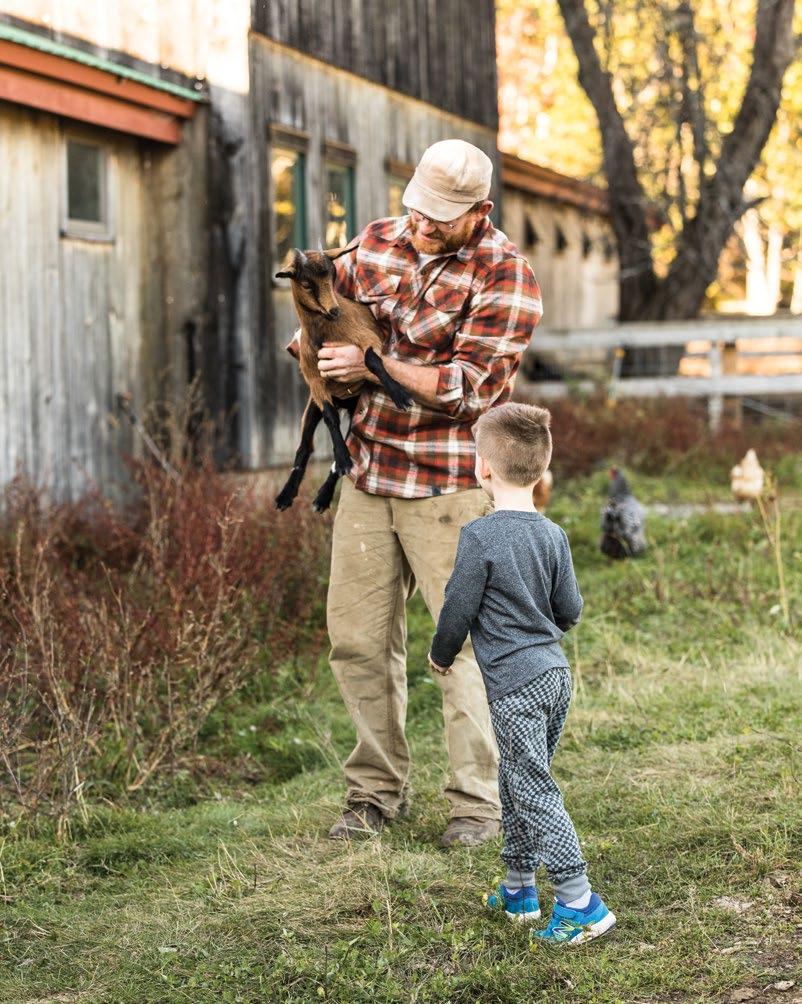
On a Friday afternoon in October, at a place called Toddy Pond Farm down a long dirt road in Monroe, Maine, a four-year-old boy named Ethan cannot wait to meet some pigs. His excitement lifts him up on his toes. “Can I also see cows?” he pleads with the farm’s owners, starting to hop.
Heide Purinton-Brown, who co-owns Toddy Pond Farm with her husband, Greg Purinton-Brown, laughs and nods. “C’mon,” Heide says, turning toward the barns and pastures. Ethan, his parents, and his younger brother follow along. The family is spending a long weekend at the Toddy Pond Farm Cottage and this—the opportunity to join Heide and Greg on a round of afternoon chores—is part of the package. When Heide and Greg established Toddy Pond Farm in 2012, the property included the guest cottage (“house” is probably more apt—it’s big, warm, and well-built). Offering farmstays made sense; they
had the infrastructure in place, as well as a desire to educate people about life on a small, diversified family farm and microdairy and how it feels to eat “food you can feel good about.” The cottage is perched on a ridge overlooking a winding dirt path, rolling hills, and the pond that gives the farm its name. Guests also enjoy private access to Toddy Pond, hiking trails, and a peek into life on a working farm.
It turns out that a peek into life on a working farm is an experience more and more people are looking for. Maine farmers—and farmers across the country—are taking note and expanding into agritourism, trying everything from onsite farm cafes to pick-your-own berry patches to farmstays. (The term farmstay is somewhat of a catchall; a farmstay can range from experiences where guests work in exchange for accommodations to leisurely, bed-and breakfast-style vacations in bucolic settings.) Between
Pitching in on afternoon chores and meeting the rambunctious goats and other animals is part of the package for guests who stay overnight on Heide and Greg Purinton-Brown’s (pictured left) Toddy Pond Farm.
2007 and 2012 (U.S. Department of Agriculture conducts its census every five years), income from farm-related agritourism and recreational services increased by 78 percent in Maine, and the number of participating farms increased by 141 percent.
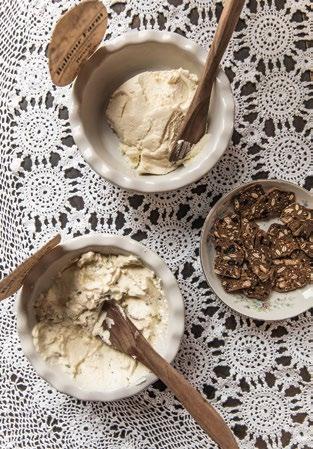
For the past couple of summers, the Toddy Pond Farm cottage has been booked every night. The family’s primary source of income is the sale of their artisan dairy products like yogurts, kefir, and ice cream, but the farmstay has become an important component of the Toddy Pond Farm business model. It has inspired Greg and Heide to investigate other agritourism opportunities, such as the farm camp Heide’s sister has run for the past several summers, where, according to their brochure, the goal is to “connect kids ages four to eleven with their food and nature, through sustainable farming.”
“Everything has been a slow progression,” says Greg of Toddy Pond Farm’s evolution. “We’re always asking ourselves, what’s going to work here? What
can this land support? How do we want to spend our time?” Heide and Greg are now working on expanding their small farm store and possibly opening the farm to visitors one day a week.
They know there’s interest in visiting the farm. All summer long customers ask about bringing their children and grandchildren by, and Heide and Greg find it hard to say no. “I want to be able to share this place, but most of the time we’re just too busy,” says Greg. They also have to be careful not to undermine their current business model. “Access to the farm is part of what our cottage guests and campers are paying for. It’s tricky to work out the right balance.”
What’s the value of access to a field of berries ripe for the picking? What about the value of sitting in a pen full of piglets? How about a more personalized and in-depth experience of a farmstay and private tour? It’s difficult to quantify, because along with putting additional, much-needed money into the pockets of small-scale farmers, the hope is that
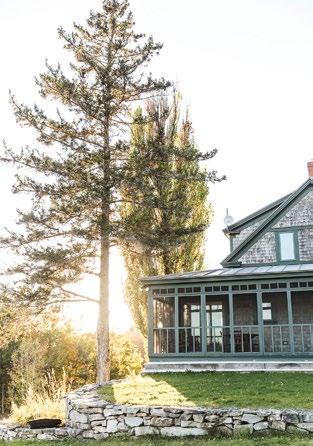
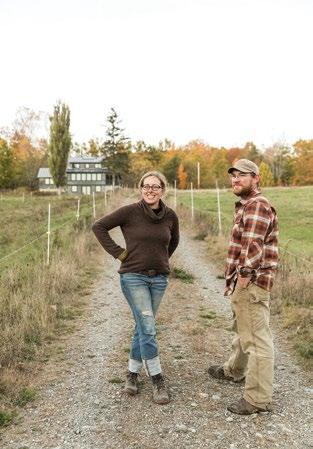
Left In October, the sun sets early on Toddy Pond Farm in Monroe. Right Heide and Greg Purinton-Brown take the path leading from the Toddy Pond Farm Cottage to Toddy Pond where guests are invited to swim, kayak, canoe, and relax on a stretch of private waterfront.
agritourism can help sustain family farms in the long-run, familiarizing more people with the unique challenges of farming and the benefits thriving farms bring to a community (cultural, health, environmental, and otherwise). Does a corn maze accomplish the latter goal? It’s hard to say. What about a farm tour? One would hope. The consensus seems to be that none of it hurts. Organizations and government entities committed to strengthening farming communities and promoting tourism are creating and throwing support behind open farm days, publishing agritourism maps (Maine’s came out in 2017), and resources for farmers looking to venture into this growing market. There’s no question that Ethan values the experience his parents have gifted him. He’s delighted to run his hand across the wiry hairs on the backs of the piglets, and he laughs when Ida, the naughtiest goat, sneaks up behind Heide and pitches herself
into a bucket of feed. He asks about the machinery and tools resting in the fields and learns why Heide and Greg keep the calves with their mothers while most farms separate them (less milk, happier cows).
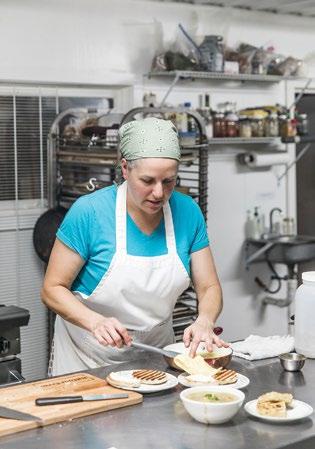
On Open Creamery Day, in a commercial kitchen attached to an old farmhouse in Pittsfield, Heather Donahue, who co-owns Balfour Farm with her husband, Doug Donahue, is busy spreading generous slabs of butter on blueberry muffins hot from the grill, sliding sunny-side up eggs onto fat slices of farm bread topped with cheese and bacon, and sprinkling crumbles of bright white feta into wraps with roasted vegetables. Server Canaan Marble carries plate after plate out to cafe customers, many of whom stuck around for a one o’clock farm tour led by Doug.
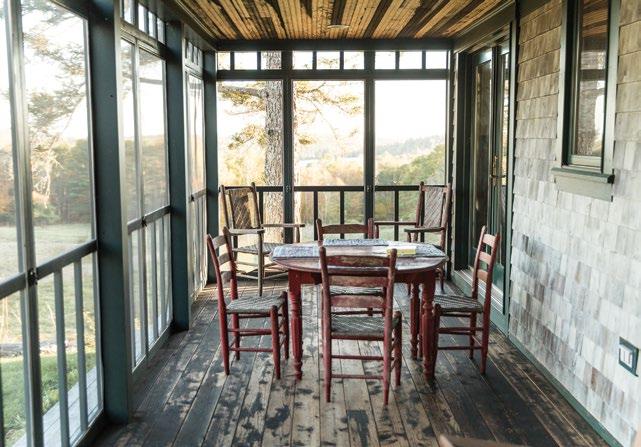
The Toddy Pond Farm Cottage sleeps seven and offers spacious living and dining spaces with views of Toddy Pond to the south and the working farm to the east.
Ten years ago, Heather probably couldn’t have imagined herself slinging egg sandwiches for cafe customers on a farm in Maine. She and Doug and their children were living and working on an organic dairy farm in northern New York, milking 50 cows twice a day and shipping the product to Horizon. They wanted to diversify, but the farm wasn’t set up for that. A move to Maine made a new way of farming—and a new way of life—possible.
“It’s a different market here. The consumer base is different here as well,” says Heather. “People are more aware of the value of farming beyond the business side of it. They understand the cultural value of having farms nearby, of seeing working landscapes.” They’re also more willing to pay for good, locally made food, like the yogurts and cheeses Heather and Doug make with the rich milk provided by their small herd of Normande cattle.
Instead of milking 50 cows twice a day, Heather and Doug are now milking around a dozen. And making yogurts and cheeses. And raising chickens and pigs. And selling their products at several different farmers markets. And running a farm store and cafe. And renovating their farmhouse to accommodate guests—Balfour’s next foray into agritourism. Their workdays are just as long as ever, but Doug will tell you they’re a whole lot more interesting and rewarding.
“We’re starting with the raw soil, we’re growing the feed, we’re growing the animal, we’re making the cheese, we’re selling that product directly to the customers in some cases,” says Doug. “It’s even better when we get to put a slice of that cheese on a hamburger and serve it to someone. You see the person enjoying your food and they’re thanking you. It doesn’t get any better than that.”
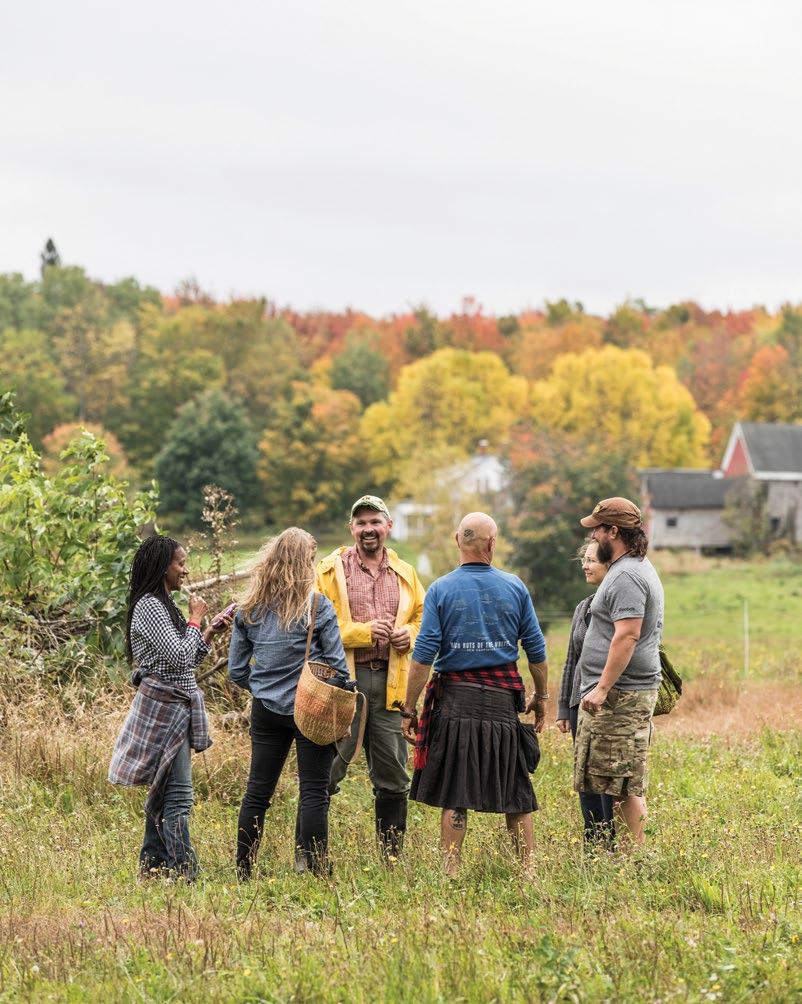
Left Heather Donahue of Balfour Farm in Pittsfield lived and worked on a large organic dairy in northern New York before moving to Maine where, along with her husband Doug, she began a more small-scale operation focused on value-added products, complete with a farm store and cafe. Right In their onsite creamery, the Donahues make a variety of beloved organic yogurts and cheeses. Opposite Page Doug Donahue shows guests around Balfour Farm on Open Creamery Day, an annual event put on by the Maine Cheese Guild.
It doesn’t taste better than that, either. “They’re doing something special here,” says one customer, who regularly drives the 35 miles to Pittsfield from Bangor—not just for the food, but for the chance to spend the morning on a farm and in the company of Heather and Doug, who answer her many questions about raising dairy cows and the benefits of raw milk. She is part of a growing consumer trend toward spending money on experiences rather than objects, and corporations and small business owners alike are taking note. Over the past 50 years, the amount of money spent on food prepared outside the home has nearly doubled. The combination of these and other factors, like the rise of the locavore movement among millennials, have created new market opportunities for farmers. Whereas Heather and Doug came to the service industry later in their farming careers, Katee
Lafleur and Andrew White from High Ridge Farm in Montville are beginning with their love of eating and serving good food and drink and growing from there. Katee and Andrew each worked on several different kinds of farms and learned cooking, food service, hosting, and marketing skills before establishing their own farm in Maine a couple years ago. They found the Belfast area a welcoming place for farmers. They also realized it could be a difficult market for a small, diversified organic farm to break into, with so many excellent producers already selling food at local farmers markets, to restaurants, and through CSA shares.
“We’re pivoting away from that kind of farming,” says Katee. “I never really loved packing up the food and saying goodbye without seeing it to the end. I want to see the experience that someone has with my product.” Instead of investing in a tractor and manual labor to harvest vegetables like beets and carrots,
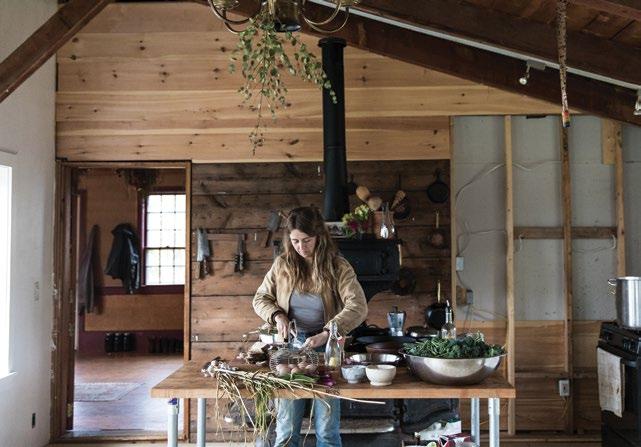
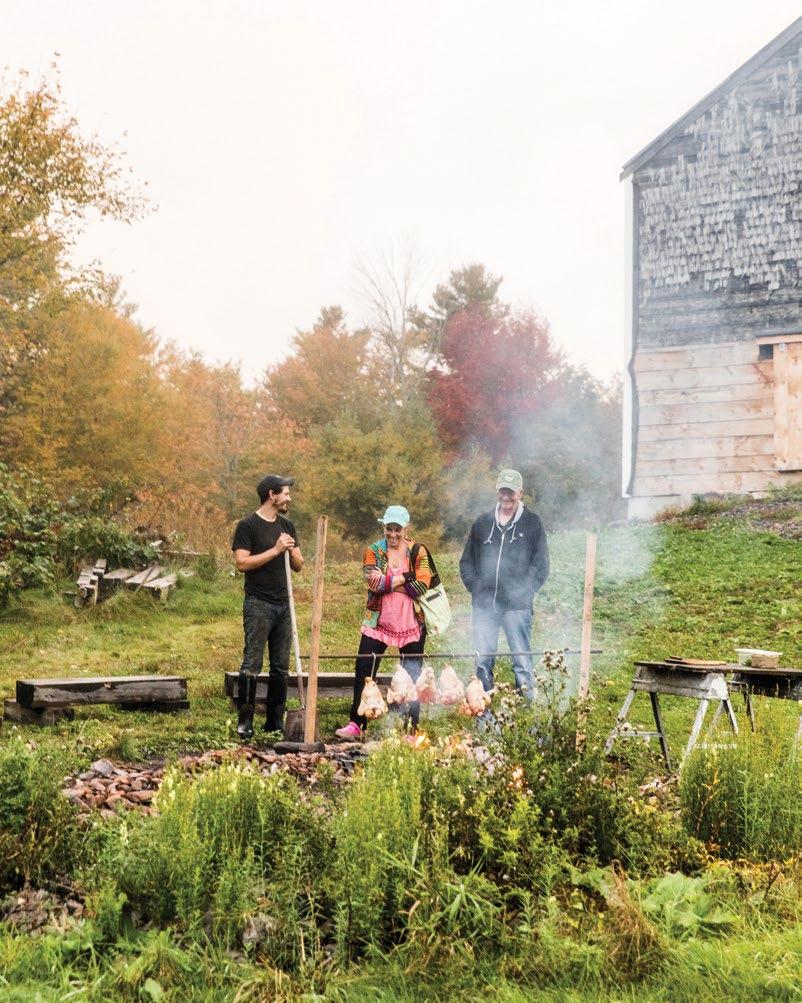
Left Andrew White, left, welcomes guests to High Ridge Farm in Montville. He’s preparing fresh chicken for High Ridge’s Monthly Supper Club. He and partner Katee Lafleur also host a series of Taco Nights and Tastings, serving farm-grown food and drink in a beautifully renovated barn. Bottom Not far from the kitchen, where Katee prepares supper, is a simple, beautifully appointed bedroom available for rent on Airbnb.
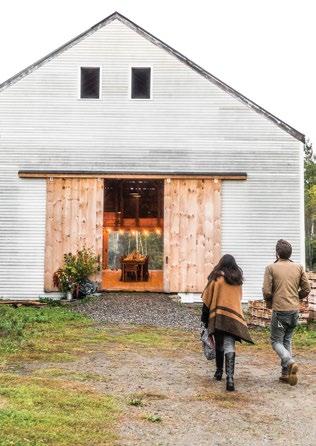
After purchasing the 35-acre farm,
Katee prioritized renovating
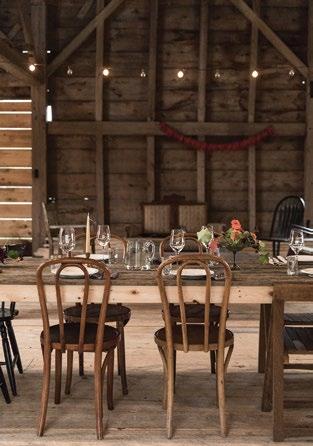
which sell well at farmers markets, they focused on restoring the barn where they now host weekly Taco Nights and a monthly Supper Club, serving the vegetables and meats grown on the farm.
A few hours before their last Supper of the 2017 season, the psychedelic-soul music of Solange fills the barn while Katee picks end-of-season whole plants and flowers to make a display for the barn entrance and Andrew strings fresh chickens to cook over an open fire. They are industrious but calm, interspersing food prep with daily afternoon chores. Since it’s a pre-registered event, they know how many they’ll be feeding tonight (they’re expecting 18 guests), but Taco Nights are anybody’s guess. In their first season, they had as few as three people show up (“We ate a lot of tacos over the next week,” says Katee) and as many as 100, including kids running gleefully around the gardens and visiting the pigs in the woods.
for
“We’re trying to make a livelihood farming, growing healthful food and stewarding this land, whatever that looks like for us,” says Andrew. It looks beautiful—the rolling landscape as well as the house. Their farmhouse renovations have revealed old plaster walls with textures and colors reminiscent of those you’d expect to find in the French countryside rather than Waldo County. Their kitchen is big and airy, filled with vintage appliances and collected pots and pans along with herbs, curing onions, and dried peppers that will end up in homemade hot sauces and salsas served on Taco Nights.
As of a few months ago, two rooms in the house are now open for visitors. Online reviews suggest that the guests who appreciate it the most are those capable of seeing beauty, also, in the scrappiness on display, the omnipresent reminders of life and death in the gardens, now bursting with bushy fall
Andrew and
the barn to host guests
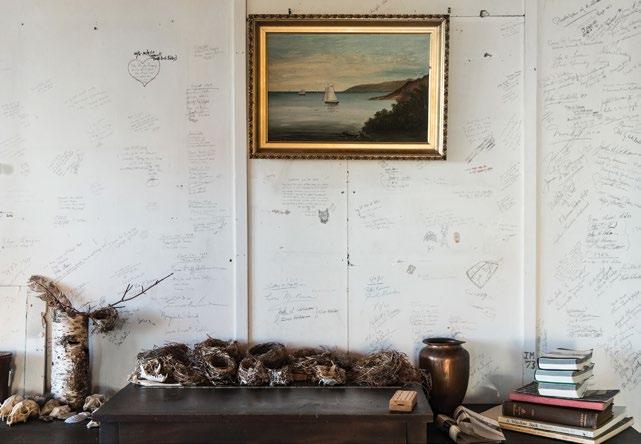
culinary gatherings. The barn is now filled with barrels of farm cider; handmade and collected furnishings, including a long farmhouse table; and twinkle lights. Opposite Page One of the original walls of the Toddy Pond Farm Cottage is covered in messages from visitors that date back to the forties. Heide and Greg are keeping the tradition alive, encouraging farmstay guests to leave a note on the wall upon departure.
flowers, and in the old, gnarled apple trees. (Those trees are still producing, and Andrew harvests their fruit to make cider—wild fermented and stored in oak barrels—that he shares with dinner guests.)
“With the combination of Airbnb and our events, we are hoping to attract folks to come eat food where it was grown, cooked by the farmers who grew it, and to drink a couple of bottles of cider without worrying about getting in a car, knowing a comfy bed awaits them,” says Andrew. “Our version of agritourism.” A variety of people from several different towns show up for that last Supper. They spend the night mingling, asking questions about the homemade paté made with liver from the chickens, the mash of potato, rutabaga, and celeriac, and the kind of wood used to smoke and flavor the chicken. The table twinkles with candlelight as they pass around the bird, cutting portions for each plate.
“We’re trying to create a farm that reflects all our interests and experiences, one that feeds a person’s senses in a single place—on the farm. A farmer’s life isn’t extravagant, but it can be quite rich. We work like peasants but eat like queens and kings, and we’d like to share that experience with anyone who will come,” says Katee.
High Ridge Farm looks different from Balfour Farm which looks different from Toddy Pond Farm, but Katee, Andrew, Heather, Doug, Heide, and Greg have many things in common. They all want to share their lives, their home, their food. They all want to educate and inspire consumers, to remind them of the power of their dollar. They also want to keep farming, a livelihood that requires constant adaptation to meet customers where they are. Right now, it seems, they’re knocking on the barn doors, asking to come inside.
note In December of 2017, after this piece was reported, a fire destroyed the kitchen, poultry processing room, and the attached farmhouse cafe at Balfour Farm. Heather and Doug and their animals were unharmed, as was the creamery where they continue to make their beloved dairy products sold at farmers markets and in stores throughout the state.
sophie nelson is a writer living by the Kennebec River in Bath, Maine with her dog, Arlo, and her husband, musician Max Garcia Conover.
radishes for the whole world
maine organizations seek to expand food access
BY KATHRYN WILLIAMS | PHOTOGRAPHS BY SÉAN ALONZO HARRIS
It’s 3 pm on a November afternoon in Portland, Maine, daylight dwindling, and 13 teenagers trickle into a cobbled-together kitchen on Elm Street, trailing sweatshirts and backpacks and the chill of fall with them. A few are late (the bus is out of service), but they get to work around a large wooden table, spooning sopa de arroz, a tomato-infused Mexican rice dish, and cabbage salad into molded cardboard containers.
They work with the lassitude of teenagers, pausing occasionally to rib each other. On an old, beige refrigerator behind them, a bumper sticker reads, “Everybody has the right to good food.”
This is the Culinary Crew, a youth program of Cultivating Community, a Portland-based nonprofit that has been at the forefront of food access work in Maine for more than 16 years. Perhaps best known for its refugee and immigrant farmer training and community supported agriculture
(CSA) programs, the organization also manages, in conjunction with the City of Portland, 11 community gardens with a total of 400 plots.
Today, the crew will deliver 73 meals to elderly residents of the East Bayside neighborhood. Residents like Kenneth, whose subsidized apartment overlooks the Whole Foods Market on Franklin Street. (Sometimes, Kenneth says, when he’s sick of TV dinners and canned vegetables, he goes there for the salad bar.) And they’ll deliver meals to the woman in a black hijab who speaks Somali with the teens from behind her cracked door. She’ll take an extra serving for a neighbor who is out.
The students recognize tenants now.
“I like how they always smile,” says Ahado, a junior at Deering High School who arrived in the United States from Kenya seven years ago. Her own family relies on the Supplemental Nutrition Assistance
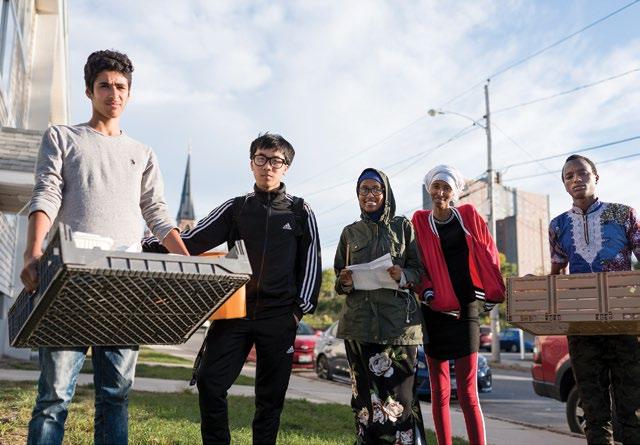
Program (SNAP, formerly “food stamps”). One of her coworkers today is Athani, a Deering senior. As the two wait for the elevator, the girls look out over the city, toward the oil tanks of South Portland. Across the river, they spy a high-rise similar to the one whose floors we’re slowly ascending and imagine, correctly, that it’s also subsidized housing. Athani, in a pea-green raincoat and long, flowing skirt, looks pensive. “Who brings food to them?” she asks.
One in six Mainers—one in four Maine children— lacks reliable access to adequate food. According to the U.S. Department of Agriculture, Maine is the seventh-most food-insecure state in the nation, a slide from last year’s ninth-worst ranking. As other states see improvement, Maine’s hunger gap is growing, says Chris Hastedt, public policy director at Maine Equal Justice Partners, a legal
aid and advocacy group working for low-income Mainers. “We’re heading in the wrong direction.”
In 2016, 14% of Maine residents received SNAP benefits—down from previous years thanks in part to economic recovery but also due to toughening of eligibility requirements. (In 2015, Governor Paul LePage removed waivers on the time limit, asset test, and work or volunteer requirements; the waivers are used by most other eligible states.)
Yet even those who receive SNAP (the average benefit is approximately $1.40 per person per meal) have trouble consistently accessing nutritious food. As a result, hunger relief charities originally intended as stopgaps have become a regular fixture in many Mainers’ lives. Good Shepherd Food Bank now partners with more than 300 food pantries across the state, while Preble Street, in Portland, serves 500,000 meals a year at eight soup kitchens. At risk are people young and old, black and white, rural and urban—mostly low-income
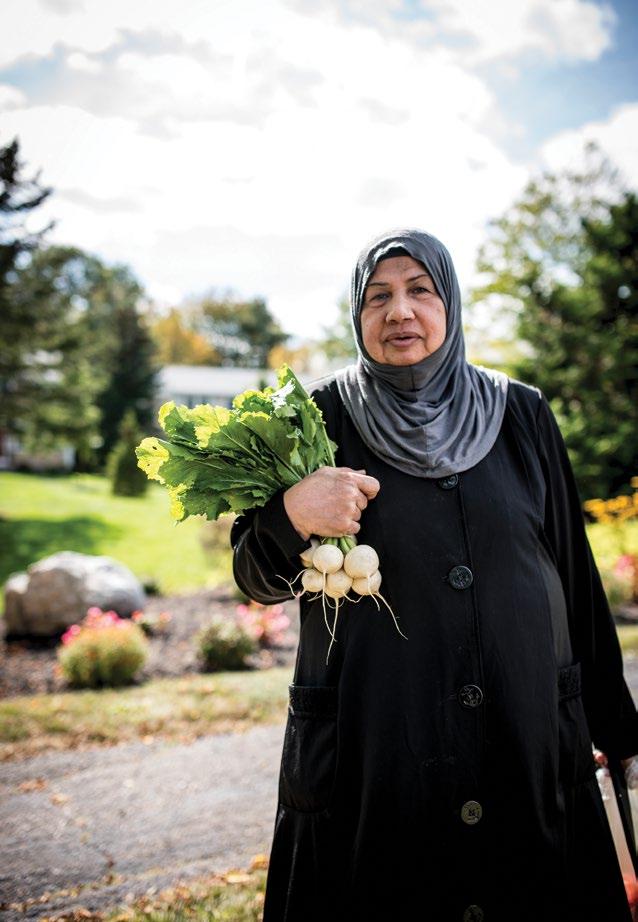
Previous Page A happy customer purchases Hakurei turnips from Fresh Start Farms at a Good Food Bus stop in Westbrook. Eggplant has been another hit in the neighborhood, which is home to many Iraqi immigrants. Above Teenage members of Cultivating Community’s Culinary Crew prepare to deliver meals to recipients of the organization’s Eldershare program.
families, seniors, veterans, the disabled, immigrants and refugees, and those living in Maine’s northern-most and far-flung communities.
Food access is a dauntingly complex issue, from farm to factory to fork (and landfill), with far-reaching social, cultural, economic, and ecological implications. The system is broken, and almost everyone agrees that poverty is at the dysfunction’s root.
There is no single solution, says Mark Winne, a longtime community food activist and policy guru who spoke recently at a lecture hosted by University of Southern Maine’s new Food Studies Program— though he’d start with raising the minimum wage.
“Many [food access] programs are Band-Aids that are helping mitigate larger structural problems,” says Shannon Grimes of Maine Farmland Trust, though there is hope and evidence that some programs are having a deeper impact. For lasting systemic change, there must be innovative intervention at every link in the chain.
Hundreds—some estimate thousands—of organizations work to improve food access in Maine. Their efforts are varied and promising, from permaculture experiments such as the Alan Day Community Garden “food forest” in Norway, an eventually self-sustaining edible ecosystem, to 32 winter farmers’ markets making cold-hardy produce like spinach, chard, radishes, and candy-sweet carrots available year-round. There are rooftop gardens and thriving co-ops, food hubs bringing small farms into wholesale and institutional markets, and initiatives to increase production and consumption of locally grown food.
And if activists at one end of the chain are figuring out how to get healthy, locally grown food to market, there are those on the other end working tirelessly— and creatively—to get it from market to table.
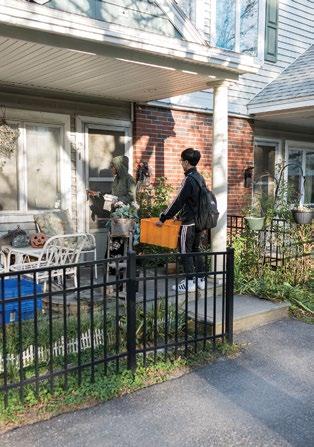
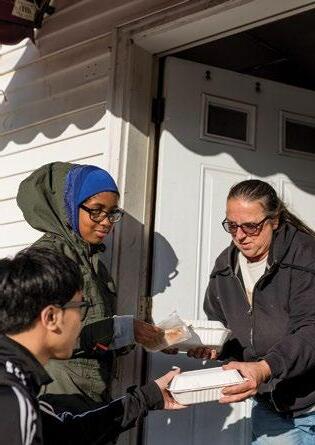
Members of the Culinary Crew, many of whom have benefited from food access programs themselves, deliver meals to residents of Portland’s East Bayside neighborhood. Students in the program learn how to harvest, cook, and preserve local foods, some of which are grown in Cultivating Community gardens. They also gain valuable job skills and a better understanding of sustainable food systems.
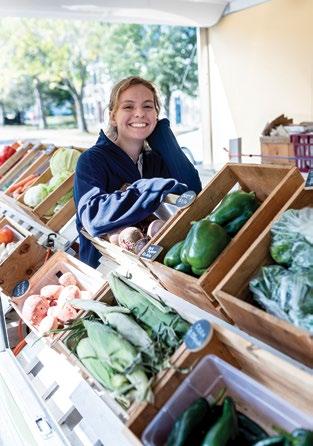
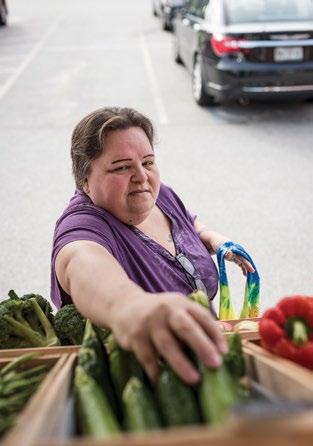
Left “We’re here for everyone, regardless of income or background. We’re just trying to get good food to people, regardless of who you are,” says Kathleen McKersie, who trailers the Good Food Bus mobile market to 13 weekly stops. Right “A lot of people don’t even think where their food’s coming from,” says Maxine, a Good Food Bus customer. Her family used to grow their own string beans, potatoes, and tomatoes.
Outside the Center for Wisdom’s Women in Lewiston, Maxine rolls a collapsible shopping cart toward a stainless steel trailer painted with a three-foot pumpkin. On her shoulder is a reusable grocery bag fashioned from a tie-dyed T-shirt. Plump zucchini, pert green beans, and picture-perfect peppers set in wooden crates beckon from the trailer’s open windows. On a table beside the trailer sit printed recipes and a pint of exotic husk cherries, free for the sampling.
Two years ago, Maxine blew out her leg when she fell on cement. Now, without work, she, like nearly a third of the population of Lewiston, relies on SNAP. On Wednesdays, she shops the Good Food Bus, a mobile farmers’ market run by nearby St. Mary’s Nutrition Center and Cultivating Community. (Its former incarnation was an actual bus.)
This week Maxine asks about some collard greens her friend Ruth requested; they’ll be stewed in a crockpot with a special seasoning blend Ruth found at the Save-a-Lot. “She’s been talking about them all week.”
Though she grew up on a farm in Jackson, Maine, and wishes she could grow and can tomatoes and string beans the way her mother once did, Maxine doesn’t have space in the small apartment from which, importantly, she can walk to this parking lot. When it comes to food access, getting there can be more than half the battle. In the last U.S. Census, Maine had the highest percentage of rural residents in the nation, many of them living more than 10 or 20 miles from a grocery store or supercenter, in what experts call “food deserts.” Even with a vehicle, consider the inconvenience and cost of gas, and one can understand how many rural Mainers end up grocery shopping at the local convenience store. In denser urban areas, public transportation helps alleviate the problem, but seniors and those with limited mobility still often struggle to get to a market less than a mile away. Even when they do, they are limited to what they can carry. For someone working several jobs or odd shifts, getting to a Wednesday afternoon
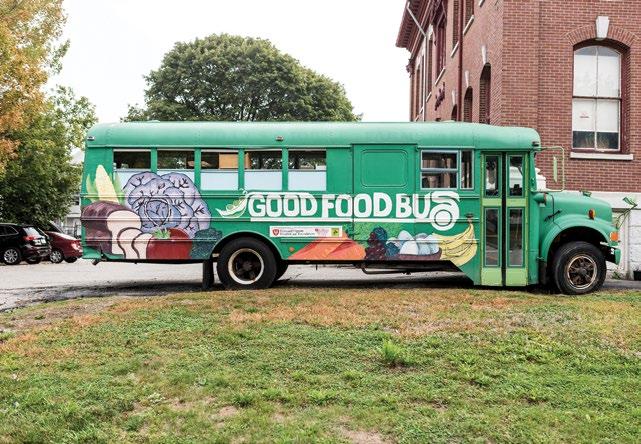
Top The original Good Food Bus still graces the parking lot of St. Mary’s Nutrition Center in Lewiston. Bottom Health- or age-related mobility issues can be a major obstacle to accessing good, fresh food, making the “we come to you” approach of the mobile market model appealing.
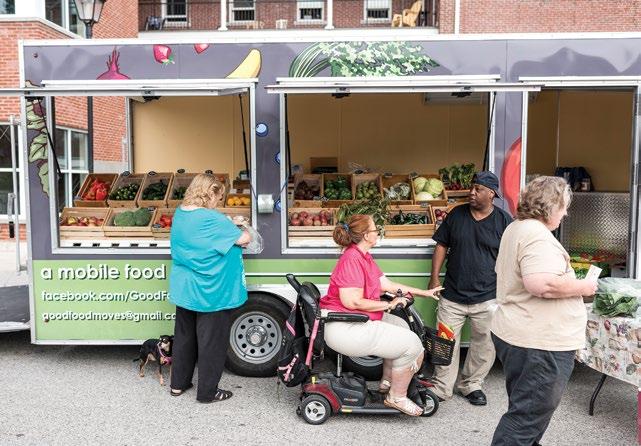
farmers’ market might be a ridiculous proposition.
“How do you get [healthy, local food] to where people are?” says Karen Voci, president of the Harvard Pilgrim Health Care Foundation, which funds the Good Food Bus.
In 2017, the “bus,” which accepts SNAP and WIC (the supplemental nutrition program for Women, Infants, and Children), had almost 3,000 transactions at 13 weekly stops across LewistonAuburn, Bath, Westbrook, and Gorham and a 42% increase in sales from the year before. After the Center for Wisdom’s Women, the Good Food Bus will head, courtesy of a pickup truck, to a regional medical center and community garden. Later in the week, it will hit Bath Iron Works and a YMCA.
Another mobile model (with a similarly loose definition of “bus”—the program currently runs from volunteers’ cars) is serving Downeast Mainers.
The Magic Food Bus, a program of Healthy Peninsula in partnership with Edible Island, brings free local produce, along with books, to seven towns
across the Blue Hill Peninsula and Deer Isle. Each week, staff and volunteers distribute a mix of purchased, donated, and gleaned produce at apartment complexes, community centers, and schools.
“Mobile food initiatives are particularly wellsuited for communities that are spread out,” says Stephanie Aquilina, the program’s island coordinator.
They are also opportunities to introduce consumers to new foods. Aquilina recalls an elementary schooler’s wide-eyed reaction to his first fresh radish. “The whole world should eat this,” he said. That’s the idea.
“Our clients, they want to buy broccoli,” says Chris Hastedt, “they want to feed their families healthy meals.”
But accessibility is not just about distribution and cost. What all consumers want—convenience, familiarity, options—these are what go
Opposite Page A gardener in the hoophouse at Alan Day Community Garden in Norway. The non-profit organization seeks to strike a balance between innovation, education, and approachability, being truly accessible to all kinds of community members. A few years ago it conducted a study to discover any obstacles it might unknowingly create.
Fall work in Norway’s three-acre, volunteer-driven Alan Day Community Garden. “We don’t want to be an organization that just gives food out,” says garden coordinator Rocky Crockett. “We want people to have a relationship with the garden.”
the final mile toward true accessibility. And in the end, food equality sometimes comes down to good, old-fashioned marketing.
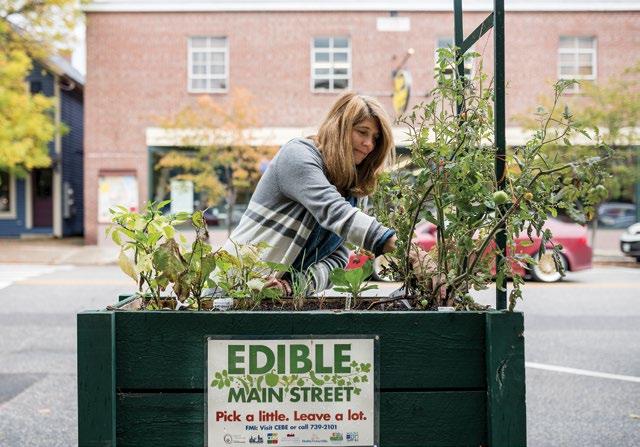
In Lewiston, small vegetable and herb planters cared for by local farmers and businesses run along Lisbon Street. Inspired by Edible Main Street in Norway, Maine, and similar initiatives in the United Kingdom, the program is as much about advertising as about providing access to fresh peas and parsley.
It’s “to show anyone they can do this,” says Scott Vlaun, of the Center for Ecology-Based Economy, which runs the Norway program. “More than trying to grow food in the community, we’re trying to grow food growers.”
Familiarity and convenience are key. The Good Food Bus carries Marble Family Farms “Hotties,” local and organic savory hand pies akin to healthy Hot Pockets, as well as snack-size baggies of almonds and raisins, while their Anchor Meals, with prepped ingredients and recipes, resemble something from a meal delivery service like Blue Apron.
The FVRx program, piloted in Skowhegan in 2010 by the national organization Wholesome Wave, leverages familiarity in another way. Health care providers offer qualifying patients “prescriptions” for produce in the form of vouchers that can be redeemed at the local farmers’ market or grocery store.
Doctors’ orders carry “a certain weight,” says Jenny Schultz of York County Community Action Corporation, who will coordinate a new FVRx program in Sanford in 2018. Plus, she says, the message can be personalized to address a person’s particular health concerns, such as high blood pressure or diabetes. It’s a kind of hyper-targeted marketing. Other initiatives run like promotions, similar to a buy-one-get-one deal. There are two nutrition incentive programs in the state: Maine Farmland Trust runs Farm Fresh Rewards in participating stores, and Maine Federation of Farmers' Markets and others facilitate Maine Harvest Bucks at farmers' markets and some farms. The programs effectively double SNAP dollars by offering $5 produce vouchers
One of sixteen Edible Main Street planters in Norway gets some love. “It’s about getting food growing front and center in the community,” says Scott Vlaun of the Center for Ecology-Based Economy.
for every $5 spent on local products. Maxine at the Good Food Bus is one enthusiastic user.
Of course, the most tried-and-true marketing is word of mouth.
“What makes the biggest difference,” says Shannon Grimes, who manages the Farm Fresh Rewards program, “is to have a community champion.”
In the advertising world, they are called “tastemakers” or “influencers.” Perhaps the biggest influencers are the next generation, which is why much of the focus in food access is on education and youth programs. When it comes to forging healthier habits, “we should forget about adults,” says Ken Morse of the Maine Network of Community Food Councils and Maine Farm to Institution, half-joking, “and just raise a generation of kids who have a new relationship to food.”
On a brisk walk back to Cultivating Community after her final meal delivery, Athani talks about the hunger she felt her first year and a half in the United States. Before her family qualified for assistance, they relied heavily on the local Somali community.
“Why are you going to bring us to this country with no food and no place to live?” she wondered. “Now,” she says, with a flutter of her hands, “I feel good.”
With a full stomach, the teen now worries instead about the elderly clients to whom she brings food. Just last week a woman new to the Cultivating Community program told Athani that until the Culinary Crew arrived, she wasn’t sure she’d have anything to eat that day. It’s a story of both validation and urgency for those working tirelessly and creatively to get good food to those who need it most.
kathryn williams is a Maine-based writer and teacher with a special fondness for condiments in small jars.
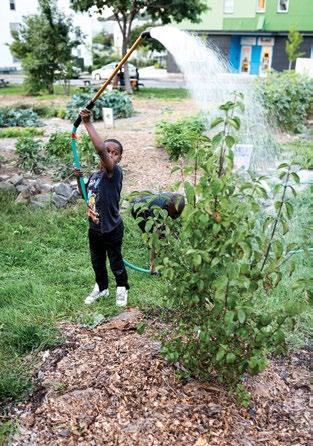
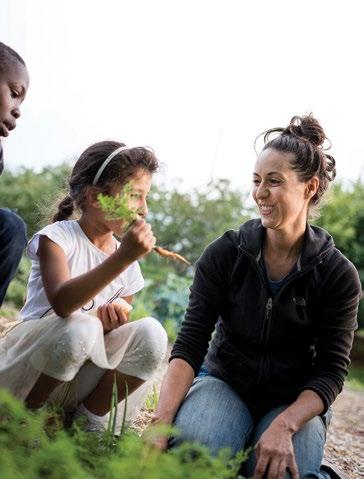
Young gardeners work with urban agriculture specialist Laura Mailander at Boyd Street Urban Garden. Cultivating Community founded this garden in 2004, specifically for residents of the Kennedy Park neighborhood. It strives to make community plots around the city more accessible to low-income gardeners.
STORIES g a t h e r i n g
The Salt Story Archive at MECA features hundreds of true tales of Maine lives, from migrant apple pickers to lifelong potato growers.
PHOTOGRAPHS FROM THE SALT STORY ARCHIVE, FEATURING WORK BY Jennie Vosacek, Lynn Kippax, Jr., Tonee Harbert, and Christopher Knight
TEXT BY KATY KELLEHER
there are as many types of stories as there are storytellers, but one way of cataloging stories places them into two categories: the big and the small. The big stories make the national news—these are tales of international scandal, epic triumph, heartbreaking failure, and earth-shaking events. These stories, while important, can often overshadow that other kind of story: the quiet story of an individual’s struggle, their quest for joy, meaning, and connection. These stories are harder to find, but they exist, swirling nebulously around us at all times. We swim in them like water, and like water, we often forget they are there. But they’re worth noticing, and hundreds of them can be found online in the Salt Story Archive.
The Salt Institute for Documentary Studies has digitized over 400 pieces of student work and has published these pieces online. They cover a wide range of topics presented through a variety of mediums—for example, you might finds a photojournalism project about an immigrant family arriving in Maine, a multimedia piece about a homeless newspaper editor in Portland, or a long-form article about bush pilots in Greenville. There are also dozens of pieces that document farm work and rural life. “Whenever I go into the Salt archives, I’m struck by what an amazing wealth of real people’s stories we have,” says Annie Avilés, program chair of Salt at MECA. “It’s an incredible resource for the state.”
The stories at Salt illuminate the reality of life in Maine. While there are interesting pieces that cover life in Portland, Lewiston, and other major cities, there’s a particular poignancy to the pieces that focus on Maine’s far-flung communities and small towns. Avilés points out that the projects on rural life have a particularly strong impact since this is an
area that is often misrepresented in national media. “There is a lot of talk now about being rural—good and bad,” she says. “There’s an idea of rural as ‘pure’ or going back to ‘rural values.’ There’s also an idea that rural is dark and at the heart of everything that is wrong in America. Yet so often, people’s ideas about rural life are based on caricature and myth.” The Salt Story Archives showcase the daily lives of dairy farmers and winter gardeners, deer hunters and fishing guides. The stories are deeply humanizing and thoughtful. They’re also incredibly varied; the students who created these documentary pieces come from all walks of life, and each maker brings their own unique voice to the project.
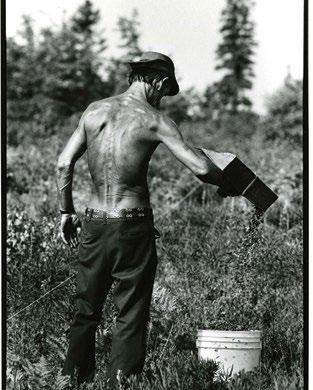
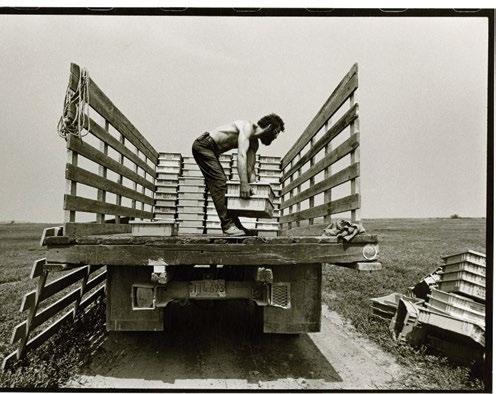
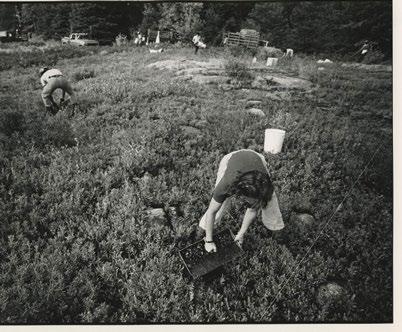
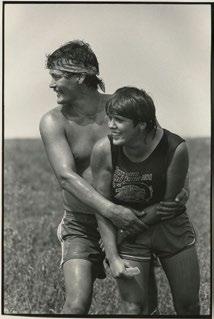
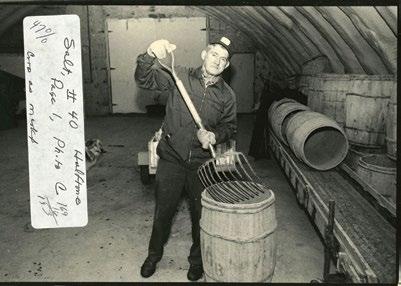
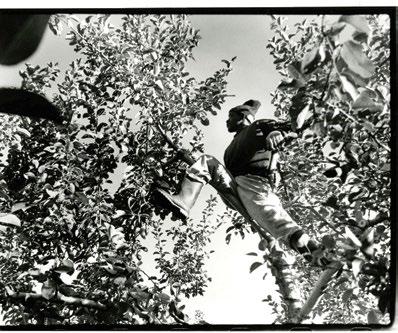
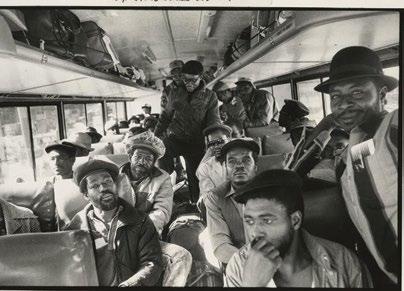
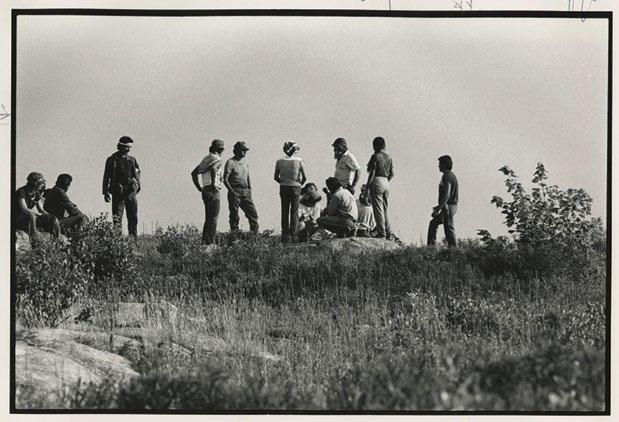
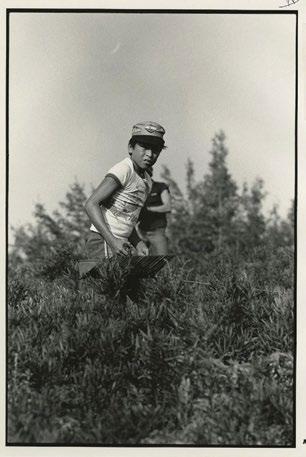
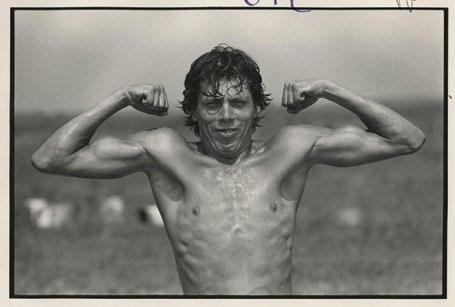
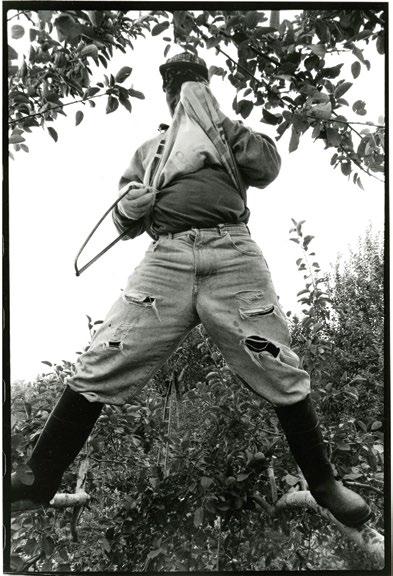
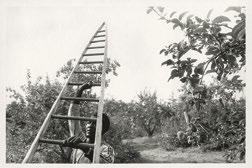
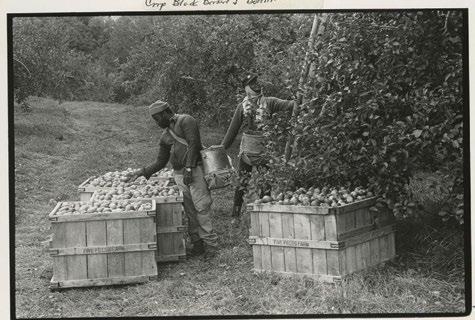
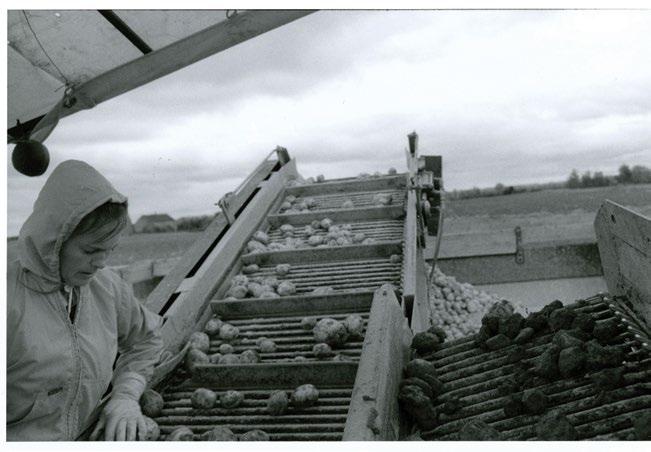
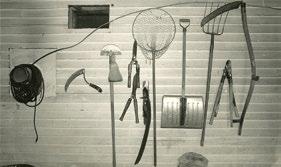
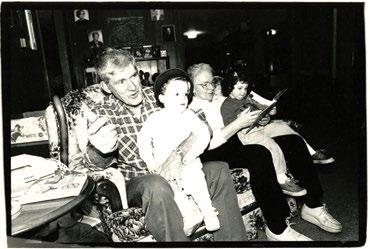
To provide readers with a glimpse into the wealth of stories available at Salt, we’ve selected a series of images by Lynn Kippax Jr., Tonee Harbert, Jennie Vosacek, and Christopher Knight. These pictures show blueberry rakers at work in the Gouldsboro fields, apple pickers climbing through orchards in Bridgton and Kents Hill, and a longtime potato farmer on his Aroostook County property. Farm labor is often invisible; we see the final product—the shiny apples, the buttery potatoes, the tart berries—but we don’t often think about the people who handled them or how they got to our table. The photographs in these pages are just a sampling of the work at the Salt Story Archive, but they speak to the mission of the institution.
“Our students don’t usually cover stories because they’re in the limelight,” Avilés says. “At Salt, we believe that each person’s life is important. Each person’s experience is important. And that everyone has a story to tell, if you pay attention. That is really what Salt tries to teach.”
BLUEBERRIES
These images shot by photographer Lynn Kippax Jr. show workers harvesting wild blueberries in Gouldsboro, Maine. Kippax collaborated with writer Pamela H. Wood to create a long-form feature about the blueberry industry, which was published in the November 1985 issue of Salt Magazine. The full feature can be read online in the Salt Archives.
Opposite Page All images by Lynn Kippax Jr.
APPLES
For decades, workers have been coming from Jamaica to harvest fruit, and several Salt-trained photographers have chosen to focus their lenses on this subject. Shooting 13 years apart, Tonee Harbert and Jennie Vosacek each brought their own sensibilities and style to the evergreen topic.
Top Left Jennie Vosacek, Town of Kent's Hill, Kennebec County, 2001
Bottom Left + Right Tonee Harbert, Town of Bridgton, Cumberland County, Maine, 1988
POTATOES
In December 1990, Salt Magazine published a feature written and photographed by Christopher Knight titled “Death of an American Potato Farm.” This piece captured Aroostook County farmer Mike Brown’s decision to quit the struggling business after years of financial instability.
All Images Christopher Knight, Town of Houlton, Aroostook County, 1988
THE SWEET STORY OF BITTER
V I N E S
AROOSTOOK HOPS OWNERS
KRISTA DELAHUNTY AND JASON
JOHNSTON
WORK TO BRING A FRAGRANT
NEW CROP TO NORTHERN
MAINE
BY LAURA POPPICK | PHOTOGRAPHS BY MOLLY HALEY
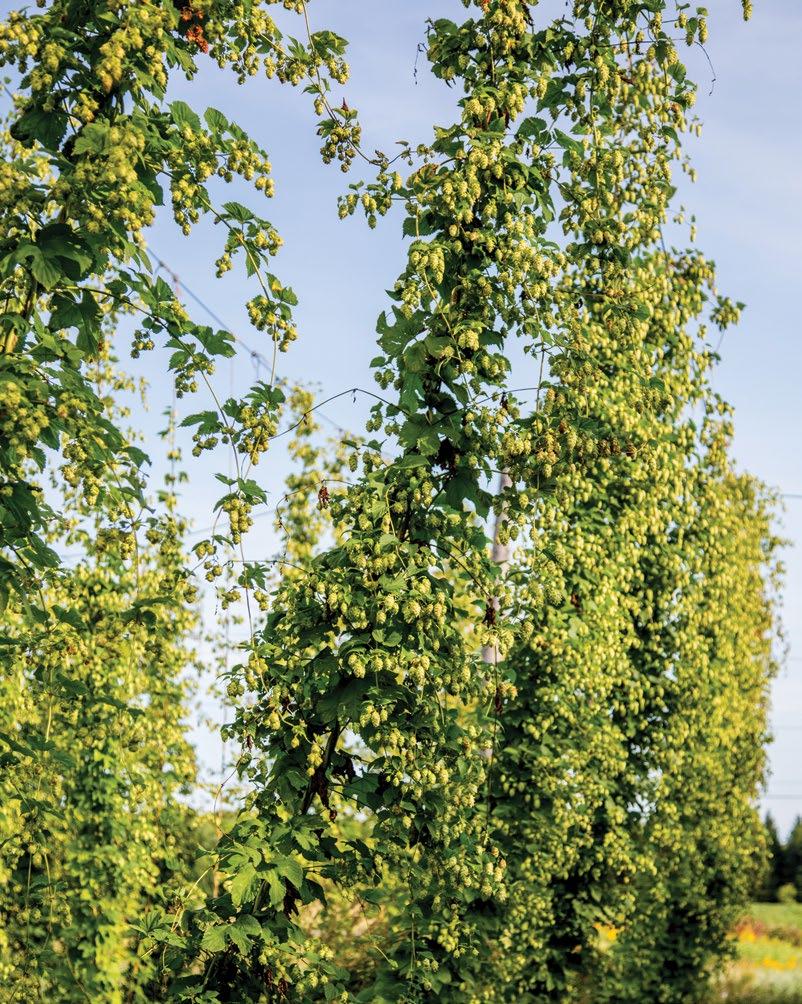
It’s a clear September day as I drive north on Route 1 in Aroostook County and potatoes tumble out of the truck in front of me, bouncing to the side of the road like balls spilling from a bin. It’s hard to go a mile without spotting bags of the region’s hallmark crop for sale. But as I approach Westfield, about 9 miles south of Presque Isle, a less expected crop appears over the horizon: rows upon rows of trellises covered in vibrant green hops vines, reaching taller than surrounding trees.
“Most people haven’t seen it before,” says Krista Delahunty of her unusual crop. “So many people drive down this road just to look at it; it’s like a Sunday drive for people.”
Krista and her husband Jason Johnston own Aroostook Hops, one of the largest hops farms in Maine. They started the operation in 2009 and have since expanded from growing just 150 plants to more than 3,000 in five varieties. They sell their organic product to some of the largest breweries in the state, including Allagash and Gritty McDuff’s. With microbreweries popping up across the state, demand continues to increase for their bitter and aromatic harvest.
“If I called the farmers down the road right now and said, ‘Zach, I need a trailer,’ I’d have one in half an hour,” says Jason. He’s talking about his neighbor Zach Smith, owner of Smith’s Farm,
Previous Page The low light of autumn falls beautifully on hops vines but also brings a sense of urgency to harvest before optimal conditions shift to cooler, darker days. Right Jason and Krista rely on a seasonal crew to help tackle fall harvest tasks, from picking unwieldy vines to sorting and drying thousands of cones.
the largest broccoli producer in New England. “The farming community here is fantastic. We couldn’t have done what we did without them.”
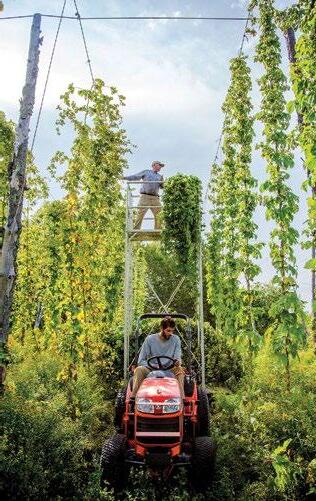
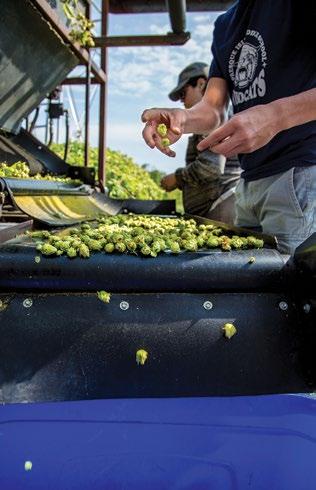
When I arrive at Aroostook Hops, the glow of the afternoon sun streams through the trellises. Jason and his crew of high school and college students busily run the harvesting machine, a boxy metal contraption made of several rows of loudly rattling rubber belts and metal claws that mechanically remove hops cones from vines— when all runs smoothly, that is. “The harvester has been really cantankerous today. It’s certainly not a perfect machine,” says Jason with a smile.
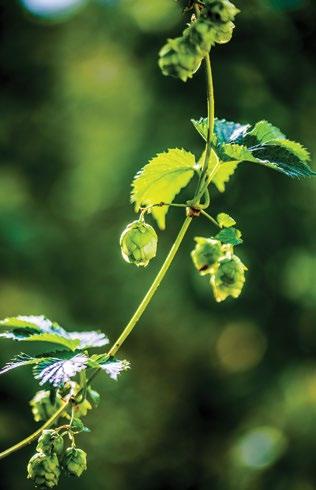
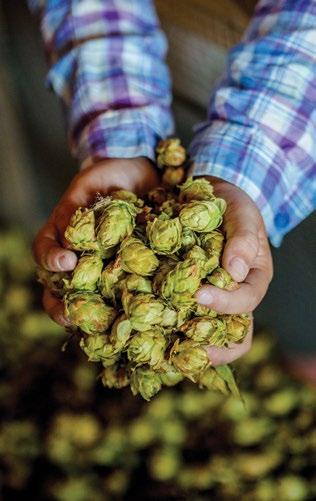
Still, the crew gets the job done. As they work, they’re surrounded on all sides by a distinct zesty aroma, one that I associate with pubs, not farm fields. The scent comes from a bright yellow substance called lupulin that coats the harvesting machine and the crew’s hands. Lupulin is what gives hops its distinct taste. It’s why brewers add hops to their beers, and can range in flavor from floral to citrus to spicy to bitter, depending on the variety. It’s mostly farmed for beer, but can also be found in various herbal remedies, the occasional restaurant dish, and soaps, which Krista and Jason make and sell on their website.
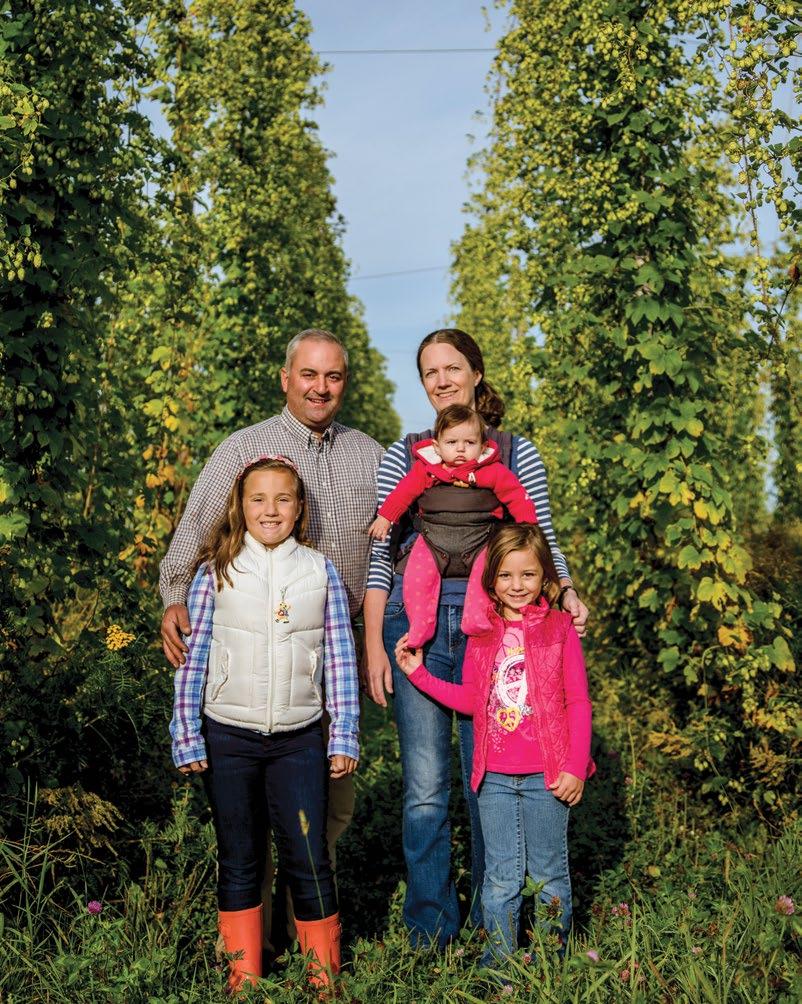
I take a quick turn picking leaves out of the harvest and get my own hands covered in sticky lupulin powder before Krista and I walk away from the commotion and out to some of the yet-to-beharvested fields. Their two daughters, Kathleen and Marie, join us on the tour, along with baby Elise, who is currently strapped to Krista’s chest.
Crickets chirp noisily around us as we look down an impressive field of 40 rows of hops, each 250 feet long and about 20 feet high.
“They grow so quickly, it’s incredible,” says Krista. She explains that they begin planting rhizomes in April, and by the second week in May, they train the plants to grow upward by wrapping them around lines hung from above. It’s labor-intensive to do the process manually but, once trained, the plants take off on their own. “By late June, they reach the top of the trellis and start making their side arms,” she explains.
The harvest season comes in a rush in August and September, when the cones are fully mature and have the right moisture content for optimal flavor. But Jason works full-time at the University of Maine at Presque Isle as an environmental science professor, and Krista also works part-time teaching an online biology course, so harvesting can only happen in the early mornings, evenings, and weekends. Pressures aside, they are glad to be part of this booming business, which they got into as a way to supplement their income and out of
genuine interest in the biology of the hops plant. “There is so much to know about it,” says Jason.
Jason had dabbled in growing a couple of plants for homebrewing and then, on a winter’s day in 2009 (just a month after their first daughter, Kathleen, was born), he and Krista started toying with the idea of expanding their crop—a notion they now attribute to the crazy ideas that grow like weeds during long Maine winters.
“We thought, well, the only way we can make any money off of this is to at least have an acre,” says Jason. “And then when we got to an acre, we realized that we really needed more gear and equipment and the only way to support that was to have at least 4 acres, which is where we are at now.”
For now, beers with Aroostook Hops are generally available on draft, and have included Gritty McDuff’s County Wet Hop and Geaghan Brothers’ Aroostook Hop Harvest, both IPAs. Jason and Krista hope to eventually grow to a scale that would allow them to be in more bottles and cans, but first they need to be sure that they can consistently meet the demand of brewers they sell to. “The breweries have to know that year-round, they can get the same hops for their beer, for quality control,” Jason says. “Customers want their beer to taste exactly the same.”
After leaving the family with the sun setting on their front porch, I drive further north to Caribou. On their recommendation, I go to Northern Maine Brewing for dinner. The menu is not only great, they say, but this brewery uses Aroostook Hops in essentially all of its beers.
Chris Bell, co-founder of the brewery, says it was a no-brainer to use Krista and Jason’s hops in their brews as a way to support local business in The County, and because it’s a tasty product. “I love their hops, they are really very good,” he tells me as he serves me a flight.
I settle in and sip, enjoying the citrusy tanginess of my Maine Logger (a Pilsner-style lager with malt and “low hop bitterness”). This beer, matched with an order of potato-encrusted haddock served with a side of smashed potatoes, showcases the best flavors to come from The County, all in one starchy, hoppy meal.
laura poppick is a freelance journalist based in Portland, Maine who covers science and the environment. | laurapoppick.com
Left Krista Delahunty and Jason Johnson pose with their children, surrounded by hops vines. They have been growing hops on their Aroostook County farm since 2009.