It’s been a challenging year for agriculture, to say the least. From funding freezes and cuts, to increasing production costs and tariffs, to months of severe drought that will persist unless we get enough snow this winter…if it’s not one thing, it’s another, and farmers are feeling the squeeze.
But. “The thing about Mainers is that we are a motivated bunch,” says dairy farmer and Maine Dairy Industry Association President Annie Watson in “Passing on the Milking Pail,” a piece about how, despite the heap of challenges in their way, Maine’s dairy farmers aren’t giving up. And neither can we.
When federal funds for climate resilience programs were frozen earlier this year, leaving farmers in debt for projects they expected to be repaid for, many farmers worried about how long they could continue to operate without being reimbursed. One farmer reached out to us asking if we had any resources to help them explain to customers why their business took such a hit. Shouldn’t their business be able to sustain itself without having to be “propped up” by those funds? From this, the idea for the “What’s in the Recipe?” story was born. Many of us are keenly aware of the cost of an ingredient, but what are the “ingredients” and costs incurred down the line for a farmer to produce it?
Production expenses, labor, and investments in equipment and buildings are among the major “ingredients” for farmers, but farmland is foundational—and increasingly unaffordable.
“Finding Their Way to Farmland” delves into creative ways that our communities can help farm seekers overcome barriers to getting onto the land.
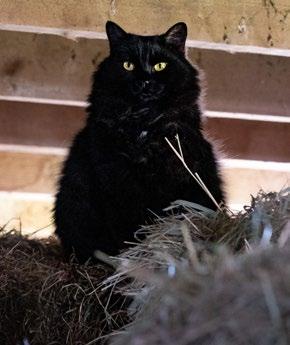
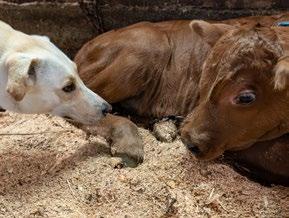
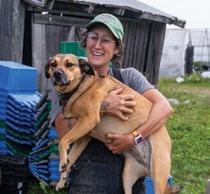
The power of community is perhaps the most essential ingredient of all. “Grounded in Community” profiles farmers and land tenders who prove every day that when we grow relationships between community, food, and land, we all benefit. And that reciprocity is not limited to the human realm. “Barn Cats and Farm Dogs” reminds us that when we bring a diversity of skills to work toward a common goal, we can achieve far more than we could on our own (plus, everyone needs a back scratch or an affectionate nuzzle sometimes).
As poet Gwendolyn Brooks famously penned, “We are each other’s harvest; we are each other’s business; we are each other’s magnitude and bond.”
The Maine Farmland Trust supporters in “Voices from the MFT Community”—and all of you—are growing the vibrant food system we know can be possible. Thank you for sowing the seeds for the harvest that we reap together.
Emily Lad Assistant Director of Engagement, Communications
editor
Alex
Emily
Chip Dillon
Karl Schatz
Kelsey Kobik
Molly Haley
Séan Alonzo Harris
publisher
Maine Farmland Trust 97 Main Street, Belfast, Maine 04915 (207) 338-6575 | mainefarmlandtrust.org info@mainefarmlandtrust.org
The Maine Farms journal is a publication of Maine Farmland Trust, a statewide non-profit that protects farmland, supports farmers, and advances the future of farming.
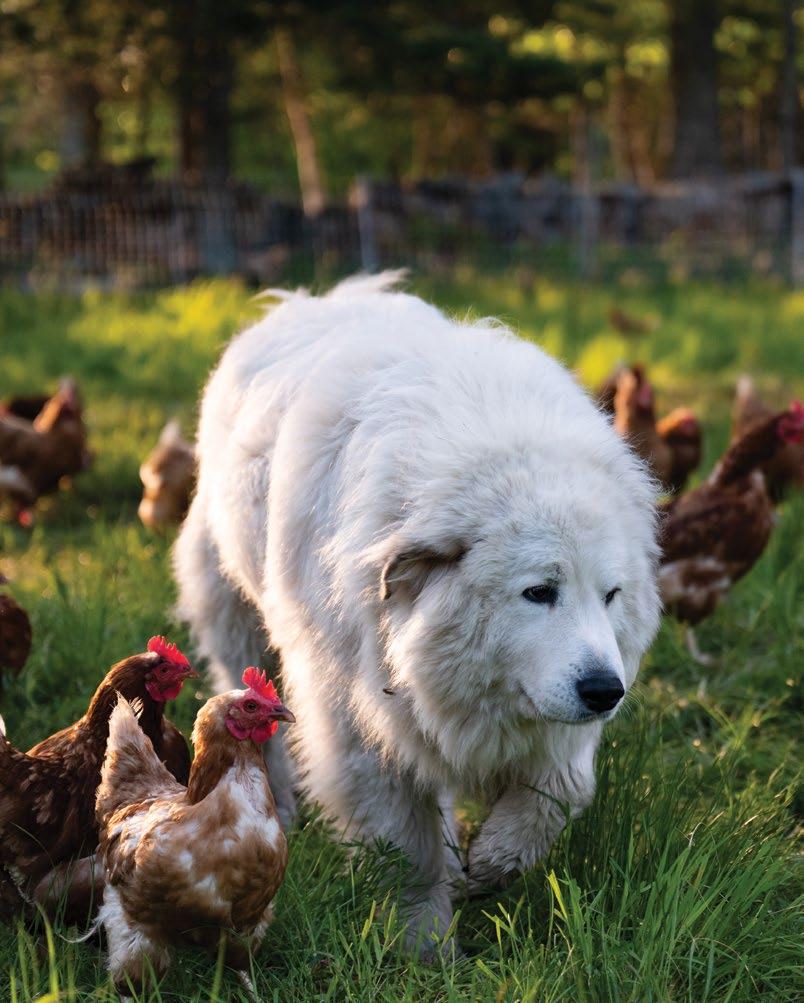
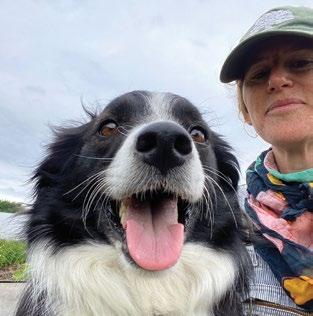
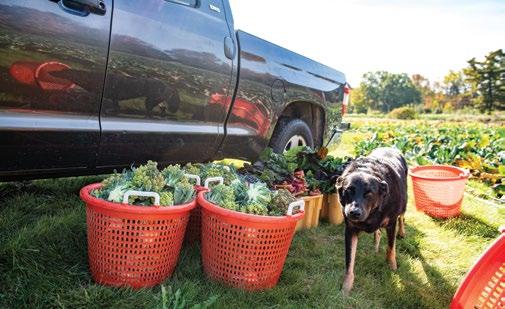
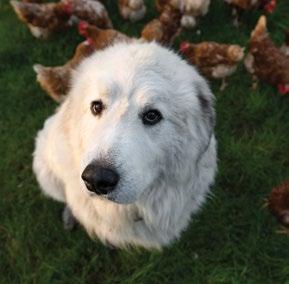
Cover: Livestock guardian dog Ida at Apple Creek Farm in Bowdoinham. Photo by Kelsey Kobik.
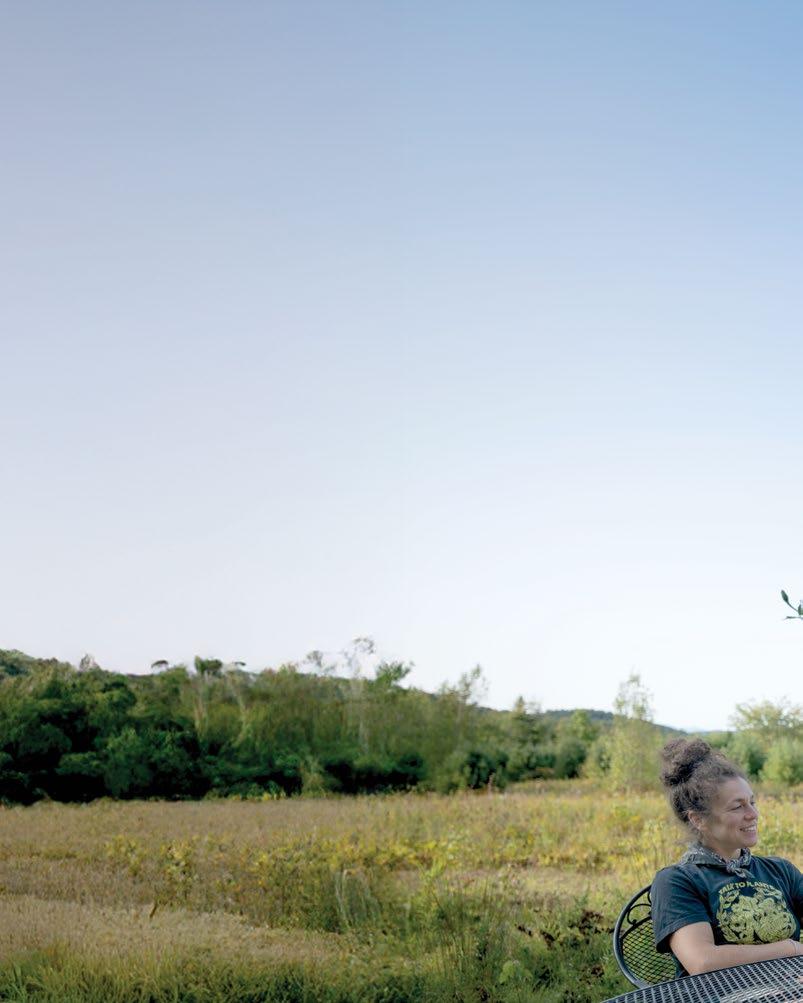
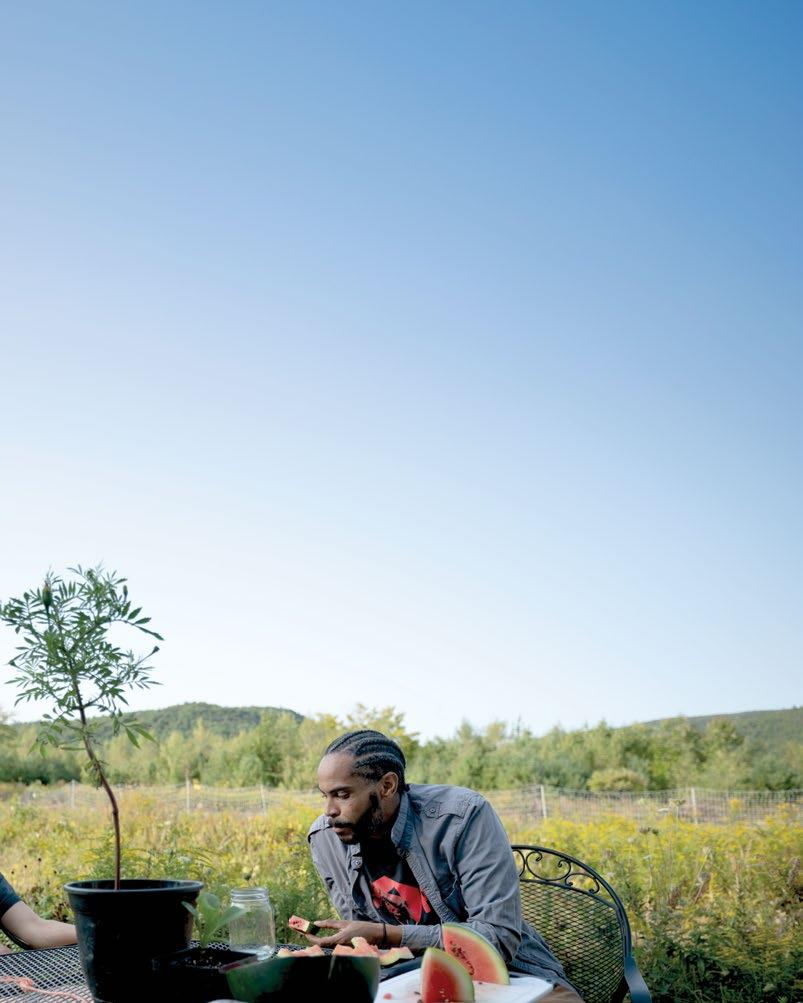
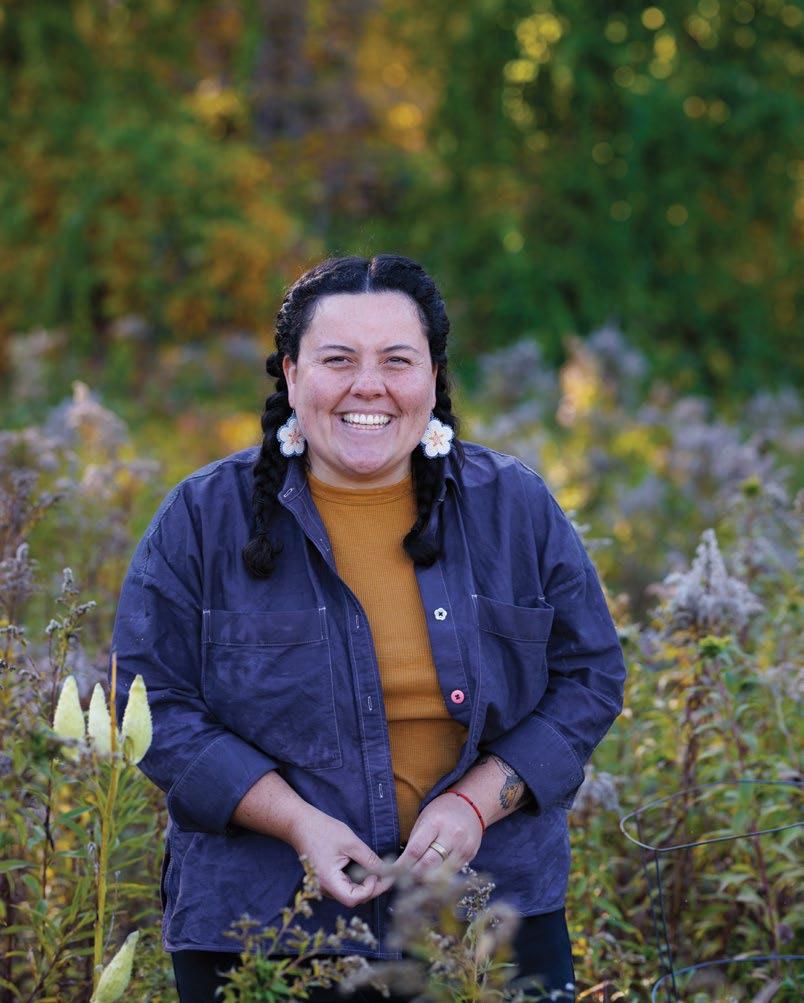
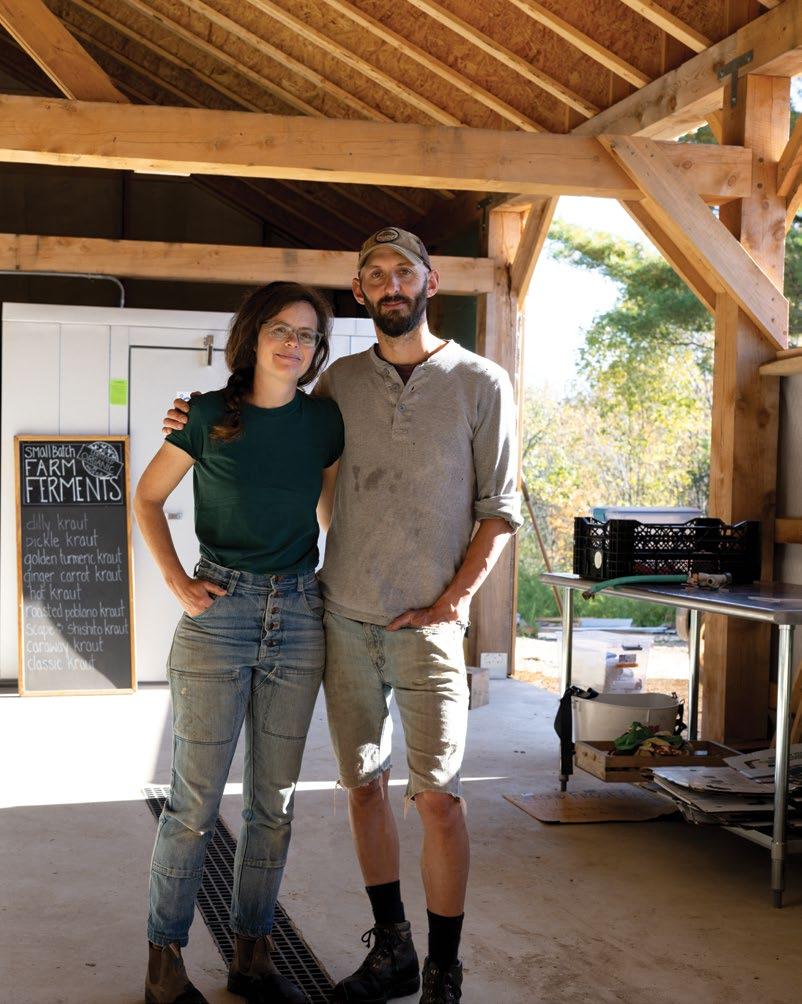
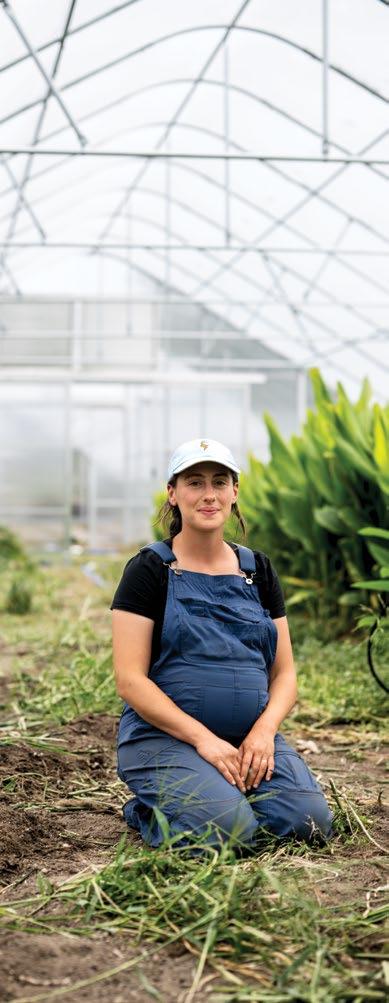
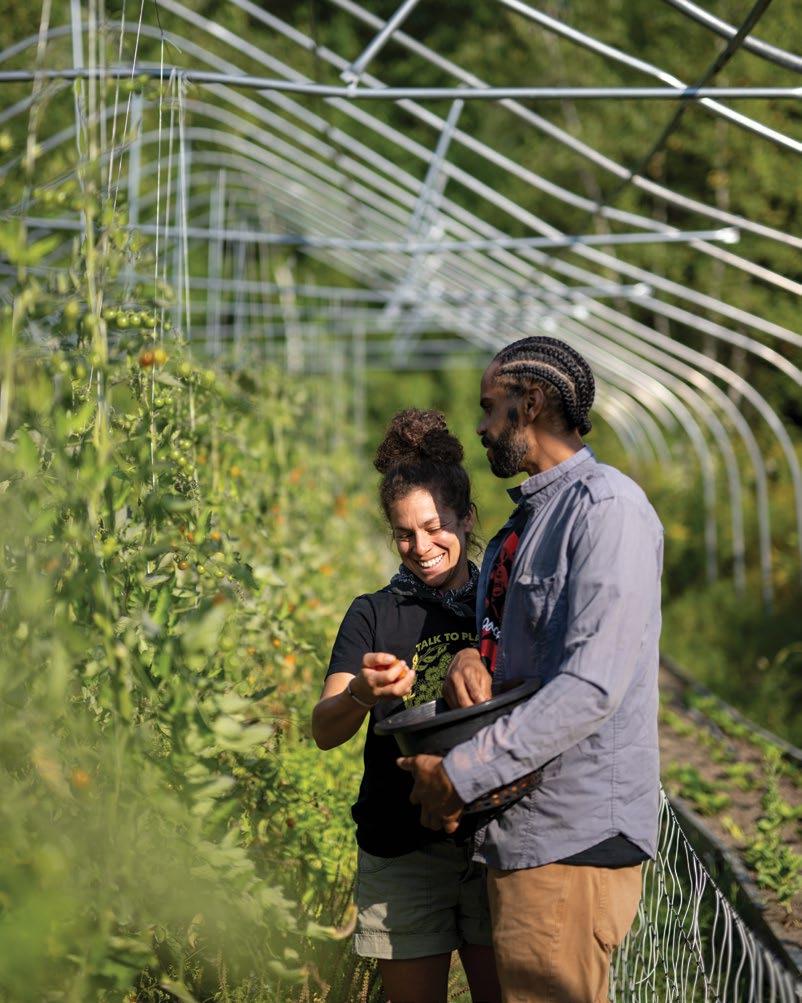
Current Page: Amara Watkin-Anson and Antonio LaSalle of La Finca Cooperative in Porter. Photo by Séan Alonzo Harris.
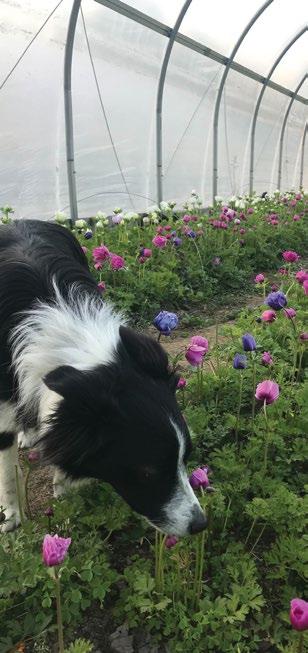
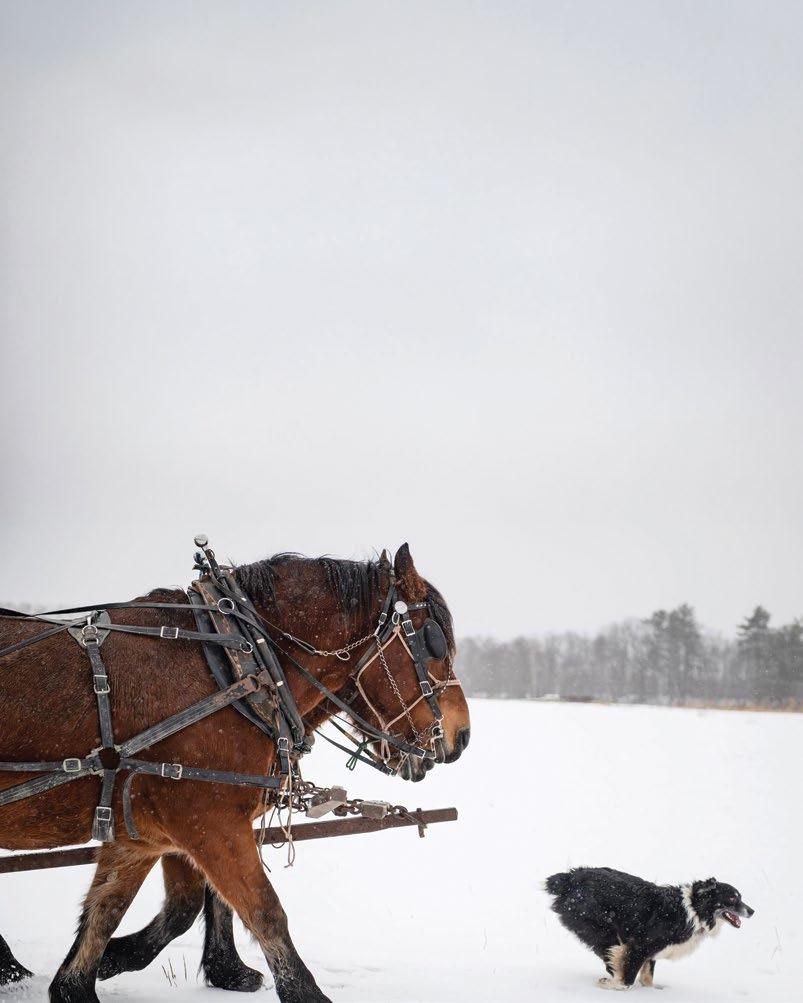
Back Cover: Farm dog Lila sets the pace at Goranson Farm in Dresden. Photo by Kelsey Kobik.
the field
snippets from the farming landscape
“With all the farm pets featured in this issue, I couldn’t resist sharing one of my own! Franny is an English Shepherd who likes things samesame—the same routes, the same rhythms, the same order to the day. On the farm she is endlessly alert and vigilant, a serious and highly effective rodent catcher who takes her job to heart. Her steady companionship grounds me, a loyal presence that brings comfort, calm, and a reminder to breathe, enjoy the light and make the walk last. She prefers I get 10,000 steps a day which means at least 40,000 for her.”
–STACY BRENNER MFT President & co-owner of Broadturn Farm
| claireackroyd.com read
listen
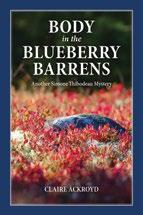
Body in the Blueberry Barrens
Maine author and certified organic inspector Claire Ackroyd is back with a new mystery novel, this time set in the blueberry barrens of Washington County. Ackroyd’s debut novel Murder in the Maple Woods made the rounds among MFT staff for its cozy mystery vibes and its detailed portrayal of the syruping process and multi-national economics of the maple syrup industry in Northern Maine. We’re eager to pass around Body in the Blueberry Barrens to find out whodunit this time and learn about the complexities of another of Maine’s most iconic crops.
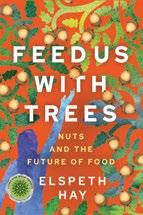
Feed Us With Trees: Nuts and the Future of Food
For millennia, trees like oaks, chestnuts, and hazelnuts have sustained humans all over the globe and continue to be a dietary staple in many Indigenous, African, Asian, and Middle Eastern communities. Maine-born author, public radio host, and MFT Farm Network member Elspeth Hay takes a critical look at how industrial agriculture has narrowed the Eurocentric American view of what we eat and how we grow it. Through conversations with nut growers, scientists, Indigenous knowledge-keepers, researchers, and food professionals, Hay describes how we might repair relationships with food-producing trees and reimagine agriculture as part of an abundant ecological landscape.
| elspethhay.com
We’ve curated two playlists to accompany this issue.
With so many excellent podcasts out there, it’s hard to recommend just one!
We’ve selected a few favorite episodes, including some familiar voices: MFT staff
Stacy Brenner and Ellen Sabina, writers Alex Redfield and Kirsten Lie-Nielsen, farmer Omasombo Katuka, and the Wabanaki land tenders of Niweskok.
of the Summer
Maine farmers’ music tastes are as diverse as the goods they produce. We asked what they had on repeat this summer, whether blasting from the farm truck on their way to market, the barn radio during early morning chores, or headphones while harvesting in the field. Rock out to this delightfully eclectic mix the next time you get your hands in the dirt. Podcast Playlist
Song
What’s in the Recipe?
A Maine-made meal and the often unseen ingredients—from seed to irrigation systems to shelving—in the journey from farm to table
BY MARGARET HATHAWAY | PHOTOGRAPHS BY KARL SCHATZ
Strolling the booths at the local farmers market or the aisles of the grocery store, shoppers are sometimes startled by the price of ingredients. $3.50 per pound for winter squash? $14.95 for a sack of locally milled cornmeal? $36 a pound for an aged cheese?
As they wonder where these figures come from, consumers may not realize the true cost of the foods we eat. We can measure these costs in financial investments, but also in human labor, time, and
more intangible ingredients like community value and environmental sustainability. Together, they more than justify the dollar amount—and supporting local farmers makes every meal richer.
This recipe incorporates local produce, grains, and cheese, and the photos and stories that follow trace the “ingredients” that each producer puts into their goods before they reach your kitchen table.
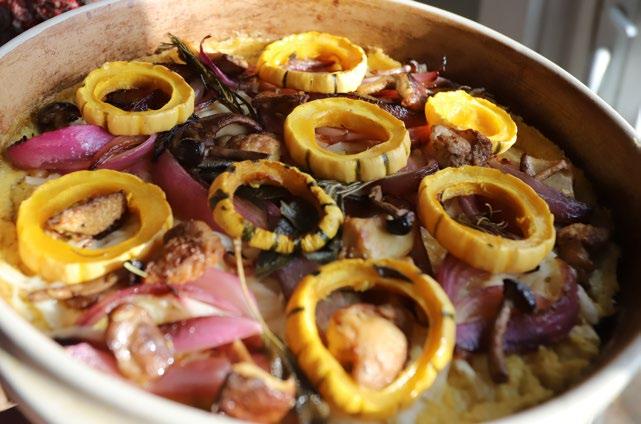
Baked Polenta Pie
Since our daughters were little, this has been a favorite hearty dinner on our homestead, Ten Apple Farm. We top it with seasonal vegetables and herbs—this recipe was written with fall/winter produce in mind, but you could use early spinach, asparagus and chèvre in spring, or tomato, zucchini, and basil in summer.
MAKES ONE 10-INCH PIE
Crust
1-2 tablespoons extra virgin olive oil, separated
1 ½ cups Maine Grains Liberation Farms cornmeal
1 teaspoon kosher salt
3 ½ cups water, separated
Toppings
2-3 tablespoons extra virgin olive oil
1 large onion, sliced lengthwise
2-3 cloves garlic, pressed
8 ounces assorted mushrooms, cleaned and trimmed
1 Open Heart Farm delicata squash, skin on and seeds removed, sliced into rings
Shaved or crumbled cheese for topping: crumbled blue, chèvre, or more Frost Heave, if desired
DIRECTIONS
1 Preheat oven to 375 degrees. Lightly oil a 10-inch round baking dish with 1 teaspoon of the olive oil.
2 Whisk cornmeal, kosher salt, and 1 ⅟ 2 cups of cold water in a medium bowl. In a large pot set over high heat, bring 2 cups of water to a boil. Pour the cold cornmeal mixture into the boiling water in a thin stream, stirring continuously to avoid clumping. Reduce heat and cook over low, stirring regularly, until mixture thickens, 10–15 minutes. Remove from heat and let cool slightly.
3 When polenta is cool enough to handle, pour it evenly into the baking dish, smoothing the top. Drizzle with remaining olive oil and bake, uncovered, until set and beginning to brown, 45–55 minutes.
4 While crust is baking, prepare the toppings. In a large skillet, heat 1 tablespoon of olive oil over medium-high heat. Sauté the onion in the oil, until fragrant and softened; remove and set aside. Add 1 tablespoon of olive oil and the pressed garlic to the skillet and cook until fragrant. Add the mushrooms and sauté until they begin to crisp at the edges. Remove pan from heat and set aside.
5 Grease a baking sheet with oil and arrange the delicata rings so that they don’t overlap. Tuck herb sprigs among the slices and drizzle squash with remaining oil. Roast in the oven (alongside the polenta) until squash is tender, 15–20 minutes.
6 When the crust is ready, remove from oven and sprinkle with grated sharp cheese. Arrange sautéed onions, mushrooms, squash, and herb sprigs on top. Scatter additional crumbled or shaved cheese over the vegetables, if desired, and return to oven. Bake until cheese is bubbly and serve hot!
Enjoy.
Image by Zack Bowen.
DELICATA SQUASH
Open Heart Farm
AUBURN
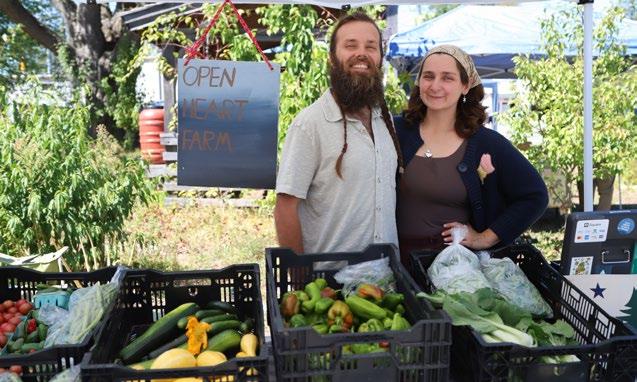
In the third season on their 20-acre property, farmers Chloe Meyers and Grant Roberts have one acre in cultivation, growing certified organic vegetables and berries. This is the first season that Grant has been able to farm full time, while Chloe continues to work full time at Pine Tree Seeds. Over time, they hope to expand their production. With the support of their families, they have invested $500,000 in the land, high tunnels, irrigation system, organic compost, and MOFGA certification. They sell their produce at area farmers markets and from a roadside stand.
INK
YIELD
100 squash plants grown in a 100-foot bed
INGREDIENTS
Organic seeds from Pine Tree Seeds, composted organic chicken manure
EQUIPMENT
Hand tools for planting and light tillage, fabric weed barriers, greenhouses
LABOR
Sow seeds, tend seedlings, plant in ground, weed/lay down weed barrier, harvest, bring to market
TIME
30 days in greenhouse, 60 days in field
Above Grant Roberts and Chloe Meyers in the Open Heart Farm booth at the Gray Village Farmers Market in Gray, Maine. 2026 will be Open Heart Farm’s third year as a member of the Gray market.
Fuzzy Udder Creamery
WHITEFIELD
When Michael and Jacqueline Segura purchased Fuzzy Udder Creamery in April 2024, the business came with a house and attached creamery, all the cheesemaking equipment, a trove of recipes, a small retail space, and several acres on which the original owner raised dairy goats to provide milk for the cheeses.
In their first year, the Seguras made only one significant change: they began purchasing milk from surrounding farms such as Pumpkin Vine Family Farm, which has allowed them to scale up production on cheeses such as their awardwinning aged goat’s milk Frost Heave.
Increased volume of cheese has required $7,000 in additional shelving for their cheese cave, in which wheels age for as long as one year. National recognition for their cheese has led to increased demand, which sends both Seguras on deliveries from Bar Harbor to Kennebunkport.
YIELD
10-12 wheels of Frost Heave cheese
INGREDIENTS
80 gallons milk per batch (sourced from Pumpkin Vine Family Farm, who milk 43 goats on 80 acres in Somerville, Maine), cultures and rennet
EQUIPMENT
105-gallon vat pasteurizer for cheesemaking, temperature and humidity-controlled cheese cave, specialized paper for wrapping
LABOR
Wash and sanitize equipment, collect milk from farms, affinage during aging (brush, turn, monitor conditions daily), cut and package wedges for sale, deliver to wholesalers throughout state
TIME
6 hours active cheesemaking, 36 hours soaking cheese in brine, 6 months aging
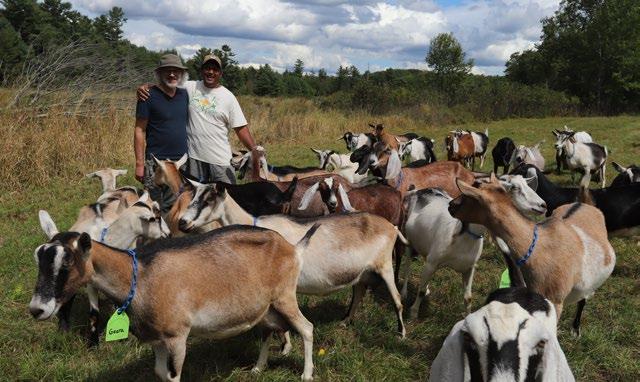
Above Michael Segura of Fuzzy Udder Creamery with Anil Roopchand of Pumpkin Vine Family Farm visit with Roopchand’s herd of dairy goats during one of Segura’s weekly trips to pick up goat’s milk at Pumpkin Vine.
Liberation Farms
WALES
Founded in 2014 by the Somali Bantu Community Association, Liberation Farms had temporary leases before acquiring their current property in 2020. Since then, they have brought 35 acres into production, dividing the land into 215 plots, cultivated by a collective of farmers. Each farmer has control over their ⅒-acre plot, growing vegetables for their family and selling surplus back to the collective.
In most plots, flint corn, a staple used in East African essentials like ugali and muufo cornbread, is interplanted with squash, beans, and greens such as collards and amaranth. The original seed corn for this drought-resistant variety was brought from Africa by an elder in the community and distributed to farmers five or six kernels at a time, and now each new farmer is gifted with saved seeds.
There is no irrigation on site, and farmers rely on rain to water their plots. Liberation Farms invested $150,000 in a corn house on the property that is used exclusively for drying, winnowing, shelling, and hand-milling flint corn for the community. Skowhegan’s Maine Grains purchases dried corn from the collective and mills it for retail sale, paying each farmer by the pound for their corn, and donating 5% of the proceeds back to the Somali Bantu Community Association.
margaret hathaway and karl schatz are the wife-husband team behind seven books on food and farming. The couple co-founded the non-profit Community Plate, and live with their three daughters on Ten Apple Farm, a homestead and agritourism business where they raise dairy goats, tend a large garden and small orchard, and more.
YIELD
100 pounds of corn grown in a 1/10-acre plot
INGREDIENTS
Seeds saved from previous year
EQUIPMENT
Hand tools
LABOR
Sow seeds, weed 3-4 times each season, harvest, process corn by hand
TIME
90 days from planting to harvest, 4-5 weeks to dry before milling
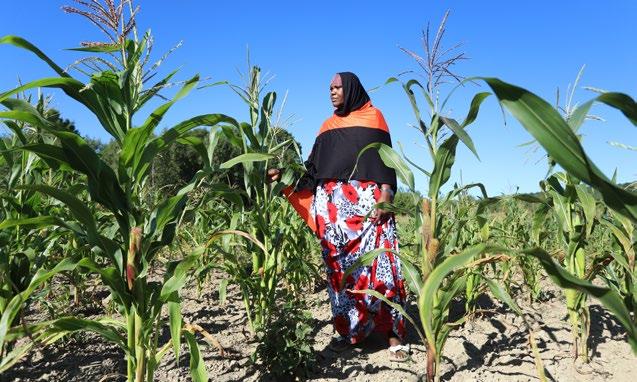
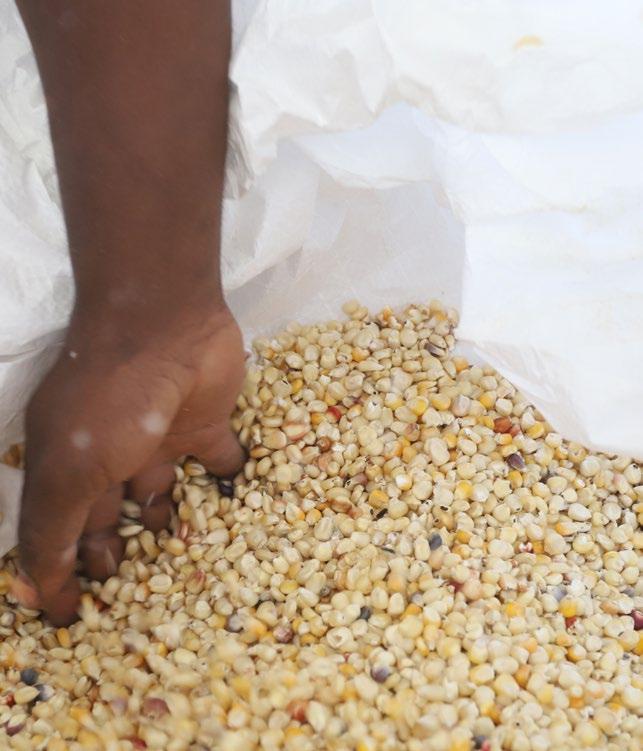
Opposite Farmer Hawa Kulow inspects her plot of corn at Liberation Farms in Wales, Maine. Above Muhidin Libah, Executive Director of the Somali Bantu Community Association, reaches into a bag of seed corn that has been saved for future plantings at Liberation Farms.
Passing on the Milking Pail Growing the future of Maine’s dairy industry
Two Loons Farm in South China, Maine, has spread out over more than 400 acres since Spencer Aitel and his wife, Paige Tyson, began farming in 1977. Standing in the hayloft, where upwards of 12,000 bales are put away every summer, you can look down upon the wide, watery eyes of young cows, over their sloping chestnut backs, and across rolling fields to the shores of China Lake.
The farm has long been more than just a business. Aitel and Tyson have helped to train apprentices who now operate nearby dairies, and the farm is a hub of
BY KIRSTEN LIE-NIELSEN | PHOTOGRAPHS BY CHIP DILLON
sustainable practices, powered by solar panels and certified organic, with rich, healthy soil from regular crop rotations. Yet for the past half decade, the two have wrestled with one problem they cannot solve alone: succession.
“There’s so much thoughtfulness that’s gone into the way things are here,” explains Aitel. “I feel like I walk in 200-year-old footsteps. The family that preceded us started in 1920, so dairying in particular, but livestock farming in general, is a multi-generational project.”
Without children to pass the farm to, the couple has explored several options. They have sold one portion of the land to a vegetable farm. They’ve spoken with organizations about turning it into a research farm and have weighed every possibility for the future.
“In order of preference,” Aitel says, “We’d like to preserve the farm, find somebody who wants to do this right or change it enough to make it viable for them. Or, then, breaking it up into little farms.” Although development is at the very bottom of the list, “it’s always possible.”
Two Loons is a mid-size dairy with fertile soil, carefully genetically selected and bred dairy cows, and years of investments in sustainable infrastructure. But selling a dairy farm in 2025 is no easy task. Milk consumption has decreased in the U.S. by almost 50% since 1975. Interest in solid
dairy products, like cheese, has increased, but those products require more infrastructure investments. And, as any dairy farmer will tell you, operating a dairy farm is a 24/7, no holidays, all-weather job.
Over the past 30 years, Maine has lost more than three-quarters of its dairy farms, from 602 in 1994 to 140 in 2024. In response to that dire statistic, in 2024 the Maine State Legislature established the Maine Dairy Task Force. Maine already has a first-in-thenation “Tier” pricing system, designed in 2004 to stabilize the market when the price of milk falls below the cost of production. But, as the task force concluded, in order for the Tier Program to work as intended, it must be funded at the current cost of production, and more support is needed for Maine dairy farmers to thrive.
Expanding on-farm and statewide dairy processing capacity to help reduce bottlenecks,
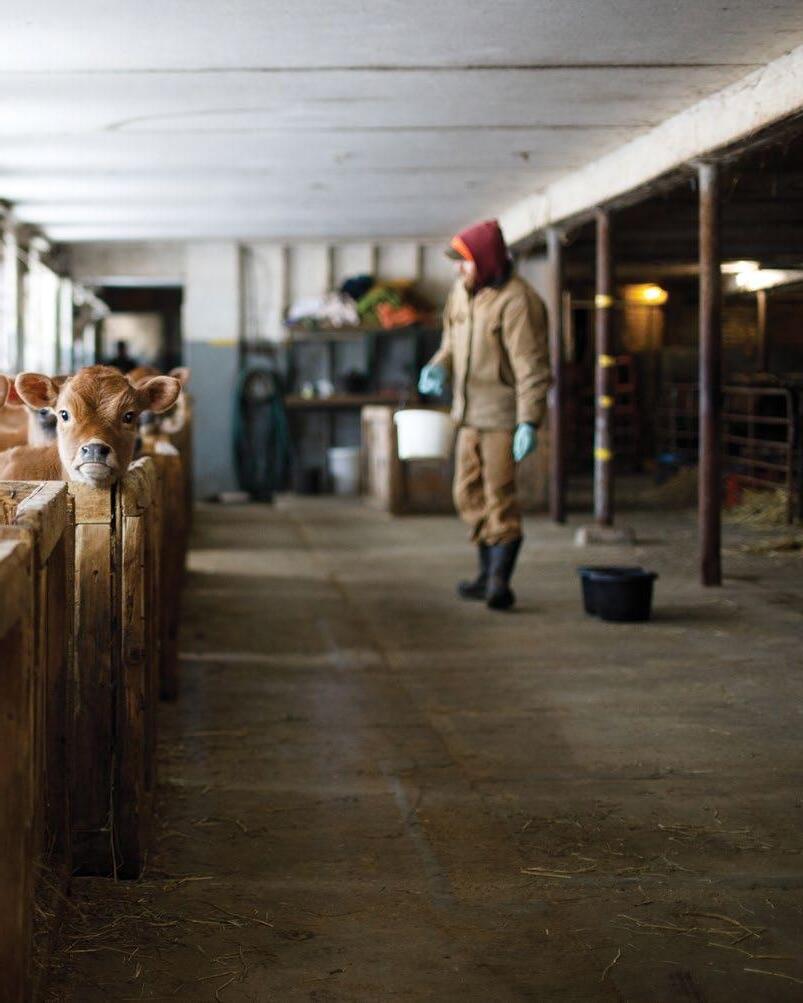
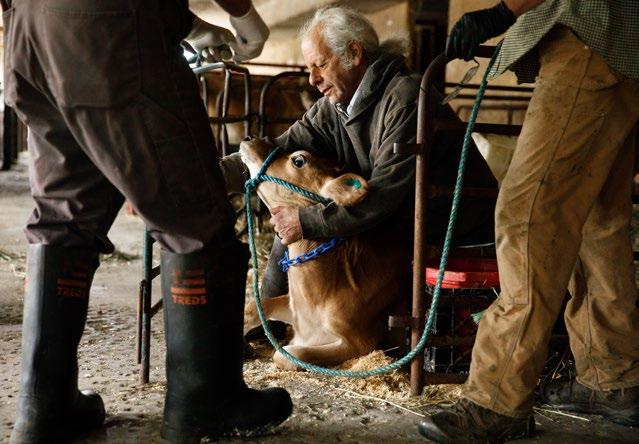
Above At Two Loons Farm, Spencer Aitel (center) and farm employee John Strieff (right) secure one of the calves as veterinarian Pete Caradonna (left) administers a vaccine, farm identification tattoo, and radio frequency ID. Maine’s dairies generate a volume of business that help anchor an ecosystem of suppliers and service providers that serve a variety of area farm operations. Previous Page Employee John Strieff tends to the Jersey calves at Two Loons Farm in South China.
lower costs, and increase efficiencies is another top recommendation—but that’s not as simple as it seems, explains Annie Watson, Director of the Maine Dairy Industry Association, owner of Sheepscot Valley Farm in Whitefield, and a member of the Dairy Task Force. “There’s this mentality that a silver bullet is to build more processing, but it’s a really difficult hill to climb. It is not just the milk supply, but refrigeration; it’s an expensive processing process because it is a highly perishable product.”
Watson describes other strategies to support the viability of existing farms and attract newer farmers, including greater investment in infrastructure upgrades and farm transfer planning support. But at every turn there are unique challenges.
Watson and her husband Michael Moody are first-
generation dairy farmers at Sheepscot Valley Farm. They understand firsthand what it takes to break into the dairy world. Starting dairy farmers often have difficulty qualifying for traditional mortgages and FSA loans without a financial history for their business. Watson and Moody purchased their farm from a farmer who was willing to owner finance, meaning they could pay off their loan to the seller directly, and started with a detailed business plan and some existing infrastructure.
Watson describes their experience as “test case that worked,” but admits that farms turning over from generation to generation is still the standard in succession planning in Maine farming. When families don’t have heirs, or the heirs aren’t interested, the system can falter.
“If we lose the farmland, we lose the understanding of how best to use the land. Then we lose the people, and then we can’t feed ourselves, which is the biggest danger that we risk.”
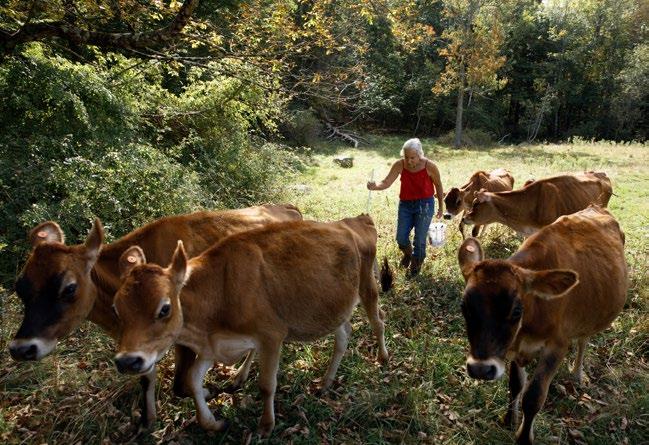
Paige Tyson (below) and Spencer Aitel of Two Loons Farm have been dairy farming for nearly 50 years. Without a next generation to pass the farm to, the two have spent several years exploring different possibilities to secure the farm’s future. While they hope to find a way to keep the farm in agriculture, the future is uncertain.
“If we lose the farmland, we lose the understanding of how best to use the land,” she says, “Then we lose the people, and then we can’t feed ourselves, which is the biggest danger that we risk.”
But for those who are fortunate enough to have children interested in continuing their legacy in dairy, the rewards are clear.
“I am the middle generation,” says Heath Miller, who owns Green Valle Farm in Newburgh and is also a member of the Dairy Task Force. “Currently on the farm we have my father, who is in his 70s, myself, then my son who graduated from college last spring, and my daughter, who is at UNH studying dairy science.”
Green Valle Farm has been in some form of dairy since the mid-1800s, when it was a subsistence farm. Miller’s grandfather built it up to a thirty-cow operation in the 1950s, and Miller, his father, and his children have all continued to expand the operation.
“The next generation really sparks the ability to
reinvest,” Miller says, “because most of us don’t care about retiring with the money in our pocket, and a lot of older farmers will think there’s no sense in investing without a next generation.”
Knowing that the farm will continue for another generation has allowed Miller to make educated decisions on farm infrastructure. Infrastructure investments make milking, storage, and processing more efficient, allow for expansion, and make the farm more desirable should anyone decide to sell it in the future. But putting money towards new equipment is a huge cost, and it can take years to see the returns.
“So many farms have aging infrastructure,” Annie Watson says. “They think, why update if you don’t have a successor? That even happened here; the farmer we bought from hadn’t made major updates in years because his kids didn’t want the farm. So then we had to think about how we would fund those updates when we bought the farm.”
“The next generation really sparks the ability to reinvest...a lot of older farmers will think there’s no sense in investing without a next generation.”
Left Three generations of the Miller family contribute to the dairy operation at Green Valle Farm in Newburgh, including Heath Miller (right) and son Ethan (left). Bottom Green Valle Farm has been a dairy for more than 150 years. Over the past three generations, the farm has grown from a herd of 30 to 350 cows and heifers.
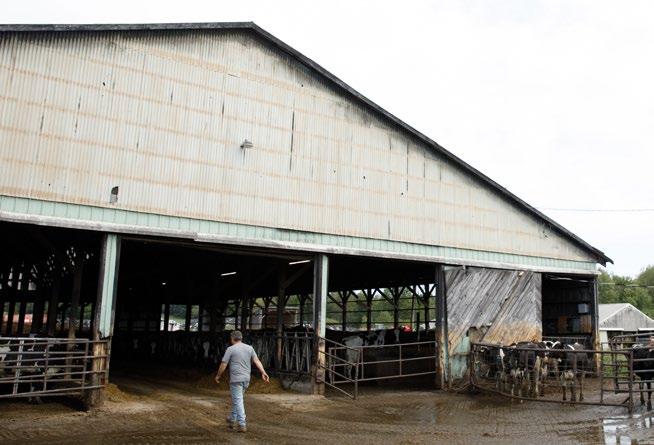
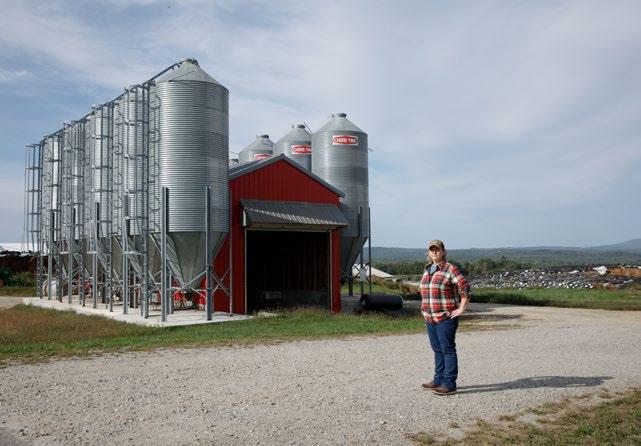
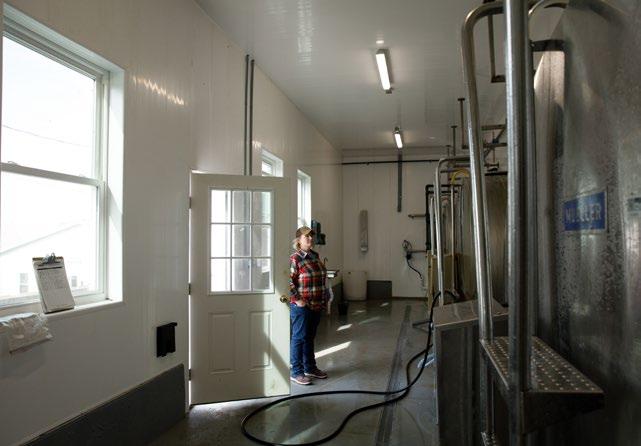
Above 10th-generation farmer Betsy Bullard stands in front of the grain storage bins at Brigeen Farms in Turner. Below With the help of a grant from Maine Farmland Trust, Brigeen Farms recently constructed a new operational hub facility to increase their milk storage capacity, improve trucking accessibility, and upgrade water and electrical systems. In addition to reducing costs and increasing efficiencies for the current business, the Bullards hope these investments will also help position the dairy for a successful transfer to the next generation in the future.
“What is the value of the landscape, what does it mean to the community? What is the conscious value of dairy farms in our communities, and in our ecosystems?”
Dairy equipment is expensive, and keeping it running is expensive. Looking at any dairy farm in Maine, you are gazing over acres of land that developers would happily snap up and a millionaire’s worth of equipment and cows. But very little of that is reflected as cash in the farmer’s pocket.
At Two Loons Farm, Spencer Aitel notes that a dairy farm is worth much more than its land or its equipment. It is a community hub for delicious milk and milk products, it is where many of the neighborhood kids have their first jobs, and it is a pastoral landscape that the neighborhood would miss in its absence. And as the Dairy Task Force report points out, Maine’s dairies generate a volume of business that anchors a whole ecosystem of suppliers and service providers, like equipment and repair shops, that neighboring farms depend on too.
“What is the value of the landscape, what does it mean to the community? What is the conscious value of dairy farms in our communities, and in our
ecosystems?” reflects Aitel. “We’ve been serving all of these functions which dairy farms have done for a long time.”
Overcoming the obstacles to grow the future of Maine’s dairy sector demands creativity and commitment—but farmers are up for the challenge.
”The thing about Mainers is that we are a motivated bunch. We’re willing to put up with more than most because we have an extreme place we live in,” says Annie Watson. “Although it looks like we are an aging dairy farming community, there are young people who will come into their own and it will be interesting to see where those generations take it.”
kirsten lie-nielsen is the author of two books on homesteading and animal husbandry, a regular contributor to Modern Farmer, Civil Eats , and The Boston Globe , and is Assistant Editor of Edible MAINE . Find her at hostilevalleyliving.com.
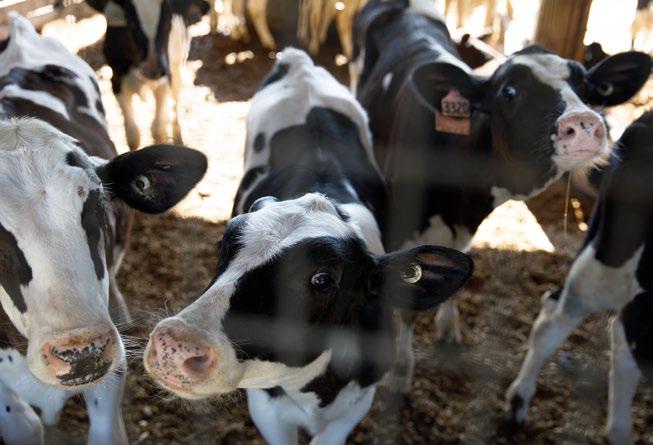
Below By investing in their dairy infrastructure and growing their herd of registered Holstein cows from 580 to 700 over the next several years, Brigeen Farms aims to increase their profitability and efficiencies of scale.
GROUNDED COMMUNITY
BY KATY KELLEHER | PHOTOGRAPHS BY MOLLY HALEY
Meet three land stewards striving to enrich our local communities
Feeding oneself has never been a solo affair. The human species is a social one, and we’ve only grown more interdependent as we’ve continued to evolve. While there is a certain stereotype in popular culture of the isolated, reserved, individualistic farmer, Maine’s food and farming community is full of people who balance working the land with serving the public. And we’re all the better for it.
“...farming itself feels like ‘a remembering.’”
HEATHER FLOR CRON
PRESENTE! MAINE | portland
It was March 2020, and Heather Flor Cron was, like most everyone, afraid. The Portland-based artist and community activist saw how people in the Latinx community were suffering during the pandemic for lack—of information, of food, of stability. “The limited information we were getting about staying safe was all in English,” she remembers. “In so many ways, our community was being left out of the conversation.” Alongside her sister, Crystal, and the rest of the staff at Presente! Maine, Cron began working to address an immediate, pressing issue. “One of the first things we thought we could do, that would be direct support, would be to buy and distribute food,” she says.
At first, they were purchasing food and rationing it, delivering it to community members in Southern Maine and Androscoggin County, but this didn’t feel like enough of a long-term solution. What if food stopped coming to Maine? What would happen if the supply chains broke down further? “We thought, ‘How can we start growing our own food and becoming more self-sustaining?’” she recalls. And although she had no direct background in farming or gardening, this spark of an idea caught flame. Presente! Maine broke ground on their Outdoor Learning Center and Food Hub later that year.
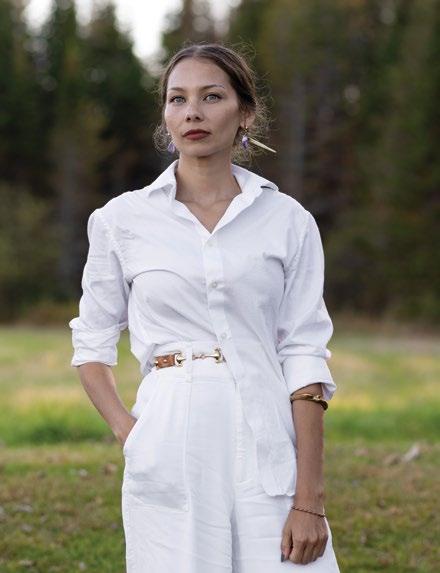
These days, Cron runs a thriving two-acre farm, located in Androscoggin County on property owned and managed by the community land trust nonprofit, Land in Common. The food grown there is distributed by the Food Brigade, given for free to members of the Afro-Indigenous-Latine diaspora community in twice-monthly deliveries. “At the beginning, that first year, we had big ideas. Like most farmers starting out, we wanted to do it all, to grow everything,” she recalls. “But we realized that wasn’t really possible.” Instead, their farm output supplements donations from partner organizations, including the Good Shepherd Food Bank and the Cumberland County Gleaning Initiative. “There are things like carrots and greens that we can rely on getting every week, so it made sense for us to change our focus,” she says. “Over the years, we’ve shifted what crops we grow. Now we prioritize a lot of culinary herbs, which is something you’re much less likely to get from a food pantry.”
In addition to cilantro, parsley, and basil, the Presente! Maine fields yield a variety of plants that are “relevant to how people might have cooked back home,” Cron explains. “Before we started growing it, I had only ever had the dried version of epazote,” she says. “It’s really exciting that it grows well here, too.” She’s also had luck with huacatay (sometimes known as “black mint”), a peppery green in the marigold family that is common in South American cuisine. Like these flavors, farming itself feels like “a remembering” for Cron. “When I started doing this, it reminded me so much of hearing my grandmother’s stories about being a land steward back home in Peru,” she says. “To reconnect with our land here is important. It might not be our homeland, but that connection is still important to the Latin diaspora.”
Recently, national politics and ongoing ICE raids have forced Presente! Maine to stop offering on-site community days at the farm, a loss that Cron feels acutely. “With what’s happening with immigrants being stopped and detained, we had to stop having people drive an hour to the farm,” she says. “This is a space that we want to bring community members to, so they can participate in the growing and farming of food, so they can connect with the land. Being unable to do that—it’s just really sad.”
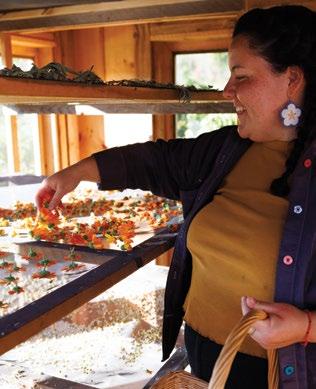
Opposite Heather Flor Cron at the Presente! Maine farm. Above The food and traditional plants grown on the two-acre farm, like the calendula Cron is spreading onto the drying racks, is distributed to members of the AfroIndigenous-Latine community through the organization’s Food Brigade.
AUTUMN-JADE FITCH
SACRED CONNECTIONS | yarmouth
“I’m not a farmer,” clarifies Sacred Connections founder Autumn-Jade Fitch. “I’m a wild harvester.” A member of the Passamaquoddy tribe, Fitch grew up on the Indian Township Reservation in Washington County, but it was on her grandmother’s land in Pownal where she learned to forage. “It was very rural with woods and fields, and there were always acorns, wild sorrel, clovers, and berries. The land was so abundant,” she recalls. “But on my reservation, it was very different. We didn’t have the greatest piece of land to sustain ourselves.”
Farming, she explains, isn’t a big part of her culture. “Farming is amazing, but it’s not instinctual or natural for us,” Fitch says. “My work is about protecting our lands so that they can sustain life in many different ways.”
Sacred Connections is an Indigenous-led land trust that aims to protect donated parcels of land for communal use. Although still in their early stages— Fitch is currently working with pro bono lawyers to file their 501(c)(3) application—the organization has already been gifted 40 acres of wild blueberry lands in Searsport. “It’s on top of a small mountain, and it’s breathtaking,” says Fitch. “We didn’t know what we were walking into when we went to visit this summer.” The blueberries hadn’t been maintained since the previous owner passed several years ago, but happily, the fields were still rich with flavorful fruit. “It goes to show that you don’t always need complicated farming practices,” Fitch says. “Native American practices involve letting it be, then doing a burn every few years. That’s it. No chemicals needed.”
Through Sacred Connections, Fitch hopes to share the knowledge of her tribe with the general Maine public, including (but not limited to) their
traditional ways of land stewardship. “I’ve lived in rural Maine, and it’s not just indigenous people who go through suffering and oppression and deal with poverty,” she says. “I realized that I want to help Mainers in general, from my Native American background.” During the pandemic, for example, Fitch noticed that reservations tended to fare better than other places due to their preexisting mutual aid systems. “That really was an epiphany for me,” Fitch continues. “I realized that there is so much that tribal communities could offer. There’s a lot of ways that we can teach other communities.”
In the coming years, Fitch plans to expand Sacred Connections’ land holdings and open their current parcels to the public, offering community events that will “help heal the fragmented relationship between natives and nonnatives,” she says. Her goal is to educate through sharing spaces and activities, like invasive species clean-up days, as well as more traditional workshops. “There’s an amazing opportunity here for us to teach people how to take care of the land,” says Fitch. “There’s a way of taking care of things that comes from a different perspective and world view, and that’s one of the first things I teach people. In an indigenous world view, the earth comes first.” It’s even in her language, she reveals. “Our word for dirt, tupqan, has two parts. The first means something that gives life, gives spirit. And the second part means something that is essential.”
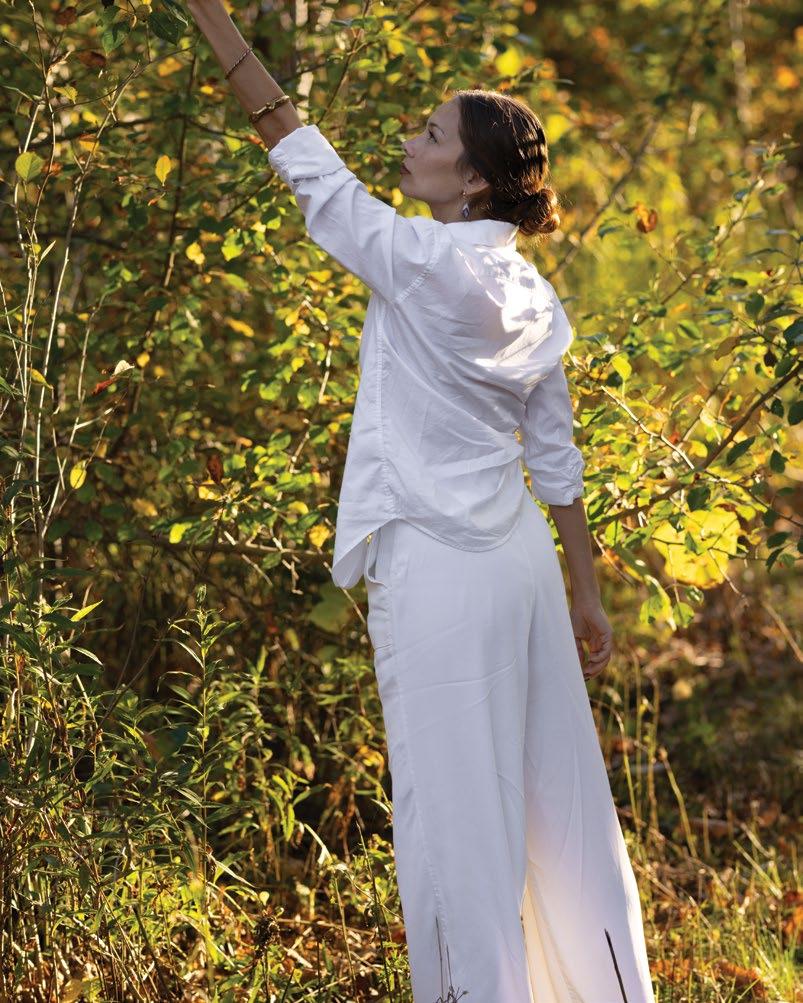
Above, Opposite Autumn-Jade Fitch at some of her favorite places in nature in Southern Maine.
“I’m not a farmer. I’m a wild harvester.”
“I’m a better farmer when there are successful farmers around me.”
ERICA EMERY
RUSTIC ROOTS FARM | farmington
Although Erica Emery grew up on a dairy farm, she didn’t always dream of having her own plot. As a child in Farmington, she was involved with 4-H, and as a teen, she sold sweet corn on the side of the road. “My first foray into vegetables,” she says. But it took leaving Maine to hammer home the point. “After college, I moved to Boston and worked in nonprofits doing youth development,” she explains. “Then I hit a wall. I was really burnt out. I was sick of being inside, and I realized I needed an outdoor job.”
In 2013, Emery moved back to Farmington to start Rustic Roots Farm on two acres of land that she rented from her parents. The transition from big city to rural Franklin County wasn’t difficult, though Emery did notice a certain lack of cohesion among her peers. “I didn’t feel like there was a strong network of farmers around,” she says. “MOFGA and Maine Farmland Trust are amazing, but they have a state-wide outlook. I thought there could be something more hyperlocalized to promote and strengthen farming as a profession.” In 2017, she joined forces with a group of local farmers, advocates, and educators to create the Greater Franklin Food Council, and in October of 2024, Emery was hired as the nonprofit organization’s first executive director. “It’s very part-time,” she says. “But we started with one school garden project, and we’ve just grown and grown.”
At the Greater Franklin Food Council, Emery oversees a school garden coach, who has helped implement agricultural programs at eight schools in Farmington, Kingfield, Rangeley, and Stratton. But while she loves seeing kids dig in the dirt, Emery admits that her true passion lies in “farmer resource and development.” She says, “I don’t want to farm in a silo. I think I’m a better farmer when there are
successful farmers around me.”
In addition to running events like Farmer Resource Day and the annual Franklin County Holiday Food Hall, Emery also gets to talk up her fellow farmers at her shop/restaurant, Root Down Market, which she co-owns with her partner, Dave. “Our farm store is one of the ways we’re trying to promote super-local ag,” she says. “We have 25 to 30 other farm vendors that are selling goods through our market, and that was by design. We never wanted to just sell our stuff. We wanted to be a robust marketplace.” She’s seen businesses— including Colby Woods Farm in Chesterville, Shady Maple Farm in Starks, and True Mountain Maple in Industry—grow by “leaps and bounds” through their collaboration. Emery’s own farm is growing, too: over the next two years, Rustic Roots Farm will establish on a new piece of farmland purchased this summer, with room to double their crop production and build an on-site farmstand. As it turns out, “there’s a lot of demand. People are really hungry for local food.”
katy kelleher is a freelance writer and editor living in Buxton. A regular contributor to Down East Magazine , Edible MAINE , and more, she is also the author of two books, Handcrafted Maine: Art, Life, Harvest & Home and The Ugly History of Beautiful Things: Essays on Desire and Consumption .
Above Erica Emery harvests cantaloupes at Rustic Roots Farm in Farmington. Opposite Erica Emery (center) with vendors Joanna Hall (left) of Hall Farm and Abigail Perry (right) of Shady Maple Farm at Root Down Market in New Sharon.
STORIES FROM THE FIELD Finding Their Way to Farmland:
BY ALEX REDFIELD | PHOTOS BY SÉAN ALONZO HARRIS
It’s a tough time to be a Maine farmer. Beyond the typical hard work and long days, growers are facing sharp rises in costs, and severe drought in three of the last five years has added to the burden. Yet, almost incredibly, there are more farmers ready to jump in and get growing. The 2022 USDA Agricultural Census ranks Maine third in the nation for the percentage of “new and beginning farmers,” with almost 36% of growers having ten or fewer years of experience.
The challenge of running a viable farm starts well before the first sale. New growers must first find the right place for their business, and quality farmland is increasingly unavailable and unaffordable. The following stories highlight five creative pathways to farmland access. These approaches are diverse, complicated, and often still require some luck—but they show what can be possible now as we work towards a vibrant food system in the future.
SECOND FROST FARM
When Noami Brautigam and James Gagne were looking to start their own farm ten years ago, they had years of experience managing other farms, existing customers, and savings in hand for a down payment. But, after a year of monitoring real estate listings, they began wondering if that was enough—until a unique opportunity popped up on Maine FarmLink.
Amanda and Eric Rector had been farming their 100-acre property in Monroe since 1990 and were ready to see the farm flourish under new ownership. Instead of listing their property on the open market, which would have likely secured a higher financial return, the Rectors wanted to make it easier for aspiring growers to get up and running.
After a short “get to know you” period, the Rectors transferred ownership of the land and infrastructure to a newly formed LLC, and then crafted an operating
agreement in which the farmers at Second Frost incrementally purchase shares of the LLC over time. “This model meant there was no down payment needed,” Gagne said, which was key in the beginning stages of their farm business. “We didn’t need to start out with a line of credit or an operating loan to get set up and we could get started immediately.”
Ten years into this shared ownership model, it’s clear that four human beings regularly need to come to an agreement on sticky questions. “One piece that’s felt really important throughout has been that both parties assume positive intent,” says Gagne. “When there is conflict, there’s still an underlying understanding that we’re all bringing different perspectives and that solutions are possible. At the end of the day, we both own this property and we’re both invested in seeing it succeed.”
Left Noami Brautigam and James Gagne are incrementally purchasing ownership shares of the land and infrastructure they farm in Monroe. Above Gagne harvests cabbage (left) and Gagne and Brautigam till carrot beds at Second Frost Farm, their diversified vegetable operation. Previous Page A peek inside one of the high tunnels at Second Frost Farm.
DANCING HARVEST FARM south portland
When you think of affordable farmland, coastal Cumberland county may not immediately come to mind. Yet, Daniela Aldrich’s vegetable operation, Dancing Harvest Farm, sits on the suburban edge of South Portland. After launching her farm through the farm-incubator program at New Entry Sustainable Farming Project in Massachusetts, Aldrich was looking to find a home to keep her new business growing—and meet other needs as well.
“My partner needed to find off-farm work, we wanted to live where we didn’t feel isolated, and, growing up in a bilingual household, it was important to stay connected to a community where I could raise my children speaking Spanish,” Aldrich explained.
After offers on other parcels didn’t pan out, Aldrich saw the South Portland property listed on the New England Farmland Finder service in 2022. The owners were not interested in farming themselves but offered a leasing opportunity to keep the land in agriculture, as it had been for over 100 years while suburbs developed around it.
Support from Maine Farmland Trust and Land for Good helped Aldrich find land that suited her business model, communicate clearly with nonfarming landowners, and negotiate an arrangement that gave her the security she needed.
Three years later, Dancing Harvest has a thriving customer base and Aldrich has secured a ten-year lease to justify longer-term investments. “The farm is connected to people and place and the surrounding ecosystem…but it’s still my small business. Building it in a way that can contribute to all of those communities is what I love, and that’s why I’m investing my energy and resources in building this.”
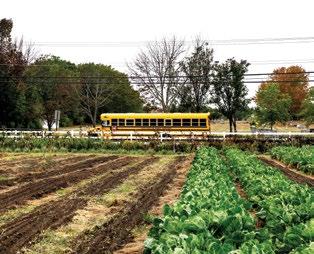
Left Daniela Aldrich will be entering her third year of production at Dancing Harvest Farm. Beginning with a short-term lease in 2022, Aldrich has since secured a 10-year lease on the property as she deepens her investment in the farm. Above A school bus passes by the farm, which sits on the suburban edge of South Portland.
OK COMMUNITY FARM wales
At OK Community Farm, Omasombo Katuka and his family grow carrots, tomatoes, onions, and spinach— but the farm’s unique identity is revealed by the plots of amaranth, pumpkin leaves, sweet potato leaves, and small, green eggplants. Specializing in the crops familiar to Maine’s still-growing and still-underserved immigrant community, OK Community Farm is a major player in the food system for New Mainers. Years ago, Katuka got his start through Cultivating Community’s New American Sustainable Agriculture Project, and he has spent the past decade farming on leased land. But without stable land access, it was tough for Katuka to keep his business growing. Driving 50 minutes from his home to one field for harvest, then an hour to the wash station in Lisbon, then 20 minutes to market in Lewiston…this was an unsustainable model for even the most dedicated farmers.
OK Community Farm had sound financials, a strong connection to markets, and demonstrated production and marketing expertise, but finding
the right parcel, in the right place and at the right price, proved difficult. Attempts to access federal loans were slow and ultimately unsuccessful, and private financing was unavailable, as banks are often hesitant to offer mortgages on open land. After four years of searching, an old hayfield in Wales popped up on Maine FarmLink that met most of Katuka’s criteria.
In 2024, Katuka purchased the 53-acre parcel. Three key factors helped. First, the land had been protected by Maine Farmland Trust with an agricultural conservation easement, reducing the property value. Second, the sellers, Andy Smith and Caitlin Frame of The Milkhouse Farm & Creamery, were committed to making a nontraditional transaction successful. Finally, Katuka’s track record of growing affordable, fresh produce for several anti-hunger programs aligned with the Elmina B. Sewall Foundation’s investment priorities, providing a unique opportunity to secure a loan with favorable terms.
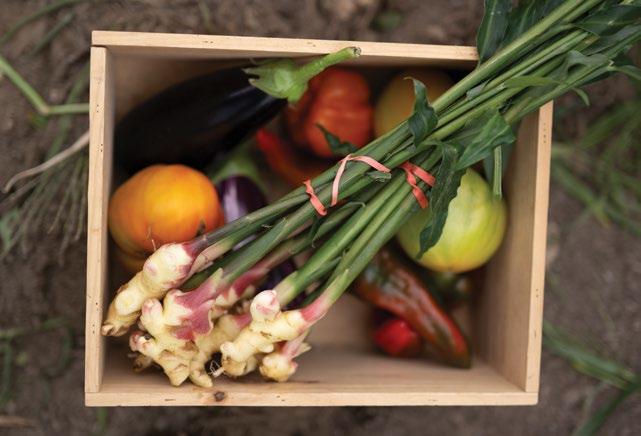
Above Aldrich’s late summer harvest includes ginger, tomatoes, eggplant, and peppers. Many of her CSA customers live in the surrounding residential neighborhoods and can walk (or make a short drive) to pick up their shares.
Opposite Amara Watkin-Anson and Antonio LaSalle harvest tomatoes at the La
farm
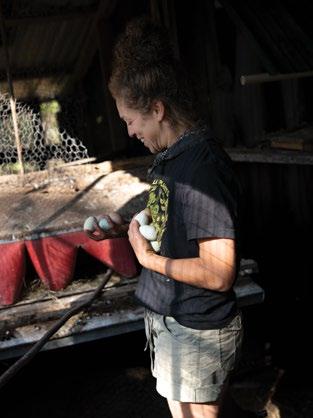
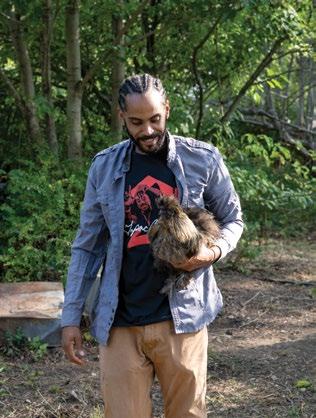
lease from Land in Common. “When we get Black and brown folks back on the land, that’s when things are really going to start happening,” says LaSalle. “There’s real power in showing it can be possible.” Above Watkin-Anson gathers eggs (left) while LaSalle tends to the chickens (right).
LA FINCA COOPERATIVE porter
At the end of a two-mile gravel road, nestled in the woods and hills of Western Maine, is La Finca Cooperative, run by Antonio LaSalle, Amara Watkin-Anson, Jamel Torres, and Aisha Geerings. Years ago, while a student at Fryeburg Academy, a friend took LaSalle up this road on a four-wheeler, past the same view of Mt. Adams through the clearing that he now farms.
Committed to making space for Black and brown people in Maine to feel comfortable and connected to their place in the food system, when LaSalle and Watkin-Anson saw this familiar parcel listed, they knew it was the right place for their vision. The 100+ acre property, much of it wooded, was too expensive to purchase outright, but with creativity and committed partners, La Finca Cooperative now raises livestock and grows vegetables on 15.4 acres.
Two key collaborations paved the way. The Francis Small Heritage Trust agreed to purchase a significant portion of the parcel’s woodlands to add to their
existing conservation lands and trail network. And Land in Common, a community land trust, purchased the farmstead and executed a 99-year, transferable ground lease with La Finca, allowing the farmers to invest in the land, the farm, and the community with stability. The co-op won’t be able to “cash out” on the land as a retirement plan—but that was never the top priority anyway. “We’re in it to break these cycles of exclusion and to disrupt narratives that keep Black and brown people off the land,” Watkin-Anson explained.
The collaboration at the core of La Finca’s land tenure allowed for a diverse group of partners, each with their own skills, resources, and connections, to make this happen. “We have to tap into our community,” said LaSalle, “not just the people who live near the farm, but all of our community, to see what people need, see what they can contribute, and see what we can offer.”
Finca Cooperative
in Porter, where the cooperative holds a 99-year
NIWESKOK swanville
Niweskok is a Wabanaki collective dedicated to reclaiming and rebuilding Indigenous foodways. Since 2018, their programs have connected Wabanaki families with opportunities to grow and harvest food and medicine, largely on borrowed or leased land. The collective is also focused on a broader, more transformative effort: to provide space for the reproduction of cultural knowledge and Wabanaki identity and to restore a relationship with the land as kin, despite centuries of displacement and destruction of their ancestral homelands, histories, and identities.
Niweskok began building partnerships with other conservation, food sovereignty, and justice-oriented organizations, with the explicit goal of calling on them when the time came to secure a permanent home. Niweskok embarked on a two-year journey, culminating in the acquisition of a 245-acre farm in Swanville in late 2024. A farm like this, with river frontage, outbuildings, and a large farmhouse, doesn’t come cheap. But it was the right farm for Niweskok, with upland soils, young woods, and marshy access to the Goose River, offering an opportunity to solidify existing programs and to co-create new and exciting directions.
Partners, donors, and non-Indigenous community members were asked to understand that this collaboration would not mirror typical land protection projects. It might move at a different pace, require different styles of communication, request different types of gifts and support —and above all, would require centering the direction and leadership offered by the Wabanaki leaders driving the work.
Deliberately unencumbered by an easement, partners were also asked to redefine land protection and stewardship. Instead of measuring success by the number of legally-conserved acres, how many kids would be able to harvest and prepare sweet fern, black ash, or wild leeks for the first time? How many families would be able to recall and reproduce the knowledge cultivated over thousands of years on this landscape? How many people would be able to just feel safe while reconnecting with the lands stolen from them?
Opportunities to nourish and repair can only emerge from work that is fundamentally different from other food and farmland interventions, and they are essential to growing a vibrant and just food system.
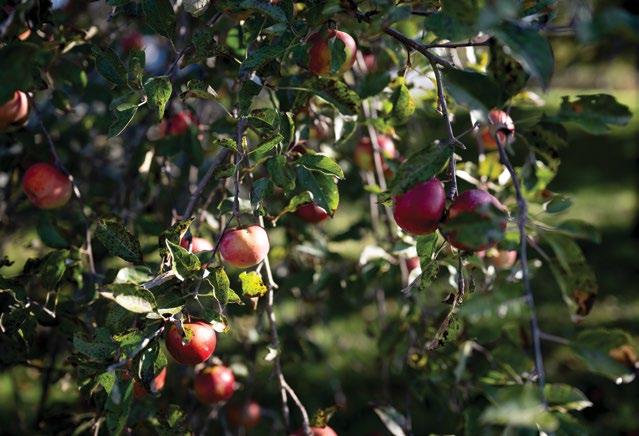
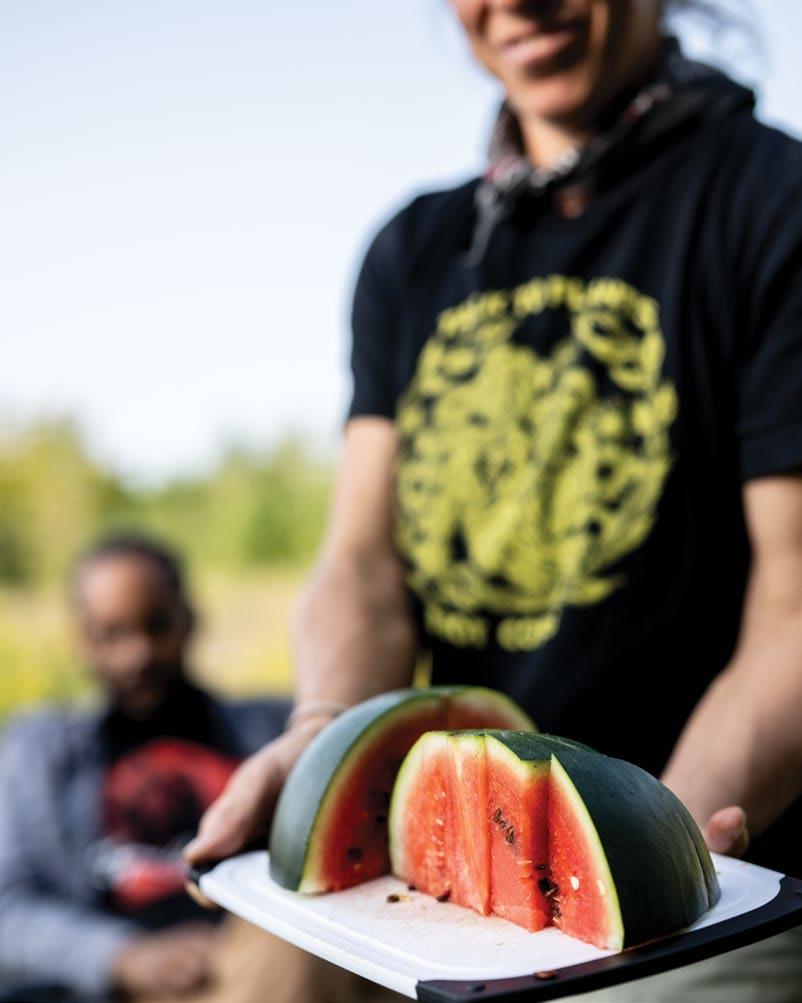
Above Apples ripen in the late summer sun at Second Frost Farm in Monroe. Right At the La Finca Cooperative farm in Porter, Amara Watkin-Anson slices up a freshly-harvested watermelon as she and Antonio LaSalle take a moment to enjoy the fruits of their labor.
Given the depth and breadth of the social, political, economic, and climate-related challenges facing Maine agriculture, the five farms featured here will not fix our food system by themselves. But it is possible to see their pathways to land access as building blocks for a better future. These stories offer lessons to guide our collective work and a clear reminder that, as Huey Newton said, “We must survive until we can transform society.” If we don’t sufficiently support the people who are ready to grow food for our shared communities right now, who will we learn from and lean on in the future?
alex redfield serves as Policy Director for Wildlands, Woodlands, Farmlands & Communities. For two decades he has worked on the farm, in state government, and across regional food and conservation policy networks to support a just transition for New England’s landscape and the people who depend on it. He lives in South Portland.
Barn Cats & Farm Dogs:
Companions, Workers, and Agricultural Icons
BY HOLLI CEDERHOLM | PHOTOGRAPHS BY KELSEY
KOBIK
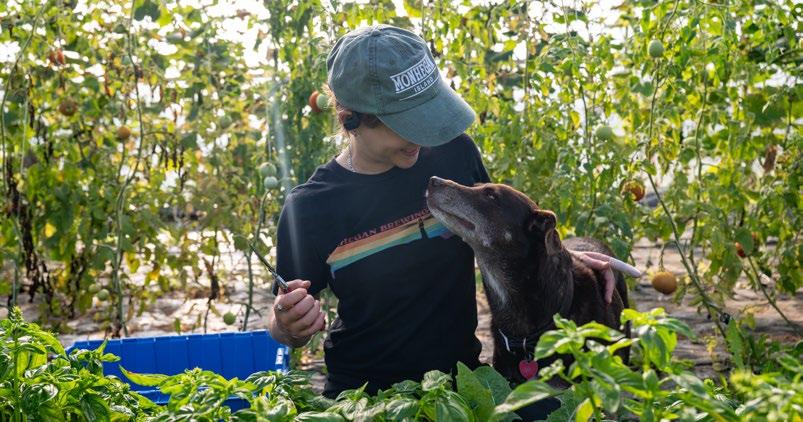
At Seven Moon Farm in Freedom, Maine, the day starts with Arlo, a Lab-Collie mix, and Nellie, a stocky, barrel-chested potato of a dog, bouncing at the front door and notifying Rachel Chapman and Nate Gorlin-Crenshaw that their farm crew has arrived. When they head to the field, the dogs bound in front of the work truck, leading the charge.
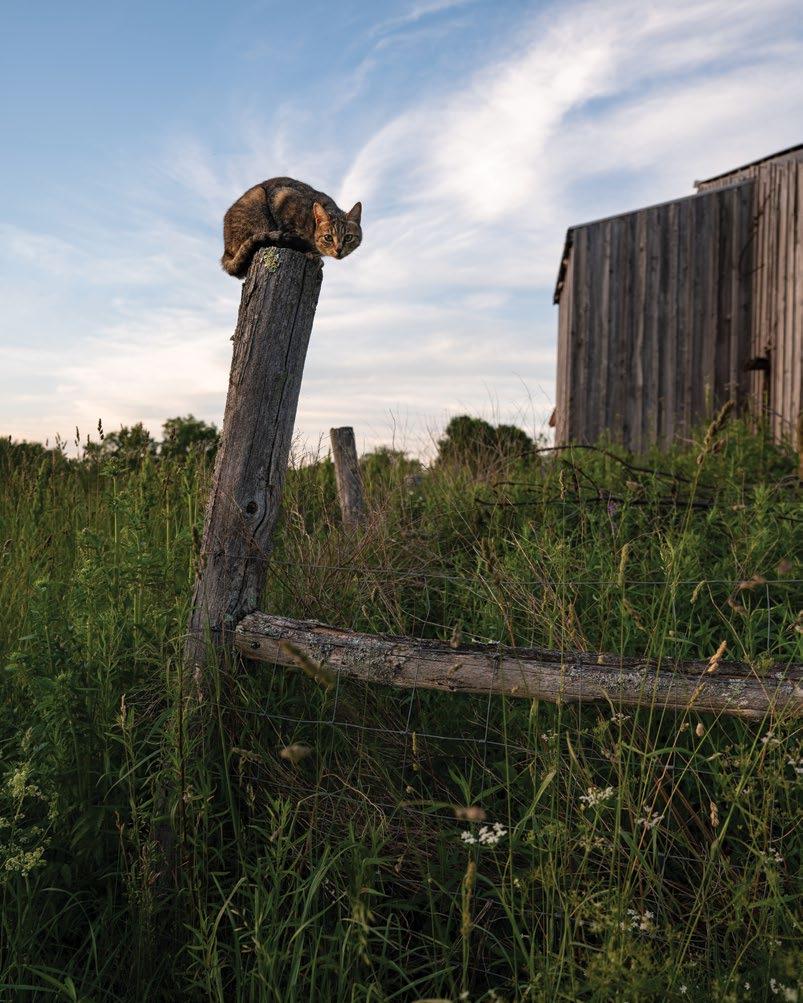
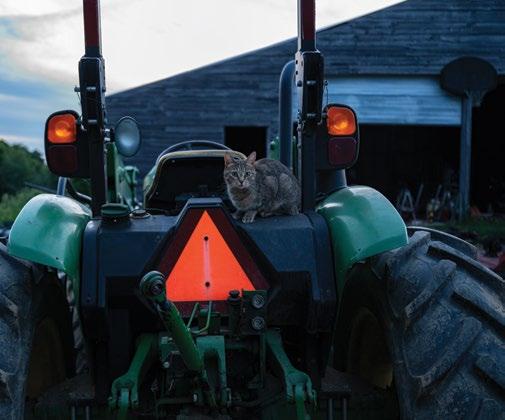
While the farmers cut lettuce mix or thin carrots, Arlo and Nellie do what a lot of dogs do: seek belly rubs from friendly hands, roll in the grass and nap in the sun, and bark at strange noises. If they catch wind of an intruder—such as a vole, rat, or woodchuck—in the compost pile or under a heap of row cover, they’ll flush them out. Meanwhile, the resident cat, Thistle, patrols the farm’s greenhouses, her sleek tabby coat acting as ready camouflage. Chapman considers all three animals to be part of the crew. “But they’re also a part of our family and a part of our household,” she adds.
The human connection to cats can be traced to the dawn of agriculture some 12,000 years ago, when early grain storehouses attracted rodents—and wild cats were happy to offer pest control. Our relationship with dogs stretches even further. Though the exact timeline is up for debate, evidence indicates that dogs were the first domesticated animal, predating the bonds we formed with livestock animals by a few thousand years. Over time, specific breeds have evolved with people and our lifeways, leading to dogs who are indispensable to agriculture.
Opposite Thistle on patrol. Above Farm employee Emma and Arlo. Right Nellie, at Seven Moon Farm in Freedom.
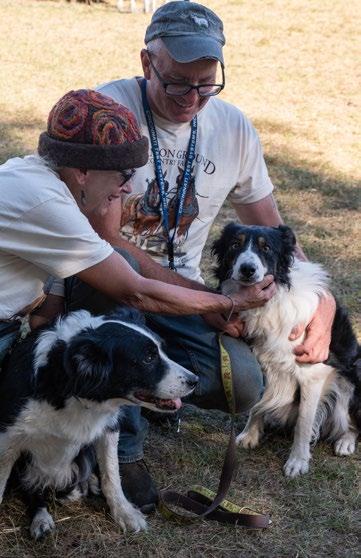
One such breed is the Border Collie, often simply called “sheepdogs” due to their deep ties to a certain wooly ruminant. Tim and Lisa Molinero of Heart Stone Farm raise 100 heritage ewes on their farm in Milton, New Hampshire and 25 acres of rough pasture on a small Maine island, noting that they couldn’t handle such a large flock without the help of their five collies.
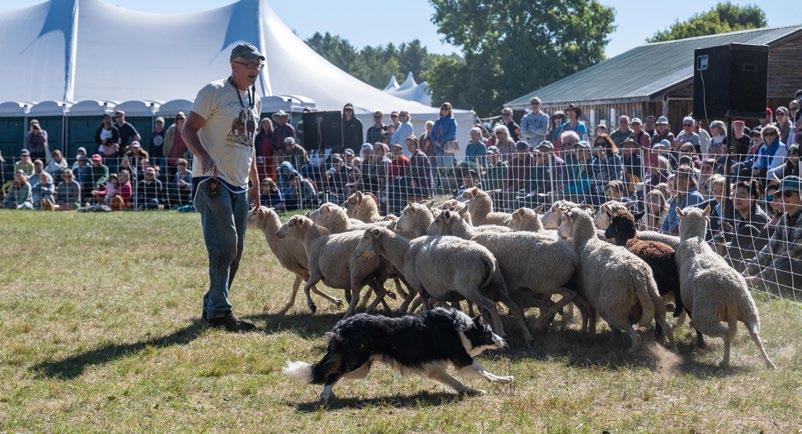
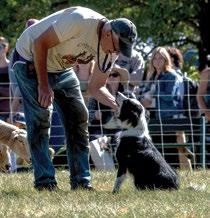
The dogs, who know their rights from their lefts and respond to both whistles and voice commands, drive the sheep down the road in a fluid throng from one pasture to the next. The collies are also able to divide and control livestock, and can sort sheep for shearing, for example, with the mere point of a farmer’s finger.
While the Molineros work with a breeder to select their dogs and begin training them at four to five months of age, they credit the animals’ prowess to the long legacy of canine cooperation that came before them. “This is hundreds of years of hardwiring their brains and picking the best natural dogs,” says Tim. “They kind of already know what to do. You just need to put a command on that behavior.”
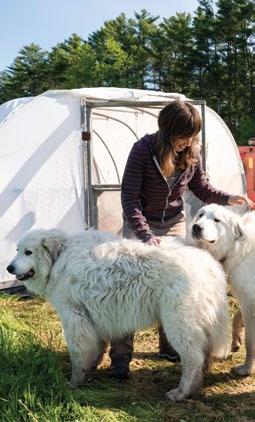
Left Lisa and Tim Molinero of Heart Stone Farm, with Kena (left) and Davey (right). Top Tim Molinero and Colin perform a sheepdog demonstration at the 2025 Common Ground Country Fair. Opposite Ida, Abby Sadauckas, and Monty at Apple Creek Farm in Bowdoinham (top). Ida keeps watch while Sadauckas tends to the flock (right).
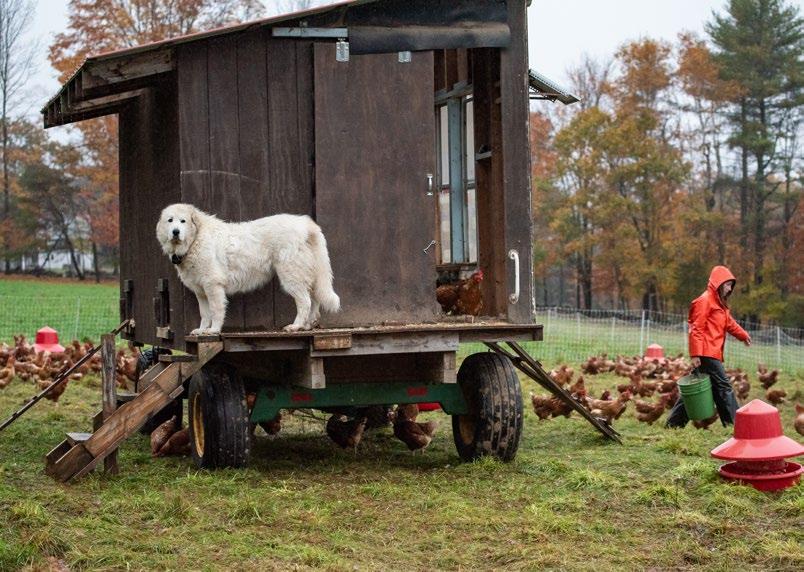
On rolling pastures at Apple Creek Farm in Bowdoinham, Maine, two massive Great Pyrenees stand guard against predators. Ida and Monty can differentiate between the farm’s 800 laying hens and 1,000 broilers and other birds—namely hawks and great horned owls. The dogs, who live with the poultry flocks, keep an eye on the sky, alerting Abby Sadauckas and Jake Galle to unwanted visitors through incessant fierce barking. The farmers reinforce the dogs’ natural behavior by maintaining strong boundaries between work and play, and ultimately, recognizing the dogs as a partner on the farm.
“That’s what we’ve enjoyed about them, that makes it a lot different than a pet,” says Sadauckas. “I think a pet, you want them to be submissive and do what you ask them to do in all cases. With the guardian dogs, you kind of have to let that go a little bit and trust that they know what they’re doing.”
holli cederholm is the editor of The Maine Organic Farmer & Gardener, the quarterly publication of the Maine Organic Farmers and Gardeners Association (MOFGA), and the host of MOFGA’s Common Ground Radio, a discussion of local food and organic agriculture. She lives and farms in rural Maine.
Lila, with farm employees Aaron and Marissa, Goranson Farm
TimMolinero and Colin, Heart Stone Farm
Nala, Tide Mill Farm
Nellie and Rachel Chapman, Seven Moon Farm
Nellie and Arlo, Seven Moon Farm
Lila and Jan Goranson, Goranson Farm
Sally, Bumbleroot Organic Farm
Thistle, Seven Moon Farm
Ida, Apple Creek Farm
Lulu and Beth Schiller, Dandelion Spring Farm
Adrienne Lee and Stormy, New Beat Farm
Voices from the MFT Community
Three MFT supporters reflect on the future of farming
Maine Farmland Trust is powered by a community of supporters who are deeply concerned, yet undaunted, by the challenges that threaten Maine’s farms and farmland. If you’re reading this, that includes you!
This year, we asked three MFT supporters to share what inspired them to get involved with the organization and their hopes for the future of farming in Maine. Though we all bring different life experiences and perspectives to this work, these stories each point to the same core belief: local farms matter to our collective well-being, and we all have something to contribute toward a future where farms and communities thrive.
Want to share your own story? Send it to Emily Lad at outreach@mainefarmlandtrust.org
JOSSELYN MILLER | Ellsworth MFT supporter since 2025
As a lifelong Mainer, local agriculture has been a consistent presence and source of joy since I was a young child. As an adult, I have come to recognize the importance of food sovereignty, sustainable farming, and community building.
Maine Farmland Trust addresses all of these issues by supporting our agricultural workers, who in turn provide us with not only sustenance for our bellies, but for our hearts and collective sense of wellbeing.
Every meal I have that includes Maine-produced ingredients fills me with warmth and utter joy, and I feel far more connected to the land and the communities that reside in this beautiful state. My hope is for Maine to regain its footing as an agricultural hub and to expand access to local ingredients for all residents.
Brigeen Farms, Turner
ROB TOD | Portland Founder, Allagash Brewing Company
MFT Business Member since 2015
Beer and agriculture are deeply connected. The quality of our ingredients has a direct impact on the final quality of our beer. And we're lucky to have amazing grain farmers, and maltsters, right in our backyard. This year, we were able to brew with over 2 million pounds of Maine-grown grain, a milestone we’ve been working toward for nearly a decade.
Growing the demand for Maine-grown ingredients is just one part of the equation. It takes collaboration to grow agricultural infrastructure across the state so that farmers can grow their operations.
We, and our farmer friends, are lucky to have Maine Farmland Trust as an exemplary resource to protect farmland and grow resources for farmers, ensuring we all get to enjoy locally grown Maine goods for many years to come.
ALIX HOPKINS | Pownal
MFT supporter since 2000
MFT Board of Directors member since 2024
Though my career has spanned 40 years in various forms of land conservation, farming represents (literally) the grounding of my life. From growing up on a farm outside of Baltimore, where chores were part of our daily lives, to slowly restoring an old farm in Pownal over the past 34 years—my life on farms has come full circle.
As a 25-year member of MFT, I have witnessed and supported the organization's germination and progress. Early on, MFT co-founder Frank Miles approached me for advice on starting nonprofits. I knew he was on to something, as farms began disappearing and becoming too expensive for younger farmers to afford. Since every local community fosters some form of agriculture, any loss is unacceptable.
Since joining the Board, my enthusiasm has only grown. While attending community gatherings focused on strategic planning this summer, I’m impressed with the thoughtful comments, perspectives and insights shared by farmers, donors, and members, and by the caliber of MFT’s staff and Board.
This is a watershed moment for farming in the U.S. With Stacy Brenner at the helm, I know MFT’s work to protect farmland and keep local farms in agriculture will continue to make an impact and resonate with people of all ages in the future.
Thank you to the businesses, farmers, and individual supporters whose member support powered our work this year. Together we are growing a landscape and economy where farmers and communities thrive.
Thank you to the Fruit level business members who helped to power our work this year: