maine farms
JOURNAL OF MAINE FARMLAND TRUST • 2021
Spring came early this year, nipping at the heels of a mild winter. While its premature arrival is a troubling sign of the changing climate, the reappearance of buds and birds and seedlings felt especially hopeful to me this year; we too were emerging, unfurling after the pandemic, reentering public life. The past year at home has given us a lot of time to reflect. It also highlighted the instability and inequity of our food system, and underscored just how much work we all need to do to build a system that serves everyone. There’s no shortcut to a more equitable food and farm system, but there’s so much fruitful and hopeful work and conversation happening already.
The stories in this issue show signs of green growth, tender shoots of what could be—healthy, vibrant communities rooted in the land, resilient farms, and space for all. Suzanne Greenlaw, Alivia Moore, and Nolan Altvater generously shared their perspectives of Wabanaki relationship to the land we now call Maine. Through their essays and photographs, they challenge us to reconsider the ways we think about land, property, and our food system. Jesse Ellison and Chip Dillon highlight Bahner Farm as a case study of all the often-obscured points of community support that help farms thrive. Laura Poppick and Kelsey Kobik look at some of the gleaning projects in Maine that have ramped up their efforts during the pandemic to deliver nutritious, local food to those who need it. Anna Forentino and Brendan Bullock learn about a project to support veterans who want to become farmers. Katy Kelleher and Yoon Byun explore the natural dyes and fibers used by Maine farmers and artists.
As storytellers, we have a responsibility to expand the dominant narratives and uplift all representations of Maine agriculture. We started this journal with the understanding that stories have the power to broaden the way we think about the world and help connect us with different ideas and perspectives. Over the last few years, we’ve continued to see how powerful it is when individual narratives coalesce. Stories can shape the public understanding, altering our shared reality. They can create unity or sow division. They can reinforce existing power structures, or help us to imagine new ones.
Thanks for learning with us,
Ellen Sabina, Outreach and Communications Director, Maine Farmland Trust
maine farms
(207) 338-6575 | mainefarmlandtrust.org
info@mainefarmlandtrust.org
Printed on 80# Finch Opaque Bright White Smooth by J.S. McCarthy Printers, Augusta, Maine
All material © 2021 Maine Farmland Trust
The Maine Farms journal is a publication of Maine Farmland Trust, a statewide nonprofit that protects farmland, supports farmers and advances the future of farming.
the field
snippets from the farming landscape
explore!
Discover Maine’s abundant local farm landscape with us
You can discover farms in your neck of the woods, plan an adventure further afield in search of newto-you spots, or learn about Maine’s food system. Whichever way you choose to do the Maine Farms Scavenger Hunt, it’s sure to make for a memorable and delicious season for the whole family. Learn more and sign up at our website.
| mainefarmlandtrust.org
watch
Voices from the Barrens: Native People, Blueberries, and Sovereignty
0:56:46 | 2020 | produced and directed by Nancy Ghertner shop
Voices from the Barrens: Native People, Blueberries, and Sovereignty documents the wild blueberry harvest of the Wabanaki native peoples from the USA and Canada. The film focuses on the Passamaquoddy tribe's challenge to balance blueberry hand raking traditions with the economic realities of the world market, which favor mechanical harvesting. Each August, First People of the Canadian Wabanaki, the Mi'kmaq and Maliseet tribes cross the US/Canada border into Maine to take part in the tradition of hand raking blueberries with their Passamaquoddy brothers and sisters. This crossing to Maine blueberry barrens isn't considered “agricultural labor” but is part of the traditional harvest from the earth.
| voicesfromthebarrens.com
A short list of Wabanaki-owned places to shop
Dawnland Handmade Creations
Maine Indian Basketmakers Alliance
Micmac Farms Passamaquoddy Maple
Wabanaki Marketplace
Korean Beef Bulgogi
Recipe provided by farmer and veteran Anne Devin of Chase Stream Farm (read more about Devin on page 46).
Ingredients
1 pound sliced beef (1/4 inch for tenderloin or boneless ribeye, 1/8 inch for sirloin)
½ Korean pear (or bosc pear), peeled and coarsely grated
¼ cup soy sauce
2 tablespoons brown sugar
2 tablespoons sesame oil
3 cloves of garlic, minced
1 tablespoon freshly grated ginger
½ teaspoon black pepper
2 tablespoons vegetable oil, divided
2 scallions, thinly sliced
1 teaspoon sesame seeds
Salt to taste
Directions
1 In a medium bowl, combine pear, soy sauce, brown sugar, sesame oil, garlic, ginger and black pepper.
2 In a gallon size Ziploc bag, combine soy sauce mixture and beef; marinate for at least 2 hours to overnight, turning the bag occasionally.
3 Heat 1 tablespoon vegetable oil in a cast iron grill pan, skillet or bbq grill over mediumhigh heat. Working in batches, add steak to the grill pan in a single layer and cook, flipping once, until charred and cooked through, about 2-3 minutes per side. Repeat with remaining 1 tablespoon vegetable oil.
4 Serve immediately, garnished with scallions and sesame seeds, if desired. Best served with rice and kimchi!
Opening The Earth aka The Wedding Song
by Craig Hickman
When the weather breaks, stand before the unquilted stretch of land and gaze directly across into your lover’s eyes. Resist the half-second instinct to blink.
Ready yourself for designing earth too hard to chop. Remove the gloves of shame. Clip the nails of fear. Fall, in unison, to your knees. Fertilize the earth with raw honesty.
Weed out dissension. Plot vegetables and flowers and talk about the colors that will bloom. Water often with fluid from a red, red heart.
Welcome imperfection. When needed, rest in solitude near the tree-rooted corner. Surrender to the half-second instinct to blink. Pray. Pray.
Pray. Refreshed, work steadfast till night’s star-nailed, pewter close. Lie in your lover’s arms. Gaze once more into his eyes. Anoint each other with moonlight.
Sleep in the dream-blossomed embrace of rich harvests to come. Crack open fever-bright eyes and awaken to morning’s sun-forged opening. Begin again.
craig hickman is an organic farmer, as well as the Maine State Senator for District 14. He shares his musings about life and land on his blog. | craighickman.blogspot.com
L O C A L
C O L O R
A new wave of textile artists are using old techniques to harvest color from the landscape
BY KATY KELLEHER | PHOTOGRAPHS BY YOON S. BYUN
Right now, chances are good that you’re wearing some form of chemically dyed cloth. Maybe it’s a pair of blue jeans, a garment that would have once been dyed with legume leaves but now are soaked in synthetic indigo. Or maybe you have on a cotton shirt with red threads in the weave, their fibers colored with sodium salts. The colors that surround us, that sit close to our beating hearts and swaddle our tiny children, would have been an incredible luxury for humans living a few hundred years ago. We walk through our lives, drenched in color, and rarely do we notice it. We don’t often think about where the color comes from, how it was made, in what laboratory, with what materials. Or what alternative sources of color might be out there, hiding in the landscape, growing in your garden, or even mouldering in your kitchen compost.
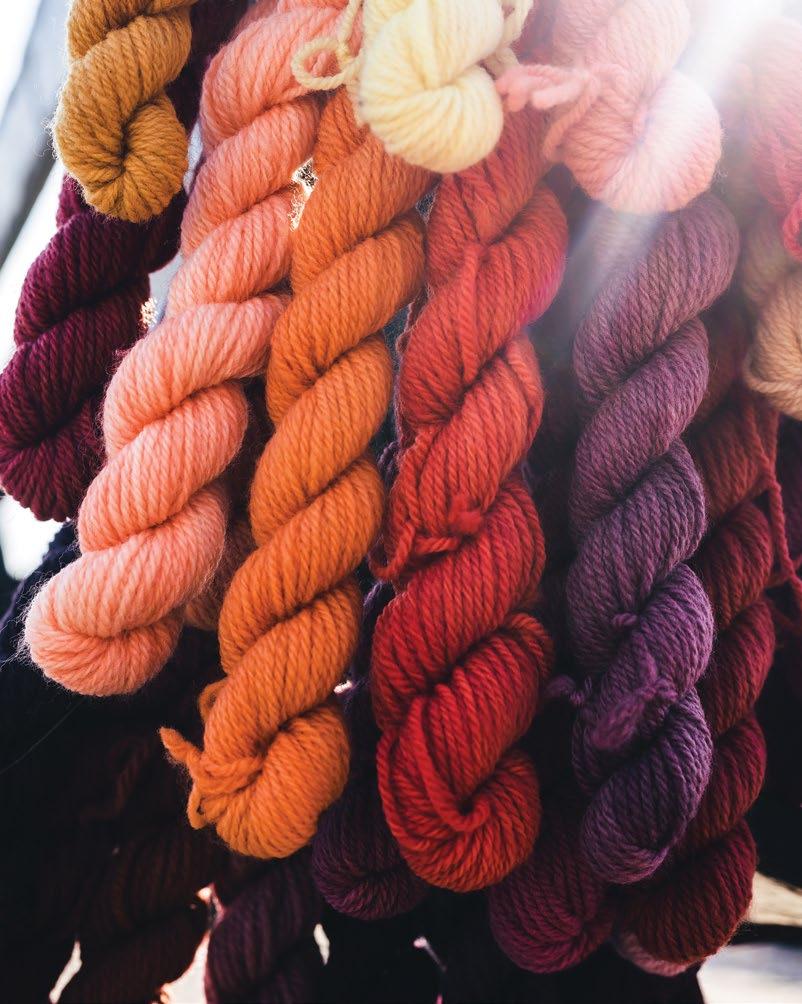
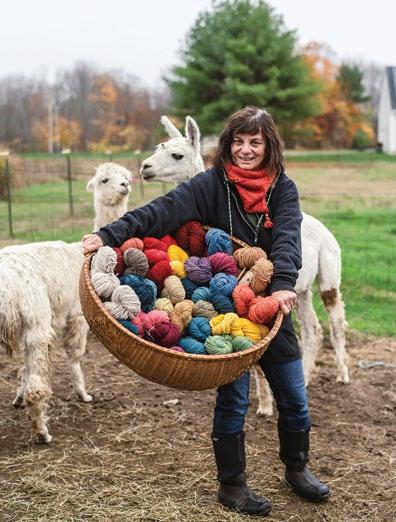
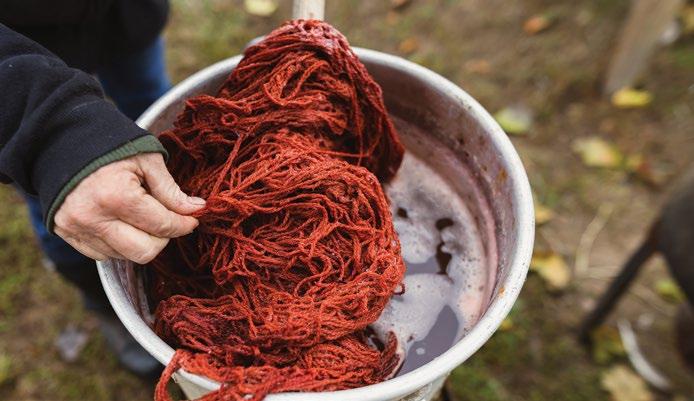
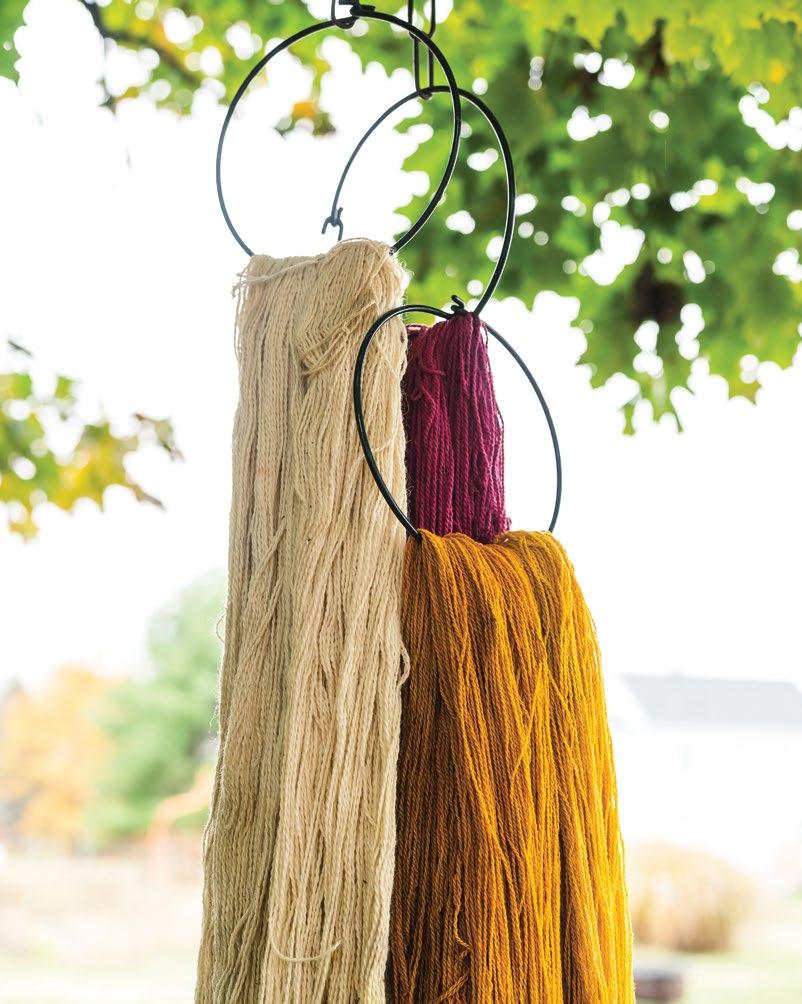
One day last fall, Marcia MacDonald spread a selection of yarn across a table in her Buxton backyard for me to examine. Made with wool from her family’s herd of alpacas, which graze peacefully behind a fence nearby, the skeins vary in hue from soft taupe to vivid scarlet and moody teal. There’s a sunny yellow made from marigolds and a pretty violet that comes from sumac. While I move my hands over the soft wool, a rooster crows loudly, and MacDonald talks in serene tones about her history with wool, fiber, and natural dye.
“I’m always looking for wool,” MacDonald says. “There’s a lot of sheep around but not always a lot of good wool.” She sometimes buys wool from local farmers. Sometimes she gets it gifted from farmers who simply want to be rid of their piles of coarse, dirty wool that clutter up a barn. But most of her wool comes from her herd of friendly, soft-eyed grazers. After shearing and cleaning the fibers, she sends the raw wool out to Green Mountain Spinnery in Vermont, where they turn it into yarn. Then, she takes the skeins of wool and dyes them at her farm using simple, ancient techniques and plants both found and foraged. “The first time I ever did it, I used goldenrod, because it’s all over the place,” MacDonald says. “It was there, so I thought I’d try.”
What color did that make? Yellow, of course. “Yellow is an easy color to get,” adds MacDonald. “I don’t need to grow many plants to make yellow, though I do grow marigolds for that mango-y orange.” She goes into the woods nearby to collect ferns for yellow, and she uses the
plentiful Queen Anne’s Lace that grows around her lawn for a pale green. “I try to put off mowing for as long as possible each summer,” she says. Not only is this practice good for pollinators, it’s also good for dyers, as it turns out.
While much of our clothing and textiles come from abroad, there are farmers working locally to produce more sustainable garments. For some, this means raising animals to collect their wool (or hair, in the case of angora rabbits). For others, it means harvesting dye ingredients from the land. Some artists buy pre-made cloth, dye it, and sew it. Nearly all of the fiber artists and makers use help at some step along the way. Although she doesn’t spin her own yarn, MacDonald does raise the animals and dye her own fibers. She sells skeins of wool in her Etsy shop and to various retailers under the brand Lana Plantae. At Seacoast Yarnery at Meadowcroft Farm in Washington, artist Nanne Kennedy raises her own
Opposite page These skeins of wool were dyed using natural materials derived from plants, insects, and animals. Above Marcia MacDonald stands on her Buxton farm alongside a few of her wooly alpacas.
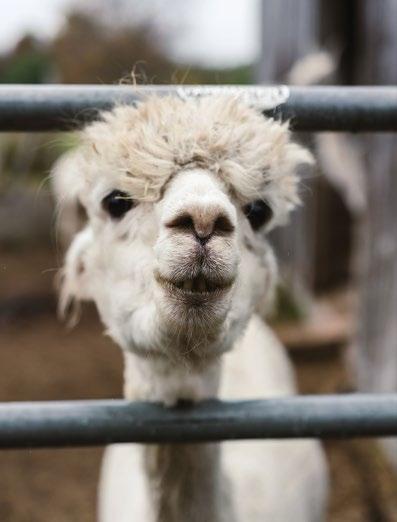
Top left A curious creature at MacDonald’s farm.
Top right MacDonald works on a vat of dye.
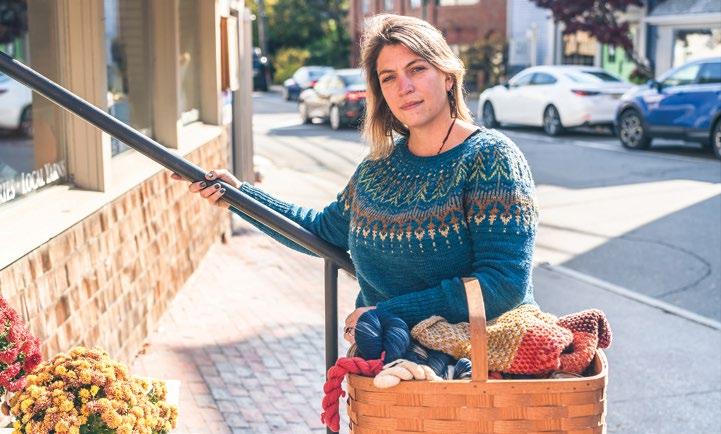
Bottom left Instructor and artist Jackie Ottino Graf stands with a basket of her hand-dyed fibers.
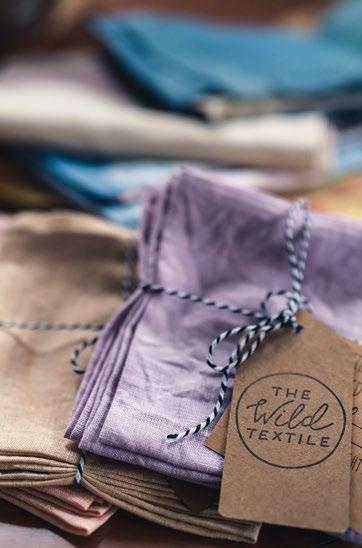
Bottom right Soft purples and beige linens created by Lizz Berry.
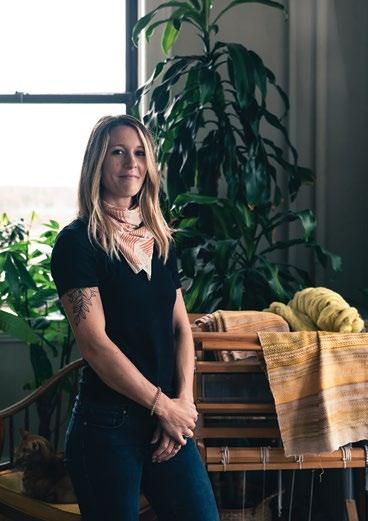
sheep, spins her own yarn, and dyes it on-site using seawater and mineral-based dyes. Kennedy sells yarn, blankets, sweaters, and other products (many of which are knitted by her team of “cottage industry divas”). Although it’s not a huge industry, there seem to be a surprising number of sustainable textile makers working in Maine, from the largescale (Swans Island Blankets in Northport uses natural dyes, including real indigo) to the small (like Allysun West, who sells a line of hand-dyed and -sewn garments at CIA Cafe in South Portland).
The Wild Textile is one of the smaller players in the game. By day, Lizz Berry works for the Maine Crafts Association. Her experiments with natural dyeing happen in her off-hours, when she’s relaxing with a bunch of avocado peels or a boiling pot of onion skins. She sells and makes her wares out of her Portland apartment. Like many people in the craft space, Berry is both trained (in textile art) and self taught (in the art of natural dye). “In college, we used ‘reactive dyes,’ classic chemical dyes,” she explains. “I made the switch because I was bored. I was bored seeing it. It’s the same color, every time, the same fuchsia. Everyone in the world can purchase that dye and make that fuchsia.” But even if you collected a week’s worth of avocado peels and pits just as Berry does, and even if you boiled them on the same stove she uses, and even if you added in a stack of cloth napkins ordered from the same source, you still wouldn’t have the same table linens as Berry. Natural dye doesn’t work like that. It’s varied and changeable. For some artists, that’s exactly why they like it. These days, any kind of naturally dyed cloth is a novelty. It’s cheaper and easier to produce denim with synthetic indigo than it is with natural indigo. The color often lasts longer with synthetic dyes. These chemicals aren’t bad or dangerous necessarily and there’s good reason to use synthetic colors. They create uniform results. They offer a huge variety of options. Some synthetics are perfectly eco-friendly (ironically, green tends to be the most toxic color to produce synthetically, which adds another layer to the term “greenwashing”). But many artists and makers continue to use plant-based and animal-derived colors for how it makes them feel.
MacDonald enjoys the process of making dyes, experimenting with color, and crafting with yarn almost as much as she enjoys spending time with her animals. (They were the driving force behind her choice to move out to rural Buxton, she says.) She mixes dyes to create new hues, like indigo and goldenrod—which form a gorgeous green—and
plays with historic colors. She recently completed a project for a quilt expert from York, who was looking to get exactly the right color of red to complete a restoration project. “She needed it to match the old fabric exactly,” she says, “so I used dyes derived from insects.” MacDonald isn’t a bug-farmer, so she sourced her cochineal (made from the pulverized bodies of cacti-dwelling insects) from abroad. “I used to be a purist,” she says. “But I just love some of the colors you can get from things like lac, cochineal, indigo, and madder root. I always have those on hand.”
Dye instructor Jackie Ottino Graf, founder of “mobile dye studio” Forage Color, points out that it is “very hard to get a rainbow with colors from Maine.” Our short growing season means we have a limited color palette for would-be dyers. Plus, some of the mollusks and insects that have historically been used to create bright
purples and reds simply don’t live this far north. However, there’s still a wealth of colors available, if you know where to look. “There are so many dyes that come from trees,” Ottino Graf points out, and as the most heavily forested state in the country, we have no shortage of birch, apple, walnut, and oak. Natural dyers can use both leaves and bark to generate colors for their textiles, and while most trees produce earth tones, birch can be used to create lavender and mauve. Oak can create a range of ambers, cinnamons, and chocolate tones.
Weeds, too, are a fertile source of color.
Goldenrod, Queen Anne’s Lace, and pokeberry can all be used to transform a plain piece of wool, linen, or cotton. In addition to foraging, Ottino Graf also likes to use food scraps for her dyes, and she harvests some colors from newly minted farmers.“I do a lot of growing with the Belfast Middle School,” she explains. “They have a massive garden that grows tons of food. A few years ago, we started a project where they learned all about dye plants. We started them in the greenhouse and grew them in the garden.” Now, every year, Ottino Graf works with the seventh grade students to grow, harvest, and dye their own piece of textile art. They use Japanese binding techniques (similar to tie-dye) to create their own patterns. “Each student makes a shibori bandana to wear to the Common Ground Fair,” she says. “It’s a pretty elaborate project.” Although interest in natural dyeing appears to be on the rise, it remains a relatively niche hobby. Fortunately, Maine is a good place to do this kind of slow, landscape-based work. Not only are there students (both young and old) interested in learning these practices, but there’s also a strong interest in supporting the arts. “Maine is a craft destination,” Berry says. “It’s incredible for my line of work because there’s such a big presence of good, fine craft, especially given how few people live here.” In some ways, it’s easier to be a craftsperson in Maine than elsewhere because tourists come here expecting to buy niche goods, like naturally dyed table linens made in a city sink or skeins of wool straight from the farm. It’s part of the experience. They want to take a bit of local color home with them. And just as importantly, Berry says, the people who live here are “willing to pay for it, too. You don’t have to explain to them why it costs what it costs. People here understand the slower lifestyle.”
katy kelleher is the managing editor of Maine Farms . She lives in Buxton with her two dogs, one husband, and one daughter.
Above Berry lives and works in Portland. She does much of her dyeing in the kitchen sink. Opposite page Wool hangs from a tree in Buxton. Although you can’t get quite the same range of colors from natural dyes as you can synthetic products, these hues have their own appeal.
Essential Wisdom for Collective Healing
Indigenous perspectives on the ongoing occupation of land and how we can move forward, together.
BY SUZANNE GREENLAW AND ALIVIA MOORE | PHOTOGRAPHS BY NOLAN ALTVATER
Land is Kin
suzanne greenlaw is a citizen of the Houlton Band of Maliseet Indians and a PhD candidate at the University of Maine School of Forest Resources. She is an ethno botanist focused on mobilizing Indigenous Knowledge and cultural practices to address Indigenous cultural resource issues such as reduced access, invasive species planning, and loss of traditional food sources.
Rivers and Resources
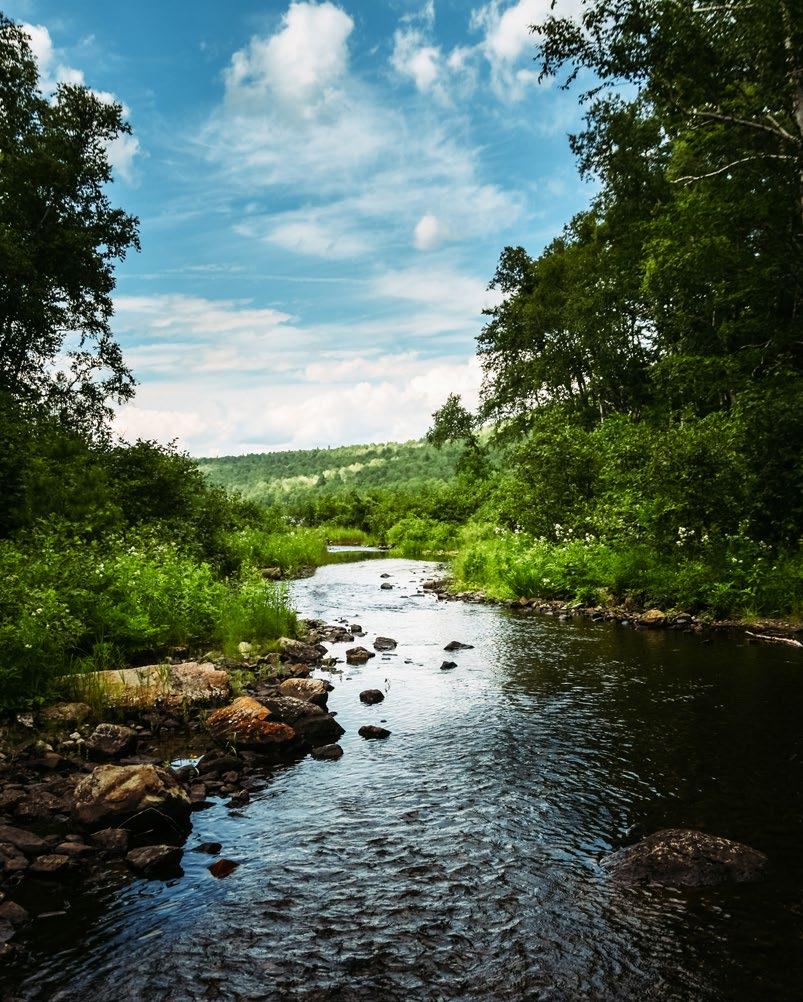
Traveling in your car on the highway you plot how far away your exit is or where the next gas station will be. On the road you pass over a river, often traveling perpendicular to the way the water flows. The only reference to Wabanaki traditional travel systems is in the signs you see, often in a language unknown to most Mainers. Many of the river or landscape names are Maliseet, Mi'kmaq, Passamaquoddy, or Penobscot in origin. These words are the formulation of Wabanaki knowledge and informed how, why, and where we would travel. For generations, Wabanaki people traveled these routes and developed an intimate knowledge of the river, rocks, and all that inhabits Wabanakiyik. These lands extend throughout what is today known as Maine and the Maritime Provinces. Throughout Wabanakiyik, the rivers were our highways. They carried us from coast to inland, to visit other communities and families, and to lead us to and ensure access to resources.
Two resources that have continually held a significant place in our culture are sweetgrass and brown ash. We still travel to the coast for sweetgrass and back inland to floodplains for brown ash. Although today our canoes have four tires, our harvest practice has not changed and is informed by our ancestral teachings. Harvesting is a practice of Wabanaki philosophy in caring for non-human relatives. This philosophy assumes that both the resource and humans have a responsibility towards each other; a tree will provide for humans and in return Wabanaki people welcome kinship responsibilities to our non-human relatives. Our sustainable practice is exemplified through our continual resource harvesting in the same stands over generations. The areas where we harvest sweetgrass and brown ash are the same locations where our fathers, our grandmothers, our ancestors once harvested. Within our harvesting, we practice a form of internal gover-
nance that emerges from our ethics and values to ensure future relationship between the grass and Wabanaki people.
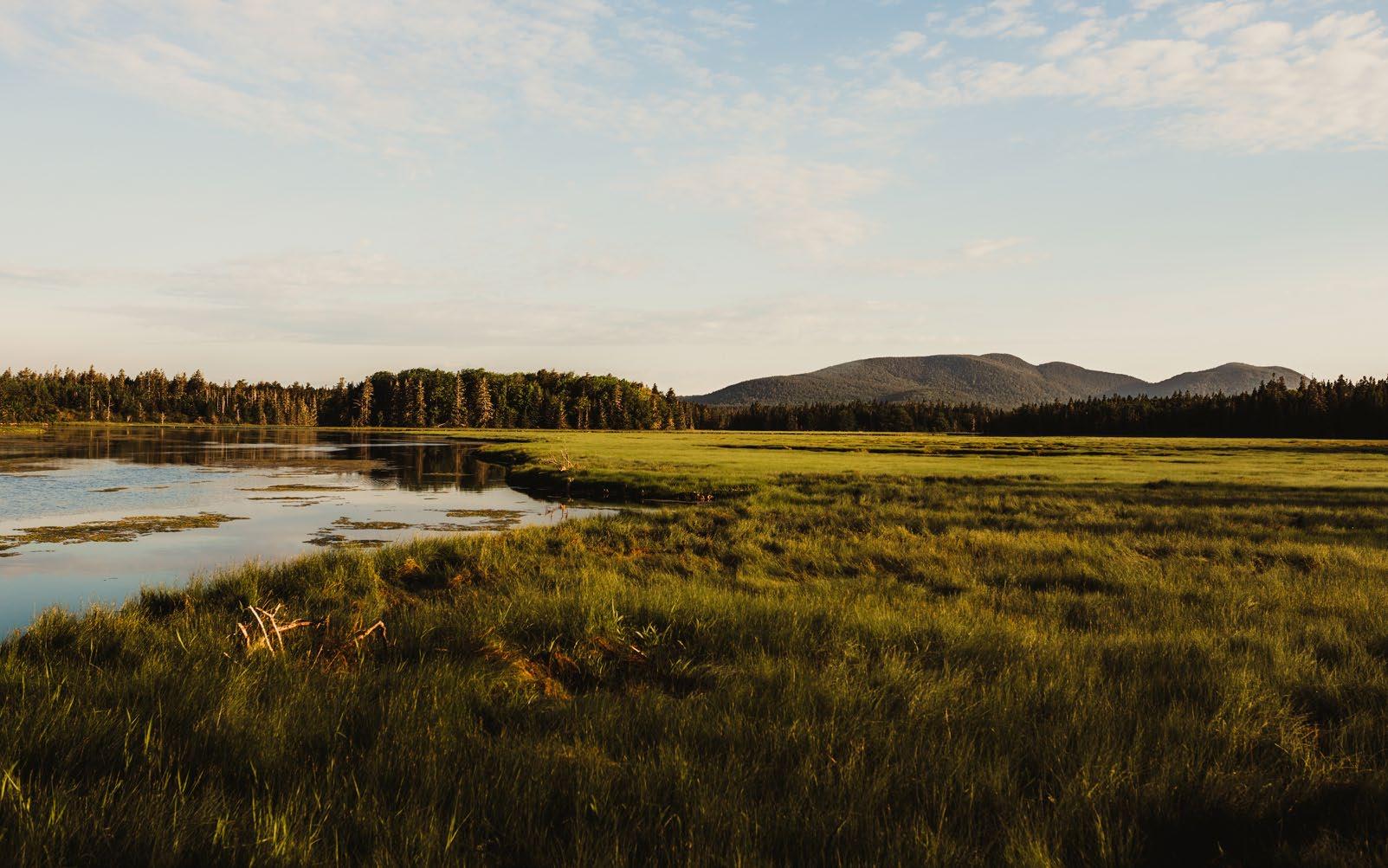
Brown ash is a small tree that grows in wetlands or riparian river floodplains. Sweetgrass is a grass that grows in salt marshes and wet meadows. Both of these resources had little value to settlers. Farmers altered the ecological habitats of saltmarshes or floodplains to create more usable farm land. In some of our harvest locations, the settler legacy is evident though man-made dikes that drained the salt marsh or the remnant of stone walls that delineated settler properties. As I lift my leg to step over a rock wall or take a running leap to jump the salt marsh dike, I’m reminded of the cultural intersection of worldviews in land use and kinship roles. The western approach of land as property fostered the complete alteration of an ecosystem to support domesticated animals. Wabanaki philosophy, where land is kin, fosters a recognition of land as sovereign and holding agency. Reciprocity and respect are tenets within this Wabanaki approach. Respectful harvesting strengthens our connection to non-human relatives and in return brown ash and sweetgrass shape our culture.
Baskets and Resistance
Both brown ash and sweetgrass are integral in our basket making tradition. They have spiritual, cultural and economic significance. We have creation stories with both sweetgrass and brown ash. Before European contact, brown ash baskets were made to gather and prepare food and trap fish. The role of basket making took on greater economic importance for Wabanaki communities as traders, tourists, and industry formed a consumer market for Wabanaki baskets. From the 1850s to 1950s, Wabanaki baskets were sold for Northern
Maine farming and hunting, Down East Maine fishing, and Coastal Maine tourist industries. By the 1900s, every Passamaquoddy and Penobscot household was involved with basket making. While economic incentive is a driving force for Wabanaki basket making, the internal need of brown ash basket is more complex than just sales. Brown ash basketry was a tool for Wabanaki people to adapt to a changing socio-economic environment while maintaining cultural traditions. Basket making provided a source of income, maintained travel routes, fostered language use, and strengthened family connections. Federal and state agencies employed poverty and starvation to force Wabanaki assimilation. Basket making was a form of resistance to cultural genocide.
Wabanaki basket makers had a reciprocal relationship with private landowners. Often basket makers would exchange a basket for gaining access to ash stands. Many farmers would allow access to ensure they could buy baskets from those Wabanaki people. Richard Silliboy, a Mi’kmaq basket maker elder, remembers weaving up to 125 baskets a week with his family to supply the Northern Maine potato farming industry. While the relationship was reciprocal, it wasn’t equitable. Dispossession of Wabanaki lands and private property laws were settler colonial tools to benefit the statehood of Maine and its citizens. Wabanaki people were denied citizenship and the right to vote until the late 1930s and 1950s respectively.
With 90% of the state’s land privately owned, land access is crucial for many people across the state. Wabanaki people rely on private property access to reach traditional harvest sites. Many Wabanaki harvesters report a reduction in access with some experiencing contentious interactions with land owners.
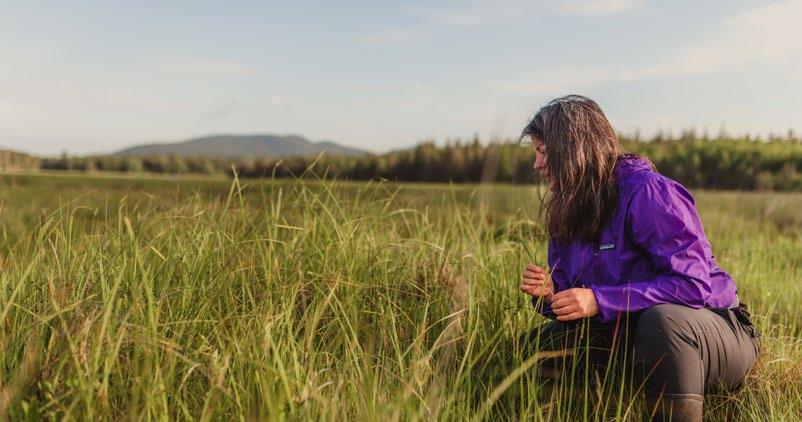
Imagine you are sitting in a salt marsh, surrounded by sweetgrass. You’re in a location you have gone to every year since you were a child. Your grandmother taught you how to pick sweetgrass in this location. The sweetgrass is tall and healthy because your harvesting techniques have helped the grass to thrive. The breeze picks up and water ripples in the salt marsh channel. Your ancestors traveled these waterways. Time is not linear but circular. Your ancestors are here with you. Your grandmother is here with you, guiding you. Suddenly a sharp voice breaks your thoughts. You look up and a man is pointing his finger aggressively at you, yelling at you to stop tearing up his grass. You try to explain what you are doing but it does not matter. He tells you if he finds you here again, he’ll be carrying a gun. There is nothing you can do. You leave and never go back. Many Wabanaki people do not have to imagine this scenario. This is their truth.
A Project in its Infancy
alivia moore (she/they), of the Penobscot Nation, is a two-spirit community organizer committed to restoring balanced relationships with the earth. As co-founder of Eastern Woodlands Rematriation, they support the revitalization of indigenous food & healing systems, working closely with the Wabanaki Community Herbal Apothecary & Rematriation School. She is also dedicated to child welfare system reform and fosters native children.
The future of the land is its liberation. As a sovereign being, the earth will always take its course to restore balance, and there is an opportunity for us to collectively embrace this reality. We can choose to mirror the earth's propensity for balance and with that, we can allow for the possibility of human liberation. What we must do is respect the land. We must humble ourselves to understand that we can’t heal it. We are not the earth’s saviors. We may make claims to the earth by imposing our laws and our private and collective ownership structures on it, but ultimately the land cannot be owned. We are derived from the land, it holds us rather than any of us truly being land holders.
Rematriation
Rematriation in Maine is a process of Wabanaki people restoring our matriarchies with matriarchal laws and relationships being embraced by the people of this land again. Wabanaki matriarchies, our social, economic and political systems, have been developed in deep relationship with and humbling ourselves to the cycles of the earth. Prior to colonization, our societies were more balanced, egalitarian, resilient, and responsive. The worldview of Wabanaki peoples is one of understanding all things in cycles— whether it be seasons, life cycles, and seasonal village locations. Our cultures are reflective of the earth, respecting natural limits and being simultaneously predictable and flexible. Wabanaki languages demonstrate our expansive non-binary cosmology, rather than gendering beings with concepts of “he” and ”she”, we generally use “they” which means something is alive. We know that all beings—human, plant, rock, animal, and so on—have a gift and a role to play in service of others. Matriarchies, where decision-making is based in nurturing, honor everyone's gifts. The source of power differs from dominant culture where power is derived from
influence over others and resources; matriarchies recognize power from within and cultivate reciprocity that strengthens the collective. Matriarchies are a system of human law that lays out our responsibilities to the earth and one another rather than our rights and entitlements.
Burgeoning solutions in the agricultural community such as regenerative agriculture, permaculture, and community land holding are indigenous practices that were forcibly disrupted by colonization. While these approaches move us towards relational ways of respecting the land, the indigenous embodiment of them differ from the white-led movements of today in crucial ways. Wabanaki “regenerative” food systems are time tested and developed hyperlocally in reflection of the specific parts of the earth where we have thousands of years of deep reciprocal relationships.
To attain justice on the land, it is necessary to grapple with settler colonialism, white supremacy, and to understand agriculture as a tool of historical and present day genocide of Wabanaki people. Indigenous and Black folks are the most immediately impacted by existing extractive relationships to the land; we can more clearly see the tactics of oppression and harm. Indigenous and Black folks together must lead land justice work; white folks can do more to dignify our struggle and align with our movements.
Our Maine farming and fishing communities need to honestly and wholly reckon with the past, which continues to shape our current reality. It is past time to examine power relationships to and on the earth. The way we relate to the earth is how we relate to each other.
Indigenous people know that food and healing systems are pathways to becoming rooted in the earth again; they are avenues for transforming society. Reciprocity and responsibility need to become central to how we exist on the land and how we organize society. Now is the time to adapt and to come into right relation. Climate
Only take what you need.
gluskape
crises, social inequities, and racialized violence often leave us feeling entrenched in destructive pathways of exploitation, white supremacy, and colonialism. Remember, however, that the American project is in its infancy. The Wabanaki nations of the Abenaki, Maliseet, Mi'kmaq, Passamaquoddy and Penobscot exist and were developed in reflection of this land for at least 12 millenia. We are the elders here, we carry essential wisdom for collective healing
Unsettling our relationship to land
Just as we share this land, we share a future. The earth, its land and waters, is the basis of all beings’ survival. The earth is our only source of true security. Land is also at the heart of settler colonialism, extraction, imperialism, and environmental collapse. We are inviting our non-indigenous relatives into the process of unsettling current harmful ways of relating
and to position yourselves to adapt, as Wabanaki people have done since time immemorial.
For us to come into relationship with the land as a relative, private land ownership must be ended. While a colonial land ownership structure is still in place, the rightful return of Wabanaki land to Wabanaki nations and Wabanaki-led land trusts should occur. Wabanaki, Black, and brown people should have access to land and water through cultural use agreements. This will provide an opportunity for us to revitalize our earth-based traditional economies. Support indigenous restoration of our political, economic and social systems founded in matriarchal values. Acknowledge matriarchies as the human law of the land. As non-Wabanaki, respect that you are visitors here and know that Wabanaki people, in accordance to our responsibility as your host, will make sure your needs are met in our territory. Trust the leadership of Wabanaki peoples, we are here continuing the work of our ancestors—this work benefits all that call Wabanakiyik home.
Where We Stand: Indian Tribal Lands in Maine
Wabanaki is a regional identity encompassing members of the Passamaquoddy, Penobscot, Maliseet, Abenaki and Mi'kmaq tribes. Today, there are approximately 8,000 Wabanaki Tribal members and countless direct descendant kin living in Maine. Federally recognized tribes in Maine include the Penobscot, Passamaquoddy, Houlton Band of Maliseets, Aroostook Band of Micmacs. In Maine, 90% of land is privately owned. Wabanaki people are able to legally access just 0.01% of their ancestral land and waterways. In Maine and across the country, efforts to re-establish Indigenous access and stewardship of the land are taking root.
Androscoggin River
Penobscot Trust Lands
Penobscot Fee Lands
Penobscot Reservation Islands
Passamaquoddy Trust Lands
Passamaquoddy Fee Lands
Maliseet Tribal Lands
Mi'kmaq Tribal Lands
FRANKLIN
Machias
Eastport
Houlton
Resources for Healing
A few ways to support Wabanaki land access:
Educate yourself about Wabanaki history and land dispossession in Maine. Attend a Wabanaki REACH workshop about Wabanaki history. Read about Wabanaki land loss and tools to expand Indigenous land stewardship.
Read about efforts to uphold and restore Wabanaki sovereignty and LD2094 An Act To Implement the Recommendations of the Task Force on Changes to the Maine Indian Claims Settlement Implementing Act. Learn more about the recommendations the Indian Land Claims Task Force recently made to change the Maine Indian Land Claims Settlement Act and affirm Wabanaki sovereignty.
Support Wabanaki organizations and initiatives, including:
The Wabanaki Commission on Land and Stewardship Nil yut ktahkomiq nik (the whole earth is our home) improves the health and well-being of Wabanaki people through a sustained effort to expand access, management, and ownership of lands to practice land-based cultures across Wabanaki homeland in what is now the State of Maine.
The Wabanaki Alliance advances and advocates for policy on the state and federal level which will better the lives of all members of the tribes in Maine. The Wabanaki Alliance was formed to educate people of Maine about the need for securing sovereignty of the tribes in Maine.
Wabanaki REACH supports the self-determination of Wabanaki people through education, truth-telling, restorative justice, and restorative practices in Wabanaki and Maine communities.
Bomazeen Land Trust is dedicated to social and environmental justice in Wabanakiyik, to protecting and honoring culturally significant spaces through the repatriation of ancestral remains and artifacts, and the rematriation of ancestral land.
Eastern Woodland Rematriation Collective is boldly reclaiming the right to food and relationship to the earth for Indigenous peoples by focusing on land rematriation, with an emphasis on restoring indigenous spiritual foundations and relationships with Indigenous food systems.
Wabanaki Public Health provides community-driven, culturally centered public health and social services to all Wabanaki communities and people while honoring Wabanaki cultural knowledge, cultivating innovation, and fostering collaboration.
Nibezun aims to begin the process of healing through seven components of healing; Mind, Body, Soul, Social, Earth, Culture, Water. Each of these components promote the healthy life ways, planting seeds of healing by way of Wabanaki culture, ceremonies, traditions and language.
Maine Indian Basketmaker’s Alliance is a nonprofit Native American arts service organization focused on preserving and extending the art of basketmaking within Maine’s Native American community. MIBA seeks to preserve the ancient tradition of ash and sweetgrass basketmaking among the Maliseet, Mi'kmaq, Passamaquoddy, and Penobscot tribes.
Wabanaki Youth in Science Program (WaYS) is a collaboration involving the University of Maine at Orono, the U.S. Forest Service, and Wabanaki tribes designed to engage Wabanaki students (6-12 grades) through their cultural heritage and environmental legacy to encourage persistence in sciences through college and into a career.

photographer nolan altvater of Sipayik is a Passamaquoddy citizen and forthcoming student at Harvard Graduate School of Education.
IT TAKES A VILLAGE
With farms facing uncertainty across the state, one couple reveals how they’ve made it work—they didn’t do it alone.
BY JESSE ELLISON | PHOTOGRAPHS BY CHIP DILLON
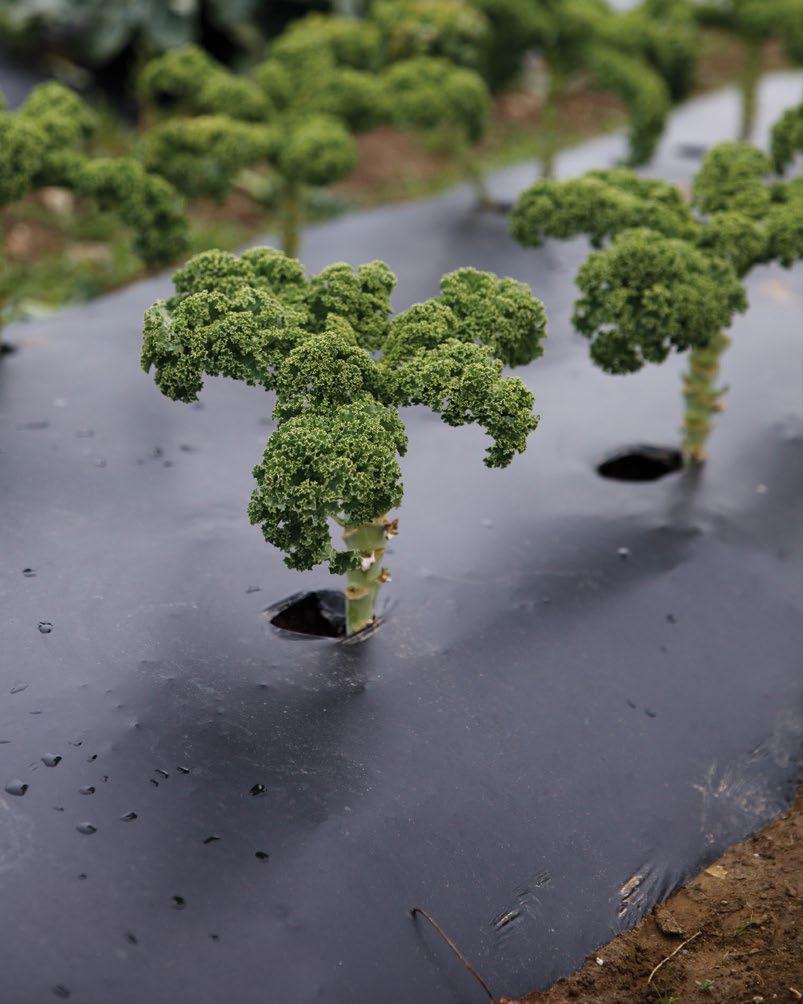
The last day that Mike and Christa Bahner’s farm stand was open in 2020 fell on the day before Halloween, the first bitingly cold day of autumn. Despite a vicious wind, a steady stream of customers continued through the morning, pulling off of the busy stretch of Route 3 and donning masks to approach the window and make their requests. A little ways away, under the protection of plastic, a tender quilt of winter greens was growing, vegetables almost ready to harvest.
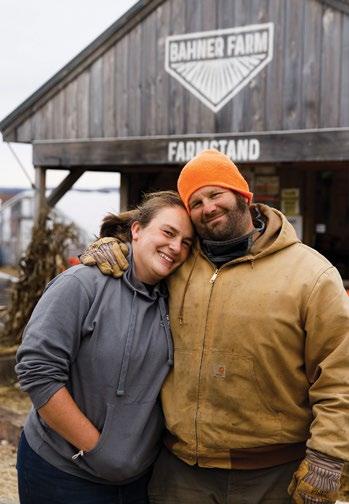
As they walked down the hill that slopes from the house to the high tunnels, Mike and Christa pointed out the parts of the farm that they’d gotten help to purchase or build. The list seemed to encompass everything. It included multiple trucks; the compost pad; the building they use for washing, packing, and storage that they call “the palace;” the farm stand and parking lot; even the house that they live in. Their eleven year old farm is in the business of selling organic vegetables, and they do that very well, but to hear them describe it, it’s clear that the whole enterprise is also supported by a largely invisible network of outside support. “I just feel so incredibly lucky,” Christa said, looking around the property. “I just feel like we are the luckiest bastards in the world this year.”
Farming, of course, is a notoriously tough industry. Every five years the National Agricultural Statistics Service, part of the Department of
Left At the tail end of the 2020 season, kale was the last vegetable standing.
Right “All year, we were really scared,” Christa says. “We thought, ‘Well, we had a great spring because people were excited about seedlings, but maybe we’ll have a bad August because the tourists won’t be here.’ We just didn’t know.”
Agriculture, conducts a census on agricultural data. The last one, conducted in 2017 and released in 2019, showed some serious cause for concern for the future of farms and farmland in Maine. It clocked a statewide loss of 573 farms over the previous five years, and an almost 16% decrease in average income, down to just $16,958 per farm. It also showed that fully half of Maine’s farms aren’t profitable at all, and half of those farming in Knox, Lincoln, and Waldo counties get their primary income from off-site work.
“The story of agriculture is not the story of pulling yourself up by the bootstraps and going out to the prairie,” Mike says. “The history of agriculture is that somebody rich owns the land and you work your ass off your entire life to never actually own any of it. It’s
only in recent years that that’s changed.” He says he and Christa have “gotten lucky” but have also “been working our asses off” building Bahner Farm into what it is today.
Mike believes that the programs that have helped them are representative of a well-run social democracy. “That’s the thing about a lot of these programs we’re tapping into,” he says. “It’s all part of the investment the government in a social democracy should be making in things like agriculture. You don’t just put tariffs in place and hand farmers checks to replace the soybeans they couldn’t sell. That’s bullshit.”
"The history of agriculture is that somebody rich owns the land and you work your ass off your entire life to never actually own any of it."
Christa and Mike were both well into their 20s before they decided to pursue farming as a career. Christa grew up in Cambridge, Massachusetts, and came to Maine after working as a guide on the Appalachian Mountain Club trail crew. She started working on farms in Penobscot County because she wanted to be outside, and to do something that was physical. She completed a MOFGA apprenticeship, and worked at a horse-powered farm started by a group of back-to-thelanders in the 1970s, but it wasn’t until she started working at Peacemeal Farm in Dixmont that farming came to seem like an actual, viable career. “That was the first farm I worked on where it was clear that they were supporting themselves,” she says. “The other farms had some kind of other support—they’d been passed down or whatever.” Peacemeal, she says, made farming seem like a lifestyle she could pursue.
Peacemeal was also where Christa met Mike. He’d grown up in Vermont and Indiana and spent a few years working on his undergraduate degree at the University of Maine at Orono before getting work painting houses in Bangor. He entered into farming at the suggestion of a friend, who knew of Peacemeal from the local farmers market. “I was in my second year working on that farm when the idea dawned on me that, ‘Oh maybe I could do this. Maybe I should do this’,’” he says. Like Christa, he liked being outside, and he was intrigued by the myriad skills farming
requires—things like physical strength, personability, entrepreneurialism, and soil science. “I think for my mother, it was odd,” he says of his decision. “She was raised by a single mom who was the daughter of immigrants. My grandmother lived through the Depression. They had that immigrant mentality where you’re either an engineer or a doctor or a lawyer—that’s the first tier. The second tier is teacher, and everything else that has a stable income. Farmers aren’t even on there.”
Mike worked at Peacemeal for four years, and lived on site for three. Christa, meanwhile, decided to study agriculture, and then got into MOFGA’s farmer-in-residence program. She spent two years living on MOFGA’s land in Unity, growing demonstration crops for the annual Common Ground Fair. When it came time for them to start their own operation, they had about $3,000 in savings and a loan of less than $10,000 from a family member. It wasn’t nothing, but it wasn’t enough.
“In order to be a farmer you have to also be an entrepreneur,” Mike says. “There isn’t a big career ladder you have to climb. There’s no middle management to speak of.” Instead, farmers have to cut their own paths, figuring out not just the particularities of growing their crops or raising their animals, but also the logistics of actually getting their products to consumers. “That’s really the most difficult part—how
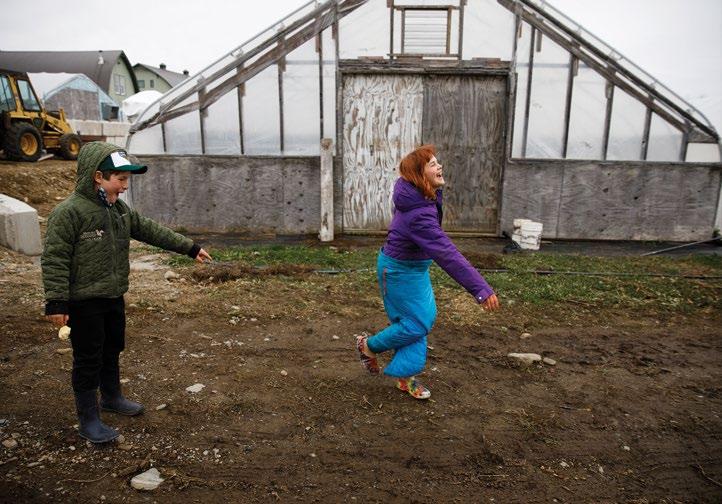
years later. The two already have their own little garden, and plan to sell their vegetables and flowers at the Camden Farmers Market.
Left Lizzy, in tie-dye printed Crocs on a frigid day, was born the first year the Bahners owned their Belmont property. Nicky came along a few
It’s clear that the whole enterprise is also supported by a largely invisible network of outside support.
you’re going to sell it. That’s also [what makes it] difficult to convince anyone that it’s worth investing in.” Mike explains, “Banks don’t want to touch farmers.” They turned instead to the Farm Services Agency, a branch of the Department of Agriculture, which has a program specifically designed to give loans to farmers, an enterprise considered too risky by traditional banks. The loans are a godsend for farmers like the Bahners—they require no down payments and offer extended terms at extremely low interest rates. They’re also a hassle. In order to apply, you need to provide a letter of rejection from a bank, and they can only be secured once you’re already under contract on a property. They require an extremely cooperative seller, and the Bahners tried and failed to buy a couple of different places before they found someone willing to work with them. The loan, Christa says, “made it possible for us to buy our farm. If all mortgages were like that, everyone could have one.”
They started breaking ground on their land before they even closed on it, finally closing on the 37 acre property, a former dairy farm that had been fallow for at least a decade, in late 2009, for just under $150,000. They dove in, deciding to grow and produce in their first season so they could continue selling to farmers markets where they already had connections. “It felt,
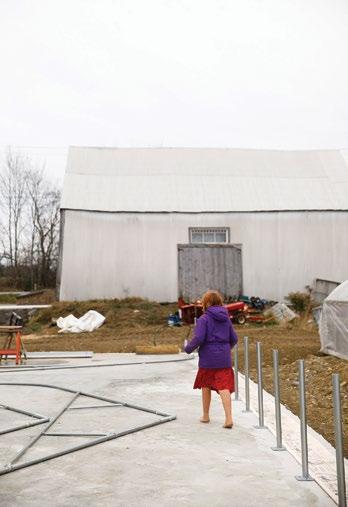
Left Lizzy plays on the poured slab for their new greenhouse, about thirty percent of which was funded by a Farms for the Future grant.
Right “We feel incredibly lucky,” Christa says of having weathered the pandemic as well as they did. “We tried to make sure we were doing more reaching out and donating this year, because we felt so lucky, and a lot of people are not right now.”
in some ways, like a bit of a mess, like any new farm trying to grow in its first year,” Christa says. “It was one of those get married, buy a property, have a baby, within a year,” she laughs. “It was a lot.” But with no employees and hardly any equipment, their overhead was low enough to make it work. For the first few years, Mike worked a winter job at Johnny’s Selected Seeds in Albion.
Every year they scaled up a little more. Slow Money Maine, an organization started in 2010 to connect farmers to lenders and outside business consultants, linked them up with their investment clubs No Small Potatoes and Maine Organic Lenders. They got two small loans—one they used to buy a small box truck to take to farmers markets, the other was used to build additional tunnels and to purchase a truck for
the farm. Along the way, they had their son, Nicky, and leased a couple of additional fields. By 2012 they were selling to four separate farmers markets and feeling like they were spread pretty thin. Their property, which sits on a busy stretch of Route 3, had the sort of road frontage and traffic that makes it perfect for a farm stand. They launched a Kickstarter campaign to build one— asking for $6,800 for construction of the stand, and another $4,796.50 for earthwork to build a parking area.
The stand was built in 2013, but the first few years were “super slow,” Christa says. “If I wasn’t already half chained to the house with little kids, we wouldn’t have done it. It was not easy, but I was there.” Christa says she was later told by a farmer in New Hampshire that people have to drive by sixty times before they
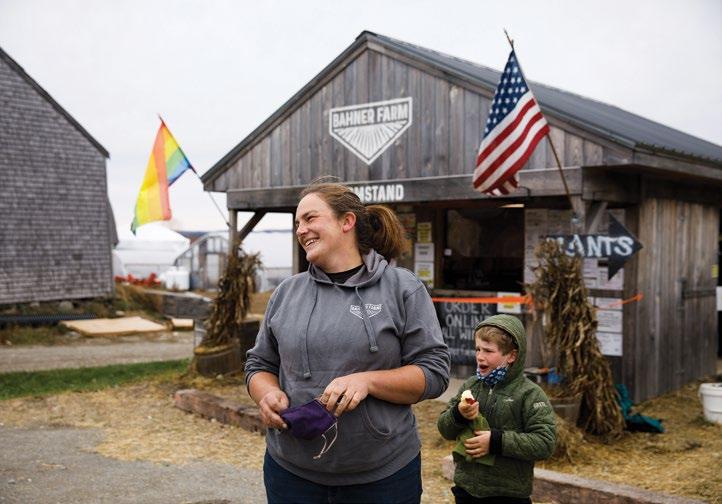
stop in, and that proved to be the case at the Bahner’s. Today the stand is easily their biggest source of income, Christa says.
The same year they built the farm stand, Mike and Christa applied to the Farms for the Future program, a state run program that provides a $25,000 grant along with a 2% loan of up to $75,000 through the Financial Authority of Maine. They used it to build what they call “the Palace,” a freestanding heated building that has a wash space and coolers. “It was just so much better after that,” Christa says. “We had been washing outside under tents. It was fine, but inefficient.”
The drawback of the property is its relatively modest size. For years, the Bahners have leased a few acres here and there to help supplement their growable land. In 2018, they worked with Maine
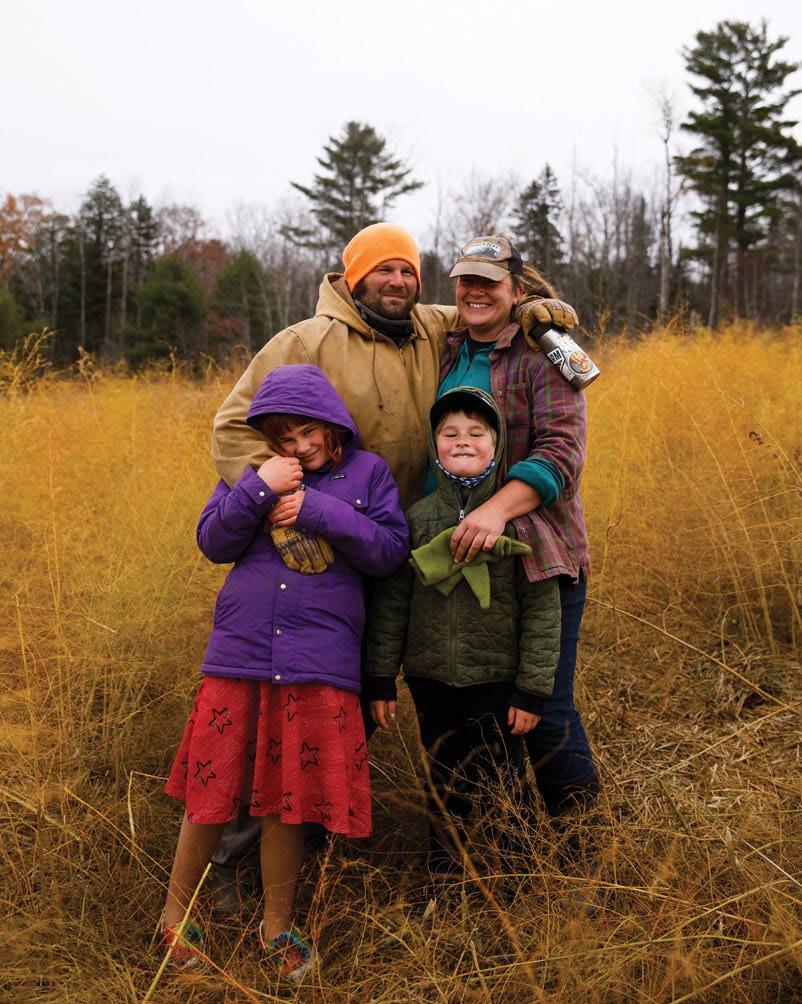
Farmland Trust to purchase a 12 acre field under a conservation easement about three miles from their property. “To be in the sweet spot, we needed at least 15 acres of field available to be rotating and growing on,” Christa says. With only eight clear acres at their Belmont property, “we’d always had this land insecurity.” The fields they’d leased were often with handshake deals, and no security. By purchasing land, they can invest in permanent irrigation, and in lime to enhance the soil. “It was a total game changer,” she says.
“They say it takes a village to raise a child,” says Bonnie Rukin, the coordinator of Slow Money Maine, “I think it takes a whole community to support those who are nourishing our communities with the food that they grow.” Rukin says the Bahners have been a prime example of how a small farm can utilize the network that Slow Money Maine has established over the past decade. She recalls a time when the head of Maine Organic Lenders helped Mike bag lettuce to sell at the Camden Farmers Market. “It’s a win-win connection,” she says, and community involvement and support is something the Bahners have excelled at fostering. “The stand is right there on their farm, the greenhouses, the children are there. It gives you the sense that it’s not just about raising radishes, but children are being raised as well. And the same care goes into each of them.”
At the height of the season, Mike and Christa now employ up to seven full time workers—two to man the stand, and five to help work the farm. They consider themselves fortunate for having weathered the pandemic as well as they did, and they’re shooting, in an industry that can be crushing in its demands, to keep a healthy balance. “We’ve worked on farms where there’s no end to the day, or eating dinner at 9 pm is a normal thing,” Christa says. “Our kids are nine and seven and we don’t have that many years when they’re in the house and wanting to hang out with us, so we’re trying to make sure we have weekends and time with them.” She admits that there are times when she’ll feel exhausted, or even envious of her friends who with “normal jobs” and hours of free time. And yet, she says, “There’s nothing else we would want to do.”
jesse ellison is a freelance writer based in Camden, Maine.
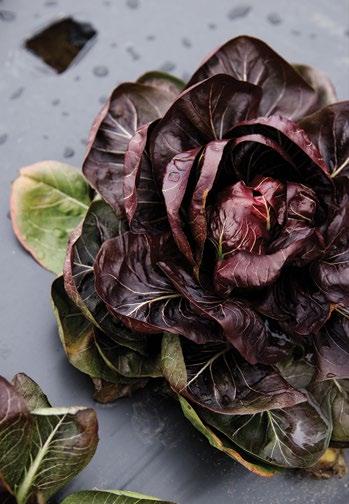
Left Lettuce heads almost ready for harvest. Right The family poses on their land, which was purchased with help from multiple organizations, grants, and loans.
Growing to Give
How gleaning efforts across Maine have increased access to local food during the COVID-19 pandemic
BY LAURA POPPICK
PHOTOGRAPHS BY KELSEY KOBIK
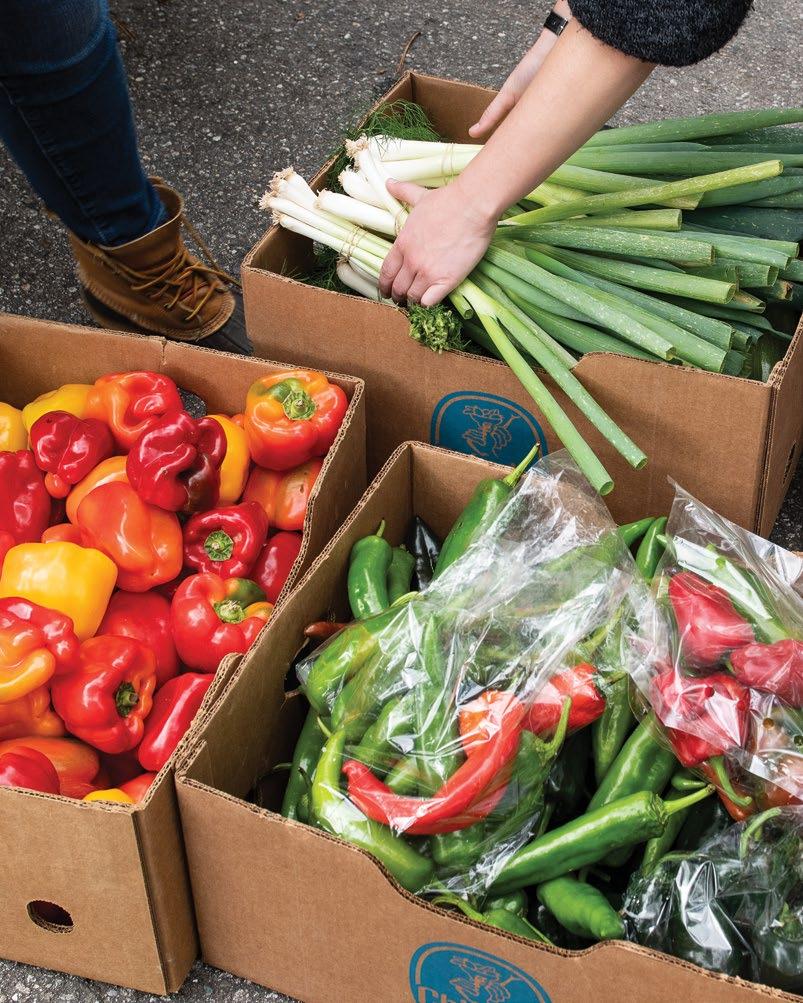
On a brisk January afternoon, cold winds snap through an open barn door at Goranson Farm in Dresden. A small group of volunteers huddles at the edge of the barn around a stack of black totes that brim with the buttery yellows and creamy oranges of winter squashes and root veggies—vessels of sunshine glowing against a landscape now muted by muddy snow.
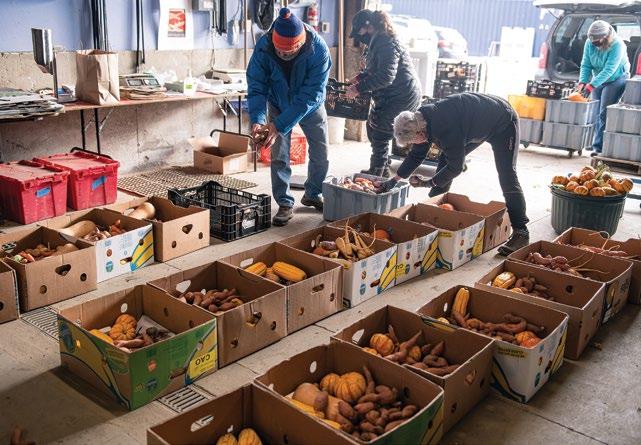
Stationed six feet apart and wearing face masks, the volunteers begin transporting the bright veggies into cardboard boxes splayed out on the barn’s concrete floor. Goranson Farm workers had arrived here earlier in the day to pack goods to sell at a few different Saturday farmers
markets. But we’re not here to prep these veggies for sale. We’re packaging them to donate to a network of hunger relief programs across the Merrymeeting Bay region. We’re here to glean.
The group coordinating the effort, called Merrymeeting Gleaners, spends an hour in this barn each Saturday afternoon collecting veggies deemed not-quite-right for market but in good enough shape to share with local food pantries, soup kitchens, and other groups working to increase community access to local food. The veggies look in perfect condition to an undiscerning eye, but a picky market goer may opt for slightly larger or less blemished options in a bin of
many. So the farmers set these leftovers aside for the gleaners. “They are the wrong size, they are funny shaped, but still perfectly edible and nutritious,” Kelly Davis, the group’s coordinator, tells me as she rearranges boxes full of parsnips, sweet potatoes, and delicata squash.
Merrymeeting Gleaners has collected oddly shaped produce from this barn since 2016 and, in that time, has donated tens of thousands of pounds of vegetables across the region. On this January day alone, the group gathers nearly 1,000 pounds of veggies that lack nothing beyond aesthetic appeal, and that would otherwise be destined for the compost pile. It’s an effort that Jan Goranson, the farm’s co-owner, feels proud to be a part of. “You look at that and you go, ‘that’s going to feed a lot of people,’” Goranson says of the stack of totes piled up each Saturday. “It’s so great.”
A steadily expanding group of gleaning organizations has cropped up across the state in recent years, working with farmers like Goranson to help meet the needs of Mainers who lack the resources to access adequate food. These food-in-
secure members of the community now make up 13.6 percent of the population—including a staggering one in five children—ranking Maine as the most food-insecure state in New England. To help close this hunger gap, organizations within the Maine Gleaning Network have donated more than half a million pounds of food to hunger relief programs since 2016.
Still, even with these considerable efforts, many Mainers remain hungry. The onset of the pandemic last year further deepened this crisis as jobs disappeared and the economy fell off-kilter. In response to this increased need, gleaning groups rapidly formed new partnerships, and farmers who had never before donated to these organizations inquired about ways to get involved. These collaborations resulted in more than 135,000 pounds of food donated over the course of 2020. Those spearheading this work hope that the momentum persists well beyond the pandemic, and that this movement continues to evolve in ways that support Mainers seeking access to local food and the farmers who grow it.
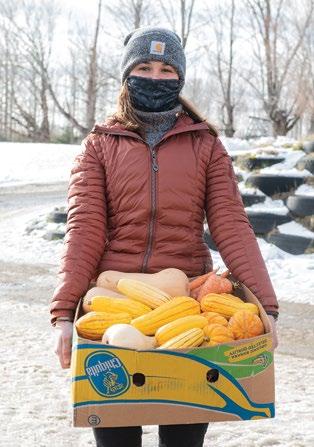
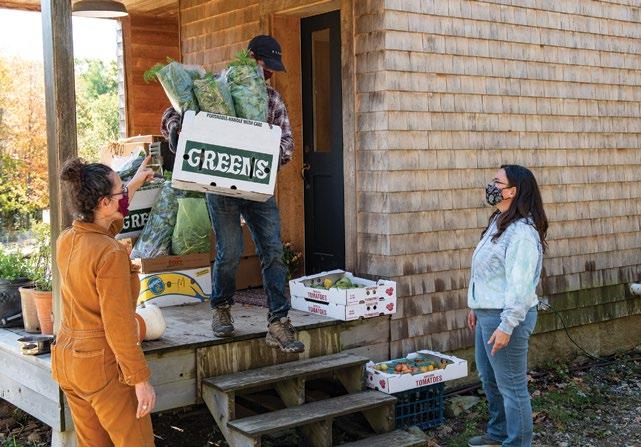
Left A volunteer collects a box of winter squash destined for the Morris Farm's Take-What-You-Need Farm Stand in Wiscasset.
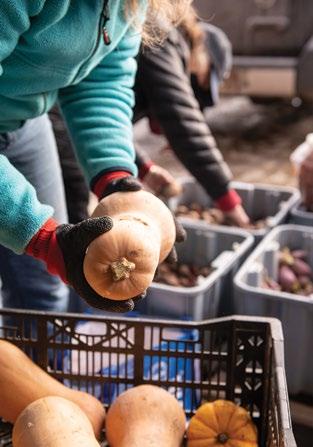
Right A butternut squash with a scar from a crow peck will make a delicious free meal.
Gleaning can take on a number of different forms. It doesn’t always look the way it did on that January day on Goranson Farm. In some cases, gleaners go directly into farm fields and gather surplus crops that farmers don’t intend to harvest. In other cases, gleaning groups may hang around at farmers markets and pick up any unsold perishable goods that would otherwise become compost if not distributed that day. And in still other cases, some farms grow food for the sole purpose of donating to hunger relief programs and gleaning groups.
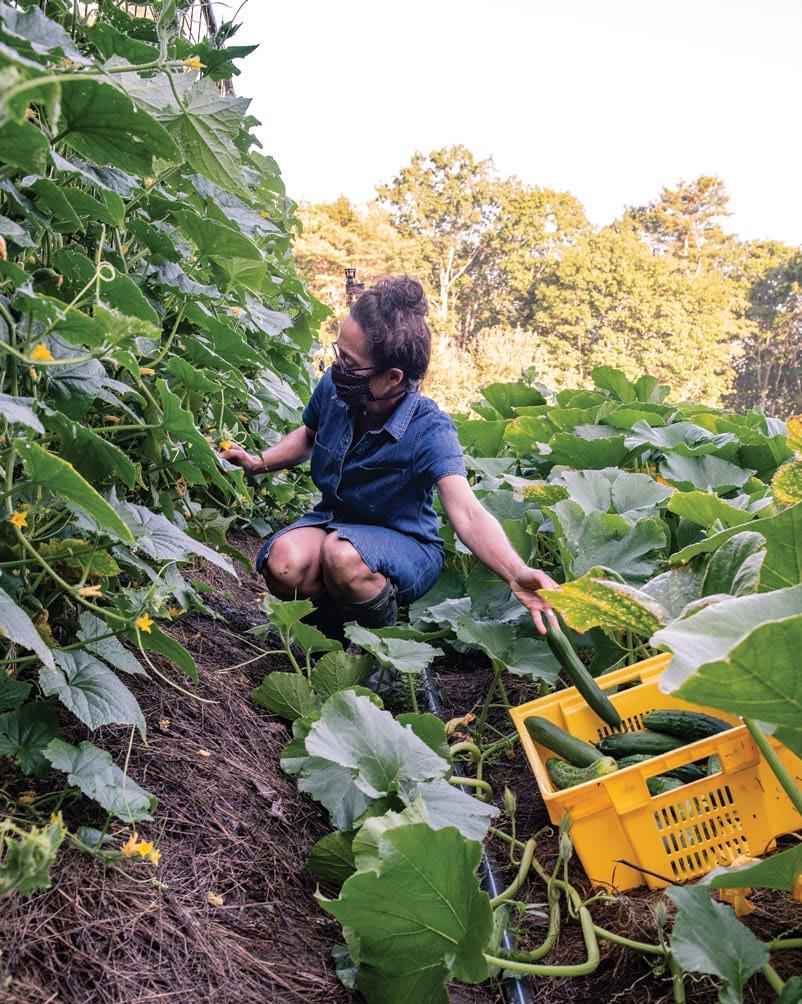
This is the case for Veggies to Table, a nonprofit organic farm in Newcastle committed to donating 100 percent of its crops to help address food insecurity in Maine. Last year, they donated 11,000 pounds of goods grown on just half an acre, distributing these products to more than 30 different programs in the region. This was twice the amount they produced during their first season in 2019—a jump in production motivated largely by the
rise in need brought on by the pandemic, says Erica Berman, the farm’s founder. She says in addition to typical veggies one might expect, she also weaves in flowers and other striking goods like purple Brussels sprouts to increase the beauty and whim of her donations.
No matter the form that gleaning takes, the work always requires a fair amount of coordination and a lot of help from volunteers. In a typical year, Kelly Davis with Merrymeeting Gleaners manages roughly 150 volunteers who help with tasks ranging from harvesting, to packaging, to transporting veggies to their final destinations. The number of prospective volunteers ballooned in 2020 with more people out of work and looking for ways to productively spend their time—including some who had become more food-insecure themselves and appreciated the opportunity to take a bag of food home at the end of a shift, Davis says.
Betsy Fear, a Woolwich resident who began volunteering with Merrymeeting Gleaners
Members of the Merrymeeting Gleaners sort a week's worth of second-quality produce culled from storage at Goranson Farm in Dresden.
before the pandemic, says she considers the work a form of comfort food in itself. “It’s giving me good feelings that I think we all really need right now,” she tells me amidst the gleaned goods on that January day.
The process that afternoon goes smoothly and wraps up before the hour is complete, with Lila the farm dog happily chewing on a stray sweet potato under a beam of January sunlight. The speed and efficiency of the operation is a testament to how well Davis orchestrates the work and the volunteers. She benefits from years of experience—having led the group since it formed in 2016—and shares some of her wisdom and insights with other gleaning coordinators through the Maine Gleaning Network’s monthly Zoom calls.
Lauren Hickey, Local Food Coordinator with the Cumberland County Food Security Council, attends these meetings and says she gains a lot from the support within that network. “It’s really nice,” she says. “A lot of
the gleaning groups are really connected."
The fruits of these collaborations have been substantial, including a grant the network received last year to purchase 40,000 pounds of potatoes from Maine farmers who weren’t able to process them due to COVID-19 restrictions. The funds allowed the network to pay the farmers fully for their potatoes and transport the goods to drop-off locations across the state.
Growers don’t generally expect this type of compensation for their gleaned crops, and many happily donate food with the knowledge that it will make a difference in somebody’s life, Hickey says. But she and her co-worker Colleen Donlan hope to increase opportunities to compensate farmers in this way to make gleaning more sustainable for all parties involved. “We really want farmers to get paid for their produce,” Hickey says. “Our goal is to prevent food waste in the first place.”
Preventing that waste requires not only identifying farmers who have surplus food, but also coordinating ways to gather, refrigerate, and
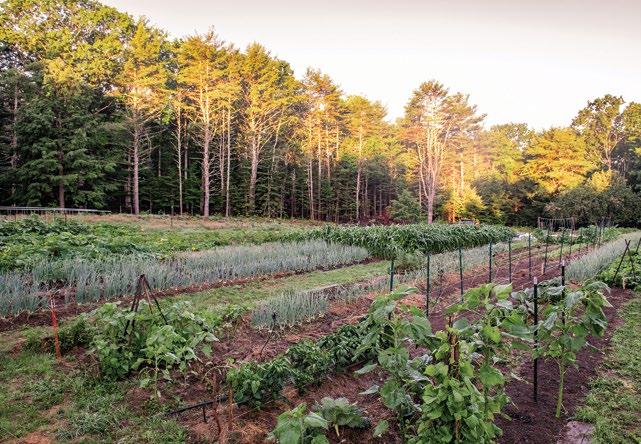
Above Fields of vegetables growing to be donated at Veggies To Table. Right Erica Berman harvests cucumbers at her farm, Veggies to Table.
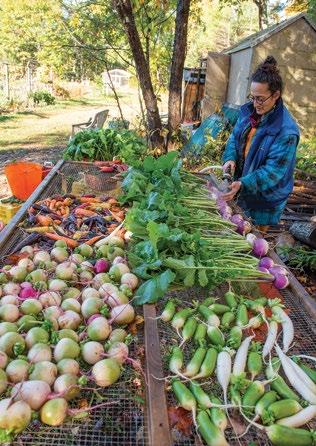
Above left Erica Berman washes purple top turnips, daikon and watermelon radishes, and rainbow carrots after a morning of harvesting.
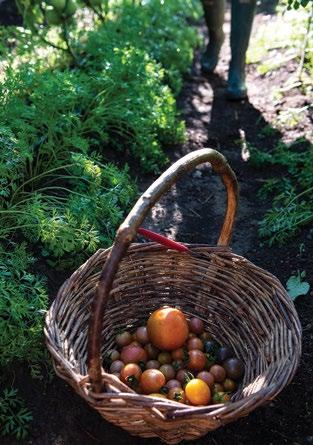
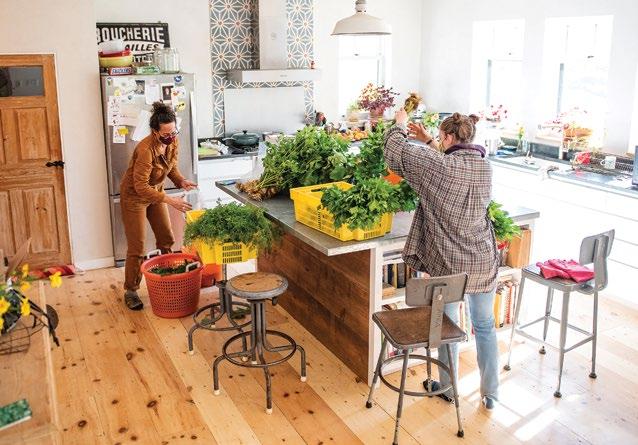
Above right A basket of heirloom tomatoes at Veggies To Table destined for the food pantry. Below Erica Berman sorts and weighs produce in her kitchen with help from Maeve, a WWOOF volunteer. Opposite page Erica Berman and volunteer Harry Koeppel bring boxes of fresh produce to Allison Brooks for the Jefferson Area Food Pantry.
distribute the food in a timely manner—often on a thin budget. This becomes a tricky logistical puzzle when gleaning from numerous farms and donating to dozens of programs located throughout a region, as most gleaning groups do.
Managing this puzzle becomes far easier when teaming up with other community partners, says Mary Leaming, the coordinator of a Unity-based gleaning group called Veggies For All. At the onset of the pandemic last spring, she helped launch Waldo County Bounty, a campaign aimed to raise funds to support collaboration between growers, gleaning groups, and hunger relief programs in Waldo County. By the end of 2020, the campaign had raised $100,000 and donated more than 25,000 pounds of food— twice what Veggies for All donated in 2019.
Leaming attributes much of the success of Waldo County Bounty to close collaboration with community partners. Daybreak Growers Alliance, an aggregator of local food, helped pick up, store, and drop off gleaned goods across the county. Home gardeners and homesteaders donated surplus crops through Give and Take tables set up in 10 locations where anyone in the community could take the food they needed. “It really offered an opportunity for different
layers of our community to work together to accomplish this mission,” Leaming says.
In addition to veggies, Waldo County Bounty facilitated donations of processed foods like applesauce and maple syrup, as well as animal products like meat and eggs. They also offered seeds and seedlings through partnerships with Fedco Seeds and Johnny’s Selected Seeds, to help clients of hunger relief programs grow their own food.
Leaming hopes the buzz around this type of highly-collaborative food distribution won’t fade away as Mainers begin to slowly reenter public life. “This is a shift in the way we are thinking about our food system and how we care about our community members,” she says.
This shift reflects the willingness and eagerness of Maine farmers to rise up and meet the needs of other Mainers—to nourish their community, in every sense of the word. “They are helping to change the food system into one that I think we all want to be a part of,” Leaming says.
laura poppick is a freelance environmental journalist based in Portland, Maine whose favorite garden snacks are strawberries and sugar snap peas. She contributes to Scientific American, Audubon Magazine , and elsewhere.
The Farm Tools Project
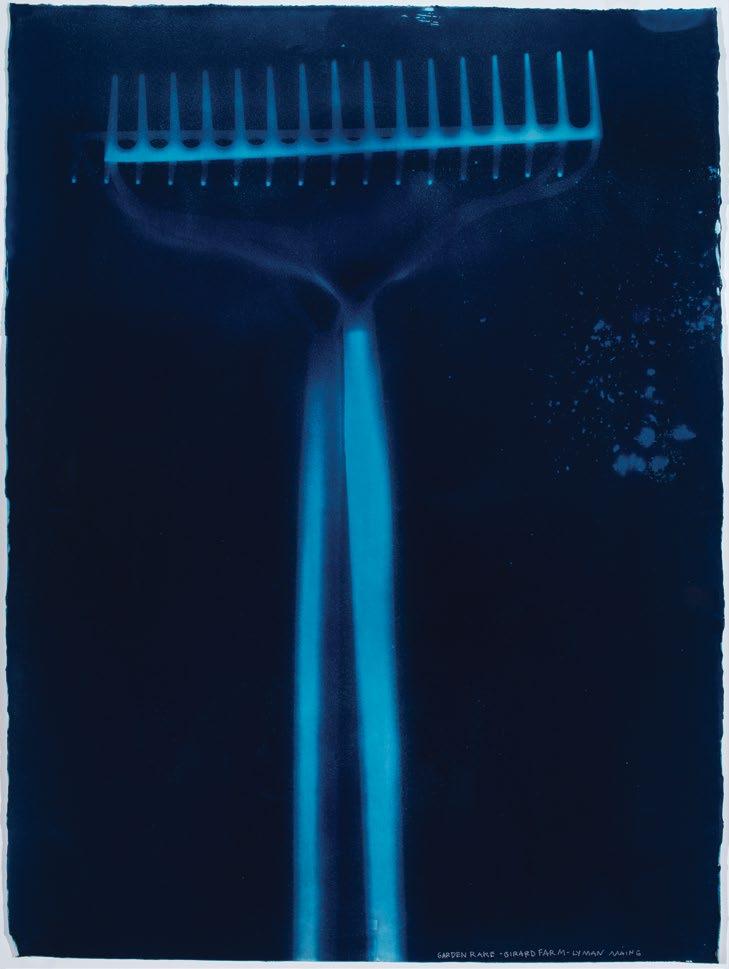
We spent the better part of the year traveling around Maine with a portable cyanotype kit (an old form of non-toxic photography relying on water and sunlight) creating images of hand tools with people in their fields, barns, and greenhouses and talking with farmers about their practices, the tools they choose to use, and how they engage with the earth to produce and harvest food.
The tools we use are extensions of ourselves, a second pair of hands and partners in our complicated relationships with the world, but they also have their own animus and story. Stories that run parallel to our own and speak to past generations of brilliance and love, trouble and consequence, and our collective capacity for invention and ingenuity as well as devastation and destruction.
As farmers move through the seasons, they pick up these histories again and again, cycling them into the present and pulling them into the future. Layer upon layer of knowledge and discovery that has somehow led to the present. For a lot of us, the art of how to grow food, the gestures and movements, the push and pull, have been lost in waves of monocropping, factory and industry, but many farmers and gardeners are wading back, sorting through the events, and reworking this long history.
The Farm Tools Project is funded in part by a grant from the Maine Arts Commission and by the Kindling Fund, a grant program administered by SPACE as part of the Andy Warhol Foundation for the Visual Arts Regranting Program.
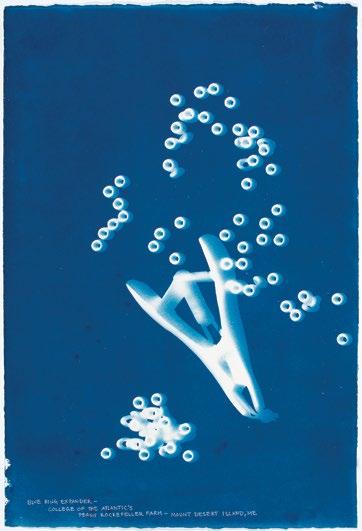
Ring Expander
College of the Atlantic’s Peggy Rockefeller Farm, MDI Cyanotype, 15” x 22"
Ring expanders are used to dock a lamb’s tail. Sheep have been bred for millennia, selected for their thick wool. This can make for heavy tails that are difficult to pick up. As a result, they can easily get caked with feces and trap moisture, which makes sheep vulnerable to fly strike, a painful infestation that is sometimes deadly. Research suggests that tail docking can prevent fly strike. Farmers also use ring expanders for castrating lamb and goat kids.

Hubbard Blueberry Rakes
Burke Hill Farm, Cherryfield Cyanotype, 22" x 30"
Burke Hill uses all aluminum blueberry rakes designed by Ike Hubbard. Hubbard grew up in Jonesport, Maine in the 1940s. When he was a teenager, his family moved to South Portland, but Hubbard returned north each summer to harvest blueberries. Over the years, he saw the need for a lightweight, unbreakable rake, and so he started making prototypes, eventually settling on this tined classic in the early 1990s.
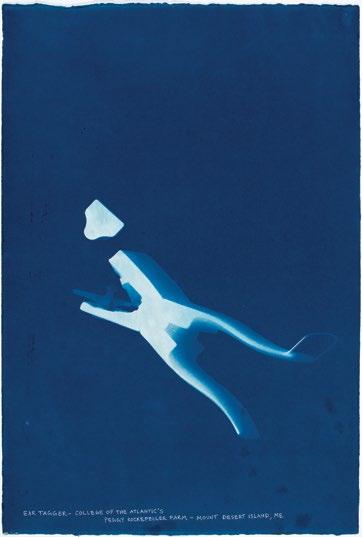
Ear Tagger
College of the Atlantic’s Peggy Rockefeller Farm, MDI Cyanotype, 15” x 22"
Ear taggers were first used to mark England’s royal Merinos and then to separate out sick and healthy cattle during a rampant 1913 Tuberculosis epidemic. C. J. Walke and his students at COA ear mark their sheep to keep track of them as they rotationally graze the fields. Rotational grazing gives the land a chance to rest so that heartier, more diverse forage has a chance to grow. There is also less compaction, less run-off, increased drought resistance and better nutrition for the animals. All of which are important as farmers reckon with the impacts of climate change.

Mortar Hoe
Hurricane Valley Farm, West Falmouth
Cyanotype, 15" x 22"
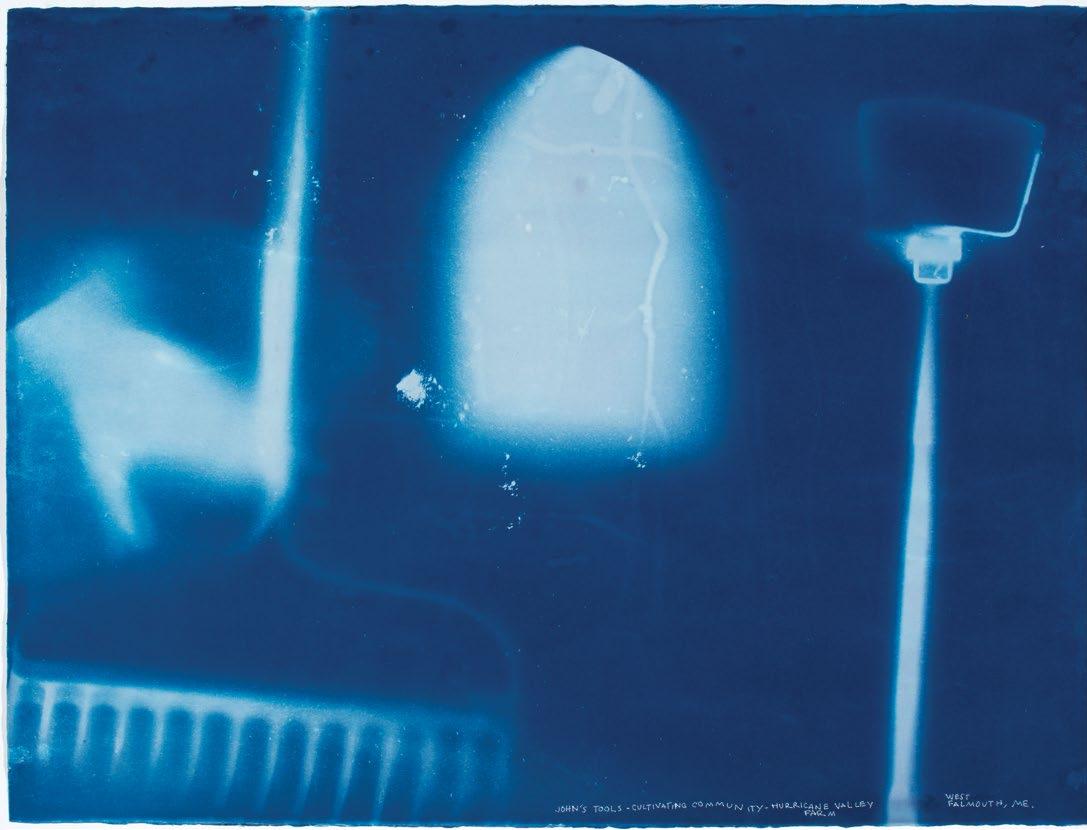
This large hoe is actually a mortar hoe used to mix water and mortar (the two holes allow the mortar to move through more easily). John Yanga sometimes uses it for tilling the tough soils at Hurricane Valley Farm, which was a horse farm for decades before being transformed into a community farm. John is working to restore fertility to the land through the use of sustainable methods and over time the compacted soils will become easier to work with. The other hoe that John relies on is a type of hoe from his native Sudan and one that is common across much of Africa. It has a heavier, sturdier blade than most of the hoes you can find in the States and works well when breaking in new ground. He often alternates these hoes with a mattock, or grub hoe, other tools that work well on tough ground.
John’s Tools
Hurricane Valley Farm, West Falmouth
Cyanotype, 22" x 30"
A rake, shovel, stirrup hoe, and the shadow of John Yanga’s hand—basic tools used to lay out and maintain a healthy row of vegetables.

Machete
Hurricane Valley Farm, West Falmouth
Cyanotype, 15" x 22"
Machetes are one of the oldest and most common farming tools found around the world, particularly in tropical climates with thick vegetation. They vary in shape and size depending on the origin, but generally consist of a 10-to-24-inch broad blade used to easily clear brush or harvest crops.
Seed Plates
Villageside Farm, Freedom Cyanotype, 22" x 30"
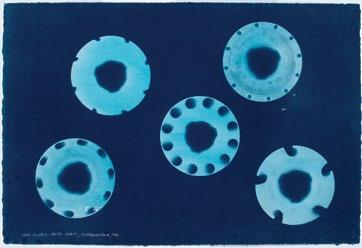
Villageside Farm’s 1960s Planet Jr. push seeder has been on long-term loan from a friend (going on 12 years). It is relied upon to directly seed a wide variety of vegetables grown on the farm. These round discs are seed plates with different sized holes that can be swapped out to accommodate different seed types and drop rates.
michel droge is a painter, printmaker and educator based in Portland, Maine.
sarah loftus is an archaeologist at the Northeast Archaeology Research Center in Farmington, Maine.
BOOTS GROUND ON THE
Meet Anne Devin, the retired Marine Corps officer who’s teaching veterans to sow, weed, and harvest.
BY ANNA FIORENTINO | PHOTOGRAPHS BY BRENDAN BULLOCK
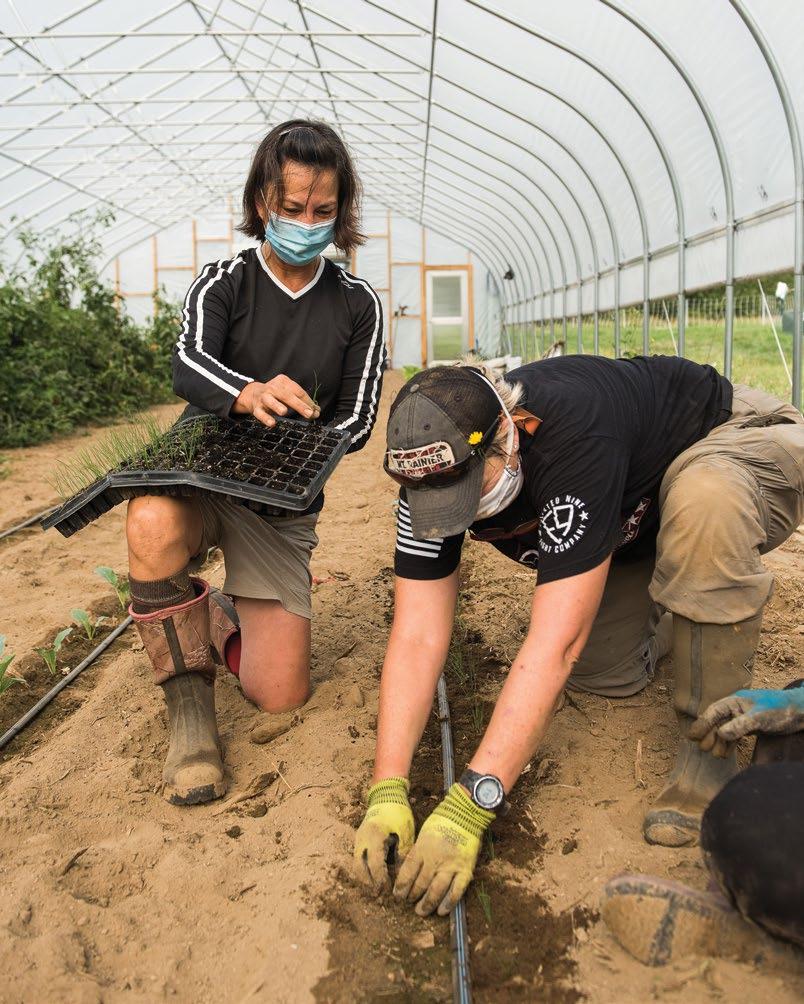
Right Boots-2-Bushels founder Anne Devin and student Genee Gregory transplant Chinese chives.
Air Force veteran Lisa daRosa found her way to farming in an emergency room, of all places. She’d gone to the Veterans Affairs hospital in Augusta for a severe anxiety attack. She was in the waiting room when she noticed a white board near the entrance.
One ad caught her attention. It was for a program that teaches military veterans how to start a farm called Boots-2-Bushels. “I’d been living in an unsuitable temporary situation. Although I was looking to buy a house and land to homestead, I didn’t have the foggiest idea on how to begin,” says daRosa. “My boyfriend and I had all sorts of grandiose ideas and dreams.”
Sponsored by Maine AgrAbility, in partnership with the Maine Organic Farmers and Gardeners Association, Boots-2-Bushels (B2B) offers ten weeks of online instruction through the University of Maine
on everything from soil health and crop planning to the ins and outs of running an economically viable farm, followed by an intensive period of hands-on training. The program is open to veterans, their families, and differently-abled Mainers. After completing their online coursework, participants spend six months putting their knowledge into action building high tunnels full of veggies and tending to the animals. “I enjoyed every minute of working there, from seeding to planting, moving the meat, and even weeding the strawberry house,” says daRosa. “We plucked garlic out of the ground, picked squash and pumpkins from the patch, and foraged for rhubarb and elderberries.”
DaRosa was one of 16 to begin the nine-month B2B program in its inaugural year, just months before the COVID-19 pandemic hit. Her goal was to live as self sufficiently as possible, and in 2020 that proved to be of particular importance. By
the end, daRosa was one of only two vets to complete the program, due to stay-at-home orders and other complications. But at a time when the food system was at risk of breaking down, millions across the country joined her in learning how to grow their own vegetables at home. “There is a real push to know your food source, buy locally, and understand how the processes work behind the scenes,” says daRosa, who now lives on a small homestead in Medford. “Know your farmer, know your food.”
The farmer behind the Augusta ad was also relatively new to agriculture when she started B2B last year. Retired Marine Corps intelligence officer Anne Devin moved from Washington, DC to Maine with her husband Tim in 2016 and the couple became first-time farm owners with the purchase of Chase Stream Farm in Monroe. This rural property became a safe haven for B2B participants when the Augusta VA, where they’d been operating the program, suspended classes during the pandemic.
Dubbed “boot camp for market gardeners and farmers,” Anne’s B2B program provides support and focus to people who are looking to start their own farm or sharpen up their gardening skills. B2B gives vets confidence and a foundation of trust and understanding to grow their own food and live a healthy life. It also allows people with similar life experiences and goals to connect and share. “Even though we never served together, people open up and have really serious, heartfelt conversations to help each other through,” says Anne. “That part has been really therapeutic.”
Anne’s goal in building B2B was to create a supportive community for vets, including those dealing with post traumatic stress, traumatic brain injury, or depression (among other issues).
“We had just started having lunches together after the classroom work, and that had to come to an abrupt and unfortunate end because of the pandemic,” says daRosa. “On the farm, Anne
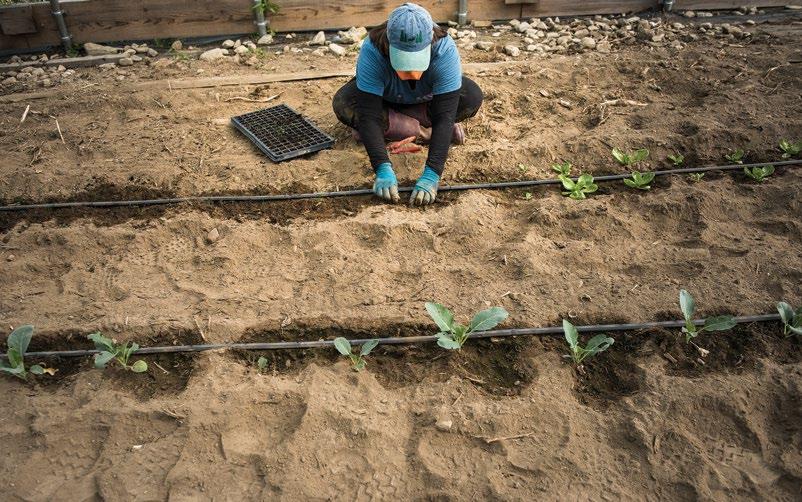
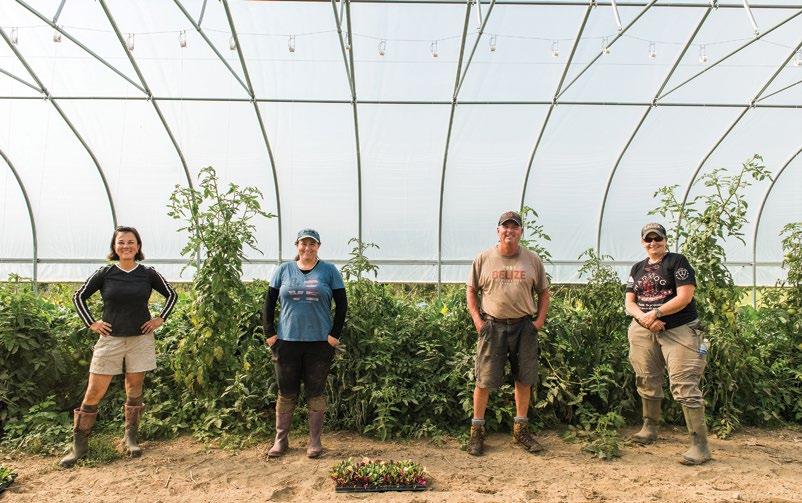
Left Anne Devin, her husband Tim, and students Lisa daRosa and Genee Gregory stand six feet apart in a high tunnel. Right Lisa daRosa plants cabbage seedlings.
became our shepherd as we dealt with the roller coaster of emotions—the stress, and sometimes overwhelming anxiety—that this year has caused.”
Five years ago, Anne knew almost nothing about Maine or farming. She had served on active duty for 27 years in hotspots like Somalia, Iraq, and Afghanistan, and she had experience living abroad in Japan and Korea. What little she did know about working the land was through her dad, who grew up poor in Madawaska with 15 brothers and sisters. So when she and Tim, a former helicopter pilot who later contracted with the Office of Naval Research, purchased Chase Stream Farm in their retirement, they poured themselves into books on winter harvesting, and filed away any bit of advice they received from the robust farming community in Monroe (which includes the likes of Dickie Hill Farm, Toddy Pond Farm, and Teltane Farm).
Tim learned the habits of the sheep, the pigs, and the hens, and how to operate the plow, while Anne,
a pragmatist, dove into the business of agriculture. Neither of them went in with any romantic notion of owning a farm. “It's really easy to have this idyllic vision of waking up to the sun shining through the window, the lamb bleating, and everybody just kind of in Shangri La,” says Anne. “The reality is the sheep are hungry and sometimes you’re like, ‘shut up.’”
Her idea of farming is centered around providing service to her community. “As military folks, many of us have spent our entire adult lives working to accomplish something bigger than ourselves,” says Anne, who donates to Good Sheperd Food Bank and to the senior farm share program. Soon after moving to Maine, she became the outreach coordinator for Maine AgrAbility, a national program funded by the United States Department of Agriculture. She worked in collaboration with the University of Maine Cooperative Extension, as well as differently-abled farmers, fishermen, and forest workers. Through this work, it became clear to Anne
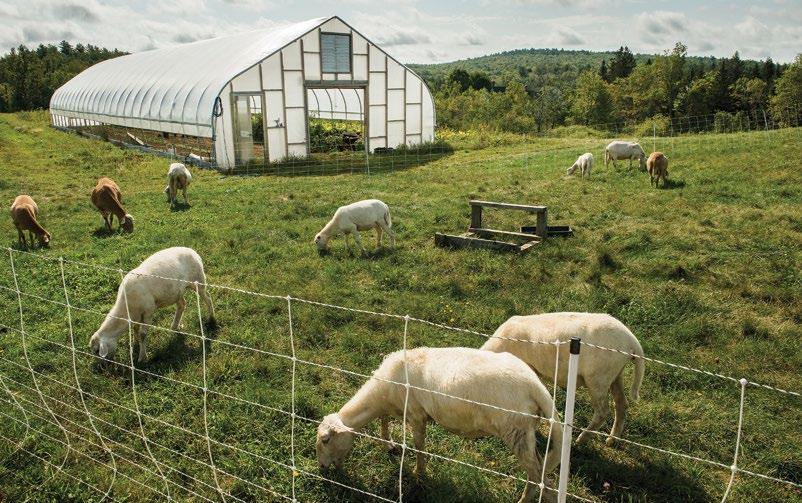
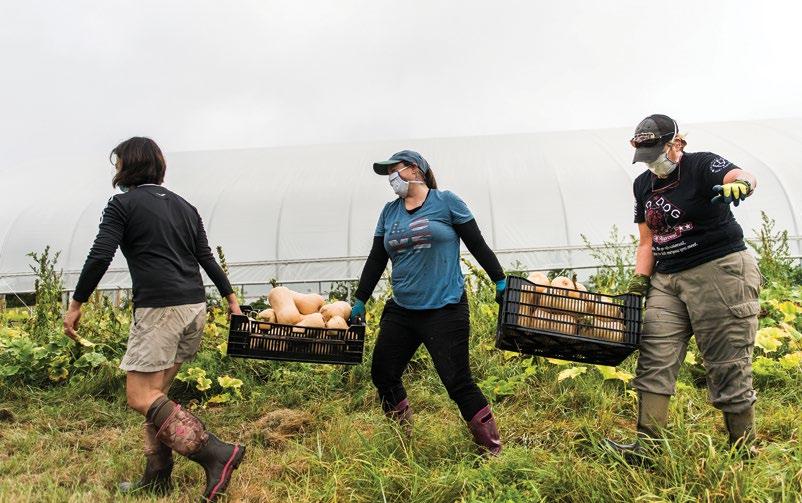
Left Katahdin sheep graze at Chase Stream Farm in Monroe. Right Devin, DaRosa, and Gregory haul newly harvested butternut squash. .
that veterans needed a more deliberate means of learning how to build a sustainable farm business; this revelation is what led to the launch of B2B.
In January 2021, daRosa will join a new roster of B2B participants in its second year, while simultaneously working toward earning her bachelor’s degree in entrepreneurship. This time, enrollment numbers are up, food security has improved, and the program itself is growing. Field work—and eventually the classroom portion—will migrate from Chase Stream Farm to the Harold Alfond Campus at Kennebec Valley Community College. “They have a sustainable agriculture program and we’re excited to use their fields, farm equipment, high tunnels, and their greenhouses for seed production,” says Anne. If all goes as planned, B2B will also offer therapeutic classes like tai chi and yoga, and one day, it may even expand beyond Maine.
“There are veterans all over the country and very few comprehensive programs that offer growing opportunities, so I would like to see
Boots-2-Bushels spread to the AgrAbility sites all over the country,” says Anne. But ultimately, for Anne, the real measure of success is on the faces of veterans when they too discover the healing power of pulling weeds and harvesting food.
“To bring home the goods that I helped nurture and cultivate and to create meals with them gave me a feeling of great personal satisfaction. I made pumpkin pie from a pumpkin that I picked, and even learned how to drive a tractor,” says daRosa, “Just the simple act of having a place to go this summer and feel productive in a small way during this pandemic meant so much.”
anna fiorentino is a Portland-based journalist whose stories have appeared in National Geographic online, Outside Magazine online, Maine Magazine , the Boston Globe Magazine , the Boston Globe , and the Portland Press Herald , as well as publications by leading research institutes.
Make Maine farms part of your legacy with a planned gift to Maine Farmland Trust.
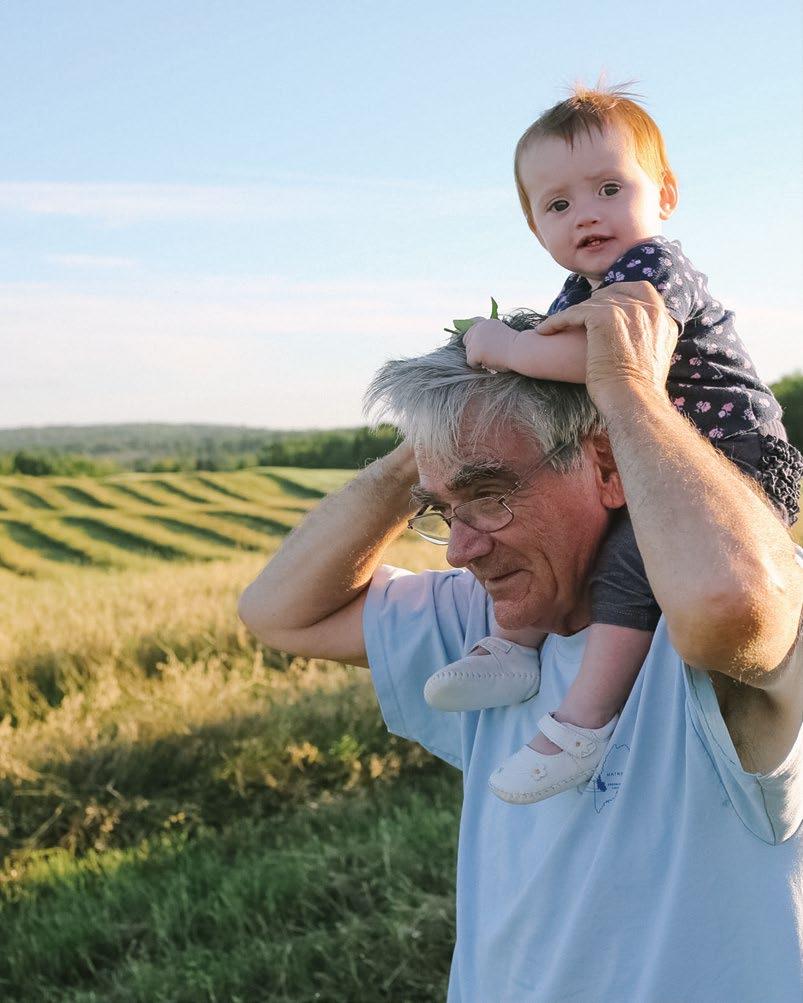
Whatever stage of life you are in, planned giving is one of the most impactful ways you can support MFT’s work. You may be able to save on taxes, receive income for life or enjoy other financial benefits—all while helping keep Maine agriculture vibrant and growing for years to come.
To learn more or to speak with MFT staff about the benefits of becoming a Cultivator, please contact us at : 207-338-6575 or cultivators@mainefarmlandtrust.org