el Restaurante magazine, April/May/June 2021 issue
Fully vaccinated. I never imagined that those two words would fill me with such relief. But relief is exactly what I felt as soon as that needle filled with Pfizer vaccine #2 hit my arm in mid-April.
With everyone in our immediate family and our close circle of friends vaccinated, too, Publisher Ed Avis and I are enjoying small, unmasked get togethers (although masks remain a must when we’re out and about). We’re eagerly anticipating a summer that more closely resembles those pre-pandemic summers that seem so long ago—a summer we plan to spend dining out at our favorite Mexican restaurants in Chicago, of course! We hope all of you are experiencing a sense of relief for your businesses, too.
It’s hard to image that one year ago, we were debating if publishing el Restaurante was wise—or doable at all. Restaurants were closed, vendors weren’t selling…and we wondered if anyone would be around to support the publication. Thanks to our loyal readers and advertisers we forged ahead. We can’t express how grateful we are to all of you.
We hope those small issues of 2020 offered some guidance as you weathered the pandemic’s challenges…and we hope this issue offers insights you can use as you return to businessalmost-as-usual for the spring and summer seasons.
New contributing writer Jacqueline Raposo has crafted an information-packed cover story about asado cooking that explores ways Mexican and Latin-themed restaurants are embracing the concept. You’ll find tips on wood-fired cooking and on how to find wood-fired ovens for your establishment on the story that star ts on page 16.
Street foods are the topic Mexico-based writer Joseph Sorrentino tackled for this issue. Turn to page 28 to discover what he discovered during his self-guided tour of food stands and markets in Puebla, Xochimilco and Milpa Alta.
We also cover your bar twice in this issue with stories about patio-perfect cocktails and Mexican craft beer trends. On the business side, we delve into today’s hiring challenges and the benefits of Restaurant Week promotions.
Happy reading!
Ed Avis PUBLISHER
Kathleen Furore EDITOR Ala Ennes ART DIRECTOR
Maya Dollarhide, Elyse Glickman, Jacqueline Raposo, Joseph Sorrentino CONTRIBUTING WRITERS
MAIN OFFICE phone: 708.267.0023
PRESS RELEASES TO: kfurore@restmex.com
MAILING ADDRESS P.O. Box 13347 Chicago, IL 60613
SHIPPING ADDRESS 1317 W. Belden Ave. Chicago, IL 60614
AD SALES/ENGLISH Ed Avis 708.218.7755 edavis@restmex.com
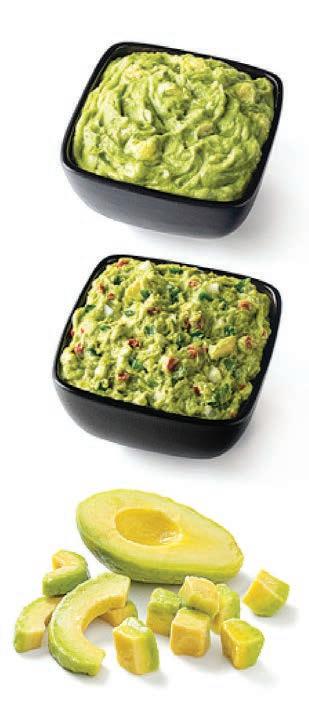
Say adios to slicing and scooping avocados by hand. WHOLLY® AVOCADO is ready to use right away. With 100% real Hass avocados and no preservatives, or arti cial colors or avors, you can quickly give your best with ours.
Try it yourself. Request a sample. megamexfoodservice.com/sample | 1.817.509.0626
BACK IN ACTION: TRADE SHOWS RETURN IN 2021
The trade show world came to a screeching halt when COVID-19 hit in early 2020, and some restaurant and hospitality shows remained closed in 2021. The National Restaurant Show, for example, has been canceled two years running. However, three restaurant shows with sizable Latin attendance are still planned for this year.
TEXAS RESTAURANT ASSOCIATION MARKETPLACE
July 10-12
Henry B. Gonzalez Convention Center San Antonio, Texas
The association is expanding its educational offerings for the 2021 show, with a slate of pre-conference educational sessions including Digital Marketing, Digital Tools & Collaboration, and Leadership. www.tramarketplace.com
WESTERN FOODSERVICE EXPO
August 22-24
Anaheim Convention Center Anaheim, California
Dubbed “A Reinvented Event for a Refocused Foodservice Industry,” this show—which will be co-located with Coffee Fest and Healthy Food Expo—will include five “educational summits” designed to help different types of businesses: Independent Restaurant; Small- to Mid-Size Chain; Business & Institutional Foodservice; Retail Operation; and Technology. www.westernfoodexpo.com
COCINA SABROSA TRADE EXPO
October 4-5
Long Beach Convention Center, Long Beach, California
This new Latin-focused show will feature exhibitors that “represent a wide range of companies, with products that include everything from tequila, chicharones, soda and juices, michelada and wine to hot sauces, tortillas, cheeses, bakery items, nuts and snacks, parchment paper and agave products,” says show director Eric Jurado. “In addition, we have received contracts for exhibit space from food truck manufacturers, retail services such as POS and insurance, as well as kitchen equipment businesses.”
Show organizers have developed an 8-step safety process to minimize COVID risk, Jurado stresses. The steps range from enhanced cleaning to non-contact registration to attendee screening. “We couldn’t be more excited to see again how quickly the Latin foodservice industry has embraced the 2021 show so far,” Jurado says. “We moved the 2021 CSTE to late fall to make sure this Expo has the greatest opportunity for success.” www.cocinaexpo.com
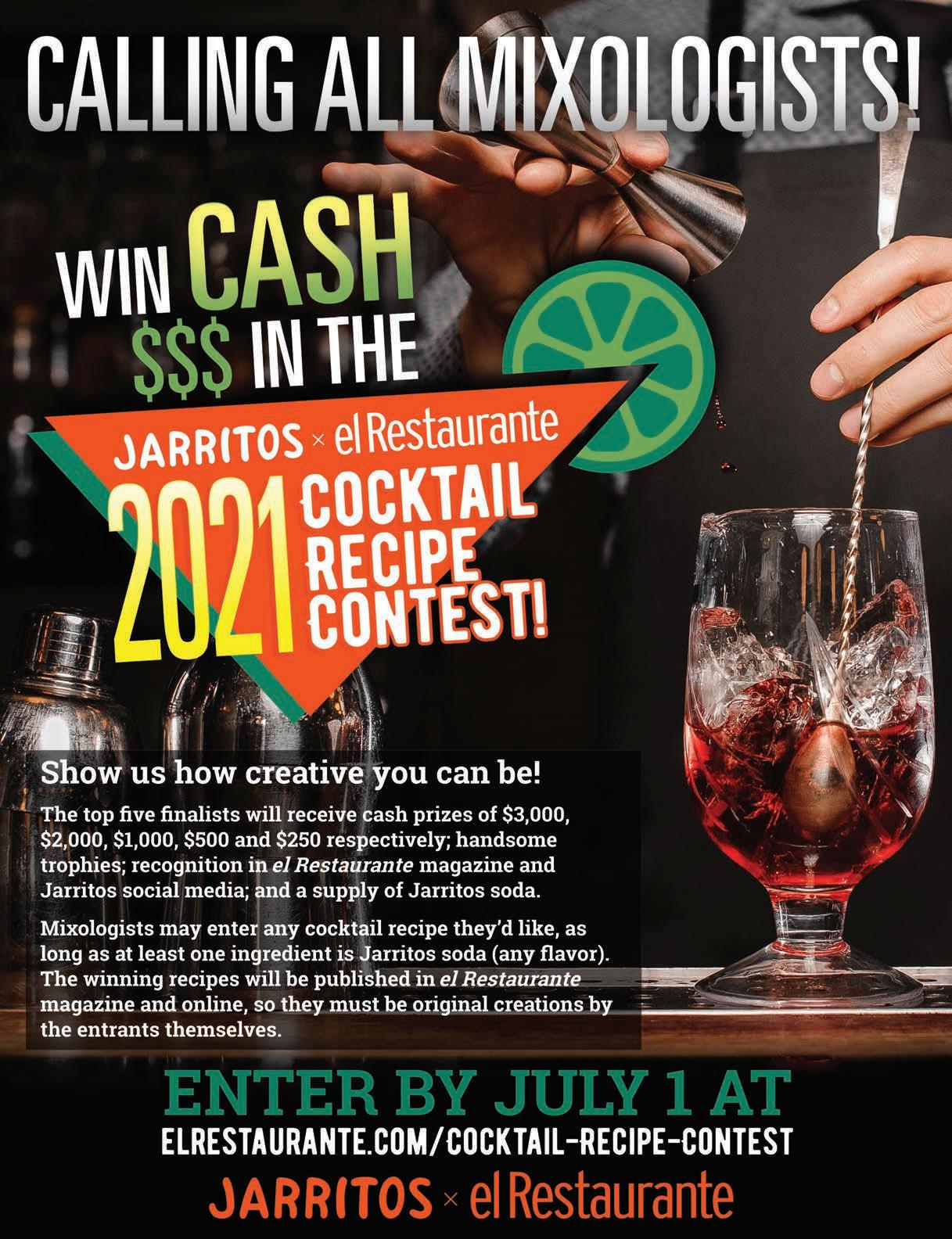
Calling All Mixologists!
Jarritos, el Restaurante Partner on
COCKTAIL RECIPE CONTEST
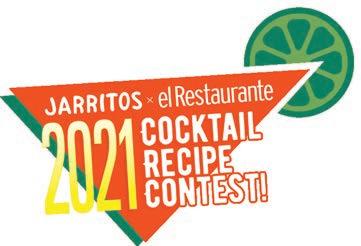
COCKTAILS ARE A MAJOR PART OF THE EXPERIENCE in many Mexican/Latin restaurants. A new contest co-sponsored by Jarritos and el Restaurante magazine is designed to encourage creativity among mixologists.
The top five finalists in the Jarritos/ el Restaurante Cocktail Contest will receive cash prizes of $3,000, $2,000, $1,000, $500 and $250 respectively; handsome trophies; recognition in el Restaurante and via Jarritos social media; and a supply of Jarritos soda. To enter, mixologists may submit any original cocktail recipe they’ve created, as long as at least one ingredient is Jarritos soda (any flavor). The winning recipes will
be published in el Restaurante’s print issue and online. There is no cost to enter.
“Jarritos plays a big role in Mexican/Latin bars, and we can’t wait to see the creative cocktails mixologists will develop using Jarritos as an ingredient,” says Eric Delamare, Jarritos marketing director.
The contest officially begins May 1 and winners will be announced in September. To submit your recipe, visit elrestaurante.com/ Cocktail-Recipe-Contest.
CREATE YOUR MADE-FROM-SCRATCH DISHES WITHOUT ALL THE MADE-FROM-SCRATCH WORK.
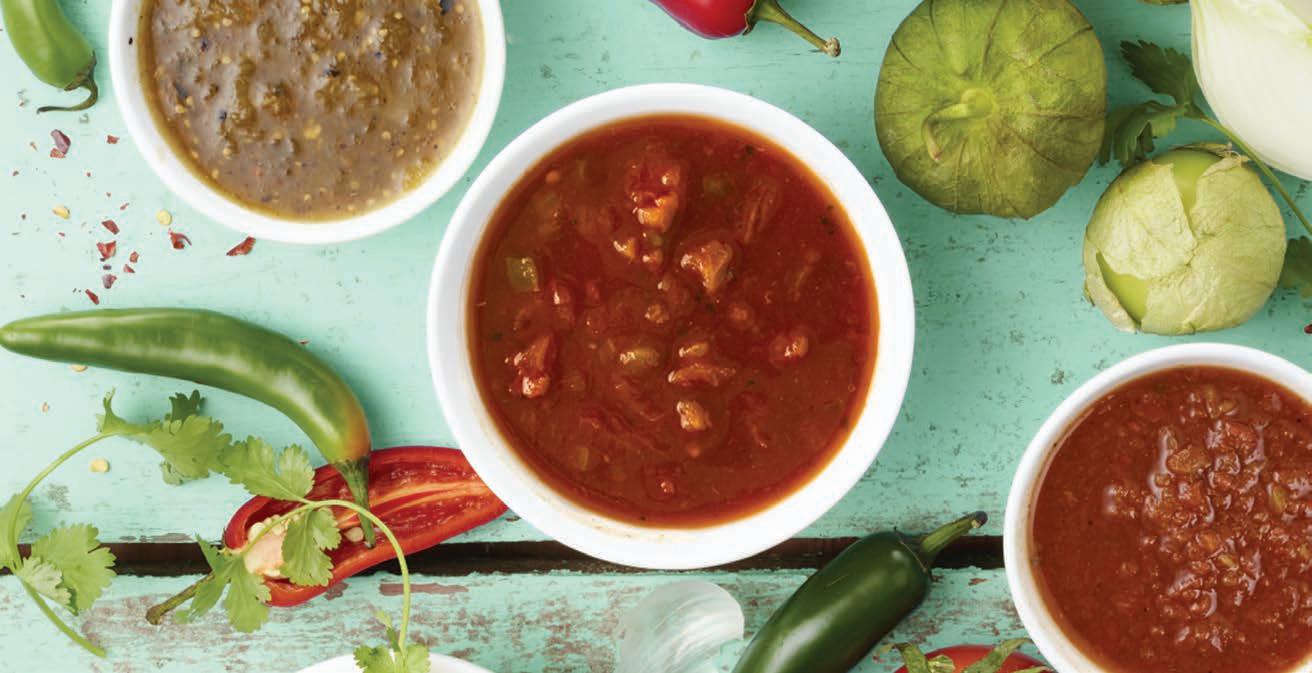
LA VICTORIA® salsas are here to make prepping your signature dishes a whole lot easier. Get creative without sacrificing flavor or quality. Our salsas are consistent and versatile — the perfect ingredients that make any application more delicious. And, for a limited time, you can get a $10 per case rebate*. Order now and make your meal prepping easier and cost-efficient-er.*
Catering Makes a COMEBACK
DOES YOUR RESTAURANT OFFERING CATERING?
If not, it’s something you might want to consider, according to a new survey that shows pandemic-weary customers are planning events that will need catered food this summer.
According to data from the survey of 1,000 consumers by Tripleseat (a web-based sales and event management platform for restaurants, hotels, and unique venues) and SevenRooms (a data-driven guest experience platform for the hospitality industry), 72 percent of
events planned for 2021 are expected to be held in person. Private restaurant space was one of the top venues respondents said they would consider for hosting their events—and just under 50 percent of those planning an event said they would host their event outside.
In addition, one in three respondents shared that they plan to host their event at home, and 51 percent said they will
MORE HELP ON THE WAY: The Restaurant Revitalization Fund
On March 11, the American Rescue Plan Act of 2021 created the $28.6 billion Restaurant Revitalization Fund (RRFG) to provide grants for restaurants sustaining financial losses due to the COVID-19 pandemic. The U.S. Small Business Administration (SBA) is administering the program, and will be issuing the necessary federal rules, regulations, and applications before grant funds are distributed. The National Restaurant Association has created a frequently asked questions (FAQ) resource, which will be updated as the SBA releases additional information on the RRFG program. Here are just a few of the questions and answers currently available:
• Who is an “eligible entity” for Restaurant Revitalization Fund Grants (RRFG)? Entities that own a place of business where the public or patrons assemble for the primary purpose of
being served food or drink can apply.
• What disqualifies an entity from RRFG eligibility? As of March 13, 2020, an entity that owns or operates (together with any affili -
ated business) more than 20 locations, regardless of whether those locations do business under the same or multiple names, would not be eligible for a grant.
• Is an entity that applied for and received a first draw and second draw Paycheck Protection Program (PPP) loan eligible to apply for an RRFG? Yes. However, the RRFG will be reduced by the total amount of PPP loans.
That means restaurants “should begin promoting these offerings through their marketing and social channels,” a release about the survey said.
• How much can an eligible entity receive? An entity can receive a tax-free federal grant equal to the amount of its pandemicrelated revenue loss, subtracted by the total amount it received in all PPP loans. have those events catered at home, which presents another oppor tunity for restaurants to generate income.
• What documents might an eligible entity need to prepare to apply for a RRFG? An application form and the IRS Form 4506-T, as well as gross receipts documentation.
• Will banks, local lenders, or community development financial institutions be involved in RRFG? No. The RRFG program is administered through the SBA.
For more information visit sba.gov or restaurant.org
TACKLING POST-COVID HIRING CHALLENGES
| BY ED AVIS | The past year has presented countless challenges to Mexican/Latin restaurants, but a new one is emerging: Many are having trouble hiring enough staff to gear up
for the summer season.
“It’s been a nightmare,” says
Danny Sandoval, owner of Sandoval’s Café & Cantina in Portland, Oregon. “We usually have pretty good luck using Craigslist, or we talk to our staff and see if they have friends who want a job. But that’s not working now. I don’t know where they’re going.”
Sandoval is not alone.
According to an el Restaurante survey sent out the week of April 12, 89 percent of Mexican/Latin restaurant owners report that they are not getting enough applications for their openings. The sur vey respondents average
7 openings each. Nearly 93 percent of respondents said they have openings for servers and other front-of-house staff, and 85 percent are looking for cooks. About 63 percent are trying to hire dishwashers and busers, and 22 percent are seeking managers.
THE REASONS
Why are so many restaurant openings going unfilled?
Sandoval says local landscap-
“It’s been a nightmare. We usually have pretty good luck using Craigslist, or we talk to our staff and see if they have friends who
want a job. But that’s not working now. I don’t know where they’re going.”
No matter what equipment, ingredients, beverages or restaurant and grocery store supplies you offer, you’ll connect with a booming market of buyers at Cocina Sabrosa Trade Expo
At the only U.S. trade expo and wholesale market dedicated to the Latin Food and Beverage Industry, you’ll meet in-person with the industry’s most influential foodservice distributors, retail stores, chefs, restaurants, taquerías, bars, panaderías, carnicerías and local grocers. Don’t miss your best opportunity to build lasting relationships with restauranteurs with more than $45 billion in buying power, who are responsible for the fastest-growing restaurant segment in the nation. book your booth! | cocinaexpo.com
—Source: el Restaurante reader survey, April 2021
ing companies are hiring many back-of-house workers that he previously counted on.
Respondents to the el Restaurante sur vey offered other ideas:
UNEMPLOYMENT BENEFITS: More than half the survey respondents blamed the situation at least partly on generous government unemployment benefits. “Those who lost jobs and are on unemployment have
less reason to return,” one respondent wrote. “There are not as many people actively in the industry due to transition or supplemental assistance,” another wrote.
FEAR OF COVID: Several survey respondents speculated that workers are afraid to come back to a high-touch business like restaurants until COVID is fully under control.
ONCE BURNED: Others think
“I am preparing to run a restaurant with as [few] people as possible and I’m ready to introduce technology into this family-owned restaurant… With our new POS I will encourage customers to place their order online and I will eventually stop taking orders via phone.” –
restaurant workers don’t want to come back because they fear that restaurants will close again, leaving them suddenly unemployed. “Perhaps they are afraid of getting hired by a restaurant and getting shut down again,” wrote one respondent.
COMPETITION: As always, bigger restaurants and chains typically pay more than independent restaurants, and that’s especially important when the
EL RESTAURANTE SURVEY RESPONDENT
labor pool is small.
RELUCTANCE TO WORK: Finally, some respondents think people just don’t want to work in restaurants anymore. “Americans do not want to work nights and weekends, which are the busy hours in a restaurant,” one respondent wrote. “Let’s get the new immigrants and … put them to work as they see these jobs as an opportunity to make money and get ahead.”
THE REMEDIES
So what are restaurateurs struggling with hiring doing?
INCREASING PAY. Mexican/Latin restaurant owners are digging deeper into their pockets to attract staff, according to the survey. Nearly 78 percent said they have raised their pay rates.
“I have given my entire kitchen staff raises to keep what I have,” wrote one respondent. “I have to continue raising prices, which concerns me because it will start to inhibit people from eating out as often.”
OFFERING FLEXIBLE SCHEDULES. Over 70 percent of respondents say they are trying that strategy to keep staff happy.
PAYING INCENTIVES. When it comes to recruiting, nearly half of the survey respondents said they are paying bonuses to current staffers who bring in new employees. About 19 percent said they have resorted to poaching employees from other restaurants.
MAKING DO WITH CURRENT STAFF. Restaurant owners who can’t hire enough staff are struggling to maintain the quality of service their customers expect, but some are getting clever. For example, one respondent to the survey is leaning into technology to pick up the slack.
“I am preparing to run a restaurant with as [few] people as possible and I’m ready to introduce technology into this family-owned restaurant,” the respondent wrote. “With our new POS I will encourage customers to place their order online and I will eventually stop taking orders via phone. I have also purchased a wait list app. We don’t have enough staff currently to have a host so with our wait list app we just take the name and when we are ready for the customer, we ping them. I will also be ordering a kiosk to allow customers to order on site.”
PERSONALLY PICKING UP THE SLACK. It’s something owners have always had to do at one time or another—it’s just a more urgent, ongoing situation this time around. Sandoval, for example, takes orders, picks up supplies, helps prepare to-go orders, and anything else that needs to get done. But he says there’s a silver lining to all that extra work.
“If anything good has come out of it, it has forced me to reconnect to my obligation as a restaurateur,” he says. “People want to see the owner. My wife and I are there every day that we’re open. I open every morning and close every night.”
Ed Avis is the publisher of el Restaurante
RUBIO’S COASTAL GRILL
Emerging from Bankruptcy with Lessons Learned
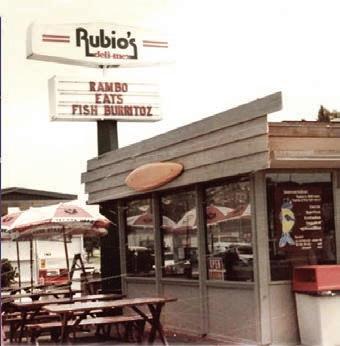
EDITOR’S NOTE : When Ralph Rubio opened his first restaurant in San Diego in 1983, his plan was simple: to offer the kind of fish tacos he’d discovered during a college trip with friends. Rubio’s Coastal Grill (originally Rubio’s Fresh Mexican Grill) eventually grew to 200+ locations; but too-rapid expansion and COVID-19’s impact forced the company into bankruptcy in 2020. el Restaurante Publisher Ed Avis spoke with Rubio (no longer president but still involved in many decisions) about the downside of rapid growth, and how lessons learned will help the company move forward as it emerges from bankruptcy.
EL RESTAURANTE : Tell me about how Rubio’s grew in the early days.
RALPH RUBIO: There was a point very early on where I was very happy with where we were and where we were
going. But as we got into the late ‘90s and started to use the money we’d raised privately to grow from 11 restaurants to 63, I started to realize, “Gosh, this could be a national chain.” I came to find out that’s a lot easier said than done.
ER: What mistakes did the company make in its growth plans?
RR: Growing continuously geographically was a mistake because there’s a socio-demographic aspect to your cus-
tomer base. The food culture in Denver is very different than in the Southwest. You have to know that—especially in a business that features a fish taco as a signature product. People in new markets don’t have any clue what a fish taco is, so they think it’s really weird.
ER: How did the Initial Public Offering (IPO) in 1999 affect your growth?
RR: Going public gave us capital to really grow the business. But the key thing is you have to consistently grow quarter after quarter, and that’s hard to do. Post-IPO, we were growing at a 30 to 50 percent clip in year-over-year units—that was way too fast. We were growing beyond our ability to operate. ER: Was it difficult to profit in new markets?
RR: It was hard because we didn’t have the brand equity. In Denver or Salt Lake City, for example, there were a lot of homegrown competitors, along with chains of scale like Chipotle and Panera that are ubiquitous, so people knew who they were. When someone was looking for a job, they weren’t sure what Rubio’s was. It was daunting.
ER: You recently pulled out of Florida and reduced your presence in other states. Was COVID to blame or were there other problems?
RR: It was probably half and half. We were challenged in Florida because we were too spread out. Denver and Salt Lake were always challenging operationally and from a revenue point of view, but we were making some ground, especially in Denver. Then COVID came and gave us the impetus to retreat. We figured, let’s retreat now and live to fight another day. As we start to grow again, we can look to enter one, two or three of those markets.
ER: Rubio’s is emerging from bankruptcy with about 150 locations. How will things be different?
RR: That’s a tough question because we’re still in the midst of it. What about our salsa bars? Can we bring them back? Is there going to be such a thing as a buffet anymore? Or a salad bar? There are more questions than answers in terms of what the future looks like. On the positive side, we introduced an Impossible Taco Salad. It’s done pretty well, so we’re going to keep Impossible in the restaurants. We did a partnership with Top Chef judge Richard Blais on a line of street tacos we’re going to roll out this summer. Also, when COVID came we pivoted to digital ordering because we were geared to do that. We’re going to continue to grow revenue digitally [as we move ahead].
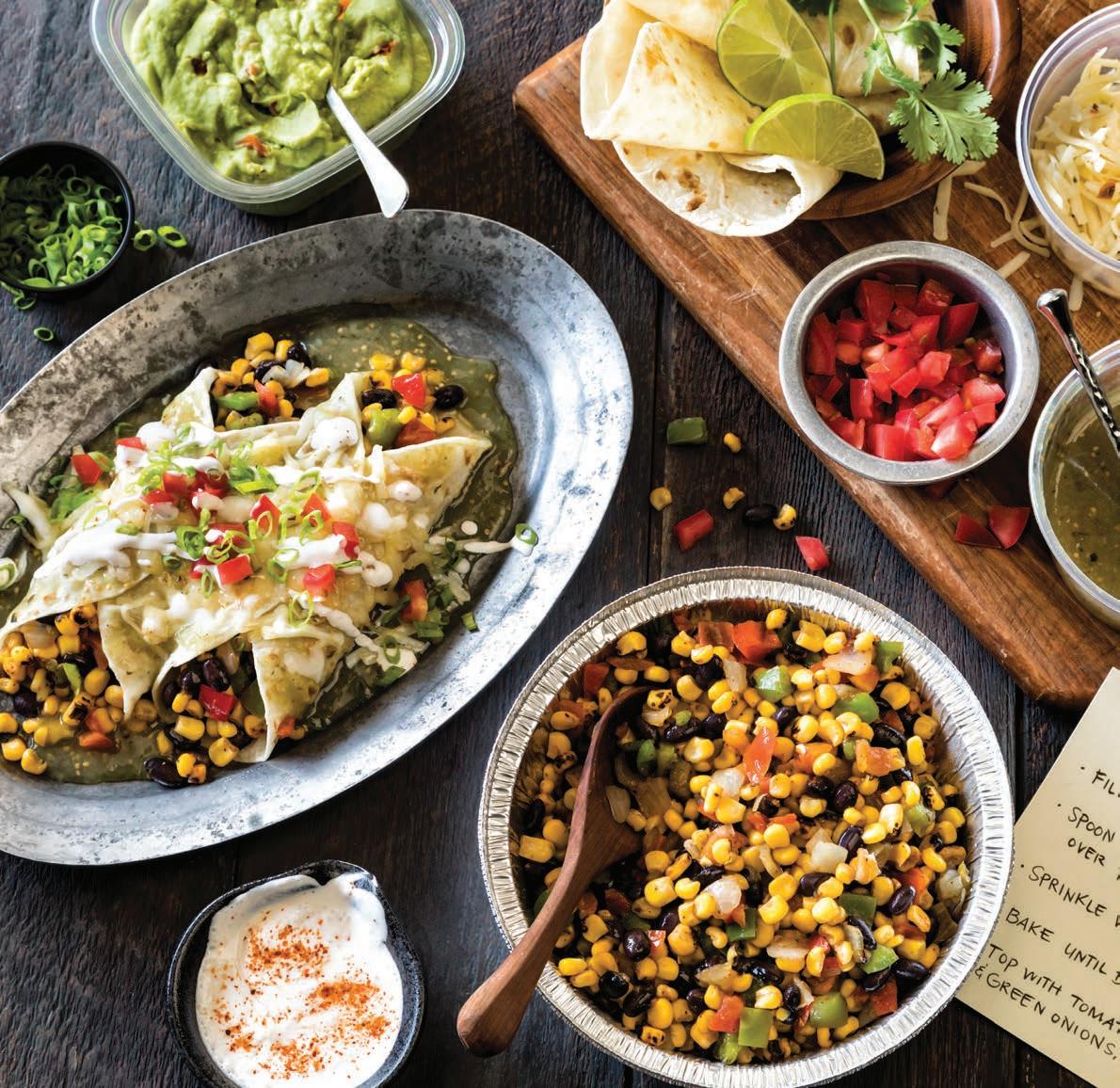
Harvest Fresh™ Avocados Guacamole:
Always ripe. No pitting, peeling or preservatives.
RoastWorks® Flame-Roasted Corn & Black Bean Fiesta Blend: No shucking required.
THE APPEAL OF
asado
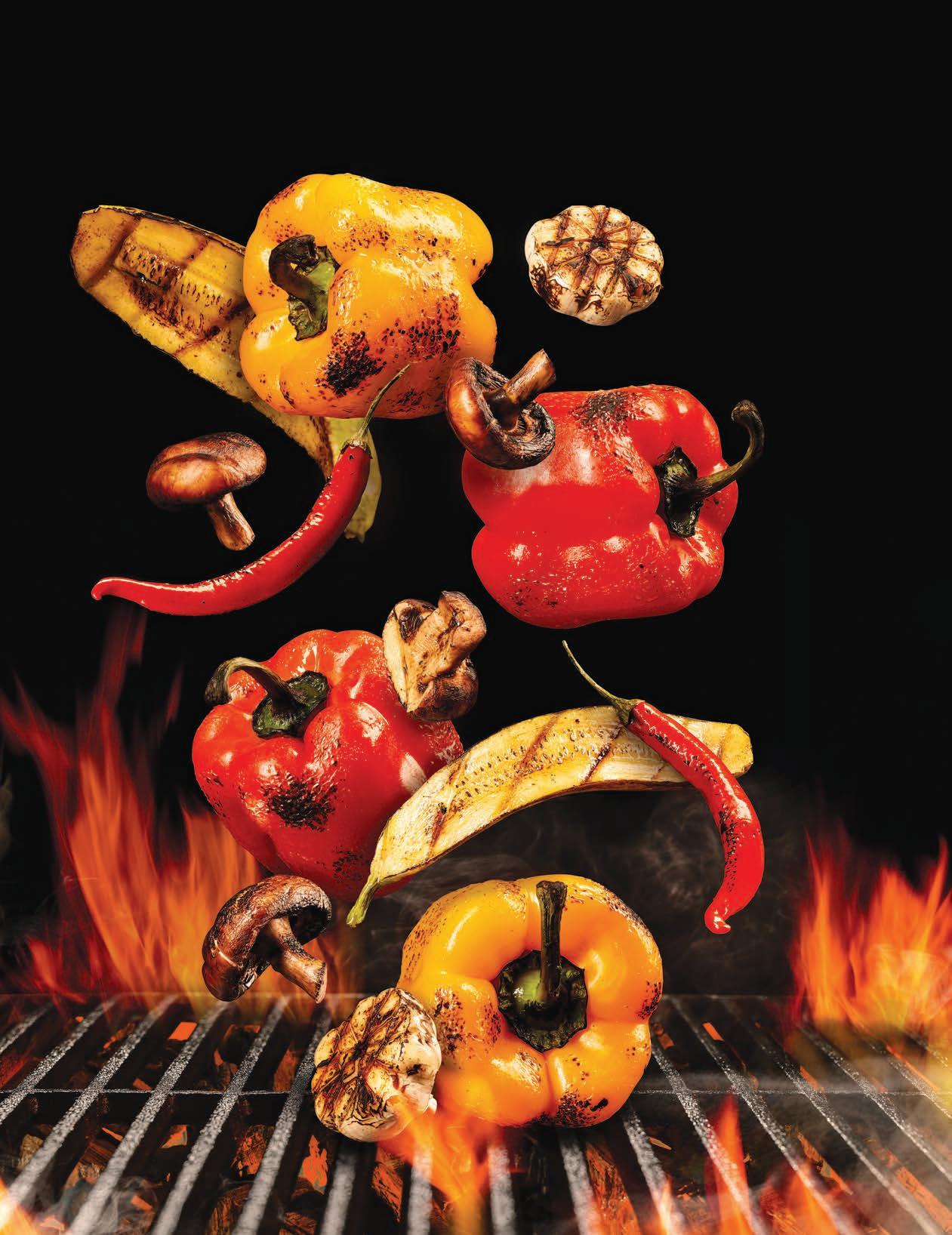
Chefs embrace the theater and flavor wood-fired cooking imparts
| BY JACQUELINE RAPOSO |
With a recent focus on all things safety, it can be hard to remember the thrill of interactive hospitality.
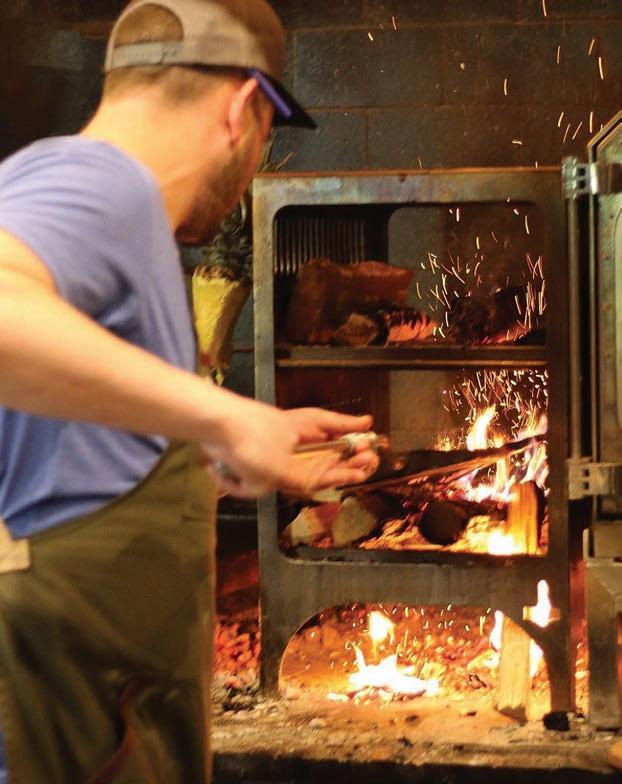
“Every cooking method has its place, and all can be enjoyable,” says Greg Denton, co-chef-owner with his wife, Gabrielle Quiñónez Denton, of the Argentinian-inspired Ox restaurant in Portland, Oregon. During the COVID-19 pandemic, the Dentons have offered everything from outdoor dining to to-go barbecue boxes. But diners miss out on the theater of their wood-fired grill. “Everyone loves the look and feel of the fire as they enter our restaurant,” Denton continues. “It’s exciting in the same way that a roller coaster is—so much fun, but with a hint of danger.”
While asado has a beloved history among Mexican and Latino cuisines, cooking over wood fire fell out of fashion in U.S. kitchens when cleaner fuels inspired compact setups and faster lines. But as diners pine for the thrill of shared experiences once again, supermarket and chef trends suggest a return to grilling with a heavy interest in spiced meats.
Which means it’s time to bring the fire back where it belongs: everywhere
A LITTLE ABOUT A LONG HISTORY
Scientists estimate homo sapiens first threw meat onto
flames around 1.8 million years ago, and they credit this revelation for why we evolved as we did: cooked foods are easier to digest than raw foods and create surplus energy. Over time, this helped our brains become almost double in size to those of our primate cousins. As our societal bonds deepened, the hunting and gathering of food evolved into gathering around fire to cook and eat it, too.
In following centuries, roaming tribes made and remade spit-roasts for meat and clay ovens for fish. Staid farmers and fishers smoked proteins and baked grains in crude closed “fire chambers.” Then came indoor cooking hearths so tall you could stand in them. In the mid-16th century, Argentina’s gauchos dotted the plains with openfire grills, cooking large slabs of meat on makeshift parillas to define asado cooking. Styles in Brazil, Uruguay, Peru, and Mexico followed.
By the mid-1700s, professional kitchens in the United States swapped out those massive cooking hearths for enclosed “fireboxes” built into chimneyed walls where, for the first time, cooks could somewhat control the heat as it twisted to a series of cooking chambers. The iron boom of the early 1800s then inspired massive cast iron cooking stoves complete with ranges, ovens, broilers, and hoods. Ovens were still fueled
by wood until coal became the post-Civil War norm, and the 20th century brought gas and then electricity into the slim, colorful ranges that soon entirely replaced those iron klunkers.
The sole means of cooking for millions of years, open-fire cooking became almost obsolete within a century. It’s still beloved for backyard cookouts and barbecue restaurants. But as anyone working the smoker can tell you, cooking with wood takes work.
AND YET… WE ALWAYS RETURN TO THE HEARTH
“This is how we all started to cook,” says chef Justin Bazdarich of Oxomoco, a Mexican restaurant in Brooklyn, New York. “It’s sort of in
“EVERYONE LOVES THE LOOK AND FEEL OF THE FIRE AS THEY ENTER OUR RESTAURANT,” DENTON CONTINUES.
“IT’S EXCITING IN THE SAME WAY THAT A ROLLER COASTER IS—SO MUCH FUN, BUT WITH A HINT OF DANGER.”
–CO-CHEF-OWNER GREG DENTON, Ox restaurant
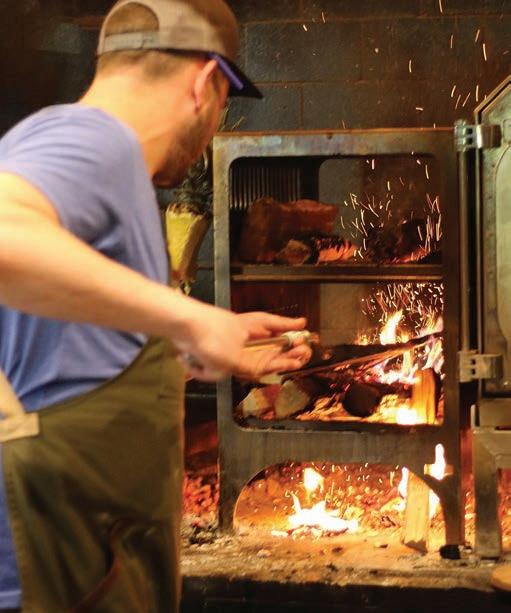
The wood-fired oven at La Vecina Restaurante
“THERE ARE VERY FEW THINGS THAT ARE NOT FITTING FOR THE WOOD FIRE…IT CAN BRING A CONCENTRATION OF FLAVOR THAT OTHER COOKING METHODS MAY NOT BE ABLE TO.”
–CO-CHEF-OWNER GREG DENTON, Ox restaurant
our DNA to be enjoying this in its primality.” Because of its history, it’s almost sacrilegious to call openfire cooking a trend. But as diners seek restaurants that comfort and entertain, chefs lean into cuisines that fire them up, too. Literally.
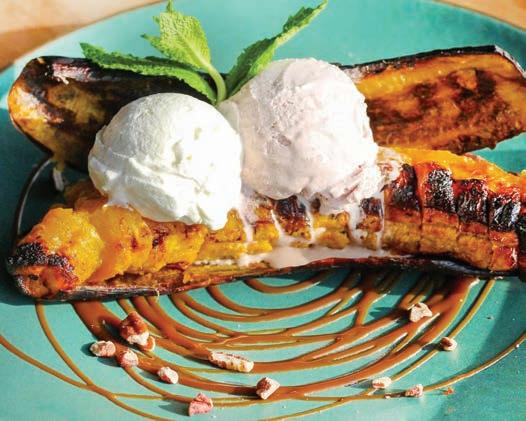
Coralville, Iowa’s new La Vecina Restaurante creates wood-fired Oaxacan fare, featuring grilled proteins folded into heirloom masa tor tillas.
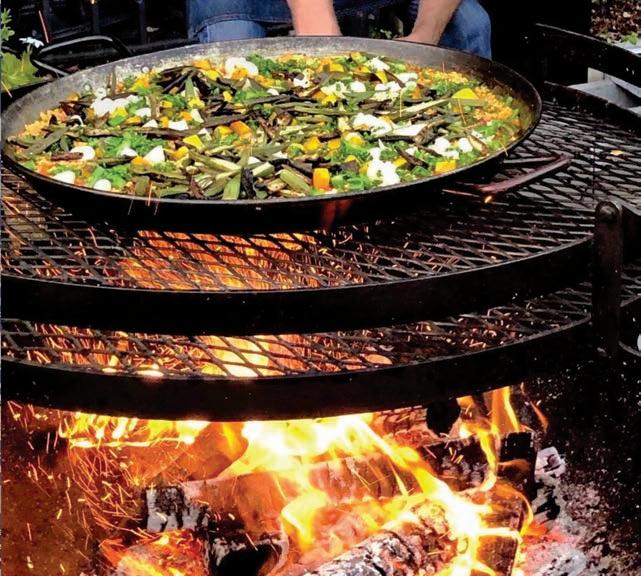
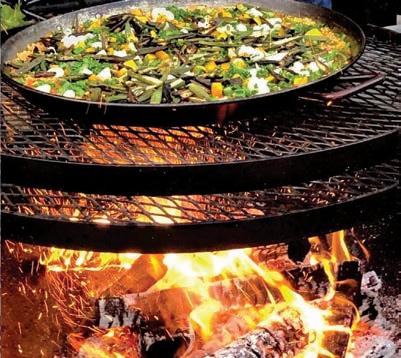
For over five years now, Chris and Idie Hastings have relied on open-fire cooking to marry southern ingredients with the cooking traditions of Spain, Portugal, Argentina, and Uruguay at their Birmingham, Alabama Ovenbird. After selling one of his two Mexico Clasico Grill locations in Rockford, Illinois, Chef Jose Chaves renamed his sole location El Fuego Grill to make sure guests know he has a
particularly hot offering. And the Dentons’ Argentinian cuisine would not be complete without it: “We knew our first restaurant would feature wood-fire cooking because we love the smoky, charred flavors that this kind of grilling imparts,” Denton says assuredly.
Bazdarich got hooked on wood-fired cooking at his first restaurant, too. “I wanted everything to be wood-fired,” he remembers of the first dishes coming out of his wood-burning ovens at Speedy Romeo in Manhattan. “I wanted wood-fired tacos, wood-fired steak frites…” Having traveled throughout Mexico since high school, he
points out that ingredients like chiles and masa already have or pair well with inherently earthy, smoky flavors. It only made sense to give two wood-burning grills focus at Oxomoco, too. “I took all my favorite dishes and put a wood-fired twist to them,” he says of that menu.
THE CHALLENGES
Of course, folding wood-fire cooking into a professional kitchen isn’t as simple as firing up a Weber or Big Green Egg.
For decades, even the toughest commercial grills came with expensive upkeep and lacked finesse. Then designers like Ben Eisen-
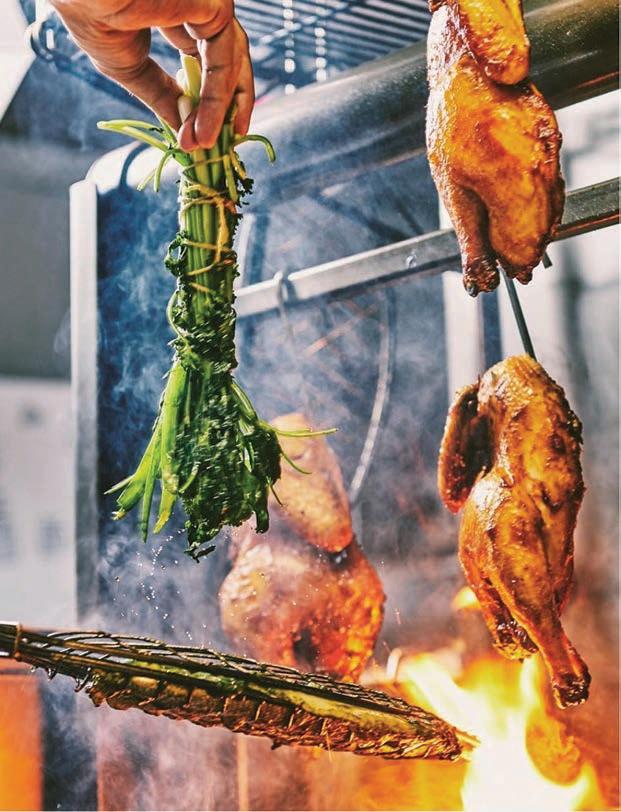
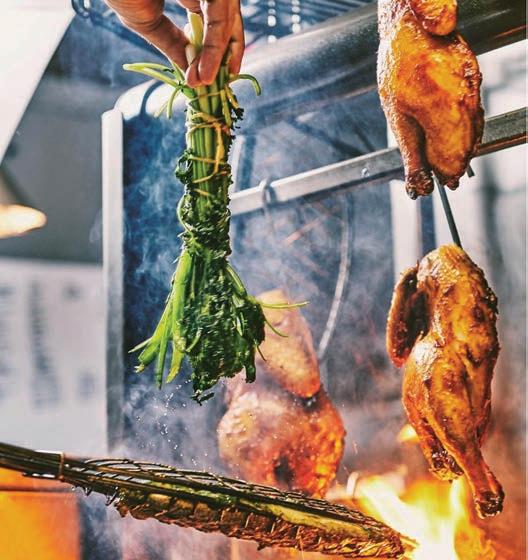
Cilantro and green onion add flavor to Oxomoco’s Brazino, as Sasso Chicken hangs in the background PHOTO BY LOUISE CECILIA PALMBERG
“THIS IS HOW WE ALL STARTED TO COOK…IT’S SORT OF IN OUR DNA TO BE ENJOYING THIS IN ITS PRIMALITY.”
– CHEF JUSTIN BAZDARICH , Oxomoco
drath hit the scene. Eisendrath’s Grillworks grills replicate the asado technique with angled grates, rotisseries, mesh surfaces, and planchas that move by crank wheels over adjustable fireboxes so that chefs get the precise steam or char they desire. They’re dubbed the “gold standard of wood-burning grills” by The New York Times, and the Dentons are among those who praise their custom-made setups. La Vecina’s stacked setup comes from Grills by Demant, an Atlanta-based company that customizes stainless-steel grills for regional chefs. Texas companies Champion Tuff Grills and M Grills also make grills that handle that heat. Such getups make for expensive startup costs but are worth the long-term investment.
Sourcing natural, kiln-dried
hardwood for those grills isn’t an issue. But wood isn’t the friendliest fuel to cook with. “The biggest challenge is the physical nature of it,” says Denton, whose chefs continually load and unload heavy fuel, and regularly risk dehydration and heat rashes from standing for hours at the fire.
Bazdarich points out that wood is more expensive to purchase and store than gas or electricity, too, and that unlike those other fuels, it’s an ingredient: “It also adds flavor to the dish,” he says. While he’s never figured wood into his menu costs, he points out the expense should be reflected there.
There are expenditures related to state environmental regulations, too. New York City now requires a “smog hog” to mist smoke particulates out of exhaust systems before it clears the roof.
Soups, sauces and salsa !
Immersion Blenders
#1 Selling
20 models available :
· Removable stainless steel blade and bell for perfect sanitation
· Multipurpose : blade and whisk
· Powerful motor for great performance
· Compact and easy to handle appliance
· Patented Easy Plug system making it far easier to replace the power cord for MP Models during after-sales servicing
Ovenbird’s Paella on the Patio
In Portland, Oregon, a woodfired hearth requires a separate hood system entirely. These are costly to build out, clean, and maintain. “I understand it. But the expense is exhausting,” Bazdarich says.
THE REWARDS
Even with all those things considered, wood-fire cooking transforms ingredients so fully as it cooks, crisps, and caramelizes that there’s no substitute for it.
“There are very few things that are not fitting for the wood fire,” Denton says of its versatility, citing how tender
fish fillets, tiny spring onions, and sweet seasonal melons all benefit. The collagen of skin and bones in whole animals and large chops meld to turn out incredibly tender and juicy results, too, cutting down ingredient waste at the same time. “It can bring a concentration of flavor that other cooking methods may not be able to,” he points out.
Bazdarich incorporates the grill into most dish components at Oxomoco, even grilling ingredients before chilling them for marinades and salsas. But his Sasso
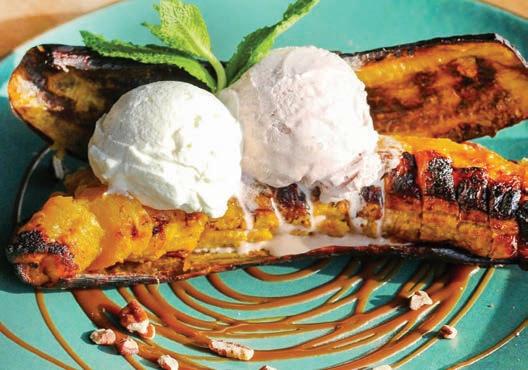
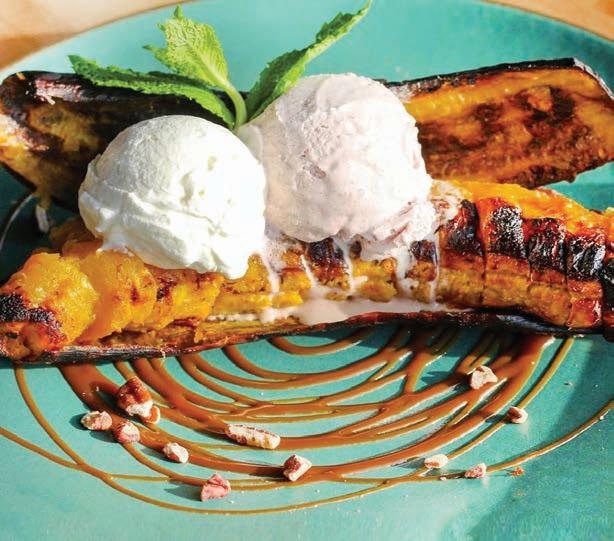
La Vecina Restaurante’s wood oven-roasted Plátanos
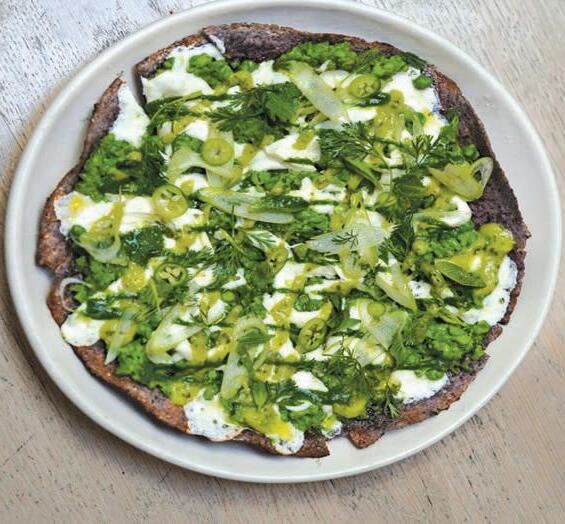
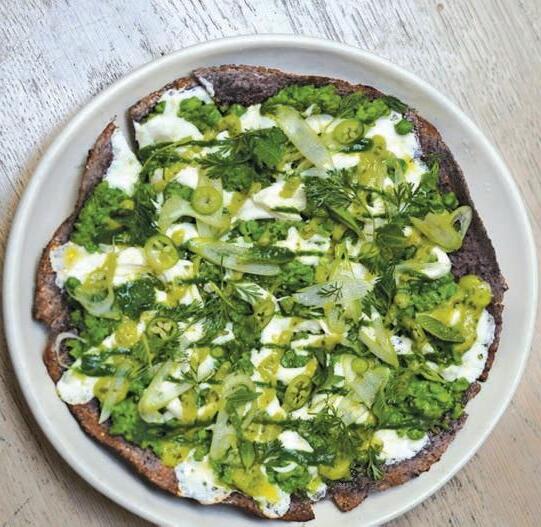
Chicken—which he brines and cooks in a low oven before hanging over the grill to slow smoke and then fries to finish—wouldn’t be the same without it. “We wouldn’t be able to get that same level of smoke flavor that’s so subtle and nice and juicy and tender,” he says of how other barbecue methods would overpower the particular hen’s subtle, tender fat and flavor. Even meatless, tortillabased dishes like his Spring Pea Tlayuda with salsa cruda, mint puree, quesillo, serrano and scallions get the wood-fire treatment.
While an incredibly versatile a cooking method, eaters know dining by an open fire remains a rarity, and noses perk wherever sweet smoke wafts. As food only gets tastier when touched by flame, asado is an antique technique that well deser ves trending.
Ready to take the torch?
Jacqueline Raposo is a food writer and podcast producer based in New York City. First generation Azorean American, her mouth waters for fresh fish grilled over open flames and playing fútbol with family 0while waiting on churrasco.
See recipe for Oxomoco’s wood-fired roasted Spring Pea Tlayuda on page 54.
“I WANTED WOOD-FIRED TACOS, WOOD-FIRED STEAK FRITES…I TOOK ALL MY FAVORITE DISHES AND PUT A WOOD-FIRED TWIST TO THEM.”
– CHEF JUSTIN BAZDARICH , Oxomoco
Oxomoco’s Spring Pea Tlayuda
asado EL ATRACTIVO DEL
Los chefs apuestan por el teatro y el sabor que proporciona la cocina de leña
|
POR JACQUELINE RAPOSO |
Con el énfasis actual en todo lo relacionado con la seguridad, puede ser difícil recordar la emoción de la hospitalidad interactiva.
“Cada método de cocina tiene su lugar, y todos pueden ser agradables”, dice Greg Denton, copropietario con su esposa, Gabrielle Quiñónez Denton, del restaurante Ox, de inspiración argentina, en Portland, Oregón. Durante la pandemia de Covid-19, los Denton han ofrecido desde cenas al aire libre hasta cajas de barbacoa para llevar. Pero los comensales se pierden el teatro de su parrilla de leña. “A todo el mundo le encanta el aspecto y la sensación del fuego al entrar en nuestro restaurante”, continúa Denton. “Es emocionante, igual que lo es una montaña rusa: muy divertido, pero con una pizca de peligro”.
Aunque el asado tiene una historia muy querida entre las cocinas mexicana y latina, cocinar con fuego de leña pasó de moda en las cocinas estadounidenses, cuando los combustibles más limpios inspiraron montajes compactos y mayor rapidez en las filas. Pero a medida que los comensales vuelven a anhelar la emoción de las experiencias compartidas, las tendencias de los supermercados y de los chefs sugieren una vuelta a la parrilla, con un gran interés por las carnes especiadas.
Lo que significa que ha llegado el momento de devolver el fuego a donde debe estar: en todas partes.
UN POCO SOBRE UNA LARGA HISTORIA
Los científicos estiman que el homo sapiens echó por primera vez carne al fuego hace unos 1.8 millones de años, y atribuyen a esta revelación la razón por la que evolucionamos como lo hicimos: los alimentos cocinados son más fáciles de digerir que los crudos y crean un excedente de energía. Con el tiempo, esto ayudó a que nuestros cerebros tuvieran casi el doble de tamaño que los de nuestros primos primates. A medida que nuestros lazos sociales se profundizaban, la caza y la recolección de alimentos evolucionaron hacia la reunión en torno al fuego para cocinarlos y también para comerlos.
En los siglos siguientes, las tribus itinerantes hicieron y rehicieron asadores para la carne y hornos de barro para el pescado. Los agricultores y pescadores sedentarios ahumaban las proteínas y horneaban los granos en toscas “cámaras de fuego” cerradas. Luego llegaron los fogones interiores, tan altos que se podía estar de pie en ellos. A mediados del siglo XVI, los gauchos argentinos salpicaron las llanuras con parrillas de fuego abierto, cocinando grandes trozos de
carne en parillas improvisadas para definir la cocina del asado. Le siguieron estilos en Brasil, Uruguay, Perú y México.
A mediados del siglo XVII, las cocinas profesionales de Estados Unidos cambiaron esos enormes fogones por “cajas de fuego” cerradas construidas en paredes con chimeneas en las que, por primera vez, los cocineros podían controlar en cierto modo el calor al girar hacia una serie de cámaras de cocción. El auge del hierro a principios del siglo XIX inspiró entonces las enormes cocinas de hierro fundido completas con fogones, hornos, parrillas y campanas. Todavía con leña como combustible, hasta que el carbón se impuso después de la Guerra Civil, el siglo XX trajo el gas y luego la electricidad a las esbeltas y coloridas cocinas que pronto sustituyeron por completo a esos aparatos de hierro.
“A TODO EL MUNDO LE ENCANTA EL ASPECTO Y LA SENSACIÓN DEL FUEGO AL ENTRAR EN NUESTRO RESTAURANTE”, CONTINÚA DENTON. “ES EMOCIONANTE, IGUAL QUE LO ES UNA MONTAÑA RUSA: MUY DIVERTIDO, PERO CON UNA PIZCA DE PELIGRO”. – GREG DENTON, chef copropietario del restaurante Ox
El horno en La Vecina Restaurante
“HAY MUY POCAS COSAS QUE NO SEAN ADECUADAS PARA EL FUEGO DE LEÑA. PUEDE APORTAR UNA
CONCENTRACIÓN DE SABOR IMPOSIBLE DE CONSEGUIR CON OTROS MÉTODOS DE COCINA.”
– GREG DENTON, chef copropietario del restaurante Ox
Como única manera de cocinar durante millones de años, la cocina de fuego abierto quedó casi obsoleta en un siglo. Sigue siendo muy apreciada en las comidas al aire libre en los patios y en los restaurantes de barbacoa. Pero como puede contarle cualquiera que trabaje con un ahumador, cocinar con leña implica mucho trabajo.
Y SIN EMBARGO... SIEMPRE VOLVEMOS A LOS FOGONES
“Así es como todos empezamos a cocinar”, dice el chef Justin Bazdarich de Oxomoco, un restaurante mexicano de Brooklyn, Nueva York. “Está en cierto modo en nuestro ADN disfrutar de esto en estado
puro”. Debido a su historia, es casi un sacrilegio decir que la cocina a fuego abierto es una moda. Pero a medida que los comensales buscan restaurantes que los reconforten y entretengan, los chefs se inclinan por cocinas que también los enciendan. Literalmente.
El nuevo restaurante La Vecina de Coralville, Iowa, crea comida oaxaqueña a la leña, con proteínas a la parrilla dobladas en tortillas de masa tradicionales. Desde hace más de cinco años, Chris e Idie Hastings confían en la cocina a fuego abierto para combinar los ingredientes sureños con las tradiciones culinarias de España, Portugal, Argentina y Uruguay en su local de Bir-
mingham, Alabama, Ovenbird Después de vender uno de sus dos locales de México Clásico Grill en Rockford, Illinois, el chef José Chaves rebautizó su único local con el nombre de El Fuego Grill para que los comensales sepan que tiene una oferta especialmente ardiente. Y la cocina argentina de los Denton no estaría completa sin ella: “Sabíamos que nuestro primer restaurante contaría con cocina de leña porque nos encantan los sabores ahumados y carbonizados que ofrece este tipo de parrilla”, dice Denton con seguridad.
Bazdarich también quedó fascinado por la cocina de leña en su primer restaurante. “Quería que todo fuera a la leña”, recuerda de los primeros platos que salían de sus hornos de leña en el Speedy Romeo de Manhattan. “Quería tacos a la leña, bistecs fritos a la leña...” Al haber viajado por todo México desde el instituto, señala que ingredientes como los chiles y la masa ya tienen o combinan bien con sabores inherentemente terrosos y ahumados. Era lógico que en Oxomoco también se centraran en dos parrillas de leña. “Agarré todos mis platos
favoritos y les di un toque de leña”, dice sobre ese menú.
LOS DESAFÍOS
Por supuesto, incorporar la cocina de leña a una cocina profesional no es tan sencillo como encender una Weber o un Big Green Egg. Durante décadas, incluso las parrillas comerciales más resistentes tenían un mantenimiento costoso y carecían de delicadeza alguna. Entonces entraron en escena diseñadores como Ben Eisendrath. Las parrillas Grillworks de Eisendrath reproducen la técnica del asado con rejillas angulares, asadores, superficies de malla y planchas que se mueven mediante ruedas con manivela sobre las cajas de fuego ajustables para que los chefs logren el vapor o el carbonizado preciso que desean. El New York Times las ha calificado como el “patrón a seguir de las parrillas de leña”, y los Denton están entre los que alaban sus montajes a medida. La configuración apilada de La Vecina proviene de Grills by Demant, una empresa con sede en Atlanta que personaliza parrillas de acero inoxidable para los chefs de
Paella de Ovenbird
Brazino y pollo de Oxomoco
la región. Las empresas de Texas Champion Tuff Grills y M Grills también fabrican parrillas que soportan ese calor. Estas parrillas suponen unos costos iniciales elevados, pero la inversión a largo plazo merece la pena.
Conseguir madera dura natural y secada al horno para esas parrillas no es un problema. Pero la madera no es el combustible más agradable para cocinar. “El mayor reto es su naturaleza física”, dice Denton, cuyos cocineros cargan y descargan continuamente el pesado combustible, y se arriesgan con frecuencia a sufrir deshidratación y erupciones cutáneas por estar de pie durante horas junto al fuego.
Bazdarich señala que la madera es más cara de comprar y almacenar que el gas o la electricidad, también, y que a diferencia de esos otros combustibles, es un ingrediente: “También añade sabor al plato”, dice. Aunque nunca ha incluido la madera en los costos de su menú, señala que el gasto debería reflejarse ahí.
También hay gastos relacionados con la normativa
medioambiental estatal. La ciudad de Nueva York ahora exige un “filtro de aire” para nebulizar las partículas de humo de los sistemas de escape antes de que lleguen al techo. En Portland (Oregón), una chimenea de leña requiere un sistema de campana totalmente independiente. Estos son costosos de construir, limpiar y mantener. “Lo entiendo. Pero el gasto es desorbitado”, dice Bazdarich.
LAS RECOMPENSAS
Incluso teniendo en cuenta todas esas cosas, la cocina de leña transforma los ingredientes por completo a medida que los cocina, los vuelve crujientes y los carameliza, de modo que no hay nada que la sustituya.
“Hay muy pocas cosas que no sean adecuadas para el fuego de leña”, dice Denton sobre su versatilidad, y menciona cómo se benefician de ella los tiernos lomos de pescado, las diminutas cebollas cambray y los dulces melones de temporada. El colágeno de la piel y los huesos de los animales enteros y las chuletas grandes se funden para
“ASÍ ES COMO TODOS EMPEZAMOS A COCINAR...
ESTÁ EN CIERTO MODO EN NUESTRO ADN
DISFRUTAR DE ESTO EN ESTADO PURO.”
– JUSTIN BAZDARICH
, chef de Oxomoco
obtener resultados increíblemente tiernos y jugosos, reduciendo al mismo tiempo el desperdicio de ingredientes. “Puede aportar una concentración de sabor imposible de conseguir con otros métodos de cocina”, señala.
Bazdarich incorpora la parrilla a la mayoría de los componentes de los platos en Oxomoco, incluso asando los ingredientes antes de enfriarlos para los escabeches y las salsas. Pero su Pollo Sasso—que pone en salmuera y cocina en un horno a baja temperatura antes de colgarlo sobre la parrilla para ahumarlo lentamente y freírlo para terminar—no sería lo mismo sin ella. “No podríamos conseguir ese mismo nivel de sabor ahumado que es tan sutil, agradable, jugoso y tierno”, dice
sobre cómo otros métodos de barbacoa dominarían la grasa y el sabor sutil y tierno de la gallina en particular.
Aunque se trata de un método de cocción increíblemente versátil, los comensales saben que cenar junto a un fuego abier to sigue siendo algo poco frecuente, y los olfatos se agudizan allí donde el humo dulce se difunde. Como la comida solo se vuelve más sabrosa al contacto con la llama, el asado es una técnica antigua que bien merece estar de moda.
¿Listos para tomar el relevo?
Jacqueline Raposo es una escritora gastronómica y productora de podcasts afincada en la ciudad de Nueva York. Americana de primera generación de las Azores, se le hace la boca agua con el pescado fresco asado al fuego y jugando al fútbol con la familia mientras espera el churrasco.
Plátanos de La Vecina Restaurante
Spring Pea Tlayuda de Oxomoco; ver receta en la página 54
EXPLORING THE STREET FOODS OF MEXICO
EDITOR’S NOTE: A few months ago, I read about a tour that took visitors on a culinary journey to explore the street foods of Puebla. Since el Restaurante contributing writer Joseph Sorrentino is our resident writer in Mexico, I tapped him to explore the topic by taking his own personally designed tour. Here, he shares a “menu” of his discoveries from Chipilo, Atlixco, San Pedro Cholula and Santa Maria Tonantzintla, all in the state of Puebla; San Gregorio Atlapulco and Santa Cruz Acalpixca in Xochimilco; and Villa Milpa Alta in Milpa Alta. (Xochimilco and Milpa Alta are municipios or boroughs of Mexico City).
|
BY JOSEPH SORRENTINO,
writing from Mexico | I avoided street food during my first couple of trips to Mexico mainly because whenever I was heading there, some friend would inevitably tell me a horror story about what happened
to them or someone they knew when they ate food sold on the street. I took their warnings to heart. What a mistake. I missed out on a lot.
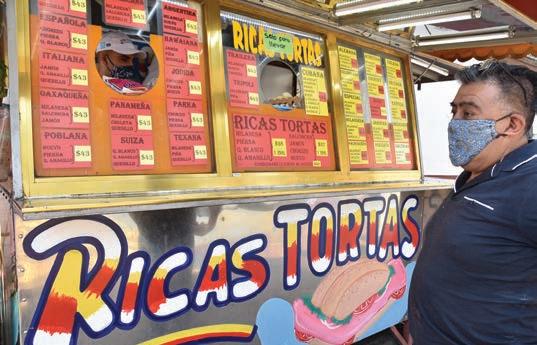
People across Mexico sell food from baskets attached to their bicycles, carts, small
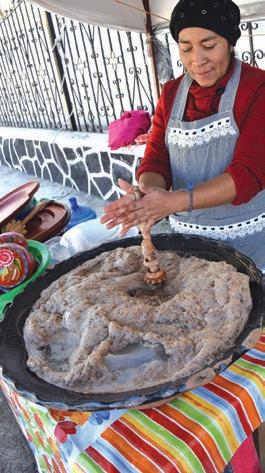
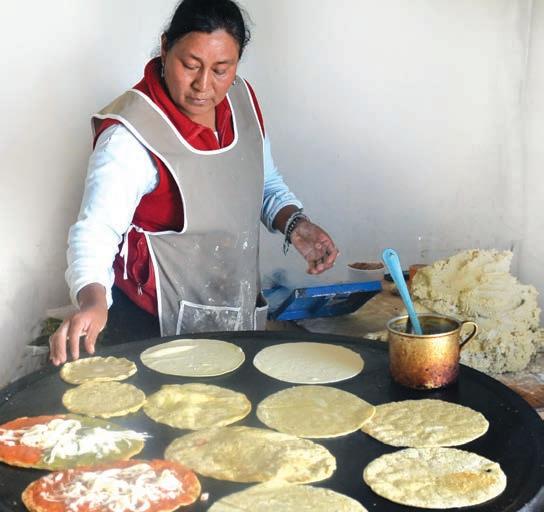
stands, taquerías, and holein-the-wall restaurants. Street food is really just home-made food that’s extremely inexpensive and very tasty. Many items ser ved in Antojitos Mexicanos (tiny restaurants, someone’s front room or a large tent) typically are cooked on a comal, a large metal griddle and start with a cook taking a handful of masa, passing it through a tortilla press to flatten it and then shaping it into circles, ovals or other shapes depending on what’s been ordered.
There’s an almost infinite variety of street food options, and each location has its own take on Mexican favorites. I and a companion ate
at 20 different locations and, happily, have no horror stories to regale you with. Here’s some of what we enjoyed:
MAIN MEALS
TAMALES In the early morning, heavy three-wheeled bicycles loaded with silver containers jammed with tamales appear on corners in virtually every Mexican city and pueblo. Most stands offer several types, including rajas (queso fresco, and strips of chiles, typically poblanos, that have been cooked with tomatoes); dulce (a sweet, red tamale made with strawberries, raisins and vanilla); mole (some type of mole, chipotle and pork); verde (tomatillos, cilantro, chile, pork or chicken). Although tamales may be eaten any time, they’re typically sold as a breakfast food on the street and carts disappear by mid-morning.
Masa-based foods cooking on a comal
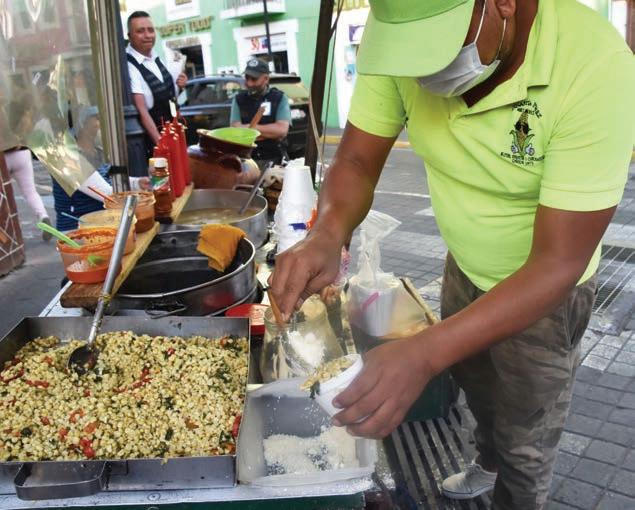
Esquites
TACOS They’re sold from bikes, stands and in taquerías…and if you hear someone calling out “Tacos... tacos de la canasta,” head on over. In Cholula, these are often small tacos sold from a basket attached to a bike. They can be filled with meat, beans or potatoes and topped with salsa. An order is four tacos and since they’re small and tasty, two orders may be required. Other types include tacos dorados, tacos that have been fried to a crispy, golden brown, and tacos camioneros, soft tacos piled high with meat, onions, peppers and french fries. One order will almost certainly suffice. At outside taquerías, you’ll often find marinated pork cooking on a trompo, a vertical rotisserie. The pork is layered on the trompo, slow-cooked, and then thinly sliced to make tacos al pastor, or taco árabes. Both are made with pork cooked on a trompo but the marinades differ.
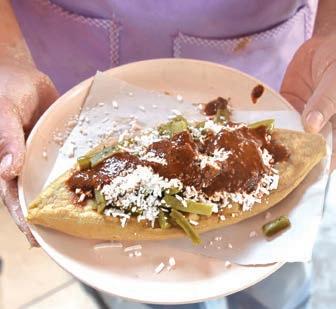
TLACOYOS These are traditionally oblong or triangular. Refritos, cheese or mashed potatoes are added to the masa, which is worked slightly and then shaped. Surprisingly, I’ve never seen
a tlacoyo filled with any kind of meat. Once cooked, they’re often topped with nopales and grated cojita.
QUESADILLAS You can order these large tortillas filled with whatever your heart desires. Be sure to ask for quesillo (queso Oaxaca)—you won’t regret it. A popular quesadilla in Milpa Alta is filled with seso (brains), onions, jalapeños and epazote (that one isn’t cooked on a comal—it’s deep-fried).
GORDITAS In Mexico City, gorditas are usually large, thick and round. Cooks slice these in half and stuff them with the customer’s choice of fillings. Chicharron is added whether you’ve asked for it or not. But in Puebla, gorditas look like quesadillas that have been filled with refritos.
MOLOTES A cross between fried dough and a calzone, molotes are found mainly in Puebla. The ones I ate were made from dough that’s a mix of flour and corn and pressed until paper-thin. A generous amount of filling is added, along with thin slices of jalapeño and some epazote. The dough is folded over and deep-fried resulting in a surprisingly soft molote.
TORTAS On my second trip to Mexico—way back in 1999—I spied a stand advertising tortas. My Spanish wasn’t very good—in fact, it was almost non-existent—and I figured a torta was a small tortilla.
Tlacoyo
Makes sense, right? So, I went in and ordered two. Big mistake. Turns out tortas are large sandwiches. Although torta is a generic name for any kind of sandwich, in Mexico City there are torta stands everywhere selling tortas filled with meat, cheese, avocado, onion, refritos and mayonnaise. My favorite is torta suisa, which is made with three kinds of melted cheese. Adding chipotle takes it to whole ‘nother level.
CEMITAS A sandwich found only in Puebla, it’s made with a roll called a cemita and generally has meat, queso Oaxaca, avocado and onions—but each stand has its own version.
BARBACOA Meat is traditionally, but not always, placed on top of charcoal in a hole in the ground and covered with maguey leaves. It cooks for 8 to 12 hours and, at least for estilo Hidalgo (Hidalgo-style) preparations, is served with a soup made with the meat drippings, rice, garbanzos and carrots. I was told the soup was “90 percent vegetarian.” Unlike barbecue in the U.S., no sauce is added.
SNACK ATTACK
ESQUITES Made from fresh corn kernels, this is a simple but delicious snack that’s either fried (with poblano chile, epazote and salt) or boiled (no chile). Both are traditionally served topped with cojita cheese, chile powder, mayonnaise and lime.
CACAHUATES Y CHAPULINES
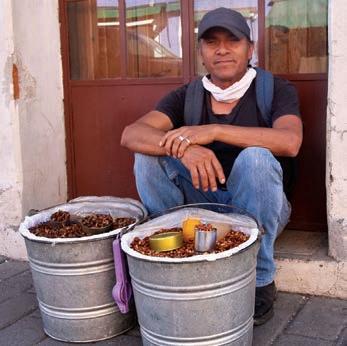
Vendors called itinerantes carry buckets of peanuts and fried grasshoppers through the streets of cities and pueblos. I’m really fond of the peanuts but have yet to tr y the chapulines. I’m told they taste like peanuts, so I’ve decided to stick to the peanuts.
CHICHARRÓNES Deep-fried pork skins…need I say more?
HELADO Y NIEVE Ice cream and water ice made fresh in buckets at stands that line many streets.
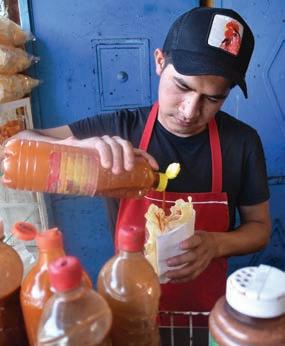
PAPAS Once you’ve eaten fresh-cooked potato chips, you’ll never buy bagged chips again. Potatoes are sliced into hot oil, cooked for about three minutes, drained, cooled and bagged. Adding salsa, lime and salt is a must.
DRINK UP
JUGOS Stands sell fruit and vegetable juices (fruit juices are called aguas frescas). They’ll often also sell horchata (a sweet rice drink) and jamaica (made from hibiscus flowers).
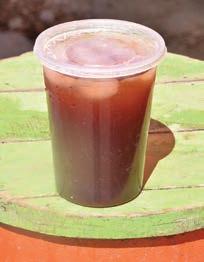
TEPACHE Also called pineapple wine, it’s a slightly alcoholic (about 2 percent) drink made from pineapple peels. The peels are placed in water, along with sugar and cinnamon and allowed to ferment for two or three days. The result is a deep reddish-brown drink that’s somehow able to taste sweet and vinegary at the same time. It’s traditionally served ice-cold.
PULQUE Another fermented, slightly alcoholic drink (around 4 percent) that’s made from agave.
CHILE ATOLE One of my favorite drinks, this is made by mixing
masa with water and boiling that mixture with corn kernels, chile (usually serrano) and epazote. Some cooks add radish leaves. This green, spicy drink is really good during the colder months.
ATOLE Often sold at tamale stands, this sweet drink is made with masa, milk, piloncillo (raw sugar) and cinnamon. There’s also a chocolate version.
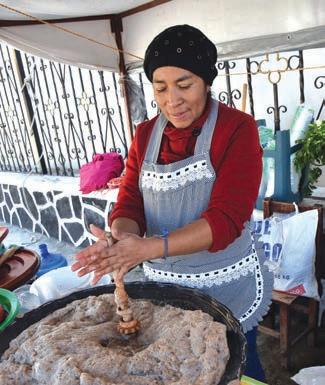
CACAO Known as tejate in Oaxaca and chilate in Guerrero, this cold, delicious chocolate drink is simply known as cacao in Santa Maria Tonantzintla, Puebla where it’s made with cacao, toasted corn, amaranto and cinnamon. The drink is stirred with a special, elaborately car ved stick called a molinillo which is spun between a person’s hands to give the cacao its froth.
See a recipe for Barbacoa on page 54.
Cacahuates and Chapulines Papas
A steet tortas stand
Tepache
Cacao
| BY ELYSE GLICKMAN
| After 2020’s unprecedented dry spell, bar business is heating up, as vaccinations coincide with summertime weather. And that begs the question: What are some cocktail trends heating up the bar scene as we cautiously move out of COVID-19 and into the summer time drinking and dining season?
“This has been a hot-button topic for the past year. It’s really hard to say as the whole world stood still, and while creativity wasn’t halted, trends definitely slowed down,” says Southern Glazer’s Wine & Spirits Illinois Mixologist Daniel DeOliveira. “One thing we did see was bars and bartenders using spirits that may have just been collecting dust in a liquor room—flavored vodkas, odd liqueurs, free stock—and turning those spirits that were otherwise overlooked into something delicious. I think it really caused people to get creative as bars were not bringing in new products and being very conscious of the COVID climate, thus using what they had on hand.”
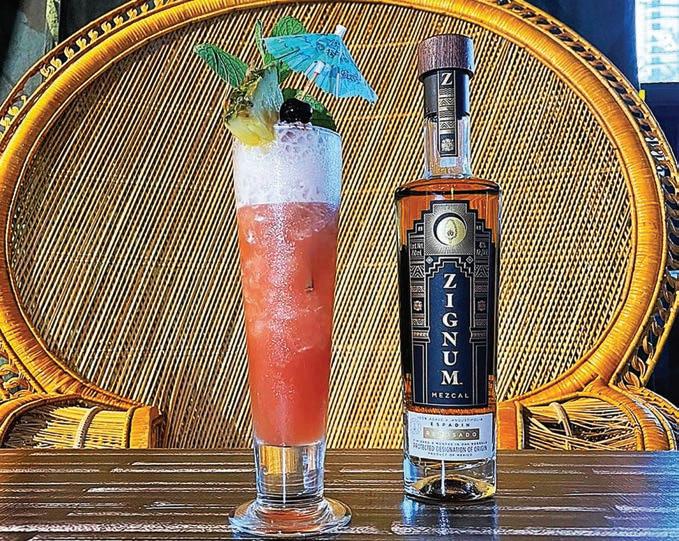
A creative approach that took safety into account has also affected cocktail trends, according to Saul Moise, commercial director for ZIGNUM Mezcal. For example, one-time outdoor staples such as the big cocktail bowl or giant margarita that customers could share are out, while “deconstructed cocktails” are poised for a comeback, Moise says. “Consumers became accustomed to to-go cocktails as well as home mixology, so will feel both safe and comfortable when presented with ingredients and tools allowing them to mix their own cocktails at their own tables.”
“Speed of service will be even more important than before, as you don’t want crowds hovering at a bar waiting for
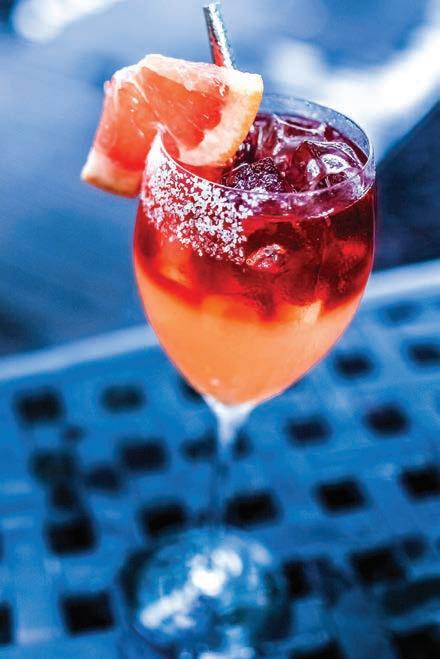
PATIO-PERFECT COCKTAILS
Light, fresh and fruit-forward define summertime libations
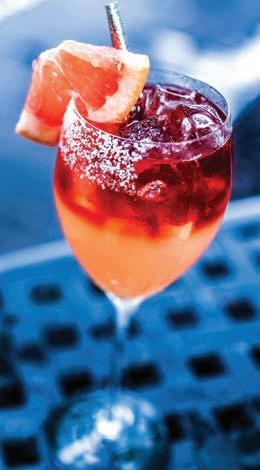
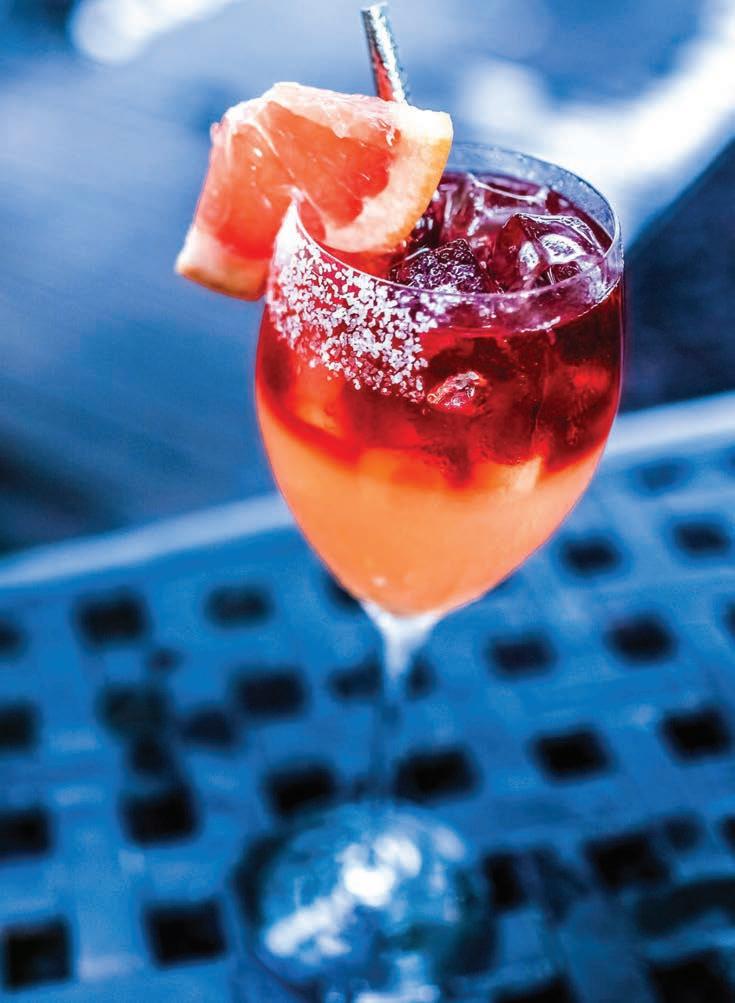
La Duni’s Paloma Francesa
A New Take on Tiki?
| BY
KATHLEEN FURORE |
Colorful, fruity, umbrella-accented “Tiki” cocktails have been popular for decades. But as concerns about cultural appropriation gain steam, there’s debate about whether or not the term is the right one to use in restaurant and bar settings.
Consider this assessment from “8 Trends That Will Define How We Drink in 2020,” a story at Liquor. com: “While the canon of Tiki drinks will live on, Tiki bars, as we know them, are fast on their way to extinction as the industry continues to recognize Tiki’s problematic history and misuse of Indigenous iconography and language.”
San Francisco’s Sobre Mesa and Chicago’s 14 Parish, for example, serve what once might have been labeled “Tiki” cocktails, but are doing so through the lens of what liquor.com calls “the Black and Caribbean diaspora,” the story notes.
Wine Enthusiast Magazine’s “10 Drinks Trends for 2021” weighed in on the subject last December, too: “Tiki bars are out; tropical and nautical bars, in…While the desire for colorful, rum-soaked drinks will continue, don’t call the bars that serve them ‘tiki bars.’”
Daniel DeOliveira, Southern Glazer’s Wine & Spirits Illinois Mixologist, has a slightly different take on the topic.
“I do know a lot of places are not necessarily shying away from using the term ‘tiki’ but are more or less losing some of the glassware and imagery that is disrespectful to other cultures—and there is a lot of it,” DeOliveira says. “The tiki craze is definitely here to stay, but there is a way to have and honor it while being respectful of the cultures it draws upon.”
Thoughts on the subject? We’d love to hear them! Email Editor Kathleen Furore at kfurore@restmex.com and we’ll share the comments in our next issue.
drinks,” Moise adds. “Eyes will be on the high-energy bars, making sure they are implementing sanitary processes.”
LIGHTER DRINKS FOR A LIGHTER SEASON
Coming out of the COVID lockdown, Moise projects consumers will lean toward lighter, cleaner, not-too-sweet flavor profiles.
Melissa Scroger, beverage director at Mas Amor Cantina in Hickory, North Carolina, is applying some of those principals by using fresh herbs to mellow out flavor profiles in specialty cocktails once defined by intense sweetness.
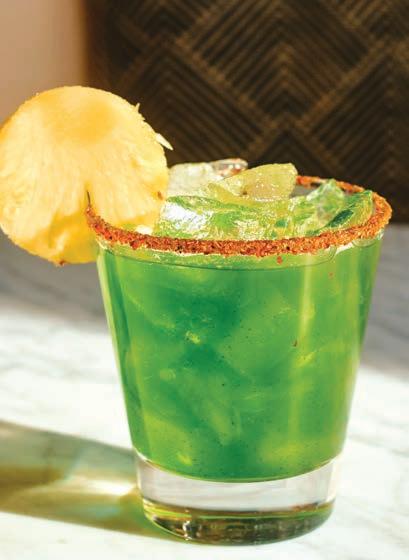
“We are incorporating daily freshsqueezed juices and herbs muddled into our signature drinks,” she says. “Our Mojito Margarita is a great take on two classic summertime cocktails, with muddled mint, fresh squeezed lime juice, and only a touch of simple syrup shaken into a black smoked salt rimmed glass with guests’ choice of tequila. Our Pineapple-Cilantro Margarita is curated with our house-made cilantro simple syrup, pineapple puree, fresh squeezed lime juice, shaken with guests’ choice tequila into a Tajin-rimmed glass.”
Daniel Guillen, beverage director at La Duni in Dallas, sees a trend toward lighter libations featuring fruit, too.
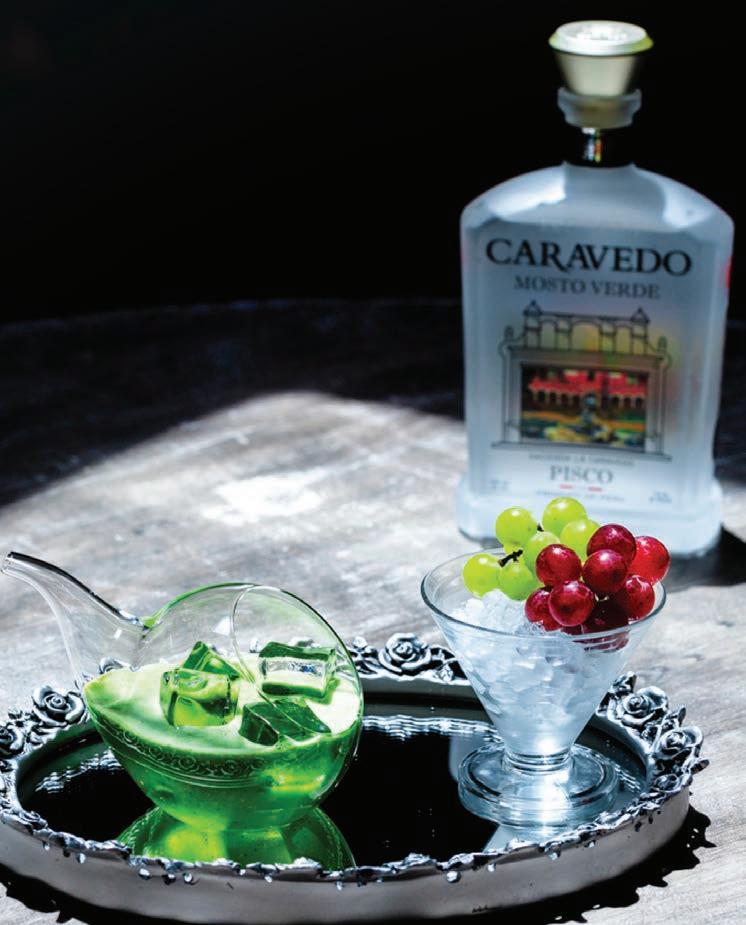
“While I am not sure of what the market will accept or will trigger for summer 2021, I personally think pink grapefruit and mint or black pepper are beautiful combinations and could have legs this year,” Guillen says. “Citrus-forward tonic highballs with clear spirits like Pisco, meanwhile, could become a thirst quencher on summer afternoons. Hibiscus is also a ‘thing,’ growing more and more in Latin menus, coming in strong as hibiscus margaritas, mojitos or sours.”
The La Madrugada cocktail
—MELISSA SCROGER, Mas Amor Cantina
“We are incorporating daily fresh-squeezed juices and herbs muddled into our signature drinks. Our Mojito Margarita is a great take on two classic summertime cocktails, with muddled mint, fresh squeezed lime juice, and only a touch of simple syrup shaken into a black smoked salt rimmed glass with guests’ choice of tequila. Our Pineapple-Cilantro Margarita is curated with our house-made cilantro simple syrup, pineapple puree, fresh squeezed lime juice, shaken with guests’ choice tequila into a Tajin-rimmed glass.”
A few La Duni favorites include the Chamoyada made with mango puree, the Clementina Margarita shaken with fresh clementines, and the Ica Press made with green apples and grapes pressed in a cold press juicer.
“We’re also seeing things like alcoholic popsicles, different types of hard seltzers that are becoming more and more crafty and seasonal, grapefruit spritzers with clear spirits and (beer-based) Micheladas of all kind,” Guillen adds.
Keeping it fresh should remain the focus, DeOliveira stresses.
“When it comes down to it, it’s all about the ingredients. Are you using fresh lime juice in your margaritas and other cocktails? If the answer is no, you will never ser ve a great cocktail, period. There are quality mixers out there, like Liquid Alchemist that just launched their Peach and Blood Orange syrups, that are real products with real ingredients. They may cost a bit more than some of their competitors, but at the end of the day, you get what you pay for. Sure, this other syrup/puree might taste delicious and be half the cost, but if it can be stored once opened at room temperature for over six months, what chemicals are they using to preserve it? I don’t want/ care to know.”
Mas Amor Cantina’s Pineapple-Cilantro Margarita
PHOTO BY BLAKE POPE
La Duni’s Ica Press cocktail
The No- and Low-Alcohol Trend
With summer calling for lighter cocktails, no- and low-alcohol options are things to consider—at least based on a 2021 study from IWSR Drinks Market Analysis.
“While 2020 was a challenging year for beverage alcohol, consumer demand for no- and low alcohol beer, wine, spirits, and ready-to-drink (RTD) products continues to increase,” the No- and Low-Alcohol Strategic Study 2021 says. “The buoyant no/ low category gained share within the total beverage alcohol market last year to 3 percent, and total volume is forecasted to grow by +31 percent by 2024.”
When it comes to where these no- and low-alcohol beverages are trending, some markets are proving more resilient than others. According to the study, the U.S. “is currently the most dynamic, with the no/low segment registering over +30 percent increase in 2020 despite the enormity of the challenges faced by the industry.”
“Passionfruit and mezcal is a combination to look out for. [Passionfruit] is a sexy fruit with Latin mystique and citrusy flavor.”
– MARCELLO COPPOLA , ZIGNUM Mezcal
TEQUILA ALTERNATIVES
While tequila always will be prevalent behind the bar, especially in Mexican establishments, other liquors are taking hold in Mexican- and Latin-inspired cocktails.
Mas Amor’s Scoger, for example, is turning to brown spirits in place of familiar tequila in some cocktails.
“To wet the whistle of any summertime whiskey fan, we’ve got the Blood Orange Bourbon Smash, shaken with Heaven Hill Bourbon, blood orange puree, fresh squeezed lemon and lime juice and finished with Angostura orange bitters and a slice of blood orange. Our Horchata is made from scratch daily with shaved almonds, white rice, Melipone genuine Mexican Vanilla, and cinnamon, then shaken with our Dark Goslings Rum and Sambroso coffee liqueur.”
MARCELLO COPPOLA , East Regional manager for ZIGNUM Mezcal, says “Tiki” is still big, but with strong brown spirits, along with mezcal, replacing sweeter rums and tequilas.
“Passionfruit and mezcal is a combination to look out for. [Passionfruit] is a sexy fruit with Latin mystique and citrusy flavor,” Coppola says. (See sidebar about Tiki on page 32.) “Mezcal, like tequila, is very versatile, as you can essentially replace any white spirit with it to enhance the cocktail and give it an entirely new flavor profile,” interjects Moise. “Another example is the Paloma, which normally is tequila-based. However, if you switch it with a mezcal, you give it an earthy, peppery, more agave-forward flavor profile.”
See cocktail recipes on page 54.
Summer cocktails get a fresh twist with watermelon and mint
Elyse Glickman is the At the Bar columnist for el Restaurante.
Pro-Tip:
| POR ELYSE GLICKMAN | Tras un periodo inédito de escasez en 2020, el negocio de los bares está retomando fuerza debido a que la vacunación coincide con la temporada veraniega. Esto nos lleva a la pregunta: ¿cuáles son algunas de las tendencias cocteleras que están mejorando el panorama de los bares a medida que nos alejamos cautelosamente de la COVID-19 y nos adentramos en la temporada de comida y bebida estival?
“Este tema dio mucho de qué hablar el año pasado. Es difícil saber, ya que el mundo entero se detuvo y aunque no se frenó la creatividad, las tendencias definitivamente se ralentizaron”, comenta Daniel DeOliveira, mixólogo de Southern Glazer’s Wine & Spirits Illinois. “Algo que sí notamos es que los bares y cantineros usaron bebidas alcohólicas que podrían haber estado acumulando
COCTELES PERFECTOS PARA DISFRUTAR EN LA TERRAZA
Lo ligero, fresco y frutal caracteriza las bebidas del verano
polvo en el almacén (vodkas con sabor, licores poco comunes, existencias gratis) y convirtieron estas bebidas, que de otro modo habrían pasado desapercibidas, en algo delicioso. Creo que esto realmente contribuyó a estimular la creatividad de la gente, pues, como los bares dejaron de traer nuevos productos y estaban muy conscientes de la situación de la COVID, usaban lo que tenían a mano”.
De acuerdo con Saul Moise, director comercial de ZIGNUM Mezcal, un enfoque creativo que tomó en cuenta la seguridad también ha afectado las tendencias de los cocteles. Por ejemplo, las bebidas alcohólicas de una sola vez para tomar al aire libre, como el recipiente grande para cocteles o la margarita gigante que los clientes podían compartir ya no se consumen, mientras que los “cocteles deconstruidos” se están preparando para su regreso, dice Moise. “Los consumidores se acostumbraron a los cocteles para llevar y a la mixología casera, por lo que se sentirán seguros y cómodos cuando se les proporcionen los ingredientes y las herramientas que les permitan mezclar sus propios cocteles en sus propias mesas”.
“La velocidad del servicio será aún más importante que antes, pues querrán evitar las acumulaciones de gente esperando sus bebidas en un bar”, agrega Moise. “La atención se centrará en los bares con mayor actividad, asegurándose de que estén implementando los procedimientos sanitarios”.
BEBIDAS MÁS LIGERAS PARA UNA TEMPORADA MÁS LIGERA
Al terminar el confinamiento de la COVID, Moise predice que los consumidores preferirán perfiles de sabor más ligeros, puros y no demasiado dulces.
MELISSA SCROGER , directora de bebidas de Mas Amor Cantina en Hickory, Carolina del Norte, está aplicando algunos de esos principios mediante el uso de hierbas frescas para suavizar los perfiles de sabor en cocteles especiales que alguna vez se caracterizaron por su dulzura intensa.
“Incorporamos diariamente jugos recién exprimidos y hierbas mezcladas en nuestras bebidas exclusivas”, dice. “Nuestro Mojito Margarita es una excelente versión de dos cocteles clásicos de verano, con una mezcla de menta, jugo de limón recién exprimido y solo un toque de jarabe simple mezclado con el tequila que de elección del cliente en un
vaso con sal ahumada negra en el borde. Nuestra margarita de piña y cilantro está curada con nuestro jarabe simple de cilantro casero, puré de piña y jugo de limón recién exprimido agitados con el tequila que prefiera el cliente en un vaso con Tajín en el borde”.
DANIEL GUILLÉN , director de bebidas de La Duni en Dallas, también observa una tendencia hacia bebidas más ligeras con contenido frutal.
“Aunque no sé con certeza qué aceptará o fomentará el mercado para el verano de 2021, mi opinión personal es que la toronja rosa y la menta o la pimienta negra son combinaciones espléndidas y podrían ser relevantes este año”,
dice Guillén. “Por su parte, los jaiboles tónicos de cítricos con bebidas claras como el pisco podrían ayudar a calmar la sed en las tardes de verano. El hibisco también es un ‘elemento’ cada vez más común en los menús latinos, con una fuerte presencia en forma de margaritas, mojitos o cocteles tipo Sour de hibisco”.
Algunos de los favoritos de La Duni incluyen la chamoyada hecha con puré de mango, la Margarita clementina agitada con clementinas frescas y la Ica Press, elaborada con manzanas verdes y uvas exprimidas en un exprimidor de presión en frío.
“También estamos viendo cosas como paletas heladas alcohólicas, diferentes
¿Una nueva versión de Tiki?
| POR KATHLEEN FURORE | Los cocteles “tiki” coloridos, afrutados y adornados con sombrillas han gozado de popularidad durante décadas. Sin embargo, a medida que aumenta la preocupación sobre la apropiación cultural, existe un debate sobre si el uso de este término es adecuado para restaurantes y bares.
Considere esta evaluación de “8 tendencias que definirán la manera en que bebemos en 2020”, una historia en Liquor.com: “Si bien el canon de las bebidas tiki seguirá vigente, los bares tiki como los conocemos en la actualidad van rápidamente en camino hacia la extinción a medida que la industria con-
tinúa reconociendo la problemática historia de los tiki y el uso indebido de la iconografía y el lenguaje indígenas”.
Por ejemplo, Sobre Mesa de San Francisco y 14 Parish de Chicago sirven lo que alguna vez se llamó cocteles “tiki”, pero lo hacen desde la perspectiva de lo que liquor.com llama “la diáspora negra y caribeña”, señala la historia.
La revista Wine Enthusiast también abordó el tema en su artículo “10 tendencias de bebidas para 2021” el pasado mes de diciembre: “Los bares tiki están en desuso, mientras que los bares tropicales y náuticos son lo de hoy... Aunque la gente continuará buscando las bebidas coloridas e impregnadas de ron, no debe llamar a los bares que las sirven ‘bares tiki’.”
Daniel DeOliveira, mixólogo de Southern Glazer’s Wine & Spirits Illinois, tiene una visión ligeramente diferente del tema.
“Sé que muchos lugares no necesariamente evitan el uso del término “tiki”, pero en cierta medida están dejando de usar parte de la cristalería y las imágenes que son irrespetuosas para otras culturas, y esto es algo bastante significativo”, dice DeOliveira. “La fiebre del tiki definitivamente llegó para quedarse, pero existe una manera de conservarla y honrarla sin dejar de respetar las culturas en las que se basa”.
¿Tiene algo que decir sobre el tema? ¡Nos encantaría leer sus comentarios! Envíe un correo electrónico a la editora Kathleen Furore a kfurore@restmex.com y compartiremos los comentarios en nuestra próxima edición.
La Madrugada
|
BY
ED AVIS
| When customers at Los Dos Potrillos want a beer to go with their Pollo Ranchero or Chuletas de Puerco, they’re not limited to the usual selection of Corona, Modelo and Dos Equis. Instead, they can choose from a wide selection of craft beers with a Mexican/Latin twist, ranging from Mexican Amber Lager to Prickly Pear Saison to Los Dos APA.
The owners of Los Dos Potrillos, which has four locations in the Denver metro area, are exceptional among Mexican restaurant proprietors in that they brew their own beer. Brothers Daniel and Luis Ramirez launched their beer line in 2018, shortly after opening a new location in a building that had previously housed a sports bar that brewed its own beer
“Offering our own beer really has enhanced the customer experience,” Luis Ramirez says. “Our philosophy is that we will always pick the best ingredients, best quality, and we will never sacrifice that to make a profit. We brought that same philosophy to our beer.”
Brewing beer is a big undertaking and may not be in your plans—but that doesn’t mean you can’t offer your customers a superior selection of Latinthemed brews. Adding a few craft beers to your menu could attract a different customer demographic and, at the very least, will give your beer-loving clients a broader choice.
CRAFT BEER TRENDS
Fruit and fruit essences enliven brews with a Latin twist
AVAILABILITY GROWS
The list of Mexican/Latin craft beers has grown substantially over the past few years, especially in urban areas. Los Angeles, Chicago, Miami and other large cities with growing Latinx populations each have
multiple breweries that focus on Latin craft beer.
Sometimes it’s hard to distinguish a Latin craft beer from a regular craft beer, but in general the breweries listed below add some element to their beers—fruit or pieces of
“WE’RE GOING TO BE DOING A LOT OF BARREL-AGED BEERS SPECIFICALLY WITH TEQUILA BARRELS.”
–LUIS RAMIREZ , Los Dos Potrillos
fruit essence, for example— that makes them suitable for pairing with Latin cuisine.
Naturally, there is good craft beer coming from Mexico, too, though much of that production stays in-country. This ar ticle focuses on craft beers made in the United States. Each brewery below has some level of distribution to restaurants, either self-distribution or through a distributor.
DENVER
LOS DOS POTRILLOS offers beer in kegs to other restaurants and retailers in the Denver area, and Ramirez says that they plan to start canning beer in 2021. Their bestsellers currently are their lager, amber, and Agua Fresca, which Ramirez describes as a light lager. But they recently hired a new brewmaster and plan some more exotic brews.
“We’re going to be doing a lot of barrel-aged beers specifically with tequila barrels,” Ramirez says.
CHELUNA , another Denver-area craft brewer, was founded in 2017 and consistently offers four craft beers: Lowrider Mexican Lager, Lupita IPA, Chilango
Hefeweizen, and Coco-Xoco Porter—all featuring some type of Latin essence. CocoXoco Porter, for example, is flavored with cacao, coconut and vanilla. The beers are distributed to a small number of restaurants and retailers in the Denver area.
MIAMI
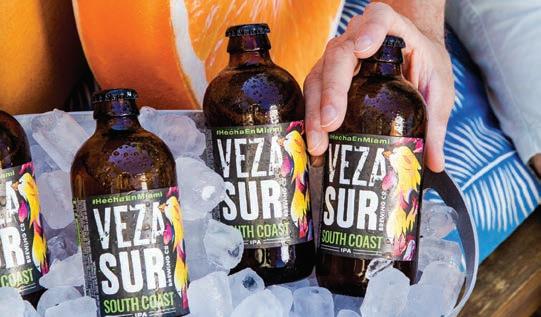
VEZA SUR BREWING CO . has been offering a selection craft beers since 2017. The brewery sells the beer from its own brew pub, but also distributes to bars and restaurants throughout Florida.
“Our two main priorities and best-sellers for the year are Mangolandia and our newest release, South Coast IPA,” says Thais Venturini, the company’s brand manager.
Mangolandia is a blonde ale flavored with mango—and it’s been a favorite of Veza Sur drinkers for the past several years. South Coast IPA, which debuted in February 2021, has a relatively high ABV of 7.5 percent, like many IPAs, but with a more tropical, citrusy
taste, according to Rhett Dougherty, the company’s head brewer. “South Coast IPA is perfect for letting the buenas vibras roll all year long,” Dougher ty says.
Another Miami brewer with some Latin-themed beers is THE TANK BREWING . The company offers El Farito, an IPA with citrus and tropical notes; La Finca, a wheat saison; and La Playita, a pils with a floral, spicy taste. The brewery distributes to bars, restaurants and retailers from the southern tip of the state to as far north as Orlando.
CHICAGO
CRUZ BLANCA is among the better-known craft beers in the Chicago area. Created in part by famed chef Rick Bayless (who is no longer with the company), Cruz Blanca-branded beers include Palm Shade, an IPA with hints of orange, mango and pineapple; Barba Negra, a porter flavored with Mexican chocolate and coconut; and 3 Kings, a double IPA inspired by Mexican ponche. The beers are
distributed by Windy City Distribution in the Chicago area. New on the Windy City’s Latin-themed brewery scene is CASA HUMILDE CERVECERIA , founded by brothers Javier and Jose Lopez in 2019. The beers are decidedly Mexican and include Maizal, a Mexican-style lager with a touch of corn; Nopali, a farmhouse ale with prickly pear; and Media Naranja, a pale ale with orange peel. The brothers also collaborated with the Big Mich Michelada Company to create two canned micheladas, Pa’ La Casa Pepino Michelada with cucumber and lime; and Pa’ La Casa Tamarindo Michelada. The company distributes throughout the greater Chicagoland area.
DALLAS
Dallas is home to FOUR CORNERS BREWING CO., whose beers are distributed in Texas by Glazers. The company, founded in 2009, offers a lineup that includes Four Corners El Chingon IPA; Four Corners El Grito, a lager; Local Buzz, a honey-rye golden ale; and Heart O’ Texas Red Ale.
SOUTHERN CALIFORNIA
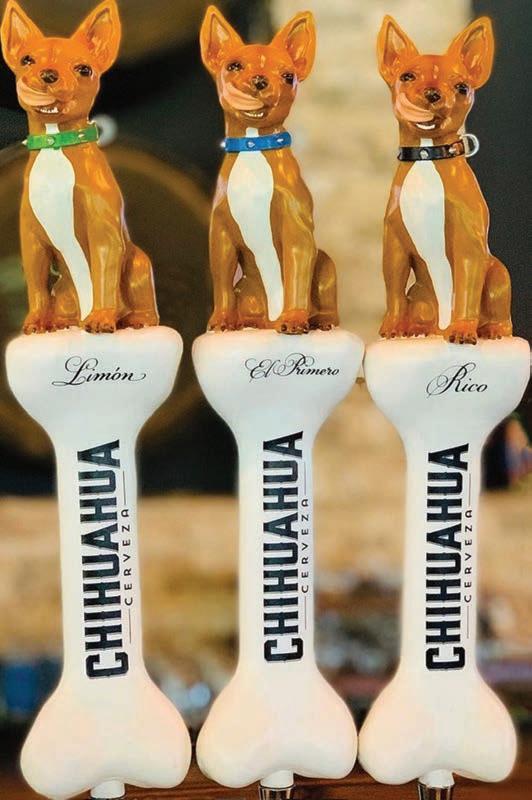
Founded in Newport Beach, California in 2017, CHIHUAHUA CERVEZA offers a line of
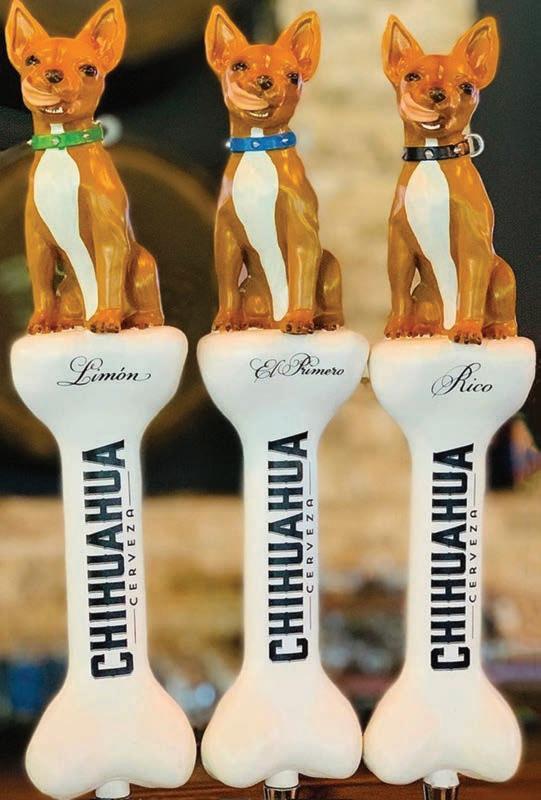
Mexican-style lagers including Chihuahua El Primero, an international pale lager with a clean and lightly sweet finish; Chihuahua Limón, a lager with a lime spritz and a pinch of salt; Chihuahua GuavaLime, a low-cal lager brewed with guava and a hint of lime; and Chihuahua Rico, a fullflavored lager with a touch of malt flavor. Chihuahua beers are distributed in Southern California and Texas.
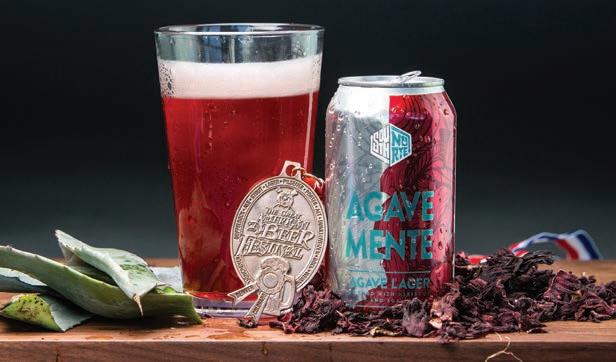
SOUTHNORTE , founded in 2016, brews a line of Latin-themed beers that regularly win medals in beer competitions. Among its most popular brews are Sea Señor Mex Lager, which won a gold medal in the Cream Ale-style category at the 2019 Great American Beer Festival; and Agavamente Hibiscus Lager, which is brewed with hibiscus and agave and earned a silver medal in the Specialty Beer category in that contest. SouthNorte beers are distributed throughout southern California.
Don’t see a brewery that supplies your area? The good news is that Latin-themed breweries seem to emerge with regularity these days. If you can’t find a Latin craft brew in your area, ask your distributor for some options. Your customers will thank you!
| POR ED AVIS | Cuando los clientes de Los Dos Potrillos quieren una cerveza para acompañar su pollo ranchero o sus chuletas de puerco, no se limitan a la selección habitual de Corona, Modelo y Dos Equis. Más bien, pueden elegir entre una amplia variedad de cervezas artesanales con un toque mexicano o latino, que van desde la mexicana Amber Lager hasta la Prickly Pear Saison y Los Dos APA.
Los dueños de Los Dos Potrillos, que cuentan con cuatro sucursales en el área metropolitana de Denver, son un caso fuera de serie entre los propietarios de restaurantes mexicanos porque elaboran su propia cerveza. Los hermanos Daniel y Luis Ramírez lanzaron su línea de cervezas en 2018, poco después de abrir una nueva sucursal en un edificio que anteriormente albergaba un bar deportivo que elaboraba su propia cerveza.
“Ofrecer nuestra propia cerveza realmente ha mejorado la experiencia del cliente”, dice Luis Ramírez. “Nuestra filosofía es que siempre elegiremos los mejores ingredientes, la mejor calidad, y nunca sacrificaremos eso para obtener ganancias. Aplicamos esa misma filosofía a nuestra cerveza”.
Elaborar cerveza conlleva un gran compromiso y puede que no esté en tus planes, pero eso no significa que no puedas ofrecerles a tus clientes una selección superior de cervezas de temática latina. Agregar algunas
TENDENCIAS EN CERVEZAS ARTESANALES
Las frutas y las esencias de frutas dan vida a las cervezas con un toque latino.
cervezas artesanales a tu menú podría atraer a un grupo demográfico de clientes diferente y, al menos, les ofrecerá a tus clientes amantes de la cerveza una gama más amplia.
LA DISPONIBILIDAD CRECE
La lista de cervezas artesanales mexicanas o latinas ha crecido
“VAMOS A ELABORAR MUCHAS CERVEZAS DE BARRIL ESPECÍFICAMENTE CON BARRILES PARA TEQUILA”.
–LUIS RAMIREZ , Los Dos Potrillos
una cerveza artesanal normal, pero en general, las cerveceras que se enumeran a continuación agregan algún ingrediente extra a sus cervezas (trozos o esencias de frutas, por ejemplo) que las convierte en un complemento ideal para la cocina latina.
Por supuesto que en México también se elaboran buenas cervezas artesanales, aunque gran parte de esa producción se queda en ese país. Así que este artículo se centra en las cervezas artesanales que se elaboran en Estados Unidos. Cada una de las cerveceras que se mencionan a continuación tiene algún nivel de distribución en restaurantes, ya sea de manera directa o a través de un distribuidor.
DENVER
sustancialmente en los últimos años, especialmente en zonas urbanas. Los Ángeles, Chicago, Miami y otras grandes ciudades con poblaciones latinas en crecimiento tienen múltiples cerveceras que se especializan en la cerveza artesanal latina.
A veces es difícil distinguir una cerveza artesanal latina de
LOS DOS POTRILLOS ofrece cerveza en barriles a otros restaurantes y comercios del área de Denver, y Ramírez dice que planean comenzar a envasar cerveza en 2021. Actualmente sus productos con más demanda son la lager, la ámbar y la Agua Fresca, que Ramírez describe como una lager ligera. Pero recientemente contrataron a un nuevo maestro cervecero y tienen planeadas algunas
cervezas más exóticas. “Vamos a elaborar muchas cervezas de barril específicamente con barriles para tequila”, dijo Ramírez.
CHELUNA , otra cervecera artesanal del área de Denver, abrió sus puer tas en 2017 y siempre ha ofrecido cuatro cervezas artesanales: Lowrider Mexican Lager, Lupita IPA, Chilango Hefeweizen y Coco-Xoco Porter, todas con algún tipo de esencia latina. A la Coco-Xoco Porter, por ejemplo, se le da sabor con cacao, coco y vainilla. Las cervezas se distribuyen entre unos cuantos restaurantes y comercios del área de Denver.
MIAMI
VEZA SUR BREWING CO. ha estado ofreciendo una selección de cervezas artesanales desde 2017. Esta cer vecera vende la cerveza en su propia cantina, pero también la distribuye en bares y restaurantes de toda Florida. “Nuestros dos productos principales y con mayor demanda durante el año son la Mangolandia y, nuestro lanzamiento más reciente, la South Coast IPA”, dijo Thais Venturini, director de marca de la compañía.
La Mangolandia es una cerveza rubia con sabor a mango y ha sido una de las
favoritas de los consumidores de Veza Sur durante los últimos años. La South Coast IPA, que debutó en febrero de 2021, tiene una graduación alcohólica relativamente alta de 7.5 por ciento, al igual que muchas IPA, pero con un sabor cítrico más tropical, según Rhett Dougherty, cervecero principal de la compañía. “La South Coast IPA es perfecta para dejar que las buenas vibras fluyan durante todo el año”, dijo Dougherty. Otra cervecera de Miami con algunas cervezas de temática latina es THE TANK BREWING . Esta compañía ofrece El Farito, una IPA con notas cítricas y tropicales; La Finca, una saison de trigo; y La Playita, una pilsener con sabor floral y especiado. La cervecera surte a bares, restaurantes y comercios desde el extremo sur del estado hasta el norte de Orlando.
CHICAGO
CRUZ BLANCA se encuentra entre las marcas de cervezas artesanales más conocidas del área de Chicago. Creadas en parte por el famoso chef Rick Bayless (quien ya no está en la compañía), las cervezas de la marca Cruz Blanca incluyen la Palm Shade, una IPA con toques de naranja, mango y piña; la Barba
Negra, una porter con sabor a chocolate mexicano y coco; y la 3 Reyes, una doble IPA inspirada en el ponche mexicano. Las cer vezas son distribuidas por Windy City Distribution en el área de Chicago. Una novedad en la escena cervecera de temática latina de Windy City es CASA HUMILDE CERVECERIA , fundada por los hermanos Javier y José López en 2019. Las cervezas son decididamente mexicanas e incluyen la Maizal, una lager al estilo mexicano con un toque de maíz; la Nopali, una cerveza de granja de tuna; y la Media Naranja, una pale ale con cáscara de naranja. Los hermanos también colaboraron con la Big Mich Michelada Company para crear dos micheladas enlatadas: Pa’ La Casa Pepino Michelada, con pepino y lima, y Pa’ La Casa Tamarindo Michelada. La empresa distribuye sus cer vezas en toda el área metropolitana de Chicago.
DALLAS
Dallas es el hogar de FOUR CORNERS BREWING CO ., cuyas cervezas son distribuidas en Texas por Glazers. Esta compañía, fundada en 2009, ofrece una línea que incluye la Four Corners El Chingon IPA; la Four Corners El Grito, una lager; la Local Buzz, una cerveza dorada de miel y centeno; y la Heart O’ Texas Red Ale.
SUR DE CALIFORNIA
Fundada en Newport Beach, California en 2017, CHIHUAHUA
CERVEZA ofrece una línea de lagers de estilo mexicano que incluye la Chihuahua El Primero, una lager pálida internacional con un acabado limpio y ligeramente dulce; la Chihuahua Limón, una lager con unas gotas de lima y una pizca de sal; la Chihuahua Guava-Lime, una lager baja en calorías elaborada con guayaba y un toque de lima; y la Chihuahua Rico, una lager de intenso sabor con un toque de malta. Las cervezas Chihuahua se distribuyen en el sur de California y Texas.
SOUTHNORTE , fundada en 2016, elabora una línea de cervezas de temática latina que constantemente se llevan las medallas en concursos de cerveza. Entre sus cervezas más populares se encuentran la Sea Señor Mex Lager, que ganó la medalla de oro en la categoría estilo cream ale en el Great American Beer Festival de 2019, y la Agavamente Hibiscus Lager, que se elabora con hibisco y agave y ganó la medalla de plata en la categoría de cervezas especiales del mismo concurso. Las cervezas de SouthNorte se distribuyen por todo el sur de California. ¿No ves ninguna cervecera que distribuya sus productos en tu región? La buena noticia es que las cerveceras de temática latina parecen surgir con regularidad en estos días. Si no puedes encontrar una cerveza artesanal latina en tu región, pregúntale a tu proveedor si tiene algunas opciones. ¡Tus clientes te lo agradecerán!
Agavamente Hibiscus Lager de SouthNorte Nuevo South Coast IPA de Veza Sur
RESTAURANT WEEK PROMOTIONS:
Turning the “BUZZ ” into business
| BY MAYA DOLLARHIDE |
“Restaurant Week” events are common across the United States. Food lovers enjoy the opportunity to try new restaurants at a good price, and restaurants often benefit by attracting new customers. But overall, are these events worth your while?
Many restaurant owners think so.
“Restaurant Weeks bring new customers in and create a buzz with the regulars. Everybody loves a special night, a treat, and showing the newbies what to order,” says Dora Herrera, co-owner of California’s Yuca’s Pasadena and Yuca’s Hut Los Feliz. Her family—with matriarch Socorro Herrera at the helm—has been cooking award-winning Yucataninspired dishes since 1976.
Both locations participated in this year’s Dine Latino Restaurant Week in April, which was sponsored by the non-profit Latino Restaurant Association (LRA) and focused on promoting Mexican and Latin restaurants in the greater Los Angeles area.
THE PLANNING PROCESS
Many different organizations plan and sponsor Restaurant Week events throughout the country, which typically take place during spring and fall.
In Chicago, the destination
marketing organization Choose Chicago runs Chicago Restaurant Week every spring. In Beaumont, Texas, the Beaumont Convention & Visitors Bureau runs #EATBMT Restaurant Week, while the job of organizing Restaurant Week in Placentia, California falls to that city’s Chamber of Commerce. Regional or local restaurant associations like the LRA handle planning in some locales. And local media sometimes take over planning: Restaurant Week in New York’s Hudson Valley is the purview of the Valley Table magazine.
Belonging to or partnering with the sponsoring organizations or associations often is the only requirement to participate; in the case of the Hudson Valley event, however, restaurants pay $800 to be part of the event.
CREATING THE MENU
Multi-course lunch and dinner specials are the most common offering found on Restaurant Week menus. Sometimes the dishes are from the regular menu, sometimes they’re new creations a chef or owner might want to try. In most cases, event organizers set rules participating restaurants must follow.
For example, restaurants participating in Austin Restaurant Week—which will return this August in Austin, Texas after a
“Restaurant Weeks bring new customers in and create a buzz with the regulars. Everybody loves a special night, a treat, and showing the newbies what to order.”
–DORA HERRERA , Yuca’s Pasadena and Yuca’s Hut Los Feliz
2020 hiatus—will be required to offer $20 prix fixe meals for lunch or brunch and $35 or $50 options for dinner.
Choose Chicago instructs restaurants to offer multi-course meals priced at $25 for brunch or lunch, and $39 and/or $55 for dinner (excluding beverages, tax, gratuity, and delivery fees). This year, diners had the flexibility to experience Chicago Restaurant Week, which ran from March 19 through April 4, through indoor and outdoor dining, or at home with delivery and takeout options.
Other organizers are more flexible about the meal pricing, but all recommend that the restaurant offer some kind “deal” to attract diners.
Whatever the choices, there are three basic “rules of the Restaurant Week road”: The meals should represent a good value, showcase the kind of quality cuisine your restaurant is known for, and still be priced in a way that adds a few dollars to your bottom line.
Other tips?
Include at least one vegetarian or vegan dish so diners on special diets have an option. And don’t make things too complicated, says Herrera, who offered machaca, cochinita pibil, and milanesa de res on Yuca Pasadena’s spring Dine Latino menu, then threw in free house-made guacamole and chips for every customer who bought a plate and a drink during the promotion.
“We try to keep things
simple,” says Herrera, who suggests first-time Restaurant Week participants in particular keep it simple, too. “The service, especially during restaurant week, is important. You want to treat every diner as a favorite VIP, and I recommend that restaurants, especially during Restaurant Week, offer a tasty loss leader.”
PROMOTION MATTERS
Successful Restaurant Weeks are not only the result of restaurants’ participation; promotion is an essential part of a winning event, too. The good news is that most organizations that sponsor the events handle much of the PR.
The Valley Table promotes Hudson Valley Restaurant Week with promotions in the New York Times, the Poughkeepsie Journal and other local publications, as well as on social media. That promotion pays off: Organizers report that 92 percent of par ticipating restaurants see an average of 25 percent more sales during the week.
The LRA heavily promotes Dine Latino, as well.
“We wanted to give restaurants as much support as possible for April’s Dine Latino, so we created national and local press releases, plus social media, of course,” LRA co-founder Lilly Rocha says. “In addition, we gave all participating restaurants a kit with all the graphics and logos to use. We leave planning the specials and menus up to the restaurants for
Dine Latino, but we help them with the marketing to advertise the good work they are doing. We promote all types of Latino cuisine, and our job is to help get people out there to enjoy it. We want this week to help Latino restaurants get back on their feet, as Latino owners are facing critical needs.”
Promotions will continue with the Dine Latino event planned in conjunction with Latin Heritage Month and scheduled for September 28 - October 3.
Some Restaurant Week, events also include charitable contributions and co-promotions that can help boost press coverage.
A CONCEPT IS BORN
The marketing concept behind Restaurant Week started as a New York Citybased promotional event in 1992 by Tim Zagat of the famous Zagat’s Guides. Its success swept across most of the U.S., providing an opportunity for diners to enjoy specially priced dishes from their favorite restaurants and also to find new spots to patronize.
In Austin, each meal or drink purchased during Restaurant Week helped the Central Texas Food Bank’s programs that serve nearly 50,000 people each week. And in Chicago, Choose Chicago partnered with the Shedd Aquarium to bring attention to plastic pollution, which impacts aquatic animals across the globe. In the lead-up to the 2021 Restaurant Week, three of the aquarium’s Magellanic penguins visited Shaw’s Crab House, one of several Restaurant Week participants that have committed to reducing their single-use plastic footprint via Shedd’s Let’s Shedd Plastic program for restaurants.
But don’t leave all the promotion up to the organizers. Be sure to promote your restaurant’s specials on your own social media and advertising and consider making a teaser video to show of f what you’re going to offer.
Maya Dollarhide is a New York-based freelance writer.
Botrista DrinkBot. This automated, contactless drink solution for restaurants and foodservice providers helps ensure guest safety while letting you enhance your drink menu and drive revenue by adding specialty beverages like fruit tea blends, fusion lemonades, mocktails, cocktails, and more—all with minimal labor. The small, 5-sq-ft. footprint makes it perfect for any size establishment. 650-797-0851; botrista.co
DrinkBot de Botrista. Esta solución de bebida automática y sin contacto para restaurantes y proveedores de alimentos ayuda a garantizar la seguridad de los visitantes mientras le permite realzar su menú de bebidas e impulsar sus ingresos agregando bebidas especiales como mezclas con tés de fruta, fusiones de limonada, mocktails (cocteles sin alcohol), cocteles y más: todas con poco trabajo. El reducido tamaño de 5 pies cuadrados la vuelve perfecta para cualquier establecimiento, sin importar su tamaño. 650-797-0851; botrista.co
Folcklor Latino Restaurant Furniture. The images of Mexican culture all can be found in the hand-made tables, chairs, booths, carts and other furniture made by craftsmen at Folcklor Latino in Tonalá, Mexico. “People love the changes they’ve seen in my restaurant since Folcklor Latino crafted our new furniture,” says Manuel Hernández, owner of Monte de Rey Mexican Restaurant in Clemmons, N.C. “They all say how beautiful it is and how fascinated they are by the details.” 210-374-7445; contacto@folcklorlatino.com; folcklorlatino.com
Muebles para restaurantes de Folcklor Latino. Las imágenes de la cultura mexicana pueden hallarse en las mesas, sillas, puestos, cestas y otros muebles hechos a mano por artesanos de Folcklor Latino en Tonalá, México. “A la gente le encantan los cambios que han visto en mi restaurante desde que Folcklor Latino fabricó nuestro mobiliario”, dice Manuel Hernández, propietario de Monte de Rey Mexican Restaurant en Clemmons, N.C. “Todos mencionan lo hermoso que es y lo fascinados que están por los detalles”. 210-374-7445; contacto@folcklorlatino.com; folcklorlatino.com
Simplot Harvest
Fresh™ Avocados
Everything Mexican restaurants need to meet their operational needs! Products include avocado pulp, which offers a great labor-saving head start on making guacamole, sauces, toppings and dips; five flavors of ready-toserve prepared guacamole; and avocado slices and dices (including avocado halves), popular for salads, sandwiches and more. All products available fresh chilled or frozen. simplotfoods.com
Aguacates de Simplot Harvest Fresh™. ¡Todo restaurante mexicano necesita satisfacer sus necesidades de operación! Entre los productos se incluyen la pulpa de aguacate, la cual ofrece una excelente ventaja para ahorrar tiempo al preparar guacamole, purés, complementos y dips; cinco sabores de guacamole preparado y listo para servir; y rebanadas y cubitos (incluyendo mitades de aguacate), popular para ensaladas, sándwiches y más. Todos los productos disponibles están frescos, refrigerados o congelados. simplotfoods.com
La Pinta Tequila liqueur. This bright red liqueur brings together the unparalleled smoothness of Clase Azul silver tequila with the crisp taste of pomegranate to produce a delicious blend and unique flavor. Perfect served on its own, chilled and straight, and as a base for a fresh, premium cocktail. lapinta.mx
Licor de tequila de La Pinta. Este licor de un color rojo brillante reúne la suavidad incomparable del tequila blanco de Clase Azul con el sabor fresco de la granada para producir una mezcla deliciosa y sabor único, servido perfectamente por su cuenta, enfriado y directo, y como una base para un coctel fresco y de primera calidad. lapinta.mx
Estrella Jalisco Tropical Chamoy Michelada. This refreshing new lager is a fruity spin on the Mexican brunch staple—and it’s here just in time for the outdoor dining season. Featuring a 3.5% ABV, the traditional lager packs a delicious punch, blending the sweet and tart taste of pineapple with a kick of heat from clamato and chamoy. EstrellaJalisco.com
Tropical Chamoy Michelada de Estrella Jalisco. Esta nueva cerveza clara refrescante es un giro frutal en los básicos para un brunch (almuerzo) mexicano; y está aquí justo a tiempo para la temporada de comedor al aire libre. Con un 3.5% de volumen de alcohol, la cerveza clara tradicional tiene un delicioso gran impacto, mezclando el sabor dulce y agrio de la piña con el toque cálido del clamato y el chamoy. EstrellaJalisco.com
Phade Marine Biodegradable Straw. This new, sustainable straw was named a standout in the National Restaurant Association’s 2021 Innovation Awards for Foodservice in the Sustainable Solutions category. Made in the USA by WinCup, the straw meets consumers’ performance expectations but has substantially less environmental impact than standard plastic straws because it’s made from PHA, an earth-friendly material derived from canola oil. It’s marine and soil biodegradable, and home and industrial compostable, too. For use with cold drinks only. Free samples available on request. phadeproducts.com
Popote biodegradable en el entorno marino de Phade Este popote nuevo y sustentable sobresalió en la categoría de Soluciones Sustentables de los Premios de Innovación de Servicios Alimenticios de 2021 de la Asociación Natural de Restaurantes. Hechos por WinCup en los EE. UU., el popote cumple las expectativas de desempeño de los clientes, pero tiene un impacto ambiental considerablemente menor que los popotes plásticos normales porque están hechos de PHA, un material respetuoso con el medio ambiente derivado del aceite de canola. Es biodegradable en el entorno marino y en el suelo, y también puede usarse para abono en casa e industrial. Se usa solo con bebidas frías. Muestras disponibles a solicitud. phadeproducts.com
MegaMex Foods TRES COCINAS Authentic Pepper
Pastes. Simplify kitchen labor and expand flavor options with these pepper pastes that bring authentic Mexican flavors to any restaurant menu. They’re ideal for making sauces, salsas, side dishes, soups, stews, marinades, glazes and dressings, cocktails and desserts. Available in 3 gluten-free and Kosher varieties: Chipotle with Adobo, Guajillo, and Ancho & Pasilla. Each pepper paste comes in a convenient 7-ounce resealable pouch. Samples available on request. megamexfoodservice.com/brand/tres-cocinas
Auténticas pastas de chile TRES COCINAS de MegaMex Foods. Simplifique el trabajo en la cocina y amplíe las opciones de sabor con estas pastas de chile que llevan los auténticos sabores mexicanos al menú de cualquier restaurante. Son ideales para preparar purés, salsas, guarniciones, sopas, guisos, marinados, glaseados y aderezos, cocteles y postres. Disponible en 3 variedades sin gluten y kosher: chipotle con adobo, guajillo, y ancho y pasilla. Cada pasta de chile viene en una práctica bolsa resellable de 7 onzas. Muestras disponibles a solicitud. megamexfoodservice.com/brand/tres-cocinas
Sign up for el Restaurante’s Recipe of the weekemail!
EMAIL Kathy Furore, kfurore@restmex.com, with ‘Recipe’ In the subject line
Signature/Firma (REQUIRED/REQUERIDA)
Please Print Name Here / Nombre Company Name / Companía Street Address/P.O. Box/Dirección
CHECK BOXES NEXT TO ALL ANSWERS THAT APPLY. ___NO, thanks. ___Address change only. ___YES! I wish to receive/continue to receive el Restaurante FREE of charge. ___Also send Emex, our FREE email newsletter. Email Address:____________________
Date/Fecha
Spring Pea Tlayuda
Recipe courtesy of Justin Bazdarich, Oxomoco, New York
Tlayudas
Pea Mash (recipe below)
Salsa Cruda (recipe below)
Mint Puree (recipe below)
Quesillo
Grill herb oil
Serranos, sliced thin
Scallions, sliced thin
Mint leaves, picked
Cilantro leaves
Olive oil drizzle
Lime juice
Sea salt
The Salsa Cruda:
800g tomatillo
170g white onion
150g serrano
420g lime juice
2 bunch cilantro
3 ea. avocados
Salt, to taste
Puree all in Robot Coupe until smooth. Reserve chilled in quarts.
The Pea Mash:
4576 g peas frozen (4 bags)
400 g spring onion, greens and whites sliced thin
50 g garlic, sliced thin
100 g epazote, picked leaves cut rough
500 g olive oil
4 T salt
Place oil in a shallow rondeau and bring to a shimmer on medium heat. Add onion, garlic and salt and cook on medium until tender and translucent. Add chopped epazote and wilt quickly. Add peas and stir to coat in oil on medium heat until peas are not cold and just warmed through. Take off heat and place two pints in the Robot Coupe. Process for about a minute wiping sides of bowl occasionally. Mash should still be chunky.
The Mint Puree:
6 bunch mint, rough chop right off the bunch, discard bottom two inches of the bunch (it is ok to have stems in with the leaves).
40 g serrano
1 T salt
900 g canola
Place medium size pot of water to boil. At boil, add mint and stir into the pot. Pour off into a chinois and then run cold water over mint to stop the cooking. Squeeze excess water from the mint and then lay on a flat clean side towel. Roll towel and twist to eliminate all water from mint. Place mint in the blender and add salt and oil. Blend on high speed for 5 minutes. While blending put ice in a medium bowl. Cover ice with a sprinkle of kosher salt. Place a bowl on ice. Pour mint puree in cold bold. Stir till cold and place in squeeze bottle.
To Plate: Top each tlayuda with 1 cup pea mash and spread unevenly to edge with the spoon. Top with cheese and drizzle with olive oil. Place on grill over wood fire and cook until cheese is melted and tlayuda is crispy on the bottom. Cut into three pieces. Plate on round plate. Top with Salsa Cruda, Mint Puree, serranos, scallions, mint, cilantro, olive oil, lime juice, sea salt
Everyday Beef Barbacoa
Recipe courtesy of Cattlemen’s Beef
Board and National Cattlemen’s Beef
Association (beefitswhatsfordinner.com) Makes 10 servings
3-5 lbs. Beef Chuck Roast or Beef Cheek
2 Tbsp. olive oil
⅓ cup orange juice
¼ cup lime juice
1 cup beef broth
3-4 chipotle peppers in adobo sauce, chopped
¼ cup light brown sugar
1 tsp. apple cider vinegar
2 tsp. Kosher salt
5 cloves garlic, minced
1 onion, chopped
1 Tbsp. cumin
2 tsp. oregano
Tortillas (optional)
Cilantro (optional)
Onion (optional)
Lime wedges (optional)
Heat olive oil in a large skillet or Dutch oven on medium-high heat. Sear roast on each side until brown; about 4-5 minutes; transfer to
slow cooker. In the bowl of a food processor add orange juice and remaining ingredients. Pulse until blended and a smooth consistency. Pour mixture on top of roast. Cover and cook on low for 8 to 10 hours or on high for 6 to 8 hours. Carefully remove beef from the cooker. Shred beef and return to the cooker. Cook for an additional 10 minutes on high to absorb additional liquid. Serve with warmed tortillas and desired toppings.
Chamoyada
Recipe courtesy of La Duni, Dallas
Makes 1 cocktail
2 oz. silver tequila
1.5 oz. “Canoa” mango puree
1 oz. lime juice
0.5 oz. simple syrup
1.5 oz. chamoy de barrio of El Cantinero
Shake first 4 ingredients with rocks ice and strain into a chile salt rimmed tumbler glass with crushed ice. Layer the chamoy on top and garnish with a lime wedge.
Clementina Margarita
Recipe courtesy of La Duni, Dallas
Makes 1 cocktail
2 oz. Tesoro silver tequila
2 oz. fresh clementines
1 oz. El Cantinero “La Chingona Mix” Chile fruit seasoning rim
Shake first 3 ingredients with rocks ice. Single strain into a chile fruit seasoning-rimmed tumbler glass with cracked ice. Garnish with clementine segments.
Ica Press
Recipe courtesy of La Duni, Dallas
Makes 1 cocktail
4 oz. vodka
2 oz. fresh ginger
2 oz. Caravedo Pisco mosto verde
1 green apple
12 green grapes
0.75 oz. fresh lime
1 oz. agave syrup
2 dashes ginger tincture
In a cold press juicer, juice 1 green apple and 12 green grapes.
Strain juice and set aside. In a small blender add 4 oz of high-proof vodka or everclear and 2 oz. of fresh ginger. Blend and double strain; set aside for 1 day and its ready for use. In a shaker add remaining ingredients with rocks ice and shake well. Double strain into a rocks glass with a clear ice cube. Garnish with green grapes.
Paloma a la Francesa
Recipe courtesy of La Duni, Dallas Makes 1 cocktail
1.5 oz Avion Reposado Tequila
0.5 oz. Dubonnet Rouge
1.5 oz. El Cantinero Artizan
grapefruit cordial
3 oz. mineral water
1/8 t. cracked black pepper
In a white wine glass, add fresh cracked black pepper, tequila and grapefruit cordial. Add rocks ice and top with mineral water. Stir to combine and top with ice. Gently layer the Dubonnet Rouge and garnish with a grapefruit wedge.
Pineapple-Cilantro
Margarita
Recipe courtesy of Mas Amor Cantina, Hickory, North Carolina Makes 1 cocktail
2 oz. blanco tequila
¾ oz. house made cilantro simple syrup
¾ oz. caramelized pineapple purée
½ oz. fresh juiced lime
Add all ingredients to a cocktail shaker with ice. Shake until well mixed; strain over ice into a Tajin rimmed glass. Garnish with fresh cut pineapple.
La Madrugada
Recipe courtesy of Elis Carriero, Esotico Miami, Miami, Florida
1½ oz ZIGNUM Mezcal Reposado
1 oz. Martini Fiero
1 oz. citrus mix
2 oz. pineapple juice
2 bar spoons of grenadine
Sprig of mint for garnish
Add all ingredients to cocktail shaker with crushed ice. Shake well and pour into a Catalina glass.
Our powerful combination of print and web ads plus email promotions can deliver business-building benefits for your company!
THREE MORE GREAT ISSUES IN 2021 !
JULY/AUGUST
• COVER STORY: Tortilla Trends—Beyond the Basics
• AT THE BAR : Rethinking Sangria
• AD CLOSE : June 30 M ATERIALS DUE : July 7
SEPTEMBER/OCTOBER
• COVER STORY: The Queso Connection— Hispanic Cheese on the Menu
• AT THE BAR : Mezcal
• AD CLOSE : August 25
MATERIALS DUE : September 6
NOVEMBER/DECEMBER
• OUR ANNUAL BUYER’S GUIDE , with Special Offers for Advertisers!
• COVER STORY: Mole Magic
• SPECIAL REPORT: 7th Annual Independent Mexican Restaurant Report
• AD CLOSE : October 28 M ATERIALS DUE : November 2 AND IN EVERY ISSUE…Hotline, Marketplace, My Favorite Recipe and more! FOR
COLLIN CORRIGAN
El Cruce + 241
WITH A PASSION FOR THE VIBRANT CULTURE OF BAJA, owners Collin Corrigan, Galen Rogers and Pamela Rogers recently debuted
El Cruce + 241 along Chula Vista’s historic Third Avenue in October of 2020. The Baja inspired destination is South San Diego County’s first wholly devoted Baja taproom, wine bar and kitchen committed to sourcing auténtico Baja specialties in San Diego’s South County.
The menu showcases its ode to Baja flavors with noteworthy seafood selections including the Ceviche Campechano, fresh oysters, and the signature Ceviche de Pescado—the latter each owner’s favorite dish. The menu was developed by acclaimed Ensenada-based chef Sano Hussong, while Executive Chef Charleen Sandoval helms the kitchen, bringing the thoughtfully curated dishes and flavors to life.
The fact that the ceviche embodies Baja and showcases flavors from Ensenada is why Corrigan so enthusiastically embraces the dish.
“The blend of tomatillo and chile güero give it just enough spice while still keeping the flavors of the seasonal fresh fish that is used,” Corrigan says. “It is a dish where ‘por el centro’ is the best way to enjoy.”
Ceviche de Pescado
Makes 2 to 4 servings
2 c. largely diced fish loin
½ c. medium diced fresh tomatillo
¾ c. thinly sliced shallot
1 T. minced chile serrano
⅓ c. thinly sliced chile güero
¼ c. rough chopped cilantro (plus extra for garnish)
Juice of 1-2 fresh limes
Salt and black pepper to taste
Soy sauce to taste
⅓ c. charred Tomatillo Salsa (recipe below)
Combine all ingredients thoroughly and scoop desired amount into a serving bowl or dish. Top with extra cilantro for garnish and enjoy with tostadas or chips of choice.
The Tomatillo Salsa:
7 c. husked, washed tomatillos
5 c. white onion
1 c. chile jalapeño
1 avocado
1 bunch cilantro
⅓ c. peeled garlic cloves
Salt to taste
Juice of 3 limes
Grill all of the ingredients except the avocado and cilantro. Once all ingredients are charred, blend and add in remaining ingredients. Taste and adjust as needed.
Call today for samples of our authentic Al Pastor, Pollo Adobo and Carne Asada. Available in Trompos (hand-stacked cones) and cooked-to-order IQF Strips that provide maximum flavor, yield and portion control. Now Serve Delicious Authentic Tacos EVERY DAY!