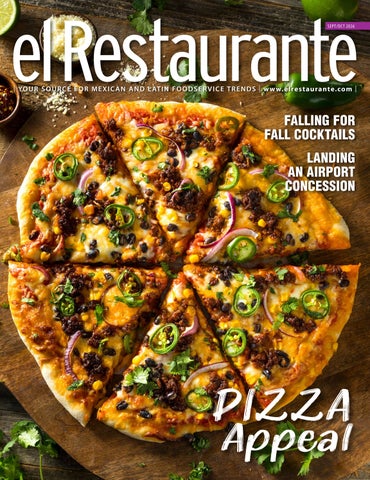
SEPT/OCT 2026
| YO U R S O U R C E F O R M E X I C A N A N D L AT I N F O O D S E R V I C E T R E N D S | w w w.elrestaurante.com |
FALLING FOR FALL COCKTAILS LANDING AN AIRPORT CONCESSION
PIZZA Appeal
In This Issue
20
22
25 14 ›HAGA CLIC AQUÍ PARA LEER EN ESPAÑOL
6 10 14 20 22 25
HOTLINE — Antojo Industry Trade Expo Preview; Contest Deadlines Approaching FIVE QUESTIONS COVER STORY — Pizza Appeal By Kathleen Furore CULINARY TRENDS — Microgreens: Small Greens, Big Flavor AT THE BAR — Falling for Fall Cocktails BUSINESS BASICS — Landing an Airport Location: Restaurants Succeed with Terminal Locations
30
MARKETPLACE
31
RECIPES
32
MY FAVORITE RECIPE
ON THE WEB AT www.elrestaurante.com
Don’t miss an issue! SCAN TO SUBSCRIBE NOW! SEPT/OCT 2026 | el restaurante
1
editor’s note
›HAGA CLIC AQUÍ PARA LEER EN ESPAÑOL
Leaves are falling. School (with its requisite roster of home-
Kathleen Furore, editor
Scan now to
SUBSCRIBE 2
work and events that parents enjoy and dread simultaneously!) has started. And the holiday season is just around the corner. Fall certainly is the season when everything starts changing and stress starts to mount in anticipation of all there is to do before the typically quieter months that January ushers in. The good news: All of the changes and events fall brings also present Mexican/Latin restaurants with great business-building opportunities. From September 15 through October 15, there’s Hispanic Heritage Month, which means there’s an entire month to leverage your position in the foodservice space to introduce customers to special dishes and traditions you might not highlight at other times of the year. In Chicago, for example, Mercadito launched a Toasted Pumpkin Seed Guacamole while Fat Rosie’s planned a celebration featuring a $25 fiesta-style taco platter and tri-color Margaritas inspired by the colors of the Mexican flag. As the month-long celebration of Hispanic Heritage comes to a close, customers will be looking forward to Halloween and Día de los Muertos (a holiday more and more people in the U.S. are embracing). In-restaurant ofrendas, sugar skull decorating events, and themed cocktails are some ways Mexican restaurants have celebrated. In 2025, for example, Mexico Restaurant in Atlantic City, New Jersey, featured a video of the restaurant’s Día de los Muertos altar on Instagram and invited customers to “stop by … to celebrate the memories of those we love — from family and friends to loyal customers who’ve become part of our story.” And then it’s on to end-of-year holiday events and creating menus for 2027. We hope this issue delivers information that will help you capitalize on fall opportunities and plan for the year ahead. You’ll find ideas for creative cocktails that make the most of fall themes and ingredients, plus year-round menu-building ideas like introducing Mexican pizza (perhaps as an LTO that would work great as a delivery item during football season) and using microgreens to add flavor and color in the kitchen and behind the bar. We’ve even delved into how you can get into the airport concession game (teaser: It isn’t an easy process, but airport locations typically bring in more than brick-and-mortar locations when done successfully). Enjoy the issue, enjoy fall…and let us know if there are any topics you would like us to cover in future issues.
el restaurante | SEPT/OCT 2026
PUBLISHER Ed Avis EDITOR Kathleen Furore ART DIRECTOR Ala Ennes MAIN OFFICE phone: 708.267.0023 PRESS RELEASES TO: kfurore@restmex.com MAILING ADDRESS P.O. Box 13347 Chicago, IL 60613 SHIPPING ADDRESS 1317 W. Belden Ave. Chicago, IL 60614 AD SALES/ENGLISH Ed Avis 708.218.7755 edavis@elrestaurante.com Suzanne Bernhardt 678.880.9282 suzanne@elrestaurante.com AD SALES/ESPAÑOL Alfredo Espinola 52-55-4006-9540 alfredo@elrestaurante.com Published by Maiden Name Press, LLC Volume 29, Number 5 el Restaurante (formerly el Restaurante Mexicano) (ISSN 1091-5885) is published six times a year by Maiden Name Press, LLC 1317 W. Belden Ave., Chicago, IL 60614 All contents copyright© 2026 Maiden Name Press, LLC. Nothing in this issue may be reproduced in any form without publisher’s consent.
We confess. When it comes to freshpacked flavor, we’re a show off. Old California® pioneered clear, easy-open pouches for foodservice tomato products in 1999. We figured the vine-ripened quality of the reddest, richest, sweetest, California tomatoes available was something discerning customers would want to see. No wonder the nation’s finest restaurants love us! For the quality you desire, choose the best ingredients – The Original Old California Freshpack Pouch from Neil Jones Food Company! For more information, call 800.291.3862 | njfco.com/see2believe
hotline
›HAGA CLIC AQUÍ PARA LEER EN ESPAÑOL
BE&SCO Manufacturing Booth #441. The Mini Wedge Press delivers efficiency without sacrificing authenticity. Its compact footprint is perfect for kitchens with limited space and high standards. With intuitive controls and precision engineering, one operator can consistently press tortillas while minimizing training and labor. Fresh, house-made tortillas every time. Request a quote: 210-734-5124 or www.bescomfg.com
MARK YOUR CALENDARS:
Antojo Industry Trade Expo Coming OCT. 5 - 6! DUBBED ONE OF THE ‘FASTEST 50” EXPOS by Trade Show Executive, the Antojo Industry Trade Expo is set to take over the Long Beach Convention Center in Long Beach, California from October 5 - 6. This year’s event — the 4th annual gathering for this Latino-owned and operated trade show focused on the multicultural food and beverage market — will feature a rapidly expanding lineup of exhibitors, according to show producer Eric Jurado. For two action-packed days, attendees will have the opportunity to connect directly with hundreds of key suppliers offering the latest foodservice and CPG products, and to discover cutting-edge trends, innovative solutions, and essential services that can significantly boost your restaurant’s bottom line. Be sure to visit el Restaurante and our advertisers who will be showcasing their products at Antojo: el Restaurante Booth # 624 Publisher Ed Avis and Editor Kathleen Furore will be on hand to share an informative video presentation about el Restaurante magazine (now available in 3 easy-to-access online formats), as well as the company’s other digital publications.
6
el restaurante | SEPT/OCT 2026
Best Mexican Booth #217. We’re here for all your Mexican foodservice needs. We’ve been serving restaurants in the Northeast for over 50 years…and we can help you keep your restaurant running for whatever type of service you’re offering today. 800-867-8236; 845-469-5195; Bestmexicanfoods.com Tortilla Masters Booth #313. Creating perfect, ready-to-cook corn tortillas has never been easier thanks to the Ventura Flex Corn Tortilla Machine — the first tabletop restaurant-style corn tortilla machine to meet UL and NSF standards. Convenient and small, with big production capabilities — makes up to 840 tortillas per hour. Can be placed on a table, occupying just 2 x 2 feet of space. Also available: Molino Masters Tabletop Corn Grinder, the first NSF and UL tabletop corn grinder restaurants can use to make masa; can produce up to 140 pounds of masa per hour and can be used with 7” x 3” grinding discs or volcanic stones. Made in the USA. 281-994-7010; tortillamachine.com V & V Supremo Foods Booth #605. This award-winning producer of authentic Hispanic-style cheeses is your source for melting cheeses like Chihuahua® Brand Quesadilla; fresh cheeses such as Queso Fresco, Queso Blanco Del Caribe®, Queso Enchilado, Queso Asadero and Requeson; aged cheeses like Cotija; and Mexican crema. Chorizo in beef, pork, and chicken varieties also available. 1-888-887-8773; www.vvsupremo.com
hotline
›HAGA CLIC AQUÍ PARA LEER EN ESPAÑOL
DEADLINES APPROACHING!
Enter the 2026 Sassiest Salsa and Mexican/ Latin Restaurant of the Year Contests Today! This year, el Restaurante is offering two contests that give restaurants two great opportunities to earn recognition and cash prizes! SASSIEST SALSA CONTEST: DEADLINE SEPTEMBER 30, 2026 Are you proud of your restaurant’s salsa? Then put your recipe to the test in our Sassiest Salsa Contest co-sponsored by el Restaurante and Sammic! Entering the contest is easy, and the prizes make it worthwhile: The First Place Winner will receive a Sammic XM-52 Immersion Blender, the ultimate tool for mixing salsa! And the top three winners will get a cash prize of $750, $500 and $250, respectively. To top it off, all winning recipes will be featured in our Recipe-of-the-Week email program and published in the November/December issue of el Restaurante. Your recipe must be an original creation. Also remember that we’ll publish the winning recipes, so don’t send one you’re trying
Made in the USA.
713.896.9924
8
el restaurante | SEPT/OCT 2026
to keep secret. The recipes will be judged 2026 by experienced chefs, and the winners will be announced in October. To enter the contest, click here and complete the form. Last year’s winners exceeded expectations with their remarkable salsa creations. Click here to read about last year’s winners. 2026 INDEPENDENT MEXICAN/LATIN RESTAURANT OF THE YEAR: DEADLINE OCTOBER 1, 2026 Co-sponsored by el Restaurante and Mineragua sparkling water, this contest will shine a light on authentic Mexican/Latin cuisine restaurants that are supportive employers and essential meeting places for members of the community. Restaurant owners are welcome to nominate their own restaurants, and to share the nominating form with their customers and employees. Every restaurant nominated will receive a handsome nomination certificate, and the top three will receive recognition in el Restaurante magazine and a prize package designed to provide a cash infusion to the restaurants and help them grow their market: •
• •
First place will receive $5,000, a package of point-of-sale materials, and an exclusive “Behind the Kitchen” video created just for the winning restaurant, an additional $5,000 value. Click here to see an example of this video. Second place will get $2,000, a package of point-of-sale materials, and a $1,000 social media ad campaign. Third place will win $1,000, a package of point-of-sale materials, and a $500 social media ad campaign.
Entries will be evaluated by a panel of judges who will consider each restaurant’s service to their community, support of their employees, and creation of culturally authentic cuisine. The contest is open to any Mexican or other Latin-cuisine restaurant with 10 or fewer locations. To nominate a restaurant, click here
five questions
›HAGA CLIC AQUÍ PARA LEER EN ESPAÑOL
Gabriel González
GG’S BARBACOA CAFÉ | BY NATALIA OTERO | Gabriel González and Lourdes Ávalos came from two small farming communities in Tabasco, Mexico, and now own one of Kansas City’s highest-rated restaurants, GG’s Barbacoa Café. The husband-and-wife owners say that their restaurant, named among the Top 50 Restaurants in major U.S. cities, was built around one simple idea: share the food they grew up with and welcome every guest as though they were entering their own home.
In this conversation with el Restaurante Magazine, González reflects on the restaurant’s roots, its growth, and the lessons he has learned as a restaurateur.
1
Where did the inspiration for GG’s Barbacoa Café come from?
GG’s Barbacoa Café was born from our roots, our family, and a dream that began many years before we opened the restaurant. My wife, Lourdes Ávalos, was born in La Lucha, a small community in Tabasco, and I was born in El Mulato, also in Tabasco. We both grew up surrounded by the traditional flavors of southeastern Mexico. I’ve always admired the way Lourdes prepared barbacoa. One day I told her, “If we ever have the opportunity to open a restaurant, I’d love for us to serve your barbacoa and those smoked pork black beans.” That dream stayed with us for years. After we immigrated to the United States (Gabriel in 1998 and Lourdes in 1999), I worked in several restaurants, including McDonald’s, Boston Market, Applebee’s, and other establishments throughout Kansas. Every place taught me something about service, discipline, and kitchen operations, but I never forgot the flavors of our homeland. When we finally opened our own restaurant in 2017, we wanted to build it around our identity. (continued on page 12)
2026
sponsored by Sammic
TO SUBMIT YOUR RECIPE, GO TO www.elrestaurante.com/2026-salsa-contest
ALL RECIPES MUST BE RECEIVED BY MIDNIGHT, SEPTEMBER 30, 2026
WIN A Sammic
XM-52 Immersion Blender Plus
$750 CASH!
Get out your salsa-making ingredients and create a unique foodservice salsa recipe you think has the consistency and flavor to wow the judges. The grand prize winner will receive a Sammic XM-52 Immersion Blender and $750. Second and third place will receive $500 and $250, respectively. Plus the top three recipes will be featured in the NovDec issue of el Restaurante. All readers of el Restaurante are welcome to enter the contest. The recipe must be an original recipe of your own creation. There are no restrictions on the ingredients of the recipe. All recipes will be judged on taste, creativity and appropriateness for foodservice applications.
five questions
›HAGA CLIC AQUÍ PARA LEER EN ESPAÑOL
“Our sandwiches and tortas allow us to bring together two cultures. They preserve authentic Mexican flavors while presenting them in a format that’s familiar to American customers. Many people first try our barbacoa in a sandwich, then come back to explore our tacos, quesabirrias, pozole, and smoked pork black beans.” – GABRIEL GONZÁLEZ
Lourdes’ seasoning is the heart of GG’s, and my experience helped transform those family recipes into a restaurant.
2
A Sammic immersion blender makes your salsa preparation easier than ever! A powerful motor, easy-to-use controls and ergonomic design mean your staff can create amazing salsas, soups and other blended menu items with ease and speed. You will love the labor savings and your customers will love the results!
Learn more at sammic.us
12 el restaurante | SEPT/OCT 2026
Where does the name GG’s Barbacoa Café come from?
While I was working in a restaurant kitchen, one of the chefs started calling me “Gigi” because it was easier than saying Gabriel González. Over time, the nickname stuck, and eventually it became part of the restaurant’s name. We added “Barbacoa” because it represents the traditional dish we grew up eating and the heart of our menu. The word “Café” also has a very personal meaning for me. I’m a member of Alcoholics Anonymous, where coffee represents fellowship, conversation, recovery, and a second chance at life. So, the name brings together our food, our family, our culture, my personal journey, and our faith.
3
Why did you decide to focus on barbacoa and sandwiches?
We wanted to offer something with a clear identity. Barbacoa represents our roots, and it became the foundation of many of our signature dishes. Our sandwiches and tortas allow us to bring together two cultures. They preserve authentic Mexican flavors while presenting them in a format that’s familiar to American customers. Many
people first try our barbacoa in a sandwich, then come back to explore our tacos, quesabirrias, pozole, and smoked pork black beans. The response from Kansas has been incredible. Our best advertising has never been a marketing campaign; it has always been the quality of our food and our customers’ recommendations. From day one, we’ve welcomed every guest as if they were entering our home. To us, every customer is trusting us with their time and money, so every plate leaves the kitchen as if we were serving our own family. Many guests tell us our food reminds them of Mexico or of meals their mothers and grandmothers used to make. Hearing that means more to us than any award. Because of word-of-mouth and positive reviews, we now welcome customers from cities and states across the country. That makes us proud, but it also reminds us of the responsibility we have to maintain our quality every single day.
4
What’s the biggest piece of advice you would give other restaurant owners?
First, don’t open a restaurant just to make money. Of course, a business has to be profitable, but there also has to be genuine love for what you do. When difficult times come, and they always do,
five questions
that purpose is what keeps you going. It’s also essential to stay current on your taxes, control your inventory, and have the courage to eliminate anything that isn’t working. Restaurants lose money through waste, excess inventory, and menu items that simply don’t sell. Never serve a plate that you wouldn’t be willing to eat or pay for yourself. Every customer deserves the same quality and the same respect. Another important lesson is not letting your ego run the business. I always give my wife the recognition she deserves because she has strengths and knowledge that I don’t. Working with family requires respect, communication, and humility. Alcoholics Anonymous has also taught me to recognize my mistakes, apologize when I’m wrong, and never allow pride to destroy what we’ve built. Above all, don’t try to copy other restaurants. Learn from them but find your own identity. Ours comes from our roots in Tabasco, Lourdes’ cooking, and our story as immigrants. When a restaurant has an authentic story, people can feel it.
5
›HAGA CLIC AQUÍ PARA LEER EN ESPAÑOL
Our dream is to create opportunities for others while leaving a legacy for our children. We want them to understand that this restaurant wasn’t built overnight — it was built through sacrifice, hard work, faith, mistakes, and perseverance. More than opening more restaurants, our goal is to reach more people without ever losing the heart with which we served our very first plate. That’s what the future of GG’s Barbacoa Café will always be about. Natalia Otero is a freelance writer who contributes frequently to el Restaurante.
“Many guests tell us our food reminds them of Mexico or of meals their mothers and grandmothers used to make. Hearing that means more to us than any award.” – GABRIEL GONZÁLEZ GG's owners Gabriel Gonzalez and Lourdes Ávalos share their story on KCTV 5.
What are your plans for the future of GG’s Barbacoa Café?
We want to continue growing without losing the essence that brought us here. Our goal is to open a second location when the time is right, but we want to do it responsibly and without compromising our quality. We also want to strengthen our systems, build a great team, and continue growing as leaders. Personally, I want to become a better CEO by learning more about management, finance, marketing, and leadership. SEPT/OCT 2026 | el restaurante
13
| COVER STORY |
Pizza Appeal BUILDING A MENU OF MEXICAN-INSPIRED PIES
Spicy Mexican Taco Pizza with chorizo and cilantro
| COVER STORY |
›HAGA CLIC AQUÍ PARA LEER EN ESPAÑOL
Pizzeria El Jefe’s La Vaca Flaca birria pizza with consommé
| BY KATHLEEN FURORE | Is it possible to make Mexicaninspired pizzas the mainstay of a restaurant menu? And if you do, will customers actually come? Those were the questions Pizzeria El Jefe: Mexican Pizza Revolution in Chula Vista, California faced as the restaurant prepared to debut on Main Street in Chula Vista, California in 2019. The answer to both questions turned out to be “Yes!” Husband-and-wife team Ana Concepcion de la Rocha Tapia and Jose Rios have grown the concept — known for its wide-ranging pizza menu and Mexican-inspired wings — from a small, struggling startup into a popular family-run business that relocated to a larger location in
a nearby strip mall in December 2024. “Jose and Anna built something here that belongs to this neighborhood, a family business rooted in Mexican culinary tradition, run by people who show up every day and put their names on every pie that goes out the door,” a story in Chula Vista Living reported.
BUILDING THE PIES The pizzas that have become a fixture in Chula Vista are far more than tortillas layered with meat and cheese — the “recipe” most people picture when they hear “Mexican pizza.” That picture is a legacy of the item Taco Bell debuted with much fanfare in the 1980s: two crisp tortillas SEPT/OCT 2026 | el restaurante
15
›HAGA CLIC AQUÍ PARA LEER EN ESPAÑOL
| COVER STORY |
Pizzeria El Jefe’s Mar y Tierra shrimp and carne asada pizza with mayo-chipotle sauce
stacked with seasoned beef, beans, cheese, and toppings. At Pizzeria El Jefe, fresh ingredients and house-made crusts are the cornerstones of each pie. “Everything is made by hand — we make our own flour dough, and nothing is store-bought,” the manager, Diego, stresses. Three of the pies are customer favorites, he says. •
La Vaca Flaca — house-made dough topped with traditional Mexican birria, diced onion, fresh radish and cilantro, and served with consommé on the side.
•
Mar y Tierra — a surf-and-turf pie built on the proprietary dough, layered with sautéed shrimp and carne asada, finished with avocado, tomato, onion, jalapeño and mayo-chipotle sauce.
•
Me Gustan Tus Piñas — the restaurant’s made-from-scratch dough piled high with adobada pork, freshly diced pineapple, thinly sliced red onion, jalapeños, cilantro and house-made Frida poblana sauce. (continued on page 18)
Creative Pizzas in the Heart of Mexico
At Ix’im Pizza in Azcapotzalco, a borough of Mexico City, the menu is designed for customers who crave Mexican flavors but want to enjoy them in a whole new way. They can do just that at this popular pizzeria where favorite Mexican dishes are transformed into artisanal pizzas made with a blue corn and wheat crust. Among the topping choices: • Buttered esquites • Suadero (slow-cooked beef ) • Carne al pastor
16 el restaurante | SEPT/OCT 2026
• Cochinita pibil • Chapulines (grasshoppers) • Huitlacoche (corn fungus)
| COVER STORY |
›HAGA CLIC AQUÍ PARA LEER EN ESPAÑOL
“Everything is made by hand — we make our own flour dough, and nothing is store-bought.” – DIEGO, Pizzeria El Jefe’s manager “MEXICAN-STYLE” PIZZA DEFINED So, what exactly makes a pizza a Mexican pie? According to information from the California Milk Advisory Board, the ingredients fall into three categories: • The meat. Chorizo is an obvious topping choice; it is widely recognized as a Latin product and delivers a spicy-but-nottoo-spicy flavor that most customers recognize. But while it tops many Mexican pizzas, it shouldn’t be the only (or even necessarily the primary) option you offer your customers. As Pizzeria El Jefe has proven, meats like birria, carne asada and adobada pork turn basic Mexican pizzas into culinary explorations of regional fare. • The cheese. Replacing mozzarella — the ubiquitous pizza cheese — with any of several Hispanic quesos will be a clear signal your pizza has moved beyond the Italian realm. According to the California Milk Advisory Board, Oaxaca cheese offers a nearly identical melt with a distinctly Mexican identity. Cotija and queso fresco also are frequently used, layered in for texture and a sharper, saltier finish. • The toppings and sauces. Think common taco and burrito ingredients repurposed on a pizza — black beans, corn, jalapeños, salsa, chili powder, and mole, for example.
The good news is that you likely have everything you need on hand to create at least one or two Mexican pizzas — maybe as LTOs to test the concept (they’re ideal options for delivery orders, too). Pizzeria El Jefe’s Me Gustan Tus Piñas adobado pork and fresh pineapple pizza
18 el restaurante | SEPT/OCT 2026
See the recipe for the Calabacitas Con Puerco Pizza topped made with Real California Queso Oaxaca and Real California Queso Fresco on page 31.
ANNOUNCING THE
2026 Independent Mexican/Latin Restaurant of the Year
CONTEST! Sponsored by Mineragua
• FIRST PLACE: $5,000 and an exclusive “Behind the Kitchen” video • SECOND PLACE: $2,000 and a $1,000 social media ad campaign • THIRD PLACE: $1,000 and a $500 social media ad campaign Open to any Mexican or other Latin-cuisine restaurant with 10 or fewer locations. FIND DETAILS AT elrestaurante.com/2026-independent-contest DEADLINE: October 1, 2026
ENTER TODAY!
culinary trends
›HAGA CLIC AQUÍ PARA LEER EN ESPAÑOL
“I often think of microgreens almost like seasoning. A slightly bitter, spicy, citrusy, or herbal microgreen can help balance fat, sweetness, salt, and chile heat.” – CHEF GENO BAHENA, MANCHAMANTELES
sources most of his microgreens from California-based Fresh Origins. “The right microgreens add flavor, texture, color, freshness, aroma, balance, and visual height to a dish.” Among his favorites: micro cilantro (for its “fresh herbal character”) and micro epazote (milder than mature epazote, with herby/spicy flavors of thyme, mint, and pine).
IDEAL FOR MEXICAN MENUS
Microgreens:
SMALL GREENS, BIG FLAVOR | BY KATHLEEN FURORE | When customers order the tuna tostada ceviche, tamal de huitlacoche, or pulpo al mojo de ajo at Manchamanteles in Chicago, they find a chef’s mix of delicate microgreens accenting each dish. Micro marigolds also show up behind the bar in the Flor el Caribe cocktail. For chef/owner Geno Bahena, those greens are more than garnish — they’re an important component of his culinary repertoire, too. “I often think of microgreens almost like seasoning. A slightly bitter, spicy, citrusy, or herbal microgreen can help balance fat, sweetness, salt, and chile heat,” says Bahena, who
20 el restaurante | SEPT/OCT 2026
Microgreens have become an often-used tool in chefs’ culinary arsenal thanks, in part, to the nutritional value they deliver. Harvested just after their first true leaves emerge, these young greens pack up to 40 times more vitamins and antioxidants than their fully grown counterparts, including vitamins A, C, E, K, and beta-carotene. They also bring serious versatility: their flavor, aroma, texture, and color pair well with Mexican food, according to information from Texas-based ChefPax Microgreens, which says that three microgreens work particularly well with the cuisine: Manchamanteles’ Tuna Tostada Ceviche
culinary trends
•
Micro cilantro. It has “a brighter, cleaner citrus punch than mature cilantro, with none of the soapiness,” making it ideal “for finishing tacos, ceviches, and salsas.
•
Radish Microgreens. Its “sharp, peppery” flavor “cuts through rich dishes including carnitas, fish tacos, and chicken tinga.
•
Arugula or Mustard Microgreens. “A spicy edge that slices through heavy, cheese-forward dishes” makes it a good choice for pairing with chilaquiles and quesadillas. ChefPax also explains how to use microgreens in specific menu categories:
•
Tacos and tostadas. “Add raw, right before serving to keep the volatile oils, aroma, and crisp contrast against braised or grilled proteins.”
•
Slaws and salads. “Fold into shredded cabbage or cornand-bean fiesta salads with a lime-chili-cilantro dressing.”
•
Sauces and moles. “[Add] a finishing pop of fresh, acidic green to balance rich, earthy, rustic flavor profiles — a move more chefs are borrowing for modern plating.”
Pairing Microgreens with Tacos Since tacos are such popular items at most Mexican restaurants, knowing which microgreens enhance which taco fillings can help upscale a basic taco menu.
Radish microgreens are best for tacos when you want spice, sunflower shoots add crunch and substance, and pea shoots bring a fresh green balance to rich fillings. Rambo radish microgreens add a horseradish-like bite and vivid magenta stems that stand out on the plate — ideal for fish, pork, and carnitas tacos. Sunflower shoots add crunch while radish delivers a spicy finish that cuts through eggs, cheese, and avocado on breakfast tacos. Pea shoots bring a light sweetness and fresh green note that balances richer taco fillings. They work particulary well with chicken, shrimp, or roasted vegetables. — Source: ChefPax Microgreens
SEPT/OCT 2026 | el restaurante
21
at the bar
›HAGA CLIC AQUÍ PARA LEER EN ESPAÑOL
Falling for Fall Cocktails:
TELLING THE SEASON’S STORY BEHIND THE BAR | BY ED AVIS | Customers coming into your restaurant or bar this time of year are primed for fall cocktails. The season has already surrounded them with rich scents and flavors, so when you tap into the spirit of the season with an autumninspired mixed drink or two, they will respond. Two beverage leaders at Mexican/Latin restaurants share the stories of how they created cocktails to help customers fully enjoy the spooky season.
GILBERTO MENDEZ, Matilda, Chicago Matilda is a Mexican-Peruvian fusion restaurant in Chicago’s River North neighborhood that is part of the hospitality group Éxodo. Gilberto Mendez, Éxodo’s beverage director, created La Cosecha as an autumn cocktail for Clandestino Cocktail Club, located in the basement of Matilda. “La Cosecha is my interpretation of fall,” Mendez says. “Instead of leaning on traditional pumpkin and baking-spice flavors, I wanted to express fall through ingredients that connect to my memories of growing up in Mexico. Reserva de la Familia Mole Cask [a limited edition anejo tequila from Jose Cuervo seasoned with red mole] brings richness and depth, while fig and piloncillo add warmth. Fino sherry keeps the cocktail dry and structured, and marigold adds a final aromatic element that connects the drink to Mexico’s
The La Cosecha cocktail from Matilda’s Clandestino Cocktail Club
fall festivities and harvest season.” When Mendez creates new cocktails, he starts with a foundational understanding of how the elements of a cocktail work together. A good cocktail includes acidity, sugar, bitterness, aroma, texture, dilution, and ABV, he explains, but the ratios of those elements vary. When Mendez was working on La Cosecha, he thought carefully about the ingredients. “We have to think about which flavors we know for a fact work together,” he says. “Tequila and mole? Yes! So we take a stirred cocktail direction, then what? Here is when storytelling helps you find the purpose of the drink. The honey/jammy darkness of the fig acts as a bridge to connect the vegetal, agave, and peppery brightness of the tequila, while the mole complements those peppery notes with bitter, bold cacao aromas that blend the cocktail together.”
DAVID BROOMHEAD, Maíz de la Vida, Nashville Maíz de la Vida, which was named one of USA Today’s Best Restaurants of 2026, is known for merging Tennessee-grown ingredients with Mexican flavors centered around the corn tortilla. Bar Manager David Broomhead crafted Paper and Ash as an autumn cocktail that nods towards the restaurant’s second anniversary, being celebrated this year. “The story behind the cocktail began with our one-year anniversary,” Broomhead says. “Paper is the traditional gift for the first anniversary, while the addition of Dickel, a Tennessee ingredient, keeps the story relevant for our second. The ash of burnt applewood pushes that idea somewhere more visceral. It asks the drinker to consider summer’s diminishing heat giving way to the crisp winds of fall.” The cocktail elicits autumn sensations with its distinct combination of flavors and its smoky garnish. “It suits fall so well,” Broomhead says. “We’re using a slightly aged mezcal, Ilegal Reposado, drawing out some of its barrel notes. Dickel White Corn Whiskey brings marshmallow, vanilla, and burnt corn. Together, they sit naturally with the warmth of cedar in the syrup.”
at the bar
Fall Cocktail Recipes Gilberto Mendez of Chicago’s Matilda aand David Broomhead of Maíz de la Vida in Nashville, Tennessee, share recipes recently added to their fall menus:
La Cosecha Makes 1 cocktail
5 grams of marigold petals in 100 ml of Everclear for 24 hrs, strain and fill sprayer.)
1½ oz Reserva de la Familia Mole Cask
Paper and Ash
½ oz Fino Sherry
Makes 1 cocktail
½ oz Fig–Piloncillo Cordial
1.5 oz Ilegal Mezcal Joven
1 barspoon Yellow Chartreuse (approx. ⅛ oz)
.75 oz Dickel White Corn Whiskey
2 drops 20% saline solution
.25 oz cedar & vanilla syrup
Add all ingredients to a mixing glass with ice. Stir until chilled and diluted, 15–20 seconds. Strain into a chilled Nick & Nora glass.
5 dashes Angostura bitters
Garnish with a light cempasúchil aromatic mist. (Steep
5 drops saline Build in an Old Fashioned glass with a large ice cube, stir, and garnish with smoking cedar chips on a burnt orange peel.
Maíz de la Vida’s Paper and Ash cocktailClub
“It suits fall so well. We’re using a slightly aged mezcal, Ilegal Reposado, drawing out some of its bar. Dickel White Corn Whiskey brings marshmallow, vanilla, and burnt corn. Together, they sit naturally with the warmth of cedar in the syrup.” – DAVID BROOMHEAD, Maíz de la Vida SEPT/OCT 2026 | el restaurante
23
THE NATIONAL LATINO
RESTAURANT ASSOCIATION supports and promotes restaurateurs, small businesses and the entire Latino restaurant community at a national level to ensure the equitable economic growth of the sector. LRA community members come together to network with industry pros, market their brand and learn new ways of making their business more efficient.
MEMBER BENEFITS INCLUDE: BOOTCAMPS FREE CLASSES FOCUSED ON RESTAURANT INDUSTRY DEVELOPMENT AND EXCLUSIVE NETWORKING OPPORTUNITIES WITH CERTIFICATION UPON COMPLETION OF COURSES ACCESS TO CATERING RFP'S BID ON CATERING CONTRACTS EXCLUSIVE TO LRA MEMBERS DINE LATINO RESTAURANT WEEK EXCLUSIVE PROMOTIONS FOR YOUR RESTAURANT DURING THE RESTAURANT WEEK! (SAVE $900+)
GRANT OPPORTUNITIES GRANT ALERTS FOR LRA MEMBERS EXCLUSIVE ACCESS TO THE LRA MEMBER PLATFORM GROW YOUR PROFESSIONAL NETWORK BY ENGAGING OUR 8,000+ MEMBER CONTACTS
Join Us!
BECOME A MEMBER
@latinorestaurantassociation Latino Restaurant Association www.latinorestaurantassociation.org abril@latinorestaurantassociation.org
business basics
›HAGA CLIC AQUÍ PARA LEER EN ESPAÑOL The Dos Toros location in La Guardia Airport
“The average unit volume for airport locations is traditionally higher than what you would find for street locations. It might do the sales volume of two locations on the street or three locations on the street, depending on the airport and the [volume of passengers].” – JEFF DRAKE, Dos Toros
Landing an Airport Concession:
MEXICAN/LATIN RESTAURANTS SUCCEED WITH TERMINAL LOCATIONS | BY ED AVIS | Since 2021, travelers passing through Terminal
TRAINING PROGRAM, MENU, SUPPLY CHAIN ARE KEY
B of LaGuardia Airport in New York have been able to enjoy a tasty burrito or plate of tacos at Dos Toros Taqueria. When that location opened it was the first Dos Toros in an airport; today there are six airport locations and three more in development. Clearly, airport locations have paid off for Dos Toros. “The average unit volume for airport locations is traditionally higher than what you would find for street locations,” says Jeff Drake, president of Dos Toros, which also has 20 stand-alone locations. “It might do the sales volume of two locations on the street or three locations on the street, depending on the airport and the [volume of passengers]. They’re very complicated and take a lot of work to set up and run correctly, but if you make the investment up front and you’re really thoughtful and understand all of the responsibilities that come along with giving someone else the rights to operate your business, it can be a very good way to build your brand.”
The first step towards opening an airport location is making sure your restaurant is set up in a fashion that can be reproduced with the same quality and standards as your standalone restaurant. A good employee training program is essential. “The process by which you get employees to be able to master your brand and to execute your brand — from the perspective of a cashier or a grill cook or a manager — is critical because you’re not going to be there every day to watch your restaurant being run,” Drake says. “Someone else is going be running it, so making sure that you have the foundation of training really well established is critically important.” A menu that is appropriate for an airport location is also essential. Some travelers want a full meal, while others want to grab a quick bite, so the menu must accommodate both preferences. The menu also must feature items that can be efficiently produced in a fast-paced environment. SEPT/OCT 2026 | el restaurante
25
business basics
›HAGA CLIC AQUÍ PARA LEER EN ESPAÑOL
The right menu for an airport location might be smaller than the menu in your stand-alone location, Drake adds. Passengers have less time to peruse the menu, so the restaurant should focus on sure winners. Manuel Trevino, vice president of culinary at OTG, a major airport concession management company, says restaurants that offer signature dishes that can be executed well in airport settings have an edge when the company considers restaurants for partnerships. “The strongest menus are focused, flexible and designed for consistent execution,” Trevino says. “They work across multiple dayparts, accommodate fluctuating passenger volume and balance speed with quality.” A correctly designed menu is tightly connected to the supply chain. Since the majority of airport locations are run by airport concession management companies, rather than by the restaurant owners, the ingredient suppliers often are not the same as those that supply the stand-alone locations. Consequently, the ingredients specified for the menu might need to be adjusted to
accommodate what the airport supplier has available. Drake explains that ingredient issues are addressed in the license agreement the restaurant has with the concessionaire. He says the agreement will have “hard specs” and “soft hard specs.” “In other words, one of the hard specs for Dos Toros is that you have to use this specific brand of tortilla. If you don’t use those tortillas, you can’t have a Dos Toros, because those tortillas are a critical component of the experience,” Drake says. “Then there are other things, like produce. We have specs on produce, but we’re not going to say that you have to buy from this farm for our lettuce. You just have to buy domestic lettuce.”
GETTING INTO THE AIRPORT So how do you get your foot in the door? In most cases, you should start by learning which concession management companies are active in your local airports and reach out to them. Airports generally work with those types of companies, rather than with individual restaurants, because it’s easier to work with one big operator than multiple small restaurants. OTG, for example,
neHUB COLLECTION
JERKY SLICER VEGETABLE CUTTER
STUNNING DESIGN FOR ANY KITCHEN
26 el restaurante | SEPT/OCT 2026
MEAT CUTTER MEAT GRINDER
ONE MOTOR MULTIPLE ATTACHMENTS
MEAT TENDERIZER
SAVE LABOR COSTS INCREASE PROFITS
business basics
runs the restaurants in 11 major airports, ranging from LaGuardia to O’Hare to Denver. In a smaller market, however, it’s possible that your nearest airport runs its own concessions. In that case, reach out to the airport manager to ask about concession opportunities. When an airport needs to select restaurants — for example, when an existing concession agreement expires or the airport expands — it asks concession management companies for proposals (small airports may request proposals from local restaurants directly). Fortunately for local Mexican and Latin restaurants, the airports often tell the management companies to include quality local restaurants in their proposal so that the airport has a local feel. Sometimes restaurants reach out to OTG and ask to be included in their proposals,
›HAGA CLIC AQUÍ PARA LEER EN ESPAÑOL
Mexican Fare: An Airport Crowd-Pleasing Cuisine We asked Manuel Trevino, vice president of culinary for airport concessions manager OTG, if Mexican/Latin cuisine works well in airports. Here is his reply: “As a Mexican-American chef, this is something I feel strongly about. People genuinely love Mexican food. It is consistently one of the most popular ethnic cuisine choices among diners, and its flavors are both familiar and exciting to a very broad audience. “Mexican food also translates naturally into an airport environment. Tacos, tortas, quesadillas, bowls and breakfast tacos can be served quickly and travel well, while regional specialties and composed entrées can support a more complete sit-down experience. The cuisine works throughout the day and offers tremendous flexibility for different dietary preferences. “There is also a strong beverage component, from coffee, aguas frescas and fresh juices to margaritas, tequila and mezcal. That versatility allows a Mexican concept to serve many different types of travelers and occasions. “However, authenticity matters. Mexican cuisine is incredibly regional and diverse, just as Latin cuisine represents many distinct countries, cultures and traditions. The strongest concepts have a specific identity and an honest story. They should celebrate those differences instead of presenting a generic version of ‘Latin’ food. Today’s diners are more informed, adventurous and able to recognize when the food is genuine.”
SEPT/OCT 2026 | el restaurante
27
business basics
This location of El Premio, located in George Bush Intercontinental Airport in Houston, is operated by airport concessions manager OTG.
and sometimes OTG reaches out to restaurants, Trevino explains. Either way, the company seeks restaurants with credibility in the market and a good local following. “We are especially interested in brands that immediately connect travelers to their destination,” he explains. “Our restaurant portfolio should ‘scream’ the city we are in — its neighborhoods, people, food culture and personality. The goal is to introduce travelers to restaurants that locals genuinely know and support, rather than simply placing a concept in an airport because it is convenient to replicate.” Obviously, as you surely saw the last time you were in an airport, concession managers also love familiar national brand restaurants. Randy Hazelton, the CEO of H&H Hospitality, which operates restaurants in Hartfield-Jackson Airport in Atlanta and two other airports, notes that national brands are often favored because they have proven operational models and travelers quickly recognize them. “National brands tend to do better than local, independent brands — that’s not true 100 percent of the time, but it’s substantially the case,” Hazelton says. “Part of that comes down to operations: Airport restaurants need streamlined, tight operational models so throughput is fast, because travelers are moving, they’re focused on getting to their flight, and they don’t have a lot of time to spare. The more familiar the brand, the better it tends to perform.”
28 el restaurante | SEPT/OCT 2026
›HAGA CLIC AQUÍ PARA LEER EN ESPAÑOL
So, whether you have a great local brand or represent a national Mexican/Latin restaurant brand, airport opportunities exist. Dos Toros — which falls between those two extremes, since it has 20 stand-alone locations in New York, Washington D.C., and Chicago — developed marketing material and presentations to help persuade airport concession operators to include them, Drake says. “Then we started making sure that people were aware that Dos Toros was open for business in the airport space,” he says. “We networked within the industry to let everyone know we’re good at this, we’re excited about it.” Attending airport conferences is part of Drake’s strategy. Hazelton recommends that tactic as well. “There are a few good industry conferences I’d point people toward,” Hazelton says. “AXC — the Airport Experience Conference — is one. AMAC is another, which focuses on minority- and women-owned businesses in airports. And ACI, Airports Council International, brings together airport stakeholders to talk through a lot of these industry issues.”
ONCE YOU’RE IN Getting chosen for an airport location is a giant first step, but there’s still plenty of work to do, even if your restaurant is part of a proposal made by a concession management company that will run the restaurants. The agreement between your restaurant and the management company or airport will drive the relationship. Issues in the agreement include everything from the location of the restaurant inside the airport to the training of staff to the finances. All of those issues are important.
“The strongest menus are focused, flexible and designed for consistent execution. They work across multiple dayparts, accommodate fluctuating passenger volume and balance speed with quality.” – MANUEL TREVINO, OTG
business basics
Location, for example, can make a significant difference in sales. “People assume that just having a spot in the airport guarantees success, but that’s not true,” Hazelton says. “You want to be near the center of the concourse or close to where passengers enter, which is often where the food courts are.” Jenn Reynolds, CEO and founder of Ideation Design Group, a firm that designs airport restaurant locations, agrees. She stresses that airport authorities often dictate the type of restaurants they want in certain locations when they issue the request for proposals. “They may identify a space specifically for a quick-service restaurant, coffee concept, local brand, national brand, burger concept, chicken concept, sandwich shop or another particular use,” Reynolds says. “Concessionaires then respond with brands and concepts that fit those requirements, and the airport ultimately selects the operator and concepts.” If location decisions are made at that level, how can the restaurant affect that? For Dos Toros, if the location doesn’t seem right, they simply say “no,” Drake says. “Sometimes you’re excited about the partner, you’re excited about the airport, but at the end of the day, [you realize] the location in the airport isn’t going to be a good fit for the brand.” The financial terms also are essential. If the restaurant is working directly with the airport operator, it will pay the airport some percentage of sales, Hazelton says. That percentage is typically 15 to 20 percent, and there’s a minimum — the Minimum Annual Guarantee (MAG) — that the restaurant must pay whether it has one dollar or a million dollars in sales. If the restaurant is partnering with an airport concessions manager, the manager assumes more of the risk. “In terms of deal structure, the concessionaire licenses the brand’s intellectual property rather than the other way around,” Trevino explains. “OTG pays the brand for the right to operate under its name and system. Terms vary, but the payment is typically a lump sum up front plus an ongoing royalty on gross sales.” In the latter case, once the agreement is signed, the concession management company pays for the buildout of the space in the airport, hires the staff, pays rent to the airport or developer, and runs day-to-day operations. But that doesn’t mean the restaurant just sits back and collects the checks, Drake stresses. The airport staff must go through the same training as other employees, and the training staff provide support after the opening to ensure the restaurant is running well. In the long term, menu changes that occur in the stand-alone locations must be implemented at the airport locations, too. Fur-
›HAGA CLIC AQUÍ PARA LEER EN ESPAÑOL
Design Matters We interviewed Jenn Reynolds, CEO and founder of Ideation Design Group, to find out how the design of an airport restaurant differs from that of a stand-alone concept. Here she explains what sets concourse locations apart: “Airport restaurants have to tell the brand story faster and work harder operationally. In an airport, you may only have a few seconds to capture a traveler’s attention as they move through the concourse. The concept needs to be immediately recognizable and communicate what it offers from a distance. “Operationally, airport restaurants also experience significantly higher traffic and turnover, often within a much smaller footprint. Every square foot has to work incredibly hard. We are designing around luggage, circulation, queuing, food pickup, seating and the movement of employees, all while maintaining a strong guest experience. “What I find particularly important when designing Mexican and Latin concepts is maintaining cultural authenticity while adapting the experience to an airport. Color, materiality, pattern, artwork and food presentation can all be incredibly powerful. We want to understand the origin and personality of the concept rather than simply applying decorative elements that are associated with a region. “Food visibility and the bar experience can also play a major role. In an airport, seeing the energy of the restaurant, the preparation of the food or a vibrant bar can immediately communicate what the experience is going to be.”
thermore, to make sure the airport location is maintaining standards, Dos Toros managers visit the airport locations regularly. “If you do not show up and you don’t pay attention to how they’re operating your brand, mission creep can take place where all of a sudden your brand gets further and further away,” Drake says. “At Dos Toros, our standard is we visit once a month in the first three months, and then we’re visiting quarterly.” The quarterly visit includes an audit on food, food safety, cleanliness, hospitality, and other important factors, Drake adds. Ultimately, for Dos Toros, the effort clearly pays off. “We’re excited to bring our version of Mexican food to travelers across the country,” Drake says. “If you can put your brand into a non-traditional venue, such as an airport location, and have the confidence that other people can operate your brand and deliver the delicious food that you do on the street, it’s a great opportunity.” SEPT/OCT 2026 | el restaurante
29
marketplace
›HAGA CLIC AQUÍ PARA LEER EN ESPAÑOL
THE FOLLOWING COMPANIES ARE JUST A FEW OF THE MYRIAD EXHIBITORS YOU’LL FIND AT THE 4TH ANNUAL ANTOJO INDUSTRY TRADE EXPO OCTOBER 5 – 6 AT THE LONG BEACH CONVENTION CENTER IN LONG BEACH, CALIFORNIA: Caborca Ron. This 100% Mexican rum is produced at the DENOSA distillery in Caborca, Sonora, using sugar beets grown near the Altar Desert instead of traditional sugarcane or molasses. Known for a sweet, smooth, and clean taste with woody aromas and a pleasant finish, the rum is available in Blanco (white) and Oro/ Añejo (gold/aged). info@caboron.com.mx; caboron.com.mx Vieroma. Crafted from real Amazonian cacao, this small-batch crafted chocolate liqueur delivers rich layers of cacao in a smooth, sophisticated pour that showcases the true character of cacao with balanced sweetness and remarkable depth. 25% ABV; ideal for sipping or cocktails. Lower sweetness than traditional chocolate liqueurs. No artificial chocolate flavors. Vegan; dairy- and preservative-free. vieroma.com
Chillitas. No tomatoes, no beer! The salt and spice of a chelada are gone in these canned, ready-to-pour flavored malt beverages with a fruit-forward flavor profile from Future Proof Brands, LLC. Made with real agave and light bubbles. Available in 4 refreshing flavors: Chillitas Wild Paloma, Chillitas Pica Pina, Chillitas Sandia Loca, and Chillitas Chili Mango. 8.1% Alc/Vol. chillitas.com
Botanas Mexico Inc. This wholesale distributor and supplier of Mexican snacks, dry produce, spices, and seasonings based in South El Monte, California supplies bulk food products, herbs, spices, and specialty snacks to leading food establishments and manufacturers. The inventory includes traditional snacks like Japanese peanuts (cacahuates japoneses), snack mixes, tamarind treats and pistachios, plus a large selection of wholesale spices and dried chiles. botanas-mexico.com
30 el restaurante | SEPT/OCT 2026
recipe
resource guide
Calabacitas Con Puerco Pizza Recipe by Lars Smith, State of Mind Public House & Pizzeria, Los Altos, Calif.; courtesy of California Milk Advisory Board
The Corn Sauce: 1¼ c. roasted corn kernels 1 c. Real California requeson cheese 2 T. Real California Crema Mexicana 1 T. salt ¼ t. ground piment d’ville pepper The Red Chile Braised Pork Shoulder: 2½ lbs. pork shoulder, cut into cubes 20 guajillo peppers 1 chile de árbol 6 cloves garlic ½ t. black pepper ½ t. ground cumin ½ t. Mexican oregano ¼ t. ground cloves ¼ t. ground cinnamon ½ t. ground piment d’ville pepper 1 T. salt 3 T. vegetable oil The Pizza and Garnishes: 13 oz. prepared pizza dough, made with bread flour at 65% hydration 3 oz. Real California Oaxaca cheese, diced into quarter-sized pieces 4 oz. mixed colors summer squash, shaved thin 4 oz. slow roasted toy box cherry tomatoes 3 oz. crumbled Real California Queso Fresco 1½ oz. micro cilantro Lime juice, as needed
AUTHENTIC MEXICO FOR YOUR BAR
Great tortillas start wi�...
To prepare Corn Sauce: Put corn in food processor and process until well broken up. Add requeson cheese, crema Mexicana, salt and piment d’ville pepper; process until smooth. Pass through a fine mesh sieve and reserve. To prepare Red Chili Braised Pork Shoulder: Combine pork and ¼ cup water in saucepan large enough to fit pork snugly in no more than 2 layers. Cover and simmer on low until just tender, about 45 minutes. Meanwhile, bring chile peppers to a boil in a saucepan of water; simmer until soft, about 10 minutes. Add peppers and 1 cup steeping liquid to a blender with garlic, pepper, cumin, oregano, ground cloves, cinnamon, piment d’ville and salt. Blend until smooth, then pass through a fine mesh sieve and set aside. When pork is tender, drain off all remaining liquid. Add vegetable oil to pan and increase heat to medium. Brown pork on all sides. Add strained chile sauce to pork and cook for 3 minutes. Add 2½ cups water; reduce heat to low and simmer until sauce has thickened and pork is tender. Season with salt if needed.
SCORPIONMEZCAL.COM SIERRANORTEWHISKEY.COM
SUBSCRIBE NOW
To prepare pizza and garnishes: Preheat deck oven to 575°F. Stretch pizza dough to approximately 14-inch round and place on a lightly floured peel. Spoon 3½ ounces corn sauce over dough leaving about ½-inch
bare at the edge. Top with Oaxaca cheese. Layer over slices of squash, alternating colors for maximum visual appeal. Scatter roasted tomatoes over squash then top with 4 ounces pork. Bake for 5-6 minutes in preheated oven. Remove from oven and place on wire rack. Distribute queso fresco over top of pizza then scatter with cilantro. Place lime juice in spray bottle and mist pizza and crust, before slicing to serve.
SCAN THE CODE TODAY so we can start delivering el Restaurante to your inbox in 2026
SEPT/OCT 2026 | el restaurante
31
my favorite recipe
›HAGA CLIC AQUÍ PARA LEER EN ESPAÑOL
HECTOR AGUIRRE
Quiero Tacos There's nothing more San Diego than tacos, craft beer, and a view of the water — and that's exactly what Quiero Tacos delivers in Seaport Village and Imperial Beach. Both locations debuted in March 2021 and share their spaces with the famous local brewery Mike Hess Brewing. The menu at each location includes a variety of Mexicaninspired dishes and quintessentially American offerings like hamburgers and hot dogs, but craft tacos are the focus and the foundation of the menu. Among the expansive roster of tacos (approximately 20, including traditional, seafood, vegetarian and specialty varieties), owner Hector Aguirre lists the Ossobuco Taco as a personal favorite, thanks to its “potpourri of incredible
flavors and melt-in-your-mouth texture.” The secret is in the beef shank. “It’s a popular taco because of the flavors and the true tenderness of the beef shank. If it’s not tender enough, we don’t use it,” Aguirre stresses. For those who like heat, a serrano salsa brings extra punch. “For the spicy lovers, the serrano salsa adds even more to the flavor explosion in your mouth.” According to Aguirre, the right setting only enhances the flavor — something the Seaport Village location in particular definitely provides. Here, he shares that recipe with el Restaurante readers:
The Ossobuco Taco Makes 6 to 7 tacos
1.5 kg of beef shank 1 T. of oregano ¼ T. paprika 3 c. of water ½ c. cut mushrooms 3 jitomates (globe tomatoes) 1 oz. aromatic herbs 6 - 7 oz. asadero cheese 6-7 tortillas Cilantro and onion, for garnish Chile serrano salsa (your own, optional)
Add the first seven ingredients into a pot or slow cooker and boil.
32 el restaurante | SEPT/OCT 2026
Then simmer down and slow cook for about 4 hours. After the 4 hours the bones should easily slide off. Melt the asadero cheese (approximately 1 oz. per taco) right onto a flat– top grill. Place tortilla on top to get all the cheese melted with a golden crispness. Scoop about 3 to 4 ounces of the beef shank onto the cheese side of the tortilla. Finish it off with a pinch of cilantro and onion. For a nice spicy kick, add the chile serrano salsa.