IRMAAN BUSINESS MAGAZINE
1
2
IRMAAN BUSINESS MAGAZINE
IRMAAN BUSINESS MAGAZINE
3
Business & Economics Club
The Somali Millionaires DAHABSHIIL
I
t was founded in the late 1970s by Mohamed Saeed Duale and today it is the largest money transfer
Photo: Mohamed Saeed Duale
company in the world operating over 144 countries with over 1,400 branches. All the UN and Aid agencies use it to transfer millions of dollars from countries such as Somalia/Somaliland where there are no central banking or recognized government (until recently). It handles about 60% of $1.6 billion Somalis abroad send home and all the other billions from Ethiopians, South Sudanese, and Arabs etc.
the Republic of Djibouti and Republic of Somaliland (East Africa). Somcable is deploying a terrestrial fiber optic network to allow Somaliland to interconnect to submarine cable network. They We are laying the submarine cable from Djibouti cable landing station to Berbera, Somaliland, while a second fiber optic cable would be routed overland for redundancy along the coast. A third link is currently being deployed inland, interconnecting major towns in the country. The terrestrial fiber optic backbone infrastructure covers a total distance of 1200 Km from Loyada to Las Anod connecting the Ethiopian border in the west, Puntland in the South East and Djibouti on the North West is designed to service both domestic and international requirements of Somaliland.
SBI
(SOMALILAND INDUSTRY)
BEVERAGE
HARGEISA, SOMALILAND
SOMCABLE
O
wned by Osman Gelle family (two brothers) and is the largest beveromcable is part of the MSG Group of Companies and has age company in Somaliland with been formed to specifically fo- Coca Cola investing $17 million cus on the Somaliland wholesale dollars.
S
market initially. Somcable is an established telecommunications company registered in 4
IRMAAN BUSINESS MAGAZINE
HASS PETROLEUM
K
enya but also operating in Somaliland, Tanzania, Uganda, South Sudan, Rwanda, Burundi and the Democratic Republic of Congo. Founded in 1997 by two Somali brothers, the late Abdirizak Ali Hassan and Abdinasir Ali Hassan they took their family name HASS (Hassan). The company recently won major agreement with the Kenyan government. “Hass placed a tender at the Ministry of Energy to deliver 34,143mt of gasoil to the industry through the open tender system (OTS) and emerged victorious after a fierce contest with other big names in the petroleum importation arena. Among those who placed their bids were Vivo, Ggapco, Galana, Kencor and Gulf who put their premiums at 34.78, 29.64, 37.2, 29.89, 34.46 and 30 US dollars per metric ton respectively. Hass bid the lowest with USD28.44 per ton thus saving the country millions of shillings and as a result adding the name of the company among the list of importers for bulk petroleum into the country.” http://www.hasspetroleum.com/
Business & Economics Club
OMAAR INTERNATIONAL COMPANY:
the Laburnam Courts. She also runs Kingstone Enterprises Limited, one of the largest distributors of cement and other hardware materials in Kampala. In Uganda they call her Mama Harris.
AFRICAN EXPRESS
O
minco is one of the largest Trading House in the Horn of Africa. Being active for more than 30 years in the trading of food stuff, Ominco has 14 branches all over the horn of Africa with more than 300 employees.
OASIS CENTRE MALL KAMPALA, UGANDA
Airways
– SOMALILAND/ KENYA frican Express Airways is the first Somaliland and second fully Kenyan designated airline to over 30 countries in four continents. The airline is largest and oldest privately owned in East Africa based at Jomo Kenyatta International Airport in Nairobi. It is owned by Captain Musa Bulhan, who is the most qualified pilot in Kenya.
A
G A T E W A Y UGANDA
C
ost over $25 million and owned by Amina Mogeh Hersi, a Somaliland born in Kenya, whose father made riches in the cement industry. This is the owner below. She is whose in Uganda and has dinners with the elite of East Africa including Somaliland Government when they visit Uganda. Amina has launched several multi-million dollar projects in Kampala, Uganda,[1] such as the luxury mall the Oasis Centre and
he walks into a room, his very presence whiffs of wealth. Shire is the owner and CEO of Gateway, one of the largest bus companies in the country – with more than 100 buses operating all over Uganda. Gateway is also the only Ugandan company that operates a service to Kenya. Born in Tororo, Shire, a Somali by origin started his career in the transport industry, ferrying passenger in a blue Peugeot 504 car along the Tororo – Malaba highway. Ugandan media says: Being a resilient people, Somalis have prospered because they are willing to take risks and accept smaller profits. Yassin Mattan, Head of Business Affairs for the Somali Community Association in Uganda, explains that when it comes to trade, “everyone wants to be very competitive in terms of the pricing factor, so it’s the margin that people are looking for. While some people are looking for a higher margin, these guys [Somalis] are looking for a lower margin. They’re looking at the turnover.”Hassan Mohammed Hersi, for example, has been Manager of Half East Forex Bureau on Kampala Road, for 11 years.
INDHADEERO GROUP OF COMPANIES
The rise, fall and rise of Uganda’s rich Hussein Shire He’s one of the quiet tycoons. He keeps out of sight and hates showing off his wealth. But when IRMAAN BUSINESS MAGAZINE
5
Business & Economics Club
I
NDHADEERO GROUP is a group of companies established 1960. It started as a general trading and the major focus was importation of commodities such as rice, sugar, wheat flour, naturally flavoured fruit juices, tea, and spaghetti, cooking oils. The company also involved importation of all kinds building materials. After ten successful years in business and in 1970 the company added its operation for exporting livestock to middle east countries mainly to Saudi Arabia, Yemen and Egypt and in very short period the company achieved complete freedom to carry out its activities of exporting livestock systematically and in well programmed manner. Today the company has a network of six exclusive sites across the country in purchasing a good quality livestock in highly competitive rates for export and has the potential and ability to export any amount of livestock of any kind in a very short notice. Indhadeero group is committed in providing a high quality services and products and excellent distribution capabilities enable us consistency to deliver quality services and products in time needed. Also we are heavily invested in Somalia and the neighbouring countries such as Ethiopia, Djibouti with
6
IRMAAN BUSINESS MAGAZINE
expanding business performance. - Retail - Wholesale - Shipping - Real Estate - Livestock - Factories http://www.indhadeero.com/
HOTEL
- either on land or at sea. So, why wait? Take the opportunity to realize your dream at Complexo Âncora de Vilankulo.
CONTINENTAL OIL COMPANY – ZAMBIA
ÂNCORA
DE VILANKULO MOZAMBIQUE.
O
wned and managed by Abdullahi Nur Takar, a Somali. They were about 700 km f r o m Maputo city and approximately 2 hours f l i gh t from Johannesb u r g . Hotel Âncora de Vilankulo they wraps you in comfort, provides you with the best of culinary delights, and leaves you to have some of the most exhilarating experiences you have ever had in your life time
I
n an effort to expand operations in Zambia, a local firm Continental Oil Company has undertaken to invest K3.5 billion in the construction of a new filling station in Kasama to serve Northern Province. Company representative Osman Farah said in Kitwe. Continental Oil Company is a Zambian registered company owned by a Somali with its presence in Ndola, Kapiri Mposhi and Mpika. Mr Farah said the proposed Continental Oil Company modern filling station is located at Plot Number Six, Mbala Road in the Kasama Central Business District. The company has fuel depots with the capacity of 2.5 million litres, while an additional 3.5 million litres would be included to expand capacity to six million litres. C o n t i n ………………………………………….
u
e
Business & Economics Club
IRMAAN BUSINESS MAGAZINE
7
Business & Economics Club
SOMALILAND: President Silanyo Cuts the Ribbon at the Opening of Dahabshiil Bank International BY: ABDIRISAK ITAQILE IRMAAN CONTRIBUTOR
H
argeisa, (IRMAAN) — Amid cheers and applause from the gathered officials and guest, Somaliland president Ahmed Mohamed Mohamoud “Silanyo” has on Sunday officially cut the ribbon symbolizing the opening of Dahabshiil International Bank headquarters in Hargeisa, the first commercial bank in Somaliland’s history. President Silanyo approaches the building amid cheers and applause from the gathered crowds of Hargeisa residents The inaugural ceremony attracted a large number of dignitaries including Dahabshiil Group CEO Abdirashid Duale, members of the cabinet, Chairpersons of the National political Parties, parliamentarians, traditional leaders, religious scholars, intellectuals and distinguished guests greeted the Somaliland leader. Dahabshiil Group CEO Mr. Abdirashid Mohamed Saed Duale welcoming the president to the brand new and ultramodern building which will house Dahabshiil International bank will and other businesses and facilities including a state-of-the-art hotel and the first truly modern mall in Hargeisa In his remarks, President Silanyo expressed his delight to officiate the inaugural ceremony of the country’s biggest investment since its inception in 1991, where he lauded Dahabshiil Group’s contribution to the economic development of the country. “I am very happy to attend the grand opening of Dahabshiil Bank International headquarters , Dahabshiil Group has played an important role in the development and progress made in the country since the time of the civil war , today the opening of the Dahabshiil Islamic bank hails a new era and I believe it contribute to the economic development of this nation ,Somaliland needs 8
IRMAAN BUSINESS MAGAZINE
Dahabshiil Group CEO Mr. Abdirashid Mohamed Saed (left) gives president Silanyo and Interior Minister Ali Waranade a tour of the $12 million brand new and relatively ultramodern building
investment in order to grow our economy and increase the business opportunities ,I do hereby take this opportunity by inviting both local and foreign investors to come invest in the country,” President Silanyo said in his opening speech. President silanyo while speaking at the inaugural ceremony expressed his delight to officiate the inaugural ceremony of the country’s biggest investment since its inception in 1991. Located in the heart of the capital, the $12 million brand new and relatively ultramodern building is much more than just a bank building. It will also house the first truly modern mall in Hargeisa, which is substantial in size. Central Bank Governor Mr. Abdi Diri Abdi speaking at the ceremony
Besides the bank and modern mall which also being launched the building will also house other businesses and facilities including a state-of-the-art hotel, conveniently situated in central Hargeisa. In this way, the Dahabshiil company ventures into the world of investment in high-tech hence encouraging businesses to thrive and grow in Somaliland, in a truly modern environment. Neither the sun nor the rain will get in the way of business in the new building, which will also be a safe and secure place to shop and do business in. Dahabshiil, Africa’s largest money transfer business, expanded into banking where Dahabshiil International Bank, a full service bank headquartered in Djibouti with branches across the Somali territories offers banking, mobile banking and debit card service.
Business & Economics Club In his speech, Dahabshiil Group CEO Mr. Abdirashid Mohamed Saed Duale ststed that the Group’s investment will serve as an inspiration for all Somalis Mr. Abdirashid Dualeh , the CEO of Dahabshiil speaking at the opening ceremony of the new Dahabshiil International Bank headquarters narrated the history of Dahabshiil business. Parliamentarian and businessman Khadar Ambassador who owns Ambassador hotel, a Luxury Hotel with international standards is one of the beneficiaries of the Dahabshiil investment “This is an emotional day for Dahabshiil. The business started more than forty years ago, as a small shop in Burao, and now we are launching a commercial bank, mall and other ventures in this beautiful building, the first of its kind in Somaliland. Unlike some Somalis who invest their money outside, today is proof that we invest our money here, a show of faith in Somaliland, its stability, its good environment to do business in, and its future,” Dahabshiil CEO Abdirashid Daule said during his speech of the inaugural ceremony. Dahabshiil Group CEO Mr. Abdirashid Mohamed Saed (left) gives president Silanyo and Interior Minister Ali Waranade a tour of the $12 million brand new and relatively ultramodern building “I hope it will serve as an inspiration for all Somalis, to show what you can do if you work hard and have good ideas, even if you start with nothing, and even – if like us – you lose everything and have to start again from scratch. Aim high, but always keep your feet on the ground. Also, I hope the new building will serve as a launch pad for other Somali businesses. Come and join us!” Abdirashid Duale added. The grand Mufti of Somaliland Sheikh Mohamed Sheikh Omer Dirir speaking at the ceremony Dahabshiil CEO Abdirashid Mohamed Saed Duale went on to say: “A next phase of Dahabshiil Bank’s development will be ATM machines, which should revolutionize life here. We have signed a contract with MasterCard to offer credit cards to our clients soon. Many people in Somaliland have never had a credit card in their life (and possibly most of them don’t know what a credit card is!). Opening such a project in Hargeisa is a truly special day for us, but I would like to remind you that
In his speech, Dahabshiil Group CEO Mr. Abdirashid Mohamed Saed Duale ststed that the Group’s investment will serve as an inspiration for all Somalis
we are already open elsewhere – from our headquarters in Djibouti, to Muqdisho and Bosaaso. Who knows where we will open next?!?! Kismayo, Kenya, Burao, London. A farmer whose business skyrocketed thanks to the Bank’s micro finance project Dahabshiil Group CEO Mr. Abdirashid Mohamed Saed Duale also stated that Dahabshiil Group invested and helped more than 700 businesses enabling them to start and succeed. “Although today is the official launch; we have already invested and helped more than 700 businesses, enabling those who would not previously have had the opportunity to get off the ground,” Abdirashid Duale said. Mahad, the founder of Noradin Schools owns one of the businesses beneficiaries of the Dahabshiil Group investment Finally, Mr. Duale called international community and international banks to work with Dahabshiil Group in order to help community develop. “All of this creates jobs, enables people to start businesses and helps community develop. To make this work better and faster, we would like others including the international community and international banks to work with us. But what makes me most proud today is to be launching our bank – and this beautiful new building. It is proof of what a place that only twenty years ago was destroyed by war, especially this city of Hargeisa which was literally reduced to rubble, can do – if
its people are resilient, hardworking and dynamic. About Dahabshiil Group Dahabshiil is Africa’s largest money transfer business, with branches in 126 countries worldwide and over 5,000 employees. It is one of the most important multinational businesses in the Horn of Africa, which provides a vital money transfer lifeline to those living in many countries across Africa and beyond. For over 40 years it has provided a valuable lifeline to many in East Africa and the Horn of Africa and it remains committed to its original values of trust, reliability, integrity and customer-focus The ten-storey skyscraper is the largest and the tallest building in Somaliland In addition to serving individual customers, Dahabshiil offers money transfer and bank services to local businesses and some the world’s leading humanitarian organisations, including the United Nations, Oxfam and Save the Children. Dahabshiil is headquartered in London, where it opened its first office in 1989. It is core business is remittance services; Dahabshiil’s portfolio includes Dahabshiil Bank International, a full service bank headquartered in Djibouti with branches across the Somali territories, and a leading telecommunication services provider, Somtel.
IRMAAN BUSINESS MAGAZINE
9
10
IRMAAN BUSINESS MAGAZINE
Business & Economics Club
Global Entrepreneurship Week Somaliland Press Communique BY: Mubarak A. Maal IRMAAN CONTRIBUTOR
O
n November 23rd, a conference to commemorate the Somali chapter of the Global Entrepreneurship Week was held at Maansoor Hotel in Hargeysa, Somaliland with a wide range of participants in attendance. With a particularly strong focus on inspiring and empowering youth entrepreneurship, the conference’s key objective was raising the awareness of local businesses, civil society, policymakers and the international community on the socioeconomic and structural challenges faced generally by entrepreneurs in Somaliland, but especially the youth. Officially opening the conference, Hon. Hersi H. Ali Hassan, the Minister of Presidency conveyed his appreciation for the significant role the private sector plays in social development and nation-building. He, in turn, also stressed there was a great need to engage in concerted and cross-sectoral efforts to create an enabling and business-friendly environment for entrepreneurs. While acknowledging the importance structural reform, the Minister also emphasised that harnessing the entrepreneurial spirit of local populations cannot be left to the government alone. As such, he implored on the business community to demonstrate greater willingness to work together in exploiting local resources to stimulate economic prosperity. Concurring with these sentiments, Hon. AbdiAziz Samale, the Minister of Finance, provided a detailed account of the important strides the government has made over the past four years to significantly increase the country’s annual budget through improved state revenue and fiscal systems. The Minister also highlighted a number of critical challenges which limit economic growth including the high rate of Khat consumption. Although it constitutes one of the largest sources of revenue for the state, the Minister stated that the associated social and economic problems with its consumption far outweigh the benefits both in the short as well as long-term.
Reaffirming the perils faced by the business community, the Minister of Commerce, Dr. Musa Qasim, highlighted a number of critical initiatives in which his ministry has engaged as part of efforts to creating an enabling environment for local enterpris-
es. For example, housed inside the Ministry of Commerce, the One-Stop Shop is a single-location agency that will streamline the paperwork and formalities involved in obtaining business license and certification. The agency, which will be launched in December, is part of a strategic response to minimise the daunting bureaucracy that often dispirits local entrepreneurs. The minister is also committed to formulate national entrepreneurship policy emphasising youth startups and local entrepreneurs in partnership with Shaqodoon organization. The Minister of Youth and Sport, Hon. Ali Saed Raygal, spoke lengthily of the overall challenges facing the youth in general, but particularly with regards to their capacity to engage in business and enterprise. While attributing some of the challenges to the fact that the country is still recovering from the heritage of war, he also mentioned the use of Khat and illegal migration as among a list of other social ills facing the youth. He implored on the youth to demonstrate maturity and willingness to engage in meaningful ways to improve their own lives. Three lively panel discussions were facilitated during the event in which representatives of the private sector, civil society, academia, and government participated. Despite their busy schedules, the ministers
demonstrated their commitment to the issue at hand by actively participating in the panel discussions. Led by the Minister of Commerce, Dr. Musa Qasim, the first panel examined the importance of sound and efficient policies in the creation of an enabling environment for business and enterprise. While the substantial steps recently taken by the government were acknowledged including the soon-to-be launched One-Stop Shop and Investment Portal, it was agreed that the existing system and policies were a hindrance to innovation and entrepreneurship in this country. In response, the panel proposed a critical review of existing laws and policies as part of a comprehensive and multi-sectoral effort to empowering local populations. Reaffirming the role played by the country’s entrepreneurs in driving economic growth and developing solutions to local problems, the second panel discussion examined the major opportunities open to local entrepreneurs and, in turn, the challenges they face in harnessing those prospects. The panel, which was led by Hon. Ali Saed Raygal, the Minister of Youth, underlined lack of skilled workforce, lack of access to finance and structural inefficiencies as the major critical factors challenging how entrepreneurs do business in this country. While it was agreed that some of these challenges will require a long-term multi-sectoral strategy, the need for a quick response from the different stakeholders was also underscored. Titled “Access to Source of Finance for Start-up” the final panel looked at the limited options the vast majority of entrepreneurs face in securing capital for start-ups or expansion to existing businesses. During the panel discussion, representatives from the country’s major financial institutions – i.e. MicroDahab, Investsoma and Dara Salaama Bank – took the floor to illustrate the process through which entrepreneurs and local businesspeople can secure investIRMAAN BUSINESS MAGAZINE
11
Business & Economics Club ment loans and credit from their respective institutions. Although recognising the importance of their services to the wider business community, it was widely-acknowledged that the parameter of their systems continues to alienate youth entrepreneurs.
12
IRMAAN BUSINESS MAGAZINE
In response, representatives from these institutions pledged their willingness to exploring with options that would render their investment and credit systems more youth-friendly. The panel, which was led by Mr. Abdi Guray, the Director General of
the Ministry of Industry, agreed there was a greater need for tapping into alternative sources of capital such as crowd-funding and local diaspora investment prospects as finance options for particularly youth entrepreneurs.
Business & Economics Club
CREATING NEW BUSINESSES, JOBS AND A BETTER FUTURE IN SOMALILAND
matching funds since 2012 The SBF is part of the $29 million Somalia Private Sector Development Re-engagement Project financed by the World Bank State and Peacebuilding Fund, Danida and Department for International Development
STORY HIGHLIGHTS
•
The Somaliland Business Fund (SBF) is supporting • private sector development in agriculture, livestock, fisheries, manufacturing, and green energy • The SBF has awarded more than $10.5 million in grants to investment projects and $10 million in ARGEISA, Changing professions camels, and his business employs 15 laborfrom orthopedic surgeon to camel ers to help with the business during peak farmer may not seem like prog- season. ress, but for Dr. Ismail Ali, it was an op- Ali is just one of many private entrepreportunity to blend science with tradition neurs the SBF has helped since it opened and enjoy a rural lifestyle away from urban its doors in 2012. With some preference sprawl. for the priority areas of fisheries, gums and Ali left the Somaliland capital for land in resins, and solid waste management, the the nearby countryside in 2009 and used SBF has awarded more than $10.5 million modern water conservation and feed pro- in grants to 175 investment projects, as well duction technologies to nurture his initial as matching private investments of an addiherd of seven camels. The herd thrived and tional $10 million. The majority of projects multiplied under his scientific guidance, are in agriculture, livestock, fisheries, manand four years later, Ali established the Saa- ufacturing and green energy. Larger grants fi Camel Milk Dairy with a matching grant above $50,000 went to support renewable of $49,000 from the Somaliland Business energy and solid waste management projFund (SBF). Today, Ali is the proud own- ects. er of 28 female camels providing 150 liters When fully operational, the businesses are of milk daily, he exports the meat of male expected to generate at least 3,000 jobs, of
H
which about 40% are expected to be for women, such as Qani Abdi Alin. Alin started Dheeman Tailoring and Fashions from her house. With her $6,000 investment into the male-dominated industry, her business has grown into a $180,000 company in four years, employing six tailors and seasonal workers. Alin is now exporting her designs to other African and Middle East countries.
“Hard work and determination are especially important for women wanting to succeed in a man’s world” Qani AbdiAlin
The SBF is part of the $29 million Somalia Private Sector Development Re-engagement Project (SOMPREP-II) financed by the World Bank State and Peacebuilding Fund, Danida and Department for International Development. SOMPREP-II also supports banking, investment climate and regulatory reforms, as well as public- private partnerships for developing the Port of Berbera and a solid waste management initiative for Hargeisa. These initiatives are backed by continuous policy making and analytical work.
Somaliland Business Fund
IRMAAN BUSINESS MAGAZINE
13
Business & Economics Club
10 FORMER BILLIONAIRES
WHO LOST THEIR RICHES
T
he Most Expensive Items Made With Gold Making a billion dollars is no easy task. In a world with a popula-
reason. They believe that even if you want to live a very lavish lifestyle (which they both do) there is only so much money you can use. After a certain point, they believe you’re just hoarding cash. Regardless of their reasons, not everyone can ride the billionaire train forever. For many, this kind of wealth is short lived. Whether it’s Ponzi Schemes, a charitable nature, or bad investment decisions, let’s take a look at some past billionaires that couldn’t hold on to their billionaire status.
10. VINCE MCMAHON
tion of over 7 billion, only 1,645 individuals can boast billionaire status as of Forbes last list of the world’s richest men and women. From there, only two-thirds of those individuals were self-made billionaires. That isn’t even a ten-thousandth of a percent of the global population. If that kind of money is so rare and that hard to make, one has to assume it has to be just as difficult to keep. There are many problems that come with this kind of money, and not all of them are the typical problems you hear about when someone acquires great wealth, such as: • All the friends and family you weren’t aware you had before you acquired your wealth. • The obtaining of this wealth just makes you greedy, you want more and you begin doing illegal things and using unethical loopholes to keep that wealth and make it grow. • The headaches involved with trying to manage this much money; amounts of money that in some cases could change the world. In addition to these problems we hear about with some regularity when it comes to having a lot of money, some people simply don’t feel right having it and they just give it away. Bill Gates and J.K. Rowling are two billionaires that feel this way. One of these two even makes the list for this very 14
IRMAAN BUSINESS MAGAZINE
via: vb.is How He Made It: Gudmundsson was a former football player that made a good deal of money in the beverage business. Most of the money he made was as chairperson and owner of both the West Ham United Football Club and the Icelandic bank Landsbanki. He was the second person in Iceland’s history to hit billionaire status. How He Lost It: The Icelandic banking crisis in 2008 hurt a lot of wealthy men and women in the banking business. He also had a number of bookkeeping offenses that cost him a considerable amount of money to fight in the courts. Forbes magazine listed Gudmundsson as one of the richest people in the world in March of 2008, and then valued him with a net worth of $0 by December of the same year.
8. T. BOONE PICKENS via: onlineworldofwrestling.com How He Made It: At one time Mcmahon was a promoter, announcer, and occasional wrestler in the pro-wrestling circuit. As time went on he ran and acquired a number of pro-wrestling leagues until he grew to become the majority owner of the premier pro-wrestling league, known as the WWE. How He Lost It: In just two days McMahon’s worth dropped by $700 million, bringing him well below the billionaire status he had just barely clipped. Shares in WWE plummeted after McMahon signed a television deal with NBCUniversal for an amount far less than investors had hoped for.
9. BJORGOLFUR GUDMUNDSSON
via: businessinsider.com How He Made It: Pickens made his money in natural gas and big oil, a method that has seemed to work for a number of individuals. He was also big into corporate acquisitions and seemed to have an eye towards acquiring companies that would treat him very well financially. How He Lost It: There are a couple of reasons that Pickens fell just below billionaire status to a net worth of around $950 million. First, Pickens is a known philanthropist who has actually given away nearly a billion dollars as it is. Pickens is one of the wealthy elite that signed The Giving Pledge to give away half of their money. The second reason is a move towards clean wind energy; A move that has cost him quite a bit as most Americans don’t seem ready to give up their oil quite yet.
Business & Economics Club
7. MANOJ BHARGAVA
via: frostmagazine.com How He Made It: Manoj made his money the old fashioned way: lots of jobs and working hard at all of them. After stints as a clerk and a taxi driver, Manoj started a plastics company that became a $20 million business. Most of his riches were acquired from his start-up company Living Essentials, which makes the 5-hour Energy beverage. How He Lost It: 5-Hour Energy had a rough year when a number of heart attack deaths were reportedly linked to the popular energy shot. Bhargava is still sitting pretty with a net worth of $800 million, but he is no longer a billionaire after sales and stock plummeted.
known as the “Wealthiest Divorcee in History.” No one is sure exactly how much she got, but some reports claim the settlement included a payment of $1 million a year plus assets that put her into a net worth of over $1 billion. Her divorce was from media mogul John Kluge. How She Lost It: Her wealth was lost through parties and a bad investment. Patricia Kluge decided to host parties for the wealthy and elite on her newly acquired 300-acre estate. On this estate, Kluge decided she’d use the acreage for a vineyard where she could make and bottle her own wine for funsies as opposed to, you know, selling the wine. She eventually filed for Chapter 7 bankruptcy and the vineyard was purchased by Donald Trump.
million to these arts. Unfortunately, Vilar was also a fraud. Through his investment firm, Vilar had been laundering money in addition to participating in securities fraud, mail and wire fraud, and investment advisor fraud. It’s alleged that he had been doing this to cover his huge philanthropic commitments.
4. OLAV THON
2. SEAN QUINN
via: commercehall.com How He Made It: Olav Thon started a real estate and hotel business that was so successful he became the single richest person in Norway with a net worth of $6 billion in
6. ALLEN STANFORD
How He Made It: Initially Stanford made his money through buying depressed real estate and then selling it when the market bounced back. He went on to get into finance and made money as a financier and sponsor of professional sports. How He Lost It: He was a major fraud. This guy didn’t just write some bad checks he couldn’t cash, his entire investment company was discovered to be a hub through which he orchestrated a massive Ponzi Scheme. He was convicted of every charge brought against him, save a lone wire fraud charge. Stanford is currently serving a 110 year prison sentence as a result.
5. PATRICIA KLUGE
Advertisement via: cvilleuncorked.com How She Made It: Patricia Kluge was once
2013. This is a pretty impressive feat for a man that started out as a simple farm boy. These humble beginnings may explain why he left behind his billionaire status. How He Lost It: Thon didn’t just donate a large sum of money to a charity, he donated the ownership of his entire empire to his own charitable foundation. He still controls the company but all profits now go directly to charity. Thon isn’t entirely crazy though. He still has $250 million sitting in the bank.
3. ALBERTO VILAR via: nydailynews.com How He Made It: Vilar obtained a Masters Degree in Economics and went on to use that knowledge to start an investment firm. He largely invested in technology funds. How He Lost It: A number of reasons can be cited for Vilar’s losses. He donated a lot of money to opera houses, classical music, and ballet. It’s claimed he gave nearly $250
How He Made It: Quinn is a business man and conglomerateur who definitely didn’t put all his eggs in one basket. In Ireland he made money in the hospital industry, hotels, radiators, plastics, and bank investment. At one point he was considered the single richest person in Ireland. How He Lost It: Quinn didn’t just buy shares in the Anglo Bank. When Quinn put his money into Anglo Bank, he invested in Contracts For Difference. If the shares had gone up, he would have made billions. Since they went down, he was hit for five times his initial investment.
1. J.K. ROWLING
via: harrypotter.wikia.com How She Made It: Rowling is a renowned author who clipped the billionaire mark due to the popularity of her Harry Potter books and film franchises. How She Lost It: She simply gave enough away to charity that it put her under the billionaire mark. It’s said that Rowling had given nearly $160 million dollars to charities. In addition, Britain has some pretty rough taxes, which also played a hand in her boot from the club. IRMAAN BUSINESS MAGAZINE
15
Business & Economics Club
16
IRMAAN BUSINESS MAGAZINE
Business & Economics Club
The 5 Richest Kings in Africa
Africa may be full of democratically governed countries, but it is still the land of many kings. Sure, there are only three African countries with constitutional monarchies – Morocco, Swaziland and Lesotho — but there are several hundred traditional monarchs dispersed across Africa in urban, semi-urban and rural communities in independent countries. Mostly, these monarchs wield little or no formal political power, but they fulfill spiritual and ceremonial obligations to members of their community. Being a traditional monarch in Africa can be a lucrative affair. A significant number of these rulers are formally recognized by state institutions and as a consequence, many of them receive generous stipends and allowances from the government. For example, King Goodwill Zwelithini kaBhekuzulu, the traditional King of the Zulu people, South Africa’s largest ethnic tribe, receives an annual allowance of about $6 million to cater to the needs of his royal household. He also gets to enjoy other perks like frequent private air travel and keeps an exotic collection of automobiles, all paid for by South Africa’s taxpayers. Many African monarchs also earn a significant income through the goodwill and generosity of their communities. It is not uncommon for wealthy members of a
tribe or community to give substantial sums of money, cars, land or houses to their traditional Kings in return for spiritual blessings or unrelated favors. And since these traditional monarchs may wield significant influence in political circles, some of them get invited join boards of large corporations. Obi Nnaemeka Achebe, the Obi (King) of Onitsha, a mid-sized commercial town in Nigeria’s southeastern region, serves as the Non-Executive Chairman of Unilever Nigeria, a large publicly-listed manufacturer of consumer goods, and he previously served as Chairman of Diamond Bank, a leading Nigerian commercial bank. Oba Adedotun Gbadebo, who is the Alake (King) of Egbaland, a clan of Yoruba-speaking people in Nigeria, is the Chairman of Oando, a large Nigerian energy company. IRMAAN BUSINESS MAGAZINE
17
Business & Economics Club Some of these rulers control large fortunes. Some have built their fortunes from scratch by starting successful enterprises and shrewdly reinvesting their profits into a diverse range of business concerns. Others have simply had wealth transferred to them by their forefathers. Who are the wealthiest Kings in Africa? I spent quite a bit of time trying to find out. In doing the research for this list, I excluded wealth held or controlled by rulers in trust for their nation or territory. Meet the 5 richest Kings in Africa.
Oba Obateru Akinrutan, Ugbo Land,Nigeria Estimated net worth: $300 million Source: Oil
King Mohammed VI, Morocco Estimated net worth: $2 billion Source: Investments His Majesty King Mohammed VI of Morocco is the wealthiest monarch in Africa. He derives his fortune from his control of Société Nationale d’Investissement (SNI), a large Moroccan investment holding company with assets valued at more than $10 billion. SNI’s largest asset is a 48% stake in Morocco’s largest bank, Attijariwafa, as well as controlling stakes in mass distribution giant Marjane Holding; mining company Managem Group and mobile telecoms company Inwi. The King also owns a substantial chunk of the world’s phosphate reserves. King Mohammed VI, the 27th king of the Alaouite dynasty, ascended the throne in July 1999 and immediately set out to initiate a series of socio-political and economic reforms that have made the Kingdom freer and more prosperous than during the reign of his father, King Hassan II. In 2014, the King introduced a new family law giving women legal equality with men in key areas; his economic strategy has led to the creation of new industrial zones which in turn has given a boost to the number of global industrial corporations setting up shop in Morocco. On the political front, he has enacted a series of reforms to the country’s constitution, including amendments that stripped him of some of his political powers. 18
IRMAAN BUSINESS MAGAZINE
Oba Obateru Akinrutan is the Olugbo (traditional King) of Ugbo land, a small oil-rich community in Ondo state, in Nigeria’s southwestern region. Oba Akinrutan, who ascended the throne in 2009, is also the founder ofObat Oil, one of Nigeria’s largest privately-held oil trading companies. He founded the company in 1981 with a single gas station to meet the needs of his family and neighboring community. OBAT Oil now owns more than 50 gas stations across Nigeria as well as one of the largest tank farms in Africa- a modern storage facility that has the capacity to store 65 million liters of petroleum products. He also owns an extensive portfolio of prime commercial and residential real estate in London and Nigeria, including the landmark Febson Hotels and
Mall in the Central Business District of Abuja. Oba Okunade Sijuwade, Ile-Ife, Nigeria Estimated net worth: At least $75 million Source: Construction, Property, Oil Alayeluwa Oba Okunade Sijuwade, Olubuse II, is the traditional King (Ọọ̀ni) of Ile-Ife’, an ancient city locat-
Business & Economics Club ed in Osun state in Nigeria’s south-western region. IleIfe is generally believed to be the traditional home of the Yoruba civilization. Oba Sijuwade, 84, who ascended the throne in 1980, is also a prosperous businessman. The Ọọ̀ni first cut his teeth in business by working in his father’s trading business as a teenager before going to the United Kingdom to study for a degree in business. Upon his return back to Nigeria, he worked as a manager for the Leventis Group and as a sales executive for National Motor. He struck out on his own in 1964, when he started WAATECO, an automotive distribution business that imported vehicles and vehicle parts from the Soviet Union to sell in Nigeria. He went on to build the Motel Royal hotel and several residential and commercial properties. He is the founder of the Sijuwade Group, a Nigerian conglomerate with interests in oil & gas, construction, property development and hospitality, which he incorporated in 1975. The group owns stakes in two onshore oil blocks in partnership with London-listed energy giant Centrica PLC as well as a construction outfit that handles large-ticket road construction projects in Nigeria and was awarded a concession by the Federal Government to construct and manage a tollgate along the Ibadan-Ife dual carriageway- one of the major vehicular routes in Nigeria. The King also owns several residential properties in Nigeria and the U . K .
pensive celebrations, irking thousands of human right activists. Reason: The poverty rate is escalating – more than 65% of the Swaziland’s population gets by on less than $1.25 a day, while unemployment rates are as high as 40% — but the King remains unaffected. The King is one of Africa’s wealthiest royals. His personal net worth is at least $50 million, based on the annual $50 million salary that he is paid out of government coffers. He also controls Tibiyo TakaNgwane, an investment holding company that owns stakes in sugar refining giants Ubombo Sugar and Royal Swaziland Sugar Corporation (RSSC), dairy company Parmalat Swaziland, spirits manufacturer Swaziland Beverages and hotel chain Swazi Spa Holdings. The company has assets worth over $140 million, but he holds it in trust for the people of Swaziland.
Otumfuo Osei Tutu II, Ashanti, Ghana Estimated net worth: $10 million Source: Mining Equipment, Property, Jewelry
King Mswati III, Swaziland Estimated net worth: At least $50 million Source: Investments Africa’s last absolute monarch is more well known for his relationships with women (he had at least 15 wives at the last count), and for his flamboyant parties. He turned 46 recently, with his birthday coinciding with the Christian Easter holidays. Not willing to share the spotlight with Jesus, King Mswati postponed his birthday celebrations for five days so that a proper national holiday could be held in his honor. American R&B artist Erykah Badu performed for the King during the ex-
Otumfuo Osei Tutu II is the King of Ghana’s gold-rich Ashanti kingdom, home to the country’s largest ethnic group, the Asantes. He ascended the throne in 1999 and serves as the political and spiritual head of the Asante people. After studying in the United Kingdom, Osei Tutu II worked briefly in private and public organizations in the United Kingdom and Canada before returning to Ghana in 1989 to set up Transpomech Ghana, a $12 million (sales) company that provides mining equipment to several large industrial companies in Ghana. The King also owns extensive real estate in Ghana and South Africa as well as a collection of valuable gold crown jewels. Source: Forbes
IRMAAN BUSINESS MAGAZINE
19
SocialStory Cover Club
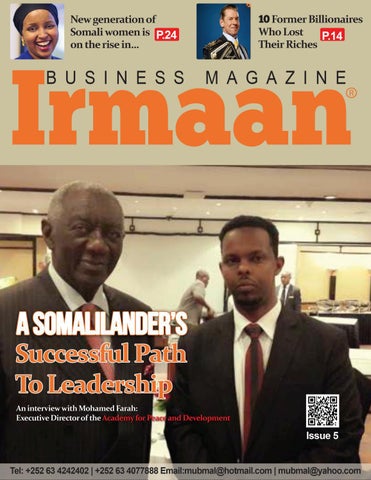
A SOMALILANDER’
SUCCESSFUL PATH TO LEADERSHIP BY: MUBARAK MAAL - IRMAAN CONTRIBUTOR
An interview with Mohamed Farah: Executive Director of The Academy for Peace and Development
M
ohamed Farah Hersi, born in Somaliland, understood at a very young age that education was the key to self-development and progress. He graduated from Hargeisa University in 2006 with at the top of his class, and then embarked on a journey as an international student to South Africa. There he attended the University of Pretoria, earning a Masters of Law at one of the most prestigious faculties in the world. He has already published three books such as, ‘Somaliland and International Criminal Law’, ‘Vote for Peace II and ‘A Decade of Democracy the case of Somaliland’. This once young Somaliland youth, aspiring to become the change that he so desperately sought in others, was determined in returning to his birthplace to work towards improving the lives of others and his surroundings. Mr. Hersi became a Lead Researcher for the Democratization Department of The Academy for Peace and Development almost immediately after his return in 2009; only to later transpire to become the Executive Director of one of the most accredited, renowned local organizations in Somaliland. “I had a simple goal in mind; assisting my people and nation would be the prime factor in my life. I am very fortunate that the Academy for Peace and Development has provided me with avenues of reaching such a goal”, stated the Executive Director. There are thousands of youth engaging in illegal migration to other countries everyday (tariib); it devastates me to know that these are our Somaliland youths who have lost the hope and desire of becoming successful in Somaliland. The story of Mohamed Farah Hersi is one of genuine dedication, hard-work and persistence with the unquenchable desire of a local citizen setting an example to the youth by showing them the results in working effortlessly to bring about positive change to his country. We had the opportunity to have a question and answer session with the Executive Di20
IRMAAN BUSINESS MAGAZINE
rector, Mohamed Hersi. 1- How important are good employees towards achieving success? Thank you first of all for inviting me to this interview; I’m deeply honoured and grateful. I think good employees can contribute greatly towards success in either of two ways: a. During a process of recruitment, you need to select employees based on their knowledge, professionalism and skills that can meet the institution’s requirements. b. You must never select or recruit employees through a clan-based system. You should always base your selection on hiring the best individual with the required qualifications and experience for the job. 2- If you had the chance to start your career over again, what would you do differently? First of all, praise and thanks in any form of success belongs to Allah, I can say that we are heading on the right track in terms of our work. I have always dreamed of studying law when I was younger and to conduct research in a notable research institute. Today, as the Director of one of greatest research centres in Somaliland, it is important I understand the needs of my people and any difficulties they may face within our society. Hence, there is no better starting point than this one, and if I had to do that all over again, I believe I would follow the same path. 3- In your point of view, what are the top three skills needed to be a successful Director? Yes, we can mention the following skills: a. To be able to make good decisions during tough situations. b. One must possess good leadership, most importantly visionary leadership. c. A good listener with a passion for his work and a good decision maker. 4- Would you kindly share some of your failures with us, and what you have learned from? As you may already know, weat (APD) of-
ten work in all regions of Somaliland and analyse issues and challenges that are relevant to society. We, as human beings, are capable of doing mistakes. However, you always have something to learn from a mistake. Therefore, as an institution, we can stumble and commit a few mistakes. But what is important is that we always ensure to correct ourselves whenever that happens, and strive to do better by learning from our mistakes. 5- Tell me about a project or an accomplishment that you consider as the most significant in your career. Every project that we pursue here at APD is significant, but there is a particular project that had immensely influenced my ideas and that is the Democratization programme in Somaliland. It analyses how Somaliland moved forward from a clan based system into a multi-party system. I had the chance to conduct research on Somaliland’s political dynamics and this helped me understand how if a traditional and modern element merged together in our democratic system is leading Somaliland towards a brighter future. 6- What’s your vision in APD? My vision is to see The Academy for Peace and Development (APD) grow into a greater wellestablished and prominent institution and above all, a respected centre of knowledge within Somaliland. For APD, to be a place that can take a significant role in the overall development of Somaliland. Furthermore, I also hope that APD will deliver Somaliland’s story to the rest of the world. 7- Would you please characterize your life as a Director? I think it is very important for the Director of APD to be a visionary leader and a decision maker. 8- What are some of the biggest mistakes you’ve made? Oh. This is difficult question! (Smiling), I don’t think that I can recall any big mistake
SocialStory Cover Club I may have done. But since you have asked, I can say that my schedule can be quite hectic sometimes and this leads to a conflict with my appointments and meetings.
single day. 12- What sacrifices have you had to make to be a successful Director? With every high depending position one
nization in 5 years? 10 years? In the next 5 to 10 years I would like see APD continue to impact the development and stability of Somaliland as a peaceful
However, it’s a learning experience and I’m working on improving it. 9- How can you prevent mistakes or do damage control? We can prevent mistakes through common consultations, data gathering techniques, deep investigation, and then analysing it in a very systematic way and to be very careful in passing out judgment. 10- What are your hobbies? What do you do in your non-work time? Watching documentary movies is one of the hobbies I enjoy doing during my spare time. I also like reading books that are based on true stories. 11- What makes you happy? Taking care of my parents and looking after my loved ones. Especially after coming home to mybeloved wife and beautiful baby girls Rayaan and Huda after work every
makes sacrifices with their time, energy, and resources. As a director I shoulder enormous amount of responsibilities, and without being dedicated to the success of the organization I would not have gained all the skills, knowledge and experience at APD over the years and all my efforts and hard work led to where I am today. 13- Excluding yours, what organization or business do you admire the most? I really admire two wonderful companies in particular: Dahabshiil and Telesom for the amazing services they provide to the people of Somaliland. Communication is very important to all Somalilander’s and these two organizations have been providing such with improvements to our daily communication every year.
country. I hope to contribute my part in the democracy, economical growth and the peace and stability of Somaliland. We hope that you and the people of Somaliland continue to benefit from our work so that we continue to be a prime catalyst for positive change, Insha’Allah. As for myself, I am confident Somaliland will transform in terms of its development and I hope that I will take a significant role in its future transition. The first generation of our people will be replaced by a newer generation which will lead our country, and this new generation is ours and I will be there for my country when that time comes Insha’Allah. Mohamed Farah with the Former President of Ghana John Kufuor Director of APD Mohamed Farah working from his office
14- Where you see yourself and your orga-
IRMAAN BUSINESS MAGAZINE
21
Social Club
Success Keeps Heating up for
Sadia’s Hot Sauce
F
rom a young age, Sadia was an entrepreneur. At the age of eleven, her father died and her mother became bedridden, so Sadia began selling tomatoes on the streets after school to make money to feed her and her five siblings. Even then, she had the dream to one day come to America to become a successful business woman. When Sadia was in the eleventh grade, Somalia exploded into a violent civil war. Sadia and her family fled to Kenya for safety, where she met and married her husband and started her own family. She worked many jobs there, but still held onto her dreams to someday move to America. As her family grew, Sadia grew more impatient to get out of the refugee camp life. In 1999, she was finally granted an interview which she passed. Sadia and her young family arrived in New York City in September, 1999. Her husband and five children flew with her to San Diego where they were assigned. A year later, they moved to Minneapolis because of the growing Somali community here. Both Sadia and her husband found jobs here, but she still had that dream of going into business. In her spare time, Sadia began experimenting with her mother’s recipe for hot sauce, ultimately perfecting the three products currently available: Hot, Mild, and Sweet Sauce. Although she has plans for more recipes, Korad has chosen to focus her business on the high quality of her sauces. All three are made using the highest quality ingredients, all organic, natural and gluten free. Her ingredients include tomatoes, onions, cilantro, garlic, jalapenos, red peppers, dates, tamarind and sea salt. They can be used as a marinade for meats, or cooked with sauces for added flavor; but they are best when added to meats, chicken or fish, even pasta and rice. To begin selling her sauce, Sadia first went to the store where she bought the ingredients for the sauce. She met with a manager to see if they were interested in selling 22
IRMAAN BUSINESS MAGAZINE
her sauce. He explained that she must go through their wholesaler. So, Sadia made an appointment with the wholesaler, and he took her hot sauce there for a taste testing. They loved it, but laid out the long process she would have to go through to sell her product in grocery stores. Undeterred, Sadia remained focused on completing this process and reaching her goals. The African Development Center of Minnesota is extremely proud of the work that Sadia has put in to her dream, and glad to be a part of her continued success. In 2010, ADC approved a loan to expand her business, and has since devoted a number of technical hours to help her take this business to the next level. Sadia understands the importance of strategic marketing and is working to increase her presence in the local Farmer’s Markets, and Co-Ops. After multiple meetings with ADC staff, Korad was given access to ADC’s expansive network that connect her to number of oppor-
tunities. Additionally, ADC also assisted Korad in resolving wholesale issues. Her efforts in the last two years have been centered on getting FDA approval and chemical testing of her products for nutritional labels. Her sauces can already be found in 14 locations, including Farmer’s Markets and Co-ops in the Twin Cities, with her next goal to be a greater presence in area grocery stores and chains. ADC was created in order to assist self-starters like Sadia – willing to work hard to achieve their dreams. A creative thinker, Sadia always knew that if she was lucky enough to be selected to come to the United States, she would make the best of that given opportunity. ADC simply provided the tools to help her achieve this. In Sadia’s own words, her business “would not be where it is today if it weren’t for the SOURCE: Southwest Journal
Social Club
IRMAAN BUSINESS MAGAZINE
23
Social Club
New generation of Somali
women is on the rise in Minnesota:
W
hen Sahra Noor first visited People’s Center Health Services, she was a harried college freshman and the single mom of a toddler. She had arrived in the United States two years earlier after spending most of her teenage years in Kenyan refugee camps. She returned to the center last summer as the chief executive of what is now a network of clinics headquartered in the Minneapolis’ Cedar-Riverside neighborhood. In the 15 intervening years, Noor earned a graduate degree and rose rapidly in health
24
IRMAAN BUSINESS MAGAZINE
care leadership. But she says she will draw heavily on her back story as a patient — at a time when the pressure is on for safety-net clinics to better track patient results and cut costs. The proud Somali community of Cedar-Riverside has high expectations of Noor, as well. “I see myself as a cultural broker, someone who understands the American health care system and the needs of low-income and immigrant communities,” said Noor. Over the past decade, a growing number of Somali-American women have launched
successful professional careers. Now, some are aiming higher, eyeing new roles as decisionmakers. On a recent morning at People’s Center, Noor stepped out of her uncluttered corner office for a twice-daily ritual. She strode briskly through the clinic’s ground floor, pausing to chat casually with patients in the waiting room and peeking into the new pediatric wing. A welcome sign in a dozen languages and a sign-up sheet for an immigration lawyer are posted on the pastel walls.
Social Club The ritual is an antidote to Noor’s biggest fear — that marooned in her office upstairs, she might lose touch with the front lines of patient care. “We are dealing with people’s lives, and we need to think like a patient,” said Noor, who started in August. The center opened in 1970 as an all-volunteer operation with limited hours. By the time Noor became a patient in 1998, it was a full-fledged community clinic. It was among a growing number of providers that rely largely on publicly subsidized coverage such as Medicaid as well as state and federal grants, but also aim to save taxpayer money by warding off costly emergency room visits and hospital stays. Once Noor rushed in as her 2-year-old daughter cried in pain from an ear infection. The young mom had lapsed health insurance and no appointment. The nurse practitioner who treated her daughter gave the young family free medication and that ineffable “reassurance everything would be OK.” Noor had arrived in the United States at age 18 and squeezed a high school career into two years at a Virginia alternative high school. In Minnesota, Noor and her daughter moved into a Cedar-Riverside high-rise apartment so Noor could attend nursing school at St. Catherine University. Noor had wanted to work in health care since she experienced firsthand the shortage of care at Kenyan refugee camps. Months after her extended family arrived there, relieved to have survived the fighting back home, tragedy struck: A pregnant aunt died of a treatable illness while Noor battled malaria. Those early experiences fueled Noor’s resolve when she arrived in Minneapolis. She juggled college, motherhood and a parttime job: in a nursing home, a call center and later as a medical assistant at Hennepin County Medical Center. All along, she says, “I felt I had to be the best at everything I did. Being a single mom, I wanted to make sure I did not become a statistic.” She got up at 3 a.m. to study before dropping off her daughter at day care and heading to an 8 a.m. class. She was overwhelmed — and determined not to show it. “She didn’t want anyone to cut her any slack,” said Noor’s sister, Ilhan Omar, now a Minneapolis City Council senior policy aide. “Her daughter was never going to be an obstacle or an excuse.”
After graduation, Noor worked as a nurse at Hennepin County Medical Center. Dr. Osman Harare, a Somali patient advocate at the time, remembers her explaining carefully how immunizations, insurance and appointments work to patients. Noor remembers working with people on dialysis and with pacemakers, and yearning to be a leader who championed prevention. Rising in leadership From there, Noor’s career picked up speed. She got a job at the Community-University Health Care Center, a safety-net clinic in the Phillips neighborhood, as a health educator and later an assistant clinic manager. During that time, she also got a master’s in nursing and health systems administration at the University of Minnesota. Next, she landed a management position spanning eight states with insurer UnitedHealth Group. Friends joked she had crossed over to the “dark side,” but as a supervisor of case managers for Medicaid beneficiaries, she saw herself as a patient advocate. Later, she took over the language services and community health department at Fairview Health Services, with a staff of interpreters who spoke 16 languages. At the time, she launched the Health Commons in Cedar-Riverside, an innovative bid to bring health care to patients’ home turf. There, walk-ins could take wellness classes and get free consultations with volunteer physicians and nurses. Cawo Abdi, a University of Minnesota sociology professor, says for years now Somali-American women have launched businesses and pursued professional careers, defying more circumscribed gender roles mothers and grandmothers might have hewed to in East Africa. Now, Abdi predicts, more of them will rise to leadership positions, challenging an expectation — in the society at large and within the Somali community — that “women should not be too loud or too assertive. “Young Somali women are becoming much more visible,” Abdi said. “They are a part of the landscape now.” Coming full circle: Stephen Blair Venable, a People’s Center board member who led the search for a new leader, says Noor had it all: She is a seasoned health care leader, a former nurse with an intense focus on the patient experience, and a warm, personable presence. She also happens to be a trusted member of the Somali community, which accounts for 70 percent of the patients at the Cedar-River-
side location. In the community, Noor’s hire made a splash on social media. Somali leaders hosted dinners in her honor. Abdirahman Ahmed, the owner of Safari Restaurant in Minneapolis and a friend, held one of them. The dinner was emotional and celebratory, says Ahmed, but the guests also took the opportunity to give the new CEO a piece of their minds. Ahmed urged Noor to think big. He pitched a collaboration with the Mayo Clinic, with Mayo visiting hours at the center. Noor has heard much more since. Omar, her sister, passed on feedback from several patients who thought the clinic could change its scheduling to make short-notice appointments easier and ensure that calls from patients did not go unreturned. “Oh my god, we pay consultants for that kind of feedback,” Noor told her sister. “Give these patients my phone number.” Since, Noor has launched a call center that tracks call waiting and response times. “In the Somali community, Sahra is family,” said Omar. “People are comfortable giving her criticism and opinions. That also creates a lot of pressure, but she excels in pressure.” Noor already has a lengthy to-do list. She’ll work to deepen a partnership with nine community clinics that banded together into an “accountable care organization” under the Affordable Care Act. Under the model, the state rewards clinics for patient results and Medicaid savings. She’s also gearing up to launch a new initiative to integrate the services the center offers, which include dental and mental health care. The idea is that if a busy mom comes in for a child’s checkup, the center would also seamlessly fit in a dental exam and, if needed, face time with a social worker. In returning to the center, Noor once again finds herself juggling a lot. Noor, who married six years ago, has a toddler and a new college student at home. The job is demanding: compliance deadlines, leadership meetings, new projects, all under the watchful eye of a patient community that sees Noor as one of its own. “It’s OK to say no,” Denise Ryan, Noor’s assistant, told her recently. But Noor feels a sense of purpose and, as her sister puts it, “a sense of homecoming.” “I am impressed,” Venable said. “Sahra is rising to the challenge — as I expected she would.” Source: http://www.startribune.com IRMAAN BUSINESS MAGAZINE
25
26
IRMAAN BUSINESS MAGAZINE
Xeer-Nidaamiyaha Shaqalaha Dowladaha Hoose Wasaarda arimaha gudaha jamhuuriyada Somaliland ayaa markii u horaysay soo saartay xeer-nidaamiye shaqaalaha dawladaha hoose, xeerkan oo sumadiisu tahay 38(11), 54(1) 59 & 61aad ee xeerka ismaamulka gobalada iyo degmooyinka Xr Lr 23/2007, xaarkan oo ka kooban 62 qodob ( laba iyo lixdan qodob) ama 28 bog ( sided iyo labatan bog) xeerkan oo si faahfahsan uga hadlaya qaab dhismeedka uu yeelan doono ama lagu dhaqayo shaqaalaha dawladaha hoose ee dalka. Xeer-nidaamiyahan waxa la bilaabay diyaarintiisa bishii September/2013, waxana si rasmi ah loo bilaabay in la qoro ama bishii koowaad ee sanadkan 2014 iyada oo uu soo dhamaaday qabyo qoraalkisii u horeyey bishii February/2014 iyada oo qabyo-qoraalkaasi koowaad lagu soo bandhigay kulan ay isugu yimadeen maamulada dhamaan degmooyinka darajada (A), qaarka mid aha degmooyinka derajooyinka (B) iyo (C), wasaaradaha dawlada dhexe iyo hay’adaha sharciga iyada oo intii ka dambaysayna la qabtay kulamo dhawr ah oo lagu lafa gurayay dhammaystirkiia Waxana ka qayb-galay dhamaan cida kasta oo loo arkay in ay door ku yeelanayaan ha noqoto dhinaca hirgalintiisa iyo talo bixintiisaba, waxana ka mid ahaa kuwan hoos ku qoran
ageerto xaga farsamada iyo dhaqaalaha sida iyada oo u qabatay la taliyaha sharciga ee wasaarada, iyo in ay ka qayb-qaadatay fududaynta kulandii la isugu yeedhay dhamaan daneeyayasha kor ku xusan oo ay bixinaysay kharashaadka kulanadaasi hadana ay qorshaha ugu jirto sida uu noo sheegay agaasimaha guud jirto in ay ka daboosho kharashaafka daabacaada iyo ku tababarida shaqaalaha Dawladaha hoose 1. Ujeedooyinka loo sameyey xeerkan: •
In la abuuro hab-raac iyo nidaam maamul oo lagu dhaqo shaqaalaha dawladaha hoose
• In dawladaha hoose helaan shaqaale xirfad, aqoon, karti iyo khibrad u leh gudashada xilka iyo waajibaadka shaqo iyo kor usoo qaadida hufnaanta, Hamada iyo xiisaha (Motivation) shaqaalaha •
In la xaqiijiyo nidaam ku dhisan caddaalad iyo sinnaan oo lagu ilaalinayo xuquuqda shaqaalaha iyo nid aamka shaqalaysiinta ee shaqaalaha Dawladaha Hoose; 2. Dabaqaada Xeer-nidaamiyaha •
Xeer-nidaamiyahani waxa lagu dabaqayaa ama lagu dhaqayaa shaqaalaha joogtada ah ee ka shaqeeya Dawladaha Hoose ee dalka
•
Xeer-nidaamiyahani laguma dabaqayo ama laguma dhaqayo:
•
Xohgahayayaasha fulinta ee dawladaha hoose
•
Shaqaalaha wasaaradaha iyo hay’adaha dawlada dhexe ee ka hawl-gala degmooyinka.
2. Maamulada degmooyinka darajada A, qaarka mid ah degmooyinka B iyo C
•
Lataliyaasha ama khabiirada heshiis hawl-qabad oo mudaysan Dawladaha hoose la galaan;
3. Xubno sharci yaqaano ah oo ka kala tirsanaa xafiisyada qareenada (SLO), Xeer-ilaaliyah Guud, Garyaqaanka guud, wasaarada cadaalada, iyo qaybta sharciga ee jaamacada Hargeisa
•
Shaqaalaha mudada cayiman ee shaqadoodu tahay meel iyo muddo cayiman ee lagu sheegay qodobka 22aad ee xeer-nidaamiyahani
1. Wasaarada arimaha gudaha oo ay ugu horeeyaan xubnaha kala ah, la taliyaha sharciga ee xafiiska agaasimaha guud, madaxa waaxda horumarinta degmooyinka iyo xubno shaqaale ah oo ka tirsan wasaarada arimaha gudaha. xubnahaasi waa kuwa ka gaystay diyaarin iyo talo bixin iyo waxa kale ooh awl weyn ka gaystay agaasimaha Guud ee wasaarada arimha gudaha bilawga diyaarintiisa iyo dhamaystirkiisaba
4. Hay’ada UNDP/JPLG oo iyana ku lahayd in ay ka ta-
IRMAAN BUSINESS MAGAZINE
27
Social
SOMALILAND: VICE-PRESIDENT SAYLICI CUTS THE RIBBON AT THE OPENING OF
SUMMERTIME GREEN PLAZA By: Abdirisak Itaqile IRMAAN CONTRIBUTOR
H
argeisa, (Somaliland Monitor) — Amid cheers and applause from the gathered officials and guest, Vice-president Abdirahman Abdilahi Ismail “Sayli” has on Tuesday night officially cut the ribbon symbolizing the opening of Summertime Green Plaza, the first stateof-art Wedding and Conference hall in Somaliland. Summertime Green Plaza which is a modern, unique and elegant brand new ultramodern building locates in Jigjiga Yarprovides city residents an attractive wedding venue and high quality conference facilities for business meetings and corporate events. Besides the vice-president, the inaugural ceremony attracted a large number of dignitaries including the founder and owner of summertime chain of restaurants, halls and luxury hotels Mr. Saed Sheikh Omer Yusuf, Minister of Presidency Hirsi Ali Hajji Hassan, Public utility Minister Abdirisak Khalif Ahmed, deputy Information Minister, Abdiwahid Abdikadir, Deputy Labour Minister Shukri Harir Ismail, parliamentarians, businessmen religious scholars, intellectuals and distinguished guests. The owner of Summertime Green Plaza Mr. Saed Sheikh Omer while speaking at the ceremony In his opening remarks the owner of Sum-
28
IRMAAN BUSINESS MAGAZINE
mertime Green Plaza Mr. Saed Sheikh Omer narrated the humble beginning of his business ten years ago in small telephone substation until reaching this stage of building this modern building, where he stated that the new 40mx17m wedding and conference hall will accommodate up 1500 guest. Mr. Saed also stated that a new 80 room five star hotel, summertime hotel is on the way. Currently under construction the new ultramodern five star hotel will have swimming pool and kings suite for newly-wed couples. Speaking at the ceremony, Eng. Ahmed Warsame Saed, the chief Engineer of Warsame Saed Construction Company which built the hall stated that $350,000 hall is uniquely constructed in locally produced soft sulfate mineral composed of calcium sulfate dehydrate known as Gypsum. In his remarks, Vice-president Abdirahman Abdilahi Ismail “Sayli” expressed his delight to officiate the inaugural ceremony of the country’s Wedding and Conference venue since its inception in 1991, where he lauded the owner of Summertime Green Plaza Mr. Saed Sheikh Omer’s contribution to the economic development of the country. “I am very happy to attend the grand opening of Summertime Green Plaza wedding
and conference hall, the owner Mr. Saed made a tangible progress in his business where he begun a small telephone substation ten years until reaching this stage,” VP Saylici said. VP Saylici also stated that Mr. Saed Sheikh Omer became a role model for Somaliland youth where he urged young businessmen to follow his footsteps. Other officials who spoke at the ceremony include Presidency Minister Hirsi Ali, Public Works Minister Abdirisak Khlaif, deputy labor minister Shukri Harir and Deputy Information minister Abdiwahid Abdikadir. Summertime Green Plaza offers the perfect setting and atmosphere for wedding celebrations. The newly built hall has classical fireplaces at each end which feature magnificent new paintings and tiles specially commissioned to enhance the room. The owner of Summertime Green Plaza Mr. Saed Sheikh Omer Yusuf also owns one of the most iconic restaurants in the city, Summertime Restaurantwhich is popularly known for its different dishes that attract both locals and foreigners. Summertime restaurant which is located at Jigjiga yar village is frequented by high profile customers including government officials, politicians, lawyers, bankers and even tourists.
History, Arts & Culture
AFROPEAN STYLE: Thrifting with Dualleh Abdulrahman
By: Tommy Evans
S
elf-made fashionista Dualleh Abdulrahman is both Afropean in heritage and style. A designer, photographer and stylist, Dualleh talks to Tommy Evans about how he creates his signature look, how he remains dapper on a thrift shop budget and what it’s like to work for a mainstream brand when your own style is that much more laudable. Afropean has been defined as “the social, cultural and aesthetic interplay of Black and European culture”. As a Dubai-born, German-raised, England-educated, Dutch-based gentleman of Somali and Iraqi heritage, would ‘Afropean’ be an apt description of your experiences, identity and ambience? “Afropean” is a good description of what I am. It’s always been hard to explain my background to people. I lived in Germany before coming here [to Holland] and I was the first black guy they ever saw. To explain black culture to my classmates, the teacher showed the movie ‘The Gods Must Be Crazy’ [a 1980 South African comedy]– that was black culture to them! But that didn’t make me want to join the crowd or fit in. You’ve previously mentioned how pivotal your father and uncle were in implanting and cultivating your passion for fashion… My father, Allah bless his soul, was a stylish guy: he dressed funky fresh with a big afro. My uncle, who was half Italian/half Somali, dressed in the ‘dandy’ style. I just loved it. I used to hear my uncle tell his friends why the pocket square was invented. He said it was not only
to finish the outfit but it had a function too: when you were leaving on a long trip, the wife would cry on your shoulder so… you rest the pocket square on your shoulder so that you don’t get makeup on your suit! T h a t stuck with me until today. Everything in a man’s wardrobe has a function. How influential were your institutional educational experiences in shaping your outlook? Can sartorial savviness schooled? Or has the ‘Unisity of Life’ you more clothing and accompanies School just you the bafashion, which but fashion style. I always can’t break if you don’t what the rules
be vertaught about all that it? teaches sics of is good, is not say you the rules k n o w are. So
I learned the history of fashion and style but the rest is just the ‘University of Life’. I love clothing but I will not pay thousands of Euros for something I can make myself – so thrifting was the next thing. Most times, I don’t even know what I will find. But I will keep my eye out for something I saw in a shop and then find similar items. Breaking the rules of men’s fashion is what sets you apart. Some like it, some don’t and you only learn that in real life. Sometimes I found things like braces that I had no clue about previously. So the thrift store helped broaden my closet with unique items. What was the experience of working with a mainstream global brand such as H&M like? Working in H&M was good but it had its downsides too. I worked in the men’s section – the classic section with suits – but I also gave style advice by appointment. For example, a customer would have a private session for three hours in which I would style and explain men’s fashion, but since I always wore my own stuff and not H&M’s, the custom-
IRMAAN BUSINESS MAGAZINE
29
History, Arts & Culture ers tended to follow my cheap trend and I made no major sales! When they asked me where I got my clothes, I couldn’t keep it to myself. I love helping people out, just like the men or women who put free tutorials out there on the internet. I just couldn’t make customers buy offthe-rack, ill-fitted clothing. Buying cheap and making a ‘one of a kind’ piece was the next thing, so I quit my job and now I am thinking of starting my own clothing line. As a photographer and stylist, do you adopt a different method to “making over” a client as you would to designing and constructing an outfit of your own?
30
IRMAAN BUSINESS MAGAZINE
Photography was not my thing but I couldn’t find a photographer who had experience in male photography. It was on TFPs [Time for Print meaning an arrangement whereby the photographer provides a set number of prints in exchange for the model’s time] and I never got what I wanted so I picked up the camera myself. I majored in analogue photography so I had to learn digital myself; YouTube and Google are the best teachers! I had clients that I did the art directing and styling for, some of them paid, some on TFPs, I just can’t bring myself to ask for money every time. My wife hates this! I say to her, “First fame, then money!” I was just tired of putting in one hundred per cent and getting back zero, so I use all that Allah gave me to maybe, inshallah, reach my goal.
History, Arts & Culture
IRMAAN BUSINESS MAGAZINE
31
32
IRMAAN BUSINESS MAGAZINE