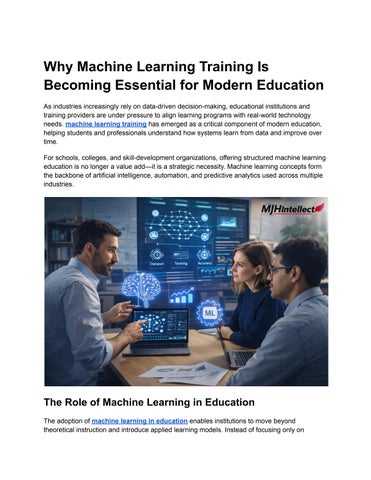
Why Machine Learning Training Is Becoming Essential for Modern Education As industries increasingly rely on data-driven decision-making, educational institutions and training providers are under pressure to align learning programs with real-world technology needs. machine learning training has emerged as a critical component of modern education, helping students and professionals understand how systems learn from data and improve over time. For schools, colleges, and skill-development organizations, offering structured machine learning education is no longer a value add—it is a strategic necessity. Machine learning concepts form the backbone of artificial intelligence, automation, and predictive analytics used across multiple industries.
The Role of Machine Learning in Education The adoption of machine learning in education enables institutions to move beyond theoretical instruction and introduce applied learning models. Instead of focusing only on
algorithms, students learn how data is collected, processed, and used to make informed decisions. Machine learning in education encourages analytical thinking, logical reasoning, and problem-solving skills. Learners explore how systems recognize patterns, make predictions, and continuously improve based on feedback. This practical exposure ensures that graduates are better prepared for higher education pathways and technology-driven careers. From a B2B perspective, institutions that integrate machine learning programs enhance curriculum relevance and improve student outcomes.
Building Practical Skills Through Machine Learning Projects One of the most effective ways to reinforce learning is through machine learning projects. These projects allow students to apply theoretical knowledge to real-world scenarios such as classification, recommendation systems, and predictive modeling. Machine learning projects promote hands-on experimentation and critical thinking. Students learn to work with datasets, evaluate results, and refine models based on performance. This approach builds confidence and technical competence while helping institutions measure learning effectiveness. By implementing structured machine learning projects, training providers can offer experiential learning that aligns with industry expectations and workforce requirements.
Benefits of Machine Learning Training for Institutions Offering machine learning training helps institutions position themselves as future-focused and industry-aligned. These programs support scalable learning models that can be adapted for schools, colleges, and professional training environments. When learners engage in machine learning training, institutions benefit from improved engagement, stronger skill retention, and better placement readiness. Programs focused on machine learning in education also support collaboration, data literacy, and interdisciplinary learning across STEM domains. Additionally, machine learning projects enable institutions to showcase measurable outcomes, which is increasingly important for accreditation and partnership opportunities.
Preparing Learners for a Data-Driven Workforce
As organizations across sectors adopt AI and automation, learners must be comfortable working with data-driven systems. Exposure to machine learning training ensures that students develop adaptability and a structured approach to problem-solving. By embedding machine learning in education, institutions help learners transition smoothly into advanced studies and professional roles. Carefully designed machine learning projects reinforce these skills and prepare students to contribute effectively in real-world environments.
Contact Us Looking to integrate machine learning programs into your institution or training ecosystem? Connect with us to explore scalable and industry-aligned machine learning education solutions. Contact Us