Why AI and ML Projects Are Essential for Industry-Aligned Learning
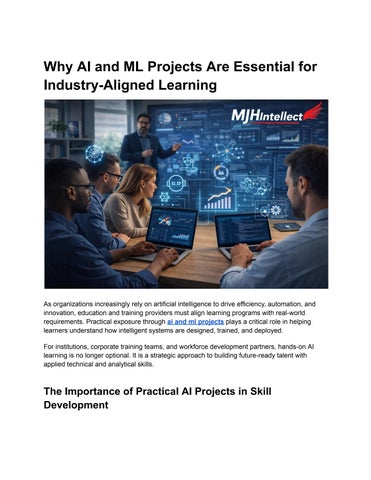
As organizations increasingly rely on artificial intelligence to drive efficiency, automation, and innovation, education and training providers must align learning programs with real-world requirements. Practical exposure through ai and ml projects plays a critical role in helping learners understand how intelligent systems are designed, trained, and deployed. For institutions, corporate training teams, and workforce development partners, hands-on AI learning is no longer optional. It is a strategic approach to building future-ready talent with applied technical and analytical skills.
The Importance of Practical AI Projects in Skill Development
Theoretical knowledge alone is not sufficient to prepare learners for modern AI-driven roles. Structured ai projects allow learners to apply concepts to realistic scenarios such as prediction, classification, automation, and optimization. Through ai projects, learners work with real datasets, experiment with models, and evaluate outcomes. This approach improves problem-solving abilities and helps learners understand the full lifecycle of AI systems—from data preparation to model evaluation. For institutions, this ensures measurable learning outcomes and improved learner engagement. From a B2B perspective, practical AI learning also helps organizations reduce the skills gap by producing learners who are ready to contribute in professional environments.
Strengthening Technical Foundations Through Algorithm Development A core component of effective AI education is alogorithm development. Algorithm development focuses on teaching learners how logical rules, decision-making processes, and optimization techniques form the backbone of AI and machine learning systems. By working on algorithm development, learners gain clarity on how models make decisions and improve accuracy over time. This builds strong analytical thinking and supports deeper understanding beyond tool-based usage. For training providers, emphasizing algorithm development ensures learners are equipped with transferable skills that remain relevant as technologies evolve.
Benefits of AI and ML Projects for Institutions and Organizations Implementing ai and ml projects enables institutions to offer applied, outcome-driven education aligned with industry expectations. These projects encourage collaboration, experimentation, and critical thinking, all of which are essential in modern technical roles. For organizations, integrating ai projects into training programs improves learner readiness and accelerates onboarding for AI-related positions. Structured learning through hands-on projects also supports scalable training models that can be adapted for students, professionals, and enterprise teams. Additionally, focusing on alogorithm development helps institutions demonstrate depth in technical education, strengthening credibility with industry partners and accreditation bodies.
Preparing Learners for AI-Driven Business Environments As AI adoption expands across sectors such as finance, healthcare, manufacturing, and logistics, learners must understand how intelligent systems are built and optimized. Exposure to ai and ml projects ensures learners develop adaptability and confidence in working with complex systems. A curriculum that combines ai projects with structured alogorithm development prepares learners to solve real business challenges using data-driven approaches. This positions educational institutions as key contributors to workforce transformation and digital innovation.
Contact Us Looking to integrate hands-on AI and ML programs into your institution or training ecosystem? Connect with us to explore scalable and industry-aligned AI education solutions. Contact Us