Why a Data Science and Analytics Course Is Essential for Modern Institutions
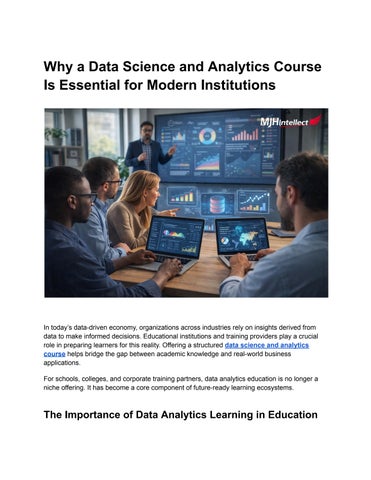
In today’s data-driven economy, organizations across industries rely on insights derived from data to make informed decisions. Educational institutions and training providers play a crucial role in preparing learners for this reality. Offering a structured data science and analytics course helps bridge the gap between academic knowledge and real-world business applications. For schools, colleges, and corporate training partners, data analytics education is no longer a niche offering. It has become a core component of future-ready learning ecosystems.
The Importance of Data Analytics Learning in Education
Effective Data analytics learning equips learners with the ability to collect, interpret, and analyze data to support decision-making. Rather than focusing only on tools, data analytics learning emphasizes analytical thinking, data interpretation, and problem-solving skills. When institutions adopt structured data analytics learning programs, learners gain exposure to real datasets and practical scenarios. This prepares them to understand trends, identify patterns, and communicate insights clearly—skills that are highly valued across sectors such as finance, healthcare, technology, and operations. From a B2B perspective, strong data analytics learning frameworks also enhance curriculum relevance and institutional credibility.
Applying Knowledge Through Data Analytics Projects Theory alone is not sufficient to build analytics expertise. Well-designed Data analytics projects enable learners to apply concepts in realistic and measurable ways. These projects simulate real business challenges, such as performance analysis, forecasting, and data-driven optimization. Data analytics projects encourage learners to work with structured and unstructured data, develop dashboards, and present actionable insights. This hands-on approach improves engagement and reinforces learning outcomes. For institutions, incorporating data analytics projects helps standardize skill assessment and demonstrate tangible learning impact to stakeholders and industry partners.
Benefits of a Data Science and Analytics Course for Institutions A comprehensive data science and analytics course supports scalable and modular learning models that can be adapted for different learner groups. Whether offered to students, professionals, or enterprise teams, such programs align education with workforce expectations. Institutions that invest in data analytics learning also benefit from improved learner retention and stronger placement readiness. By combining theory with data analytics projects, organizations can offer experiential learning that mirrors real-world workflows. From a B2B standpoint, this strengthens partnerships with industry, enhances program differentiation, and supports long-term growth.
Preparing Learners for a Data-Driven Workforce
As organizations increasingly rely on data to guide strategy, learners must be comfortable working with analytics tools and methodologies. Exposure to a data science and analytics course builds confidence in handling data and interpreting results. A structured approach to data analytics learning ensures learners understand not just how to analyze data, but why insights matter. Reinforced through practical data analytics projects, these skills prepare learners to contribute effectively in professional environments from day one.
Contact Us Looking to integrate data analytics programs into your institution or training ecosystem? Connect with us to explore scalable and industry-aligned data analytics education solutions. Contact Us