


Green Weevil © Louis P




As we settle into summer, I am always grateful for the feeling of gaining more time. The longer, lighter days bring with them more time to get outdoors, enjoy the evenings and appreciate what is happening around us locally. There are lots of festivals and events happening all around Dorset this summer. Do you have any pencilled into your diary yet? Do let us know.
The change in season is being felt by wildlife too. Gardens are full of activity and, in my case, are in need of plenty of care and attention. This is something I always find a challenge, but I enjoy it once I get started.
Nature is very much on the move again. Just a couple of evenings ago, I let my dog out into the garden, and she seemed a little too interested in one place. On further investigation, I realised her new-found discovery was, in fact, a wandering hedgehog! My dog was very good and came away so the hedgehog could continue its night-time wanderings. When I went out later to check, our travelling friend was nowhere to be found.
I was also delighted to have the opportunity to watch the live webcam for the barn owl nesting box sent over by CHOG (see more about this on page xvii). The barn owls are so beautiful, and I found it a lovely, calming alternative use of my phone to scrolling on social media. Seeing them carefully looking after their eggs is such a privilege.
If you have not yet seen the barn owl camera link, or heard about the wildlife activity around Christchurch Harbour, take a look at CHOG’s article in this issue to find out more.





From 17 to 19 July, the Christchurch Music Festival is sure to delight visitors. As well as a full line-up of music acts including Toploader, Blazin’ Squad and Martin Kemp, there will be plenty of activities for children including a mobile petting zoo, spectacular bubble displays and a performance by comedy magician Jamie Jambo. Book your tickets from christchurchmusicfestival.com.
The Christchurch River Pageant will take place once again after last year’s spectacular debut. Dozens of watercraft will parade down the River Stour on Saturday 25 July, starting at 12noon from Tuckton Tea Gardens. Organised by the Christchurch and Boscombe & Southbourne Rotary clubs, the pageant aims to raise money for local causes.
And head to Mudeford Quay Green on 25 and 26 July for the Mudeford Arts Festival, an annual celebration of arts and crafts.
And oh my God, you guys! ‘Legally Blonde the Musical’ is coming to the Regent from 30 July to 1 August. Fans of musical theatre are sure to enjoy BMT Productions’ latest show, full of catchy tunes and bombastic dance numbers.
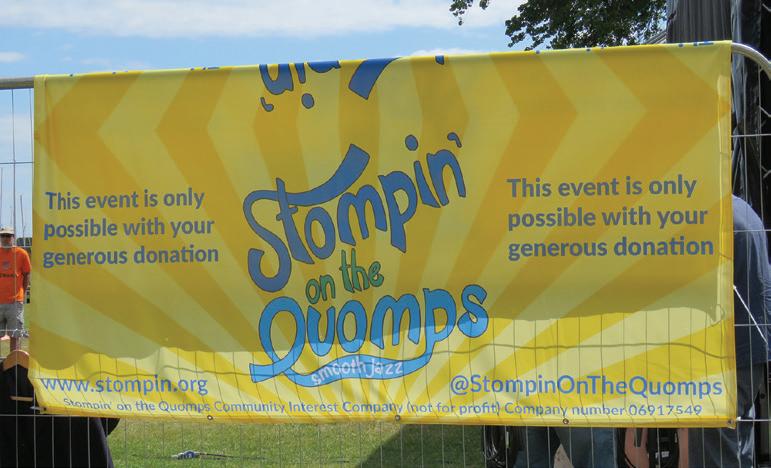
Saturday 1 August sees Stompin’ on the Quomps take over the Christchurch Quomps from 11.30am until 10.15pm. Now in its 30th year, this celebration of smooth jazz and live music is a popular day out. As well as the entertainment, there will be a wide range of food and drink stalls, plus a raffle.
Christchurch Carnival takes place from 14 to 16 August at
the Quay for a fun-filled weekend of community events. The highlight will be the parade through the streets of the town on Sunday 16 August.
At the end of the month, Highcliffe Charity Players are staging the deeply moving musical ‘Come From Away’, all about how the 9/11 terror attacks affected a small-town community in Newfoundland. Based on real-life stories, this is a heartfelt musical. Proceeds from the show will go to support local causes. See it at the Regent from Thursday 27 to Saturday 29 August.
To round out the summer, head to Highcliffe on Saturday 5 and Sunday 6 for the Cliff Top Music Festival. Now extended to a two-day event, visitors can look forward to a weekend full of live music, vintage fashion and family fun. This year’s headliners are The Commitments with Robert Arkins, and The Fleetwood Mac Experience. Head to ticketfairy.com/event/ctmf26 to book your tickets now.







FRIDAY 14 AUGUST 7.30PM AT THE REGENT, CHRISTCHURCH
Calling all Dancing Queens, this is your night to say, Thank you for the Music!
The ultimate ABBA tribute act are coming back to Christchurch this summer. This international smash-hit show brings all of ABBA’s number one hits to the stage in a production like no other.
The hugely popular show combines unmistakable harmonies, colourful costumes, and dazzling performances by the all-star cast.
Head to the Regent for the party of the year, with all the hits including ‘Waterloo’, ‘Dancing Queen’, ‘Super Trouper’, ‘Mamma Mia’, ‘Knowing Me, Knowing You’ and many more.
REGENT CENTRE BOX OFFICE
01202 499199
TICKETS £33
For your chance to win two tickets to the show, all you need to do is find Sammy Seagull who is hidden somewhere inside this month’s magazine (excluding this page).
Send an email with the subject line ‘Sammy Seagull’, the page number where he is hiding and your contact details to competition@ themudefordmag.co.uk.

Closing date is 31 July 2026
PREVIOUS WINNER: Two tickets to see The Dolly Show in April were won by Ann Crickmore from Mudeford who spotted Sammy on page 38.

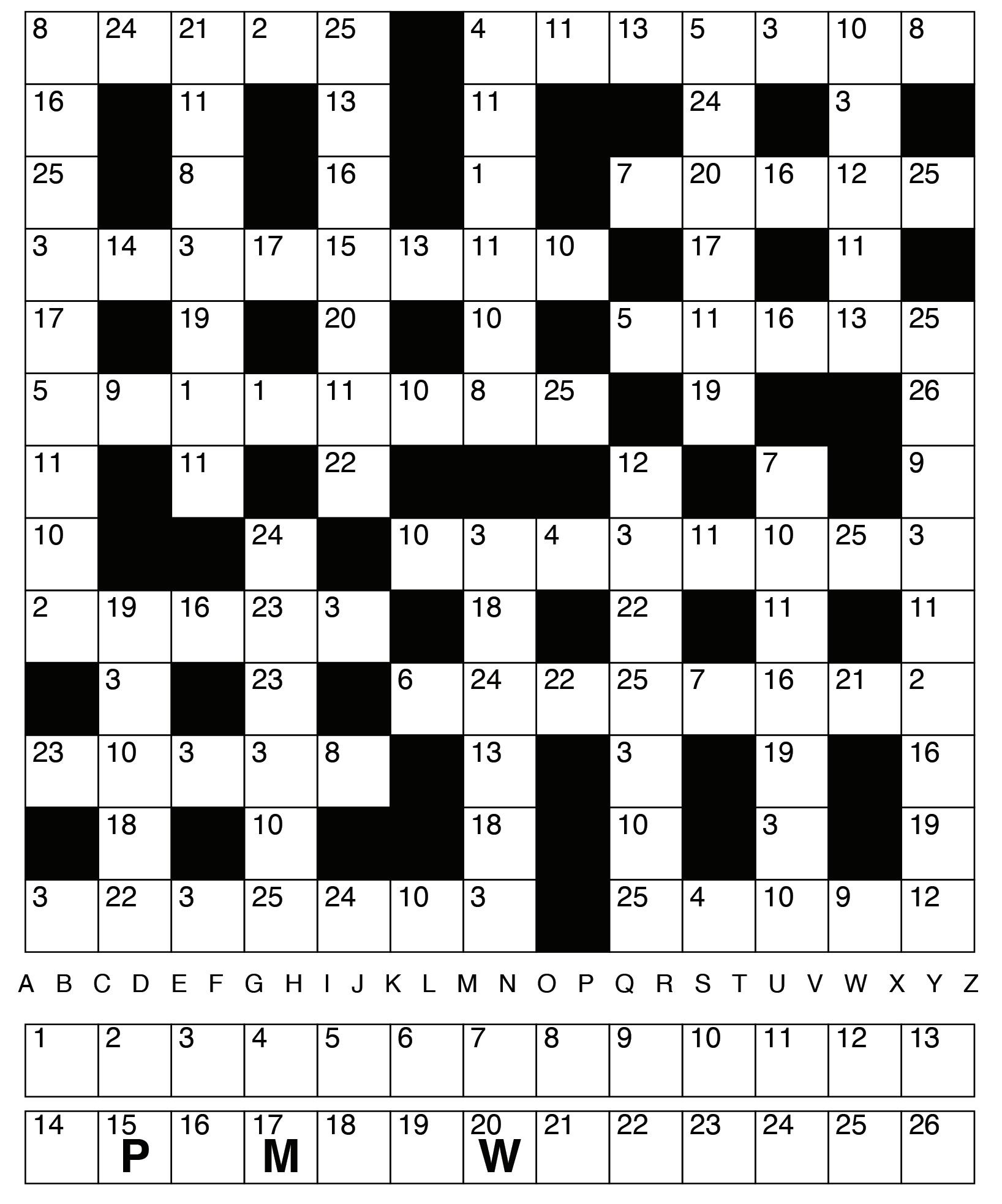
Every letter of the alphabet has been replaced by a number.
All you have to do is decide which letter is represented by which number.
To start you off we reveal the code for 3 letters.
Solutions on page xxii




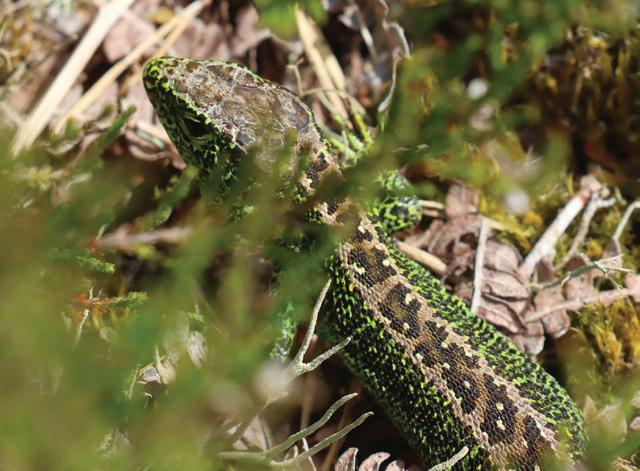
Pine martens, sand lizards, water shrews and adders, as well as the candelabra coral fungus, are among 1,100 species recorded in the New Forest during a two-year nature recovery project.
Almost 100 different types of bird, including 13 ‘priority’ species, and more than 300 plants were identified through survey work during the project, which saw 321 hectares of land — the equivalent of 418 football pitches — enhanced for the benefit of New Forest wildlife.
A total of 28 mammal species and seven species of reptile and amphibian were recorded, including two sand lizards, which are nationally red-listed as endangered.
Prof Russell Wynn, director of Wild New Forest, said: “There were
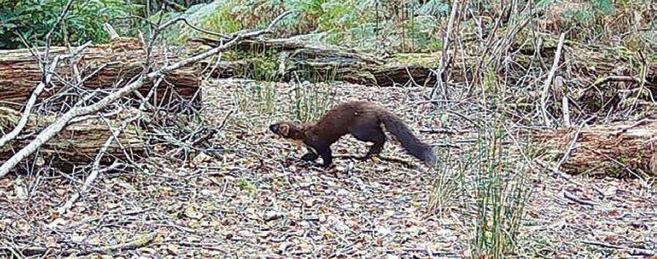
multiple sightings of pine martens during surveys in 2024 and 2025, as well as a pair marking their scent on the same rhododendron stump an hour apart in October 2025.
“A nearby camera also recorded a female pine marten transferring at least three kits between den sites, which suggests breeding took place locally.”
Experts from various organisations came together for the £1.3 million Species Survival Fund scheme, led by the New Forest National Park Authority, to create and restore grassland, heathland, wetland and woodland habitats around the edges of the Forest.




The ever-popular smooth jazz festival Stompin’ on the Quomps will take over the Christchurch Quomps from 11.30am until around 10.30pm on Saturday 1 August.
This year marks the 30th Stompin’ on the Quomps. The festival is run by the community, for the community, and is a free event (though donations are greatly appreciated, as the organisers must pay for the use of the Quomps). It receives no council funding.
Families and friends will gather on the banks of the River Stour for a day and night of jazz talent from the local area and beyond.
This year’s line-up will feature seven bands, including The Taverner’s Big Band, Zoe Schwarz Blue Commotion, and Thokozile. There will also be food stalls, bars, a children’s funfair, and even a Zumba demonstration.
For the full line-up and further details, visit the website: stompin.org.

The Paddington tour, part 3
“I’ll
By Rebecca Smith
In June last year, I was offered the chance to housesit in the Midlands. Knowing there were at least three Paddington statues en route, I couldn’t refuse!
On 20 June, Millie and I set off from Poole to spend the next few days in Lichfield. We broke up our journey at Reading (a small detour from our planned route), then headed into central Birmingham (by now getting very brave at navigating large, unfamiliar cities), and later planned a day trip to Ashby-de-la-Zouch.
We arrived in Reading just as the market was setting up. The city was quiet, and we found Paddington in a central location by lots of shops. Every statue so far had a QR code next to it, but this one was sadly missing. We wished Paddington a good morning and moved on in search of breakfast.
In Birmingham, we headed to the Bullring. Some shopping centres allow dogs and others don’t, so we weren’t sure how easy this Paddington would be to find. Luckily, the Bullring had provided a trail of yellow bear pawprints for Millie to follow. When we arrived, there was a group on a work team-building treasure hunt. They kindly took our photo and we helped them with clues too.
After a couple of days housesitting, we explored Ashby-de-la-Zouch. They had placed their Paddington statue at the very top end to encourage footfall to the quieter part of the town. He was in a beautifully maintained flower garden and looked very happy. We were pleased to meet him, and before a countryside walk, we stopped for lunch in a local pub. Sadly, I had a ‘trickster’ bottle of vinegar which went all over my lunch — maybe this was the time for that marmalade sandwich!
After a few weeks back home, at the end of July, Millie and I went camping in Suffolk via Peterborough and Bury St Edmund’s. We found a little campsite and enjoyed being ‘off-grid’ for a few days.
Have you visited any Paddington statues? We would love to know! Please send your stories and photos to: luke@dorsetview.co.uk.
You can also find me on Instagram: @beckygoesbimbling. Next time, we are off to the north east of England and Scotland!
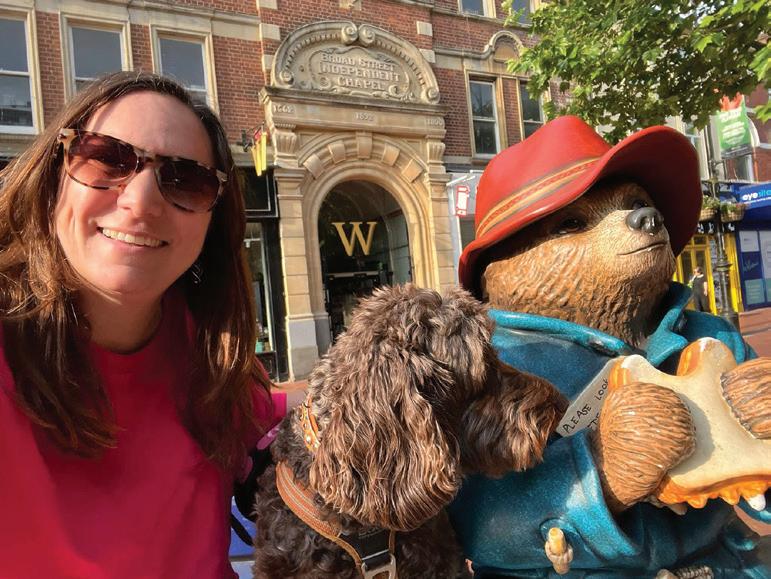
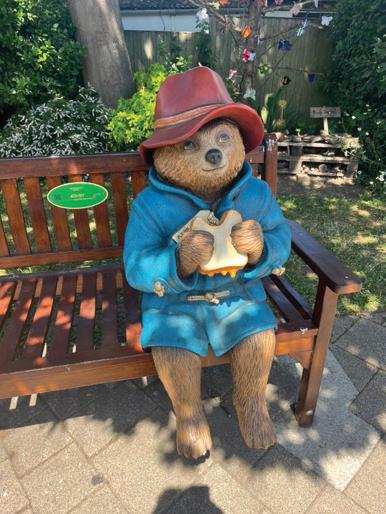

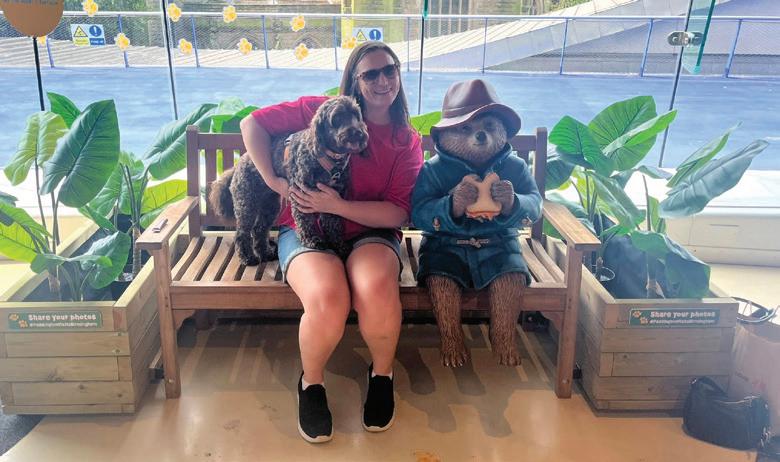
In Peterborough, the Paddington statue was inside a dog-friendly shopping centre, and a member of staff offered to take our photo and made a fuss of Millie. The backdrop featured a vibrant giraffe artwork. Then on to Bury St Edmund’s, where Paddington was on an outside bench watching a carousel and a lively square full of cafés and entertainment.



Christchurch Rotary Club is launching ‘Dinner About Town’, a unique dining experience taking place in September.
The event on Saturday 16 September sees diners move between four of the town’s most prestigious restaurants for different courses. It aims to showcase the local culinary scene while raising funds for charity.
For its first year, the Rotary has partnered with Captain’s Club Hotel & Spa, The Priory Restaurant, The Boathouse and Eighteen Restaurant & Bar, which is located inside The Kings Arms.
The evening begins with a communal Champagne reception, after which guests are given a ‘Dining Passport’ revealing their personal culinary trail. Diners will enjoy a different course at three of the four participating restaurants, with a stroll through the town centre between each venue.
Stewart Day, event organiser and Christchurch Rotarian, said: “We wanted to create an event that truly captures the spirit of Christchurch — combining our beautiful surroundings with the exceptional hospitality our town is known for. While this is our first year, we see this as a

‘proof of concept’ that we hope to expand significantly in 2027 and beyond. The support from the local restaurants has been fantastic, and we are excited to offer guests a social, adventurous way to dine while supporting a very worthy cause.”
Proceeds from the event will go towards Parkinson’s UK (Christchurch Branch), alongside various local community projects supported by the Rotary Club.
For full details and to book tickets, visit christchurchrotary. org.uk/christchurch-dinnerabout-town.




By Elizabeth McPherson
For those of us who are curious, self-development and finding out what makes ‘us’ tick are great ways not only to find deeper meaning in life but also to enhance relationships with friends and family.
In the last 10 years, I have been on a massive journey of self-discovery and have enjoyed finding ways to live a better life. Like me, I am sure you have wondered why your brain works the way it does.
One of my favourite tools for this is MyersBriggs — it’s a great place to start. You can do the test online for free.
The Myers-Briggs Type Indicator (MBTI) is a popular personality assessment that categorises individuals into 16 distinct types based on preferences in four domains: energy (Extraversion/Introversion), information processing (Sensing/Intuition), decision-making (Thinking/Feeling), and structure (Judging/ Perceiving). Developed by Isabel Briggs Myers and Katharine Briggs, it is used for self-awareness and team building.
For instance, you may be someone who feels they are an extrovert — after all, that is a fun place to come from. But often, many extroverts are, in fact, introverted/extroverted. In other words, we put on a big personality to cover up the reality that we struggle with unfamiliar places or people.
I recall that I used to think I was an extrovert — always the ‘life and soul’ of the party — only to find, having done the test, that I am an introvert. I like my own company and, although I am ‘social’, can easily get overwhelmed by too much noise and being out of my comfort zone. Which is why, more often than not, I find myself saying “No” to social situations where I may feel less comfortable. That is, I believe, one of the many benefits of ageing: you get to say “No” more often, rather than the “Yes” we used to say to everything thrown our way!
Another fascinating subject is numerology, and it is worth taking a look at.
Numerology is an ancient, esoteric practice

that believes in a mystical, vibrational connection between numbers and events or personality traits. It involves analysing significant numbers in a person’s life — specifically birth dates and numerical values assigned to letters in names — to gain insight into character, destiny and life paths.
The first time I did a numerology test — again, you can do this for free — I was fascinated to find how accurate it was. What is doubly interesting is the idea that your ‘life path number’ is who you are intrinsically and what your destiny is. In some cases, you may find out that you are not even remotely on your life path, but, in essence, that is the reality of who you are, whether you believe it or are even living it right now. How you find your life path number is quite easy: simply add up the individual numbers of your date of birth and keep adding those numbers together until you come to the final number (which is always a single digit).
And finally, the Enneagram is another fascinating insight into the self.
The Enneagram test is a personality assessment tool that classifies individuals into one of nine distinct, interconnected personality types based on core motivations, fears and emotional drivers. It aims to foster self-awareness, personal growth and improved relationships by explaining the “why” behind human behaviour.
If nothing else, these insights are a great conversation starter at a dinner party — better than discussing the latest news — and a great way to find out not only more about yourself but also your family and friends.
I hope you have a wonderful summer. With all the rain we have had, there are no excuses for water shortages, which is why we got a deluge at the start of this year — to prepare us for wonderful weather.
With Love
Beth The Lifestyle Concept www.thelifestyleconcept.co.uk

By Colin Nash | Head Chef colinnashrestaurant.co.uk
There is something really satisfying about making your own spring rolls. These ones are refreshing due to the hint of pickled ginger in them. You could make some with other flavours such as duck and hoisin, pork and apple or just vegetables. We use these as an amuse-bouche when our customers arrive.
One important tip: don’t leave the spring roll pastry out too long as it will dry out. You will end up with cracks in your rolls, and they will become very greasy inside.
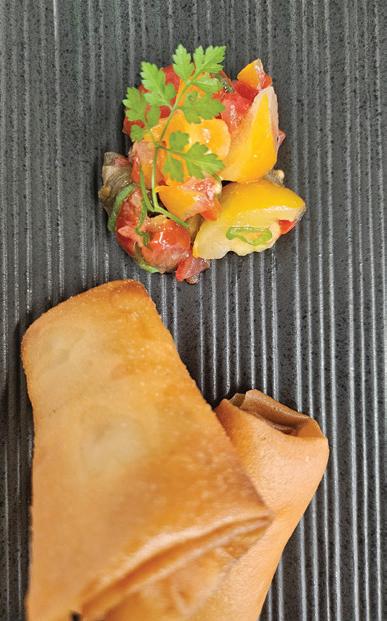
2 chicken legs
1 sprig of thyme
1 packet of spring roll pastry or filo pastry
3 slithers of pickled or sushi ginger
2 leaves of cabbage
50g sweetcorn kernels
1 shallot (peeled)
Oil for frying
Salt and pepper
1 egg

First, boil the chicken legs in water with a sprig of thyme and a pinch of salt and pepper for 30 minutes. Add washed cabbage leaves to the water and leave to cool, then pick the meat off from the bone, removing the skin and thyme. The chicken should be flaky.
Finely shred the cabbage leaves and add to the chicken meat. Shred the ginger quite finely and thinly slice the peeled shallot. Add this to your chicken with the sweetcorn. Taste the mix and add more seasoning to your desired taste; remember to under season to start with because, if you over season, you won’t be able to take it away.
Beat the egg in a bowl and leave to one side. Open the pastry and cut into long strips roughly 15cm wide. You can make them any size you wish but I find this width a nice workable size. At one end of your strips, add a tablespoon of chicken mixture about 2cm from the end edge and 2cm from the sides. Start to roll until you can’t see the chicken, then fold in the sides and brush the other end with a little egg. This will help it stick together as you roll up and finish the spring roll.
Place on greaseproof paper on a tray, ready to cook. Repeat until you have lots of rolls. Refrigerate if not cooking straight away. Finally, you can deep fry the rolls at 180C for four minutes, or you can brush with oil and bake in a pre-heated oven again at 180c. Leave to cool for five minutes then serve.
If you would like to serve with a dip, you could use soy sauce, sweet chilli, hoisin sauce or even mayonnaise.





Smokey Mose’s food trailer is a popular sight across the South West. I caught up with the chef and social media star to find out more about cooking the perfect jacket potato.
Tell us about yourself?
My real name is David, though these days most people know me as Smokey or Mose. I’ve loved food from a very young age and was always experimenting in the kitchen.
I’ve been fortunate to have had a career that allowed me to travel extensively, meet some incredible people, and experience a wide range of cuisines from around the world.
I returned to the UK in 2021 after more than 20 years living overseas. I no longer wanted to continue in the corporate world.
Food has always been a passion of mine, particularly street food, so starting a food trailer felt like a natural next step. I wanted a base ingredient that would allow room for creativity, something versatile enough to build on with bold and varied flavours.


The humble jacket potato proved to be the perfect canvas, offering endless possibilities for inventive toppings.
It’s a dish I genuinely love: simple, comforting, and universally appealing. Who doesn’t enjoy a really good jacket potato?
What is your favourite spud on your menu?
My go-to spud has to be the Kickin’ Chicken, though I’ll admit I like to add a splash of hot sauce to give it an extra kick. It’s the perfect balance of flavours: slightly sweet, smoky barbecue chicken paired with creamy melted cheese, lifted by the herby tang of ranch dressing. Then there’s the rich, smoky heat from the shack sauce, all rounded off with the fresh bite of spring onions and jalapeños. It’s a combination that hits the spot every single time.
Where can the readers find you to experience your spuds?
Readers can usually find me in Bournemouth Square on Sundays and at Christchurch

High Street market on Mondays. I also pop up at a range of events throughout the year, including the Bryanston School Summer Fair in Blandford, the Highcliffe Food and Arts Festival, Canford School Summer Fair, and the Mudeford Arts Festival, among others. The best way to keep track of where I’ll be next is through my social media channels — TikTok, Facebook, Instagram and YouTube — where I regularly share updates and locations.
Can you share a favourite story?
As a long-time fan of ‘Top Gear’ and ‘The Grand Tour’, I was genuinely thrilled when Jeremy Clarkson liked one of my early social media videos. For a brief moment I thought: “That’s it — I’ve made the big time.”
Dorset View is running a competition in collaboration with Smokey Mose, offering readers a chance to win £50 worth of food. For details, head to tiktok.com/@smokeymose.



By Julie Ratcliffe, Christchurch History Society
2026 sees the 20th anniversary of the awardwinning Captain’s Club Hotel and Spa at Wick Ferry, and next year will see a century of holidays here beside the Stour at Christchurch.
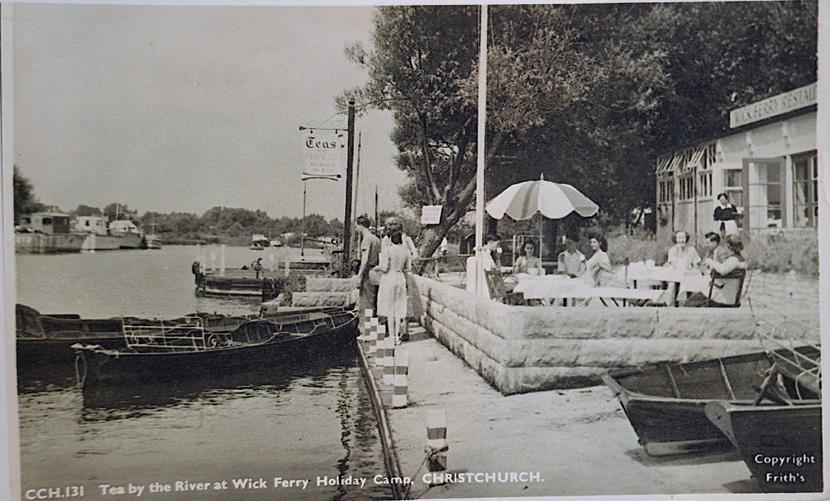
The first holiday park on the site was opened by John Charles Edmunds who owned Wick Ferry. He built a houseboat on the Wick side, offering teas to increasing numbers of walkers and ferry users. Seeing further opportunities, in 1927, he built a boathouse on the Christchurch side and began offering ‘furnished huts’ with ‘everything provided’.
In 1934, he was advertising: ‘Caravan Bungalettes (Furnished) at 30/- per week for four people.’ The following year, there were: ‘Caravans, Cabins, Tents Furnished at Edmunds Holiday Camp.’
Edmunds retired in 1947, and the site was sold to Bill Warner, along with Paul Lugrin of Betty’s Café, Bournemouth. Works improved the site including raising it three feet above flood level. At the official reopening the same year, guests dined in the site’s new restaurant, designed in the style of an ocean liner.
Warner’s Wick Ferry Holiday Camp accommodated up to 150 people and was a great success. In 1948, he proudly announced: “I do not think we shall have any vacancies at all from June onwards.” Watching this success was Tom McArdle, who set up an adjacent site, McArdle’s, on Wick Lane.
The riverside in 1955 © Reproduced from an original F Frith & Co postcard, CHS collection

The next big change came in 1962 when Warner’s site was sold to Pontins. Then in 1965, Pontins purchased McArdle’s. This now large site became Pontins’ first entirely self-catering park. It was a major tourist and recreation site for the town, so the announcement of its closure in 1998 was a huge blow to the town’s economy, with a loss of around 20,000 annual visitors.
The site, by this time owned by Manor Parcs, was deemed unviable and was sold to Berkeley Homes. Their planning application for 87 homes was rejected. They resubmitted them, this time including a hotel. In August 1999, plans for 60 houses and a 60-bed hotel were approved.
Two local businessmen, Tim Lloyd and Robert Wilson, along with a friend, were the people behind the hotel, purchasing the plot. Work started in 2005. In November 2006, the doors of the brand-new Captain’s Club Hotel and Spa opened. The luxury, four-star hotel was designed to look like a cruise ship; perhaps the ghost of Bill Warner had some influence here! It has won multiple awards, including two rosettes for culinary excellence.
A popular wedding and conference venue, the hotel continues the tradition of bringing many visitors to Christchurch for riverside holidays.
Held at Christchurch Junior School, 7.30pm
1 September
Early Monastic Manuscript Art by Dr C Biggam FSA FRHistS. The early history of the art of illumination practised in many of the monastic scriptorium.
6 October
Christchurch History Society AGM. W: historychristchurch.co.uk E: enquiries@historychristchurch.co.uk
Back in February, we interviewed Liberal Democrat Cllr Millie Earl on the Your Voice | Dorset Podcast to discuss the council’s budget and future plans for Bournemouth, Christchurch and, her home town, Poole.
In February, council tax for the BCP area rose by 6.74 per cent. Why was that necessary?
“No one’s surprised to hear there’s a lot of funding pressure (on local government and councils). We hear about it on the news when it comes to things like adult social care, SEND (special educational needs and disabilities) services and children’s services. Costs are rising a lot.
“The government had done a big review into the money that they give to local councils, and unfortunately we were one of the councils that lost quite heavily. Because of that drop in revenue income from central government, we’ve had to find other ways to fill that gap.”
It’s worth talking about SEND. The council estimates it will spend £10.5 million on interest costs to finance more than £180 million of debt. How did BCP develop such a large deficit?
“This goes back to a policy from over a decade ago, to provide children and young people with the education and care that they needed.
“The government told councils that they could spend the money on delivering these services that children are legally entitled to, however we’d have to hold that as a debt off our books.
“So I was really pleased when government announced that they would be funding 90 per cent of it (£165.2 million). They recognise that this isn’t something that councils should bear the burden of. However, that
still leaves us with potentially somewhere around £38–40 million to pay.”
In March, BCP Council announced the BCP LIFE residents’ card initiative, which offers perks including an hour of free parking at select council-owned car parks. Can you tell us more about this initiative?
“As a resident of an area that’s got a real tourist industry, we often feel like we get stung by things like higher parking charges or maybe crowded beaches and so on.
"Residents (who apply for a card) will be able to get a free swim at one of our leisure centres every month. They will be able to get an additional hour on parking in our surface car parks in the town centre. We’ll also have discounts in various shops, cafes or local businesses. Also, a 10 per cent discount on things like coffees and ice creams from our seafront outlets.”
To watch the full interview, head to dorsetview.co.uk/podcast or YouTube.com/ @dorset_view. Subscribe to our YouTube channel for more interviews and videos.





From the moment you arrive, South Africa feels like several holidays in one: wild Bushveld and the Big Five (the lion, leopard, rhinoceros, elephant, and Cape buffalo), vineyard-cloaked valleys, dramatic coastline, and cosmopolitan cities. It is a destination that lends itself beautifully to premium, tailor-made itineraries, where every day can blend adventure, fine dining and time to simply soak it all in.
For me, the best place to begin your journey is Cape Town, framed by the iconic silhouette of Table Mountain. Here you can wake in a stylish waterfront hotel, step out to artisan coffee shops and galleries, then be on the summit of the mountain within an hour.
Just beyond the city, the Cape Winelands offer a slower, more indulgent rhythm. Think restored Cape Dutch estates with contemporary

interiors, vineyard suites with private plunge pools, and lunches overlooking perfectly manicured vines. Wine tastings are available across a range of estates and the Franschhoek Wine Tram connects several of them in an easy way. Many properties offer exceptional spa facilities and immersive experiences such as cycling between estates with a private guide. No journey of South Africa is complete without a safari. Whether you decide on a private reserve bordering Kruger or a game reserve in the Eastern Cape, the focus is on intimacy and exclusivity. Luxurious lodges combine glassfronted suites, gourmet dining and expert rangers, so guests can track lion at dawn, share stories around the boma fire at night and fall asleep to the sounds of the bush. A guided bush walk is a great way to get up close and personal with nature

and learn about smaller creatures that call the reserve home. Responsible, non-intrusive wildlife encounters are key, with a strong emphasis on conservation and community partnerships. Along the southern coast, the Garden Route weaves between ocean and forest, with world-class golf courses, boutique guesthouses and eco-lodges. Here, days can be tailored to each traveller’s style: ocean-view hikes and lagoon cruises, spa afternoons, gourmet dining or simply pausing to watch the sun set over the Indian Ocean. Plettenberg Bay offers a quieter feel, with places like Robberg Beach for long walks. Further east, KwaZulu-Natal combines golden beaches, dramatic battlefields and rich Zulu culture; ideal for those who enjoy history alongside relaxation. What truly sets South Africa apart is its diversity and value. Itineraries can be created that flow seamlessly from city chic to rural retreat, from outdoor adventure to fine dining. Whether it’s a once-in-a-lifetime honeymoon, a multigenerational celebration or a solo escape, South Africa will capture your imagination at every turn.
If you would like to know more or need help with any other travel plans, please get in touch.
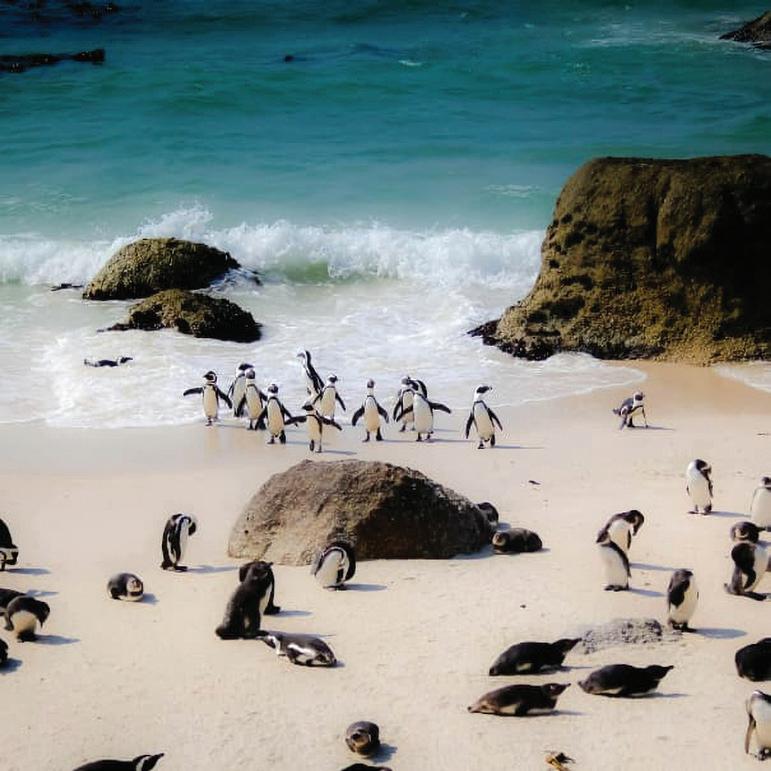


By Tom (CHOG)


From white-tailed eagles over Mudeford Quay to barn owls raising a brood at Hengistbury Head, our harbour edge is putting on a wildlife show this season.
If you’ve found yourself looking up more often lately, you’re not alone. Christchurch Harbour has quickly become one of the country’s best places to watch white-tailed eagles — huge, freeflying birds that can turn an ordinary stroll into a stop-you-in-yourtracks moment.
Continued on next page...
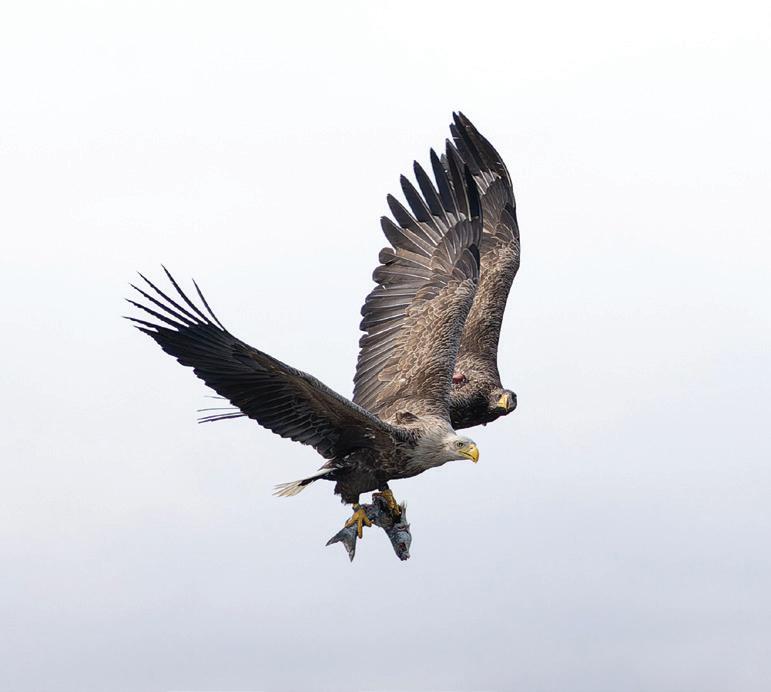

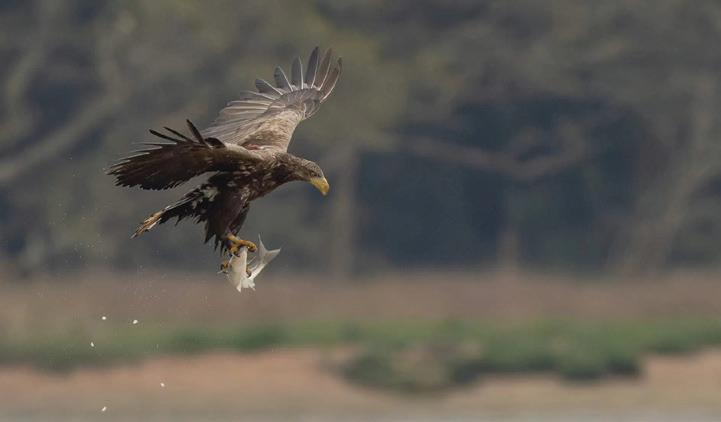
Since the start of 2026, usually two (and occasionally four) eagles from the Isle of Wight reintroduction project have been dropping in almost daily. From Mudeford Quay you can often watch them perched on islands, wheeling overhead or powering low across the water with a freshly caught fish.
This is part of a bigger story that is just as encouraging. Forestry England has now released 45 young eagles since 2019, and pairs are beginning to settle across the South Coast. In 2025, breeding was confirmed in both Sussex and Dorset — taking the number of wild-hatched youngsters to six so far.
The harbour regulars include a female released in 2021 (ring G818) and a male (ring G625) that fledged in 2023 in West Sussex — born wild and now making himself at home here. Local photographs, including the spectacular ‘fish-in-talons’ shots, are being shared with Forestry England to support ongoing research into how these birds are using the area and what they are catching.
Get involved: Photo of the Week
CHOG’s weekly Photo of the Week celebrates the best harbour-area wildlife images, with winners shared online. You can enter via Facebook or by emailing sightings@chog.org. uk with ‘POTW’ in the subject line.
Selected photos may also be featured on the CHOG website.
Summer watchlist: owls, reptiles and the nightjar’s churring call
Over at Hengistbury Head, the barn owls are busy again — and this year you can follow the action via a wildlife webcam. When we went to press, there were six eggs in the nest box and they had just started hatching, so expect a lively few weeks as the adults hunt and (if all goes well) feed a growing family.
Wildlife success here doesn’t happen by accident. Wick Fields has been managed for around 30 years as open, cattle-grazed grassland, with pockets of woodland and thick hedgerows. That mix creates prime hunting ground for voles and mice (and the small birds that follow) — exactly what barn owls need. Keep an eye out for deliveries to the nest box when you watch the livestream
on the website: visithengistburyhead.co.uk/ visitor-centre/wildlife-webcams.
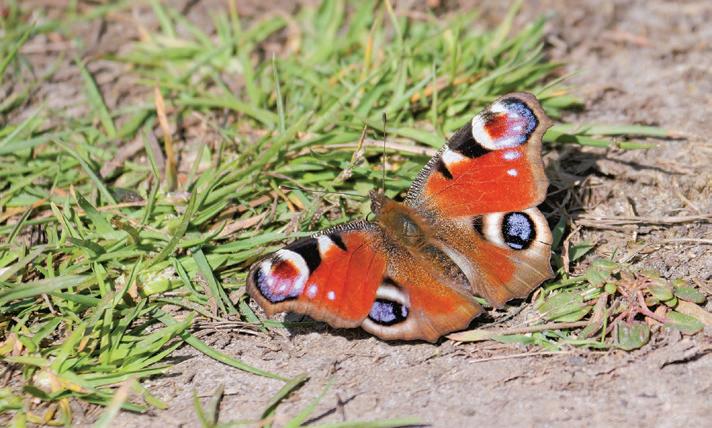
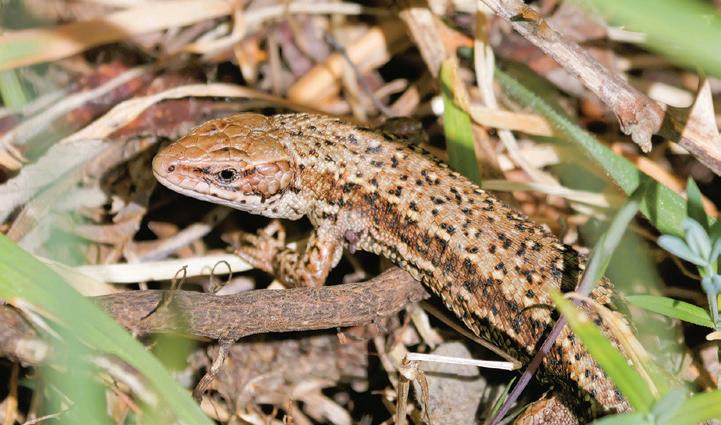
And don’t stop at the birds. Hengistbury’s heathland warms quickly on bright days, making summer one of the best times to spot basking reptiles such as the common lizard, adder and slow worm. Stay into the evening and you may hear the nightjar’s distinctive, rhythmic ‘churr’ once butterflies and dragonflies have settled.
As dusk deepens, moths take over — and around the harbour an impressive 40 per cent of the UK’s moth species have been recorded. Check the moths page on our website for information about what you’re likely to see, and where and when.
Christchurch Harbour Ornithological Group (CHOG) is an independent organisation and registered charity dedicated to recording, promoting and restoring nature across the Christchurch Harbour area. You’ll find daily sightings updates, details of a summer family day on 22 August 2026 and more at chog.org. uk (or via the QR code).

by Tricia Hayne
From its squat Tudor stone keep to its huge Victorian wings, Hurst Castle oozes nearly 500 years of history.
Over the years, it’s stood guard over the Solent, its garrison keeping watch over the seas and — during the two World Wars — into the skies. It’s also served as a prison and a hospital, a communications centre and — with a lighthouse constructed within its walls — an aid to navigation.
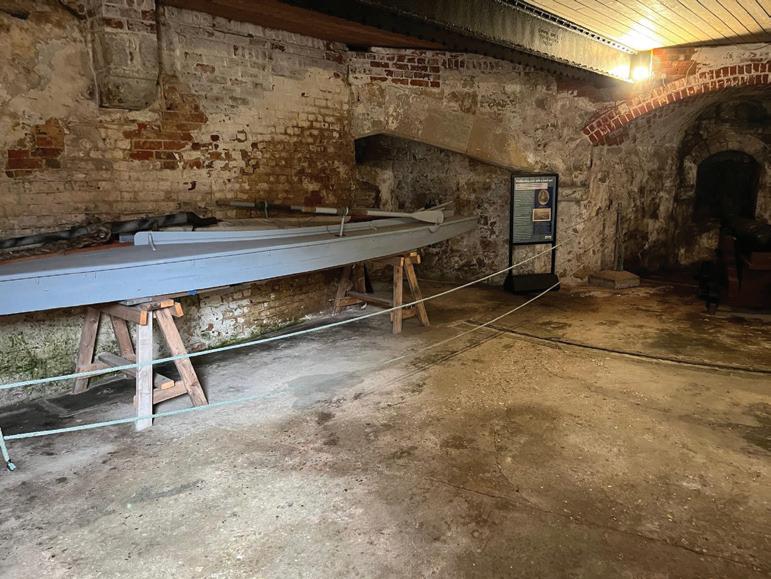
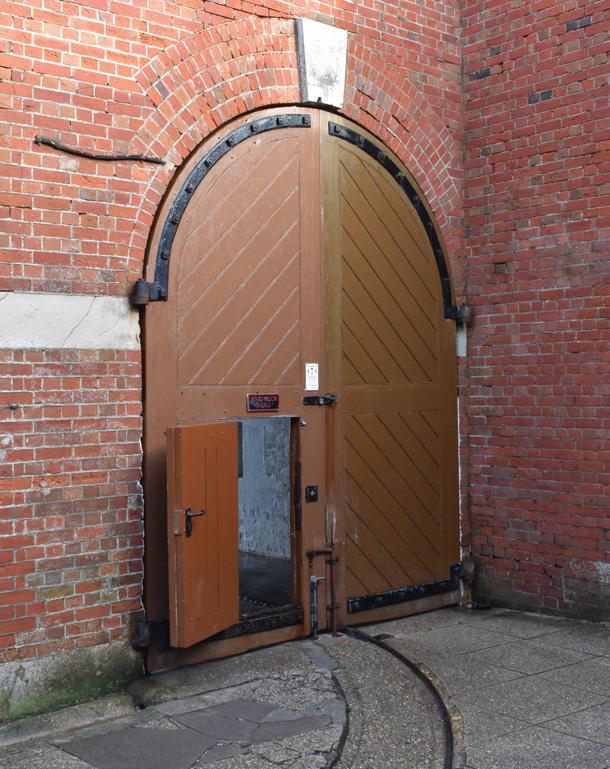
Step inside, and it all comes to life — intriguingly so. What are the railway tracks for? What is so special about the Edwardian gun on display in the theatre? Why is there a wildfowling punt complete with punt gun on display? And what on earth are those huge square metal plates with jagged holes in them?
With the introduction for 2026 of new information panels at the castle, all will be revealed. You’ll find, too, a wealth of information about the castle’s extensive range of big guns, its model ships, its communications room and even its barracks, which were once the preserve of artillery officers.
As you approach the castle by ferry along the Keyhaven River or on foot along the shingle Hurst Spit, this historic monument gradually materialises out of the surrounding sea, shingle

and marshes. It’s an impressive sight in itself, made all the more intriguing by the artefacts that lie behind its walls.
It’s also a great place for children to explore — with a trail to add to the fun — and dogs are welcome too. What are you waiting for?
The Friends of Hurst Castle have supported this historic building for 40 years. Some members get involved as volunteers; others enjoy taking part in events. All receive our regular newsletter and are entitled to free entry to the castle. To find out more, email trjhayne@gmail.com. We’d love you to join us.










When you read this, we will be reflecting on our undoubtedly successful sixth annual Blue Light Day and preparing for our other upcoming events. We rely heavily on community support, and we are grateful to Winkworth for once again being our major sponsor to defray the costs of Blue Light Day.
The Noisy Lobster continues to support us in many ways, including their recent Fish Friday fundraising dinner. They have now raised £48,000 since the Hayward Family took over the restaurant and shop.
As well as our ‘bucket collectors’ who can be found at Avon Beach on weekends year-round, our RNLI souvenir and used book and jigsaw stalls are up and running again at Mudeford Quay for the next few months… weather permitting, as you will understand from the photo showing our volunteers quickly springing into action during a heavy rain shower.
Mudeford Lifeboat Station has now become the very first RNLI lifeboat station to earn a RNLI Green Award for making small sustainable changes that have been embraced by the crew at the station.
RNLI souvenir stall and used books and jigsaws, Mudeford Quay by the lobster pots, 10am–4pm every Sunday, weather permitting Mudeford Lifeboat Funday, Mudeford Quay Green, 11am–5pm, Sunday 9 August Pirate Day, Avon Beach, 11am–2pm, Sunday 30 August, TBC
Sea Shanties, St Mark’s Church Hall, 7pm, Friday 11 September

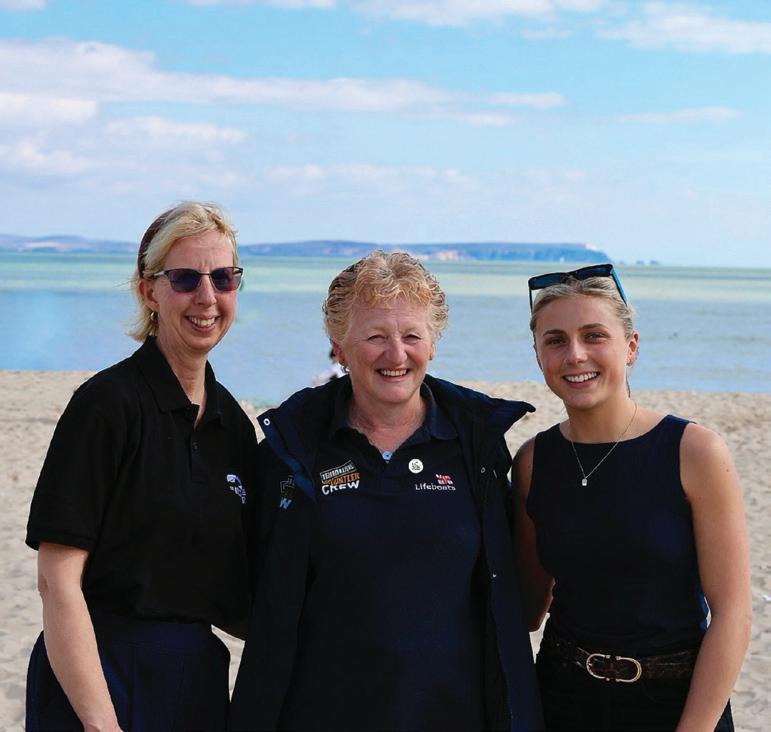

For more information on our events or monthly meetings, please contact Chair Adele at adele.orr.63@gmail.com. We are always pleased to welcome new volunteers for our FUNdraising team. We meet at 2.15pm on the first Wednesday of the month at Stanpit Village Hall.




To raise funds for this vital charity, which delivers care to Dorset children with a lifelimiting or life-threatening condition, a team from Pulford Publicity (the publisher of this magazine) plan to walk that same distance this summer.
Julia’s House is Pulford Publicity’s charity of the year. It provides a lifeline of care to seriously ill local children and their families. Fundraising is vital to Julia’s House — 92 per cent of its funding comes from the local community.
To support our chosen charity, the six members of the team will divide up the distance between the two hospices and walk 10 miles each in one day.
The Connecting the Hospices Hike is scheduled for Friday 21 August. The team are planning to tackle an iconic route through Dorset,
hiking along the Jurassic Coast past Old Harry Rocks and Swanage.
To take on this mighty hike and support Julia’s House in delivering care to Dorset children with a life-limiting or life-threatening condition, we need your help to hit our fundraising target of £1,500.






Traitor by Philippa Gregory, paperback £9.99
Jane Boleyn watches from the shadows of the Tudor court, where nothing is more powerful or deadly than a secret. As the Boleyns rise, Jane rises with them, but the King’s love is a fickle thing and when the royal gaze turns elsewhere, Jane uses the only weapon she has: her voice. To survive in this dazzling, dangerous world she has mastered many masks: loving wife, devoted sister, and obedient spy. Now she must step out of the shadows. She might know the court’s darkest secrets, but power rests on the edge of a tyrant king’s sword. Where will it fall next? Philippa Gregory brings the Boleyn traitor into the light in an explosive story of one woman’s survival in the treacherous heart of the Tudor court.
By Kirsty Robinson

by Ted Powell, hardback £20
This is the story of Winston Churchill’s long relationship with the Crown, from radical liberal under Edward VII to his last premiership as an old man under the young Queen Elizabeth II. Winston Churchill was born in a palace and was given a funeral worthy of a king. His family had enjoyed an intimate association with the British monarchy stretching back centuries. This book tells the story of Churchill’s relationship with the various kings and queens he served during his long political career, from young journalist under Edward VII, through his dramatic fall from grace in the First World War under George V, the frustrations of appeasement during the interwar period, and his relationship with Edward VIII during the abdication crisis of 1936, culminating in his Finest Hour in the Second World War under George VI and the coda of Churchill’s public service to his final monarch, Queen Elizabeth II.
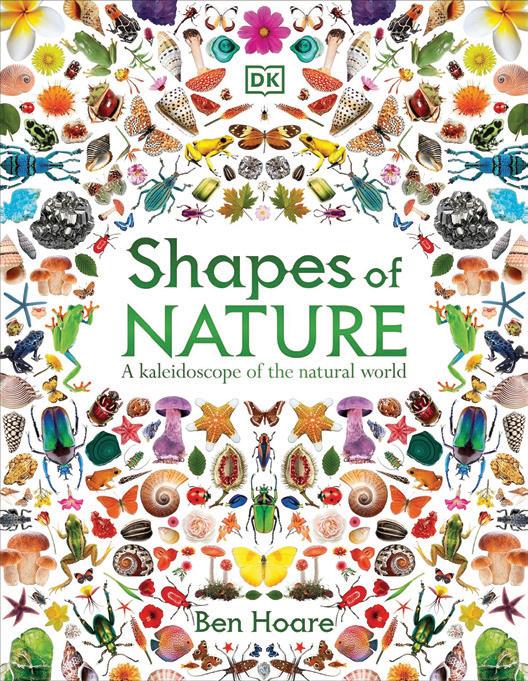
by Ben Hoare, hardback
£20
This spectacular, large-format nature book is designed to inspire a new generation of nature lovers. Inside, you’ll discover shimmering beetles and dazzling tree frogs, knobbly seashells and sparkling crystals, plus fabulous fungi and delicate feathers, all arranged in stunning mosaics. Each page transforms nature’s treasures into works of art, revealing the hidden shapes and intricate details that we often overlook. Big, bold, and beautiful, ‘Shapes of Nature’ is a visually stunning gift and a timeless keepsake that invites you to dive in, look closer, and see nature as you’ve never seen it before.
Why not pop into the shop to have a browse and see lots of great book ideas for adults and children, as well as jigsaws, cards, homewares and gifts? Orders are usually fulfilled within 24–48 hours. Contact us on 01202 418403, email sales@bh6booksandhome.co.uk or find us on social media @bh6booksandhome to place orders and discover all that we have to offer at BH6 Books and Home, 69 Southbourne Grove, BH6 3QU.

by David Kendrick
Taking a short cut down the small footpath, I reach Coy Pond. In my mind, I keep replaying my exit from the house, trying to make sense of her words.
“Just think of your son, think of Jack, that’s all I ask,” she said.
“But I’ve worked my socks off for this promotion, I thought you’d be happy. Now, I’m the bad guy.”
Silence pervaded the room, broken only by the distant hum and clunk of revolving washing. I knew she was upset because she wouldn’t look up from her PC.
“You’ve got until Monday before you have to decide. Go away, think it through. My marketing business is picking up, we’re not destitute.”
“Yeah, I’ll do that.” I marched down the hallway, grabbed my coat and left the house, slamming the door behind me.
I look into the pond, tossing a stone into the water, the reflection of my brow creases and distorts as the ripples arc outwards. I amble along the gravel path that follows the river’s course to Bournemouth seafront. The sun warms my cheeks as it flickers between the leaves of swaying trees. Time seems frozen, as I watch the reeds drift in the current and emerald dragonflies dart from leaf to leaf. Familiarity surrounds me like the fluffy warm feel of a child’s blanket. I pass the clock tower in the square and cross the road to where the balloon used to land. I feel my mind drifting back.
I’m stood staring at Dad’s knees, clutching a ‘99’ in one hand and Action Man in the other. I scan from side to side with eagle-like eyes. I’m dressed in combats, and a gun belt hangs from my waist. I can see many legs: brown, white, hairy, fat, thin. A black dog bounds by as the vanilla ice cream tingles my teeth. A wetted tissue smothers and smears my mouth. Suddenly the sky goes grey and
feathery. I’m surrounded by flapping, cooing pigeons. Startled, I drop my cone to the floor. It disappears in the melee of nodding beaks. I cry until lifted out of pigeon world.
Above the skyline of legs, animals and birds, I see huge teddy bears hanging from a wooden shed and point, shouting “Teddy!” Then I wipe sticky hands down my trousers. The pigeon trauma is over. I rub Action Man’s head. The bristly hair is comforting on my fingertips. I open squares of paper with numbers on. The basket is almost full as mum shrieks with joy and I get to choose a teddy bear.
I called that bear ‘Lucky’. It now sits on Jack’s shelf. It’s a dirty brown colour and has one eye missing, but it’s always the first toy Jack grabs when he can’t sleep. I want to win a teddy for him some day. I pass under the flyover and breathe in the salty, sea air.
I remember walking the same path in the firm grip of my granddad.
My red bucket swings as we pass glass containers filled with coloured sand and a man who can ‘Guess your Age’. That’s easy, I’m five. The pier is lined with blue-and-yellow striped deckchairs. The arcade throbs behind us. We sit with the fishermen on the rusty pontoon as fish twitch on the deck. I squirm at the sight of maggots wriggling in plastic tubs. Potbellied men lean against the railing, swapping stories with one keen eye watching their lines. I catch nothing on my orange crabbing line, but it doesn’t matter. I remember the last time Granddad and I went to the beach together. His words didn’t mean much to me at the time.
“I don’t have much to pass on,” he said. Coughing a little, his face turned red. “But remember, memories are worth more than any gift.”
I bury my toes into the cool sand, that once made helter skelters, castles and boats. My job seems like it’s some alien world now. I can see
the turrets of the Royal Bath Hotel. It reminds me of Rapunzel’s castle. I am the hero come to rescue the fair maiden. I can picture the day I married Vicky and the promise I made to her when Jack was born.
“I’ll be the father to our child that yours never was to you,” I’d said.
As I’d cradled Jack in my arms, her eyes moistened and a tear trickled down her cheek. It was a tear of trust, a lifetime bond connecting three bodies together.
I arrive home just as the sun dips below the trees. I quietly enter the kitchen, and Vicky is at the table multi-tasking emails whilst doing a puzzle with Jack. I wrap my arms around her waist and kiss her gently on the neck. Her body jolts, and then relaxes.
“I’m not taking the job.”
She spins around, her face aglow. “You’re not, but…”

“I’ll tell the boss on Monday.”
“What changed your mind?”
I pause to part a stray hair from her fringe.
“I want Jack to grow up feeling the sand between his toes.”
“I want that too,” she says, nestling close to my chest.
“I took a walk through my past this morning, it made me realise that Jack deserves to grow up in a beautiful place.” I see a fleeting glimpse of my face in the glass of the oven.
“That place is right here.”
Author David Kendrick lives in Bournemouth. He has an MA in Creative Writing, and you can find his novel ‘Reef’ on Amazon, along with his short story collections ‘Elements of Life’.



By David Sidwick | Dorset Police and Crime Commissioner
Strong partnerships which deliver real results are an underrated and underappreciated part of policing. To successfully tackle serious offences, we need effective partnerships with local and regional partners to deliver successful results and ensure victims are cared for. The value of these relationships is why I’d like to highlight a vital partnership delivering terrific results in Dorset.
The South West Regional Organised Crime Unit (SWROCU) plays a significant role in tackling serious and organised crime across multiple areas, including Dorset. Its work forms part of a strong, successful collaboration focused on intelligence-led policing at a regional level. The ROCU supports and enhances Dorset Police operations, providing specialist capabilities, focusing on high-harm and complex cases. Their key areas of focus include drug supply and county lines networks, child sexual abuse and exploitation, modern slavery and human trafficking, organised immigration crime, cyber crime, fraud and money laundering, as well as crime and corruption in our prisons.
In Dorset, high-profile cases involving SWROCU are linked to Operation Scorpion, and indeed, serious and organised drug crime. Through Operation Scorpion, Dorset Police works closely with neighbouring forces across the South West — Devon and Cornwall, Gloucestershire, Avon and Somerset and Wiltshire — alongside SWROCU and British Transport Police to disrupt county lines, smash the drug gangs and safeguard vulnerable people.
Recently, Dorset Police and SWROCU carried out 18 warrants, arrested 47 people, safeguarded 17 people, and seized 2.47g of heroin, £30,000 worth of cocaine and weapons including knives and a crossbow. These results show the power of this partnership.
It’s not just through Operation Scorpion either that this joint work has yielded results.
In April, a man and woman from Wimborne were sentenced for drugs and money laundering offences following an investigation by SWROCU. Officers seized 1.5kg of cocaine, 400 grams of heroin, 500 grams of ketamine, 2kg of cannabis, approximately £20,000 in cash and a knuckleduster from the couple’s home, thanks to support from Dorset Police. Both received custodial sentences, meaning the community is free from the harm they were causing.
Another SWROCU investigation led to the jailing of a crime group who ran a drugs lab in Bournemouth. The five men, three from Bournemouth, were part of an organised crime group who supplied cocaine to areas across the UK including London, West Sussex, Cumbria, Avon and Somerset, Dorset, Devon, Cornwall and Hampshire. This case took tireless work from all involved, and I thank them for their relentless pursuit of this group.
The reality is that serious and organised crime does not respect county boundaries. It is sophisticated, mobile and often hidden, which is why this partnership approach is so important. SWROCU brings advanced capabilities, enhanced intelligence and coordinated action that allows Dorset Police to respond at scale and with precision. It is through this model that we can deliver impactful, multi-agency operations, bring dangerous offenders to justice and disrupt criminal networks operating both within and beyond Dorset.
This is what effective policing looks like: a strong local presence from Dorset Police, backed by regional strength. By continuing to invest in and support this partnership, we are ensuring that Dorset remains a hostile environment for organised crime, taking away the drugs, ill-gotten gains and ultimately the liberty of those who seek to harm us, and creating a safer place for everyone who lives, works and visits here.



Has anyone seen that strange orange ball in the sky? It can only mean one thing: summer has finally hit the South Coast, and wow, we’ve missed you, sunshine. It’s time to root out the Bermuda shorts, dust off the deck chairs, stoke up the barbies, and — more importantly — crack open a cold, crisp, delicious beer.
We’re blessed to have some of the best beaches, from Sobo to Sandbanks, and it doesn’t get much better than the beach and a refreshing craft beer. When the heat’s beating down, we all naturally reach for that old reliable lager. But hold on there, tiger! There’s a tasty alternative that delivers the refreshment of a lager while beating it hands down on outright flavour.
Cue a golden ale — and there could only be one brew… Golden Years Golden Ale from Sandbanks Brewery. Who knew Sandbanks had a brewery? Best of all, it’s brewing some right little Dorset gems. It’s an absolute classic; a must-have

On the pour, this little beauty of an ale delivers a stunning orangey amber glow, reminiscent of a Purbeck sunset.
Your nose and lips will be drawn in to find out more. First, you’re hit with the comforting aroma


of freshly baked bread, then comes the cheeky sweetness of honey. It’s now time to quench your thirst with that eagerly awaited initial sip.
First to arrive on the tongue is that light, biscuity malt, with our old pal breadcrumb making an appearance, offering a reassuring base to the beer. But wait… we’ve got more flavours arriving at the palate party. Well hello, citrus and stone fruit, with this standout ale delivering tantalising tangerine, zesty lemon and mild apricot, all topped off with a drop of honey.
It’s beautifully balanced, with a gentle tingle of carbonation, a welcoming bitterness and a light, refreshing finish, making this the ultimate sundowner.
At 4.3 per cent, this is one sessionable summer brew that will have you reaching into the cooler box for another. The perfect pairing with this crisp, cheeky ale has to be the king of British coastal cuisine, the seaside classic: fish and chips.
What a coupling this is! The zesty citrus and lemon notes from the ale complement the delicate white fish like a squeeze of fresh lemon. Then comes the gentle carbonation, acting like a natural palate cleanser, with a team of tiny bubbles cutting through the batter and washing away the oily fat, each sip acting like a reset. The saltiness of the chips balances perfectly with the bitterness of the beer; it’s a match made in Dorset.
If you want to get your hands on Sandbanks’ iconic cold ones, you can grab it on draught at Knoll House and The Pig on the Beach in Purbeck, or head over to their brewery, tucked away in the Nuffield Industrial Estate in Poole. Let’s be honest, you can’t beat the sound of waves, sea breeze, sand between your toes and delicious food and drink… cheers!
For more information on Crafty Beer Boy and upcoming events, visit craftybeerboy.com or tiktok.com/@craftybeerboy.



An Avro York aircraft transporting freight in 1953. Its design was based on the Avro Lancaster heavy bomber, with several identical sections © RuthAS

By
Hurn transferred from military to civilian use in 1944 and British Overseas Airways Corporation (BOAC) started exploring the viability of converting military aircraft for the carriage of civilian passengers; it was particularly interested in the Avro Lancaster. This subsequently resulted in the creation of the Avro Lancastrian civilian airliner.
This was the start of Hurn as a civilian airport and resulted in the first passenger services to Sydney via Karachi (the ‘Kangaroo Route’), Cairo and Durban (the ‘Horseshoe Route’) and early transatlantic services. Routes to various European capitals, including Paris and Brussels, were also established. The aircraft used included Lancastrians, Yorks, and flying boats.
By February 1945, Hurn had become the largest civilian long-haul airport in Britain. Operators included BOAC, Qantas, KLM, and Sabena, with DC-4 transatlantic flights by American Overseas Airways, whilst Pan-Am flew its first passenger transatlantic flight into Hurn using a Lockheed Constellation on 1 January 1946.
Then, in May 1946, an airfield called ‘Heath Row’ was opened to the west of London. BOAC left Hurn in 1948.
In the late 1950s/1960s, commercial flights resumed, with operators such as ‘Palmair’ providing flights to Palma, Majorca. Palmair was a small, award-winning British tour operator and airline based at the airport and was known for its exceptional customer service, being frequently voted one of the best airlines in the world by passengers. It ceased operations in 2011.
In 1969, the airport was purchased by Bournemouth Corporation and Dorset County Council and became known as ‘Bournemouth Hurn Airport’. Between the 1980s and 2000s, it was further developed as a commercial airport with a new, modern terminal being built. It was acquired by Regional & City Airports (RCA) in 2017 and now acts as a regional airport serving destinations across Europe.


By Kat Amey, life coach
The summer months are here, and even if the weather doesn’t quite match up to our hopes (I’ll have a repeat of 2025 please, weather gods!), it comes with garden parties, fêtes, outdoor concerts, festivals, beach days, holidays and endless invitations to “pop over for a BBQ”.
What I have noticed from experiencing my first full year back in the UK after living abroad for eight years is this: in the UK, we live for the summers.
Now, I totally get it. I’m someone who would always vote hot over cold, so the summer months are my favourite. Things feel easier to get done, the lighter mornings mean the motivation is there to get up and out each day, and we finally have British strawberries to eat en masse.
But does this mean we will have a cup-filling summer, or do we end up feeling exhausted by the time September arrives? When autumn comes, we use the hibernation months to restore our energy and get ready to repeat it all again the following year.
So, what would happen if you said fewer yeses this summer?
I know what you are probably thinking: “I don’t want to miss out. I finally have the energy to be social, so I’m ready to show up and party!”
I hear you, but I just said fewer yeses, not all noes!
I want to encourage you to consider what you are about to say yes to before those words are out. If it’s a yes, what impact does this have on your own time and energy? Are you willing to make that exchange?
Not everyone will understand a “No” or a “Can we decide nearer the time?” But who will appreciate it? Your future self!
So, before your diary becomes packed full of summer-themed fun, make your future self happy and consider these three questions:
1. How do I want to feel at the end of the summer this year?
2. What have I already committed to?
3. Do I have space in my diary to allow for spontaneity and quiet time?
If the answer to the last question is no, I’d encourage you to see what changes you can make and, if needed, schedule in your quiet time. Trust me, you’ll be so grateful you did when it comes.
If you are looking for the ultimate quiet time and an instant way of restoring your energy before the summer is in full swing, I am hosting a three-night Women’s Wellbeing Retreat near Plymouth on 2–5 July. Get in touch if you’re craving a slower pace and time for you.
I wish you an amazing summer of fun, space, rest and endless smiles.
W www.kathrynamey.com E kathryn@kathrynamey.com I @kat_amey
Kat Amey is a certified life coach who helps people ditch expectations and timelines and create a life that brings them joy. As well as offering life coaching, Kat hosts journaling workshops and wellbeing retreats in Dorset.




Report by Janine Pulford | Photos by Danny Howe Photography
The most stunning UK bird has to be the kingfisher, with its vivid blue and orange plumage. At only 17cm long, this little bird could fit into the palm of your hand.
According to the RSPB, there are between 3,800 and 6,400 breeding pairs in the UK. Kingfishers are vulnerable to hard winters and habitat degradation caused by pollution or poor management of watercourses.
They favour slow-moving or still water, shallow rivers and streams, but will even take a chance with a garden pond if there are small fish present. Their diet mainly consists of minnows and sticklebacks, topped up with shrimps and tadpoles. Surprisingly, they can eat fish up to 80mm long.
Astonishingly, kingfishers fish ‘blind’. From a perch above the water, they watch for prey and, once spotted, dive with an open beak and eyes closed by a third eyelid. After scooping up the fish, they return to the perch and bash it repeatedly until the fin spines relax, allowing the bird to swallow it whole, usually head-first. A kingfisher must eat its own bodyweight in fish each day, between 34 and 46 grams.
Kingfishers nest in tunnels that can be up to 90cm long. They excavate burrows into stream banks. At the end of the tunnel, eggs are laid directly onto the sand. The birds usually raise two or three broods a year, with up to seven eggs per brood.
extremely territorial, as maintaining an adequate food supply is vital for survival. Territories can range from one to five kilometres.
Sadly, kingfishers do not live very long. Many young birds survive only a week or two; around a quarter live long enough to breed the following year, maintaining population levels. Few survive beyond one breeding season.
River pollution is a big threat, killing the fish the kingfishers rely on. Meanwhile, disturbance by humans can make the broods fail. Kingfishers are shy and won’t enter the burrow if humans are nearby. The chicks can weaken and stop calling for food, leading parents to believe they are well fed and so stop feeding them, with fatal results.
These little jewels along our riverbanks are a delight to watch. Their lives may be short and fragile, but when you consider the effort required to survive, it is hardly surprising. Next time you see one, treasure the moment.
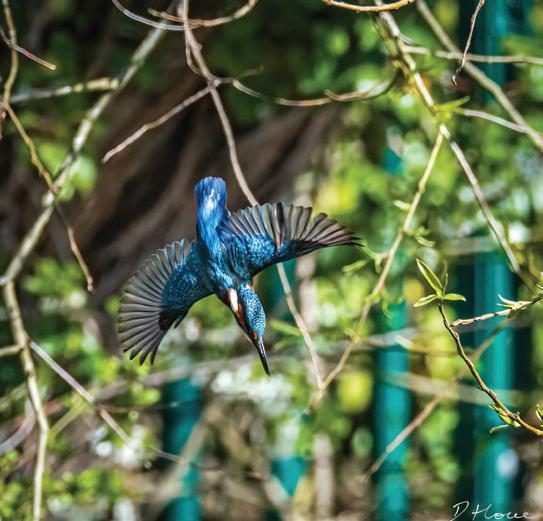
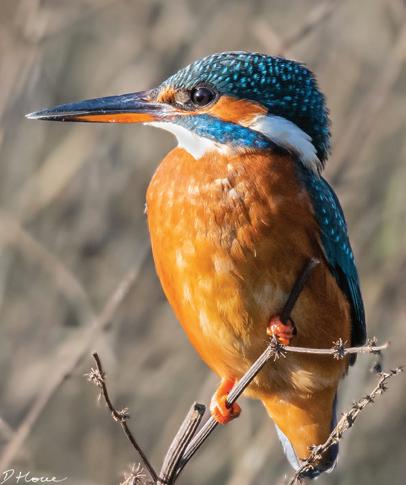
Once hatched, life becomes frantic. Hungry chicks can eat up to 18 fish each per day. They usually fledge at around 24 days old, but if food is scarce they may remain in the burrow for more than five weeks.
Parental care is brief once the chicks leave the nest. After around four days, the adults drive them away. Kingfishers are


The nearby town of Ringwood is to mark the 800th anniversary of a hugely important event on Sunday 12 July.
In March 1226, during the reign of Henry III, Ringwood received the royal charter to hold a market in the town.
To celebrate this historic anniversary, a community celebration will take place on Sunday 12 July in Ringwood Market Place.
The day will begin with a church service in the Market Place from 10.30am to 11.30am, followed by the official event hosted by Ringwood Town Council from 11.30am onwards. Celebrations will continue throughout the afternoon and evening until 7.30pm, followed by a funfair on Bickerley Green.
Attractions will include Morris dancers, traditional village games, market stalls, hot and cold food and arts and crafts. A bar will be provided by Ringwood Carnival, while visitors

can enjoy an animal petting experience hosted by Riverside Lakes.
The town council will promote related activities through its social media channels, and a commemorative logo is available for organisations wishing to support and celebrate the anniversary.

By Dr Helen
The moment my son reacted to milk during weaning is one I will never forget. What began as an ordinary milestone quickly became hives, vomiting and panic. As both a parent and a doctor, it was terrifying — and it changed the course of my life.
Like many families living with allergies, we soon realised the condition affects far more than food. It shapes routines, social lives, school decisions and sleep. The constant vigilance can be exhausting.
At the time, I was working as a GP and training in general surgery, but suddenly my professional path felt incomplete. I wanted to do more for families facing the same uncertainty.
Retraining as an allergy specialist was a significant step, but one driven by purpose. Completing a Master’s in Allergy and establishing a dedicated clinic allowed me to combine medical

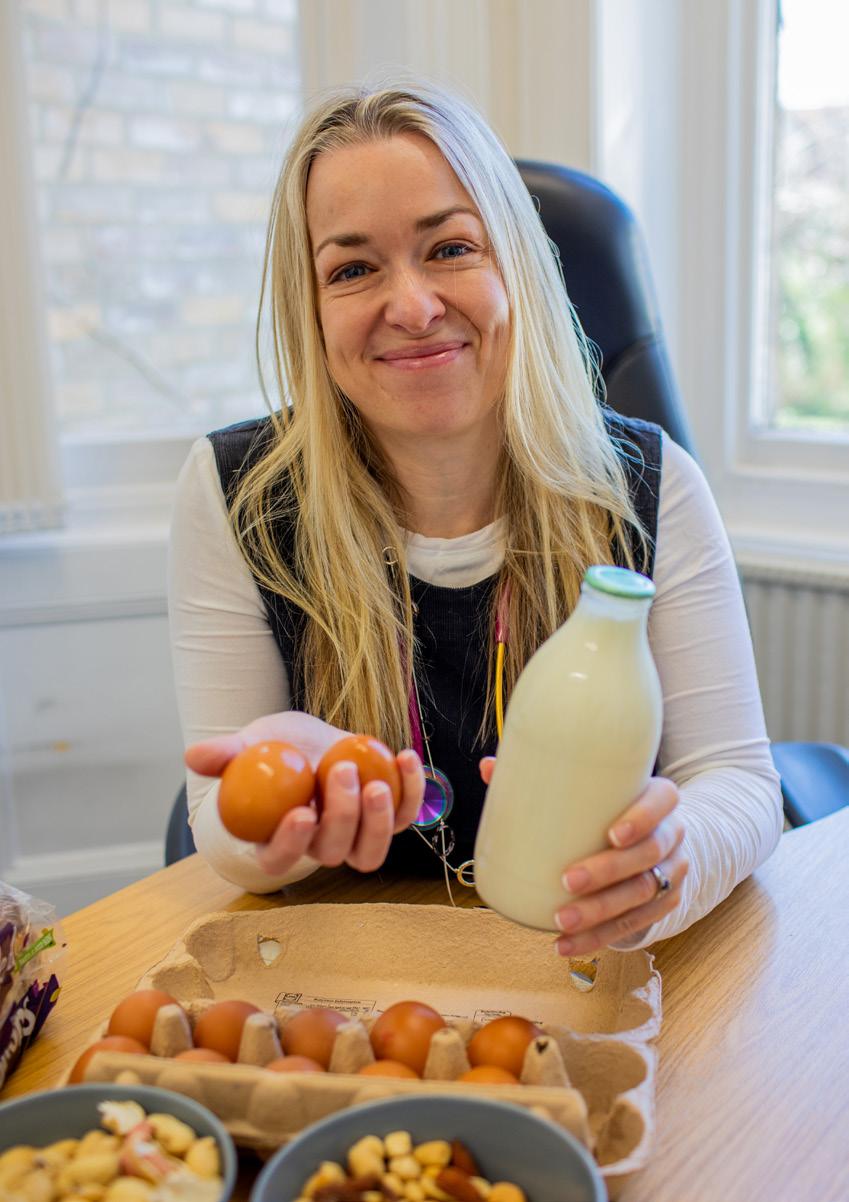
expertise with lived experience. Today, I support families who often arrive overwhelmed and frightened, but leave feeling informed, reassured and empowered.
As I often tell parents, when I say something is difficult, it is not just “doctor speak” — it comes from walking that path myself. That understanding builds trust and reminds families they are not alone.
Through Dr Helen Allergy in Ringwood, we are proud to offer evidence-based treatments, including immunotherapy, helping children and adults safely tolerate foods once feared — and giving families hope for the future.
To learn more or book an appointment, call 01202 022956 or visit www.drhelenallergy.co.uk.
For more general medical concerns or enquiries, you can visit our private GP practice next door, Dr Helen Medical, or visit www.drhelenmedical.co.uk.
Dr Helen Allergy & Dr Helen Medical Endeavour House Crow Arch Lane Ringwood BH24 1HP
By Janine Pulford
Heritage is important, whether personal or otherwise.
The country’s heritage is defined by the Heritage Council as: “What we have inherited from the past, to value and enjoy in the present, and to preserve and pass on to future generations.”
By examining the country’s heritage and how our ancestors lived, we can measure our developments and look towards the future. Unfortunately, the very act of progression causes conflict because, for everything new that is built or invented, something old is lost or becomes obsolete.
Christchurch, like every other town in the country, is changing all the time. It becomes more modern as it grows. Properties and land are developed and redeveloped, chipping away at the past.
Fortunately, national bodies and local planning departments can protect certain aspects of our heritage. Stately homes, water mills, thatched cottages and even ancient trees benefit from being preserved. Inevitably, there are occasions when something of great significance, but perhaps of little stature, gets overlooked.
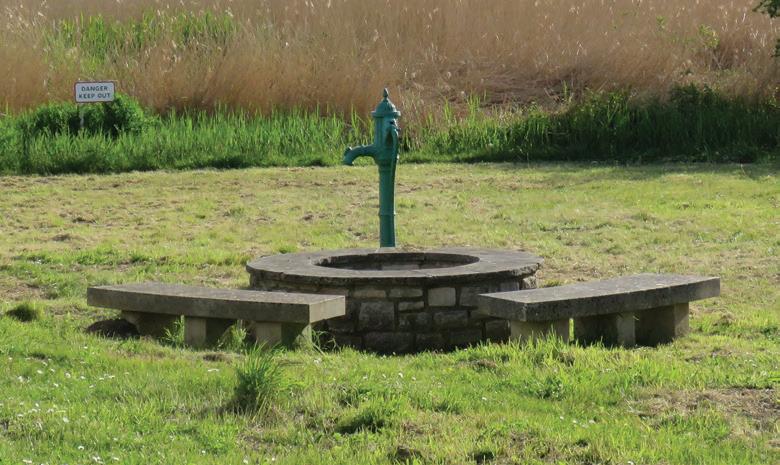
Take Tutton’s Well at Stanpit, for example. It wouldn’t surprise me if you’ve never heard of it, yet it is described as the “oldest link to antiquity” in Christchurch.
The spring serving Tutton’s Well rises on a piece of land that was given to the people of Christchurch in 1885. The well, pump and green were given as a public water supply and public open space by Sir William Rose. The council took them over on 12 April 1887. Four years later, a bucket well was dug near the spring. The water from the well gave a constant supply. It was so pure it was thought to have healing properties, particularly for the eyes. It was even hawked further afield as the Christchurch Elixir.
The well was later replaced with a pump, which became known as Town Pump. During a diphtheria scare in the early 1940s, the
springhead was capped and the pump sent for salvage. The well’s significance was diminished.
In 1957, the Girl Guides were allowed to erect a temporary Guide hut on the land. They sought permission for a larger hut in 1996. It was thought the building might encroach over the springhead and that Tutton’s Well would be lost forever.
The Friends of Tutton’s Well were formed, and the group lobbied against the development and argued for the preservation of the site.
Though planning permission was granted to the Guides in 1999 for a larger building, the Friends’ action was not without success.
Now, solely due to the efforts of the Friends, the site has been preserved. Although the probable site of the dipping place is thought to have been built over in 2002, the Friends, with the help of their benefactor Tom Tutton and under licence from the council, restored the wellhead in 2004. Two stone seats were placed beside it and a plaque noting the well as a part of Christchurch’s heritage.
The voice of the people secured Tutton’s Well for future generations. What’s more, the site overlooks one of the area’s most stunning natural habitats: Stanpit Marsh. The Friends of Tutton’s Well have kept sight of our heritage in more ways than one.
To visit this historical landmark, proceed along Stanpit. You can park in Stanpit Marsh public car park and walk the short distance along the road to the site.

By Priory Vets
As our local parks, gardens and forest walks burst into life, it’s a beautiful time to be out with our pets — although not all pets welcome the season quite so much.
If you’ve noticed your dog chewing their paws after a walk, or your cat grooming more than usual, you’re not imagining it. Late spring and early summer are peak months for allergies in pets.
Unlike us, pets don’t usually show allergies with sneezing or runny eyes. Instead, they tend to appear on the skin, often in ways that are easy to miss at first.
Signs you might notice at home
• Scratching, licking or chewing (especially paws)
• Red or irritated skin
• Ear shaking or repeated ear problems
• Over-grooming in cats
• Small scabs or patchy hair loss
• Scooting or licking around the bottom
These early changes are often your pet’s way of telling you something isn’t quite right.
Why this time of year can be tricky
At this time of year, there are a few familiar triggers. Grass pollen is a big one, especially for dogs who pick it up on their paws, bellies and underarms during walks. Fleas also become more active as temperatures rise, and for some pets, even a single bite can trigger intense irritation. Add in


environmental allergens like tree pollen and mould spores, and symptoms can quickly build.
Some breeds are naturally more prone to allergies, meaning symptoms may appear earlier or become more persistent.
The good news is that, with the right support, most pets can be kept comfortable. The key is not waiting until things become severe.
For many owners, one of the biggest challenges is knowing when to seek veterinary attention. Symptoms can vary from season to season, and what settled on its own previously may not follow the same pattern — sometimes becoming more persistent or leading to infection and increased discomfort.
Because allergies tend to be something we manage over time, rather than cure completely, it helps to think ahead about day-to-day care, including routine parasite control and how best to support your pet when things change.
Having that support in place makes it easier to check in early, often preventing problems from escalating and keeping treatment simpler and less costly. At Priory Vets, our Priory Pet Club is designed with this in mind, with consultations included so you can seek advice as soon as something changes — giving reassurance and helping keep pets comfortable and happy this season.
If your pet doesn’t seem quite themselves this spring, trust your instinct. You know them best and acting early can make a real difference to their comfort over the months ahead.
To find out more, you can scan the QR code to visit our website.

01202 484466 | office@prioryvetgroup.com www.prioryvetgroup.com Priory Vet Group, 59 Purewell, Christchurch, BH23 1EN

Rural heroes are to be celebrated at the 2026 New Forest Awards.
Organised by the New Forest National Park Authority and the Country Land and Business Association (CLA), the winners will be announced at a special awards ceremony and drinks reception at the New Forest & Hampshire County Show on Wednesday 29 July at New Park in Brockenhurst.
Individuals, businesses and organisations that live, work or operate within the New Forest have been nominated across six different categories. These categories are:
• Sustainability Champion
• Young Farmer (aged 35 and under)
• Best Supporter of Local Produce
• Young Environmental Champion (aged 25 and under)
• Farming and Nature Champion
• Commoning Champion Nominations for the six categories closed on 31 May.
Alison Barnes, chief executive of the New Forest National Park Authority, said: “This is a valuable opportunity to recognise the people whose dedication helps shape and sustain this extraordinary place.
“We are proud to host these awards, which celebrate those who consistently go above and beyond for the New Forest, its unique landscape, its rural communities and its future.”
Tim Bamford, regional director of CLA South East, said: “The New Forest is unique, and these well-established awards champion the very best across our rural community and economy.
“The CLA is proud to once again be honouring those who go above and beyond, and we look forward to celebrating with the winners at the show in July.”
The New Forest & Hampshire County Show takes place on Tuesday 28 to Thursday 30 July. To book tickets, visit newforestshow. ticketsrv.co.uk/tickets.
By Marilyn Barber | newseditor@dorsetview.co.uk
A New Forest District councillor is unhappy about the naming of authorities when local government reorganisation takes place in 2028.
Under the plans, New Forest District Council (NFDC) will be abolished and the New Forest split between two new unitary authorities, with Ringwood and Fordingbridge set to be included in the new Mid Hampshire Council.
But NFDC Cllr John Haywood, who represents Ringwood North and Ellingham, feels that it should be called New Forest and Mid Hampshire.
NFDC has also received a petition from New Forest Together, which is campaigning to protect the identity of the New Forest. The group has voted unanimously to support the council exploring legal options to challenge the government’s reorganisation decision.
Cllr Haywood is also calling for the South West Hampshire unitary council — which covers the Southampton and Eastleigh areas — to use the name New Forest for all area committees and internal functions that relate to the New Forest District.
In 2028, five unitary councils will replace the current 15 county, district, borough and unitary councils that serve Hampshire, Southampton, Portsmouth and the Isle of Wight, according to plans announced by the government on Wednesday 25 March.
Cllr Haywood said: “Even though New Forest District Council is consulting on its legal options, we know that plans for the new unitaries are moving ahead now. So it’s really important that we embed the New Forest name as deeply in the new authorities as possible — including in the name of the Mid Hampshire unitary council.”



11-year-old Aria was diagnosed with cancer in January 2025

A sense of normality has returned for an 11-yearold Christchurch cancer sufferer thanks to cutting-edge technology.
Aria, who was diagnosed with neuroblastoma in January 2025, has been able to return home from Southampton Children’s Hospital and attend school, thanks to a small but life-changing piece of equipment funded by Southampton Hospitals Charity.
Her intensive treatment meant hours each day connected to equipment on the ward at the hospital, which is based at University Hospital Southampton NHS Foundation Trust.
“We even gave the chemo stand a name,” Aria said. “We called it the ballerina, because it twirled around so much. I couldn’t really go far with it.”
But everything changed when hospital staff introduced Aria to a small backpack containing a computerised ambulatory delivery device, known as a CADD pump.
The portable pump, carefully programmed and monitored by specialist teams on the Piam Brown ward, allows medication to be delivered continuously while children move freely — meaning they are no longer confined to a hospital bed or ward.
Suzanne, Aria’s mum, said: “For us, it was an absolute game changer. With the continuous infusion of anti-sickness medication, the vomiting stopped and she could live as close to a normal life as possible. When your child is diagnosed,
you feel completely overwhelmed. You take things one day at a time, but the CADD pump gave Aria some of her life back. She could sit at the dinner table and just be a child again — even in the middle of treatment. It sounds simple, but in those moments, it means everything.”
Ellis Banfield, chief executive of Southampton Hospitals Charity, said: “Stories like Aria’s show exactly why charitable funding matters. These backpacks may seem small, but the impact is enormous. They give children freedom, independence and a sense of normality at a time when everything else feels uncertain.
“For families facing long hospital stays and intensive treatment, being able to go home, go to school, or simply spend time together makes a world of difference. We are proud to support care that treats not just the illness, but the whole child.”
Southampton Hospitals Charity is now supporting the expansion of this service, led by specialist nurses, to ensure more children and young people undergoing cancer therapy can receive their treatment at home, putting families at the heart of care. This innovative approach will help to modernise cancer care.
Southampton Hospitals Charity is encouraging the public to support its work to ensure more children like Aria can benefit from life-changing equipment. To find out more or donate, visit southamptonhospitalscharity.org.
If you dread hearing “Are we there yet?” on car journeys, then road safety charity IAM RoadSmart has some tips on how to manage road trips with children.
Before heading off on your holidays, make sure you check your vehicle is roadworthy; you don’t want it breaking down with screaming kids in the back. Check your oil, water and tyres, and inspect the vehicle for any damage, including to wiper blades.
By law, all children must use a suitable restraint in the car until the age of 12 or height of 135cm tall, whichever comes first. To keep your child as safe as possible, use the best car seat available to you and only change it when they have physically outgrown it, rather than upgrading based on the minimum requirements of the next stage. Learn about car seat safety on the website carseatninja.com.
Plan your journey so you know where you are going before you set off. Allow plenty of time to get to your destination.
Some parents prefer to drive through the night, so the children can sleep and the roads are quieter; others prefer to drive during the day but avoid the busiest times. Remember that the quickest route might not be the best one when you are travelling with children, so think imaginatively.
Backseat mirrors allow you to see what is going on behind you without taking your focus off the road. Installing a sunshade in the back will also help keep children cool and comfortable in hot weather. A backseat car organiser will keep items like drinks, snacks and books within arm’s reach.
If you don’t fancy spending money at restaurants for food at every stop, prepare a packed lunch you can eat at a service station or rest stop. Keep plenty of healthy snacks and sugar-free drinks in the car, and
always have a plastic bag for rubbish. Don’t forget tissues or wet wipes for spills.
Try to plan your stops at fun places, where everyone can get out of the car and release some energy. Motorway service stations often have children’s play areas, but you could consider stopping at other places with a play area just off the motorway.
A break where children can run around is much more enjoyable than a stop with nothing that interests them. Obviously, the type of stop depends on the age of your children, but these ideas should help with all but the stroppiest of teenagers!
If games of “I Spy” cannot keep your children entertained, then tablets and smartphones might be the answer. Download some of their favourite films and TV shows, but don’t forget headphones; this will help the driver keep their focus on the road. Colouring books, pens and stickers are also great ideas to keep children from becoming bored — and if they are occupied, they are less likely to distract the driver.
What are your tips for long car journeys? Email luke@dorsetview.co.uk with your ideas.

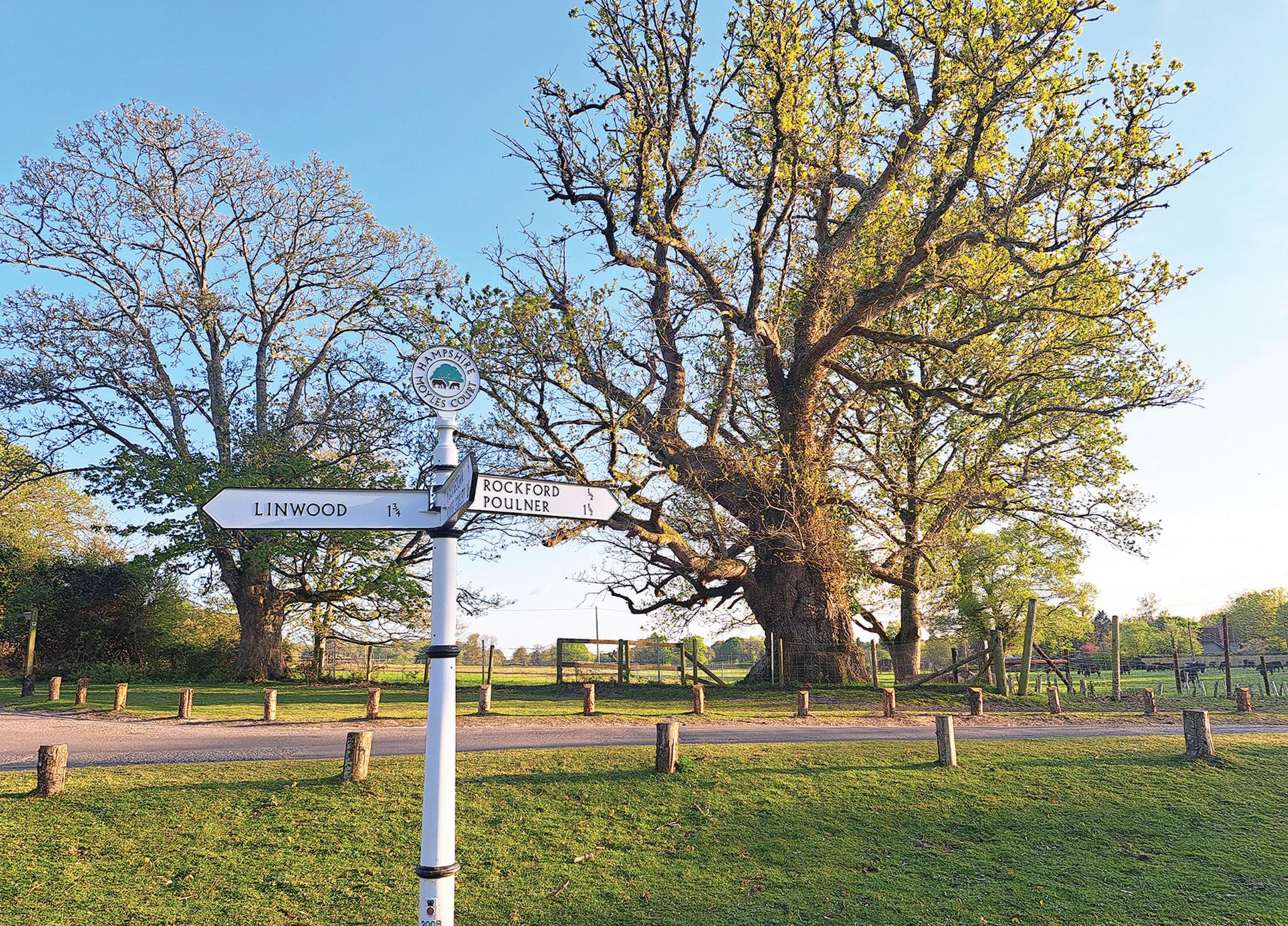
The future of a tree in the New Forest, estimated to be around 650–700 years old, is looking more secure.
The Tree Council, New Forest National Park Authority (NPA) and members of the community have come together to install measures to protect the Queen Oak, which sits by the roadside in an area of high visitor traffic.
The tree was just a sapling when the Black Death was raging through the country. Now, the Queen Oak — and similarly aged trees — is full of microhabitats like bark cracks and nesting holes that support hundreds of rare and unusual species.
Opposite is the King Oak — another ancient tree — that, although still standing, was declared dead two years ago after nearly seven centuries of life. Its demise was hastened by vehicles and visitors compacting the soil around its base, reducing the vital flow of water, nutrients and oxygen from roots to tree.
To prevent the Queen Oak suffering a similar fate, the community has installed dragon’s teeth — small wooden posts — around the base of the tree to stop vehicles parking on the verge and
damaging this Site of Special Scientific Interest.
As well as preventing vehicles from parking near the tree, the Queen Oak will benefit from careful pruning of neighbouring competing trees, and bracing has been applied to support its ancient branches, reducing future vulnerability to storm damage.
The Tree Council CEO Sara Lom said: “The UK has more ancient trees recorded than any other country in Europe, and the New Forest has the highest density.
“They are just as important as our stately homes and historic cathedrals, but are often overlooked or neglected.
“We have a huge responsibility to do all we can to ensure the health and vitality of these incredible national assets.”
Will Jones from The Tree Management Company, which helped with the project, said: “Having lived in the Forest my whole life, it means so much to have had the opportunity to help protect this special tree, using our collective skills to make a positive difference for its future and supporting an important asset in our ecosystem.”