6 minute read

Faculty members take on new leadership roles in teaching, coaching, and artificial intelligence
By Teresa Messmore, Director of Communications
With Lifelong Learning being a Core Value for not just students but also faculty and staff, Magnificat has added three leadership positions this school year to help set teachers and coaches up for success.
“The Leadership Team has tapped current faculty members to take the lead in mentoring new teachers, developing coaches, and harnessing artificial intelligence,” Dean of Faculty and Academics Colleen Greller said. “They are available on a day-to-day basis as resources to help their colleagues continually improve, complementing the professional development and department meetings that are already in place. We are excited to see where they guide us in these important areas of focus.”
Mentoring New Teachers
Social studies faculty member Liz DiGeronimo is taking on the additional role of Instructional Teacher Coach to mentor colleagues who are new to teaching or joined
Magnificat within the last two years. She is meeting oneon-one with them on a regular basis to provide advice on topics like lesson planning, teaching strategies, and ways to engage students.
DiGeronimo takes inspiration from her experience at St. Martin De Porres High School earlier in her career, where her own teacher coach would review lessons to provide feedback or offer support if she was struggling with a particular activity or group of students. While she had completed bachelor’s and master’s degrees in education, the immediate, on-the-job feedback was invaluable in real-world situations.
“I honestly think that’s really when I learned how to be a teacher,” she said.
When she came to Magnificat in 2021, she felt that the model could benefit her new colleagues and proposed the idea to Dean Greller, who agreed. DiGeronimo reduced her teaching load from five to three sections of Advanced Placement United States History to allow time to meet with teachers and observe them in the classroom. Her feedback does not replace the annual evaluations by administrators, but rather provides ongoing support and dialogue for continual improvement. Her hope is that sharing her experiences and serving as a sounding board for new teachers will help them avoid common pitfalls, pivot when needed, and expedite success.
“This role is really important because education is changing,” DiGeronimo said. “The pedagogy that we learned in school way back when has changed, and if we’re not adapting to the ever-evolving classroom, we’re going to find ourselves in a place where we’re not seeing growth.”
Coaching the Coaches
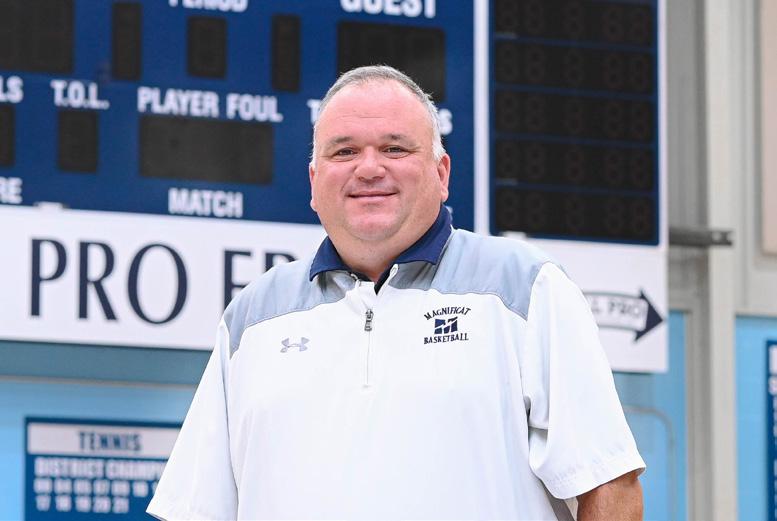
Danny Gallagher is starting a similar role with Magnificat’s coaching staff, but his position has a greater emphasis on incorporating faith and Magnificat’s Mission and Values into the student-athlete experience. Moving away from his previous duties teaching social studies and physical education, he will introduce new programming and communication channels for coaches as the Associate Director of Coach and Athlete Formation.
“Each athletic team should be using our Mission and our Values to drive what they do every day to ensure that our girls are getting a holistic experience, not just a focus on what they’re doing on the field or their results of winning and losing,” he said.
Gallagher has had many successes as a basketball and golf coach at Magnificat, culminating in last year’s OHSAA state title in golf. Like all teams, his teams pray before practices and competitions, but he also finds ways to encourage students to reflect on the school’s Values. For example, he has brought in motivational speakers for his teams and uses “shoutout time” for players to recognize the ways that their teammates have exemplified one of the Values.
Working closely with Athletic Director Paul Barlow, Gallagher will hold group and individual coaches meetings to talk about faith formation, team dynamics, and other topics. With more than 70 coaches, and many who have come to Magnificat without Catholic school experience, there are varying levels of experience among coaches when it comes to weaving faith into athletics.
“I want to be a support for coaches, as someone who understands what they’re going through,” Gallagher said. “I want to help coaches grow on and off the field to ensure that our athletes are getting the best experience that they can.”
Integrating Artificial Intelligence
ChatGPT, Claude, Perplexity ... The quantity and functionality of artificial intelligence tools can be daunting, even though users are looking to make life easier. Add in the ethical considerations within the education sector, and many teachers hesitate to give them a try. At Magnificat, French teacher Alex Weil is helping fellow teachers navigate the AI landscape as the AI Lead Teacher and encouraging the responsible use of AI in teaching and learning.
“I’m not approaching it to convince someone to use it or not,” Weil said. “But if that person is open to exploring what it has to offer, then I am hoping to help and share what I know.”
Weil’s foray into artificial intelligence started at home for assistance with things like enhancing ice cream recipes. Dabbling with ChatGPT led to exploration of other tools like Diffit, which helps teachers to make instructional materials, and ElevenLabs, to convert French text to speech for pronunciation help. He uses the tools sparingly in the classroom, but in preparation for class, he uses AI for specific tasks like quickly generating new grammar exercises—for example, if he notices the class would benefit from extra practice in a particular area.
Weil has taken several online courses about AI for professional development through Anthropic, and in September he started holding Learn at Lunch sessions for teachers several times a month. The opportunity is open to those just beginning to explore AI or already more advanced, and participants are asked to bring a particular idea or problem to work on together, using AI to augment their thinking.
“I think there’s potential for teaching students how to use it responsibly, morally, ethically, and in a positive way that is going to help rather than just automate the student’s work,” Weil said. “We have to create an environment that understands the importance of ethical usage, and then model it.”