Demagnetizer Testing Machine in India Introduction A demagnetizer machine is an industrial device that is absolutely essential for the effective removal of unwanted or residual magnetism from ferromagnetic tools and materials. Metal parts might keep magnetism after the different procedures mentioned above such as magnetic particle inspection (MPI), welding, grinding, or machining. This remaining magnetic field can create serious problems like attracting metal debris, electronic instruments interference, and altering machining accuracy, so it can even affect product performance and safety.
What is Demagnetizer Machine? A demagnetizer machine is used to eliminate the undesirable residual magnetism present in the metal parts and tools. It works by creating a controlled reversing magnetic field, which effectively nullifies the magnetic force and makes the components clean, safe, and accurate in their functioning during the manufacturing, inspection, and assembly processes.
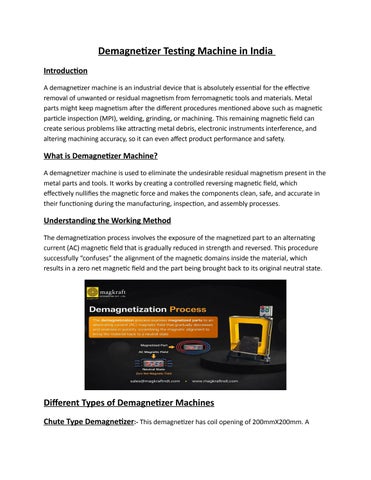
Understanding the Working Method The demagnetization process involves the exposure of the magnetized part to an alternating current (AC) magnetic field that is gradually reduced in strength and reversed. This procedure successfully “confuses” the alignment of the magnetic domains inside the material, which results in a zero net magnetic field and the part being brought back to its original neutral state.
Different Types of Demagnetizer Machines Chute Type Demagnetizer:- This demagnetizer has coil opening of 200mmX200mm. A
stainless steel chute passes through the coil & components slide down this chute with gravitational force. It is suitable for small components.
Conveyor Type Demagnetizer:-This demagnetizer uses a belt type conveyor. It is available in three different sizes of coil opening, 200X200mm, 300X300mm & 500X500mm. Conveyor length is different for different coil openings & can be customized also. Features such as Auto Start, Auto Stop & job counter can be integrated on demand.
Trolley Type Demagnetizer:- This demagnetizer employs a manual trolley to take the component from one end to the other. Trolley is supported on sturdy wheels. Three different coil opening sizes are available, 200X200mm, 300X300mm & 500X500mm. It is the most commonly used demagnetizer.
Motorized Trolley Demagnetizer:- This demagnetizer uses a motorized trolley to carry the component from one end to the other. The trolley is connected to a chain driven by a geared motor. Three different sizes of coil opening are available, 200X200mm, 300X300mm & 500X500mm. Optional features such as job counter & auto return can be easily integrated on demand.
Stationary Type Demagnetizer :- This demagnetizer uses electronic circuitry to produce a slowly reducing AC current in the demagnetizer coil. The component is placed inside the coil. The slowly reducing magnetic field demagnetizes the component. Available in coil sizes of 200mmX200mm, 300mmX300mm, 400mmX400mm & 500mmX500mm.
Reversing DC Demagnetizer:-This reversing DC demagnetizer passes slowly reducing & reversing DC current through the component using headshot method. This produces a slowly reducing circular magnetic field in the component thereby demagnetizing it completely. Use of DC ensures that the part is demagnetized not only from the surface but from the core also.
Key Applications of Demagnetizer Machine's ·
NDT & Quality Assurance: Essential post-MPI to prepare parts for further use or inspection.
·
Manufacturing & Machining: Ensures tools and components are magnet-free before assembly or shipping.
·
Automotive & Aerospace: Used on engine parts, landing gear, and other critical components.
·
Tool Maintenance: Demagnetizes precision tools like drills, gauges, and screwdrivers to prevent interference.
Benefits of Demagnetizer Machine's ·
Improves Safety: Reduces risk of attracting ferrous particles.
·
Ensures Accuracy: Prevents interference in electronic and measurement equipment.
·
Enhances Quality: Prepares parts for coatings, painting, or further processing.
· Increases Efficiency: Automated systems allow fast, consistent treatment in production environments.