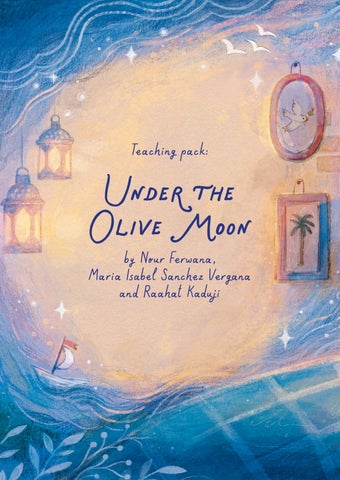
Teaching pack:
Under the
Olive Moon by Nour Ferwana, Maria Isabel Sanchez Vergana and Raahat Kaduji
Synopsis: Ten magical Palestinian fables passed down through generations, sharing messages of hope, kindness, patience and bravery
Themes: Palestine, family, home, moral lessons Writing style: Fables Before you begin:
If students haven’t looked at fables before, share the definition with them: A story (often featuring an animal, object, plant or natural force) that demonstrates, or ends with, a moral lesson. You may choose to share some famous fables with them as examples. There are a selection of Aesop’s Fables videos here. Depending on time, you could watch/read a few and ask students to define what a fable is.
Classroom activity idea 1:
Em p athy Building/Stor y Sharing
Read Nour’s letter to students. Ask how hearing her words makes them feel. Can they think of a time when they have felt scared, experienced unkindness, or needed to be brave? Who helped? Were there any stories that made them feel better? This could be done as a whole class, or initially in smaller groups before sharing with the class. Read the fables - or a selection of them - to the class. Reflect on Nour’s introduction to each one, bringing students back to the above conversation. After reading each one, ask them to consider the lesson learned/shared.
Classroom activity idea 2: Symbolism Using the imagery on Raahat’s IG page (1st Oct), look at the symbols of Palestine that are included in the book. Look at the meaning behind each and consider why they have been included.
Keffiyah:
These black and white scarfs are traditionally worn by working people to protect against the sun, cold and dust but, almost 100 years ago, when Palestinians wanted the British to leave their country, it became a symbol of resistance and Palestinian identity (other Arab countries have their own versions). The patterns are:
• Olive leaves, symbolising the deep connection to the land and the strength of Palestinian people and their heritage.
• Fishing nets, symbolising the connection with the Mediterranean sea and the work of Palestinian fishermen.
• Straight lines, symbolising the trade routes crossing Palestine.
Tatreez: Traditional Palestinian embroidery, with motifs (such as specific types of tree, the
Star of Bethlehem, feathers, and the Palestine flag) and patterns used to tell stories. Different areas and sometimes even individual families can be represented in the stitches. Panels of tatreez are used to create thobes (traditional long dresses) and showcase the wearer’s village/ town, social status, and sometimes even their personality.
Watermelon: Watermelons grow in Palestine but, because the colours also match the red, green, white and black of the Palestinian flag. In times when Palestinians have been banned from flying their flag, the watermelon has been a symbol of resistance and protest.
Dove: An international symbol of peace Kites: a symbol of joy and childhood. Making kites has long been a family activity in refugee camps, with children waiting for the wind to fly them together. Israel has restricted materials like paper and glue entering Gaza, and have now banned the flying of kites.
Olives/olive trees: A symbol of connection to the land. Palestinians have always grown and harvested olives, treating the trees with great care and reverence. Often, invading forces will burn the trees, destroying them, and taking away livelihood (jobs and money) away from Palestinians.
Extend: Using these symbols, plus words from the fables, you could create a display of kites made from wooden sticks, paper and string. Or organise a school kite flying event. See Kites4Palestine for inspiration.
Classroom activit y idea 3: Reworking Choose one of the fables to turn into a short graphic novel/comic strip. Make sure all elements of the story feature and think carefully about how you will make the moral lesson clear to your reader. Not keen on drawing? You can describe each panel instead. Or why not create it on a computer (but please don’t use AI)
Classroom activit y idea 4: Lights, Camera, Fable
In small groups, students can choose a fable to act out, ensuring they’re working on a different story to previous activities. Think about how to convey the moral to your audience so the message is really clear. You could choose to create a series of freeze frames. You could act it silently but with a narrator. You could have spoken lines as you act, as in a traditional play.
Classroom activity idea 5: Write your own fable
Individually, as a class or in small groups, write your own fable. Choose a situation and think about the message or lesson you want to convey. You may want to mindmap or brainstorm your ideas first. It could be based on something that has happened to you, or something from your imagination. As with the stories in the book, it doesn’t need to be long, so choose your descriptions and words carefully.
Other titles to support:
Studio Press: We Are Palestinian Macmillan: A Map for Falasteen Interlink: Homeland: My Father Dreams of Palestine Interlink: Everything Grows in Jiddo’s Garden Viking: These Olive Trees