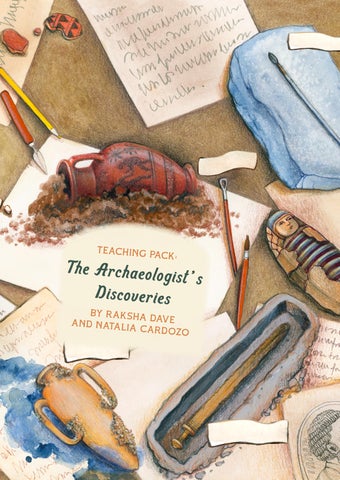
Teach ing p ack :
The Archaeologi st ’s Discoveries by Raksha Dave an d Natal ia Card ozo
Synopsis: A fascinating glimpse into the past, with ten ancient artefacts presented in scrapbook format. These precious objects are embossed, inviting young historians to ‘handle’ them, and the accompanying field notes reveal their provenance and place in history.
Themes: Archaeology, ancient history
Writing style: Archaeologist’s field notes/scrapbook
Classroom activity idea 1: Predict Display a picture of the artefact in isolation (no labels). Ask students to predict: • • • • • •
its age; whereabouts in the world it came from; what it is made from; what it might have been used for; what (if anything) might it have represented; who might have owned or used it.
Ask them to explain why they’ve made these predictions. Share the full details with them - were any of their predictions correct or close? What do we learn about culture/daily life/society/communication from each artefact? This could be done as a group, on screen *or* you could have a number of stations around the room with a big piece of paper at each, with the artefact in the middle of the paper. Students can carousel around until they’ve visited each station, adding ideas and creating a big brainstorm.
Classroom activity idea 2: Date Using the timeline at the back, create a human timeline, with ten* students holding a piece of paper with each of the ten artefacts pictured. Ask the class to work together to put them in order from oldest to most recent. Ask them to explain their rationale, such as the materials used. As you reveal the era of each, students can shuffle accordingly to work towards an accurate timeline. This could be stuck up on the wall afterwards. Extend this by putting the timeline next to a world map, with tape or string from object/area to the relevant area on the map. *You could add other time periods if you have a bigger class and want all students to be included *or* divide the class in half to see if both sides come up with similar ideas. For a less chaotic alternative, the first part of this activity could also be done using a piece of string across the room, with each piece of paper fastened using a peg.
Classroom activity idea 3: Perform Using the information gathered from the book, ask students to work in pairs/threes to write a short play featuring one of the artefacts being used, to help others understand its purpose. Remember to think about the time period and historical context: Who would have been using it? What was life like then? Perform these short plays to the rest of the class - you could keep each group’s artefact a surprise and ask the other students to work out which one it is.
Classroom activity idea 4: Report Imagine you are a time-travelling newspaper reporter and an artefact has just been discovered. Your readers will need to know what it is (though this might still be a mystery) at the time of discovery, where it was found, who found it, and when. You might talk about how it has been preserved. What will happen to the item now? Will it need careful preservation before being displayed?
Consider the concepts of ‘treasure’, ‘valuable’, ‘precious’, ‘cultural and historical significance’. Does it belong in a museum? Why? You might want to add some quotes from other people, such as the person who found it, or a local archaeologist, historian or museum curator.
Classroom activity idea 5: Recreate! Explore the idea of replicas (the item reproduced to look as much like the original as possible). Why are they important? Using materials appropriate for your class, recreate an artefact, or a selection of them. Write the label that would be displayed on a cabinet in a museum, alongside the artefact. These could be displayed alongside the student’s timeline and newspaper articles.
Other titles to support: What on Earth: Amazing Treasures Templar: Locked in the Museum Hachette: The Treasure Hunt Puffin: There Was a Roman in Your Garden Quarto: The Atlas of Lost Treasures