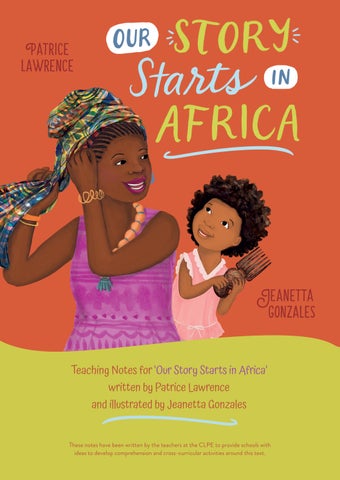
Teaching Notes for ‘Our Story Starts in Africa’ written by Patrice Lawrence and illustrated by Jeanetta Gonzales These notes have been written by the teachers at the CLPE to provide schools with ideas to develop comprehension and cross-curricular activities around this text.
Before you start: Before starting work on the book, create a class ‘reading journal’ using large pieces of sugar paper and use the pages of the journal to capture responses, reflections, notes and language generated.
These notes have been written by the teachers at the CLPE to provide schools with ideas to develop comprehension and cross-curricular activities around this text. They build on our work supporting teachers to use quality texts throughout the reading curriculum. They encourage a deep reading of and reflection on the text, which may happen over a series of reading sessions, rather than in just one sitting. We hope you find them useful. These teaching notes have been written with children from 7-11 in mind, but you will need to differentiate them as appropriate to the needs and experience of your own children.
As the Caribbean setting and African culture are central to this book, it would be effective to provide access to books which support children’s knowledge and interest in these islands. This might also include maps and atlases; fiction and non-fiction choices – see linked texts. You might introduce these texts and resources during the first few sessions in which the Caribbean setting is discussed and investigated. If any children in the class originate from a country in the Caribbean or Africa, or have family who lived/live there, or if children have been on holiday there, draw on their knowledge and expertise to start to build a deeper and increasingly multi-dimensional picture of life in these places. To support children’s understanding of the theme of transatlantic slavery which is explored throughout the book, it is advisable to spend some time in History lessons studying this more broadly. These websites provide good starting points:
https://www.bbc.co.uk/newsround/41433197 https://www.bbc.co.uk/bitesize/topics/z2qj6sg/articles/zfkfn9q https://www.bbc.co.uk/bitesize/topics/z2qj6sg/articles/z6cptrd https://kids.britannica.com/kids/article/slavery/353782
The book depicts the rich cultural diversity of the African nation and its history. Slavery is part of this history, and should be explored, but any teaching around this needs to be set alongside a more thorough study of the richness of the past, present and future of the continent, as this book provides. There are some useful websites that provide guidance on teaching children about slavery in primary schools: https://www.history.org.uk/primary/ resource/2811/teaching-slavery http://www.recoveredhistories.org/
Reading aloud and key talking points
Display the illustration of the front cover of the book for the pupils to reflect on, without revealing the title yet. What is happening in this illustration? Who could these people be? What might they be thinking or feeling? What do you think the title of the book might be? Explore the children’s initial ideas and encourage them to support their ideas by referring to the images. Who is looking at whom? Where is your eye led as you look at this illustration? How would you describe the energy in the illustration? How does it make you feel? They might comment on the props they have been given. What is the lady dressing her head with? What is the little girl holding in her hand? What might these things tell you about them?
Look closely at the expressions on the characters’ faces. What might they be feeling? Why might they feel this way? What could they be thinking? What might they be saying to each other? Arrange the children into pairs and ask them to conduct a freeze frame as these characters. Then tap them on the shoulder and ask them to speak in role as the characters. They can say what they might be thinking and what they might be saying to one another. For example, the little girl could be saying ‘please can you do my hair like yours?’ or the lady might be saying ‘come and sit down here with me and let me do your hair, when I’ve finished tying my wrap’. This activity is known as Freeze Frame and Thought Tracking.
More information about this can be found on the CLPE website: https://clpe.org.uk/teaching-resources/teaching-approaches/freezeframing-and-thought-tracking-teaching-approach
Now reveal the title of the text ‘Our Story Starts in Africa’. Is this what you expected? Why or why not? What could the story be about? How might these characters be involved in this story? Encourage the children to make predictions about what the story could be, drawing on their wider knowledge of the continent of Africa and building on some of the learning you may have already done about African History prior to reading this book or on their own personal experiences. Give the children time and space to discuss their ideas in groups and then share as a class, recording any observations or ideas into your class reading journal.
Open the book and look at the endpapers. What do these brightly coloured patterns make the children think of? Have they seen patterns like this before? Where? Turn back to the cover and link these with the patterns on the head wrap. You may want to spend some time looking at some more African art of this kind to support children’s understanding of the African culture, particularly within textiles. You can visit websites like: https://www.contemporary-african-art.com/african-patterns.html https://minds-africa.org/fabric-map-of-africa-the-art-of-storytelling https://afrolegends.com/2013/05/17/history-of-african-fabrics-and-textiles/
Or, children may be able to bring in their own examples of fabrics like this from home.
Turn to the publication page and look at the dedication that the author, Patrice Lawrence has made.
Come back to look at the sentence ‘She is visiting her family in Trinidad’.
What might this suggest about the story she is about to tell? What could she mean by Africa’s true histories? What do you think she means when she says ‘so many so unwilling to listen’? Why do you think this might be?
Where do you think could Paloma have travelled from? Are there any clues in the illustration or the text that she may not be from the same part of the World?
Allow children time to discuss this and make suggestions based on their prior knowledge and own experiences. Add these ideas to your reading journal. Then look at the illustration on this page. Here we see the same characters again, this time embraced in a hug. What more do we learn about them from this illustration? How is this different from the previous one? What relationship could these characters have? What does the hug suggest about that relationship?
Look at the illustration on the title page. Here we see the two characters again. What are they doing this time? Where could they be? What is the girl picking from the tree? How might this fit with the title of the story? Give time for the children to share their ideas about this image and record them, around a copy of this illustration, in the reading journal.
Read the first double page spread and look at the accompanying illustration. Who do you think Paloma is? Which character do you think she is, in this illustration? Why is she excited? Look at the other characters in the illustration. Who do you think they might be? Which are the cousins? Who is Tante Janet? Who do you think the character with Paloma might be, who is not named in the text? What makes you think this?
The children might talk about the different skin tones of the characters; use this as an opportunity to talk about heritage more widely with the children and draw on the experiences of those within the classroom about different cultures, family experiences and where children have family members living in different parts of the world.
Look closely at the expressions on the characters’ faces. The text indicates that Paloma is excited but does her expression match this? Why not? What does her body language suggest about how she is feeling? How would you describe how the cousins are feeling right now? Why might Paloma be clinging to her mum’s leg, even though she is excited?
Re-read the line ‘She wants to play with her cousins, but…’ Discuss with the children what could be stopping her playing with them. Make connections to the children’s own personal experiences of being in a place that is less familiar to them and how they felt at this time.
Turn to the next double page spread and read the first page and show the illustration. ‘You don’t talk like us’ they say ‘How can you be family?’ How do you think Paloma might feel when she hears this? Look closely at the illustration and encourage the children to pick out the features and what they indicate about how she is feeling – staring straight ahead, away from the cousins, shoulders down, lips slightly dropped. Why could the cousins be saying this about Paloma? Does she speak a different language? Use this to open up discussions around accents and dialect, linked to children’s own experiences with different accents and dialects within the class.
You could expand and develop children’s understanding by listening to some poets reading their work in different dialects, on the poetry pages of CLPE’s website, such as: Haircut Rap by Valerie Bloom: https://clpe.org.uk/videos/video/ valerie-bloom-haircut-rap • Wha Mi Mudder Do by Grace Nichols: https://clpe.org.uk/ videos/video/grace-nichols-wha-mi-mudder-do • River Reflection by Jackie Kay: https://clpe.org.uk/videos/video/ jackie-kay-river-reflection • Ten by Matt Goodfellow: https://clpe.org.uk/videos/video/mattgoodfellow-ten • For You by Karl Nova: https://clpe.org.uk/videos/video/karlnova-you • The Reader of This Poem by Roger McGough: https://clpe.org. uk/videos/video/roger-mcgough-reader-poem • Free by Kate Wakeling: https://clpe.org.uk/videos/video/katewakeling-free • Isn’t My Name Magical? by James Berry: https://clpe.org.uk/ videos/video/james-berry-isnt-my-name-magical • Superpowers by Ruth Awolola: https://clpe.org.uk/videos/video/ ruth-awolola-superpowers
Read and explore the illustration on the next page of this spread. Look closely at the illustration and discuss the bond between Paloma and Tante Janet. What do you think their relationship is like? What tells you this? What do you think the word Tante means? Who do you think this woman is, and how do you think they are related? If the children aren’t sure, or don’t notice the linguistic similarities between ‘tante’ and ‘aunt’ and that the other children are referred to as cousins, research the word ‘Tante’ together, to clarify the children’s understanding. ‘Tante’ is another word for Aunt (from Dutch, German, French and Afrikaans).
Re-read the text ‘I’m going to tell you a secret’. What do you think this secret could be? Encourage the children to draw on the knowledge they have gained so far about Paloma, Trinidad and the cousins to make a prediction. Record these ideas and responses in the class reading journal.
Turn to the next double page spread, and look closely at the illustration, before you read the accompanying text. What can we see, particularly in the first illustration that may indicate more about Paloma’s heritage? Look at the combs and brushes on the table and the items hanging from the wall and on the dresser. What do these suggest about Paloma’s family history? Read the accompanying text and then discuss the significance of the comb. Why do you think this is so important to Paloma and Janet’s story? Make links to the children’s own experiences if you have children within your class with African or Afro-Caribbean heritage. What knowledge do they have about having their hair done? What is the significance of this? What bond does this create between family members?
Read the next spread and discuss The Library of Alexandria. You will want to do some background Read the next double page spread and look at the accompanying illustration. Look at the illustration of Queen Amanirenas. What do the children notice about how the illustrator has drawn this Queen? What similarities can they notice to Janet? At this point, you may want to do some further research on Queen Amanirenas, perhaps as part of your wider History learning about significant figures from World History.
Read the next spread and look at the accompanying illustrations. Discuss the history of storytelling across Africa and how this has developed not just orally, but by noting down the stories in various media. It would be beneficial for the children’s understanding to be able to see examples of stories told on parchment or jars, or on the weave of kente cloth, as well as published retellings of stories from across the continent (see suggested texts). If possible, source a range of authentic artefacts to share with the children and perhaps form part of a display on the continent of Africa.
Re-read the line ‘But best of all, we pass stories between each other, across thousands of years. Just like we’re doing now Tante!’ Make reference here back to the author’s dedication at the beginning of the book. Discuss the importance of oral storytelling and provide opportunities for the children to share experiences of stories they know that they can tell ‘from their heads’. Give time for the children to share their experiences and discuss this as an important way for traditions and cultures to be passed down through generations, especially if some of the stories are not necessarily ones that some want to be remembered.
research on this and consider its significance in the lost stories in African history.
Why do you think people travelled from miles and miles to visit it? Why do you think it might have disappeared? How might this relate to the author’s wish to ‘keep Africa’s true histories alive’?
Look closely at the second page illustration and note how the author continues to bring back the story to focus on the bond between Paloma and Janet.
Discuss how the story may be discussing historical events, but how these still remain significant for young African and Afro-Caribbean children today to connect with their culture, heritage and family history, and for children more generally in understanding African history and its standing and influence on the wider world.
Read the next double page spread and look closely at the illustrations. What do the children notice about Paloma’s facial expression and body language now? How does this compare to the first spread? What has changed about the way Paloma is feeling or thinking? Why do you think this change has occurred?
‘
Tante’s yard is full of trees that Paloma has never seen before’. What does this suggest about the environment they are in? What might the climate be like? What other fruits or vegetables might grow there? How do you think this might be different from where Paloma lives? Does it give you any clues as to where she might have travelled from? What do the clothes they are wearing suggest about the climate? What other clues are there in the illustration to support the children’s ideas?
‘
Read the text ‘..The pods are like treasure chests’.
What does the author mean here? Why has she used a simile to describe the pods? What impression does this give you of the pods and what might lie inside them? Why might the cocoa beans be described as treasure?
‘
Look at the illustrations depicting things in the past.
What do you notice about these illustrations? How has the illustrator used a different colour palette to convey that this is not happening now? How does this help us as a reader to understand the story?
‘
Look at the spread which ends with the line ‘… including our most precious thing of all…’ What do you notice about the people in this illustration? How do they look different to the other characters? Where do you think these traders have come from? Why is this significant? To develop children’s understanding, you will want to research and discuss more broadly how explorers and traders from Europe exploited and looted resources from across Africa for their own gain.
This could lead to a wider look at the cocoa industry, including the Fairtrade movement, designed to target the exploitation of cocoa farmers in Africa and other parts of the world, as part of wider learning in Geography.
‘ Read the next two double page spreads and discuss the
wider significance of using the simile of a treasure chest.
Why might the author have chosen to describe Africa as a treasure chest? What image does this invoke in you? At this point you might also want to do some further research on African rulers and the rise of their mighty kingdoms to support the children’s understanding as the story develops.
Discuss with the children what they think the most
precious thing of all could be.
What is precious to them? Encourage them to make a list of all the things that are most precious to them. What might be at the top of that list? Record these ideas in your reading journal. Do you think this is the same for Paloma and Janet?
‘
Discuss with the children what they think the most precious thing of all could be. What is precious to them? Encourage them to make a list of all the things that are most precious to them. What might be at the top of that list? Record these ideas in your reading journal. Do you think this is the same for Paloma and Janet?
‘ ‘
Discuss how the illustrations are depicting the current way of life for Janet and how this is rooted in her past.
Now look at the next spread.
What is the significance of the words ‘our people’ in isolation on the page? What is going on here? Where do you think the people being taken in the boats and for what purpose? How are the people depicted in this illustration? What do you notice about the boats and how they are travelling?
Look also at the way the cousins are peering in on Janet and Paloma talking through the door. Why do you think they are doing this? What do you think they are thinking as they look in on this moment? ‘ Come back to look at the final sentence in this section: ‘They’re like cousins that don’t know each other’.
Give the children time to look closely at this illustration. How does it make them feel? Why? Does it remind them of anything they have seen or heard before, either in other books or on TV or in films?
Why do you think the author has chosen to have Aunt Janet use these words in particular as an analogy here?
At this point, it would be beneficial to spend more time investigating slavery, starting with the explanation given in the ‘Paloma’s Questions’ section at the end of this book, then drawing on resources mentioned at the beginning of these notes, which are most appropriate to your children.
Discuss how Aunt Janet is helping Paloma to understand how her history is still important today and that it is very much like how her cousins felt towards her when she first arrived to visit. What has Paloma learned about her heritage? How do you think this might affect the relationship she has with her own cousins? What have you learnt about the experiences of African people across history from this section of the text? What have you learnt that you didn’t know before about World History?
‘
Read the next two spreads and look closely at the accompanying illustrations. Look at the verb choices used by Tante Janet: We were stolen from Africa and forced by rulers from Europe to work as slaves growing cocoa and sugar. What insights does this give us into those who took the people, the people who were taken and into the historical events more broadly?
Look closely at the illustration on the page with the line ‘They cut Africa into chunks’. What has the illustrator done to help us visualise this chopping up of lands? How does this aid our understanding?
‘
Throughout these spreads, Paloma asks lots
of questions and it may be that your children have questions too.
This is to be encouraged and any questions they may have should be noted in the reading journal to return to. At this point, turn to the end of the book to look at ‘Paloma’s Questions’ and see if some of the answers provided can answer the questions the children had. Discuss how this type of non-fiction writing has a different voice. How is this type of writing different? What more do we learn from this? Why do you think the author has chosen to include this section in the book?
‘
Read the next spread and discuss the significance of the new space telescope in South Africa. It is important for children to understand, if they don’t already, that African countries and Africans have always, and continue to, lead and contribute to developments and discoveries in all areas of life. At this point, it would be good to find out more about the continent and countries within it by reading ‘Africa, Amazing Africa’ by Atinuke, and Mouni Feddag alongside this book.
‘
Read and look closely at the final spread of the story.
What impact does this illustration and the title line ‘And our story starts in Africa’ have on us as a reader? How does it make you feel? What does it make you want to find out more about?
‘
T ake time to closely read and reflect on the final illustration . What do you think is happening here? What is Paloma doing? What do you think she is thinking or feeling? What are the cousins doing or thinking about at this point? What do you think Janet is thinking? How is she feeling towards Paloma?
N ow look at the note from the author at the back of the book . What do we learn about Patrice Lawrence and how does this help us to understand the story better? What questions do we now have? What more do we want to find out? Record these questions in the class reading journal.
‘
E ncourage the children to think about their own story and family history . How much do they already know about the history and heritage of their family? Where might their story start? How might they go about finding out about their own story? Do they have a relative like Tante Janet, who could support them in learning more? Record these ideas in the class reading journal. These could then be explored further either in class or as a home learning project.
After reading, you could also: Provide opportunities for the children to write in role as the characters of Paloma or Janet. How do they feel at different points in the story? What might make them feel this way? How might they express this? Conduct a wider piece of research on the rich, broad and diverse History of Africa, including aspects explored in the text - its kingdoms and rulers; its contributions to developments in language, music, art, science and technology; trade and exploration between Europe and Africa and the transatlantic slave trade, with opportunities to write for different audiences and in different forms to communicate their learning. Study some African artwork and have a go at creating some African textile weaves like the kente cloth. You may want to look at the works of African American artist Bisa Butler here: https://www.bisabutler.com/ or Nigerian Nike Davies-Okundaye here: https:// www.shadesofnoir.org.uk/creatives/portfolio/nike-davies-okundaye/ Provide opportunities for children to role play Paloma retelling her story to her cousins and then write up that story in their own words. They could also choose to write the story from the perspective of one of the cousins retelling the story from Paloma’s version. Invite the children to find out about their own stories and then write about them, either as an Autobiography or as a non-fiction narrative like this story. Invite African storytellers into school to enrich the children’s understanding of a real life story as well as to learn more about the art of Storytelling. Conduct an author study of Patrice Lawrence and learn more about her work and motivations Look at the works of illustrator Jeanetta Gonzales. This is her first book for children; try and find out what motivated or inspired her to be involved in this book. She uses bold colour through paint and digital illustration. Have a go at experimenting with bold colours using paint to replicate some of her illustrations and style.
Other titles by Patrice Lawrence or to support exploration of themes from the book:
Granny Came Here on the Empire Windrush illustrated by Camilla Sucre (Nosy Crow 2022) Granny Ting Ting illustrated by David Dean (Bloomsbury Education 2020) Diver’s Daughter: A Tudor Story, part of the Voices series (Scholastic, 2019) Toad Attack illustrated by Becka Moor (Barrington Stoke 2019) Tales from Africa by K.P. Kojo (Puffin 2017) Tales from the Caribbean by Trish Cooke (Puffin 2017) Black and British. A Short Essential History by David Olusoga (MacMillan 2020) Secrets of the Afro Comb, 6,000 Years of Art and Culture by K.N Chimbri (Golden Destiny 2013) Africa, Amazing Africa: Country by Country by Atinuke and Mouni Feddag (Walker Books 2019) Black Stories Matter: Groundbreaking Scientists by J.P Miller (Wayland 2020) Black Stories Matter: Brave Leaders and Activists by J.P Miller (Wayland 2020) Black Stories Matter: Amazing Artists by J.P Miller (Wayland 2020) The Ga Picture Alphabet by Nii Ayikwei Parkes and Avril Filomeno (Kane Series 2020) African Tales: A Barefoot Collection by Gcina Mhlophe and Rachel Griffin (Barefoot Books 2017) African and Caribbean Folktales, Myths and Legends by Wendy Shearer (Scholastic 2021) There are relatively few recent non-fiction UK titles exploring the countries of the Caribbean for primary age children. However, some series have been published in America which school libraries may choose to import. For example: Exploring World Cultures – series published in 2020 by Cavendish Square Publishing: includes Cuba and Haiti Countries We Come From – series published in 2019 by Bearport Publishing: includes Guyana, Haiti, Dominican Republic, Tobago and Cuba amongst other featured countries Caribbean School Atlas, Hodder Education, 2018