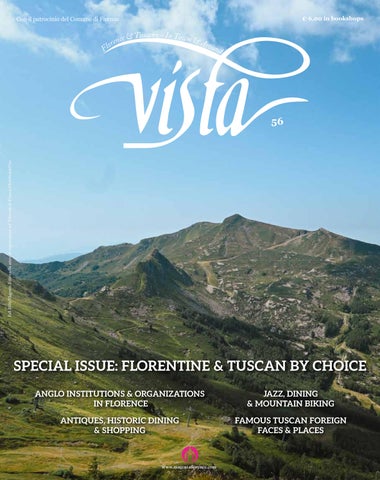
€ 6,00 in bookshops
Con il patrocinio del Comune di Firenze
cany - In Town ce & Tus &A n e roun or l F d
Fall 2026/Magenta Editrice/In attesa di registrazione nel Tribunale di Firenze/Distributed Free
56
SPECIAL ISSUE: FLORENTINE & TUSCAN BY CHOICE ANGLO INSTITUTIONS & ORGANIZATIONS IN FLORENCE
JAZZ, DINING & MOUNTAIN BIKING
ANTIQUES, HISTORIC DINING & SHOPPING
FAMOUS TUSCAN FOREIGN FACES & PLACES
www.magentaflorence.com
A World of Fragrance Exclusive to Tuscany
The Scuola Italiana del Profumo in Florence offers perfumery courses in English and Italian. Learn about fragrances from the foundation (base notes) to the finishings (top notes), to design and marketing. The hands-on experience culminates in the creation by the student of a unique, custom perfume. Classes are held on the premises of the Antica Erboristeria San Simone, which carries on a 300-year-old tradition of producing and selling personalized holistic remedies, perfumes and cosmetics. VIA GHIBELLINA 190/R � FLORENCE ITALY Tel. + 39 393 823 4575 / info@anticaerboristeriasansimone.it www.anticaerboristeriasansimone.it
The cover photo of the Abetone mountain resort is by Elisa Lopez Rochin. Direttore Responsabile managing editor Rosanna Cirigliano graphic design
Alessandro Naldi
editorial assistant
Francesca Negri
music editor
Anne Lokken
art editor
Elizabeth Wicks
tuscan editor
Rita Kungel
photographers
Andrea Pistolesi Marco Pardini Vinnie Wilson Elisa Lopez Rochin Maria Contreras
contributing writers
Lucy Turner Piper Begler Mina Lozanova Gillian Melendez Keziah McCann Daniel Capobianco Colin Healy April Shally
interns
Mikela Caracciolo Molly Evans Maquinna Peglow Marie Huertgen Nicholas Carbone
offices
Via Guelfa, 1 - 50129 Florence (Italy) Phone 055/2342898 E-mail: info@magentaflorence.com All editorial, advertising content graphics © Magenta Editrice 1991 – 2026 Web sites: www.magentaflorence.com www.tuscantrends.com Blog: www.beautifulflorence.blogspot.com plates & printing
ABC Tipgrafia srl Calenzano
opening
Charles H. Cecil Studios
ANGLO INSTITUTIONS IN FLORENCE
Churches, Libraries, and Art Studios with Historical Roots
by
4
Mina Lozanova
F
or centuries Florence has been a beacon for artists, intellectuals and seekers of beauty from all over the world. Among the many cultures that have found a home in the city, the English and American communities have played a significant role in the city’s establishment as a multicultural hub. From churches to ateliers and institutes, they reflect the shared history between the nations. The Anglican and Episcopal churches have been active in the city since the 19th century, offering not only places of worship, but also centres for music, learning and social engagement. The British Institute of Florence, founded in the final years of the First World War, fosters a cultural dialogue between Italy and the U.K. through language, literature, and art. The American Consulate, among the oldest U.S. diplomatic posts in Europe, has long served as a bridge between the nations, surviving even proposed closures. Meanwhile, in the spirit of a Renaissance bottega, the Charles H. Cecil Studios maintains a figurative tradition that is on the verge of disappearing in the wake of emerging modern art. Together these institutions tell a story of enduring influence and shared values where faith, creativity and community continue to thrive in Florence.
TUSCANY ’S CULT URA L G UI D E
U.S. CONSULATE GENERAL, FLORENCE The American Consulate in Florence traces its origins back to May 29, 1794 in the port city of Livorno with Philip Felicchi appointed as consular general. At the time, the Grand Duchy of Tuscany did not formally recognise foreign consulates in Florence. This changed on May 15, 1819 when Giacomo Ombrosi, a Florentine native, was appointed Vice Consular Agent. Although not officially sanctioned by the Grand Duke, Ombrosi served with dedication until his death in 1852. That same year the U.S. Consulate in Florence was formally recognised and began operating from various locations. Notably, from 1865 to 1871 – when Florence served as the capital of the Kingdom of Italy – the U.S. Embassy was housed in the Palazzo Rosselli del Turco on via de’ Serragli. In 1947, the U.S. government purchased Palazzo Canevaro, a neoclassical landmark on Lungarno Amerigo Vespucci, designed in 1857 by Giuseppe Poggi. This building remains the Consulate’s official residence to this day. In 1995 it faced possible closure due to a cost-cutting initiative by the U.S. Secretary of State, but strong opposition from local American residents and Italian officials led to its preservation. In 2019 the Consulate celebrated its bicentennial with ‘Insieme200,’ a series of cultural events highlighting the enduring ties between the U.S. and Florence. Once again faced with permanent closure in April 2025, the Consulate received official word that it will remain open through to 2028. CHARLES H. CECIL STUDIOS Located in historic ateliers at Borgo San Frediano 68 and Piazzale Donatello 31, the Charles H. Cecil Studios sustains a centuries-old tradition that stands in sharp contrast to the dominant trends of contemporary art. Over the decades the studios have become a sanctuary for classical figurative drawing and painting, rooted in the sightsize method, which is a rigorous observational technique passed down through a lineage of artists that includes the Florence–born John Singer Sargent. After becoming disillusioned by the modernist orthodoxy he encountered at Yale, Charles Cecil sought to revive a vanishing technique. His vision was shaped under the mentorship of the Bostonian R.H. Ives Gammell, a pivotal figure in the 20th century revival of 19th century atelier practices.
opening Cecil has been painting and teaching at his atelier on Borgo San Frediano since the early 1980’s. The former church of San Raffaello Arcangelo was converted into a studio complex by the renowned sculptor Lorenzo Bartolini and has since passed to generations of the Romanelli family. Horatio Greenough, the first American sculptor in marble, trained with Bartolini on the premises in the 1820’s. Now two centuries later students draw and paint the figure in the very oval room (Tribuna) designed by Bartolini for his statuary. Advanced portrait painting to the scale of life is taught at Piazzale Donatello in spacious north-lit ateliers, especially constructed in the 1870’s for painters and sculptors. Under the daily guidance of Cecil’s British colleague Sam Good, students work exclusively from life, distancing themselves from photographic constraints and digital distractions that
dominate modern art education. Thursday evenings are reserved for lectures on the lives, practice and legacy of the great masters. The atelier attracts mostly young students from the U.K. and U.S. many of whom bypass traditional university education, drawn instead to the intense training and deeply collaborative studio culture. Even as AI and conceptual art redefine the boundaries of creative expression, the Charles H. Cecil Studios imparts a unique alternative artistic lineage ST. MARK’S ENGLISH CHURCH The origins of Anglican worship in Florence trace back to the early 19th century when British expatriates held services in various locations, including Palazzo Panciatichi-Ximenes d’Aragona and the Swiss Church in via de’ Serragli. As the English-speaking population in Florence grew,
St. Mark’s English Church
5
opening the first Holy Trinity Church was built in 1844 on via La Marmora. Theological and liturgical differences within the Anglican community led to the establishment of St. Marks in 1877 by Reverend Charles Tooth. He initially held services at via dei Serragli 1 and in 1880 acquired a 15th century palazzo at via Maggio 18, which is believed to have been associated with the Machiavelli family. The first Eucharist was celebrated there on May 1, 1881, although official recognition by the Diocese of Gibraltar would not come until 1884. Transformation of the palazzo into a church was a joint effort between Reverend Tooth and notable artists and architects, including George Frederick Bodley and John Roddam Spencer Stanhope. The result was a richly decorated space featuring floral motifs, stencilled walls and a Renaissance-style altar. In 1906 the adjacent building at via Maggio 16 was acquired to accommodate the growing congregation, leading to further architectural adjustments. Father Chris Williams became chaplain in 2022. Along with regular worship services, St. Mark’s also hosts a variety of cultural and community events, including concerts. ST. JAMES EPISCOPAL CHURCH Also known as the American Church, St. James Episcopal Church traces its roots in the city back to 1846. Services were first held in private homes and at the British Consulate, long before non-Roman Catholic denominations were formally permitted to establish places of worship. That changed after the 1849 exile of the Grand Duke of Tuscany when new legislation allowed for religious tolerance. By 1853 the growing Episcopal community was gathering at the church of Santa Maria del Carmine, and in 1867 the congregation of St. James was officially recognised. A major milestone came in 1908 with the construction of the present-day church. Designed by Riccardo Mazzanti in the English neo-Gothic style, the church features beautifully crafted stained-glass windows and elegant architectural details. Funding came in part from prominent American philanthropists like Edward Francis Searles and financier J. Pierpont Morgan, who, dissatisfied with the original plans, commissioned a redesign by Gino Marchi and R. Carrère and contributed $10,000 to the project. The church was completed in 1911 with its first service held that
6
Charles H. Cecil Studios
November. Reverend Richard B. Easterling from New Orleans became rector in 2022. St. James offers bilingual services in English and Italian, serving as a dynamic community hub for all. THE BRITISH INSTITUTE OF FLORENCE Nine years ago, with a great fanfare, the British Institute of Florence celebrated its first hundred years. It was founded late in 1917, towards the end of the First World War, by Anglophile Italians and Italophile Britons. By far the most active among the British were Mrs. Aubrey Waterfield (née Lina Duff-Gordon, the niece of Janet Ross) and travel writer Edward Hutton, who were interested respectively in setting up a library and in countering enemy propaganda. The first Honorary Director was Arthur Spender, uncle of the poet Stephen, and the Institute’s first home was the beautiful 15th century Loggia Rucellai in via della Vigna Nuova, after which it moved into somewhat poky premises in via de’ Conti. Before long, it found a more permanent home in Palazzo Antinori, at the far end of via Tornabuoni, which was big enough to accommodate both the Library and the School.
In 1922, Harold Goad, an admirer of Italian Fascism became the new honorary director. With help from the novelist John Buchan, at the Ministry of Information in London, and from the British ambassador Sir James Rennell Rodd, a Royal Charter was applied for and granted in 1923. The unsuitable Goad was replaced in 1939 by the musicologist Francis Toye, but the Institute had to shut down when Mussolini declared war on Britain in 1940. It reopened triumphantly after the war, and Toye was followed as director by Ian Greenlees in 1958. In 1965 the splendid Library was moved to the elegant Palazzo Lanfredini, on the south side of the river, thanks to the generosity of Greenlees’s old friend Sir Harold Acton. Lectures and concerts took place in Palazzo Spini-Feroni in via Tornabuoni, where the School was housed. There, the Institute also organised English, Italian, and art history courses, now in Viale Mazzini. Eventually, the school became a recognised centre for Cambridge examinations. Under the directors David Rundle, Dr. Frank Woodhouse, Christine Wilding, Sarah Milne, Julia Race and Simon Gammell, the Institute and the Library have both continued to flourish.
TUSCANY ’S CULT URA L G UI D E
displays & shows
MEDIEVAL MASTERS TO MODERN MAKERS
The 2026 International Biennial of Antiques in Florence by H.R.D and Francesca Negri
Palazzo Corsini
T
he 17th-century Palazzo Corsini will once again open its doors to collectors, dealers, and art enthusiasts from around the world Florence will host the 34th Biennale Internazionale dell’Antiquariato di Firenze (The International Biennial Antiques Show, BIAF). Italy’s oldest and most prestigious antiques fair returns with Gucci as its main sponsor—a continued partnership rooted in a shared dedication to Italian craftsmanship and culture. Notably, this is the first edition directed by the newly appointed Secretary General, Bruno Botticelli. Taking the reins from his predecessors, Fabrizio Moretti and Giovanni Pratesi, Botticelli is bringing a shifted focus to the fair. In an era dominated by digital speed
and mass production, BIAF 2026 spotlights what antique art offers naturally: uniqueness, material substance, and permanence. The fair is positioning itself as more than just a marketplace; by crossing paths with neighboring industries like design and fashion, BIAF aims to highlight the true weight of “Made in Italy” while acting as a hub for cultural exchange. There is also a strong emphasis on education, specifically aimed at encouraging a younger generation to look up from their screens and engage with physical, historical objects. “We have to anticipate, change, and create rather than just follow the current,” Botticelli says. “Art won’t solve the world’s conflicts, but it can be connective tissue—a glue binding different worlds, cultures, and
eras. Like the old Japanese art of Kintsugi, which mends ceramics by drawing attention to the breaks.” It is a fitting metaphor for the event. Rather than masking the wear of time, the Biennale wants the accumulated history of these pieces to be to be an event on center stage. “We aren’t proposing a return to the past as a nostalgic escape,” Botticelli adds, “but as a living tool for making sense of the present.” Inside Palazzo Corsini, visitors will find over 80 meticulously selected exhibitors representing the top tier of the international art market. The lineup pulls major dealers from Italy’s cultural hubs—Milan, Rome, Florence, Naples, Bologna, and Veneto— alongside leading international galleries
7
displays & shows
A hall in Palazzo Corsini
from London, Paris, Munich, Geneva, Lugano, and Palm Beach. The selection stands out for its sheer breadth. Expect to see everything from Old Masters and fondo oro paintings to marble and wood sculpture, period furniture, fine decorative arts, and contemporary 20th-century masters. Curated to feel like a museum-quality journey, the fair leans into how modern collectors actually buy, effortlessly mixing the antique with the contemporary. Some of the galleries will focus on the art of sculpture, displaying pieces spanning the renaissance to the twentieth century in a range of diverse mediums. A notable work on display from the 15th century is Andrea della Robbia’s Bambino Gesù (Baby Jesus) in glazed terracotta from a tondo of the l’Adorazione del Bambino. Featured alongside Robbia’s work is Lorenzo Bartolini’s La Carità, a marvelous group of marble sculptures depicting a mother tenderly embracing her two young children in a show of maternal affection. From the modern art period, there is Bozzetto per l’Arengario a Milano (Study for the Arengario in Milan) by Tuscan sculptor, Marino Marini. In addition to sculpture, there is a section of the BIAF devoted to the works of great Italian painters of the 14th to 18th centuries. One such masterpiece is Neri di Bicci’s Madonna con bambino e angeli adoranti (Madonna with Child and Adoring
8
Angels), an outstanding piece with a rich gold background that reflects the religious identity tied to medieval art. Also on display is Il Re di Bretagna, padre di Sant’Orsola, in preghiera (The King of Brittany, father of Saint Ursula, in prayer) by the renowned Paolo Veneziano. From the 15th century, there is a biblical painting by Baroque painter Luca Giordano, Rebecca al pozzo. Other classic forms of the visual arts will include works of drawing, graphics, and watercolor. A major piece in the exhibition is a detailed pencil drawing of Guercino (Giovanni Francesco Barbieri) depicting Saint Jerome writing with a pensive expression. From a different style and period is a pencil, ink and watercolor work by Giuseppe Vannini depicting Canova’s Monument of playwright Vittorio Alfieri found in the basilica of Florence’s Santa Croce. The BIAF’s will also dedicate space to creations from the applied arts, furniture, and precious manufacturers. Highlights include majolica ceramics created for Francesco I De Medici; an elaborate 17th century wooden cabinet with tortoiseshell, copper, and coral enamels; in addition to a Louis XV walnut trumeau (French cabinet with mirror). Moving from museum artifacts to modern artworks, visitors will also get to admire great pieces of the 20th century and avant garde period, including a lovely porcelain, Archi e corde designed by Gio Ponti for
Richard Ginori in 1927. From the world of abstract art comes Lucio Fontana’s Concetto Spaziale, Attese (Spatial Concept. Waiting), a series of monochrome canvases given dimension by thin, razor blade cuts. Also featured is delicate murano glass cups designed by Venetian architect, Carlo Scarpa. Beyond art, this year’s BIAF aims to emphasize the invaluable impact of conservation. They are partnering with the Fondazione CR Firenze to give platform to the restoration project of Michelangelo’s facade of San Lorenzo. Currently housed in Casa Buonarotti, the historical drawing is on display for visitors to witness the remarkable efforts of Florence’s premier cultural heritage institution, Opificio delle Pietre Dure. Another BIAF initiative of the same mission is a series of guided tours of the Horne Museum titled, “The Connoisseur’s Eye: Herbert Horne, an English Collector in Florence.” This is an exclusive event for participating collectors to engage with the history of their business and explore its prominent position in the Florentine landscape. Also planned is the revival of the Premio Lorenzo d’Oro, an esteemed award for the promotion of Italian art and culture abroad. Presentation of the award on September 24 will celebrate both its recipient and the team of outstanding Florentine silversmiths assigned to design the honorary artwork. The Premio Lorenzo d’Oro serves as an exciting start to the antique show as well as a prime example of Botticelli’s dedication to blending contemporary achievement with classic Italian craftsmanship at this year’s biennale.
THE INTERNATIONAL BIENNIAL ANTIQUES SHOW September 26 - October 4 Palazzo Corsini Via del Parione, 11, Florence Open from 10:30 am to 7:30 pm daily Admission: €25 for general ticket, €10 admission by displaying the Magenta Smart Card, scan the QR code below
TUSCANY ’S CULT URA L G UI D E
buon appetito!
A MEAL FIT FOR A PRINCE
Ristorante La Giostra Carries on Timelessly Delicious Culinary Tradition by Keziah McCann photos by Marie Huertgen
Soldano of La Giostra
S
earching for a restaurant that honors Italy’s passion for people and excellent food like no other in Florence? Look no further than La Giostra. La Giostra is first and foremost a restaurant that treats the senses. Guests are greeted year-round by fairy lights warming the entrance archway, the bar and the breathtaking dining area, while the scents of freshly prepared pasta, Florentine T-bone steak (Bistecca alla Fiorentina) and the ever-popular Wiener Schnitzel (a Viennese breaded veal cutlet) welcome every guest. All of La Giostra’s pasta, including the must-try pear and pecorino ravioli, is freshly prepared each morning, current owner Soldano told us. “Two, three girls” make the pasta, “then I do the rest.” Pasta is not the only thing in abundance: whether you’re in the mood for grilled chops, saffron and caramelized onion risotto, or steamed octopus carpaccio, La Giostra’s culinary excellence never disappoints. Soldano’s passion and talent for food were inspired by his late father, Dimitri, who opened La Giostra over 33 years ago as a natural extension of his lifelong zest for the culinary arts. Obsessed with food from the age of seven, Dimitri became known amongst friends and family for his dinner parties so popular that he decided to share them with an even wider family: the Florentines. In opening a restaurant, Dimitri was excited by a new challenge, his reasoning being, “let’s see if Restaurant La Giostra people really like my food.”
The menu itself rarely changes: the food is timelessly delicious, and Soldano likes to cook what his father taught him, what he knows will be a crowd-pleaser. “I don’t like the rules of other people… I like the way I do things.” A perfect example is “the most famous cake in Austria” (where Dimitri’s family was from), the Sacher torte: a chocolate sponge cake covered with chocolate glaze, with an interior layer of apricot jam. “My father’s relatives handed down the authentic recipe,” Soldano told us. A timeless and delicious family heirloom, the Sacher Torte is a dessert that will never disappear from the menu. Another favorite is the apple tarte tatin. But Soldano doesn’t only honor Dimitri’s culinary legacy. For the owner, the love of people — of receiving guests is the “best part.” His father felt this passion, and so did the son. “I get it from him,” he says. He is therefore more than willing to accommodate guests’ every wish, including those who want to “stay away from the crowd.” A private room can be reserved for customers, “like Elton John,” who wish to enjoy a quiet meal. Soldano has been able to make this possible because the layout of the restaurant was adapted. Once two separate restaurants with two different kitchens, the buildings were divided by a bakery, which Soldano bought. Now both sides of La Giostra are connected, everything is easier to manage, and the owner can open this new private area where the old kitchen used to be. Tables can be booked through the website (ristorantelagiostra.com), via WhatsApp (+39 335 761 5196) or by calling +39 055 241341.
9
today & tomorrow
WOMEN’S GROUPS OF FLORENCE: AILO & WIN A Talk with Presidents Sylvia Brighina and Giulia Scarpa by Maquinna Peglow & Francesca Negri photo by Marie Huertgen
Giulia Scarpa and Sylvia Brighina
F
lorence is home to two major organizations for English-speaking expats, the American International League of Florence (AILO) and the Women’s International Network of Florence (WIN). Both institutions originated as community-centered groups for foreign women living in the Italian city. Both meet at the Officer’s Club on via della Scala on different days and times. SYLVIA BRIGHINA & AILO The American International League of Florence (AILO) is preparing for a new era with longtime Florence resident Sylvia Brighina who has officially stepped into the role of president. Brighina, originally from Toronto, Canada, has lived in Florence for 27 years. After first coming to Italy to study menswear fashion, she later returned to Canada before settling
10
permanently in Florence. Today, she works as a freelance translator and is currently studying to become a real estate agent. Although she has only been a member of AILO for about five years, Brighina said she has long been familiar with the organization and believes strongly in its mission. She accepted the leadership role because she feels she has the energy needed to help guide the association into its next phase. Founded more than 50 years ago, AILO has become a longstanding presence within Florence’s international community. While the organization originally served mostly American women, its membership has grown increasingly international over the years. Despite its history, membership is open to both women and men. The association focuses on philanthropy, community service, and supporting other nonprofit organizations through fundraising
and volunteer work. Over the decades, AILO members have raised and donated approximately €800,000 to charitable causes. Brighina acknowledged that one of the organization’s biggest challenges is adapting to changing times. Like many long-established associations, AILO has experienced a generational shift as its membership has aged. Rather than focusing solely on increasing numbers, she hopes people will continue to see membership as an opportunity to be a part of an organization with a strong legacy of service. “It is clear that AILO is entering a new phase that requires a long-term vision,” Brighina said in her acceptance speech. “This is not about abandoning traditions, but honoring them while preparing for the future.” As part of that future, the organization has hired a rebranding specialist and is
today & tomorrow
TUSCANY ’S CULT URA L G UI D E
examining its structure, communication strategies, and membership experience. Leaders are also considering adjustments to meeting schedules to better accommodate younger members and working professionals. One notable change this year is the decision not to hold AILO’s traditional Christmas Bazaar, an event long associated with the organization. Instead, members hope to participate in the Four Seasons Hotel Firenze’s opening event, with alternative plans being considered for the spring if necessary. Looking ahead, AILO is also working toward bringing the Federation of American Women’s Clubs Overseas (FAWCO) regional meeting to Florence in 2027. The international organization connects 58 clubs across 29 countries and represents one of AILO’s closest partnerships. For Brighina, the focus is not on leaving the past behind, but on ensuring that the association remains relevant, sustainable, and impactful for future generations. “Momentum can slow,” she said, “but rather than looking backward, this is the moment to move forward.” As AILO enters its next 50 years, its leadership hopes to preserve the values that built the organization while embracing the changes needed to strengthen its future.
importance of creating spaces where women can connect, support one another, and thrive.” Scarpa was first introduced to the organization by her good friend and former WIN president, Tina Carrari. Originally, she declined membership as she felt she could not fully commit amidst juggling multiple jobs and the responsibilities of single motherhood. However, later on in life, she returned to WIN and began attending meetings, always leaving inspired by the conversations she had with the other women. A few years after becoming a member, Scarpa was invited to join the Board of Directors, serving as venue coordinator. Since then, she has continued to work on the Board, which prepared her to take on the role of president in 2026. One of Scarpa’s major goals for the upcoming year (events run from September to June) is to grow WIN’s membership base while strengthening connection between current members. On WIN’s website, there is an interactive map where one can locate other members by geographical location, career field, and personal interests. To generate a robust support system, Scarpa is encouraging women to complete their online
profiles and institute a Big Sister Mentoring program that partners newcomers with established members. Scarpa also hopes to create a series of short-form video interviews with WIN’s members that provide insight on the careers and achievements of this diverse group of women. Such a project would revitalize the organization’s member spotlight features by giving more speakers the opportunity to present themselves and expanding audience engagement across social media. In February, WIN hosts the members fair, an official meeting and apericena where women can reserve booths to advertise their work and network. Members give a two-minute elevator pitch in which they present themselves and their recent projects to the audience. Later in the year, they organize an annual opening social gathering where new and old members meet after the summer vacation. These two events highlight the mission of WIN, which, as Scarpa described, is “to provide a welcoming and supportive community where English-speaking women living in Tuscany can connect, build meaningful friendships, and thrive both personally and professionally.”
GIULIA SCARPA & WIN The Women’s International Network of Florence (WIN), founded in 1991, is a non-profit fostering community among English-speaking women living in the Tuscan area. WIN recently experienced an exciting new changeover in management as the Board of Directors have elected Giulia Scarpa to serve as president for the 2026 to 2028 term. Scarpa embodies the diverse nature of WIN’s membership base. Born to an Istrian mother and Sardinian father, she was raised in a multilingual household in Florence where she grew up speaking Italian, English, and French. Both her educational and professional careers have been equally international, as she has attended and taught at universities in both Italy and the United States, such as Smith College and the universities of Florence and Bologna. When talking about her background, Scarpa recounted, “I’ve been involved in women’s issues and women’s organizations since I was young, so I think that those experiences have reinforced my belief in the
11
resources
BUILDING COMMUNITY ONLINE Firenze Moms 4 Moms, Florence’s Mother’s Group by Gillian Melendez
photo by Elisa Lopez Rochin
FOR THE ENGLISHSPEAKING GROUPS DIRECTORY:
Firenze Moms 4 Moms is a nonprofit organization with a community of over 1,000 mothers living in Florence. Many of the group’s members are expats seeking connection with other women with similar experiences on motherhood and living abroad. Founded by Kimberly Vanzi in 2004, Firenze Moms 4 Moms has grown into an expansive volunteer network fostering female support and solidarity. They can be reached on Facebook, Instagram or online at firenzemoms4moms.com.
I
n the heart of Florence’s vibrant community lies a digital refuge where mothers find solace, advice, and friendship. This Facebook group, Firenze Moms 4 Moms is a resource for local Florence moms, one that has turned into a lifeline for the many women navigating the joys and challenges of motherhood. This English-speaking group was founded by Kimberly Vanzi on Facebook in 2004. Since its creation, the group has evolved tremendously into an expansive online community for expat mothers. From sharing parenting tips to organizing meetups, Moms 4 Moms has become a support network that transcends the screen. One mother, Jacqui Owen, joined the Moms 4 Moms Facebook group in years ago. With a four-year-old daughter at the time, she was pleased when she found the group’s page on social media. Owen says she was within the first 100 of moms to join Firenze Moms 4 Moms which now has over 1,000 members. “Membership is completely free,” Owen said with admiration for the group’s founder. Vanzi’s goal was always to create a welcoming space accessible to all moms across the city. “It’s so well organized and so well done, she really did it from the goodness of her heart.” Owen is grateful for the support she received from Moms 4 Moms when her daughter was growing up. “All the women were there for
12
each other, you could turn to the group to seek advice from a mom that has dealt with the same problem,” she says. “It’s a nice community, everyone is very friendly,” says Owen. She has never seen any bullying or judgement on the social media page. “Everyone is there to help and support each other, and with having a young child, this group was incredibly helpful.” To this day Owen still has friends she met through the group’s organized lunches. Her long-time involvement with Moms 4 Moms means that Owen herself has now been able to share her experience and answer many a question from first-time mothers. “When I joined it was a very different society back then” said Owen, “we didn’t have smartphones telling us what to do, women were more isolated and so there was a greater sense of community when asking questions online.” Back then, new moms couldn’t simply send out a Google search to find the information they needed. “It’s an old school group and I like that,” said Owen. Firenze Moms 4 Moms is a place where all mothers find a sense of belonging. The English-speaking group is active on both Facebook and Instagram, making it easy for women across the city to reach out and connect with one another. To learn more, visit the website at firenzemoms4moms.com.
nightlife
TUSCANY ’S CULT URA L G UI D E
A GUIDE TO JAZZ IN FLORENCE Lively Clubs, Concerts, and Festivals
by April Shally additional reporting by Molly Evans photo by Marie Huertgen
O
ften overlooked, the Florentine jazz scene is far from non-existent. In fact, the musical genre remains vibrant and deeply rooted in the city’s cultural life. Florence’s jazz story began quietly in the 1970s, when concerts tucked into Case del Popolo (neighborhood centres) and cultural clubs brought small communities together. Since then, the city has built a thriving ecosystem: festivals, academies, and venues ranging from intimate basements to open-air piazzas. Autumn through spring, Florence hums with saxophone solos and syncopated piano riffs. Whilst the winter period marks the height of Florence’s jazz festival season, the city stays swinging all year-round. Florence is home to several reoccurring festivals and cultural hubs which dedicate their spaces to jazz, ensuring that the genre remains accessible and celebrated all year round. NOF CLUB Tucked away on Borgo San Frediano 13, NOF Club is a late-night cocktail and live music bar open Monday to Saturday from 6:30 pm to 2:30 am. Featuring a varied programme of performances from soulful live jazz jam sessions to rock tribute nights and comedy shows, it guarantees every evening to be a different, unforgettable experience. CIRCOLO IL PROGRESSO More than just a venue, Il Progresso is a vibrant cultural hub at the heart of Florence’s creative community that supports the activities of local musicians, artists, performers. While there is no fixed monthly calendar, Il Progresso offers an inclusive, open space where jazz and other live music genres regularly come alive. For further information check the events schedule available online at circoloilprogresso.it. Circolo Il Progresso is located on via Vittorio Emanuele II, 135. PINOCCHIO LIVE JAZZ Named to symbolize the fact that it presents a local stage for Italian artists, Pinocchio Jazz is an iconic music venue, found in the Circolo Vie Nuove of the Gavinana neighbourhood. For over 30 editions,
Nof Club
Pinocchio has organised a concert series, that includes international guests, from November to March. Hosting some of the biggest names in jazz, Pinocchio’s stage has been graced by greats such as Stefano Bollani, Enrico Rava and Rita Marcotulli. In its humble but legendary community centre surroundings, Pinocchio has been the starting point for many remarkable careers in the music industry. To attend a concert, it is necessary to purchase a membership to the Cultural Association Vie Nuove, which hosts the concerts on its ground floor. Membership costs €7 or €13 for guests under 35. Admission is free for under 25 with a membership, subject to availability, while general tickets are €15 and special events are priced at €18. Concerts take place every Saturday from November to December and January to the start or mid-April. Doors open at 9 pm; concerts start at 9:30 pm with a variety of drinks, food and refreshments available for purchase. Pinocchio can be reached by the 23 bus which runs until midnight. At the start of spring 2027, visitors will be able take the new T3 tramline directly to Viale Donato Giannotti, 13, making the venue even more accessible.
CLUB ANTISALOTTO CULTURALE Club Antisalotto Culturale is a warm, intimate space dedicated to embracing music, art, and culture. Located at via della Fornace and open Tuesday to Sunday from 6 pm to 12 am, the club hosts a variety of live music acts, often including jazz, that can be enjoyed almost every night of the week. THE JAZZ CLUB Florence’s Jazz Club is a unique venue that blends live jazz, RnB, and funk music jams with a laid back, intimate atmosphere and an interior reminiscent of the classic jazz bars of New York, New Orleans and Chicago. A €10 membership fee guarantees unlimited access for an entire year, along with a free drink on your first visit. The cocktail list features music themed creations such as the Ella Spritzgerald, best enjoyed in the club’s dimly lit space, with nestled chairs and cosy booths. Open Wednesday to Sunday, The Jazz Club is a place to unwind and discover the diversity of Florence’s live music scene. In February 2026 the Jazz Club moved from Via Nuova de’ Caccini to Drinking Blues, a cocktail bar located just across the
13
nightlife Cairoli from February to March, the festival focuses on innovation and creating spaces within the city to allow art, music and culture to continue to thrive under the direction of Enrico Romero and Giuseppe Vigna. Further information on the next Jazz Festival can be found at: metastasio.it.
Flavio Boltro
Arno in Piazza del Tiratoio. According to their social media accounts, the move is temporary so make sure to monitor @ jazz_clubfirenze on Instagram for any future updates. A JAZZ SUPREME From October through to December, A Jazz Supreme is an annual series transforming Florence into a hot spot for discovering contemporary jazz. It is hosted at the Sala Vanni and the Sala del Paradiso at the Museo dell’Opera del Duomo (Cathedral Museum) in Florence, a duo of settings that pair world-class acoustics with
historic surroundings. The programme is particularly interested in providing a platform for emerging talent and young artists, supporting the next generation of jazz. A Jazz Supreme is truly a place where Florence audiences can listen to the future of the genre. METASTASIO JAZZ (MET JAZZ) FESTIVAL Just a short journey outside Florence, the city of Prato comes alive each year for the annual ‘Met Jazz’ festival, showcasing a fine selection of international and Italian jazz acts. Held at Teatro Metastasio on via Benedetto
FIRENZE JAZZ FESTIVAL Each September, Florence’s very own Jazz Festival returns to several venues around the city, filling it with rhythm, improvisation and high energy. 2026 will be the festival’s 10th edition and everyone from first-time listeners to dedicated jazz aficionados is invited. The venues are spread out across the city, including performances in Villa Bardini, Forte Belvedere, Rifrullo, and Il Conventino Caffè Letterario; along with a few outdoor and camping-adjacent spots. The main stage will be located in the Giardino delle Scuderie Reali, the garden of the Royal Stables complex near Porta Romana. In partnership with the organisations Music Pool, Musicus Concentus, and the Uffizi Galleries, Firenze Jazz Festival promises to deliver the best of international and Italian jazz performances.
Gilda and son William are the heart and soul of Gilda Bistrot. Their inspiration for traditional cuisine with a personal touch comes from morning visits to the Sant’Ambrogio market. Gilda greets each customer with a radiant smile in a charming setting where no two menus or place settings are alike. Come by for breakfast, lunch, happy hour and dinner.
Gilda Bistrot Piazza Ghiberti 40-41/r, Florence
14
Tel. 055/23 43 885 www.gildabistrot.it
Open 8 am - 11:30 pm, closed Sunday
TUSCANY ’S CULT URA L G UI D E
EXPLORING ABETONE
sports & fitness
Mountain Biking Through Italy’s Lesser-Known Gem
by William Slavinsky photos by William Slavinsky & Elisa Lopez Rochin
O
ne fall day, my girlfriend Taylor and I headed to Abetone, a small mountain town about 100 kilometers north of Florence, for a day of mountain biking. Known as a ski destination, Abetone has a population of fewer than 700 people yet boasts four ski resorts that draw visitors from across Tuscany for their world-class slopes. Ski legends Zeno Colò, Celina Seghi, and Paride Milianti once called Abetone home, and several ski runs on the mountain were even designed by Colò himself. We met our guide, Alessandro, at the base of the gondola, or “ovovia.” Alessandro, a local ski instructor, manages mountain bike rentals during the off-season. Abetone offers two types of mountain biking: downhill, which runs from late spring to early fall with the gondola in operation, and cross-country, which spans from the end of ski season in April through November. After picking up two Cannondale e-bikes, we headed into town to start our ride on a trail branching off the main road. This wide path, used for cross-country skiing in winter, offered a gradual slope and was easy to navigate. The autumn scenery was breathtaking; the trail was blanketed with red and brown leaves, a refreshing escape from the bustling streets of Florence. We soon emerged from the forest to a small picnic area right on the border of Tuscany and Emilia-Romagna. After a short break, Alessandro led us onto a more challenging route. We climbed a steep, rocky trail to a viewpoint overlooking the gondola and ski resort. On the way, Alessandro shared stories about the town’s connection with Aspen, Colorado. Abetone and Aspen are sister cities. An exchange program
allows middle school students from Abetone to visit Aspen for a two-week skiing experience. Alessandro himself participated in this exchange twice growing up, recalling the experience with fond memory. In winter, the area becomes a sledding and beginner ski zone. Abetone offers plenty of year-round outdoor activities; beyond skiing and biking, the Pistoia Mountains are home to hiking trails, and summer brings rafting opportunities in nearby Bagni di Lucca. As for skiing, the resort is set to open after the first week of December. We opted to rent a car for our trip, as a national bus strike made public transit unreliable. The drive took just under two hours, with winding mountain roads after we exited the highway near Pistoia. Abetone is also accessible by train and bus: a one-hour train ride from central Florence to Pistoia, followed by an hour-long bus journey to Abetone, totaling about 2.5 to 3 hours with stops and transfers. For skiing, a day pass costs around €50, and gear rentals start at €20, with full gear (including ski jackets, pants, and gloves) also available. A multi-resort pass connects all four ski areas around Abetone, with a season pass costing around €700—a popular choice for locals. In summer, mountain bike rentals cost €50-60 for cross-country e-bikes and €90 for downhill bikes (excluding lift tickets). Our day in Abetone was a unique experience, showcasing the town’s rich outdoor offerings beyond its ski slopes. We can’t wait to return when the snow falls and the ski season begins.
15
vines & wines
FROM GROUND TO GLASS Vineyards in Tuscany
by William Fitzgerald
16
I
f there’s one thing that Italy is known for, it’s wine. Tuscany alone is home to about 61,000 hectares of vineyards. Tuscany’s vineyards are steeped in tradition and innovation. Winemaking is an exercise in patience, one that requires viticulturists to adapt to the natural terrain of their local environment. This is no small feat as a large percentage of the region’s wine producing land is situated on high mountain tops and sloping hillsides. Noteworthy locations that demonstrate this diversity in landscape are Pistoia, Bagni di Lucca, Valdarno, Cortona and Sarteano. The majority of the wine produced in the region is classified as either Denominazione di Origine Controllata e Garantita (DOCG) or Denominazione di Origine Controllata (DOC). DOCG is the highest quality classification for Italian wines. To claim the DOCG label, vineyards must receive the seal of approval from an official wine quality tasting panel. DOC is the category just below DOCG. These are high quality wines that must adhere to local winemaking standards but do not need a panel of judges to establish their ranking.
vines & wines
TUSCANY’S CULTURAL GUIDE
Two other prominent classifications are Indicazione Geografica Tipica (IGT) and “Super Tuscan.” According to Italian wine regulations, a minimum of 85% of the grapes used for IGT production must be sourced from the vineyard’s declared geographical area. For greater experimental freedom, the category of “Super Tuscan” was coined in the 1970s to denote red wines produced in Tuscany using non-native varieties such as Merlot and Cabernet. With recent global warming contributing to one of Tuscany’s hottest summers on record, this year has proved a challenge for the region’s winemaking industry. Traditional DOC and DOCG standards do not permit producers to irrigate their vineyards. The logic behind this practice is that limiting excess water results in smaller grapes with more concentrated flavors, stronger aromas, and richer tannins. To preserve this quality, hand-watering the plants is allowed only in cases when the vines are at serious risk. THE WINE OF THE PISTOIA MOUNTAINS Reaching about 1,930 meters at their peak, the Pistoia Mountains boast some of the highest-altitude viticulture not just in Tuscany, but in Europe. Because of this, viticulture on the Mountainside falls firmly within the category of the ‘Heroic.’ ‘Heroic’ viticulture is that which is practiced in places that would not, traditionally, be considered viticulturally ideal. Indeed, a bit like DOCG status, for a wine to be considered ‘heroic,’ there are certain requirements that must be met. Fundamentally, the requirements describe conditions adverse for standard vineyards: or sin if the wine is produced on a geographic ‘terrace’—a kind of landform that gradually slopes in step-like form, usually created by erosion—or on a small island, then it is heroic. If the vines grow over 500 meters above sea-level, and on a slope of more than 30%, such vineyards are also considered viticultural heroes. Atop the mountain sits a vineyard called the Terre dei Lontani, or ‘Distant Lands’—a poetic name suited to a vineyard producing ‘heroic’ wine. Until Gregorio Ceccarelli founded the vineyard in 2014, most had considered the mountain simply too inhospitable for wine-making. Ceccarelli set out to prove these people wrong. Terre dei Lontani only makes three types of wine, a testament to the care and craft
that goes into each. The ripening process is slowed by the high-altitude climate, and so harvest takes place in autumn. This, combined with the rocky soils in which the vines grow, makes for deeper colors, more intense flavors, and higher tannin content in the wine. Elegant and complex, Terre dei Lontani’s Pinot Noir—their flagship wine, Primo, is characterised by a “beautiful ruby red color,” possessing “the fresh and captivating scent of berries” interspersed with “pleasant spicy notes.” Their white wine, Quota Millecento is made from Riesling, Muller Thurgau, Chasselas, and Manzoni Bianco grape varietals, possessing a freshness and acidity imbued by the altitude.
THE BAGNI DI LUCCA Another wine region—albeit at just 150 meters above sea level, a far less ‘heroic’ one—is the Bagni di Lucca, or “Baths of Lucca.” The natural thermal springs also imbue the soil with minerals. Nestled in its heart lies the Tenuta La Fratta vineyard and winery. The small, picturesque, family-run estate sits atop a hill in the village of Fornoli. The wines are IGT Toscana. Divale’s blending of native Tuscan grapes (Canaiolo), and foreign varietals (Merlot and Syrah — French; Malvasia — broadly Mediterranean), puts their wine in the category of “Super Tuscan,” including Divale, characterized by an ‘intense ruby color with lively violet notes.” VALDARNO Valdarno, in the province of Arezzo have been subordinated to Florence since the
Medicis firmly established themselves as the primary power in 1434. Wine, of course, was also important to the Medici family, and Cosimo III de’ Medici included the Valdarno di Sopra in his 1716 winemaking edict—an early form of the modern IGT, DOC, and DOCG labels. Cosimo III recognised the area for its established wine-making capacity, and its topographical diversity, a uniqueness extended to today’s wineries. Il Palagio, owned by the singer Sting, produces a number of wines, mainly IGT, but also one Chianti DOCG and one Chianti Riserva DOCG. There is a special romance to these wines. Their 2022 Message in a Bottle, for instance, was produced both a red (Sangiovese IGT) and white (Vermentino IGT), featured a beautiful label on which a message was written in scrawled, cursive font, ending with Sting and Trudie’s signatures. The couple also make a wine called Sacred Love—a dark, sultry wine with notes of liquorice, cherry, and dark chocolate. CORTONA The ancient hilltop town of Cortona is also located in the province of Arezzo. With viticultural traditions extending back to the Etruscans. Most commonly grown is Syrah, a non-native grape whose local presence dates back to the early 20th century. Recent research by the University of Milan identified key similarities between the terrains of Cortona and Rhone Valley of the French coast, the presumed birthplace of Syrah. The two other main grapes are Sangiovese and Merlot. What are the components of the Cortona climate that lend themselves to the cultivation of Syrah? The answer is the term terroir, a word of French origin often used to describe the environment of a vineyard’s region. In Cortona, the climate is generally warm, breezy, and dry due to proximity to Lake Trasimeno. Vineyards are situated on elevations as high as 600 meters above sea level and the land’s soil is low in calcium with a mix of clay, silt, and sand. So, where can one go to sample these wines? For prized reds, there is Azienda Agricola I Vicini located 310 meters above sea level. In autumn, the vineyard looks like a watercolor painting as the vines become covered in beautiful, bright-red foliage. CHIANTI Pieve di Campoli is a diocese-owned
17
vines & wines Classico and Chianti wines. Chianti Classico refers to those produced in the designated Chianti district between Florence and Siena where the wine originated. The regulations for this classification marked by the signature Black Rooster label (Gallo Nero) are stricter than those for standard DOCG Chianti which may be produced from the region’s larger surrounding area. WINE IN SARTEANO Another Tuscan region important to Italy’s wine making industry is Sarteano, a province of Siena with a history of viticulture dating back to Ancient Etruria, the local civilization conquered by Romans. In a collaboration with the Civic Archaeological Museum, a new vintage was announced at the end of August 2026 whose creation stems from ancient Etruscan wine-making techniques. The wine is called Charun, named after the demon depicted in Sarteano’s 4th-century B.C. fresco on the Tomb of the Infernal Chariot. Charun is marketed as a versatile choice that can be mixed into cocktails, paired with aged cheese and dark chocolate, or simply enjoyed on its own after being chilled for a few hours. farm that is home to 50 hectares of terrace and hillside vineyards. The wine making land spans two municipalities, San Casciano in Val di Pesa and San Donato in Poggio and Barberino Tavarnelle. The Pieve di Campoli vineyards are known for Chianti Classico grapes such as Sangiovese, Malvasia Bianca, Trebbiano, Canaiolo, Colorino, and the rare Pugnitello. Also cultivated are popular French varieties including Petit Verdot and Merlot. The Pieve di Campoli estate is devoted to preserving the heritage of the land. The vines, in fact, date back to over half a century. Rather than uprooting and discarding them, the farmers use cuttings from these old vines to help propagate the land’s new plants. This method adds structure and boosts biodiversity as older strains can offer resistance to diseases that target the younger vines. The vineyards of Pieve di Campoli combine tradition with innovation. Italian and French varieties are utilized in two main lines of wine products, the historic Pieve di Campoli line from San Casciano and the modern Cortine line from San Donato in Poggio. True to its Tuscan roots, the majority of the bottles sold are DOCG Chianti
18
views & interviews
TUSCANY ’S CULT URA L G UI D E
Father Chris Williams & Father Richard
ANGLICANS ABROAD: ST. JAMES AND ST. MARK’S Florence’s English-Speaking Churches by Daniel Capobianco
additional reporting by Lucy Turner & Francesca Negri photo by Elisa Lopez Rochin
I
n addition to Florence’s many Roman Catholic churches, there are a handful of Protestant parishes which serve English-speakers: St. James Episcopal Church and St. Mark’s English Church. Arriving at St. James, one is struck by its unique neo-gothic facade, whose design differs vastly from Florence’s traditional baroque and renaissance architecture. It is an elegant blend of simplicity and complexity, with echoes of antiquity. Inside the complex is a square chancel instead of the classic Italian round one. The walls of the interior are characterized by tall, lancet windows, the lower set containing a set
of glasses illustrating the life of Christ, all designed by Ezio Giovannozzi. The centerpiece of this collection is the monumental Triumphal Entry of Christ into Jerusalem. The structure, with its soaring ceiling and large stained-glass windows, dates back to 1908 and was officially consecrated in 1911. St. James has played a prominent role in recent Florentine history and pop-culture. After the major flood of the Arno River in 1966, the parishioners of the Church, with the help of their friends in America, raised $425,000 to support the families affected by the tragic disaster. Fast forwarding
to the end of the century, it was also the setting where David Bowie chose to marry Imam in 1992. St. Mark’s, the only branch of the Church of England in Tuscany, shares a similar beauty from an earlier era. Established in 1880 in a building once owned by the Machiavelli family, the church’s interior is ornate, contrasting the simple exterior. The inside is stunning, distinguished by the warm tones and decorations characterizing Pre-Raphaelite art. Father Chris Williams of St. Mark’s grew up in the Pentecostal Church in England, received a degree in theology
19
buon appetito! at Spurgeon’s Baptist college, before he discovered his calling to priesthood after a five-year placement at the Anglican Church in Maidenhead. Since the COVID pandemic, Father Chris has found himself rebuilding the St. Mark’s community anew, with the help of his wife, Bernadette. The priest is optimistic about the future and the change in momentum of his church. Another community-based event is St. Mark’s writing group, a small workshop that typically meets once a month. One of the group’s organizers, George Perlov, describes the meetings as, “a group of writers working on projects who want support and feedback from other writers.” It is an environment where authors can collaborate, create, and form lasting friendships. More on the matter of building the bridge between church and community, Father Chris encourages people to get involved in the outside world. The way to inspire more people to come to church, according to Chris, is through genuine, personal connection. The priest wants people of all backgrounds to feel comfortable at St. Mark’s: “The church worries about a lot of things but I don’t think God is always as bothered as we are!” This mentality, he believes, is what has allowed those who did not feel accepted at other churches to feel cared for at St. Mark’s. “God is for people. God created people; He loves people. I think the church is there really to reinforce that and do what we can to enable human flourishing.” St. Mark’s is a welcoming church and community hub that invites English speakers to pay a visit. Holy Communion is held every Sunday from 10:30 to 11:30 am. Additional events and dates may be found on the church’s website. The church itself is situated at Via Maggio 16/18 in Florence. Father Richard, at St. James Church has been a member of the clergy for about half of his life. After graduating from Louisiana State University in 1999 with a degree in German, he went on to earn his Master of Divinity in 2003 at Seabury-Western Theological Seminary in Evanston, Illinois. He considers his hometown to be New Orleans where he led his parish through and following the tragic events of Hurricane Katrina. From 2013 to 2020, he served as the Rector in one of the city’s prominent Episcopal churches, St. George’s, where he received accolades for his powerful preaching and community organizing. At the beginning of the COVID pandemic, Father
20
Richard and his husband David uprooted their lives in the United States and moved to Florence where Easterling had accepted the calling to St. James. Father Richard informed us that the Florentine church serves a wide range of individuals that speak both English and Italian. He explains that while St. James has American roots, there is a large and vital international presence. Like St. Mark’s, St. James is a pillar of community support. The Church offers services such as the English and Ukrainian Children’s Lending Libraries, a food bank, and a thrift store. Despite its small size, the Children’s Lending Library is full of books for kids of all ages. From September to June, the library is open Thursdays 4:30 – 6:30 pm and Sundays 10:30 am – 12:30 pm. The food bank supplies a variety of options for those in need, ranging from dried, packaged food to toiletries and clothes. There is also a "baby bank," where formula, diapers, feminine hygiene products, strollers, and school supplies are donated for those in need. The food and baby bank are open to the public Thursdays from 10 – 11 am.
The church’s thrift shop is a hot spot for sustainable shopping with greatly discounted prices and high-quality secondhand pieces. Lucky shoppers may even find a Prada purse or a pair of Ferragamo shoes. Of course, along with designer brands, it sells children’s games, clothing, and baby accessories for those seeking essential familial needs. Even better, all proceeds from the sales go to the Church’s food bank. The thrift shop is open the last Wednesday of the month, from 9:30 – 11:30 am, September through June. St. James also hosts Alcoholics Anonymous meetings, craft workshops (including needlework, cross stitch, and quilt-making), and Bible and study prayer groups. For those interested, Mass at St. James begins at 11 am every Sunday, with the exception of those in July and August that start at 10 am. Their calendar of events can be accessed at stjames.it. The church is located at Via Bernardo Rucellai, 9, Florence. Together, the churches of St. Mark’s and St. James offer welcoming spaces for English-speaking expats and Italians alike who want to participate in Florence’s active church life.
design & fashion
TUSCANY ’S CULT URA L G UI D E
THE STORY OF SIEME AND ZERO LAB Cassandra Kane Looks Toward the Future of Leather in Tuscany by Piper Begler photo by Maria Contreras
When a tourist comes to Florence, it’s almost impossible to miss the city’s leather goods. Nearly every street has vendors selling bags, wallets, and accessories made from the material. But what gets overlooked is the huge difference in quality, from knock-offs to pieces carrying the signature “Firenze” stamp to designer items costing hundreds or thousands of euros. Cassandra Kane, a former New Yorker, who now resides in Florence has been asking the right questions. After working in luxury leather production, she saw firsthand how much material was being wasted, especially by brands with extremely high standards for the appearance of their products. Tuscany is home to Santa Croce sull’Arno, one of the world’s major leather production centers and is the main supplier for fashion houses like Gucci and Valentino. Because leather is a natural material, it can contain scratches, wrinkles and other imperfections. These standards can lead luxury manufacturers to discard as much as 60% of the material. Factories may also produce more leather than necessary, leaving excess material sitting unused. Vista had the chance to talk to Cassandra Kane about her experience. Originally from the United States, she worked as a designer in New York for 10 years. After falling in love with Florence during a visit at 21, she always felt drawn back to Tuscany. In 2017, Kane came to Italy to study handbags and accessories, planning to stay for “a year” but ended up staying. While working for a luxury leather factory that produced for brands including Dolce & Gabbana, Kane became interested in finding a use for discarded material. In 2021, she began traveling through industrial areas across Italy, looking for ways to give excess leather a second life. Instead of being ground up and burned for disposal, Kane began partnering with factories to take the material and reuse it. That effort eventually led to Sieme, her sustainable luxury leather brand, and Zero Lab, a coworking and leather upcycling studio she opened with business partner Gabriele Rorandelli in Florence’s Scandicci Industrial Zone.
Cassandra Kane
For Kane, circularity is a priority. She wants products to be durable, repairable, and recyclable. Zero Lab also gives emerging artisans access to expensive machinery they might otherwise be unable to afford. The space offers vocational training for disadvantaged groups, workshops for university and international school students, and sustainability training for employees of luxury brands. Sieme follows the same philosophy, using finished natural leather waste from partners such as Gucci and Ralph Lauren. Its handbags and accessories are crafted by Tuscan artisans, giving discarded material another life instead of sending it toward disposal.
Looking ahead, Kane hopes to expand her work with Humana by turning small pieces of leather scrap into everyday items, or what she calls products for the “gadget industry,” including passport covers, wine bottle covers and company badge holders. For Kane, the bigger goal is to show that there is another way to approach the leather industry. Where materials have longer lives and consumers can feel more connected to products. “I believe artisans made products tell stories; stories of discovery and the connection between you and the makers. When we know who, how, and where our favorite products are made, we tend to love them even more,” says Kane.
21
nightlife
ROOFTOP CAFES IN FLORENCE Where to Go for an Aperitivo/Happy Hour
by Colin Healy & Maria Contreras photo by Vinnie Wilson
A
t street level, Florence is non-stop motion, bustling piazzas, echoing voices and tour groups weaving around the sights. Yet a few floors higher, the city comes to a quiet standstill. The rooftop cafés dotted around the city offer a sanctuary, where the sounds down below fade into a distant murmur. These elevated escapes provide a different view of Florence, with clear sightlines and spectacular views from the Duomo to the Arno River. HOTEL TORRE GUELFA The Hotel Torre Guelfa is located between Ponte Santa Trinita and Ponte Vecchio at Borgo Santi Apostoli 8. Despite being a hotel, the terrace is fortunately not exclusive to guests. Simply ask the concierge to use the elevator for the bar, and you will be directed up.
22
This is the smallest rooftop of the bunch, with two levels but only room for a handful of tables on each. The upper level has arguably the best view of the city and its surroundings, a 360-degree unobstructed outpost. The Duomo is directly north, Palazzo Vecchio to the east, and Piazzale Michelangelo is visible across the river. The hotel advertises the tower as being accessible at all hours, though the bar hours are separate and vary. On a quiet day, there is a good chance of having the tower all to yourself. VIEW ON ART A popular spot for tourists and students alike, View on Art on at via dei Medici 6 is located just minutes away from the Duomo. The menu features classic cocktails and a solid selection of wines, and drinks
are typically served with a complimentary bowl of chips. No reservation is necessary, and the roof is open all day, closing at 11:30 pm. Thanks to its prime location, it can get quite busy – whilst it may not be the most peaceful of the rooftop bars, its lively atmosphere and unbeatable views make up for it. ANGEL ROOFBAR & DINING Tucked above the historic bustle of via Calimala, Angel Roofbar & Dining offers a refined yet relaxed take on the Florentine aperitivo. Located within Hotel Calimala, this multi-level rooftop space isn’t immediately obvious from street level, but it is worth seeking out. The layout spans three distinct terraces: the lowest features cushioned bench seating and a private pool area reserved for hotel guests, whilst the upper levels offer a split view—one side faces the
nightlife
TUSCANY ’S CULT URA L G UI D E
the Santa Maria Novella train station, it sits slightly further from landmarks like the Duomo or Palazzo Vecchio, offering unique views of San Lorenzo and the historic centre instead. There is also an indoor section with a bar and dining area for lunch or dinner. In case of rain, you can retreat inside to sit on a nice couch by the bar and enjoy your drinks with some finger food. The upper level offers a panoramic 360-degree view. No reservations are required for this rooftop bar.
Duomo (partially obscured by neighboring buildings), the other opens up to a striking view of Palazzo Vecchio, which becomes the real visual centrepiece as the sun begins to set. Cocktails are a strong point, though priced slightly above average. While it may not the cheapest aperitivo in town, the setting, quality, and service make it a solid option for your next night out. Reservations are highly recommended—hotel guests are given priority, and whilst the space is generous, it fills quickly. Entry is through the hotel’s reception on the first floor. The aperitivo menu has something for everyone. There is the Patata Perfetta — freshly cut fries served with a subtly sweet beetroot ketchup — and the Dip Trio, a shareable mix of hummus, baba ganoush, and tabbouleh salad, paired with crisp pita. For something heartier, the fried ravioli comes in two versions: a slow-cooked meat option served with a yogurt and herb sauce, and a vegetarian version filled with potato and truffle, topped with truffle aioli. The tagliere offers a classic selection of cold cuts and cheeses, served alongside fresh bread, homemade jam, and seasonal fruit. One of the more unexpected highlights is the warm pretzel, served with grated tomatoes, creamy labneh, and a sprinkle of za’atar — a Mediterranean twist on a comfort staple. Angel Roofbar might not have the most sweeping view in Florence, but what it offers is something more nuanced: an elevated experience with thoughtful details, good food, and a setting that feels like a genuine escape above the city.
ANTICA TORRE TORNABUONI The most exclusive place on this list is Antica Torre Tornabuoni, a luxury hotel with a spectacular rooftop experience. Antica Torre has two different open-air patios, one with a view of the city centre, the other overhanging the banks of the Arno with Forte del Belvedere directly ahead. The middle third is closed overhead, housing the bar and a space to sit should you prefer some shade. Typically reserved for guests at the hotel, access to the roof is tough but not impossible. A reservation can be made in person at the concierge desk at the location on via de’Tornabuoni 1 or over the phone, though
an in-person visit tends to yield better results. A €5 service fee is applied to every person in your party, so expect an addition to your bill. Wherever you sit, the experience is exceptional. Cocktails are on the expensive side, though the setting and quality justify the price. All drinks are accompanied by a generous tray of finger food, allowing you to settle in and take in the atmosphere. This is arguably the best rooftop experience in Florence.
HOTEL BAGLIONI Hotel Baglioni boasts the largest rooftop on this list and offers a great setting for a cocktail or a glass of wine. Located near
23
music & dance
CLASSICAL CONCERTS IN CONTEMPORARY CONTEXTS Amici della Musica’s 2026-2027 Program by Francesca Negri
C
oncerts are unifying experiences capable of transcending culture, country and class. This belief is embodied by the Amici della Musica, a historical Florentine institution founded over a century ago in 1920. Loyal to the mission of musical appreciation, the Amici’s Artistic Director, Andrea Lucchesini, has curated an impressive series of performances for the 2026-27 season. The concerts, mainly at the Pergola and Nicolini theatres, will celebrate the works of world class composers while showcasing the talents of contemporary musicians. Some highlights include upcoming recitGabriela Montero alsPianist by Daniil Trifonov, Beatrice Rana, and Grigory Sokolov. Trifonov is a renowned Russian pianist who won the Grammy Award for Best Instrumental Solo Album of 2018. He has performed worldwide at venues such as Carnegie Hall in NYC, Salle Pleyel in Paris, and Suntory Hall in Tokyo. This year he will be joining the Berlin Philharmonic on their tour of Brahms’ First Piano Concerto across South America. Also highly acclaimed is Italian pianist Beatrice Rana. At only 18 years old, Rana won first place at the 2011 Montreal International Musical Competition. She has shared the stage with elite orchestras such as New York Philharmonic, Pittsburgh Symphony Orchestra, and Czech Philharmonic Orchestra. In 2017 she founded Classiche Forme, a chamber music festival in her hometown of Lecce, Puglia. Featured alongside these two young artists is the esteemed solo pianist, Grigory Sokolov. He gained global fame in 1966 after becoming the youngest musician to win first place at Moscow’s International Tchaikovsky Piano Competition. He has performed countless times across Europe, including with the Philharmonia Orchestra of London. In addition to these incredible recitals, the program also features a diverse array of events such as the Glocal Piano Festival, the Musica &... concerts, and the Piccola, Grande Musica series.
24
choose one of the 12 [pianists] to go directly to the finals. So our public has a big role in this event.” Also slated for this year’s program is the innovative Musica &... concert series. These performances feature contemporary musicians approaching classical repertoire with an alternative edge. For example, on Sunday, October 18, pianist Roberto Prosseda will perform works of Mozart, Schumann, and Bach on the pedal piano for his concert Musica &...Sperimentazione.
Beatrice Rana
The Glocal Piano Festival is the first round of the Ferruccio Busoni International Piano Competition based in Bolzano. On Sunday, November 8, Florence will be hosting a group of the competition’s preliminary performances. Lucchesini, who has served on Ferruccio Busoni’s jury in past years, expressed with excitement that this fall’s concert will be special for those in attendance because “our audience can
Roberto Prosseda
What is a pedal piano you may wonder? It was an instrument popular in the 19th century, a piano-organ hybrid with two keyboards – “one for the hands and one for the feet,” explained Lucchesini. This performance will be a unique way for music lovers to experience compositions of the past how they would have been heard by original audiences. More than curating concerts for longtime music enthusiasts, the Amici della Musica also produces Piccola, Grande Musica, a concert series designed specifically for children and families. These performances feature instrumental scores from Looney Toons, comedic musical duels, and narrated fairy tales. With a program of eclectic performances, there’s something for everyone to enjoy in the 2026-27 Amici season.
music & dance
TUSCANY ’S CULT URA L G UI D E
MUSIC CALENDAR OCTOBER
2 FRIDAY at 7 pm Cherubini Conservatory, Piazza delle Belle Arti, 2 PIANO RECITAL by Ruben Xhaferi Music of Chopin, Tchaikovsky and Stravinsky at 8 pm Teatro del Maggio, Piazza Vittorio Gui, 1 MAGGIO MUSICALE ORCHESTRA conducted by Thomas Guggeis Music of Haydn and Bruckner
by Francesca Negri
23 FRIDAY at 8 pm Teatro del Maggio, Piazza Vittorio Gui, 1 ROMANZO CRIMINALE Maggio Musicale Orchestra conducted by Nicola Piovani Opera by Nicola Piovani
25 SUNDAY at 3:30 pm Teatro del Maggio, Piazza Vittorio Gui, 1 ROMANZO CRIMINALE Maggio Musicale Orchestra conducted by Nicola Piovani Opera by Nicola Piovani
24 SATURDAY at 4 pm Teatro Niccolini, Via Ricasoli, 3 VIOLIN, CELLO, AND PIANO RECITAL by Marco Rizzi, Ettore Pagano, and Gabriele Strata Music of Schulhoff, Janáček and Schubert
at 7 pm Teatro Niccolini, Via Ricasoli, 3 THE TALLIS SCHOLARS VOCAL ENSEMBLE conducted by Peter Phillips Music of Monteverdi and Palestrina
3 SATURDAY at 3:30 pm Teatro del Maggio, Piazza Vittorio Gui, 1 WOZZECK Maggio Musicale Orchestra conducted by Thomas Guggeis Opera by Alan Berg at 9 pm Teatro Verdi, Via Ghibellina, 99 ORCHESTRA DELLA TOSCANA conducted by Simon Halsey featuring the Choralspace Festival Choir Music of Puccini and Ešenvalds 4 SUNDAY at 5 pm Teatro Verdi, Via Ghibellina, 99 ORCHESTRA DELLA TOSCANA conducted by Simon Halsey featuring the Choralspace Festival Choir Music of Puccini and Ešenvalds 5 MONDAY at 7 pm Cherubini Conservatory, Piazza delle Belle Arti, 2 PIANO RECITAL by Daniele Martinelli Music of Brahms, Kurtág and Beethoven 7 WEDNESDAY at 7 pm French Institute, Piazza Ognissanti, 2 PEGREFFI QUARTET Music of Dutilleux and Mendelssohn 15 THURSDAY at 8 pm Teatro del Maggio, Piazza Vittorio Gui, 1 MAGGIO MUSICALE ORCHESTRA AND TREBLE CHOIR conducted by Aziz Shokhakimov featuring Alexandra Dovgan (piano) Music of Beethoven and Holst
Concert Season 2026/2027 Providing great music since 1920 Don’t miss getting a seat! Concerts through June 11th, 2027
17 Saturday at 4 pm Teatro della Pergola, Via della Pergola, 12/32 THE POMO D’ORO ORCHESTRA conducted by Giovanni Sollima Music of Sollima, Zappa and Moretto 18 SUNDAY at 7 pm Teatro Niccolini, Via Ricasoli, 3 MUSICA &...SPERIMENTAZIONE by Roberto Prosseda (piano and pedal piano) Music of Mozart, Schumann, Gounod, Bach and Liszt
Calendar, tickets and information www.amicimusicafirenze.it +39 055 607440
22 THURSDAY at 9 pm Teatro Verdi, Via Ghibellina, 99 ORCHESTRA DELLA TOSCANA conducted by Diego Ceretta with soloist Francesca Dego (violin) Music of Brahms, Campogrande and Tchaikovsky
25
music & dance 28 WEDNESDAY at 8 pm Teatro del Maggio, Piazza Vittorio Gui, 1 ROMANZO CRIMINALE Maggio Musicale Orchestra conducted by Nicola Piovani Opera by Nicola Piovani 31 SATURDAY at 4 pm Teatro della Pergola, Via della Pergola, 12/32 VIOLIN AND PIANO RECITAL by Viktoria Mullova and Alasdair Beatson Music of Beethoven at 5 pm Teatro del Maggio, Piazza Vittorio Gui, 1 ROMANZO CRIMINALE Maggio Musicale Orchestra conducted by Nicola Piovani Opera by Nicola Piovani
NOVEMBER 1 Sunday at 5 pm Teatro Niccolini, Via Ricasoli PICCOLA, GRANDE MUSICA: CONCERT FOR CHILDREN AND FAMILIES featuring Microband (Luca Domenicali and Danilo Maggio) Music of Bach, Beethoven and Mozart 7 SATURDAY at 4 pm Teatro della Pergola, Via della Pergola, 12/32 PIANO RECITAL by Lucas Debargue Music of Rachmaninoff, Debargue and Mussorgsky 8 SUNDAY from 11 am to 7 pm Teatro Niccolini, Via Ricasoli, 3 GLOCAL PIANO FESTIVAL
at 6 pm Teatro del Maggio, Piazza Vittorio Gui, 1 MAGGIO MUSICALE ORCHESTRA AND CHOIR conducted by Daniele Gatti featuring Rosalia Cid (soprano I), Giulia Alletto (soprano II) and Yijie Shi (tenor) Music of Mendelssohn
15 SUNDAY at 5 pm Teatro del Maggio, Piazza Vittorio Gui, 1 SIMON BOCCANEGRA Maggio Musicale Orchestra conducted by James Conlon Opera by Giuseppe Verdi at 7 pm Teatro Niccolini, Via Ricasoli, 3 INDACO QUARTET Music of Debussy, Carovani, and Beethoven 18 Wednesday at 8 pm Teatro del Maggio, Piazza Vittorio Gui, 1 SIMON BOCCANEGRA Maggio Musicale Orchestra conducted by James Conlon Opera by Giuseppe Verdi 21 SATURDAY at 4 pm Teatro Niccolini, Via Ricasoli PIANO RECITAL by Anna Kravtchenko Music of Liszt and Chopin
26
at 8 pm Teatro del Maggio, Piazza Vittorio Gui, 1 MAGGIO MUSICALE ORCHESTRA conducted by Christophe Rousset with soloists Marie-Eve Munger (soprano), Beth Taylor (mezzosoprano), and Sebastian Kohlhepp (tenor), Luca Tittoto (bass), and Riccardo Donati (double bass) Music of Mozart
22 SUNDAY at 3:30 pm Teatro del Maggio, Piazza Vittorio Gui, 1 SIMON BOCCANEGRA Maggio Musicale Orchestra conducted by James Conlon Opera by Giuseppe Verdi
29 SUNDAY at 5 pm Sala Vanni, Piazza del Carmine, 14 TRIBUTE TO FRANCO ROSSI featuring Mario Brunello and the Indaco Quartet Music of Gabrieli, Beethoven, Mozart, Carovani, Wagner and Sollima
at 5 pm Teatro Niccolini, Via Ricasoli, 3 PICCOLA, GRANDE MUSICA: CONCERT FOR CHILDREN AND FAMILIES featuring Auriga Teatro (Veronica Del Vecchio, Lorenzo Marchi, and Andrea Tettamanti)
DECEMBER
24 TUESDAY at 8 pm Teatro del Maggio, Piazza Vittorio Gui, 1 SIMON BOCCANEGRA Maggio Musicale Orchestra conducted by James Conlon Opera by Giuseppe Verdi
1 TUESDAY at 8 pm Teatro Niccolini, Via Ricasoli, 3 VOICE AND VIOLIN RECITAL by Anna Prohaska (soprano) and Isabelle Faust Music of Kurtág
27 FRIDAY at 9 pm Teatro Verdi, Via Ghibellina, 99 ORCHESTRA DELLA TOSCANA conducted by Diego Ceretta with soloist Pietro De Maria (piano) Music of Brahms
10 TUESDAY at 9 pm Teatro Verdi, Via Ghibellina ORCHESTRA DELLA TOSCANA conducted by Riccardo Bisatti with soloists Bruno Canino and Antonio Ballista (piano) Music of Solbiati, Stern, and Beethoven 14 SATURDAY at 4 pm Teatro della Pergola, Via della Pergola, 12/32 PIANO RECITAL by Paul Lewis Music of Mozart, Schubert, and Chopin
28 SATURDAY at 4 pm Teatro della Pergola, Via della Pergola, 12/32 PIANO RECITAL by Lukas Sternath Music of Schubert and Liszt
5 Saturday at 4 pm Teatro della Pergola, Via della Pergola, 12/32 PIANO RECITAL by Arsenii Moon Music of Scriabin, Scarlatti, Brahms, and Ravel
2026 2027
CONCERT SEASON WITH THE CONTRIBUTION OF
MORE INFO & PROGRAM
orchestradellatoscana.it
music & dance
TUSCANY ’S CULT URA L G UI D E 6 SUNDAY at 7 pm Teatro Niccolini, Via Ricasoli, 3 MUSICA &...LIBERTÀ by Emanuele Arciuli (piano) Music of Rzewski 9 WEDNESDAY at 8 pm Teatro del Maggio, Piazza Vittorio Gui, 1 MAGGIO MUSICALE ORCHESTRA conducted by Daniele Gatti Music of Mendelssohn 12 SATURDAY at 4 pm Teatro della Pergola, Via della Pergola, 12/32 PIANO RECITAL by Jean-Efflam Bavouzet Music of Haydn and Debussy at 4:30 pm Teatro Verdi, Via Ghibellina, 99 THE NUTCRACKER Orchestra della Toscana conducted by Giuseppe La Malfa
JANUARY 1 FRIDAY at 5 pm Teatro Verdi, Via Ghibellina, 99 ORCHESTRA DELLA TOSCANA conducted by Alessandro Bonato featuring Martina Gresia (soprano), Joseph Dahdah (tenor) and the Harmonia Cantata Choir Music of Beethoven, Verdi, and Puccini 2 SATURDAY at 5 pm Teatro del Maggio, Piazza Vittorio Gui, 1 THE TALES OF HOFFMAN Maggio Musicale Orchestra conducted by Kent Nagano Opera by Jacques Offenbach 9 SATURDAY at 4 pm Teatro del Maggio, Piazza Vittorio Gui, 1 PIANO RECITAL by Beatrice Rana Music of Bach, Debussy and Chopin
13 SUNDAY at 7 pm Teatro Niccolini, Via Ricasoli, 3 CELLO AND PIANO CONCERT by Santiago Cañón-Valencia and Naoko Sonoda
10 SUNDAY at 5 pm Teatro del Maggio, Piazza Vittorio Gui, 1 OPERA ARIAS AND DUETS featuring Pretty Yende (soprano), Ludovic Tézier (baritone), and Alessandro Praticò (piano)
at 5 pm Teatro del Maggio, Piazza Vittorio Gui, 1 MAGGIO MUSICALE ORCHESTRA conducted by Daniele Gatti Music of Mendelssohn
at 7 pm Teatro Niccolini, Via Ricasoli, 3 CASALS QUARTET Music of Haydn, Shostakovich, and Schubert
19 Saturday at 6 pm Teatro del Maggio, Piazza Vittorio Gui, 1 MAGGIO MUSICALE ORCHESTRA AND CHOIR conducted by Daniele Gatti with soloists Sara Blanch (soprano), Michèle Losier (mezzosoprano), Daniel Behle (tenor) and Jordan Shanahan (baritone) Music of Mendelssohn 20 SUNDAY at 5 pm Teatro del Maggio, Piazza Vittorio Gui, 1 THE TALES OF HOFFMAN Maggio Musicale Orchestra conducted by Kent Nagano Opera by Jacques Offenbach
13 WEDNESDAY at 9 pm Teatro Verdi, Via Ghibellina, 99 ORCHESTRA DELLA TOSCANA conducted by Diego Ceretta featuring Silvia Chiesa (cello) Music of Stravinsky, Casella, and Beethoven 15 FRIDAY at 8 pm Teatro del Maggio, Piazza Vittorio Gui, 1 LA TRAVIATA Maggio Musicale Orchestra conducted by Alessandro Bonato Opera by Giuseppe Verdi 16 Saturday at 4 pm Teatro della Pergola, Via della Pergola, 12/32 THE KING’S SINGERS VOCAL ENSEMBLE Music of von Bingen, Lasso, Poulenc, and Rimsky-Korsakov
23 WEDNESDAY at 8 pm Teatro del Maggio, Piazza Vittorio Gui, 1 MAGGIO MUSICALE ORCHESTRA AND CHILDREN’S CHOIR conducted by Gianandrea Noseda Music of Tchaikovsky
17 SUNDAY at 3:30 pm Teatro del Maggio, Piazza Vittorio Gui, 1 LA TRAVIATA Maggio Musicale Orchestra conducted by Alessandro Bonato Opera by Giuseppe Verdi
24 THURSDAY at 5 pm Teatro Verdi, Via Ghibellina, 99 ORCHESTRA DELLA TOSCANA conducted by Diego Ceretta Music of Respighi, Brahms, and Schumann
at 7 pm Teatro Niccolini, Via Ricasoli, 3 VIOLIN AND PIANO RECITAL by Kyoko Takezawa and Edoardo Maria Strabbioli Music of Brahms, Prokofiev, and Ravel
27 SUNDAY at 3:30 pm Teatro del Maggio, Piazza Vittorio Gui, 1 THE TALES OF HOFFMAN Maggio Musicale Orchestra conducted by Kent Nagano Opera by Jacques Offenbach
20 WEDNESDAY at 8 pm Teatro del Maggio, Piazza Vittorio Gui, 1 LA TRAVIATA Maggio Musicale Orchestra conducted by Alessandro Bonato Opera by Giuseppe Verdi
30 WEDNESDAY at 8 pm Teatro del Maggio, Piazza Vittorio Gui, 1 THE TALES OF HOFFMAN Maggio Musicale Orchestra conducted by Kent Nagano Opera by Jacques Offenbach
22 FRIDAY at 8 pm Teatro del Maggio, Piazza Vittorio Gui, 1 LA TRAVIATA Maggio Musicale Orchestra conducted by Alessandro Bonato Opera by Giuseppe Verdi
23 SATURDAY at 4 pm Teatro della Pergola, Via della Pergola, 12/32 CELLO AND PIANO RECITAL by Ettore Pagano and Maximilian Kromer Music of Beethoven at 4:30 pm Teatro Verdi, Via Ghibellina, 99 A SERENADE IN THE CLOUDS: MAGDACLAN CIRCUS Orchestra della Toscana conducted by Giacomo Bianchi Music of Tchaikovsky at 8 pm Teatro del Maggio, Piazza Vittorio Gui, 1 MAGGIO MUSICALE ORCHESTRA conducted by Zubin Mehta Music of Haydn and Schubert 24 SUNDAY at 5 pm Teatro Niccolini, Via Ricasoli, 3 PICCOLA, GRANDE MUSICA: CONCERT FOR CHILDREN AND FAMILIES narrated by Arianna Gaudio Music of Bach, Khachaturian, Sakamoto, Tchaikovsky and Williams 25 MONDAY at 8:30 pm Teatro Verdi, Via Ghibellina, 99 PIANO RECITAL by Daniil Trifonov Music of Handel, Stravinsky, and Schubert 27 WEDNESDAY at 9 pm Teatro Verdi, Via Ghibellina, 99 ORCHESTRA DELLA TOSCANA conducted by Kolja Blacher featuring Dayoon You (violin) Music of Wagner, Prokofiev, and Schubert 30 SATURDAY at 5 pm Teatro Goldoni, Via Santa Maria, 15 IL MONDO ALLA ROVERSA O SIA LE DONNE CHE COMANDANO Maggio Musicale Orchestra conducted by Chiara Cattani Opera by Baldassarre Galupp at 6 pm Teatro della Pergola, Via della Pergola, 12/32 LA LIRA DI ORFEO BAROQUE ENSEMBLE featuring Raffaele Pe (countertenor) Music of Monteverdi, Cima and Castello 31 SUNDAY at 3:30 pm Teatro Goldoni, Via Santa Maria, 15 IL MONDO ALLA ROVERSA O SIA LE DONNE CHE COMANDANO Maggio Musicale Orchestra conducted by Chiara Cattani Opera by Baldassarre Galuppi at 7 pm Teatro Niccolini, Via Ricasoli, 3 CLARINET, VIOLIN, AND PIANO CONCERT by Kevin Spagnolo, Andrea Obiso, and Massimo Spada Music of Menotti, Bartók, Milhaud, and Schoenfield
FEBRUARY 2 TUESDAY at 8 pm Teatro Goldoni, Via Santa Maria, 15 IL MONDO ALLA ROVERSA O SIA LE DONNE CHE COMANDANO Maggio Musicale Orchestra conducted by Chiara Cattani Opera by Baldassarre Galuppi 6 SATURDAY at 4 pm Teatro della Pergola, Via della Pergola, 12/32 PIANO RECITAL Music of Scarlatti, Clementi, Beethoven and Chopin
27
music & dance 7 SUNDAY at 5 pm Teatro del Maggio, Piazza Vittorio Gui, 1 MAGGIO MUSICALE ORCHESTRA conducted by Daniele Gatti with soloist Elīna Garanča (mezzo-soprano) Music of Mahler, Berg, and Bruckner at 7 pm Teatro Niccolini, Via Ricasoli, 3 MUSICA &...VIAGGIO ALL’ORIENTE DELLA MUSICA E DELL’ANIMA featuring La Magnifica Comunità Ensemble directed by Enrico Casazza narrated by Francesco Micheli Music of Gallo, Handel, Vivaldi and Hasse 9 TUESDAY at 9 pm Teatro Verdi, Via Ghibellina, 99 ORCHESTRA DELLA TOSCANA conducted by Jaume Santonja featuring João Barradas (accordion) Music of Copland, Piazzolla, Fauré and De Falla 13 SATURDAY at 4 pm Teatro della Pergola, Via della Pergola, 12/32 PIANO RECITAL by Elisso Virsaladze Music of Beethoven 14 SUNDAY at 7 pm Teatro Niccolini, Via Ricasoli, 3 PAVEL HAAS QUARTET Music of Shubert, Beethoven, and Dvořák
18 THURSDAY at 9 pm Teatro Verdi, Via Ghibellina, 99 ORCHESTRA DELLA TOSCANA conducted by Giuseppe Mengoli featuring Mario Caroli (flute) Music of Prokofiev, Andersen, and Mendelssohn 20 SATURDAY at 4 pm Teatro della Pergola, Via della Pergola, 12/32 PIANO RECITAL by Paul Lewis Music of Mozart, Mendelssohn, and Copland 21 SUNDAY at 7 pm Teatro Niccolini, Via Ricasoli, 3 I FIATI DI VENEZIA ENSEMBLE Music of Mozart, Danzi, and Beethoven 23 TUESDAY at 8 pm Teatro del Maggio, Piazza Vittorio Gui, 1 IL TROVATORE Maggio Musicale Orchestra conducted by Daniele Gatti Opera by Giuseppe Verdi 26 FRIDAY at 8 pm Teatro del Maggio, Piazza Vittorio Gui, 1 IL TROVATORE Maggio Musicale Orchestra conducted by Daniele Gatti Opera by Giuseppe Verdi 27 SATURDAY at 4 pm Teatro Niccolini, Via Ricasoli, 3 VIOLIN, VIOLA, CELLO AND PIANO CONCERT by Hyeyoon Park, Timothy Ridout, Kian Soltani and Benjamin Grosvenor Music of Taneyev and Dvořák
at 4:30 pm Teatro Verdi, Via Ghibellina, 99 PETER AND THE WOLF Orchestra della Toscana conducted by Carlomoreno Volpini narrated by Sergio Bini aka Bustric Opera by Sergei Prokofiev at 8 pm Teatro del Maggio, Piazza Vittorio Gui, 1 MAGGIO MUSICALE ORCHESTRA conducted by Daniele Gatti featuring Francesco Piemontesi (piano) Music of Brahms and Bruckner 28 FRIDAY at 3:30 pm Teatro del Maggio, Piazza Vittorio Gui, 1 IL TROVATORE Maggio Musicale Orchestra conducted by Daniele Gatti Opera by Giuseppe Verdi at 7 pm Teatro Niccolini, Via Ricasoli, 3 CHIAROSCURO QUARTET with Nicolas Baldeyrou (clarinet) Music of Mendelssohn and Mozart
MARCH 2 FRIDAY at 8 pm Teatro del Maggio, Piazza Vittorio Gui, 1 IL TROVATORE Maggio Musicale Orchestra conducted by Daniele Gatti Opera by Giuseppe Verdi
·
28
©
closing
TUSCANY ’S CULT URA L G UI D E
FAMOUS FOREIGN FACES OF TUSCANY’S PAST AND PRESENT Frances Alexander, Rachael Ray, and Many More by Mikela Caracciolo
Diocesan Museum, Cortona
F
ew places can enchant the imagination more than Tuscany. The beautiful countryside and majestic cities have influenced centuries of artists and residents. The sweet Tuscan air casts a spell on those who visit, encouraging many foreigners to settle in Tuscany for prolonged periods. However, these famous faces have also given love back to the region, preserving and contributing to its history and culture. Here is a north to south guide of Tuscan towns through the perspective of residents of the present and past, who have cemented their legacies in the region.
degli Ontani. Alexander was interested in the customs of the local people, collecting, translating, and illustrating their folk songs. The folksongs were often inspired by the natural landscape, something protected by the Abetone Nature Reserve and Campolino Nature Reserve. British artist John Ruskin took an interest in Alexander’s work on Abetone folksongs, editing and publishing her manuscript into the best-selling Roadside Songs of Tuscany anthology. Alexander’s contributions helped protect Abetone’s local culture by transcribing their oral traditions.
ABETONE The Tuscan tour begins in the small, mountainous village of Abetone, where 19th century illustrator Frances Alexander spent many summers. She befriended local poet and shepherdess Beatrice of Pian
BAGNI DI LUCCA The tour continues in Bagni di Lucca, a place of stunning natural beauty, spas and a prominent English community. Its 11th century health spa attracted rogues, romantics and reformers, including Lord
Byron, Percy Shelley, and Elizabeth and Robert Browning. The English community was not limited to great writers, others also sought the healing properties of the spa, leading to the building of an English cemetery. Today it is still known for its luxury spa experiences and steam filled cave. Bagni di Lucca is a calming place that has helped and healed many, including great artists, over the centuries. LAMPORECCHIO The northern region of Pistoia boasts a rich historical legacy, including being the birthplace of Leonardo da Vinci. Around the corner from Vinci, the painter’s home village, is the Lamporecchio commune, the preferred home of American heiress and philanthropist Laura Towne Merrick. Merrick, a needlework enthusiast, brought her passion to Lamporecchio by founding a
29
closing by a different, but equally traditional, side of Sarteano: the rustic architecture and rural landscape. The stunning countryside is protected by the Pietraporciana Nature Reserve. Ray fell in love with and settled in Sarteano, moving from the American dream to the Tuscan dream. Through her farm and vineyard, Ray honours Tuscan agricultural heritage by maintaining it for another generation.
Pisa's 'Field of Miracles' which hosts the 'Anima Mundi' Festival / Photo © Fabio Muzzi
school of lace making to ensure women had valuable skills and a steady supply of work throughout the year. Merrick honoured the commune’s history through her restoration of the historic 15th century Villa Papiano. Few foreigners have given as much to Tuscany as Merrick gave to Lamporecchio. SAN CASCIANO VAL DI PESA Less than an hour away from Lamporecchio, is the lovely town of San Casciano Val di Pesa. San Casciano is home to the Art Centre of Fattoria La Loggia, a residence situated in the heart of Chianti Classico. Historically, the estate owned by the Baruffaldi family has hosted Italian and international artists, supporting their research and creative passions. One such artist was American ceramicist Betty Woodman who has exhibited works at New York’s Metropolitan Museum of Art, London’s Institute of Contemporary Arts, and Florence’s Pitti Palace. Although she passed away in 2018, the Woodman Artist Residency near San Casciano carries on the artistic legacy of Betty and her husband George. La Loggia also features a contemporary sculpture garden where guests can enjoy the Tuscan countryside and meditate on the magic embodied by the whimsical installations of contemporary artists like Woodman. FIGLINE VALDARNO Heading southwest, the small but vibrant commune of Figline Valdarno in the region's hills evokes everything conventionally associated with Tuscany: old estates, rolling hills and abundant harvests. Legendary
30
musician Sting has called this place home since 1997, when he and his family bought and renovated Il Palagio, a 16th century estate. Sting has sought to protect the estate’s history as it grows fresh fruit and produces wine, reflecting how Figline Valdarno is one of the most fertile and luscious areas in Tuscany. Abundant harvests are feted in the annual Autumnia festival, celebrating agriculture, food, and local craftsmanship, thus maintaining its tradition.
PISA Strategically set in command of the mouth of the Arno River, Pisa’s universally treasured monuments—the Leaning Tower, Baptistery and Cathedral, marble monuments that dazzle the eye—which comprise the so-called “Field of Miracles”—are invariably mentioned in the diaries of foreign writers. Their sculpted grandeur inspired Charles Dickens to remember the complex as “perhaps the most remarkable and beautiful in the whole world.” Today, the sights have evening hours and reduced admission during the summer, and the Cathedral hosts a prestigious festival of sacred music. This free event, Anima Mundi, showcases the talent of renowned international artists every September.
CORTONA To the south, Cortona in Arezzo reached a mainstream audience in the late 1990s, as a filming location for Roberto Benigni’s masterpiece La Vita è Bella and as the setting of Frances Mayes’ bestselling book Under the Tuscan Sun. Yet since the Middle Ages, Cortona has been a vibrant and flourishing town, known for its ecclesiastical architecture and Roman archaeological sites. Outside of the city centre, Mayes’ Villa Bramasole, the focus of Under the Tuscan Sun is available to visit. As Mayes writes, “life offers you a thousand chances… all you have to do is take one,” showing the power of a visit to Tuscany to inspire.
MONTE ARGENTARIO The tour finishes in the southernmost province of Grosseto, in the unique Monte Argentario commune. The region combines impressive geology, unique beaches, and lush greenery. The area has become the home of acclaimed musician Harry Styles. It signifies a peaceful retreat from the bright lights of the music industry. Styles’ move appears to be more permanent with previous generations of celebrity holiday makers, including Audrey Hepburn and Charlie Chaplin. The question of what has enchanted so many celebrities is answered in the noble savagery of the landscape, combining ancient defence walls with untameable nature. Styles’ songs have enthralled many worldwide, but it is easy to see why he is bewitched with Monte Argentario as he rests and works on his music.
SARTEANO From Arezzo to Siena, Sarteano is a town boasting a fascinating medieval history having been governed by the powerful Borgia, Medici and Strozzi families. Sarteano is known for its ancient tournament, Giostra del Saracino de Sarteano, consisting of a horse race between the different contrade. American chef Rachael Ray was attracted
Walking through these places feels like walking through history, with images of previous residents springing to life. This tour of Tuscany has focused on tracing the footsteps of foreign artists who have uprooted their lives to live in Tuscany, its great style and substance proving to be eternal sources of inspiration, worthy of being preserved.
e n o t e b A s ’ y n t a r c o Tus tain Res n u o M l Year Round l Al
There’s something for everyone: skiing, snowboarding, hiking, E-biking, mountain biking ziplines, peaceful nature and mountain lakes. Abetone offers 19 lifts and 30 miles of trails, much more affordable than the U.S.
Download the Tuscan Smart Card, which includes a student discount. For more information, visit www.tuscantrends.com and www.tuscanymountain.it