UPMC MAGEE-WOMENS HOSPITAL
SUMMER 2026
DEPARTMENT OF OB/GYN/RS
MAGEEMATTERS Transforming the Future of Women’s Health and Reproductive Sciences
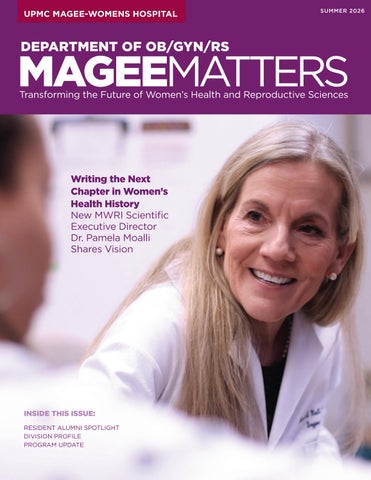
Writing the Next Chapter in Women’s Health History New MWRI Scientific Executive Director Dr. Pamela Moalli Shares Vision
INSIDE THIS ISSUE: RESIDENT ALUMNI SPOTLIGHT DIVISION PROFILE PROGRAM UPDATE
heryl Bailey Cheryl Bailey
DEPARTMENT HIGHLIGHTS
A NOTE FROM THE EDITOR
A Message from Dr. Robert Edwards Dear Magee-Womens Alumni, No matter where your career has led, you remain an important part of our legacy as a program and a specialty. In fact, our lifelong connection is one way the Magee culture sets itself apart. And it is an exciting time to be part of our community for many reasons… one of which is our cover story. As of July 1, 2026, Dr. Pamela Moalli has assumed the position as Executive Scientific Director of Magee-Womens Research Institute. Her decades of proven leadership, ongoing dedication, and ambitious vision for Magee-Womens is set to usher in a new era of women’s health research that builds upon our legacy of excellence and innovation (p. 14). With her guidance, we will continue to cultivate the combined strengths of our robust research infrastructure and world-class care to drive advancements and impact for women and families in Pittsburgh and around the world. Speaking of partnerships, various examples in this issue demonstrate the possibilities when teams across the system work together. At the Center for Medical Genetics & Genomics, a Magee-Pitt collaboration has unlocked rapid genome sequencing tests that are already saving lives of NICU patients (p. 10). Through our Ovarian Cancer SPORE program, a large, highly competitive 5-year grant program launched at Magee-Womens and Hillman in 2023, we are collaborating across sites to expand treatment options and improve outcomes for women facing ovarian cancer (p. 8). Continuing a legacy of pioneering programs centered on better treating patients with cancer, Magee’s Division of Gynecologic Oncology is combining groundbreaking research with compassionate, patient-centered care (p. 5). As one of the largest subspecialty divisions in the country comprised of many Mageetrained faculty, this team carries out the values of belonging and mutual support as it also delivers rigorous educational experiences and foundational grounding for trainees entering a new era of cancer care. With this issue’s focus on the personal connections that define the Magee culture, it seems fitting that our resident alumni spotlight features my colleague and friend, Dr. Laura Riley. Her career exemplifies the evolving opportunities by not only training at Magee but staying in touch with our network (p. 3). On that note, I encourage you to explore the stories, events, and opportunities featured in this issue and online at MageeWomens.org. Whether you reconnect with fellow alumni, attend an upcoming event, support trainee education, or simply stay tuned to what’s happening at Magee, your involvement strengthens the community that has always been at the heart of our institution. As always, we thank you for continuing to be part of Magee-Womens, and for living out the legacy we’ve built together. Sincerely,
Robert P. Edwards
Page 2
Hello, Magee alumni! I am thrilled to share our Summer 2026 edition of Magee Matters with you — an issue packed with stories and snapshots of Magee pride. Do you have a memory, story, or photo to share from your time at Magee? Or have questions about the newsletter? If so, please reach out to me at edwardsgn@mwri.magee.edu. And don’t forget to follow us @MageeWomens to get Magee news all year long! — Gina N. Edwards
IN THIS ISSUE: 3 Resident Alumni Spotlight: Dr. Laura Riley 5 Division Profile: Gynecologic Oncology 11 Program Update: Medical Genetics & Genomics 14 MWRI News 17 Residency Program Update 18 Alumni News & Events CONTRIBUTORS Magee-Womens Research Institute & Foundation Cerrina Hagood Joan McSorley Jessica Rock Jill Trimble University of Pittsburgh Dept. Of Ob/Gyn Leadership Dr. Robert P. Edwards, Department Chair Dr. Hyagriv Simhan, Vice Chair Administrative Team: Genia Andrews Cheryl Bailey Chelsea Boocks Teri Hicks Debi Hotujec Michele Nix
RESIDENT ALUMNI SPOTLIGHT
Magee-Trained, Ready for Anything
Magee alum Dr. Laura Riley reflects on the experiences that guided her work advancing maternal health and equity by Cerrina Hagood
Long before she stepped into one of the most senior leadership roles in academic medicine, Dr. Laura Riley was a resident at Magee.
“The community lasts even after you’re done. I have called fellow Magee alums to talk about cases or ask questions, and sometimes get, career advice,” she says.
Today, Dr. Riley serves as Chair of Obstetrics and Gynecology at Weill Cornell Medicine and Obstetrician-in-Chief at New York-Presbyterian/Weill Cornell, where she leads nearly 100 faculty members in a system spanning multiple hospitals, and delivering thousands of babies each year.
“At Magee, all of the faculty were truly invested in helping you become a really good doctor — the culture of teaching and helping the next generation is something that I’ve tried to foster here.”
But the foundation for that work traces back to Pittsburgh, where she trained in an environment defined by urgency, volume, and constant clinical decision-making at UPMC Magee-Womens Hospital. Though she started residency with the goal of becoming a gynecologic oncologist, immersion in the day-to-day work introduced a different perspective. “After one rotation, I realized it wasn’t for me. I figured out quickly that this is not good for my mental health,” she says. “You always have plans, you have aspirations, and then you have reality.” She began to consider other pathways and found herself drawn to obstetrics for its combination of complexity and continuity. For Dr. Riley, obstetrics offered an opportunity to manage high-risk, rapidly evolving clinical situations while also building meaningful relationships with patients. Magee’s training environment helped her develop confidence through experience in a busy, high-volume setting that required residents to learn quickly and perform independently.
She’s also working to impact major issues in the field — specifically the disparities in Black maternal health. “One of the things that was really top of mind was maternal mortality and the excess maternal mortality in Black women, which is staggering in New York City,” she says. Addressing that challenge has required coordinated action across multiple systems: “It’s one thing to write guidelines. It’s another thing to actually implement them.” Dr. Riley is also being thoughtful about hiring faculty and building care teams that reflect their patient population. She knows that the complexity of the issue will require sustained effort, adding: “It’s going to be a forever work.”
Dr. Riley
Dr. Edwards
“The first time I did things were almost always with private doctors… some of that was just the culture. It was a place where everyone invested in training the next generation,” Dr. Riley says. And the relationships she built at Magee did not end with her residency.
Page 3
RESIDENT ALUMNI SPOTLIGHT
Additionally, she continues to contribute to national conversations in infectious disease and pregnancy, including efforts to address vaccine hesitancy and improve public trust and education around vaccines and science more broadly. Now her work is entering another phase as she prepares to become Executive Director of the Women’s Health Initiative at Weill Cornell Medicine. She aims to bring together clinical care, research, and education in a more integrated way to improve outcomes through evidencebased approaches and to advance women’s health care across every stage of life. She adds that fostering collaboration across the medical disciplines that touch women’s lives is daunting but necessary to advance care and research. Reviewing medical and PA school curricula on women’s health is also on her “to do” list.
For Dr. Riley, obstetrics offered an opportunity to manage high-risk, rapidly evolving clinical situations while also building meaningful relationships with patients.
Page 4
Dr. Riley continues to draw lessons from her Magee experience shaped by unexpected turns and evolving opportunities. In guiding the next generation of students on their own paths in medicine: “I always say to people: have an open mind… the career path that I had anticipated doesn’t even exist now.” Reflecting on her own journey, Dr. Riley credits her foundation at Magee for preparing her to take on new challenges. “It’s a great place to do a residency because you get skills quickly so that when you leave, you literally can do anything.”
DIVISION PROFILE: GYNECOLOGIC ONCOLOGY
Magee’s Legacy of Cancer Care Continues in the Division of Gynecologic Oncology
Meet the Large, Multidimensional Team Advancing Cancer Care, Expanding Community Access, and Training the Next Generation of Physician-Scientists by Gina Edwards
In the early 1960s, Dr. Milton McCall pioneered advancements in surgical techniques that began the field of gynecologic oncology here at Magee-Womens Hospital. Magee’s gynecologic oncology program has grown over the last six decades, led by a lineup of esteemed Pittsburgh and national medical leaders, including Dr. Arthur Murphy, Dr. Allen Kunschner, Dr. Harry Ball, Dr. Michael Berman, Dr. Jan Seski, Dr. Herb Buchsbaum, Dr. Wayne Christopherson, Dr. Joseph Kelly, and Dr. Bob Edwards. Today’s current team of outstanding oncologists is practicing both surgery and medical cancer therapy across 14 hospitals in the UPMC system.
Building the Magee Community: Dr. Madeleine Courtney-Brooks, Former Magee Resident/Fellow When Dr. Madeleine Courtney-Brooks was doing her residency at Magee, she spent long shifts bonding with fellow trainees. She often saw the same environmental services employee at the café and exchanged greetings. Even after spending years away from Magee for her fellowship, when Dr. Courtney-Brooks later returned to the hospital for an interview, her café buddy asked her how she was doing, as if no time had passed. “It was such a simple interaction, but it was incredibly heartwarming,” she says. “It reminded me that Magee is a place where people genuinely know one another and feel they belong.” Common goals make for common friends. As director of the department’s gynecologic oncology division, Dr. Courtney-Brooks seeks to pass on the Magee culture by instilling the importance of forming connections with colleagues. “Excellent clinical training and research opportunities are important, but so are the relationships you build. Magee, my co-residents, and the hospital itself felt like a second family during what can be a very challenging period of life.” Now, Dr. Courtney-Brooks continues her clinical work while helping the group realize its vision, which encompasses excellent clinical care, cutting-edge research, and education of future ob-gyns and gynecologic surgical subspecialists.
Page 5
Evolving Ob-Gyn Education for the Times: Dr. Michelle Boisen Former Magee Resident/Fellow Magee trainees have ample opportunities to learn open, laparoscopic, and robotic surgical techniques. That’s important to Dr. Michelle Boisen, who directs surgical education, both within gynecologic oncology and outside of the specialty. Dr. Boisen aims to give back to trainees the same way others invested in her — especially given the changing nature and roles of the specialty. “We’re realizing that some of the things we were doing 20 or 30 years ago to train residents and fellows need to be reimagined,” she says. “One trainee might achieve competence in a particular skill after three years, while another might need more time. The challenge is figuring out how to operationalize that approach.” She adds the Magee model is distinct from many other large academic programs because it does not only focus on training subspecialists, but also highly-skilled, well-rounded generalists: “That’s not easy to do, and I think it’s one of the things that distinguishes our program from others of similar size and reputation.”
Outreach Care in the Community: Dr. Jessica Berger Former Magee Fellow With Magee embedded in the heart of Oakland, it could be easy to forget about the women’s health care deserts just outside of Pittsburgh. But each member of the division faculty commits to providing outreach care at a site beyond the city. “I’ve been involved in developing the ways our division delivers care so that we’re not wasteful of resources or patients’ time. Outreach is a major part of that,” says Dr. Jessica Berger, who leads operational excellence and quality improvement efforts in the division. In fact, for the last 11 years, Dr. Berger has driven two hours to Erie to provide care. “I see patients in Erie who are still driving three hours to see me. It’s mind-boggling that there isn’t care available closer to them,” she says. Particularly in Erie, the division has built a robust presence and program with their own staff so that patients can access most of their care closer to home.
Page 6
“We’re very proud of the programs we’ve built that meet patients in their communities and bring our care to them whenever possible. It helps eliminate some of the disparities we would otherwise see by helping share the burden of travel.” Division fellows are often the point of contact for these outside physicians who need access to specialized care for their patients and support the coordination of expedited outpatient follow-up visits that allow those patients to be seen by a Magee gynecologic oncologist within 72 hours. “Over six months, we’ve avoided dozens of hospital transfers while still getting patients into our system for the care they need,” Dr. Berger says. “Programs like that are where education, operational excellence, and clinical excellence all come together.”
Opening Access to Clinical Trials: Dr. Sarah Taylor Former Magee Resident/Fellow If you’ve ever been a patient, you know the importance of seeing a doctor you know and trust. But for gynecologic patients, accessing the latest treatments through clinical trials has often meant going to a new facility with an unfamiliar care team. Dr. Sarah Taylor is changing that model. In directing the Phase I Center, Dr. Taylor is figuring out ways to conduct clinical trials based at other sites within Magee. “We are thinking more holistically about how we develop a trials portfolio that offers the most comprehensive opportunities for our patients and also bridges the gap,” she says. “Being physically present and serving as that touchpoint for patients with gynecologic malignancies means we’re simply opening more opportunities for them to access care.” She is working toward bringing more clinical trials to communities beyond Pittsburgh, and emphasizes that the world of clinical trials is more complex than delivering treatment. “It’s about caring for the entire person. If someone doesn’t have food on the table, transportation to appointments, or support people who can come with them, then they’re not going to be able to access the therapies they need,” Dr. Taylor says. “If we’re not supporting people in those more basic ways, getting them onto a clinical trial becomes even harder.”
Dr. Taylor works with nursing colleagues to roll out systematic screening programs to identify patient needs beyond treatment. “Patients don’t always volunteer that information because they’re afraid that if they tell us something is wrong, it might affect their cancer treatment. That’s terrifying,” she says. “We need to take a patient-centered approach to cancer care by thinking about how we care for people as individuals.”
Trialing Tomorrow’s Treatments: Dr. Alexander Olawaiye With nearly two decades under his belt at Magee, Dr. Alexander Olawaiye has witnessed and contributed to the evolution of both the gyn-onc division and cancer care as a whole. As the division’s director of both minimally invasive surgery and gynecologic cancer research, he has helped put Magee on the national and international stage as a key research center for gynecologic cancers. Gynecologic oncology fellows at Magee complete a year of research at the start of their training — a requirement that is facilitated seamlessly by access to Magee-Womens Research Institute investigators. “There are so many researchers at MWRI doing excellent translational and bench research that these fellows can go to their labs and receive wonderful research-based education in their first year. We don’t take that for granted,” Dr. Olawaiye says, adding; “There are many institutions where, for fellows to engage meaningfully in research, they have difficulty finding researchers who can help educate them or provide that aspect of their training. We don’t have that problem. We have an abundance of that kind of resource.” Dr. Olawaiye recognizes that Magee’s reputation is owed in large to the longstanding legacy built and sustained by its alumni. “Magee obviously took many, many years to evolve into the great institution that it is today for training people,” he says. “We are grateful to those alumni for their ever-present support and for how well they continue to represent the institution wherever they are.”
GYN-ONC DIVISION BY THE NUMBERS
1 12 2 10 6 2 15-25 OF THE LARGEST GYN-ONC DIVISIONS IN THE COUNTRY
GYNECOLOGIC ONCOLOGISTS
MEDICAL ONCOLOGISTS
MID-LEVEL PROVIDERS
FELLOWS
DAILY ORS
AVERAGE INPATIENT CENSUS
Page 7
Only 5 Of These Exist in the US... And One’s in Pittsburgh Ovarian Cancer SPORE Co-Director Reflects On 3 Years of Progress & Potential Dr. Ronald Buckanovich co-directs the Ovarian Cancer SPORE, a large, highly competitive 5-year grant program that launched at Magee-Womens and Hillman in 2023. Now more halfway through its third year, the SPORE team is not only celebrating promising progress — it’s also planning for the next breakthrough.
Page 8
Magee-Womens: What is an Ovarian Cancer SPORE? Dr. Buckanovich: I came to Pittsburgh to build a SPORE, which is a collaborative grant that typically oversees three to four major projects, along with supportive cores and developmental programs. Every project connects laboratory discoveries to patients in some way. It’s translational, and that’s what I love about it. And these projects are exciting because work is truly homegrown, originating from collaborative research at the University of Pittsburgh and now moving into clinical trials. Magee-Womens: So, what projects does our Ovarian Cancer SPORE program have? Dr. Buckanovich: We have three major projects, each of which is a clinical trial focused on overcoming therapeutic resistance in ovarian cancer. Every trial also includes a strong scientific component: we collect tumor samples and blood samples to better understand why certain patients respond while others do not. Across the three trials, we’ve enrolled dozens of patients and have already seen some remarkable responses. These are often patients with very limited treatment options, so even helping a handful of individuals makes this work meaningful.
Magee-Womens: What role do patients have in the SPORE? Dr. Buckanovich: Success depends on patient participation — none of our work happens without them. Hundreds of women have contributed samples, participated in studies, or enrolled in clinical trials that made this work possible. These women agree to participate in clinical trials when there is no guarantee the treatment will help them. Their willingness to contribute during some of the most difficult moments of their lives in the hopes that other women who come after them may benefit is incredibly generous and altruistic. Magee-Womens: What’s next for the SPORE? Dr. Buckanovich: The goal is to renew the SPORE and continue developing new clinical trials. In fact, we’re already planning the next cycle. Our investigators will present ideas for future projects, which will be evaluated and narrowed down to the handful we believe have the greatest potential to improve outcomes for women with ovarian cancer. Through SPORE’s Career Enhancement Program and Developmental Research Program, we also involve and support both junior investigators and established researchers wanting to pivot into ovarian cancer research. Some of our fellows have already developed their own clinical trial concepts based on discoveries made through the SPORE. That’s exactly what these programs are designed to do — train the next generation of investigators while advancing science.
“Across the three trials, we’ve enrolled dozens of patients and have already seen some remarkable responses.”
Ovarian Cancer SPORE Projects Project 1: How Do We Make Tumors More Sensitive to Chemotherapy (and Maintain That Sensitivity Over Time)? Assess the ability of inhibitors of the epigenetic regulator EZH2 to prevent/ overcome OvCa stromal progenitor cell-driven resistance to platinum-based chemotherapy. Project 2: Can We Prevent Tumors from Becoming Resistant to PARP inhibitor Treatment? Determine whether BET inhibitors, which downregulate critical DNA repair and cell cycle checkpoint proteins, can reverse resistance to PARP inhibitors. Project 3: How can we help the immune system fight ovarian cancer? Test whether inhibitors of the hedgehog signaling pathway, which drives tumor immune exclusion, can improve OvCa patient response to immune checkpoint inhibitor therapy.
DONATE TO THE OVARIAN CANCER FUND
— Dr. Ronald Buckanovich Magee-Womens: How did philanthropy help the SPORE come to be? Dr. Buckanovich: One of the things I’m most proud of is how philanthropic support helped make this work possible. Before we received SPORE funding, we received support from the Ovarian Cancer Research Alliance and the OCRA of Greater Cincinnati. Those grants allowed us to generate the preliminary data necessary to convince the NIH that these projects were feasible and ultimately helped unlock a multi-million-dollar federal grant. Without those early investments, we would never have been able to move these ideas into large clinical trials.
Page 9
innovatio When a Snowstorm Shut Down Pittsburgh, a Magee Lab Saved the Day... And a Baby’s Life How teamwork across UPMC and Pitt built a cutting-edge genetics program by Gina Edwards
Page 10
on
PROGRAM UPDATE: MEDICAL GENETICS & GENOMICS
It’s the dead of winter in Pittsburgh. A powerful storm has covered the roads with over a foot of snow. Two babies are in critical condition in the NICU at UPMC Children’s Hospital. The patients require genetic testing to determine the best treatment... and fast. Rapid whole genome sequencing (WGS) is a comprehensive, first-tier test that can provide a diagnosis quickly enough to guide treatment when time is tight. This kind of testing usually requires sending patient specimens to external labs. But given the storm, FedEx deliveries halted, and options quickly dwindled. The clock was ticking. Physicians at UPMC Children’s called for help across the city to Dr. Fen Guo, the lab director of the UPMC Clinical Genomics Lab at Magee, which launched an in-house rapid WGS service just weeks before the snowstorm hit. She said yes. Stress Testing Clinical Innovations Despite the hazardous road conditions in the city, the blood samples arrived in Oakland at noon on Friday, January 30 via MedExpress. While genome sequencing usually takes six weeks, the two labs quickly mobilized. They worked through the weekend to complete the two STAT whole genome sequencing cases, and issued final clinical reports on Monday, February 3 — just four days later. One of the babies came back with an OTC deficiency diagnosis, a rare metabolic disorder that can cause permanent brain injury or be life-threatening without proper treatment. “Having the molecular diagnosis allowed the patient to receive more precise treatment immediately,” says Dr. Guo. “We feel incredibly proud because the patient received appropriate treatment and was discharged a couple of days later with a crisis management plan. In the future the medical team will know exactly how to manage the condition.” This is not simply a tale of healthcare heroes; it’s a snapshot of the promise and impact for patients when world class genetics research and dedication to patient care come together.
Page 11
Magee Means ‘We’ Only a handful of academic centers in the United States offer comprehensive in-house genome sequencing. Magee-Womens is one of them. “The reason we could launch clinical genome sequencing in a cost-efficient way is because we combine the strengths of both laboratories to create an end-to-end solution,” Dr. Guo says. “This distributed clinical–research model reduces sequencing costs by batching samples together.” The UPMC Clinical Genomic Laboratory (UCGL) at Magee handles sample intake, insurance billing, clinical analysis, and reporting. As a CAP/CLIA-certified diagnostic laboratory, it offers carrier screenings for OB and prenatal groups, as well as NICU and pediatric patients. UCGL’s clinical workflow relies on the high-capacity sequencing infrastructure High Throughput Genomics Core (HTGC) at the University of Pittsburgh. The Pitt lab’s powerful processing conducts the genome sequencing that generates the clinical reports that Magee’s lab delivers to patients. “Together, this collaboration enables UPMC to deliver faster, clinically accountable whole-genome sequencing with improved turnaround time and operational scalability,” says Dr. Guo. “It also models how we can expand multi-omics testing at UPMC to make it available to our patients.” While current prenatal screenings often focus on conditions like spinal muscular atrophy and cystic fibrosis, broader testing 27 or more recessive diseases is coming soon.
Page 12
“We are in the process implementing comprehensive carrier screening for all prenatal patients,” says Dr. Guo. Is this the Future of Prenatal Care? Even just 5 years ago, few insurance companies covered pediatric genome sequencing. Today, most insurers — including Medicare and Medicaid — recognize genome sequencing as medically necessary. Prenatal genome sequencing is on the same trend. That is: upward, quickly. As a high-volume medical center and world class hospital, Magee is also uniquely poised to lead human trials in prenatal gene therapy, or treating a condition in the middle of pregnancy to prevent it from worsening before the baby is born. What would that look like? Maternal-fetal medicine physician Dr. Matt Shanahan likens it to a factory conveyor belt. As we grow in the womb, proteins and sugars travel down the conveyor belt, and move through specific steps to develop. With inborn errors, the belt is either missing or broken. Prenatal gene therapies could identify the issue, and either fix the belt or help the traveling molecule bypass the breakdown. As Medical Director of Reproductive Genetics at the Magee-Womens Fetal Center, Dr. Shanahan is building a system that doesn’t exist yet, which can be challenging.
Using Genetics Testing to Help Patients Navigate Cancer Beyond obstetrics and gynecology, genome sequencing is guiding care for other patients like those of Dr. Phuong Mai, Medical Director for the Cancer Genetics program. “Genetic testing has become a major aspect of medical care over the past decade, and as technology continues to advance, it will become even more important,” says Dr. Mai.
“Ultrasounds and MRI’s are good, but it is not the same thing as having a baby right in front of you,” he says. “It’s kind of like playing poker and you have half the cards turned over, but there’s still two more to be flipped. Some diseases are going to be very, very hard to do this, but some won’t be.” While future possibilities in genetics research develop in the background, real patients’ lives — like the NICU snowstorm babies — rely on the information we can access now through current tools. At Magee’s Ultrasound Department, Dr. Shanahan helps patients understand abnormal ultrasounds and discuss treatment options. These can be tough, life-altering conversations. “No two patients are the same, no two situations are the same, and there isn’t a script. You try to meet someone where they’re at, and that can be difficult,” he says. But even with the obstacles, he’s determined to design a patient-centered process that honors the gravity of the experience. By working across departments and developing new systems, he is hoping to connect patients more quickly to pediatric subspecialists quickly after diagnosis.
She and the counselors on her team see patients who have a personal or family history of cancer for whom genetic testing should be considered in-person at UPMC MageeWomens Hospital, UPMC Hillman Cancer Center, and UPMC Cranberry Passavant, as well as virtual appointments at multiple sites across the region, and works closely with UCGL to provide testing for her patients. “One of the most meaningful parts of my work is helping people navigate the healthcare system and determine whether they are truly at increased risk for cancer,” she says. “If they are high risk, we help them understand what steps they should take. Helping clarify risk and guide patients appropriately is extremely important work.” Dr. Mai’s team also studies clinical management strategies, including surveillance, interventions, and the psychosocial aspects of living with a hereditary cancer predisposition. She says that healthcare system backing is crucial to ensure patient access: “Having institutional support for genetics programs and internal laboratories is essential if we want to continue expanding access to genetic services and improving patient care.”
“We need to build everything from the patient’s perspective,” says Dr. Shanahan. “Because it’s not only an efficient thing to do, it’s the right thing to do.”
Page 13
MWRI NEWS Leadership Philosophy
Writing the Next Chapter in Women’s Health History: New MWRI Scientific Executive Director Dr. Pamela Moalli Shares Vision
Since its humble inception in the basement of UPMC Magee-Womens Hospital in 1992, MageeWomens Research Institute & Foundation has evolved into a global recognition as a leader in women’s health research. The appointment of Pamela Moalli, MD, PhD as Scientific Executive Director of Magee-Womens marks a new era for the institution, which operates at the intersection of world class clinical care at UPMC Magee and academic excellence at the University of Pittsburgh. In her expanded role, Dr. Moalli will oversee strategic research initiatives, collaborations with academic and industry partners, and a growing portfolio of basic, translational, and clinical research programs focused on improving health outcomes for women across the lifespan.
Transformative science is achieved through collaboration, empowerment, and purpose. I strongly embrace a team science approach, recognizing that the most effective leaders do not strive to be the smartest person in the room; rather, they build diverse teams of experts whose collective knowledge, perspectives, and experiences far exceed those of any individual. By fostering an environment of mutual respect, trust, and shared ownership, I believe we can address the most complex challenges in women’s health and accelerate scientific discovery. A second pillar of my leadership philosophy is investing in people. The future of science depends on our ability to recruit, mentor, and empower the next generation of investigators, clinicians, innovators, and leaders. I view mentorship as one of our most important responsibilities and greatest opportunities. My goal is to create an environment where individuals at every career stage are supported, challenged, and provided with the resources necessary to reach their full potential. Success is measured not only by the discoveries we make today, but also by the leaders we help develop for tomorrow.
“Together, we can improve the health of the world by advancing the health of women.” — Pamela Moalli, MD, PhD Finally, I am driven by a deep commitment to advancing the health of women. Women’s health has historically been underfunded, understudied, and undervalued despite its profound impact on families, communities, and society. I believe that when we improve the health and well-being of women, we create benefits that extend across generations. This conviction serves as the foundation of my work and my vision for MWRI — to be a place where scientific excellence, innovation, and collaboration converge to improve the lives of women throughout their lifespan. As a leader, I strive to cultivate a culture that values scientific rigor, inclusivity, innovation, and collaboration, while never losing sight of the ultimate purpose of our work: generating knowledge that improves human health and creates meaningful impact for women and their families.
Page 14
v
vision Strategic Vision:
Each research group plays a distinct yet interdependent role in the continuum of discovery, application, and impact. This strategically integrated model accelerates innovation, enhances funding competitiveness, and improves our value and recognition as leaders in women’s health. Five key goals will guide the actions to realize this vision: 1. Position MWRI as the premier global institute for women’s health research
Integrate clinical, translational, and basic research built around core services and break down silos to establish interdisciplinary research groups organized by thematic interests and guided by a team science approach. Elevate visibility of MWRI scientists and innovators through speaker circuits, whitepapers, conferences, community and industry partnerships, health system messaging, and presence in earned and social media. Expand beyond reproductive biology into other pressing challenges in women’s health: aging, autoimmune disease, cardiovascular health, musculoskeletal diseases, and brain health.
2. Grow and maintain the pipeline of committed investigators Expand and diversify MWRI’s investigator base (e.g., early-career physician-scientists, PhD scientists, and entrepreneurial researchers); recruit strategically around high-impact areas like reproductive longevity, perinatal programming, and innovation in therapeutics. Cultivate a culture that values contribution by growing mentorship networks, investing in cores, and advocating for equitable promotion pathways. Support robust faculty career development programs for both rising and established investigators; expand funding for training opportunities at MWRI; use “grow our own” approach to identify and develop rising stars.
4. Advocate for the health of women and girls in our communities Engage with women and patients in City of Pittsburgh and surrounding communities via social media channels, Department of Ob/Gyn Women’s Health Podcast, MWRI-sponsored events, in-person and virtual “Behind the Science” tours, and sponsored events like (e.g., P3R Marathon Charity Runners, Pink the Pete, Women Who Rock benefit concert). 5. Support employee wellness Address burnout, mental health and wellness curriculum, promote wellness activities, support physicians through challenging periods of low funding, and engage in social activities.
3. Diversify funding portfolio Pursue larger grants and funding via NIH (e.g., P01, U01, RM1); Federal organizations (e.g., DARPA, DOD, NSF, AHRQ, PCORI); Industry, Biotechnology, and Femtech sectors; and Intramural (Pitt Momentum, Pitt Seed, CMI, CTSI); outside Foundations. Grow the MWRI Institutional funds (e.g., Women’s Health Discovery Fund, Cancer Funds, Young Investigator Fund, Bridge Funds, Trainee Funds).
Page 15
MWRI NEWS
CEO Michael Annichine Highlights Latest News As we welcome Dr. Moalli into her new role as our Scientific Executive Director, we look forward to continued collaboration in building the future of women’s health research.
Obstetrics & Gynecology Resident 2025 Graduates Nicole Fischer, MD, MPH Reproductive Endocrinology & Infertility Fellow, UPMC Magee-Womens Hospital, Pittsburgh, PA
New Memorandum of Understanding, $25 Million Investment in Women’s Health
Margaret Flanigan, MD Gynecologic Oncology Fellow, UPMC Magee-Womens Hospital, Pittsburgh, PA
Under an updated agreement designed to simplify and modernize our partnership while strengthening women’s health research across the institution, the University of Pittsburgh will assume responsibility for research administration and grant management. MWRIF will continue to operate as an independent foundation focused on raising, stewarding, and investing philanthropic resources to support transformative research and innovation.
Alexa Henderson, MD Maternal-Fetal Medicine Fellow, UPMC Magee-Womens Hospital, Pittsburgh, PA
This transition positions us to streamline operations, strengthen research infrastructure, expand mentorship and training opportunities, recruit promising early-career researchers, diversify funding sources, and build the interdisciplinary collaborations needed to address the most pressing challenges in women’s health. Most importantly, it allows both organizations to focus on their greatest strengths while remaining united by a common mission. Together, Pitt and MWRIF have committed $25 million in general research funding for women’s health over the next 5 years, plus an additional $18 million over the next 3 for recruitment and operations; reinforcing our shared commitment to growing this field and supporting the next generation of investigators. Brenda Psotka Named MWRIF Executive Director of Development I am also delighted to announce the promotion of Brenda Psotka to Executive Director of Development for MageeWomens Research Institute & Foundation. Brenda has been an exceptional leader within our development team for nearly three years, building meaningful relationships with our supporters, strengthening fundraising initiatives, and helping advance our mission through her dedication and expertise. With more than three decades of experience in the nonprofit sector and a proven record of leadership, Brenda is uniquely positioned to guide our fundraising efforts into an exciting new chapter. In her new role, she will lead strategic fundraising initiatives across Magee-Womens Research Institute & Foundation, the Department of Obstetrics, Gynecology and Reproductive Sciences, and UPMC Magee-Womens Hospital, helping secure the resources needed to accelerate breakthroughs in women’s health. With Brenda’s leadership and this renewed framework for collaboration, we will build on that legacy and accelerate progress for generations to come.
Page 16
Carly O’Connor-Terry, MD, MS Obstetrician Gynecologist, Assistant Professor, West Virginia University Medicine Natalie Shovlin-Bankole, MD Maternal-Fetal Medicine Fellow, Columbia-New York Presbyterian Hospital, New York, NY Sarah Smith, MD Obstetrician Gynecologist, Associate Professor, Lexington Women’s Health, Axia Women’s Health, Lexington, KY Margaret Starcher, MD, MPH Obstetrician Gynecologist, Assistant Professor, UPMC Washington Hospital, Washington, PA Anna Weimer, MD, MPH Gynecologic Oncology Fellow, UPMC Magee-Womens Hospital, Pittsburgh, PA Hannah Wichmann, MD, MPH Minimally Invasive Gynecologic Surgery Fellow, UPMC Magee-Womens Hospital, Pittsburgh, PA
Fellow Graduates Maternal-Fetal Medicine Laura Brubaker, MD, MPH Assistant Professor, Division of MFM Carrie Bennett, MD Assistant Professor, Division of MFM Rosemary Shay, MD Faculty, Maternal-Fetal Medicine Gynecologic Oncology Mackenzy Radolec, MD Faculty, Gynecologic Oncology Division Sarah Bell, MD Assistant Professor, Division of Gynecologic Oncology Reproductive Endocrinology & Infertility Roy Handelsman, MD REI Specialist, HRC Fertility
RESIDENCY PROGRAM UPDATE
Complex Family Planning
Mackenzy Radolec, MD 09/01/2025, Gynecologic Oncology
SREI Award Gabrielle LeBlanc, MD
Margaret Starcher, MD 08/01/2025, Washington
SOGH Award Jessica Eskridge, MD
Mark Bucsek, MD 02/01/2025, University Ob/Gyn (UOG)
SASGOG Resident Award Margaret Starcher, MD
Marianne Wizda, MD 01/01/2025, Washington Hospital
SMFM Award Margaret Mahoney, MD
Coralee Toal, MD Assistant Professor
Nicole Fischer, MD 06/21/2025, University Ob/Gyn (UOG)
ASCCP Award Nat Jones, MD
Additional Fellowship Training
Nicole Garcher, DO 01/01/2025, Washington Hospital
Spirit of a Midwife Award Natalie Shovlin-Bankole, MD
Nicole Henry, CNM 02/23/2025, Womancare South
Resident Departmental & Research Awards
Nina Ragunanthan, MD 10/01/2025, University Ob/Gyn (UOG)
Crombleholme Award Resident: Jessica Eskridge, MD Faculty: Kristiina Parviainen, MD
Amanda Lacue, MD Assistant Professor Urogynecology & Reconstructive Pelvic Surgery Erin Elizabeth Mowers, MD, PhD, MSc Professor of Clinical Obstetrics and Gynecology
Cynthia Pathmathasan, MD Family Physician Marwa Daghsni, PhD Assistant Director, Cytogenetics Laboratories Megan Howard, MD MIGS Specialist
Rim Abou Chakra, MD 09/01/2025, Washington
Dina Abdelsamad, MD Generalist
Sarah Richina, MD 07/01/2025, Midlife
Laila Younes, MD Family Medicine Physician
Shannon Varga, DO 08/01/2025, Hamot
New Hires
Retirees
Bart Matson, DO 09/01/2025, Altoona
James Garver Womancare North
Carrie Bennett, MD 09/01/2025, Maternal Fetal Medicine
Ira Abramowitz Horizon
Caroline Snyder, CNM 03/23/2025, Womancare South
Robert Collins Reproductive Endocrinology & Infertility
Coralee Toal, MD 09/01/2025, Urogynecology
Theodore Hovick Altoona-Bedford
Cristina Young, MD 08/15/2025, University Ob/Gyn (UOG)
Renata Hoca Ob/Gyn Associates of Pittsburgh
Elizabeth Campbell, MD 09/01/2025, University Ob/Gyn (UOG)
Resident Awards
Emma Pindra, MD 10/01/2025, Greater Pittsburgh Ob/Gyn (GPOB) Hayley Button, CNM 03/09/2025, Horizon Jessica Bhandari, DO 08/01/2025, Womancare North Kathryn Schmiech, MD 09/01/2025, Reproductive Endocrinology & Infertility
RSGO Award Gabrielle LeBlanc, MD Ryan Program Award Nat Jones, MD Junior FP Award Savannah Tollefson, MD AAGL Award Kara Skjoldager, MD SLS Award Hannah Wichmann, MD
Laura Brubaker, MD 09/01/2025, Maternal Fetal Medicine
AUGS Award Kristiana McLarty, MD
Laura Sproat, MD 02/01/2025, Womancare East
NASPAG Award Margaret Mahoney, MD
Margaret Scearce Award Savannah Tollefson, MD Morris Turner Award Hannah Wichmann, MD Marvin C. Rulin Research Award Belita Opene, MD
Faculty & Fellow Awards CREOG National Faculty Award Malay Sheth, MD OPC Faculty Teaching Award Erin Rhinehart, MD SASGOG Faculty Award Erin Rhinehart, MD Wayne A. Christopherson Award Sarah Allen, MD Fellow Teaching Awards GYN: Megan Howard, MD OB: Praveen Ramesh, MD
Teaching Awards APGO Excellence in Teaching Erin Rhinehart, MD APGO Humanism in Teaching Pritha Workman, MD
Resident Teaching Awards Zoe Kibbelaar, MD Margaret Mahoney, MD Belita Opene, MD Sarah Smith, MD
Fellow Teaching Awards Sarah Bell, MD Praveen Ramesh, MD
Page 17
ALUMNI NEWS & EVENTS
Magee Alumna Dr. Ragunanthan (’12) Receives Impact Award Drs. Nina & Braveen Ragunanthan are the inaugural recipients of the Mark Laabs Impact Award. Guided by a simple but powerful conviction, “know your values, and big decisions become small decisions,” the couples made a choice few would. With their 21-day-old daughter, they moved to the Mississippi Delta, returning to a community they had first encountered as students. There, in one of the most medically underserved regions in the country, they became two of the only physicians serving their area. Together, their work extends far beyond clinical care: they are training maternal health workers, expanding access to critical resources, and mentoring the next generation of leaders. Their impact reflects the legacy of Mark Laabs: one rooted in principled and courageous leadership. 50th Alumni Day Recap The 50th Annual Alumni Day brought together the Magee ob-gyn community in person and through Microsoft Teams, creating space for connection across generations of trainees and faculty. The program recognized milestone reunion classes from 1975, 1985, 1995, 2000, 2005, 2015, and 2020, celebrating both individual journeys and the shared impact of Magee training. The event served as a meaningful opportunity to reflect on the program’s legacy while reconnecting with colleagues across the field.
Exploration of the vein to vein blood transfusion system in three Kenyan counties: a qualitative study Recently featured in The Lancet Global Health, a new publication from Dr. Jennifer Makin brings critical attention to the structural challenges shaping blood transfusion systems in Kenya. With in-depth qualitative research across Siaya, Nakuru, and Turkana counties, Dr. Makin and collaborators examine the full blood transfusion continuum, identifying fragmentation between collection, storage, and distribution as a key driver of shortages. The study covers widespread supply-demand mismatches, resource limitations, and the continued reliance on family replacement donors. All of which contribute to delays in emergency care and increased burden on health-care systems.
Page 18
CONNECT WITH US
Community Events 2026 Pars for Postpartum July 27, 2026 Edgewood Country Club, Pittsburgh, PA Presented by UPMC Health Plan 18 championship holes and a day on the course in support of the postpartum depression program at UPMC Magee-Womens Hospital. 2026 Pittsburgh Penguins Alumni Association’s Cast for a Cure August 13-14, 2026 HomeWaters Club, Spruce Creek, PA Two days of fly-fishing competition with Pittsburgh Penguins Alumni. Proceeds benefit the Nicole Meloche Breast Cancer Fund at Magee-Womens Research Institute. 2026 Women’s Cancer Research Center Fly Fishing Classic Sep 3 - Sep 4, 2026 HomeWaters Club, Spruce Creek, PA Presented by Williams A two-day fly-fishing competition on the beautiful waters at HomeWaters Club. Proceeds benefit the Women’s Cancer Research Center’s efforts in advancing medicine for women’s cancers. 2026 Alumni Day Save the Date Reception – Thursday, October 15 Program – Friday, October 16
SHOW YOUR SUPPORT Interested in supporting residents, fellows, and programs at Magee-Womens? Contact Jessica Rock at rockjj2@mwri.magee.edu or 412-641-4008.
JOIN OUR MAGEE ALUMNI EMAIL LIST Help us keep you informed! Please join our email list to stay up to date on the great things happening at Magee-Womens. To get on the list, email Jessica Rock, rockjj2@mwri.magee.edu or call 412-641-4008.
FOLLOW AND SUBSCRIBE
@MageeWomens @mageeobgynresidency MageeWomens.org/Newsletter
GIVE BACK TO MAGEE-WOMENS Your donation supports our commitment to advancing lifesaving women’s health research and patient care, paving the way for the next generation of fellows and residents at UPMC Magee-Womens Hospital.
MageeWomens.org/Alumni-Giving
Three ways to give. So many lives to touch. Bequest – You can remember Magee-Womens through your will. IRA – Name Magee-Womens as a beneficiary on a retirement account. Charitable Remainder Trust – Create an income stream for your life while also making a gift to Magee-Womens.
There are many other gift options to choose from, including life insurance, gifts of real estate, and gifts of stock. For more information about making a meaningful gift to Magee-Womens, contact Jessica Rock at rockjj2@mwri.magee.edu or call 412-641-4008.
204 Craft Avenue Pittsburgh, PA 15213
PITTSBURGH PERMIT NO. 1212
PAID NONPROFIT ORG U.S. POSTAGE