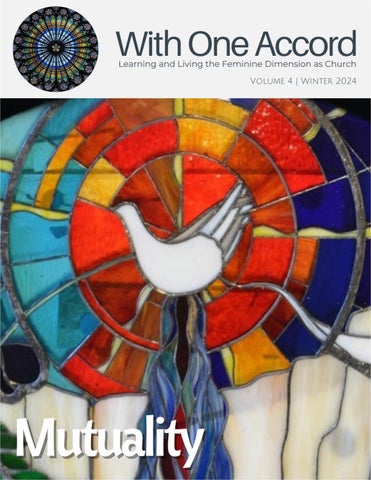
With One Accord
Mutuality Volume Four, Issue 1
Winter 2024
CONTENTS EDITORIAL Lucinda M. Vardey CLERGY AND LAY IN A SYNODAL CHURCH Valerio Mauro OFM Cap. THE MAGDALA INTERVIEW: ON SPIRITUAL FRIENDSHIP Emily VanBerkum with Susan Muto COSMIC MUTUALITY AND ECOLOGICAL ETHICS Dawn M. Nothwehr O.S.F. INNER MUTUALITY: A PASSAGE TO HOLY LOVE Lucinda M. Vardey TOGETHER, NOT ALONE John Dalla Costa GOVERNANCE AND LOVE: MUTUALITY IN WOMEN’S LEADERSHIP Maria Rita Cerimele BOOKS OF INTEREST Emily VanBerkum
www.magdalacolloquy.org
1
Editorial Mutuality has been recommended in the feminist discourses over recent decades as the only way for equality to be fully embraced by the Church. American Franciscan, Dawn Nothwehr OSF states in her article that mutuality is recognized as “morally normative” that it “functions as a corrective to any form of love and justice.” Mutuality is not the same as complementarity, a term commonly used to mean equality among the people of God. Complementarity French theologian, Anne-Marie Pelletier emphasized (in an earlier issue of this journal on the subject of Community) “only reiterates traditional hierarchical inequality” and contributes to an erasion of the fullness of being human, either as a man or woman. It is through the understanding and practice of mutuality that we can begin to experience the grace of synodality. As we enter more deeply into the synodal process this year—and with Pope Francis’ call for greater “co-responsibility” in the Church’s evangelizing mission— mutuality as a reciprocal relationship between Jesus and oneself and two or more people, has at its core the principles of caring, sharing and co-operation. In this issue we address some prominent matters in relationships affecting our Church and world, as well as giving examples of mutuality in action. These include advancing respectful spiritual f riendships between clergy and lay. The Magdala interview with Susan Muto introduces the various mutual f riendships with Christ and another that have offered many gifts to the Church and Christ’s mission over the centuries.
2
Mutuality between God and humanity is explored in regards the cosmos and ecology as well as in God’s plans for human partnership in overcoming loneliness. Identified in 2023 as the prominent disease of the west by the World Health Organization, loneliness was earlier designated by Mother Teresa as the western world’s greatest poverty. Mutuality is also evident in the inner process of the heart as conveyed by 13thcentury Flemish Cistercian mystic, Beatrice of Nazareth, and which informed one woman’s style and example of leadership in the Focolare Movement. We conclude with a book review by our associate editor on the role of the laity. Lucinda M. Vardey Editor
“Diversity is necessary; it is indispensable. However, each sound must contribute to the common design. This is why mutual listening is essential: Each musician must listen to the others.” Pope Francis
(In the address for the consistory for the creation of new cardinals, sept 30, 2023).
www.magdalacolloquy.org
Valerio Mauro OFM Cap was born in Mazara del Vallo in 1956, but raised in Florence. He became a Franciscan Capuchin friar in 1982 and was ordained a priest in 1988. After receiving a licentiate in dogmatic theology from the Pontifical Gregorian University in Rome, he has taught theology and served two terms as the Provincial Minister for the Capuchins in Tuscany. From 1997 he has lectured on Sacramental Theology at the Theological Faculty of Central Italy, and as a member of the Italian Theological Association has also served on its Presidential Council. In between his teaching posts he ministers as a parish priest. His additional interests include art and ecumenical/ interreligious dialogue.
Clergy and Lay in a Synodal Church Valerio Mauro OFM Cap Combining the different interpretations of synodality, including those from the International Theological Commission’s document on the subject, it seems to me that the synodal process, on which Pope Francis has initiated the Church’s journey, unfolds within three intersections: events, structures and style. Events, such as an inaugural celebration of combining a diocesan synod or, more simply, a parish assembly, situate the proceedings of a community in a precise time and place. Synodal structures have a wide range of possibilities and implementations, from pastoral councils to economic councils to assemblies at both the parish and diocesan levels. In the current context, synodal structures are being increasingly transformed in order to open them to wider use in the various components of ecclesial structures. Under Pope Francis’ direction, lay men and women have been invited to participate in a greater way with the various other bodies of the Apostolic See. What seems clear is that the fundamental elements at every level of the whole process, are carried out in a synodal style, without which any possible event and structural change would lose its dependability and effectiveness. A synodal style, then, while truly lived and shared at every level, gives rise to an environment inspired totally by Gospel values in all their radicality. If we look back at history, and consider the processes that have most marked concrete developments in the Church, relationships were key between the people of God, especially those of laity and clergy. Holding firm to the fact that ordained ministry is an essential and constitutive element of ecclesial reality, the call that arises from today’s experience is that of the dialogic style that drives relationships between ordained ministers and the laity. In this, there’s a need for mutual recognition of charisms, and a deep communion of Spirit. After all, in order for this idea to have apostolic root, we need only to take seriously what is written in the letter to the Christians of Ephesus: “[Christ] gave some to be apostles, some to be prophets, some to be evangelists, and some to be pastors and teachers, in order to prepare the brethren for the work of ministry (literally: diakona) for the purpose of building up the Body of Christ, until all of us come to the unity of the faith and of the knowledge of the Son of God, to maturity, to
www.magdalacolloquy.org
3
the measure of the full stature of Christ” (Eph 4:11-13). The building up of the Body of Christ takes place through the diakonia (the work of ministry) of the whole people of God, in whose service Christ has arranged a variety of ministries, all related in some way to the proclamation of the Word. This Gospel Word, once again, must be sown in the field of the world so that tended and protected, it may bear fruit towards the fulfillment of the Kingdom.
MUTUAL INTIMACY We are going through an epochal change without having any map to guide us on the way except the Word of God, which questions and enlightens us as we continually move from life to the Gospel and from the Gospel to life. This movement forms a hermeneutical circle that is as necessary as it is delicate. Taking seriously what I have just written, I’ve had it confirmed during the last ten years of pastoral and academic ministry, how fruitful interaction between laity and ministers can be. I recall the many families with whom I shared a life journey of mutual listening. How wise were their judgements of the present moment, how well-founded their needs and concerns, how exhausting and joyful, at the same time, was their witness of faith! This sharing by mutual esteem shaped my ministry, molding it into a way of service formed less and less by theory, and more and more by lived experience. My life as a minister was to come into deep “contact” with theirs. Here I’d like to emphasize the bodily dimension present in every encounter, a singular, intimate sense that has bred reciprocity: when we touch we are touched. Something happens in that intimate proximity, so much so that we can claim that “He touched my heart.” Jesus himself lived in the fullness of contact with women, men and children. He touched to heal, to restore life, to enter into communion, into that very special communion that is friendship. Friends live by mutual intimacy and contact. How a particular person enters and touches your heart is how you understand that friendship is a gift from heaven, of which you become aware only when it has taken root in your innermost being. Friends the Lord has called us (cf.Jn. 15:15).
THE EXISTENTIAL HEART The process of becoming a synodal Church, to be truly that of a field hospital invoked by Pope Francis, requires more than changes in structures, broadening participation and co-responsibility in decision-making—however necessary and urgent all this is. The new
4
www.magdalacolloquy.org
style we need lies in the capacity for deep, warm, intimate friendships within individual church communities. I do not delude myself into thinking that every situation is irenic (i.e. aimed at peace and reconciling differences). All community life is steeped in conflicts, where differences in attitudes, ideas and goals show it to be a place to experience and live the complexity of living with the Gospel as leaven. But right here lies the opportunity for a witness of faith for the world, in the common sacramental foundation of baptism and the gift of the Spirit. What is referred to as the common priesthood, the first and fundamental participation in Christ’s priesthood, I’ve also experienced through theological reflection. The expertise of lay people in this area is increasingly worthy of attention, and needs to be listened to. Participating in many conferences and congresses of the Italian Theological Association, I have had the joy of meeting many sisters and brothers through the intellect as well as the existential. Admiration for the acuity and depth of their thinking became mutually combined with esteem for their lives, especially when dedicating themselves to the study of the Word in academic environments that were not always favourable. If I may be permitted a final thought: to get to the existential heart of the synodal journey proposed to the Church, I believe we are faced with a call to build bonds of friendship between men and women, towards creation, within the Church and with God.
Aelred of Rievaulx wrote about spiritual friendship. He saw in dedicated friendship the fulfillment of humanity and a translucent reflection of the mystery of God. For Deus est amicitia (God is love) as derived from 1 Jn. 4:16 in light of what the Lord Jesus said, “there is no greater love than to lay down one’s life for one’s friends” (Jn. 15:13). The Eucharist is the focal reference of this call to celebrate each Sunday. It is the symbolic act of a Church gathered in synodality. The Eucharist immerses us each time in that great desire of Jesus to eat the Passover with his friends (Lk 22:15).
www.magdalacolloquy.org
5
Susan Muto is Executive Director of the Epiphany Association and Dean
of its Academy of Formative Spirituality in Pittsburgh, Pennsylvania. As a frequent contributor to scholarly and popular journals, she has authored and co-authored more than forty books. She lectures nationally and internationally on the treasured wisdom of the Judeo-Christian faith and formation tradition and on many foundational facets of living human and Christian values and virtues in today’s world. Honoured with a lifetime achievement award in 2009 by the Catholic Historical Society of Western Pennsylvania, she is also the recipient of the 2014 Aggiornamento Award from the Catholic Library Association. Her most recent book is “Formation for the Spiritual Life: Questions and Reflections for Today’s Christian” published in 2023 by The Teresian Press. Her previous book “A Feast for Hungry Souls: Spiritual Lessons from the Church’s Greatest Masters and Mystics “ won the 2021 first-place award for Spirituality from the Catholic Media Association.
Emily VanBerkum is Associate Editor of With One Accord. For more information on her background, please visit our website.
On Spiritual Friendship Emily VanBerkum in conversation with Susan Muto
6
www.magdalacolloquy.org
Dawn M. Nothwehr OSF is the Erica and Harry John Family Professor of Catholic Theological Ethics at Catholic Theological Union, in Chicago, Illinois. A leading Catholic environmental ethicist, she is a consultant for the Laudato Si’ Encyclical Working Group of the Office of Human Dignity of the Archdiocese of Chicago. Her research and teaching address a variety of issues in environmental ethics, ethics of power and racial justice, and fundamental moral theology, through the lens of Franciscan theology. Of equal concern is the religion/science dialogue. She was a Project Leader for AAAS-DoSER Grant that enabled the CTU Faculty to integrate the science / religion dialogue in theology and ethics courses. She currently serves as grant proposal evaluator with AAAS-DoSER, a program that offers support for theology schools, enabling them to include the science/ religion dialogue in their curriculum. Her most recent book is “Franciscan Writings: Hope amid Ecological Sin and Climate Emergency” (London, Bloomsbury, 2023).
Cosmic Mutuality and Ecological Ethics Dawn M. Nothwehr O.S.F. One of the finest minds to study the Creator’s cosmos was that of Scottish priest and Franciscan friar, Bl. John Duns Scotus (1266-1308). In his work, The Treatise on God as First Principle, he reviewed the vast array of creation and asked: what is the nature and the cause of all that has been produced here? Scotus then worked back to discover the primary and the efficient cause, which he called God, the First Principle.1 Scotus also concluded that God did not have to create anything and is absolutely free as well as absolutely necessary.
have become incarnate even if Adam (humans) had not sinned.3 The Incarnation was God’s free and eternal decision to have (outside God’s self) someone who could love God perfectly. Understood in this way, the Incarnation is a paradigm for human beings to be partners with God in the ongoing co-creation and co-redemption of the world.
Even though we may realize that our life source is God, we know only our side of the God-human relationship. Scotus’ principle of haecceitas (meaning individuation or “thisness”) establishes mutuality as a relationship among distinct beings.2 Scotus draws attention to the sacredness of each cosmic element. God embraces everything and everyone, including the natural and the imperfect.
Mary Elizabeth Ingham C.S.J. wrote that “Mutuality between God and humanity was foreseen from eternity, begun in the Incarnation and is to be fully realized in the future when Christ will be ‘all in all.’ The summit of creation is the communion of all persons with one another and with God... Christ is the very person in whom human and divine achieve mutuality.”4
INCARNATION Scotus maintained that the Word would
Because of the Incarnation, humans are ecologically challenged and empowered to play a Christ-like role in the cosmos; to love God in God’s self and in the entire cosmos,
www.magdalacolloquy.org
7
God’s self-expression. Because the entire cosmos resembles Christ, “the firstborn of all creation,” (Cf. Col 1:15-19) we must cherish creation as we reverence Christ.
MUTUALITY AS A CORRECTIVE AND COMPLEMENTARY NORM Today’s “climate emergency” poses questions of relationship and survival that are ultimately questions of power. Mutuality was earlier recognized by feminists as morally normative.5 Feminists distinguished between “power-over”—being acted upon and controlled; and “power-with”—a side-by-side relationship. American feminist theologian, Carter Heyward wrote that “Using power-with is good. Using power-over is evil.”6 In the Roman Catholic ethics tradition (from Aquinas) power relationships have been understood within an ethical framework of the formal norms of love and justice. Indeed, throughout the canon of scripture, love and justice are viewed as coordinates of the same plane. As theologian and ethicist, Daniel C. Maquire explains “Sow for yourselves justice and reap the fruit of steadfast love” (Hos. 10:12). The dichotomy between love and justice is spurious. The two are naturally related. Justice goes before love, insisting on the minimal prerequisites for survival. But then it makes common cause with love upon discovering that surviving without thriving is not surviving at all.”7 It is precisely in considering what constitutes “thriving” that the need arises for mutuality to be the formal norm. Mutuality is about “the sharing of ‘power-with’ by and among all parties involved in a relationship that recognizes the wholeness and particular experience of each participant toward the end of optimum flourishing of all.”8 Generally, mutuality functions as a corrective to any form of love or justice, limiting power dynamics to “powerwith.” Mutuality limits “justice” to whatever constitutes a holistic thriving and moves love beyond mere sacrificial demands to a shared, agreed upon relational partnership. Mutuality characterizes the life of the Trinity. It typifies the relationships Jesus embraced in his earthly ministry and the Reign of God. It has deep roots in the Franciscan tradition and the Christocentric origin of creation and the primacy of Christ, placing humans in constant relationship with God and the entire cosmos, setting the dynamic of “power-with” in place.
MUTUALITY AND THE COSMOS Like love and justice, there are many manifestations of mutuality in various realms of relationship be they of gender, generativeness, social, and cosmic. Cosmic mutuality is found in relations between God and the whole of creation. Similarly, humans are commonly related to everything in the entire cosmos by virtue of their relationship with God. “Cosmic mutuality is the sharing of ‘power-with’ by and among the Creator, human beings, all earth elements, and the entire cosmos in a way that recognizes their interdependence, and reverences all.”9 The sciences, e.g. astrophysics, ecology, and quantum physics, attest to the interrelatedness of the cosmos and harmonize with the feminist assertion of “our bodies, ourselves,” meaning the beauty and value of humans, particularly women as physical beings. The Franciscan charism upholds orthodox panentheism – “God in the world and the
8
www.magdalacolloquy.org
world in God.” If we acknowledge the kinship of creation, then we must extend the “love of neighbour” commandment to all of creation. All creation is good and thrives in mutual relationships. The Incarnation is the root of relationships within the entire cosmos. Scotus’ notion of haecceitas (individuation or thisness) not only defines individuality, but also points to the aspect of each element being known only to God. “Thisness” then is enhanced by the Incarnation insofar as all are joined to and in the One who fulfills God’s hidden plan (Cf. Eph. 1:3-10). Cosmic mutuality is vital for ecology in this time of “Climate Emergency.” As moral agents, human beings must deal concretely with all creation – not only humankind but planetary life of all kinds—plant life, animal life, flora and fauna etc. It requires exerting the dynamics of “power-with” with all the elements involved. Cosmic Mutuality turns our attention to act for the thriving of all creation. Consideration needs to be extended to the historical consequences of our actions. In short, it demands honesty and integrity for the good of all God’s creation. We can no longer construe ourselves to be the sole brokers of “power-over” all others. Rather, we must embrace the stance of cosmic mutuality, “the sharing of power-with by and among the Creator, humans, all earth elements, and the entire cosmos in a way that recognizes their interdependence and reverences all.”10 Notes to be found on page 20.
www.magdalacolloquy.org
9
Inner Mutuality: A Passage to Holy Love Lucinda M. Vardey Lucinda M. Vardey is the editor of With One Accord. For more on her background please visit our website.
“It is the desire of the good soul to faithfully serve and piously imitate—and truly love—Our Lord.” Beatrice of Nazareth In our Church’s tradition we have many female exemplars of the inner mutuality evidenced in mystical life. Some of them have left us invaluable documentation of their experiences with purification, illumination and union with Christ. The most famous of these is undoubtedly Teresa of Avila’s Interior Castle. Three hundred years prior to Teresa, Flemish Cistercian, Bl. Beatrice of Nazareth (1200-1268) penned The Seven Ways (or Stages) of Holy Loving which is one of the earliest works of mystical prose in the Church, and one of the first recorded works in the Dutch vernacular. What we know of Beatrice comes from a Latin biography Vita Beatricis written after her death by an anonymous Cistercian cleric, who gathered information from Beatrice’s own writings and f rom one of her sisters who lived at the same monastery. Beatrice was born at Tienen (in presentday Belgium) the sixth and youngest child of
10
devout parents. After her mother died when Beatrice was seven, her father entrusted her to a group of Beguines in a nearby town in order “to make progress in the virtues.” After a year, and desiring monastic life, Beatrice became an oblate with nearby Cistercians where her father held the position of general manager. At fifteen she entered the novitiate, and after making her profession, her father and two brothers and two sisters, joined the community as lay associates. Beatrice developed a close friendship with an older nun, Ida of Nivelles, who recognized her giftedness. In addition to being adept at copying manuscripts, Beatrice, although physically not very strong, displayed much spiritual wisdom. In a later biography of her we read that Ida recommended Beatrice to “carefully empty your heart of anything superfluous and prepare it to be an acceptable place for divine grace.”1 Her interior passage took many circuitous routes, but eventually she records her progress in The Seven Stages of Holy Loving “which come from on high and return to the most high.”
STAGES IN HOLY LOVING The first stage Beatrice calls “Orderly Love,” requiring the examination towards self-knowledge: “Its heart never rests from inquiring and entreating and learning and drawing to itself and retaining whatever can help or bring the soul towards love.” The second stage requires living without confines or structures, the soul assuming a sort of organic disposition devoid of the effects of ego or plans, preconceptions and agendas.
www.magdalacolloquy.org
She just humbly serves the Lord with no rewards of grace or glory for herself except the Divine’s “good pleasure.” This brings her to the third stage where love is tested, where she lacks any interior consolation or peace and life becomes a struggle. She writes “It is a great pain that she desires what she cannot obtain.” After this lonely, aimless experience, the fourth stage brings many gifts of grace through no efforts of her own. She feels “a great closeness to God” and “an intense embrace” of the presence of God. Her heart melts and she receives many visions. From this experience of delight and union, she is led to the fifth stage where despair and delight co-exist and work together causing her much restlessness and “a deep dissatisfaction.” She realizes that she is called to love God with her whole mind, heart and soul even when unable to do so due to physical sickness. She sees her weakness as bodily purgation to help her soul be cleansed “and washed interiorly.”
“For the very thing that tortures her and gives her the greatest suffering makes her whole and what wounds her most deeply is the source of her greatest relief.” Being transformed by God through suffering, Beatrice refers to the “Divine Severity” that purged her not only of her temporal afflictions and obstacles of the flesh, but the possibilities of future faults. Now she enters the sixth stage of holy loving, “higher knowledge” filled with “a divine power, a clearer purity, a spiritual sweetness, an enviable freedom and a delicious equality with God.” This state is one that Beatrice
realizes is “the beginning and foundation of everlasting life.” Even though the sixth stage would seem to be the final, a seventh “the highest state attainable” Beatrice writes is that of hope without question. Hope absorbs the soul into perpetual love “in the sweet company of the highest spirits.” While desiring “to enjoy Jesus’ presence forever,” Beatrice feels imprisoned by not yet arriving at her resting place with him and yet, at the same time, feeling she doesn’t belong to the world. But she reminds herself that she mustn’t forget she is in exile. This exile calls her to live in hope through the hardships of life, a hope that she will endure what needs to be endured to reach her refuge and her home. Her body dwells on earth but her whole mind dwells in heaven.
THE FINAL YEARS AND BEYOND Elected the first Prioress in 1236 of a new Cistercian monastery called Our Lady of Nazareth—suggested and built by her father—Beatrice moved in with her two lay sisters, Christine and Sybil, along with a few nuns and her brother and father. Here Beatrice documented many other spiritual experiences, including witnessing the fire of Divine Love and feeling it burning within her heart. She grew in her prayer life to such an extent that love poured out of her. Visitors to the monastery were healed or consoled, as were animals and birds in its vicinity. Our Lady of Nazareth flourished under Beatrice’s guidance for 32 years. It was during
www.magdalacolloquy.org
11
Christmas 1267 that she became ill with what she identified as “the fever of love” which was to take her to her heavenly home seven months later. She was buried in the ambulatory of the cloister between the Church and the Chapter of her monastery. The monastery continued to prosper until 1797 when it was forced to close during the French Revolution. It remained abandoned even after the Belgian Revolution in 1830 (when Belgium gained independence from the Netherlands). It was only in the early 20th century that it was resurrected—on a new site at Brecht. Brecht Abbey also carries the original name of Our Lady of Nazareth and was formally opened on 25th June 1950, remaining to this day a Cistercian abbey of Trappistine nuns. Notes to be found on page 20.
Together, Not Alone John Dalla Costa John Dalla Costa is an ethicist, theologian and author of five books. For more on his background please visit our website.
who are constituted, like Adam and Eve, to be in generative relationship. Indeed, in God’s infinite goodness God states explicitly that it is “not good” for the human once created to be alone.
Mutuality is woven into the structure of God’s creation. In Genesis, the cosmic forces of day and light, the earthly separation of land f rom oceans, and the springing forth of an immense diversity of plants and animals, were each and all regarded as fundamentally good. As in life, goodness is a relational value—something to be seen, cherished or shared that is of benefit to others as well as self.
To be deprived of mutuality means diminishing or damaging our essential humanity. Numerous scientif ic studies show that loneliness reduces life expectancy, drains meaning and happiness f rom everyday life, and entangles even many adolescents in webs of despair. Perhaps the data is helpful, but the more pressing question is why do we even need massive studies to remind us that we need one another? Are we now so removed f rom the realities of our hearts that we require overwhelming statistical proof to even
That core mutuality becomes much more explicit with the creation of human beings
12
www.magdalacolloquy.org
consider that most basic human truth, which is that none of us are created alone, and none of us can survive or thrive without living in the mutual exchange of love and care?
THE ROOT CAUSE Loneliness is disease (dis-ease), but the root cause of it is selfishness. Those of us involved in business have seen a degradation in ethics and responsibility from the economy’s insistence on maximizing results. The principle of “self-interest” espoused by early economist, Adam Smith has morphed into “selfish-interest,” to the point where even greed is regarded as a virtue. The inability of nations and corporations to tackle the existential threat of climate change rests on this mutation. “Self-interest,” as Smith saw it, involved “moral sentiments” of obligations to others, while “selfish-interest,” as is all too clear now, is indifferent to anything that does not gratify the self. The extreme selfishness in our economy, most evident in surging statistics for inequality, has contaminated politics and culture. The angry populism roiling nations, and the dangerous hatred, racism and misogyny irrupting on social media, bespeak the wounds f rom selfishness that beget evermore-aggressive selfishness. This idolatry of self, at a moment when technology has placed so much power in human hands, has brought us capacities to undo Genesis—to destroy the good earth, to make extinct the bounty of diversity created by God, and to desecrate, if not destroy, the humanity created in God’s image and likeness. In many ways our conscience is now deformed by the selfishness that propels our economy. Most people recognize the ecological and social catastrophes unfolding, yet most also insist that remedies not comprise convenience or low costs.
Sadly, the extreme selfishness plaguing global society is rife in the Church as well. Of course, in every age the Body of Christ has faced virulent, and all-too-often violent disagreements. For limited human beings to be involved with the infinite God means that even our best understanding is always less than complete, and prone to differences. However, at this time, all too many Christians have appropriated the narrowest of selfinterest prominent in society and applied it to the Church. Rather than offering and modelling reconciliation and unity, we disparage and vehemently oppose those who disagree with us. Hence the great need and urgency to recover mutuality. In Jesus, the very reality of his incarnation as true God and true man conveys the salvific blessing of relational reciprocity. The cross is an embrace. By his self-offering, Jesus restores us to the only relationship that truly satisfies the infinity of our longing—the only mutuality that restores us to fullness.
In his ministry, Jesus paradoxically reached out to the selfish, such as the tax-collector Levi, and to those discarded as worthless by selfish society, such as the woman caught in adultery. He recognized the need for goodness beyond the distortion of sin, and called them to life-in-full through renewed mutuality. The blind that he helped to see,
www.magdalacolloquy.org
13
the lame whom he healed to walk, and the lepers he cleansed, were all blessed with a physical restoration that also and essentially involved restoration in the mutual potential relationship.
MUTUAL COMMUNITY As the “mystical body of Christ,” the responsibility is now ours to engage the selfishness, in ourselves, in our communities, and in our culture with the same compassion and love that Jesus extended. Jesus gave us the formula for loving mutuality. To forgive, and forgive, and forgive, ceaselessly. To walk with others those extra miles beyond what they may need or request. To see the divine goodness worthy of our love even in enemies or those that hate and despise us. To be the Good Samaritan, binding wounds of strangers. And even to be Simon of Cyrene, stepping out of our own self-interest to become indispensable bearers of Christ’s cross. Mutuality with friends is fairly easy as the basis and benefits for reciprocity are clear. Our more difficult challenge is to extend mutuality in situations where such generosity may be ridiculed or taken-for-granted. Thankfully, Jesus bequeathed sacraments and the Holy Spirit to replenish our courage for risking mutuality. At Eucharist, we ingest the self-offering gift of the living Christ, not simply enacting mutuality, but metabolizing the indwelling of God. From that sacramental mutuality each of us are rendered a whole greater than the sum of our individual parts. Thus our mutual life in the love of God creates capacities for mutual life in community. Our world’s problems are such that huge interventions of mutuality are needed. We cannot assume to do this without God’s grace. Any practical turn to mutuality therefore needs to be with mutuality in prayer. For this we have the inspiration of the still-forming Church community in Acts, when all the apostles “with one accord were devoting themselves to prayer, together with the women and Mary the mother of Jesus, and his brothers” (1:14). Think of the differences between the apostles: fishermen and tax-collectors, doubters and believers, brothers who wanted the best seats in God’s kingdom. Think of the differences between the disciples who fled from Jesus at the Garden of Gethsemane, and the women who walked up Calvary with him and witnessed Golgotha. Think about the trembling fear of the group in the Cenacle, and the “enflamed hearts” of those who had seen the resurrected Lord. Despite their failings and differences, despite their biases, they chose—even before Pentecost and the outpouring of the Holy Spirit—to pray together, to pray in the mutuality of “one accord” to entrust their regeneration to the Christ whom they loved and together incarnated.
“First, you have to love, expressed in concrete experiences, and then share your experiences. This is how the first Christians acted.” Chiara Lubich
(In an address ‘mutual love is our uniform’).
14
www.magdalacolloquy.org
Maria Rita Cerimele is part of the Work of Mary (better known as the
Focolare Movement www.focolare.org). She has held many positions within the Focolare throughout Italy, at the national and international levels as well as having taught Latin and Greek in state high schools. She has written several articles on topics relating to her specialization in Classical Philology, her teaching experience and current events, the latter primarily published in Città Nuova online and the website AngeliPress, where she works as editor. She is a member of the international planning committee for the World Day of Reflection and Prayer against Human Trafficking and collaborates with the planning of “I Dialoghi a Spoleto” (Dialogue at Spoleto). She is the editor of “Futuro Anteriore, alla ricerca di nuovi paradigmi” (Future Perfect: in search of new paradigms, April 2021 Francesco D’Amato editore). Her latest book is “Governance=Amore” about the life and work of Focolarina Ginetta Trotter (Edizioni Insieme, 2022).
Governance and Love: Mutuality in Women’s Leadership Maria Rita Cerimele I have recently published a book (in Italian) on a woman who is little known even in Italy. Her name is Ginetta Trotter. She was born in Canal San Bovo (province of Trento) on June 17th, 1924. The reason I wanted to write on her is as a fellow focolarina (member of Focolare) who has experienced how Ginetta enabled the ‘extraordinary’ in the ordinary fabric of life, and was capable of making others experience the same. Her life, example and memory is certainly worth keeping alive especially today with all the negativity and conflicts that are leading to wars, while peace and loving relationships become increasingly fragile. Ginetta was 23 years old when she met the young Chiara Lubich, founder of the Focolare Movement. It was in the final year of World War Two where the city of Trento had been destroyed by bombshell, and Lubich was led, along with a few friends, to care and share all they had with those in need around them. Ginetta recalls her encounter with Chiara Lubich as “unexpected but revolutionary” igniting an uncommon light that pervaded
her being. What became fixed in Ginetta’s heart and mind was the single idea that in life it is only love that counts. “The events we were experiencing,” she recounted,”the continual sadness that enveloped us, the presence of war and death, had taken away our capacity to love and also our conscious need to receive it.” As the truth unfolded— that love is the meaning of existence and the teaching of Jesus—Ginetta cried for the first time in years, tears of joy at meeting God. And thus she began a new journey, a profound and joyful fidelity to that God rediscovered as Love, to whom she consecrated herself and with whom she wove an ever more solid, vital relationship. A God who is Love can only be served by the loving of all God’s children, our brothers and sisters. And this Ginetta did. For many years Ginetta held positions of leadership within the Focolare Movement that demanded much responsibility. Shy by character and upbringing, Ginetta avoided bringing any attention to herself. Over time, I recognized her maturity in the typical aspects and characteristics of female
www.magdalacolloquy.org
15
leadership. She never imposed her own vision on things, instead she made the space and time to share with others. She communicated in words but mostly by her actions. She welcomed every person, helped them with their needs and managed to be always available for them in times of pain or joy. And she extended tenderness to the vulnerable. She was able to build loving, authentic and friendly relationships that would be invariably met with reciprocity.
TRUSTING THE SPIRIT An essential component in Ginetta’s ways of governing was to listen deeply to the other. Convinced that the Holy Spirit blows where it wills and speaks to everyone, Ginetta did not hesitate in re-directing programmes, reviewing decisions already made and allowing herself to be changed by attentive listening. She would listen to everyone, even a little boy or girl. Because of this level of attentiveness, others would adopt a serious and honest approach to what they said or suggested, making sure that what was to be discerned had to be true, expressed in words, action or by silence. Ginetta would indicate a way forward but she could make others discover the direction for themselves. For Ginetta, the primary and irreplaceable relationship with Jesus and Mary as the source of love of neighbour, was what she cared for through prayer and absolute trust. She constantly referred to the Gospel, guided by what Jesus asks of the Father “that they all may be one” (John 17:21). She firmly believed in the Focolare’s charism of Unity, always seeking to translate it into life, not only in major events or special encounters but the mundane happenings of each day. She was close to a variety of people of differing ages and status, f rom the homemaker to the university professor, from the Orthodox bishop to the atheist, to the young person in love or on a quest. They were all loved and valued for the beautiful sides of themselves. Ginetta’s calmness in suggesting an idea that contrasted with another’s, her tenacity in not giving up in the face of anything, for starting again, for remaining faithful to charity, were the fruits of her commitment to the particular words of Jesus “Peace I leave to you, my peace I give you“ (John 14:27). These words formed and informed her life. Hers was an active peace, a peace that became contagious. She died on 19th September 2007 and is buried in Loppiano (province of Arezzo). In a time of so much superficiality in relationships driven by social media—and where the Church has been wounded by multiple abuses of power and lapses in leadership— Ginette Trotter’s example of mutuality in women’s governance can bring hope and commitment to rediscovering the wisdom at the heart of the Gospel, while we continue our synodal journey.
16
www.magdalacolloquy.org
Books of Interest Emily VanBerkum
It has been nearly sixty-five years since the Second Vatican Council was convoked by Pope John XIII, providentially at the tomb of St. Paul. The hope of renewal and the fruits of the Council’s teachings reintroduced Paul’s theology of the Body of Christ, and ushered in a New Pentecost that transformed the role of the laity in the Church and in the world. Set within the historical backdrop of a shifting political and social landscape, the Second Vatican Council was a response to changing times, producing teachings that brought about liturgical reform, increased ecumenical and interfaith dialogue, and significantly, a richer theology and spirituality of the laity. It has long been shared in theological circles and Church leadership that the richness of Vatican II teachings are worthwhile formative reading for all lay people, although it is clear that not much has infiltrated the grassroots of Christian laity. Author and theologian, Aurelie Hagstrom’s, book The Emerging Laity strives to translate Vatican II theology into simplified language for ordinary Catholics so as to be more accessible and dialogical. The book’s purpose is for the faithful to “understand who they are in the Church and what God has called them to do.” It is highly recommended reading because it exposes how the beauty and endurance of Vatican II teachings relate to a broad spectrum of lay people, who are undoubtedly its imperative audience.
Emerging Laity illuminates—and celebrates—lay peoples’ roles in the Church’s mission as the “energy source” needed to animate Christ’s love in the world. In six easy-to-read chapters that build upon one another, Hagstrom thoughtfully introduces the scriptural precedent for the universal call to holiness and the history leading up to Vatican II that paved the way for renewed conversations in the Church about lay spirituality, mission, and vocation. The author’s interpretations of Vatican II teachings— and more recent apostolic exhortations—illustrate how holiness and vocation are not the exclusive realms of clergy and religious. Christian discipleship is also brought to life by labouring and serving as the Body of Christ within families or as singles as well as all professional domains. In every case a lay vocation equally pursues the transformation of the world. This book beautifully explores lay spirituality and vocations in a way that is accessible and prayerful. It’s a valuable road map for living, witnessing, and ministering as a lay Christian in contemporary life. Personally and spiritually fulfilling for individuals and lay ministers, Emerging Laity is also resourceful for church groups and book clubs alike. Questions at
www.magdalacolloquy.org
17
the end of each chapter provide for deeper reflection and vocational discernment, either through personal study and meditation, or ideally, in relationship and conversation with others.
Emerging Laity is a book that can be returned to many times, giving renewed purpose and depth to lay service and callings throughout one’s life cycle. The Emerging Laity: Vocation, Mission, and Spirituality By Aurelie A. Hagstrom Available in Paperback ($14.95) and Kindle ($11.95) 125 Pages Published in 2010 by Paulist Press, NJ.
18
www.magdalacolloquy.org
With One Accord O God, our Creator, You, who made us in Your image, give us the grace of inclusion in the heart of Your Church. R: With one accord, we pray. Jesus, our Saviour, You, who received the love of women and men, heal what divides us, and bless what unites us. R: With one accord, we pray. Holy Spirit, our Comforter, You, who guides this work, provide for us as we hold in hope Your will for the good of all. R: With one accord, we pray. Mary, mother of God, pray for us. St. Joseph, stay close to us. Divine Wisdom, enlighten us. R: With one accord, we pray. Amen. www.magdalacolloquy.org
19
NOTES Dawn M. Nothwehr, O.S.F.: Cosmic Mutuality and Ecological Ethics 1 Armond A. Mauer, Medieval Philosophy, The Etienne Gilson Series 4, Second Edition, (Toronto: Pontifical Institute of Medieval Studies, 1982), 223-24. 2 Mary Elizabeth Ingham, “Integrated Vision,” in The History of Franciscan Theology, ed. Kenan B. Osborn, (St. Bonaventure, NY: The Franciscan Institute, 1994), 210. 3 Robert North, The Scotist Cosmic Christ,” in De Doctrina Ioannis Duns Scoti, vol. III, 194-198. 4 Ingham, “Integrated Vision,” 222. 5 Dawn M. Nothwehr, Mutuality: A Formal Norm for Christian Social Ethics [(San Francisco: Catholic Scholars Press, June 1998); Republished: Eugene, OR: Wipf & Stock Publishers, 2005). Key feminists: Rosemanry Radford Ruether, Carter Heyward, Beverly Wildung Harrison, Elizabeth A. Johnson. 6 See Nothwehr, Mutuality, 33-95. 7 Daniel C. Maguire, “The Primacy of Justice in Moral Theology,” Horizons 10 (1983): 77. 8 Nothwehr, 233. 9 Ibid. 10 Ibid. Lucinda M. Vardey: Inner Mutuality - A Passage to Holy Love 1 From The Life of Beatrice of Nazareth, translated and annotated by Roger De Ganck (Cistercian Publications, 1991) p. 63. Quotes from “The Seven Stages of Holy Loving” taken from a translation from early Dutch vernacular by Katrien Vander Straeten.
20
www.magdalacolloquy.org
We welcome your comments and reactions and will consider sharing them in future editions or on our website. Please send to editor@magdalacolloquy.org
If you haven’t already subscribed, you can do so at any time at no cost due to the generous support of the Basilian Fathers of the Congregation of St. Basil. Just visit our website www.magdalacolloquy.org where you can also read past issues of the journal and be informed of our ongoing activities and news items. With One Accord journal is published in English, Italian and French. To access the other language editions please visit our website.
With One Accord signature music for the Magdala interview composed by Dr. John Paul Farahat and performed by Emily VanBerkum and John Paul Farahat.
Images used in this edition: Cover: Detail of a stained glass designed by Elena Manganelli O.S.A. and produced by the Augustinian sisters at the Monastery of St. Anthony of Padua in Pennabilli, Italy. Page 4 “Jesus and His Disciples” by Carl Wilhem Friedrich Oesterley (1825-1891). Page 5 “A Host and Two Silver Candlesticks in a Stone Niche” by Jan van Kessel (1626-1679). Page 7 “Portrait of John Duns Scotus” (French school) Page 9 “Sunset in Tuscany 2023” photo by John Dalla Costa. Page 11 Detail from “The Virgin and Child with a Cistercian Nun” by Joachim Patinir (c.1480-1523). Page 14 “The Woman taken in Adultery” by Giovanni Francesco Barbieri (1591-1666).
www.magdalacolloquy.org
21
This edition Copyright © 2024 Saint Basil’s Catholic Parish, Toronto, Canada For editorial enquiries, please contact editor@magdalacolloquy.org ISSN 2563-7924 PUBLISHER Morgan V. Rice CSB. EDITOR Lucinda M. Vardey ASSOCIATE EDITOR Emily VanBerkum CONTRIBUTING EDITOR Gregory Rupik PRODUCTION COORDINATOR Michael Pirri VIDEO EDITOR Michael Pirri CONSULTANT John Dalla Costa TRANSLATORS Elena Buia Rutt (Italian) Véronique Viellerobe (French) ADMINISTRATOR Margaret D’Elia