With One Accord
Creativity Volume Three, Issue 4
Autumn 2023
CONTENTS EDITORIAL Lucinda M. Vardey THREADS THAT BIND Martine Gilsoul THE ART OF STORY: LIVING THE MYSTERY Megan McKenna ADORATION AND INSPIRATION John Dalla Costa THE WAY OF WRITING ICONS Martine Roy O.S.B. THE MAGDALA INTERVIEW: ON CREATING HARMONY with John Paul Farahat and St. Basil’s Schola Cantorum WOMBS OF CREATIVITY Chiara Calderoni O.S.A. BOOKS OF INTEREST Lucinda M. Vardey
www.magdalacolloquy.org
1
Editorial Creativity as it relates to God is a very broad subject. God has created, is creating and will continue to create within the enormous expanding universe as well as the tiny elements of life contained in a mustard seed. Therefore the urge to create is something we share with our Creator. By creating we harmonize with the ongoing creative energies that surround us. Etty Hillesum wrote in her diary “There is no hidden poet in me, just a little piece of God that might grow into poetry.”
and creativity. From her early years, she was recognized as not only gifted with spiritual wisdom but a talent for writing poetry. Her artistic abilities developed with painting, composing prayers, letters and plays while portraying a profound metaphorical sense to chart her journey as “a little white flower” in God’s garden. Even during her suffering at the end of her short life she created, scribbling her spiritual autobiography (published posthumously as Story of A Soul) in the infirmary at Lisieux’s Carmelite convent. Creating life is one aspect of creativity, The words she uttered on her deathbed creating art is another. Both go hand-in- were so valuable as to be recorded by her hand in fact because, as Martine Gilsoul sisters attending her. As a result she lives explains in her piece, making things— on, inspiring millions with her “little way” painting, writing and working with our of doing everyday things for and with the hands and hearts—creates happiness, love of God. meaning, purpose and generosity. Art in our Christian tradition is inspired by a relationship with Jesus, one that is contemplative and from where expression is ignited. Art is meant to activate prayer, to transform us, to aid devotion and worship. English artist and writer, Caryll Houselander stated that artists need to know that they have a part “in the service of humanity,” that one’s creativity is “not merely decorating life but taking part in it, living it as one of the wonders of the world in full communion with all the others and working with them for the things that The art of living creatively is to be an bring us peace.” 1 instrument for beauty. In this year of celebrating the 150th anniversary of St. Not everyone is an artist, or recognizes Thérèse of Lisieux’s birth, her life was themselves as such. Many people feel they certainly an example of imbued beauty are not creative, have no gifts for artistic
2
www.magdalacolloquy.org
expression, although this is not really true. Creativity, like everything else, needs attention; it needs practice and time carved out from busy schedules and social activities. “It is much better for me to go on trying to learn to write,” wrote Thomas Merton, “I can become a saint by writing well for the glory of God.”2 Creativity, like prayer, is about not giving up too soon: it requires patience and perseverance, as well as trust in the Holy Spirit to be our inspiration and guide.
of the outcome. This issue concludes with a review of Sally Read’s latest book of poems written over nine months while undergoing her conversion from atheism to Catholicism. She wrote in her introduction “In the course of writing, I realized that all our own stories, our grief and our joys, fit into the shapes of the events and emotions in Christ’s life and the lives of those surrounding him. We can find refuge in him precisely because of that fit.”
Losing ourselves in what we are creatively doing can bring us much joy. Lucinda M. Vardey Many of the great classical composers Editor (who contributed music for the Church) claimed it wasn’t they who wrote the melodies, created the harmonies, the Works Cited instrumentation and variations on 1 Caryll Houselander Mother of Christ (London, themes. In this issue, John Paul Farahat Sheed and Ward, 1993) p. 111. shows how participating in sacred 2 Thomas Merton The Sign of Jonas (Orlando music can become an experience of Florida, Harcourt, 2002) p. 40. transcendence. The German philosopher, Martin Heidegger said that “Art is truth setting itself to work.” Megan McKenna addresses the telling of stories (an approach adopted by Jesus) as sharing the mystery, and how truth emerges in the relationship between teller and listener. John Dalla Costa explores where the practice, and power, of Adoration can lead, and Martine Roy O.S.B. reveals how the development of icon-writing has flourished in her Benedictine monastery. Over the centuries nuns have proven to be highly creative within the walls of their convents. In preparing their 2023 Summer School, some Augustine sisters gathered artifacts from their own and other convents to organize an exhibition. Chiara Calderoni O.S.A. shares the process that informed the experience with details
“O my God...may I be ever attentive, ever alert in my faith, ever adoring and all given up to your creative action.” St. Elizabeth of the Trinity
(Holy Trinity Whom I Adore Prayer).
www.magdalacolloquy.org
3
Martine Gilsoul was educated at the University of Liège in Belgium. She first
worked as a teacher of children in Brussels before moving to Rome where she was made responsible for the San Lorenzo Youth Centre at the Holy See. She later trained in the Montessori method and became director of a Montessori crèche at the Bank of Italy, as well as holding the post of editor-in-chief at MoMo magazine (Fondazione Montessori Italia - Edizioni Erickson). She is currently a PhD candidate in History of Education at Roma Tre University. Among her publications are “Maria Montessori. Une vie au service de l’enfant” (Desclée de Brouwer 2020 with C. Poussin). This article was first published on the website of the Pontifical Dicastery for the Laity: Women’s section.
Threads that Bind Martine Gilsoul “The guards were different,” explained Kommunella Markman, recalling the eight years in a gulag camp, “some were terrible, like Captain Poljakov, who would fly into a rage on seeing a flower embroidered on a uniform.” Convinced that her experience gave her the possibility of truly knowing humanity, Markman said that human beings always surprise. “For example, women. It’s impossible to imagine what women are capable of! They returned from work exhausted but they tidied their hair because they wanted to be beautiful. They wrote letters, embroidered handkerchiefs; we didn’t have a house, or a private life, we had no hope, but we had life. And we had friendship and love.” 1 There is much to be said about the lives of these brave women, but the question that remains is how is it that a work of embroidery could incite a guard’s fury? Was it because it represented an act of freedom, that beauty was so incongruous with such ugly surroundings, or was it evidence that the prisoners’ dignity could not be destroyed? How could these women, deprived of everything, find the strength after hours of inhumane labour, to embroider? Was there a special ‘power’ in their art that provided much-needed relief? Since entering the world of Montessori, I have come to realize how important it is to work with our hands—as adults as well as children. Maria Montessori considered the hand to be an organ of the spirit. American sociologist, Richard Sennet, a disciple of Hannah Arendt’s, after studying the benefit of manual work concluded that there is a price to pay when one’s hand is separated from the spirit. Manual work, then, has a value that is very often neglected: it is frequently viewed as a waste of time, or as something less interesting to do. By manipulating so many touch screens, we have forgotten that we have gold at our fingertips. For some years I have accompanied a group of young women who spend time in Rome as part of their studies. Once a month we meet to speak about women, covering the areas of anthropology, sexual differences and topics related to female life. For one meeting we addressed the Gospel of the parable of the talents. I asked each of the women to share at least two talents she had. I had no idea that such a simple straightforward question would cause such extreme responses, including the shedding of tears. “I don’t have a single talent!” was the common answer.
4
www.magdalacolloquy.org
I left that meeting worried. I recalled the conversations we had had, and what these young women had undergone over the years. They had great ability in speaking about theological and spiritual matters, but were limited in understanding and sharing their own humanity. It was as if they didn’t know who they were, launching instead into generic discussions on the problems of society. So I asked myself, what is the efficacy of a theoretical discourse that isn’t sustained by the ‘flesh,” embodied in everyday life? A dear friend of mine, who is now a bishop, once said to me “With young people today it is necessary to first teach them to be men and women, and then advance to the spiritual.” So I began steering the young women to reflect on their deepest desires, explaining that to love themselves it is necessary for them to know themselves. And if they don’t know themselves, how do they know what they are capable of? Edith Stein said precisely this when she wrote that a woman runs the risk of losing her character when she is not fully committed to a work or activity. I believe we have all experienced this great risk. It is important to objectivize, asking ourselves what we like doing and what helps us to gain more confidence and be able to share our talents with others. It doesn’t matter if we have received two, five or ten talents, but it is each person’s responsibility to make them bear fruit.
RETRIEVING THE CRAFTS Oftentimes we fall into the temptation to forget about ourselves in order to help others. It seems to me that in doing this we disregard Jesus’ commandment to “love your neighbour as yourself.” How come we always forget these last two words? And then when I do something I enjoy, I am attacked by guilt. There is no selfishness involved in taking some time for oneself, rather we see that women who allow themselves the pleasure of doing so are often more able to open themselves to others. I have various friends—mothers and grandmothers—who are extremely busy in different areas of their lives, who have found immense help by taking a course in handicrafts: ceramics, découpage, sewing or something similar. One of them said to me that afterwards she always feels better, full of energy to give to others. On my birthday, she signed me up for a course on building with cardboard in the Montessori method. It was a day that did me a lot of good! Not just for the healthy pride of having made a very beautiful box (with a lid) but also because working with my hands was relaxing, the accompanying concentration gave meaning and provided me with a feeling of security. So, let us take up crochet hooks, recipe books, pens, pencils, brushes, scissors, needles and threads. Let’s ask our grandmothers how it’s done. Let’s discover the use of our hands, the gold at our fingertips. Works Cited 1 A. Bonaguro, M. Dell’Asta, G. Parravicini Vive come l’erba…Storie di donne nel totalitarismo To live like grass... Stories of Women in Totalitarianism (Milano, La casa di Matriona 2015) pp. 71-74. 2 R. Sennett Ce que sait la main, La culture de l’artisanat (Paris, Albin Michel, 2010).
www.magdalacolloquy.org
5
Megan McKenna has degrees in Scripture, Adult Education and Literacy
from the Graduate Theological Union and the University of California, Berkeley, and Systematic Theology from Catholic University. She is a renowned theologian, storyteller, and lecturer who has taught at several colleges and universities and conducts retreats, workshops, and parish missions. She works with Indigenous groups, in base Christian Communities, and with justice and peace groups as well as parishes, dioceses and religious communities. She has served on the National Board of Pax Christi USA and in 2002 was appointed an Ambassador of Peace for Pax Christi. She is an internationallyknown author of more than fifty books including her soon-to-be published book entitled, “All My Relations” which focuses on forgiveness, reconciliation, restorative justice and repairing the world across cultures. Megan is a lover of words — the Scriptures, stories and tales, poetry, images, and phrases spoken aloud, written down and spun to make meaning — and how these can convert, transform and bring meaning and hope to the world. Originally from New York City, she presently resides in Albuquerque, New Mexico. Her website is www.meganmckenna.com
The Art of Story: Living the Mystery Megan McKenna ‘Once upon a time’… ‘As the elders say’… ‘In those days’… ‘In the beginning”…are the common phrases we use to begin to tell a story. And there are as many ways to start the telling, as there are stories to tell. Yet there is a famous line cherished by storytellers that says “There is only one story: how do you tell it?” The first rule in storytelling is that all stories are true and some of them have actually happened! As soon as a story begins to be told it happens in the listening. Truth is universal, crossing all boundaries and borders, ages, cultures, languages, nations, religions and geographies. Truth shares this realm of mystery with story. So all stories are about pieces of mystery that are impossible to explain. The more we speak of these mysteries within Mystery, the more we realize we know next to nothing. Stories pose questions like: 1. Are you alive? How do you know? Are you going to die? Knowing you’re going to die, does that change the way you live [and how you tell your stories]? 2. There is suffering in the world. Why do some people suffer so terribly and others seem to breeze through life? Why does suffering make some people bitter and angry and others more compassionate, in solidarity with others? 3. There is good and evil in the world. Which is stronger and which will win out in the end? Which side are you on? 4. Where do you live on earth? Does where you dwell change the way you tell stories? 5. Everyone is hungry. Yet 85% of the world go to bed hungry every night. What are your hungers? 6. Who do you love best? Who have you loved the longest? 7. What is the ultimate power on earth? Do you obey it? How do you use this power? All these issues are core pieces of mystery and so all stories seek to dig into these elements in relationship with others.
6
www.magdalacolloquy.org
The second rule of storytelling is that stories create community—no matter how they are told, they are universal, in the plural and touch home base with everyone. Most people—and even religions—believe that we are known by the stories we tell, the company we keep. There are only two responses to a story: I love this story! I want to make this story come true and I believe you. Or: I don’t like this story; I don’t even know for sure why I don’t like it, but I know I don’t want it to come true. And I don’t much like the storyteller either. Every story throws a piece of life into your lap, and says: now, you decide.
BLACK STONE, WHITE STONE Here’s a story. It’s an old Jewish one from the time of the Ba’al Shem Tov (by a rabbi called the Master of the Good Name) who wedded storytelling, music and dancing to faith and belief in the ancient mystical tradition. It’s called simply “Black Stone, White Stone.” Once upon a time there lived a Jewish man who had a lovely and gracious daughter. His wife had died early and he was raising her alone. But she was now of an age where she was taking care of him. They were poor and lived on the estate of a wealthy man who was harsh and calculating. The old man still worked for him. One day, the rich man caught sight of the old man’s daughter and was captivated, deciding that he wanted her for his own. He asked her soon after but she refused. Angered he was not about to give up. He tried to bribe her, but to no avail. Then he threatened her father with the loss of his job, and that he would throw them off his land. Finally, the young girl decided that she’d try to make a deal with the owner. She would marry him in exchange for her father coming to live with them providing her the freedom to care for him and others. The three of them met together to discuss the
arrangement. She reluctantly said she would marry him if he agreed to her terms. But he was shrewd and wanted her only on his terms so he devised a test and summoned a judge and his staff to watch over and witness the outcome. He told her the test was simple. In a cloth bag he would put one smooth white stone and one smooth black stone, picked from the path that was paved with these stones under their feet. She would choose a stone and if she chose the black one, she would marry him on his terms. If she chose the white one, she would marry him on her terms. Both agreed. He bent over and picked up two stones, and put them into the bag. No one but the young woman noticed that he had put 2 black stones in the bag. She was trapped. The man had her—she had to choose, yet there really was no choice. She took a minute to gather her courage and then said to him, “Sir, why don’t you choose for me, since it is you I will be marrying and everyone will know that I will obey your decision.” He was trapped now! No matter which stone he chose, she could declare “O, I would have chosen the white one!” And all were witnesses to her statement. She would marry him, on her terms and live as freely as she could. A marvellous wise story. The story itself reveals imagination, feminine creativity, and many of the mysteries of truth while, at the same time, providing a doorway out of violence, pain and suffering and the same doorway into hope, unrealized possibilities and life! The story creates freedom, a widening of goodness and confronts all the options of a situation while surprising us with heretofore unknown truths and a way of responding to a seeming impossible situation.
www.magdalacolloquy.org
7
SCRIPTURE IN THE TELLING
participants working in the theatre] to be the other performer.”
Jesus is a storyteller. All his stories are Good News to the Poor, revealing the truth of the universe and how things really are according to God. But the amazing reality is also that Jesus himself is the story! He, his person, his presence, is the Story! We read in the opening words of the Gospel of John (1:14) that “The Word became flesh and dwelt among us.” And now it is the work of being a believer and disciple of Jesus to take our flesh, with the power of the Spirit and Word of God, and become Words of good news, words of the Father that make others the children and friends of God. The mystery of the Incarnation—the Word of God putting on flesh, the flesh of God is now what we must do, along with Jesus. Now it is our flesh that breathes the Word and others can see and hear it in our stories and lives, as we all come true together. A story can open some glimpses and create ways to actually know the truth in the process of listening. This story actually happened in New York City, in the late ‘80s at a party that celebrated the opening of a play on Broadway. The guests were from the audience, the cast, the writers, producers and those who made the play a wild success. As they toasted one another they discussed what made an actor great. Was it the play, the words, the actors, along with the staging and director, or was it even the audience itself? Someone suggested an exercise to test some possible answers. They asked the lead actor to recite something by heart and another, not an actor, to do likewise. One of the writers suggested using material that practically everyone at the party were already familiar with—Psalm 23 “The Lord is My Shepherd.” Then someone said, “OK then, let’s ask someone who really knows the words, like Father [a chaplain who knew many of the
8
And so the actor gathered himself and recited the psalm. It was very quiet and everyone listened attentively. It took a couple of moments before the other person, the chaplain took his turn. He then recited the familiar psalm. There was silence again, but it was deeper, heavier, extended. Was it caused by embarrassment, questioning, surprise, awkwardness? Finally someone asked rather vaguely which was the better? Much reaction ensued but most agreed on the chaplain’s rendition over the actor’s. Then someone asked the actor if he agreed and he did wholeheartedly, explaining why this was the case. He said solemnly “I know the words. I know the psalm. But he knows The Shepherd.” We tell the stories we love and the stories we tell affect us and those who listen. There is a famous saying that is universal “The story begins when the teller stops talking!” This is the art of story—it is the mysterious way we become the storyteller and make the story come true in us and in one another.
www.magdalacolloquy.org
Adoration and Inspiration John Dalla Costa John Dalla Costa is an ethicist, theologian and author of five books. For more on his background please visit our website.
I hesitate to write about Adoration. This wondrous form of prayer defies easy description, and my own devotion remains very much a work in progress. Adoration is a gift, wrapped in grace, embedded in a thicket of mysteries that evoke ever-inadequate awe, and ever-deficient gratitude. How can it not be disorienting to be in the living Presence of God? The Blessed Sacrament exposed is simultaneously Trinity, Creation, Incarnation, Crucifixion, Resurrection and Pentecost. Nothing of God is held back. All of God’s love is present. Hence the need and desire to adore, to worship, to give all to the kenotic God that has given all. I do not go to Adoration for inspiration. In fact, I had to learn to unlearn wanting anything in Adoration, to escape, in my own way, what Cardinal Joseph Ratzinger called “the tyranny of functionalism.” 1 Yet Adoration is inspiring in an even more fundamental way. If we attend Mass to consume the Blessed Sacrament, with Adoration we open ourselves to being consumed by the Blessed Sacrament. Being taken-over in this way yields a whole other level of insight and creativity, including answers to questions I did not know to ask, because God’s inspiration overflows so effusively. Possession from immersion in God is not always gentle, but always generative, as we become the person God created us to be.
but which possesses us, unfolds in at least several ways. The first is through breathing. The etymology of the word “inspire” from the Latin, means “breathe-in,” or “blowninto.” Breathing with intentionality before the Blessed Sacrament is therefore literally inspiring. It is also theologically so. Every breath connects to that holy moment when God blew “the breath of life” into the human form God sculpted from dust (Genesis 2:7). Every breath also inhales the Holy Spirit that Jesus imparted by breathing on the Apostles when he first appeared to them after his Resurrection (John 20:22). All to say that simply breathing in the sacred presence of the Eucharist is a holy and uplifting act. There is also inspiration to be had in exhalation. I’ve learned that tiny idolatries are always pushing into this form of prayer. I have petitions to make, questions to ask, problems that need solving, anxieties that need stilling. All of these human needs are indeed worthy of prayer, but in other contexts. Adoration is not about me, not about my needs, not about my hopes or desires, not even about my faults, sins, or regrets. It is prayer offered as purely as possible for God. Again, something inspiring occurs in this release and emptying. The many “nots” allow us to become as close as possible to naught, and this smallness helps grow much bigger capacities for homage. As Cardinal Ratzinger explained, this “praise itself is a movement, a path; it is more than understanding, knowing and doing—it is an ‘ascent.’ ”
ATTENTIVENESS This upwards-turn to ascent requires being present in a way that, especially today,
This inspiring that we do not posses, www.magdalacolloquy.org
9
few of us readily attain. I do not want to diminish the unique and unsettling reality of those persons, especially children, suffering the neurodevelopment afflictions of ADHD, but it seems to me that “attention-deficit and hyper-activity disorder” is also a cultural and spiritual phenomenon. The disorders in our politics, our Church, and even in our own lives, are in large part from not paying attention to what matters the most. French philosopher Simone Weil wrote that, “every time a human being accomplishes an effort of attention with the sole desire of knowing the truth, they acquire a greater aptitude for it.” 2 We all know the heavy toll of distraction. We all know the exhaustion from our culture’s commerce in stimulation, entertainment, and, increasingly, misinformation. Evil inveigles its way into the world at exactly those points where attention lapses. Conversely, as the Benedictine monk Lawrence Freeman reminds us, what we
pay attention to is what we believe. In fact, love itself is only lived by paying attention to The Other, and others. In the presence of the Blessed Sacrament we gaze at our most precious truths. All the beauty of creation, all the love of redemption, all the gifts of the Holy Spirit pour out continuously. It is breathtaking to behold, and overwhelming to be so held. Much of our distress today is from being paralyzed by the complexity befalling us, facing crises and problems of immense magnitude, with few, if any, paths for understanding or solving them. Dispiriting is the opposite of inspiring. Again, as Cardinal Ratzinger expressed so beautifully, “What we need is the presence in our lives of what is real and permanent so that we can approach it. No external participation and creativity is of any use unless it is a participation in this inner reality, in the way of the Lord, in God himself.” 3 Immersed in the truth of God’s love, another inspiring turn is for the audacity of God’s presence to beckon something special, something bold and unique from us. The surge here is infinite. In the Blessed Sacrament, Jesus is fully present in his full humanity and full Divinity. His brokenness on the cross breaks us. Such is God’s vulnerability that Jesus needs our consolation, taking up that share of the cross that only we can bear. Yet, even as we strain to lift that cross, such is God’s generosity that the glory of the resurrection pours forth in gifts of the Holy Spirit. For our Church and for the world, Pope Francis calls us to forge unity from our differences and diversity.4 Praying in the presence of the contradictions of our faith—of the Incarnation, of the Trinity, of the sacramental presence of our infinite God in a tiny host—paradoxically prepares us to live hopefully in the otherwise debilitating polarities afflicting our world. The inspiration
10
www.magdalacolloquy.org
here is to be mediators and bridge-builders, to absorb into our cells the Beatitudes and then practically enact them. Adoration is the “pearl of great price.” Many of us, myself included, have neglected this prayer as optional to the celebration of the Eucharist. If we are confused and dispirited by the world it’s because we’ve pawned this pearl for the trinkets of busyness—work, entertainment, experiences, and messages. Our first turn then, is to return to the Lord who is hungry for our presence and friendship. And in worshipping Christ’s monstrance, we will receive his inspiration. Works Cited 1 Joseph Ratzinger, Feast of Faith: Approaches to a Theology for the Liturgy (San Francisco: Ignatius Press, 1986) p. 93. 2 Simone Weil, Awaiting God (Abbotsford, B.C., Fresh Wind Press, 2012) p. 22. 3 As above, Joseph Ratzinger, Feast of Faith, p.150. 4 Pope Francis, Evangelii Gaudium, Vatican City, November 24, 2013, https://www.vatican.va/content/francesco/ en/apost_exhortations/documents/papa-francesco_esortazione-ap_20131124_evangelii-gaudium.html, 117.
Martine Roy O.S.B. was born in the Beauce region of Quebec, Canada. She entered the monastery at Ste-Marthe-sur-le-Lac in the outskirts of Montreal in 1983 taking monastic vows in 1986. The first and foremost function of nuns is to pray in praise of God and supplication for the whole world. This is done by praying seven times a day, as required by the Rule of St. Benedict, which is also the liturgical prayer of the Church. Other activities in the monastery relate to this “opus dei” whether it be laundry, cooking or teaching monastic and theological life to the young people in the Novitiate. Although Sr. Martine’s work is writing icons, she also applies herself to the simpler work of sewing or arranging flowers in the sanctuary. For more information on the monastery visit www.abbayesaintemarie.ca
The Way of Writing Icons Martine Roy O.S.B. “My house shall be a house of prayer” (Luke 19:46). The way of writing icons is a way of prayer and that is why icons are mostly found in churches and monasteries. The monastic way of life with God is one of prayer and silence which is why I was drawn to join the only Benedictine contemplative monastery for women in Quebec. On arrival I discovered that it’s also the only monastery of its kind in Canada. How fortunate was I to have come across it! This house of God, founded by the French monastery of NotreDame de Wisques, is affiliated with the Solesmes Congregation. Dom Prosper Guéranger,
www.magdalacolloquy.org
11
the restorer of St.Pierre de Solesmes, also restored monastic life in France in the 19th century. The first Abbess of the monastery of nuns founded by Dom Guéranger said: “The restoration of Christian art is a small branch of Dom Guéranger’s liturgical restoration; the liturgy itself being the most artistic means of entering into Catholic doctrine.” At last, I could focus my life in this place residing in the presence of God imbued with liturgy drawn from the Gospel and brought to life by Gregorian chant. This chant permeates the entire life of a nun, connecting her to relive the whole life of Christ, from his birth to his death and resurrection. The nun follows Christ, just as Mary, his Mother, and his disciples followed him. One fine day, after being integrated into monastic life, a wave of ecumenism swept through the monastery and there I was, with a colleague, looking for a teacher. Our aim was to take courses in iconography in order to make contact with our Orthodox brothers and sisters. We met a master iconographer straight from Russia who had to learn French to instruct us. He was trained in the art of iconography by observing the monks work at the Great Lavra of St. Sergius of Radonezh near Moscow. St. Sergius was a renowned spiritual leader, monastic reformer, miracleworker and protector of medieval Russia. And here we were, nuns according to the Rule of St. Benedict of Nursia in the Western monastic tradition in contact with a St. Sergius of the Eastern monastic tradition. Our master iconographer was passing on to us, so to speak, the Eastern monastic treasure of writing icons, the way that Eastern monks and nuns pray. Beginning in August 2006 and lasting a whole year, we took daily intensive courses
12
for five straight hours. There was a different theme for each week and therefore a different icon to create. We started with the basics: how to draw on board and then how to draw and paint faces, hands, feet as well as miniatures. This was followed by preparing the red clay to be able to apply the gold leaf, and finally how to grind the natural pigments (earth or stones already ground, such as lapis lazuli, malachite, cinnabar, haematite etc.) which we mixed with egg yolk and white wine to produce what is called “Tempera.” A lot of expensive tools were required, like the glass wheel for grinding pigments on a glass plate, the gilding palette, made from squirrel hair, and the brushes. Other simple items like cotton wool were needed to apply the gold, ear picks to clean the gold, and shellac, wine, vodka and a few drops of rabbit skin glue to apply the gold and help it stick. All products to be used are natural.
Here is an icon I wrote recently. It differs from Orthodox icons in its theme, as there is no devotion to the Stations of the Cross in Orthodox circles. However, on this new icon containing 10 small icons, there is a Russian
www.magdalacolloquy.org
Orthodox-style icon for the Resurrection or Descent into Hell, and then the one in the bottom right-hand corner, a “Mother do not weep for me” icon that the Orthodox venerate on Holy Saturday. There are canons expressly written by our Orthodox brothers for the writing of icons. These rules are quite strict so as to avoid ay doctrinal errors. Even colours and shapes are to teach the doctrine of Christ. As our founder, St. Benedict, tells us in Chapter 19 of his Rule “Let us give ourselves over to psalmody in such a way that our spirit agrees with our voice,” I would add “Let us write an icon in such a way that our minds agree with our eyes.” The drawings and colours must be in keeping with the Gospel story and be accurate according to the evangelist of choice. For example in the Gospel of Matthew (28:2) “And suddenly there was a great earthquake; for an angel of the Lord descending from heaven, came and rolled back the stone and sat on it,” we see one angel. There is one angel in the Gospel of Mark (16:5) “As they entered the tomb, they saw a young man dressed in a white robe sitting on the right, and they were alarmed.” Then in Luke 24:4 “While they were perplexed about this suddenly two men in dazzling clothes stood beside them.” So the iconographer must choose a text from the Gospel and conform to that text, which is why there may be differences in the way the icon
is written. Just as the monastic life is a life of liturgical prayer centred especially on Gregorian chant, singing the psalms, prayers inspired by God, so contact with the Word of God is made through hearing. The ear is therefore a door through which God can enter our hearts. There is also another door to the heart through which we can enter into contact with God: the eye. By looking lovingly at the Word of God, Jesus Christ himself, a door opens. The Word put into images, into visuals, is there to complete the hearing. When we love we seek the presence of the one we love! As he came to unite all creation that was lost and did not know him well, saying “I am the Way, the Truth and the Life,” he also promised to give us life in abundance. And so, by naturally entering the world of iconography, a door has also been opened to the Eastern world. Contact with God leads us to contact with our brothers and sisters.
“Sacred art is true and beautiful when its form corresponds to its particular vocation: evoking and glorifying, in faith and adoration, the transcendent mystery of God—the surprising invisible beauty of truth and love visible in Christ.” Catechism of the Catholic Church (No. 2502).
www.magdalacolloquy.org
13
John Paul Farahat is Director of Music and Principal Organist of St.
Basil’s Catholic Parish at the University of St. Michael’s College. He directs St. Basil’s Schola Cantorum, as well as the Parish Choir, and oversees the historic Casavant Frères organ. He further serves on the team of organists for St. Michael’s Cathedral Basilica, Toronto.John Paul’s notable past solo organ concerts include the Cathédrale Notre-Dame, St-Eustache, St-Sulpice, and La Madeleine in Paris, as well as the Cathédrale Saint-Etienne in Toulouse (France); Westminster Abbey and St. Paul’s Cathedral in London, Trinity College Cambridge, and Coventry Cathedral (England); the University of St. Andrews (Scotland); Grace Cathedral in San Francisco, the Basilica of the National Shrine of the Immaculate Conception in Washington DC, and St. Patrick’s Cathedral in New York (USA). Upcoming concerts include the Berliner Dom (Germany), St. Davids Cathedral (Wales), Montpellier Cathedral (France), and Kallio Church (Finland). He is on faculty as Instructor of Organ and Piano at St. Michael’s Choir School and a cross-listed adjunct organ faculty member at Emmanuel College of Victoria University. He holds the Doctor of Musical Arts in Performance degree from the University of Toronto and sits on the Board of Directors of the Royal Canadian College of Organists.
The Magdala Interview: On Creating Harmony With John Paul Farahat
The vocal ensemble, St. Basil’s Schola Cantorum, has been singing at St. Basil’s Parish in Toronto for seven years. What were the ideas behind its formation? The principal idea behind St. Basil’s Schola Cantorum was to create a meeting place for university music students, supported by professional singers, within the context of the worshipping community of St. Basil’s. The purpose was of course to support the liturgy but, alongside that, it was to provide an experiential aspect to education, while developing mentors and friendships in an organic kind of way. Essentially, the choristers would learn from each other by singing together. With just eight positions in the ensemble (two sopranos, two altos, two tenors, and two basses), everyone gets to know and learn from one another. You emphasize the importance of relationship. How else is relationship formed, especially with the music itself? There are a number of elements. One of the most important ones for me is relationship through listening. The act of listening when singing in an ensemble is really key to understanding that the whole is greater than the sum of the parts. Listening in an ensemble heightens our awareness of the interactions between the voices, for example, the shaping and dynamics in each line. I would argue that these experiences of listening tell us something about the Divine, through music.
14
www.magdalacolloquy.org
There is also an element of relationship with the composers, it’s important to underscore that their music is not just an historical artifact. With all their successes and failures in their lives—being human individuals who loved, lost, and prayed—these composers are brought to life when we sing their music, especially in the context of prayer and liturgy. Many masterpieces left to us, from the Renaissance, Baroque and beyond, combine the human with the transcendent. And of course, we see that same experience of the transcendent in the work of living composers. How important is the relationship between the music and the text? Very important. The text and music in these choral pieces go hand in hand—they are inextricably linked. It’s important to consider church music through the lens of “text first.” St. Augustine’s assertion that a person who sings prays twice speaks powerfully to this dynamic. Consider, for example, the entrance antiphons: the original Gregorian chants take texts of the liturgy and make them even more florid. We cannot extricate text from music in a church setting because music is not an add-on to liturgy: it is liturgy. How do you introduce the musical pieces to the singers? I send the singers the scores three or four days in advance, and then we meet directly before Mass for 45 minutes to rehearse. We usually rehearse each piece twice. What are your views on congregational singing versus a choir? This always makes me think of the concept of active participation. What does active participation mean with regards to music in liturgy? Absolutely, it means congregational singing. At the same time, active participation includes listening. But not simply listening in a passive way. Active, honest, open listening. Listening in a way that allows you to interact with the music, the text, and the voices, and then allows that experience to become transcendent and move you. Just like we listen actively when we interact with the proclamation of the Scriptural readings. I think that, in many ways, congregational singing and choral singing are two sides of the same coin. We do our best to recognize this Vatican II teaching at St. Basil’s, and to empower the congregation to actively engage in music as a prayer of the Church. The St. Basil’s Schola Cantorum has a reputation for bringing the beautiful and transcendent to worship. What, in your view, is required to arrive at this standard? Beauty and transcendence are central goals in music. Functionally, I think we move in that direction when the readings and music are related and appropriate for the day. I mean this both in terms of the narrative of the Scriptural readings, but also in terms of the atmosphere that the music creates. On a more technical level, members of the ensemble require a strong ability to sightread, and with music that is written for up to eight parts, they must be comfortable singing independently. I always encourage promising up and coming singers to audition for the ensemble. Especially if they are training for a career in music, it is important that they have experiences of singing amongst their peers.
www.magdalacolloquy.org
15
How would you define your role as music director and conductor? My role is, above all, as a facilitator. The singers that I work with are profound artists, and I am privileged and humbled to know them. I feel that my role is more to guide and listen, but not so much to “direct” in a hierarchical sense. There is something fundamentally transcendent that takes place when a piece finally clicks—when everyone is listening. And there is nothing quite like it in art: to touch the eternal, in that moment where heaven and earth come together into pure harmony.
View St. Basil’s Schola Cantorum performing three short pieces by Hildegard von Bingen, Dame Ethel Smyth and Josef Rheinberger. For more information on these choral works, see opposite.
16
www.magdalacolloquy.org
Hildegard von Bingen (1098-1179), the 12th century German abbess, speaks to us in the present through a Medieval lens. O virtus Sapientiae (tr. O strength of Wisdom) is written as a single line of music, sung by the sopranos, and supported by the altos, tenors, and basses of the Schola Cantorum. Nathaniel M. Campbell and Beverly Lomer (on hildegardsociety.org) describe the work as being “urged with a divine lightness of touch into the playful, joyous, and yet full-bodied twirling movement of God’s provident, creative, and life-giving Wisdom.”
The English composer Dame Ethel Smyth (1858-1944) composed Komm, süßer Tod, komm selge Ruh (tr: Come, sweet death, come, blessed rest) between 1882-1884 as part of Five Sacred Part-Songs Based on Chorale Tunes. Dame Smyth’s use of chromaticism in the alto, tenor, and bass, in contrast to the melody in the soprano, shows a close relationship between harmony and text; the result is a stunning reinterpretation of the well-known melody of Johann Sebastian Bach of the same name.
Josef Rheinberger (1839-1901) was a prolific composer who lived most of his life in Bavaria. His wife, the poet Franziska Hoffnaaß, provided the texts for many vocal works that Rheinberger set to music. One of his most famous works of sacred music, Abendlied (tr. Evening Song) uses scriptural texts of the Road to Emmaus. The six-part motet gives a masterful musical depiction of the urging of the disciples to their companion on the road: stay with us.
www.magdalacolloquy.org
17
Chiara Calderoni O.S.A. is a member of the St Anthony of Padua
monastery in Pennabilli (RN) Italy. Born and raised in Verbania, on the shores of Lake Maggiore in Piedmont, she attended the classical high school in her hometown and later enrolled at the Amedeo Avogadro University of Eastern Piedmont in the Faculty of Paediatric Nursing. As a newly-graduated paediatric nurse, she spent four months participating in the project of the Mas Children Teaching Hospital in Hargeisa, Somaliland, an independent region in northern Somalia. In 2013, thanks to some friends, she met the Augustinian community of Pennabilli. The beauty she witnessed of life in common, the truth of the path of faith and freedom that the sisters lived, awakened in her a deep yearning and desire. She entered the monastery in 2015 and began a journey of formation that led her to become more and more herself in a shared life of friendship and prayer, work and study, in the unceasing search for God and humanity. Thanks to her community, Chiara began studying Theology and obtained, together with some sisters, a Baccalaureate in Theology at the Augustinianum Patristic Institute.
Wombs of Creativity Chiara Calderoni O.S.A. Every young woman who enters a monastery brings a novel freshness to the life of the community. The process unfolds like a womb of creativity that cherishes the past and opens up the future forming a sort of dialogic interconnection between generations. Yesterday’s history meets today’s as if in need of each other: the former, so as not to be lost and forgotten in attics, the latter, so as to be rooted in belonging to a history broader than one’s own. The monastic tradition creates when it allows itself to be recreated. By being rewoven and imagined by those who discover it, it creates life, as artists are intuitively aware. In this manner, every artistic expression finds its home, from music to sculpture and from weaving to cookery. The everyday life of the monastery promotes art, because it promotes the interiority of each person in their human and spiritual development. It intuits that tradition is a place for the transmission of “what is” and the creation of “what is not yet,” allowing for a listening to the depths of the Spirit. I noticed how our Summer School exhibition was created, as I witnessed and accompanied the coming to light of Alessia, the 31-year-old woman who on March 19th joined our Augustinian community. The Summer School, held from June 30th to July 2nd 2023 was entitled “ Work and Working on Self as a Way of Peace,” a formative event dedicated to an in-depth study of ‘work’ as a fundamental human and spiritual dimension for every man and woman and which resonates in the monastic life. Alessia desired to participate in the Summer School by exhibiting the past work in the monastery in which she was beginning to reside as well as that from other Augustinian monasteries in nearby Urbino, Sigilio and Montefalco. She wanted to dig more deeply into an ancient monastic house to get to know the world of women’s monastic work that had, due to the marginality that characterizes monastic life, remained a “world outside the world.”
18
www.magdalacolloquy.org
The passion with which Alessia threw herself into this adventure overwhelmed us and literally shattered our home space! Well acquainted with the world of technical artistry as a film producer, with its pressing timelines and all-encompassing demands, Alessia came to realize that the first job she had to do was to work on herself in order to live with others. Life in a monastery is to live a life that is also about God. This is where the real work began for her, the work that gave meaning to what she was undergoing in this period of her life. The exhibition was designed as a process: there was to be a thread that would weave its way through the course in stages. The process called for an immersion into the experiential, an indissoluble interweaving of working and working on oneself as well as being woven into the depths of everyday monastic life, where the responsibility for work is mixed with the free right to create.
A HOUSE WITHIN A HOUSE I first learned with Alessia that to start creating and re-inventing the old into the new, it is necessary to free up space. We can make new rooms new by placing old and precious objects in this house.The intent was for everyone who visits to feel welcomed, like stepping onto a film set, a documentary of ancient history being revealed before their eyes, mirroring something back to themselves, while, establishing a dialogue with each visitor’s memory. At the entrance is a small pharmacy and herbalist shop, where the preparation of medicines and knowledge of medicinal herbs is shared. Next to this is a worktable showing the creating of paper flowers and an old oven, where they heated the tools for making communion wafers or the baking of bread. Then the granary, where the grain was stored, brought by the local peasants who rented the nuns’ estates, and rainwater collection documents showing how they gauged rainfall in a monastery garden. Next is the ironing room, the laundry and the kitchen, with a table set for tools that prepared the biscuits and wafers. In the centre of the “house within a house” is a small handmade bingo table. It speaks well of the creative style with which monastic communities not only worked, but lived life in all its dimensions, including the gratuitous dimensions of play and recreation. In a monastery a specific time is set aside daily for recreation, in order to take care of the creative and precious work of being together. In other Augustinian communities they made tambourines and small musical instruments for dances and the theatrical arts performed especially during the feast days of their Superiors. The second stage is structured as a visit to the sewing and weaving workshop, the main work of a monastic community. The late 19th-century loom in the centre of the room dominates the scene, embraced by other tools such as the spinning wheel and old sewing and knitting
www.magdalacolloquy.org
19
machines, and a tombolo, a traditional working tool used for making lace. Also decorating this room are numerous works woven with beads and precious gold and silver threads, intended for liturgical use (frontals and sacred vestments etc). While our knowledge deepened about the purpose of these tools as we set them in place, we also discovered more about the work of weaving. The long preparation of the warp, the patient interweaving of the threads, the complexity of the woven weft, proceeds in a slow and interior rhythm, made up of beats and pauses, that well expresses the daily rhythm of monastic life. A “time within time” in which the weaving asks one to let oneself be weaved in turn. Finally, the third stage invites each visitor to pause while being enveloped by the melodies of liturgical chants. Song and music, in fact, are also places of artistic and creative expression in the monastic tradition, particularly linked to the dimension of prayer, a place of inner workings that radically expose oneself to a relationship with the Other. This contemplative moment concludes the course of the exhibition, as it invites each visitor to seek and participate in the treasures of history. The monastic tradition guards and encourages such a search so that, ever more rooted in ‘yesterday’s time,’ we become ever freer to lean towards the future, towards a newness where history meets us and goads us on. The exhibition was composed to bring into dialogue the history of creativity in the monastic communities with the history of anyone who is curious to know. Its intention was to create the space in which we can weave the most creative work of art in our lives, that of relationship.
20
www.magdalacolloquy.org
Books of Interest Lucinda M. Vardey The title of Catholic poet Sally Read’s latest book Dawn of this Hunger comes from a line in a poem about Mary Magdalene’s longing at the empty tomb. It’s placed in the middle of a collection that traces the people and events that accompany Christ’s “faultless blossoming.”
go back to the way things were again” while women’s ears “are strummed by those last cries.” The final poems in a powerful and provoking book contemplate Mary and the Resurrection and that timeless relationship with the creativity of God and its human responses. These poems bring Jesus’ incarnation to a new level of embodied experience.
Sally Read provides us with real feelings of pregnant women, beginning with St. Anne, then Mary as a young girl and her cousin Elizabeth. In her poem about the Visitation, she paints the ‘in utero’ experiences of the two women as they greet and meet. She ponders how Mary received the first gaze of Christ as he breastfeeds, “The present moment; this is the first lesson of prayer.” She reflects on St. Joseph, on the women Christ encounters and the bleeding woman whose “prayer is all touch.” Read’s masterful use of language and description gives us such lines as “a clarity that no words can bear” in her poem on St. Peter at the Transfiguration. She writes from the crucifier’s point of view and brings alive the dreadfulness of being the one who hammers the nails. And her statement on Holy Saturday reveals that the way of man is to shut Jesus’ body in and try “uselessly to
Dawn of this Hunger Poems by Sally Read Available in paperback 51 pages @ $13.95 Published 2021 by Second Spring, an imprint of Angelico Press, Brooklyn NY.
“Christ is the inspiration of Christian poetry...” Thomas Merton
(Art and Spirituality).
www.magdalacolloquy.org
21
With One Accord O God, our Creator, You, who made us in Your image, give us the grace of inclusion in the heart of Your Church. R: With one accord, we pray. Jesus, our Saviour, You, who received the love of women and men, heal what divides us, and bless what unites us. R: With one accord, we pray. Holy Spirit, our Comforter, You, who guides this work, provide for us as we hold in hope Your will for the good of all. R: With one accord, we pray. Mary, mother of God, pray for us. St. Joseph, stay close to us. Divine Wisdom, enlighten us. R: With one accord, we pray. Amen.
We welcome your comments and reactions and will consider sharing them in future editions or on our website. Please send to editor@magdalacolloquy.org
If you haven’t already subscribed, you can do so at any time at no cost due to the generous support of the Basilian Fathers of the Congregation of St. Basil. Just visit our website www.magdalacolloquy.org where you can also read past issues of the journal and be informed of our ongoing activities and news items. With One Accord journal is published in English, Italian and French. To access the other language editions please visit our website.
With One Accord signature music for the Magdala interview composed by Dr. John Paul Farahat and performed by Emily VanBerkum and John Paul Farahat.
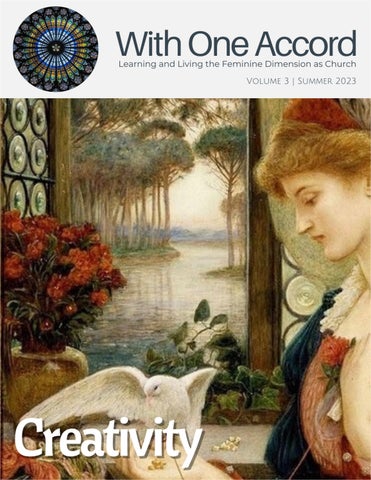
Images used in this edition: Cover: “Love’s Messenger” by Marie Spartali Stillman (1844-1927). Page 5 “Woman Sewing” by August Macke (1887-1914). Page 8 “The Storyteller” by Hugues Merle (1822-1881). Page 10 “Monstrance at the crypt of the Church of San Giustino, Umbria.” (photo by John Dalla Costa).
This edition Copyright © 2023 Saint Basil’s Catholic Parish, Toronto, Canada For editorial enquiries, please contact editor@magdalacolloquy.org ISSN 2563-7924 PUBLISHER Morgan V. Rice CSB. EDITOR Lucinda M. Vardey ASSOCIATE EDITOR Emily VanBerkum CONTRIBUTING EDITOR Gregory Rupik PRODUCTION COORDINATOR Michael Pirri VIDEO EDITOR Michael Pirri CONSULTANT John Dalla Costa TRANSLATORS Elena Buia Rutt (Italian) Véronique Viellerobe (French) ADMINISTRATOR Margaret D’Elia