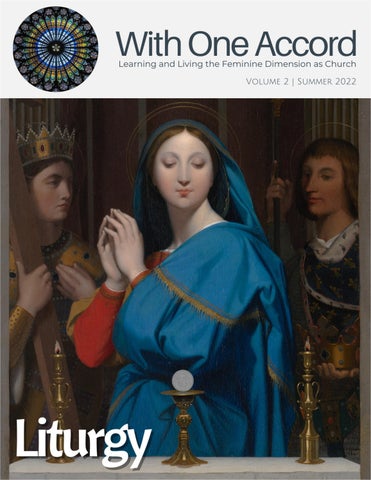
With One Accord
Liturgy Volume Two, Issue 3
Summer 2022
CONTENTS EDITORIAL Lucinda M. Vardey RE-ENCOUNTERING LITURGY The Magdala Interview: Emily VanBerkum with Archbishop Paul-André Durocher ESSENTIAL ELEMENTS OF RITUAL Lucinda M. Vardey and John Dalla Costa ONLINE PASTORAL LITURGY AND MINISTRY Morgan V. Rice CSB UPHOLDING THE WORD IN ART Elena Manganelli O.S.A. THE FARMER’S LITURGY Michael Martin FIRST GESTURE OF COMMUNION Maria Clara Bingemer BOOKS OF INTEREST Leanna Rose Parekh
www.magdalacolloquy.org
1
Editorial English author and artistic theologian, Caryll Houselander, wrote that “The Liturgy expresses every passion, every emotion, every experience of the human heart. It is the song of the whole world.” This idea of song echoes that of German theologian, Romano Guardini, who explained that liturgy’s purpose is not a means to an end, but “an end in itself.” It is the universal Church’s prayer in which the People of God participate in the work of God (Ref: Catechism 1069). In the Magdala interview which leads off this issue, Archbishop Durocher states that the Mass, as the foremost-recognized liturgy, is not a performance but a play for God; one in which the mystery of Christ’s passion, death and resurrection is proclaimed and celebrated so that we may “live from it and bear witnesses to it in the Yet the experience of liturgy need not be world” (Catechism 1068). confined to Church, Mass or the breviary. Liturgy has a broad application in the practice of prayer and devotion. Praying in common “with one accord” in the early Church (Acts 1:14) seems to have established a proto-liturgy of the Word, what is also referred to as Liturgy of the Hours or the Divine Office. Practiced to this day in religious communities, parishes as well as individually, the “Hours” offer a daily discipline with scripture and the psalms, that are often sung. Ethicist John Dalla Costa addresses the need for nonexclusionary language in their recitation. Liturgical art, be it permanent (like Elena Manganelli’s Mary Magdalene ambo at Siena Cathedral) or temporary (like the arrangement of flowers and other preparations required to imbue sacred spaces) require special care and personal attentiveness to the essential components.
2
Fr. Morgan Rice reports on a new form of Liturgy of the Word via Zoom, and philosopher, Michael Martin, takes us through the liturgical calendar of his farm. Brazilian theologian, Maria Clara Bingemer, introduces the paschal mystery brought alive in women’s corporality, and writer, Leanna Rose Parekh, reviews a book on how to realize liturgical potential in the happenings of ordinary, everyday life. Lucinda M. Vardey Editor
Liturgy is living and existing in God’s sight.
www.magdalacolloquy.org
Romano Guardini
(The Spirit of the Liturgy)
Archbishop Paul-André Durocher is presently the Archbishop
of Gatineau in Quebec, Canada. Trained in music, theology, education and canon law, his research has been in reconciling traditional understanding of the functioning of the sacraments with recent advances in philosophies of language. Having pastored in bilingual parishes, he has also held responsibilities in various dioceses in faith education, liturgical formation and youth ministry as well as teaching theology. After receiving a degree in Dogmatic theology from the Gregorian in Rome, he was appointed to the bishopric. Past president of the Canadian Conference of Catholic Bishops, he served on the Doctrinal Commission and the Commission for Liturgy and Sacraments for the French sector. He was appointed the Canadian delegate to the Synod of the Family in 2014 and by Pope Francis to the Pontifical Council for Culture. He has recently completed a mandate as an episcopal delegate to the Canadian Jewish-Catholic dialogue and has been named to the Standing Committee on Responsible Ministry at the Canadian Conference of Catholic Bishops. He continues to compose liturgical music.
Re-Encountering Liturgy Interview with Emily VanBerkum and Archbishop Durocher
Emily VanBerkum is the Dean of Student Residence of Loretto College, affiliated with the University of St. Michael’s College in the University of Toronto. She holds a B.A. (Hons) with a specialist in Christianity and Culture and an M.Div degree from the St. Michael’s College Faculty of Theology in the Toronto School of Theology. She has volunteered widely in campus ministry settings and as a student intern in Ecumenical Chaplaincy. Her scholastic interests include the historical development of the liturgy, theology of ministry, Catholic social teaching, as well as inter-religious dialogue and practice. A past Director of pastoral ministries at St. Basil’s Parish, she is a founding member of the Magdala Conciliary. She also collaborated with her husband, Dr. John Paul Farahat, organist and choirmaster, to compose and perform the introductory theme to the Magdala interviews in the With One Accord journal.
www.magdalacolloquy.org
3
Essential Elements of Ritual Lucinda M. Vardey is the editor of With One Accord. For more on her background please visit our website.
sight of them, the touch of their pervading sweetness, the delicacy of their presence, reflected the delight of the Creator brought in from the fields to give praise and glory to the Risen Christ.
For any ritual to be meaningful, effective and long-lasting, as well as contribute to an experience of transcendence, the physical senses need to be not only awakened but nourished into participation. For this to happen, the preparation required is far longer than the actual ritual itself. So that the sacred space reflects the care given to God’s presence, attention to the details are essential. It is a practice of gift-giving, of doing your best, however invisible, like polishing kneelers, pews and floors, or, more easily recognized, like music rehearsed, played and sung. In the case of the altar itself, the natural fall of a beautiful starched cloth is as vital as the accompaniment of fresh flowers.
Having been responsible for church flowers in many parishes, my last assignment which was the most rewarding and revealing, was in a large downtown parish. A group of us formed what we called “the flower ministry” where some helped with arrangements and others with maintenance and watering throughout the week. For the fresh arrangements, I was assisted each weekend by a parishioner called Rose, who was eager to absorb the wisdom about height, foliage placement and other essential aesthetics for decorating the altar space. Rose was a woman of deep faith, and as we cleaned the vases and prepared the green oasis in the sacristy, we’d talk about God, or share some insights from the saints. After a few weeks, we noticed how the flowers reflected the themes of our conversations, calling us to become more reverent and silent while we worked. Our attitude changed from a commitment to decorating the altar to offering our work as service for the praise and glory of God and love of Jesus. Something happened then; Rose called it the mystical in the mystery as the Spirit guided the placements and the choices. Parishioners noticed a difference as well as us, commenting on how the flowers helped their prayer and devotion. The following poem, written during that time, attempts to put words to the experience.
I learned about arranging church flowers from my mother. She was on a rota with three other women so every fourth Sunday was her turn. As I helped her, she informed me of the details in making a display, about the importance of height, of where to put the foliage, of dried grasses or ivy that would flow down the pillars. She’d place the flowers themselves last, stepping back at each insertion and moving them around until they came naturally together in a symphony of colour, complement and texture. Flowers are the silent music on the altar, and their songs are their fragrances.
AWAKENING
I remember one Easter in New York receiving the shock of the abundant perfume of white lilies that cascaded the multiple columns in St. Patrick’s Cathedral on Fifth Avenue. The
Not my hand but Yours guides the end at start.
4
www.magdalacolloquy.org
Misty images in the mind kind striving brought to life.
Diverse creations come to meeting, single beauty prods the grace.
Blessings spark an Eden light, Heaven lifts the earthly heads.
No thoughts but sight, witnessing a birth.
Not my hand but Yours arranges blooms within the bowl.
Laudate rose and orchids, lilies red, hymns composing in the air.
Stalk skeletons befriend in greeting— water sits in wait.
A flash complete, O breathless awe many fall into the whole.
Not my hand, Lord a maiden turns her eyes, as Love’s imprint taps upon the soul.
Something intangible here and something intangible there and yet clearly one overlays the other and can be used to access the other, not by arbitrary choice and systematic comparison but in symbolic experience that strives upon primitive connections and thus finds a necessary figuration for what is conceptually unutterable. Edith Stein
(Science of the Cross)
www.magdalacolloquy.org
5
John Dalla Costa is an ethicist, theologian and author of five books For more on his background please visit our website. One of the responsibilities we share in prayer is to bring ethical scrutiny to bear on the words we use to enter into dialogue with God. In his book Prayer, twentieth-century Swiss theologian, Hans Urs von Balthasar, noted that understanding and conversation with God “must be on the basis of God’s language.” Part of our ethical concern must therefore be to grapple with this holy yet alien grammar, challenging words that are familiar for being ours to ensure that they are authentically sourced in God, and conforming us to God’s will. A second reason to examine prayer with an ethical conscience is to penetrate the layers of cultural interpretation, or bias, that can all too easily obscure the source code for communion with God. Since the time of St. Augustine, the Church has professed “lex orandi, lex credendi,” confirming that “the law of prayer is the law of belief.” Because doctrine is the daughter of devotion, we must be careful that the words we utter bespeak God’s revelation rather than our preference or presumption. For example, God’s covenant with Abraham was not bestowed singularly. It was with, and through, Sarah. Remember that in the book of Genesis God changed both their names at the same time. And when Abraham tried to redirect the covenant’s promise onto Ismael— the son he’d already fathered with Hagar— God answered: “No, but your wife Sarah shall bear you a son, and you shall name him Isaac. I will establish my covenant with him as an everlasting covenant for his offspring after him” (Genesis 17:15-20). Why is this detail important? At least twice
6
a day in the Liturgy of the Hours, when the Benedictus is prayed at Lauds, and the the Magnificat at Vespers, participants recall the “oath” and “promise” made to Abraham. Although indispensable to God and God’s covenant, Sarah is left out. By omitting Sarah these prayers are therefore directly delimiting, distorting, or redirecting belief. The covenant God generated through a couple is recalled in repeated daily praying as a singular, masculine inheritance.
WORDS MAKE WORLDS In Genesis, God does not create by imagining or crafting, but by speaking forth creation from “a formless void and darkness” (1:2). The evangelist, John, would later echo this motif of linguistic holiness to introduce the incarnation as “the Word made flesh” (1:14). Language is precious for being the basis for communion as well as communication. With words, we hear, and are heard. With words, we gain both potential for understanding and possibilities for meaning. What does it do our imagination as Church, and to our vocation as disciples, to continue to give unwarranted priority to Abraham and fathers and brothers and sons? Can we, with today’s consciousness and conscience, continue to pray out the tired exclusions and sexist language that pervade biblical translations and breviaries? These questions came to the fore in very practical terms when a group of us were preparing to launch the Liturgy of the Hours at our parish. With only one priest on staff, the painful decision was made to terminate the evening mass during weekdays, and the morning mass on Saturdays. Charged with praying Vespers and Lauds to substitute the Eucharist, we turned to the breviary to learn the format and prayers. While struck by much of the poignancy of the psalms
www.magdalacolloquy.org
and intercessions, we were also shocked by how patronizing and sexist was the patriarchal language. Not surprisingly, God was always addressed with masculine pronouns. But disconcertingly, those of us praying, and those for whom we were praying, were subsumed under the genus of “man.” Over a typical three-day span of liturgies, we are to read or chant: “Let the sons of Zion delight in the king.” “To you must all men come, because we are sinners.” “What is the son of man that you should look after him?” “You have made him but one step lower than angels.” “You have put everything beneath his feet.” “Open our eyes and hearts to our brethren today.” Reflecting on this language, author/scholar Phyllis Zagano (who was a member of the initial Papal Commission for the study of the diaconate of women) writes: “It has to stop. It has to stop because the small pinpricks of language collect until the entire conversation dies, and people who may listen no longer hear what is said. It has to stop because the people needing aid, the hungry poor hugging this ailing planet, the migrants and the homeless, the ill and the frail, these all hear one less voice raised on their behalf.” 1 As have many of the women’s religious orders, we decided at our parish to prepare a much more inclusive version of Lauds and Vespers. We did our best to address God as God, and to avoid the language traps that foiled and spoiled Fratelli Tutti before its 2020 ink was dry. Finally, we took the audacious step of elaborating the Benedictus and Magnificat to include Sarah as well as Abraham. We understood that we were treading on scripture, but persisted for two basic reasons. One is that the Church itself often elides psalms and readings in the liturgy to underscore particular teachings. The other is that the syntax for God’s grammar is, in our view, much better served by growing inclusion than by retaining inherited exclusions. Works cited 1 National Catholic Reporter, Oct 29, 2020.
www.magdalacolloquy.org
7
Morgan V. Rice, CSB was born and raised in Corpus Christi, Texas.
He studied mechanical engineering at the University of Virginia and later worked for six years in the engineering field in Houston. It was there that he met the Basilian Fathers at St. Anne Parish and began to discern seriously the priesthood and religious life. He served as Associate Pastor at St. Kateri Tekakwitha Parish in Rochester, New York, for eight years and is presently the Pastor of St. Basil’s Parish Church at the University of St. Michael’s College, Toronto, Canada. Fr. Morgan is completing his second term on the General Council of the Basilian Fathers and is a member of the Council of Priests for the Archdiocese of Toronto. He is also the Publisher of With One Accord.
Online Pastoral Liturgy and Ministry Morgan V. Rice CSB A central teaching/reminder of Holy Week is the paschal mystery. While Jesus’ death and resurrection changed history by introducing the possibility of eternal life for us, the paschal mystery changed the way we go through the various “deaths” we encounter during our earthly lives. We have hope that despite having to face them, we can look forward to newness beyond our imagining. One of the many ways that we have experienced a dying has been through the effects of the Covid pandemic. Though it continues, new opportunities have arisen. During March 2020 in Toronto, public Masses were cancelled and churches completely shuttered due to the quickly spreading Covid virus. Parishes were faced with what to do to serve the spiritual needs of parishioners who were not allowed to gather in-person, or even step inside a church to privately pray. As a result, we, at St. Basil’s Parish, like many other parishes, began to make use of online platforms like Zoom, which, to that point, had not been a regular ministry tool. However, the time had come for Zoom to become a common household term and a way of connecting multiple households in a Covid-safe way. (Throughout this article, the term “Zoom” shall be used to represent the assortment of online platforms). Many parishes began offering online what we Catholics value so much—a live-streamed or Zoom Mass. Because so many options for Mass on TV or online were available, we pondered whether there was something new and exciting that St. Basil’s might offer through the wonders of Zoom and the inspiration of the Holy Spirit. This gave birth to The Gathering, which I consider an example of something truly life-giving that arose from the pandemic. In many ways, The Gathering was nothing new; it was a Liturgy of the Word. What made it different was how it was being offered. Since the pandemic restrictions were causing many people to be isolated, we sought to offer something that would not only nourish the faith of parishioners but also create a sense of community. With Zoom, participants could choose to turn on their cameras during the liturgy and be seen (without masks!) or leave them turned off as they joined together in prayer. Week after week, many of the same people came, and an online community did indeed begin to form. People who would not have known each other because they went to different Masses or lived away from the parish, came to know and trust each other.
8
www.magdalacolloquy.org
Another very important aspect of The Gathering was that it provided the format for multiple voices to be heard. At a Sunday Mass, only a clergy member regularly shares a homily based on the scripture texts. At The Gathering, we also heard from women and men, lay and religious, each of whom offered a reflection on the Sunday Gospel. They brought their life experiences and perspectives, their theological training, and different gifts and shared them with those attending. Beautiful, profound, touching, challenging, enriching, and thought provoking are just some of the ways I would describe those reflections.
THE PARISH EXTENDED After The Gathering, people could stick around for the “coffee hour.” The coffee hour became a space for hearing even more voices through faith sharing and processing what had been shared during the reflection. Some people felt comfortable sharing verbally or in the chat function, while others simply listened. Eventually, we added one more piece to this community gathering by offering the celebration of the Eucharist on Zoom after the coffee hour. When the churches began to open more fully and the virus seemed to be diminishing in the summer of 2021, we discontinued The Gathering though the Mass on Zoom continued. While we recognized that an online platform, like Zoom, was not a replacement for in-person gatherings, surprisingly it has allowed for some very meaningful experiences. It achieved the goal of forming community when people either could not or did not feel safe to gather. Zoom found its way into other areas of parish ministry including how we offered children’s ministry, baptism preparation, marriage preparation, and the Rite of Christian Initiation of Adults (RCIA). It has made the church more accessible to those whose commitments and life situations might have prevented greater church involvement and engagement. It was encouraging to hear that people who were interested in becoming Catholic were finally exploring that desire, because they were able to join the RCIA from their homes via Zoom. As Covid restrictions continue to be lifted and people, once again, feel comfortable returning to in-person worship and participation in the parish, how will our experiences of the last two or so years influence the possibilities of future ministry? One possibility is related to the Synod on Synodality, which aims at creating spaces and structures for the Church to listen to people’s hopes, desires, hurts, and joys. The Gathering and other ministries that utilized Zoom have demonstrated that people desire to share their experiences, particularly those of faith within a safe space, and this includes online spaces. If we want to reach people who are hesitant to step foot in a church, for whatever reason, Zoom provides that connection to some of what the church can offer including an experience of Christ. Even if churches return to their pre-Covid ways, I expect that Zoom will continue to provide a vital place in the life of the community and its efforts of evangelization.The pandemic has taught us that we really need both forms of connection with people. The challenge will be to find a balance between online ministry and the irreplaceable in-person encountering of one another face-to-face in the pews or around the table with a cup of coffee and a doughnut. Both will enhance and renew the Church and allow people the spaces to listen to one another, and share their experiences and gifts.
www.magdalacolloquy.org
9
The paschal mystery of death and resurrection certainly has been at play during the Covid pandemic and will continue to manifest itself. Shall we see only the death, or shall we also see the life that is arising from it? The Holy Spirit is our guide in using our gifts and the tools in which to share them. Perhaps ones like Zoom and others that might still manifest themselves, will allow for the budding and blossoming of new and exciting life-giving opportunities that God is giving birth to in our midst.
Elena Manganelli O.S.A. is a sculptress and Augustinian nun from
the Monastery of S. Antonio da Padova (Pennabilli, Rimini, Italy). Born in Siena, she studied at the Academy of Fine Arts in Florence and with the Sienese sculpture Alberto Inglesi. She participated in many exhibitions and competitions with some of her works in Siena, Vienna, New York and Rome. In 2011 she created the panels for the Stations of the Cross presided over by Pope Benedict XVI. In 2016 she completed the bronze ambo of Magdalene at the Sepulchre for Siena’s Cathedral. Her most recent works are the high altar of SS Annunziata in Siena and a series of stained-glass windows in Marian themes for the Sanctuary of Poggetto, Ferrara. She is currently continuing theological studies at the Theological Faculty of Northern Italy in Milan.
Upholding the Word in Art Elena Manganelli O.S.A. Mary Magdalene’s body knew the divine touch, she had received the promise, but after Jesus’ death, that Word now had died in her. Just as it had for Jesus on the cross. However, the promise is kept, contained within the Word, as an indomitable seed. Magdalene remains at the tomb, just as her hand remains on her belly, believing against all hope, that the only possible life for her must be there, in her womb as in the body of her beloved. She feels the tomb inside of her as an absence, a void, an abysmal loss, yet something unheard of is promised there. The death of the Word is not a death of the promise. It is kept by the Father.
10
www.magdalacolloquy.org
The dark and sucking abyss beside her (in the body of the angel/father) is depicted as an empty cornucopia. The cornucopia, being one of the symbols for Christ, represents the container for creation’s abundant fruits. The Father cannot bear the absence caused by the Son’s death, which is the death of God in God. The abyss within this cornucopia constitutes the beyond, the mystery. It is as if on reaching the depths of human pain and separation, we need to cross death to God, a fertile death in fact because it is to be founded on faith and trust. In order to welcome not only God’s resurrection, but the resurrection of one’s own flesh, of one’s own life, this abyss is necessary to bridge. As the very promise of God that seems definitely lost when the Word given by God for us to live is seen to die, a new abyss opens wide. God gives life back to Jesus, and Jesus announces it and gives it back to Magdalene in the garden outside the tomb
www.magdalacolloquy.org
11
Michael Martin is a writer, philosopher, poet, musician, songwriter,
editor, director of the Center for Sophiological Studies and a biodynamic farmer in Michigan. He spent sixteen years as a Waldorf teacher and Master Teacher, and taught English, Philosophy, and Theology at the university and college level for over seventeen years. He began farming in 1990 and currently raises dairy cows, bees, and other animals while managing a market garden with his wife and some of his nine children. His poetry and scholarship have appeared in many journals. He is the editor of Jesus the Imagination: A Journal of Spiritual Revolution and author of many books including The Submerged Reality: Sophiology and the Turn to a Poetic Metaphysics (Angelico Press, 2015), Transfiguration: Notes Toward a Radical Catholic Reimagination of Everything (Angelico Press 2018), and Sophia in Exile (Angelico Press 2021). His website is www.thecenterforsophiologicalstudies.com.
The Farmer’s Liturgy Michael Martin I was probably about twenty-six when I first read Teilhard de Chardin’s “The Mass on the World,” a work of imaginative prose that profoundly moved me. In the essay Teilhard, a priest without eucharistic elements while on the steppes of Asia, as recourse, decides to enter the liminality of the Creation and participate in the oblation that is always already happening. He writes: “Since once again, Lord...I have neither bread, nor wine, nor altar. I will raise myself beyond these symbols, up to the pure majesty of the real itself; I, your priest, will make the whole earth my altar and on it I will offer you all the labours and sufferings of the world.”1 I read these words now, after more than thirty years, with a deeper understanding of both “the real itself” and the attendant “labours and sufferings.” Teilhard’s is a profoundly sophiological sensibility. I often get the impression that people think I live a very romantic existence, a pastoral life enclosed just this side of Elysium. That is not at all what it is like. Of course, there are moments— many moments, in fact—when sophianic splendour shines through the world to reveal the unfallen aspect of Creation, when the transcendent becomes immanent, when the light of the first day shimmers through the light of the fourth. But there are also days of labour and suffering: days when I mourn the death of a colony of bees, or deal with flooding in my lower garden or doctor a sick animal, or when I grow frustrated as our crops are afflicted by late or early frosts or the ravages of deer. It’s not an easy job. Farming, if anything, places us in touch with the precariousness and preciousness of life. Recently, I wrote a prose poem that treats this subject. Here is a passage: Five springs ago, the goat mother was too tired to deliver the second of her twins, so I reached into her womb and took hold of a hoof and drew the little buckling to life. Three years later, I slaughtered him in the same barn, turned his flesh into ground and cutlets, fed the offal to the pigs. The life never vanished, but moved through...through what? Through life. Most people outsource their complicity in the drama of sustenance, but the farmer accepts his place in this liturgical dance: the live buckling and the dead wether were the same goat: the midwife and the butcher, the same farmer.
12
www.magdalacolloquy.org
A farmer, like priest or physician, is someone who trades in both life and death as well as in the fragility that fills the space between the two, “the fragility that necessitates and therefore guarantees God’s unwavering attention.”2 This fragility, in its mindfulness of God, is, for me at least, nothing other than a participation in the mysterion, an unmistakable liturgical act. In the northern hemisphere (where I live), the liturgical cycle of the farm beautifully mirrors the liturgical cycle of the Church year. After the relative quiet that follows Christmas, when Christ is born and the sun is renewed, the farm seems to slumber: the cows and she-goats, growing large with their young, are not milked in the last months of their pregnancies, and there are very few eggs to collect: it is a season of fasting. But then nature shows sure signs of awakening following Candlemas—the hens, unproductive since December, begin to lay in earnest and the queen bee in the darkness of the hive also resumes depositing her eggs. Kidding, lambing, and calving seasons, echoing the Feast of the Annunciation and its promise of divine fertility, begin in anticipation of Easter and continue through Pentecost. Near St. John’s Day, the garden plants and field crops reach their zeniths and afterwards fall into a kind of chaos of growth. At Lammas through the Feast of the Assumption, the feasts of the grain and flowers remind us of preservation, the Eucharist, and Mary’s enthronement as Queen of both heaven and the harvest. In September, with Marymas and Michaelmas, we move toward our final harvests, which will be complete just before All Soul’s Day. Then the farm appears as almost bereft of life, and we again enter the season of the meditation upon death, when the task is to preserve the lives of our remaining livestock and plan for the next growing season. Memento mori, but remember that thou shalt live hereafter. But the most sacramental aspect of farming—and therefore the most liturgical—is that the farmer participates in a very real way in the continued death and resurrection of Christ. The liturgical life of the Church is centred on the Eucharist; the liturgical life of the farm is no different. Not every farmer knows this, of course. For this insight I draw on both the Austrian philosopher and mystic, Rudolf Steiner, who thought that the salvation wrought through Christ’s death and resurrection was not only on behalf of humanity but for the Creation as well, and the Eastern Orthodox priest and theologian, Sergei Bulgakov, who argued along similar lines. For Bulgakov, “Through the precious streams of Christ’s blood and water that flowed out of His side, all creation was sanctified.”3 Bulgakov concludes that the earth is therefore the Holy Grail: the vessel that received the Precious Blood and Water. This imagination informs all of my work in farming, and, indeed, in life.
www.magdalacolloquy.org
13
Finally, as I often tell people, biodynamic farming is the resurrection business. It is—or should be—an intimate involvement in the cycle of death and resurrection that the Paschal cycle illustrates. The farmer, therefore, has an obligation to regenerate the soil and all that lives by it, as Christ regenerated and regenerates all life. Of course, farming that relies on toxic pesticides or other synthetic monstra, that promote the illusion of health and growth (but which are neither) and relies upon genetically-modifying our agricultural posterity, could only ever amount to blasphemy. How could anyone do that to the Holy Blood and Water? I certainly can’t. To enter this consciousness regarding the farm is to once again enter into the pure mystery of the Real itself, into the vast sophianicity of the cosmos: For both we and our words are in his hand, as are all understanding and skill in crafts. For it is he who gave me unerring knowledge of what exists, to know the structure of the world and the activity of the elements; the beginning and end and middle of times, the alternations of the solstices and the changes of the seasons, the cycles of the year and the constellations of the stars, the natures of animals and the tempers of wild beasts, the powers of spirits and the thoughts of human beings, the varieties of plants and the virtues of roots; I learned both what is secret and what is manifest, for Wisdom, the fashioner of all things, taught me (Wis 7: 16-22). Works cited 1 Pierre Teilhard de Chardin, Hymn of the Universe (Harper & Row, 1965), 19. 2 Ellen F. Davis, Scripture, Culture, and Agriculture (Cambridge University Press, 2009), 27. 3 Sergius Bulgakov, The Holy Grail and the Eucharist, trans. Boris Jakim (Lindisfarne Books, 1997), 33.
14
www.magdalacolloquy.org
Maria Clara Bingemer has, for almost forty years, served as professor
of Fundamental Theology and the Theology of God at the Pontifical Catholic University of Rio de Janeiro, Brazil. She also served as Dean of the Faculty of Theology and Human Sciences. After participating in the construction of the Jesuit Centro Loyola de Fé e Cultura (The Loyola Center for Faith and Culture) at PUC Rio, she became its Chair. Coeditor of the Revista Eclesiástica Brasileira (REB), the most important theological magazine in Brazil, she also serves on the editorial board of the international journal of theology, Concilium. From 2004 to 2008 she was co-editor of the Journal of the American Academy of Religion (JAAR). One of the founders of feminist liberation theology in Latin America, she was awarded the Brazilian Fulbright Distinguished Chair in Democracy and Human Development at the Kellogg Institute for International Studies at the University of Notre Dame, U.S.A. She is presently President of ALALITE (Latin American Association of Literature and Theology) and Vice President of SOTER (The Theology Society of Brazil). Her books on Trinitarian and Latin American Theologies have been published in many languages and her book on Simone Weil explores her compassion and mysticism.
First Gesture of Communion Maria Clara Bingemer The recent emergence of women in the public and ecclesial sectors, has given voice to new ways of living, and reflecting on, the experience of God. Women’s experiences are inseparable from their bodies. They present and make visible their own corporeality when they speak about the mystery of God, and introduce a novelty into the understanding of spiritual life and the action of the Spirit of God in the world. In addition, that same mystery of God, as it affects and configures the created sexual corporeity of women, reveals other aspects of identity which enrich the People of God. For instance, women are able to evoke and communicate spiritual experiences that are often more difficult for men. As an example, we refer to being Christ’s spouse, of living the spiritual marriage. And, even more fundamentally, we speak of being impregnated by the Spirit of God, giving a
new body to the Word made flesh, therefore mediating the mystery of Incarnation in the world. Many men in Christianity’s history have also lived these kind of experiences in a deep and beautiful way. They are frequently those who have liberated their feminine dimension, their “anima” in their relationship with God. Many of these mystics and spiritual directors have used a variety of linguistic terms in referring to experiences offered by God to every human being, such as loving partner or “the soul.” But these descriptions are contemplated and felt more tangibly within the female body.
REAL PRESENCE There is one dimension of Christian life in which women emerge as privileged subjects, and that is the identification of their corporeality with the sacrament of the Eucharist. It is as a specific expression of
www.magdalacolloquy.org
15
“transubstantiation,” real presence and communion, the body and blood of Jesus, under the species of bread and wine, given to the people as food and drink. To feed others with one’s own body is the supreme way God chose to be definitively present in the midst of God’s people. The bread we break and share, which we confess to be the body of Jesus Christ, brings us into the great mystery of his Incarnation, Death and Resurrection. It is his person given as food; it is his corporeal life made the source of life for all Christians. Women, by their very nature, have, within their corporeality the physical possibility of understanding such Eucharistic divine action. During the whole process of gestation, parturition, protection and nourishment of new life, the sacrament of Eucharist, the divine act par excellence, occurs again and again. The whole drama of salvation, present in Jesus’ words and gestures; “Take and eat: This is my body….this is my blood…for you,” (Matthew 26:26) is present and acting in women’s bodies. The female body also immeasurably gives and grows in others’ lives. It gives itself as food and nourishes with its flesh and blood, the lives it has conceived. It is the same body that wastes away and dies while tilling the earth, working in factories and homes, stirring pots and sweeping floors, spinning thread and washing clothes, organizing meetings, teaching, ministering and leading struggles. A woman’s body as Eucharist, given up for the lives of others, and physically distributed, eaten and drunk by those men and women of tomorrow who will continue the same struggle of patience and resistance, pain and courage, joy and pleasure, life and death. Breaking the bread and distributing it, having communion in the body and blood of Jesus until he comes again, means that women today, even and especially those living in the poorest and most negative situations, will reproduce and symbolically enact in the midst of society and the believing community, this divine act of surrender and love. This very act enables others to grow into the fullness of life to come, to celebrate in the feast of true and final liberation. Besides bearing the seal of God’s image, women in the world can be the real “Christic presence.” They can make visible in an anthropological and unique way, the sacrament of love that gives life “for many,” for all. Such an Eucharistic mode of existence reverberates not only on a personal level— by increasing private devotion or stimulating Eucharistic piety or mysticism—but can have deep, serious and abiding social, political and collective connotations. If women suspend their strong and intimate covenant with life, what kind of future can humankind expect? If women cease to bring to public spaces their intimate pains, sorrows and joys, how can the world learn to live, cry and rejoice?
16
www.magdalacolloquy.org
Books of Interest Leanna Rose Parekh I stumbled upon the book Liturgy of the Ordinary by Tish Harrison Warren when I was very pregnant. Scrolling Instagram, a friend—also expecting her second baby—sent a message recommending it. This unprompted sharing felt like the Spirit’s familiar nudge. The subtitle alone—Sacred practices in everyday life—seemed an answer to a wordless prayer. I ordered the book that same day. Before long, I was reading it while stroking my growing belly. Within the week, my daughter was born. I roared her into the world with all the power of mothers before me. As if learning a sacred battlecry, she roared with me. Pregnancy and childbirth carries uncertainty, excitement, agony, euphoria and all nuances in between. But a little known phenomenon of the postpartum “4th trimester” is crippling boredom. Repeating the same basic necessities over and over again—nights hardly different from the days—caring for a tiny, dependent human you’ve just met, makes any grounded person feel a little undone. Hormonal, sleepdeprived and in the shadows of a newborn, young mothers often feel unimportant, invisible to God and out of sync with meaningful prayer. Harrison Warren seeks to rewrite this narrative. Her chapter headings mimic the natural rhythm of an ordinary day, beginning with waking in the morning and ending with falling asleep at night. In between, we have perfectly ordinary tasks like brushing teeth, checking email, sitting in traffic and eating leftovers. Pedestrian, no? Contraire. For each of these chapters covers a hidden form of worship, like the importance of authentic community (her chapter titled “Calling a Friend”), holy habits and prayerful rituals (“Making the Bed”) and, my personal favourite, laying down your pride (“Fighting with my Husband”). I found pockets of time to read throughout my days, between changing diapers, putting bandaids on scrapes, toilet learning and rocking to sleep. Sometimes a page or two felt like a feat worthy of a medal. But those snippets were enough to make me nod, weep or ponder my own daily rhythms. It helped put words to the things I allowed to be my incarnate prayer, my primal reality. The author’s poetic yet down-to-earth prose were just the vibe I needed. It’s written in a way that allows you to get on with your day, but with new influences. One of the many examples of parallels between ordinary and extraordinary was in her chapter on losing her keys. She describes, to alarming accuracy, the six stages of helplessness from logic, “they must be here” to last-ditch, “St. Anthony, I need you.” It reminded me of a popular tweet by Aubrey Bell, “ever spill a little bit of coffee and realize the thread you are hanging on by is actually quite thin?” It’s been re-tweeted over 24,000 times by exhausted mothers everywhere. How quickly I doubt God’s providence for me when something small goes against my expectations. I tend to, like the author, let my reality be shaken. Motherhood
www.magdalacolloquy.org
17
is not for the faint of heart, yet keeping our hearts soft is how we raise authentic, resilient children. From her chapter on drinking tea, she writes, “In my daily life I find moments of sanctuary, moments when wonder scoots up next to me with a nudge.” Cue my almost three-year-old son cuddling up to me in a rare moment when his baby sister naps and it’s just the two of us. “This quiet moment with a cup of tea is a moment of sanctuary in every sense - a haven of beauty and a place of worship.” I ease into his wriggly, warm body and ask forgiveness for snapping at him earlier; something I do often these days. “The steam warms my face like incense.” Grace floods my body, easing the tension I seem to live in, reminding me how truly blessed I am to live this beautiful, ordinary life.
Liturgy of the Ordinary: Sacred Practices in Everyday Life by Tish Harrison Warren Available in kindle, hardcover, paperback and audio 170 pages Published November 2016 by InterVarsity Press, Downers Grove, IL 2016
18
www.magdalacolloquy.org
With One Accord O God, our Creator, You, who made us in Your image, give us the grace of inclusion in the heart of Your Church. R: With one accord, we pray. Jesus, our Saviour, You, who received the love of women and men, heal what divides us, and bless what unites us. R: With one accord, we pray. Holy Spirit, our Comforter, You, who guides this work, provide for us as we hold in hope Your will for the good of all. R: With one accord, we pray. Mary, mother of God, pray for us. St. Joseph, stay close to us. Divine Wisdom, enlighten us. R: With one accord, we pray. Amen. www.magdalacolloquy.org
19
We welcome your comments and reactions and will consider sharing them in future editions or on our website. Please send to editor@magdalacolloquy.org
If you haven’t already subscribed, you can do so at any time at no cost due to the generous support of the Basilian Fathers of the Congregation of St. Basil. Just visit our website www.magdalacolloquy.org where you can also read past issues of the journal and be informed of our ongoing activities and news items. With One Accord journal is published in English, Italian and French. To access the other language editions please visit our website.
With One Accord signature music for the Magdala interview composed by Dr. John Paul Farahat and performed by Emily VanBerkum and John Paul Farahat.
Images used in this edition: Cover: “The Virgin Adoring the Host” by Jean-Auguste-Dominique Ingres (1852). Page 5,7 “Flowers at tabernacle” St. Anne’s Church, Ancaster, Ontario, Canada. “Ambo and icon” Eremo di Montecasale, Sansepolcro, Italy. Photos by John Dalla Costa. Page 10-11 “Mary Magdalene at the Sepulchre” by Elena Manganelli O.S.A. Siena Cathedral. Photo John Dalla Costa. Page 13-14 Farm photos by Michael Martin. Page 16 Detail from “Charity”(1878) by Willam-Adolphe Bouguereau.
20
www.magdalacolloquy.org
This edition Copyright © 2022 Saint Basil’s Catholic Parish, Toronto, Canada For editorial enquiries, please contact editor@magdalacolloquy.org ISSN 2563-7924 PUBLISHER Morgan V. Rice, CSB EDITOR Lucinda M. Vardey ASSOCIATE EDITOR Emily VanBerkum CONTRIBUTING EDITOR Gregory Rupik PRODUCTION COORDINATOR Michael Pirri VIDEO EDITOR Eric Patrick Hong CONSULTANT John Dalla Costa TRANSLATORS Diana Isacchi (Italian) Patricia O’Grady (French) ADMINISTRATOR Margaret D’Elia
www.magdalacolloquy.org
21